An efficient recurrent neural network based confusion component construction and its application in protection of saliency in digital information
-
Lal Said
 und
Muhammad Amin
und
Muhammad Amin

Abstract
The explosive growth of Internet of Things (IoT)-driven imaging in medicine, city surveillance, and intelligent infrastructure requires secure, timely transportation of delicate visual information with salient information, like faces and diagnostically important medical areas. Standard block ciphers, including AES, are unable to consistently retain these attributes under burst errors, partial data corruption, or focused cropping. In this paper, we introduce a lightweight substitution–permutation network (SPN) oriented encryption paradigm purpose-built for salient information secrecy in resource-limited IoT applications. We integrate permutation-driven block shuffle by chaos, recurrent neural network (RNN)-guided nonlinear static S-box generation, and bit-parity scrambling at the bit level to improve confusion–diffusion properties. We demonstrate experimental results of NPCR > 99.60 %, UACI > 33.40 %, near-zero correlation, and satisfactory key sensitivity. The technique maintains integrity of the salient region even with 50 % pixel loss, with throughput acceptable for real-time applications. Compared with previous work on lightweight approaches, we provide improved salient feature retention and lower computational complexity, and thus an ideal solution to security-critical applications of IoT-driven imaging.
1 Introduction
Recent computing technological advancements have transformed the generation, processing, and transmission of information, reforming the very essence of our connected globe. The spread of the Internet of Things (IoTs) and massive IoT systems has brought into being huge networks of billions of devices, interchanging voluminous data in real-time to drive automation, industrial intelligence, and smart infrastructures. Blockchain technology has brought into being decentralized, tamper-proof ledgers, permitting secure and transparent digital transactions. Quantum computing approaches a tipping point where problems are solved by quantum computers but are unsolvable by classical devices, but such power itself holds a huge threat to conventional cryptographic mechanisms. Artificial intelligence (AI)-powered intelligent computing, with deep learning and neural networks, optimizes at hitherto unimaginable scales the decision-making and predictive analytics. In the age of global village of internet linking at ultra-high data rates, data flows unimpeded across borders, promoting worldwide collaboration and innovation. But such hyper-connectivity exacerbates exposure to data breaches, privacy intrusion, and cyberattacks. Cryptography does not appear as an optional solution but as the foundation of digital trust mathematical armor preserving confidentiality, integrity, and authentication of the source of every transmitted bit. Cryptography absence renders immutability useless in blockchain, IoTs become exploitable surveillance tools, AI models can be poisoned, and quantum breakthroughs could unravel the very ciphers protecting our most sensitive data. In this period, information security is at data gathering, transmission, storage, and even during handling transcends as more than a technical necessity but as the cornerstone of future safe, resilient, and trustworthy digital system bases. In the last few years, number of lightweight encryption schemes has been developed by researchers in the field of cryptography [1]. The motivation of all researchers is to design between low latency, high throughput and reduced computation [2]. In most cases security is compromised at the cost of lightweight. The work presented in ref. [3] proposes a privacy-preserving learning mechanism (PPLM) coupled with an industrial IoT system for the detection of bearing failures using lightweight edge-based model aggregation and a 2 dimensional Convolutional Neural Network. The scheme ensures privacy but the use of Cryptonet, introduces processing delays when implemented real-time and the scheme does not discuss saliency protection. The work presented in ref. [4] presents a lightweight encryption scheme for IoT devices that utilize quantum encryption; chaotic maps, confusion-diffusion operations, and discrete wavelet transform (DWT). The scheme possesses resistance against statistical differential attacks and brute force attacks. However, converting between quantum and classical domains introduce computational overhead, lack of saliency protection and real-world deployment on constrained IoT hardware remains invalidated. The work presented in ref. [5], evaluates the S-boxes before implementing in the lightweight encryption scheme, using a machine learning-based model. The machine learning model utilizes the key cryptographic properties and selects best S-boxes from a pool of generated S-boxes to be utilized in the encryption scheme. This approach enhances security at the cost of computational overhead and latency. To secure IoT communications, the work presented in ref. [6] introduces a lightweight encryption scheme. The scheme utilizes DNA sequences to generate keys and ECC to form a private key for encryption and decryption. The encryption scheme possesses strong immunity to differential, statistical and brute force attacks. The work lacks discussion on the scalability and saliency protection in real world images. To balance the processing efficiency and security in a constraint environment, a lightweight encryption scheme is proposed in ref. [7]. The scheme follows SPN architecture, and it is evaluated across various metrics and shows improvements in both encryption speed and security performance. However, the paper lacks technical specifics about the cryptographic primitives used, and potential limitations under adversarial conditions, lack of saliency protection or large-scale deployment are not explored. A lightweight image encryption scheme that is designed for IoT based environment is presented in ref. [8]. The encryption scheme utilizes chaotic mapping, password-based fuzzy shifts, and logical XOR with shift registers to enhance key complexity. The scheme is implemented on MATLAB and AVR microcontroller. The scheme shows strong immunity to various cryptographic attacks. However, its reliance on fuzzy logic and specific hardware modeling limit generalizability and real-time adaptability across diverse IoT platforms. The work presented in ref. [9] a multiple-image encryption scheme utilizing spatial multiplexing, encryption is achieved via Fresnel diffraction and Fibonacci Lucas transform, creating a rich key space for improved security. While offering strong theoretical and experimental validation, the system’s optical complexity and hardware dependency may limit scalability and integration into typical IoT or low-resource environments. The work presented in ref. [10] proposes a new image encryption scheme based on a one-dimensional piece-wise quadratic polynomial chaotic map (PWQPCM), offering enhanced chaotic behavior. It utilizes pixel segmentation, substitution, and diffusion for secure encryption with low time cost. While the scheme shows promising results in simulations, its performance under hardware constraints and resistance to advanced cryptanalysis require further exploration for practical deployment. The use of deep learning algorithms has also gained significant attention from the researchers in the field of cryptography. Due to the ability to learn complex patterns and optimized performance of neural networks, are being widely utilized in the generation of nonlinear mapping S-boxes and random sequences for cryptography. By adjusting the parameters in training, deep learning frameworks have been utilized to increase the nonlinearity and avalanche effects of S-boxes. The work presented in ref. [11], has presented a novel algorithm that utilizes a Generative Adversarial Network (GAN) to create cryptographic keys with high entropy, enhancing resistance to brute force attacks. To secure wireless sensor networks (WSN) in vehicular networks, the work presented [12], introduces a deep learning-based intrusion detection and prevention system. In this mechanism, to analyze the data from the WSN-DS dataset, CNN is utilized. The proposed approach addresses security challenges in WSNs and demonstrates significant improvements over existing methods. The study presented in ref. [13] introduces a deep-learning-based framework, DeepEDN that can be utilized for secure medical image encryption. Using a Cycle-GAN network, medical images are transformed between original and encryption and restored via a reconstruction network for decryption. The schemes discussed in this section do not protect salient information under data loss or cropping attack. This study fills the research gap by introducing lightweight encryption scheme that safeguards image saliency within an SPN structure, balancing security with high throughput. In this SPN architecture, the substitution is done through pre-computed S-boxes that are generated by utilizing chaotic maps and RNNs. The S-box generation approach employs the Logistic Chaotic Map to generate a sequence that serves as input to an RNN, which undergoes iterative training to t optimized S-box values. These values are designed to meet critical cryptographic criteria, including Nonlinearity (NL), Strict Avalanche Criterion (SAC), Bit Independence Criterion (BIC), and Linear Approximation Probability (LAP), ensuring robust security properties. The encryption framework incorporates block and bit-level permutations to effectively distribute salient image features, while multiple rounds of S-box substitutions ensure confusion. This layered approach significantly amplifies protection for critical information while maintaining a lightweight architecture, Important for resource-constrained IoT devices.
1.1 Research objective
This research addresses the protection of saliency in images within an IoT framework. By developing an advanced, lightweight encryption scheme, we aim to overcome the limitations of traditional block ciphers in high-security IoT applications [14], [15], [16], [17], [18], [19], [20], [21], [22], [23], [24], [25], [26], [27], [28], [29], [30], [31], [32], [33], [34], [35], [36], [37], [38], [39], [40]. The primary contributions of this work are as follows (see Figure 1):
To protect saliency in RGB images, we introduce a lightweight encryption scheme that safeguards image saliency within an SPN structure, balancing security and computational complexity with high throughput.
For the SPN encryption scheme we proposed chaos and RNN based highly nonlinear S-box generation method achieving robust cryptographic properties.
To disperse the salient information in the encrypted image a block shuffling algorithm is implemented.

Research objectives of proposed study.
1.2 Organization of the paper
The paper is organized as follows: Section 2 added the problem formulation by highlighting the strengths and gap analysis for the proposed investigation. Section 3 provides a detailed setup of the experimental environment and the specifications of the dataset utilized in the security analysis of the proposed saliency-preserving lightweight encryption scheme. The proposed encryption scheme follows SPN architecture; for the Substitution, S-boxes are pre-generated using RNN. Section 4 is devoted to the discussion on the generation of these S-boxes. To check the cryptographic strength and feasibility of the generated S-boxes in the proposed scheme, the analysis of the proposed S-boxes is carried out and listed in Section 5 of the paper. Section 6 is devoted to the discussion on the proposed encryption scheme, and Section 7 carries out the analysis of the proposed encryption scheme. Finally, the conclusion is drawn in Section 8 of the article.
2 Problem formulation
The rapid advancement of Internet of Things (IoT) technologies has transformed the acquisition, processing, and exploitation of real-time imaging data in applications such as smart infrastructure and public safety, surveillance, intrusion detection, driverless vehicles, medicine diagnostics, and robots. In these applications, the imagery acquired has salient components faces, license plates, signs of disease, or other objects of significance in assisting humans and computer vision systems to make decisions. These salient components must be preserved because of corruption or loss of them during transmission and decryption might render the data useless for operations purposes. Traditional block ciphers, like advanced encryption standard (AES) is applied to fixed-size data blocks of substitution–permutation rounds tailored for generic secrecy with no built-in capability to privilege or protect prominent visual information. As such, in practical transmission applications with burst errors, partial data corruption, or deliberate cropping, traditional cryptographic methods tend to lead to permanent distortion of important areas (see Figure 2). This deficiency undermines the integrity and usability of security sensitive and mission-critical IoT-enabled imaging applications.

Cropped AES-encrypted images from the center region and their corresponding decrypted cat images for different crop sizes: (a) original image, (b) AES encrypted image, (c) cropped image, (d) recovered image, (e) original image, (f) AES encrypted image, (g) cropped image, (h) recovered image.
The importance of the problem inability of traditional encryption mechanisms to preserve salient regions offers a direct threat to operational decision-making under high-stakes scenarios such as identifying suspects in video surveillance, identifying abnormalities in radiological images, or detecting perils in driverless navigation. Under scenarios where each pixel of critical information has the potential to make or break safety, security, or life-saving responses, loss of these features undermines the very purpose of the imaging system itself. Bridging this gap requires creating a fast, salient-information-preservation-oriented encryption scheme where secure confidentiality is ensured and, simultaneously, ensures these decision-critical regions are saved and readable even under uncooperative transmission scenarios.
3 Experimental setup
The image encryption scheme was implemented using MATLAB 2017b on a personal computer featuring an Intel(R) Core(TM) i7-7700 CPU, operating at 3.60 GHz, with 8GB of RAM and running on the Windows 10 platform. The effectiveness of the scheme was assessed using a dataset comprising ten RGB images as shown in Figure 3. The dataset comprises a diverse collection of images varying in content, resolution, and file size, making it well-suited for evaluating image encryption schemes. It includes standard benchmark images like Barbara, Peppers, and Baboon, as well as high-resolution real-world scenes such as Riverfront Walkway and Outdoor Gathering. Resolutions range from 512 × 512 to 1,916 × 1,078, and file sizes vary from approximately 110–800 KB, as shown in Table 1. This mix of synthetic and natural images, with varying textures and complexities, ensures a comprehensive assessment of the encryption algorithm’s performance across different visual scenarios. We have used standard test images data set [14] and VisDrone2019-DET datasets [15] and are commonly utilized in image processing literature, making comparisons possible with another research.

Image dataset used for performance evaluation. The dataset includes twelve color images of varying resolutions and sizes, representing both natural and synthetic scenes. (a) Watch, (b) Barbara, (c) Peppers, (d) airplane, (e) girl, (f) monarch, (g) Baboon, (h) cat, (i) aerial parking view, (j) outdoor sports court, (k) lakeside pathway, (l) urban street view, (m) glass bridge walkway, (n) riverfront walkway, (o) waterpark crowd, (p) outdoor gathering.
Specifications of images used for the evaluation of proposed encryption scheme.
| Image | Dimension | Size | Bit depth |
|---|---|---|---|
| Watch | 1,024 × 768 | 700 | 24 |
| Barbara | 787 × 576 | 650 | 24 |
| Peppers | 512 × 512 | 550 | 24 |
| Airplane | 512 × 512 | 450 | 24 |
| Girl | 768 × 512 | 610 | 24 |
| Monarch | 768 × 512 | 600 | 24 |
| Baboon | 512 × 512 | 620 | 24 |
| Cat | 490 × 733 | 650 | 24 |
| Aerial parking view | 960 × 540 | 110 | 24 |
| Riverfront walkway | 1,916 × 1,078 | 380 | 24 |
| Waterpark crowd | 1,389 × 1,042 | 234 | 24 |
| Outdoor gathering | 1,400 × 1,050 | 225 | 24 |
4 S-box generation methodology
The encryption scheme immunity to differential and linear cryptanalysis depends heavily on the S-boxes. In this section, we present a novel S-box generation technique using RNNs and chaotic maps. The proposed method utilizes RNN architecture with a Long Short-Term Memory (LSTM) layer. The LSTM layer contains 100 hidden units. This is followed by a fully connected layer of size 256 (matching the number of 8-bit S-box values), a softmax layer for class probability distribution, and a classification layer. The technique relies on a formal mathematical framework using matrix algebra and modular arithmetic. The sequence of steps involved in this algorithm is given as follows (see Figure 4):

Flowchart of the proposed chaotic RNN-based S-box generation. The process starts with initialization of control parameter r = 3.99 and an initial value x 0 = 0.5, followed by generation of chaotic sequences using a logistic map. These sequences are used in the RNN architecture for S-box generation.
Step 1: Initialization of Parameters
The initialization of parameters is a critical step to ensure the stability and performance of the chaotic sequence and neural network-based S-box generation process. The chaotic sequence is initialized using the Logistic Map with a control parameter r = 3.99 and an initial value x 0 = 0.5, both chosen to ensure high sensitivity and chaotic behavior. For the RNN, the number of hidden units is set to 100 to balance model complexity and training efficiency. The network is trained using the Stochastic Gradient Descent with Momentum (SGDM) optimizer, with a learning rate of 0.01 and a total of 100 epochs. The parameters for chaotic map and S-box generation using RNN are initialized.
Step 2: Generation of Chaotic Sequence Using Logistic Map
The parameter space as a transformation on a metric space
The normalization mapping
Step 3: RNN Architecture for S-box Generation
The transformation from input X t output Y t modeled as:
Hidden state update (Recursive transformation in modular Hilbert space
(3)Activation function as a nonlinear mapping in modular space
(4)Output computation with softmax projection in modular space
(5)where W h , U h , b h , W y , b y are trainable weight matrices over
Step 4: Data Preparation and Training of RNN
Define the categorical target modular vector space
The parameter updates using modular gradient descent on the loss manifold are given by:
where η is the learning rate controlling convergence over
Step 5: S-box Generation using Trained Network
The trained network generates Y t iteratively, and the S-box values S are extracted as:
Ensuring uniqueness via an injective mapping:
where duplicate values are replaced iteratively to maintain bijection over
Step 6: Termination of Algorithm
The S-box nonlinearity NL(S) is computed as a measure of security strength with the condition:
then the algorithm terminates. Otherwise, the initial chaotic parameter is perturbed infinitesimally:
Leading to a new transformation
RNN based nonlinear S-box 1.
| 207 | 149 | 112 | 138 | 150 | 234 | 81 | 226 | 185 | 151 | 165 | 16 | 200 | 54 | 198 | 40 |
| 97 | 233 | 135 | 249 | 42 | 164 | 139 | 96 | 194 | 189 | 1 | 111 | 117 | 147 | 216 | 179 |
| 162 | 10 | 51 | 13 | 161 | 119 | 9 | 25 | 152 | 245 | 121 | 66 | 136 | 22 | 14 | 254 |
| 76 | 214 | 103 | 173 | 148 | 208 | 131 | 91 | 210 | 23 | 7 | 201 | 100 | 145 | 8 | 2 |
| 176 | 242 | 27 | 221 | 57 | 45 | 59 | 153 | 85 | 239 | 116 | 174 | 232 | 192 | 39 | 212 |
| 236 | 172 | 184 | 30 | 78 | 133 | 50 | 143 | 26 | 98 | 155 | 247 | 199 | 64 | 159 | 33 |
| 36 | 183 | 225 | 77 | 213 | 186 | 146 | 142 | 115 | 126 | 241 | 253 | 113 | 46 | 68 | 231 |
| 137 | 110 | 109 | 34 | 238 | 223 | 3 | 70 | 163 | 48 | 101 | 6 | 65 | 188 | 156 | 83 |
| 123 | 15 | 127 | 60 | 215 | 61 | 243 | 104 | 29 | 252 | 157 | 177 | 19 | 21 | 203 | 235 |
| 181 | 128 | 5 | 209 | 228 | 28 | 204 | 89 | 180 | 99 | 141 | 195 | 251 | 24 | 178 | 182 |
| 196 | 160 | 35 | 122 | 4 | 55 | 41 | 144 | 202 | 94 | 87 | 158 | 88 | 217 | 106 | 79 |
| 32 | 58 | 240 | 71 | 191 | 18 | 230 | 197 | 227 | 154 | 86 | 0 | 244 | 130 | 166 | 248 |
| 69 | 125 | 169 | 75 | 193 | 53 | 90 | 67 | 43 | 80 | 219 | 222 | 190 | 206 | 124 | 187 |
| 49 | 168 | 250 | 11 | 170 | 93 | 47 | 132 | 74 | 120 | 56 | 31 | 175 | 63 | 134 | 38 |
| 44 | 255 | 224 | 118 | 82 | 107 | 95 | 205 | 84 | 73 | 108 | 129 | 62 | 17 | 105 | 102 |
| 218 | 211 | 140 | 167 | 237 | 229 | 171 | 52 | 246 | 92 | 220 | 20 | 12 | 37 | 114 | 72 |
RNN based nonlinear S-box 2.
| 177 | 165 | 167 | 114 | 121 | 138 | 105 | 136 | 243 | 213 | 134 | 38 | 35 | 36 | 21 | 161 |
| 62 | 139 | 194 | 186 | 67 | 27 | 197 | 15 | 20 | 119 | 84 | 90 | 204 | 43 | 229 | 135 |
| 50 | 143 | 18 | 83 | 224 | 75 | 237 | 200 | 170 | 65 | 226 | 57 | 210 | 245 | 144 | 201 |
| 209 | 106 | 69 | 184 | 171 | 205 | 146 | 7 | 64 | 169 | 168 | 179 | 92 | 23 | 133 | 47 |
| 221 | 152 | 79 | 71 | 251 | 192 | 26 | 254 | 196 | 199 | 193 | 203 | 149 | 112 | 100 | 183 |
| 31 | 60 | 158 | 104 | 225 | 120 | 206 | 109 | 208 | 175 | 5 | 110 | 25 | 223 | 22 | 239 |
| 202 | 118 | 125 | 44 | 102 | 162 | 211 | 98 | 145 | 3 | 234 | 111 | 147 | 156 | 59 | 10 |
| 250 | 85 | 212 | 74 | 219 | 97 | 232 | 246 | 195 | 17 | 155 | 70 | 140 | 176 | 81 | 230 |
| 32 | 227 | 101 | 191 | 4 | 141 | 93 | 52 | 41 | 126 | 28 | 37 | 73 | 137 | 159 | 215 |
| 182 | 132 | 54 | 174 | 51 | 154 | 217 | 34 | 130 | 247 | 89 | 103 | 150 | 16 | 173 | 108 |
| 29 | 117 | 190 | 253 | 53 | 9 | 220 | 40 | 113 | 129 | 6 | 123 | 56 | 153 | 188 | 233 |
| 128 | 207 | 241 | 72 | 198 | 180 | 96 | 240 | 242 | 218 | 185 | 178 | 86 | 244 | 160 | 236 |
| 91 | 131 | 127 | 228 | 187 | 30 | 78 | 122 | 164 | 68 | 235 | 99 | 231 | 8 | 24 | 0 |
| 82 | 222 | 115 | 58 | 142 | 19 | 252 | 248 | 77 | 49 | 45 | 12 | 87 | 11 | 216 | 39 |
| 172 | 238 | 2 | 88 | 33 | 181 | 61 | 107 | 13 | 189 | 249 | 166 | 116 | 151 | 148 | 14 |
| 76 | 124 | 163 | 95 | 66 | 157 | 1 | 55 | 255 | 48 | 46 | 214 | 80 | 63 | 42 | 94 |
RNN based nonlinear S-box 3.
| 141 | 63 | 72 | 205 | 201 | 214 | 180 | 13 | 57 | 140 | 225 | 236 | 244 | 95 | 24 | 12 |
| 172 | 166 | 85 | 186 | 100 | 210 | 206 | 89 | 142 | 231 | 161 | 70 | 108 | 241 | 174 | 251 |
| 23 | 111 | 92 | 242 | 90 | 39 | 221 | 117 | 243 | 246 | 18 | 212 | 218 | 106 | 200 | 74 |
| 122 | 135 | 87 | 185 | 47 | 9 | 146 | 173 | 30 | 35 | 27 | 175 | 148 | 222 | 99 | 38 |
| 193 | 112 | 232 | 197 | 228 | 202 | 154 | 121 | 235 | 252 | 144 | 164 | 54 | 167 | 52 | 216 |
| 19 | 171 | 219 | 17 | 208 | 234 | 132 | 76 | 181 | 165 | 255 | 65 | 16 | 20 | 71 | 93 |
| 118 | 169 | 26 | 66 | 189 | 177 | 64 | 176 | 36 | 43 | 82 | 40 | 37 | 1 | 155 | 88 |
| 223 | 77 | 204 | 131 | 119 | 127 | 158 | 188 | 3 | 21 | 139 | 0 | 149 | 160 | 226 | 191 |
| 179 | 240 | 159 | 103 | 49 | 229 | 217 | 34 | 249 | 101 | 91 | 80 | 116 | 215 | 81 | 163 |
| 58 | 207 | 45 | 48 | 115 | 227 | 130 | 203 | 168 | 114 | 6 | 237 | 60 | 253 | 170 | 97 |
| 55 | 254 | 84 | 42 | 199 | 94 | 69 | 8 | 44 | 128 | 109 | 196 | 83 | 151 | 125 | 245 |
| 86 | 124 | 61 | 239 | 10 | 123 | 110 | 233 | 183 | 56 | 157 | 178 | 211 | 59 | 182 | 220 |
| 152 | 75 | 107 | 190 | 15 | 28 | 187 | 7 | 31 | 29 | 195 | 248 | 126 | 32 | 198 | 192 |
| 224 | 25 | 230 | 41 | 104 | 79 | 102 | 67 | 5 | 98 | 156 | 247 | 51 | 33 | 105 | 53 |
| 184 | 147 | 62 | 22 | 162 | 194 | 14 | 250 | 50 | 150 | 78 | 153 | 68 | 4 | 145 | 213 |
| 133 | 134 | 129 | 2 | 113 | 120 | 96 | 143 | 209 | 138 | 238 | 11 | 46 | 136 | 137 | 73 |
5 Evaluation of S-boxes
Substitution boxes are assessed based on a range of criteria that determine their effectiveness. Key attributes considered in this evaluation are Nonlinearity (NL), Bit Independence Criteria (BIC), Strict Avalanche Criteria (SAC), Linear Approximation Probability (LAP), and Differential Approximation Probability (DP).
5.1 Nonlinearity (NL)
S-box is designed to mask the relationship between the encryption key and the resulting cipher text, enhancing the security of the encryption process. One way to measure the effectiveness of an S-box in achieving this goal is through its nonlinearity. Nonlinearity quantifies how well the S-box resists linear approximations. This measure of nonlinearity for an S-box can be determined by using the mathematical formula in Eq. (12):
The nonlinearity of the projected S-boxes is computed and tabulated in Table 5. Table 6 shows the comparison of the nonlinearities of the projected S-boxes and state of the art S-boxes.
Nonlinearity of proposed S-boxes.
| f 0 | f 1 | f 2 | f 3 | f 4 | f 5 | f 6 | f 7 | Average | |
|---|---|---|---|---|---|---|---|---|---|
| Proposed S-box 1 | 112 | 112 | 112 | 112 | 112 | 112 | 112 | 112 | 112 |
| Proposed S-box 2 | 112 | 112 | 112 | 112 | 112 | 112 | 112 | 112 | 112 |
| Proposed S-box 3 | 112 | 112 | 112 | 112 | 112 | 112 | 112 | 112 | 112 |
Comparison of cryptographic characteristics of proposed S-boxes with existing nonlinear confusion components of modern block ciphers.
| Nonlinearity | SAC | BIC-NL | BIC-SAC | LAP | DAP | |
|---|---|---|---|---|---|---|
| Proposed S-box 1 | 112 | 0.5022 | 112 | 0.500 | 0.0620 | 0.0156 |
| Proposed S-box 2 | 112 | 0.5002 | 112 | 0.505 | 0.0620 | 0.0156 |
| Proposed S-box 3 | 112 | 0.4899 | 112 | 0.5046 | 0.0620 | 0.0156 |
| Ref. [16] | 114 | 0.4975 | 112 | 0.508 | 0.1360 | 0.1000 |
| Ref. [17] | 112 | 0.5063 | 104.3 | 0.5083 | 0.1250 | 0.0468 |
| Ref. [18] | 106.75 | 0.5020 | 103.6 | 0.5023 | 0.1328 | 0.0391 |
| Ref. [19] | 108 | 0.4941 | 108 | 0.5141 | 0.0781 | 0.0156 |
| Ref. [20] | 110 | 0.500732 | 108 | 0.5036 | 0.0781 | 0.0156 |
| Ref. [21] | 110 | 0.500732 | 108 | 0.5036 | 0.0781 | 0.0156 |
| Ref. [22] | 110.25 | 0.4951 | 103.36 | 0.4951 | 0.0625 | 0.0156 |
| Ref. [23] | 112 | 0.5031 | 112 | 0.5112 | 0.0926 | 0.0291 |
| Ref. [24] | 110 | 0.5005 | 102.78 | 0.5001 | 0.1328 | 0.0390 |
Figure 5 shows the nonlinearity values of all eight Boolean functions of each of the proposed S-boxes, with each of them attaining the best score of 112. The nonlinearity measures the minimum Hamming distance of a Boolean function from the set of affine functions, and larger values reflect greater resilience against linear cryptanalysis. The uniform attainment of the highest possible magnitude among all Boolean components across the substitution level ensures no output bit has lower security, eliminating potential weaknesses exploitable by linear approximations of outputs. In addition, the consistent outcomes among the three proposed S-boxes demonstrate the strength and reproducibility of the utilized RNN-aided nonlinear S-box generation technique. The uniform attainment ensures even confusion properties across the substitution layer, essentially improving the whole cipher’s resistance to analytical attack in both lightweight and cryptographic applications of high security.
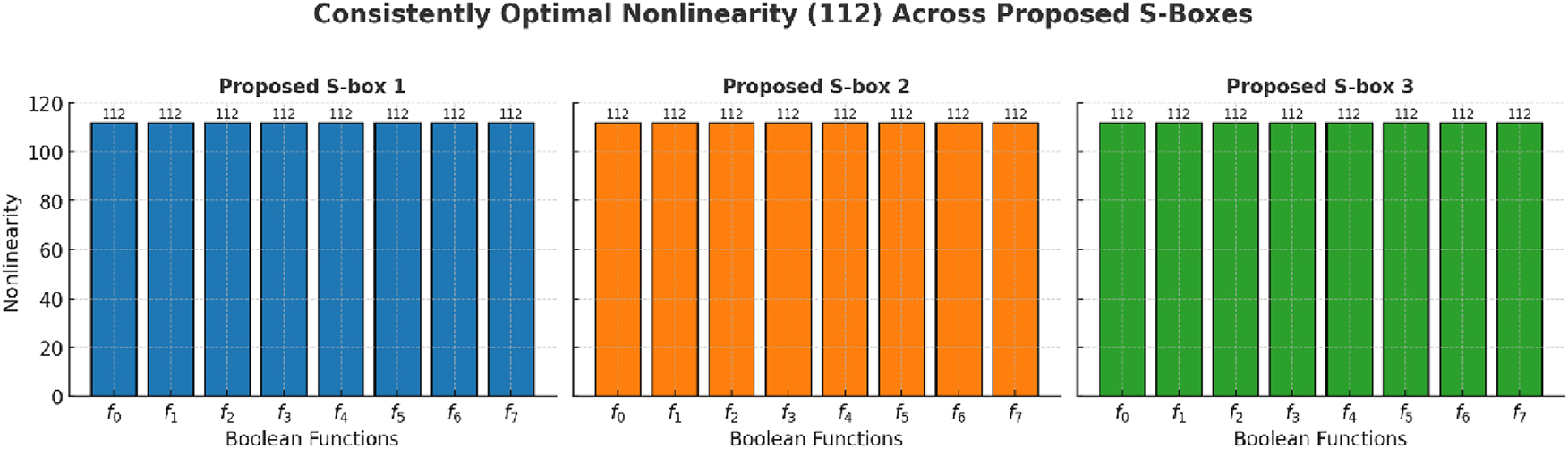
Comparison of nonlinearity values for Boolean functions f 0 − f 7 across three proposed S-boxes. Each proposed S-box achieves consistently optimal nonlinearity of 112, demonstrating strong resistance to linear cryptanalysis and uniform performance across all Boolean components.
5.2 Bit Independence Criteria (BIC)
A vector Boolean function
5.3 Strict Avalanche Criteria (SAC)
The Strict Avalanche Criterion (SAC) for an S-box
where e i is the unit vector with a 1 in the i-th position. For a cryptographic S-box to meet this criterion, it must achieve a SAC value of 0.5, reflecting its ability to disrupt predictable patterns in the output and enhance overall security.
5.4 Differential Approximation Probability (DAP)
Let
where the differential distribution table (DDT) entry is defined as:
Thus, DAP(S) quantifies the maximum probability over all nonzero input differences Δx and output differences Δy, satisfying:
where the differential uniformity is:
A lower DAP(S) value corresponds to higher resistance against differential cryptanalysis. The ideal DAP is close to zero, while the theoretical maximum is 1. Evaluating DAP is important for assessing the S-box’s resilience against differential analysis, with results for both the proposed and literature-based S-boxes shown in Table 7.
5.5 Linear Approximation Probability (LAP)
For an S-box
where the Walsh-Hadamard correlation is given by:
LAP values for the proposed and literature-based S-boxes are presented in Table 6 to show their resistance to linear cryptanalysis.
Figure 6 show a side-to-side comparison of the given S-boxes (S-box 1, S-box 2, and S-box 3) with the existing nonlinear confusion components of contemporary block ciphers, evaluated across six basic cryptographic strength indicators having a direct impact on cryptanalytic attack resistance.
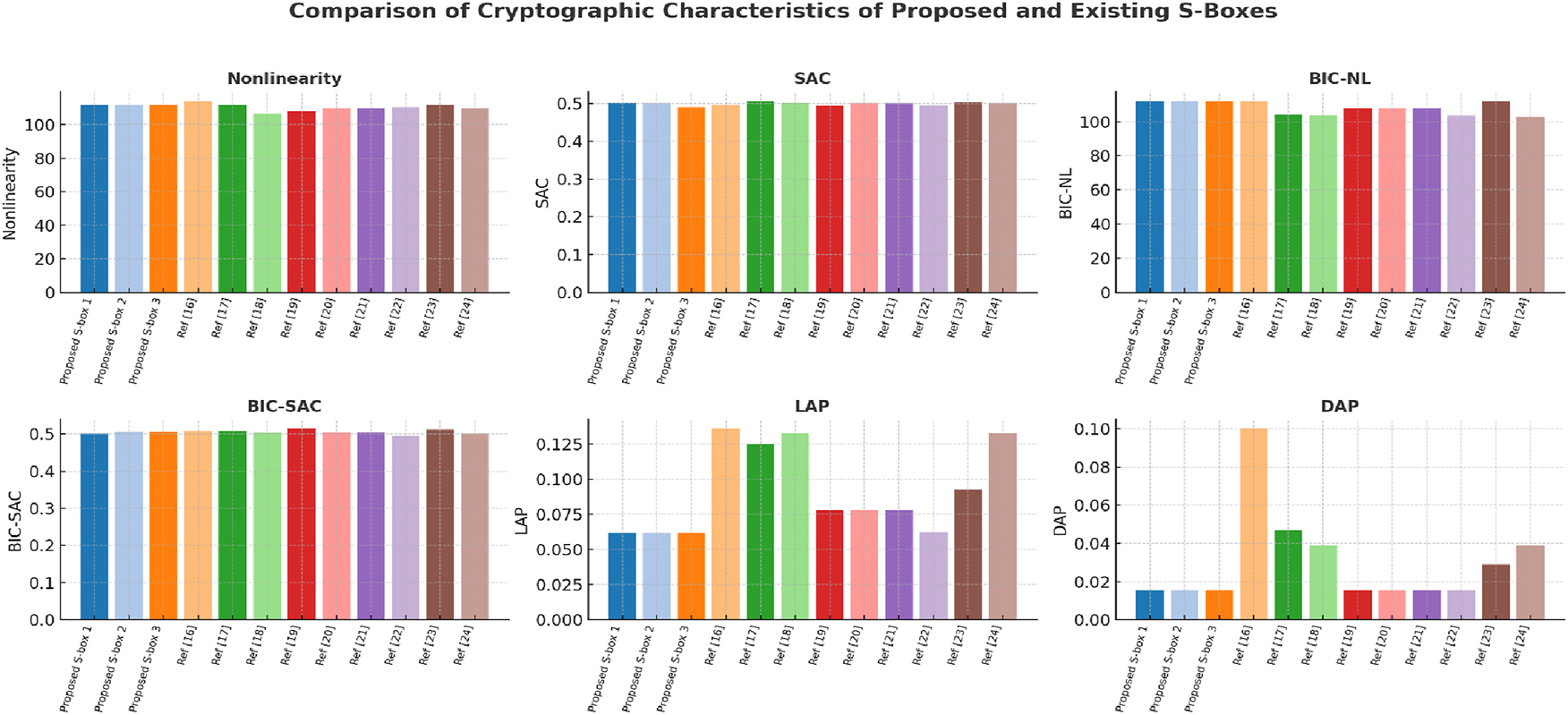
Visual comparison of cryptographic characteristics for the proposed S-boxes and existing nonlinear confusion components from modern block ciphers.
In nonlinearity metric, all the proposed S-boxes achieve an ideal uniform level of 112, which approaches the upper theoretical limit of 8-bit balanced S-boxes and offers fair resistivity against linear cryptanalysis by minimizing the correlation of the linear approximations and true input–output mapping to a minimum degree. The output of the Strict Avalanche Criterion (SAC) is kept decisively around the ideal 0.5 boundary level, such that single-bit input variation induces an even and extensive output variation and boosts unpredictability and slows down differential and statistical attack analyses. In the case of BIC with reference to BIC-NL, the designs put forward again achieve the ideal 112, with no exploitable linear relationships of output bits among them which is a property useful in defying correlation attack types. The BIC-SAC scores, again close to ideal 0.5, confirm this independence of avalanche spread, defying once more any statistical guess an attacker might make.
The proposed S-boxes have the LAP among the lowest seen (0.0620), thereby directly improving immunity to Matsui’s linear cryptanalysis by minimizing the highest success probability of linear approximations. Finally, the DAP results (0.0156) are tied to the minimum achievable limit for 8-bit S-boxes, thereby drastically restricting the practicability of Biham–Shamir differential cryptanalysis by minimizing the highest differential propagation probability. Figure 6 and Table 6, clearly reveal the fact that the proposed S-boxes are not only comparable but, in some cases, superior to existing confusion elements in cryptographic power, and they possess better resistivity to a vast spectrum of classical and modern block cipher assaults.
5.6 Bijectivity
Bijectivity is an important property of S-boxes in cryptography, ensuring each input maps to a unique output and every output have a distinct input. This one-to-one mapping prevents attackers from inferring input values from outputs and adds critical confusion and diffusion to the cryptographic process. In our case, the S-boxes meet the bijectivity criterion by containing unique values from 0 to 255.
5.7 Fixed point analysis
A strong fixed point satisfies:
The number of strong fixed points is:
A cryptographically strong S-box should minimize
Number of rows and columns to be added after zero padding.
| Image | Dimension | Number of rows to be added | Number of columns to be added | Size after zero padding |
|---|---|---|---|---|
| Watch | 1,024 × 768 | 0 | 0 | 1,024 × 768 |
| Barbara | 787 × 576 | 1 | 0 | 788 × 576 |
| Peppers | 512 × 512 | 0 | 0 | 512 × 512 |
| Airplane | 512 × 512 | 0 | 0 | 512 × 512 |
| Girl | 768 × 512 | 0 | 0 | 768 × 512 |
| Monarch | 768 × 512 | 0 | 0 | 768 × 512 |
| Baboon | 512 × 512 | 0 | 0 | 512 × 512 |
| Cat | 490 × 733 | 2 | 3 | 490 × 736 |
| Aerial parking view | 960 × 540 | 0 | 0 | 960 × 540 |
| Riverfront walkway | 1,916 × 1,078 | 0 | 2 | 1,916 × 1,080 |
| Waterpark crowd | 1,389 × 1,042 | 3 | 2 | 1,389 × 1,044 |
| Outdoor gathering | 1,400 × 1,050 | 0 | 2 | 1,400 × 1,052 |
Table 7 outlines the fixed point analysis of the provided S-boxes against prevalent nonlinear confusion elements. In cryptography design, a fixed point, where S(x) = x, or a repulsive fixed point, where inputs map close to themselves under repeated application, introduces structural vulnerabilities exploitable in chosen-plaintext and algebraic attacks. The proposed S-box 1, S-box 2, and S-box 3 exhibit zero fixed points and zero repulsive fixed points, ensuring the absence of identity mappings or short cycles that could weaken cipher strength. This structural robustness, combined with the high nonlinearity, optimal SAC, and low LAP/DAP values demonstrated in Table 7, confirms the proposed mechanism’s enhanced resistance to linear, differential, and structural cryptanalysis, making it a highly effective and secure choice for modern block cipher architectures.
6 Proposed encryption scheme
The proposed encryption scheme follows SPN architecture, leveraging structured linear transformations, algebraic mappings, and modular arithmetic in
Step 1: Preprocessing and Image Partitioning
The image is partitioned into b × b blocks. If the image is not multiple of b × b, zero padding is done. To make the image divisible by block size 4 × 4, Table 8 lists the number of rows and zeros to be added. By doing this the image gets divisible by block size and can be portioned into blocks for further process. Define the image as a matrix
where m′, n′ are the nearest multiples of block size b, ensuring uniform partitioning into b × b subspaces for encryption operations.
Step 2: Permutation Transformation
To disperse the salient information in the image, the blocks of images are permuted using a permutation transformation. Using a logistic chaotic map, construct a permutation matrix
where x t follows a chaotic sequence. The number of rows and blocks are checked in the image and based on that the first row or column of the permutation matrix is generated using Eq. (23), the remaining rows/columns are the shifted version of first row/column. The dimensions of the permutation matrix depend on the dimensions of blocks. Apply a block-wise transformation via conjugation:
The scrambling and information spreading in the modular space are ensured. The mapping matrix should be such that the first row should contain unique numbers randomly from 1 to G and the remaining rows will consist of numbers that are shifted version of row 1 and it is also essential that the columns must also contain unique values.
Step 3: Bit-Level Parity Mapping
The parity based mapping is data-dependent and provides immunity against the chosen plaintext. For this, define a parity mapping operator
where the bijective reordering function is defined as in Eq. (26) ensuring permutation within each block by altering the even and odd bit distributions.
Step 4: Nonlinear Algebraic Substitution
Substitution replaces pixel values or bits using nonlinear mappings, which breaks direct statistical relationships between the original image and encrypted image, making cryptanalysis much harder. Substitution is performed using structured S-box transformations in the modular space:
for an 8-bit substitution:
for a 4-bit transformation, ensuring cryptographic nonlinearity via structured algebraic mappings as shown in Figure 7.

Illustration of the image encryption process using the proposed S-box. The plain image is first converted into binary form, and then partitioned into least significant bits (LSBs) and most significant bits (MSBs). After binary-to-decimal conversion, the resulting values determine the row and column indices used for S-box substitution. This mapping produces the encrypted image, ensuring strong pixel confusion and enhanced security.
Step 5: Affine Key Mixing via XOR
Introduce a 128-bit encryption key K and apply an affine transformation via modular XOR:
where ⊕ denotes the affine transformation under modular addition in
Step 6: Circular Shift Transformation
Apply a cyclic shift operator CSCS over the modular space:
where
ensuring uniform spreading via structured matrix shifts in
Step 7: Final Nonlinear Substitution and Key Mixing
A final round of S-box substitution is performed, followed by key mixing:
ensuring maximal nonlinearity and resistance against cryptanalytic attacks.
Decryption via Inverse Transformations
Decryption follows a structured sequence of inverse transformations, restoring the original image:
where each inverse function is systematically applied in

Flowchart of the proposed hybrid image encryption scheme. The plain image is divided into blocks and processed through multiple S-box substitution stages (4-bit and 8-bit), guided by modular conditions and a 128-bit key. Circular shift and parity-based bit permutation operations enhance diffusion and confusion.
7 Security analysis
To check the immunity of the proposed scheme against various cryptographic threads, the security analysis is of vital importance. The security analysis includes key analysis, histogram, differential, correlation and entropy analysis. To check the protection of salient information we utilize cropping analysis. For the speed of the encryption, throughput analysis is carried out.
7.1 Encryption key analysis
In this examination, two critical analyses, Key Space analysis and key sensitivity analysis, are employed and presented accordingly.
7.1.1 Brute force analysis
A brute-force attack tries each possible encryption key in a systematic way until the proper one is located. With the scheme envisioned here, the implementation of a 128-bit encryption key implies a key space of 2128 possible combinations, which significantly exceeds the commonly recommended cryptographic security threshold of 2100 [26]. Such a large key space makes comprehensive key searches computationally infeasible for any practical adversary, even one with powerful computing capabilities. Table 9 provides a comparative evaluation of the new scheme’s key space with recently established algorithms, showing large variability across schemes. The AES standard, for example, also uses 128-bit key space (2128), with strong and highly reputable security. While widening the key space particular beyond 2512 practical for brute-force resistance and future-proof security for the advent of new threats like quantum computing but also provides trade-offs. Relatively large key sizes require larger memory and increased processor power for encryption and decryption and can have effects in real-time or processor-starving environments, like IoT devices [27]. Our proposed scheme puts such consideration in a balanced state with secure yet computationally feasible design.
Comparison of key space analysis of recently projected encryption scheme.
| Algorithm | Key space length | Comparison with 2100 |
|---|---|---|
| Ref. [21] | 21754 | Exceeds threshold significantly |
| Ref. [28] | 2212 | Exceeds threshold |
| Ref. [29] | 24624 | Exceeds threshold significantly |
| Ref. [30] | 2512 | Exceeds threshold significantly |
| Ref. [31] | 2100 | Matches threshold |
| Ref. [32] | 2200 | Exceeds threshold |
| Ref. [33] | 2279 | Exceeds threshold |
| Proposed | 2128 | Exceeds threshold |
7.1.2 Key sensitivity analysis
We carried out an exhaustive key sensitivity analysis to test the strength of our encryption system. In experiment 1, the encryption and decryption operation with Key 1 effectively recovered the original image, validating the accuracy of the decryption process. In Experiment 2, the original image was encrypted using Key 1 but decrypted with Key 2, which had only a single-bit change from Key 1. The output was a totally distorted and unrecognizable image, as can be seen from Figure 9. The radical change indicates the high key sensitivity of our scheme, withstanding unauthorized decryption and strengthening the system’s capability in protecting sensitive information.
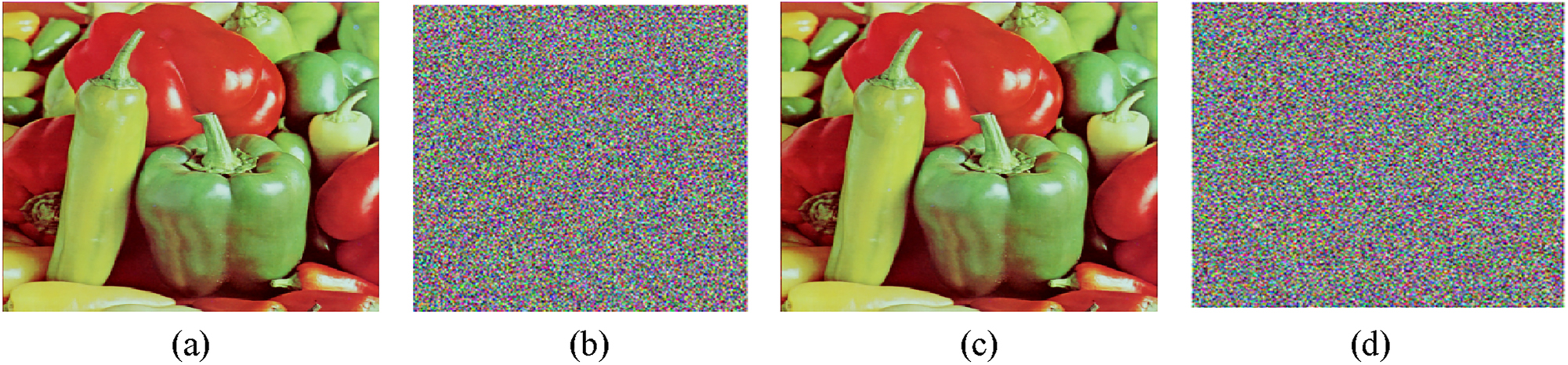
Key sensitivity analysis of suggested encryption algorithm. The image decrypted with one bit changed key does not convey any useful information. (a) Plain image, (b) enciphered image, (c) correctly decrypted image, (d) decrypted image with changed key.
7.2 Histogram analysis
The three dimensional (3D) histogram is the graphical representation of the frequency distribution of the pixel intensities within an image, plotting the range of color combinations within the RGB color space. For a flat image, natural patterns and structures cause noticeable differences in the histogram representation. This can be seen in Figure 10, whereas some of the spheres in the 3D space are clearly larger, and others are smaller. The varying sizes of the spheres indicate that certain color combinations occur more frequently than others. The random placement of spheres at different positions in the 3D cube signifies the presence of different distributions of colors in the original image. When the image is encrypted using the proposed scheme, the cryptographic operation destabilizes the inherent patterns, achieving a high level of diffusion and confusion. The 3D histogram is now evenly distributed, tiling the cube with spheres of equal area. This homogeneity suggests that all color combinations are equally probable, eliminating any prevailing colors or structural dependencies. The absence of variation among the sizes of spheres shows that the distribution of pixel intensity is ideally balanced, in favor of the strength of the encryption mechanism. The transformation of the histogram from non-uniform to a uniform distribution confirms the success of the proposed encryption technique. A uniformly distributed 3D histogram is one of the main signs of high entropy, reducing statistical leakages that might be used in cryptanalysis. The elimination of structured patterns in the encrypted image demonstrates better resistance to statistical and color-based differential attacks. Effectively, the uniformity illustrated in Figure 10 that verifies the proposed scheme achieves a good security level by keeping an equal distribution of colors across the RGB space, making it highly resistant to cryptographic attacks. The detail of three dimensional histograms was introduced.

Histogram analysis of the encrypted image. The pixel intensity distribution appears nearly uniform, indicating that encryption effectively conceals statistical features of the original image. This uniformity demonstrates strong resistance against histogram-based and statistical attacks.
Figure 11 presents the histogram analysis of the proposed encryption scheme for two test images. The subfigures (a–d) and (i–l) show the original images with their respective red, green, and blue channel histograms, where distinct peaks reflect the uneven distribution of pixel intensities typical of natural images. After encryption, shown in (e–h) and (m–p), the histograms for all three color channels become uniformly distributed, indicating that the encrypted images have no visible statistical patterns from the originals. This uniformity demonstrates the scheme’s effectiveness in concealing image characteristics, thereby enhancing resistance against statistical attacks.

Histogram analysis of the encrypted image. The pixel intensity distribution appears nearly uniform, indicating that encryption effectively conceals statistical features of the original image. This uniformity demonstrates strong resistance against histogram-based and statistical attacks.
Figure 12 shows the three-dimensional histograms of the plain and encrypted images for two test cases. In the original images (a–d, i–l), the histograms exhibit sharp peaks and concentrated clusters, indicating strong correlations between neighboring pixel intensities, which is a common trait in natural images. After encryption (e–h, m–p), the histograms become uniformly dispersed across all intensity bins, with no visible peaks or patterns. This transformation confirms that the proposed encryption scheme effectively removes inherent pixel correlations, making the encrypted images statistically indistinguishable and more secure against histogram-based cryptanalysis.

Three dimensional histograms analysis of the encrypted image. The pixel intensity distribution appears nearly uniform, indicating that encryption effectively conceals statistical features of the original image. This uniformity demonstrates strong resistance against histogram-based and statistical attacks.
7.3 Differential analysis
Exploiting the encryption algorithm’s sensitivity to small changes in the original image, attackers conduct differential attacks. By making minute alterations to the original image, they encrypt both versions using the same secret key, aiming to discern the relationship between the resulting cipher texts. To thwart such attacks, the encryption system should produce vastly different cipher texts even with slight modifications to the original image, indicating strong sensitivity. Two analyses are employed to assess the system’s resilience against such attacks one is the universal average change intensity (UACI) and the other is the number of pixels change rate (NPCR). UACI measures the disparity in average intensity between two encrypted images derived from an original and a slightly altered single-pixel version. The mathematical expression for NPCR is given as Eq. (34):
where N × M represents image dimensions, E(a, b) denotes the encrypted plain image, and
where N × M represents image dimensions, E(a, b) stands for the encrypted plain image, and

Differential analysis of the proposed encryption scheme. The metrics NPCR and UACI show high values, indicating that small changes in the plain image produce significant differences in the encrypted image. This confirms strong resistance against differential attacks.
Comparison of NPCR and UACI of recently encryption scheme for 512 × 512 images of Lena.
| Algorithm | NPCR | UACI |
|---|---|---|
| Ref. [34] | 99.61 | 33.46 |
| Ref. [35] | 99.63 | – |
| Ref. [29] | 99.61 | 32.50 |
| Ref. [36] | 99.60 | 32.18 |
| Proposed | 99.60 | 33.50 |
Correlation analysis of the proposed encryption scheme.
| Image | Original | Encrypted | Image | Original | Encrypted | ||
|---|---|---|---|---|---|---|---|
| Lena | Vertical | 0.97266 | 0.00231 | Monarch | Vertical | 0.8953 | 0.0154 |
| Horizontal | 0.94555 | 0.0032 | Horizontal | 0.8433 | 0.0542 | ||
| Diagonal | 0.921301 | 0.0008 | Diagonal | 0.8129 | 0.0046 | ||
| Barbara | Vertical | 0.949987 | −0.0051 | Baboon | Vertical | 0.8261 | 0.0047 |
| Horizontal | 0.91338 | −0.0034 | Horizontal | 0.8737 | 0.0060 | ||
| Diagonal | 0.8707 | −0.00233 | Diagonal | 0.7843 | 0.0020 | ||
| Peppers | Vertical | 0.97051 | −0.0015 | Cat | Vertical | 0.9091 | −0.0034 |
| Horizontal | 0.96347 | 0.0018 | Horizontal | 0.9623 | −0.0019 | ||
| Diagonal | 0.93652 | 0.0035 | Diagonal | 0.8798 | −0.0034 | ||
| Airplane | Vertical | 0.930144 | −0.0034 | Girl | Vertical | 0.9921 | 0.0049 |
| Horizontal | 0.93640 | 0.0031 | Horizontal | 0.9755 | 0.0034 | ||
| Diagonal | 0.88191 | 0.0073 | Diagonal | 0.9705 | −0.0023 | ||
| Sails | Vertical | 0.884244 | 0.0010 | Watch | Vertical | 0.9206 | −0.0037 |
| Horizontal | 0.8389 | −0.0198 | Horizontal | 0.9208 | −0.0052 | ||
| Diagonal | 0.7817 | −0.01251 | Diagonal | 0.8988 | −0.0069 | ||
| Aerial parking view | Vertical | 0.989939 | 0.000928 | Glass bridge walkway | Vertical | 0.941963 | 0.001202 |
| Horizontal | 0.918405 | 0.006507 | Horizontal | 0.972396 | 0.000852 | ||
| Diagonal | 0.964264 | 0.003373 | Diagonal | 0.996383 | 0.006049 | ||
| Outdoor sports court | Vertical | 0.948632 | 0.002375 | Riverfront walkway | Vertical | 0.924528 | 0.000552 |
| Horizontal | 0.961195 | 0.002576 | Horizontal | 0.972169 | 0.003173 | ||
| Diagonal | 0.999272 | 0.004021 | Diagonal | 0.993953 | 0.005287 | ||
| Lakeside pathway | Vertical | 0.898726 | 0.006727 | Waterpark crowd | Vertical | 0.941963 | 0.0068 |
| Horizontal | 0.978619 | 0.007899 | Horizontal | 0.972396 | 0.002985 | ||
| Diagonal | 0.900481 | 0.006322 | Diagonal | 0.996383 | 0.004454 | ||
| Urban street view | Vertical | 0.911549 | 0.002805 | Outdoor gathering | Horizontal | 0.967445 | 0.005177 |
| Horizontal | 0.897174 | 0.004935 | Diagonal | 0.980877 | 0.00321 | ||
| Diagonal | 0.968902 | 0.005121 | Vertical | 0.96752 | 0.008616 |
7.4 Correlation analysis
The correlation coefficient (CC) is a key statistical measure for dependency of the neighboring pixels and offers a direct estimate of the encryption efficiency in disturbing the spatial redundancies. In the case of any image, the values of the CC are calculated in the horizontal direction (HC), vertical direction (VC), and diagonal direction (DC) and are bounded in the range [−1, 1]. A CC of 1 reflects perfect linear dependency, a CC of 0 indicates no correlation, and a CC of −1 denotes complete negative correlation. In the flat image, Table 11 depicts CC values near unity (≈0.98) in all orientations for the Lena benchmark, highlighting its inherent vulnerability due to strong pixel associations. In contrast, our proposed RNN–chaos-based S-box encryption mechanism drastically suppresses these correlations, yielding CC values near zero across all directions, thereby eliminating exploitable patterns. This substantial decorrelation serves as a formidable defense against statistical and differential cryptanalysis, ensuring that the cipher image exhibits near-random structural properties. The visual evidence in Figure 14 further corroborates the numerical results. In the plain image correlation plots (Figure 14a, c, and e), pixel clusters are tightly concentrated along the principal diagonal, indicative of strong linear associations. Post-encryption (Figure 14b, d, and f), the pixel distributions become uniformly scattered, illustrating the algorithm’s capacity to dismantle deterministic dependencies. This decorrelation, driven by the synergy of chaotic sequence-driven pseudo-random number generation and RNN-optimized S-box transformations, exemplifies the strength of the proposed scheme in concealing salient visual structures and preserving confidentiality under high-stakes imaging scenarios.

Visualization of horizontal (HC), vertical (VC), and diagonal (DC) pixel correlations for the original and encrypted Baboon images. The original image shows strong pixel correlations, while the encrypted image exhibits a random scatter distribution, confirming effective decorrelation and high security against statistical attacks. (a) Vertical CC analysis of Baboon, (b) vertical CC analysis of encrypted Baboon, (c) horizontal CC analysis of original Baboon, (d) horizontal CC analysis of encrypted Baboon, (e) diagonal CC analysis of original Baboon, (f) diagonal CC analysis of encrypted Baboon.
7.5 Cropping analysis
As discussed in the earlier sections of this write up that the available lightweight encryption schemes are subjected to cropping and noise attack. In this section of the article, we have to check the immunity of the encryption scheme against cropping and noise attacks. The noise and cropping alter pixels values; therefore, separate analysis is not necessary. Figure 15 shows the Impact of increasing pixel loss on the decryption quality of an encrypted cameraman image using the proposed scheme. Figure 15(a) shows the encrypted image and Figure 15(b) shows the decrypted cameraman. In (c, e, g, i, k), progressive pixel loss is introduced in the top-left region of the encrypted image 12.5 %, 16.7 %, 25 %, 33.3 %, and 50 %, respectively. The corresponding decrypted results in (d, f, h, j, l) show preserved structural and salient features, such as face details, despite significant data loss. This demonstrates the scheme of strong resistance to cropping attacks and its ability to retain critical visual information under pixel loss conditions. To quantitatively assess the encryption scheme’s ability to preserve structural integrity under conditions such as burst errors, cropping, or data loss, the Structural Similarity Index (SSIM) is employed. SSIM evaluates the perceived quality and structural similarity between two images, with values ranging from 0 to 1. A score near 1 indicates strong structural resemblance, while a score near 0 reflects significant differences. Given an original image I orig and an encrypted image I enc, SSIM is computed as:
where μ
orig and μ
enc are the mean luminance values of the original and encrypted images,

Decryption results under pixel loss conditions. The proposed encryption scheme demonstrates strong robustness against cropping and data loss, successfully recovering the main visual content and preserving salient image features despite missing pixel regions.
SSIM measurements of cropped images with original image.
| Cropping ratio | SSIM |
|---|---|
| No cropping | 1.0000 |
| 1/8 cropping | 0.9986 |
| 1/6 cropping | 0.9987 |
| 1/4 cropping | 0.9824 |
| 1/3 cropping | 0.8781 |
| 1/2 cropping | 0.7598 |
Table 12 listed SSIM values for the image subjected to varying levels of cropping. Higher SSIM values indicate stronger structural resemblance between the cropped decrypted images and the originals. The results demonstrate the proposed encryption scheme’s robustness against cropping and burst errors, effectively preserving structural integrity even under substantial pixel loss.
7.6 Man-in-the-Middle (MITM) attack
Man-in-the-Middle (MITM) attack is a severe threat where data is intercepted, modified, or injected in between communicating parties. In encrypted image transmission, attackers may attempt chosen-ciphertext attacks to modify ciphertext and monitor system behavior when decrypting. The proposed chaos and RNN-based encryption algorithm offer strong resistance to MITM attacks through multiple security layers. In the first place, it employs a 128-bit secret key, offering 2128 combinations, making brute-force attacks infeasible. Even a single change in the key produces a totally different ciphertext, as can be seen from Figure 11, foiling the attempts of attackers to predict or manipulate encrypted data. Second, disorderly block shuffling confuses image blocks with a logistic chaotic map so that attackers cannot restore the original image without accurate information about block locations. Third, a nonlinear S-box generated using RNN improves confusion, satisfying the Strict Avalanche Criterion (SAC) that even slight changes in ciphertext produce extremely different decrypted results, disabling any effort to inject or alter data. These collective mechanisms make MITM interception ineffective, providing unbroken security for IoT-based image encryption.
7.7 Data injection attack
The proposed encryption technique enhances image security against data injection attacks by causing even cropped or manipulated encrypted images to retain essential visual information upon decryption though with degradation, as shown in Figure 16. The application of chaotic block shuffling disrupts the location of injected or manipulated data, rendering unauthorized alteration meaningless. The RNN-based nonlinear S-box transformation also increases confusion so that even a slight alteration in encrypted data causes drastically different decrypted output, thereby effectively thwarting pattern injections and desired changes. By combining multi-round XOR operations, bit permutations, and S-box substitutions, the scheme diffuses information in a chaotic way, destroying any tampering attempt. Despite cropping attacks or burst errors, the encryption scheme preserves the integrity of key visual content such as facial contours in surveillance videos ensuring aggressive protection in IoT applications. Data injection attempts ultimately collapse, being unable to manipulate meaningful content, embedding uncompromising security and tenacity in real-world applications.

Test findings of the proposed cryptosystem based on NIST SP 800-22 statistical experiments. The results show that all tested sequences pass the randomness criteria, confirming the proposed system’s strong statistical performance and suitability for secure cryptographic applications.
7.8 NIST analysis
To validate the randomness in the encrypted image, encrypted through the proposed lightweight encryption scheme is tested utilizing the NIST 800-22 test suite. For successful passage of each test in the suit a p value exceeding 0.01 is required. The outcomes are presented in Figure 16, and it is affirmed from this investigation that the encrypted image complies with all the tests listed in NIST 800-22.
7.9 Chosen plaintext attack
The 128-bits key and its circular shifted version XORed with each block and the blocks are permuted using chaotic generated permutation matrix. The resulting image is heavily dependent on key and permutation matrix. Hence it is not possible for the attacker to predict the output, even by choosing the plaintext. Moreover, the bit level parity making further harder the success of chosen plaintext attacks. This combination of block permutations, key XORing and bit level parity mapping hides the relation between the chosen plain image and its cipher image.
7.10 Chosen cipher text attack
The same complex process is used in the decryption phase. The proposed encryption scheme applies nonlinear substitution at two distinct stages (Steps 4 and 7). These layers introduce high confusion and nonlinearity, making differential patterns difficult to trace in chosen cipher text attack. Secondly the encryption scheme utilizes a chaotic permutation matrix derived from a logistic map to disrupt the spatial locality of image pixels. Even minor changes in cipher text blocks result in unpredictable shifts, making it infeasible for the attacker to isolate meaningful patterns.
7.11 Throughput analysis
Encryption speed analysis measures the time an algorithm takes to process data, expressed as throughput. High throughput is crucial for performance, especially in data communication and IoT applications. The proposed encryption scheme’s throughput was assessed on a personal computer featuring an Intel(R) Core(TM) i7-7700 CPU, operating at 3.60 GHz, with 8GB of RAM and running on the Windows 10 platform. The results, shown in Figure 17, and Table 14, show that the proposed scheme outperforms recent LWE schemes in throughput.

Throughput analysis of the proposed encryption scheme. The results indicate a high throughput, demonstrating the scheme’s computational efficiency and suitability for real-time or large-scale image security applications.
Figure 17 presents a bar chart illustrating the throughput analysis of the proposed encryption scheme across various images. The average throughput benchmark (8.675 kB/s) serves as a reference point for evaluating performance consistency. Higher throughput values indicate faster encryption processing, making the proposed scheme suitable for high-speed encryption applications in real-world scenarios (see Table 13).
Throughput analysis of the proposed LWE and comparison with state of the art LWEs.
| Encryption scheme | Time in seconds | Size of data (bytes) | Throughput in KB/s |
|---|---|---|---|
| AES [37] | 64 | 513,024 | 7.828125 |
| HIGHT [38] | 159 | 513,024 | 3.1509433962 |
| ITUBee [39] | 0.0842 | 40 | 0.463925178 |
| Lilliput [40] | 0.1218 | 32 | 0.2565681 |
| PRESENT | 0.1488 | 128 | 0.840053 |
| Proposed | 59 | 513,024 | 8.695322 |
7.12 RAM storage and suitability for IoT deployment
The RAM footprint of an encryption algorithm is a decisive factor in determining its suitability for resource-constrained environments such as IoT and embedded systems. As shown in Table 14, the proposed chaos–RNN-based scheme requires 40,812 bytes of RAM, which is slightly lower than AES (43,119 bytes) yet higher than ultra-lightweight algorithms such as PRESENT (3,430 bytes), Lilliput (4,394 bytes), and ITUBee (6,207 bytes). While these smaller ciphers offer superior memory efficiency, they do so at the expense of reduced cryptographic strength and limited resistance to advanced attacks. In contrast, the proposed scheme strikes a deliberate balance between security and efficiency, integrating high-strength cryptographic features, such as an S-box nonlinearity of 112, effective linear and differential attack resistance, and information-preserving functions for key information, in a memory size variable for implementation in mid-level edge computing and IoT devices. Minimizing S-box storage, RNN calculations, and buffer space will form the future research agenda for ultra-constrained IoT nodes with small memory of a few kilobytes for decreasing the memory required without losing the efficacy of the encryption.
7.13 Discussion on lightweight encryption
Due to the low computational complexity, efficient memory usage, and high throughput, the proposed encryption scheme qualifies for lightweight cryptographic solutions for the IoT devices. The proposed encryption scheme utilizes a block-based design, dividing the image into 4 × 4 blocks, which allows for localized and parallelizable operations, minimizing both processing time and memory overhead. The use of a simple one-dimensional logistic map for permutation ensures efficient key-dependent scrambling with minimal arithmetic operations. Additionally, the bit-level parity mapping is implemented using lightweight logic operations that do not introduce any significant computational burden. Substitution is achieved using pre-generated S-boxes obtained from RNN models, which are stored as lookup tables to avoid runtime neural computations, thereby reducing complexity and memory access latency. The affine key mixing is performed via XOR operations, which are natively supported by hardware and the operation is computationally inexpensive. The use of modular arithmetic, simple logic, and avoidance of heavy mathematical primitives like matrix inversion or elliptic curve operations further reinforce its lightweight nature. Based on the throughput and RAM analysis provided in Table 14, the proposed encryption scheme demonstrates favorable lightweight characteristics when compared with state-of-the-art lightweight encryption (LWE) algorithms. Although the RAM usage of the proposed scheme is 40,812 bytes, which is higher than most lightweight schemes like PRESENT (3,430 bytes), Lilliput (4,394 bytes), and ITUBee (6,207 bytes), it remains lower than AES (43,119 bytes). Given that all schemes were implemented and tested under the same MATLAB 2017b environment on the same hardware, the trade-off between higher speed and moderate RAM usage is acceptable, especially for image-based applications where performance is critical. Therefore, the proposed scheme can still be classified as lightweight, offering a balance between computational efficiency and memory requirements.
8 Conclusion with future recommendations
This paper puts forward a chaos–RNN-based lightweight encryption system for the encryption of the most prominent image regions in IoT applications. The new design sustains an average S-box nonlinearity of 112, near the theoretical optimal and directly supporting resistance to linear attack by decreasing linear correlations, improves the Strict Avalanche Criterion (SAC) and Bit Independence Criterion (BIC) for improved diffusion, reduces Linear Approximation Probability (LAP), and indirectly the Differential Approximation Probability (DAP), supporting resistance to linear and differential attack respectively. These cryptographic strengths are tempered by a UACI of 33.50 % and NPCR of 99.60 %, ensuring high sensitivity to plaintext changes. The scheme provides a throughput of 8.695 KB/s, outperforming AES and other lightweight cryptosystems, and demonstrates robustness against cropping and burst errors, enabling accurate reconstruction even after 30 % data loss. NIST SP 800-22 tests validate utmost statistical randomness. Though RNN training and S-box generation add computational overhead for highly resource-constrained IoT devices, future research will address optimizing computational efficiency, minimizing the memory footprint, applying the approach to multimedia formats, and adding post-quantum resilience. These results represent a critical step toward AI-driven, cryptographically secure, and lightweight encryption optimally tailored for next-generation IoT environments.
Funding source: Prince Sattam bin Abdulaziz University
Award Identifier / Grant number: PSAU/2025/R/1447
-
Funding information: This study is supported via funding from Prince Sattam bin Abdulaziz University project number (PSAU/2025/R/1447).
-
Author contributions: All authors have accepted responsibility for the entire content of this manuscript and approved its submission.
-
Conflict of interest: Authors state no conflict of interest.
-
Data availability statement: All data generated or analysed during this study are included in this published article.
References
1. Wenhua, Z, Hasan, MK, Jailani, NB, Islam, S, Safie, N, Albarakati, HM, et al.. A lightweight security model for ensuring patient privacy and confidentiality in telehealth applications. Comput Hum Behav 2024;153:108134. https://doi.org/10.1016/j.chb.2024.108134.Suche in Google Scholar
2. Islam, MOU, Parah, SA. Fast and lightweight image cryptosystem for IoMT applications. Internet Things 2024;25:101083. https://doi.org/10.1016/j.iot.2024.101083.Suche in Google Scholar
3. Deebak, BD, Hwang, SO. Privacy-preserving learning model using lightweight encryption for visual sensing industrial IoT devices. IEEE Trans Emerg Top Comput Intell 2025;9:3039–56. https://doi.org/10.1109/tetci.2024.3523771.Suche in Google Scholar
4. Aljaedi, A, Alharbi, AR, Aljuhni, A, Alghuson, MK, Alassmi, S, Shafique, A. A lightweight encryption algorithm for resource-constrained IoT devices using quantum and chaotic techniques with metaheuristic optimization. Sci Rep 2025;15:14050. https://doi.org/10.1038/s41598-025-97822-6.Suche in Google Scholar PubMed PubMed Central
5. Shafique, A, Mehmood, A, Alawida, M, Khan, AN, Shuja, J. Lightweight image encryption scheme for IoT environment and machine learning-driven robust S-box selection. Telecommun Syst 2025;88:17. https://doi.org/10.1007/s11235-024-01251-1.Suche in Google Scholar
6. Aqeel, S, Khan, AS, Abbasi, IA, Algarni, F, Grzonka, D. Enhancing IoT security with a DNA-based lightweight cryptography system. Sci Rep 2025;15:13367. https://doi.org/10.1038/s41598-025-96292-0.Suche in Google Scholar PubMed PubMed Central
7. Mehmood, A, Khan, AN, Natgunanathan, I, Shafique, A, Khan, IA, Khan, AUR. Enhanced lightweight and compromised-resilient image encryption for resource constrained environments. PLoS One 2025;20:e0320046. https://doi.org/10.1371/journal.pone.0320046.Suche in Google Scholar PubMed PubMed Central
8. Gilmolk, AMN, Aref, MR. Lightweight image encryption using a novel chaotic technique for the safe internet of things. Int J Comput Intell Syst 2024;17:146. https://doi.org/10.1007/s44196-024-00535-3.Suche in Google Scholar
9. Tian, H, Zhuang, X, Yan, A, Zhang, H. A novel multiple-image encryption with multi-petals structured light. Sci Rep 2024;14:19559. https://doi.org/10.1038/s41598-024-70425-3.Suche in Google Scholar PubMed PubMed Central
10. Zhu, S, Deng, X, Zhang, W, Zhu, C. Secure image encryption scheme based on a new robust chaotic map and strong S-box. Math Comput Simulat 2023;207:322–46. https://doi.org/10.1016/j.matcom.2022.12.025.Suche in Google Scholar
11. Kumar, M, Chivukula, AS, Barua, G. Deep learning-based encryption scheme for medical images using DCGAN and virtual planet domain. Sci Rep 2025;15:1211. https://doi.org/10.1038/s41598-024-84186-6.Suche in Google Scholar PubMed PubMed Central
12. Choudhary, D, Pahuja, R. Deep learning approach for encryption techniques in vehicular networks. Wirel Pers Commun 2022;125:1–27. https://doi.org/10.1007/s11277-022-09538-9.Suche in Google Scholar
13. Ding, Y, Wu, G, Chen, D, Zhang, N, Gong, L, Cao, M, et al.. DeepEDN: a deep-learning-based image encryption and decryption network for internet of medical things. IEEE Internet Things J 2020;8:1504–18. https://doi.org/10.1109/jiot.2020.3012452.Suche in Google Scholar
14. University of Southern California. Signal and image processing institute. Image databases; 1997. Available from: http://www.imageprocessingplace.com/root_files_V3/image_databases.htm.Suche in Google Scholar
15. Zhu, P, Wen, L, Du, D, Bian, X, Fan, H, Hu, Q, et al.. VisDrone dataset [Dataset]. GitHub; 2021. Available from: https://github.com/VisDrone/VisDrone-Dataset.Suche in Google Scholar
16. Waheed, A, Subhan, F, Su’ud, MM, Alam, MM. Molding robust S-box design based on linear fractional transformation and multilayer perceptron: applications to multimedia security. Egypt Inform J 2024;26:100480.10.1016/j.eij.2024.100480Suche in Google Scholar
17. Waheed, A, Subhan, F, Suud, MM, Malik, MYH, Mirza, A, Afzal, F. Construction of nonlinear component of block cipher using coset graph. AIMS Math 2023;8:21644–67. https://doi.org/10.3934/math.20231104.Suche in Google Scholar
18. Malik, AW, Zahid, AH, Bhatti, DS, Kim, HJ, Kim, KI. Designing S-box using tent-sine chaotic system while combining the traits of tent and sine map. IEEE Access 2023;11:79265–74. https://doi.org/10.1109/access.2023.3298111.Suche in Google Scholar
19. Alexan, W, Korayem, Y, Gabr, M, El-Aasser, M, Maher, EA, El-Damak, D, et al.. Anteater: when Arnold’s cat meets Langton’s ant to encrypt images. IEEE Access 2023;11:106249–76. https://doi.org/10.1109/access.2023.3319335.Suche in Google Scholar
20. Alexan, W, El-Damak, D, Gabr, M. Image encryption based on Fourier-DNA coding for hyperchaotic Chen system, Chen-based binary quantization S-box, and variable-base modulo operation. IEEE Access 2024;12:21092–113. https://doi.org/10.1109/access.2024.3363018.Suche in Google Scholar
21. Artuğer, F. A novel algorithm based on DNA coding for substitution box generation problem. Neural Comput Appl 2024;36:1283–94. https://doi.org/10.1007/s00521-023-09095-7.Suche in Google Scholar
22. Abughazalah, N, Said, L, Khan, M. Construction of optimum multivalued cryptographic Boolean function using artificial bee colony optimization and multi-criterion decision-making. Soft Comput 2024;28:5213–23. https://doi.org/10.1007/s00500-023-09267-6.Suche in Google Scholar
23. Qazi, AS, Zahid, AH, Baz, A, Arslan, F, Ali, M, Ali, J. Innovative transformation of S-box through chaotic map using a pragmatic approach. IEEE Access 2024;12:42725–36. https://doi.org/10.1109/access.2024.3378731.Suche in Google Scholar
24. Khan, M, Alanazi, AS, Khan, LS, Hussain, I. An efficient image encryption scheme based on fractal Tromino and Chebyshev polynomial. Complex Intell Syst 2021;7:2751–64. https://doi.org/10.1007/s40747-021-00460-4.Suche in Google Scholar
25. Alvarez, G, Li, S. Some basic cryptographic requirements for chaos-based cryptosystems. Int J Bifurc Chaos 2006;16:2129–51. https://doi.org/10.1142/s0218127406015970.Suche in Google Scholar
26. Rana, M, Mamun, Q, Islam, R. Enhancing IoT security: an innovative key management system for lightweight block ciphers. Sensors 2023;23:7678. https://doi.org/10.3390/s23187678.Suche in Google Scholar PubMed PubMed Central
27. Alexan, W, Aly, L, Korayem, Y, Gabr, M, El-Damak, D, Fathy, A, et al.. Secure communication of military reconnaissance images over UAV-assisted relay networks. IEEE Access 2024;12:78589–610. https://doi.org/10.1109/access.2024.3407838.Suche in Google Scholar
28. Alexan, W, Elabyad, N, Khaled, M, Osama, R, El-Damak, D, Abd El Ghany, MA, et al.. Triple layer RGB image encryption algorithm utilizing three hyperchaotic systems and its FPGA implementation. IEEE Access 2024;12:118339–61. https://doi.org/10.1109/access.2024.3446733.Suche in Google Scholar
29. Xu, C, Shang, Y, Yang, Y, Zou, C. An encryption algorithm for multiple medical images based on a novel chaotic system and an odd-even separation strategy. Sci Rep 2025;15:2863. https://doi.org/10.1038/s41598-025-86771-9.Suche in Google Scholar PubMed PubMed Central
30. Hosny, KM, Elnabawy, YM, Salama, RA, Elshewey, AM. Multiple image encryption algorithm using channel randomization and multiple chaotic maps. Sci Rep 2024;14:30597. https://doi.org/10.1038/s41598-024-79282-6.Suche in Google Scholar PubMed PubMed Central
31. Niu, Y, Zhou, H, Zhang, X. Image encryption scheme based on improved four-dimensional chaotic system and evolutionary operators. Sci Rep 2024;14:7033. https://doi.org/10.1038/s41598-024-57756-x.Suche in Google Scholar PubMed PubMed Central
32. Zhu, S, Zhu, C. A visual security multi-key selection image encryption algorithm based on a new four-dimensional chaos and compressed sensing. Sci Rep 2024;14:15496. https://doi.org/10.1038/s41598-024-66320-6.Suche in Google Scholar PubMed PubMed Central
33. Zhu, S, Deng, X, Zhang, W, Zhu, C. Image encryption scheme based on newly designed chaotic map and parallel DNA coding. Mathematics 2023;11:231. https://doi.org/10.3390/math11010231.Suche in Google Scholar
34. Alexan, W, Elkandoz, M, Mashaly, M, Azab, E, Aboshousha, A. Color image encryption through chaos and KAA map. IEEE Access 2023;11:11541–54. https://doi.org/10.1109/access.2023.3242311.Suche in Google Scholar
35. El-Damak, D, Alexan, W, Mamdouh, E, El-Aasser, M, Fathy, A, Gabr, M. Fibonacci q-matrix, hyperchaos, and Galois field (28) for augmented medical image encryption. IEEE Access 2024;12:102718–44.10.1109/ACCESS.2024.3433499Suche in Google Scholar
36. Daemen, J, Rijmen, V. The design of Rijndael. New York: Springer-Verlag; 2002, vol 2.10.1007/978-3-662-04722-4Suche in Google Scholar
37. Hong, D, Sung, J, Hong, S, Lim, J, Lee, S, Koo, BS, et al.. HIGHT: a new block cipher suitable for low-resource device. In: International workshop on cryptographic hardware and embedded systems. Berlin: Springer; 2006:46–59 pp.10.1007/11894063_4Suche in Google Scholar
38. Karakoç, F, Demirci, H, Harmancı, AE. ITUbee: a software oriented lightweight block cipher. In: International workshop on lightweight cryptography for security and privacy. Berlin: Springer; 2013:16–27 pp.10.1007/978-3-642-40392-7_2Suche in Google Scholar
39. Berger, TP, Francq, J, Minier, M, Thomas, G. Extended generalized Feistel networks using matrix representation to propose a new lightweight block cipher: Lilliput. IEEE Trans Comput 2015;65:2074–89. https://doi.org/10.1109/tc.2015.2468218.Suche in Google Scholar
40. Bogdanov, A, Knudsen, LR, Leander, G, Paar, C, Poschmann, A, Robshaw, MJ, et al.. PRESENT: an ultra-lightweight block cipher. In: International workshop on cryptographic hardware and embedded systems. Berlin: Springer; 2007:450–66 pp.10.1007/978-3-540-74735-2_31Suche in Google Scholar
© 2026 the author(s), published by De Gruyter, Berlin/Boston
This work is licensed under the Creative Commons Attribution 4.0 International License.
Artikel in diesem Heft
- Research Articles
- The dynamics of prey–predator model with global warming on carrying capacity and wind flow on predation
- Analysis of traffic density dynamics under varied noise conditions using data-driven partial differential equations
- Soliton, stability, multistability, and diverse tools for identifying chaos in a nonlinear model with two modified methods
- An efficient recurrent neural network based confusion component construction and its application in protection of saliency in digital information
- SI Nonlinear Analysis and Design of Communication Networks for IoT Appl.APC
- A passive wireless sensor signal anti-interference method based on RFID
- SI: Advances in Nonlinear Dynamics and Control APC
- Application of backpropagation neural network algorithm in e-commerce customer churn prediction
Artikel in diesem Heft
- Research Articles
- The dynamics of prey–predator model with global warming on carrying capacity and wind flow on predation
- Analysis of traffic density dynamics under varied noise conditions using data-driven partial differential equations
- Soliton, stability, multistability, and diverse tools for identifying chaos in a nonlinear model with two modified methods
- An efficient recurrent neural network based confusion component construction and its application in protection of saliency in digital information
- SI Nonlinear Analysis and Design of Communication Networks for IoT Appl.APC
- A passive wireless sensor signal anti-interference method based on RFID
- SI: Advances in Nonlinear Dynamics and Control APC
- Application of backpropagation neural network algorithm in e-commerce customer churn prediction
