When English isn’t enough in advertising: the role of language, ad length, and complexity in consumer attitudes across Spain and Poland
-
 and
and

Abstract
The use of English in advertising across non-English-speaking countries is pervasive, often seen as a strategy to evoke prestige, modernity, and global appeal. However, its effectiveness may depend on factors such as text length, linguistic complexity, and local language use, which remain underexplored. This study investigates how Spanish and Polish consumers respond to English-language advertisements of varying lengths (for a cream, a watch, and a perfume) featured in women’s glossy magazines, examining whether English is as effective as often assumed or if its impact is moderated by these factors. The study involved 210 university students: 105 from the Catholic University of Murcia (Spain) and 105 from Maria Curie-Skłodowska University (Poland). Findings reveal that while both Spanish and Polish participants generally favored advertisements primarily or partially in English (i.e., code-mixed) over those solely in their native languages, this preference did not consistently enhance their evaluations of the advertised products. Products were rated more favorably when presented in the native language, especially in longer, more linguistically complex ads. By contrast, shorter ads elicited more positive attitudes towards the product when English was used. These findings suggest that the symbolic appeal of English interacts with linguistic complexity and cultural factors, indicating that English is not universally effective in advertising. While English remains attractive to consumers, its use should be balanced with considerations of clarity, comprehension, and the cultural resonance of the local language to avoid undermining advertising effectiveness. Results highlight the nuanced role of English in advertising, challenging assumptions about its universal appeal and providing insights into designing multilingual campaigns that resonate with diverse audiences across Europe.
Second Language Abstract
El uso del inglés en la publicidad en países no angloparlantes es común, ya que se considera una estrategia para transmitir prestigio, modernidad y un atractivo global. Sin embargo, su efectividad puede depender de factores como la longitud del texto, la complejidad lingüística y el uso del idioma local, aspectos que aún no se han explorado a fondo. Este estudio analiza cómo los consumidores españoles y polacos responden a anuncios en inglés de diferente longitud (para una crema, un reloj y un perfume) en revistas femeninas de alta gama, y si el inglés es tan efectivo como se suele pensar o si su impacto está influido por estos factores. El estudio incluyó a 210 estudiantes universitarios: 105 de la Universidad Católica de Murcia (España) y 105 de la Universidad Maria Curie-Skłodowska (Polonia). Los resultados muestran que, aunque tanto los participantes españoles como polacos prefirieron los anuncios que contenían inglés (totalmente en inglés o con mezcla de inglés y su lengua materna), frente a los que estaban solo en su lengua materna, esta preferencia no mejoró de manera constante su valoración de los productos. Los productos fueron evaluados de manera más positiva cuando se anunciaron en su idioma nativo, especialmente en los anuncios más largos y complejos lingüísticamente. En cambio, los anuncios más cortos generaron actitudes más favorables hacia el producto cuando se usaba el inglés. Estos hallazgos sugieren que el atractivo simbólico del inglés interactúa con la complejidad lingüística y los factores culturales, lo que indica que el inglés no siempre es efectivo en la publicidad. Aunque sigue siendo atractivo para los consumidores, su uso debe equilibrarse con la claridad, la comprensión y la resonancia cultural del idioma local para no reducir la efectividad de los anuncios. Los resultados subrayan el papel matizado del inglés en la publicidad, cuestionando las ideas preconcebidas sobre su atractivo universal y ofreciendo ideas para diseñar campañas multilingües que conecten con audiencias diversas en toda Europa.
Funding source: Spanish Ministerio de Ciencia, Innovación y Universidades, Agencia Estatal de Investigación and FEDER/UE funds
Award Identifier / Grant number: PID2021-123650NB-I00
-
Research funding: This work was supported by the Spanish Ministerio de Ciencia, Innovación y Universidades, Agencia Estatal de Investigación and FEDER/UE funds (grant number PID2021-123650NB-I00). This funding source played no role in the collection, analysis and interpretation of data, or the decision to submit the article for publication.
Appendix 1: English-language version of the questionnaire designed for the experiment
Dear students,
We are conducting research on the language of advertisements and, more specifically, the impact of language on consumer reception of advertisements. In order to carry out an experiment, we would be grateful if you could answer the following survey questions. This survey is confidential and anonymous, and its results will only be used for scientific research. Thank you very much for your participation.
Please, take a closer look at the ad of a watch (a cream/perfume) and comment on the following statements indicating your degree of agreement or disagreement according to the following scale:
strongly agree
agree
neither agree nor disagree
disagree
strongly disagree
| Strongly agree | Agree | Neither agree nor disagree | Disagree | Strongly disagree | |
|---|---|---|---|---|---|
| I like the fact that the whole ad is in English/includes some English/is in Spanish (Polish)a | 1 | 2 | 3 | 4 | 5 |
| I find the product attractive. | 1 | 2 | 3 | 4 | 5 |
| I think the product is of high quality. | 1 | 2 | 3 | 4 | 5 |
| The product must be expensive. | 1 | 2 | 3 | 4 | 5 |
| I think the product is modern. | 1 | 2 | 3 | 4 | 5 |
-
aThis item was expressed according to the language version of the ad handed out to the participants.
Personal data
Age ________________
Gender ________________
Academic year ________________
Degree ________________
My level of English[2] __________________
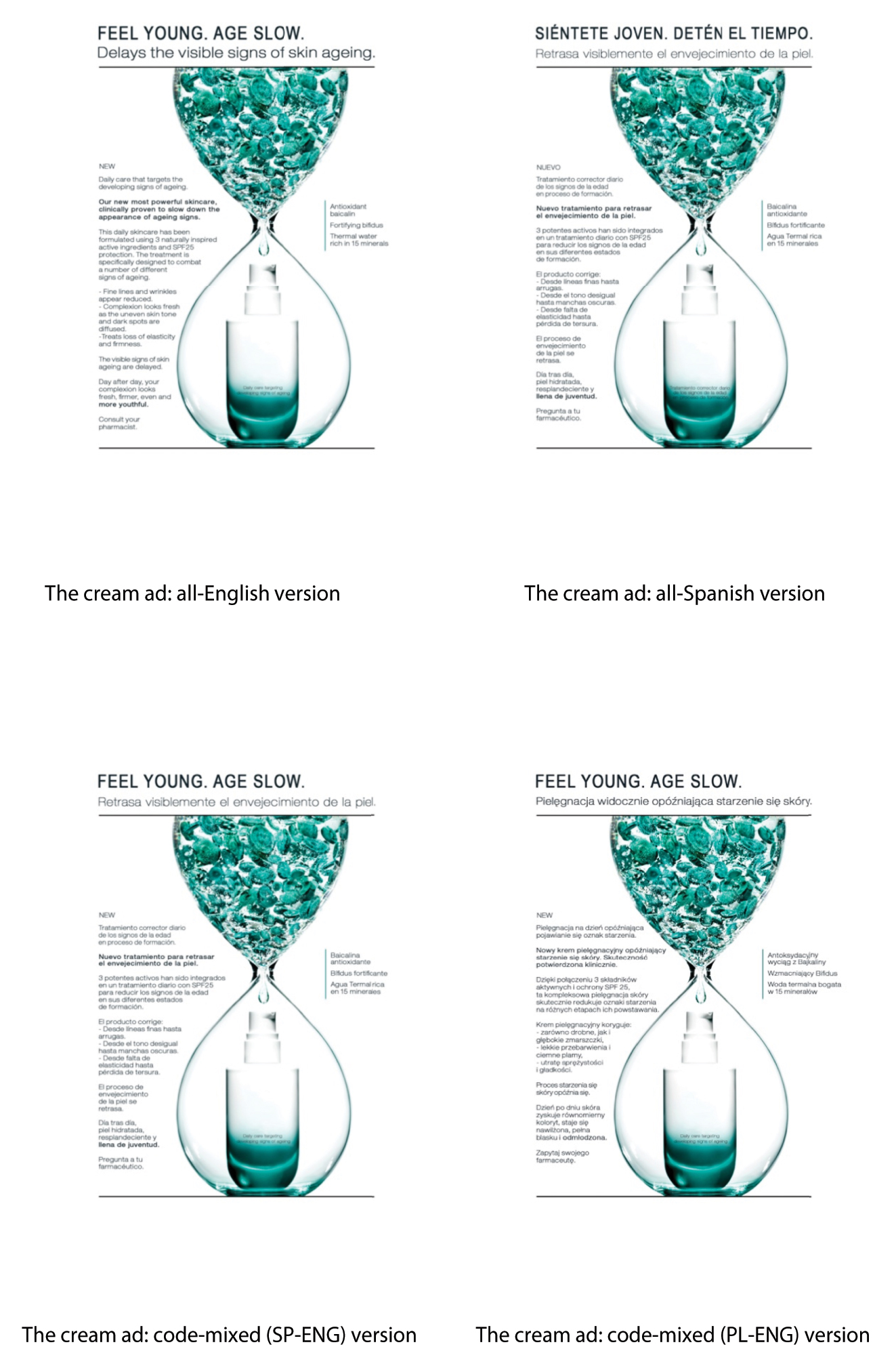
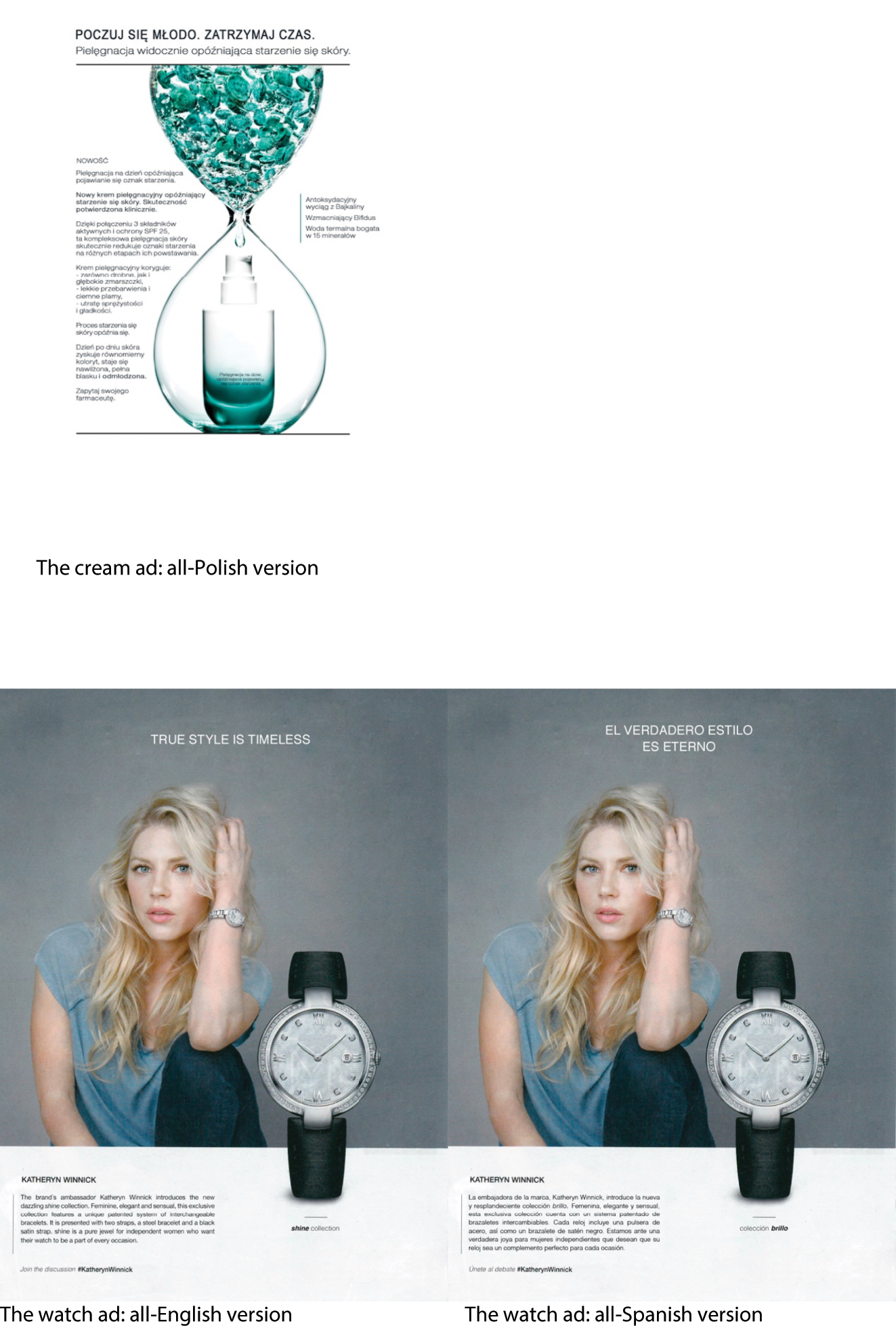
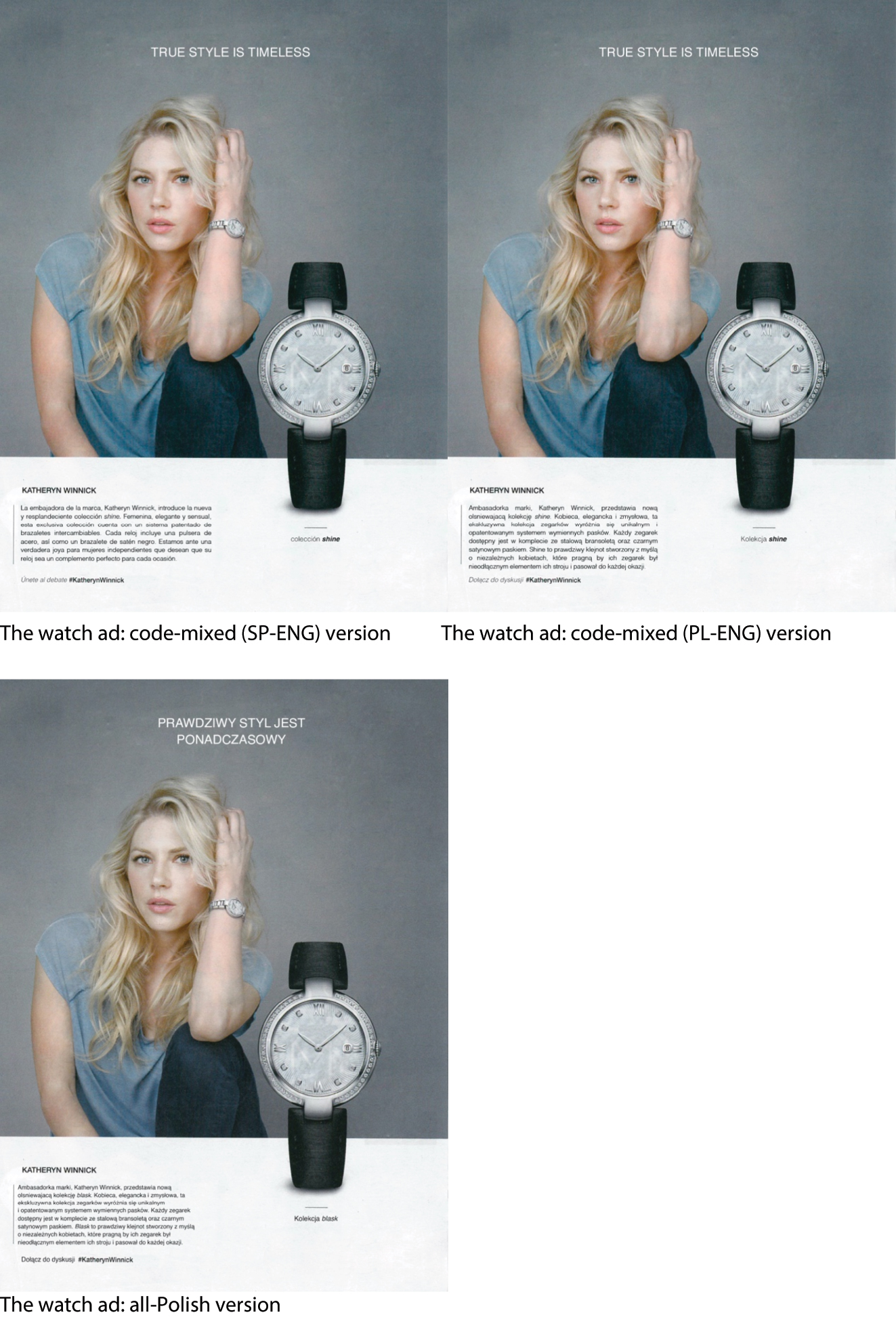
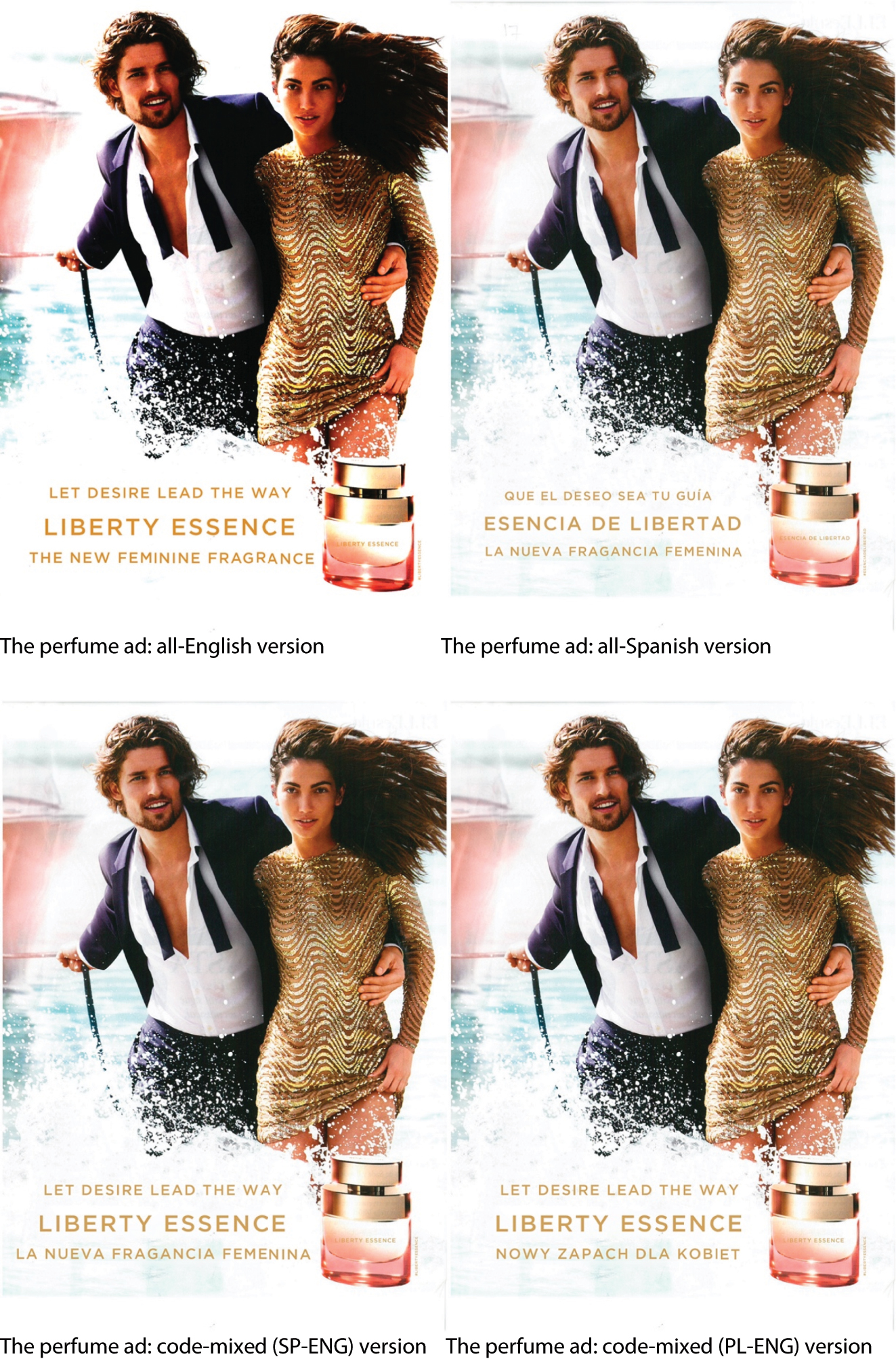

References
Allen, Mark S., Dragos Iliescu & Samuel Greiff. 2022. Single item measures in psychological science: A call to action [Editorial]. European Journal of Psychological Assessment 38(1). 1–5. https://doi.org/10.1027/1015-5759/a000699.Search in Google Scholar
Buławka, Hanna M. 2006. English in Polish advertising. Birmingham: University of Birmingham MA thesis.Search in Google Scholar
Cook, Guy. 2001. The discourse of advertising. London: Routledge.10.4324/9780203978153Search in Google Scholar
Friedrich, Patricia. 2002. English in advertising and brand naming: Sociolinguistic considerations and the case of Brazil. English Today 18(3). 21–28. https://doi.org/10.1017/S0266078402003048.Search in Google Scholar
Gerritsen, Marinel, Catherine Nickerson, Andreu van Hooft, Frank van Meurs, Ulrike Nederstigt, Marianne Starren & Rogier Crijns. 2007a. English in product advertisements in Belgium, France, Germany, The Netherlands and Spain. World Englishes 26(3). 291–315. https://doi.org/10.1111/j.1467-971X.2007.00510.x.Search in Google Scholar
Gerritsen, Marinel, Catherine Nickerson, Corine van den Brandt, Rogier Crijns, Nuria Domínguez, Frank van Meurs & Nederstigt Ulrike. 2007b. English in print advertising in Germany, Spain and The Netherlands: Frequency of occurrence, comprehensibility and the effect on corporate image. In Giuliana Garzone & Cornelia Ilie (eds.), The use of English in institutional and business settings: An intercultural perspective, 79–98. Bern: Peter Lang.Search in Google Scholar
Gerritsen, Marinel, Catherine Nickerson, Andreu van Hooft, Frank van Meurs, Hubert Korzilius, Ulrike Nederstigt, Marianne Starren & Rogier Crijns. 2010. English in product advertisements in non-English-speaking countries in Western Europe: Product image and comprehension of the text. Journal of Global Marketing 23(4). 349–365. https://doi.org/10.1080/08911762.2010.504523.Search in Google Scholar
Gómez Cerdeño, Teresa. 2010. The use of foreign words as a persuasive tool in Marketing discourse: The cultural stereotype of global English in Spanish print advertising. Madrid: Complutense University MA thesis.Search in Google Scholar
Haarmann, Harald. 1989. Symbolic values of foreign language use: From the Japanese case to a general sociolinguistic perspective. Berlin: Mouton de Gruyter.10.1515/9783110868395Search in Google Scholar
Hendriks, Berna, Frank van Meurs & Chantal Poos. 2017. Effects of difficult and easy English slogans in advertising for Dutch consumers. Journal of Current Issues & Research in Advertising 38(2). 184–196. https://doi.org/10.1080/10641734.2017.1291384.Search in Google Scholar
Hornikx, Jos & Frank van Meurs. 2017. Foreign languages in advertising as implicit country- of- origin cues: Mechanism, associations, and effectiveness. Journal of International Consumer Marketing 29(2). 60–73. https://doi.org/10.1080/08961530.2016.1243996.Search in Google Scholar
Hornikx, Jos & Frank van Meurs. 2020. Foreign languages in advertising. Linguistic and marketing perspectives. London: Palgrave Macmillan.10.1007/978-3-030-31691-4Search in Google Scholar
Hornikx, Jos, Frank van Meurs & Anja de Boer. 2010. English or a local language in advertising? The appreciation of easy and difficult English slogans in The Netherlands. Journal of Business Communication 47(2). https://doi.org/10.1177/0021943610364524.Search in Google Scholar
Hsu, Jia-Ling. 2008. Glocalization and English mixing in advertising in Taiwan: Its discourse domains, linguistic patterns, cultural constraints, localized creativity, and sociopsychological effects. Journal of Creative Communications 3(2). 155–183. https://doi.org/10.1177/097325860800300203.Search in Google Scholar
Kasztalska, Aleksandra & Aleksandra Swatek. 2024. The dynamic role of the English language in contemporary Poland. World Englishes 43(2). 301–314. https://doi.org/10.1111/weng.12642.Search in Google Scholar
Kelly-Holmes, Helen. 2000. Bier, Parfum, Kass: Language fetish in European advertising. European Journal of Cultural Studies 3(1). 67–82. https://doi.org/10.1177/a010863.Search in Google Scholar
Kelly-Holmes, Helen. 2005. Advertising as multilingual communication. London: Palgrave Macmillan.10.1057/9780230503014Search in Google Scholar
Llurda, Enric & Vasilica Mocanu. 2024. English in Spain: Education, attitudes and native-speakerism. World Englishes 43(2). 315–331. https://doi.org/10.1111/weng.12651.Search in Google Scholar
Mellinger, Christopher D. & Thomas A. Hanson. 2024. Psychometric properties of survey translations: A simulation study. Translation, Cognition, & Behavior 7(1). 159–185. https://doi.org/10.1075/tcb.00094.mel.Search in Google Scholar
Nickerson, Catherine & Belinda Crawford Camiciottoli. 2013. Business English as a Lingua Franca in advertising texts in the Arabian Gulf: Analyzing the attitudes of the Emirati community. Journal of Business and Technical Communication 27(3). https://doi.org/10.1177/1050651913479930.Search in Google Scholar
Nederstigt, Ulrike & Béryl Hilberink-Schulpen. 2018. Advertising in a foreign language or the consumers’ native language? Journal of International Consumer Marketing 30(1). 2–13. https://doi.org/10.1080/08961530.2017.1363008.Search in Google Scholar
Nowak, Katarzyna A. 2021. English in Spanish and Polish advertising: The impact of non- translation and code-switching on the receiver’s attitudes and preferences. Murcia: Universidad de Murcia doctoral dissertation.Search in Google Scholar
Olszewska, Aleksandra, Maria Coady & Urszula Markowska-Manista. 2022. Language planning, linguistic imperialism, and English language teacher education in post-Soviet Poland: A literature review. In Lee McCallum (ed.), English language teaching, English language teaching: Theory, research and pedagogy, 51–67. Singapore: Springer.10.1007/978-981-19-2152-0_4Search in Google Scholar
Planken, Brigitte, Frank van Meurs & Radlinska Ania. 2010. The effects of the use of English in Polish product advertisements: Implications for English for business purposes. English for Specific Purposes 29(4). 225–242. https://doi.org/10.1016/j.esp.2010.06.003.Search in Google Scholar
Perzyna, Natalia. 2017. Langauge choice in advertising: The response of Polish consumers to Polish, English and mixed-language advertisements for luxury and necessity products. Nijmegen: Radboud University MA thesis.Search in Google Scholar
Piller, Ingrid. 2002. Identity constructions in multilingual advertising. Language in Society 30(2). 153–186. https://doi.org/10.1017/S0047404501002019.Search in Google Scholar
Piller, Ingrid. 2003. Advertising as a site of language contact. Annual Review of Applied Linguistics 23. 170–183. https://doi.org/10.1017/S0267190503000254.Search in Google Scholar
Raedts, Mariet, Natalie Dupré, Jef Hendrickx & Sophie Debrauwere. 2015. English in television commercials in Belgium, France, Italy, The Netherlands and Spain. World Englishes 34(4). 576–599. https://doi.org/10.1111/weng.12161.Search in Google Scholar
Truong, Yann, Rod McColl & Philip. J. Kitchen. 2010. Uncovering the relationships between aspirations and luxury brand preference. Journal of Product & Brand Management 19(5). 346–355. https://doi.org/10.1108/10610421011068586.Search in Google Scholar
Ustinova, Irina P. & Tej K. Bhatia. 2005. Convergence of English in Russian TV commercials. World Englishes 24(4). 495–508. https://doi.org/10.1111/j.0883-2919.2005.00433.x.Search in Google Scholar
Van Hooft, Andreu, Frank van Meurs & David Spierts. 2016. Arabic, English or a mix? Egyptian consumers’ response to language choice in product advertisements. Paper presented at 15th International Conference on Research in Advertising (ICORIA) at European Advertising Academy/University of Ljubljana, 30 June – 2 July.10.1007/978-3-658-18731-6_11Search in Google Scholar
Vettorel, Paola. 2013. English in Italian advertising. World Englishes 32(2). 261–278. https://doi.org/10.1111/weng.12023.Search in Google Scholar
Zeithaml, Valarie A. 1988. Consumer perceptions of price, quality, and value a means-end model and synthesis of evidence. Journal of Marketing 52(3). 2–22. https://doi.org/10.1177/002224298805200302.Search in Google Scholar
© 2024 Walter de Gruyter GmbH, Berlin/Boston
Articles in the same Issue
- Frontmatter
- Articles
- The role of the insider translator in conservation and development: comparing multilingual (auto)ethnobotanical books from Tanzania, Thailand, and Taiwan
- Philanthrocapitalism and the languaging of empowered women in the Global South
- The Complementary Principle and language dominance: mapping the language–domain relationships of Spanish–English bilinguals
- When English isn’t enough in advertising: the role of language, ad length, and complexity in consumer attitudes across Spain and Poland
- “Calming my heartbeat to enjoy the show”: the social-indexical meanings of in-yer-face theater recontextualized in China
Articles in the same Issue
- Frontmatter
- Articles
- The role of the insider translator in conservation and development: comparing multilingual (auto)ethnobotanical books from Tanzania, Thailand, and Taiwan
- Philanthrocapitalism and the languaging of empowered women in the Global South
- The Complementary Principle and language dominance: mapping the language–domain relationships of Spanish–English bilinguals
- When English isn’t enough in advertising: the role of language, ad length, and complexity in consumer attitudes across Spain and Poland
- “Calming my heartbeat to enjoy the show”: the social-indexical meanings of in-yer-face theater recontextualized in China
