New Insights on the Multivariate Skew Exponential Power Distribution
-
Jorge M. Arevalillo
 and
Hilario Navarro
and
Hilario Navarro

ABSTRACT
The multivariate exponential power is a useful distribution for modeling departures from normality in data by means of a tail weight scalar parameter that regulates the non-normality of the model. The incorporation of a shape asymmetry vector into the model serves to account for potential asymmetries and gives rise to the multivariate skew exponential power distribution. This work is aimed at revisiting the skew exponential power distribution taking as a starting point its formulation as a scale mixture of skew-normal distributions. The paper provides some highlights and theoretical insights on the role played by its parameters to assess two complementary aspects of the multivariate non-normality such as directional asymmetry and tail weight behavior regardless of the asymmetry. The intuition behind both issues relies on well-known mathematical ideas about skewness maximization and convex transform stochastic orderings.
1. Introduction
The exponential power (EP) distribution has an ancient history in statistics which dates back to Subbotin’s pioneer work [42] with an early multivariate generalization introduced by De Simoni [41], later on quoted by the follow-up [24]; it can also be considered as a particular case of the Kotz-type family of distributions [31] as highlighted in [19: Section 3.2]. Unlike other non-normal distributions, like for example the t distribution, the EP family has the advantage of including distributions having heavier and lighter tails than the normal one with the normal model being an intermediate distribution within the family. Due to its flexibility and wide scope, a lot of research has been carried out since the aforementioned foundational works with contributions that show its usefulness both in univariate [1, 13, 14, 18, 25, 39, 45, 46] and multivariate settings [20, 22, 23, 32, 35], a matrix generalization of the model [40], its study in the context of the general class of elliptically contoured distributions [3, 21, 30, 38], some caveats about its limitation to remain closed under marginalization [27], as well as related variants to assess asymmetry [2, 6, 12] and some other models under which this family can be considered [37, 38].
This paper adopts the approach of several of the aforementioned works [19, 21, 24, 27] to define the multivariate EP distribution as follows: we say that an input vector X follows a p-dimensional exponential power distribution with location vector ξ and full rank scale matrix Ω if its probability density function (pdf) is given by
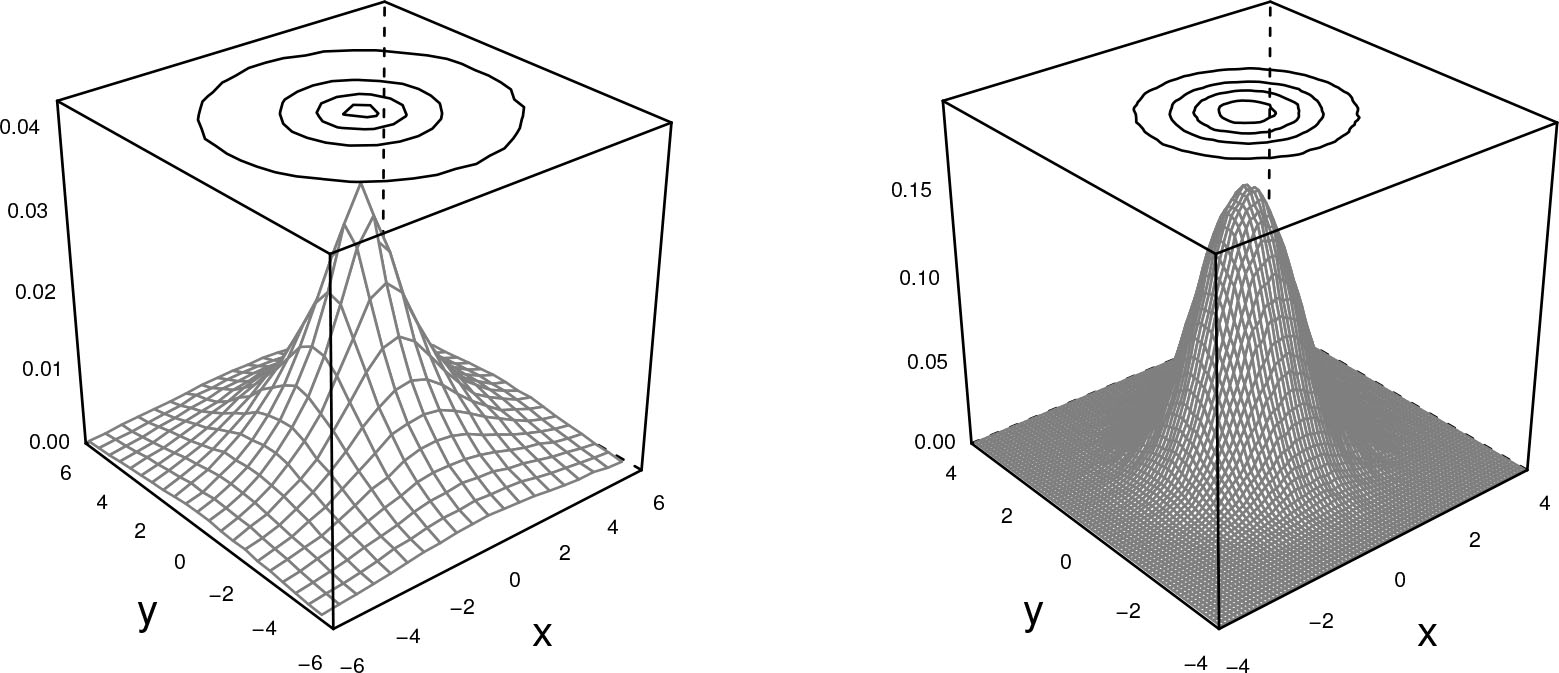
Probability density functions for the bivariate double exponential (left) and normal (right) variables with location ξ = (0,0) and scale matrix Ω = I2.
The skew exponential power (SEP) class arises when asymmetry is injected into a EP distribution so that a skewed model is obtained as a result; some past works have addressed the issue dealing with different variants of skewed EP distributions: see the works [2, 6, 12] or the alternative formulation as a scale mixture of skew-normal (SMSN) distributions [15: Section 3]. This paper examines the multivariate SEP family from the latter representation, from which analytical closed expressions for moments can be obtained [16, 28], a relevant issue when addressing skewness maximization. The paper is organized as follows: The next section gives some background about the multivariate SN distribution and the SMSN representation of the SEP vector. Section 3 discusses the role played by the shape vector and the tail weight β as parameters that account for the multivariate non-normality of the model; some novel insights regarding the assessment of directional asymmetry, through the direction that yields the maximal skewness projection, as well as the connection of the tail weight parameter with well established multivariate convex transform stochastic orderings, are studied in order to enhance their interpretation in the assessment of the multivariate non-normality. Finally, Section 4 recaps the main findings of the paper suggesting yet unexplored ideas to advance progress towards future research directions.
2. The multivariate skew exponential power distribution
This section deals with some material aimed at presenting the SMSN formulation of the SEP distribution. Firstly, some background about the SN distribution and its extension to the SMSN family is provided; then the representation of the multivariate exponential power distribution as a scale mixture of normal (SMN) distributions is used in order to introduce the SMSN representation of the SEP model in a natural way.
2.1. The multivariate skew-normal and SMSN families
The multivariate skew-normal (SN) distribution was introduced by [9] to regulate asymmetry departures from normality. Here, it is adopted the notation of the original seminal works [8, 9] to define the pdf of a p-dimensional SN vector with location vector ξ = (ξ1, …, ξp)┬ and scale matrix Ω as follows:
where ϕp(·; Ω ) denotes the pdf of a p-dimensional normal variate with zero mean and covariance matrix Ω, Φ is the distribution function of a standard N(0, 1) scalar variable, ω = diag(ω1, …, ωp) is a scale diagonal matrix with non negative entries such that
Note that the diagonal matrix ω can be written as ω = (Ω ☉ Ip)1/2, where the symbol ☉ denotes the entry-wise matrix product. It also holds that X = ξ + ωZ, where Z is a normalized multivariate skew-normal variable with pdf given by
The normalized SN variate has a simple pdf and a tractable stochastic representation which enables its extension to the wider SMSN family in a natural way [11, 16, 17] (with reference [17] a posthumous reprint of [16]). This paper adopts the formulation from the aforementioned works to define a SMSN vector as follows:
Let Z be a random vector such that
We put X ~ SMSNp(ξ, Ω, α, H) with H the distribution function of the mixing variable S and
2.2. The SMSN formulation of the skew exponential power distribution
The SMSN distribution reduces to a scale mixture of normal distributions when the shape vector is equal to the p-dimensional zero vector, a = 0p, since the vector Z from Definition 1 has a p-dimensional normal distribution, i.e.
Let X be a p-dimensional vector such that X ~ EPp(ξ, Ω, β). Then it holds that X ~ SMNp(ξ, Ω, H) if and only if 0 < β ≤1. When β ϵ(0, 1) the distribution H of the mixing variable is absolutely continuous and it has pdf given by
where
The result of Proposition 2.1 motivates to define the skew EP distribution as follows.
Let Z be a vector such that
We write X ~ SEPp(ξ, Ω, α, β) to indicate that X follows a p-dimensional SEP distribution with location ξ, scale matrix
From the stochastic representation of the SEP vector in Definition 2, the mean vector and the covariance matrix of the model are obtained by combining (6.18) of [11] with Lemma 2.1:
Let X be a vector such that X ~ SEPp(ξ, Ω, α, β). Then the moments of the mixing variable are given by
Proof. See the appendix. □
Then it can be shown in an easy way that
with
The stochastic representation also provides a natural strategy for the simulation of observations from a p-dimensional SEP vector. Although the observations from the SN vector ωZ can be obtained in an easy way using the functionalities of the sn R package [7], the non tractability of the density function (2.3) makes the simulation of the mixing variable a difficult task. However, for some specific tail weight parameters the mixing variable has a well-known distribution; in such cases we can simulate observations from S: for example, when β = 1, the model becomes the SN distribution, whereas β = 1/2 corresponds to the skewed version of the multivariate double exponential distribution, with the mixing variable S following a generalized gamma distribution [23]. Figure 2 displays the plots of the pdf for the skewed bivariate double exponential; it illustrates the effect caused by the parametric vector α on the shape of the densities as well as the contoured plots obtained after injection of asymmetry across different directions.

Density functions of the bivariate double exponential (β = 1/2), with location ξ = (0, 0) and scale matrix Ω = I2, for different shape vectors.
3. Insights on the multivariate non-normality of the model
This section examines the role played by the parameters of the SEP model to assess multivariate non-normality; some ideas on kurtosis and directional asymmetry are discussed next.
3.1. Assessment of kurtosis
First of all, we introduce some notation: Let X be SEP vector such that X ~ SEPp(ξ, Ω, α, β) and let us denote by X0 the vector obtained when α = 0p, where 0p is the p-dimensional zero vector so that X0 ~ EPp(ξ, Ω, β). Let us consider the quadratic forms QX and QX0, associated to X and X0, given by QX = (X – ξ)┬Ω−1(X – ξ) and QX0 = (X0 – ξ)┬Ω−1(X0 – ξ). Finally, let us denote by SEP the class of skew exponential power distributions having a SMSN representation, which is given by
Since X0 follows an elliptical distribution, the quadratic form QX0 has the same distribution as the so called modular variable,
We now define a stochastic relation between SEP vectors as follows:
Let X1 and X2 be two vectors such that Xi ~ SEPp(ξi, Ωi, αi, βi) : i = 1, 2. We say that X1 and X2 are modular related, and we denote it by
It can be shown that
so it holds that
Let us consider X and Y two SEP vectors such that X ~ SEPp(ξ1, Ω1, α1, β1) and Y ~ SEPp(ξ2, Ω2, α2, β2). We say that X is less than or equal to Y in kurtosis, and we denote it by X ≤k Y, if and only if
The k-ordering handles the comparison of SEP vectors by setting the problem in terms of the convex transform ordering of their quadratic forms QX and QY. The next theorem shows that the order in Definition 4 is actually a total ordering in the same direction as the tail weight parameter β.
Let us consider two random vectors X and Y such that X ~ SEPp(ξ1 Ω1, α1 β1) and Y ~ SEPp(ξ2, Ω2, α2, β2). If 0 < β1 ≤ β2 ≤ 1, then Y ≤ k X when p > 2.
Proof. We must proof the convexity of the function
The proof follows from a simple argument that uses the definition of the relation
Theorem 3.1 provides intriguing theoretical insights. In addition to providing a mathematically sounded result for the stochastic comparison of equivalence classes from the relation
3.2. Assessment of directional asymmetry
While the tail weight parameter β regulates the peakedness of the distribution irrespective of its asymmetry, the shape vector α —or its equivalent counterpart η = ω−1α— is aimed at accounting for multivariate asymmetry in a directional fashion. In order to delve into its role to handle directional asymmetry, we set out the problem of finding directions that yield maximal skewness projections when the input vector X follows a SEP distribution. The problem can be formally described as follows:
Let X be a p-dimensional input vector such that X ~ SEPp(ξ, Ω, α, β) with 0 < β ≤ 1. Our goal is to find the vector c for which the scalar variable Y = c┬X attains the maximal skewness, that is, the vector yielding the maximal skewness proyection. This goal is accomplished by solving the optimization problem:
Since γ1 is scale invariant, without loss of generality, we can confine to vectors such that c┬Ωc = 1; hence, the problem can be formulated as
where
The maximal skewness
Let S be the mixing variable of a scale mixture model with density function (2.3). Then it holds the moment inequality E(S3) – E(S)E(S2) ≥ 0.
Proof. See the appendix. □
Let X be a vector such that X ~ SEPp(ξ, Ω, α, β). Then the moments of the mixing variable meet the following inequality:
Proof. See the appendix. □
Let X be a vector such that X ~ SEPp(ξ, Ω, α, β). Then it holds the following inequality:
Proof. See the appendix. □
The result on directional asymmetry is now stated in the next theorem.
Let X be a random vector such that X ~ SEPp(ξ, Ω, α, β) with 0 < β ≤ 1. Then the maximum skewness in (3.1) is attained at the direction of the shape vector η┬ = α┬ω−1, specifically at
Proof. When β = 1, the input vector X follows a SN; so the proof follows from [33]. In order to prove the statement when β ϵ (0,1), we use the lemmas in the Appendix in combination with some of the arguments deployed by [4, 33].
Since γ1 is location invariant, we can assume that ξ = 0 for the sake of simplicity. Taking into account the SMSN representation of the SEP vector, the properties of the SN under linear transformations – see [11: (5.42) and (5.43)] or alternatively the earlier work [8] – and the assumption c┬Ωc = 1 for the vector driving the direction, it follows that the scalar variable Y = c┬X = SZ, with Z = c┬ωZ, has a SN distribution such that Z – SN1(0,1, λ), where the shape scalar parameter λ is given by
Therefore, Y admits a SNSM formulation so that we can apply Proposition 3 from [16] to get
where the quantities appearing in (3.2) are defined by
We now show that γ1(Y) is non decreasing function with respect to δ2. Its first derivative is given by
The quantities appearing in the expression above can be rearranged to give
where h(δ2) = δ2 − bE(S2) with
Lemmas 3.1 and 3.3 show that −b ≥ 0 and a −2b ≥ 0 which implies that a −3b ≥ 0. We now study the sign of the factors aδ2 – 3b and h(δ2) from the expression above.
If it happened that α ≥ 0, then we would obtain that aδ2 – 3b ≥ 0 whereas if a < 0, it would result that aδ2 – 3b > a – 3b so aδ2 – 3b ≥ 0 once again. To study the sign of h(δ2), we also distinguish two cases: if c ≥ 0, then it suffices to invoke Lemma 3.1 once again to get h(δ2) ≥ 0; meanwhile, if it happened that c < 0, then, taking into account Lemma 3.2, we obtain that h(1) − c – bE(S2) ≥ 0; so we conclude that h(δ2) > h(1) ≥ 0.
The non negativity of aδ2 – 3b and h(δ2) shows that γ1(Y) is a non decreasing function of δ2. Therefore, the maximization of the skewness measure γ1(c┬X) is equivalent to the maximization of the quantity
where
Note that if we replace δ2 in expression (3.2) by the quantity
where the moments appearing in this expression can be calculated from their general expression in Lemma 2.1. Actually, the quantity above provides an analytical formula for Malkovich-Afifi’s measure of skewness [36] under SEP multivariate distributions.
For the specific case of a tail weight parameter β = 1, the mixing variable is degenerate at S = 1 so that E(S) = E(S2) = E(S3) = 1; hence, the quantity in expression (3.4) becomes
This quantity corresponds to Mardia’s and Malkovich-Afifi’s measures of multivariate skewness under the multivariate SN distribution [8, 11, 33] as was expected to happen.
Figure 3 displays the heat color surfaces that depict the skewness measure
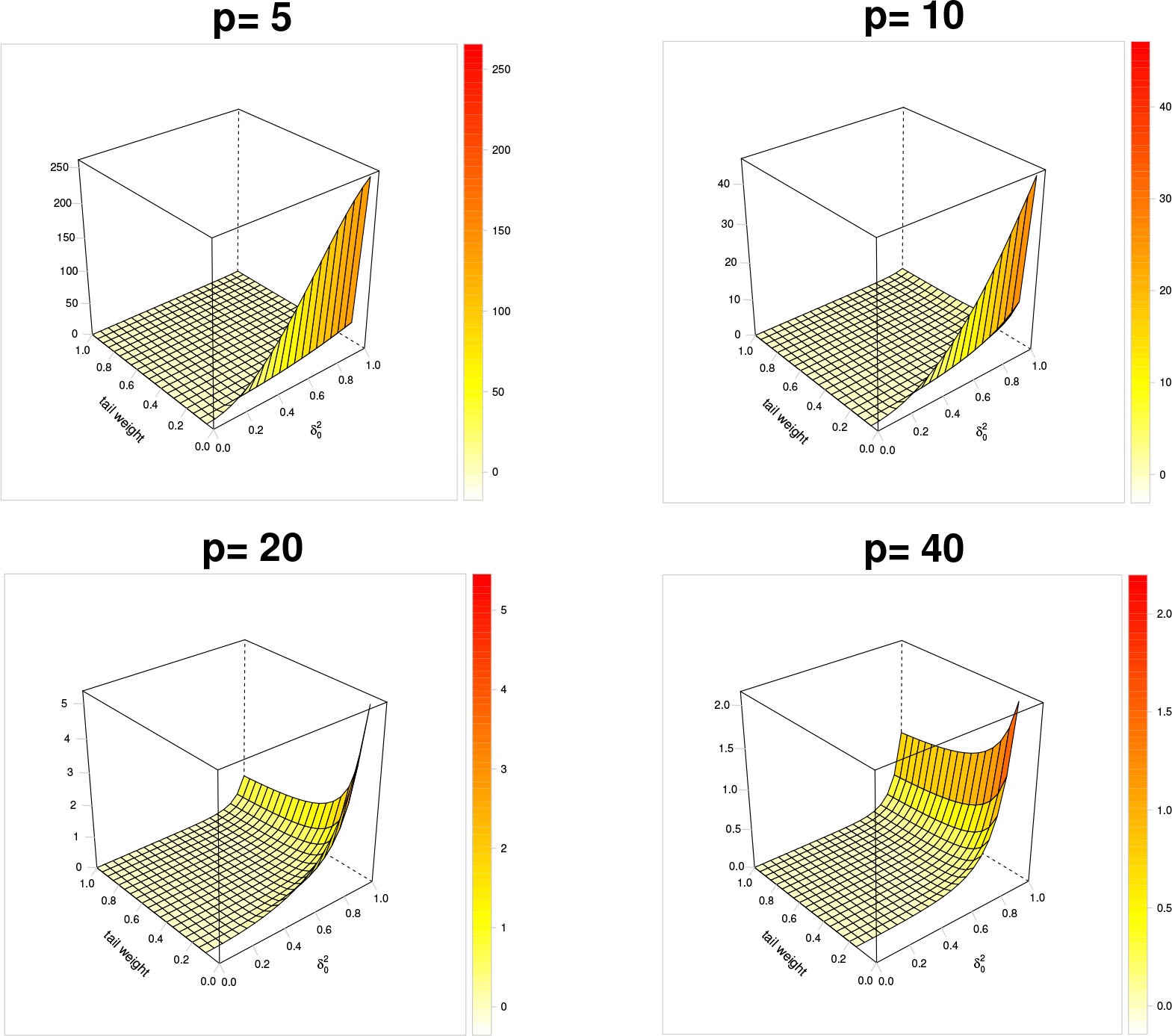
Skewness surfaces with respect to the quantities

Skewness curves for the tail weight parameters: β = 3/4 (solid line), β = 1/2 (dashed line), β = 1/4 (dotted line) and dimensions p = 5 (top left), p = 10 (top right), p = 20 (bottom left) p = 40 (bottom right).
4. Concluding remarks
In this paper we have examined the multivariate skew exponential power distribution and have studied some of its theoretical properties in order to delve into the role played by the parameters of the model to handle the multivariate non-normality. It has been assumed that the tail weight parameter meets the condition 0 < β ≤ 1 so that the skew exponential power vector admits a SMSN stochastic representation. The SMSN formulation is useful to show that the tail weight parameter accounts for multivariate kurtosis regardless of the shape asymmetry vector, whereas the shape vector regulates the multivariate asymmetry in a directional fashion; specifically, it is shown that such a shape vector lies on the direction yielding the maximal skewness projection regardless of the value of the tail weight parameter. When the tail weight equals to β = 1, the underlying model reduces to the SN distribution and our result on directional skewness agrees with previous work for SN vectors [33]. Summing up, we advocate the unique and singular role of the tail weight and the shape vector of multivariate skew exponential power model to account independently for different facets of the non-normality.
The theoretical results from Theorems 3.1 and 3.2 have implications for research in the statistical practice including but not limited to: skewness-based projection pursuit, the modeling of non-normal asset returns, model-based clustering and the role played by the SEP parameters as well as the sensitivity of gaussian bayesian networks to deviations from normality along the lines of previous work [35]. Moreover, an explicit expression of the pdf of the SEP model would enable inferential work; research in this direction may benefit from the approach followed in Section 4.1 of [10].
Our findings also highlight some other problems for future research: A major advantage of the exponential power distribution is that it can model both light and heavy tails; as the Kotz-type distribution has the same characteristic and additionally it can also model holes [29], we wonder whether the properties studied for SEP distributions would also be valid for skewed generalizations of Kotz-type distributions. Moreover, the consideration of other SEP formulations, like those ones introduced in [2,12], may deserve further investigation on kurtosis assessment and directional skewness for the case β > 1. On the other hand, the skew-normal Cauchy model can be represented as a shape-scale mixture of SN distributions whose properties, including third moments and cumulants, have been investigated by [26] and are closely related to those ones of the SEP model; the study of directional asymmetry under shape-scale mixtures of SN vectors is also an open problem. Another issue is concerned with the consideration of other measures of multivariate skewness that depend on third moments [34].
As an afterthought, the results derived in this work also point out further research regarding the stochastic comparison of SMSN vectors: the SMSN representation of the multivariate skew exponential power model suggests looking into the role played by the non-normality parameters of the SMSN class by means of an ad hoc convex transform stochastic ordering; research effort along this line would complement previous related work on the issue [3, 5, 44].
Appendix
proofs of auxiliary lemmas
The proof relies on a property about quadratic forms of SN vectors. Taking into account [11: Corollary 5.1] or the property appearing in expression (5.7) of [11: Section 5.7], we can assert that the quadratic form Q = (X – ξ)┬Ω−1(X – ξ) = S2Y┬Ω−1Y − with Y a vector such that Y ~ SNp(0p, Ω, α) – has the same distribution as
Since the scalar variables R2 and Q have the same distribution, we can put:
from which we get
The expectations appearing in E(Sk) can be calculated in an easy way due to the tractability of the density functions of R and G2; simple integral calculus gives
which in turn leads to the expression of the statement. □
The result follows from the next property: if f and g are two increasing functions, then it holds that Cov(f(X), g(X)) ≥ 0 provided that the second order moments and cross moments of f(X) and g(X) exist. Since S is a non negative random variable the statement of the lemma will follow putting f(S) = S2 and g(S) = S. □
Using the general expression from Lemma 2.1, we get
We now define the function:
From the series expansion of the digamma function given by
where γ is the Euler-Mascheroni constant, we obtain
Hence, g is a convex function which implies that g′(x) and g0(x) are non decreasing functions, with the latter one being non decreasing because
with f the function defined by
The previous expression shows that f is non decreasing; so putting
which implies that the quantity (4.1) is non negative, as we aimed to prove. □
From the general expression of the moments of the mixing variable in Lemma 2.1, we obtain after simple calculations
where
with f1 and f2 functions given by
Their first derivatives are
with g0 the same function as the one defined in the proof of the previous lemma. Using analogous arguments as before, we can conclude that f1 and f2 are non decreasing which implies
We now calculate the first derivative of f:
Taking into account the lower bound for f2, we get
Therefore, we can assert that f is also a non decreasing function for ω ≥ 1; consequently f(ω) ≥ f(1) = −1/2 which implies that
as we aimed to prove. □
Acknowledgement
The authors are grateful to the reviewers for their useful recommendations that contributed to improve the draft version of this paper. JMA also acknowledges the support received by NextGenerationEU.
References
[1] Agrò, G.: Maximum likelihood estimation for the exponential power function parameters, Comm. Statist. Simulation Comput. 24(2) 1995, 523–536.10.1080/03610919508813255Search in Google Scholar
[2] Arellano-Valle, R.—Richter, W.-D.: On skewed continuous ln,p-symmetric distributions, Chil. J. Stat. 3 (2012), 193–212.Search in Google Scholar
[3] Arevalillo, J. M.—Navarro, H.: A study of the effect of kurtosis on discriminant analysis under elliptical populations, Multivariate Anal. 107 (2012), 53–63.10.1016/j.jmva.2012.01.011Search in Google Scholar
[4] Arevalillo, J. M.—Navarro, H.: A note on the direction maximizing skewness in multivariate skew-t vectors, Statist. Probab. Lett. 96 (2015), 328–332.10.1016/j.spl.2014.10.014Search in Google Scholar
[5] Arevalillo, J. M.—Navarro, H.: A stochastic ordering based on the canonical transformation of skew-normal vectors, TEST 28(2) (2019), 475–498.10.1007/s11749-018-0583-5Search in Google Scholar
[6] Azzalini, A.: Further results on a class of distributions which includes the normal ones, Statistica 46 199-208, 1986; Reprinted with annotations and corrigenda 80 (2020), 161–175.Search in Google Scholar
[7] Azzalini, A.: The R package sn: The Skew-Normal and Related Distributions such as the Skew-t and the SUN (version 2.0.0), Università di Padova, Italia, 2021.Search in Google Scholar
[8] Azzalini, A.—Capitanio, A.: Statistical applications of the multivariate skew normal distribution, J. R. Stat. Soc. Ser. B. Stat. Methodol. 61(3) (1999), 579–602.10.1111/1467-9868.00194Search in Google Scholar
[9] Azzalini, A.—Dalla Valle, A.: The multivariate skew-normal distribution, Biometrika 83(4) (1996), 715–726.10.1093/biomet/83.4.715Search in Google Scholar
[10] Azzalini, A.—Capitanio, A.: Distributions generated by perturbation of symmetry with emphasis on a multivariate skew t-distribution, J. R. Stat. Soc. Ser. B. Stat. Methodol. 65(2) (2003), 367–389.10.1111/1467-9868.00391Search in Google Scholar
[11] Azzalini, A.—Capitanio, A.: The Skew-Normal and Related Families. IMS Monographs, Cambridge University Press, 2014.10.1017/CBO9781139248891Search in Google Scholar
[12] Azzalini, A.—Regoli, G: Some properties of skew-symmetric distributions, Ann. Inst. Statist. Math. 64(4) (2012), 857–879.10.1007/s10463-011-0338-5Search in Google Scholar
[13] Box, G. E. P.: A note on regions for tests of kurtosis, Biometrika 40(3–4) (1953), 465–468.10.1093/biomet/40.3-4.465Search in Google Scholar
[14] Box, G. E. P.—Tiao, G. C.: Bayesian Inference in Statistical Analysis, Addison-Wesley Publishing Company, 1973.Search in Google Scholar
[15] Branco, M. D.—Dey, D. K.: A general class of multivariate skew-elliptical distributions, J. Multivariate Anal. 79(1) (2001), 99–113.10.1006/jmva.2000.1960Search in Google Scholar
[16] Capitanio, A: On the canonical form of scale mixtures of skew-normal distributions, https://arxiv.org/abs/1207.0797.Search in Google Scholar
[17] Capitanio, A: On the canonical form of scale mixtures of skew-normal distributions, Statistica 80(2) (2020), 145–160.Search in Google Scholar
[18] Choy, S. T. B.—Smith, A. F. M.: Hierarchical models with scale mixtures of normal distributions, TEST 6(1) (1997), 205–221.10.1007/BF02564434Search in Google Scholar
[19] Fang, K. T.—Kotz, S.—NG, K.-W.: Symmetric Multivariate and Related Distributions. Monographs on Satistics and Applied Probability, Chapman & Hall, 1990.10.1007/978-1-4899-2937-2Search in Google Scholar
[20] Gómez-Villegas, M. A.—Main, P.—Navarro, H.—Susi, R.: Assessing the effect of kurtosis deviations from gaussianity on conditional distributions, Appl. Math. Comput. 219(21) (2013), 10499–10505.10.1016/j.amc.2013.04.031Search in Google Scholar
[21] Gómez, E.—Gómez-Villegas, M. A.—Marín, J. M.: A multivariate generalization of the power exponential family of distributions, Comm. Statist. Theory Methods 27(3) (1998), 589–600.10.1080/03610929808832115Search in Google Scholar
[22] Gómez-Sánchez-Manzano, E.—Gómez-Villegas, M. A.—Marín, J. M.: Sequences of elliptical distributions and mixtures of normal distributions, J. Multivariate Anal. 97(2) (2006), 295–310.10.1016/j.jmva.2005.03.008Search in Google Scholar
[23] Gómez-Sánchez-Manzano, E.—Gómez-Villegas, M. A.—Marín, J. M.: Multivariate exponential power distributions as mixtures of normal distributions with bayesian applications, Comm. Statist. Theory Methods 37(6) (2008), 972–985.10.1080/03610920701762754Search in Google Scholar
[24] Goodman, I. R.—Kotz, S.: Multivariate θ-generalized normal distributions, J. Multivariate Anal. 3(2) (1973), 204–219.10.1016/0047-259X(73)90023-7Search in Google Scholar
[25] Hazan, A.—Landsman, Z.—Makov, U. E.: Robustness via a mixture of exponential power distributions, Comput. Statist. Data Anal. 42(1) (2003), 111–121.10.1016/S0167-9473(02)00153-6Search in Google Scholar
[26] Kahrari, F.—Rezaei, M.—Yousefzadeh, F.—Arellano-Valle, R. B.: On the multivariate skew-normal-cauchy distribution, Statist. Probab. Lett. 117 (2016), 80–88.10.1016/j.spl.2016.05.005Search in Google Scholar
[27] Kano, Y.: Consistency property of elliptic probability density functions, J. Multivariate Anal. 51(1) (1994), 139–147.10.1006/jmva.1994.1054Search in Google Scholar
[28] Kim, H.-M.—Kim, C.: Moments of scale mixtures of skew-normal distributions and their quadratic forms, Comm. Statist. Theory Methods 46(3) (2017), 1117–1126.10.1080/03610926.2015.1011339Search in Google Scholar
[29] Kollo, T.—Roos, A.: On Kotz-type elliptical distributions, In: Contemporary Multivariate Analysis and Design of Experiments, World Scientific, 2005, pp. 159–170.10.1142/9789812567765_0010Search in Google Scholar
[30] Korolev, V.: Some properties of univariate and multivariate exponential power distributions and related topics, Mathematics 8(11) (2020), Art. No. 1918.10.3390/math8111918Search in Google Scholar
[31] Kotz, S.: Multivariate distributions at a cross road. In: A Modern Course on Statistical Distributions in Scientific Work (G. P. Patil, S. Kotz, and J. K. Ord, eds.), Springer Netherlands, Dordrecht, 1975, pp. 247–270.10.1007/978-94-010-1842-5_20Search in Google Scholar
[32] Kuwana, Y.—Kariya, T.: Lbi tests for multivariate normality in exponential power distributions, J. Multivariate Anal. 39(1) (1991), 117–134.10.1016/0047-259X(91)90009-QSearch in Google Scholar
[33] Loperfido, N.: Canonical transformations of skew-normal variates, TEST 19(1) (2010), 146–165.10.1007/s11749-009-0146-xSearch in Google Scholar
[34] Loperfido, N.: Singular value decomposition of the third multivariate moment, Linear Algebra Appl. 473(2015), 202–216.10.1016/j.laa.2014.05.043Search in Google Scholar
[35] Main, P.—Navarro, H.: Analyzing the effect of introducing a kurtosis parameter in gaussian bayesian networks, Reliab. Eng. Syst. Safety 94(5) (2009), 922–926.10.1016/j.ress.2008.10.004Search in Google Scholar
[36] Malkovich, J. F.— Afifi, A. A.: On tests for multivariate normality, J. American Statist. Assoc. 68(341) (1973), 176–179.10.1080/01621459.1973.10481358Search in Google Scholar
[37] Morán-Vásquez, R. A.—Ferrari, S. L. P.: Box–cox elliptical distributions with application, Metrika 82(5) (2019), 547–571.10.1007/s00184-018-0682-zSearch in Google Scholar
[38] Morán-Vásquez, R. A.—Ferrari, S. L. P.: New results on truncated elliptical distributions, Commun. Math. Stat. 9(3) (2021), 299–313.10.1007/s40304-019-00194-3Search in Google Scholar
[39] NADARAJAH, S.: A generalized normal distribution, J. Appl. Stat. 32(7) (2005), 685-694.10.1080/02664760500079464Search in Google Scholar
[40] Sánchez-Manzano, E. G.—Gómez-Villegas, M. A.—Marín-Diazaraque, J.-M.: A matrix variate generalization of the power exponential family of distributions, Comm. Statist. Theory Methods 31(12) (2002), 2167-2182.10.1081/STA-120017219Search in Google Scholar
[41] Simoni, S.: Su una estensione dello schema delle curve normali di ordina r alle variabili doppie, Statistica 28 (1968), 151–170.Search in Google Scholar
[42] Subbotin, M. T.: On the law of frequency of error, Mat. Sbornik 31(2) (1923), 296–301.Search in Google Scholar
[43] Van Zwet, W. R.: Convex Transformations of Random Variables, Mathematish Centrum, Amsterdam, 1964.Search in Google Scholar
[44] Wang, J: A family of kurtosis orderings for multivariate distributions, J. Multivariate Anal. 100(3) (2009), 509–517.10.1016/j.jmva.2008.06.001Search in Google Scholar
[45] Wang, M.—Lu, T.: A matching prior for the shape parameter of the exponential power distribution, Statist. Probab. Lett. 97 (2015), 150–154.10.1016/j.spl.2014.11.016Search in Google Scholar
[46] West, M.: On scale mixtures of normal distributions, Biometrika 74(3) (1987), 646–648.10.1093/biomet/74.3.646Search in Google Scholar
© 2023 Mathematical Institute Slovak Academy of Sciences
This work is licensed under the Creative Commons Attribution 4.0 International License.
Articles in the same Issue
- Voltage Lifts of Graphs from a Category Theory Viewpoint
- Extensions and Congruences of Partial Lattices
- On Recurrences in Generalized Arithmetic Triangle
- The Asymptotics of the Geometric Polynomials
- D(4)-Triples with Two Largest Elements in Common
- Hardy-Leindler Type Inequalities for Multiple Integrals on Time Scales
- A New Version of q-Hermite-Hadamard’s Midpoint and Trapezoid Type Inequalities for Convex Functions
- Existence and Finite-Time Stability Results for Impulsive Caputo-Type Fractional Stochastic Differential Equations with Time Delays
- On Oblique Domains of Janowski Functions
- Sharp Approximations for the Generalized Elliptic Integral of the First Kind
- Topological Properties of Jordan Intuitionistic Fuzzy Normed Spaces
- Evaluation of Norm of (p, q)-Bernstein Operators
- Weyl ρ-Almost Periodic Functions in General Metric
- Certain Fixed Point Results On 𝔄-Metric Space Using Banach Orbital Contraction and Asymptotic Regularity
- Yamabe Solitons and τ-Quasi Yamabe Gradient Solitons on Riemannian Manifolds Admitting Concurrent-Recurrent Vector Fields
- On the Bivariate Generalized Gamma-Lindley Distribution
- New Insights on the Multivariate Skew Exponential Power Distribution
- On Locally Finite Orthomodular Lattices
Articles in the same Issue
- Voltage Lifts of Graphs from a Category Theory Viewpoint
- Extensions and Congruences of Partial Lattices
- On Recurrences in Generalized Arithmetic Triangle
- The Asymptotics of the Geometric Polynomials
- D(4)-Triples with Two Largest Elements in Common
- Hardy-Leindler Type Inequalities for Multiple Integrals on Time Scales
- A New Version of q-Hermite-Hadamard’s Midpoint and Trapezoid Type Inequalities for Convex Functions
- Existence and Finite-Time Stability Results for Impulsive Caputo-Type Fractional Stochastic Differential Equations with Time Delays
- On Oblique Domains of Janowski Functions
- Sharp Approximations for the Generalized Elliptic Integral of the First Kind
- Topological Properties of Jordan Intuitionistic Fuzzy Normed Spaces
- Evaluation of Norm of (p, q)-Bernstein Operators
- Weyl ρ-Almost Periodic Functions in General Metric
- Certain Fixed Point Results On 𝔄-Metric Space Using Banach Orbital Contraction and Asymptotic Regularity
- Yamabe Solitons and τ-Quasi Yamabe Gradient Solitons on Riemannian Manifolds Admitting Concurrent-Recurrent Vector Fields
- On the Bivariate Generalized Gamma-Lindley Distribution
- New Insights on the Multivariate Skew Exponential Power Distribution
- On Locally Finite Orthomodular Lattices
