Harmony in diversity: exploring cross-linguistic, cross-cultural and multimodal dimensions of temporality within tourism discourse
-
Monika Messner


Abstract
This study explores temporal aspects in tourism discourse across modes, languages and cultures, focusing on translated texts in German, Italian, French, English, and Spanish. Tourism communication, a persuasive force promoting destinations, constructs authentic experiences for potential tourists. Beyond promotion, it reflects a societal practice shaping tourist identities and destination cultures. The translation of tourism texts involves considerations of cultural values and multimodal representations, seeking to transfer the unique selling proposition effectively. Existing research has analyzed trigger words, interlingual strategies, and cultural representations, but a gap exists in understanding the translation of temporal aspects. This paper investigates the multimodal representation, promotion, and transfer of temporality in tourism texts, contributing to contrastive and multimodal research in tourism communication. Key questions addressed include how elements from different modes contribute to the unique selling proposition, how the advertising message is conveyed in a multimodal coherent way, and which temporal aspects are translated and adapted in the target language. The present paper sheds light on the intricate interplay of language and image in conveying the temporal dimension of tourist experiences across diverse linguistic and cultural contexts.
1 Introduction
The present paper aims at investigating temporal aspects represented explicitly and implicitly in tourism discourse from a cross-linguistic, cross-cultural and multimodal perspective. The focus is on tourism texts that are translated in other languages, including German, Italian, French, English and Spanish as possible source and target languages. Tourism today is an activity that involves both travelers and hosts, organizers and promoters and represents a global industry that relies on a network of texts and forms of communication to transmit information, create tourist identities and promote touristic places and vacational time across cultures (cf. Antelmi 2022: 7). The aim of tourism discourse is first and foremost persuasive, as its ultimate purpose is to sell a destination by describing a reality which has to be perceived by potential tourists as authentic and which transmits the illusion of really living an ‘off-the-beaten-track’ holiday experience (cf. Maci 2013: 21). Simultaneously, tourism communication goes beyond the promotional sphere and becomes a mirror of a social practice in which language and picture play a fundamental role both in the construction of the tourist image and of destination cultures. It is part of the cultural system where identities are constructed and alterity is pre-packaged and turned into an object of consumption (cf. Manca 2016a: 3). This goes in line with the observation made by Cogno and Dall’Ara (1999): the most important element of the tourist image is the reality which is portrayed and which must be made functional to the image to be conveyed. This image, which Urry (2002) calls the tourist gaze, i.e., the tourists’ perception of places and the motivations to travel, is formed through verbal and visual signs that are captured as indices of a particular quality of a place. Tourism texts are therefore characterized by a network of interrelations in which verbal and iconic elements are coherently combined to meet the tourists’ expectations (cf. Maci 2013: 21).
If tourism texts are translated into other languages, the translation process has to consider both the cultural values and identities as well as the multimodal representation of a place and vacational time, and must search for suitable ways to express the same/a similar message, i.e., to transfer the unique selling proposition of a destination into the target language (cf. also Torresi 2010; Sulaiman 2013). Recent studies on the analysis of tourism discourse through a cross-cultural and multimodal approach have focused on the role of trigger words at the intersection between image and language when promoting a touristic place as well as on the transfer possibilities from one culture to another (Held 2008a, 2008b), and on the representation and transfer of cultural meanings through interlingual and intersemiotic strategies (Denti 2012; Helfrich 2016). Other studies have investigated verbal and visual techniques on websites of different countries to describe their cultural values (Manca 2013, 2016b, 2018) as well as on the website of one destination to capture different cultural targets (Manca 2017).
However, there is no existing research on how temporal aspects in tourism texts, made visible in an explicit (e.g., by promoting a destination through the headline Where to live a unique experience? Guyana.) or implicit way (e.g., by using the verbal and visual metaphor of diving into the holiday experience), are translated from one language/culture to another. The present paper is especially interested in the multimodal representation, promotion and transfer of temporality (e.g., points in time, time directions, and changes of time, cf. Section 2) from a cross-linguistic and cross-cultural perspective. The study contributes to the growing body of multimodal and contrastive research in tourism communication by analyzing print and online tourism texts in different source and target languages. The following research questions will be addressed in this paper:
How do individual elements from different modes contribute to the realization of the unique selling proposition and how do these elements interact?
How is the advertising message transmitted in a coherent multimodal way?
Which temporal aspects are translated and adapted into the target language and why?
2 Temporality in destination advertising
Destination advertising does not only consist in promoting a touristic place, but also in selling touristic time. Touristic time has already been the subject of studies in social science, e.g., Clawson and Knetsch (1966) identified and described five phases of tourists’ consumption: anticipation, travel to sites, on-site experience, return travel and post travel memories and outcomes. From a sociological perspective, Dann (1996) separates the tourist cycle into three phases and assigns different tourist text types to them: pre-trip (adverts, leaflets, brochures), on-trip (travel guides, travelogues) and post-trip (trip reports and reviews). Dann’s classification was applied by Messner (2023a) to the multimodal analysis of destination advertisements in the touristic sector. The author divides the holiday experience expressed explicitly and/or implicitly in destination ads into a pre-trip phase (which includes the preparation for the trip, and where everyday life is in opposition to holiday), an on-trip phase (the actual holiday experience, collection of memories) and a post-trip phase (the focus is on memories and the return to everyday life) (Messner 2023a). The post-trip phase again leads into a next pre-trip stage, i.e., in a phase before the next trip; the three stages are to be understood circularly (cf. Messner 2023b).
This tripartition is comparable to Bruner’s (2005: 19) threefold distinction of a trip from an anthropological point of view: a) the trip as lived, i.e. the reality; b) the trip as experienced, i.e. images, feelings, desires, thoughts and meanings; c) the trip as told (stories, photographs). According to Bruner (2005: 22), before travelling, tourists have preconceived ideas about the destination to be visited, called the “pretour narrative”. This type of narrative is reshaped and personalized with experiences made during the holiday and altered into a more coherent narrative after returning home (Bruner 2005: 22). Tourism texts work within the framework of this pretour narrative in their writing, advertising, visualizing and depiction of the destination with the objective to turn potential tourists into actual tourists.
Simultaneously, the semiotic and cognitive levels are mixed: destination advertising uses semiotic means to evoke imaginations, ideas and visions in the minds of potential tourists, it brings the there to the here, distant times become near times. For instance, Held (2008a, 2008b, 2009 describes destination ads as multimodal texts whose basic concern is to present the touristic place symbolically as a dream image, i.e., to turn it – literally – into a dream (cf. also Held 2019: 155). Promoting a holiday destination thus moves imaginatively between the real, everyday experience of time and the still unreal, upcoming holiday experience (cf. Wöhler 2011: 74). Always relevant are a point in time from where to start (everyday life), a time direction (to the holiday experience) and a change of time (the actual moving in time, from everyday life to holiday). These temporal relations are connected to an origo, i.e., to a time span of present experience: “[e]verything before that is accessible to us only by memory, everything later only by expectation” (Klein 2018: 25). To express temporality and to represent vacational time, destination advertising uses lexical and grammatical means (e.g., adverbial expressions, prepositions, syntactical structures); indexicality, iconicity and symbolism; metaphors, metonymies and analogies; but also visual and iconographic/typographical codes (cf. e.g., Denti 2021; Fehse 2017: 619–621; Held 2009; Messner 2023a, 2023b).
3 The cross-cultural language of tourism
According to Thurlow and Jaworski (2011: 287), tourism has a powerful role in reshaping cultural practices and constituting ideologies of difference (cf. also Manca 2016a: 1). It ‘produces’ the culture and distinct patterns of the cultural identity of a place or territory that tourists/travelers explore and promoters of tourist destinations uncover (cf. Denti 2012: 11). Tourism therefore is more than just a leisure or professional activity: it can be described as the representation and the discovery of the cultural identity of a country (Manca 2016a: 1). The role of language and communication in tourism, then, is to represent those social and cultural choices which are characteristic of each country and each culture (Manca 2016a: 1). Agorni (2012: 8) considers the language of tourism itself a form of “cultural mediation”, as it ‘translates’ cultural values by promoting the identity of specific geographical areas. It uses words and images to turn pre-packaged representations of promoted destinations into objects of tourist consumption (cf. Francesconi 2007: 6) and serves as an extension of the tourist gaze, i.e., the socially organized and systematized way in which tourism is structured and experienced.
Contrastive studies in tourism discourse have described how culture influences the language and visuals used in promotional texts. For instance, Helfrich (2016) compared examples of the international tourism campaign I need Spain in Spanish, French and German also including intersemiotic and intermedial aspects. On the verbal level, the author observed intercultural adaptations of syntactic, idiomatic and pragmatic nature; yet, the visuals used for the campaign were largely identical in the source and target culture (cf. Helfrich 2016). Differences of pragmatic nature were also identified by Manca (2012) in her analysis of examples of translations of sentences taken from British and Italian tourist websites. To convince potential customers to book the holiday advertised, the two cultures tended to adopt different types of promotion: high presence of abstract nouns in the Italian language, which contributed to the creation of a poetic atmosphere, versus focus on concrete nouns in the British language, which reflects the tendency to put emphasis on the facts and on the content of the message rather than on how the message is conveyed (cf. Manca 2012). In another study, Manca (2016b) contrasted the homepages of the official tourist websites of Italy, France, Germany and New Zealand, including verbal, visual and hypertextual elements. The author observed that the tourist promotion on the homepages of Italy and France focuses on how contents are presented and provides readers with offers rather than making demands. The German and New Zealand homepages realize the promotion through emphasis on facts and details which guides the readers along well-defined paths (cf. Manca 2016b).
These studies, among others (cf. also e.g., Budiharjo et al. 2022; Held 2008a, 2009; Pano Alamán and Rodrigo Mora 2012), reveal the fact that tourism is differently conceptualized in the source language and in the target language cultures and that adaptations are made to allow ‘outsiders’ to meet and appreciate the culture of the ‘insiders’ (cf. Katan 2016). In tourism advertising, if texts are translated, “the point which is more important than fidelity to the micro-linguistic features of the source text is the compulsion that demands the target text to function best in the target culture to achieve the intended goal”, that is, to turn potential tourists into actual tourists (Budiharjo et al. 2022: 2).
To meet this criterion, understanding cultural differences is essential (cf. Budiharjo et al. 2022: 2). The promotion and perception of a destination are – following Manca (2016a: 1–2) – involved in a circular process. On the one hand, the action of promoting a destination reflects the socio-cultural features of the context in which the tourist product has been created; on the other hand, the promotional message is culturally filtered through the way of viewing of tourists, who have a different socio-cultural background. Part of this circular process – from an anthropological perspective – are “tourism imaginaries” (Salazar 2012: 864), i.e., “socially transmitted representational assemblages that interact with people’s personal imaginings and are used as meaning-making and world shaping devices.” When people travel, they have certain expectations towards the envisaged destination which derive from advertisements, images attached to the place and personal experience and imagining (cf. Salazar 2012). Tourism imaginaries and the associated social practices, ideologies and behaviors are able to channel tourist experiences into pre-determined formats and to influence how people engage with the ‘Other’ (Salazar 2012: 876–877). The aim of the present study is to describe the promotional strategies adopted in advertising texts from a linguistic, multimodal and socio-cultural perspective, i.e., to investigate how pre-systematized representations of a destination are verbally and visually orchestrated to persuade potential tourists to choose the product advertised.
4 Data and method
The data used for analysis are derived from a corpus consisting of 310 print and online destination advertisements collected between 1971 and 2024 (with a few gaps within this time span). In the corpus, cities, regions and countries in Western Europe are represented, e.g., Aosta Valley (Italy), Austria, Bretagne (France), Guyana, Portugal, Spain, Vienna. The texts were selected with focus on explicit (e.g., Austria is waiting for you) or implicit (e.g., Immerse yourself in the calm sea) reference to temporality on the verbal and/or visual level and coded with regard to specific criteria, such as themes and sub-topics, language-based and image-based components, page composition, verbal analysis, visual grammar and information linking. The ads are often part of (usually even global) multi-subject campaigns, which are placed simultaneously in different media over a longer period of time (cf. Held 2019: 162).
For the present study, advertising tourism texts for the destinations Guyana, Portugal, Austria and Spain, which are translated in other languages, were chosen. The adverts have been drawn from the following sources: magazines Le Nouvel Observateur, Le Figaro Magazine, Panorama, Qui Touring and Geo Saison; Austria Advertising (austriatourism.com); and tourism website for Austria (austria.info). Although the analyzed print and digital materials belong to different genres, they share the same promotional target: they are developed in the marketing departments of agencies and other tourism companies, aimed at promoting the direct sale of the tourism product and conquering the consumer’s mind (cf. Calvi 2010: 22). As far as online tourism texts are concerned, the focus is on websites as they are examples of institutional communication which express the industry’s point of view (cf. Denti 2021: 87).
From the data material, two limitations arise: a) focusing on western European languages (and presumably markets) the ‘cultural scope’ is limited; b) the ads in the corpus are not always multilingual and there are translations especially for the print texts from the 2000s and for the online texts collected in 2023; that is why the publication date spans over 25 years (from 1998 to 2023). The focus on printed ads appearing in magazines from 20 to 25 years ago, and the types of adaptation/localization of the tourist products selected for the analysis reflect the practices of that time. In the present study, however, there is no intention to compare the print and online ads, but to illustrate the representation of vacation time from a multimodal and contrastive linguistic perspective.
The methodological approach used for the analysis starts from a social semiotic multimodal discourse analysis (cf. Jewitt and Hendriksen 2016; Kress 2011; Kress and van Leeuwen 2020) and identifies the strategies adopted in tourism texts to communicate meanings and to influence tourists’ behaviors at a pre-trip stage. Drawing from Kress and van Leeuwen’s (2020) multimodal discourse analysis, the textual, formal, iconic and typographical features of a text affect the objective or filtered representation of reality (representational/ideational metafunction), the relationship between the represented tourist destination and the interactive participants of the tourist message (interactive/interpersonal metafunction) as well as its structure and communicative purpose (compositional/textual metafunction). Furthermore, functional linguistic approaches (Halliday 2004) and reflections on temporality, modality and aspectuality (Haßler 2016) are integrated into the analysis.
The tourism industry has always taken advantage of texts that are defined by a network of interrelations in which linguistic and iconic aspects are interwoven in order to create a persuasive language and satisfy the needs of the tourists (Maci 2020: XI). The assumption is that an advertising text “is not only language but also a set of culturally and functionally dependent modes which all contribute to the overall meaning and make the text function as a full system of communication” (Manca 2016a: 3). Yet, it is primarily the image character of the communication codes which is responsible for the creation of a persuasive language: “The use of imagery aids evaluation by reducing the set of attributes considered. As such destination […] decisions may be based on symbolic elements of the destination (product) as conveyed in pictures and processed as imagery rather than their actual features” (MacKay and Fesenmaier 1997: 541). Studies on tourism promotion grounded in social semiotic and/or multimodal discourse-analytical approaches stress the use of imagery in tourism, on the visual and the verbal level, to construct mental images, perceptions, ideas, expectations, and feelings held by people towards a place (cf. e.g., Denti 2021; Francesconi 2014; Held 2019; Maci 2020). As the holiday cannot be directly seen before the actual tourist experience, the primary goal of destination marketing is to textually re-present the location so that visitors feel as though they could view the holiday before leaving home (Francesconi 2014: 81). As stated by Held (2004: 259), destination advertisements systematically employ visual and verbal elements to make the site ‘visible’ and thus authenticate the sight and the promotional message (cf. also Francesconi 2014: 81).
In the analytical part of this study, the described theoretical principles are applied to print and digital texts. The investigation focuses on how temporality in tourism texts is represented (interconnection of verbal and visual elements, text composition) and how the addressee is positioned in relation to what is described/depicted and enters into an interactive relationship with it (relational/social). The objective is to elaborate a social semiotic/multimodal discourse analytical framework for interpreting ‘touristic temporality’ in images and text. The analysis starts with a multimodal description of an advertisement for the destination Guyana in order to show how touristic time is realized in visual and textual terms. Further examples (for the destinations Portugal, Austria and Spain) are then investigated from a cross-linguistic and cross-cultural perspective. Image rights have been obtained for all images used in this paper. The text reported within the examples is the original text of the ads; an English translation made by the author is included.
5 Analysis: multimodal, cross-linguistic and cross-cultural perspectives on temporality
5.1 The multimodal representation of touristic time
| (1) | Où vivre une expérience unique ? Guyane. Personne ne vous croira. La tortue Luth… Mystérieuse, puissante et vulnérable. Cette tortue marine de plus de six cents kilos, à la dossière recouverte d’un cuir épais, revient depuis des millénaires sur les plages de Guyane pour pondre, selon un rite naturel et immuable. Emotion forte, émotion faune. A découvrir en autotour sur le littoral, entre avril et août. |
| ‘Where to live a unique experience? Guyana. Nobody will believe you. The leatherback sea turtle… mysterious, powerful, vulnerable. This marine turtle, weighing over six hundred kilos, the back covered in thick leather, has been returning to the beaches of Guyana for thousands of years to lay its eggs, following a natural and unchanging ritual. Strong emotion, wildlife emotion. To discover on a coastal self-drive tour between April and August.’ |
Figure 1 consists of a headline at the top, a catch visual in the center, a slogan under the picture and a body text placed at the right edge of the picture. Furthermore, trademarks, logos and the URL of the Guyana tourism homepage are included in the ad. In order to evaluate the ideational function, i.e., the expression of content of this ad, the focus is on representational structures and participants (interactive vs. represented participants, cf. Francesconi 2014). In the catch visual, the Guyanese flora and fauna are represented without any human presence. According to Francesconi (2014: 82), if there is no human presence in the visual space, “the interactive participant [i.e. the viewer] has an invitation to enter the represented natural […] space, which seems to be waiting to be visited” (cf. also Dann 1996); the sand acts as locative circumstance which surrounds the turtle. The invitation is also expressed verbally in the headline (Où vivre une experience unique? Guyane. Personne ne vous croira.) which frames the visual. The body text offers information about the depicted turtle by describing its characteristics (mystérieuse, puissante, vulnérable), its physical appearance (tortue marine de plus de six cents kilos à la dossière recouverte d’un cuir épais) and its role for the destination (revient depuis des millénaires sur les plages de Guyane pour pondre). Text and image include a ‘suggestive’ symbolic process (cf. Francesconi 2014: 87), i.e., they depict a place in its typical atmosphere.

Guyana advertisement. Source: Le Nouvel Observateur, 2007.
On the interactional level, the Guyana ad frames a notion of offer in the visual and headline which is enhanced in the body text (à découvrir en autotour sur le littoral, entre avril et août). In terms of social distance and attitude, the viewer can almost grasp the object of the visual text (cf. ‘close personal distance’); the use of eye level angles and frontality establishes a relationship of (maximum) involvement (cf. Kress and van Leeuwen 2020: 136–139). On the linguistic level, interaction is created through the question in the headline and the emphasis on the emotions related to the destination (émotion forte, émotion faune in the body text). Another parameter fulfilling the interpersonal function is modality. The ad expresses a naturalistic orientation through the depiction of reality in the most faithful way possible, i.e., with a “naturalistic palette of colors, naturalistic color modulation and differentiation, and naturalistic distribution of shade and light” (Francesconi 2014: 96).
The compositional nature of the advertising text is on the one hand characterized by its information value. The ad is structured along the dimensions of ‘center’ and ‘margin’ (cf. Kress and van Leeuwen 2020: 190–194): the most crucial part of the text is the visual representing Guyanese fauna and flora; textual elements frame the visual and simultaneously are still prominent through the size of the letters and the use of contrastive colors (white lettering on turquoise background). On the other hand, salience emanates from the size and placement of important verbal and visual elements. Additionally, framing is strong due to the vertical composition (cf. Kress and van Leeuwen 2020: 204–210).
In the ad, verbal and visual modes work together to express vacation time. The ad pre-trip promotes a holiday in Guyana by referring to a unique experience (une expérience unique) in the headline and by using the telic, dynamic and non-durative verb (à) découvrir in the body text which indicates an achievement, a punctual change of state (from everyday life to holiday). The on-trip stage is verbally expressed by the durative verb vivre in the headline, which characterizes a continuous temporal process, and by the adjective immuable in the body text, which indicates a state that does not change or does not appear to change over a relatively long period of time. This durability is visually enhanced by the depiction of a place in its typical atmosphere. The visual contributes to “have tourists feel as if they could see the holiday before leaving home” (Francesconi 2014: 81). Text and visual are connected through the explicit mention of the turtle in the body text (la tortue Luth) and the description of its characteristics and significance for the destination Guyana which also implies a reference to the past (revient depuis des millénaires sur les plages de Guyane pour pondre). An allusion to the post-trip phase is made by the use of the future tense in the slogan personne ne vous croira (‘nobody will believe you’): relative to the ‘now’, the actual holiday, there will be a moment after the holiday where memories and experiences play a role.
The ad employs different dimensions of touristic time and places them in a common context: uniqueness and extraordinary character of the touristic experience; punctual change of state versus durative, permanent state; natural atmosphere of a place including its timeless, frozen, universal value. In the following ads, also other facets of touristic time as well as temporal semantic fields are expressed on the verbal level and represented on the visual level.
5.2 Similar promotional strategy but different temporal isotopies
The following two ads are taken from a Portugal campaign from 2005 and show how temporality is represented differently in print ads even if they use similar images and a similar promotional strategy. The first example is in Italian, the second in German.
| (2) | il Portogallo. Fino in fondo. Goditi un mare di tranquillità. Immergiti nel mare tranquillo che bagna le coste del Portogallo. Dove il sole ti accompagna dai prati in fiore delle isole fino alle bianche spiagge del continente. E tutto intorno regna una pace profonda come l’oceano. |
| ‘Portugal. All the way (down). Enjoy a sea of tranquility. Immerse yourself in the calm sea that wets Portugal’s coasts. Where the sun accompanies you from the flower meadows of the islands to the white beaches of the mainland. And all-around reigns a peace as deep as the ocean.’ |
In Figure 2, the destination is promoted through the headline Il Portogallo. Fino in fondo. The USP builds on an image-text metaphor whose interface culminates in a linguistic and visual polysemy. On the linguistic level, the metaphorically used conceptual domain of immersion (cf. also Manca 2018: 93) invites the reader to experience the destination fully (fino in fondo). The headline can be read in its literal meaning, referring to an underwater scenario, or in a figurative sense, alluding to a scenario of the Portuguese habitat. On the visual level, the page-wide underwater scenario where divers (here: kids who personalize the enthusiastic vacationers) discover ‘at the bottom of the sea’ a typical section of Portugal’s nature directly visualizes the literal meaning of the headline. This idea, connecting the activities of discovering and diving into the sea, is spun on the body text (Goditi un mare di tranquillità). The ideational function of the ad is therefore to invite the potential tourist to enter the represented space, but also to identify with the depicted participants (here: guests). Within this narrative structure (Kress and van Leeuwen 2020), an ‘action’ process is expressed through vectors originating from the actors and the sunbeams and reaching downwards, towards Portugal’s beach. On the interpersonal level, contact is created through the participants’ direct look at the viewer and the use of the pronoun ti which conveys a feeling of intimacy (cf. Denti 2012: 77). In terms of the textual metafunction, the vertical line of the ad represents the information given ‘on the top’ as the most salient and/or ideal part (‘diving in’), whereas ‘on the bottom’ more specific and practical information is given (‘enjoying holidays in Portugal’, cf. also Francesconi 2014: 97).

Portugal advertisement I. Source: Panorama, 2005.
In terms of temporality, various isotopies, which include text and image, are present in the ad:
tranquility and peace: especially transmitted by the visual (calm sea and [almost] empty beach);
the act of enjoying: represented by the verb godersi, indicating a state, and by the smiling kids on the top of the visual;
the idea of immersion: the verb immergere, used in the body text, can be described as an inchoative verb, inherently carrying the semantic features +telic, +dynamic; the dynamism of immerging is also depicted in the visual by the diving kids;
the idea of accompaniment: on the one hand, this sentiment is conveyed by the body text which personifies the sun (dove il sole ti accompagna), and on the other hand also by the visual, in which the sun’s rays are formed by the immersion of the divers; in addition, the verb accompagnare indicates a non-terminative state (+atelic, +static) and implies a spatial and a temporal meaning; on the spatial level, the verb denotes the activity to accompany someone for a stretch of road whose final end is also expressed in the body text (fino alle bianche spiagge del continente); on the temporal level, to accompany someone means ‘to spend a period of time with somebody’, i.e., the verb specifies an iterative action that takes place in a continuous way.
The different temporal semantic fields in the Portugal ad belong to the pre- and on-trip stage of traveling. The ad works on the pre-trip stage as it tries to turn potential tourists into actual tourists. Simultaneously, the ad conveys on-trip adventures and literally ‘immerses’ the reader into the holiday experience. The idea of immersion is supported by verbally and visually creating a similarity between the destination, the activity of fully diving in, Portuguese habitat as well as tranquility and peace. The result is a creative metaphorical image which can be verbalized as follows: Making holidays in Portugal means immersing yourself (cf. also Pollaroli and Rocci 2015). The Portugal advertisement in German is comparable to the Italian version:
| (3) | Portugal. Tauchen Sie ein. Genießen Sie Spaziergänge an den weiten, weißen Sandstränden unserer Atlantikküste unter einer Sonne, die das ganze Jahr über scheint. Tauchen Sie ein in das ruhige Meer, das Portugal umsäumt. Hier, wo sich das Meer im Himmel spiegelt. |
| ‘Portugal. Dive in. Enjoy walks on the wide, white sandy beaches of our Atlantic coast under a sun that shines all year round. Immerse yourself in the calm sea that surrounds Portugal. Here, where the sea is reflected in the sky.’ |
The ad combines two possible activities in a narrative structure during a holiday in Portugal in the verbal and visual message: diving and passing time at the beach (cf. Figure 3). Similar to the Italian ad, the action of diving (in) is represented in its literal and simultaneously in its metaphorical meaning. The temporal-spatial metaphor Making a holiday is diving in is used to express the depth of the holiday experience, resulting from the interplay of the headline (‘Portugal. Dive in.’) and a diving family depicted in the image, who discovers at the bottom of the sea a typical section of Portugal’s nature (cf. also Figure 2). Other than in Figure 2 however, the participants refer by deictic pointing to the center of the image. The gestures act as vectors which guide the attention of the observer in the same direction.

Portugal advertisement II. Source: Geo Saison, 2006.
On the linguistic level, the ad uses different temporal isotopies to promote a vacation in Portugal. On the one hand, the verb eintauchen (‘dive in’), which is present in the headline and in the body text, indicates an instantaneous achievement, a punctual change of state that takes place immediately (+dynamic, +punctual, +telic). On the other hand, the verb genießen (‘enjoy’) implies an activity which has a duration but no specific endpoint (+dynamic, −punctual, +atelic), i.e., the endpoint is not focused on in the semantic structure of the verbal lexeme. The combination of the two lexical aspects telic and atelic in the promotional message refers to the transition from one state (diving in) into a specific post-state (enjoying, immersing), both belonging to the on-trip stage. Another temporal isotopy represented in text and visual is the shining of the sun all year round. Here temporality is evidenced through the temporal adverbial qualification das ganze Jahr über in the body text; the image visualizes the shining of the sun by the sun rays on the top and the light which illuminates the scenery at the beach in the center.
The Italian and the German ad have in common that they both use the present tense to promote Portugal as a holiday destination. The present is employed for a description, i.e., to represent characteristics of a situation (‘descriptive present’, cf. Haßler 2016: 94). Simultaneously, the present tense refers to an event in the future and shows modal properties (‘deontic present’, cf. Haßler 2016: 106) as it expresses an invitation/a suggestion to visit the promoted destination. However, whereas the structure, the composition, the established interactional rapport between represented participants and observers, the expressed temporal isotopies in both advertisements, and the use of tense are very similar, the two ads differ in the headline. The Italian ad employs the prepositional phrase fino in fondo, the German version makes use of the imperative phrase Tauchen Sie ein. In both phrases, the temporal action of immersion is expressed: more implicitly in Italian, where the prepositional phrase is indicating a direction; very explicitly in the German headline, where also the coherence between text and visual is more explicit and the polysemy is weaker.
It is obvious that the two touristic texts belong to the same campaign. A multimodal design was created in such a way that it can be adapted to other target cultures without major loss of meaning, thus making it transculturally translatable (cf. Held 2008a: 155). However, cross-lingual adaptations are made in the two translations, also with bearing in mind that specific (temporal) connotations, polysemy and coherent connections might disappear or become more prominent. Another difference consists in the representation of the type of ‘nature’ offered to the two groups of potential visitors. Even though both ads give a direction (cf. e.g. the deictic gestures of the divers in the German ad) and guide the observer’s eye to the center of the image, i.e. to Portugal’s habitat and nature, in the Italian ad, the beach is empty and the participants depicted are looking at the reader. In the German ad, vectors stemming from the participants’ arms are clearly visible and the beach is not empty. The picture in the Italian ad can therefore be described as symbolic, whereas the picture in the German ad is narrative.
5.3 Differences in the semantics and pragmatics of touristic time
The following examples promote vacations in Austria by using the same picture in the German and Italian version of the ad. Yet, linguistic elements have an impact on the differing semantic and pragmatic effects in terms of temporality in the two languages.
| (4) | Groß in Fahrt. Alltag raus, Österreich rein. |
| ‘Big on the road. Everyday life out, Austria in.’ |
| (5) | Attraverso l’Austria. Cambia aria! L’Austria ti aspetta. |
| ‘Across Austria. Change air! Austria is waiting for you.’ |
In terms of their composition, both ads consist of two elements: the visual which represents a red car driving along a lake in the middle of mountains, and the text integrated in a sort of (bus/train/plane) ticket and placed on the top of the picture (cf. Figures 4 and 5). Visual salience is produced by the red color of the car and the text background; framing is strong because of the presentation of the textual element as separate and distinct (cf. Francesconi 2014: 99). On the representational level, the ads express the unfolding of an action (driving in the middle of the Austrian mountains). Interpersonal meaning is generated by the red color, which – according to Francesconi (2014: 94) and van Leeuwen’s (2011) social semiotics of color – evokes vitality and dynamism, fun and joy. Similarities are also present in the arrangement of the text elements on red and white background. The left side is constituted by the headline; on the right side, the slogan and the trademark are expressed. Another similarity resides in the slogan of both languages: the theme, i.e. the prominent element (Austria as destination), is postponed to the rheme. By this marked thematization (cf. also Halliday 2004) a particular rhythm is created, with emphasis on the second part of the message (the destination) (cf. also Eggins 2011: 320).

Austria advertisement I. Source: Österreich Werbung, 2002.

Austria advertisement II. Source: Österreich Werbung, 2000.
However, differences between the two ads appear when looking closer on the representation of temporal aspects, especially on the verbal level. The German headline Groß in Fahrt, on an inchoative level, is comparable to the collocations auf große Fahrt gehen ‘departing, leaving (also: to set sail)’ and (groß) Fahrt in kommen ‘get going’. The expression implies the connotative meaning of ‘in a particular way, effort involved’ which is also illustrated typographically with the capitalization of the element Groß. This polysemy is not present in the Italian headline: the simplified declaration attraverso l’Austria gives a direction by involving the destination name (absent in the German headline). The German slogan uses the antithesis raus versus rein to play with the juxtaposition of everyday life (now) and holidays in Austria (future), a punctual change of state, and with pre-trip longings. The Italian slogan instead expresses a gradual change of state which also implies the change of air (Italian vs. Austrian air). Another difference consists in the addressing of the interlocutor: in the Italian ad, the observer is directly addressed by the imperative cambia and the exclamation mark; this direct addressing is absent in the German ad. In addition, the Italian verb aspettare in present indicative form has a predominantly imperfective value (cf. also the signification of predicting, with hope that something will happen; cf. Treccani online 2023). The German version of the advertisement does not make use of verbs, but works with nominal phrases. However, the particles raus and rein could also be part of syntagmatic verbs (e.g., reinnehmen ‘put in’ and rausnehmen ‘put out’). They could be used in an elliptical manner and therefore have to be completed by the co-operative recipient.
In both ads, on the linguistic level, a temporal and dynamic change of state, i.e., from every day to vacation life is indicated and, on the visual level, connected to (car) driving in Austrian nature. Yet, temporality is made more explicit in the Italian version by the use of temporal expressions such as cambia aria or ti aspetta. In the German version, a punctual change of state is specified by the nominal, antithetical juxtaposition Alltag raus, Österreich rein. In the following two examples, which appertain to the same campaign (same slogan) and which again utilize the same promoting picture (here: an Austrian lake), the German ad puts focus on ephemerality, the Italian version centers on durability.
| (6) | Sie wollten doch auf einen Sprung vorbeischauen. Alltag raus, Österreich rein. |
| ‘You said you wanted to stop by. Everyday life out, Austria in.’ |
| (7) | Sul lago dorato. Scopri dove trascorrere delle vacanze di divertimento puro, puro come i laghi dell’Austria. Cambia aria! L’Austria ti aspetta. |
| ‘On the golden lake. Find out where to spend a holiday of pure fun, as pure as the lakes of Austria. Change air! Austria is waiting for you.’ |
In both ads, the idea of spending holidays immersed in a natural scenario is conveyed (cf. Figures 6 and 7). The German ad exploits the polysemy of the expression auf einen Sprung, which signifies ‘to stop by’. In connection with the image, where the jump into an (Austrian) lake is depicted, the literal meaning of Sprung (‘jump’) is added to the promoting message. The substantive Sprung includes the semantic features non-durable and short-lived. In addition, the use of the subjunctive form of the modal verb wollen and the modal particle doch alludes to a form of reproach which works on the interactive level as an invitation to enter the represented natural space, waiting for the tourist to be visited. The modal verb denotes epistemic modality, which is intensified by the particle doch, i.e., it expresses (on a subjective way) which conditions are given for the statement to be true, suggests that the interlocutor should follow the assumption conveyed in the proposition, and takes on the function of marking an inference (cf. Haßler 2016: 316).

Austria advertisement III. Source: Österreich Werbung, 1999.

Austria advertisement IV. Source: Qui Touring, 1998.
In the center of the German ad is the ephemeral character of a vacation in Austria: stopping by, entering and exploring the space. The Italian ad, on the other hand, does not convey ephemerality, even if the same picture is used. The focus of the ad is on durability which is expressed in the headline sul lago dorato and also in the body text (trascorrere delle vacanze). The meaning of the picture here is turned to pure fun (divertimento puro) which is compared to the pureness of lakes in Austria (cf. also the emphasis of the adjective ‘pure’ through anaphora). The ad works with adjectives (dorato, puro) and a comparison to emphasize the beauty of a place. In this way, the ad refers to the sense of seeing: seeing the pureness and beauty of Austrian nature.
The ads in German and Italian thus show different temporal orientations: the Italian ad is oriented towards a state, a non-action and conveys personal feelings (on-trip); the German ad expresses a short-lived action and stresses the importance of a holiday in Austria, emphasized by the illocutionary force of the headline (pre-trip). Diverging orientations in terms of temporality are also observable in the slogans of the same campaign for Austria in different languages, between 1998 and 2003. The English slogan Austria. Europe with a Difference. and the Spanish slogan Austria, ¡… y rompe moldes! focus on the peculiarities of the country, on originality without following the established norms. In the Spanish slogan, additionally, the inchoative lexical aspect of the verb romper ‘to break’ represents an antonymy to the content structure of the noun moldes ‘the mould’. The French slogan Autriche. Changez de rythme., the German slogan Alltag raus, Österreich rein. and the Italian slogan Cambia aria! L’Austria ti aspetta. place the emphasis on a change of state and on the difference between everyday life and vacation life. Yet, common to all five slogans is the semantic component ‘extraordinary’, which is frequently employed in tourism texts to promote a pleasurable experience with different characteristics from the ‘ordinary’ one, experienced in everyday life (cf. Urry 2002). In addition, the slogans work on the pre-trip stage and invite the interlocutor to exchange the actual state (everyday life) with a future state (vacation life). Although the ads and slogans in different languages may mirror different cultural orientations, i.e., a culture’s tendency towards a particular way of perceiving (cf. Manca 2013, 2016a), it is important to note that the different concepts of temporality are not bounded within a nation-state, but do possess changing characteristics.
5.4 Temporal focus altered by translation
In a Spain tourism campaign from 2005 to 2007, the trigger word smile is iconified in the headline Smile, you are in Spain – with possible modification of the localities (cf. also Held 2008a). The iconification of the verb takes place on two visual levels: first, in the constantly changing, indexical depiction of people ‘smiling’ with happiness; and second, as a pictogram drawn over the scenes, which is simultaneously re-stylised into a kind of infogram and provided with pseudo-topographical markings. In this way, a bridge between effect (‘smile’) and cause (‘you are in Spain’) is established. On the temporal level, the three following ads in Italian, French and German focus the on-trip phase by using the present tense – and also the deictic vagueness – of the verb to be.
| (8) | Sorridi! Sei in Spagna. |
| Dal camminare lungo un sentiero carico di Storia, alla conquista di una città degna di tale sforzo. Sorridi! Sei in Spagna. | |
| ‘Smile! You are in Spain. From walking down a path steeped in history, to conquering a city worthy of the effort. Smile! You are in Spain.’ |
| (9) | Souriez ! Vous êtes en Andalousie. |
| Après avoir bénéficié des meilleurs traitements de santé et de beauté, prenez le temps de profiter du soleil sur les côtes de l’Andalousie. Souriez ! Vous êtes en Andalousie. | |
| ‘Smile! You are in Andalusia. After enjoying the very best health and beauty treatments, take time out to soak up the sun on the Andalusian coast. Smile! You are in Andalusia.’ |
| (10) | Freu dich! Du bist auf Mallorca. |
| Erkunden Sie mit dem Rad die Sträßchen und Wege unserer Insel. Gönnen Sie sich eine wohlverdiente Ruhepause in einem unserer vielen bezaubernden Hotels. Freu dich! Du bist auf Mallorca. | |
| ‘Be happy! You are on Mallorca. Explore the roads and paths of our island by bike. Treat yourself with a well-deserved rest in one of our many enchanting hotels. Be happy! You are on Mallorca.’ |
The three ads have in common that they work with narrative images, i.e., they represent smiling people and display the unfolding of actions (e.g., hiking, relaxing, biking; cf. Figures 8–10). In doing so, the images stimulate in the tourist-viewer a process of identification (cf. Francesconi 2014: 82). On the compositional level, framing is strong (cf. Kress and van Leeuwen 2020: 205): the yellow and violet pictograms are presented as distinct elements within the image. Through their placement in the centre of the picture and the colour contrast, the pictograms attract the viewer’s attention.

Spain advertisement I. Source: Panorama, 2006.

Spain advertisement II. Source: Le Figaro Magazine, 2005.

Spain advertisement III. Source: Geo Saison, 2006.
In the Italian version of the ad (cf. Figure 8), an ‘action’ process is expressed through the pictogram in the function of a vector originating from the actor on the left side going to the actor on the right side of the picture (cf. also “unidirectional transactional action”, Kress and van Leeuwen 2020: 71). The vector simultaneously leads to the name of the city (Santiago de Compostela) which is alluded to in the body text. The ad also uses the vertical axis of the picture to present information as given and new (cf. Kress and van Leeuwen 2020: 186): the elements placed on the left are introduced as given (collecting steps), whereas the elements placed on the right are characterized as new, i.e., as something which is not yet known (the destination). Temporality is expressed in a contiguity relation that is observable in text, image and pictogram: the cause, i.e., walking, stepping or hiking, leads to the effect, i.e., enjoying the effort, arriving at a final destination. Additionally, temporality is present in the text by the use of the noun Storia (cf. also the capitalization).
In the French version of the ad (cf. Figure 9), the vector represented in the pictogram culminates in time on the Andalusian coast. The temporal message is triplicated: in the body text, the temporal sequence of activities is listed and inserted into a contiguity relation; in the visual, the activity of enjoying a beauty treatment before going to the beach is depicted; the pictogram draws a line between spa (now) and beach (afterwards). Another reference to temporality is established in the lexicalized expression prenez le temps de (faire qc) in which the time window is subjectively variable. Interestingly, the Italian and French ads use the verbs sorridere and sourire (‘smile’) which express a dynamic and durative activity as result of the vacation in Spain. The German ad is out of line (cf. Figure 10), because the transposition of smile into freu dich (‘be happy’) results in a cognitive concept change and thus loosens the cohesion of the text design. In addition, the temporal contiguity, which is expressed in the Italian and French body text through prepositional phrases (da…a) and verbal structures indicating immediate posteriority (après avoir fait X, faire Y), is absent in the German body text. There is no explicit, but rather implicit reference to temporal proximity on the visual level, where the activity of biking leads to a siesta/rest.
The examples show that text coherence and cohesion can transform by slight changes on the verbal level. The activity of smiling as a temporal effect of a vacation in Spain, which stands in the centre of the tourism campaign, can be altered by a different translation. The three ads perform the same effect, i.e., they try to convince potential tourists to book the holiday advertised, but this pragmatic effect is realized differently by language (cf. also Manca 2012).
5.5 ‘Temporal’ tourist gaze guided in different directions
The next examples come from the tourism website for Austria (austria.info, accessed on 2023/12/19; permission to use pictures was only obtained for the examples 12–14). They show how the tourist gaze is guided in different directions depending on the language – German, French, English, Italian or Spanish – in which the website is accessed.
| (11) | (Picture of a woman skiing in the mountains, text under the picture) |
| Hier gibt es die beste Inspiration und Information, Tipps und Angebote für echte Erlebnisse in Österreich. | |
| ‘Here you will find the best inspiration and information, tips and offers for real experiences in Austria.’ |
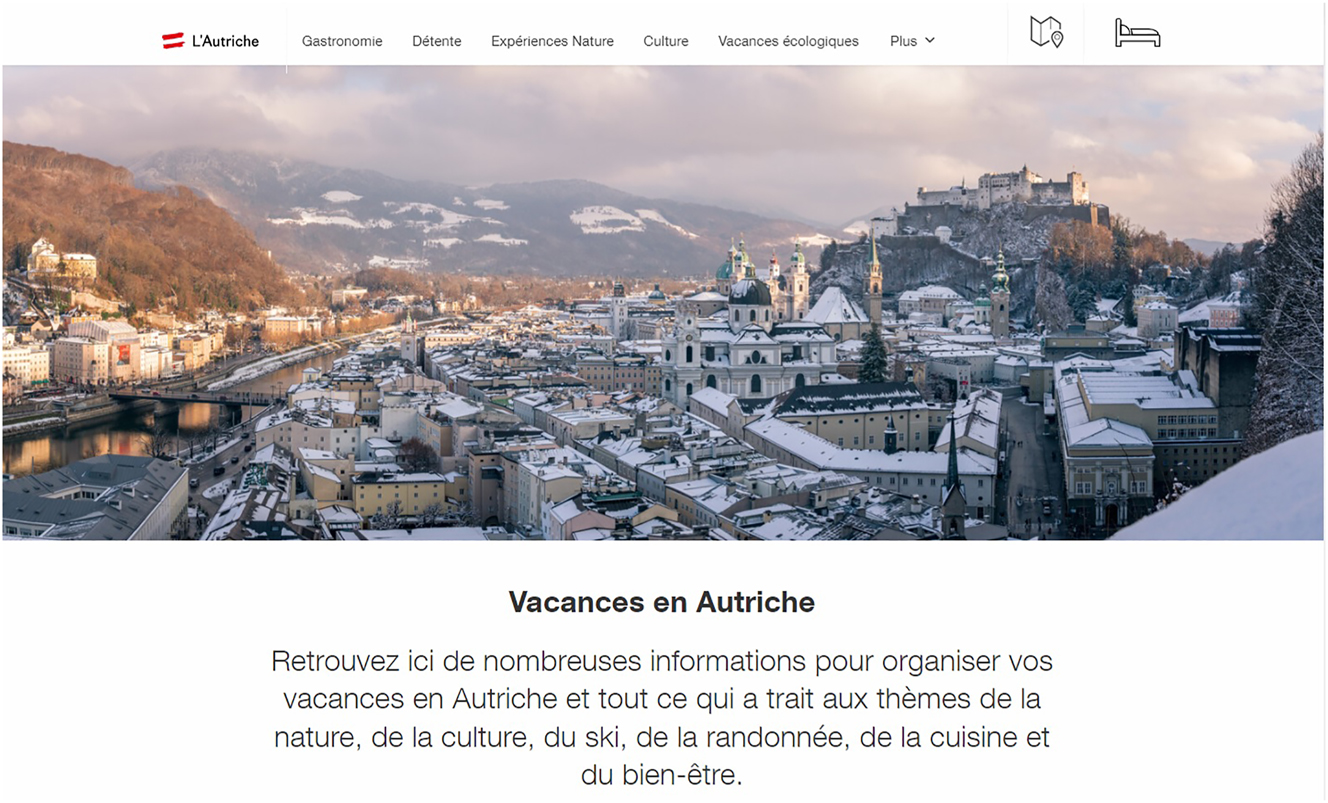
| (12) | Vacances en Autriche. Retrouvez ici de nombreuses informations pour organiser vos vacances en Autriche et tout ce qui a trait aux thèmes de la nature, de la culture, du ski, de la randonnée, de la cuisine et du bien-être. |
| ‘Holidays in Austria. Here you’ll find all the information you need to plan your holiday in Austria, including everything you need to know about nature, culture, skiing, hiking, cuisine and well-being.’ |
| (13) | Winter Holidays – the Austrian Way. What is it that makes a winter holiday in Austria so unique? It’s the Austrian way of life. Blissful moments in the snow, experienced and enjoyed together with family and friends. The ones you brought along, and the ones you just met! |
| (14) | Avvento imperiale, romantico, goloso. Scoprite l’Avvento in Austria (button). |
| ‘Imperial, romantic, longing Advent. Discover Advent in Austria.’ |
| (15) | (Picture of illuminated Belvedere Palace in Vienna, during night, text in the picture, people strolling around) |
| Austria celebra el Adviento con pasión: mercadillos navideños, galletas de Navidad y otras tradiciones navideñas acompañan la magia del Advento. Ir a la magia del Adviento en Austria (button). | |
| ‘Austria celebrates Advent with passion: Christmas markets, Christmas biscuits and other Christmas traditions accompany the magic of Advent. Go to the magic of Advent in Austria.’ |
On the representational level, the websites work with narrative images that depict the unfolding of actions; except the French website which uses a conceptual image, i.e., it portrays a city as static and timeless concept (Figures 11–13). The Italian and Spanish websites show pictures taken during night: these are characterized by low modality and high symbolism (cf. Manca 2017: 234). On the interactive level, the observer is immersed into the picture, i.e., a certain involvement is created. However, the potential tourist viewing the image is rarely invited, through gaze, to interact with the portrayed participants (cf. the presentation of the participants not as central element, but rather as peripheral; cf. also Thurlow and Jaworski 2010). On the compositional level, the information value is emphasized through the location of textual elements: there is text placed in the picture or under the picture. In the latter case, more emphasis is put on the visual; in the former case, the text is in the foreground.
Austria advertisement V. Source: Austria Advertising, © Christoph Oberschneider.

Austria advertisement VI. Source: Austria Advertising, © Christoph Oberschneider.

Austria advertisement VII. Source: Austria Advertising, © Michael Stabentheiner.
On the German version of the website, echte Erlebnisse (‘real experiences’), i.e., an event or activity that affects the potential tourist in some way is promoted. The temporal focus is on the on- and pre-trip level, i.e., on emotions while practicing sports, on the type of travel and the details of the travel organization. The headline on the French site is comparable to the German headline, but more focus is put on culture (cf. also the picture) and on different possibilities to do and explore during a vacation in Austria (pre-trip level). Additionally, the French headline includes a deontic (i.e. expressing duty or obligation) present tense in the verb retrouver. The two websites differ in the use of pictures: whereas on the German website a narrative image that conveys dynamism and the idea of active holidays is employed, the French website makes use of a non-narrative, conceptual picture that represents timelessness (cf. also Kress and van Leeuwen 2020).
On the English site, the Austrian Way is stressed in the text and the visual (cf. also the capitalization of the noun Way). The Austrian way is represented as a sporty vacation with family and friends. Emphasis is put on the on-trip level through the use of past tense and the adverb just as well as through the use of the temporal nominal lexeme moments. In this way, the ad conveys the message ‘you are already on holiday’. In addition, in the text, a rhetorical question is employed to which immediately an answer is given. Yet, the answer is already specified in the title of the headline and depicted in the visual (a family on a ski slope in Austria).
The webpage in Italian employs different adjectives which activate various inferences: the adjective imperiale alludes to Austrian history; the adjective romantic hints at emotions; last but not least, the adjective goloso puts Austrian gastronomy in the foreground. The three adjectives are added to the noun avvento and characterize it in the form of an asyndeton. The signification of the adjectives is also expressed in the picture: persons passing by in a scenery of illuminated mountain huts during a winter night. Different to the websites in German, French and English, the visual on the Italian site is provided with a button (also the Spanish webpage, see below). By clicking on the button to discover Advent in Austria, the user is redirected to a new page where more information on Austrian Advent is given and where the picture transforms into a video. The focus in the video is on tradition, emotions and magic (cf. also the hashtag #realAustria). In this way, a cohesive line is spun to the picture on the front page and the video viewer is directly zoomed into the event. The headline on the Spanish webpage is similar to the headline on the Italian version of the website. For a Spanish audience too, emphasis is put on passion, emotions, tradition and magic in text and visual. Other than in the Italian headline, however, the Spanish text uses the directive infinitive ir (a) which refers to posteriority and a possible activity in the future (pre-trip). A second analogy between the Italian and the Spanish webpage consists in the presence of a button on the picture. By clicking on the button, the user is directed to a new page where the picture becomes the thumbnail of a video. Both videos, in Italian and in Spanish, conclude with the message to live advent in Austria. In other words, the Italian and Spanish site stress the on-trip-level of the vacation experience. By placing the idea of magic in the foreground, they create “possible worlds” (Rocci 2009: 16), i.e., they evoke imaginary, alternative worlds disconnected from the one inhabited by the potential tourists.
The examples show that tourism professionals ‘manipulate’ the image of Austria as a tourist destination for different audiences. Whereas the webpages in German and French prioritize the different possibilities for guests during their holidays in Austria, on the English site, attention is drawn to winter holidays on snow with the family. The Italian and Spanish version of the website, on the other hand, give prominence to temporal attributes such as tradition, history, emotions, passion and magic. These entities implicitly transmit nominal aspectuality (cf. Kleineberg 2022), i.e., they share the internal temporal features of +atelic, +dynamic and +durative. Additionally, it is observable that the tourist gaze identified on the Italian and Spanish webpages can be described as a subgroup of what Urry (2002: 150) calls the romantic gaze: a gaze in which solitude, privacy and a personal, semi-spiritual relationship with the object of observation is emphasized (cf. also Manca 2017). The tourist gaze develops through confrontation with what is different, i.e., with non-tourist forms of social experience, and it is, therefore, inevitable that factors such as culture and social group play a fundamental role in its construction (cf. Urry 2002). In fact, it can be constructed in two ways: first, internally, through the decoding that the tourist carries out on the basis of their own socio-cultural filters; secondly, externally, by tourism professionals who strategically create an image of the tourist product that will influence the tourist’s expectations. While the internal construction of the tourist gaze can be developed in all three phases of the trip (before, during and after the tourist experience), the external construction is more identified in a pre-trip-stage promotional strategy (cf. Manca 2017). The expectations, i.e., the external tourist gaze created in the analyzed official tourist promotion websites is, therefore, strategically constructed to bring out what it is considered distinctive and of greatest interest or attractiveness to tourists.
6 Discussion
Tourism texts in different languages share the same objective, i.e., they try to promote vacational time and to convince potential tourists to visit the destination advertised. This paper invited the reader to look in more detail at the temporal aspects both in text and visual in different tourism texts and how they are transferred from one language to another.
Tourism communication focuses on the pre-, on- and post-trip level of the touristic experience by employing for instance lexical and grammatical means on the verbal level (cf. Figure 1, where by the use of the future tense in the phrase personne ne vous croira ‘nobody will believe you’ a reference is made to the post-trip phase) and pictures expressing temporality on the visual level (cf. Figure 2, where the temporal activity of diving in is represented in the visual). Texts in the tourist sector preferably make use of tourism imaginaries, i.e., socially transmitted visual assemblages that, by interacting with people’s personal imaginations, function as world-shaping and meaning-making tools (cf. Salazar 2012: 864). However, the pragmatic effect of inducing tourists to visit the destination is achieved differently by language and culture. Advertisements from the same campaign in different languages share common features, e.g., they use the same/similar pictures; but especially on the verbal level, the advertising message differs with regard to the representation of temporality. The analyzed examples show that isotopies and metaphors expressed in ads can differ from one language to another, even if the texts are part of the same touristic campaign. Differences also arise in the utilization of verbs and the related semantic features of verbs (cf. e.g., the cognitive concept and temporal change in the use of the verbs sorridere/sourire vs. freu dich). Such dissimilarities may have an impact on the prominence or not of specific (temporal) connotations as well as on the presence or absence of polysemy. In other words, (temporal) strategies that are successful within a culture do not always work in a different culture and adaptations have to be made especially on the linguistic level but also on the visual level (cf. also Manca 2013: 109). However, this does not mean that different concepts of temporality are bounded within a nation-state and that there is a fundamental difference between what tourists from one culture and tourists from another culture want on holidays. The results of this study rather reflect strategies of adaptation and localization of the tourist products and demonstrate that temporality and messaging shift in relation to the market demographic. Furthermore, there may also be shifts and changes within a culture with regard to temporal orientations.
The analysis has also shown similarities in the representation of temporality in the different languages and cultures. The ads often make use of the present tense to promote vacation time. The present tense, on the one hand, expresses deictic vagueness, i.e., it can be employed on all three levels of the temporal touristic experience (pre-, on- and post-trip). On the other hand, the (partly) deontic-modal value of the tense (cf. Haßler 2016) is manipulated to convey, in an indirect way, a directive illocution. Future research studies are needed to investigate the deontic-modal nature of the present tense in more detail and its employment in conjunction with the visual message to guide the tourist gaze in a specific (temporal) direction. Furthermore, the frame for understanding temporality within tourism promotional texts offered in this paper, focusing on both textual and visual multimodal elements in marketing a destination in different languages, may function as foundation for further discussions of temporality in tourism from a social semiotic and/or multimodal discourse analytic perspective.
References
Agorni, Mirella. 2012. Questions of mediation in the translation of tourist texts. Altre Modernità, Confini mobili: lingua e cultura nel discorso del turismo 02/2012. 1–11.Search in Google Scholar
Antelmi, Donella. 2022. Il turismo come discorso. Generi e testi dal racconto al Web. Rome: Dino Audino.Search in Google Scholar
Bruner, Edward M. 2005. Culture on tour. Ethnographies of travel. Chicago and London: University of Chicago Press.Search in Google Scholar
Budiharjo, Bayu, Adrianna Nuraeni, Nur Saptaningsih, Bayu Dewa Murti & Anita Rusjayanti. 2022. Persuasion in tourism promotion bilingual Texts: The importance of syntactic forms and choices. Leksema Jurnal Bahasa Dan Sastra 7(1). 1–12. https://doi.org/10.22515/ljbs.v7i1.4419.Search in Google Scholar
Calvi, Maria V. 2010. Los géneros discursivos en la lengua del turismo: Una propuesta de clasificación. Ibérica 19. 9–32.10.3726/978-3-0351-0293-2Search in Google Scholar
Clawson, Marion & Jack L. Knetsch. 1966. Economics of outdoor recreation. Baltimore: Johns Hopkins.Search in Google Scholar
Cogno, Enrico & Giancarlo Dall’Ara. 1999. Comunicazione e tecnica pubblicitaria nel turismo. Milan: Franco Angeli.Search in Google Scholar
Dann, Graham. 1996. The people of tourist brochures. In Tom Selwyn (ed.), The tourist image: Myths and myth making in tourism, 61–81. Chichester: John Wiley.Search in Google Scholar
Denti, Olga. 2012. Cross-cultural representations in tourism discourse: The case of the island of Sardinia. Cagliari: AIPSA.Search in Google Scholar
Denti, Olga. 2021. Building the tourist destination through multiple semiotic modes. International Journal of English Linguistics 11(4). 83–104. https://doi.org/10.5539/ijel.v11n4p83.Search in Google Scholar
Eggins, Suzanne. 2011. An introduction to systemic functional linguistics, 2nd edn. London: Continuum.Search in Google Scholar
Fehse, Beatrix. 2017. Metaphern in Text-Bild-Gefügen. Sprachliche und kognitive Metaphorik. Visuelle Metaphorik. Zeitmetaphern in der Anzeigenwerbung und der Gegenwartskunst. Duisburg: Universitätsverlag Rhein-Ruhr.Search in Google Scholar
Francesconi, Sabrina. 2007. English for tourism promotion: Italy in tourism texts. Milan: Hoepli.Search in Google Scholar
Francesconi, Sabrina. 2014. Reading tourism texts: A multimodal analysis. Bristol: Channel View Publications.10.21832/9781845414283Search in Google Scholar
Halliday, Michael A. K. 2004. An Introduction to functional grammar, 3rd edn., revised by C. Matthiessen. London: Arnold.Search in Google Scholar
Haßler, Gerda. 2016. Temporalität, Aspektualität und Modalität in romanischen Sprachen. Berlin and Boston: De Gruyter.10.1515/9783110312997Search in Google Scholar
Held, Gudrun. 2004. L’annuncio pubblicitario di destinazione. In Paolo D’Achille (ed.), Generi, architetture e forme testuali, 257–274. Florence: Cesati.Search in Google Scholar
Held, Gudrun. 2008a. Der Raum als Traum – ein Blick auf intersemiotische Gestaltungsstrategien und ihre Realisierung in globalen Kampagnen der Tourismuswerbung. In Gudrun Held & Sylvia Bendel (eds.), Werbung – grenzenlos. Multimodale Werbetexte im interkulturellen Vergleich, 149–172. Frankfurt a.M.: Lang.Search in Google Scholar
Held, Gudrun. 2008b. Grenzenloser Traum vom Raum? Suggestive Bild-Text-Konfigurationen in der Tourismuswerbung aus kontrastiver Sicht. In Heinz H. Lüger & Hartmut E. Lenk (eds.), Kontrastive Medienlinguistik, 95–112. Landau: Verlag Empirische Pädagogik.Search in Google Scholar
Held, Gudrun. 2009. Qui mi sento libero. Zu Formen der multimodalen Inszenierung von ‘Raum als Traum’ in der Tourismuswerbung. In Verena Dolle & Uta Helfrich (eds.), Zum spatial turn in der Romanistik. Akten der Sektion 25 des XXX. Romanistentages, 143–161. Munich: Martin Meidenbauer.Search in Google Scholar
Held, Gudrun. 2019. Destinationswerbung. Zur Image-Konstruktion von touristischen Räumen durch multimodale Inszenierung von Identitätsmarkern. Zeitschrift für Tourismus-Werbung 11(1). 149–173. https://doi.org/10.1515/tw-2019-0008.Search in Google Scholar
Helfrich, Uta. 2016. Zwischen Übersetzung und Adaptation: Tourismuswerbung im Vergleich (Spanisch-Französisch-Deutsch). In Christina Ossenkop & Georgia Veldre-Gerner (eds.), Zwischen den Texten. Die Übersetzung an der Schnittstelle von Sprach- und Kulturwissenschaft, 171–194. Stuttgart: ibidem.Search in Google Scholar
Jewitt, Carrey & Berit Henriksen. 2016. Social semiotic multimodality. In Nina-Maria Klug & Hartmut Stöckl (eds.), Handbuch Sprache im multimodalen Kontext, 145–164. Berlin and Boston: De Gruyter.10.1515/9783110296099-007Search in Google Scholar
Katan, David. 2016. Translating for outsider tourists: Cultural informers do it better. Cultus 9. 63–90.Search in Google Scholar
Klein, Wolfgang. 2018. Looking at language. Berlin and Boston: De Gruyter.10.1515/9783110549119Search in Google Scholar
Kleineberg, Désirée. 2022. The expression of “collectivity” in Romance languages. Berlin and Boston: De Gruyter.10.1515/9783110784695Search in Google Scholar
Kress, Gunther. 2011. Multimodal discourse analysis. In James P. Gee & Michael Handford (eds.), The Routledge handbook of discourse analysis, 35–50. London and New York: Routledge.Search in Google Scholar
Kress, Gunther & Theo van Leeuwen. 2020. Reading images: The grammar of visual design, 3rd edn. London and New York: Routledge.10.4324/9781003099857Search in Google Scholar
Maci, Stefania. 2013. Tourism discourse: Professional, promotional and digital voices. Genoa: ECIG.Search in Google Scholar
Maci, Stefania. 2020. English Tourism Discourse. Insights into the professional, promotional and digital language of tourism. Milan: Hoepli.Search in Google Scholar
MacKay, Kelly J. & Daniel R. Fesenmaier. 1997. Pictorial element of destination in image formation. Annuals of Tourism Research 24(3). 537–565. https://doi.org/10.1016/s0160-7383(97)00011-x.Search in Google Scholar
Manca, Elena. 2012. Translating the language of tourism across cultures: From functionally complete units of meaning to cultural equivalence. Textus 1. 49–66.Search in Google Scholar
Manca, Elena. 2013. Describing through the five senses. A contrastive socio-cultural and linguistic analysis of Italian and British tourist websites. In Elena Manca & Francesca Bianchi (eds.), Tourism and tourist promotion around the world: A linguistic and socio-cultural perspective, 109–124. Lecce: Salento University Publishing.Search in Google Scholar
Manca, Elena. 2016a. Persuasion in tourism discourse: Methodologies and models. Newcastle upon Tyne: Cambridge Scholars Publishers.Search in Google Scholar
Manca, Elena. 2016b. Official tourist websites and the cultural communication grammar model: Analysing language, visuals, and cultural features. Cultus 9(1). 2–22.Search in Google Scholar
Manca, Elena. 2017. Persuasione, tourist gaze e viaggi di lusso: modi comunicativi e culture a confronto. In Maria G. Guido (ed.), Strategie di comunicazione dei prodotti di lusso attraverso l’inglese come ‘lingua franca’ internazionale: sostenibilità ed emozioni come leve strategiche per lo sviluppo del ‘Made in Puglia’, 215–237. Lecce: Salento University Publishing.Search in Google Scholar
Manca, Elena. 2018. Verbal techniques of the language of tourism across cultures: An analysis of five official tourist websites. In Magdalena Bielenia-Grajewska & Enriqueta Cortés de los Ríos (eds.), Innovative perspectives on tourism discourse, 91–110. Hershey: IGI Global.10.4018/978-1-5225-2930-9.ch006Search in Google Scholar
Messner, Monika. 2023a. ‘Domani a quest’ora potresti essere qui’: Multimodal practices for representing temporality in destination advertising. Visual Communication 1–26.10.1177/14703572231187001Search in Google Scholar
Messner, Monika. 2023b. Zwischen Alltagszeit und Urlaubszeit, zwischen Imagination und Zurückerinnern – Zeitlichkeit in der Destinationswerbung. In Steffen Pappert & Kersten S. Roth (eds.), Zeitlichkeit in der Textkommunikation, 111–144. Tübingen: Narr Francke Attempto.Search in Google Scholar
Pano Alamán, Ana & María José Rodrigo Mora. 2012. En la persuasiva Red del eslogan turístico. In Patricia Botta & Sara Pastor (eds.), Rumbos del hispanismo en el umbral del Cincuentenario de la AIH. Actas del Congreso de la Asociación Internacional de Hispanistas (Roma, 19–24 de julio 2010), 469–477. Rome: Bagatto Libri.Search in Google Scholar
Pollaroli, Chiara & Andrea Rocci. 2015. The argumentative relevance of pictorial and multimodal metaphor in advertising. Journal of Argumentation in Context 4(2). 158–199. https://doi.org/10.1075/jaic.4.2.02pol.Search in Google Scholar
Rocci, Andrea. 2009. Doing discourse analysis with possible worlds. In Jan Renkema (ed.), Discourse, of Course. An overview of research in discourse studies, 15–35. Amsterdam and Philadelphia: Benjamins.10.1075/z.148.03rocSearch in Google Scholar
Salazar, Neol B. 2012. Tourism imaginaries. A conceptual approach. Annuals of Tourism Research 39(2). 863–882. https://doi.org/10.1016/j.annals.2011.10.004.Search in Google Scholar
Sulaiman, M. Zain. 2013. Translating tourism: A cultural journey across conceptual spaces. Melbourne: Monash University PhD thesis.Search in Google Scholar
Thurlow, Crispin & Adam Jaworski. 2010. Silence is golden: The ‘anti-communicational’ linguascaping of super-elite mobility. In Crispin Thurlow & Adam Jaworski (eds.), Semiotic landscapes: Language, image, space, 187–218. London and New York: Continuum.Search in Google Scholar
Thurlow, Crispin & Adam Jaworski. 2011. Tourism discourse: Languages and banal globalization. Applied Linguistics Review 2/2011. 285–312. https://doi.org/10.1515/9783110239331.285.Search in Google Scholar
Torresi, Ira. 2010. Translating promotional and advertising texts. Northampton, MA: St. Jerome.Search in Google Scholar
Treccani online. 2023. Aspettare. https://www.treccani.it/vocabolario/aspettare/ (accessed 15 November 2023).Search in Google Scholar
Urry, John. 2002. The tourist gaze. London: Sage.Search in Google Scholar
Van Leeuwen, Theo. 2011. The language of colour. London: Routledge.Search in Google Scholar
Wöhler, Karlheinz. 2011. Touristifizierung von Räumen. Kulturwissenschaftliche und soziologische Studien zur Konstruktion von Räumen. Wiesbaden: Verlag für Sozialwissenschaften.10.1007/978-3-531-92761-9Search in Google Scholar
© 2024 the author(s), published by De Gruyter, Berlin/Boston
This work is licensed under the Creative Commons Attribution 4.0 International License.
Articles in the same Issue
- Frontmatter
- Research Articles
- The salience of students’ body language during in-person and online lectures at a Canadian university
- “Let’s talk divorce”: a multimodal critical discourse analysis of Oduduwa secessionist discourse
- A multimodal analysis of the English-to-Arabic adaptation of Disney’s “The Bare Necessities”
- Investigating pausing and gesturing patterns in children with and without developmental language disorder
- Language politics and prestige in The Walled City: an exploratory study of the linguistic landscape of Intramuros, Manila
- Harmony in diversity: exploring cross-linguistic, cross-cultural and multimodal dimensions of temporality within tourism discourse
- The semiotics of red-tagging: hateful affects against the community pantry movement
- Age and gender differences in meme humor: a multimodal variationist mixed-method approach
- Imagined versus practiced professional identity development: a multimodal (inter)action analysis of a Chinese novice english teacher
- Essay
- Adapting and extending multimodal (inter)action analysis to investigate synchronous multimodal online language teaching
Articles in the same Issue
- Frontmatter
- Research Articles
- The salience of students’ body language during in-person and online lectures at a Canadian university
- “Let’s talk divorce”: a multimodal critical discourse analysis of Oduduwa secessionist discourse
- A multimodal analysis of the English-to-Arabic adaptation of Disney’s “The Bare Necessities”
- Investigating pausing and gesturing patterns in children with and without developmental language disorder
- Language politics and prestige in The Walled City: an exploratory study of the linguistic landscape of Intramuros, Manila
- Harmony in diversity: exploring cross-linguistic, cross-cultural and multimodal dimensions of temporality within tourism discourse
- The semiotics of red-tagging: hateful affects against the community pantry movement
- Age and gender differences in meme humor: a multimodal variationist mixed-method approach
- Imagined versus practiced professional identity development: a multimodal (inter)action analysis of a Chinese novice english teacher
- Essay
- Adapting and extending multimodal (inter)action analysis to investigate synchronous multimodal online language teaching
