Home Mathematics Strong indecomposability of the outer automorphism groups of nonabelian free profinite groups
Article Publicly Available

Strong indecomposability of the outer automorphism groups of nonabelian free profinite groups

  • Arata Minamide EMAIL logo and Shota Tsujimura
Published/Copyright: May 22, 2025

Abstract

In this paper, we prove that the outer automorphism groups of nonabelian topologically finitely generated free profinite groups are strongly indecomposable. This means that no open subgroup has a nontrivial direct product decomposition.

1 Introduction

One of the most fundamental objects in the category of infinite nonabelian profinite groups is the free profinite group F m of rank m 2 . With regard to the noncommutativity of F m , the following fact [1, Proposition 8] is well known.

Fact 1

The center of F m is trivial.

Here, we note that the “discrete analogue” of Fact 1 (i.e., the center-freeness of free discrete groups of rank 𝑚) is relatively easy to prove using explicit descriptions of elements as “words”. However, since elements of F m cannot be described in terms of “words” (of finite length) in a useful way, one cannot simply modify the proof used in the discrete setting to prove Fact 1. In fact, in the proof of [1, Proposition 8], cohomology theory of free pro-𝑝 groups is applied. This situation suggests that, in general, the study of free profinite groups is much more difficult than the study of free discrete groups.

In this paper, we study the group structure of the outer (continuous) automorphism group Out ( F m ) , which is much more complicated than F m . We recall that Out ( F m ) admits a natural structure of profinite group; see [14, Corollary 4.4.4]. Here, we note that, although F m is topologically finitely generated, Out ( F m ) is not topologically finitely generated; see [14, Theorem 4.4.9]. This fact lies in stark contrast to the fact that the outer automorphism group of a free discrete group of rank 𝑚 is finitely generated; see [7, §3.5, Theorem N1]. One of the most interesting aspects of our work is that, in our study of Out ( F m ) , we apply results in anabelian geometry for hyperbolic curves over number fields or finite fields. In fact, by applying a result in anabelian geometry for hyperbolic curves over finitely generated fields of characteristic 0, the following fact (which concerns the noncommutativity of Out ( F m ) ) has been proved by Tamagawa [17, Theorem 7.4].

Fact 2

The center of Out ( F m ) is trivial.

In the following, let Q ̄ be an algebraic closure of the field of rational numbers ℚ, K Q ̄ a number field, and 𝑍 a hyperbolic curve of genus 0 over 𝐾. Write G K = def Gal ( Q ̄ / K ) , Z Q ̄ = def Z × K Q ̄ , and Π Z Q ̄ for the étale fundamental group of Z Q ̄ relative to a suitable choice of basepoint. We recall that Π Z Q ̄ is a nonabelian free profinite group; see [16, Corollary 4.6.11]. Write 𝐏 for the set of prime numbers. For a profinite group 𝐺 and a nonempty subset Σ P , write G Σ for the maximal pro-Σ quotient of 𝐺. For every nonempty subset Σ P , write

ρ Z Σ : G K Out ( Π Z Q ̄ Σ )

for the natural pro-Σ outer Galois representation; see Definition 4.1. We are now ready to state our main results, also concerning the noncommutativity of Out ( F m ) .

Theorem 1.1

Let Σ P be a subset such that either | Σ | = 1 or | P Σ | is finite. Let G Out ( Π Z Q ̄ Σ ) be a closed subgroup such that

  • 𝐺 contains an open subgroup of ρ Z Σ ( G K ) ,

  • there exists a prime number l Σ such that the image of 𝐺 via the natural morphism

    ϕ l : Out ( Π Z Q ̄ Σ ) Out ( Π Z Q ̄ { l } ) ,

    which is necessarily surjective by [14, Proposition 4.5.4 (b)], is slim, i.e., the center of every open subgroup of ϕ l ( G ) is trivial.

Then 𝐺 is strongly indecomposable, i.e., no open subgroup of 𝐺 has a nontrivial direct product decomposition.

We recall that, for every integer m 2 and every nonempty subset Σ P , F m Σ is a free pro-Σ group of rank 𝑚.

Corollary 1.2

Let m 2 be an integer and Σ P a subset such that either | Σ | = 1 or | P Σ | is finite. Then Aut ( F m Σ ) and Out ( F m Σ ) are strongly indecomposable.

We recall that, for an arbitrary nonempty subset Σ P , the group F m Σ itself is strongly indecomposable; see [14, Theorems 3.6.2, 8.6.5]. It is not clear to the authors at the time of writing whether or not the assumption that | Σ | = 1 or | P Σ | is finite can be dropped; compare with Remark 4.5.

Finally, we add the following remark. In light of a well known injectivity result of Belyi [5, Theorem C] and Remark 5.2 below, Theorem 1.1 has the following immediate applications, arising from the special case where Σ = P and Z = P K 1 { 0 , 1 , } , the projective line minus three points.

  1. The profinite Grothendieck–Teichmüller group GT ̂ , introduced in [3] and considered in [11, Remark 1.11.1], is strongly indecomposable.

  2. The absolute Galois groups of number fields are strongly indecomposable.

Assertion (i) gives an affirmative answer to an open problem posed by the first author in [8]. Assertion (ii) is a special case of the fact that the absolute Galois groups of Hilbertian fields are strongly indecomposable – which follows immediately from a theorem of Haran–Jarden [4, Corollary 2.5].

2 Notation and conventions

Rings and schemes

Let 𝐴 be a commutative (unitary) ring. Then we shall write char ( A ) for the characteristic of 𝐴. We shall write A × for the group of units of 𝐴. Let 𝐹 be a perfect field and F ̄ an algebraic closure of 𝐹. Then we shall write G F = def Gal ( F ̄ / F ) .

Let 𝑆 be a scheme. Then we shall write Aut ( S ) for the group of automorphisms of 𝑆. Let 𝐾 be a field, K L a field extension, and 𝑆 a scheme over 𝐾. Then we shall write S L = def S × K L . We shall write Aut K ( S ) for the group of automorphisms of 𝑆 over 𝐾 and P K 1 for the projective line over 𝐾.

Let 𝑆 be a connected locally Noetherian scheme. Then we shall write Π S for the étale fundamental group of 𝑆 relative to a suitable choice of basepoint. Note that, for any perfect field 𝐹, Π Spec ( F ) G F .

Profinite groups

Write 𝐏 for the set of prime numbers. Let Σ P be a nonempty subset. Then we shall say that an integer n Z 1 is a Σ-integer if every prime factor of 𝑛 is contained in Σ. Let 𝐺 a profinite group. Then we shall write G Σ for the maximal pro-Σ quotient of 𝐺. We shall write G ab for the abelianization of 𝐺 (i.e., the quotient of 𝐺 by the closure of the commutator subgroup of 𝐺), Aut ( G ) for the group of automorphisms of 𝐺 (in the category of profinite groups), Inn ( G ) Aut ( G ) for the group of inner automorphisms of 𝐺, and Out ( G ) = def Aut ( G ) / Inn ( G ) . If 𝑝 is a prime number, then we shall also write G p = def G { p } and G ( p ) = def G P { p } . If 𝐷 is a discrete group, then we shall write D p for the pro-𝑝 completion of 𝐷.

Suppose that 𝐺 is topologically finitely generated. Then 𝐺 admits a basis of characteristic open subgroups; see [14, Proposition 2.5.1 (b)]. Such a basis induces a profinite topology on the groups Aut ( G ) and Out ( G ) . Let H G be a closed subgroup. Then we shall write Aut H ( G ) Aut ( G ) for the subgroup of Aut ( G ) consisting of elements that induce automorphisms of 𝐻. We shall write Inn H ( G ) Aut H ( G ) for the image of 𝐻 via the natural surjection G Inn ( G ) . Let 𝐽 be a profinite group. Then we shall refer to a continuous homomorphism J Aut H ( G ) / Inn H ( G ) as an 𝐻-outer action of 𝐽 on 𝐺.

3 Preliminaries

In this section, we recall some basic notions concerning profinite groups and hyperbolic curves, and we establish Lemmas 3.4 and 3.8 which will be applied in Section 5.

First, from [12, Notations and Conventions] and [12, Definition 3.1], we recall basic notions concerning profinite groups.

Definition 3.1

Let 𝐺 be a profinite group and H G a closed subgroup of 𝐺.

  1. We shall write Z G ( H ) for the centralizer of 𝐻 in 𝐺, i.e., the closed subgroup { g G g h g 1 = h for any h H } , and Z ( G ) = def Z G ( G ) .

  2. We shall say that 𝐺 is slim if Z G ( U ) = { 1 } for every open subgroup 𝑈 of 𝐺, or, equivalently, Z ( U ) = { 1 } for every open subgroup 𝑈 of 𝐺.

  3. We shall say that 𝐺 is decomposable if there exist nontrivial normal closed subgroups H 1 G and H 2 G such that G = H 1 × H 2 . We shall say that 𝐺 is indecomposable if 𝐺 is not decomposable. We shall say that 𝐺 is strongly indecomposable if every open subgroup of 𝐺 is indecomposable.

Remark 3.2

Let 𝐺 be a slim profinite group. From [12, §0] and [8, Lemma 1.6], we recall the following well known facts.

  1. Every finite normal closed subgroup of 𝐺 is trivial.

  2. Let H G be an open subgroup and α Aut ( G ) . Suppose that 𝛼 induces the identity automorphism on 𝐻. Then 𝛼 is the identity automorphism on 𝐺.

For completeness, we prove a basic lemma which will be applied in Section 5.

Lemma 3.3

Let 𝐺 be a profinite group and { G i } i I a directed subset of the set of characteristic open subgroups of 𝐺, where j i G j G i , such that

i I G i = { 1 } .

Write ϕ i : Out ( G ) Out ( G / G i ) for the natural homomorphism. Then

i I Ker ( ϕ i ) = { 1 } .

Proof

We consider σ i I Ker ( ϕ i ) Out ( G ) and a lifting σ ̃ Aut ( G ) . For each i I , write σ ̃ i Aut ( G / G i ) for the automorphism induced by σ ̃ . Then, since σ Ker ( ϕ i ) , the automorphism σ ̃ i is inner. Let γ i G / G i be an element which induces σ ̃ i via conjugation. Write C i = def γ i Z ( G / G i ) G / G i . Here, we note that if i 1 i 2 ( i 1 , i 2 I ), then the natural surjection G / G i 1 G / G i 2 induces a map C i 1 C i 2 . Observe that, since C i ( i I ) is a finite nonempty set, the inverse limit lim i I C i is nonempty; see [14, Corollary 1.1.6]. Then σ ̃ is the inner automorphism given by any element γ lim i I C i ( lim i I G / G i = G ) . This completes the proof of Lemma 3.3. ∎

Lemma 3.4

Let 𝐺 be a topologically finitely generated profinite group and S P a finite subset. Then the natural homomorphism

Out ( G ) p P S Out ( G ( p ) )

is injective.

Proof

Since 𝐺 is topologically finitely generated, there exists a directed subset { G i } i I of the set of characteristic open subgroups of 𝐺, where j i G j G i , such that i I G i = { 1 } ; see [14, Proposition 2.5.1 (b)]. Fix such a family. For each i I , let p i P S be such that p i does not divide the order of the finite group G / G i . Then the natural surjection G G / G i factors through the natural surjection G G ( p i ) . Thus, Lemma 3.4 follows from Lemma 3.3. ∎

Next, we recall basic notions concerning hyperbolic curves.

Definition 3.5

Let 𝑘 be a field, k ̄ an algebraic closure of 𝑘, and 𝑋 a smooth curve (i.e., a one-dimensional, smooth, separated, finite-type, geometrically connected scheme) over 𝑘. Write X ̄ k ̄ for the smooth compactification of X k ̄ over k ̄ . Then we shall refer to any element of the underlying set of X ̄ k ̄ X k ̄ as a cusp of X k ̄ . We shall say that 𝑋 is a smooth curve of type ( g , r ) over 𝑘 if the genus of X k ̄ is 𝑔, and the cardinality of the set of cusps of X k ̄ is 𝑟. If 𝑋 is a smooth curve of type ( g , r ) over 𝑘, and 2 g 2 + r > 0 , then we shall say that 𝑋 is a hyperbolic curve over 𝑘.

Definition 3.6

Let 𝑘 be an algebraically closed field, 𝑍 a hyperbolic curve over 𝑘, 𝑄 a profinite group, and q : Π Z Q an epimorphism (in the category of profinite groups).

  1. Write Z ̄ for the smooth compactification of 𝑍 over 𝑘, 𝐾 for the function field of Z ̄ , K ̃ for the maximal Galois extension of 𝐾 that is unramified over 𝑍 within a fixed separable closure K sep , Z ̄ ̃ for the normalization of Z ̄ in K ̃ , and S ̃ for the inverse image of S = def Z ̄ Z in Z ̄ ̃ . Note that we have a natural action of Π Z Gal ( K ̃ / K ) on Z ̄ ̃ . Then, for each point z S , we shall refer to the stabilizer subgroup Π Z of any point in S ̃ lying over 𝑧 as a cuspidal inertia subgroup of Π Z associated to 𝑧. We shall refer to the image under 𝑞 of any such cuspidal inertia subgroup of Π Z as a cuspidal inertia subgroup of 𝑄 associated to 𝑧.

  2. In the set-up of (i), we shall write

    Out C ( Q ) Out ( Q ) (respectively,  Out | C | ( Q ) Out ( Q ) )

    for the subgroup of outer automorphisms of 𝑄 that induce permutations (respectively, the identity permutation) on the set of the conjugacy classes of cuspidal inertia subgroups of 𝑄.

We conclude with a lemma concerning outer actions on certain quotients of the group Π Z . In its proof, we employ methods that are similar to those used in the proof of [18, Lemma 1.2].

Definition 3.7

Let 𝐺 be a profinite group, Π a topologically finitely generated profinite group such that Z ( Π ) = { 1 } , and G Out ( Π ) a continuous homomorphism. Then we shall write

Π out G = def Aut ( Π ) × Out ( Π ) G .

Lemma 3.8

Let 𝑘 be an algebraically closed field, 𝑍 a hyperbolic curve over 𝑘, 𝑄 a profinite group, and q : Π Z Q an epimorphism. Suppose that 𝑄 is topologically finitely generated and slim. Let J Out C ( Q ) be a closed subgroup and V Q an open subgroup. In particular, q 1 ( V ) Π Z may be naturally identified with the étale fundamental group of a hyperbolic curve over 𝑘. Write

ϕ V : Aut ( V ) Out ( V ) , ϕ Q : Aut ( Q ) Out ( Q )

for the natural surjections. Then, for any sufficiently small open subgroup M J , there exist an outer action of 𝑀 on 𝑉 and an open injection V out M Q out J such that

  1. the outer action of 𝑀 preserves and induces permutations on the set of the conjugacy classes of cuspidal inertia subgroups of 𝑉,

  2. the outer action of 𝑀 on 𝑉 extends uniquely (by the slimness of 𝑄) to a 𝑉-outer action on 𝑄 that is compatible with the outer action of 𝐽 ( M ) on 𝑄,

  3. the injection V out M Q out J is the injection determined by the inclusions V Q and M J , together with the 𝑉-outer actions on 𝑉 and 𝑄.

Proof

Write n Z 1 for the index of 𝑉 in 𝑄. Write

Aut [ V ] ( Q ) Aut ( Q )

for the subgroup of Aut ( Q ) consisting of elements that induce automorphisms of 𝑉, and moreover, induce permutations on the set of the conjugacy classes of cuspidal inertia subgroups of 𝑉. First, we note that, since 𝑉 is an open subgroup of 𝑄, Inn V ( Q ) is an open subgroup of Inn ( Q ) . In particular, there exists an open subgroup M 1 Aut ( Q ) such that M 1 Inn ( Q ) = Inn V ( Q ) . Next, we consider the set

Q n = def { all open subgroups of Q of index n } .

Here, observe that, since 𝑄 is topologically finitely generated, Q n is a finite set; see [14, Proposition 2.5.1 (a)]. Thus, if we write Sym ( Q n ) for the group of permutations on Q n , then the kernel of the natural homomorphism Aut ( Q ) Sym ( Q n ) is an open subgroup of Aut ( Q ) . Write

M 2 = def Ker ( Aut ( Q ) Sym ( Q n ) ) ( Aut ( Q ) ) .

In particular, it is easy to see from the relevant definitions that

M Aut = def M 1 M 2 ϕ Q 1 ( J ) ( Aut ( Q ) )

is an open subgroup of ϕ Q 1 ( J ) satisfying the following conditions:

  1. M Aut Inn ( Q ) Inn V ( Q ) ,

  2. M Aut Aut [ V ] ( Q ) .

Write

M V = def Im ( M Aut (ii) Aut [ V ] ( Q ) Aut ( V ) ϕ V Out ( V ) ) , M = def Im ( M Aut Aut [ V ] ( Q ) Aut ( Q ) ϕ Q Out ( Q ) ) , M V , Aut = def Im ( M Aut Aut [ V ] ( Q ) Aut [ V ] ( Q ) / Inn V ( Q ) ) .

Then we have a commutative diagram of profinite groups
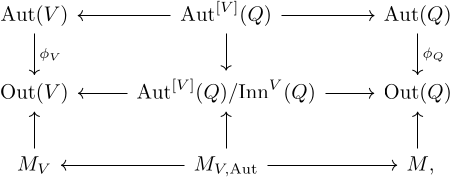
(⋆)

where the horizontal arrows in the third line are surjective; see the definitions of M V , 𝑀, M V , Aut . Now we verify the following assertion.

Claim 3.8.A

The horizontal arrows in the third line of diagram () are bijective.

Indeed, we note that, in light of our assumption that 𝑄 is slim, the natural morphism Aut [ V ] ( Q ) Aut ( V ) is injective; see Remark 3.2 (ii). Then it follows from the commutativity of the diagram

that Aut [ V ] ( Q ) / Inn V ( Q ) Out ( V ) is injective, hence that M V , Aut M V is bijective. On the other hand, it is easy to see from the above condition (i) that M V , Aut M is injective. This completes the proof of Claim 3.8.A.

In light of Claim 3.8.A, we obtain a natural outer action

M M V , Aut M V Out ( V ) .

Then, since the natural morphism V out M Aut ( V ) factors through Aut [ V ] ( Q ) , we have a natural open injection V out M Q out J . Finally, it is easy to see from the relevant definitions that the morphisms M Out ( V ) and V out M Q out J satisfy conditions (a), (b), (c). This completes the proof of Lemma 3.8. ∎

4 Computations of various Galois centralizers

In this section, by applying highly nontrivial “Grothendieck Conjecture-type results” [9, Theorem A] and [15, Theorem D] in anabelian geometry, we compute various Galois centralizers. These computations will be applied in Section 5.

Definition 4.1

Let 𝑘 be a field, k ̄ an algebraic closure of 𝑘, and 𝑍 a hyperbolic curve over 𝑘. Then we have an exact sequence of profinite groups

1 Π Z k ̄ Π Z G k 1 .

We shall write ρ Z : G k Out ( Π Z k ̄ ) for the outer representation determined by the above exact sequence. Let Σ P be a nonempty subset. Then we shall write

ρ Z Σ : G k Out ( Π Z k ̄ Σ )

for the outer representation induced by ρ Z , and

Π Z [ Σ ] = def Π Z / Ker ( Π Z k ̄ Π Z k ̄ Σ ) .

Let 𝑝 be a prime number. If Σ = { p } , then we shall also write ρ Z p = def ρ Z Σ .

Lemma 4.2

Let 𝑙 be a prime number and Σ P a subset such that l Σ . Let n Z 1 be a Σ-integer, K Q ̄ a number field, and Z P K 1 { 0 , 1 , } an open subscheme obtained by forming the complement of a finite subset of 𝐾-rational points of P K 1 { 0 , 1 , } . In particular, 𝑍 is a hyperbolic curve of genus 0 over 𝐾. Write ( P Q ̄ 1 ) Y Q ̄ Z Q ̄ ( P Q ̄ 1 ) for the finite étale Galois covering of Z Q ̄ of degree 𝑛 determined by t t n , and

Q = def Π Z Q ̄ Σ / Ker ( Π Y Q ̄ Σ Π Y Q ̄ l ) .

Then the following hold.

  1. We have a natural homomorphism

    Out | C | ( Π Z Q ̄ Σ ) Out | C | ( Q ) .

  2. Write 𝜌 for the composite of natural homomorphisms

    G K ρ Z Σ Out | C | ( Π Z Q ̄ Σ ) Out | C | ( Q ) ;

    recall our assumption that all cusps of 𝑍 are 𝐾-rational. Then

    Z Out | C | ( Q ) ( Im ( ρ ) ) = { 1 } .

  3. Let G Out | C | ( Q ) be a closed subgroup such that 𝐺 contains an open subgroup of Im ( ρ ) . Then 𝐺 is slim.

Proof

We begin by observing that the normal open subgroup

Π Y Q ̄ Σ Π Z Q ̄ Σ

(determined by the finite étale Galois covering Y Q ̄ Z Q ̄ ) may be characterized as the normal open subgroup topologically generated by the cuspidal inertia subgroups of Π Z Q ̄ Σ that is not associated to the cusps 0, ∞, and the unique closed subgroups of the cuspidal inertia subgroups of Π Z Q ̄ Σ associated to the cusps 0, ∞, of index 𝑛. Then it is easy to see from the relevant definitions that any element in Out | C | ( Π Z Q ̄ Σ ) induces an element in Out | C | ( Q ) . This completes the proof of assertion (i).

Next, we verify assertion (ii). Let σ Z Out | C | ( Q ) ( Im ( ρ ) ) . Then it follows from the above observation that any lifting in Aut ( Q ) of 𝜎 induces an automorphism of Π Y Q ̄ l . Let σ ̃ Aut ( Q ) be a lifting of 𝜎 such that the automorphism

σ ̃ | Π Y Q ̄ l Aut ( Π Y Q ̄ l )

induced by σ ̃ preserves the Π Y Q ̄ l -conjugacy class of cuspidal inertia subgroups of Π Y Q ̄ l associated to the cusp 1. Here, we note that, since σ ̃ preserves the 𝑄-conjugacy class of cuspidal inertia subgroups of 𝑄 associated to the cusp 0 (respectively, ∞), and the finite étale Galois covering Y Q ̄ Z Q ̄ is totally ramified over the cusp 0 (respectively, ∞), it follows that σ ̃ | Π Y Q ̄ l preserves the Π Y Q ̄ l -conjugacy class of cuspidal inertia subgroups of Π Y Q ̄ l associated to the cusp 0 (respectively, ∞). Write

σ Y : Π Y Q ̄ l Π Y Q ̄ l

for the outer automorphism determined by

σ ̃ | Π Y Q ̄ l Aut ( Π Y Q ̄ l ) .

Observe that, since the outer action of G K , together with σ Y , on Π Y Q ̄ l preserves the Π Y Q ̄ l -conjugacy class of cuspidal inertia subgroups of Π Y Q ̄ l associated to the cusp 1, it follows from our assumption that

σ Z Out | C | ( Q ) ( Im ( ρ ) )

that σ Y commutes with the outer action of G K on Π Y Q ̄ l . Then it follows from the Grothendieck Conjecture [9, Theorem A] that σ Y arises from a unique isomorphism f : Y Q ̄ Y Q ̄ of schemes over Q ̄ . Note that, since σ ̃ | Π Y Q ̄ l induces the identity permutation on the set of the Π Y Q ̄ l -conjugacy classes of cuspidal inertia subgroups of Π Y Q ̄ l associated to the cusps 0, 1, ∞, it follows that 𝑓 induces the identity permutation on the subset { 0 , 1 , } P Q ̄ 1 . In particular, we conclude that 𝑓 is the identity automorphism, hence that σ Y is the identity outer automorphism. Recall that the automorphism

σ ̃ | Π Y Q ̄ l Aut ( Π Y Q ̄ l )

is the restriction of σ ̃ Aut ( Q ) . Thus, since 𝑄 is slim by [12, Proposition 1.4], it follows from Remark 3.2 (ii) that σ ̃ is an inner automorphism, hence that 𝜎 is the identity outer automorphism. This completes the proof of assertion (ii).

Finally, we verify assertion (iii). Since every open subgroup of 𝐺 contains an open subgroup of Im ( ρ ) , to verify (iii), it suffices to show that Z ( G ) = { 1 } . But this follows from assertion (ii). This completes the proof of assertion (iii), hence of Lemma 4.2. ∎

The following notion plays an important role in our work.

Definition 4.3

Let 𝑙 be a prime number. We shall say that a profinite group 𝐺 is almost Z l if there exists an open subgroup H G such that 𝐻 is isomorphic to Z l .

Lemma 4.4

Let 𝑝 be a prime number, Σ P a nonempty subset such that p Σ , and 𝑘 a finite field of characteristic 𝑝. In the notation of Definition 4.1, suppose that 𝑍 is a hyperbolic curve of genus 0 over 𝑘 such that all cusps of 𝑍 are 𝑘-rational. Write ρ = def ρ Z Σ . Then the following hold.

  1. Suppose that | P Σ | is finite. Then the natural homomorphism

    Aut ( Z k ̄ ) Out ( Π Z k ̄ Σ )

    determines an isomorphism

    Aut ( Z k ̄ ) Z Out ( Π Z k ̄ Σ ) ( ρ ( G k ) ) .

  2. Suppose that either | Σ | = 1 or | P Σ | is finite. Then, if we write

    χ Σ : Out | C | ( Π Z k ̄ Σ ) ( Z ̂ Σ ) ×

    for the pro-Σ cyclotomic character, which is obtained by considering the actions on the cuspidal inertia subgroups of Π Z k ̄ Σ , then the natural composite

    Z Out | C | ( Π Z k ̄ Σ ) ( ρ ( G k ) ) Out | C | ( Π Z k ̄ Σ ) χ Σ ( Z ̂ Σ ) ×

    is injective.

  3. Let 𝑙 be a prime number p . Then Z Out ( Π Z k ̄ l ) ( ρ ( G k ) ) is almost Z l .

Proof

First, we verify assertion (i). Write Out G k ( Π Z [ Σ ] ) for the group of Π Z k ̄ Σ -outer automorphisms of Π Z [ Σ ] that lie over G k ; see Definition 4.1. Then, since Π Z k ̄ Σ is center-free by [12, Proposition 1.4], it is well known that the natural homomorphism

Out G k ( Π Z [ Σ ] ) Z Out ( Π Z k ̄ Σ ) ( ρ ( G k ) )

is an isomorphism; see [17, Lemma 7.1]. On the other hand, since G k is abelian, it follows from [15, Theorem D], together with the definition of Out G k ( Π Z [ Σ ] ) , that

Aut ( Z k ̄ / Z ) Out G k ( Π Z [ Σ ] ) ,

where Aut ( Z k ̄ / Z ) Aut ( Z k ̄ ) denotes the subgroup consisting of automorphisms of Z k ̄ that induce automorphisms of 𝑍 compatible with the natural morphism Z k ̄ Z .

Next, we verify the following assertion.

Claim 4.4.A

The inclusion Aut ( Z k ̄ / Z ) Aut ( Z k ̄ ) is bijective.

Indeed, let α Aut ( Z k ̄ ) and σ G k ( Aut ( Z k ̄ ) ) . Then, since G k is abelian, it follows that

γ = def σ α σ 1 α 1 Aut k ̄ ( Z k ̄ ) .

Next, we note that 𝛾 induces the identity permutation on the set of cusps of Z k ̄ . Thus, we conclude that γ = 1 , hence that 𝛼 induces a unique automorphism in Aut ( Z ) compatible with the natural morphism Z k ̄ Z . This completes the proof of Claim 4.4.A.

Thus, by applying Claim 4.4.A, we obtain a natural isomorphism

ϕ : Aut ( Z k ̄ ) Z Out ( Π Z k ̄ Σ ) ( ρ ( G k ) ) .

This completes the proof of assertion (i).

Next, we verify assertion (ii). If | Σ | = 1 , then the desired conclusion follows from the latter half of the proof of [13, Proposition 2.2.4]. Thus, we may assume without loss of generality that | P Σ | is finite. Write Aut | C | ( Z k ̄ ) Aut ( Z k ̄ ) for the subgroup of automorphisms of Z k ̄ that induce the identity permutation on the set of cusps of Z k ̄ . Then 𝜙 induces a composite

Aut | C | ( Z k ̄ ) Z Out | C | ( Π Z k ̄ Σ ) ( ρ ( G k ) ) Out | C | ( Π Z k ̄ Σ ) χ Σ ( Z ̂ Σ ) × .

Observe that this composite factors as the composite of the natural injection

Aut | C | ( Z k ̄ ) G F p

with the pro-Σ cyclotomic character G F p ( Z ̂ Σ ) × . Thus, since this character is injective by [2, Théorème 1], we conclude that the natural composite

Z Out | C | ( Π Z k ̄ Σ ) ( ρ ( G k ) ) Out | C | ( Π Z k ̄ Σ ) χ Σ ( Z ̂ Σ ) ×

is injective. This completes the proof of assertion (ii).

Finally, we verify assertion (iii). We begin by observing that, since the image of the 𝑙-adic cyclotomic character G k Z l × is infinite, it follows from [10, Corollary 2.7 (i)] that

Z Out ( Π Z k ̄ l ) ( ρ ( G k ) ) = Z Out C ( Π Z k ̄ l ) ( ρ ( G k ) ) .

Moreover, we observe that, since

Out | C | ( Π Z k ̄ l ) is open in Out C ( Π Z k ̄ l ) ,

it follows that

Z Out | C | ( Π Z k ̄ l ) ( ρ ( G k ) ) is open in Z Out C ( Π Z k ̄ l ) ( ρ ( G k ) ) .

Thus, to verify assertion (iii), it suffices to show that

Z Out | C | ( Π Z k ̄ l ) ( ρ ( G k ) ) is almost Z l .

On the other hand, since ρ ( G k ) is an infinite abelian group by [8, Lemma 4.2 (iv)], we conclude from assertion (ii) that

Z Out | C | ( Π Z k ̄ l ) ( ρ ( G k ) ) is almost Z l ,

as desired. This completes the proof of assertion (iii), hence of Lemma 4.4. ∎

Remark 4.5

It is natural to pose the following question.

Question

In the notation of Lemma 4.4 (i) (respectively, Lemma 4.4 (ii)), can the assumption that | P Σ | is finite (respectively, | Σ | = 1 or | P Σ | is finite) be dropped?

However, at the time of writing, the authors do not know whether the answer to this question is affirmative or not.

Lemma 4.6

Let 𝑙 be a prime number and K Q ̄ a number field. In the notation of Definition 4.1, suppose that k = K , and 𝑍 is a hyperbolic curve over 𝐾. Then every open subgroup U Im ( ρ Z l ) is nonabelian.

Proof

Recall that, since the image of the 𝑙-adic cyclotomic character G K Z l × is infinite, it follows that Im ( ρ Z l ) is infinite [8, Lemma 4.2 (iv)]. In particular, 𝑈 is infinite. Write K Q ̄ for the finite extension of 𝐾 determined by 𝑈. Suppose that 𝑈 is abelian. Then, since

U Z Out ( Π Z Q ̄ l ) ( U ) ,

the centralizer

Z Out ( Π Z Q ̄ l ) ( U )

is infinite. However, since Aut K ( Z K ) is finite, this contradicts the Grothendieck Conjecture for hyperbolic curves over number fields [9, Theorem A]. Thus, we conclude that 𝑈 is nonabelian. This completes the proof of Lemma 4.6. ∎

5 Strong indecomposability of the outer automorphism groups of nonabelian free profinite groups

In this section, by applying the results obtained in Sections 4 and 5, we prove Theorem 1.1 and Corollary 1.2.

Lemma 5.1

Let Σ P be a nonempty subset and K Q ̄ a number field. In the notation of Definition 4.1, suppose that k = K , and 𝑍 is a hyperbolic curve of genus 0 over 𝐾. Let

G Out ( Π Z Q ̄ Σ )

be a closed subgroup such that

  • 𝐺 contains an open subgroup of ρ Z Σ ( G K ) ,

  • there exists a prime number l Σ such that the image of 𝐺 via the natural morphism

    ϕ l : Out ( Π Z Q ̄ Σ ) Out ( Π Z Q ̄ l ) ,

    which is necessarily surjective by [14, Proposition 4.5.4 (b)], is slim,

  • there exist normal closed subgroups G 1 G , G 2 G such that G = G 1 × G 2 .

Then either
  1. ϕ l ( G 1 ) = { 1 } and G 1 Out | C | ( Π Z Q ̄ Σ ) , or

  2. ϕ l ( G 2 ) = { 1 } and G 2 Out | C | ( Π Z Q ̄ Σ ) .

Proof

First, by replacing 𝐾 by a finite extension of 𝐾, we may assume without loss of generality that ρ Z Σ ( G K ) G , and all cusps of 𝑍 are 𝐾-rational. Let 𝔭 be a maximal ideal of the ring of integers of 𝐾 such that

  • the characteristic of the residue field at 𝔭 is not equal to 𝑙, and

  • 𝑍 has good reduction at 𝔭.

Let F G K be a lifting of the Frobenius element at 𝔭. We shall write,
  • for each i = 1 , 2 , pr i : G G i for the natural projection,

  • J G K for the closed subgroup topologically generated by 𝐹, where we note that 𝐽 is isomorphic to Z ̂ ,

  • I = def ρ Z Σ ( J ) G ,

  • I 1 = def pr 1 ( I ) × { 1 } G 1 × G 2 = G , I 2 = def { 1 } × pr 2 ( I ) G 1 × G 2 = G .

Here, we note that, since 𝐼 is abelian, it follows that

I I 1 × I 2 Z G ( I ) ,

hence that

ϕ l ( I ) ϕ l ( I 1 ) ϕ l ( I 2 ) Z ϕ l ( G ) ( ϕ l ( I ) ) Z Out ( Π Z Q ̄ l ) ( ϕ l ( I ) ) .

Moreover, we note that, since 𝑍 has good reduction at 𝔭, it follows from the theory of specialization isomorphism, together with Lemma 4.4 (iii), and [8, Lemma 4.2 (iv)] that

  • Z Out ( Π Z Q ̄ l ) ( ϕ l ( I ) ) is almost Z l , and

  • ϕ l ( I ) is infinite.

In particular, either ϕ l ( I 1 ) is infinite, or ϕ l ( I 2 ) is infinite. We may assume without loss of generality that ϕ l ( I 2 ) is infinite. Observe that, since Z Out ( Π Z Q ̄ l ) ( ϕ l ( I ) ) is almost Z l , it follows that ϕ l ( I 2 ) ϕ l ( I ) ϕ l ( I ) is an open subgroup. Then, since G 1 Z G ( I 2 ) , there exists an open subgroup I I such that

ϕ l ( G 1 ) Z Out ( Π Z Q ̄ l ) ( ϕ l ( I ) ) .

Now suppose that ϕ l ( G 1 ) is infinite. Then, since

ϕ l ( I ) Z Out ( Π Z Q ̄ l ) ( ϕ l ( I ) ) ,

and moreover, by Lemma 4.4 (iii),

Z Out ( Π Z Q ̄ l ) ( ϕ l ( I ) ) is almost Z l ,

it follows that ϕ l ( G 1 ) ϕ l ( I ) ϕ l ( I ) is an open subgroup. On the other hand, since G 2 Z G ( G 1 ) , there exists an open subgroup I I ( I ) such that

ϕ l ( G 2 ) Z Out ( Π Z Q ̄ l ) ( ϕ l ( I ) ) .

In summary, we have

ρ Z l ( G K ) = ϕ l ( ρ Z Σ ( G K ) ) ϕ l ( G ) = ϕ l ( G 1 ) ϕ l ( G 2 ) Z Out ( Π Z Q ̄ l ) ( ϕ l ( I ) ) .

Then, since Z Out ( Π Z Q ̄ l ) ( ϕ l ( I ) ) is almost Z l by Lemma 4.4 (iii), it follows that there exists an open subgroup U ρ Z l ( G K ) such that 𝑈 is abelian, a contradiction; see Lemma 4.6. Thus, we conclude that ϕ l ( G 1 ) is finite. Therefore, since ϕ l ( G 1 ) ϕ l ( G ) is a finite normal subgroup, it follows from our assumption that ϕ l ( G ) is slim that ϕ l ( G 1 ) = { 1 } ; see Remark 3.2 (i).

Finally, we verify the inclusion G 1 Out | C | ( Π Z Q ̄ Σ ) . Write

χ l : Out | C | ( Π Z Q ̄ Σ ) Z l ×

for the 𝑙-adic cyclotomic character, which is obtained by considering the actions on the cuspidal inertia subgroups of Π Z Q ̄ Σ . Then, since χ l ( I ) is infinite, it follows from [10, Corollary 2.7 (i)] that

I 1 × I 2 Z Out ( Π Z Q ̄ Σ ) ( I ) Out C ( Π Z Q ̄ Σ ) .

In particular, since ϕ l ( I 1 ) ϕ l ( G 1 ) = { 1 } , we have I 1 Out | C | ( Π Z Q ̄ Σ ) ; see [10, Proposition 1.2 (i)]. Thus, we obtain an inclusion

I I 1 × I 2 | C | ( Out | C | ( Π Z Q ̄ Σ ) ) ,

where we write

I 2 | C | = def I 2 Out | C | ( Π Z Q ̄ Σ ) .

Here, observe that, since χ l factors through the restriction of ϕ l on Out | C | ( Π Z Q ̄ Σ ) , it follows that

χ l ( I ) χ l ( I 2 | C | ) ( Z l × ) ,

hence that χ l ( I 2 | C | ) is infinite. Therefore, we conclude from [10, Corollary 2.7 (i)] that

G 1 Z Out ( Π Z Q ̄ Σ ) ( I 2 | C | ) Out C ( Π Z Q ̄ Σ ) .

In particular, since ϕ l ( G 1 ) = { 1 } , we have G 1 Out | C | ( Π Z Q ̄ Σ ) ; see [10, Proposition 1.2 (i)]. This completes the proof of Lemma 5.1. ∎

Remark 5.2

In the notation of Lemma 5.1, suppose that

G Out | C | ( Π Z Q ̄ Σ ) .

Then the second assumption on 𝐺 (concerning the slimness of ϕ l ( G ) ) follows automatically from the first assumption on 𝐺. Indeed, to verify the slimness of ϕ l ( G ) , by replacing 𝐾 by a finite extension of 𝐾, we may assume without loss of generality that 𝑍 is an open subscheme of P K 1 { 0 , 1 , } obtained by forming the complement of a finite subset of 𝐾-rational points of P K 1 { 0 , 1 , } . Then the slimness of ϕ l ( G ) follows from Lemma 4.2 (iii).

We are now ready to prove Theorem 1.1.

Proof of Theorem 1.1

We begin by observing that every open subgroup Γ of 𝐺 contains an open subgroup of ρ Z Σ ( G K ) , and moreover, ϕ l ( Γ ) is slim. In particular, to verify Theorem 1.1, it suffices to prove that 𝐺 is indecomposable. If | Σ | = 1 , then the indecomposability of 𝐺 follows from Lemma 5.1. Thus, we may assume without loss of generality that | P Σ | is finite. Next, by replacing 𝐾 by a finite extension of 𝐾, we may assume without loss of generality that ρ Z Σ ( G K ) G , and all cusps of 𝑍 are 𝐾-rational. Moreover, we may assume without loss of generality that 𝑍 is an open subscheme of P K 1 { 0 , 1 , } obtained by forming the complement of a finite subset of 𝐾-rational points of P K 1 { 0 , 1 , } .

Suppose that there exist normal closed subgroups G 1 G and G 2 G such that G = G 1 × G 2 . We shall write,

  • for each Σ-integer n Z 1 , ( P Q ̄ 1 ) Y Q ̄ n Z Q ̄ ( P Q ̄ 1 ) for the finite étale Galois covering of Z Q ̄ of degree 𝑛 determined by t t n ,

  • Q n , l = def Π Z Q ̄ Σ / Ker ( Π Y Q ̄ n Σ Π Y Q ̄ n l ) ,

  • ϕ n , l : Out | C | ( Π Z Q ̄ Σ ) Out | C | ( Q n , l ) for the natural homomorphism; see Lemma 4.2 (i).

Note that Y Q ̄ 1 = Z Q ̄ , and Q 1 , l = Π Z Q ̄ l .

Next, let us observe that, by applying Lemma 5.1, we may assume without loss of generality that

ϕ l ( G 1 ) = { 1 } and G 1 Out | C | ( Π Z Q ̄ Σ ) .

In particular, we have a direct product decomposition

G | C | = G 1 × G 2 | C | ( Out | C | ( Π Z Q ̄ Σ ) ) ,

where we write G | C | = def G Out | C | ( Π Z Q ̄ Σ ) and G 2 | C | = def G 2 Out | C | ( Π Z Q ̄ Σ ) .

Next, we verify the following assertion.

Claim 1.1.A

For any Σ-integer n Z 1 , ϕ n , l ( G 1 ) = { 1 } .

Indeed, since Π Z Q ̄ Σ is slim by [12, Proposition 1.4], it follows from Lemma 3.8 that we have normal open subgroups H G | C | , H 1 G 1 , and H 2 G 2 | C | such that

  • H = H 1 × H 2 ,

  • there exists an injection H Out | C | ( Π Y Q ̄ n Σ ) ,

  • there exists an injection

    Π Y Q ̄ n Σ out H Π Z Q ̄ Σ out G | C |

    that is compatible with the inclusions between respective subgroups

    Π Y Q ̄ n Σ Π Z Q ̄ Σ

    and quotients H G | C | .

Then it follows from Lemma 5.1, Remark 5.2, together with [12, Proposition 1.4], that ϕ n , l ( H 1 ) = { 1 } or ϕ n , l ( H 2 ) = { 1 } . Suppose that ϕ n , l ( H 2 ) = { 1 } . Here, we note that, since Q n , l l Π Z Q ̄ l , it follows that ϕ l factors as the composite of ϕ n , l with the natural homomorphism

Out | C | ( Q n , l ) Out | C | ( Π Z Q ̄ l ) .

In particular, ϕ l ( H 2 ) = { 1 } . Then our assumption that ϕ l ( G 1 ) = { 1 } implies that ϕ l ( G 1 × H 2 ) = { 1 } , hence that ϕ l ( ρ Z Σ ( G K ) ) ( ϕ l ( G ) ) is finite. This is a contradiction; see [8, Lemma 4.2 (iv)]. Thus, we conclude that ϕ n , l ( H 1 ) = { 1 } , hence that ϕ n , l ( G 1 ) is finite. Therefore, since ϕ n , l ( G 1 ) ϕ n , l ( G ) is a finite normal subgroup, and moreover, ϕ n , l ( G ) is slim by Lemma 4.2 (iii), we get ϕ n , l ( G 1 ) = { 1 } ; see Remark 3.2 (i). This completes the proof of Claim 1.1.A.

Write χ Σ : Out | C | ( Π Z Q ̄ Σ ) ( Z ̂ Σ ) × for the pro-Σ cyclotomic character, which is obtained by considering the actions on the cuspidal inertia subgroups of Π Z Q ̄ Σ . Then it follows from Claim 1.1.A that

χ Σ ( G 1 ) = { 1 } .

For each p Σ , write

ϕ ( p ) : Out ( Π Z Q ̄ Σ ) Out ( Π Z Q ̄ Σ { p } )

for the natural surjection.

Next, we verify the following assertion.

Claim 1.1.B

There exists a finite subset S Σ such that, for each p Σ S , ϕ ( p ) ( G 1 ) = { 1 } .

Indeed, let 𝔭 be a maximal ideal of the ring of integers of 𝐾 such that

  • the characteristic, which we denote by 𝑝, of the residue field at 𝔭 is contained in Σ, and

  • 𝑍 has good reduction at 𝔭.

Let F G K be a lifting of the Frobenius element at 𝔭. We shall write,
  • for each i = 1 , 2 , pr i : G G i for the natural projection,

  • J G K for the closed subgroup topologically generated by 𝐹, where we note that 𝐽 is isomorphic to Z ̂ ,

  • I = def ρ Z Σ ( J ) G | C | ,

  • I 1 = def pr 1 ( I ) × { 1 } G 1 × G 2 | C | = G | C | , I 2 = def { 1 } × pr 2 ( I ) G 1 × G 2 | C | = G | C | .

Then, since 𝐼 is abelian,

I I 1 × I 2 Z G | C | ( I ) .

Then it follows from Lemma 4.4 (ii), together with the theory of specialization isomorphism, that our assumption that χ Σ ( I 1 ) χ Σ ( G 1 ) = { 1 } implies that

ϕ ( p ) ( I 1 ) = { 1 } .

In particular, ϕ ( p ) ( I ) ϕ ( p ) ( I 2 ) . Thus, since χ Σ ( G 1 ) = { 1 } , and G 1 Z G ( I 2 ) , we conclude from Lemma 4.4 (ii), together with the theory of specialization isomorphism, that ϕ ( p ) ( G 1 ) = { 1 } . Observe that there exists a finite subset S Σ such that 𝑍 has good reduction at any maximal ideal of the ring of integers of 𝐾 that lies over a prime number in Σ S . Therefore, we obtain the desired conclusion. This completes the proof of Claim 1.1.B.

Write Σ = def P Σ . Note that, by Lemma 3.4 and the finiteness of | Σ S | , the composite

Out ( Π Z Q ̄ Σ ) p P ( Σ S ) Out ( ( Π Z Q ̄ Σ ) ( p ) ) p Σ S Out ( Π Z Q ̄ Σ { p } )

is injective. Thus, we conclude from Claim 1.1.B that G 1 = { 1 } , hence that 𝐺 is indecomposable. This completes the proof of Theorem 1.1. ∎

Remark 5.3

It is natural to pose the following question.

Question

In the notation of Theorem 1.1, can the assumption that | Σ | = 1 or | P Σ | is finite be dropped?

However, at the time of writing, the authors do not know whether the answer to this question is affirmative or not.

Corollary 5.4

In the notation of Theorem 1.1, suppose 𝐺 is slim. Then Π Z Q ̄ Σ out G is strongly indecomposable.

Proof

First, since Π Z Q ̄ Σ is center-free by [12, Proposition 1.4], we have an exact sequence of profinite groups

1 Π Z Q ̄ Σ Π Z Q ̄ out G G 1 .

Thus, since 𝐺 is infinite, we conclude from Theorem 1.1, together with [8, Proposition 1.8 (i)] and [12, Propositions 1.4, 3.2], that Π Z Q ̄ Σ out G is strongly indecomposable. This completes the proof of Corollary 5.4. ∎

Lemma 5.5

Let m 2 be an integer, Σ P a nonempty subset, and F m a free profinite group of rank 𝑚. Then Out ( F m Σ ) is slim.

Proof

First, we consider the case where m = 2 . In this case, we claim the following assertion.

Claim 5.5.A

There exists a closed subgroup

H 1 Out ( F m Σ ) ( respectively, H 2 Out ( F m Σ ) )

such that, for every open subgroup H 1 H 1 (respectively, H 2 H 2 ),

Z Out ( F m Σ ) ( H 1 ) S 3 ( respectively, Z Out ( F m Σ ) ( H 2 ) Z / 2 Z ) ,

where we write S 3 for the symmetric group on 3 letters.

Indeed, write C 1 for the projective line minus { 0 , 1 , } over a number field K 1 Q ̄ . Let ( E , { o } ) be an elliptic curve, where 𝑜 is the origin of 𝐸, over a number field K 2 Q ̄ such that the 𝑗-invariant of ( E , { o } ) is not equal to 0 or 1728. Write C 2 for the hyperbolic curve over K 2 obtained by removing { o } from 𝐸. In particular, as is well known, for any finite extension K 1 L 1 ( Q ̄ ) (respectively, K 2 L 2 ( Q ̄ )), we have

Aut L 1 ( ( C 1 ) L 1 ) S 3 ( respectively, Aut L 2 ( ( C 2 ) L 2 ) Z / 2 Z ) .

Thus, since, by applying the Grothendieck Conjecture for hyperbolic curves over number fields [9, Theorem A], we have a natural isomorphism

Aut L 1 ( ( C 1 ) L 1 ) Z Out ( Π ( C 1 ) Q ̄ Σ ) ( ρ C 1 Σ ( G L 1 ) ) ( respectively, Aut L 2 ( ( C 2 ) L 2 ) Z Out ( Π ( C 2 ) Q ̄ Σ ) ( ρ C 2 Σ ( G L 2 ) ) ) ,

we conclude that the image of ρ C 1 Σ ( G K 1 ) (respectively, ρ C 2 Σ ( G K 2 ) ) via any isomorphism

Out ( Π ( C 1 ) Q ̄ Σ ) Out ( F m Σ ) ( respectively, Out ( Π ( C 2 ) Q ̄ Σ ) Out ( F m Σ ) )

determines the desired subgroup. This completes the proof of Claim 5.5.A.

Let us recall that, to verify Lemma 5.5, it suffices to show that, for every normal open subgroup N Out ( F m Σ ) , we have Z Out ( F m Σ ) ( N ) = { 1 } . Now suppose that Z Out ( F m Σ ) ( N ) { 1 } . Then, since

Z Out ( F m Σ ) ( N ) Z Out ( F m Σ ) ( H 1 N ) Z Out ( F m Σ ) ( H 2 N ) Z Out ( F m Σ ) ( H 2 N ) Z / 2 Z

by Claim 5.5.A, we have

Z Out ( F m Σ ) ( N ) = Z Out ( F m Σ ) ( H 1 N ) Z Out ( F m Σ ) ( H 2 N ) = Z Out ( F m Σ ) ( H 2 N ) Z / 2 Z .

Thus, since Z Out ( F m Σ ) ( N ) is normal in Out ( F m Σ ) by our assumption that 𝑁 is normal in Out ( F m Σ ) , we conclude that Z Out ( F m Σ ) ( H 1 N ) , which is isomorphic to S 3 by Claim 5.5.A, admits a normal subgroup of order 2, a contradiction. Therefore, we have Z Out ( F m Σ ) ( N ) = { 1 } . This completes the proof of Lemma 5.5 in the case where m = 2 .

Next, we consider the case where m = 3 . In this case, we claim the following assertion.

Claim 5.5.B

There exists a closed subgroup

H 1 Out ( F m Σ ) ( respectively, H 2 Out ( F m Σ ) )

satisfying the following conditions.

  • For every open subgroup H 1 H 1 (respectively, H 2 H 2 ),

    Z Out ( F m Σ ) ( H 1 ) Z / 2 Z × Z / 2 Z ( respectively, Z Out ( F m Σ ) ( H 2 ) Z / 2 Z ) .

  • For any l Σ , every nontrivial element α 1 Z Out ( F m Σ ) ( H 1 ) (respectively, the unique nontrivial element α 2 Z Out ( F m Σ ) ( H 2 ) ) induces a Z l -automorphism α ̄ 1 (respectively, α ̄ 2 ) of ( F m l ) ab such that the rank of the Z l -submodule of ( F m l ) ab consisting of elements in ( F m l ) ab fixed by α ̄ 1 (respectively, α ̄ 2 ) is 1 (respectively, 0).

Indeed, write C 1 for the projective line minus { 0 , 1 , 3 , } over a number field K 1 Q ̄ . Let ( E , { o } ) be an elliptic curve over a number field K 2 Q ̄ such that the 𝑗-invariant of ( E , { o } ) is not equal to 0 or 1728, and that 𝐸 has a non-4-torsion K 2 -rational point 𝑥. Write C 2 for the hyperbolic curve over K 2 obtained by removing { x , x } from 𝐸. Observe that the Q ̄ -automorphism “ [ 1 ] ” of E Q ̄ (of order 2) preserves the set { x , x } , and that if a nontrivial element f Aut Q ̄ ( E Q ̄ ) satisfies f ( x ) = x , then 𝑓 coincides with the map

z 2 x z

on the set of Q ̄ -rational points of E Q ̄ , so f ( x ) x . In particular, as is easily verified, for any finite extension K 1 L 1 ( Q ̄ ) (respectively, K 2 L 2 ( Q ̄ )), we have

Aut L 1 ( ( C 1 ) L 1 ) Z / 2 Z × Z / 2 Z ( respectively, Aut L 2 ( ( C 2 ) L 2 ) Z / 2 Z ) .

Let α 1 be a nontrivial element in Aut L 1 ( ( C 1 ) L 1 ) that induces a permutation 𝑠 on the set of cusps { 0 , 1 , 3 , } . Here, we note that 𝑠 may be written as the product of the transposition of two distinct elements in { 0 , 1 , 3 , } and the transposition of the other two distinct elements in { 0 , 1 , 3 , } . Write α 2 for the unique nontrivial element in Aut L 2 ( ( C 2 ) L 2 ) . Then it follows from the well known structure of the étale fundamental group of a smooth curve over an algebraically closed field of characteristic 0 that if we identify ( Π ( C 1 ) Q ̄ l ) ab (respectively, ( Π ( C 2 ) Q ̄ l ) ab ) with the free Z l -module

( a 0 , a 1 , a 3 , a a 0 + a 1 + a 3 + a = 0 l ) ab ( respectively, ( b , c , d x , d x d x + d x = 0 l ) ab ) ,

where a (respectively, d ) corresponds to the cusp { 0 , 1 , 3 , } (respectively, { x , x } ), 𝑏 corresponds to a meridian of the “complex torus E ( C ) ”, and 𝑐 corresponds to a longitude of E ( C ) , then α 1 (respectively, α 2 ) induces the Z l -automorphism

α ̄ 1 : ( Π ( C 1 ) Q ̄ l ) ab ( Π ( C 1 ) Q ̄ l ) ab , a 0 a s ( 0 ) , a 1 a s ( 1 ) , a 3 a s ( 3 ) , a a s ( )
( respectively, α ̄ 2 : ( Π ( C 2 ) Q ̄ l ) ab ( Π ( C 2 ) Q ̄ l ) ab , b b , c c , d x d x , d x d x ) .
Now one verifies easily that the rank of the Z l -submodule of

( Π ( C 1 ) Q ̄ l ) ab ( respectively, ( Π ( C 2 ) Q ̄ l ) ab )

consisting of elements in

( Π ( C 1 ) Q ̄ l ) ab ( respectively, ( Π ( C 2 ) Q ̄ l ) ab )

fixed by α ̄ 1 (respectively, α ̄ 2 ) is 1 (respectively, 0). Thus, Claim 5.5.B follows from a similar argument to the argument applied in the final portion of the proof of Claim 5.5.A.

In light of Claim 5.5.B, for every open subgroup N Out ( F m Σ ) , we have

Z Out ( F m Σ ) ( N ) Z Out ( F m Σ ) ( H 1 N ) Z Out ( F m Σ ) ( H 2 N ) = { 1 } .

This completes the proof of Lemma 5.5 in the case where m = 3 .

Finally, we consider the case where m 4 . In this case, by considering the hyperbolic curve 𝐶 over a number field K Q ̄ obtained by removing m + 1 distinct ℚ-rational points from P K 1 such that Aut Q ̄ ( C Q ̄ ) = { 1 } , the next claim follows from a similar argument to the argument applied in the final portion of the proof of Claim 5.5.A.

Claim 5.5.C

There exists a closed subgroup H Out ( F m Σ ) such that, for every open subgroup H H , Z Out ( F m Σ ) ( H ) = { 1 } .

It is easy to see from Claim 5.5.C that Out ( F m Σ ) (where m 4 ) is slim. This completes the proof of Lemma 5.5. ∎

Remark 5.6

Lemma 5.5 in the case where m 4 also follows from [6, Theorem A].

Finally, we prove Corollary 1.2.

Proof of Corollary 1.2

The strong indecomposability of Out ( F m Σ ) follows from Theorem 1.1 and Lemma 5.5. The strong indecomposability of Aut ( F m Σ ) follows from Corollary 5.4 and Lemma 5.5. This completes the proof of Corollary 1.2. ∎

Award Identifier / Grant number: 20K14285

Award Identifier / Grant number: 18J10260

Award Identifier / Grant number: EP/M024830

Funding statement: The first author was supported by JSPS KAKENHI Grant Number 20K14285, and the second author was supported by JSPS KAKENHI Grant Number 18J10260. This research was also supported by the Research Institute for Mathematical Sciences, an international joint usage/research center located in Kyoto University, as well as by the International Research Center for Next Generation Geometry (a research center affiliated with the Research Institute for Mathematical Sciences). This research was partially supported by EPSRC programme grant “Symmetries and Correspondences” EP/M024830.

Acknowledgements

The authors would like to express deep gratitude to Professor Ivan Fesenko for stimulating discussions on this topic. Part of this work was done during their stay in University of Nottingham. The authors would like to thank their supports and hosts. Moreover, the authors would like to thank the participants of RIMS NT/AG Seminar (February 2024) for their questions and comments.

  1. Communicated by: Timothy C. Burness

References

[1] M. P. Anderson, Exactness properties of profinite completion functors, Topology 13 (1974), 229–239. 10.1016/0040-9383(74)90016-0Search in Google Scholar

[2] C. Chevalley, Deux théorèmes d’arithmétique, J. Math. Soc. Japan 3 (1951), 36–44. 10.2969/jmsj/00310036Search in Google Scholar

[3] V. G. Drinfel’d, On quasitriangular quasi-Hopf algebras and on a group that is closely connected with Gal ( Q ̄ / Q ) , Algebra i Analiz 2 (1990), no. 4, 149–181. Search in Google Scholar

[4] D. Haran and M. Jarden, Compositum of Galois extensions of Hilbertian fields, Ann. Sci. Éc. Norm. Supér. (4) 24 (1991), no. 6, 739–748. 10.24033/asens.1641Search in Google Scholar

[5] Y. Hoshi and S. Mochizuki, On the combinatorial anabelian geometry of nodally nondegenerate outer representations, Hiroshima Math. J. 41 (2011), no. 3, 275–342. 10.32917/hmj/1323700038Search in Google Scholar

[6] Y. Iijima, On the centralizer of the image of the universal outer monodromy representation of the moduli stack of pointed hyperbolic curves, Manuscripta Math. 173 (2024), no. 3–4, 1147–1159. 10.1007/s00229-023-01480-9Search in Google Scholar

[7] W. Magnus, A. Karrass and D. Solitar, Combinatorial Group Theory, 2nd ed., Dover Publications, Mineola, 2004. Search in Google Scholar

[8] A. Minamide, Indecomposability of various profinite groups arising from hyperbolic curves, Math. J. Okayama Univ. 60 (2018), 175–208. Search in Google Scholar

[9] S. Mochizuki, The local pro-𝑝 anabelian geometry of curves, Invent. Math. 138 (1999), no. 2, 319–423. 10.1007/s002220050381Search in Google Scholar

[10] S. Mochizuki, A combinatorial version of the Grothendieck conjecture, Tohoku Math. J. (2) 59 (2007), no. 3, 455–479. 10.2748/tmj/1192117988Search in Google Scholar

[11] S. Mochizuki, On the combinatorial cuspidalization of hyperbolic curves, Osaka J. Math. 47 (2010), no. 3, 651–715. Search in Google Scholar

[12] S. Mochizuki and A. Tamagawa, The algebraic and anabelian geometry of configuration spaces, Hokkaido Math. J. 37 (2008), no. 1, 75–131. 10.14492/hokmj/1253539588Search in Google Scholar

[13] H. Nakamura, Galois rigidity of pure sphere braid groups and profinite calculus, J. Math. Sci. Univ. Tokyo 1 (1994), no. 1, 71–136. Search in Google Scholar

[14] L. Ribes and P. Zalesskii, Profinite Groups, Ergeb. Math. Grenzgeb (3) 40, Springer, Berlin, 2000. 10.1007/978-3-662-04097-3Search in Google Scholar

[15] M. Saïdi and A. Tamagawa, A refined version of Grothendieck’s anabelian conjecture for hyperbolic curves over finite fields, J. Algebraic Geom. 27 (2018), no. 3, 383–448. 10.1090/jag/708Search in Google Scholar

[16] T. Szamuely, Galois Groups and Fundamental Groups, Cambridge Stud. Adv. Math. 117, Cambridge University, Cambridge, 2009. 10.1017/CBO9780511627064Search in Google Scholar

[17] A. Tamagawa, The Grothendieck conjecture for affine curves, Compos. Math. 109 (1997), no. 2, 135–194. Search in Google Scholar

[18] S. Tsujimura, Combinatorial Belyi cuspidalization and arithmetic subquotients of the Grothendieck–Teichmüller group, Publ. Res. Inst. Math. Sci. 56 (2020), no. 4, 779–829. 10.4171/prims/56-4-5Search in Google Scholar

Received: 2024-07-15
Revised: 2025-03-09
Published Online: 2025-05-22
Published in Print: 2025-11-01

© 2025 Walter de Gruyter GmbH, Berlin/Boston

Downloaded on 10.12.2025 from https://www.degruyterbrill.com/document/doi/10.1515/jgth-2024-0153/html
Scroll to top button