Negotiating interactional routines in the openings of intercultural first encounters
-
Michael Haugh
Michael Haugh is Professor of Linguistics and Applied Linguistics in the School of Languages and Cultures at The University of Queensland. His research interests lie primarily in the field of pragmatics, with a particular focus on the role of language in social interaction.

 ,
Wei-Lin Melody Chang
,
Wei-Lin Melody Chang
Wei-Lin Melody Chang is Lecturer in Chinese in the School of Languages and Cultures at The University of Queensland. Her research interests include (im)politeness and face, intercultural communication and business discourse.
and
Yuji Sato
Yuji Sato is a PhD candidate in the School of Languages and Cultures at The University of Queensland. His research focuses on Japanese business communication and initial encounters in everyday contexts, with particular attention to small talk, ‘ma’, and ‘maai’, examined through the lens of cultural discourse analysis and interactional pragmatics.

Abstract
It is commonly assumed that the openings of first encounters are highly scripted, allowing for little variation. Building on the work of Kecskes on the sociocognitive approach to intercultural pragmatics, it is argued in this paper that in intercultural settings the openings of first encounters are inevitably negotiated by participants in situ in the course of those openings. This is because in intercultural settings participants do not necessarily know whose interactional routines they can or should be implementing: should they be following the interactional routines of L1, L2 or something between? Drawing from an analysis of the openings of first encounters between Australian L1 speakers of English with Chinese, Korean, Japanese and Taiwanese L2 speakers of English, the ways in which co-participants negotiate the occurrence of different possible components of those openings, as well as how participants go about negotiating specific components within these openings, specifically greetings and introductions, is highlighted. It is concluded that in intercultural first encounters there is less reliance on prior experience and core common ground and greater reliance on the actual situated context and emergent common ground.
1 Introduction
Meeting people for the first time can be challenging, especially when meeting people who come from different linguistic and cultural backgrounds. One of the first challenges we face in intercultural settings is how to initiate or start first conversations. It is commonly thought that openings of first encounters are highly scripted, but this does not reflect how people initiate first conversations in reality (Kim 2022; Pillet-Shore 2011). It also fails to acknowledge that in intercultural settings participants do not necessarily know whose interactional routines they can or should be implementing, especially since they do not yet know anything about their co-participant (Kecskes 2019b; Spencer-Oatey 2018). Should they be following the interactional routines of L1, L2 or something between? The rich and distinguished body of scholarship produced by Kecskes on communication in intercultural settings would suggest that in intercultural first encounters interactional routines cannot be straightforwardly presumed by participants and so are inevitably negotiated in situ in the course of those intercultural encounters.
Communication has traditionally been theorised in terms of model speaker-hearers who rely on presumed common ground and shared pragmatic norms when interacting with one another. One of the key lines of argumentation underpinning Kecskes’s (2014, 2019a, 2022a, 2023a, 2023b) seminal work in intercultural and sociocognitive pragmatics was that such assumptions should be challenged. Kecskes proposed that intracultural and intercultural communication lie on a continuum (Kecskes 2015, 2018), in which “there is a qualitative difference in the nature and content of an intracultural interaction and an intercultural interaction” (Kecskes 2020: 142). He persuasively argued that in intercultural settings, “discourse participants must create their own temporary norms and conventions” (Kecskes 2021: 1). This is because they are more reliant on emergent common ground (Kecskes 2014; Kecskes and Zhang 2009), intercultures (Kecskes 2012, 2014, 2020), and actual situational context (Kecskes 2008, 2022b, 2023a) than participants are in intracultural communicative settings.
The key tenets of sociocognitive approach to intercultural pragmatics (Kecskes 2014, 2019a, 2023a) have been explored in a series of studies by Kecskes and colleagues (e.g. Kecskes 2019b, 2021, 2023c; Kecskes and Kirner-Ludwig 2019; Kecskes et al. 2018; see also Kecskes 2022a, 2023b, and references therein). They have also been exemplified through a seminal study examining the interplay of prior experience and actual situational context in intercultural first encounters between previously unacquainted people (Kecskes 2019b). Drawing on an analysis of the openings of intercultural first encounters among speakers of English as a lingua franca, Kecskes (2019b) argued that there is a “universal skeleton” underpinning “‘getting to know you’ procedures” across languages and cultures that is fleshed out vis-à-vis “language-specific skeletons” that are characteristic of particular languages. The basic building blocks of this skeleton consist of greeting (e.g. ‘hi’), introduction (e.g. ‘can I ask your name?’), exchange of politeness (e.g. ‘so glad to meet you’), and a strong initiative, that is, a question or statement of potential common interest (e.g. ‘how long have you been here?’) (Kecskes 2019b: 119). Kecskes argued, however, that in fleshing out this skeleton in intercultural first encounters participants “co-constructed their own skeleton (frame) from building blocks including target language formulas, on-the-spot created formulas and strategies that were triggered by the immediate need that emerged in the course of interaction” (Kecskes 2019b: 130). He concluded that “the ‘flesh-building’ was characteristic not for a specific language community but for the temporary micro-speech community that the subjects created for themselves during the short interaction” (Kecskes 2019b: 130).
In this paper we examine recordings of the openings of intercultural first conversations between Australian L1 speakers of English with Chinese, Korean, Japanese and Taiwanese L2 speakers of English to further explore those claims. Building on Kecskes’s notions of emergent common ground (Kecskes 2014; Kecskes and Zhang 2009) and interculturality (Kecskes 2012, 2014, 2020), and his well-attested claims about the need for a dynamic approach to intercultural communication (Kecskes 2015, 2018, 2020, 2022a, 2019a), we argue that rather than simply involving clashes between L1 and L2 norms, openings of intercultural first encounters are accomplished through in situ negotiation of interactional routines. Complementing seminal work by Kecskes (2019b) on the use of formulaic language in the openings of intercultural first encounters, we aim to demonstrate how interactional routines in intercultural first encounters can be both implicitly and explicitly negotiated.
The paper begins by briefly reviewing prior studies of openings of first conversations between previously unacquainted persons (Section 2). We next outline the dataset and methodological framework that underpins our study (Section 3). In Section 4, we then report on our analysis of the openings of 32 intercultural first encounters between Australian speakers of English with Chinese, Korean, Japanese and Taiwanese speakers of English. We highlight how co-participants negotiate the occurrence of different possible components of those openings, as well as how participants go about negotiating specific components within these openings, focusing, in particular, on greetings and introductions. We conclude, in Section 5, by considering the implications of our study for the broader field of intercultural pragmatics.
2 Openings of (intercultural) first encounters
There is a growing body of research on the openings of first encounters between people who have not previously met.[1] Studies of the openings of first encounters in intercultural settings have, to date, focused primarily on greetings, introductions, and first topics (e.g. Brunner and Diemer 2018; Haugh 2022; Jenks 2009; Kecskes 2019b; Rehbein and Fienemann 2004).
Greetings encompass the “discrete audible and visible (vocal, verbal/lexical, and embodied) actions that participants deploy to publicly mark the moment when they ratify another’s social copresence” (Pillet-Shore 2018: 217). These include what are prototypically considered greeting utterances (e.g. ‘hi’, ‘hello’, ‘hey’ etc.) (Pillet-Shore 2012), as well as greeting gestures (e.g. hand wave, head toss or bow, eyebrow flash etc.) (Duranti 1997; Kendon and Ferber 1973), both of which are considered to prototypically occur in an adjacency pair format (Sacks 1975). Greetings may also encompass physical touch or body contact, such as shaking hands, hugging or kissing, or non-verbal social gestures like bowing one’s torso and head or pressing one’s palms together (Wierzbicka 1995). In first encounters, greetings may additionally be accompanied by pleasantries (Pillet-Shore 2008) through which participants display appreciation of that first encounter (Pillet-Shore forthcoming) (e.g. nice to meet you).
Studies of greetings have found that selecting from among the multiple different greeting design alternatives that are available in first encounters is interactionally and relationally meaningful (Ebsworth et al. 1995; Krivonos and Knapp 1975; Pillet-Shore 2012; Schneider 2012). Pillet-Shore (2012), for example, finds in her analysis of greetings among American speakers of English that “participants tailor greetings to each addressee to display a stance toward the current state and character of their social relationship, including the basic consideration of whether the present occasion ‘is a first for these parties or involves a next encounter with a history to it’ (Schegloff 1986: 113)” (p.217). This tailoring includes prosodic aspects of verbal greetings, including varying pitch, loudness and duration, with prosodically “large” greetings being used, for instance, to treat the encounter as somehow special. One complication in the case of greetings in intercultural first encounters, however, is that co-participants face a potentially larger range of choices with respect to both the type and the design of those greetings (e.g. choosing between shaking hands or bowing), which can lead to interactional misalignment in greeting sequences (Haugh and Chang 2022: 432–436; Ponton 2014).
Introductions refer to the “sequence of actions through which involved participants explicitly identify self and/or other” (Pillet-Shore 2018: 219). There are systematic alternatives available to participants for initiating an introducing sequence (Pillet-Shore 2011, in press). These include offering self-identifying information (e.g. ‘my name’s Bec’), requesting recipient-identifying information (e.g. ‘what’s your name?’), or offering other-identifying information in cases where there is someone present who knows both of the introducible parties (e.g. ‘this is Akiko’). Studies of introductions in first encounters have found that not only is offering self-identifying information treated as preferred (in English) over requesting recipient-identifying information (Chen 1993; Pillet-Shore 2011; although cf. Sinkeviciute and Rodriguez 2021), but that introducing is treated as something that is properly done prior to launching the first substantive topic in that first encounter (Haugh 2022; Jenks 2009). However, introductions in intercultural first encounters are potentially more complex than in intracultural settings, as participants can draw from a wider selection of interactional routines and name-formulations in the course of accomplishing those introductions. Rehbein and Fienemann (2004), for instance, demonstrate through a fine-grained multimodal analysis of a first encounter in which German is being used as a lingua franca that the linguistic formulae and speech patterns used to accomplish those introductions arise through transfer or synthesis of formulae and patterns from multiple different languages.
Finally, first topics encompass the first substantive topic of conversation that arises in an initial encounter following introductions between previously unacquainted people. Initiating first topic is thus an interactional routine by which participants can treat the opening sequences of their interaction as complete. Ongoing research indicates that there are at least three alternative action pathways for accomplishing first topic: (1) doing a recipient-attentive action (e.g. asking ‘where are you from?’), (2) registering a neutral referent (e.g. remarking ‘finally stopped raining’), or (3) doing a self-attentive action (e.g. declaring ‘I’ve done this once before’) (Pillet-Shore and Haugh 2023). Kecskes (2019b) argued that in intercultural first encounters, however, that initiating topical talk may take precedence over other components of openings. He referred to this phenomenon as “strong initiatives” (that is, “a question or statement related to common interest”) (p.119). An example of this is illustrated in excerpt (1), which is taken from the opening of a first encounter between a Chinese and Korean speaker of English.
| [C3: Chinese – Korean] | ||
| 01 | Jia: | How long have you been here? |
| 02 | Hyon: | Oh like a …. getting to be … almost one year |
| 03 | Jia: | One year? |
| 04 | Hyon: | Yeah, almost one year. But it’s like … ten months … |
| 05 | since I’ve been here | |
| 06 | Jia: | Oh it’s good. |
| 07 | Hyon: | Two monthses to go. |
| 08 | Jia: | So you live on campus? |
| 09 | Hyon: | Off campus. |
| 10 | Jia: | You live with your classmates or with your friends from |
| 11 | Korea? | |
| 12 | Hyon: | My friend … he … she is from Taiwan. |
| 13 | Jia: | And what is your name? |
| 14 | Hyon: | I am Hyon. And you? |
| 15 | Jia: | Call me Jianmin. |
| (adapted from Kecskes 2019b: 123) | ||
A notable feature of this opening is that it starts with Jia asking a question about long Hyon has been living in the US (lines 1–7). It is only subsequent to a follow-up question about Hyon’s living arrangements (lines 8–12) that an introducing sequence is finally launched (lines 13–15).
Kecskes (2019b) argued that the trajectory of openings of intercultural first encounters is thus qualitatively different from the ways in which openings are accomplished in intracultural settings:
While in L1 the ‘flesh’ on the skeleton that constitutes a basis for a model is predetermined mainly by requirements of core common ground and conventions in the given language, in intercultural encounters this ‘flesh building’ process in the target language (varieties of English) is not set, but is co-constructed by the interlocutors based on their prior experience with their own L1 culture, limited experience with the target language and culture (any inner circle varieties of English) and the assessment of the actual situational context. (Kecskes 2019b: 114)
However, the focus of Kecskes’s (2019b) analysis of intercultural first encounters was primarily on the various kinds of formulaic expressions that were used by participants, rather than the sequential structure of those openings. It thus arguably remains an open question whether similar claims can be substantiated with respect to the role of interactional routines in shaping the sequential trajectory of the openings of intercultural first encounters.
3 Data and method
The data examined in this study consists of 32 recordings of intercultural first encounters between Australian L1 speakers of English with Chinese (n = 10), Korean (n = 4), Japanese (n = 6) and Taiwanese (n = 12) L2 speakers of English. The participants were recruited through a snowball sampling technique by the authors of this paper. All of the participants gave written consent prior to taking part in the recorded conversations. However, due to variance in the ethics approvals given for undertaking different sets of recordings, 20 of these first encounters were video-recorded, while 12 were only audio-recorded.[2] The interactions varied in length from approximately 7 to 32 min, with a total of 554 min of interaction recorded and transcribed in full. The participants in the 32 intercultural first encounters included twenty-one Australian speakers of English (ten female; thirteen male), nine Chinese speakers of English (nine female; one male), four Japanese speakers of English (three female; one male), four Korean speakers of English (three female; one male), and seven Taiwanese speakers of English (three female; four male), with fifteen of those speakers participating in more than one initial encounter.[3] The participants themselves ranged in age from 20 through to 35. Ten conversations involved same-gender pairings (five female-female; five male-male), while the remaining twenty-two conversations involved mixed-gender pairings (i.e. female-male).
The openings of the 32 recordings of intercultural first encounters were then examined through an interactional pragmatics lens (Haugh 2012), an approach to pragmatics that is informed by research and methods in ethnomethodological conversation analysis (Heritage 1984; Sacks et al. 1974). The openings were first transcribed in detail using CA transcription conventions (Jefferson 2004; Hepburn and Bolden 2017) in order to draw attention to the timing and quality of both verbal and nonverbal (where video-recorded) aspects of those openings. These detailed transcriptions, along with close examination of the recordings themselves, were then used to analyse not only what was said, but also how and when it was said, and how the actions in these openings were both initiated and responded to by participants (Clift and Haugh 2021), as well as the sociocultural meanings made available to participants through accomplishing those actions in those particular ways (Haugh and Chang 2019). In the following section, we report on the main findings of this analysis.
4 Negotiating interactional routines in openings
A routine broadly refers to some kind of regularly followed procedure or sequence of actions. Routines in language use can be examined with respect to the linguistic format of expressions that are regularly used to accomplish particular speech acts, or the sequencing of those acts themselves. In pragmatics, this has resulted in two complementary lines of inquiry.
The first line of inquiry focuses on conversational routines (Aijmer 1996; Coulmas 1981), that is, “phrases which, as a result of recurrence, have become specialised or ‘entrenched’ for a discourse function which predominates or replaces the literal referential meaning” (Aijmer 1996: 11), or what Kecskes (2000, 2003) referred to as situation-bound utterances. In the case of openings of first encounters, for instance, this includes the use of formulaic expressions like “nice to meet you”. It has sometimes been assumed that conversational routines or formulaic expressions are pre-set and so are not subject to negotiations between individuals (Coulmas 1981: 3). However, Kecskes (2014, 2019a, 2019b) argued that in intercultural settings, the use of formulaic expressions is not necessarily tied to the core common ground that is often presumed to hold among participants in intracultural settings, and so may be deployed in less routinized ways as part of the emergent common ground.
The second line of inquiry focuses on interactional routines, that is, “a sequence of exchanges in which one speaker’s utterance, accompanied by appropriate nonverbal behaviour, calls forth one of a limited set of responses by one or more other participants” (Peters and Boggs 1996: 81, original emphasis). Notably, although interactional routines encompass expectable trajectories of action that are subject to tacit, “seen but unnoticed” sets of operations by which those actions are accomplished (Garfinkel 1967; Rawls 2006), in practice, “participants to interaction – on a moment-to-moment, action-to-action basis – [are] select[ing] from available action alternatives, spontaneously coordinating their selections vis-à-vis one another” (Pillet-Shore forthcoming: 2). In short, an interactional routine essentially refers to a sequence of actions in which participants are selecting from a constrained set of available action alternatives (Pillet-Shore forthcoming; Schegloff 1986). In the case of openings of first encounters, for instance, this includes the reciprocation of formulaic pleasantries like “nice to meet you” (i.e. saying “nice to meet you” in response to the co-participant saying “nice to meet you”). However, although participants can reciprocate pleasantries in the openings of first encounters, they do not necessarily always do so. Interactional routines thus involve systematic choices made by participants about these alternative sequences of action, which are therefore subject to negotiation by the participants.
Kecskes and colleagues argued that the accomplishment of interactional routines rely on two types of interactional competence: basic interactional competence (BIC) and adapted interactional competence (AIC) (Kecskes 2019a; Kecskes et al. 2018). The former encompasses universal “knowledge of the principled ways in which utterances/actions can be discursively linked, or fitted to each other” (Kecskes et al. 2018: 89), while the latter refers to “culture- and language-specific knowledge of [those] interactional routines” (Kecskes et al. 2018: 90). On that view, BIC provides knowledge of the “universal skeleton” that underpins openings of first encounters, which is fleshed out by AIC that provides “language-specific skeletons” of those openings (Kecskes 2019b: 119). In intercultural settings, this means that participants can draw on interactional routines from different languages and cultures in jointly accomplishing the openings of first encounters.
One question this raises, however, is how do participants navigate choices about interactional routines in intercultural settings? After all, there is not one fixed way of accomplishing an opening of a first encounter, especially when it occurs in an intercultural setting. In this section, we highlight how co-participants: (1) implicitly negotiate those interactional routines through either reciprocating (or not) the prior choices of their co-participants or through self-initiated self-repair; and (2) explicitly negotiate interactional routines through metapragmatic talk about those choices. We begin by briefly discussing how participants negotiate the occurrence of different possible components of the openings of first encounters themselves (Section 4.1), before going on to examine how they negotiate specific components within those opening sequences, in particular, greetings (Section 4.2) and introductions (Section 4.3).
4.1 Negotiating components of openings
The openings of first encounters regularly consist of a series of actions, including becoming co-present, greetings, introducing, pleasantries (appreciating the encounter), personal state talk, settling in talk and so on (Pillet-Shore 2018, forthcoming), followed by initiation of first topic (Pillet-Shore and Haugh 2023). Accomplishing each of these actions involves selecting from among action alternatives (e.g. shaking hands versus bowing; offering one’s name or asking the other person’s name), and choosing when to initiate that action in the opening sequence (e.g. pleasantries expressed either preceding or following introductions), as well as choosing whether to initiate that action in the first place (e.g. eliding greetings or pleasantries). Kecskes (2019b) referred to this process of negotiation as “fleshing out the skeleton” of those openings, and observed that not all of the possible components of openings always occur in intercultural first encounters (see also Pillet-Shore 2011, 2018).
Echoing the findings of Kecskes (2019b), we also found that not all of these various possible components necessarily occurred across the openings in our dataset. The occurrence of these different sequences across the 32 openings in our dataset is summarised in Table 1.
Interactional routines in openings of intercultural first encounters (n = 32).
| Greetings | Introducing | Pleasantries | Personal state talk | Settling in talk |
|---|---|---|---|---|
| 20 (62.5 %) | 30 (93.8 %) | 22 (68.8 %) | 10 (31.3 %) | 4 (12.5 %) |
Almost all of the openings included introductions (93.8 %), and the majority also included greetings (62.5 %) and pleasantries (68.8 %), but only a relatively small proportion featured personal state talk (31.%) or settling in talk (12.5 %).
We also observed that these openings varied along a continuum from compact (n = 10) through to expanded (n = 22) openings. About a third of the openings in our dataset are accomplished in a compact manner with a minimal number of components, as exemplified in the following two examples. In excerpt (2), which is from the opening of a first encounter between Jane (an Australian female) and Bonnie (a Taiwanese female), the two participants launch first topic immediately following introductions.[4]
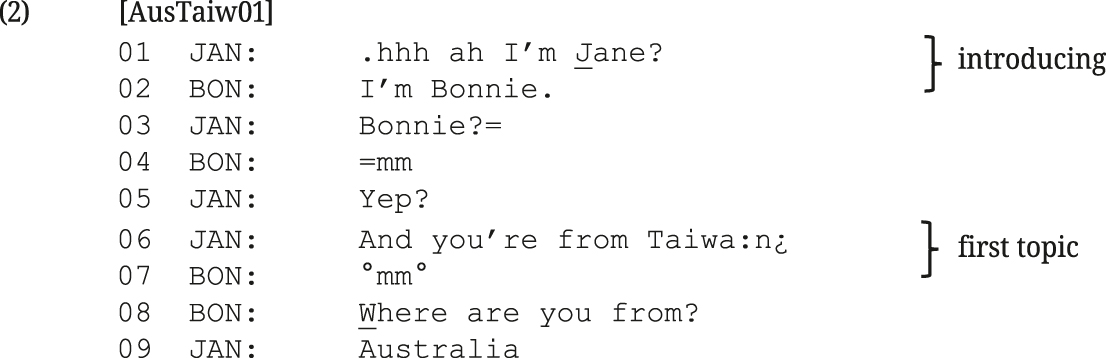
In this opening, Jane first offers her name (line 1), and Bonnie reciprocates in turn (line 2).[5] Following confirmation of the latter’s name (lines 3–5), Jane then initiates first topic through a recipient-attentive, candidate question seeking confirmation that Bonnie is from Taiwan (line 6). Following a minimal response from Bonnie (line 7), she then reciprocates Jane’s question, in line 8, with a wh-question about where Jane is from (which therefore does not build in a candidate answer in the same way that Jane’s prior polar question does). A notable feature of this relatively compact opening is that there are no greetings, pleasantries or settling in talk, and following introductions they proceed directly into initiating first topic. In this case, then, the participants implicitly negotiate a compact opening through reciprocating introductions then immediately launching first topic – or what Kecskes (2019b) termed a ‘strong initiative’.
An even more compact opening can be observed in excerpt (3), between Daniel (an Australian male) and Stella (a Chinese female).
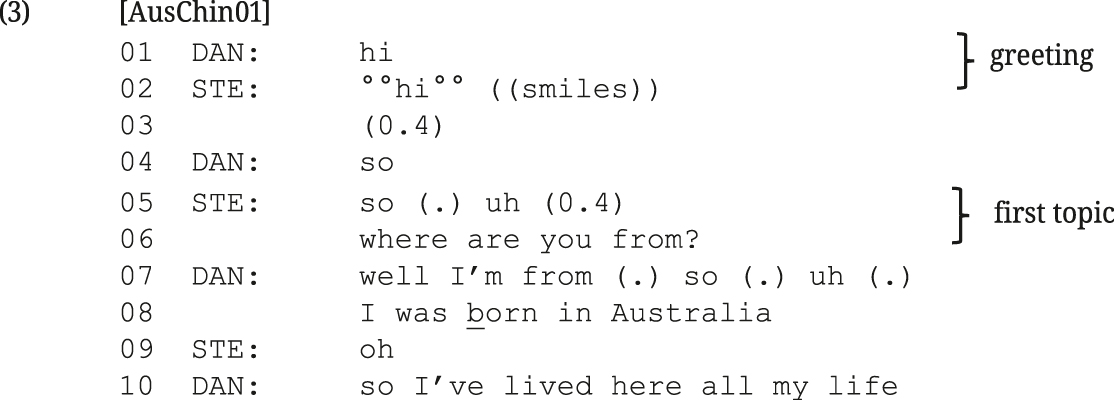
In this opening, following reciprocation of greetings (lines 1–2), the conversation briefly lapses (line 3) and Daniel appears to prompt Stella to make the next move with a standalone ‘so’ (Raymond 2004). Stella then goes on to initiate first topic with a wh-question about where Daniel is from (lines 5–6). Once again, a compact opening is implicitly negotiated by the participants through reciprocating greetings, and Daniel then prompting Stella to initiate first topic. In this case, we can observe, following Kecskes (2019b), that in intercultural first encounters participants may prioritise creating common ground over introductory formulae and other politeness markers.
Those two examples can be contrasted with the following example of an expanded opening between Carol (an Australian female) and Kaori (a Japanese female). This opening is much more extended, as it features almost all of the possible components of an opening of a first encounter.
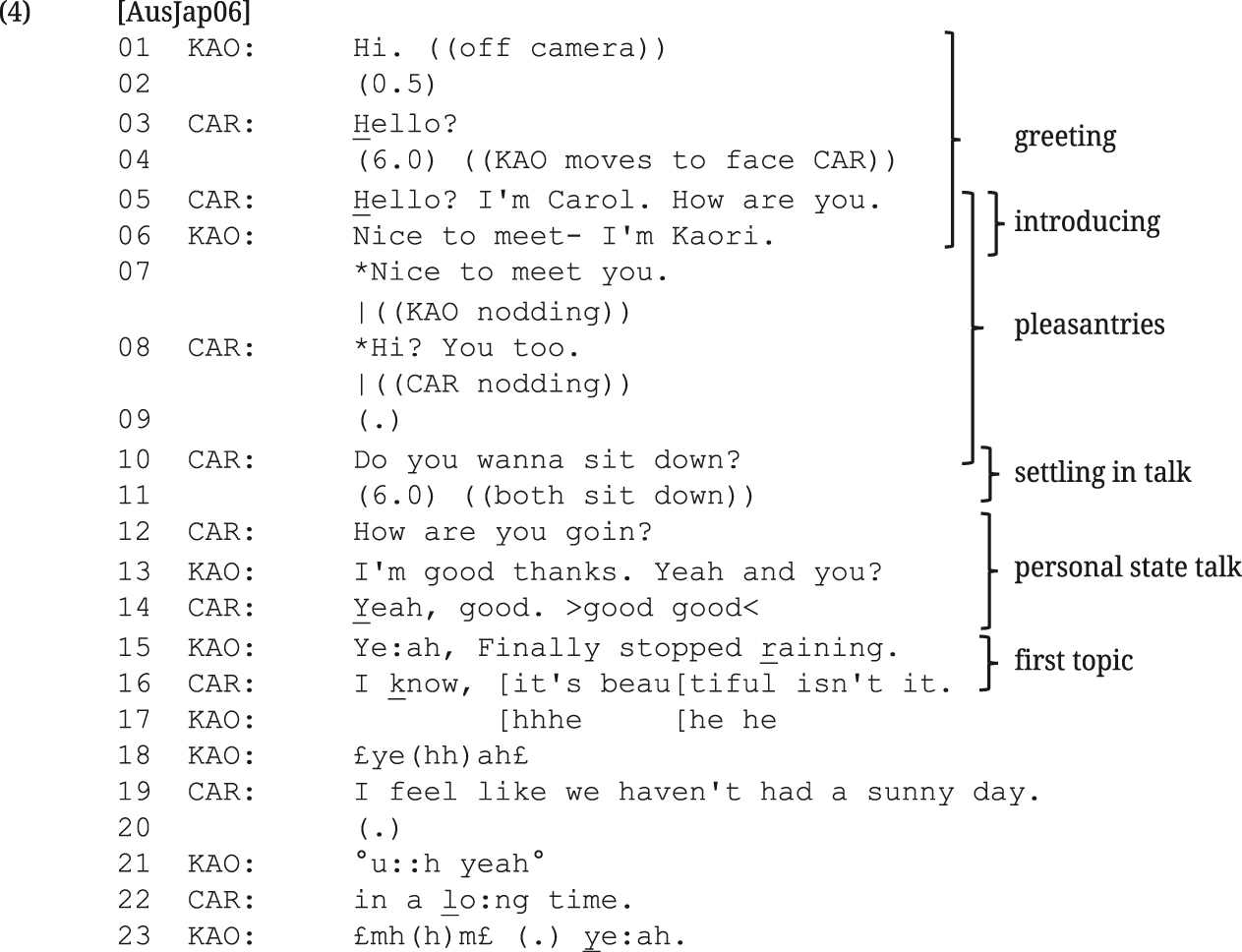
In this excerpt, following distance salutations (Kendon and Ferber 1973) in lines 1–3, Kaori approaches Carol (line 4), and they engage in interleaving sequences of reciprocated greeting (line 5), introductions (lines 5–6), and pleasantries (lines 5–8). This is followed by settling in talk where Carol invites Kaori to sit down together with her (lines 10–11), and reciprocated personal state inquiries (lines 12–14). It is only following all of these interleaving components that first topic is finally initiated by remarking on the weather (line 15), thereby registering a neutral referent (Pillet-Shore 2021). The accomplishment of this expanded opening is implicitly negotiated through the two participants reciprocating, in turn, (distant and close) greetings, introductions, pleasantries, and personal state inquiries, before initiating first topic.
The negotiation of the timing or type of action that is selected in the course of the opening can also be implicitly accomplished through self-initiated self-repair, alongside reciprocation. This can be observed in the following example of an opening between Kath (an Australian female) and Sunnie (a Taiwanese female). In this excerpt, in addition to labelling the opening components that are negotiated in the course of this opening, two examples of self-repair/correction are also highlighted in bold.
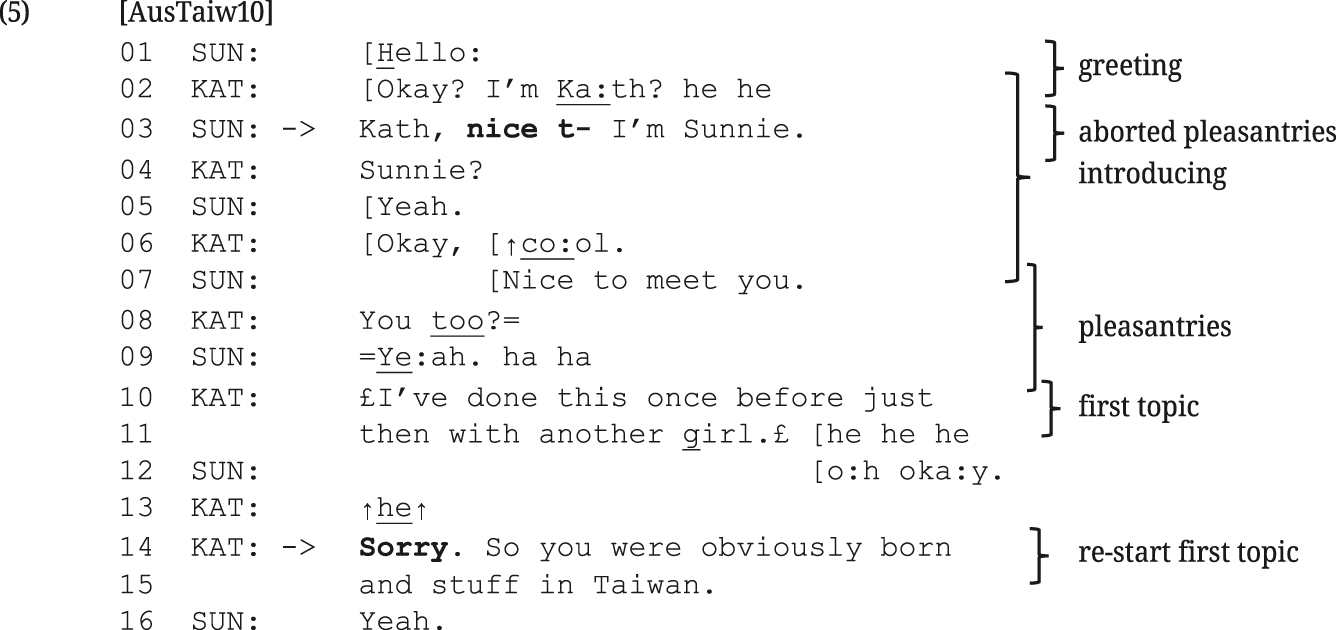
Following an overlapping greeting by Sunnie (line 1) and self-introduction by Kath (line 2), Sunnie confirms Kath’s name and then reciprocates by offering her name (line 3). However, inserted between this other-name confirmation and self-name offer, Sunnie also initiates but then abandons a pleasantry (“nice t-”). This pleasantry is subsequently redone, in line 7, following conclusion of the sequence of reciprocated introductions (lines 3–6). The second case of self-correction occurs when Kath initiates first topic through a self-attentive declaration that she has already had another first conversation with someone else (lines 10–11), but then treats initiating a self-attentive topic to which Sunnie cannot contribute much as in need of interactional remediation through an apology followed by a so-prefaced recipient-attentive, candidate question seeking confirmation that Sunnie is from Taiwan (lines 14–15). Through these two respective cases of self-repair both participants implicitly negotiate when a particular action and what action type should be accomplished in this opening. In the first instance of self-repair, Sunnie implicitly positions pleasantries as more properly done following completion of introductions. In the second instance, Kath implicitly treats initiating a recipient-attentive first topic as more appropriate than initiating a self-attentive one.
Overall, then, it becomes clear that while the openings of intercultural first encounters draw on a constrained set of components (and action alternatives within those components), these openings are in no way fixed or invariable despite being routinely accomplished (Schegloff 1986). Complementing prior claims by Kecskes (2019b) that in intercultural settings the components of openings are fleshed out according to “the immediate need[s] that emerged in the course of interaction” (Kecskes 2019b: 130), we also observed that the interactional routines through which these openings are co-constructed are “adapted in situ to contingencies of the situation” (Schmidt and Deppermann 2023: 275). This resulted in a range of different openings, some of which were relatively compact (n = 10) and others that were more expanded (n = 22). The more compact openings we observed were similar to what Kecskes (2019b) referred to as ‘strong initiative’, that is, where participants were “getting right down to business: to create some common ground that could be used for further interaction” (p.126). As we have observed, these compact through to expanded openings are co-constructed through participants initiating particular actions and reciprocating (or not) the actions in question, thereby “spontaneously coordinating their selections vis-à-vis one another” (Pillet-Shore forthcoming: 2), and by initiating self-initiated self-repair (through which they signal they are changing those selections). While these selections are largely implicitly negotiated, they can be explicitly negotiated in some cases, as we shall go on to discuss.
4.2 Negotiating greetings
In intercultural settings, co-participants not only have choices to make with respect to what interactional routines are accomplished in openings of first encounters, but also have a wider range of action and format alternatives available to them in accomplishing those routines, as they can draw from interactional routines in L1, L2 or even something between. The wider range of action and format alternatives available to participants in intercultural settings affords a greater degree of flexibility in negotiating these alternatives. One of the interactional routines where this wider range of alternatives surfaces in negotiating openings is when participants are greeting each other. Greetings can be accomplished either verbally (e.g. saying ‘hello’ or ‘hey’) or nonverbally (e.g. shaking hands or bowing), or both.
A relatively constrained set of verbal greetings were drawn upon by participants in our collection of intercultural openings (‘hi’, ‘hello’, ‘hey’, ‘g’day’, and so on) (n = 20). These greetings were largely reciprocated (n = 17, 85 %). These reciprocated greetings occurred either consecutively or in overlap, as illustrated in examples (6) and (7), respectively.
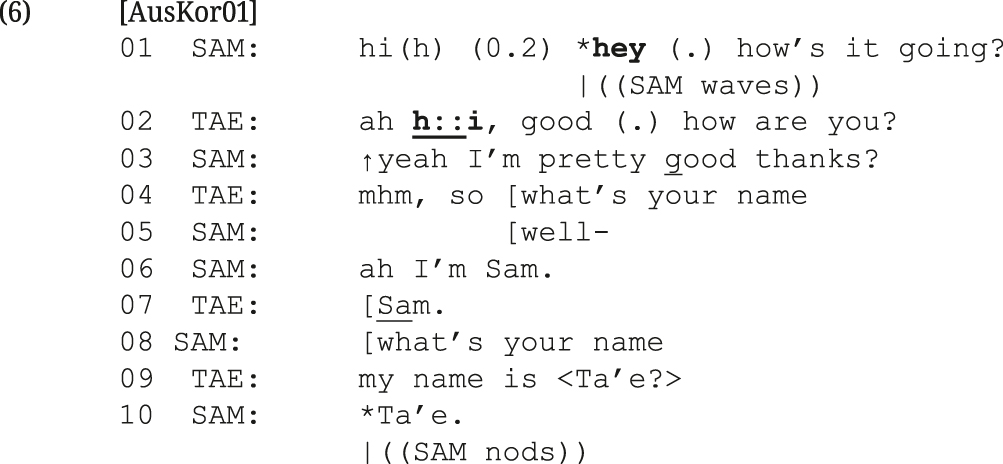
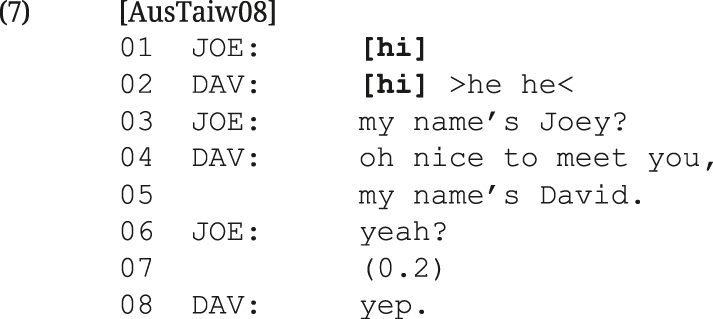
In excerpt (6), a greeting from Sam (an Australian male), in line 1, is subsequently reciprocated by Ta’e (a Korean female), in line 2. In contrast, the greetings in the opening between David (an Australian male) and Joey (a Taiwanese male), in excerpt (7), are accomplished simultaneously in overlap (in lines 1–2).
Cases in which greetings were not reciprocated (n = 3, 15 %) arose due to localised contingencies in the interaction in progress. In excerpt (8), for instance, from an opening between Melena (an Australian female) and Kevin (a Taiwanese male), Kevin offers his name (line 2) in overlap with a greeting by Melena (line 1).[6]
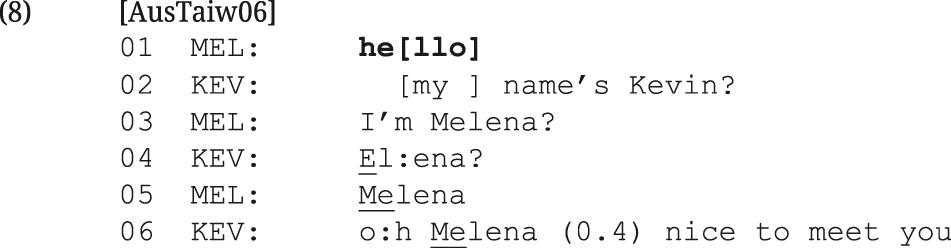
In this case, reciprocating Melena’s greeting is interactionally foreclosed by Kevin launching a self-introduction almost simultaneously with Melena’s greeting.
There were also cases in which reciprocation of a greeting was delayed due to other kinds of local interactional contingencies. In excerpt (9), a greeting from Ian (an Australian male) is not initially reciprocated by Akiko (a Japanese female). This is arguably a function of Mariko (who has just previously met Ian and is long-time friends with Akiko) mediating the introduction between the two of them.
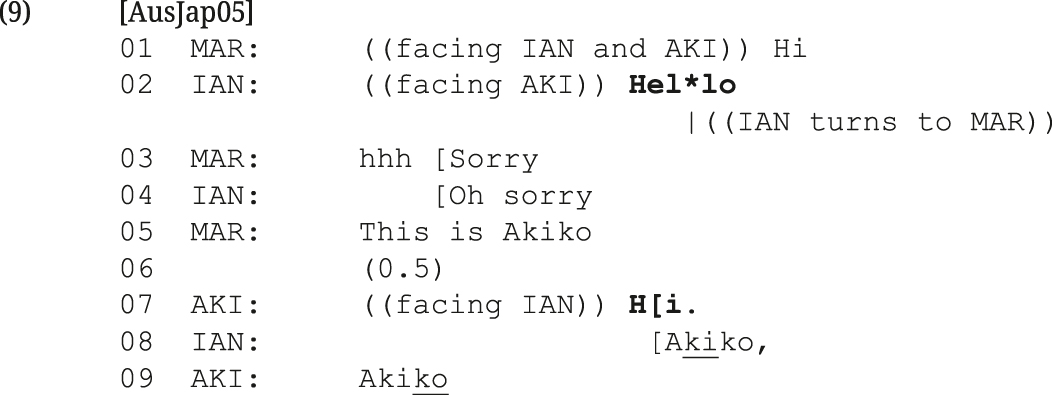
While Mariko greets them both (line 1), Ian initially directs his greeting to Akiko (line 2). Mariko and Ian subsequently apologise in overlap (lines 3–4). In so doing, they are orienting to their mutual misalignment with respect to Mariko’s normatively expected role as a third party mediator (Pillet-Shore 2011); that is, it is expected Mariko will introduce the two of them, and so greetings should be delayed until those mediated introductions have occurred. Following Mariko’s introduction of Akiko to Ian (line 5), Akiko then reciprocates Ian’s earlier greeting (line 7), orienting to this normative expectation.
Unlike verbal greetings, there is a wider range of systematic alternatives when it comes to nonverbal greetings in intercultural first encounters, as possible action alternatives include shaking hands, head nods, eyebrow raises, (close) waving, and bowing.[7] In some cases, co-participants are able to smoothly coordinate their selections of nonverbal greetings. In the following example of an opening between Hank (an Australian male) and Hyunnah (a Korean female), verbal greetings are accompanied by the two of them shaking hands. The stepwise accomplishment of this handshake is highlighted in bold.
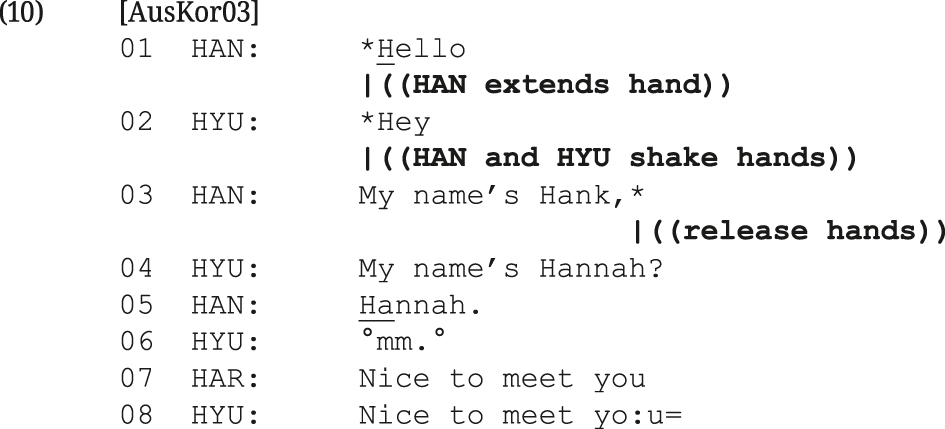
In this excerpt, Hank offers his hand at the same time as he greets Hyunnah (line 1), with the handshake itself overlapping with Hyunnah reciprocating that verbal greeting (line 2) and Hank subsequently offering his name (line 3). Hyunnah then reciprocates by offering her name (line 4), although she chooses an Anglicised version of her name (‘Hannah’) rather than her Korean name (‘Hyunnah’).[8]
In other cases, however, while the co-participants may be able to coordinate their selection of nonverbal greeting among different action alternatives, there can be a degree of misalignment in how that action alternative is implemented. In the following excerpt, for instance, Mark (and Australian male) and Mariko (a Japanese female) reciprocate bows to each other.
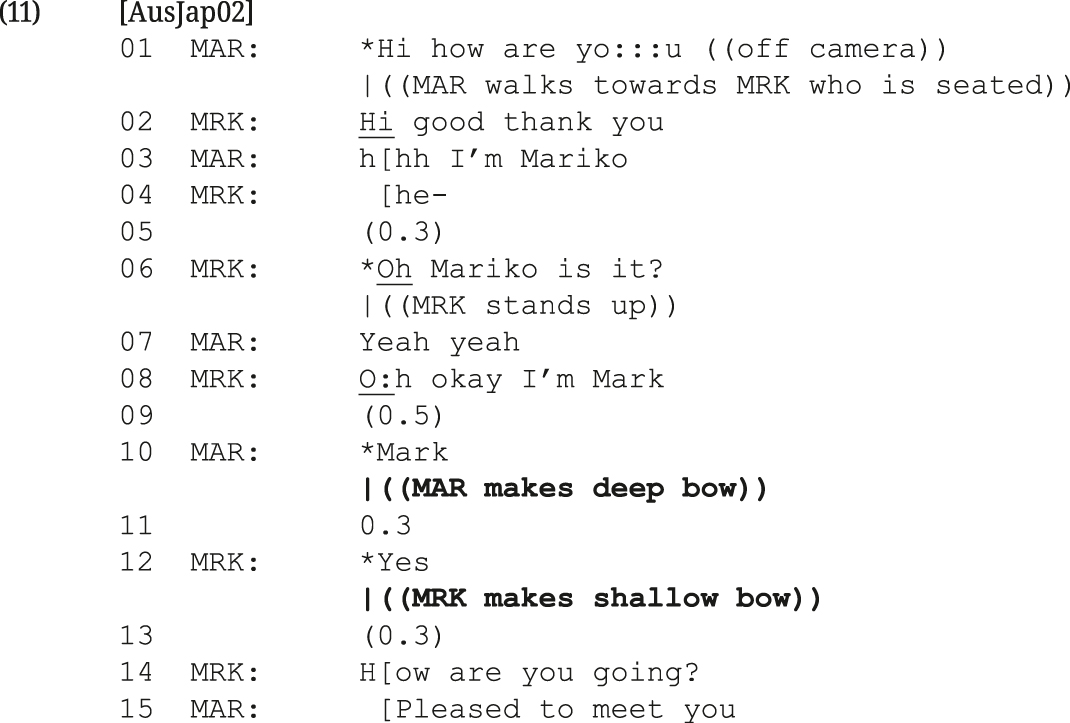
In this excerpt, following reciprocated verbal greetings that are interleaved with a (non-reciprocated) personal state inquiry (lines 1–2), Mariko introduces herself and Mark reciprocates in turn (lines 3–8). Following Mark introducing himself, Mariko bows deeply while confirming his name through a name-repeat (line 10). Mark confirms his name, in turn, while also simultaneously bowing (line 12). However, while the bowing of torso and head is reciprocated in this opening, Mark’s bow is visibly more shallow than Mariko’s bow. In this case, then, while the nonverbal greeting is reciprocated the quality of it is subtly misaligned.
In yet other cases, misalignment in nonverbal greetings may be more pronounced due to non-reciprocation of said greeting. We can observe a case of this in the following example of an opening between Leo (an Australian male) and Hayley (a Chinese female).
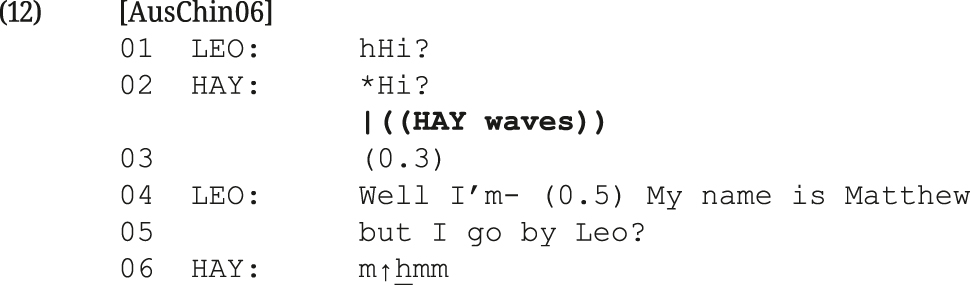
In this excerpt, Leo starts with a verbal greeting (line 1), which Hayley reciprocates, alongside a simultaneous close wave (line 2). This close wave is not, however, reciprocated by Leo, who goes on to introduce himself (lines 4–5).
Finally, misalignment arising due to non-reciprocation of nonverbal greetings may be remediated through subsequent reciprocation of a different action alternative, as can be observed in the following example of an opening between Rachel (an Australian female) and Hyunshik (a Korean male).[9]
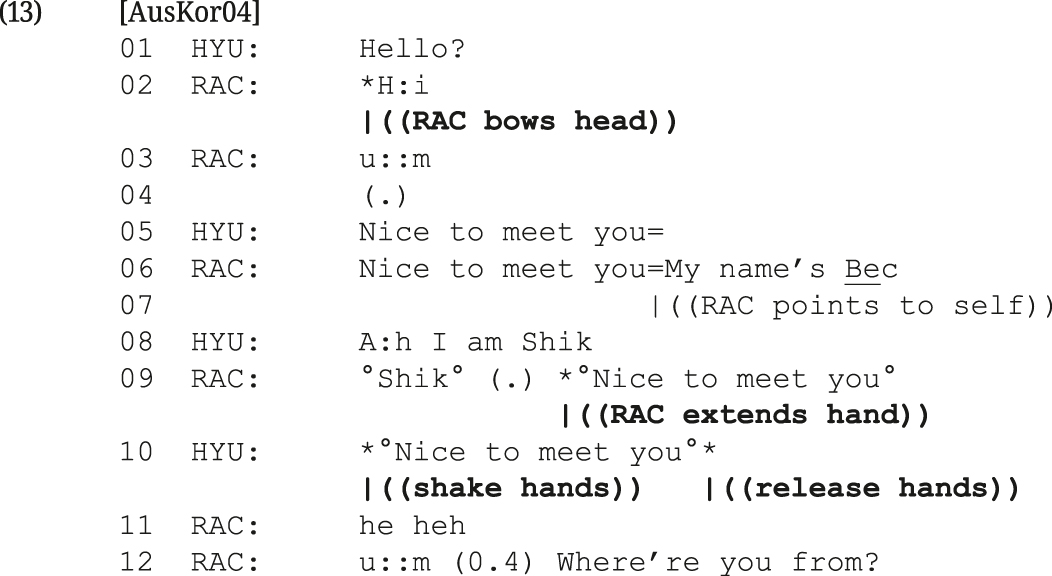
In this excerpt, Shik initiates a verbal greeting (line 1), which is reciprocated by Rachel alongside a simultaneous head bow (line 2). Shik, however, does not reciprocate the head bow, but instead goes on to express a pleasantry (line 5), which Rachel reciprocates followed by a latched self-introduction (line 6). After Shik reciprocates the self-introduction (line 8), Rachel does a name confirmation repeat followed by a redoing of a pleasantry while also extending out her hand (line 9). Shik shakes hands with her as he reciprocates the pleasantry (line 10). In this example, then, a non-reciprocated head bow is subsequently remediated through accomplishing a handshake.
Overall, we can observe that while greetings can be accomplished quite smoothly without interactional hitches in the openings of intercultural first encounters, the fact that co-participants have a relatively wide range of action alternatives available for nonverbal greetings can sometimes lead to greater difficulty in coordinating those interactional routines in intercultural settings like this. This suggests that the greater the number of action alternatives that are available the more challenging it becomes for co-participants to smoothly coordinate the accomplishment of those interactional routines. The non-reciprocation of nonverbal greetings in some cases also suggests that there is considerable variance in the uptake of attempts to accommodate to (perceived) culturally-bound nonverbal greeting interactional routines.
4.3 Negotiating introductions
Another interactional routine negotiated by participants in intercultural first encounters is how they should go about initiating introductions of names. If introductions not mediated by a third party, participants have to select whether to introduce themselves or request an other-introduction, or to do neither (Pillet-Shore 2011). In our collection, introductions were mediated by a third party in the openings of three first encounters, while in the remaining 29 cases introductions were initiated by the participants themselves through introducing themselves (‘offer name’), asking the other person for their name (‘request name’), or asking the other person to confirm their name (‘name reminder’). The occurrence of these different introduction action alternatives across the 32 openings in our dataset are summarised in Table 2.
Interactional routines in introductions in intercultural first encounters (n = 32).
| Offer name | Request name | Name reminder | Mediated introductions |
|---|---|---|---|
| 22 (68.8 %) | 5 (15.6 %) | 2 (6.2 %) | 3 (9.4 %) |
While the majority of introductions were accomplished through self-initiated offers of name offers (68.8 %), there was nevertheless a significant number of instances in which names were requested either outright (15.6 %) or requested in the context of name reminder sequences (6.2 %). The latter echoes the findings of Kecskes (2019b), who argued that in intercultural first encounters, there is greater variation in how interactional routines are accomplished.[10]
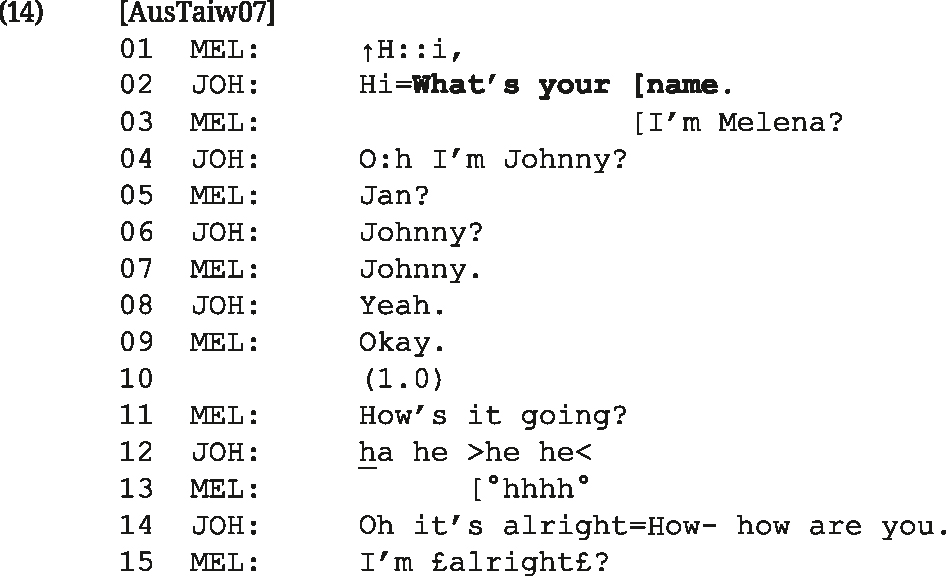
In example (14), for instance, in an opening between Melena (an Australian female) and Johnny (a Taiwanese male), following reciprocated introductions, Johnny requests Melena’s name.
A similar pattern can be observed in example (15), in which Scott (an Australian male) asks Janet (a Chinese female) to give her name.
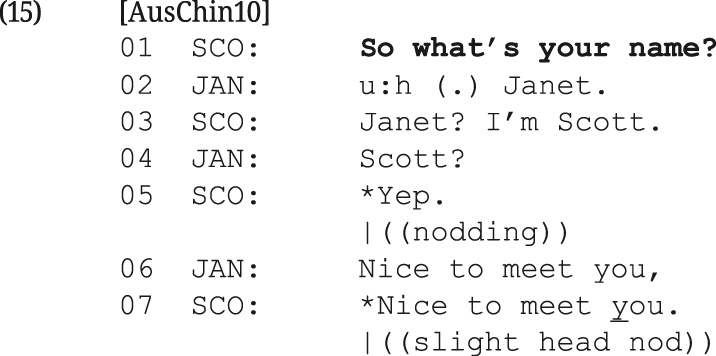
These findings suggest that there is greater flexibility in relation to the attested preference for offers over requests for names in introduction sequences (Pillet-Shore 2011) in the case of intercultural first encounters.
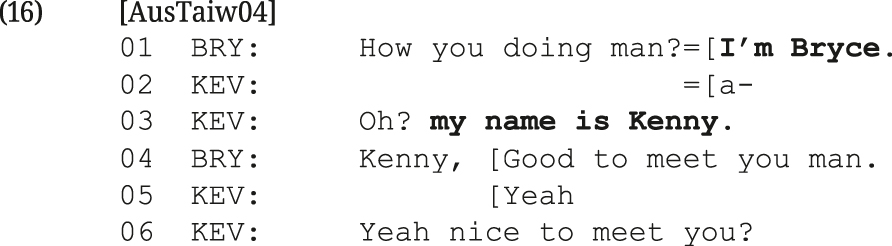
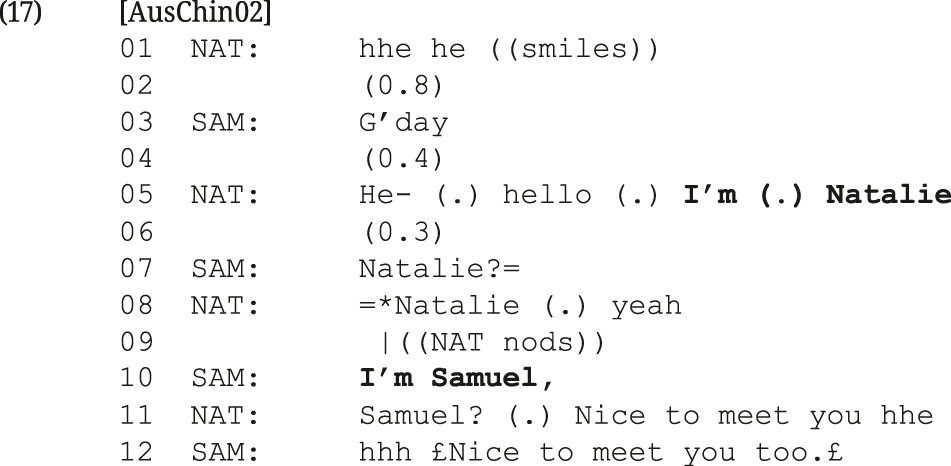
There is also a wider range of systematic alternatives when it comes to introductions, as possible person reference format alternatives include offering full name (i.e. first name and surname), first name only, a shortened version of one’s first name, an alternative (English) name, or an Anglicised or original pronunciation of non-English names. In many cases these selections are implicitly negotiated. In the following two examples, for instance, an alternative English name is given instead of the L2 English speaker’s given name, a practice that is common among Chinese and Taiwanese speakers of English (Gordon et al. 2020; Yan 2024). In example (16), Bryan (an Australian male) offers his first name, to which Zihan (a Taiwanese male) responds by reciprocating with an alternative English name (Kevin), while in example (17), Jingping (a Chinese female) offers an alternative English name (‘Natalie’), following which Samuel reciprocates by offering his first name.
Participants may also elect to offer shortened versions of their name, as previously seen in example (13), a part of which is repeated here for convenience in excerpt (18).

In this example, Rachel (an Australian female) introduces herself as “Bec” (line 7), while Hyunshik (a Korean male) introduces himself as simply “Shik” (line 9).
The pronunciation of the names of co-participants may also be implicitly negotiated in the course of name confirmation sequences or explicitly negotiated through assessments of the ‘correctness’ of the other co-participant’s pronunciation of their name. In the following example, subsequent to reciprocated greetings and settling in talk (data not shown), Ian (an Australian male) initiates a self-introduction (line 1), which is reciprocated, in turn, by Mariko (a Japanese female) (line 2).
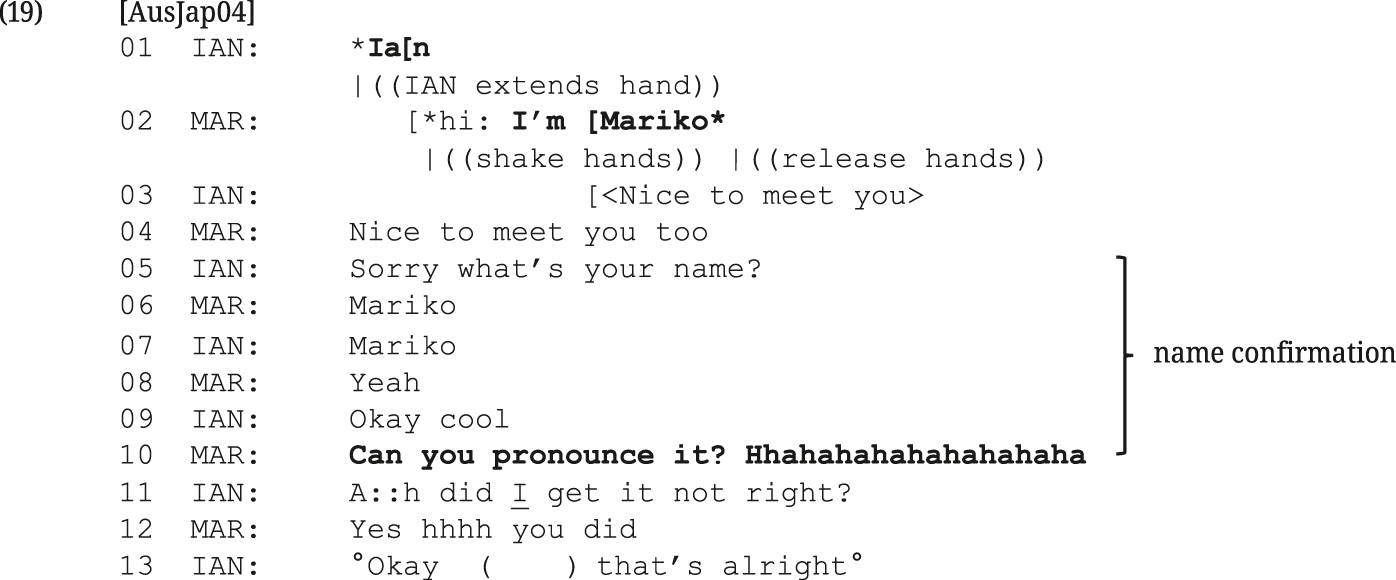
Following reciprocated pleasantries (lines 3–4), Ian initiates a name confirmation check in line 5. Mariko repeats her name (line 6), which Ian then repeats back (line 7). Notably, there is hearable attempt by Ian to pronounce Mariko’s name following standard Japanese pronunciation in his repeating back of her name (line 7), rather than the Anglicised pronunciation of it. In that way he implicitly negotiates a preference for Japanese pronunciation of Japanese names. Despite this (or perhaps because of it), Mariko then goes on to tease Ian about whether he is able to pronounce her name properly (line 10). However, the non-serious valence of this tease is not picked up on by Ian who (seriously) checks whether he did not pronounce her name correctly (lines 11–13).[11] In this case, an implicit attempt at negotiating a person reference is subsequently the target of explicit (joking) negotiation.
In the next example, which we briefly looked in the previous section (see excerpt 9), Ian (an Australian male) is being introduced to Akiko (a Japanese female) by a mediator, Mariko.
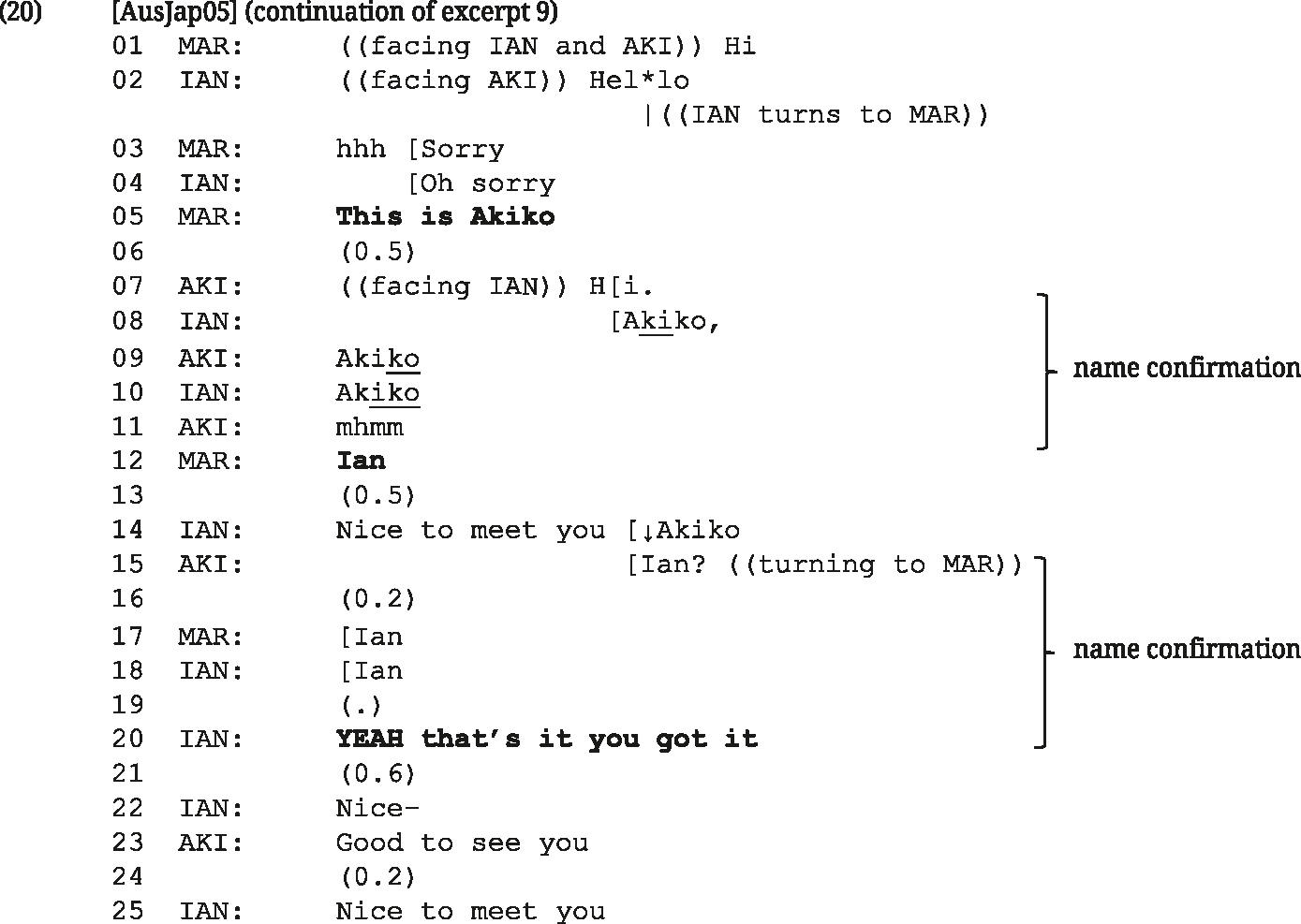
In this except, following a mediated introduction (Pillet-Shore 2011) by Mariko who introduces Akiko to Ian (line 5), Ian implicitly negotiates the ‘correct’ pronunciation of Akiko’s name through a name confirmation sequence (lines 8–11). Notably, in the course of this sequence, Akiko implicitly corrects Ian’s pronunciation of her name in line 8, by shifting the stress from Akiko to Akiko (line 9), a stress that Ian subsequently gets partially correct (line 10). Mariko then proceeds to introduce Ian to Akiko (line 12). While Ian responds with a pleasantry (line 14), Akiko initiates a (reciprocal) name confirmation sequence (line 15). While this is directed at Mariko, both Mariko and Ian respond in overlap with confirmation (lines 17–18). Ian then further responds with a positive evaluation of Akiko’s pronunciation of his name (line 20). We can thus observe in this example how participants can both implicitly (lines 8–11) and explicitly (lines 12–20) negotiate the preferred way in which their co-participant pronounces their name.
Yet while pronunciation of the names of co-participants may be implicitly negotiated through embedded corrections in the course of name confirmation sequences or explicitly negotiated through teases or assessments, participants may also decline to do so, as can be observed in the following example between Jack (an Australian male) and Soheon (a Korean female).
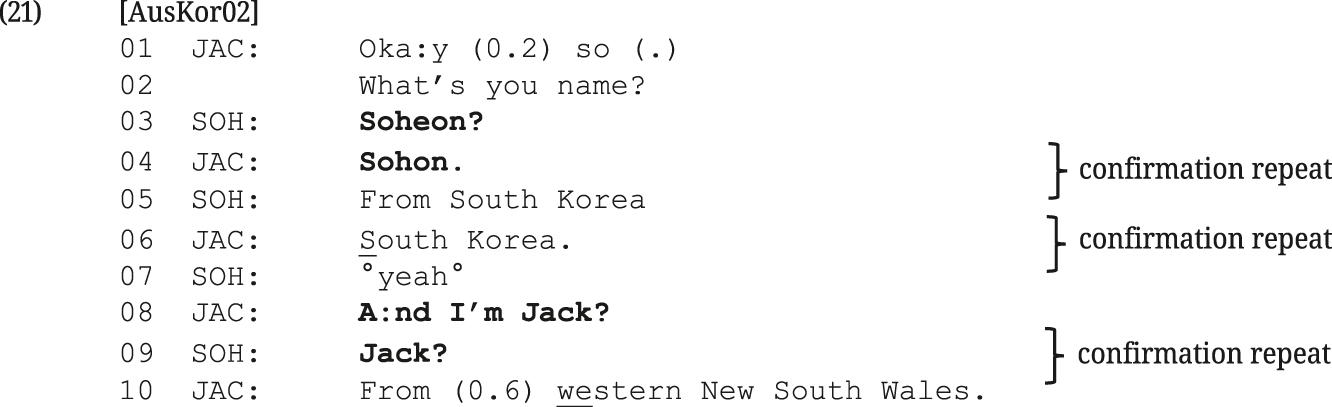
In this excerpt, while Jack hearably mispronounces Soheon’s name in his subsequent name confirmation repeat (line 4), Soheon appears to ‘let it pass’ (Firth 1996) in favour of adding where she is from (line 5). The same pattern is notably reciprocated when Jack offers his name (lines 8–10).
In some cases the selection of preferred name among alternatives, or responses to them, may itself also be explicitly negotiated. In the following excerpt, between Leo (an Australian male) and Hayley (a Chinese female), we can observe that not only is offering alternative names not restricted to L2 speakers of English, but that participants can sometimes explicitly offer a choice to their co-participant as to how to address them.
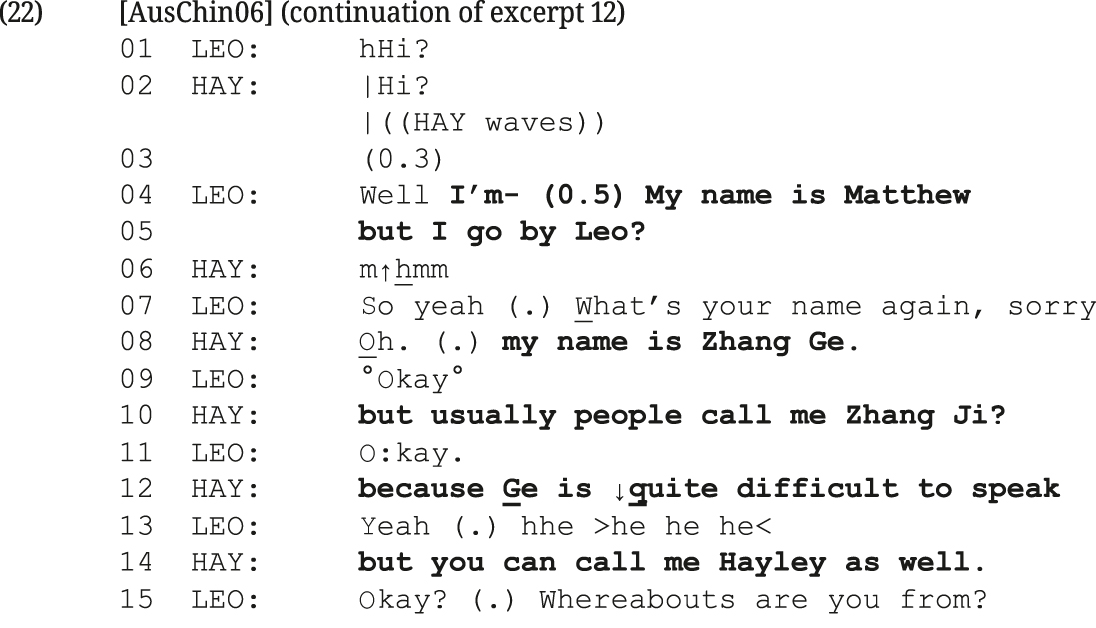
In this excerpt, following reciprocated greetings, Leo introduces himself by offering an alternative to his given name, Matthew (lines 4–5). Following a name reminder request[12] (line 7), Hayley goes on to explain her given name (line 8), describing how people usually refer to her (line 10), along with an account for that (line 12), followed by offering an explicit alternative English name by which Leo can address her (line 14).
Finally, in some cases, offering alternative English can be followed by fairly extended, if not overwrought, accounts for those alternative names in intercultural first encounters, as illustrated in the following example between Simon (an Australian male) and Kevin (a Chinese-Taiwanese female). The excerpt begins, following a brief preamble about being brought together by the researcher (data not shown), with Kevin asking Simon his name (line 1). Kevin then offers her name in turn (line 6).
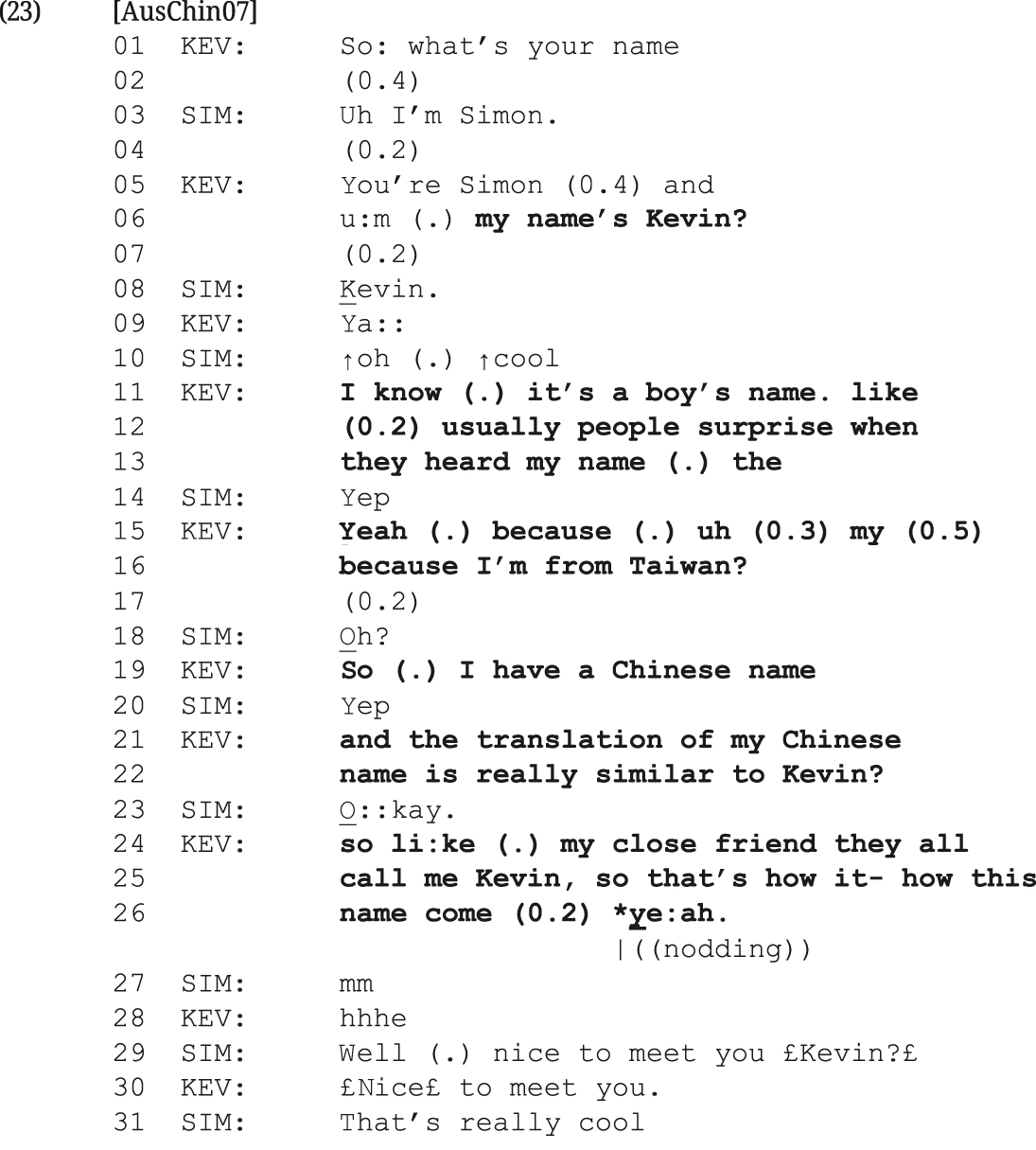
Following a name confirmation sequence (lines 8–9), Simon positively evaluates her name (line 10). Kevin then goes on to produce an extended account as to why she is called Kevin (lines 11–26). The account is framed as orienting to the presumption that Kevin is usually understood to be a name exclusively used to refer to males.[13]
Overall, while introductions are generally achieved without interactional troubles in the openings of intercultural first encounters, there are a wider range of interactional routines drawn upon by participants in accomplishing those introductions. This is due, in part, to an apparent loosening in the preference for offers over requests of self-identifying information in intercultural first encounters. It is also due, however, to the wider range of person reference format alternatives available to co-participants in intercultural first encounters. The greater range of alternatives affords both implicit and explicit negotiation of those alternatives, as participants cannot necessarily assume which alternative name (or pronunciation of their name) that their co-participant may favour. This results in a “synergetic and blended” form of interculturality (Kecskes 2020: 142) in which co-participants are introducing themselves in ways that are not exclusively centred in either their L1 or L2. In that sense, then, our findings echo the claim by Kecskes (2019b) that in intercultural settings, there is less reliance on standard assumptions about how we should go about introducing ourselves, and instead a greater reliance on emergent common ground that is accomplished in the course of those introductions.
5 Conclusions
It is commonly assumed that the openings of first encounters are highly scripted, allowing for little variation. However, empirical research has demonstrated that this is not the case. Openings may be accomplished in range of ways drawing on different kinds of formulaic language and various different interactional routines. This is because while we may have normative expectations about how openings of first encounters are accomplished that form part of our core common ground (Kecskes 2014; Kecskes and Zhang 2009), in reality we still have to negotiate those openings depending on what our co-participant does in the actual situated context. The challenge is we don’t know ahead of what is done by our co-participant what choices our co-participant will make. We have to act and react in the moment. In other words, common ground is emergent, depending on how participants co-construct those openings in real-time. In intercultural settings these challenges are exacerbated by the fact that there are a wider range of action and format alternatives available to co-participants in accomplishing these interactional routines. One key consequence of the greater range of available alternatives in the openings of intercultural first encounters is that there is, as Kecskes (2019b) argued, “less reliance on prior experience and core common ground because those are quite limited. The actual situational context usually overrides the influence of prior reoccurring context and prior experience” (p. 129). The findings of our analysis of the negotiation of interactional routines in the openings of intercultural first encounters lends further support to such claims.
A core theme underlying much of Kecskes’s seminal work in intercultural and sociocognitive pragmatics was that we should theorise intercultural communication as a phenomenon in its own right. Rather than seeing intercultural communication through the lens of the core common ground of L1 speakers, which L2 speakers can only ever have seemingly partial access, he consistently argued that what lies at the core of communication in intercultural settings is the accomplishment of emergent, situated intercultures in which participants themselves negotiate what is to be treated as common ground (Kecskes 2014, 2020). At the core of the program of work in intercultural pragmatics that was spearheaded by Kecskes, then, is a commitment to recognising that this has important implications for how we go about theorising the pragmatics of intercultural communication.[14] In this paper, we have extended Kecskes’ work by illustrating how the same theoretical claims apply to the role of interactional (i.e. sequential) routines in the openings of intercultural first encounters, in addition to the conversational (i.e. formulaic) routines that were discussed by Kecskes (2019b). In so doing, we demonstrate how a focus on the sequential accomplishment of action from an interactional pragmatics perspective can complement work on formulaic or situation-bound utterances in intercultural pragmatics.
About the authors
Michael Haugh is Professor of Linguistics and Applied Linguistics in the School of Languages and Cultures at The University of Queensland. His research interests lie primarily in the field of pragmatics, with a particular focus on the role of language in social interaction.
Wei-Lin Melody Chang is Lecturer in Chinese in the School of Languages and Cultures at The University of Queensland. Her research interests include (im)politeness and face, intercultural communication and business discourse.
Yuji Sato is a PhD candidate in the School of Languages and Cultures at The University of Queensland. His research focuses on Japanese business communication and initial encounters in everyday contexts, with particular attention to small talk, ‘ma’, and ‘maai’, examined through the lens of cultural discourse analysis and interactional pragmatics.
Acknowledgements
We would like to thank Alessandro Capone for the opportunity to contribute to this special issue in honour of the work of Istvan Kecskes, and for the helpful feedback from the anonymous reviewers. The research in this paper was inspired by a keynote speech on “The interplay of prior experience and actual situational context in intercultural first encounters” that he first gave at the Symposium on Getting Acquainted across Cultures held at the University of Queensland in October 2017. It is thus dedicated in his honour.
-
Conflict of interest: The authors report there are no competing interests to declare.
-
Research funding: This research was carried out, in part, with support from the Chiang Ching-kuo Foundation (RG009-P-21).
References
Aijmer, Karin. 1996. Conversational routines in English. Convention and creativity. London: Longman.Search in Google Scholar
Brunner, Marie-Louise & Stefan Diemer. 2018. “Okay…so…nice to meet you? {smiles}” Openings in ELF skype conversations. In María de los Ángeles Gomez -González & J. Lachlan Mackenzie (eds.), The construction of discourse as verbal interaction, 171–197. Amsterdam: John Benjamins.10.1075/pbns.296.07bruSearch in Google Scholar
Chen, Fred J. 1993. Social status and the sequencing rules of other-introductions. Working Papers in Educational Linguistics 9(2). 13–27.Search in Google Scholar
Clift, Rebecca & Michael Haugh. 2021. Conversation analysis and sociopragmatics. In Michael Haugh, Dániel Z. Kádár & Marina Terkourafi (eds.), Cambridge handbook of sociopragmatics, 616–638. Cambridge: Cambridge University Press.10.1017/9781108954105.032Search in Google Scholar
Coulmas, Florian. 1981. Introduction: Conversational routine. In Florian Coulmas & Routine Conversational (eds.), Explorations in standardized communication situations and prepatterned speech, 1–17. Berlin: Mouton de Gruyter.10.1515/9783110809145.1Search in Google Scholar
Duranti, Alessandro. 1997. Universal and culture-specific properties of greetings. Journal of Linguistic Anthropology 7(1). 63–97. https://doi.org/10.1525/jlin.1997.7.1.63.Search in Google Scholar
Ebsworth, Miriam Eisenstein, Jean W. Bodman & Mary Carpenter. 1995. Cross-cultural realization of greetings in American English. In Susan Gass & Joyce Neu (eds.), Speech acts across cultures. Challenges to communication in a second language, 89–107. Berlin: Mouton de Gruyter.Search in Google Scholar
Firth, Alan. 1996. The discursive accomplishment of normality: On ‘lingua franca’ English and conversation analysis. Journal of Pragmatics 26(2). 237–259. https://doi.org/10.1016/0378-2166(96)00014-8.Search in Google Scholar
Garfinkel, Harold. 1967. Studies in ethnomethodology. Englewood Cliffs, NJ: Prentice-Hall.Search in Google Scholar
Gordon, Rebekah R., Sandro R. Barros & Jiahang Li. 2020. Make a name for yourself: Exploring the interculturality of naming and addressing practices among transnational teachers of Chinese as a foreign language. Language and Intercultural Communication 20(6). 586–599. https://doi.org/10.1080/14708477.2020.1817058.Search in Google Scholar
Haugh, Michael. 2012. Conversational interaction. In Keith Allan & K. Kasia M. Jaszczolt (eds.), Cambridge handbook of pragmatics, 251–274. Cambridge: Cambridge University Press.10.1017/CBO9781139022453.014Search in Google Scholar
Haugh, Michael. 2022. (Im)politeness in video-mediated first conversations amongst speakers of English as a lingua franca. In Ian Walkinshaw (ed.), Pragmatics in English as a lingua franca, 81–103. Berlin: Mouton de Gruyter.10.1515/9781501512520-005Search in Google Scholar
Haugh, Michael & Wei-Lin Melody Chang. 2019. Indexical and sequential properties of criticisms in initial interactions: Implications for examining (im)politeness across cultures. Russian Journal of Linguistics 23(4). 904–929. https://doi.org/10.22363/2687-0088-2019-23-4-904-929.Search in Google Scholar
Haugh, Michael & Wei-Lin Melody Chang. 2022. Sociopragmatics and intercultural interaction. In Istvan Kecskes (ed.), Cambridge handbook of intercultural pragmatics, 420–444. Cambridge: Cambridge University Press.10.1017/9781108884303.017Search in Google Scholar
Haugh, Michael & Valeria Sinkeviciute. 2021. The pragmatics of initial interactions: Cross-cultural and intercultural perspectives. Journal of Pragmatics 185. 35–39. https://doi.org/10.1016/j.pragma.2021.09.004.Search in Google Scholar
Hepburn, Alexa & Galina Bolden. 2017. Transcribing for social research. Los Angeles, CA: Sage.10.4135/9781473920460Search in Google Scholar
Heritage, John. 1984. Garfinkel and ethnomethodology. Cambridge: Polity Press.Search in Google Scholar
Jefferson, Gail. 2004. Glossary of transcript symbols with an introduction. In Gene Lerner (ed.), Conversation analysis. Studies from the first generation, 13–31. Amsterdam: John Benjamins.10.1075/pbns.125.02jefSearch in Google Scholar
Jenks, Christopher. 2009. Getting acquainted in Skypecasts: Aspects of social organisation in online chat rooms. International Journal of Applied Linguistics 19(1). 26–46. https://doi.org/10.1111/j.1473-4192.2009.00211.x.Search in Google Scholar
Kecskes, Istvan. 2000. A cognitive-pragmatic approach to situation-bound utterances. Journal of Pragmatics 32(6). 605–625. https://doi.org/10.1016/s0378-2166(99)00063-6.Search in Google Scholar
Kecskes, Istvan. 2003. Situation-bound utterances in L1 and L2. Berlin: Mouton de Gruyter.10.1515/9783110894035Search in Google Scholar
Kecskes, Istvan. 2008. Dueling contexts: A dynamic model of meaning. Journal of Pragmatics 40(3). 385–406. https://doi.org/10.1016/j.pragma.2007.12.004.Search in Google Scholar
Kecskes, Istvan. 2012. Sociopragmatics, cross-cultural and intercultural studies. In Keith Allan & Kasia M. Jaszczolt (eds.), Cambridge handbook of pragmatics, 599–616. Cambridge: Cambridge University Press.10.1017/CBO9781139022453.033Search in Google Scholar
Kecskes, Istvan. 2014. Intercultural pragmatics. Oxford: Oxford University Press.10.1093/acprof:oso/9780199892655.001.0001Search in Google Scholar
Kecskes, Istvan. 2015. Intracultural communication and intercultural communication: Are they different? International Review of Pragmatics 7(2). 171–194. https://doi.org/10.1163/18773109-00702002.Search in Google Scholar
Kecskes, Istvan. 2018. How does intercultural communication differ from intracultural communication? In Andy Curtis & Roland Sussex (eds.), Intercultural communication in Asia: Education, language and values, 115–135. Cham: Springer.10.1007/978-3-319-69995-0_7Search in Google Scholar
Kecskes, Istvan. 2019a. English as a lingua franca: The pragmatic perspective. Cambridge: Cambridge University Press.10.1017/9781316217832Search in Google Scholar
Kecskes, Istvan. 2019b. The interplay of prior experience and actual situational context in intercultural first encounters. Pragmatics and Cognition 26(1). 112–134. https://doi.org/10.1075/pc.19008.kec.Search in Google Scholar
Kecskes, Istvan. 2020. Interculturality and intercultural pragmatics. In Jane Jackson (ed.), Routledge handbook of language and intercultural communication, 138–155. London: Routledge.10.4324/9781003036210-11Search in Google Scholar
Kecskes, Istvan. 2021. Processing implicatures in English as a Lingua Franca communication. Lingua 256. 103067. https://doi.org/10.1016/j.lingua.2021.103067.Search in Google Scholar
Kecskes, Istvan (ed.). 2022a. Cambridge handbook of intercultural pragmatics. Cambridge: Cambridge University Press.10.1017/9781108884303Search in Google Scholar
Kecskes, Istvan. 2022b. The theoretical framework of intercultural pragmatics. In Istvan Kecskes (ed.), Cambridge handbook of intercultural pragmatics, 83–104. Cambridge: Cambridge University Press.10.1017/9781108884303.005Search in Google Scholar
Kecskes, Istvan. 2023a. The socio-cognitive approach to communication and pragmatics. Cham: Springer.10.1007/978-3-031-30160-5Search in Google Scholar
Kecskes, Istvan (ed.). 2023b. Common ground in first language and intercultural interaction. Berlin: Mouton de Gruyter.10.1515/9783110766752Search in Google Scholar
Kecskes, Istvan. 2023c. Language variation and temporary norm development in intercultural interactions. Pragmatics & Cognition 30(2). 235–257. https://doi.org/10.1075/pc.00031.kec.Search in Google Scholar
Kecskes, Istvan & Monika Kirner-Ludwig. 2019. “Odd structures” in English as a lingua franca discourse. Journal of Pragmatics 151. 76–90. https://doi.org/10.1016/j.pragma.2019.04.007.Search in Google Scholar
Kecskes, Istvan, Robert E. Sanders & Anita Pomerantz. 2018. The basic interactional competence of language learners. Journal of Pragmatics 124. 88–105. https://doi.org/10.1016/j.pragma.2017.10.019.Search in Google Scholar
Kecskes, Istvan & Fenghui Zhang. 2009. Activating, seeking and creating common ground: A socio-cognitive approach. Pragmatics and Cognition 17(2). 331–355. https://doi.org/10.1075/pc.17.2.06kec.Search in Google Scholar
Kendon, Adam & Andrew Ferber. 1973. A description of some human greetings. In Richard P. Michael & John H. Crook (eds.), Comparative ecology and behaviour of Primates, 591–668. New York: Academic Press.Search in Google Scholar
Kim, Sangki. 2022. Developing practices for first-time encounters: Pursuing mutual understanding and relational achievement in conversations-for-learning. Linguistics and Education 71. 101090. https://doi.org/10.1016/j.linged.2022.101090.Search in Google Scholar
Krivonos, Paul D. & Mark L. Knapp. 1975. Initiating communication: What do you say when you say hello? Communication Studies 26(2). 115–122. https://doi.org/10.1080/10510977509367829.Search in Google Scholar
Peters, Ann M. & Stephen T. Boggs. 1996. Interactional routines as cultural influences upon language acquisition. In Bambi B. Schiefelin & Elinor Ochs (eds.), Language socialization across cultures, 80–96. Cambridge: Cambridge University Press.10.1017/CBO9780511620898.004Search in Google Scholar
Pillet-Shore, Danielle. 2008. Coming together: Creating and maintaining social relationships through the openings of face-to-face interactions. Los Angeles: University of California, unpublished PhD dissertation.Search in Google Scholar
Pillet-Shore, Danielle. 2011. Doing introductions: The work involved in meeting someone new. Communication Monographs 78(1). 73–93. https://doi.org/10.1080/03637751.2010.542767.Search in Google Scholar
Pillet-Shore, Danielle. 2012. Greeting: Displaying stance through prosodic recipient design. Research on Language and Social Interaction 45(4). 375–398. https://doi.org/10.1080/08351813.2012.724994.Search in Google Scholar
Pillet-Shore, Danielle. 2018. How to begin. Research on Language and Social Interaction 51(3). 213–231. https://doi.org/10.1080/08351813.2018.1485224.Search in Google Scholar
Pillet-Shore, Danielle. 2021. When to make the sensory social: Registering in face-to-face openings. Symbolic Interaction 44(1). 10–39. https://doi.org/10.1002/symb.481.Search in Google Scholar
Pillet-Shore, Danielle. forthcoming. ‘Routines’ and ‘formulaic language’ in conversation analysis. In Matthew Burdelski & Timothy Greer (eds.), Routledge handbook of conversation analysis. London: Routledge.Search in Google Scholar
Pillet-Shore, Danielle & Michael Haugh. 2023. “Nice to meet you” (Now what?): Introducing sequence preference organization and alternative action pathways to first topic in first conversations. Paper presented at the 5th International Conference on Conversation Analysis. Brisbane, Australia: University of Queensland.Search in Google Scholar
Ponton, Douglas. 2014. The pragmatics of the handshake: A politeness index in British and Italian usage. Russian Journal of Linguistics 18(4). 60–75.Search in Google Scholar
Rawls, Ann W. 2006. Respecifying the study of social order: Garfinkel’s transition from theoretical conceptualization to practices in details. In Harold Garfinkel (ed.), Seeing sociologically. The routine grounds of social action, 1–97. Boulder, CO: Paradigm Publishers.Search in Google Scholar
Raymond, Geoffrey. 2004. Prompting action: The stand-alone ‘so’ in ordinary conversation. Research on Language and Social Interaction 37(2). 185–218.10.1207/s15327973rlsi3702_4Search in Google Scholar
Rehbein, Jochen & Jutta Fienemann. 2004. Introductions. Being polite in multilingual settings. In Juliane House & Jochen Rehbein (eds.), Multilingual communication, 223–278. Amsterdam: John Benjamins.10.1075/hsm.3.14fieSearch in Google Scholar
Sacks, Harvey. 1975. Everybody has to lie. In Ben G. Bount & Mary Sanches (eds.), Sociocultural dimensions of language use, 57–79. New York: Academic Press.Search in Google Scholar
Sacks, Harvey, Emanuel A. Schegloff & Gail Jefferson. 1974. A simplest systematics for the organization of turn-taking for conversation. Language 50(4). 696–735. https://doi.org/10.2307/412243.Search in Google Scholar
Schegloff, Emanuel A. 1986. The routine as achievement. Human Studies 9(2/3). 111–151. https://doi.org/10.1007/bf00148124.Search in Google Scholar
Schmidt, Axel & Arnulf Deppermann. 2023. On the emergence of routines: An interactional micro-history of rehearsing a scene. Human Studies 46. 273–302. https://doi.org/10.1007/s10746-022-09655-1.Search in Google Scholar
Schneider, Klaus P. 2012. Appropriate behaviour across varieties of English. Journal of Pragmatics 44(9). 1022–1037. https://doi.org/10.1016/j.pragma.2011.09.015.Search in Google Scholar
Sinkeviciute, Valeria & Andrea Rodriguez. 2021. ‘So…introductions’: Conversational openings in getting acquainted interactions. Journal of Pragmatics 179. 44–53.10.1016/j.pragma.2021.04.024Search in Google Scholar
Spencer-Oatey, Helen. 2018. Transformative learning for social integration: Overcoming the challenge of greetings. Intercultural Education 29(2). 301–315. https://doi.org/10.1080/14675986.2018.1425828.Search in Google Scholar
Wierzbicka, Anna. 1995. Kisses, handshakes, bows: The semantics of nonverbal communication. Semiotica 103(3/4). 207–252. https://doi.org/10.1515/semi.1995.103.3-4.207.Search in Google Scholar
Yan, Xi. 2024. A study of English name adoption, use, and attitudes of tertiary students in China. Language and Intercultural Communication 24(6). 589–600. https://doi.org/10.1080/14708477.2023.2283709.Search in Google Scholar
© 2025 the author(s), published by De Gruyter, Berlin/Boston
This work is licensed under the Creative Commons Attribution 4.0 International License.
Articles in the same Issue
- Frontmatter
- This special issue is dedicated to the memory of Istvan Kecskes
- What did we learn from Istvan Kecskes? Introductory notes
- Research Articles
- Indexical shift
- Event guises and subsituations: A truth-conditional reply to Pietroski
- Rooth-Partee conditionals and the symmetry of disjunction
- “The faith of a grain of mustard seed”: A semantic and intercultural perspective
- Silent imperatives: A multimodal approach to warning expressions
- Negotiating interactional routines in the openings of intercultural first encounters
- An exploration of quasi-proper names based on Japanese data: Insights from cross-linguistic and language-specific perspectives
- Illocutionary conditionals and discourse strategies in aphasia: A corpus-based analysis
Articles in the same Issue
- Frontmatter
- This special issue is dedicated to the memory of Istvan Kecskes
- What did we learn from Istvan Kecskes? Introductory notes
- Research Articles
- Indexical shift
- Event guises and subsituations: A truth-conditional reply to Pietroski
- Rooth-Partee conditionals and the symmetry of disjunction
- “The faith of a grain of mustard seed”: A semantic and intercultural perspective
- Silent imperatives: A multimodal approach to warning expressions
- Negotiating interactional routines in the openings of intercultural first encounters
- An exploration of quasi-proper names based on Japanese data: Insights from cross-linguistic and language-specific perspectives
- Illocutionary conditionals and discourse strategies in aphasia: A corpus-based analysis
