Face in the mirror, what do you see? Catoptric autoexperimentation and the physiognomic gaze
-
Devon Schiller (b. 1980) is a DOC Fellow at the Austrian Academy of Sciences and a doctoral candidate at the University of Vienna. A biological, cognitive, medical semiotician, his scholarship centers on the epistemology of experiment in the contemporary and the historical study of facial behavior and affective phenomena. Schiller is trained in the Facial Action Coding System (FACS), Neuropsychological Gesture Coding System (NEUROGES), and forensic science of facial reconstruction.


Abstract
To critically explicate the visual epistemology for catoptric autoexperimentation in the contemporary science of facial behavior, by way of its historical progenitors, I draw upon the pragmatic semiotics of the catoptric phenomenon. This problematization of catoptrics is fundamentally about two different but related concepts: the semiotic threshold and the iconicity debate. Based on primary sources both Western and Eastern, I trace a transcultural history of scientific ideas about performing catoptric auto-experimentation through privileged case studies from physiognomic literary corpora. I probe the ways in which self-recognition has long been pragmatically necessitated as well as processually normative in the study of the face, the research and development of optical technologies has in turn led to paradigm shifts in physiognomic thought, and the procatoptric staging behind the catoptric prosthesis conditions its visual epistemology. I propose that the catoptric prosthesis is not pre- but post-semiotic. That is, the mirror only becomes a mirror when part of a semiotic process and sign relation. The extreme of iconicity that is perceptually afforded by the catoptric prosthesis, far from disqualifying it from the status of a sign, is exactly what distinguishes its role and importance for this semiosis of the face.
1 Introduction
Catoptric autoexperimentation, as I term it, is when an experimenter gazes into a mirror or mirror-like technology while making dynamic facial behaviors by volitionally activating their face, its muscles, and movements. The experimenter performs experiments with their own face. And they become themselves an epistemic tool in a research practice. Today, for example, American psychologist Erika L. Rosenberg instructs us during the Facial Action Coding System (FACS) Training Workshop to “look in the mirror and then make faces.”[1] As documented in Figure 1(A–C),[2] participants in the workshop from around the world, including myself, use handheld mirrors while referencing images projected onto screens and displayed on computers. “Action Unit (AU) 12, the Lip Corner Puller, muscularly contracts like this on my face,” Rosenberg presents as she volitionally activates her zygomaticus majores, which pulls the corners of her lips posteriorly outwards and superiorly upwards, while she draws attention to these rapid facial signs with a deictic hand gesture. “With AU6, the Cheek Raiser,” Rosenberg proceeds, “appearance changes like that occur on the face,” while a participant self-fires their orbicularis oculis, pars lateralis, which raises the infraorbital triangle, lifts the cheeks, and gathers the skin medially toward the eye sockets. “And you can get ‘crow’s feet,’” Rosenberg points out, “that is, dynamics lines of the facial skin that form perpendicularly to the movement direction of muscle contraction.” Each participant then additively combines AU6 + 12, which together constitute what is widely considered to be an enjoyment smile. “You see,” Rosenberg proclaims, “you can learn FACS by doing these Action Units yourself in a mirror.” In the FACS Manual, American psychologists Paul Ekman and Wallace V. Friesen, the creators of FACS, teach how to make faces, which not only “aids in learning” this anatomical, comprehensive, descriptive, and visual measurement system, but also “provides [a] technique” for performing dynamic facial behavior analysis, which is to say, the coder “imitates the [behavior] to be scored” and observes “which muscles [they have to] move in [their] own face” to produce it (Ekman and Friesen 1976: 67). To research and develop FACS, Ekman and his colleagues also “spent years practicing with a mirror to learn control” of their own faces (Ekman and Friesen 1975: 172). Using a prosthesis such as this, as psychologists and philosophers alike have previously examined for optics (Freud 1962 [1930]: 37–39), tools (Merleau-Ponty 1962 [1945]: 165–166), and mirrors (McLuhan 1994 [1964]: 7, 41), an experimenter can extend as well as augment their sensory-cognitive faculties. This catoptric autoexperimentation helps to make sensible that which would otherwise be unsensible, that is, one’s own face and, thereby, the faces of others.
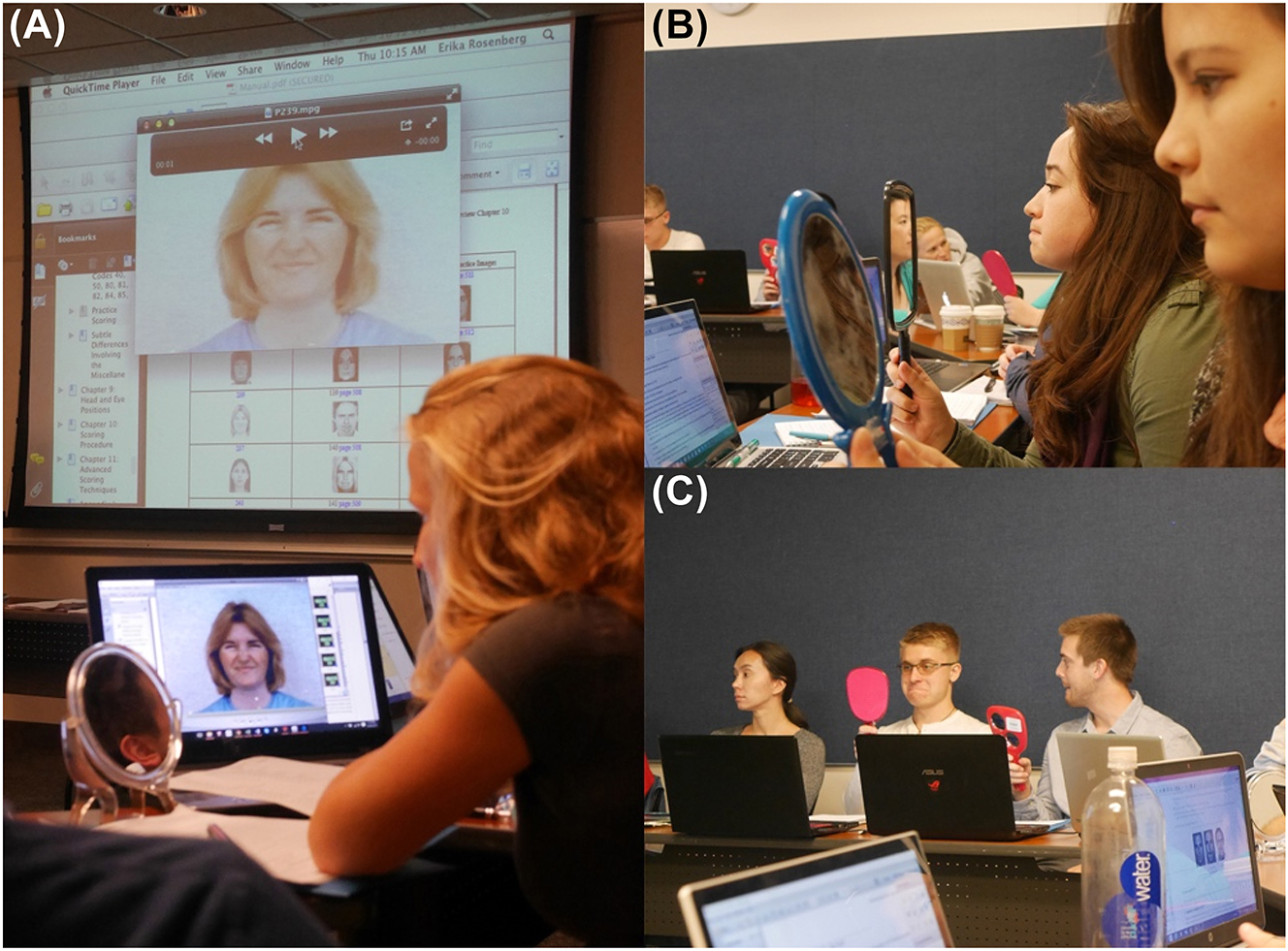
FACS Training Workshop, Room 240, Sutardja Dai Hall, University of California, Berkeley, 21–25 September 2015 (photographs by the author).
To critically explicate the visual epistemology for catoptric autoexperimentation in the contemporary science of facial behavior, by way of its historical progenitors, I draw upon the pragmatic semiotics of the catoptric phenomenon by Italian cultural semiotician Umberto Eco (1976: 201–203, 1984: 202–226, 2000: 361–370), as well as further analysis by Swedish cognitive semiotician Sonesson (2003, 2010, 2015 and Dutch cognitive semiotician Brandt (2017). This problematization of catoptrics is fundamentally about two different but related concepts: the semiotic thershold, which Eco originally introduced, and the iconicity debate, which he regularly inspirited. Arguing from the negative, Eco endeavors to “better define a sign,” or at least “what a sign is not,” by establishing the ways in which “the mirror image does not meet the requirements for a sign” (1984: 202, 216; emphasis mine). In Eco’s view, the catoptric (from the Latin katoptrikos after the Greek κατοπτρικός, meaning ‘speculum’ or ‘mirror,’ from kata after κατά ‘against,’ op after ὀπ ‘see,’ and-tron after-τρον, the suffix for ‘instrument’) constitutes a “threshold-phenomenon” between the presemiotic and the semiotic (1984: 203). Of course, to discern a threshold implies differentiating the semiosphere from the rest of the world at least to some degree, whereas to deny a threshold implies not differentiating along this continuity (Higuera and Kull 2017: 110–114). On these grounds, insofar as Eco shows, the face in the mirror and other “stimuli cannot be regarded as signs” (1976: 19). The phenomenon of the catoptric, Eco postulates, falls not on a higher but rather a “lower semiotic threshold,” where the semiotic rises from the presemiotic like “a sort of ‘missing link’” between what is a sign and what is not yet a sign (1976: 21).
Although Eco’s perspective also changes over time, the basic program Eco puts forward is a part of the so-called “problem of iconicity,” a debate that raged during the contemporary disciplinization of the semiotic field from the late 1960s to the late 1970s, continues today, and is concerned with the degree of arbitrariness, conventionality, and habituality in signs both iconic and otherwise (Polidoro 2015: 158). Eco, like many semioticians before and after him, privileges the linguistic over the imagistic and the verbal over the nonverbal, presupposing that something can be “understood as a sign if and only if there exists a convention which allows it to stand for something else” (1976: 19; emphasis mine). However, the question at hand should not be whether a catoptric prosthesis is a semiotic phenomenon or the face in the mirror is a sign, but rather how these signs function within human practice. Indeed, what has been absent from the pragmatic semiotics of the catoptric phenomenon by Eco, Sonesson, and Brandt, among others is not the analysis of abstract models but the application in actual situations, that is, explication via exemplification. I seek to rectify this oversight and by so doing resolve the status of the mirror and its semiotics. Based on primary sources both Western and Eastern, I trace a transcultural history of scientific ideas about performing catoptic autoexperimentation through privileged case studies from physiognomic literary corpora, including those relating to Phaedo’s Zopyrus (5th c. BCE), Erasmus’s Folly (1509), and Darwin’s Expression (1872). I probe the ways in which self-recognition has long been pragmatically necessitated as well as processually normative in the study of the face, the research and development of optical technologies has in turn led to paradigm shifts in physiognomic thought, and the procatoptric staging behind the catoptric prosthesis conditions its visual epistemology. In contradistinction to Eco and his claims, I propose that the catoptric prosthesis is not pre-but post-semiotic. That is, the mirror only becomes a mirror when part of a semiotic process and sign relation. What is more, the extreme of iconicity that is perceptually afforded by the catoptric prosthesis, far from disqualifying it from the status of a sign, is exactly what distinguishes its role and importance for the semiosis of the face.
2 Phaedo’s Zopyrus: neither icon nor index but information
In Athens, Greece, in the fifth century BCE, the physiognomist Zopyrus performed on the philosopher Socrates the first documented face “experiment” in occidental culture to allegedly employ something like a catoptric prosthesis. Today, the allegory of Zopyrus is preserved only in a scattered-few surviving fragments that adapt or appropriate the now-lost Socratic dialogue Zopyrus by the Greek philosopher Phaedo of Elis. As the story is told, the companions of Socrates come across Zopyrus, who claims that he can “read” the character of a person from the appearance of their face. To test this claim, the Socratics present Zopyrus with a portrait of Socrates. As Eco reckons, the face in a painting might be “‘realistic,’” but the face in a mirror cannot be “truer” than its referent (1984: 226). In terms from Charles S. Peirce, one of the founders of pragmatism, whom Eco mentions in his manifesto against mirrors, the portrait functions at least in part iconically. “An Icon,” in Peircean terms, “refers to the Object that it denotes [by] virtue of characters of its own and which it possesses,” that is, by analogy or similarity in one or more qualities, and, given “there really is such an Object,” acts as a sign because “it is like that thing and is used as a sign of it” (CPCP 2.247).
However, the physiognomist’s interpretants from this picture’s signs also depend on who is telling the story, their context, and their culture, that is, the code that relates these signs to their values. In the first century BCE, Roman statesman Marcus Tullius Cicero describes how Zopyrus diagnoses Socrates from the thickness of his neck with “stupidity and dullness” and from his notoriously ugly visage that he possessed “many vices” (Rossetti 1980: 185).[3] In the first century CE, the Greek Middle-Platonist Plutarch of Chaeronea, according to the Syriac translations of the Plutarchan corpus, describes how Zopyrus diagnoses from Socrates’ various facial signs that he is “debauched” and “succumbs to the lust for women” (Rossetti 1980: 186). And in the fifth century CE, Christian theologian John Cassian describes how Zopyrus diagnoses Socrates as a “corrupter of boys” (Rossetti 1980: 186), in other words, a pederast, or a man who has sex with boys. As the story goes, Zopyrus’ inference provokes the Socratics’ indignation. Yet, Zopyrus asserts that the image analysis is correct, appeals for a meeting with Socrates, and, face-to-face, affirms his “reading.” The Socratics become incensed. But as storied in the second century BCE by Greek Peripatetic Alexander of Aphrodisias, Socrates then “said that Zopyrus had not been mistaken, that he would have been like that as far as his nature was concerned, had he not, through the discipline that comes from philosophy, become better” (Rossetti 1980: 186). Phaedo’s allegory of Zopyrus’ encounter, as George Boys-Stones argues, is about the “epiphenomenalism” between the physiological behavior of the flesh and the psychological phenomena of the soul, which, to Phaedo, have a relatively stable correspondence and sympathetic causal interdependency, but can still be “reform[ed] through philosophy” and, above all, reason (2004: 10, 21). The original meaning of the Zopyrus allegory, through which Phaedo investigates the so-called “mind-body problem,” is that psychology may be innate, born of nature, and related to the face in such a way that it can be abducted from these forms, but does not necessarily constitute a final cause that determines behavior. The portrait of Socrates, whom Zopyrus had not yet seen face-to-face, convinces the physiognomist of the philosopher’s character because it leads him “to form an idea of the person it represents,” as put forward by Peirce, through “an Icon [but] not a pure Icon” (CP 2:92), given the conventions involved with not only producing but also interpreting the face in the painting.
Although Zopyrus used a painting not a mirror, used it on Socrates not himself, and used it more in an encounter than in what today we call an experiment, the allegory of Zopyrus originates the visual epistemology of catoptric autoexperimentation in the study of the face and exemplifies the pragmatic semiotics of catoptric prostheses, if only by contrast. Both the painting and the mirror, Eco rightly points out, constitute a “channel,” that is, a “material medium for the passage of information” (1984: 208). A prosthesis is necessarily a channel, but a channel is not necessarily a prosthesis. The difference that makes a difference between an image and the mirror image is that the catoptric is also a prosthesis, which, Eco confirms, does not “substitut[e] a missing organ,” but rather “extend[s] the range of action of an organ,” as an “extensive and intrusive prosthetics par excellence” that “allows us to look where the eye cannot reach” (2000: 361, 366): at our very own faces. To this end, the study of the face relies upon face images, whether the face in the mirror, as with the FACS Training Workshop, or the face in the painting, as with Zopyrus the physiognomist.
Many, if not most, origin stories for physiognomic science begin with the allegory of Zopyrus. Although particulars vary between texts and traditions, physiognomy as a science with specialized practitioners first emerged in Greece in the fifth century BCE, most likely by way of the Near East, where physiognomic signs conveyed prophetic objects. Indeed, Zopyrus is believed to have come from Persia or Syria to Athens. But there is today much debate over the provenance of this physiognomator and the nomenclature of his name (e.g., Boys-Stones 2004: 8n16). The allegory of Zopyrus, after being told and retold across Greek and Roman literature, is even assimilated into the physiognomic texts of the Arabic tradition. However, Mariska Leunissen historicizes, the Anatolian rhetor Polemon of Laodicea takes “the role of Zopyrus” and the Greek physician Hippocrates of Kos “that of Socrates” (2018: 755). In this way, Daniel R. McLean clarifies, the allegory of Zopyrus became “free-floating” (2007: 67), with its transcultural roles cast and recast with the heroes of the hour. By the late medieval and early modern period, Zopyrus, the myth, the legend, “the patron saint of physiognomy” one could metaphorically say, is expressed as an encounter between Zopyrus, Hippocrates, and the image of the face between them. This exemplifies the extent to which physiognomy has long been entangled, Martin Porter expounds, “with the making and viewing of images” (2005: 156). Yet only three Arabic texts portray the portrait, and thereby explicate the epistemology, used by the physiognomator.
The most detailed account comes from the translation of Polemon and his Physiognomy in the Topkapı tradition, known as the “Istanbul Polemon,” written in the thirteenth or fourteenth century. Here, the allegory of Zopyrus serves as an introduction to physiognomy, its methodological framework, and theoretical foundations. The allegory comes “before the incipit of what is stated to be the book of Polemon,” Antonella Ghersetti traces for her translation, but is “extant only in the Topkapı tradition,” and is “plainly not Polemonic” (2007: 465). As told in the Topkapı, Socrates/Hippocrates rejects Zopyrus/Polemon, saying:
‘There can be nobody who by consideration of shape or physiognomical scrutiny can obtain knowledge of what souls harbour, of the foundation upon which natures are established, and of the conduct upon which desires are based.’ [Hippocrates then] sent for some leather, drew his picture on it, and sent it along with his companions, saying ‘Take this image and show it to [Polemon] without letting him know who it represents. Ask him about the nature of its owner and his intellect, his condition, his contentment, his anger, his continence, and his desires. Afterwards let me know his reply to you.’ So [Hippocrates‘ followers] spoke, and they took the image [by Hippocrates to Polemon], put it down in front of [Polemon], and asked him what [Hippocrates] had told them. Once Polemon had observed the signs of the picture, he said, ‘There can be nobody more lustful than the owner of this image.’ When they heard his words they jumped upon him to beat him but he drove them back, and then said to them, ‘People! What are you rejecting in my analysis of this image?’ (Ghersetti 2007: 471)
Testified to by this text, Zopyrus/Polemon performs his physiognomics in two stages, as Livio Rossetti identifies, “first a diagnosis based on the portrait, then a diagnosis based on direct observation” (2015: 5). For the physiognomic method of the physiognomist Zopyrus/Polemon, the portrait and its signs (A) stand for Socrates/Hippocrates and his face (B) in the absence of the philosopher, but without material implication (if A, B), and without causally necessary or sufficient condition (A ⊃ B). As such, the portrait does in fact meet several of the requirements for sign that Eco puts forward (1984: 214–215).
To critically problematize the catoptric phenomenon, Eco draws upon the works of Danish linguist Louis Hjelmslev (1961 [1943]: 48–49, 66), who in turn draws upon the works of Swiss linguist Ferdinand de Saussure (2006 [2002]: 23, 235), and, from the binarist, verbocentrist “semiology” of this continental tradition, a dyadic sign model with its expression-signifier-antecedent and content-signified-consequent. Simplifying the semiotic to a synonymity with symbolicism, Eco claims “that anything may be taken as a sign of anything else provided that it is an antecedent revealing a consequent” (1984: 214). What is more, Eco contends that “the consequent might well be the more or less chronologically remote cause of the antecedent,” which “must be potentially present and perceptible,” while “the consequent is usually absent” (1984: 214). The antecedent, that is, the Hjelmslevian expression, or Saussurean signifier, does not require the consequent, that is, the Hjelmslevian content, or Saussurean signified, in Eco’s own words, “as either its necessary or its efficient cause” (1984: 214).
For Zopyrus/Polemon’s physiognomation of Socrates/Hippocrates’ physiognomy, the signs in the painting do not need to causally relate to their object. Although the Topkapı states that Socrates/Hippocrates “drew his picture” himself (Ghersetti 2007: 471), which, if true, may well have required some reflective surface, for the purposes of this physiognomation the painting could also have been produced by another in his absence. After all, Socrates/Hippocrates arranged for his companions to “‘[t]ake this image and show it to [Zopyrus/Polemon] without letting him know who it represents’” (Ghersetti 2007: 471). Socrates/Hippocrates did not have to be present along with the portrait for it still to be signifying. Of course, such anachronism is not the case with the catoptric. As Eco concludes, the mirror image “is present in the presence of a referent which cannot be absent,” and it “never refers to remote consequences” (1984: 216), as can Socrates/Hippocrates’ face in Zopyrus/Polemon’s painting. In this regard, the face in this painting is not comparable to the face in a mirror. However, Sonesson disputes the way in which Eco determines such causality to “exclude[s] the sign character” of the catoptric prosthesis (2010: 6). Certainly, signs of diverse shades and stripes depend on some causality, whether it be conditional, connective, or contiguous.
This epistemological distinction between mirror images and other images within the practices of physiognomy is explicitly developed via the allegory of Zopyrus by Swiss Pietist minister Johann Caspar Lavater (1741–1801) in Physiognomic fragments for the promotion of the knowledge and the love of mankind, originally published in German across four volumes between 1775 and 1778. Amidst his analysis, Lavater acknowledges that the encounter between Zopyrus and Socrates “has been repeatedly cited in modern times against physiognomy” (1789: 209). After all, Lavater waxes rhetorically, how can it be that “the wisest and best of men had the countenance of the most stupid and debauched” (1789: 211)? The later meaning of the Zopyrus allegory, in Lavater’s Fragments, and in precedent texts from the physiognomic tradition, is that of a “test-case,” McLean suggests, that serves as a “counterfactual example” and “proof [of] legitimacy” for physiognomic science (2007: 67, 70, 73). Further, to Lavater it is precisely the paradox between Socrates’ outward ugliness and his inward beauty that demonstrates the relevance of the “solid and flexible parts” of the face, which is to say, the spatial “form of the countenance,” as well as its temporally “mutable features” (1789: 213). Failure to consider both static morphology and dynamic movement results in what Lavater calls Zopyrus’s “physiognomical error” (1789: 214), or what might retrospectively be termed “The Zopyrus Fallacy.” At least in part because Zopyrus uses a painting, he is incapable of inferring that which Lavater observes is “only visible when the features are in action” (1789: 214).
In 77 CE in Natural history, Roman natural philosopher Pliny the Elder praises the Greek artist Apelles of Kos for his life-like paintings from the fourth century BCE. As Pliny reflects, these were “such perfect likenesses that, incredible as it may seem, Apion the Grammarian has left it on record that a physiognomist, or metōposkopos as [the Romans] call them, was able to tell from the portraits alone how long the sitter had to live or had already lived” (qtd. in Elsner 2007: 203). Continuing this tradition, Lavater calls on the artist to create a “true, living likeness” of “perfect nature,” to such an extent of iconicity that “it is not a painting,” but provides the physiognomist with “a countenance in a mirror, to which we would speak, that speaks to us” (1792: 266; emphasis mine). As Sonesson cites, Eco contests that the catoptric “continues to change its meaning forever” (2010: n.p.). In fact, the fundamental difference between the face in the mirror and the face in the painting, Sonesson asserts, “has to do with the relative importance of the constant and variable element in the meaning” (2010: n.p.). The mirror is exceptional among media because it is not only a channel but also a prosthesis by which the catoptric sign refers to its facial object with all the immediacy of spatial “here” and temporal “now,” that is, a temporospatial contiguity, that makes visible and sensible the temporal dynamics of facial behavior.
The title page for volume one of Physiognomic fragments illustrates not only the allegory of Zopyrus but also his pre-catoptric staging. As shown in Figure 2, the Polish-born German printmaker Daniel Chodowiecki (1726–1801) takes the signs within the eclectic “hodgepodge” of this copperplate engraving out of and away from their historical contexts and brings them together within a Christianized and Neoclassical emblematization. Indeed, Brandt points out that “no sign can be said to be exclusively iconic or symbolic; all signs are both, in variable ways” (2017: 17). The background of the engraving iconically refers to a Mesopotamian ziggurat and symbolically refers to the Near Eastern origins of Classical Greek physiognomy. The midground iconically refers to a column sculpted like a woman and symbolically refers to the caryatids that architecturally about the Athenian Acropolis. And the foreground iconically refers to a lantern and symbolically refers to Diogenes of Sinope, one of the earliest recorded Western physiognomators, who wandered Athens holding a lantern up to faces in search of virtue. Most importantly, however, for the context of this critique, Richard T. Gray argues that the figure in the foreground, whom he assumes is a Christian “angel,” has been sent from heaven “to fulfill the pedagogical task” of teaching humanity physiognomic hermeneutics, which to Lavater involves a “language” that has been “naturally ordained by divine creation” (2004: 337, 339).
However, Gray’s interpretation of Lavater’s iconology does not consider the pragmatic semiotics of this pre-catoptric staging and, consequently, misidentifies who is doing what to whom in the image. The figure in the midground wearing himation and tiara, far from just a “privileged human being” as Gray alleges (2004: 337), refers to none other than Zopyrus himself, whether as historical individual or symbolic archetype. This is apparent from the compositional geometries of the pictorial narrative. The feminine caryatid in the background holds in her arms a physiognomic grid of facial representation with a sequence of views from left to right that encompass the contour, silhouette, profile, forty-five degrees, and frontal. Yet, the face in the grid shares a likeness not with any of the humans but with the angel. Therefore, the winged, nude, masculine, long-haired figure in the foreground is not the interpreter of physiognomy but rather the object of physiognomation. “A Symbol,” in Peircean terms, the figure “refers to the Object that it denotes by virtue of a law,” which “operates to cause the Symbol to be interpreted as referring to that Object,” that is, it “acts through a replica,” and “has its being in the instances which it will determine” (CP 2:249). Here, the figure symbolizes not the divinity above humans but the divine within humanity.
Of course, the author Lavater and artist Chodowiecki prepared this title page over two millennia after the physiognomist Zopyrus performed a “face reading” on the philosopher Socrates. Nevertheless, Gray notes, this relatively contemporary illustration points to “the crucial place that representational images” assume in physiognomy (2004: 337). Indeed, the etching likely exemplifies the way in which Zopyrus gazed first at the portrait of Socrates and second at his face itself, which is exhibited within this etching at stage left and at stage right, respectively, as happening at the same place and time. Even a series of paintings cannot be compared to the ideal of a mirror. The mirror image is different than other images, Sonesson discriminates, because of “its specific referentiality (or embedded intentionality) [as it] points to that which is in front of it” (2015: 174). But in this way, the mirror and the face are neither more nor less exceptional than the weathercock and the wind.

Daniel Chodowieck, 1774, “title page,” copper etching on paper, in Johann Caspar Lavater, Physiognomische Fragmente, zur Beförderung der Menschenkenntniß und Menschenliebe, Vol. 1 of 4, Leipzig and Winterthur: Weidmanns Erben and Reich (Deutsches Textarchiv, CC BY-NC 3.0 DE, used with permission).
The face in the mirror can be experienced to be iconic but for the instant when perception has yet to distinguish between the real and its reflection. If one paints a picture of a person, as Peirce himself proposes, “with certain physiognomical peculiarities in order to see what sort of an impression of such a man’s disposition you will get in this way,” perhaps like the painting that represented Socrates that Zopyrus interpreted, then the physiognomics in the painting “are signs of their objects merely, by virtue of the analogy, and are true icons” (MS [R] L67: 37–38). But Eco suggests that for something to serve as a sign, it must be interpretable, so that “[e]ach interpretation not only defines the content of the expression but also in its own way provides […] more information” (1984: 215). On this basis, Eco surmises that a “mirror image cannot be interpreted, [just] the object to which it refers” (1984: 216). That is, at least to Eco, the face in the mirror is too iconic to be semiotic; therefore, it is presemiotic.
One of the essential problems in Eco’s pragmatics of the catoptric phenomenon is this anachronism of signification, that is, when something is a sign, it is always that sign. In Sonesson’s interrogation of Eco’s inquiry, Sonesson indicates how the “momentary sign does not appear to exist for Eco,” but if momentary signs were to be excluded, then “most examples of sign given by Peirce and others will not be eligible” for the status of the semiotic (2003: 224). In the practices of physiognomics, the face in the mirror becomes iconic as well as indexical, like the weathercock. Peirce writes that the weathercock performs as an index “by virtue of being in a real reaction with its object [and] for the reason that it is physically connected with the wind” (EP2 306–307). The “weathercock conveys information,” Peirce argues, but it does so “because in facing the very quarter from which the wind blows, it resembles the wind in this respect, and thus has an icon connected with it” (EP2 306–307). In this way, the weathercock is neither a pure icon nor a pure index, Peirce asserts, that “simply forces attention to the object with which it reacts and puts the interpreter into mediate reaction with that object, but conveys no information” (EP2 306–307). The mirror, like the painting, like any something else, Sonesson amends, serves as “the starting-point for a chain of interpretations” (2003: 225). The allegory of Zopyrus, who performs his physiognomics by gazing first into a portrait of Socrates and second into the face itself, establishes the role and importance of images for the epistemology of the science, thereby exemplifying how the mirror, when compared to the painting, affords more complex and dynamic information not less.
3 Erasmus’s Folly: truthful prosthesis v. lying semiosis
During the late fifteenth and early sixteenth century Northern Renaissance, Dutch theologian Desiderius Erasmus of Rotterdam (1467?–1536) philosophized about the face, the mirror, and the phenomenon of this relation. Neither a structured nor a systematic thinker, Erasmus’s theories about physiognomic thought appear scattered across his oeuvre, such as in Book of apophthegms in 1531. As translated from Renaissance Latin to Early Modern English by the English playwright Nicholas Udall in 1542, “the crowning glory of the Christian humanists” portrays:
[a] fellow having sight in physiognomy (who professed and openly took upon him, by the complexion and plight of the body, and by the proportion and setting, or compass of the face or visage, to be able infallibly and without missing, to find out and judge the natural disposition of any man). (Erasmus 1542: n.p.)[4]
Of course, the physiognomist in this apophthegm is none other than Zopyrus. Erasmus does not name Zopyrus. But Erasmus goes on to narrate how this physiognomator “viewed Socrates” (1542: 33). In this way, Erasmus links his Christianized physiognomy to its Classical predecessors, as Porter characterizes, with “true Renaissance humanist style” (2005: 130). Intent to establish the allegory of Zopyrus, and thereby physiognomics itself, with “a Greek genealogy,” Porter observes, “Erasmus appears to have overlooked the very strong possibility that Zopyrus [was] Syrian not Greek,” a “fact which he surely knew” (2005: 130, 173).
Despite such historical whitewashing and Western-centrism, the Renaissance European humanist Erasmus, like the Classical Eastern physiognomist Zopyrus, presumes a relatively stable one-to-one relation between “the compass of the face” and “the natural disposition” (1542: n.p.), that is, between the physiognomical sign and its psychological object. From this framework, Erasmus philosophizes about the relation between physiognomic science and catoptric prostheses in his In praise of folly, first published in Latin in 1511, and first translated into English by the English statesman and poet Sir Thomas Chaloner in 1549. In Folly, Erasmus lampoons the class values in Early Modern Europe and corrupt practices in the Roman Catholic Church by rhetorically incorporating physiognomic inferences. For example, Erasmus infers how aristocrats “their faces like visors will blush at nothing,” churchmen “did but once look wisdom in her face,” and statesman “have two faces much unlike and dissemblable” (1549: 62, 65, 21). Over the course of this satire, Erasmus contrasts these emblematic characters to his narrator, Folly, whom he writes in the first person to herald for herself:
I cannot tell what purpose it should serve, to represent a certain shadow, or image of my self, where presently you may discern me with your eyes. For I am here (as you see) the distributrix and dealer of all felicity, named Magia in Greek, Latin Stultitia, and in English Folly. But yes, what need do I have to say this much? As if I bare not signs enough in my face, and countenance, what manner of person I am: Or as if some one contending that I were Minerva [the Roman goddess of wisdom], or Sophia [the Christian personification of wisdom], might not straight with only a look be confuted, though I hold my talk, which is no lying mirror of the mind’s disposition. (1549: 3; emphasis mine)
By comparing the “truthfulness” of the physiognomic sign to that of the catoptric sign, Erasmus proposes that the signs of the face do not lie but the signs of the mirror can and do. In this way, Erasmus’ position about the “lying mirror” (1549: 3) expressly contradicts Eco’s position that “the mirror image cannot be used to lie” (1984: 216). Of course, Folly is a satirical work of moral criticism. Erasmus does not report the results from catoptric autoexperimentation in the modern sense of a scientific methodology that proves by trial and tests by probe. Nonetheless, Erasmus based Folly on the physiognomics of his day. Therefore, Erasmus’s fiction about Folly’s mirror can shed light on the semiotics of catoptrics and, ultimately, on why catoptric autoexperimentation has become common in the contemporary science of facial behavior.
Across the ages, reflective surfaces have been made from different materials with diverse results. Eco, however, claims that one “can lie about mirror images,” but one “cannot lie with and through a mirror image” (1984: 216). In Eco’s pragmatic view, the mirror provides an image with “all the properties of its denotatum” via an “absolute icon” that is not so much “an icon but a double” of the stimulating field (1984: 210). That is, in terms from optical physics, the face image inside the mirror references the human face outside the mirror by way of visible light, when incident light rays emanate off this face, as it approaches the mirror obliquely or perpendicularly, and the light strikes the plane of the mirror (Southall 1933 [1918]: 37–40, 64–67). But such “rigid designation” along the “causal chain,” to use Eco’s terms (1984: 213), is not always, and has not always been, the case with mirrors. When Erasmus penned Folly, and he posited that “the face […] is no lying mirror” (1549: 3) or “speculum” (1511: 5), to use his word from the original Latin edition rather than from the first English translation, little to no visibility would have been extended or augmented using catoptric prostheses. Indeed, it would have been difficult, if not impossible, to see the face in the mirror with the amount of “absolute[ness],” that is, of iconicity, that Eco attributes to this “apparatus” (1984: 212). In the mid-sixteenth century, when Folly gazed into her mirror, the manufacturing techniques for producing mirrors out of clear, flat, and thin glass remained largely mysterious. Many, if not most, scholars, including Erasmus, viewed the sciences and the supernatural as inextricably linked and assumed the catoptric to be alchemical in constitution (Melchior-Bonnet 2001: 17). Given these materialities, the sᴘᴇᴄᴜʟᴜᴍ (from the Latin noun speculum, meaning ‘mirror,’ after the Latin verb specere, meaning ‘to look at, observe, view’) became nigh synonymous with divine revelation in the Christian theology of Medieval and Modern Europe (Edgerton 2009: 27). From the fifteenth to the sixteenth century, the prominent thinkers of physiognomic thought would even reference the supernatural connotation of catoptric signification by including Speculum in the titles of their texts (Porter 2005: 281–284), thereby calling their readers’ attention not to the truthfulness of mirrors and technology but to the truthfulness of faces and nature.
The way the “lying mirror” works, according to Erasmus (1549: 3), can be read not only in the text for Folly but also seen in the images of Folly. As shown in Figure 3(A), German printmaker Hans Holbein the Younger (1497?–1543) draws Folly with brown ink and feather pen in a marginalia sketch. The artist gender-swaps Folly from female to male. And he formalizes this “fool” as a figure who gazes upon himself, and his own physiognomy, using a handheld catoptric prosthesis, not unlike myself and the other participants during the FACS Training Workshop. In 1515, Holbein only illustrated one copy of Folly, owned by Protestant theologian Oswald Myconius, who planned on presenting it to Erasmus (Saxl 1943: 274). But over the centuries other image-makers have remediated this catoptric autoexperiment across innumerable editions. As shown in Figure 3(B), for example, Flemish graphic artist Franz Masereel (1889–1972) illustrates Erasmus’s In praise of folly with a series of woodcuts in 1943, which depict Folly his narrator as Erasmus her writer, likely based on the Portrait of Erasmus by Holbein from 1523. The graphic representation for what has over the centuries become “the fool and the mirror” topos effectively diagrams one of the most essential sign functions from catoptric autoexperimentation: that, as Sonesson counters Eco, “all mirrors lie, or, more precisely, they interpret” (2003: 225), especially when prosthetically adapted to professional augmentation, as in physiognomic science. In what ways and to what extent, however, depends upon the mirror, the interpreter, and the act of semiosis. From the perspective of pragmatics, Eco points out, mirrors are used by following the “rules of catoptric interaction” (1984: 207), introjected from codes established by culture that represent a social dimension in semiotic dynamics. Yet Eco claims that a catoptric “tells the truth to an inhuman extent,” and that although the “brain interprets retinal data,” the “mirror does not interpret an object” (1984: 208). Albeit illustrating a fiction, Holbein’s marginalia in Figure 3(A) and Masereel’s woodcut in Figure 3(B) show this not to be the case by differentiating between the mirror sign and its facial object. Phenomenologically, as Sonesson asserts against Eco and his argument, mirrors “lie in a systematic way” (2003: 225), mediating through their mediality between the sign and its object. The face in the mirror, and the face gazing upon it, are not one and the same face. Information gets translated, and indeed mistranslated, on the way to the reflection and back again.
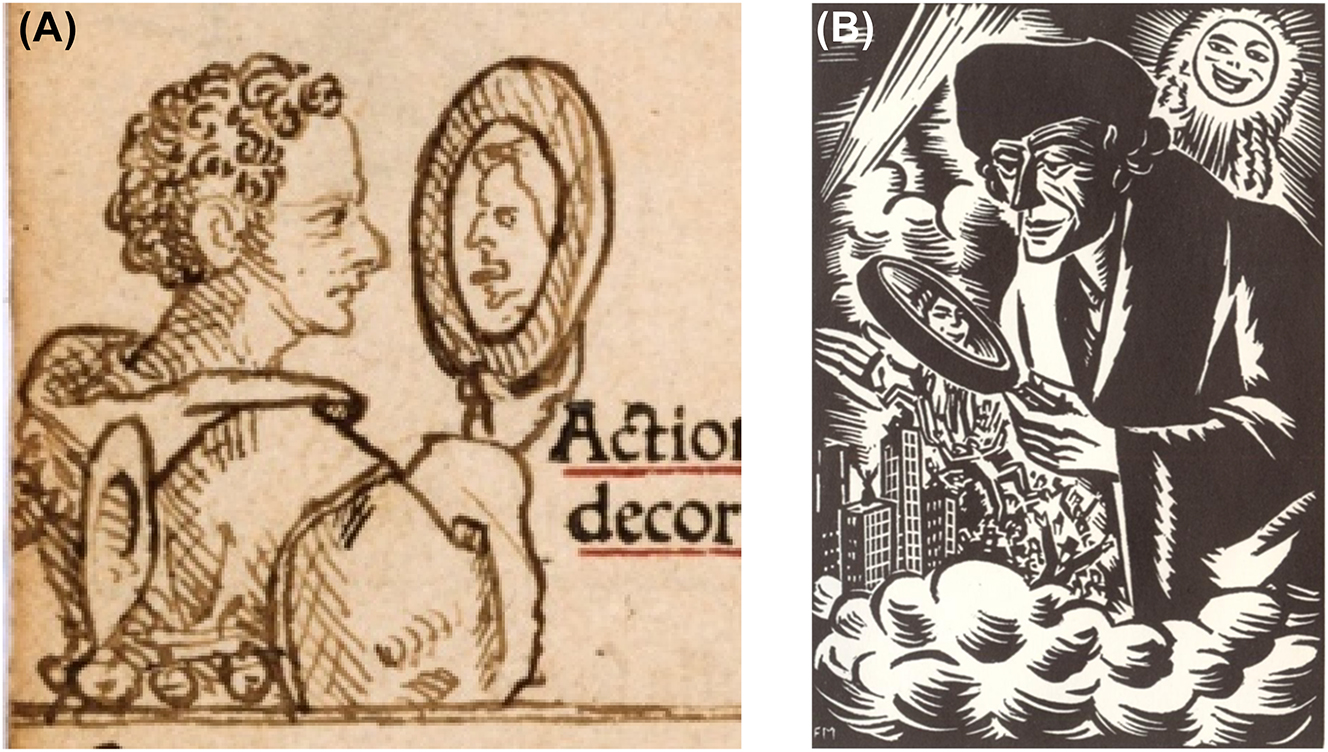
Graphic representations of “the fool and the mirror” from the sixteenth and the twentieth centuries. (A) Hans Holbein, 1515, “A fool considers himself in a mirror,” feather pen with brown ink, 22.3 × 16 cm, in Desiderius Erasmus, Moriae Encomium, copy belonging to Johann Froben, Basel, Switzerland, Inv. No. 1622.166.29, fol. E 2 verso (© Kunstmuseum Basel, Martin P. Bühler, used with permission). (B) Franz Masereel, 1943, “Frontispiece,” woodcut, in Desiderius Erasmus, Moriae Enncomium or The Praise of Folly by Desiderius Erasmus, Harry Carter (trans.), Hendrik Willem van Loon (intro.), New York: Heritage Press (public domain).
The relation between face and character as well as mirror and face in Erasmus’s Early Modern physiognomics is analogous to the relation between sign and object in the Stoics’ Hellenestic Greek semiotics. In fact, Erasmus intertextually references ancient Greek protosemioticians, such as “Aristotle [and his] study of physiognomy” (Erasmus 1990: 83). And, as Ross Dealy points out, Erasmus had been “systematically employing Stoic concepts” and “became deeply attached to Stoicism” (2017: 4, 14). But while Erasmus draws upon protosemiotics to demonstrate how the process of semiosis works for the face in the mirror as “a certain shadow, or image of [the] self” (1549: 3), Eco draws upon “the Stoics theory” to demonstrate why catoptric prostheses ought to be considered presemiotic (1984: 214). In the third century BCE, the Hellenistic Stoics defined the “sign” (sēmeîon) as ‘something that stands for something else’ (aliquid stat pro aliquo), such as the smoke that stands for fire. Similarly, Erasmus essentially states that facial appearance (aliquid) stands for (stat pro) moral character (aliquo). As Eco recalls, the Stoics described the sign not as a “material occurrence” but rather as “incorporeal” and independent from its “channel or medium” (1984: 215). It follows, Eco finds, that the sign “is the relationship of implication between two propositions,” and therefore “a law correlating a type-antecedent to a type-consequent,” that “exists between types rather than between tokens” (1984: 215). To the Stoics, a sign is not conveyed by how this smoke references that fire. And to Erasmus, a sign is not conveyed by how this face (A) references that character (B). Instead, Erasmus infers a generality and, indeed, a universality: “if there is this form of the face, then there must be that function of the character” (if A, then B; A ⊃ B; or A → B). The blushless face or two-facedness of any one or other churchman or statesman is not what is relevant but rather, in Erasmus’ own words, the “thing itself, which by [such] outward signs [is] represented” (1549: 84). That is, the sign function acquires its semiotic value by the ratio of implication (A: B) between the antecedent and consequent, such as with the causal conditional “if there is this face, then there must be that character,” or the causal law “each time there is this face, there must be that character.” However, in Erasmus’s physiognomy, as in the Stoics’ semiotics, A entails B (A ⊨ B), A implies B (A ⇒ B), and A therefore B (A ∴ B) are relatively interchangeable. While Erasmus’s model is explicitly dyadic because the “the compass of the face” stands for a “natural disposition,” it is implicitly triadic because someone who has “sight in physiognomy” must still “find out and judge” (1542: n.p.), which is to say interpret, the relation between these physiognomic signs and their psychological objects. In the phenomenological terms of Peirce’s triad, the representamen “is that character of a thing by virtue of which, for the production of a certain mental effect,” or interpretant, it “may stand in place of another thing,” its object (CP 1.564). As Eco argues, an interpreter makes the signs “occur as relations between tokens owing to the fact that he knows [that] the same relation holds between types” (1984: 215).
Erasmus investigates the importance of the interpreter in his On the education of children, written between 1506 and 1509. In this pedagogical treatise, Erasmus instructs that it is neither “idle speculation to define a person’s character on the basis of his facial appearance,” nor “a mistake to think that the distinguishing marks that reveal a person’s basic character have not been given to us by nature,” but that it can be “a moral failing to ignore these signs once they have become clear to us” (Erasmus 1990: 83–84). Thus, Erasmus attends to the interpretive determinability of sign functionality or, in Peircean terms, how “concepts are purposive” and a “sign is only a sign in actu by virtue of its receiving an interpretation” (CP 8.322, 5.569). In something of a semioethics, Erasmus teaches how the semiosis of the physiognomic can turn the outer flesh and the inner spirit inside out. However, like with the smoke that stands for fire, the most pertinent question for Erasmus is not “is there, or is there not, this facial appearance,” but rather “what does it mean for a person to have that moral character.” Eco claims that a sign does not relate to an actual situation but to “a more or less general content,” that the antecedent conveys “a class of possible consequents,” and that this “relationship exists between types rather than between tokens” (1984: 214–215). Such a requirement for the semiotic, Sonesson reflects, is often articulated as a “difference between singularity and generality” (2003: 223). That is, for something to serve as a sign, it should be possible to bring a token into relation with a type, such as, in Erasmus’s Folly, with an aristocrat’s blushless face and aristocrats whose “faces like visors will blush at nothing,” or with a statesman’s two-facedness and statesmen who “have two faces much unlike and dissemblable” (1549: 62, 21). Eco contends that “the mirror image never establishes a relationship between types but only between tokens” (1984: 216) and that in catoptrics “type and token coexist” (2000: 368). But Sonesson counters that “singularity is not, in the last instance, in the sign, but in the use to which we put the sign” (2003: 223). In Folly’s catoptric-based autoexperimentation, as in Erasmus’ semiotics-based physiognomics, it’s not what something is, but what one does with something that defines it as a sign.
“Lying” or “truthfulness,” epistemologically at least, is to be found not in the form of the sign but in the function of the semiosis. One of the essential problems with Eco’s pragmatics of the catoptric phenomenon is that he locates the lie within the very channel of the catoptric itself. Eco characterizes semiotics as the “discipline studying everything which can be used in order to lie” on the grounds that “[i]f something cannot be used to tell a lie, conversely it cannot be used to tell the truth: it cannot in fact be used ‘to tell at all’” (1976: 7). In his critique of the catoptric, Eco continues with this claim that a requirement for sign is that “[s]igns can be used to lie” because the expression-signifier-antecedent “is only presumed to be caused by” the content-signified-consequent (1984: 214). With mirrors, Eco maintains, the mirror image, “even when it is taken as an antecedent,” is present only when the consequent, “by virtue of the prosthesis action of the mirror,” comes “into the radius of the interpreter’s perceptibility” (1984: 216). In other words, only when the sign and its object phenomenologically come into temporospatial contiguity does the catoptric prosthesis afford augmentation of stimuli sensibility. The face in the mirror (aliquid) can only stand for (stat pro) the face that gazes into the mirror (aliquo) when the face that gazes into the mirror is gazing into the face in the mirror (aliquid stat pro aliquo). Consequently, Eco concludes that the mirror image refers to one and only one content because “it has a primary relationship with the referent” (1984: 216). Even so, however, the face in the mirror, Sonesson counters, is conveyed “with the fidelity permitted by its particular channel,” which provides “its ‘ground,’ its principle of relevance” (2010: 10). In Folly, Erasmus reasonably interprets the iconic relationality to be “closer” or “greater” between face and character, which have a truthfulness that he understands in the context of the physiognomic science of his period, than between mirror and face, which have a deceptiveness that he understands in the context of the catoptric technology of his time. Whether a face is truthful or lying, and whether a mirror is transparent or opaque, the intermediate channel that conveys information is but a part of the catoptric sign and its semiosis. It takes both a prosthesis as well as a semiosis to interpretively “read” the facial “text” in the mirror.
4 Darwin’s Expression: mirror stage and staging mirrors
In the mid-nineteenth century, English naturalist Charles Darwin (1809–1882) performed what would become the most-groundbreaking catoptric experiments in the history of the study of the face using great apes as well as human children. And he pioneered the scientific methodology of catoptric autoexperimentation as it is still practiced today using his very own face. Darwin judges “the so-called science of physiognomy,” such as in Phaedo’s Zopyrus and Erasmus’ Folly, to be “of little or no service,” principally because it pursues “the recognition of character through the study of the permanent form of the features” (1872: 366, 1). Drawing instead upon the recent advances in comparative anatomy, Darwin sought to systematically describe humans’ and other animals’ dynamic facial behavior through a thirty-five-year research project that culminated in 1872 with The expression of the emotions in man and animals. In the introduction to Expression, Darwin states that his study of the face “commenced in the year 1838” (1872: 19). He had just returned two and a half years earlier from the five-year survey expedition on the HMS Beagle to South America and the Galápagos Islands. And he was visiting the Zoological Society of London’s Zoological Gardens, which had opened to members in 1828 and would open to the public in 1847, at which time it would be christened the London Zoo. There, Darwin the human first met Jenny the orangutan. In a letter dated the 1st of April 1838, Darwin writes to his sister, Susan Elizabeth Darwin, about how Jenny in all her “great perfection [had] kicked & cried, precisely like a naughty child [when] the keeper showed her an apple, but would not give it to her,” the way she worked to stop whining, “then got the apple [and] began eating it, with the most contended countenance imaginable” (Burkhardt and Smith 1986: 80). Jenny became a muse to Darwin. Later that month in his Notebook C: Transmutation, Darwin proclaims: “let man visit Ourang-outang in domestication,” “see its passion & rage, sulkiness & very extreme despair,” and “let him dare boast of his proud preeminence” (Barrett et al. 1987: 79). Then in September 1838, Darwin, a primogenitor of biosemiotics, started testing his hypothesis that the difference in faciasemiotics between anthroposemiotics and zoosemiotics is one of degree and not of kind.
The Zoological Gardens served as Darwin’s research laboratory. And Jenny, along with another reddish arboreal Pongo from Asia named Tommy, served as his research subjects. In Expression, Darwin reports his experimental results:
Many years ago, in the Zoological Gardens, I placed a looking-glass on the floor before two young orangs, who, as far as it was known, had never before seen one. At first they gazed at their own images with the most steady surprise, and often changed their point of view. They then approached close and protruded their lips towards the image, as if to kiss it, in exactly the same manner as they had previously done towards each other, when first placed, a few days before, in the same room. They next made all sorts of grimaces, and put themselves in various attitudes before the mirror; they pressed and rubbed the surface; they placed their hands at different distances behind it; looked behind it; and finally seemed almost frightened, started a little, became cross, and refused to look any longer. (1872: 142)
Darwin’s report parallels Eco’s reasoning about the sign functions of the catoptric prosthesis. As Darwin observes and describes, at first Jenny and Tommy gaze into the mirror, surprised by the intensity of the iconicity, which is to say, by the degree of isomorphism, likeness, and resemblance between the orangutan-ish face in the mirror and their very own face. By changing views, approaching close, and protruding lips, the orangutans proceed to discover, to use Eco’s linguistic metaphor, the way that when “the mirror ‘names,’ […] it only names a concrete object, it names one at a time, and it always names only the object standing in front of it” (1984: 211). But Jenny and Tommy are not long illusioned by this luminous phantasm. Making grimaces and poses, rubbing the surface of the mirror, and looking behind it, the orangutans find, in Eco’s words, how the “mirror image is not independent of the medium or channel in which it is formed and by which it is conveyed” (1984: 216). It quickly becomes clear to Jenny and Tommy that this catoptric, as Eco claims, works as “a symptom of the existence of a source” that emanates these signals (1984: 209), that is, their faces, as well as a symptom of the efficiency of this channel.
One hundred years after Darwin, Jenny, and Tommy performed catoptric autoexperiments together, American evolutionary psychologist Gordon G. Gallup Jr. (1941–) developed this experiment into the Mirror Self-Recognition (MSR) Test. Staging a mirror “in front of the cage,” Gallop speculates that self-recognition requires “proprioceptive information and kinesthetic feedback onto the reflected image [for the nonhuman animal] to coordinate the appropriate visually guided movements via the mirror” (1970: 86, 87). Since the catoptric autoexperimentation by Darwin, and its comparative application by Gallup and others, a range of species have successfully passed the Mirror Test, including primates, other mammals, and some non-mammals. Other species have failed. And still others have acted with mirror-induced, self-directed behaviors other than self-recognition, from being startled to threat display. Indeed, on social media today, video posts of catoptric autoexperiments by animals both captive and wild “go viral” with enough regularity as to constitute a genre. From time to time, an addition species is catoptrically tested in some other context or environment, where, as Michael D. Breed and Janice Moore point out, the “importance of design [for the experiment] and its effect on results can be seen especially clearly,” although it still is unclear to what extent Mirror Tests demonstrate “problem solving ability and insight learning [or] cognition driven by theory of mind” (2016: 188). Nevertheless, the catoptric prosthesis continues to provide suggestive, if not conclusive, evidence for the ways in which human and other animals differentiate their own face, and with it their “self,” from the faces of others.
No photograph records Darwin’s experiments in the fall of 1838.[5] At the time, photographic technology was only just being invented. And it had not yet moved from the laboratory to the field or from the studio to the wild. Almost forty years later in Expression, however, Darwin would find “photographs made by the most instantaneous process the best means for observation, as allowing more deliberation” of facial behavior (1872: 148). Because the rapid signs of facial behavior are visible but transient, paintings, prints, and other such media may be “prone to all sorts of error,” as Phillip Prodger explicates, and photography enabled Darwin “to capture behaviors for analysis without depending on artists” (2009: 4–5). The countless photographs that Darwin collected include, for instance, those by French neurologist Guillaume-Benjamin Duchenne de Boulogne (1806–1875), who himself writes: “It is only photography, as truthful as a mirror, which could attain such desirable perfection” (1862: 65; translated by the author).
In this way, Darwin and Duchenne anticipate today’s polemic over the indexical mode of mechanical images. As Piotr Sadowski argues, photography merges iconicity, “with a close perceptual resemblance between image and its referent,” as well as indexicality, “insofar as the represented object is ‘imprinted’ by light and the chemical (or electronic) processes on the resulting image,” thereby creating a likeness with “a degree [of] ‘truthfulness’ unattainable in purely iconic signs” (2011: 355). Indeed, as Eco identifies, before digital photography, and before photographic film, the photographic plate functioned like “a ‘freezing’ mirror” that, while not a mirror image per se, could be interpreted “almost as if” it was (1984: 222, 225). One might even say that photographic technology fulfills Lavater’s dream of a “true, living likeness” for “perfect nature” (1792: 266). However, Eco contends, the photograph is a motivated heteromaterial, that is, “an imprint or a trace,” where an exposed “plate turns light rays” that emanate off an object “into different matter” (1984: 223), as with Duchenne’s albumen prints made from paper coated in egg white and silver nitrate, a light-sensitive chemical, that Darwin uses in Expression, whereas, Eco contrasts, the mirror is an unmotivated homomaterial, where the mirror image is “shaped within and by the same material stuff as that with which the possible referent of the sign-function could be made” (1976: 217). Eco claims that the catoptric expression is “not even an imprint” because imprints “tell us something, when they subsist as material traces in the absence of an imprinter, and only then do they become a semiosic phenomenon” (1997: 369). But Sonesson counters, it is not necessary for a sign to have a “change of ‘substance’” to be such a sign (2033: 9; emphasis mine). Consider Peirce’s weathercock, for example. Light, the electromagnetic radiation on the visible spectrum that is emitted by stars like the Sun as well as other sources both natural and artificial, is the first signifier of the catoptric sign.
Although no photograph records Darwin’s experiments, several artists have since represented the ways in which Darwin, Jenny, and Tommy made faces together. These artworks serve not only as a schematic for staging catoptric autoexperiments but also as an “experimentum crucis,” as Eco calls it (1984: 226), for whether mirrors in fact do fall on the threshold between presemiotic and semiotic phenomenon. In 1889, Austrian sculptor Johannes Benk depicts a juvenile orangutan holding a mirror up to a human child in the Darwin Frieze for the Upper Dome Hall of the Natural History Museum Vienna. As shown in Figure 4, the orangutan deictically gestures toward herself, directing attention to how the signs in the mirror image and their objects in the stimulating field, although referencing a human, also share many, if not most, qualities with an orangutan. Though considered today cliché, it is as if the orangutan says to the human: “you see, we are not so different, you and I.” Meanwhile, the child averts his gaze and obscures his face, looking down and away, while gripping his forehead, as if denying not only iconic likenesses between orangutan and human but also Darwinian evolution itself. In 2009, English director Jon Amiel stages this experiment in the biographical film Creation, where Darwin, played by English actor Paul Bettany, holds a mirror up to Jenny. As shown in Figure 5, the angle of the camera enables the viewer to experience the orangutan face in the catoptric prosthesis as their own. But whether in frieze or film, as Eco illuminates, such “images of mirror images do not work as mirror images” (1984: 226). There is neither iconicity nor indexicality in such a mirror other than that which relates to the very representation of the mirror itself. From this comparison between an image in a mirror and an image of a mirror, Eco concludes that “the catoptric universe is a reality which can give the impression of virtuality, whereas the semiosic universe is a virtuality which can give the impression of reality” (1984: 226). Here, Eco cites the contrast in optical physics between “real” and “virtual” images (1976: 202, 301n14), where, as psychologist James J. Gibson analyzes, the “apparent face in the mirror” is an object “in effect, not in fact” (1966: 227), unlike in a sculpture or on the screen. Regarding Eco’s reasoning, however, this is a distinction without a difference. Yes, “the face in a mirror image” is a different phenomenon from “the face in an image of a mirror,” such as in Benk’s frieze in Figure 4 and Amiel’s film in Figure 5. No, this does not disqualify the catoptric from the status of the semiotic but rather distinguishes between these channels, their function, and reference.
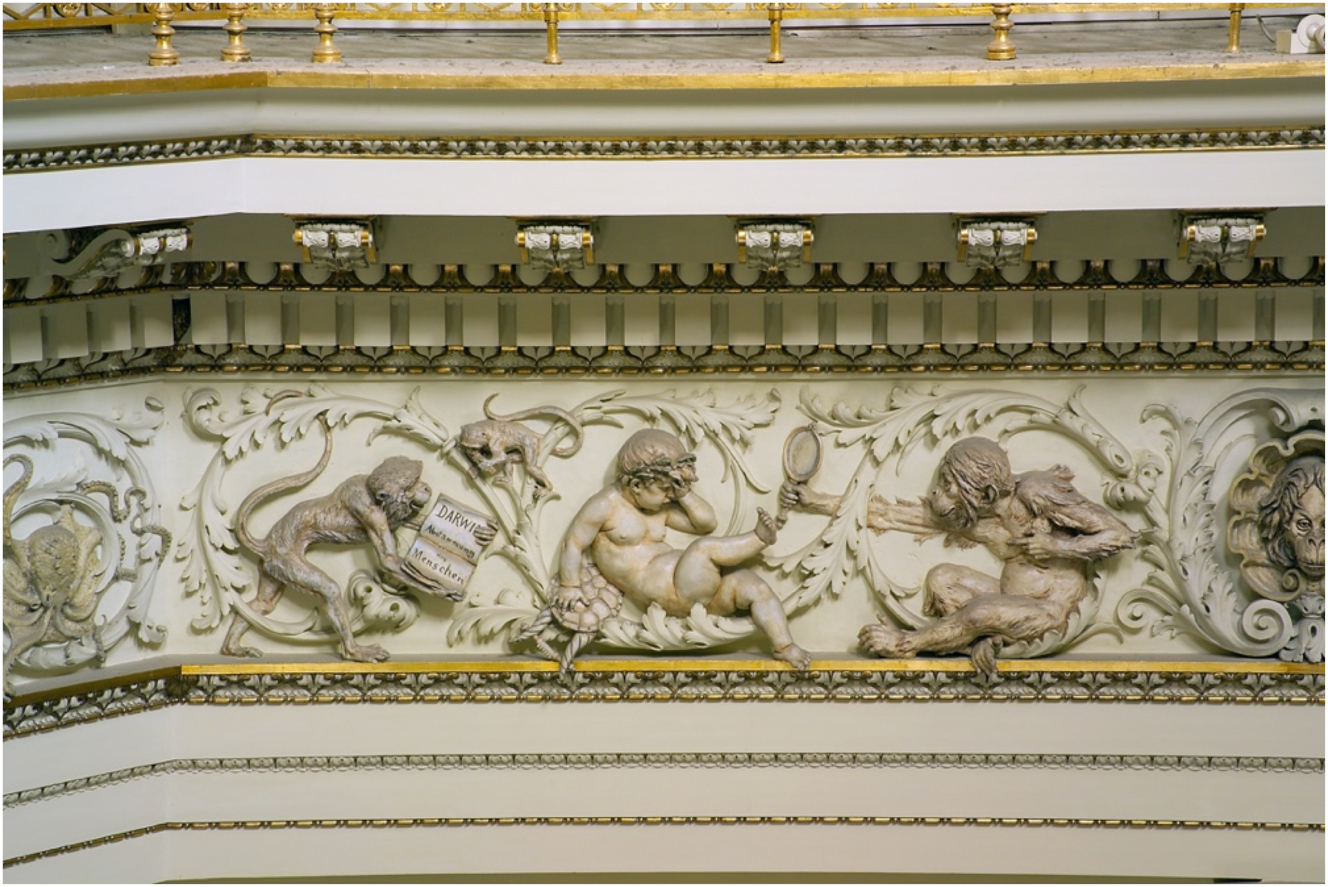
Johannes Benk, 1889, Darwin Frieze, Upper Dome Hall, Natural History Museum Vienna (photo © NHM Wien/Alice Schumacher, used with permission).

Jon Amiel (dir.), 2009, Creation, starring Paul Bettany, Recorded Picture Company with BBC Films and HanWay Films, 108 min (publicity still © BBC Films, fair use).
Darwin did not conclude his catoptric experiments on facial behavior with the great apes but rather continued with the human animal. Over the course of these investigations, the English naturalist Charles Darwin identifies what the French psychoanalyst Jacques Lacan, at the 14th International Psychoanalytic Conference in Marienbad, Czech Republic in 1936, about sixty years after Expression, and in reference to Darwin, would call “the mirror stage” for human children and their psychosocial development (2002 [1949]: 75). On the 27th of December 1839, just a few months after Darwin, Jenny, and Tommy made faces together, Emma gave birth to her and Charles’ first child, a son, whom they christened William Erasmus. Almost fifty years later in his autobiography, Darwin remembers that he “at once commenced to make notes on the first dawn of the various expressions which [William] exhibited, for [he] felt convinced, even at this early period, that the most complex and fine shades of expression must all have had a gradual and natural origin” (1887: 95). The nursery at Down House, like the Zoological Gardens in London, became Darwin’s laboratory. As Prodger identifies, “[n]otes on the mental and physical growth of William and other Darwin children form a substantial part of Darwin’s notebooks ‘M’ and ‘N,’” the two volumes that “he devoted to observations on expression,” which, in turn, became “crucial evidence in the formulation of his ideas about evolution” (2009: 103). Although Darwin summarizes this longitudinal study in 1872 in Expression, he provides further details in 1877 in “A biographical sketch of an infant” in Mind: A Quarterly Review of Psychology and Philosophy. Darwin’s “Sketch” likely inspired the popular trend among parental caregivers to keep baby journals in the late nineteenth and early twentieth centuries, but, as William R. Charlesworth and Mary Anne Kreutzer review, in the late twentieth and early twenty-first centuries it has also been prolifically criticized by child psychologists for “the weakness of [the] method” (2006 [1973]: 102–103, 123). Essentially, failure to control variables or structure observations may well have led to cause–effect confusion and observer bias. Nevertheless, as Darwin himself diarizes, William at four-and-a-half-months old:
[…] smiled at [Darwin’s] image and his own in a mirror, and no doubt mistook them for real objects. […] Like all infants he much enjoyed thus looking at himself, and in less than two months perfectly understood that it was an image. […] He also gave to ‘Ah,’ which he chiefly used at first when recognizing any person or his own image in a mirror, an exclamatory sound, such as we employ when surprised. (1877: 289, 290, 293)
Compared to the orangutan and “outdone by the chimpanzee,” Lacan observes, a human child, such as William, can “already recognize his own image as such in a mirror” (2002 [1949]: 75). The “jubilant assumption” of this “specular image,” to Lacan, exemplifies a “symbolic matrix” in which the self-cognition of the facial structure precedes the self-recognition of the first-person subject, with the apparatus of the mirror on “the threshold of the visible world” (2002 [1949]: 76–77). In Eco’s view, this confirms the mirror to be “a threshold phenomenon marking the boundaries between the imaginary and the symbolic” (1984: 203). The Lacanian triad of the imaginary, real, and symbolic is not directly comparable to the Peircean triad of the iconic, indexical, and symbolic. Eco describes how Lacan defines the imaginary “by the relation between an image and a similar object” (2010: para. 3), like the mirror and the face. However, Eco points out, this isomorphism is “not the one of so-called iconic signs” (2010: para. 3), but rather a phenomenon that takes place within the perceptual mechanism. Across the threshold of the mirror stage, Eco suggests, whereby one achieves their “self-identity only through a ‘symbolic’ experience,” the linguistic mediality and nonverbal modality among some other signs belong to the “‘order of the symbolic’” and, thus, “the symbolic is identified with the semiotic” (2010: para. 3). To Eco, the mirror self-recognition mentioned by Darwin and Lacan “seems to solve” the question about the mirror and its status as presemiotic (1984: 203). But as Eco himself acknowledges, along “the points of a circle” between the catoptric prosthesis and the semiosis of selfhood there is neither an ending nor a “starting point” (1984: 203). The mirror stage first identified by Darwin and first introduced by Lacan only describes how the mirror is used during early childhood development, but, as Eco admits, this does not “exclude that, at any further stage in the development of symbolic life, the mirror may be used as a semiotic phenomenon” (1984: 204). Indeed, as demonstrated by Darwin and the catoptric autoexperiments he conducted on the orangutans and his children, the catoptric as a prosthesis does not fall below the threshold of the semiotic but rather functions as the very threshold itself, that is, as an inception or as an opening.
By these experiments and their iterations, first with orangutans, then with children, Darwin came to research and develop the scientific methodology of catoptric autoexperimentation as it is known today in the contemporary science of facial behavior. In 1872 in Expression, Darwin articulates how “[t]wo persons, after some practice […] found by looking at a mirror” that their eyebrows pull obliquely, and mouth-corners depress, in a “naturally assumed” expression of grief (1872: 183). Everyone, Darwin affirms, if “he will attend to his own sensations and look at himself in a mirror” (1872: 204), exactly as I and the other participants do in the FACS Workshop, can feel and see how the zygomaticus majores pulls the corners of the lips posteriorly outwards and superiorly upwards, and the orbicularis oculis, pars lateralis raises the infraorbital triangle, lifts the cheeks, and gathers the skin medially toward the eye sockets. What is more, Darwin argues, “[a]ny one may see in a mirror, if he will vividly imagine” a facial sign that relates to its affective object, “that he suddenly and unconsciously throws himself into some such attitude” (1872: 247). Within the staging of these situations, that is, within the scientific performance of the catoptric autoexperiment, Eco would claim, “[e]verything is semiosic […] and yet nothing concerning the mirror as such” (1984: 219). Furthermore, Eco asserts that critical, pragmatic semiotic analysis ought to center on the staging rather than on the prosthesis because the mirror is but a channel for “procatoptric messages” (1984: 220). But there’s the rub. Without the catoptric prosthesis and its procatoptric staging, the face in the mirror would not in fact become interpretable. And what is more, in such an interpretation, the mirror would not be a mirror but only a reflective surface grasped in a hand or mounted on a wall. Ultimately, Darwin characterizes catoptric autoexperimentation thusly: “I looked at myself in a glass; and since then I have noticed the same movements in the faces of others” (1872: 265), fundamentally in the same way that Rosenberg instructs during the FACS Workshop.
5 Conclusions
Across heated polemics over presemiotic hierarchization within the pragmatist tradition of the semiotic discipline in the late twentieth and early twenty-first centuries, Eco claims that “mirrors do not produce signs” (1984: 216). Sonesson counters that “the mirror has all the properties of a genuine sign” (2010: n.p.). And Brandt carries forward with how a mirror offers “iconicity” and often “symbolicity” depending on its “communicative function” (2017: 12–13). But the mirror in and of itself, like any other artifact or object, is neither sign nor not-sign. The mirror is a channel as well as a prosthesis. It can be used, and is indeed useful, for acts of semiosis. Whether the face in the mirror, which is to say the mirror image, constitutes a presemiotic or a semiotic phenomenon, or falls on the threshold in between, is beside the point. Semiosis occurs not in a vacuum but in a context. Eco alleges that the catoptric prosthesis “neither ‘translates’ nor interprets but registers what strikes it exactly as it strikes it,” and that the relation between this sign and its object is “absolute,” “double,” and “rigid” (2000: 366, 367, 370), that is, iconic to the extent that the mirror is not semiotic but rather presemiotic. However, this assertion is ahistorical, idealized, and lacks contextualization in the material specificities of human practices. Such reductive materialism situates interpretation in the product rather than in the context and in the channel rather than in the process. Despite denying it semiotic status, Eco admits that mirrors produce sign functions in his manifesto against iconism, which, on occasion, veers from the logical to the ideological. Eco concludes that the correspondence between the catoptric and that which it cites “has no indexical value” (2000: 368). But Eco also identifies how indexicality springs from the specular: the mirror “says ‘this’ and ‘here,’” even if he finds such a sign to be “devoid of meaning” because it “refers directly to its referent” (2000: 370). As Sonesson counters Eco, “many signs function in the way they function only in the presence of their referent” or are even “dependent on their referents” (2010: n.p.). During the FACS Workshop, for example, Rosenberg draws attention to our rapid facial signs with a deictic hand gesture. Analogously, the mirror “points to” the face at the very moment that it is gazing upon itself. Doing catoptric autoexperimentation, as I diagram in Figure 6, the face in the mirror (the reflected sign) comes within the line of sight of the face directed toward or “facing” the mirror (its reflecting object) from the point of view of the experimenter and their very own face (some reflective interpreter).
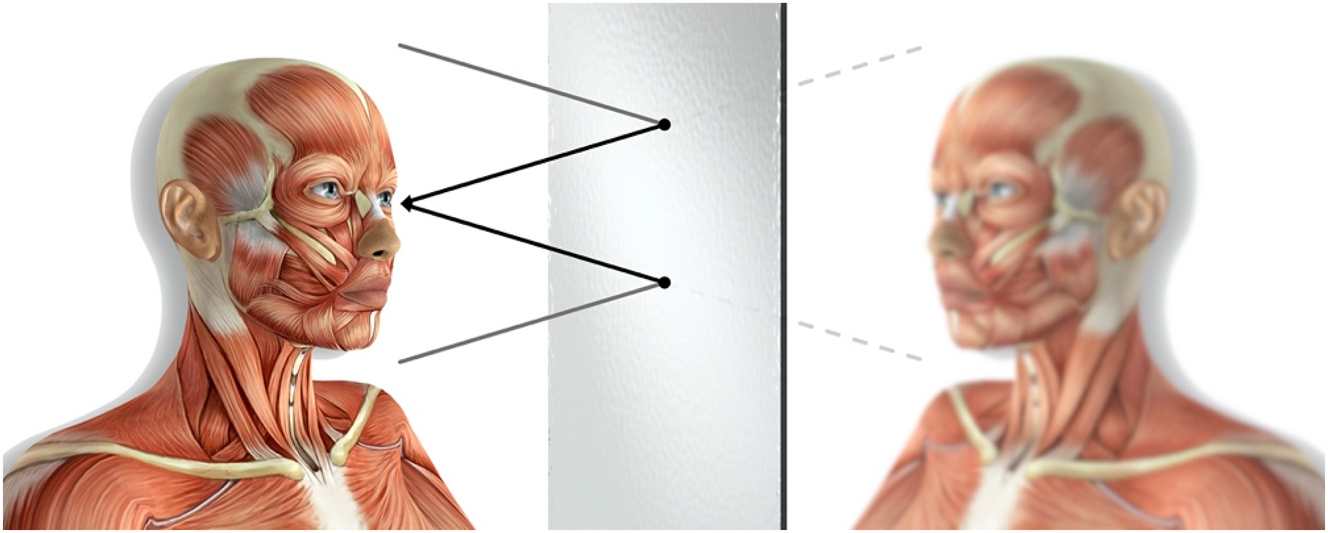
Explanatory diagram for the catoptric autoexperiment, where the incident light rays emanate off the face, this light strikes the plane of a mirror, and an image of the face is visually reflected to the sensory apparatus (© Schiller 2022).
From classical physiognomics to contemporary biometrics, the study of the face has advanced in parallel to the evolution of the mirror. The catoptric prosthesis, like any other phenomenological channel, has varied in its degree of translation, that is, its truthfulness, from the “picture” used by Zopyrus on Socrates in the fifth century BCE (Ghersetti 2007: 471), through the “speculum” used by Erasmus for Folly in the sixteenth century (1511: 5), and the “looking-glass” used by Darwin with Jenny in the nineteenth century (1872: 142), to the handheld mirrors used by Rosenberg with coders like myself in the twenty-first century. Across the history of the study of the face, the catoptric prosthesis, as Eco proposes, has served as a “framing device for epistemological reconfiguration” that “creates interpretive situation[s] to decode refractory phenomena” (1984: 220). And, Sonesson observes, mirrors have had “other uses than simply looking at the self” (2015: 173). Yet it is precisely this epistemic that makes the mirror exceptional in contrast to other channels such as painting or photography. When prosthetically adapted for professional augmentation, it is not a question of whether a catoptric prosthesis is a semiotic phenomenon or the face in the mirror is a sign, but, as Sonesson problematizes, “a question of interpreting the object as it is given in the mirror” (2003: 225). As Eco points out, when one interprets their mirror image they are “already in a more complicated phase of semiosis” (2000: 366). In Peirce’s terms from his cenopythagorean triad, as Eco traces, “the mirror image is a Firstness already anchored to a Secondness,” given that it is “already interwoven with an awareness of a relation to a fact,” and insofar as it “establishes a necessary and direct relation between the mirroring and the thing” (2000: 367). The face in the mirror is already more than the face that gazes into the mirror; it is a semiotic relation. Consequently, by means of mirrors, catoptric signs and their facial object can be perceived and, thus, interpreted. Two thousand five hundred years after Phaedo’s Zopyrus, five hundred years after Erasmus’ Folly, and a hundred fifty years after Darwin’s Expression, we continue to ask: face in the mirror, what do you see? Catoptric autoexperimentation affords for a contemporary experimenter to look where the eye itself cannot see and what the muscles themselves cannot sense: at their very own face. And today, in an age of automated facial behavior analysis, the self still serves as the starting point for this practical science, with the FACS coders who train such algorithms using catoptric prostheses as analytical as well as pedagogical tools. First and foremost, after all, the physiognomic gaze looks within.
About the author
Devon Schiller (b. 1980) is a DOC Fellow at the Austrian Academy of Sciences and a doctoral candidate at the University of Vienna. A biological, cognitive, medical semiotician, his scholarship centers on the epistemology of experiment in the contemporary and the historical study of facial behavior and affective phenomena. Schiller is trained in the Facial Action Coding System (FACS), Neuropsychological Gesture Coding System (NEUROGES), and forensic science of facial reconstruction.
-
Research funding: This research was supported by a DOC Fellowship from the Austrian Academy of Sciences. Open Access funding provided by the University of Vienna.
References
Barrett, Paul H., Peter J. Gautrey, Sandra Herbert, David Kohn & Sydney Smith (eds.). 1987. Charles Darwin’s notebooks, 1836–1844: Geology, transmutation of species, metaphysical enquiries. Cambridge: Cambridge University Press.Suche in Google Scholar
Boys-Stones, George. 2004. Phaedo of Elis and Plato on the soul. Phronesis 49(1). 1–23. https://doi.org/10.1163/156852804773617389.Suche in Google Scholar
Brandt, Per Aage. 2017. From mirrors to deixis – subjectivity, biplanarity, and the sign. In Torkild Thellefsen & Bent Sørensen (eds.), Umberto Eco in his own words (Semiotics, Communication, and Cognition 19), 11–18. Boston & Berlin: Walter de Gruyter.10.1515/9781501507144-003Suche in Google Scholar
Breed, Michael D. & Janie Moore. 2016 [2012]. Animal behavior, 2nd edn. London: Academic Press/Elsevier.Suche in Google Scholar
Frederick Burkhardt & Sydney Smith (eds.), 1986. The correspondence of Charles Darwin, vol. 2: 1837–1843. Cambridge: Cambridge University Press.Suche in Google Scholar
Charlesworth, William R. & Mary Anne Kreutzer. 2006 [1973]. Facial expressions in infants and children. In Paul Ekman (ed.), Darwin and facial expression: A century of research in review, 91–168. Los Altos, CA: Malor Books.Suche in Google Scholar
Darwin, Charles. 1872. The expression of the emotions in man and animals. London: John Murray.10.1037/10001-000Suche in Google Scholar
Darwin, Charles. 1877. A biographical sketch of an infant. Mind: A Quarterly Review of Psychology and Philosophy 2(7). 285–294. https://doi.org/10.1038/scientificamerican08251877-1372bsupp.Suche in Google Scholar
Francis Darwin (ed.). 1887. The life and letters of Charles Darwin, vol. 1. London: John Murray.Suche in Google Scholar
Dealy, Ross. 2017. The Stoic origins of Erasmus’ philosophy of Christ. Toronto: University of Toronto Press.10.3138/9781487511456Suche in Google Scholar
Duchenne, Guilaume Benjamin. 1862. Mécanisme de la physionomie humaine, ou analyse électrophysiologique de l’expression des passions [Mechanism of human physiognomy, or electro-physiological analysis of the expression of the passions]. Paris: Jules Renouard.10.5962/bhl.title.50402Suche in Google Scholar
Eco, Umberto. 1976. A theory of semiotics. Bloomington, IN: Indiana University Press.10.1007/978-1-349-15849-2Suche in Google Scholar
Eco, Umberto. 1984. Semiotics and the philosophy of language. Bloomington, IN: Indiana University Press.10.1007/978-1-349-17338-9Suche in Google Scholar
Eco, Umberto. 2000. Kant and the platypus: Essays on language and cognition. Alastair McEwan (trans.). San Diego, CA: Harcourt.Suche in Google Scholar
Edgerton, Samuel Y. 2009. The mirror, the window, and the telescope: How Renaissance linear perspective changed our vision of the universe. Ithaca, NY: Cornell University Press.10.1007/978-3-0346-0518-2_9Suche in Google Scholar
Ekman, Paul & Wallace V. Friesen. 1975. Unmasking the face: A guide to recognizing emotions from facial clues. Englewood Cliffs, NJ: Prentice-Hall.Suche in Google Scholar
Ekman, Paul & Wallace V. Friesen. 1976. Measuring facial movement. Environmental psychology and nonverbal behavior 1(1). 56–75.10.1007/BF01115465Suche in Google Scholar
Elsner, Jaś. 2007. Physiognomics: Art and text. In Simon Swain (ed.), Seeing the face, seeing the soul: Polemon’s physiognomy from classical antiquity to medieval Islam, 203–234. Oxford: Oxford University Press.Suche in Google Scholar
Erasmus, Desiderius. 1990 [1506–1509]. On the education of children. In Erika Rummel (ed.), The Erasmus reader, 65–100. Toronto: University of Toronto Press.Suche in Google Scholar
Erasmus, Desiderius. 1511. Moriae encomium. http://www.thelatinlibrary.com/erasmus/moriae.shtml (accessed 1 September 2022).Suche in Google Scholar
Erasmus, Desiderius. 1549 [1511]. The praise of folie: Moriæ encomivm a booke made in Latine by that great clerke Erasmus Roterodame. Thomas Chaloner (trans.). London: Edward Arnold. https://quod.lib.umich.edu/e/eebo/A00384.0001.001 (accessed 1 September 2022).Suche in Google Scholar
Erasmus, Desiderius. 1542. Apophthegmes. Nicolas Vdall (trans.). London: Ricardi Grafton. http://name.umdl.umich.edu/A00316.0001.001 (accessed 1 September 2022).Suche in Google Scholar
Freud, Sigmund. 1962 [1930]. Civilization and its discontents. James Strachey (trans.). New York: W. W. Norton. Originally published in German as Das Unbehagen in der Kultur by Internationaler Psychoanalytischer Verlag.Suche in Google Scholar
Gallup, Gordon G.Jr. 1970. Chimpanzees: Self recognition. Science 167(3914). 86–87. https://doi.org/10.1126/science.167.3914.86.Suche in Google Scholar
Ghersetti, Antonella. 2007. The Istanbul Polemon (TK recension): Edition and translation of the introduction. In Simon Swain (ed.), Seeing the face, seeing the soul, Polemon’s Physiognomy from classical antiquity to medieval Islam, 465–485. Oxford: Oxford University Press.Suche in Google Scholar
Gibson, James J. 1966. The senses considered as perceptual systems. London: George Allen and Unwin.Suche in Google Scholar
Gray, Richard T. 2004. About face: German physiognomic thought from Lavater to Auschwitz. Detroit: Wayne State University Press.Suche in Google Scholar
Higuera, Claudio Julio Rodríguez & Kalevi Kull. 2017. The biosemiotic glossary project: The semiotic threshold. Biosemiotics 10(1). 109–126. https://doi.org/10.1007/s12304-017-9289-4.Suche in Google Scholar
Hjelmslev, Louis. 1961 [1943]. Prolegomena to a theory of language, 2nd edn. Francis J. Whitfield (trans.). Madison, WI: University of Wisconsin Press. Originally published in Danish as Omkring Sprogteoriens Grundlæggelse by University of Copenhagen Press.Suche in Google Scholar
Lacan, Jacques. 2002 [1949]. The mirror stage as formative of the I function as revealed in psychoanalytic experience. In Jacques Lacan (ed.), Écrits: The first complete edition in English, Bruce Fink, Héloïse Fink & Russel Grigg (trans.), 75–81. New York: W. W. Norton.Suche in Google Scholar
Lavater, Johann Caspar. 1789 [1776]. Essays on physiognomy: For the promotion of the knowledge and the love of mankind, vol. 1. Thomas Holcraft (trans.). London: Printed for G.G.J. and J. Robinson. https://catalog.hathitrust.org/Record/008590796 (accessed 1 September 2022).Suche in Google Scholar
Lavater, Johann Caspar. 1792. Physiognomy; Or the corresponding analogy between the conformation of the features, and the ruling passion of the mind. Samuel Shaw (trans.). London: H.D. Symonds. https://archive.org/details/physiognomyorcor00lava (accessed 1 September 2022).Suche in Google Scholar
Leunissen, Mariska. 2018. Physiognomy in ancient science and medicine. In Keyser Paul & John Scarborough (eds.), The Oxford handbook of science and medicine in the classical world, 743–764. Oxford: Oxford University Press.10.1093/oxfordhb/9780199734146.013.36Suche in Google Scholar
McLean, Daniel R. 2007. The Socratic corpus: Socrates and physiognomy. In Michael Trapp (ed.), Socrates: From antiquity to the Englightenment (Center for Hellenic Studies King’s College London 9), 65–88. London: Routledge.Suche in Google Scholar
McLuhan, Marshal. 1994 [1964]. Understanding media: The extensions of man. Cambridge, MA: The MIT Press.Suche in Google Scholar
Melchior-Bonnet, Sabine. 2001 [1994]. The mirror: A history. Katharine H. Jewett (trans.). London: Routledge. Originally published in French as Histoire du miroir by Éditions Imago.Suche in Google Scholar
Merleu-Ponty, Maurice. 1962 [1945]. Phenomenology of perception. Colin Smith (trans.). London: Routledge Originally published in French as Phénomènologie de la perception by Éditions Gallimard.Suche in Google Scholar
Peirce, Charles Sanders. 1905. Letters to Mario Calderoni. MS [R] L67. https://www.unav.es/gep/Letter/CalderoniEn.html (accessed 1 September 2022).Suche in Google Scholar
Peirce, Charles Sanders. 1994. The collected papers of Charles Sanders Peirce, vols. 1–6, 1931–1935, Charles Hartshorne & Paul Weiss (eds.); vols. 7–8, 1958, Arthur W. Burks (ed.). Electronic edition, 1994, John Deely (ed.). Cambridge, MA: Harvard University Press. Cited as CP.Suche in Google Scholar
Peirce, Charles Sanders. 1998. The essential Peirce, Peirce Edition Project (ed.). Bloomington, IN: Indiana University Press. Cited EP2.Suche in Google Scholar
Polidoro, Piero. 2015. Umberto Eco and the problem of iconism. Semiotica 206(1). 129–160. https://doi.org/10.1515/sem-2015-0020.Suche in Google Scholar
Porter, Martin. 2005. Windows of the soul: The art of physiognomy in European Culture 1470–1780. Oxford: Oxford University Press.10.1093/oso/9780199276578.001.0001Suche in Google Scholar
Prodger, Phillip. 2009. Darwin’s camera: Art and photography in the theory of evolution. Oxford: Oxford University Press.Suche in Google Scholar
Rosenberg, Erika L. 2015. Facial Action Coding System (FACS) Training workshop. Berkeley: University of California, 21–25 September 2015.Suche in Google Scholar
Rossetti, Livio. 1980. Richerche sui “dialoghi Socratici” di Fedone e di Euclide [Research on the “Socratic dialogues” of Phaedo and Euclid]. Hermes 108(2). 183–200.Suche in Google Scholar
Rosetti, Livio. 2015. Phaedo’s Zopyrus (and Socrates’ Confidences). In Ugo Zilioli (ed.), From the Socratics to the Socratic schools: Classical ethics, metaphysics, and epistemology, 82–98. New York: Routledge.Suche in Google Scholar
Sadowski, Piotr. 2011. The iconic indexicality of photography. In Pascal Michelucci, Olga Fischer & Christina Ljungberg (eds.), Semblance and signification (Iconicity in Language and Literature 10), 353–368. Amsterdam: John Benjamins.10.1075/ill.10.20sadSuche in Google Scholar
Saussure, Ferdinand de. 2006 [2002]. Writings in general linguistics. Carol Sanders & Matthew Pires (trans.). Oxford: Oxford University Press. Originally published in French as Écrits de linguistique Générale by Éditions Gallimard.Suche in Google Scholar
Saxl, Fritz. 1943. Holbein’s illustrations to the ‘praise of folly’ by Erasmus. The Burlington Magazine for Connoisseurs 83(488). 274–279.Suche in Google Scholar
Sonesson, Göran. 2003. Why the mirror is a sign – and why the television picture is no mirror: Two episodes in the critique of the iconicity critique. S: European Journal for Semiotic Studies 15(2–4). 217–232.Suche in Google Scholar
Sonesson, Göran. 2010. Pictorial semiotics. In Thomas A. Sebeok & Marcel Danesi (eds.), Encyclopedic dictionary of semiotics, 3rd edn. Berlin: De Gruyter Mouton.Suche in Google Scholar
Sonesson, Göran. 2015. The mirror in-between picture and mind: A phenomenologically inspired approach to cognitive semiotics. Chinese Semiotic Studies 11(2). 159–180. https://doi.org/10.1515/css-2015-0009.Suche in Google Scholar
Southall, James P. C. 1933 [1918]. Mirrors, prisms and lenses: A text-book of geometrical optics, 3rd edn. New York: Macmillan.Suche in Google Scholar
© 2023 the author(s), published by De Gruyter, Berlin/Boston
This work is licensed under the Creative Commons Attribution 4.0 International License.
Artikel in diesem Heft
- Frontmatter
- Introduction to “The visage as text”
- Physiognomic theories between equation and inference
- Paolo Marzolo and Cesare Lombroso: a semiotic-medical inheritance between word, sounds, and face
- Lombroso’s criminal face across physiognomy and semeiotics
- Embodying genre: from Galton’s generic faces to Peirce’s embodied ideas
- Reading and writing in n-dimensional face space
- Face in the mirror, what do you see? Catoptric autoexperimentation and the physiognomic gaze
- Concealment of the face and new physiognomies
- Eyes on Chinese female models’ faces: stereotypes, aesthetics, self-Orientalism, and the moral discourse of the CPC
- The visage and the mask: semiotic considerations around representations of visages in Japanese Nō
Artikel in diesem Heft
- Frontmatter
- Introduction to “The visage as text”
- Physiognomic theories between equation and inference
- Paolo Marzolo and Cesare Lombroso: a semiotic-medical inheritance between word, sounds, and face
- Lombroso’s criminal face across physiognomy and semeiotics
- Embodying genre: from Galton’s generic faces to Peirce’s embodied ideas
- Reading and writing in n-dimensional face space
- Face in the mirror, what do you see? Catoptric autoexperimentation and the physiognomic gaze
- Concealment of the face and new physiognomies
- Eyes on Chinese female models’ faces: stereotypes, aesthetics, self-Orientalism, and the moral discourse of the CPC
- The visage and the mask: semiotic considerations around representations of visages in Japanese Nō
