Paolo Marzolo and Cesare Lombroso: a semiotic-medical inheritance between word, sounds, and face
-
Alice Orrù
Alice Orrù (b. 1994) is a PhD student at Sapienza University of Rome. Her research interests include the history of linguistic and anthropological ideas, semantics, lexicology, and lexicography. Her publications include “Habit and climate in Giacomo Leopardi’s theory of habituation” (2020), “Hos pharmakon chresimon: Myth as a “rhetorical remedy” within Plato’s Kallipolis” (2021), “Jordan Zlatev. On a phenomenological cognitive semiotics” (2022), “The language–race nexus in the Italian anthropo-linguistic-geographical debate: Francesco Lorenzo Pullé between Cattaneo and Ascoli” (2022).


Abstract
Within the interdisciplinary context of the nineteenth century, the paper scrutinizes the relation between Paolo Marzolo’s theory of signs and Cesare Lombroso’s anthropological-criminal approach. Best known for his unfinished work Monumenti storici (1847–1866), Marzolo (of whom Lombroso calls himself a disciple) investigates, in his last Saggio sui segni (1866), the origin and development of languages by combining the positivist approach with an eighteenth-century encyclopedic Enlightenment perspective, as well as the earlier anatomist tradition. In his view, the human production, learning, and use of signs, resting upon sensory experiences and mnemonic activity, involves the process of imitation with a pivotal role of the speakers’ phonic, gestural, and facial expressions (i.e., physiognomy), related to geographical, linguistic, and anthropological differences among human individuals, as well as the cultural element of civilization. Conceived as case(s) of semiotic ideology rooted between linguistics and medicine, the Marzolo–Lombroso filiation shows an increasing correlation between race, language, and climate in the wake of social Darwinism and akin to other coeval physiognomic theories. In Lombroso’s perspective, a radical translation from a linguistic and phonic-semiotic field to an anthropological and somatic-semiotic plane seems inevitable, emphasizing the (para) scientific flavor and widening the gap between anthropometric and ethnoanthropological approaches.
Alla memoria di Paolo Marzolo, il Darwin dell’Antropologia Italiana. Un discepolo
[In memory of Paolo Marzolo, the Darwin of Italian Anthropology. A disciple]
(Lombroso 1871, transl. mine)
1 Introduction
Paolo Marzolo’s influence on his pupil Cesare Lombroso and their personal and academical relationship grew within a shared interweaving of contexts in the interdisciplinary climate of mid-nineteenth century Italy. Mainly, some Lombrosian theoretical cornerstones, such as physiognomy and the link race–language–climate, could be found embryonically in Marzolo’s theory of the origin of language(s) and signs, conceived as a natural history and as a physiology of language(s), particularly exposed in his unfinished masterpiece Monumenti storici rivelati dall’analisi della parola () and in his last and unique complete work Saggio sui segni (1866).
Above all, given the relationship between word, sentiment, and thought, the study of the phono-articulatory apparatus and the role of facial expressions will later constitute the core of the Lombrosian criminal anthropology. Moreover, the Marzolian inheritance through the Lombrosian lens can also be found in some works of the followers of the Turin doctor, like his son-in-law Guglielmo Ferrero and his epigone Francesco Lorenzo Pullé, who overtly refers to the Lombrosian criminal physiognomy approach in his project of an anthropological-linguistic atlas of Italy, edited in 1927.
Indeed, the interpretation of Marzolian pillars such as reminiscence, imitation, pathologies of signs, and defects of the phono-articulatory apparatus in an anthropological, psychiatric, and penological sense (i.e., atavism and the role of the face, as well as a more discriminatory curvature of the race–climate–language nexus), corresponds to the shift from a physiological investigation of the origin and development of languages to a pathological study of the soma, of the psyche, and the related moral aspects in their degenerative process and regression to the atavistic stage. Accordingly, the close interaction between the study of signs and physiognomy as a linguistic, medical, and anthropological theory of the expression of emotions constitutes the pivot of the Marzolo–Lombroso filiation, as well as of the “anthropo-geo-linguistic” context of the second half of the nineteenth century.
In this regard, concepts such as Webb Keane’s semiotic ideology come to help on several levels, both on the level merely referring to signs and on the level of the context of their use, which will particularly invest the Lombrosian anthropo-criminal interpretation of Marzolo’s theories.
2 Two intersecting biographies within manifold contexts
2.1 A common starting point: Lucretius
One could say, without exaggerating, that Paolo Marzolo (1811–1868) was the disciplinary father of Cesare Lombroso (1835–1909), linked to him by a profound mutual esteem and friendship. As the dedication of his first important work, L’uomo bianco e l’uomo di colore (Lombroso 1871) proves, the filiation of the Veronese scholar to the Paduan master is compared to that of Lucretius from Epicurus, as evidenced by the passage from the De rerum natura quoted immediately after the dedication to Marzolo:
Te sequor, […] inque tuis nunc
ficta pedum pono pressis vestigia signis […]
nam simul ac ratio tua coepit vociferari
naturam rerum, divina [haud] mente co[h]orta[m],
diffugiunt animi terrores […].
[You, […] I follow, and in your footsteps I now tread boldly […]
As soon as your philosophy begins to proclaim the true nature of things revealed by your divine mind, the terrors of the mind are dispelled]. (book III, 3–4, 14–16; see also Deufert 2019: 94, transl. by Smith 2001: 67–68)[1]
Indeed, Lombroso also used the same exergue to his work as that in the M. storici, that is, Dum veteres avias tibi de pulmone revello by Aulus Persius Flaccus (‘as I eradicate from your soul the ancient prejudices of your ancestors,’ Satire V, 92, transl. mine), demonstrating his strong interest in the Marzolian study of soma. However, his debt was not only academic, but also private, especially from the point of view of training for his area of choice of medical studies – gratitude chiefly evident in the name he gave to his first daughter, Paola Marzola (see also Villa 1985: 14 and Frigessi 2003: 43). In the preface intended for the reader (dated 1868, the same year of Marzolo’s death), Lombroso explained in more detail the deep reasons that led him to write his work, a sort of monument dedicated to Marzolo and his thought:
In tanta dubiezza, un triste, un assai triste caso mi vinse. Il primo fra gli antropologi italiani, il mio Marzolo, moriva, senza aver potuto compiere e difondere la sua grand’opera, a cui egli era più legato che non alla vita. A me parve allora, che il volgarizzare alcune idee da lui predilette, fosse un conforto al dolore di quella perdita, un’espiazione all’ingiusta dimenticanza. Non potendogli erigere colle mie povere forze un degno monumento, volli almeno spargere, sulla solitaria fossa di quel gigante fra i pensatori italiani, alcune povere frondi di una pianta ch’egli crebbe robusta, e fu la gioja e la gloria della sua vita. [In so much doubt, a sad, a very sad case won me. The first of the Italian anthropologists, my Marzolo, died, without having been able to complete and spread his great work, to which he was more attached than to his life. It seemed to me then, that popularizing some of his favorite ideas was a comfort to the pain of that loss, an expiation for unjust forgetfulness. Not being able to erect a worthy monument to him with my poor strength, I wanted at least to scatter, on the solitary pit of that giant among Italian thinkers, some poor fronds of a plant that he grew robust, and was the joy and glory of his life]. (Lombroso 1871: 7–8, transl. mine)
2.2 Between facts and anecdotes
As far as Marzolo is concerned, the few biographical notes about him can be found almost exclusively in the hagiographic (hence not fully reliable) biography of his pupil Matteo Ceccarel (1870),[2] who took into account some memories and obituaries from friends and colleagues, and reported the meeting between Lombroso and Marzolo in 1851, after the publication, in the journal Il Collettore dell’Adige, of a review entitled Filologia, written by the former on the first volume of M. storici (Lombroso 1851). However, the anecdote, recalled later by Gina Lombroso (1921 [1915]) in her father’s biography, is of uncertain veracity and probably not accurate (see also Villa 1985: 91 n. 12 and Frigessi 2003: 43). This is what Ceccarel recounted:
Un giorno lesse alla fine un articolo in un giornale di Verona, nel quale si discorreva degnamente del suo libro; onde desiderò vivamente di conoscerne l’autore, il cui nome eragli sconosciuto. Fu questa la prima cara emozione ch’egli provò: fu il primo compenso a tanti anni di studi ingrati, di veglie penose e di meditazioni indefesse. Paolo Marzolo pensava che l’autore dell’articolo fosse un uomo già provetto nella scienza, un pensatore solitario e vissuto nella oscurità per condizioni fortuite o per tristizia di uomini e di tempi. L’autore dell’articolo, non guari dopo, lo visitò a Treviso. Era un giovinetto di sedici anni – era Cesare Lombroso colui che, primo, in Italia aveva intravveduto il genio di Paolo Marzolo: ed egli si presentava a lui coll’affetto di un figlio e colla riverenza di un discepolo. [One day he finally read an article in a Verona newspaper, in which his book was discussed worthily; hence he very much wanted to know the author, whose name was unknown to him. This was the first dear emotion he felt: it was the first reward for so many years of ungrateful studies, painful vigils and tireless meditations. Paolo Marzolo thought that the author of the article was a man already skilled in science, a solitary thinker who lived in darkness due to fortuitous conditions or the sadness of men and times. Not long afterward, the author of the article visited him in Treviso. He was a young man of sixteen – he was Cesare Lombroso, the one who, in Italy, had first glimpsed the genius of Paolo Marzolo; and he presented himself to him with the affection of a son and with the reverence of a disciple]. (Ceccarel 1870: 228–229, transl. mine)[3]
Born in Padua, Paolo Marzolo introduced himself to ancient and modern languages and philosophy at an early age; he graduated in medicine in 1834 with a dissertation on the vices of language (De vitiis loquelae) and began to work as a physician (i.e., medico condotto) in the Veneto area, even during the Risorgimento period and the cholera epidemic (1854–1855). In the meantime, he spent several years traveling around Italy for research stays in libraries, and became a corresponding member of various universities (e.g., Treviso) and of the Veneto Institute of Sciences, Letters and Arts, where he read four memoirs from 1850 to 1860, subsequently published in the acts of the same Institute.
Physician, philosopher-linguist, and also author of two poems, already considered by his contemporaries an anachronistic and bizarre thinker, Marzolo’s scientific fame and destiny was marked by the judgment of the well-known Friulian linguist Graziadio Isaia Ascoli, who in a footnote of his second volume of Studj critici wrote:
Un tentativo di glottologia universale ha l’Italia ne’ Monumenti storici rivelati dall’analisi della parola, di Paolo Marzolo, opera condotta con mezzi inadeguati, ma con oltrepotenza d’ingegno. Il Marzolo era di certo anche per me un vero eterodosso; ma un eterodosso geniale, poderoso, michelangiolesco, dinanzi al quale dovevamo tutti inchinarci. [Paolo Marzolo’s Monumenti storici rivelati dall’analisi della parola is the Italian attempt at a universal glottology, a work carried out with inadequate means, but with overpowering ingenuity. Even to me, Marzolo was certainly a real heterodox; but a brilliant, powerful, Michelangelesque heterodox, before whom we all had to bow]. (Ascoli 1877: 42 n. 8, transl. mine, my italics)[4]
As shown in the letter to the editor, Alberto Cavalletto, included in the second volume of the work (Marzolo 1859: 3–4), the forty-year monumental project started in 1828 and remained unfinished, due to its titanic structure and the lack of financial resources to support its publication. However, the last and unique complete work, Essay on signs, together with several other short writings published in journals of the time constitute the sketches of the topics that it should have dealt with, swinging from linguistics, to philosophy, history, and medicine, up to anthropology, ethnology, and geography. Indeed, Marzolo’s worship for a historical and polidisciplinary Vichian Scienza nuova also emerges from his close friendship with Carlo Cattaneo and the collaboration with Il Politecnico, where Marzolo published the three lecture notes of the university courses he held in Milan, Naples, and Pisa from 1860 to 1865.[5]
After the publication of the aforementioned M. storici’s review in 1851, from 1853 to 1866 Marzolo and Lombroso had friendly correspondence on their mutual issues and publications, as well as on personal and family events. The figure of Marzolo occupied a central place in Lombroso’s correspondence with his close friends, such as Paolo Mantegazza and Jakob Moleschott, and deeply impacted, both scientifically and personally, on the so-called Lombrosian school, carried on by his daughters, the eldest, Paola Marzola, anthropologist, journalist, writer, and pedagogist, and the second-eldest, Gina Elena Zefora, writer, physician, and Lombroso’s biographer, respectively the wives of Lombroso’s pupils, the physician and anthropologist Mario Carrara and the sociologist Guglielmo Ferrero, who dedicated his work I simboli in rapporto alla storia e filosofia del diritto, alla psicologia e alla sociologia to Marzolo (Ferrero 1893; see also Lauretano 1995). Moreover, Guglielmo Ferrero was co-author, with Lombroso himself, of the masterpiece La donna delinquente, la prostituta e la donna normale (Lombroso and Ferrero 1893; see also Gibson and Rafter 2004). What is more, Lombroso’s other son Ugo, a physiologist and survivor of the Italian racial deportations after 1943, also followed the scientific and divulgative path of his father and master.[6]
Born to a Jewish family in Verona and far better known than his Pygmalion, Cesare Lombroso was encouraged by Marzolo to undertake medical studies, which he completed between Pavia, Padua, and Vienna, graduating in 1858 with a dissertation on cretinism in Lombardy (Ricerche sul cretinismo in Lombardia) published in 1859. After enlisting as a volunteer military doctor in the Piedmontese army in the Second War of Independence (1859) and holding various teaching positions in psychiatry and anthropology, he first obtained the chair of forensic medicine in Turin in 1876 and finally, in 1905, the ad personam chair of the newborn criminal anthropology discipline.
From 1864, while still in Pavia, he began the study of the insane (i.e., pazzi, alienati), later founding several case analysis laboratories (cabinets), as well as, in 1880, the journal Archivio di psichiatria, scienze penali e antropologia criminale. At the same time, Lombroso’s main interests concerned the evolution of diseases influenced by geographic and climatic factors (e.g., pellagra, widespread in northern Italy), implementing a convergence between anthropology, psychiatry, and forensic medicine for a psychophysical study of man in relation to the surrounding environment and society, focusing also on medical geography. He mainly used a nosological and craniometric approach, as shown, above all, in his masterpiece L’uomo delinquente in rapporto all’antropologia, alla giurisprudenza ed alle discipline carcerarie, published in five editions (1876, 1878, 1884, 1889, and 1896–1897), the last of which in four volumes, including a physiognomic cartographic atlas (Lombroso 1896–1897).[7]
2.3 A shared framework
Lombrosian and Marzolian interdisciplinarity is the fruit of several roots, and involves manifold contexts.
Firstly, the medical-scientific interest of both can be traced back, even before the positivist milieu, to their Paduan medical-biological background. Mainly referring to Galenic anatomy and the Aristotelian works Historia animalium and De anima, in the sixteenth century it was based on the tradition of anatomical dissection beginning with Andreas Vesalius (see Leone 2022: 7) and then anchored in the seventeenth century to the figure of the anatomist Girolamo Fabrici d’Acquapendente, a pupil of Gabriele Falloppio, then founder of the anatomical theater in Padua and author of De locutione et eius instrumentis (Fabricius 1601); two centuries later, the Paduan context centers on the figure of the Paduan linguist and philosopher Melchiorre Cesarotti, author of the Saggio sulla filosofia delle lingue in 1801 (see Gensini and Tardella 2016; Orrù 2018).[8]
Secondly, the Enlightenment-positivist furrow involves an organicistic and monogenetic conception of language (e.g., Charles De Brosses), an empiricist, sensist, and ideologist approach (e.g., John Locke, Étienne Bonnot de Condillac, Antoine Destutt De Tracy, Pierre Jean Georges Cabanis), and a systematically scientific gaze à la Comte (see also Savoia 2008). As such, both linguistic comparativism (e.g., the Schlegel brothers in Germany, Bernardino Biondelli, and Graziadio Isaia Ascoli in Italy) and anthropological comparativism (e.g., Giustiniano Nicolucci and Paolo Mantegazza), result in this interdisciplinary sentiment, as well as in the disciplinarization and the systematization of the several branches of knowledge. In a nutshell, paraphrasing and summarizing Marzolo’s thought, from Aristotle to Darwin there is only one pivot, science, aiming to knock out beliefs that were not objectively grounded, and following a path from the known to the unknown (and never vice versa), in search of the causes of things and events.
On this axis, a discipline such as physiognomy – dealing with the study of emotions and their expression in humans and animals, as well as of facial expressions and articulation of sounds, up to anthropometric studies, psychiatry, etc. – implies, as Umberto Eco (1985: 45) noted, the transition from natural dispositions to science, that is, from subjective characterization to the claim of objectivity.
3 Paolo Marzolo as physiognomist of sounds: the face at the service of the word
3.1 As the sounds, so the gestures: a natural history and physiology of languages
The four published volumes (1847, 1859, 1863, 1866) of the M. storici focus on the origin of languages, on their progress and development, and on their changes. What is worth noticing is that language is conceived not only systematically, but also organically, as a body in continuous evolution, in the wake of eighteenth-century Enlightenment and nineteenth-century comparative tradition.
In the introduction, Marzolo defines his approach as “fisiologia delle lingue [physiology of languages],” supporting a scientific-positivistic point of view, and aiming “fa[r] passare la linguistica al rango di scienza naturale [at raising linguistics to the rank of natural science]” (Marzolo 1847: 21–22, transl. mine). According to the Paduan physician-linguist, this encyclopedic and mosaic-based investigation should begin from the identification of the laws of language development, resting on their original core, which can be identified through etymology and in the reconstruction of the genealogical trees of words, showing the main transformations that occurred but also opening up to future ones.
Following the Aristotelian–Fabrician medical-biological method, Marzolo presents an anatomical examination of the human phono-articulatory apparatus with its various parts cooperating in the articulation of sounds, as well as its defects, which lead to its imperfections. He also analyzes the production mechanism of the articulated sounds according to various intrinsic (e.g., sex, age, temperament, habit) and extrinsic conditions (e.g., climate, soil, social role), and therefore identifies three primary and original elements of language: (1) the automatic or mechanic element, which deals with the mere structure of the articulatory organ and the involuntary or voluntary production of inarticulate and articulated sounds; (2) the pathetic or interjective element, which implies the key role of sensitivity and perception, and constitutes the spontaneous effect resulting from the sensory impression due to an external action; (3) the imitative or onomatopoeic element, relating to the assignment of a meaning to a sound through the associative memory of a sensation, a process defined as ideological-phonetic (see Dovetto 2018; Orrù 2018) (Figures 1 and 2).

Fabrici’s organum locutionis (Fabricius 1601, image in the public domain).
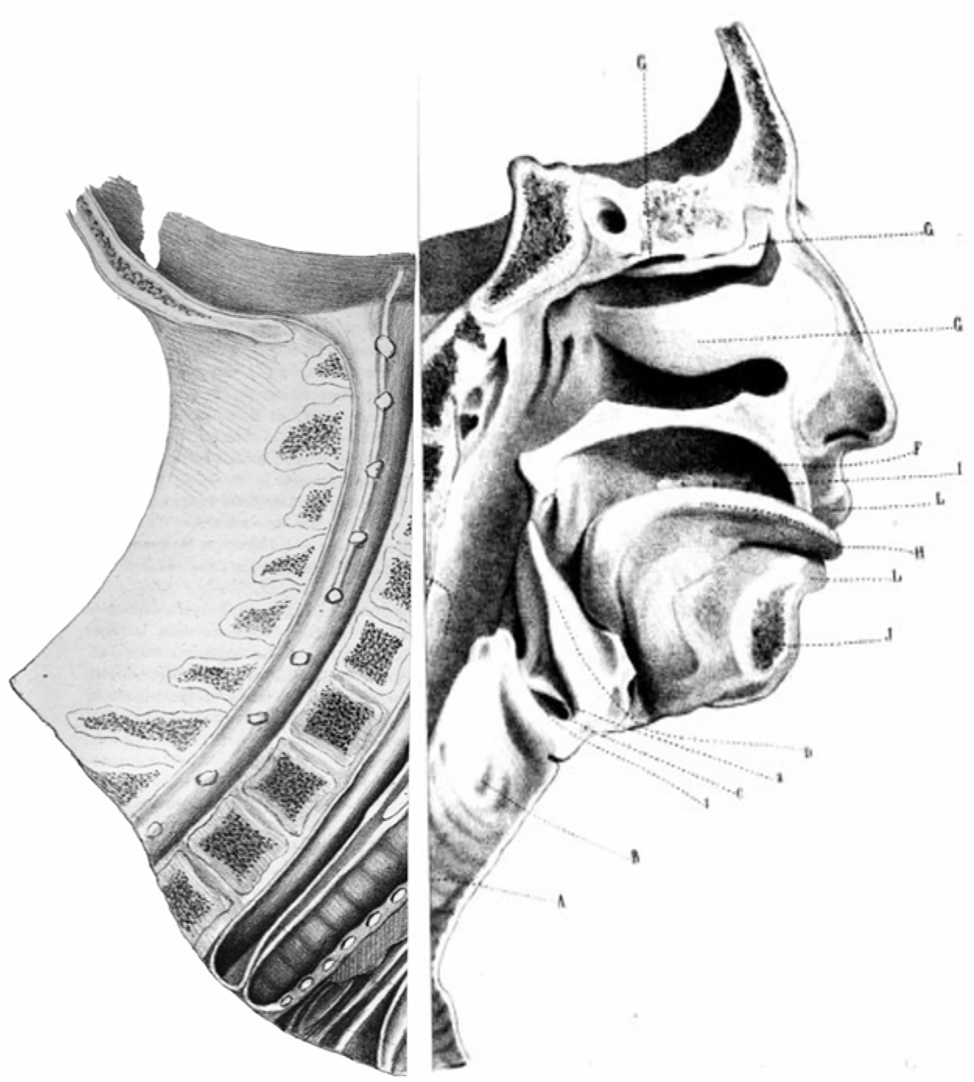
Marzolo’s phono-articulatory apparatus (Marzolo 1847, image in the public domain, modified by the author).
According to Marzolo, linguistic change, due to the laziness of the speakers, originates both from the habit of performing certain articulatory gestures and from peculiar individual dispositions (Dovetto 2018: 105). Not only sounds, but also gestures, such as body and facial movements, have a tripartite origin:
I gesti nel più lato senso, cioè comprendendo sotto tale denominazione ogni moto del corpo, quindi anche l’atteggiamento fisionomico, si distinguono in tre origini, che corrispondono ai tre elementi automatico, patetico ed imitativo. [Gestures in the broadest sense, that is, encompassing under that designation every motion of the body, thus including physiognomic stance, are distinguished in three origins, which correspond to the three elements automatic, pathetic, and imitative]. (Marzolo 1847: 75, transl. mine, my italics)
As a result, two interconnected phono-visual nexuses appear. Firstly, that of race–language, where the rigidity and flexibility (i.e., pronunciation) of the phono-articulatory apparatus mainly depend on the social and geographical conditions of the populations speaking a given language, with a key role of the habit. Greater geographical isolation (e.g., of wild populations) corresponds to greater rigidity in pronunciation and an increasing number of languages spoken, caused by a lack of (linguistic, cultural, etc.) exchange: for example, the primitive, uncivilized, and uneducated condition is reflected in the reduplication of syllables typical of wild populations, akin to the infant stage (Marzolo 1847: 83–85; see also 1847: 18–19). Secondly, that of language–climate, where the activity or inertia of the articulation of sounds rests upon the influence of both the climate (in the wake of De Brosses) and the soil, as well as of the geographical position and even of the social role (Marzolo 1847: 36–39).
In the path of the progress from non-civilization to civilization, a greater development of languages corresponds to a lesser use of gestures.[9] Onomatopoeia and facial movements coexist at the origin and during the development of language: however, if at a primitive stage (e.g., in savages) the former, consisting mainly of automatic and pathetic elements, is ancillary to mimicry, with progress toward the civilized condition, the situation is reversed. Hence, gestures constitute a spontaneous and uneducated element, while verbal languages and the presence of the imitative element in words through onomatopoeia are indicators of civilization and education – even in the civilized stage, however, gestures turn out to be present, albeit to a lesser extent (Marzolo 1847: 75). Like imitation and repetition, onomatopoeia contributes to the creation of a “fisonomia della lingua [physiognomy of language]” (Marzolo 1847: 350, transl. mine) through recollection, assimilation, and allusion (namely, reminiscence) to words of earlier origin. These close and intersecting relationships constitute the seeds of the germination of Lombrosian facial semiotics, although the Marzolian theory does not actually present a linguistic–racial taxonomy (see Dovetto 2018: 103–104).
3.2 Marzolo’s semiotic ideology: a linguistic approach to physiognomy
According to Marzolo, all sounds, regardless of their origin, are emitted contingently arising from sensations. Furthermore, pathetic sounds imply a role of the body not only in the vocal articulation through the phono-articulatory apparatus, but also through facial expressions and gestures. Interjection is rooted in humans (and in animals) because of their nature as sentient beings – indeed:
La forza, la rapidità, il tono accompagnati da speciali attitudini del volto servono ad espressioni caratteristiche, e determinano nell’uditore organizzato in simile maniera moti reattivi consensuali […] perciò e la fisonomia degli astanti e talora la voce corrispondono a quello che parla. [Strength, speed, and tone, accompanied by special facial aptitudes, are used for characteristic expressions and determine consensual reactive motions in the listener – given that the listener and the speaker are similarly organized [ …] therefore both the physiognomy of the bystanders and sometimes the voice correspond to the one who is speaking]. (Marzolo 1847: 57, transl. mine, my italics)
Consequently, in Marzolo’s scientific program, the study of language and its origin must also include the extensive study of physiognomy, conceived as a theory of the expression of emotions, in a proto-Darwinian sense. Indeed, twenty-five years later and after Marzolo’s death, in his The expression of the emotions in man and animals (1872), Darwin considers physiognomy as the starting point of the study of emotions and their externalization, defining it as “the recognition of character through the study of the permanent form of the features” (Darwin 1872: 1) – primarily, the facial and body characters, as well as gestures and inarticulate sounds, produced unintentionally, and then the articulated voice used for communicative purposes (1872: 60), both affected by emotions, i.e., states of mind, and physical and bodily sensations (1872: 27).
As far as Marzolo is concerned, according to an Enlightenment-eighteenth-century linguistic approach, the vehicle of emotions and sensations are above all primitive sounds, which are to be understood as ways or occasions for the emission of articulated sounds in the first linguistic age, as well as three degrees or phases of development that over time come to coexist, despite their origin, due to the various modifications occurred. As the weakening of impressions in the progress of civilization implies a consequent loss of the pathetic element in favor of onomatopoeia, Marzolo (1847: 57) gives imitation a central role as an instinct rooted in human nature – therefore “ogni lingua, appresa e non creata per primo consorzio di enti umani, è onomatopeia, cioè imitazione del sistema vocale di date nazioni [every language, learned and not created by the initial association of human entities, is onomatopoeia, that is, imitation of the vocal system of given nations]” (1847: 73, transl. mine).
As expounded in the fourth volume of the M. storici and in the S. sui segni, both published in 1866 and thematically related to the two memoirs of 1850 and 1856, the core of Marzolo’s semiotic thought is mostly constituted by the close relationship between word, sentiment, and thought, hinged on perceived sensations and their recollection. Sanctifying that “l’azione delle parole sull’uomo è prima di tutto acustica [the action of words on human beings is first of all acoustic],” Marzolo distinguishes between “due maniere d’intelligenza reciproca tra gli uomini col mezzo fonetico [two manners of mutual intelligence among humans with the phonetic medium]” (Marzolo 1850: 43 and 1856: 25, transl. mine): (a) a general and subjective intelligence called sympathetic or expressive, namely, sentiment, concerning the perception of sensations; and (b) a relative, specific, and objective intelligence called ideological or significative, namely, thought, implying the mnemonic ability to remember already perceived sensations (Marzolo 1866a: 5).
Indeed, Marzolo states that “la prima condizione ideologica delle parole [è] cioè di destare una reminiscenza [the first ideological condition of words is thus to arouse reminiscence]” (Marzolo 1850: 44 and 1856: 25, transl. mine, italics in the original text), that is, the faculty that allows humans to carry out the experiential, cognitive, and recollective pathway of past sensations, associating newly experienced (acoustic) sensory impressions with others previously undergone through the so-called process of allusion. Basically, it corresponds to the associative semiotic chain between words and meanings related to previous sensations, which leads to semantic extension and the acquisition of new meanings (Marzolo 1850: 45–50 and 1856: 25–26; see also Marzolo 1847: 121–122, 163, 193–194). This is certainly linked to education and to the learning process, that is, to the teaching of signs, which, however, is often based on the signs themselves and not on things and their perception and experience. Thus, the abuse of signs, with the complicity of their intrinsic imperfections, leads to those fallacies, which soon become mere pathologies (Marzolo 1866b: 48–70; see Lauretano 2003: 75–76, Savoia 2008: 522–523, and also Villa 1985: 99).
Mutatis mutandis, using Barthesian terms, we might go so far as to consider Marzolo’s associative semiotic approach as mythological (see Barthes 1972: ch. 2). After all, the Paduan thinker would have no problem defining the word (in its advanced stage) as a myth, precisely because, despite dictionary reconstruction through the etymological method, reenacting the exact chain of individually remembered sensations is highly demanding, especially when they are culturally ingrained. Within the more current semiotic debate, Marzolo’s theory of signs could be further exemplified by the notion of semiotic ideology, the acme of which can be found in the reflections of the American anthropologist Webb Keane. Following the model of Silverstein’s linguistic ideologies, primarily defined as “any sets of beliefs about language articulated by the users as a rationalization or a justification of perceived language structure and use” (Silverstein 1979: 193),[10] in Keane’s view semiotic ideology can be intended, in a narrow sense, as “the rationalization of semiotic or linguistic forms and practices” (Keane 2018: 66). Moreover, in a more extended view, “by expanding the scope of the concept of language ideology, the expression ‘semiotic ideology’ is meant to draw attention to the dynamic interconnections among different modes of signification at play within a particular historical and social formation” (Keane 2018: 67, my italics; see also Keane 2007: 18).
In fact, Marzolo dedicates the first section of his S. sui segni to the analysis of the entity, mode of action, and effectiveness of using signs (Marzolo 1866: 3–29), that correspond, in the terms of Keane (2018: 64), to “people’s underlying assumptions” about their essence, functions, and consequences. After all, in its original etymological meaning pertaining to sensoriality, ideology is a central term in Marzolo, and as such it is also perceived by Guglielmo Ferrero, particularly in relation to the pathological side, through the mediation of his master Cesare Lombroso (Lauretano 1995: X–XI). According to the Paduan linguist, the mnemonic and recollective function of signs, which underlies the relationship between language and thought, is linked to the individual sensory experience at the outset, which nevertheless becomes social and shared (Lauretano 2003: 38). The ideological plane, in Marzolo’s mind and up to Keane’s more extended sense, consists of the continuous relationship between the subject and the object, which necessarily extends to the cultural level and yet is anchored in a biological origin, identified in the primitive elements of language and its social progress related to a greater associative capacity from perceptions. In accordance with the Lombrosian law of inertia and minimum effort, in Ferrero, symbols are products of an unconscious (and primitive) activity of human beings from external impulses and sensations, also including the need for satisfaction of basic needs; as a result, Ferrero aspires to “costruire una teoria naturalistica del simbolo [build up a naturalistic theory of the symbol]” (Ferrero 1893: 15, transl. mine; see also Lauretano 1993: 140–142).
Within the close relationship between semiotics, medicine, and physiognomy, it seems that in Marzolo, the face stands a step behind – in a nutshell, a handmaid in the service of the word. Despite its secondary role, the Paduan linguist does not give up on conceiving of the face as “a text […] [that] is a proposition of meaning […] at the threshold of nature and culture, subjectivity and intersubjectivity, we and the others” (Leone 2021b: 11–12). Indeed, in Marzolo’s view, the face takes on two roles or senses: (1) as a facial structure, where the sensory organs are located (extensively, the head); and (2) as facial expressions complementary to vocal ones (i.e., mimicry, gestures). Melding sounds and gestures, Marzolo’s semiotic approach to language(s) can therefore be defined as a phono-articulatory and glottogonic (onomatopoeic) physiognomy.
4 Cesare Lombroso: from word to face, from physiology of languages to pathology of deviance
Moving away from linguistic interests and youthful glottogony, thanks to the medical education and then to the practical application in hospitals and cabinets, in the five editions of L’uomo delinquente, Lombroso shifts from a mere anthropological approach to a medical-penological method, hinged on the medicine-jurisprudence binomial and centered on the model of physical sciences, bringing together phrenology, forensic medicine, psychopathology, etc. (Gibson and Rafter 2006: 8; Villa 2013: 12).
The subject matter of the work, as well as of his criminal anthropology, is the born criminal, dangerous and marked by physical and psychological abnormalities (or anomalies, counted and classified) resembling primitive traits, so implying an innate tendency to crime. Planning a pathological study of deviant types and phenomena, Lombroso explores the born criminal within determined contexts (geographic, but above all social) and variables (sex, race, age, class), through which a visual and narrative representation of criminality can be achieved (Gibson and Rafter 2006: 1, 15–21). On that account, the newborn criminal anthropology reflects “his desire to reorient legal thinking from philosophical debate about the nature of crime to an analysis of the characteristics of the criminal” (Gibson and Rafter 2006: 1).
While in L’uomo bianco e l’uomo di colore (1871) Lombroso adopts the Marzolian anthropological and linguistic main topics (e.g., onomatopoeia and reminiscence, the latter afterwards translated into atavism; see Villa 1985: 98, and also Rodler 2012: 4–5), in L’uomo delinquente he inherits the praise of perception through the five senses then turned into the sensitivity–insensitivity opposition (Gibson and Rafter 2006: 409), as well as the links between language, climate, and race. However, language plays a secondary role absorbed by the other two elements, while climate and the social context have a greater influence even than race in the determination of a physiognomic typology and taxonomy. Indeed, as Lombroso says in the preface to the Atlas: “senza tipo criminale, infatti, non v’ha criminale-nato: né senza criminale-nato v’è antropologia criminale [in fact, without a criminal type there is no criminal-born: nor without a criminal-born is there criminal anthropology]” (Lombroso 1897, 4: III–IV, transl. mine) (Figures 3 and 4).
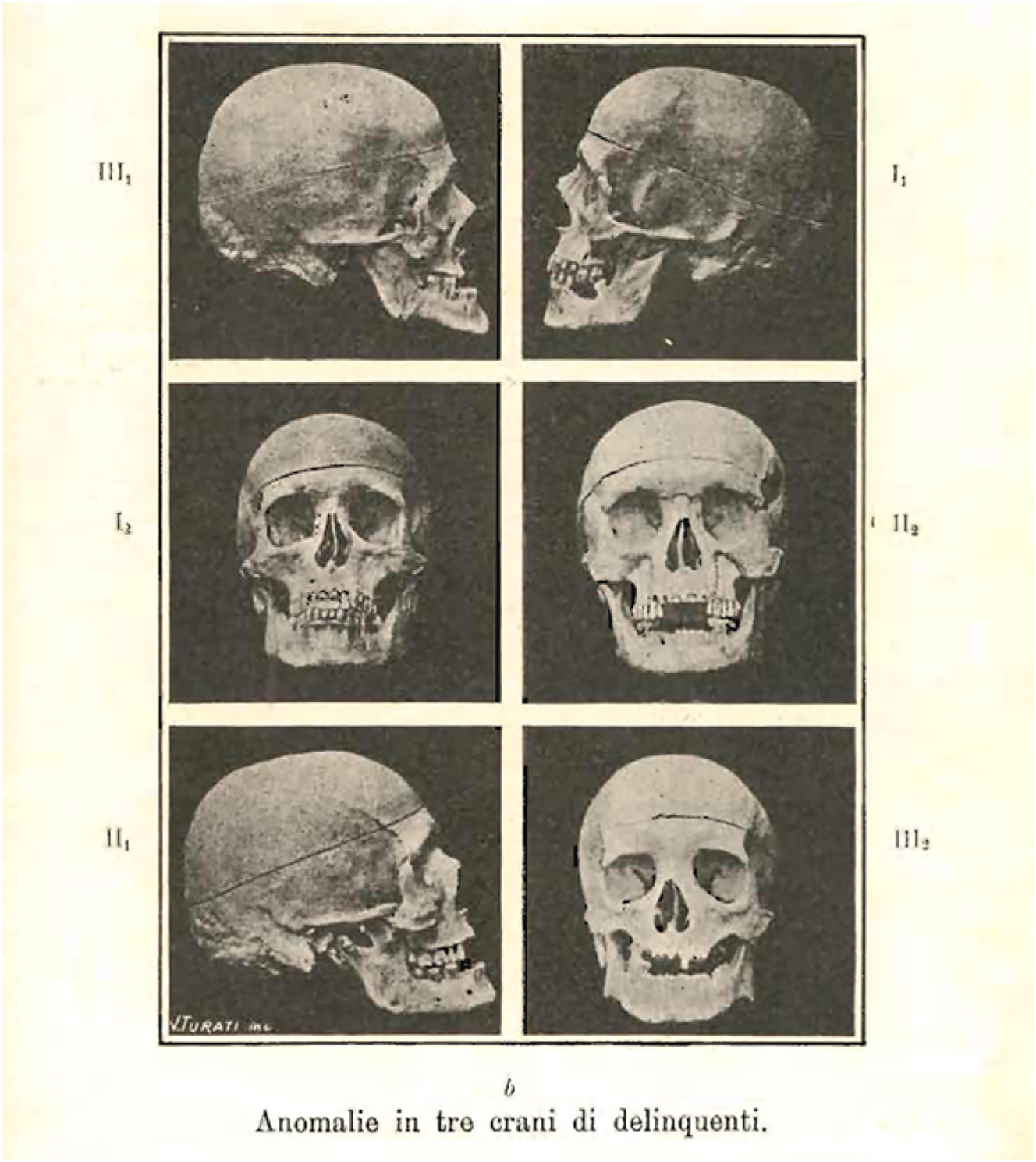
Example of cranial abnormalities of delinquents in Lombroso’s Atlas (Lombroso 1897: 4, Table XXVII, detail, image in the public domain).

Facial types of mattoids and moral-revolutionary fools (Lombroso 1897: 4, Table LXI, image in public domain).
Particularly in the third (1884) and fifth (1896–1897) editions, there is a close interrelation and cause–effect connection between the fundamental concepts of the Lombrosian science, namely atavism (inborn and primitive/savage condition, concept with earlier roots, already embedded in the Italian anthropological debate; see Pancaldi 1991: 142–146 and Frigessi et al. 1995: 347–348), degeneration (heritable or acquired), deviance, disease, and (innate) crime.[11] In this framework, the face constitutes: (1) the sign of the process of regression to the atavistic stage; and (2) the parameters and the reference tool for craniological, physiognomic, and psychological analyses of the criminal type (Gibson and Rafter 2006: 161–162).
Lombroso merges the study of physiognomy with that of anthropometry and especially with the measurement of faces and skulls, undoubtedly influenced by eighteenth- and nineteenth-century craniology and phrenology, for instance, Petrus Camper, Franz Joseph Gall, and Samuel Morton (see Siegel 2013: 269–270; Leone 2022: 10–11, 14). Since the 1870s, the Veronese anthropologist had dealt with anomalies in the skulls of famous men (for example, that of physicist Alessandro Volta) in the expanded edition of his early work Genio e follia (Lombroso 1877: 174–176), also noting the relationships between skull and face through the reporting of anthropometric data according to different parameters (e.g., stature).
As recalled in the Atlas (a summary, through tables, of research published in the previous three decades),[12] Lombroso basically affirms the connection of the physical, psychic, and moral characteristics of the criminal-born (but also in the epileptic subject) with the anomalies of the skull, thus implying the degeneration and deviance of behavior, emotions, and mental states, as shown by several related index keywords (mainly referring to criminals, prostitutes, the insane, etc.): facial index, facial angle, facial asymmetry, but also moral characters, as well as cranium and its compounds. Therefore, in Lombroso, the process of identification, description, and representation of the criminal physiognomic type consists in a codification of a grammar and an articulation of the facial-gestural apparatus, which, however, is not free from ideological rhetorical considerations and intentions, in a way not too far from the earlier craniological tradition (Leone 2022: 22–24).
Moreover, in the second half of the nineteenth century, treatises concerning the physiognomic analysis (of the face, of its expressions, of its gestures) were quite common in Italian anthropology – with, against, and beyond Lombroso. To cite just a few examples: since the 1860s, Paolo Mantegazza, founder of the Florentine school, a former friend who later had a heated quarrel with Lombroso, composed two essays on the ethno-racial physiognomy and mimicry – firstly, Prime linee di fisiognomonia comparata delle razze umane in 1861, then Fisonomia e mimica in 1881 (Mantegazza 1861, 1881); at the end of the century Giuseppe Sergi, forefather of the Roman school, wrote instead Dolore e piacere. Storia naturale dei sentimenti (1894), an essay on emotions, dedicating a chapter to physiognomy (Sergi 1894: ch. 11); finally, shortly after, Francesco Lorenzo Pullé, Sanskritist and Lombrosian epigone, in the essay Profilo antropologico d’Italia (1898) classified the populations of the Italian peninsula by language, inhabited land, and above all by soma, according to the measurement of the cephalic indices (Pullé 1898).
5 The sēmeîon between linguistics and medicine: case(s) of semiotic ideology
Both Marzolo and Lombroso use the notion of sign equally in a linguistic and medical sense. If for the Paduan thinker the core of the problem is intrinsically linguistic, for the Veronese scholar the research framework acquires a greater medical purpose, accentuating the Hippocratic sense of a symptom of some disease. In spite of this, we could try to delineate a more extended linguistic-medical context of intersection between the two theories, where the sēmeîon becomes a theoretical pivot, highlighting on the one hand the positivist approach, and on the other a precise consideration of the political and social problems of the time (e.g., illiteracy, crime), as well as the health problems (cholera, malaria pellagra) that emerged during their experiences as physicians in the Risorgimento period (see also Gibson 2013: 30–31; Conforti 2011: 599–609).
Like facial measurement theories and particularly craniological ones (Leone 2022: 17–18), Marzolo and Lombroso’s approaches, following Webb Keane (2007, 2018, constitute two different examples of semiotic ideology, which at the same time, viewed in continuity, may together prove to be yet another semiotic ideology. Their respective sociohistorical, cultural, and educational horizons show a strong positivist ideological component, which in Lombroso acquires a social-Darwinist flavor. As stated by Landucci (1977: 105), Darwinism became a propaganda tool, both scientifically and politically (questioning, for instance, the ecclesiastical monogenist creationist doctrine), having in Italy its pivot in Florence – particularly with Mantegazza, who clashed with the inherent extremisms of Ernst Haeckel and Giovanni Canestrini, the latter a disseminator of Darwinism in Italy (Landucci 1977: 130–131; see also Pancaldi 1991: ch. 3). On this wavelength, Lombroso’s criminal anthropology constitutes – not only in Italy – one of “the most controversial [cases] of the application of evolutionism to the social sciences” (Pancaldi 1991: 141) as well as to law and jurisprudence (Landucci 1977: 13), but firmly based on Marzolo’s semiotic theory that aspired to a Vichian-style reconstruction of the natural history of languages (Pancaldi 1991: 148).
Viewed as a whole, the Marzolo–Lombroso filiation stands in contrast to the linguistic and ethnoanthropological theories of the following century mainly because of a conception of primitivity, which is closely linked to problems of progress and civilization and particularly to the relationship between race, language, and culture. The latter point was the focus of Edward Sapir’s seminal work Language (1921; see Sapir 1949: ch. 10). In the light of a Boasian cultural anthropological perspective, denying any hereditary difference or inferiority of mental attitude between primitive and civilized (Boas 1894: 24, 29), and asserting the impossibility of a permanent correlation between type, language, and culture (Boas 1938: ch. 8),[13] Sapir (1949: 218) distinguished between culture as an object and language as a way of society’s thinking, clearly stating that
language, race [i.e., nature], and culture are not necessarily correlated. This does not mean that they never are. There is some tendency, as a matter of fact, for racial and cultural lines of cleavage to correspond to linguistic ones, though in any given case the latter may not be of the same degree of importance as the others. […] The geographical and historical isolation that brought about race differentiations was favorable also to far-reaching variations in language and culture. (Sapir 1949: 215–216)
Paraphrasing, we are confronted with two different semiotic ideologies: the first based on the total absence of an anthropometric approach, and the second dealing with the need highlighted (embryonically in Marzolo and more definitively in Lombroso) to identify race as a crucial parameter of anthropological analysis. The opposition between an anthropometric and an ethnological view is reflected more profoundly in the debate over the meaning of the face, which, as Leone (2021a: 270–273) notes, remained embedded in an ideological dichotomy until the middle of the last century, which should be overcome nowadays. It should be said, however, that within the field of criminological studies, the Lombrosian anthropometric physiognomic approach has also given rise to “culturalist” turns – for instance, cultural criminology, which focuses on socialization and culture instead of hereditary nature (Siegel 2013: 273–274). Although Lombroso situates the criminal as primitive or uncivilized by distinguishing him from the civilized (Siegel 2013: 276), somehow the crucial element of primitiveness transcends the mere civilized/uncivilized opposition and sheds new light on the inherited Enlightenment idea of progress, also based on the evolutionist-flavored theory derived by Marzolo (who however maintained this distinction at the anthropological linguistic level).
Moreover, particularly in pseudo-scientific contexts such as physiognomy, mathematics and measurement have been often regarded as the bearers of a semiotic ideology connected to a specific rhetoric: however, if the inherent categorizing nature of physiognomy (highlighted by artists) pertained more to “an impressionistic observation of facial commonalities and not their measurements,” after the seventeenth century, the “qualitative, morphological gaze” of anatomy seemed to separate the approximate commonality and the measurable and idealizable singularity of the face (Leone 2022: 18–21; see also Magli 1995: 368–369).
Evidently, the role of the sciences and the positivistic approach became essential: on the one hand, medicine, and on the other hand, comparative linguistics, place an important emphasis on their taxonomic function. But if Marzolo was not interested in craniometry, and numbers are not pivotal or functional to the construction of his ideological system, for Lombroso numbers are functional (e.g., facial index) but not pivotal in themselves to his theory of the criminal man. After all, ideological reasons for physiognomy understood as standardization, detailing, and measurement also imply a social urgency to identify and control deviance, translated into legal and political terms. The issue of crime (questione criminale) was a problem that gripped Italy as early as the eighteenth century with Cesare Beccaria and continued into the next century (Villa 2011: 777–785); however, the debate extended beyond the Alps (e.g., the portrait parlé, see Magli 1995: 370–373). In addition to the crucial role of facial expressions, it was important to identify the symptoms for dangerousness in the body, for example, through phrenological and craniometric methods, but with Lombroso this was extended to an interdisciplinary combination with psychology, anthropology, and adjoining sciences (Villa 2011: 786–788). However, at root, there was the firm interest of physicians and anthropologists in a supposed link between the backward or primitive conditions of the Peninsula and the origins of civilization, which referred to the reflections on primitives of a Darwinian thinker like John Lubbock (Conforti 2011: 611). Finally, as Dina Siegel points out:
The development of Lombroso’s ideas should be considered within the historical [and socio-economic] context of the Italian Unification of 1861 and the annexation of the southern provinces. The vast differences between the North and the South gave rise to all sorts of images and stereotypes about the differences between human populations [i.e., the myth of the heritage of human evolution as connected with races and individual disposition]. As medical officer, Lombroso was influenced by these stereotypes. (Siegel 2013: 274)
6 Conclusion: from father to son, with the benefit of inventory
Moving toward the conclusion, the commonality of anatomical-semiotic interests and the close kinship between the two semiotic ideologies allowed several points of continuity between Marzolo and Lombroso to emerge, materialized into two opposite poles when taken to extremes, but complementary and continuous when viewed in a more nuanced way. If Marzolo’s approach has at its heart the origin and development of language(s) and the human communicative interaction, Lombroso insists on the role of the soma as a whole, implying a greater centralization of the anthropo-nosological plane.
Moreover, the Marzolian study of defects of the phono-articulatory organ and language, which in some way has to do with sign pathologies, becomes in Lombroso a source of interest in diseases (physical, psychic, moral, and therefore social), thus in deviance and the process of degeneration which it leads to. If for Marzolo the condition of interdisciplinarity of the sciences has linguistics as its pivot and is aimed at modeling a mosaic of knowledge, with Lombroso linguistics seems to gradually acquire a secondary role, as ancilla scientiae, in favor first of geography, medicine, and anthropology, and then of psychiatry and penology, with the study of the criminal man.
Again, those concepts that are linguistically declined by Marzolo become instead in Lombroso the prerogative of the anthropological-criminal approach. More specifically, reminiscence is translated, pathologically, into atavism as a return to the past, while onomatopoeia and imitation, as well as the phono-articulatory apparatus, are converted into a facial-gestural system, where the face becomes the central core as a psycho-physical-moral parameter of origin of the criminal, atavic, and deviant man.
Thus, the linguistic primitiveness that is the subject matter of Marzolo’s studies becomes in Lombroso an anthropo-criminal primitiveness: hence this implies a shift from the phonic-semiotic to the somatic-semiotic field, that is, from a phono-articulatory and glottogonic physiognomy to a facial and anthropometric one, or again, from linguistics as the physiology and evolution of languages to criminal anthropology as the pathology of deviance. Consequently, if in Marzolo the pivot of the semiotic theory is both words (phonic ones and gestures), which serve as signs, and the process of acquiring their meanings, Lombrosian semiotics is based on the facial parameter and on skull size. After all, Lombroso links these inheritances systematically and intrinsically, but with benefit of inventory, bringing out clearly the facial element, whose semiotic role is rooted, as shown, in Marzolo’s studies of signs and the origin of language.
About the author
Alice Orrù (b. 1994) is a PhD student at Sapienza University of Rome. Her research interests include the history of linguistic and anthropological ideas, semantics, lexicology, and lexicography. Her publications include “Habit and climate in Giacomo Leopardi’s theory of habituation” (2020), “Hos pharmakon chresimon: Myth as a “rhetorical remedy” within Plato’s Kallipolis” (2021), “Jordan Zlatev. On a phenomenological cognitive semiotics” (2022), “The language–race nexus in the Italian anthropo-linguistic-geographical debate: Francesco Lorenzo Pullé between Cattaneo and Ascoli” (2022).
Acknowledgments
I would like to thank Professor Filomena Diodato (Sapienza, University of Rome) for valuable suggestions on content and language.
References
Ascoli, Graziadio I. 1877. Studj critici, vol. 2. Turin: Loescher.Search in Google Scholar
Barthes, Roland. 1972 [1957]. Mythologies. Transl. by Annette Lavers. New York: Farrar, Straus and Giroux.Search in Google Scholar
Boas, Franz. 1894. Human faculty as determined by race. Proceedings of the American Association for the Advancement of Science 43. 3–29.Search in Google Scholar
Boas, Franz. 1938 [1911]. The mind of primitive man. New York: The Macmillan Company.Search in Google Scholar
Boas, Franz. 1940. Race, language, and culture. New York: The Macmillan Company.Search in Google Scholar
Ceccarel, Matteo. 1862. Dell’aneurisma dell’aorta toracica, con tre casi clinici della detta malattia. Treviso: Dello Stabilimento Provinciale di Gaetano Longo.Search in Google Scholar
Ceccarel, Matteo. 1870. Della vita e degli scritti di Paolo Marzolo. Treviso: Tipografia di Luigi Priuli.Search in Google Scholar
Conforti, Maria. 2011. Fisiologia e fisionomia della nazione: il protagonismo e le “storie” dei medici. In Francesco Cassata & Claudio Pogliano (eds.), Storia d’Italia. Annali 26. Scienze e cultura dell’Italia unita, 599–622. Turin: Einaudi.Search in Google Scholar
Darwin, Charles. 1872. The expression of the emotions in man and animals. London: John Murray.10.1037/10001-000Search in Google Scholar
Deufert, Marcus. 2019. Titus Lucretius Carus. De rerum natura. Bibliotheca scriptorum Graecorum et Romanorum Teubneriana, vol. 2028. Berlin & Boston: De Gruyter.Search in Google Scholar
Donald, Merlin. 1991. Origins of the modern mind: Three stages in the evolution of human culture. Cambridge, MA: Harvard University Press.Search in Google Scholar
Dovetto, Francesca M. 2018. La concezione semiologica della lingua secondo Marzolo tra naturalismo e comparativismo nell’ “Analisi della parola” (1859 [1847] – 1866). Studi e Saggi Linguistici 56(2). 95–115.Search in Google Scholar
Eco, Umberto. 1985. Sugli specchi e altri saggi. Milan: Bompiani.Search in Google Scholar
Fabricius, Hieronymus. 1601. De locutione et eius instrumentis liber. Venetiis: a Ioanne Ursino editus.Search in Google Scholar
Ferrero, Guglielmo. 1893. I simboli in rapporto alla storia e filosofia del diritto, alla psicologia e alla sociologia. Turin: Bocca.Search in Google Scholar
Frigessi, Delia, Ferruccio Giancanelli & Luisa Mangoni (eds.). 1995. Delitto, genio, follia. Scritti scelti. Turin: Bollati Boringhieri.Search in Google Scholar
Frigessi, Delia. 2003. Cesare Lombroso. Turin: Einaudi.Search in Google Scholar
Gensini, Stefano & Michela Tardella. 2016. Girolamo Fabrici d’Acquapendente: De locutione; De brutorum loquela. Pisa: ETS.Search in Google Scholar
Gibson, Mary & Nicole Hahn Rafter. 2004. Cesare Lombroso: Criminal woman, the prostitute, and the normal woman. Durham & London: Duke University Press.Search in Google Scholar
Gibson, Mary & Nicole Hahn Rafter. 2006. Cesare Lombroso: Criminal man. Durham & London: Duke University Press.Search in Google Scholar
Gibson, Mary. 2013. Cesare Lombroso, prison science, and penal policy. In Knepper Paul & Per J. Ystehede (eds.), The Cesare Lombroso handbook, 30–46. London & New York: Routledge.Search in Google Scholar
Keane, Webb. 2007. Christian moderns: Freedom and fetish in the mission encounter. Berkeley, Los Angeles (CA), London: University of California Press.Search in Google Scholar
Keane, Webb. 2018. On semiotic ideology. Sign and Studies 6(1). 64–87. https://doi.org/10.1086/695387.Search in Google Scholar
Landucci, Giovanni. 1977. Darwinismo a Firenze: Tra scienza e ideologia. Florence: Olschki.Search in Google Scholar
Lauretano, Bruno. 1993. Animal symbolicum: Dalla filosofia del linguaggio alla zoosemiotica. Naples: ESI.Search in Google Scholar
Lauretano, Bruno. 1995. Guglielmo Ferrero: I simboli in rapporto alla storia e filosofia del diritto, alla psicologia e alla sociologia. Naples: ESI.Search in Google Scholar
Lauretano, Bruno. 2003. Paolo Marzolo: Saggio sui segni. Naples: ESI.Search in Google Scholar
Leone, Massimo. 2011. Dall’ideologia linguistica all’ideologia semiotica: Riflessioni sulla smentita. Eidos 14. 236–249.Search in Google Scholar
Leone, Massimo. 2021a. Introduction: Studying the “facesphere.” Cultures of the face. [Special issue]. Sign System Studies 49(3–4). 270–278. https://doi.org/10.12697/SSS.2021.49.3-4.01.Search in Google Scholar
Leone, Massimo. 2021b. Prefazione/Preface. Volti artificiali/Artificial faces. [Special issue]. Lexia 37–38. 9–25.Search in Google Scholar
Leone, Massimo. 2022. Visage mathematics: Semiotic ideologies of facial measurement and calculus. In Marcel Danesi (ed.), Handbook of cognitive mathematics, 1–26. Cham (CH): Springer.10.1007/978-3-030-44982-7_48-1Search in Google Scholar
Lombroso, Cesare. 1851. Filologia. Il Collettore dell’Adige 1(50). 402–404.Search in Google Scholar
Lombroso, Cesare. 1871. L’uomo bianco e l’uomo di colore. Letture sull’origine e le varietà delle razze umane. Padua: Premiata Tip. Editrice F. Sacchetto.Search in Google Scholar
Lombroso, Cesare. 1877 [1872]. Genio e follia. Milan: Ulrico Hoepli.Search in Google Scholar
Lombroso, Cesare. 1896–1897 [1876]. L’uomo delinquente in rapporto all’antropologia, alla giurisprudenza ed alla psichiatria, vols. 1–2, 1896; vols. 3–4, 1897. Turin: Bocca.Search in Google Scholar
Lombroso, Cesare & Guglielmo Ferrero. 1893. La donna delinquente. La prostituta e la donna normale. Turin & Rome: Editori L. Roux e C.Search in Google Scholar
Lombroso, Gina. 1921 [1915]. Storia della vita e delle opere narrata dalla figlia. Turin: Bocca.Search in Google Scholar
Magli, Patrizia. 1995. Il volto e l’anima. Fisiognomica e passioni. Milan: Bompiani.Search in Google Scholar
Mantegazza, Paolo. 1861. Prime linee di fisiognomonia comparata delle razze umane. Il Politecnico 10(55–56). 1–21, 113–140.Search in Google Scholar
Mantegazza, Paolo. 1881. Fisonomia e mimica. Milan: Fratelli Dumolard.Search in Google Scholar
Marzolo, Paolo. 1847–1866. Monumenti storici rivelati dall’analisi della parola, Vol. 1: Origine delle lingue, 1847; Vol. 2: Progresso nello sviluppo delle lingue, 1859; Vol. 3: Saggio di ragguagli eufonici speciali, 1863; Vol. 4: Trattato dei rapporti della parola col sentimento e col pensiero, 1866a. Padua: Tipografia del Seminario.Search in Google Scholar
Marzolo, Paolo. 1850. Trattato ideologico ossia Dei rapporti della parola col pensiero. Atti delle adunanze dell’I. R. Istituto Veneto di Scienze Lettere e Arti 8. 40–50.Search in Google Scholar
Marzolo, Paolo. 1856. Brevissimo cenno sui rapporti della parola col pensiero. Rivista Veneta 1(4). 25–26.Search in Google Scholar
Marzolo, Paolo. 1866b. Saggio sui segni. Pisa: Tipografia Nistri.Search in Google Scholar
Orrù, Alice. 2018. Alle origini di una storia naturale dello sviluppo linguistico: la “scienza nuova” di Paolo Marzolo. Blityri 7(2). 157–179.Search in Google Scholar
Orrù, Alice. 2021. Immaginazione, ricordanza e imitazione: Giacomo Leopardi e Paolo Marzolo. In Ludovica Boi & Sebastian Schwibach (eds.), “Il primo fonte della felicità umana”: Leopardi e l’immaginazione, 227–252. Naples: IISF Press La Scuola di Pitagora.Search in Google Scholar
Pancaldi, Giuliano. 1991 [1983]. Darwin in Italy: Science across cultural frontiers. Transl. by Ruey Brodine Morelli. Bloomington & Indianapolis: Indiana University Press.Search in Google Scholar
Pullé, Francesco L. 1898. Profilo antropologico d’Italia. Archivio per l’Antropologia e la Etnologia 28(1). 19–168.Search in Google Scholar
Rodler, Lucia. 2012. L’homme criminel de Cesare Lombroso: entre science et littérature. In Marc Renneville (ed.), Histoire de la criminologie: Autour des Archives d’anthropologie criminelle 1886–1914, 1–26. Criminocorpus. https://journals.openedition.org/criminocorpus/1893 (accessed 21 November 2022).Search in Google Scholar
Sapir, Edward. 1949 [1921]. Language: An introduction to the study of speech. New York: Hartcourt, Brace & World.10.1037/13026-000Search in Google Scholar
Savoia, Leonardo M. 2008. La linguistica di Paolo Marzolo e il pensiero del suo tempo. Studi Italiani di Linguistica Teorica e Applicata 37(3). 511–548.Search in Google Scholar
Sergi, Giuseppe. 1894. Dolore e piacere. Storia naturale dei sentimenti. Milan: Fratelli Dumolard.Search in Google Scholar
Siegel, Dina. 2013. The methods of Lombroso and cultural criminology. In Knepper Paul & Per J. Ystehede (eds.), The Cesare Lombroso handbook, 268–280. London & New York: Routledge.10.4324/9780203083369-21Search in Google Scholar
Silverstein, Michael. 1979. Language structure and linguistic ideology. In Paul R. Cline, William F. Hanks & Carol L. Hofbauer (eds.), The elements: A parasession on linguistic units and levels, 193–247. Chicago: CLS University of Chicago.Search in Google Scholar
Silverstein, Michael. 2004. “Cultural” concepts and the language-culture nexus. Current Anthropology 45(5). 621–652. https://doi.org/10.1086/423971.Search in Google Scholar
Silverstein, Michael. 2014. The race from the place: Dialect eradication vs. the linguistic “authenticity” of terroir. In Véronique Lacoste, Jakob Leimgruber & Thiemo Breyer (eds.), Indexing authenticity: Sociolinguistic perspectives, 159–187. Berlin, München, Boston: De Gruyter.10.1515/9783110347012.159Search in Google Scholar
Smith, Martin F. 2001 [1969]. Lucretius: De rerum natura/On the nature of things. Indianapolis & Cambridge: Hackett.Search in Google Scholar
Villa, Renzo. 1985. Il deviante e i suoi segni: Lombroso e la nascita dell’antropologia criminale. Milan: FrancoAngeli.Search in Google Scholar
Villa, Renzo. 2011. Le scienze del crimine. In Francesco Cassata & Claudio Pogliano (eds.), Storia d’Italia. Annali 26. Scienze e cultura dell’Italia unita, 777–803. Turin: Einaudi.Search in Google Scholar
Villa, Renzo. 2013. Lombroso and his school: From anthropology to medicine. In Knepper Paul & Per J. Ystehede (eds.), The Cesare Lombroso handbook, 8–29. London & New York: Routledge.Search in Google Scholar
Zlatev, Jordan. 2008. From proto-mimesis to language: Evidence from primatology and social neuroscience. Journal of Physiology–Paris 102(1–3). 137–151. https://doi.org/10.1016/j.jphysparis.2008.03.016.Search in Google Scholar
Zlatev, Jordan. 2013. The mimesis hierarchy of semiotic development: Five stages of intersubjectivity in children. The Public Journal of Semiotics 4(2). 47–70. https://doi.org/10.37693/pjos.2013.4.8842.Search in Google Scholar
© 2023 the author(s), published by De Gruyter, Berlin/Boston
This work is licensed under the Creative Commons Attribution 4.0 International License.
Articles in the same Issue
- Frontmatter
- Introduction to “The visage as text”
- Physiognomic theories between equation and inference
- Paolo Marzolo and Cesare Lombroso: a semiotic-medical inheritance between word, sounds, and face
- Lombroso’s criminal face across physiognomy and semeiotics
- Embodying genre: from Galton’s generic faces to Peirce’s embodied ideas
- Reading and writing in n-dimensional face space
- Face in the mirror, what do you see? Catoptric autoexperimentation and the physiognomic gaze
- Concealment of the face and new physiognomies
- Eyes on Chinese female models’ faces: stereotypes, aesthetics, self-Orientalism, and the moral discourse of the CPC
- The visage and the mask: semiotic considerations around representations of visages in Japanese Nō
Articles in the same Issue
- Frontmatter
- Introduction to “The visage as text”
- Physiognomic theories between equation and inference
- Paolo Marzolo and Cesare Lombroso: a semiotic-medical inheritance between word, sounds, and face
- Lombroso’s criminal face across physiognomy and semeiotics
- Embodying genre: from Galton’s generic faces to Peirce’s embodied ideas
- Reading and writing in n-dimensional face space
- Face in the mirror, what do you see? Catoptric autoexperimentation and the physiognomic gaze
- Concealment of the face and new physiognomies
- Eyes on Chinese female models’ faces: stereotypes, aesthetics, self-Orientalism, and the moral discourse of the CPC
- The visage and the mask: semiotic considerations around representations of visages in Japanese Nō
