Ticket Pricing and Scalping: A Game Theoretical Approach
-
Nelson Sá
 and
Evsen Turkay
and
Evsen Turkay

Abstract
Ticket scalping is frequently related to the economic puzzle of underpricing by promoters. It is also disputed whether event promoters benefit from scalper participation or not. Our article explores two questions: can promoters benefit from scalpers’ activities and what are the resulting consumer welfare effects? We address these questions by developing a three period game where the secondary market is supported by an auction mechanism, interacting with primary market decisions. We find that participation by scalpers can lead to underpricing in the primary market and that this may benefit small or credit-constrained promoters. This requires the scalper’s discount factor to be higher than the promoter’s discount factor. The necessary premium on the discount factor increases with the fraction of early buyers and decreases with market size. Finally, the effect of scalper participation on aggregate consumer welfare is shown to be positive for a large enough market size or discount rate for the scalper.
Appendix
Proof of Proposition 1
In the absence of the scalper,  and
and  . This implies that there will be
  units in the market after the first period. If the scalper participates in the market, he must buy this residual quantity. We want to show that the scalper has no incentive to participate in the market under these conditions.
If he participates, his profits can be computed using the objective function [5]. This yields
![[22]](/document/doi/10.1515/bejeap-2013-0042/asset/graphic/bejeap-2013-0042_eq24.png)
Given that 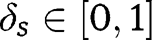 ,
,  for all
  . The scalper will then not participate in the market with
  and
and  .
.
Proof of Proposition 2
Take a quantity  and assume that
  is the profit maximizing price for the promoter. The equilibrium definition implies that the scalper chooses
  such that his profits are non-negative. For a contradiction, suppose that the scalper’s expected profits are strictly positive. This implies
![[23]](/document/doi/10.1515/bejeap-2013-0042/asset/graphic/bejeap-2013-0042_eq25.png)
where  denotes the unconditional expectation of the scalper. By definition
  and the promoter can increase his profits by choosing
  and keep the scalper still buying. Hence, a pair
  cannot maximize the profits of the promoter when the scalper participates in the market unless constraint [9] is binding.
Proof of Proposition 3
Eq. [12] may be rearranged as
![[24]](/document/doi/10.1515/bejeap-2013-0042/asset/graphic/bejeap-2013-0042_eq26.png)
From here,
![[25]](/document/doi/10.1515/bejeap-2013-0042/asset/graphic/bejeap-2013-0042_eq27.png)
Similarly,
![[26]](/document/doi/10.1515/bejeap-2013-0042/asset/graphic/bejeap-2013-0042_eq28.png)
Next,
![[27]](/document/doi/10.1515/bejeap-2013-0042/asset/graphic/bejeap-2013-0042_eq29.png)
Finally, the ambiguous sign of  may be confirmed by simple numerical simulation. This holds over a wide range of values for N,
  and
and  .
.
Concerning the number of units bought by the scalper, eqs [9] and [11] yield
![[28]](/document/doi/10.1515/bejeap-2013-0042/asset/graphic/bejeap-2013-0042_eq30.png)
Next,
![[29]](/document/doi/10.1515/bejeap-2013-0042/asset/graphic/bejeap-2013-0042_eq31.png)
with
![[30]](/document/doi/10.1515/bejeap-2013-0042/asset/graphic/bejeap-2013-0042_eq32.png)
and
![[31]](/document/doi/10.1515/bejeap-2013-0042/asset/graphic/bejeap-2013-0042_eq33.png)
As long as  ,
,  . Since
  , it follows that
 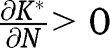 . Direct inspection of eq. [28] gives
  .
.
Using eq. [11], the equilibrium number of early buyers is
![[32]](/document/doi/10.1515/bejeap-2013-0042/asset/graphic/bejeap-2013-0042_eq34.png)
This can be rearranged as
![[33]](/document/doi/10.1515/bejeap-2013-0042/asset/graphic/bejeap-2013-0042_eq35.png)
Direct inspection of this expression makes it clear that 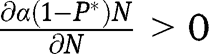 .
.
Proof for scalper participation condition
Suppose that eq. [15] is met for a set of values  . Taking by reference [13], it is straightforward to show that
![[34]](/document/doi/10.1515/bejeap-2013-0042/asset/graphic/bejeap-2013-0042_eq36.png)

and
![[35]](/document/doi/10.1515/bejeap-2013-0042/asset/graphic/bejeap-2013-0042_eq38.png)
It follows that whenever condition [15] is met, so must be the non-negativity constraint [13].
Proof of Proposition 4
The right-hand side in eq. [15] is always positive. The left-hand side must also be positive for this condition to hold given an appropriate value for N. Next, notice that when  , the left-hand side in eq. [15] equals
  . This is always negative for any
  . Furthermore, the left-hand side in eq. [15] decreases with a lower
  . It follows that when
  , it becomes increasingly negative. In conclusion, eq. [15] can only hold with
  .
.
Next, eq. [15] may be rearranged as
![[36]](/document/doi/10.1515/bejeap-2013-0042/asset/graphic/bejeap-2013-0042_eq39.png)
It is straightforward to show that the right-hand side in eq. [36] is decreasing in N. Also, because both terms are increasing in  , so does the right-hand side.
Proof of Proposition 5
Using eqs [16] and [20], welfare can be shown to improve when
![[37]](/document/doi/10.1515/bejeap-2013-0042/asset/graphic/bejeap-2013-0042_eq40.png)
Expression [11] shows that 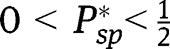 . The sufficient condition is derived by assigning a value of
  to the first
  term and a value of 0 to the second
  term.
term.
Acknowledgements
We are grateful to Geoffrey Jehle and Robert Rebelein for their helpful comments and suggestions. We also thank Jiayi Bao for her excellent research assistance. Any errors remain our own.
References
Becker, G. 1991. “A Note on Restaurant Pricing and Other Examples of Social Influences on Price.” Journal of Political Economy99(5):1109–16.10.1086/261791Search in Google Scholar
Bhave, A., and E.Budish. 2013. “Primary-Market Auctions for Event Tickets: Eliminating the Rents of ‘Bob the Broker’,” Working Paper.10.2139/ssrn.2237451Search in Google Scholar
Budnik, D., and J.Baron. 2011. Ticket Masters: The Rise of the Concert Industry and How the Public Got Scalped, 1st edn. Toronto, ON: ECW Press.Search in Google Scholar
Carroll, J.2011. “Is This the End of Unforeseen Circumstances?”The Irish Times, August 23. http://www.irishtimes.com/blogs/ontherecord/2011/08/23/is-this-the-end-of-unforeseen-circumstances/.Search in Google Scholar
Ciliberto, F., and C.Schenone. 2012. “Bankruptcy and Product-Market Competition: Evidence from the Airline Industry.” International Journal of Industrial Organization30(6):564–77.10.1016/j.ijindorg.2012.06.004Search in Google Scholar
Courty, P. 2000. “An Economic Guide to Ticket Pricing in the Entertainment Industry.” Louvain Economic Review66:167–92.10.1017/S0770451800083858Search in Google Scholar
Courty, P. 2003a. “Some Economics of Ticket Resale.” Journal of Economic Perspectives17(2):85–97.10.1257/089533003765888449Search in Google Scholar
Courty, P.2003b. “Ticket Pricing Under Demand Uncertainty.” Journal of Law and Economics46(2):627–52.10.1086/377117Search in Google Scholar
Depken, C.2006. “Another Look at Anti-Scalping Laws: Theory and Evidence.” Public Choice130(1):55–77.Search in Google Scholar
DeSerpa, A., and R.Faith. 1996. “‘Bru-u-u-uce’: The Simple Economics of Mob Goods.” Public Choice89(1/2):77–91.10.1007/BF00114280Search in Google Scholar
Diamond, T.1982. “Ticket Scalping: A New Look at an Old Problem.” University of Miami Law Review37:71–92.Search in Google Scholar
eBay.2010. “Ticket Scalping: Ticket Onselling and Consumers Submission to the Commonwealth Consumer Affairs Advisory Council,” Australian Government, The Treasury. http://archive.treasury.gov.au/documents/1879/PDF/ebay_101007.pdf.Search in Google Scholar
Elfenbein, D. 2006. “Do Anti-Ticket Scalping Laws Make a Difference Online? Evidence From Internet Sales on NFL Tickets”, Washington University Working Paper.10.2139/ssrn.595682Search in Google Scholar
Happel, S., and M.Jennings. 1995. “The Folly of Anti-Scalping Laws.” Cato Journal15(1):65–99.Search in Google Scholar
Happel, S., and M.Jennings. 2002. “Creating a Futures Market for Major Event Tickets: Problems and Prospects.” Cato Journal21(2):443–61.Search in Google Scholar
Hendel, I. 1996. “Competition under Financial Distress.” Journal of Industrial Economics44(3):309–24.10.2307/2950499Search in Google Scholar
Hendel, I. 1997. “Aggressive Pricing as a Source of Funding.” Economics Letters57(3):275–81.10.1016/S0165-1765(97)00010-4Search in Google Scholar
Karp, L., and J.Perloff. 2005. “When Promoters Like Scalpers.” Journal of Economics and Management Strategy14(2):477–508.10.1111/j.1530-9134.2005.00049.xSearch in Google Scholar
Krishna, V. 2009. Auction Theory. San Diego, CA: Academic Press.Search in Google Scholar
Leslie, P., and A.Sorensen. 2009. “The Welfare Effects of Ticket Resale,” NBER Working Papers 15476.10.3386/w15476Search in Google Scholar
Mulpuru, S. 2008. “The Future of US Online Secondary Ticket Sales, 2007 to 2012,” Discussion paper, Forrester Research.Search in Google Scholar
Pukier, B. 1992. “Exiled on Main Street: A Ticket Scalper’s Dilemma.” University of Toronto Faculty of Law Review50(2):280–300.Search in Google Scholar
Rabe, S. 1991. “Ticket Scalping: Free Market Mirage.” American Journal of Criminal Law19(1):57–69.Search in Google Scholar
Rosen, S., and A.Rosenfield. 1997. “Ticket Pricing.” Journal of Law and Economics40(2):351–76.10.1086/467376Search in Google Scholar
Simon, S. 2004. “If You Can’t Beat ‘em, Join ‘em: Implications for New York’s Scalping Law on Light of Recent Developments in the Ticket Business.” Fordham Law Review72(4):1171–218.Search in Google Scholar
Swofford, J. 1999. “Arbitrage, Speculation, and Public Policy toward Ticket Scalping.” Public Finance Review27(5):531–40.10.1177/109114219902700504Search in Google Scholar
Taraborrelli, J. R. 2009. Michael Jackson: The Magic, the Madness, the Whole Story, 1958–2009. New York: Grand Central Publishing.Search in Google Scholar
Thiel, S. 1993. “Two Cheers for Touts.” Scottish Journal of Political Economy40(4):447–55.10.1111/j.1467-9485.1993.tb00666.xSearch in Google Scholar
Weber, R. 1983. “Multiple-Object Auctions.” In Auctions, Bidding and Contracting: Uses and Theory, edited by M. S. R. Engelbrecht-Wiggans and R. M. Stark. New York: New York University Press.Search in Google Scholar
Williams, A. 1994. “Do Anti-Scalping Laws Make a Difference?” Managerial and Decision Economics15(5):503–09.10.1002/mde.4090150512Search in Google Scholar
- 1
The distinction between a broker and a scalper is straightforward. The former is an officially licensed business, whereas the latter acts informally, frequently on an individual basis. Nonetheless, their conduct is fundamentally identical in that both seek a profit through secondary market exchanges. For the remainder of the article, we shall treat both agents in the same way.
- 2
New York State laws illustrate this point well. Prior to 1984, resale for more than two dollars above face value was illegal in New York. This limit was gradually increased until the state introduced a 3-year experiment in 2007 completely deregulating ticket resale.
- 3
In a study of 103 rock concerts held in the summer of 2004, Leslie and Sorensen (2009) show that most events offered tickets at only two price levels. Ideally, the promoter would like to employ price discrimination to its fullest possible extent, precluding the scalper from exploring any arbitrage opportunities. Transaction costs in operating secondary markets are one possible reason why this does not always happen. Negative reputation effects might also discourage the promoter from engaging in excessive discrimination.
- 4
For an analysis of how a monopolist can explore individual demand uncertainty in ticket markets, see for instance Courty (2003b).
- 5
Krishna (2009) shows that first-price and second-price sequential auctions yield the same results for sellers. Besides, they both entail the same level of analytical complexity. Weber (1983) also shows that simultaneous and sequential auctions with risk-neutral bidders holding independent private values yield the same expected payoff as long as there is no time discounting within the auction period (the third period in our model).
- 6
Heterogeneous discount rates for buyers might enable their endogenous allocation to primary and secondary markets. However, it would not be possible to uniquely associate each group to one particular type of discount rate, much less with uniformly distributed sub-populations, thus compromising the analytical tractability of this model.
- 7
It should nonetheless be noted that resale dynamics are likely to vary depending on whether a single event (our example) or a season ticket are involved. The ability to resell is frequently more valued in the second case since the ticket holder may not be able or willing to attend every individual game.
- 8
This vital principle may be found in Gold v. DiCarlo, 235 F. Supp. 817 at 820 (S.D.N.Y. 1964). There, resale prices regulation is deemed constitutionally acceptable because it affects the price the public is forced to pay, thus making it a proper venue for the exercise of state police power.
©2013 by Walter de Gruyter Berlin / Boston
Articles in the same Issue
- Masthead
- Masthead
- Advances
- When Does Inter-School Competition Matter? Evidence from the Chilean “Voucher” System
- Investment, Dynamic Consistency and the Sectoral Regulator’s Objective
- Contributions
- Vertical Contracts and Mandatory Universal Distribution
- Ticket Pricing and Scalping: A Game Theoretical Approach
- Loyalty Discounts
- Age, Human Capital, and the Quality of Work: New Evidence from Old Masters
- Effects of the Endogenous Scope of Preferentialism on International Goods Trade
- Fiscal Decentralization and Environmental Infrastructure in China
- Declining Equivalence Scales and Cost of Children: Evidence and Implications for Inequality Measurement
- Political Parties, Candidate Selection, and Quality of Government
- Professors’ Beauty, Ability, and Teaching Evaluations in Italy
- Pass-through of Per Unit and ad Valorem Consumption Taxes: Evidence from Alcoholic Beverages in France
- The Tuesday Advantage of Politicians Endorsed by American Newspapers
- Topics
- The Effects of Medicaid Earnings Limits on Earnings Growth among Poor Workers
- Opportunities Denied, Wages Diminished: Using Search Theory to Translate Audit-Pair Study Findings into Wage Differentials
- Horizontal Mergers, Firm Heterogeneity, and R&D Investments
- Product Differentiation and Consumer Surplus in the Microfinance Industry
- The Multitude of Alehouses: The Effects of Alcohol Outlet Density on Highway Safety
- Solving the Endogeneity Problem in Empirical Cost Functions: An Application to US Banks
- The Internet, News Consumption, and Political Attitudes – Evidence for Sweden
- A Cross-Cultural Real-Effort Experiment on Wage-Inequality Information and Performance
- Are Students Dropping Out or Simply Dragging Out the College Experience? Persistence at the Six-Year Mark
- The Welfare Effects of Location and Quality in Oligopoly
Articles in the same Issue
- Masthead
- Masthead
- Advances
- When Does Inter-School Competition Matter? Evidence from the Chilean “Voucher” System
- Investment, Dynamic Consistency and the Sectoral Regulator’s Objective
- Contributions
- Vertical Contracts and Mandatory Universal Distribution
- Ticket Pricing and Scalping: A Game Theoretical Approach
- Loyalty Discounts
- Age, Human Capital, and the Quality of Work: New Evidence from Old Masters
- Effects of the Endogenous Scope of Preferentialism on International Goods Trade
- Fiscal Decentralization and Environmental Infrastructure in China
- Declining Equivalence Scales and Cost of Children: Evidence and Implications for Inequality Measurement
- Political Parties, Candidate Selection, and Quality of Government
- Professors’ Beauty, Ability, and Teaching Evaluations in Italy
- Pass-through of Per Unit and ad Valorem Consumption Taxes: Evidence from Alcoholic Beverages in France
- The Tuesday Advantage of Politicians Endorsed by American Newspapers
- Topics
- The Effects of Medicaid Earnings Limits on Earnings Growth among Poor Workers
- Opportunities Denied, Wages Diminished: Using Search Theory to Translate Audit-Pair Study Findings into Wage Differentials
- Horizontal Mergers, Firm Heterogeneity, and R&D Investments
- Product Differentiation and Consumer Surplus in the Microfinance Industry
- The Multitude of Alehouses: The Effects of Alcohol Outlet Density on Highway Safety
- Solving the Endogeneity Problem in Empirical Cost Functions: An Application to US Banks
- The Internet, News Consumption, and Political Attitudes – Evidence for Sweden
- A Cross-Cultural Real-Effort Experiment on Wage-Inequality Information and Performance
- Are Students Dropping Out or Simply Dragging Out the College Experience? Persistence at the Six-Year Mark
- The Welfare Effects of Location and Quality in Oligopoly
