Product Differentiation and Consumer Surplus in the Microfinance Industry
-
Darrell J. Glaser
 ,
Ahmed S. Rahman
,
Ahmed S. Rahman

Abstract
During the last 15 years, high repayment rates of up to 96% have drawn many new lending institutions to the microfinance industry. While a decade ago, the industry was dominated primarily by monopolies ostensibly focused on social welfare, the current market is filled with various types of financial institutions offering a variety of lending arrangements. The goal of this article is to capture the degree to which consumers have benefitted from these structural changes within the microfinance industry. Using a Bertrand differentiated product framework, we model the price setting and demand functions of Microfinance Institutions (MFIs). With a 7 year panel data set covering over 70 countries, we empirically estimate parameters of the Nash price equilibrium and simulate the shape and structure of the underlying demand equation. We use simulated demand parameters to derive and compare measures of consumers’ surplus across regions and countries. Our research indicates that growth in the MFI industry has brought about declines in market concentration, and furthermore that each 0.01 unit change in the Hirschman–Herfindahl index correlates with a 2% increase in consumers’ surplus.
Appendix
Testing for sample selection bias
Following from Verbeek and Nijman (1992) and based methods outlined in Wooldridge (2002), we test whether the unbalanced panel estimates reported in Section 5 suffer from bias due to sample selection.
Let T represent the total number of time periods available for panel estimation, where  represents the first period. For the ith firm in the sample, let
  represent the Tx1 vector of selection indicators. For each time period,
 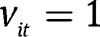 if firm i is observed and zero if not. The lagged and leading indicators of selection are defined by
  and
and  , respectively.
The null hypothesis assumes that errors in a panel regression are uncorrelated with selection variables  and
and  (or for any time period). Rejection of the null provides evidence of selection bias in an unbalanced panel. Wooldridge (2002) suggests that a simple t-statistic of the coefficients on these selection variables should suffice to test this hypothesis.
Table 10 summarizes the coefficients and standard errors for these selection variables if we include them in the specifications outlined in Table 7. Specifications are estimated and reported twice in Table 10: once with a lagged selection variable and once with a leading selection variable. For brevity, we do not report other coefficients estimated in the model; however, specifications include all variables outlined in each of the columns in Table 7. For example, the specification defined as column “(1)” of Table 7 is represented in Table 10 by columns defined by “(1)”. Also based on suggestions from Wooldridge (2002), robust standard errors are estimated and reported in parentheses.
Tests for selection bias.
| Variable | (1) | (1) | (2) | (2) | (3) | (3) | (4) | (4) |
Lagged selection,  | –0.006 | – | –0.005 | – | –0.012** | – | –0.010* | – |
| (0.004) | (0.004) | (0.005) | (0.006) | |||||
Leading selection,  | – | –0.007 | – | –0.005 | – | 0.0008 | – | 0.002 |
| (0.004) | (0.004) | (0.007) | (0.008) | |||||
| Observations | 4,963 | 4,289 | 4,963 | 4,289 | 2,342 | 2,142 | 2,342 | 2,142 |
Sensitivity to year specification (OLS).
| Variable | 2005–2010 | 2005 | 2006 | 2007 | 2008 | 2009 | 2010 |
| Loan cost | 0.574*** | 0.590*** | 0.512*** | 0.557*** | 0.593*** | 0.604*** | 0.607*** |
| (0.045) | (0.084) | (0.075) | (0.059) | (0.050) | (0.051) | (0.056) | |
| Loan cost of competitors | 0.322*** | 0.261** | 0.308*** | 0.424*** | 0.287*** | 0.271*** | 0.365*** |
| (0.065) | (0.103) | (0.086) | (0.099) | (0.078) | (0.093) | (0.081) | |
| Bank | –0.045*** | –0.020 | –0.039* | –0.052*** | –0.053*** | –0.046*** | –0.067*** |
| (0.015) | (0.022) | (0.022) | (0.019) | (0.018) | (0.015) | (0.016) | |
| Bank saturation | –0.014 | 0.052 | –0.042 | –0.037 | –0.063 | –0.035 | –0.048 |
| (0.035) | (0.040) | (0.068) | (0.062) | (0.061) | (0.055) | (0.049) | |
| Credit union | –0.054** | –0.024 | –0.055* | –0.073** | –0.063** | –0.050** | –0.042*** |
| (0.021) | (0.042) | (0.029) | (0.030) | (0.027) | (0.020) | (0.017) | |
| Credit union saturation | 0.037 | 0.105** | 0.004 | 0.044 | 0.053 | 0.005 | 0.035 |
| (0.029) | (0.042) | (0.037) | (0.031) | (0.040) | (0.038) | (0.032) | |
| Non-bank f.i. | 0.007 | 0.002 | 0.020 | –0.006 | 0.003 | 0.012 | 0.002 |
| (0.013) | (0.009) | (0.016) | (0.014) | (0.015) | (0.012) | (0.011) | |
| Non-bank f.i. saturation | 0.028 | 0.009 | –0.009 | 0.013 | 0.040 | 0.027 | 0.079*** |
| (0.022) | (0.031) | (0.033) | (0.027) | (0.029) | (0.029) | (0.022) | |
| Rural bank | –0.081*** | –0.104*** | –0.096*** | –0.067** | –0.075*** | –0.076*** | –0.082*** |
| (0.020) | (0.033) | (0.033) | (0.032) | (0.021) | (0.012) | (0.021) | |
| Rural bank saturation | 0.118*** | 0.239* | 0.113* | 0.040 | 0.132** | 0.122** | 0.093* |
| (0.039) | (0.128) | (0.056) | (0.071) | (0.059) | (0.050) | (0.055) | |
| Other f.i. | –0.005 | 0.029 | –0.010 | 0.005** | 0.001 | –0.012 | –0.010 |
| (0.036) | (0.042) | (0.028) | (0.041) | (0.057) | (0.042) | (0.041) | |
| Other f.i. saturation | 0.137* | 0.374 | 0.015 | 0.300 | 0.207 | 0.090 | 0.074 |
| (0.082) | (0.469) | (0.132) | (0.136) | (0.166) | (0.108) | (0.155) | |
| Individual/solidarity lending | 0.009 | 0.011 | 0.013 | 0.009 | 0.001 | 0.011 | 0.017 |
| (0.009) | (0.012) | (0.013) | (0.010) | (0.011) | (0.007) | (0.013) | |
| Individual/solidarity lending saturation | 0.020 | 0.014 | 0.027 | 0.039 | 0.044 | 0.011 | –0.011 |
| (0.021) | (0.029) | (0.029) | (0.026) | (0.032) | (0.028) | (0.020) | |
| Solidarity lending | –0.002 | –0.013 | 0.005 | 0.001 | –0.017 | 0.022 | –0.005 |
| (0.019) | (0.056) | (0.024) | (0.020) | (0.026) | (0.017) | (0.022) | |
| solidarity lending saturation | 0.119* | 0.112 | 0.108 | 0.205** | 0.119 | 0.087 | 0.096 |
| (0.060) | (0.095) | (0.103) | (0.093) | (0.080) | (0.079) | (0.071) | |
| Village bank | 0.030 | 0.021 | 0.048* | 0.051*** | 0.012 | 0.027 | 0.014 |
| (0.018) | (0.036) | (0.025) | (0.018) | (0.027) | (0.017) | (0.020) | |
| Village bank lending saturation | 0.049 | 0.139* | 0.019 | 0.066 | 0.054 | 0.022 | 0.056 |
| (0.063) | (0.083) | (0.086) | (0.072) | (0.068) | (0.080) | (0.069) | |
| R-squared | 0.680 | 0.633 | 0.612 | 0.694 | 0.688 | 0.752 | 0.761 |
| Observations | 2,342 | 274 | 412 | 432 | 444 | 407 | 373 |
Derivation of 
The cross-price elasticity is determined to be 0.25 based on empirical evidence (Hollo 2010). For purposes of tractability, we assume that the cross-price elasticity is constant. For each i at time t, an estimate for  follows from this elasticity and is constructed as
![[8]](/document/doi/10.1515/bejeap-2012-0046/asset/graphic/bejeap-2012-0046_eq8.png)
where q represents the gross loan portfolio issued by a firm. Therefore, when the interest rate of other firms in m increases by 1 percentage point, the loan volume demanded from firm i at time t increases by  . This subsequently constructs the parameters of demand and point elasticities for each firm at each point in time. The distribution of these elasticities for all MFIs generates the sample means and standard deviations given in Table 8.
Derivation of consumers’ surplus
From the initial setup for the demand for firm i loans in period t given by eq. [2], the inverse demand function follows directly as

To facilitate discussion, note that

The consumers’ surplus for each firm i in year t then follows from

The total consumers’ surplus in each area at time t is

References
Adams, R., K. Brevoort, and E. Kiser. 2007. “Who Competes With Whom? The Case of Depository Institutions.” Journal of Industrial Economics55(1):141–67.10.1111/j.1467-6451.2007.00306.xSearch in Google Scholar
Baron, J., and J. Greene. 1996. “Determinants of Insensitivity to Quantity in Valuation of Public Goods: Contribution, Warm Glow, Budget Constraints, Availability, and Prominence.” Journal of Experimental Psychology: Applied2(2):107–25.10.1037/1076-898X.2.2.107Search in Google Scholar
Bester, H. 1992. “Bertrand Equilibrium in a Differentiated Duopoly.” International Economic Review33(2):443–8.10.2307/2526903Search in Google Scholar
Brock, W., and S. Durlauf. 2001. “Interactions-Based Models.” In Handbook of econometrics, edited by J. Heckman and E. Leamer, Vol. 5. Amsterdam: North Holland.10.1016/S1573-4412(01)05007-3Search in Google Scholar
Conning, J. 1999. “Outreach, Sustainability and Leverage in Monitored and Peer-Monitored Lending.” Journal of Development Economics60:51–77.10.1016/S0304-3878(99)00036-XSearch in Google Scholar
Cull, R., A. Demiguc-Kunt, and J. Morduch. 2009. “Microfinance Meets the Market.” Journal of Economic Perspectives23(1):167–92.10.1257/jep.23.1.167Search in Google Scholar
Dick, Astrid. 2008. “Demand Estimation and Consumer Welfare in the Banking Industry.”Journal of Banking and Finance32(8):1661–76.10.1016/j.jbankfin.2007.12.005Search in Google Scholar
Dupas, P., S. Green, A. Keats, and J. Robinson. Forthcoming. Challenges in Banking the Rural Poor: Evidence from Kenya’s Western Province. NBER Africa Project Conference Volume.Search in Google Scholar
Hansmann, H.B. 1980. “The Role of Non-Profit Enterprise.” Yale Law Journal89:835–901.10.2307/796089Search in Google Scholar
Hollo, D. 2010. “Estimating Price Elasticities on the Hungarian Consumer Lending and Deposit Markets: Demand Effects and Their Possible Consequences.” Focus on European Economic Integration2010(1):73–89.Search in Google Scholar
Hopkins, R. and Scott, C.D.1999. The Economics of Non-Governmental Organisations. Available at SSRN: http://ssrn.com/abstract=1126984Search in Google Scholar
Jaumandreu, J., and J. Lorences. 2002. “Modelling Price Competition under Product Differentiation and Many Firms (An Application to the Spanish Loans Market).” European Economic Review46:93–115.10.1016/S0014-2921(01)00085-XSearch in Google Scholar
Kapoor, M., J.Morduch, and S.Ravi. 2007. “From Microfinance to m-Finance.” Innovations, Technology, Governance, Globalization2(1–2):82:90.Search in Google Scholar
Karlan, D., and J.Zinman. 2010. “Expanding Credit Access: Using Randomized Supply Decisions to Estimate the Impacts.” Review of Financial Studies Oxford University Press for Society for Financial Studies. 23(1):433–64.10.1093/rfs/hhp092Search in Google Scholar
Manski, C. 1995. Identification Problems in the Social Sciences. Cambridge: Harvard University Press.Search in Google Scholar
McIntosh, C., A. deJanvry, and E. Sadoulet. 2005. “How Rising Competition among Microfinance Institutions Affect Incumbent Lenders.” The Economic Journal115:987–1004.10.1111/j.1468-0297.2005.01028.xSearch in Google Scholar
McIntosh, C., and B. Wydick. 2005. “Competition and Microfinance.” Journal of Development Economics78:271–98.10.1016/j.jdeveco.2004.11.008Search in Google Scholar
Morduch, J. 1999. “The Role of Subsidies in Microfinance: Evidence from the Grameen Bank.” Journal of Development Economics60:1999.10.1016/S0304-3878(99)00042-5Search in Google Scholar
Navajas, S., J. Conning, and C. Gonzales-Vega. 2001. “Lending Technologies, Competition and Consolidation in the Market for Microfinance in Bolivia.”Journal of International Development15(6):747–770.Search in Google Scholar
Verbeek, M., and T. Nijman. 1992. “Testing for Selectivity Bias in Panel Data Models.” International Economic Review33(3):681–703.10.2307/2527133Search in Google Scholar
Wildman, S. 1984. “A Note on Measuring Surplus Attributable to Differentiated Products.” The Journal of Industrial Economics33(1):123–32.10.2307/2098429Search in Google Scholar
Wooldridge, J.M. 2002. Econometric Analysis of Cross Section and Panel Data. Cambridge, MA: Massachusetts Institute of Technology.Search in Google Scholar
- 1
Microfinance Institutions (MFIs) offer $100–$5,000 loans to customers with little-to-no collateral.
- 2
Cull, Demirguc-Kunt, and Morduch (2009) provide further discussion of the composition of firms in the microfinance industry.
- 3
Kapoor, Morduch, and Ravi (2007) find many examples where microfinance borrowers can pay installments on loans via phone drastically reducing the transaction costs associated with micro-lending.
- 4
In general, little has been done on the welfare implications from microloans except for Karlan and Zinman (2010). Using South African survey data they find that when a provider relaxed borrowing restrictions, the marginal borrower was actual relatively more productive and MFI profits as well as consumer welfare increased.
- 5
Consumer surplus may go up due to more customers (shifting out of demand) or existing customers facing lower prices (movements along demand curve).
- 6
The model is similar to Dick (2008) which looks at competition in the U.S. deposit market.
- 7
McIntosh, deJanvry, and Sadoulet (2005) find in Uganda that increased competition results in multiple loan-taking by borrowers. This further substantiates the need for a continuous choice framework.
- 8
Data discussion follows in Section 3 of the paper. Data used to compile Table 1 was gathered by the Microfinance Information Exchange (MIX) and is available from MIX market website: http://www.mixmarket.org/.
- 9
Any reference to product or firm is synonymous as we presume that each MFI produces a single product. The product differentiation exists not within the firm but between firms. This structure maps into the data very well.
- 10
The warm glow effect suggests a consumer preference for firms which appear to behave altruistically. For instance, consumers are willing to pay a price premium to shop at Whole Foods in part because of the clean and green image they offer (Baron and Greene 1996).
- 11
The set of institution types ultimately used in the analysis includes: Non-governmental organizations (NGOs), traditional banks, non-banking financial institutions, credit unions, and rural banks.
- 12
In microfinance almost all collateral is non-traditional. It varies from household assets, like sewing machines, to forced savings or guarantees from peers.
- 13
In addition to maximizing borrower welfare, even NGOs likely maximize profit to some degree given donor-pressures to eventually become self-sustaining. Cull, Demiguc-Kunt, and Morduch (2009) note that over the past two decades, all MFIs have been encouraged to achieve financial self-sustainability by earning ample “profits”.
- 14
MFI i and the group of competitors in
 can take on any characteristic and are in competition with all other MFIs in m.
 - 15
To estimate the model, attributes and prices in
 are measured as the average of all other MFIs (exclusive of MFI i) within the country m where MFI i is located.
 - 16
Note that
 theoretically appears as a constant. We estimate the empirical model allowing for multiple specifications around this assumption. Note also that
  .
. - 17
It follows from prior literature that the cross-price elasticity of demand for non-collateralized consumer lending in developing countries is approximately 0.25 (Hollo 2010). This elasticity is used to construct an estimate for
 for each firm at each point in time. Methods used to construct
  are derived in the appendix. We use this estimate, since no other estimate for the cross-price slope exists in the literature. We note later in the paper how other parameters of demand are simple monotonic transformations of this estimate.
 - 18
Data available from MIX market website: http://www.mixmarket.org/
- 19
The structural model outlines results based on marginal cost. Ideally the data would include this variable as well. Since it does not, we qualify results with the caveat that assumes equal average variable cost and marginal cost.
- 20
A breakdown of these statistics for each country is not included in this article. That being said, the country-level breakdowns strongly support the trends in Table 5. Market shares subdivided by institutional types show very little evolution over time. These results are available upon request.
- 21
Region and year fixed effects are not reported but available upon request.
- 22
Tests of the null hypothesis that
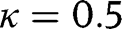 also cannot be rejected.
 - 23
As noted earlier we do not include the exact location of each MFI within a country as an additional attribute due to data limitations. This omission may be introducing some bias in our estimates.
- 24
Models that include region–attribute interactions are estimated with little impact on the main results of the paper. (i.e., The overall impact of these minor differences has little effect on the end results that relate to consumers’ surplus.) These results are available upon request from the authors.
- 25
See appendix for derivation
- 26
Results are similar if we estimate CS using the parameters from a pooled OLS regression of column 2 in Table 6. We do not estimate consumers’ surplus using regressions that control for lending methodology, since the sample of countries that includes these controls is significantly smaller.
- 27
This includes NGOs, banks, credit unions, non-bank financial institutions, rural banks, or other financial institutions.
©2013 by Walter de Gruyter Berlin / Boston
Articles in the same Issue
- Masthead
- Masthead
- Advances
- When Does Inter-School Competition Matter? Evidence from the Chilean “Voucher” System
- Investment, Dynamic Consistency and the Sectoral Regulator’s Objective
- Contributions
- Vertical Contracts and Mandatory Universal Distribution
- Ticket Pricing and Scalping: A Game Theoretical Approach
- Loyalty Discounts
- Age, Human Capital, and the Quality of Work: New Evidence from Old Masters
- Effects of the Endogenous Scope of Preferentialism on International Goods Trade
- Fiscal Decentralization and Environmental Infrastructure in China
- Declining Equivalence Scales and Cost of Children: Evidence and Implications for Inequality Measurement
- Political Parties, Candidate Selection, and Quality of Government
- Professors’ Beauty, Ability, and Teaching Evaluations in Italy
- Pass-through of Per Unit and ad Valorem Consumption Taxes: Evidence from Alcoholic Beverages in France
- The Tuesday Advantage of Politicians Endorsed by American Newspapers
- Topics
- The Effects of Medicaid Earnings Limits on Earnings Growth among Poor Workers
- Opportunities Denied, Wages Diminished: Using Search Theory to Translate Audit-Pair Study Findings into Wage Differentials
- Horizontal Mergers, Firm Heterogeneity, and R&D Investments
- Product Differentiation and Consumer Surplus in the Microfinance Industry
- The Multitude of Alehouses: The Effects of Alcohol Outlet Density on Highway Safety
- Solving the Endogeneity Problem in Empirical Cost Functions: An Application to US Banks
- The Internet, News Consumption, and Political Attitudes – Evidence for Sweden
- A Cross-Cultural Real-Effort Experiment on Wage-Inequality Information and Performance
- Are Students Dropping Out or Simply Dragging Out the College Experience? Persistence at the Six-Year Mark
- The Welfare Effects of Location and Quality in Oligopoly
Articles in the same Issue
- Masthead
- Masthead
- Advances
- When Does Inter-School Competition Matter? Evidence from the Chilean “Voucher” System
- Investment, Dynamic Consistency and the Sectoral Regulator’s Objective
- Contributions
- Vertical Contracts and Mandatory Universal Distribution
- Ticket Pricing and Scalping: A Game Theoretical Approach
- Loyalty Discounts
- Age, Human Capital, and the Quality of Work: New Evidence from Old Masters
- Effects of the Endogenous Scope of Preferentialism on International Goods Trade
- Fiscal Decentralization and Environmental Infrastructure in China
- Declining Equivalence Scales and Cost of Children: Evidence and Implications for Inequality Measurement
- Political Parties, Candidate Selection, and Quality of Government
- Professors’ Beauty, Ability, and Teaching Evaluations in Italy
- Pass-through of Per Unit and ad Valorem Consumption Taxes: Evidence from Alcoholic Beverages in France
- The Tuesday Advantage of Politicians Endorsed by American Newspapers
- Topics
- The Effects of Medicaid Earnings Limits on Earnings Growth among Poor Workers
- Opportunities Denied, Wages Diminished: Using Search Theory to Translate Audit-Pair Study Findings into Wage Differentials
- Horizontal Mergers, Firm Heterogeneity, and R&D Investments
- Product Differentiation and Consumer Surplus in the Microfinance Industry
- The Multitude of Alehouses: The Effects of Alcohol Outlet Density on Highway Safety
- Solving the Endogeneity Problem in Empirical Cost Functions: An Application to US Banks
- The Internet, News Consumption, and Political Attitudes – Evidence for Sweden
- A Cross-Cultural Real-Effort Experiment on Wage-Inequality Information and Performance
- Are Students Dropping Out or Simply Dragging Out the College Experience? Persistence at the Six-Year Mark
- The Welfare Effects of Location and Quality in Oligopoly
