Matrix autoregressive models: generalization and Bayesian estimation
-
Alessandro Celani

 und
Paolo Pagnottoni
und
Paolo Pagnottoni

Abstract
The issue of modelling observations generated in matrix form over time is key in economics, finance and many domains of application. While it is common to model vectors of observations through standard vector time series analysis, original matrix-valued data often reflect different types of structures of time series observations which can be further exploited to model interdependencies. In this paper, we propose a novel matrix autoregressive model in a bilinear form which, while leading to a substantial dimensionality reduction and enhanced interpretability: (a) allows responses and potential covariates of interest to have different dimensions; (b) provides a suitable estimation procedure for matrix autoregression with lag structure; (c) facilitates the introduction of Bayesian estimators. We propose maximum likelihood and Bayesian estimation with Independent-Normal prior formulation, and study the theoretical properties of the estimators through simulated and real examples.
Funding source: Horizon 2020 Framework Programme
Award Identifier / Grant number: 101016233
Acknowledgment
The authors gratefully acknowledges the European Union’s Horizon 2020 research and innovation program “PERISCOPE: Pan European Response to the ImpactS of COVID-19 and future Pandemics and Epidemics”, under the grant agreement No. 101016233, H2020-SC1-PHE-CORONAVIRUS-2020-2-RTD.
-
Author contributions: All the authors have accepted responsibility for the entire content of this submitted manuscript and approved submission.
-
Research funding: None declared.
-
Conflict of interest statement: The authors declare no conflicts of interest regarding this article.
Appendix A: Tensor operations and the Tucker product
A tensor is a multidimensional array, whose order expresses the number of dimensions, also known as ways or modes.[4] More formally, an Nth way tensor is an N dimensional array
Vectors are tensors of order one (denoted by boldface lowercase letters, e.g., x) whereas matrices are tensors of order two (denoted by boldface capital letters, e.g., X).
A.1 Tensor norm and inner product
The Frobenius norm of a tensor
which is analogous to the Frobenious norm of a matrix.
The inner-product of two tensors of the same dimension
A.2 Matricization and Tucker product
The process of reordering the elements of an N-way array into a matrix is called matricization. The nth way matricization of
Given the matrices B
1, …, B
N
with
and eventually forming an [i
1× … ×i
N
] dimensional array
It is worth noting that the matricization operator connects the multidimensional Tucker product to the well known matrix multiplication, facilitating both understanding and computation of the former. In fact, by applying the nth way matricization to both sides of Equation (25) we obtain the equivalent formulation:
where B −n = (B N ⊗ … ⊗ B n+1 ⊗ B n−1 ⊗ … ⊗ B 1). By repeating the operation for n = 1, …, N, it emerges that the Tucker product can be expressed as a series of N matrix reshaping and multiplications. Matricization and vectorization applied to the Tucker product give raise to the following set of equivalences:
The VAR as well as the MAR equivalent form of a TAR can be easily derived with the abovementioned tools.
Appendix B: Competing models
The PVAR in Equation (1) can be written in compact form as:
where Y = [y P+1, …, y T ] and the coefficient matrix B = [Φ 1, …, Φ P ] is of dimension GN × GNP. X = [X P , …, X T−1] where X t = [y t−1, …, y t−P ]. We consider the following competing models:
CC: Canova and Ciccarelli (2009, 2013) use a factorization approach of the parameters such that they can be divided into common, country-specific, and variable-specific factors. They specify the model in a hierarchical structure:
(28)where Λ is an GN × f matrix of loadings and F is an f × 1 vector of factors where f < GN. Under this formulation we have N common factors for coeffcients of each country and, analogously, G common factors for coefficients of each indicators. Regarding the variance hyperparameter, we fix it as
SSVS: George, Sun, and Ni (2008) specify a prior whereby each coefficient of B is drawn from a Mixture of two normal distribution, the former with a small variance aiming at shrink the coefficient towards 0 and the latter with a relatively large one. The higher the magnitude of B ij the higher is the probability that it will be drawn from the second distribution, and viceversa.
(29)with k = 1, …, G 2 N 2 P and where we set
SSSS: This algorithm created by Koop and Korobilis (2016) builds on George, Sun, and Ni (2008) but takes in into account Panel restrictions. They specify three priors based on the possible restrictions: no dynamic interdependencies, no static interdependencies and for homogeneity across coefficient matrices.
The dynamic interdependency works on off-block diagonal blocks. Let B ij ∈ B be the G × G block embodying parameters of country j on country i equations. The prior has the following form:
(30)while the cross-sectional homogeneity prior is set on the main block diagonal of f B. The prior reads as:
(31)where we set
Lasso VAR: is a regression method suited for multivariate models such as the VAR that performs both variable selection and ℓ 1 regularization enhancing the prediction accuracy and model interpretability Rothman, Levina, and Zhu (2010) and Schnücker (2019). It produces a sparse version of B which is solution to the following problem:
(32)
We fix a basic penalty of λ ij = 0.1 if B ij belongs to country block diagonal elements of B and a more restrictive one of λ ij = 0.5 if the parameter is related to the off-block diagonal ones.
Appendix C: Full conditional distribution of γ
Using a gamma prior distribution we have:
thus:
Appendix D: Additional application results
Median of the posterior distribution of C 0 (a) and D 0 (b).
| ARM | M | CO | |
|---|---|---|---|
| (a) | |||
| IR | −0.006 | −0.022 | 0.002 |
| CPI | 0.026 | 0.011 | 0.001 |
| E/I | −0.090 | −0.031 | 0.003 |
| IP | 0.017 | −0.002 | 0.005 |
| RT | 0.064 | 0.032 | 0.006 |
| UN | −0.146 | −0.027 | −0.020 |
| (b) | |||
| CA | 0.005 | 0.007 | −0.022 |
| FR | 0.020 | 0.015 | 0.002 |
| DE | −0.016 | 0.043 | 0.017 |
| IT | 0.031 | −0.009 | −0.001 |
| JP | 0.006 | 0.008 | 0.013 |
| NL | 0.015 | −0.035 | −0.006 |
| ES | 0.057 | −0.018 | −0.001 |
| GB | 0.024 | 0.027 | 0.015 |
| US | −0.002 | 0.004 | −0.010 |
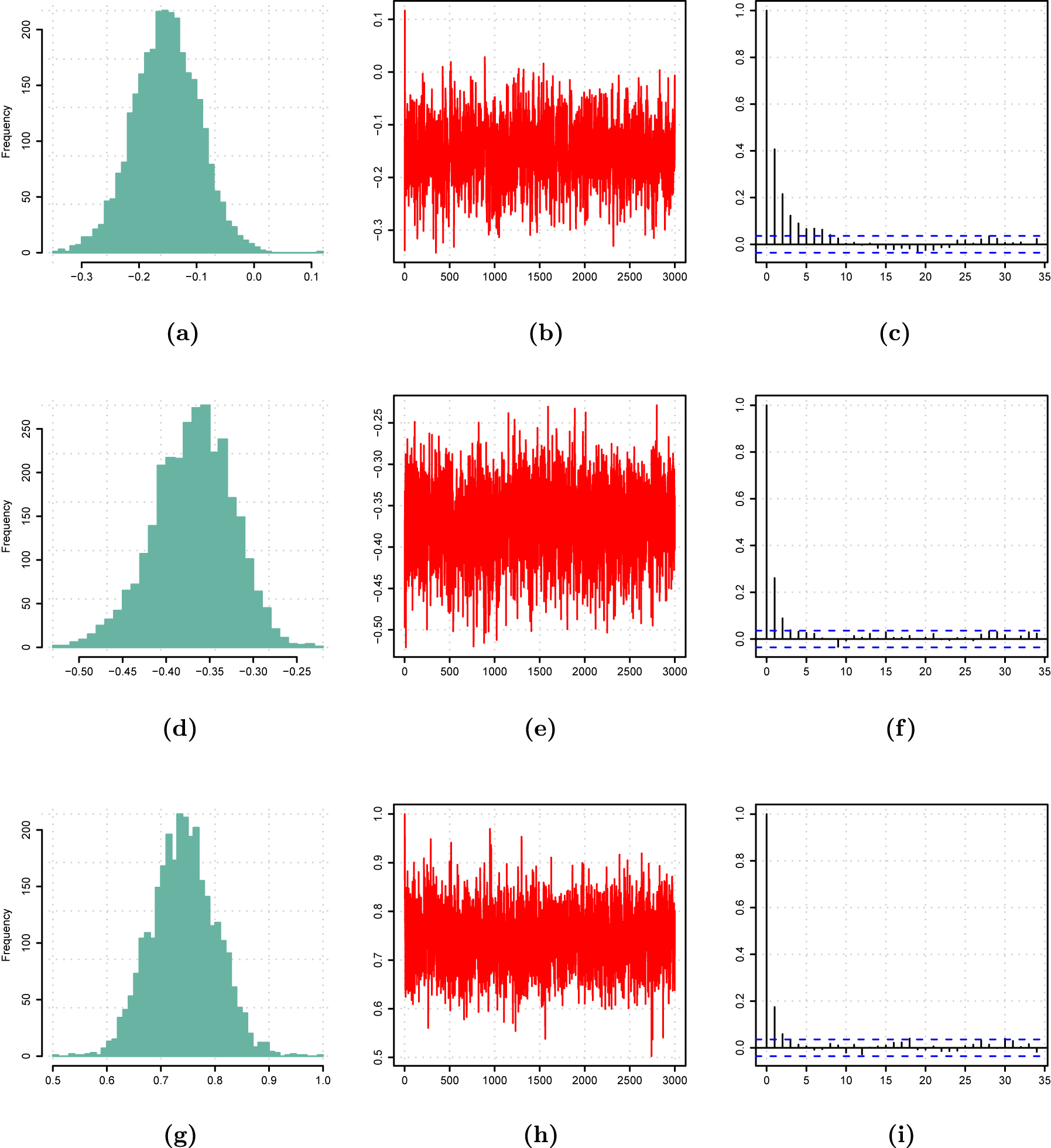
Posterior distribution (left), MCMC output (middle) and autocorrelation function (right) of three randomly selected entries of A 1.
References
Ahelegbey, D., M. Billio, and R. Casarin. 2016a. “Bayesian Graphical Models for Structural Vector Autoregressive Processes.” Journal of Applied Econometrics 31 (2): 357–86. https://doi.org/10.1002/jae.2443.Suche in Google Scholar
Ahelegbey, D. F., M. Billio, and R. Casarin. 2016b. “Sparse Graphical Vector Autoregression: A Bayesian Approach.” Annals of Economics and Statistics (123/124): 333–61. https://doi.org/10.15609/annaeconstat2009.123-124.0333.Suche in Google Scholar
Bai, J., and S. Ng. 2002. “Determining the Number of Factors in Approximate Factor Models.” Econometrica 70 (1): 191–221. https://doi.org/10.1111/1468-0262.00273.Suche in Google Scholar
Bańbura, M., D. Giannone, and L. Reichlin. 2010. “Large Bayesian Vector Auto Regressions.” Journal of Applied Econometrics 25 (1): 71–92. https://doi.org/10.1002/jae.1137.Suche in Google Scholar
Billio, M., R. Casarin, M. Iacopini, and S. Kaufmann. 2023. “Bayesian Dynamic Tensor Regression.” Journal of Business & Economic Statistics 41 (2): 429–39, https://doi.org/10.1080/07350015.2022.2032721.Suche in Google Scholar
Brown, P., and J. Griffin. 2010. “Inference with Normal-Gamma Prior Distributions in Regression Problems.” Bayesian Analysis 5 (1): 171–88. https://doi.org/10.1214/10-ba507.Suche in Google Scholar
Canova, F., and M. Ciccarelli. 2009. “Estimating Multicountry Var Models.” International Economic Review 50 (3): 929–59. https://doi.org/10.1111/j.1468-2354.2009.00554.x.Suche in Google Scholar
Canova, F., and M. Ciccarelli. 2013. “Panel Vector Autoregressive Models: A Survey.” Advances in Econometrics 31: 205–46.10.1108/S0731-9053(2013)0000031006Suche in Google Scholar
Chen, R., H. Xiao, and D. Yang. 2021. “Autoregressive Models for Matrix-Valued Time Series.” Journal of Econometrics 222 (1): 539–60. https://doi.org/10.1016/j.jeconom.2020.07.015.Suche in Google Scholar
Comon, P. 2014. “Tensors: A Brief Introduction.” IEEE Signal Processing Magazine 31 (3): 44–53. https://doi.org/10.1109/msp.2014.2298533.Suche in Google Scholar
Czudaj, R. L. 2019. “Dynamics between Trading Volume, Volatility and Open Interest in Agricultural Futures Markets: A Bayesian Time-Varying Coefficient Approach.” Econometrics and Statistics 12: 78–145. https://doi.org/10.1016/j.ecosta.2019.05.002.Suche in Google Scholar
Durante, D., and D. B. Dunson. 2014. “Bayesian Dynamic Financial Networks with Time-Varying Predictors.” Statistics & Probability Letters 93: 19–26. https://doi.org/10.1016/j.spl.2014.06.015.Suche in Google Scholar
Filippeli, T., R. Harrison, and K. Theodoridis. 2020. “Dsge-based Priors for Bvars and Quasi-Bayesian Dsge Estimation.” Econometrics and Statistics 16: 1–27. https://doi.org/10.1016/j.ecosta.2018.12.002.Suche in Google Scholar
Follett, L., and C. Yu. 2019. “Achieving Parsimony in Bayesian Vector Autoregressions with the Horseshoe Prior.” Econometrics and Statistics 11: 130–44. https://doi.org/10.1016/j.ecosta.2018.12.004.Suche in Google Scholar
Forni, M., M. Hallin, M. Lippi, and L. Reichlin. 2005. “The Generalized Dynamic Factor Model.” Journal of the American Statistical Association 100 (471): 830–40. https://doi.org/10.1198/016214504000002050.Suche in Google Scholar
Gefang, D. 2014. “Bayesian Doubly Adaptive Elastic-Net Lasso for Var Shrinkage.” International Journal of Forecasting 30 (1): 1–11. https://doi.org/10.1016/j.ijforecast.2013.04.004.Suche in Google Scholar
George, E. I., D. Sun, and S. Ni. 2008. “Bayesian Stochastic Search for Var Model Restrictions.” Journal of Econometrics 142 (1): 553–80. https://doi.org/10.1016/j.jeconom.2007.08.017.Suche in Google Scholar
Gong, L., and J. M. Flegal. 2016. “A Practical Sequential Stopping Rule for High-Dimensional Markov Chain Monte Carlo.” Journal of Computational & Graphical Statistics 25 (3): 684–700. https://doi.org/10.1080/10618600.2015.1044092.Suche in Google Scholar
Gupta, A., and D. K. Nagar. 1999. Matrix Variate Distributions, 104. Boca Raton: CRC Press.Suche in Google Scholar
Hoff, P. D. 2015. “Multilinear Tensor Regression for Longitudinal Relational Data.” Annals of Applied Statistics 9 (3): 1169–93. https://doi.org/10.1214/15-aoas839.Suche in Google Scholar PubMed PubMed Central
Hung, H., and W. Chen-Chien. 2012. “Matrix Variate Logistic Regression Model with Application to EEG Data.” Biostatistics 14 (1): 189–202. https://doi.org/10.1093/biostatistics/kxs023.Suche in Google Scholar PubMed
Kock, A., and L. Callot. 2015. “Oracle Inequalities for High Dimensional Vector Autoregressions.” Journal of Econometrics 186 (2): 325–44. https://doi.org/10.1016/j.jeconom.2015.02.013.Suche in Google Scholar
Kolda, T. G., and B. W. Bader. 2009. “Tensor Decompositions and Applications.” SIAM Review 51 (3): 455–500. https://doi.org/10.1137/07070111x.Suche in Google Scholar
Koop, G., and D. Korobilis. 2016. “Model Uncertainty in Panel Vector Autoregressive Models.” European Economic Review 81: 115–31. https://doi.org/10.1016/j.euroecorev.2015.09.006.Suche in Google Scholar
Koop, G., M. Pesaran, and S. M. Potter. 1996. “Impulse Response Analysis in Nonlinear Multivariate Models.” Journal of Econometrics 74 (1): 119–47. https://doi.org/10.1016/0304-4076(95)01753-4.Suche in Google Scholar
Korobilis, D. 2016. “Prior Selection for Panel Vector Autoregressions.” Computational Statistics & Data Analysis 101: 110–20. https://doi.org/10.1016/j.csda.2016.02.011.Suche in Google Scholar
Korobilis, D. 2021. “High-Dimensional Macroeconomic Forecasting Using Message Passing Algorithms.” Journal of Business & Economic Statistics 39 (2): 493–504. https://doi.org/10.1080/07350015.2019.1677472.Suche in Google Scholar
Lai, W.-T., R.-B. Chen, Y. Chen, and T. Koch. 2022. “Variational Bayesian Inference for Network Autoregression Models.” Computational Statistics & Data Analysis 169: 107406. https://doi.org/10.1016/j.csda.2021.107406.Suche in Google Scholar
Lee, N., H. Choi, and S.-H. Kim. 2016. “Bayes Shrinkage Estimation for High-Dimensional Var Models with Scale Mixture of Normal Distributions for Noise.” Computational Statistics & Data Analysis 101: 250–76. https://doi.org/10.1016/j.csda.2016.03.007.Suche in Google Scholar
Li, L., and X. Zhang. 2017. “Parsimonious Tensor Response Regression.” Journal of the American Statistical Association 112 (519): 1131–46. https://doi.org/10.1080/01621459.2016.1193022.Suche in Google Scholar
Loperfido, N. 2017. “A New Kurtosis Matrix, with Statistical Applications.” Linear Algebra and its Applications 512: 1–17. https://doi.org/10.1016/j.laa.2016.09.033.Suche in Google Scholar
Loperfido, N. 2018. “Skewness-based Projection Pursuit: A Computational Approach.” Computational Statistics & Data Analysis 120: 42–57. https://doi.org/10.1016/j.csda.2017.11.001.Suche in Google Scholar
Loperfido, N. 2019. “Finite Mixtures, Projection Pursuit and Tensor Rank: A Triangulation.” Advances in Data Analysis and Classification 13 (1): 145–73. https://doi.org/10.1007/s11634-018-0336-z.Suche in Google Scholar
Lütkepohl, H. 2005. New Introduction to Multiple Time Series Analysis. Berlin: Springer.10.1007/978-3-540-27752-1Suche in Google Scholar
Nardi, Y., and A. Rinaldo. 2011. “Autoregressive Process Modeling via the Lasso Procedure.” Journal of Multivariate Analysis 102 (3): 528–49. https://doi.org/10.1016/j.jmva.2010.10.012.Suche in Google Scholar
Park, T., and G. Casella. 2008. “The Bayesian Lasso.” Journal of the American Statistical Association 103 (482): 681–6. https://doi.org/10.1198/016214508000000337.Suche in Google Scholar
Rothman, A. J., E. Levina, and J. Zhu. 2010. “Sparse Multivariate Regression with Covariance Estimation.” Journal of Computational & Graphical Statistics 19 (4): 947–62. https://doi.org/10.1198/jcgs.2010.09188.Suche in Google Scholar PubMed PubMed Central
Schnücker, A. 2019. “Penalized Estimation of Panel Vector Autoregressive Models.” Econometric Institute Research Papers EI-2019-33. Erasmus University Rotterdam, Erasmus School of Economics (ESE), Econometric Institute.Suche in Google Scholar
Song, S. and P. Bickel. 2011. “Large Vector Auto Regressions.” Papers, arXiv.org.Suche in Google Scholar
Tucker, L. R. 1966. “Some Mathematical Notes on Three-Mode Factor Analysis.” Psychometrika 51: 279–311. https://doi.org/10.1007/bf02289464.Suche in Google Scholar PubMed
Van Loan, C. F. 2000. “The Ubiquitous Kronecker Product.” Journal of Computational and Applied Mathematics 123 (1): 85–100. https://doi.org/10.1016/s0377-0427(00)00393-9.Suche in Google Scholar
Van Loan, C. F., and N. Pitsianis. 1993. Approximation with Kronecker Products, 293–314. Dordrecht: Springer Netherlands.10.1007/978-94-015-8196-7_17Suche in Google Scholar
Vats, D., J. M. Flegal, and G. L. Jones. 2019. “Multivariate Output Analysis for Markov Chain Monte Carlo.” Biometrika 106 (2): 321–37. https://doi.org/10.1093/biomet/asz002.Suche in Google Scholar
Wang, H., and M. West. 2009. “Bayesian Analysis of Matrix Normal Graphical Models.” Biometrika 96 (4): 821–34. https://doi.org/10.1093/biomet/asp049.Suche in Google Scholar PubMed PubMed Central
Wang, D., X. Liu, and R. Chen. 2019. “Factor Models for Matrix-Valued High-Dimensional Time Series.” Journal of Econometrics 208 (1): 231–48. https://doi.org/10.1016/j.jeconom.2018.09.013.Suche in Google Scholar
Zhao, Q., L. Zhang, and A. Cichocki. 2013. “A Tensor-Variate Gaussian Process for Classification of Multidimensional Structured Data.” Proceedings of the AAAI Conference on Artificial Intelligence 27 (1): 1041–7. https://doi.org/10.1609/aaai.v27i1.8568.Suche in Google Scholar
Zhou, H., L. Li, and H. Zhu. 2013. “Tensor Regression with Applications in Neuroimaging Data Analysis.” Journal of the American Statistical Association 108 (502): 540–52. https://doi.org/10.1080/01621459.2013.776499.Suche in Google Scholar PubMed PubMed Central
© 2023 Walter de Gruyter GmbH, Berlin/Boston
Artikel in diesem Heft
- Frontmatter
- Editorial
- Editorial Introduction of the Special Issue of Studies in Nonlinear Dynamics and Econometrics in Honor of Herman van Dijk
- Review
- Challenges and Opportunities for Twenty First Century Bayesian Econometricians: A Personal View
- Research Articles
- Markov-Switching Models with Unknown Error Distributions: Identification and Inference Within the Bayesian Framework
- Dynamic Shrinkage Priors for Large Time-Varying Parameter Regressions Using Scalable Markov Chain Monte Carlo Methods
- Matrix autoregressive models: generalization and Bayesian estimation
- Sequential Monte Carlo with model tempering
- Modeling Corporate CDS Spreads Using Markov Switching Regressions
- Combining Large Numbers of Density Predictions with Bayesian Predictive Synthesis
- Bayesian inference for non-anonymous growth incidence curves using Bernstein polynomials: an application to academic wage dynamics
- Bayesian Reconciliation of Return Predictability
- A Dynamic Latent-Space Model for Asset Clustering
- Posterior Manifolds over Prior Parameter Regions: Beyond Pointwise Sensitivity Assessments for Posterior Statistics from MCMC Inference
- Bayesian Flexible Local Projections
Artikel in diesem Heft
- Frontmatter
- Editorial
- Editorial Introduction of the Special Issue of Studies in Nonlinear Dynamics and Econometrics in Honor of Herman van Dijk
- Review
- Challenges and Opportunities for Twenty First Century Bayesian Econometricians: A Personal View
- Research Articles
- Markov-Switching Models with Unknown Error Distributions: Identification and Inference Within the Bayesian Framework
- Dynamic Shrinkage Priors for Large Time-Varying Parameter Regressions Using Scalable Markov Chain Monte Carlo Methods
- Matrix autoregressive models: generalization and Bayesian estimation
- Sequential Monte Carlo with model tempering
- Modeling Corporate CDS Spreads Using Markov Switching Regressions
- Combining Large Numbers of Density Predictions with Bayesian Predictive Synthesis
- Bayesian inference for non-anonymous growth incidence curves using Bernstein polynomials: an application to academic wage dynamics
- Bayesian Reconciliation of Return Predictability
- A Dynamic Latent-Space Model for Asset Clustering
- Posterior Manifolds over Prior Parameter Regions: Beyond Pointwise Sensitivity Assessments for Posterior Statistics from MCMC Inference
- Bayesian Flexible Local Projections
