A tale of two tool(kit)s: from canonical antonymy to non-canonical opposition in the Qur’anic discourse
-
Hamada Hassanein


Abstract
A number of discourse functions of canonical antonyms have been quantified and classified in English and across languages, each of which is associated with typical syntactic frames. Taking such a classification of canonical antonymy as an analytical toolkit, (Davies, Matt. 2012. A new approach to oppositions in discourse: the role of syntactic frames in the triggering of noncanonical oppositions. Journal of English Linguistics 40(1). 41–73) quantified and qualified the role of these frames in triggering non-canonical oppositions in English news discourse. Synergizing the provisional typologies of canonical antonymy (Hassanein, Hamada. 2018. Discourse functions of opposition in Classical Arabic: The case in ḥadīth genre. Lingua 201. 18–44; Jones, Steven. 2002. Antonymy: A corpus-based perspective. London and New York: Routledge.) and non-canonical opposition (Davies, Matt. 2012. A new approach to oppositions in discourse: the role of syntactic frames in the triggering of noncanonical oppositions. Journal of English Linguistics 40(1). 41–73), this study has sought to develop a dynamic toolkit for the quantitative and qualitative analyses of non-canonical opposition across Arabic varieties and potentially other languages. The toolkit was tested quantitatively and qualitatively against a dataset of 2125 non-canonical oppositional pairs collected from the Qur’an with reference to the Qur’anic Arabic Corpus. Results showed that the syntactic frames which house a wide range of co-occurring canonical antonyms also house a wider range of non-canonical oppositions in binary and trinary representations of abstract and concrete entities. The role of syntactic frames in the triggering of non-canonical oppositions is quantitatively and qualitatively significant for locating and explicating the ideological repercussions of oppositions towards Qur’an interpretation. It is concluded that a synergy of typologies results in a replicable pathway for analysis.
Funding source: Prince Sattam bin Abdulaziz University
Award Identifier / Grant number: PSAU/2023/R/1444
Acknowledgments
I am grateful to PSAU, Saudi Arabia, and Mansoura University, Egypt, for giving me the support to complete this article. A note of thanks is so due to the editor in chief and anonymous reviewers of PSiCL for reshaping and rephrasing my article.
-
Research funding: This study is supported via funding from Prince Sattam bin Abdulaziz University project number (PSAU/2023/R/1444).
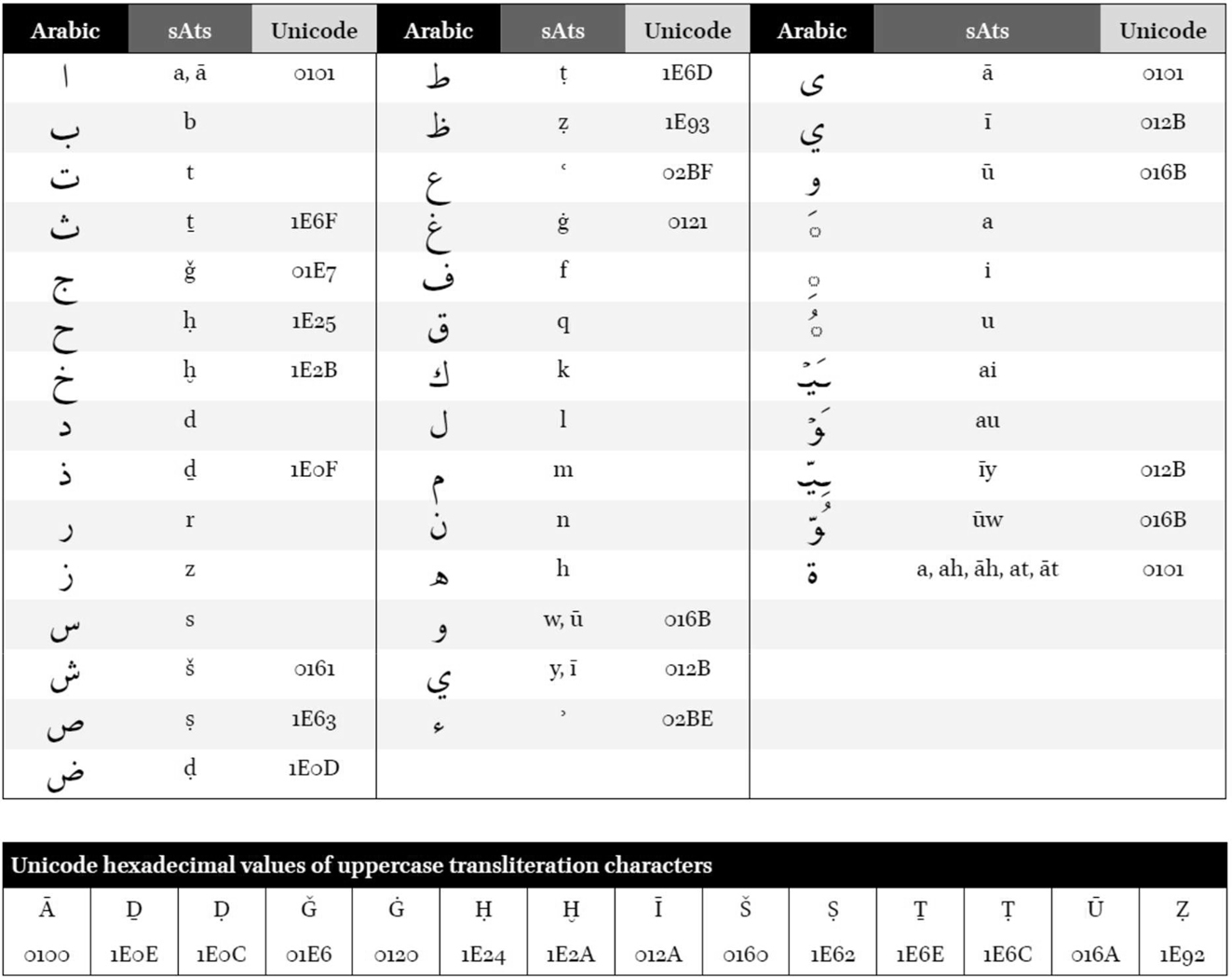
Brill’s simple Arabic transliteration system (Version 1.0, 14 December 2010/Pim Rietbroek)
https://brill.com/fileasset/downloads_static/static_fonts_simple_arabic_transliteration.pdf
References
ʿAbd al-ʿAzīz al-Ǧurǧānī, ʿAlī. 1966. Al-wasāṭah bayna al-Mutanabbī wa-ḫuṣūmih. Cairo: Maṭbaʿat ʿĪsā.Suche in Google Scholar
Abdel Haleem, Muhammad. 2004. The Qur’an: A new translation. Oxford: Oxford University Press.Suche in Google Scholar
Akşehirli, Soner. 2018. Ancillary antonymy in Turkish. Journal of Language Education and Research 4(1). 41–60.Suche in Google Scholar
Al-Buḫārī, Muḥammad. 1981. Ṣaḥīḥ al-Buḫārī. Beirut: Dār al-Fikr.Suche in Google Scholar
AlHedayani, Rukayah. 2016. Antonymy in modern standard Arabic. Sussex: University of Sussex PhD dissertation.Suche in Google Scholar
Al-Ǧammās, Niʿam. 2002. Al-ṭibāq fī al-Qurʾān al-karīm: Dirāsah balāġiyyah. Mosul: University of Mosul MA thesis.Suche in Google Scholar
Al-Qarṭāǧannī, Ḥāzim. 2008. Minhāǧ al-bulaġāʾ wa-sirāǧ al-ʾudabāʾ. Beirut: Dār al-Ġarb al-ʾIslāmī.Suche in Google Scholar
Al-Ṣiʿīdī, ʿAbd al-Mutaʿāl. 1991. Al-balāġa al-ʿāliya: ʿIlm al-maʿānī, 2nd edn. Cairo: Maktabat al-ʾĀdāb.Suche in Google Scholar
Al-Zamaḫšarī, Abū al-Qāsim. 1998. Al-kaššāf, 1st edn. Riyadh: Maktabat al-ʿUbaykān.Suche in Google Scholar
Cruse, Alan. 1986. Lexical semantics. Cambridge: Cambridge University Press.Suche in Google Scholar
Cruse, Alan. 2000. Meaning in language: An introduction to semantics and pragmatics. Cambridge: Cambridge University Press.Suche in Google Scholar
Cruse, Alan. 2006. A glossary of semantics and pragmatics. Edinburgh: Edinburgh University Press.10.1515/9780748626892Suche in Google Scholar
Davies, Matt. 2012. A new approach to oppositions in discourse: The role of syntactic frames in the triggering of noncanonical oppositions. Journal of English Linguistics 40(1). 41–73. https://doi.org/10.1177/0075424210385206.Suche in Google Scholar
Davies, Matt. 2013. Oppositions and ideology in news discourse. London: Bloomsbury.Suche in Google Scholar
Dawson, Catherine. 2009. Introduction to research methods: A practical guide for anyone undertaking a research project, 4th edn. Oxford: How To Content.Suche in Google Scholar
Dent, Susie. 2005. Fanboys and overdogs: The language report. Oxford: Oxford University Press.Suche in Google Scholar
Famian, Ali. 2014. Discourse function of lexical antonymy in Persian language. Language and Linguistics 10(19). 55–74.Suche in Google Scholar
Fellbaum, Christiane. 1995. Co-occurrence and antonymy. International Journal of Lexicography 8(4). 281–303. https://doi.org/10.1093/ijl/8.4.281.Suche in Google Scholar
Gheltofan, Daniela. 2013. Functional categories of antonymy in Romanian. Paper presented at the Second International Colloquium Communication and Culture in European Romania (CICCRE II), Szeged, 24–25 September.Suche in Google Scholar
Hassanein, Hamada. 2013. The lexical semantics of antonymy in the Qur’an: A linguistic study. Benha: Benha University PhD dissertation.Suche in Google Scholar
Hassanein, Hamada. 2018. Discourse functions of opposition in Classical Arabic: The case in ḥadīth genre. Lingua 201. 18–44. https://doi.org/10.1016/j.lingua.2017.08.009.Suche in Google Scholar
Hassanein, Hamada. 2020a. Ten paradigms of ancillary antonymy: Evidence from classical Arabic. Bulletin of the Faculty of Arts 80(8). 35–95.Suche in Google Scholar
Hassanein, Hamada. 2020b. Identical twins, different wombs: A literature review on attiba:q in Arabic and antonymy in English. International Journal of Arabic-English Studies 2(2). 7–40.10.33806/ijaes2000.20.2.1Suche in Google Scholar
Hassanein, Hamada. 2021. Oppositions in Arabic proverbs: A lexicosyntactic perspective. GEMA Online® Journal of Language Studies 21(4). 1–20. https://doi.org/10.17576/gema-2021-2104-01.Suche in Google Scholar
Hassanein, Hamada & Mohammad Mahzari. 2021. A taxonomy of antonymy in Arabic: Egyptian and Saudi proverbs in comparison. Open Linguistics 7(1). 200–222. https://doi.org/10.1515/opli-2021-0013.Suche in Google Scholar
Hassanein, Hamada. 2022. Translating semantic cases from Qur’anic Arabic into English. Journal of Intercultural Communication Research 51(1). 58–78. https://doi.org/10.1080/17475759.2021.2001357.Suche in Google Scholar
Hassanein, Hamada. 2023. Toward a new typology of al-ṭibāq “antonymy” in Qur’anic Arabic. Al-‘Arabiyya 55-56. 1–45. in press.Suche in Google Scholar
Hurford, James, Brendan Heasley & Michael Smith. 2007. Semantics: A coursebook, 2nd edn. Cambridge: Cambridge University Press.10.1017/CBO9780511841668Suche in Google Scholar
Hautli-Janisz, Annette, Katarzyna Budzynska, Conor McKillop, Brian Plüss, Valentin Gold & Chris Reed. 2022. Questions in argumentative dialogue. Journal of Pragmatics 188. 56–79. https://doi.org/10.1016/j.pragma.2021.10.029.Suche in Google Scholar
Holes, Clive. 2004. Modern Arabic: Structures, functions and varieties. Washington, DC: Georgetown University Press.Suche in Google Scholar
Hsu, Chan-Chia. 2015. A syntagmatic analysis of antonym co-occurrences in Chinese: Contrastive constructions and co-occurrence sequences. Corpora 10(1). 47–82. https://doi.org/10.3366/cor.2015.0066.Suche in Google Scholar
Hussein, Miri. 2008. The discourse marker ‘But’ in English and standard Arabic: One procedure and different implementations. Kashmir Journal of Language Research 11(1). 44–63.Suche in Google Scholar
Ibn ʿĀšūr, al-Ṭāhir. 1984. Tafsīr al-taḥrīr wa al-tanwīr. Tunis: al-Dār al-Tūnisiyyah lil-Našr.Suche in Google Scholar
Jones, Steven. 2002. Antonymy: A corpus-based perspective. London & New York: Routledge.10.4324/9780203166253Suche in Google Scholar
Jones, Steven & Lynne Murphy. 2005. Using corpora to investigate antonym acquisition. International Journal of Corpus Linguistics 10(3). 401–422. https://doi.org/10.1075/ijcl.10.3.06jon.Suche in Google Scholar
Jones, Steven. 2006. A lexico-syntactic analysis of antonym co-occurrence in spoken English. Text & Talk 26(2). 191–216. https://doi.org/10.1515/text.2006.009.Suche in Google Scholar
Jones, Steven. 2007. ‘Opposites’ in discourse: A comparison of antonym use across four domains. Journal of Pragmatics 39. 1105–1119. https://doi.org/10.1016/j.pragma.2006.11.019.Suche in Google Scholar
Jones, Steven, Lynne Murphy, Carita Paradis & Caroline Willners. 2012. Antonyms in English: Construals, constructions and canonicity. Cambridge: Cambridge University Press.10.1017/CBO9781139032384Suche in Google Scholar
Kostić, Nataša. 2011. Antonymous frameworks in Serbian written discourse: Phrasal contexts of antonym co-occurrence in text. Poznan Studies in Contemporary Linguistics 47(3). 509–537. https://doi.org/10.2478/psicl-2011-0027.Suche in Google Scholar
Lawson, Todd. 2008. Duality, opposition and typology in the Qur’an: The apocalyptic substrate. Journal of Qur’anic Studies 2. 23–49. https://doi.org/10.3366/e1465359109000400.Suche in Google Scholar
Leech, Geoffrey & Mick Short. 2007. Style in fiction: A linguistic introduction to English fictional prose, 2nd edn. Harlow: Pearson.Suche in Google Scholar
Lobanova, Anna, Tom van der Kleij & Jennifer Spenader. 2010. Defining antonymy: A corpus-based study of opposites by lexico-syntactic patterns. International Journal of Lexicography 23(1). 19–53. https://doi.org/10.1093/ijl/ecp039.Suche in Google Scholar
Loewen, Shawn & Luke Plonsky. 2016. An A–Z of applied linguistics research methods. London: Palgrave.10.1007/978-1-137-40322-3Suche in Google Scholar
Lyons, John. 1977. Semantics. Cambridge: Cambridge University Press.Suche in Google Scholar
Mettinger, Arthur. 1994. Aspects of semantic opposition in English. Oxford: Oxford University Press.10.1093/oso/9780198242697.001.0001Suche in Google Scholar
Mikołajczak-Matyja, Nawoja. 2021. Functions of a pair of lexemes man and woman in sentences from the National Corpus of Polish and their application in research on gender stereotypes. PRACE JĘZYKOZNAWCZE XXIII(3). 115–131. https://doi.org/10.31648/pj.6840.Suche in Google Scholar
Mohammadi, Mandana, Ali Reza, Gholi Famian, Ferdows Aghagolzadeh & Azita Afrashi. 2019. Discourse functions of lexical antonymy in Persian language. Scientific Journal of Language Research 11(30). 149–177.Suche in Google Scholar
Muehleisen, Victoria. 1997. Antonymy and semantic range in English. Evanston: Northwestern University PhD dissertation.Suche in Google Scholar
Muehleisen, Victoria & Maho Isono. 2009. Antonymous adjectives in Japanese discourse. Journal of Pragmatics 41(11). 2185–2203. https://doi.org/10.1016/j.pragma.2008.09.037.Suche in Google Scholar
Murphy, Lynne. 2003. Semantic relations and the lexicon: Antonymy, synonymy, and other paradigms. Cambridge: Cambridge University Press.10.1017/CBO9780511486494Suche in Google Scholar
Murphy, Lynne & Steven Jones. 2008. Antonyms in children’s and child-directed speech. First Language 28(4). 403–430. https://doi.org/10.1177/0142723708091047.Suche in Google Scholar
Murphy, Lynne. 2009. Antonymy and incompatibility. In Keith Brown & Keith Alan (eds.), Concise encyclopaedia of semantics, 25–28. Amsterdam: Elsevier.Suche in Google Scholar
Murphy, Lynne, Carita Paradis, Caroline Willners & Steven Jones. 2009. Discourse functions of antonymy: A cross-linguistic investigation of Swedish and English. Journal of Pragmatics 41(11). 2159–2184. https://doi.org/10.1016/j.pragma.2008.09.040.Suche in Google Scholar
Najjar, Ibrahim & Kais Kadhim. 2022. The English Translation of the intra-sententially repeated Quranic conjunctive particle ‘Wa’. Asia Pacific Translation and Intercultural Studies 9(1). 47–58. https://doi.org/10.1080/23306343.2022.2042781.Suche in Google Scholar
Paradis, Carita, Caroline Willners & Steven Jones. 2009. Good and bad opposites: Using textual and experimental techniques to measure antonym canonicity. The Mental Lexicon 4(3). 380–429. https://doi.org/10.1075/ml.4.3.04par.Suche in Google Scholar
Rasinger, Sebastian. 2013. Quantitative research in linguistics: An introduction, 2nd edn. London: Bloomsbury.10.5040/9781350284883Suche in Google Scholar
Ritella, Giuseppe, Antti Rajala & Renshaw Peter. 2021. Using chronotope to research the space-time relations of learning and education: Dimensions of the unit of analysis. Learning, Culture and Social Interaction 31(B). 1–7.10.1016/j.lcsi.2020.100381Suche in Google Scholar
Steffens, Marie. 2018. Antonymic discourse functions and manipulation: A corpus analysis of present-day French. Corpus Pragmatics 2. 313–332. https://doi.org/10.1007/s41701-018-0036-0.Suche in Google Scholar
Wright, William. 1974. A grammar of the Arabic language. Beirut: Lebanon Library.Suche in Google Scholar
Wurmbrand, Susi. 2008. Nor: Neither disjunction nor paradox. Linguistic Inquiry 39(3). 511–522. https://doi.org/10.1162/ling.2008.39.3.511.Suche in Google Scholar
© 2023 Walter de Gruyter GmbH, Berlin/Boston
Artikel in diesem Heft
- Frontmatter
- Research Articles
- The production of English monophthong vowels by Saudi L2 speakers
- Cartographic architecture of DP
- Parasitic gap patterns and hierarchy preservation in German
- Marking and breaking phraseology in English and Polish: a comparative corpus-informed study
- A tale of two tool(kit)s: from canonical antonymy to non-canonical opposition in the Qur’anic discourse
- The role of lexical context and language experience in the perception of foreign-accented segments
- From verb to epistemic marker: bini in Hamedanian Persian
Artikel in diesem Heft
- Frontmatter
- Research Articles
- The production of English monophthong vowels by Saudi L2 speakers
- Cartographic architecture of DP
- Parasitic gap patterns and hierarchy preservation in German
- Marking and breaking phraseology in English and Polish: a comparative corpus-informed study
- A tale of two tool(kit)s: from canonical antonymy to non-canonical opposition in the Qur’anic discourse
- The role of lexical context and language experience in the perception of foreign-accented segments
- From verb to epistemic marker: bini in Hamedanian Persian
