Iron and aluminum substitution mechanism in the perovskite phase in the system MgSiO3-FeAlO3-MgO
-
 ,
and
,
and

Abstract
Fe,Al-bearing MgSiO3 perovskite (bridgmanite) is considered to be the most abundant mineral in Earth’s lower mantle, hosting ferric iron in its structure as charge-coupled (Fe2O3 and FeAlO3) and vacancy components (MgFeO2.5 and Fe2/3SiO3). We examined concentrations of ferric iron and aluminum in the perovskite phase as a function of temperature (1700–2300 K) in the MgSiO3-FeAlO3-MgO system at 27 GPa using a multi-anvil high-pressure apparatus. We found a LiNbO3-structured phase in the quenched run product, which was the perovskite phase under high pressures and high temperatures. The perovskite phase coexists with corundum and a phase with (Mg,Fe3+,□)(Al,Fe3+)2O4 composition (□= vacancy). The FeAlO3 component in the perovskite phase decreases from 69 to 65 mol% with increasing temperature. The Fe2O3 component in the perovskite phase remains unchanged at ~1 mol% with temperature. The A-site vacancy component of Fe2/3SiO3 in the perovskite phase exists as 1–2 mol% at 1700–2000 K, whereas 1 mol% of the oxygen vacancy component of MgFeO2.5 appears at higher temperatures, although the analytical errors prevent definite conclusions. The A-site vacancy component might be more important than the oxygen vacancy component for the defect chemistry of bridgmanite in slabs and for average mantle conditions when the FeAlO3 charge-coupled component is dominant.
Introduction
MgSiO3 perovskite (bridgmanite) is the most abundant phase in Earth’s lower mantle and incorporates Al and Fe by substituting for Si and Mg. The flexible substitution in bridgmanite produces a wide range of compositional variations depending on pressure-temperature-composition conditions. Although the oxidation state in the lower mantle is considered to be below the iron-wüstite buffer (Frost and McCammon 2008), large amounts of ferric iron are expected in bridgmanite due to charge disproportionation of iron (3 FeO → Fe2O3 + Fe) when aluminum is present (Lauterbach et al. 2000; Frost et al. 2004; Irifune et al. 2010; Huang et al. 2021).
McCammon et al. (1997) reported an increased ferric iron content with increasing Al in pyroxene diamond inclusions with composition (Mg,Fe,Al)(Si,Al)O3, considered to be derived from bridgmanite. Lauterbach et al. (2000) experimentally also found a positive correlation between Fe3+ and Al. These studies suggest that iron favors the ferric state in bridgmanite by mainly forming the FeAlO3 charge-coupled component, making it a major component in bridgmanite.
The FeAlO3 component can significantly affect the properties of bridgmanite. For example, incorporating FeAlO3 decreases the bulk modulus and increases the density (e.g., Boffa Ballaran et al. 2012) and electrical conductivity (e.g., Yoshino et al. 2016).
The FeAlO3 component also affects Mg-Fe partitioning between bridgmanite and other lower-mantle ferromagnesian minerals in peridotite and basalt (e.g., Frost and Langenhorst 2002; Irifune et al. 2010). Thus, understanding the FeAlO3 component in bridgmanite is essential to argue the structure and dynamics of the lower mantle.
There are other minor components in bridgmanite. Experiments in the ternary systems of MgO- SiO2-Al2O3 and MgO-SiO2- Fe2O3 demonstrated that the oxygen vacancy components such as MgAlO2.5 and MgFeO2.5 are included in bridgmanite (Navrotsky et al. 2003; Kojitani et al. 2007; Liu et al. 2017a; Fei et al. 2020; Ishii et al. 2022a). Oxygen vacancy-bearing bridgmanite should be more compressible than stoichiometric bridgmanite. In addition, an A-site vacancy component of
Liu et al. (2020) investigated the chemistry of the perovskite phase in the MgSiO3-FeSiO3-Fe2O3-Al2O3 system at 27 GPa and 2000 K. They observed 65 mol% of FeAlO3 with a few percent of the oxygen vacancy and A-site vacancy components of MgFeO2.5 and Fe2/3SiO3, respectively, using samples with ferrous iron up to 25%. However, the temperature and pressure dependence of the chemistry of the perovskite phase in these systems is still unknown.
This study investigated the temperature dependence on the chemistry of the perovskite phase in the ferrous iron-free system MgO-MgSiO3-FeAlO3 at 27 GPa and 1700–2300 K using a multi-anvil apparatus. Excess MgO was added to explore the substitution mechanism in mantle assemblages with Mg/Si > 1, such as peridotite.
Experimental procedures
Starting material and high-pressure experiments
A mixture of MgSiO3 enstatite, Mg2SiO4 forsterite, Al2O3 corundum, and Fe2O3 hematite with mole proportions of 5:20:37.5:37.5, respectively, was used as a starting material. By following Ishii et al. (2018a, 2019a), the enstatite and forsterite samples were synthesized by dissolving Mg metal in a solution of HNO3 plus pure water, mixing it with tetraethylorthosilicate [(CH3CH2O)4Si] at Mg/Si ratios of 1 and 2 for enstatite and forsterite, respectively, adding ammonia to the solutions, and heating the resulting gels stepwise to 1700 K. Reagent grades of Al2O3 and Fe2O3 were dried at 773 K for 24 h before weighing.
High pressure-high temperature syntheses were performed at 27 GPa and 1700, 2000, and 2300 K for 2–20 h using IRIS-15, a 15-MN Kawai-type multi-anvil press with an Osugi-type guide block system installed at the Bayerisches Geoinstitut, University of Bayreuth (Ishii et al. 2016, 2019b). The starting material was packed in a Pt-tube capsule, closed with two Pt lids. To avoid the reduction of Fe3+ to Fe2+, which was observed by Liu et al. (2020), an IrO2 oxidizer was also put at the bottom of the capsule, separating it from the sample using a Pt foil. A Cr-doped MgO octahedron with 7 mm edge lengths was used as a pressure medium. A cylindrical LaCrO3 heater was inserted into the center of the octahedron. An MgO sleeve was placed in the heater to insulate the sample capsule from the heater electrically. Sample temperatures were measured at the surface of the capsule using a W97%Re3%–W75%Re25% thermocouple. The ceramic parts of the cell assemblies were kept at 1273 K for more than 3 h in an oven and taken out just before assembling them. The sample was always kept at 427 K in an oven and taken out just before assembling. The truncation size of the inner anvils was 3.0 mm. The sample was first compressed to 2 GPa (0.3 MN) at room temperature and heated to 600 K at a rate of 100 °C/min. These conditions were kept for 1~2 h to purge adhesive water in the sample and cell components. The assembly was then cooled to room temperature, compressed to 27 GPa (13 MN), and heated to the desired temperature at a rate of 100 °C/min. After keeping the target temperature, the sample was quenched by shutting off the electric power supply of the heater and slowly decompressed for 12–15 h.
To estimate a generated pressure of 27 GPa at 13 MN, we employed a pressure dependence of the alumina content in MgSiO3 bridgmanite coexisting with corundum together with the decomposition pressure of pyrope to bridgmanite plus corundum (Hirose et al. 2001; Liu et al. 2017b) in separate runs. Pressure calibration has been generally performed using phase boundaries of compounds determined by in situ X-ray diffraction in a multi-anvil press. However, there is no such pressure calibrant to cover the present pressure range (>27 GPa) (Ito 2015). Hirose and Fei (2002) calibrated pressures to 27 GPa using Al2O3 content in bridgmanite reported by Hirose et al. (2001). Liu et al. (2017b) extended the pressure range to 52 GPa with more systematic data, and therefore the present calibration to estimate 27 GPa is most reliable for the time being. Our recent study reproduced 27.1(5) GPa at 13 MN using the same calibrant in the same multi-anvil press (Ishii et al. 2022b), supporting the validity of the present way.
Sample characterization
Phases in the recovered samples were identified using a micro-focused X-ray diffractometer (Bruker, D8 DISCOVER) operated at 40 kV and 500 μA equipped with a two-dimensional solid-state detector (VÅNTEC500) and a micro-focus source (IμS) of CoKα radiation. Phase compositions were measured using an electron microprobe analyzer (EPMA) with wavelength-dispersive spectrometers (JEOL, JXA-8200), operated at an accelerating voltage and probe current of 15 kV and 15 nA, respectively. The standards for Mg and Si, Al, and Fe were natural enstatite, synthetic corundum, and synthetic hematite, respectively. Sample textures were observed using a field-emission-type scanning electron microscope (SEM) (Zeiss LEO 1530 Gemini) with a detector for backscattered electron (BSE) imaging and an energy-dispersive X-ray spectrometer (Oxford X-MaxN).
Iron valence ratios in the recovered samples were determined by Mössbauer spectroscopy. The recovered samples were polished to 150 μm thickness. Mössbauer spectra were obtained at room temperature (293 K) in transmission mode on a constant acceleration Mössbauer spectrometer with a nominal 370 MBq 57Co high specific activity source in a 12 μm thick Rh matrix (McCammon et al. 1991; McCammon 1994). The velocities in all spectra were calibrated using a reference spectrum of a 25 μm thick α-Fe foil certified by National Bureau of Standards (now referred to as the National Institute of Standards and Technology, standard reference material no. 1541) at room temperature. Spectra were collected for 1–2 days and fitted with the full transmission integral using MossA software (Prescher et al. 2012).
Results and Discussion
Tables 1 and 2 summarize experimental conditions, phases present, and chemical compositions of each sample. Figure 1 illustrates the room-temperature Mössbauer spectrum of the sample synthesized at 27 GPa and 2000 K. The hyperfine parameters for Mössbauer spectra of the bulk recovered samples obtained by fitting are also summarized in Table 1. Figures 2 and 3, respectively, show a representative X-ray diffraction (XRD) pattern and backscattered electron (BSE) images of the recovered samples. We applied heating durations of 2–20 h at 1700–2300 K, in which the sample annealed at 2300 K employed only 2 h (Table 1). Many phase-relation studies on multi-component systems such as pyrolite and basaltic crust compositions by multi-anvil press showed chemically homogeneous phases at 2000–2300 K even heated for 2 h or less (Ono et al. 2001; Hirose and Fei 2002; Ishii et al. 2011, 2012, 2018b, 2019c, 2022b). In fact, the well-crystallized texture and homogeneous chemical compositions of the recovered phases (Tables 1 and 2; Fig. 3) suggest reaching equilibrium in the present heating durations at the pressure-temperature conditions used.

Room-temperature Mössbauer spectrum of the recovered sample synthesized at 27 GPa and 2000 K. The red-shaded area is assigned to non-magnetic Fe3+. The gray shaded area is assigned to weakly magnetic Fe3+. Spectra of samples quenched from 1700 and 2300 K contain only non-magnetic Fe3+. (Color online.)

X-ray diffraction pattern of the recovered sample synthesized at 27 GPa and 2000 K. Stars indicate possible peaks of (Mg,Al,Fe3+)O4 post-spinel phase (see text). LN = lithium niobate phase. (Color online.)
Experimental conditions, phase assemblages, and chemical compositions of recovered bridgmanite
| Run no. | I-1003 | I-969 | I-991 |
| T (K) | 1700 | 2000 | 2300 |
| Heating duration (h) | 20 | 13 | 2 |
| Phases | LN+Crn+PS | LN+Crn+PS | LN+Crn+PS |
| n | 8 | 9 | 12 |
| Composition (wt%) | |||
| MgO | 9.44(37) | 9.95(30) | 10.91(38) |
| SiO2 | 14.74(62) | 15.62(50) | 15.59(47) |
| Al2O3 | 29.05(58) | 28.40(35) | 27.18(61) |
| Fe2O3 | 47.61(82) | 46.32(65) | 45.21(73) |
| Total | 100.85(130) | 100.26(122) | 98.89(148) |
| Composition (pfu) (O = 3) | |||
| Mg | 0.284(9) | 0.300(6) | 0.333(9) |
| Si | 0.298(14) | 0.315(8) | 0.319(6) |
| Al | 0.691(6) | 0.676(5) | 0.656(9) |
| Fe | 0.723(8) | 0.704(10) | 0.697(12) |
| Cation total | 1.996(7) | 1.995(3) | 2.005(4) |
| Mole fraction | |||
| MgSiO3 | 28(1) | 30(1) | 32(1) |
| FeAlO3 | 69(1) | 68(1) | 65(1) |
| Fe2O3 | 1.2(9) | 0.9(11) | 1.3(18) |
| Fe3+ 2/3SiO3 | 1.4(1.7) | 1.6(10) | N |
| MgFeO2.5 | N | N | 1.4(11) |
| Fe3+/ΣFe | 100(5) | 100(3) | 100(5) |
| Hyperfine parameters | |||
| CS for Fe3+ | 0.33(1) | 0.319(5)a | 0.32(1) |
| QS for Fe3+ | 0.92(2) | 0.895(5) | 0.92(2) |
| FWHM | 0.48(4) | 0.36(2) | 0.47(4) |
-
Notes: LN = LiNbO3-type phase; Crn = corundum; PS =
1. All Al is combined with corresponding amount of Fe3+ to form the FeAlO3 component.
2. The A-site vacancy, corresponding to 1/3 of the A-site, is used to allocate Fe and Si to the
3. The O-vacancy corresponding to 0.5 of the MgFe3+O2.5 component forms the basis for the allocation of Fe and Mg.
4. The rest of Fe is allocated to the Fe2O3 component.
5. The rest of Mg and Si is allocated to the MgSiO3 component.
a Broad, weak magnetic Fe3+ component with CS = 0.1(1) mm/s was also observed in the fitting (see Fig. 1).
Chemical compositions of recovered post-spinel phases and corundum
| Post-spinel phase, I-1003 (27 GPa, 1700 K), n = 9 | |||||
| Oxide wt% | MgO 21.32(31) | SiO2 0.86(22) | Al2O3 29.93(52) | Fe2O3 45.69(35) | Total 97.81(46) |
| Cation number (O = 4) | Mg 0.921(13) | Si 0.025(6) | Al 1.022(15) | Fe3+ 0.996(10) | Total 2.965(5) |
| Post-spinel phase, I-969 (27 GPa, 2000 K), n = 8 | |||||
| Oxide wt% | MgO 22.73(38) | SiO2 0.75(4) | Al2O3 30.39(60) | Fe2O3 45.05(48) | Total 98.93(73) |
| Cation number (O = 4) | Mg 0.968(9) | Si 0.022(1) | Al 1.024(14) | Fe3+ 0.969(15) | Cation 2.982(3) |
| Corundum, I-969 (27 GPa, 2000 K), n = 6 | |||||
| Oxide wt% | MgO 4.20(10) | SiO2 6.19(27) | Al2O3 73.84(56) | Fe2O3 14.80(56) | Total 99.03(65) |
| Cation number (O = 3) | Mg 0.113(3) | Si 0.112(5) | Al 1.574(12) | Fe3+ 0.201(7) | Cation 2.000(1) |
| Post-spinel phase, I-991 (27 GPa, 2300 K), n = 8 | |||||
| Oxide wt% | MgO 21.19(18) | SiO2 1.64(9) | Al2O3 30.44(41) | Fe2O3 44.48(41) | Total 97.75(55) |
| Cation number (O = 4) | Mg 0.910(1) | Si 0.047(2) | Al 1.033(11) | Fe3+ 0.964(5) | Cation 2.954(3) |
| Corundum, I-991 (27 GPa, 2300 K), n = 6 | |||||
| Oxide wt% | MgO 3.73(4) | SiO2 5.24(17) | Al2O3 74.27(77) | Fe2O3 14.49(32) | Total 97.72(92) |
| Cation number (O = 3) | Mg 0.102(1) | Si 0.096(3) | Al 1.604(4) | Fe3+ 0.200(3) | Cation 2.002(1) |
Note: n = number of analyzed points. Numbers in parentheses indicate one standard deviations of the mean in the analyses.

Backscattered electron images of recovered samples at 27 GPa and 1700–2300 K. White grains are platinum from the platinum capsule after polishing. LN = lithium niobate phase; Crn = corundum; PS = (Mg,Al,Fe3+)O4 post-spinel phase.
Ferric iron contents
Mössbauer spectra of the bulk recovered samples can be fitted to one doublet, although one broad peak was also detected only on sample I-969 (Fig. 1). The hyperfine parameters of the center shift and quadrupole splitting are 0.32–0.33 mm/s and 0.90–0.93 mm/s, respectively, which are in good agreement with those of Fe3+ in bridgmanite and the LiNbO3-structured phases (Fei et al. 1994; McCammon et al. 2004; Hummer and Fei 2012; Liu et al. 2020; Huang et al. 2021). The broad peak of sample I-969 can be assigned to a weakly magnetic Fe3+ component. All observed peaks were thus assigned to Fe3+, showing Fe3+/ΣFe = 100% in all samples.
Phase identification
Most XRD peaks were assigned to a LiNbO3-structured phase (Fig. 2), known as a back-transformed phase from a perovskite phase (Leinenweber et al. 1991; Akaogi et al. 2017; Ishii et al. 2017a; Liu et al. 2020). Liu et al. (2020) reported that the MgSiO3-bearing perovskite phase with more than 40% of FeAlO3 was recovered as a lithium-niobate phase at ambient conditions. Therefore, the chemistry of the LiNbO3-structured phase should represent that of the perovskite-structured phase under high pressure-temperature conditions. Hereafter, we refer to this phase as the perovskite phase when discussing the crystal chemistry at high pressure and high temperature.
The BSE images showed three phases with different textures and contrasts in addition to the LiNbO3-structured phase. One is a Mg,Al,Fe-rich phase with grain-crack texture. Its main components are MgAl2O4 and MgFe2O4, implying that this phase may be one of the
Compositions of the perovskite phase
The component fractions in the ABO3±δ perovskite phase were estimated using EPMA and Mössbauer data based on the following assumptions: (1) Al and Fe3+ produce the most charge-coupled component of FeAlO3. The remaining trivalent cations are referred to as T. (2) When the cation-oxygen ratio is smaller than 2:3, the A-site cation-vacancy component T2/3SiO3 is considered. When greater, the oxygen vacancy component MgTO2.5 is considered. (3) The remaining T produces the charge-coupled component TTO3. (4) The remaining Mg2+ and Si4+ produce the MgSiO3 component.
Figure 4 shows the changes in components of the perovskite phase with temperature obtained by the above procedure. Fe3+ and Al3+ ions dominate, resulting in the dominant component FeAlO3. This component slightly decreases with increasing temperature from 69 to 65 mol%. The second major component is MgSiO3, which increases with increasing temperature from 28 to 32 mol%. Thus, the perovskite phase in the present system can be approximated by a MgSiO3-FeAlO3 solid solution. Liu et al. (2020) reported that the perovskite phase synthesized at 27 GPa and 2000 K in the MgSiO3-FeSiO3-Fe2O3-Al2O3 system without excess MgO has 63–65 mol% of the FeAlO3 component. These values are slightly smaller than the present study (67 mol% at 2000 K), probably because Fe3+ in their perovskite phase (11–15%) was slightly reduced to Fe2+ to form some Fe2+SiO3 components. We observed 1~2 mol% of the A-site vacancy component of
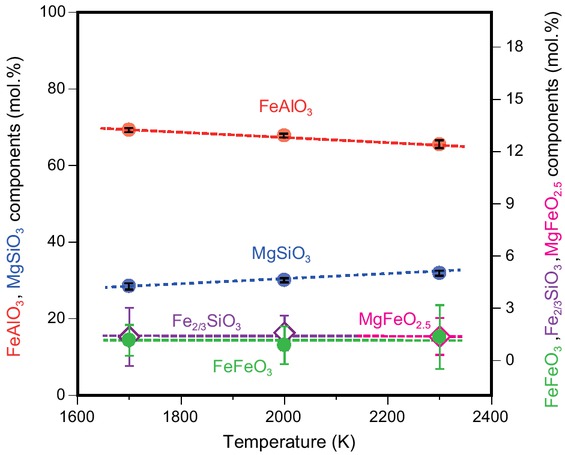
Solubility of MgSiO3, FeAlO3, Fe2O3, Fe2/3SiO3, and MgFeO2.5 components in the perovskite-structured phase at 27 GPa as a function of temperature. (Color online.)
Compositions of the associated phases
As mentioned above, we found two phases associated with the LiNbO3-structured phase, i.e., the PS phase and corundum. The primary composition of the PS phase can be expressed as MgAl2O4-MgFe2O4. However, there are extra ferric irons. Such extra Fe3+ should produce an A-site vacancy component Fe2/3Fe2O4 because the total cation number is <3 for four oxygen atoms. This component is the third most abundant, representing 5–13 mol% of the phase. This phase also has a minor component of Mg2SiO4 (2–5 mol%) because of the small amounts of SiO2 (0.8–1.6 wt%). The limited Si contents are typical in PS-related oxides, supporting the phase identification as a PS phase (Ishii et al. 2017b, 2018d; Akaogi et al. 2018; Uenver-Thiele et al. 2018). Thus, the compositions of the PS phase can be expressed as (Mg,Fe3+,□)(Al,Fe)2O4 (□= vacancy), and is almost independent of the temperature.
The composition of corundum is expressed as Al2O3-MgSiO3- Fe2O3, as mentioned above. There appears to be almost no temperature dependence, although composition at 1700 K is unknown due to the exceedingly small grain sizes (≤~1 μm) for EPMA analysis. The Al2O3, MgSiO3, and Fe2O3 contents are 80, 10, and 10 mol%, respectively.
Reaction controlling the chemistry of the perovskite phase
The present system essentially has four chemical components: MgO, Fe2O3, Al2O3, and SiO2. On the other hand, the number of phases is three: perovskite phase, an
The resulting equilibrium reaction may be:
The coincident decrease and increase in FeAlO3 and MgSiO3 components, respectively, with temperature (Fig. 4) suggest that the entropy change with this reaction is slightly positive.
Implications
The oxygen-vacancy components MgAlO2.5 and MgFeO2.5 have been proposed to exist in bridgmanite in the systems MgO-SiO2-Al2O3 and MgO-SiO2-Fe2O3, respectively (Liu et al. 2017a; Fei et al. 2020). The oxygen vacancy components should increase compressibility. Also, they possibly reduce the creep strength of bridgmanite, suggesting a viscosity contrast compared with the mantle containing stoichiometric bridgmanite (Liu et al. 2017a; Reali et al. 2019). Our study demonstrates that the vacancy component changes from A-site cation vacancy to oxygen vacancy with increasing temperature. Thus, the oxygen vacancy components are expected to be present in high-temperature regions such as plumes (White and McKenzie 1995). On the other hand, our results also suggest that the A-site cation vacancy should be more stable in relatively low-temperature regions such as subducted slabs.
These vacancy components should dominate in shallower regions of the lower mantle, namely the mid-mantle, due to their low density (Liu et al. 2017a). Although the proportions of vacancy components are small, percent-order vacancies should be enough to soften mineral strength (Reali et al. 2019). Therefore, the vacancy components would soften the mid-mantle to enhance mantle dynamics and geochemical circulation. Slab penetration and stagnation in the mid-mantle (Fukao and Obayashi 2013) and plumes becoming invisible by seismic tomography (French and Romanowicz 2015) may reflect the lower viscosity of the mid-mantle compared to deeper regions.
Vacancy in bridgmanite may also play an important role in incorporating water as OH groups in its crystal structure, which has significant importance for the geochemical evolution of the mantle. The oxygen vacancy component of MgAlO2.5 may accommodate water based on the following reaction: MgAlO2.5 + ½H2O → MgAlHO3 (e.g., Navrotsky 1999). The oxygen vacancy component of MgFe3+O2.5 would allow the incorporation of water in the same manner. The A-site vacancy component of
However, the pressure dependence of the vacancy components has not been investigated. Such a study requires a wide pressure range, which is impossible using conventional multi-anvil technology. On the other hand, no percent-order vacancy components can be detected by diamond anvil experiments due to relatively large chemical heterogeneity. Therefore, future experiments will focus on exploring the pressure dependence of vacancy concentrations to provide better constraints on their influence on lower mantle dynamics. Our ultrahigh-pressure multi-anvil technology (Ishii et al. 2016, 2017c, 2019b, 2022b) provides the best possibility to investigate pressure dependence, and we will tackle this task in the next study.
Acknowledgments and Funding
We thank H. Fischer and R. Njul for the preparation of cell assemblies and thin-section samples for Mössbauer measurements, respectively. We are also grateful to R.G. Tronnes and O. Müntener for their constructive comments. We thank two anonymous reviewers for their fruitful comments. This work was funded by research projects approved by the European Research Council (ERC) under the European Union’s Horizon 2020 research and innovation programme (Proposal No. 787 527) to T. Katsura and the German Research Foundation (DFG) grant (IS350/1-1) to T. Ishii. The NSFC National Key Research Major Research Plan on West-Pacific Earth System Multispheric Interactions (grant 92158206 to T. Ishii.) also supported this work.
References cited
Akaogi, M., Abe, K., Yusa, H., Ishii, T., Tajima, T., Kojitani, H., Mori, D., and Inaguma, Y. (2017) High-pressure high-temperature phase relations in FeTiO3 up to 35 GPa and 1600 °C. Physics and Chemistry of Minerals, 44, 63–73, https://doi.org/10.1007/s00269-016-0836-3.Search in Google Scholar
Akaogi, M., Kawahara, A., Kojitani, H., Yoshida, K., Anegawa, Y., and Ishii, T. (2018) High-pressure phase transitions in MgCr2O4·Mg2SiO4 composition: Reactions between olivine and chromite with implications for ultrahigh-pressure chromitites. American Mineralogist. American Mineralogist, 103, 161–170, https://doi.org/10.2138/am-2018-6135.Search in Google Scholar
Boffa Ballaran, T., Kurnosov, A., Glazyrin, K., Frost, D.J., Merlini, M., Hanfland, M., and Caracas, R. (2012) Effect of chemistry on the compressibility of silicate perovskite in the lower mantle. Earth and Planetary Science Letters, 333–334, 181–190, https://doi.org/10.1016/j.epsl.2012.03.029.Search in Google Scholar
Bindi, L., Sirotkina, E., Bobrov, A.V., and Irifune, T. (2014) X-ray single-crystal structural characterization of MgCr2O4, a post-spinel phase synthesized at 23 GPa and 1600° C. Journal of Physics and Chemistry of Solids, 75, 638–641, https://doi.org/10.1016/j.jpcs.2014.01.008.Search in Google Scholar
Fei, Y., Virgo, D., Mysen, B.O., Wang, Y., and Mao, H.K. (1994) Temperature-dependent electron delocalization in (Mg,Fe)SiO3 perovskite. American Mineralogist, 79, 826–837.Search in Google Scholar
Fei, H., Liu, Z., McCammon, C., and Katsura, T. (2020) Oxygen vacancy substitution linked to ferric iron in bridgmanite at 27 GPa. Geophysical Research Letters, 47(6), e2019GL086296.Search in Google Scholar
French, S.W. and Romanowicz, B. (2015) Broad plumes rooted at the base of the Earth’s mantle beneath major hotspots. Nature, 525, 95–99, https://doi.org/10.1038/nature14876.Search in Google Scholar
Frost, D.J. and Langenhorst, F. (2002) The effect of Al2O3 on Fe-Mg partitioning between magnesiowüstite and magnesium silicate perovskite. Earth and Planetary Science Letters, 199, 227–241, https://doi.org/10.1016/S0012-821X(02)00558-7.Search in Google Scholar
Frost, D.J. and McCammon, C.A. (2008) The redox state of Earth’s mantle. Annual Review of Earth and Planetary Sciences, 36, 389–420, https://doi.org/10.1146/annurev.earth.36.031207.124322.Search in Google Scholar
Frost, D.J., Liebske, C., Langenhorst, F., McCammon, C.A., Trønnes, R.G., and Rubie, D.C. (2004) Experimental evidence for the existence of iron-rich metal in the Earth’s lower mantle. Nature, 428, 409–412, https://doi.org/10.1038/nature02413.Search in Google Scholar
Fukao, Y. and Obayashi, M. (2013) Subducted slabs stagnant above, penetrating through, and trapped below the 660 km discontinuity. Journal of Geophysical Research. Solid Earth, 118, 5920–5938, https://doi.org/10.1002/2013JB010466.Search in Google Scholar
Funamori, N., Jeanloz, R., Nguyen, J.H., Kavner, A., Caldwell, W.A., Fujino, K., Miyajima, N., Shinmei, T., and Tomioka, N. (1998) High-pressure transformations in MgAl2O4. Journal of Geophysical Research, 103, (B9), 20813–20818, https://doi.org/10.1029/98JB01575.Search in Google Scholar
Hirose, K. and Fei, Y. (2002) Subsolidus and melting phase relations of basaltic composition in the uppermostlower mantle. Geochimica et Cosmochimica Acta, 66, 2099–2108, https://doi.org/10.1016/S0016-7037(02)00847-5.Search in Google Scholar
Hirose, K., Fei, Y., Ono, S., Yagi, T., and Funakoshi, K. (2001) In situ measurements of the phase transition boundary in Mg3Al2Si3O12: Implications for the nature of the seismic discontinuities in the Earth’s mantle. Earth and Planetary Science Letters, 184, 567–573, https://doi.org/10.1016/S0012-821X(00)00354-X.Search in Google Scholar
Huang, R., Boffa Ballaran, T., McCammon, C.A., Miyajima, N., Dolejš, D., and Frost, D.J. (2021) The composition and redox state of bridgmanite in the lower mantle as a function of oxygen fugacity. Geochimica et Cosmochimica Acta, 303, 110–136, https://doi.org/10.1016/j.gca.2021.02.036.Search in Google Scholar
Hummer, D.R. and Fei, Y. (2012) Synthesis and crystal chemistry of Fe3+-bearing (Mg,Fe3+)(Si,Fe3+) O3 perovskite. American Mineralogist, 97, 1915–1921, https://doi.org/10.2138/am.2012.4144.Search in Google Scholar
Irifune, T., Shinmei, T., McCammon, C.A., Miyajima, N., Rubie, D.C., and Frost, D.J. (2010) Iron partitioning and density changes of pyrolite in Earth’s lower mantle. Science, 327, 193–195 https://doi.org/10.1126/science.1181443.Search in Google Scholar
Ishii, T., Kojitani, H., and Akaogi, M. (2011) Post-spinel transitions in pyrolite and Mg2SiO4 and akimotoite-perovskite transition in MgSiO3: Precise comparison by high-pressure high-temperature experiments with multi-sample cell technique. Earth and Planetary Science Letters, 309, 185–197, https://doi.org/10.1016/j. epsl.2011.06.023.Search in Google Scholar
——— (2012) High-pressure phase transitions and subduction behavior of continental crust at pressure–temperature conditions up to the upper part of the lower mantle. Earth and Planetary Science Letters, 357–358, 31–41, https://doi.org/10.1016/j. epsl.2012.09.019.Search in Google Scholar
Ishii, T., Kojitani, H., Tsukamoto, S., Fujino, K., Mori, D., Inaguma, Y., Tsujino, N., Yoshino, T., Yamazaki, D., Higo, Y., and others. (2014) High-pressure phase transitions in FeCr2O4 and structure analysis of new post-spinel FeCr2O4 and Fe2Cr2O5 phases with meteoritical and petrological implications. American Mineralogist, 99, 1788–1797, https://doi.org/10.2138/am.2014.4736.Search in Google Scholar
Ishii, T., Kojitani, H., Fujino, K., Yusa, H., Mori, D., Inaguma, Y., Matsushita, Y., Yamaura, K., and Akaogi, M. (2015) High-pressure high-temperature transitions in MgCr2O4 and crystal structures of new post-spinel MgCr2O4 and Mg2Cr2O5 phases. American Mineralogist, 100, 59–65, https://doi.org/10.2138/am-2015-4818.Search in Google Scholar
Ishii, T., Shi, L., Huang, R., Tsujino, N., Druzhbin, D., Myhill, R., Li, Y., Wang, L., Yamamoto, T., Miyajima, N., and others. (2016) Generation of pressures over 40 GPa using Kawai-type multi-anvil press with tungsten carbide anvils. The Review of Scientific Instruments, 87, 024501, https://doi.org/10.1063/1.4941716.Search in Google Scholar
Ishii, T., Sinmyo, R., Komabayashi, T., Boffa Ballaran, T., Kawazoe, T., Miyajima, N., Hirose, K., and Katsura, T. (2017a) Synthesis and crystal structure of LiNbO3-type Mg3Al2Si3O12: A possible indicator of shock conditions of meteorites. American Mineralogist. American Mineralogist, 102, 1947–1952, https://doi.org/10.2138/am-2017-6027.Search in Google Scholar
Ishii, T., Tsujino, N., Arii, H., Fujino, K., Miyajima, N., Kojitani, H., Kunimoto, T., and Akaogi, M. (2017b) A shallow origin of so-called ultrahigh-pressure chromitites, based on single-crystal X-ray structure analysis of the high-pressure Mg2Cr2O5 phase, with modified ludwigite-type structure. American Mineralogist. American Mineralogist, 102, 2113–2118, https://doi.org/10.2138/am-2017-6050.Search in Google Scholar
Ishii, T., Yamazaki, D., Tsujino, N., Xu, F., Liu, Z., Kawazoe, T., Yamamoto, T., Druzhbin, D., Wang, L., Higo, Y., and others. (2017c) Pressure generation to 65 GPa in a Kawai-type multi-anvil apparatus with tungsten carbide anvils. High Pressure Research, 37, 507–515, https://doi.org/10.1080/08957959.2017.1375491.Search in Google Scholar
Ishii, T., Huang, R., Fei, H., Koemets, I., Liu, Z., Maeda, F., Yuan, L., Wang, L., Druzhbin, D., Yamamoto, T., and others. (2018a) Complete agreement of the post-spinel transition with the 660-km seismic discontinuity. Scientific Reports, 8, 6358, https://doi.org/10.1038/s41598-018-24832-y.Search in Google Scholar
Ishii, T., Kojitani, H., and Akaogi, M. (2018b) Phase relations and mineral chemistry in pyrolitic mantle at 1600–2200° C under pressures up to the uppermost lower mantle: Phase transitions around the 660-km discontinuity and dynamics of upwelling hot plumes. Physics of the Earth and Planetary Interiors, 274, 127–137, https://doi.org/10.1016/j.pepi.2017.10.005.Search in Google Scholar
Ishii, T., Sakai, T., Kojitani, H., Mori, D., Inaguma, Y., Matsushita, Y., Yamaura, K., and Akaogi, M. (2018c) High-pressure phase relations and crystal structures of postspinel phases in MgV2O4, FeV2O4, and MnCr2O4: Crystal chemistry of AB2O4 postspinel compounds. Inorganic Chemistry, 57, 6648–6657, https://doi.org/10.1021/acs.inorgchem.8b00810.Search in Google Scholar
Ishii, T., Uenver-Thiele, L., Woodland, A.B., Alig, E., and Boffa Ballaran, T. (2018d) Synthesis and crystal structure of Mg-bearing Fe9O11: New insight in the complexity of Fe-Mg oxides at conditions of the deep upper mantle. American Mineralogist. Journal of Earth and Planetary Materials, 103, 1873–1876.Search in Google Scholar
Ishii, T., Huang, R., Myhill, R., Fei, H., Koemets, I., Liu, Z., Maeda, F., Yuan, L., Wang, L., Druzhbin, D., and others. (2019a) Sharp 660-km discontinuity controlled by extremely narrow binary post-spinel transition. Nature Geoscience, 12, 869–872, https://doi.org/10.1038/s41561-019-0452-1.Search in Google Scholar
Ishii, T., Liu, Z., and Katsura, T. (2019b) A breakthrough in pressure generation by a Kawai-type multi-anvil apparatus with tungsten carbide anvils. Engineering (Beijing), 5, 434–440, https://doi.org/10.1016/j.eng.2019.01.013.Search in Google Scholar
Ishii, T., Kojitani, H., and Akaogi, M. (2019c) Phase relations of Harzburgite and MORB up to the uppermost lower mantle conditions: Precise comparison with Pyrolite by multisample cell high-pressure experiments with implication to dynamics of subducted slabs. Journal of Geophysical Research. Solid Earth, 124, 3491–3507, https://doi.org/10.1029/2018JB016749.Search in Google Scholar
Ishii, T., Miyajima, N., Sinmyo, R., Kojitani, H., Mori, D., Inaguma, Y., and Akaogi, M. (2020) Discovery of new structured post-spinel MgFe2O4: Crystal structure and high-pressure phase relations. Geophysical Research Letters, 47(6), e2020GL087490.Search in Google Scholar
Ishii, T., Criniti, G., Bykova, E., Dubrovinsky, L., Katsura, T., Arii, H., Kojitani, H., and Akaogi, M. (2021) High-pressure syntheses and crystal structure analyses of a new low-density I2O4-related and CaTi2O4-type MgAl2O4 phases. American Mineralogist. Journal of Earth and Planetary Materials, 106, 1105–1112.Search in Google Scholar
Ishii, T., Ohtani, E., and Shatskiy, A. (2022a) Aluminum and hydrogen partitioning between bridgmanite and high-pressure hydrous phases: Implications for water storage in the lower mantle. Earth and Planetary Science Letters, 583, 117–441, https://doi.org/10.1016/j.epsl.2022.117441.Search in Google Scholar
Ishii, T., Miyajima, N., Criniti, G., Hu, Q., Glazyrin, K., and Katsura, T. (2022b) High pressure-temperature phase relations of basaltic crust up to mid-mantle conditions. Earth and Planetary Science Letters, 584, 117–472, https://doi.org/10.1016/j. epsl.2022.117472.Search in Google Scholar
Ismailova, L., Bykova, E., Bykov, M., Cerantola, V., McCammon, C., Boffa Ballaran, T., Bobrov, A., Sinmyo, R., Dubrovinskaia, N., Glazyrin, K., and others. (2016) Stability of Fe,Al-bearing bridgmanite in the lower mantle and synthesis of pure Fe-bridgmanite. Science Advances, 2, e1600427, https://doi.org/10.1126/sciadv.1600427.Search in Google Scholar
Ito, E. (2015) Multi-anvil cells and high-pressure experimental methods. In G. Schubert, Ed., Treatise on geophysics. 2nd ed., vol. 2, 233–261. Elsevier.Search in Google Scholar
Kojitani, H., Katsura, T., and Akaogi, M. (2007) Aluminum substitution mechanisms in perovskite-type MgSiO3: An investigation by Rietveld analysis. Physics and Chemistry of Minerals, 34, 257–267, https://doi.org/10.1007/s00269-007-0144-z.Search in Google Scholar
Kubo, A. and Akaogi, M. (2000) Post-garnet transitions in the system Mg4Si4O12– Mg3Al2Si3O12 up to 28 GPa: Phase relations of garnet, ilmenite and perovskite. Physics of the Earth and Planetary Interiors, 121, 85–102, https://doi.org/10.1016/S0031-9201(00)00162-X.Search in Google Scholar
Lauterbach, S., McCammon, C.A., Van Aken, P., Langenhorst, F., and Seifert, F. (2000) Mössbauer and ELNES spectroscopy of (Mg, Fe)(Si, Al)O3 perovskite: A highly oxidised component of the lower mantle. Contributions to Mineralogy and Petrology, 138, 17–26, https://doi.org/10.1007/PL00007658.Search in Google Scholar
Leinenweber, K., Utsumi, W., Tsuchida, Y., Yagi, T., and Kurita, K. (1991) Unquenchable high-pressure perovskite polymorphs of MnSnO3 and FeTiO3. Physics and Chemistry of Minerals, 18, 244–250, https://doi.org/10.1007/BF00202576.Search in Google Scholar
Liu, Z., Ishii, T., and Katsura, T. (2017a) Rapid decrease of MgAlO2.5 component in bridgmanite with pressure. Geochemical Perspectives Letters, 5, 12–18, https://doi.org/10.7185/geochemlet.1739.Search in Google Scholar
Liu, Z., Nishi, M., Ishii, T., Fei, H., Miyajima, N., Boffa Ballaran, T., Ohfuji, H., Sakai, T., Wang, L., Shcheka, S., and others. (2017b) Phase relations in the system MgSiO3- Al2O3 up to 2300 K at lower mantle pressures. Journal of Geophysical Research. Solid Earth, 122, 7775–7788, https://doi.org/10.1002/2017JB014579.Search in Google Scholar
Liu, Z., McCammon, C., Wang, B., Dubrovinsky, L., Ishii, T., Bondar, D., Nakajima, A., Tange, Y., Higo, Y., Cui, T., and others. (2020) Stability and solubility of the FeAlO3 component in bridgmanite at uppermost lower mantle conditions. Journal of Geophysical Research. Solid Earth, 125, e2019JB018447, https://doi.org/10.1029/2019JB018447.Search in Google Scholar
McCammon, C.A. (1994) A Mössbauer milliprobe: Practical considerations. Hyperfine Interactions, 92, 1235–1239, https://doi.org/10.1007/BF02065761.Search in Google Scholar
McCammon, C.A., Chaskar, V., and Richards, G.G. (1991) A technique for spatially resolved Mossbauer spectroscopy applied to quenched metallurgical slags. Measurement Science & Technology, 2, 657, https://doi.org/10.1088/0957-0233/2/7/014.Search in Google Scholar
McCammon, C., Hutchison, M., and Harris, J. (1997) Ferric iron content of mineral inclusions in diamonds from Sao Luiz: A view into the lower mantle. Science, 278, 434–436, https://doi.org/10.1126/science.278.5337.434.Search in Google Scholar
McCammon, C.A., Lauterbach, S., Seifert, F., Langenhorst, F., and Van Aken, P.A. (2004) Iron oxidation state in lower mantle mineral assemblages: I. Empirical relations derived from high-pressure experiments. Earth and Planetary Science Letters, 222, 435–449, https://doi.org/10.1016/j.epsl.2004.03.018.Search in Google Scholar
Navrotsky, A. (1999) A lesson from ceramics. Science, 284, 1788–1789, https://doi.org/10.1126/science.284.5421.1788.Search in Google Scholar
Navrotsky, A., Schoenitz, M., Kojitani, H., Xu, H., Zhang, J., Weidner, D.J., and Jeanloz, R. (2003) Aluminum in magnesium silicate perovskite: Formation, structure, and energetics of magnesium-rich defect solid solutions. Journal of Geophysical Research. Solid Earth, 108, (B7), https://doi.org/10.1029/2002JB002055.Search in Google Scholar
Ono, S., Ito, E., and Katsura, T. (2001) Mineralogy of subducted basaltic crust (MORB) from 25 to 37 GPa, and chemical heterogeneity of the lower mantle. Earth and Planetary Science Letters, 190, 57–63, https://doi.org/10.1016/S0012-821X(01)00375-2.Search in Google Scholar
Prescher, C., McCammon, C., and Dubrovinsky, L. (2012) MossA: A program for analyzing energy-domain Mössbauer spectra from conventional and synchrotron sources. Journal of Applied Crystallography, 45, 329–331, https://doi.org/10.1107/S0021889812004979.Search in Google Scholar
Reali, R., Van Orman, J.A., Pigott, J.S., Jackson, J.M., Boioli, F., Carrez, P., and Cordier, P. (2019) The role of diffusion-driven pure climb creep on the rheology of bridgmanite under lower mantle conditions. Scientific Reports, 9, 2053, https://doi.org/10.1038/s41598-018-38449-8.Search in Google Scholar
Uenver-Thiele, L., Woodland, A.B., Miyajima, N., Boffa Ballaran, T., and Frost, D.J. (2018) Behaviour of Fe4O5-Mg2Fe2O5 solid solutions and their relation to coexisting Mg-Fe silicates and oxide phases. Contributions to Mineralogy and Petrology, 173, 20, https://doi.org/10.1007/s00410-018-1443-8.Search in Google Scholar
White, R.S. and McKenzie, D. (1995) Mantle plumes and flood basalts. Journal of Geophysical Research, 100 (B9), 17543–17585, https://doi.org/10.1029/95JB01585.Search in Google Scholar
Yoshino, T., Kamada, S., Zhao, C., Ohtani, E., and Hirao, N. (2016) Electrical conductivity model of Al-bearing bridgmanite with implications for the electrical structure of the Earth’s lower mantle. Earth and Planetary Science Letters, 434, 208–219, https://doi.org/10.1016/j.epsl.2015.11.032.Search in Google Scholar
© 2023 Takayuki Ishii, Catherine McCammon, and Tomoo Katsura, published by Mineralogical Society of America
This work is licensed under the Creative Commons Attribution-NonCommercial-NoDerivatives 4.0 International License.
Articles in the same Issue
- Mineralogy and geochemistry of hot spring deposits at Námafjall, Iceland: Analog for sulfate soils at Gusev crater, Mars
- The iron spin transition of deep nitrogen-bearing mineral Fe3N1.2 at high pressure
- Hydrogen occupation and hydrogen-induced volume expansion in Fe0.9Ni0.1Dx at high P-T conditions
- Volumes and spin states of FeHx: Implication for the density and temperature of the Earth’s core
- Thermodynamic characterization of synthetic lead-arsenate apatites with different halogen substitutions
- Structural changes in shocked tektite and their implications to impact-induced glass formation
- Characterization of vandenbrandeite: A potential alteration product of spent nuclear fuel
- The NaCl-CaCO3 and NaCl-MgCO3 systems at 6 GPa: Link between saline and carbonatitic diamond forming melts
- Single-crystal elasticity of (Al,Fe)-bearing bridgmanite up to 82 GPa
- Single-crystal X-ray diffraction of fluorapatite to 61 GPa
- Iron and aluminum substitution mechanism in the perovskite phase in the system MgSiO3-FeAlO3-MgO
- Ultrasonic studies of alkali-rich hydrous silicate glasses: Elasticity, density, and implications for water dissolution mechanisms
- Gadolinium-dominant monazite and xenotime: Selective hydrothermal enrichment of middle REE during low-temperature alteration of uraninite, brannerite, and fluorapatite (the Zimná Voda REE-U-Au quartz vein, Western Carpathians, Slovakia)
- Nucleation of Th-rich cerianite on halloysite surface in a regolith-hosted rare earth elements deposit in South China
- Presentation of the Dana Medal of the Mineralogical Society of America for 2022 to Cin-Ty Lee
- Acceptance of the Dana Medal of the Mineralogical Society of America for 2022
- Presentation of the Mineralogical Society of America Award for 2022 to Benjamin M. Tutolo
- Acceptance of the Mineralogical Society of America Award for 2022
- Presentation of the 2022 Roebling Medal of the Mineralogical Society of America to John W. Valley
- Acceptance of the 2022 Roebling Medal of the Mineralogical Society of America
- New Mineral Names
- Book Review
Articles in the same Issue
- Mineralogy and geochemistry of hot spring deposits at Námafjall, Iceland: Analog for sulfate soils at Gusev crater, Mars
- The iron spin transition of deep nitrogen-bearing mineral Fe3N1.2 at high pressure
- Hydrogen occupation and hydrogen-induced volume expansion in Fe0.9Ni0.1Dx at high P-T conditions
- Volumes and spin states of FeHx: Implication for the density and temperature of the Earth’s core
- Thermodynamic characterization of synthetic lead-arsenate apatites with different halogen substitutions
- Structural changes in shocked tektite and their implications to impact-induced glass formation
- Characterization of vandenbrandeite: A potential alteration product of spent nuclear fuel
- The NaCl-CaCO3 and NaCl-MgCO3 systems at 6 GPa: Link between saline and carbonatitic diamond forming melts
- Single-crystal elasticity of (Al,Fe)-bearing bridgmanite up to 82 GPa
- Single-crystal X-ray diffraction of fluorapatite to 61 GPa
- Iron and aluminum substitution mechanism in the perovskite phase in the system MgSiO3-FeAlO3-MgO
- Ultrasonic studies of alkali-rich hydrous silicate glasses: Elasticity, density, and implications for water dissolution mechanisms
- Gadolinium-dominant monazite and xenotime: Selective hydrothermal enrichment of middle REE during low-temperature alteration of uraninite, brannerite, and fluorapatite (the Zimná Voda REE-U-Au quartz vein, Western Carpathians, Slovakia)
- Nucleation of Th-rich cerianite on halloysite surface in a regolith-hosted rare earth elements deposit in South China
- Presentation of the Dana Medal of the Mineralogical Society of America for 2022 to Cin-Ty Lee
- Acceptance of the Dana Medal of the Mineralogical Society of America for 2022
- Presentation of the Mineralogical Society of America Award for 2022 to Benjamin M. Tutolo
- Acceptance of the Mineralogical Society of America Award for 2022
- Presentation of the 2022 Roebling Medal of the Mineralogical Society of America to John W. Valley
- Acceptance of the 2022 Roebling Medal of the Mineralogical Society of America
- New Mineral Names
- Book Review
