Ethnosemantic analysis of binary oppositions in toposystems
-
Zhanar M. Konyratbayeva
 ,
Ordaly Konyratbayev
,
Ordaly Konyratbayev

Abstract
The article considers regional issues of the Kazakh transtoposystem. There are a number of problematic issues related to cross-border Kazakh toponymy. The article analyzes only one aspect – the status of binary names in the cross-border toposystem. The goal is to study how obvious the binary opposition is there, considering the etymology of toponyms based on semantic opposition. The toposystem of the Northern and Western regions bordering Russia was used as the empirical material for the study. According to the border administrative-regional division, a number of districts of such regions of the country as North Kazakhstan, Pavlodar, Kostanay, Western Kazakhstan, Aktobe, and Atyrau border with Russia. In the article, a series of binary names along the toponyms of this cross-border zone is formed. In particular, Úlken-Kіshі (Big-Small), Aq-Qara (Black-White), Qara-Sary (Black-Yellow), Jaqsy-Jaman (Good-Bad), Jyly-Sýyq (Warm-Cold), and Ashy-Tushy (Bitter-Fresh) are analyzed. The difference between toponymic binary names and lexical antonyms is considered. We discuss the fact that the contradiction in lexical antonyms is clearly expressed, but in binary opposition along toponyms, the contradiction may not be complete. It is reported that the contradiction of toponyms is recognized only in the toponymic context, and sometimes it is even possible to form a related pair, rather than a semantic contradiction.
1 Introduction
The system of regional onyms as a complex linguistic-social, cultural-historical layer is considered from different angles in every field of science. In particular, as an integral part of the field of onomastics, solving general and particular language problems, it has a great opportunity to reflect the true image of society at every stage. “The purpose of onomastic studies related to a particular region is to determine the features of names in a particular region and/or the relationship of these names with neighboring and even remote regions. Regional onomastic studies provide valuable materials in the designation and fixation of onymic areas and their types” (Podolskaya 1988).
Each of the onomastic spaces of the regions of Kazakhstan has its own distinguishing features. Depending on the location and the historical and social conditions, the linguistic landscape of each region is formed differently (Zakirova et al. 2023). It is a matter of common knowledge that the formation and development of the onymic system of regions and their structure is influenced by various social factors at different levels. When studying the dynamics of onomastic development of each region (North-South, West-East), we can see how many names have influenced the cultural and social life of the population of the region. This is because onyms are a language layer that, by its very nature, preserves informality and sociality rather than appeal. Onyms serve a crucial function in faithfully conveying the linguistic essence of a specific historical era or world.
The toposystem of the Northern and Western regions of Kazakhstan on the border with Russia, on the one hand, has a special character as a space consisting of different ethnic groups; on the other hand, the political and ideological background is an onymic layer consisting of dense historical processes. It is noteworthy that the onomastic space of these regions is “multi-layered”: it has such features as pre-revolutionary suffixes, the policy of power in the Soviet period, and the restoration of the former name during the years of independence. Among them, the influence of the Soviet period is particularly strongly absorbed, because it is known from history that the Soviet authorities maintained their special “position” on almost all cultural and historical sites called the Soviet zone (Kulumzhanov et al. 2021).
The regions bordering Russia encompass a diverse range of geographical and cultural landscapes within Kazakhstan. These regions are significant because of their unique characteristics and contributions to the country’s cultural and economic diversity. Pavlodar region includes districts such as Ertіs, Qashyr, Aqtoǵai, and Sharbaqty. It is known for its industrial and agricultural sectors, with Pavlodar city serving as a major industrial hub. The region’s proximity to the Irtysh River contributes to its agricultural productivity and transportation infrastructure. North Kazakhstan Region is home to districts like Magzhan Zhumabayev, Zhambyl, Kyzylzhar, Mamlyut, and Shoqan Ualikhanov. North Kazakhstan region is known for its rich history, diverse ethnic communities, and cultural heritage. It has both urban centers and rural areas that reflect the blend of Kazakh and Russian influences. Kostanay region encompasses districts like Zhitiqara, Denisov, Uzunkol, Mendyqara, Fedorov, and Qarabalyq. The region is known for its extensive agriculture, including wheat and grain production, which contributes significantly to Kazakhstan’s food security. Aqtobe region includes Qargaly and Aiteke districts. Aqtobe is an industrial center with a focus on oil and gas production and processing. The region’s economy benefits from its natural resources, and it plays a vital role in Kazakhstan’s energy sector. West Kazakhstan region comprises districts like Shingirlau, Borili, Zhanibek, Kaztalov, and more. The region is known for its diverse landscapes, including the Ural River and the Caspian Sea coast. It is home to several ethnic communities and has a history influenced by trade and cultural exchanges with Russia.
These border regions not only contribute to Kazakhstan’s economic development but also showcase the country’s cultural diversity and historical significance. Their proximity to Russia has historically influenced their economic, social, and cultural interactions, making them essential components of Kazakhstan’s national identity and regional cooperation. An important phenomenon observed in the process of nominating toponymic names in the transboundary regions of Kazakhstan is the place of semantic contradiction. In scientific research, it is referred to by the terms binary opposition, binary names, and semantic opposition (Bapanova et al. 2023; Sartbekova et al. 2021). Podolskaya (1988) gives the following interpretation of the binary opposition in onomastics: “Opposition of (for differentiation) two well-known related objects using names that have the same basic lexeme and antonymic definitions.” And Superanskaya (1973) considers that the manifestation of such antonymism (binary opposition) in proper names can only be viewed from one side:
It is possible to speak about a kind of conditional antonymy not so much of names as of images associated with these names only in exceptional cases when a name with universal meaning is on the verge of becoming a common name. Particular geographical (North and South Pole, West and East Sayan) and toponymic (Greater and Minor Caucasus, Upper and Lower Maslovka) antonymy does not have linguistic antonymy and even simple onomastic one, because here the name of etymologically antonymi lexemes is included in one onomastic sequence and object coherence the names of their significant important sides. (Superanskaya 1973)
According to the author, the meaning of antonyms in names is different from lexical antonyms, in which the connection of words is restored only through the connection of concepts.
In alignment with prior research, a study by Akbari and Ashrafzadeh (2021) explored binary poetic oppositions, emphasizing their role as the foundation for poemonymic oppositions, incorporating both single-component and multi-component elements, often linked to linguistic elements like antithesis. As demonstrated by Seiitova et al. (2021), binary names exhibit a close connection within a single hydrographic or oikographic system, often resulting in compound names. Kostić (2017) investigated the usage of adjectival antonyms in discourse, specifically examining two types: scalar antonyms and complementary antonyms.
Despite the works presented, this topic is poorly researched and requires clarification. So, it is necessary to define the research questions: How prominent and evident are binary oppositions within the Kazakh cross-border toposystem, specifically when considering the etymology of toponyms based on semantic opposition? What is the relationship between toponymic binary names and lexical antonyms, and how do they differ in terms of expressing contradiction and opposition? In what ways does the contradiction in toponyms manifest itself within the toponymic context, and are there instances where related pairs are formed instead of clear semantic contradictions?
2 Materials and methods
Various methodological tools were used during the research. In particular, the method of analysis was applied to study the components of the topic of this scientific work. On its basis, the content of the concept of “binary oppositions” and “topological system” was analyzed. In addition, it was possible to reveal not only their meaning, but also the distinguishing features that make them stand out from other language structures and tools. The synthesis method was used during the formation and study of the object of scientific work. The peculiarities of the geographic units of Kazakhstan were considered, in the context of the selection of their names. This made it possible to group them, as well as to establish opposing concepts among them.
The method of comparison was used, which made it possible to compare various names and terms that are part of the structure of Kazakh cross-border toponymy. Thus, the content of the toposystem, which includes the Northern and Western names of the regions bordering Russia in Kazakhstan, was compared. Based on this, their common and distinctive features were determined, on the basis of which the classification of binary oppositions was carried out.
In addition, the article used the deductive method, which made it possible to investigate the issue of binary oppositions and toposystems from its general concepts to specific provisions. Thus, at the beginning of the work, an analysis of the regional system of Kazakhstan was carried out, namely, the regions bordering Russia were determined. Their names were specified, and the main features were analyzed. Subsequently, these principles were outlined, namely, a system of binary terms was developed, based on the results obtained above, that is, established toponyms of this transboundary zone.
The research was carried out in three stages, which involved the implementation of relevant tasks. At the first stage, the general principles relating to binary oppositions were revealed. Accordingly, the content of the entire toposystem was described, as well as its properties were revealed in comparison with other language tools, in particular antonyms. At the second stage, binary names were classified by toponyms, the results of which are shown schematically. Next, the direct geographical names of Kazakhstan’s cross-border regions adjacent to the border with Russia were studied. At the third stage, a discussion was organized, which made it possible to study positions in scientific doctrine. In particular, the works of various scientists, which related to the object of this study both directly and indirectly, were analyzed. Also at this stage, the results obtained were compared with the conclusions of other researchers. Based on this, logical conclusions were formed and approaches to the further development of this scientific work were considered. In the work scientific literature, dictionaries, archives were studied.
3 Results
In lexical antonyms, when the contradiction is expressed as a chain of meaninglessness and “comes from comparing the quality, excess, and quantity of objects, phenomena in the world” (Bolganbayuly and Kaliuly 1997), binary opposition along toponyms cannot be a clear contradiction. The contradiction of toponyms is recognized in the toponymic context, and sometimes it is even possible that it is not a semantic contradiction, but a related series. Constantly in lexical contradiction– large and small, black and white, new and old, narrow and wide – in the top system, the place of opposites is different. In lexical opposition, big, small, white, black, new, old, narrow, wide, etc., are regularly used, and so one is an antonym, and the position of these opposites in topology is different. Take, for example, Ulkenkol-Kishikol; it might be assumed that the toponyms were originally set in relation to the size of the lake, its coverage area, and formed a mutual binary (Kostić 2015, 2017; Muikku-Werner 2015). However, over time, Ulkenkol became smaller in size, so the Kishikol semantic opposition to the name may cease to exist. Therefore, the contradiction between toponyms is measured by the speed of time, considered from the point of view of the past.
History can not only “separate” toponyms, but also “add” them again due to the fact that the object was once destroyed. Such thing can be said about the toponyms Verkhnii Tagil – Nizhnii Tagil. When these names were formed, mutual binary opposition was formed. However, over time, Nizhnii Tagil developed significantly and became a large city, while Verkhnii Tagil remained at the level of a relatively small village. However, later, when Verkhnii Tagil received the status of a city, the two toponyms again formed binary pairs with each other. (Glinskikh 1987)
That is, in order to maintain the relevance of the contradiction that occurred at the time of the appearance of toponyms, it is important that these objects belong to the same category.
Figure 1 shows an Euler diagram representing the relationship between the toponyms Ulkenkol and Kishikol.
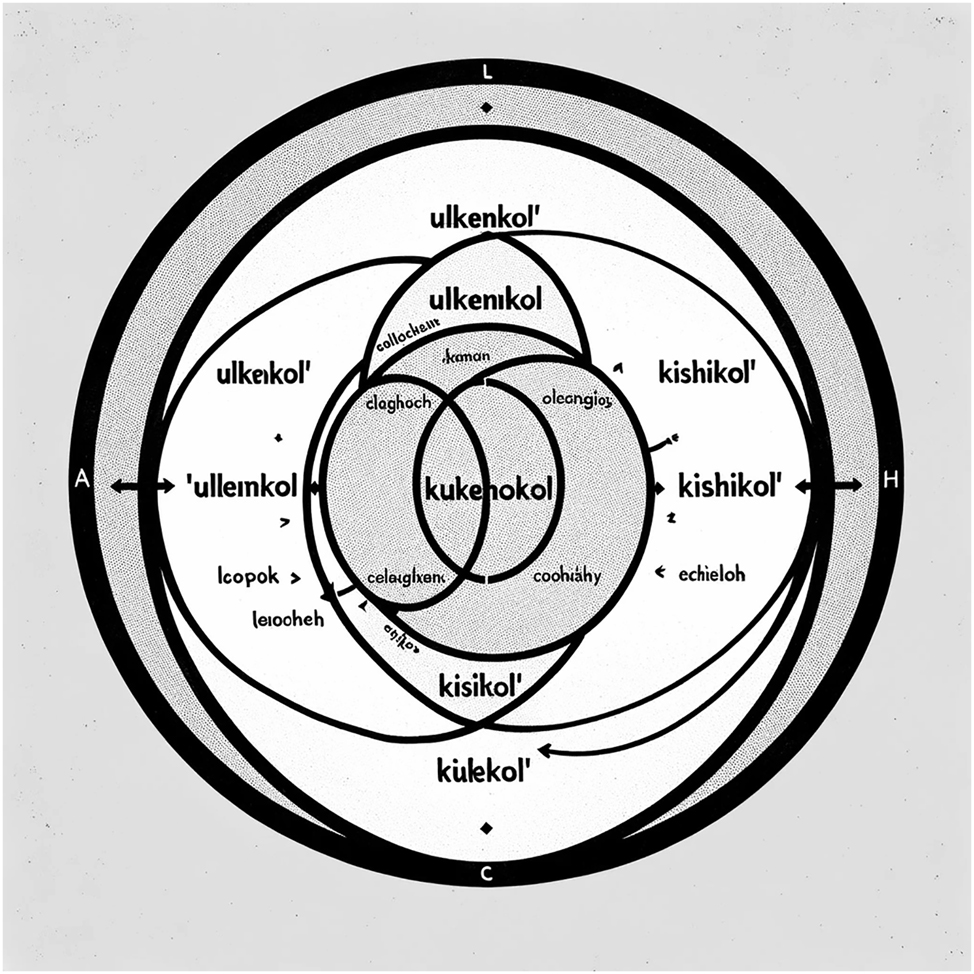
Euler diagram of toponyms Ulkenkol and Kishikol.
The diagram features two overlapping circles, with the larger circle labeled Ulkenkol and the smaller, overlapping circle labeled Kishikol. The overlapping area symbolizes the shared characteristics or close geographical relationship between the two locations, while the distinct areas of each circle represent their unique attributes. This diagram is designed to be simple and clear, focusing on illustrating the concept of binary toponyms in an abstract way.
Such antonyms, called binary names (opposites), make a significant contribution to the enrichment of the lexical fund of the toposystem. In particular, it can provide accurate data in revealing the landscape, and the historical and social conditions of the region. That is, the establishment of contradictions in the toposystem makes it possible to determine the diverse structural and typological character of a particular region, as well as determine the principles of naming places (Debois and de Stefani 2022; Heyd 2022; Tamás 2021).
Binary names are often found throughout the Turkic onomastic space, and in the Kazakh toposystem as well. This is evidenced by the accumulated linguistic data on the Northern and Western transboundary regions. Binary names along the toponyms of these regions, depending on the structural and semantic system, can be considered as:
binary rows with large and small names;
binary rows with black and white names;
binary rows with other names. Among these rows the first two types form the most productive binary series (Figure 2).
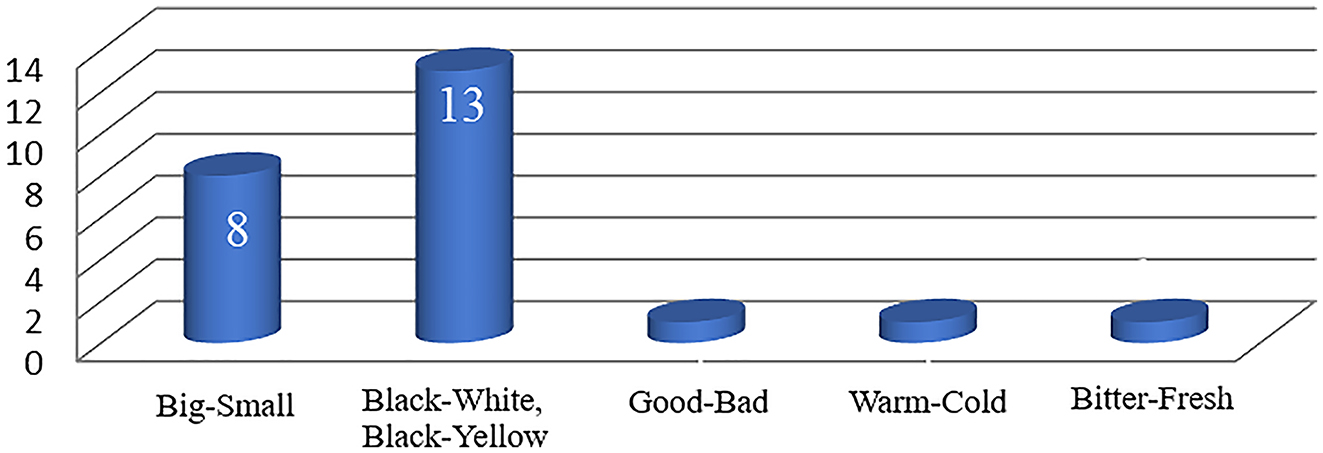
Quantitative indicator of binary names in cross-border regions of Kazakhstan. Source: compiled by the authors based on works from Debois and de Stefani (2022), Heyd (2022) and Tamás (2021).
3.1 Binary series with large and small names
This series of binary names was the basis for the creation of hydronyms and aragonyms. This is due to the fact that the Northern and Western trans-regions of the country are wet and swampy. Binary pairs of hydronyms (specific names or labels given to bodies of water such as rivers, lakes, oceans, seas, and other water-related geographical features) and oikonyms (names or labels given to specific places or locations within a particular geographic area, often used to identify and differentiate various settlements, landmarks, or features within a region) are limited to a single hydrographic or oikographic system. Toponyms represent an amplifier-reducer structural-semantic relationship. Most binary names in this series generate compound names (Seiitova et al. 2021; Table 1).
A binary series of toponyms with large and small names.
| Toponyms | Ulken (‘large’) | Location | Kishi (‘small’) | Location |
|---|---|---|---|---|
| Aqsheshey | Ulken (‘large’) Aqsheshey | Name of a winter camp, West Kazakhstan region, Shingirlau district; name of a swamp lake, Zhambyl district, North Kazakhstan region | Kishi (‘small’) Aksheshey | Name of a swamp, North Kazakhstan region, Zhambyl district |
| Sarykol | Ulken (‘large’) Sarykol | Name of a swamp, North Kazakhstan region, Zhambyl district | Kishi (‘small’) Sarykol | Name of a lake, North Kazakhstan region; Zhambyl district |
| Qaraqoga | Ulken (‘large’) Qaraqoga | Name of a lake, North Kazakhstan region, Zhambyl district | Kishi (‘small’) Qaraqoga | Name of a lake, North Kazakhstan region, Zhambyl district |
| Qorgan | Ulken (‘large’) Qorgan | Name of a winter camp, West Kazakhstan region, Kaztalov district | Kishi Qorgan | Name of a winter camp, West Kazakhstan region, Kaztalov district |
| Sulikti | Ulken (‘large’) Sulikti | Name of a lake, North Kazakhstan region, Zhambyl district | Kishi (‘small’) Sulikti | Name of a lake, North Kazakhstan region, Zhambyl district |
| Shabaq | Ulken (‘large’) Shabaq | Name of a lake, North Kazakhstan region, Zhambyl district | Kishi (‘small’) Shabaq | Name of a lake, North Kazakhstan region, Zhambyl district |
Encountering only one example, it is observed how the adjectives Ulken (‘large’) and Kishi (‘Small’) participate in a combined toponymy as an antonym pair:
Ulkenkol (name of the swamp, lake, North Kazakhstan region, Zhambyl district);
Kishikol (name of the swamp, North Kazakhstan region, Magzhan Zhumabayev district);
Kishkenekol (name of the swamp, North Kazakhstan region, Zhambyl district).
Given Ulken (‘large’) and Kishi (‘Small’), toponyms that come with their names are initially placed in relation to the location, size of the lake, swamp, and winter camps, and formed as antonyms. Over time, it is obvious that the extent to which geographical features retain/do not retain binary names is determined when conducting research expeditions to these regions (Kato et al. 2021; Tent 2017).
A binary series representing the volume occupied by a lake and marshland is represented by the following toponyms:
Ulkenkol (name of the swamp, lake, North Kazakhstan region, Zhambyl district);
Kishikol (name of the swamp, North Kazakhstan region, Magzhan Zhumabayev district);
Kishkenekol (name of the swamp, North Kazakhstan region, Zhambyl district).
Where the onym Ulkenkol “[g]ot its name due to the presence of a small lowland in the Steppe or a lowland formed by prolonged precipitation humidity. Accordingly, Kishikol the name means a small part of the lowland” (Koishibaev 1974). The toponym Kishikol in this series is a lexical and grammatical binary to Ulkenkol. When the volume of the swamp is too small, the value of the swamp is reduced, the suffix -kene is used, as in the hydronym Kishkenekol.
This is an example of a pair of lexical and grammatical binaries in the toposystem of the region:
Ulken (‘large’) Qaraqamys (name of the lake, North Kazakhstan region, Zhambyl district);
Kishi (‘small’) Qaraqamys (name of the lake, North Kazakhstan region, Zhambyl district);
Kishkentai Qaraqamys (name of the swamp, North Kazakhstan region, Zhambyl district).
Here the Ulken (‘large’) Qaraqamys hydronym is a lexical binary sequence to hydronym Kishi (‘small’) Qaraqamys. In addition, we have the reductive meaning of the suffix -kene and involuntary affix -tai through which the connection of the productive affix the onym Kishkentai Qaraqamyswas was derived. Therefore, through the phenomenon of absorption it caused the creation of grammatical binary Kish(i)-ken(e)-tai.
3.2 Aq (‘white’) and qara (‘white’); Qara (‘black’) and sary (‘yellow’) binary rows
In the transboundary regions of Northern and Western Kazakhstan, as in other Turkic languages, there are quite a lot of variegated toponyms that, as in other Turkic languages, contradict each other in meaning and form a binary row. The Binary row Aq – Qara; Qara – Sary appears to be mainly involved in creating a unified personality toponym. There are Aqoba (name of the Village, West Kazakhstan region, Zhanibek district) – Qaraoba (name of the Village, West Kazakhstan region, Kaztalov district).
The toponym “oba” is also found in the Kazakh toposystem in the form of a separate onym. Oba is a word that has several meanings in the language: “(1) Terrain, marking on convex areas made of stone, soil in bulk; (2) A place where the dead are buried, made in the form of a mound; (3) Highly contagious disease, epidemic, disease.”[1] In toponymy there is reason to believe that the first two meanings of the word are involved. This opinion is proved in the dictionaries that reveal the essence of toponyms Aqobaa and qaraoba:
Aqoba – Ak-Uba (‘a bunch of white stones’);
Qaraoba – Kara-Oba (‘A black pile of stones’; Konkashpaev 1963).
That is, a pile of white stones, a pile of black stones, Aqoba, Qaraoba oikonyms are semantically antithesis (binary) in nature:
Aqtau (name of a Mountain, West Kazakhstan region, Borili district; name of a Village, West Kazakhstan region, Shingirlau district);
Qaratau (name of a settlement, North Kazakhstan region, Zhambyl district).
Aqtau-Qaratau toponyms are a full-fledged binary name. Aqtau – the name is connected with the color of the rocks. Kononov (1978) wrote about the etymology of Karatau onym:
In order to study the Turkic orographic nomination and terminology, it is necessary to provide directions of many mountains, which are called qara (gara) dag/tag/tog/tau/too; compared uzb. qora tog “Black Mountains,” “low mountains,” “mountains without growth”; “Mountains, that are not illuminated by the sun” are also called by uzbeks Kora toga, i.e., Northern slopes of Mountains –compare with the Kyrgyz language. (South): Kara “not a covered snow place in the mountains.” (Kononov 1978)
Other scientists agree with the opinion of Murzayev (1984) that the Qaratau onym is associated with color, because in the Qaratau, there is no snow all summer, as in other great mountains (Biyarov 2013; Koishibaev 1985). Therefore, in the case of “Aqtau-Qaratau,” it becomes evident that the semantic contradiction is fully maintained within the toponyms.
Aqmola is the name of the settlement in the North Kazakhstan region, Magzhan Zhumabayev district; Qaramola is the name of a river in the North Kazakhstan region, Shoqan Ualikhanov district, and the name of shallow waters in the North Kazakhstan region, Shoqan Ualikhanov district. Here, black and white adjectives form antonyms in their final denotative meaning and participate in the creation of a toponym in the meaning of a binary name. It is known that various opinions are found in scientific works related to onym Aqmola. Zhanuzak (2010) tells the story of the origin of the name in folk etymology: “When a person was buried, white clay came out from under it. With this white clay anointed the grave installed on the head of the corpse. Then, because the grave can be seen from afar, this place is called Aqmola,” – he gives his scientific conclusion: “The name Aqmola does not mean ‘wall,’ but ‘the place of an ancient address, a sacred sign, a symbol on which the bones of ancestors lie,’ and in Russian, in some translation, it means ‘white mausoleum,’ and not ‘light church yard’.”
A wide variety of views on this issue of the Qara (‘black’) element in the onym Qaramola exist. In Koishibaev’s (1974) dictionary, “the name means ‘grave,’ which contains black it is said that it is used as ‘a lot of graves’.” However, it is still necessary to consider the principle of naming this onym. The word qara may stand not for the size of an object, but rather for its color material (sign), sculpted from black clay.
Aqtogay is the name of a settlement in the Pav. region, Aktogay district; Qaratogay is a settlement in the Aktobe region, Martok district. The black – white units, on the other hand, have a color meaning and represent a binary name. However, Aq (‘white’) and Qara (‘black’) lexical units in Kazakh language have different connotations apart from the color meaning, so these oikonyms might not be built for semantic contradiction. In the given oikonyms, the aq (‘white’) element means “pure, transparent, clear,” and the Qara (‘black’) means “a lot of.” And there are different views about the word “togai.” In the Kazakh literary language, the word togai has several semantics:
various thickets of wild growth along the river;
mixed forest with shrubs growing in floodplains of desert and semi-desert zones;
a small part of the forest isolated from the main valley.1
Koishibaev (1985) presents the following analysis of the meaning of the word “togai” in the toposystem: the word Togai is a very ancient form, which has a strong place both in the names of the peoples of the common Slavic (tugai), Ugric (Tokai) languages, and in the literary norm, when referring to the toponymy of all Turkic and Mongolian languages in the form of vocabulary or topolexema (tugai, tokoi, tokhoi, tuqai). Therefore, it can be called a form that went beyond the Turkic-Mongolian languages and entered the sphere of “altaistics.” Those who considered the origin of Russian scientific and other terminology this is the meaning of the tokai prototype, which has moved away from the original understanding of the lexeme or “bend,” literally “shyntaq” (or ‘elbow’).
In the modern Kazakh language, the meaning of the given word is ‘ravine’ or ‘old range of the river.’ Zhanuzak (2010) does not agree with these meanings. According to the author, “togai” is a lexeme that has been used in Turkic languages since ancient times as a geographical term. It has penetrated from the Turkic languages into the Russian literary language and is often used in the form of tugai. In Radlov’s dictionary, it is shown that togai, tokoi, tokai, and tokoi are used to mean “meadow,” “wooded area,” “river with thick trees and shrubs, island or semi-island,” and “thick tree on river peninsulas” (Myrzaev 1984). Hence, the oikonym Aqtogai has the meaning of a transparent forest on the banks of the water or a muddy river; the oikonym Qaratogay was named because of a thick, nullified forest.
Aqsu is the name of a village in the West Kazakhstan region, Borili district; Qarasu is the name of a winter village in the West Kazakhstan region, Kaztalov district and the name of a river in the North Kazakhstan region, Shoqan Ualikhanov district. Onyms Aqsu-Qarasuare are found in the Kazakh toposystem as hydronyms and oikonyms. In the composition of the toponym Aqsu, the diversity of opinions about white prevails. In a number of research papers, it is noted that it is not related to color. It is a stream of snow water falling down from the mountain; that is, flow. It is shown that it represents the meaning of the word (Kononov 1978; Koishibaev 1985; Myrzaev 1984; Superanskaya 1984). In this regard, it is necessary to take into account the fact that in the future there is a disagreement with this opinion. In particular, the main meaning of the name is related to the white color of the water, the white color of the river (Zhanuzak 2010); therefore, “the reason for the name is the flow of river water into the stones, foaming white” (Biyarov 2013). The principle of naming the toponym Qarasu was formed from the transparency of the water, the river, and later the name of the river became the basis for the origin of the name of the village. That is, there is a phenomenon inherent in the science of onomastics – transonymization. Comparing the ambiguous opinion about the Aqsu toponym with the principle of naming the Qarasu toponym, it can be seen that these names do not constitute a binary opposition.
Aqkol is the name of the lake in West Kazakhstan region, Shingirlau district; Qarakol is the name of a village in the West Kazakhstan region, Kaztalov district and the name of a lake, swamp in the North Kazakhstan region, Zhambyl district. In the composition of the toponyms white and black, adjectives have a semantic meaning other than color. While white represents the meaning “flow,” black unity can be said to be related to the semantics of “Earth.” Then the toponyms Aqkol-Qarakol come together with the geographical term lake of white and black units, formed in the meanings of flowing water, flowing lake and underground water, lake. Therefore, these toponyms have a different meaning than the binary name. In general, in the onomastic picture of the world, it is said that not only white-black units, but also black-yellow units form a mutual binary series.
In his work considering Altai toponymy, Molchanova (1986) argues: “Certain pairs are fixed, where in Altai ethnonyms there is an opposition of ‘kara-sary’”:
kara-almat – sary-almat;
kara-jagyryk – sary-jagyryk;
kara-irkit – sary-irkit;
kara-soyon – sary-soyon;
kara-togus – sary-togus;
kara-todosh – sary-todosh;
kara-chagat – sary-chagat.
A similar view of this opinion about the binary formation of “black-yellow” units is given by Yerzhanova (2001), who studied the toponyms of the West Kazakhstan region: “Yellow is sometimes used in comparison with the word ‘small’.”
The pair composition of black and yellow is also characteristic of the Kazakh transtoposystem (Table 2).
The pair composition of “black and yellow” in the Kazakh transtoposystem.
| Black | Location | Yellow | Location |
|---|---|---|---|
| Qaraozen | Name of a village and river, West Kazakhstan region, Kaztalov district | Saryozen | Name of a village, River, West Kazakhstan region, Kaztalov district |
| Qarakopa | Name of a locality, Qostanay region, Fedorov district | Saryqopa | Name of a winter camp, North Kazakhstan region, Shoqan Ualikhanov district |
| Qaratomar | Name of a lake, North Kazakhstan region, Shoqan Ualikhanov district | Sarytomar | Name of a village, North Kazakhstan region, Magzhan Zhumabayev district |
| Qaratal | River, North Kazakhstan region, Shoqan Ualikhanov district; forest, Zhambyl district | Sarytal | North Kazakhstan region, Zhambyl district |
| Qaraaigyr | Settlement, North Kazakhstan region, Shoqan Ualikhanov district | Saryaigyr | Village, North Kazakhstan region, Zhumabayev district |
| Qarabie | Swamp, North Kazakhstan region, Magzhan Zhumabayev district | Sarybie | Settlement, North Kazakhstan region, Magzhan Zhumabayev district |
As for the origin of some, Qaraozen (name of a village and river, West Kazakhstan region, Kaztalov district); Saryozen (name of a village and river, West Kazakhstan region, Kaztalov district). “Qara” (‘black’) and its counterpart “ulken” (‘big’), as well as “sary” (‘yellow’) and its counterpart “kishi” (‘small’), constitute an antonymic pair. Hence, there is reason to believe that toponyms “Qaraozen-Saryozenare” were caused by the large and small scale of the river. Village were named after the name of the river and the phenomenon of transonymization was formed.
However, most of the toponyms of this series do not have their original denotative meaning. In other words, it cannot be argued that a toponymic series created by “black-yellow” units is the same as a “binary series.” On the contrary, it should be said that the series made of black and yellow units in the Kazakh regions bordering Russia is not binary, but some of them are meaningful. This opinion is also confirmed by Koishibaev’s (1974) analysis of the word Qara in his dictionary, which means ‘large,’ ‘tall,’ ‘thick,’ etc., and the word yellow means ‘wide,’ ‘main,’ ‘mole,’ etc.
A similar explanation can be found in the dictionary of the Kazakh literary language: When combined with complex terrain names, “Sary” enhances their meanings, providing additional, broad, main, and clearly visible connotations1 (Yerahmetkyzy et al. 2022). Hence, the establishment of this parallel between “Qara” and “Sary” is rooted in the way their names, associated with Earth and water, primarily revolve around concepts like large, high, thick, big, wide, and abundant. Let’s analyze it with regards to the example of cross-border regions: Qarakamys-Sarykamis – North Kazakhstan region, Zhambyl, Sh. name of the lake in Ualikhanov district. Black and yellow units in the first generation of hydronyms are not named because of the color of the reeds. The word Qara in the composition of the hydronym Qarakamys means that the reed is thick-growing, that is, the reed is formed from a thick lake (Koishibaev 1974). The etymological basis of the word yellow in the composition of the hydronym Saryqamys is also this seme. In dictionaries, it is noted that the yellow reed is used in the meaning of thick.1 It is clear that the etymology of the toponym comes from the meaning of a wide valley of reeds (Molchanova 1986). In other words, the name of the lake is formed from the yellow reed appellate, which means thick, thick reeds. Consequently, both “black” and “yellow” share a common meaning within the onym, signifying thickness and used for creating meaningful lines.
Qarakopa is name of a location in Qostanay region, Fedorov district; Saryqopa is the name of a winter camp in the North Kazakhstan region, Shoqan Ualikhanov district. The origin of these oikonyms is close to the etymology of the previous Qaraqamys/Saryqamys hydronyms. Qopa here is a noun with the meaning of “a barren land where reeds are mixed with the decay of dried herbs.”1 It has long been registered on the Kazakh onomastic map as a geographical term. Semantics: “wet, swampy land with thick reeds. It does not matter whether the land is a lake or a swamp; thick reeds are an important sign” (Biyarov 2013). Thus, “Qaraqopa-Saryqopa” onyms show that the meanings of thicket, reed thicket, and land, and are not an antonymous pair, but a mutually meaningful series.
3.3 Binary series with other names
In the space of the transtoposystem bordering Russia, binary names with the adjectives good-bad, warm-cold, bitter-fresh also occur: for example, both Zhaqsytuz and Zhamantuz are the name of bitter-salty lakes in North Kazakhstan, Shoqan Ualikhanov district.
In research, it is said that good and bad adjectives in the topological system mainly have other meanings that develop from their denotative meaning. In semiotics, a topological system refers to a framework or approach that focuses on the spatial relationships and configurations of signs and symbols within a semiotic system. It examines how signs are organized and interconnected in a given context, emphasizing the spatial arrangement and proximity of signs as a means of conveying meaning. In a topological system in semiotics, the emphasis is on the relative positions, boundaries, and connections between signs rather than their individual characteristics or isolated meanings. This approach is often used to analyze how signs relate to each other within a text, discourse, or visual representation, and how these spatial relationships contribute to the interpretation and communication of meaning. Topological systems in semiotics can be particularly useful when studying complex visual texts, such as maps, diagrams, or artworks, where the arrangement of signs plays a crucial role in conveying information and conveying specific messages (Kulgildinova and Uaissova 2016; Sabirzyanova et al. 2022). By examining the topological aspects of semiotic systems, semioticians can gain insights into how meaning is constructed and understood through the spatial organization of signs.
Regarding a zhaqsy unit: Koishybayev mentions that the word “zhaqsy” performs two different functions in the calculation of the defining link of a topological object:
it distinguishes the height of objects in a row from each other;
it separates the natural superiority of objects from each other (Koishibaev 1985).
Biyarov (2013) notes that many indirect meanings of the adjective “good” are derived from its main concept (“good, positive, agreed”). Regarding the unit “bad”:
He cites the fact that the word “bad” means “bad, small” when it appears in toponyms, and shows that it can be recognized in another sense: if the word “bad” is used in the sense of “not good,” sometimes it is used as a phonetically changed form of the word “chaman” in the Mongolian and Tajik languages. According to observation, “chaman” in the Tajik language may be a modified form of the word “blue meadow,” “maysa,” “plain field.” The names “Chamanbulak” and “Chamankuly” in the Tajik language are full proof of this. Sounds “ch/sh” at the beginning of the words are like exchanging the sounds of “zh” (Zhanuzak 2010).
In Koishibaev’s (1985) dictionary, negative shades of the word “bad” in toponyms are revealed, such as small, inconvenient, unsuitable.
Biyarov (2013) shows that when a bad word turns into a toponym, it often manifests itself in two ways: “First of all, the natural object becomes inhospitable to a person and his life,” and secondly, “a geographical object becomes ‘barren, lying, unplanted, ugly’ from other objects of the same kind. The appearance of bad adjective + noun creates complex names.”
Comparing the above analyzes, there is reason to believe that the hydronyms “Zhaqsytuz-Zhamantuz” show the bitterness and saltiness of the lake water, the pleasantness and unpleasantness of the lake water, and are reflected as a full-fledged binary name. Because the Northern and Western regions of the country are salty and suitable for grazing livestock. In other words, the name of hydronyms should be derived from the fact that lakes are salty.
Zhylybulaq is the name of village in Pavlodar region, Shcherbakty district; Suyqbulaq is the name of a river in East Kazakhstan, Borili district. The name Zhylarbulaq can be found in the Kazakh onomastic space as Zhylbulak (in Almaty, in the regions of South Kazakhstan region). According to Koishibaev (1985), “zhyly bulak” is a name formed in the form of “zhylbulak” after the final sound of the word is dropped (Kyrgyz: Zhyluubulak). And as for semantics, warm-cold adjectives represent a criticism of a geographical object, a character. That is, the spring is designed to express the warm-cold of the river water. Over time, it was also given to the name of the village.
Therefore, the binary opposition is fully preserved throughout the toponyms. Ashchyqudyq is the name of a winter camp in East Kazakhstan region, Kaztalov district; Tushchyqudyq is the name of a winter camp in East Kazakhstan region, Shingyrlau district. The word bitter in the Kazakh language means “not fresh, but salty, with a salty taste,”1 and the word fresh means “water without salt, suitable for drinking”1 and is a binary of bitter. Oikonyms containing bitter-fresh adjectives convey their denotative meanings and are constructed on a semantic contradiction.
Thus, the main binary oppositions do not go beyond the laws inherent in toponymy, reflecting certain features of geographical features. Compared to lexical antonyms, time is measured with its speed. Binary names within toponyms, even when structurally constituting an antonym pair, might not necessarily exhibit a semantic contradiction (Lemghari 2021; Masini and Mattiola 2022; Taylor and Stoltz 2021). Binary oppositions, often referred to as dichotomies or binary pairs, are pairs of opposing concepts or ideas that are used to highlight contrasts and create distinctions in various fields such as linguistics, literature, philosophy, and cultural studies. These pairs typically consist of two mutually exclusive and contrasting terms, where one term is defined in relation to the other. Binary oppositions represent a fundamental concept in structuralism, a theoretical framework employed for the analysis and comprehension of how meaning arises from the contrast between opposing elements. Examples of binary oppositions include good versus evil, male versus female, hot versus cold, and nature versus culture. Because, as Nikonov (1964) noted
a geographical name is not part of the object it refers to. It doesn’t belong to it. Neither the river nor the mountain can name themselves; the name is given to them by society and in the interests of that society. Geographical names belong not to nature, but to society, which, like all social phenomena, is considered historical. Even if the meaning fully reveals the properties of this object (Volchya river), it is recognized as productive for historical reasons, and not for the same property. The whole problem is not in the sign itself, but in its evaluation. (Nikonov 1964)
The peculiarity of regions is that it allows identifying certain types of land-water objects, and object types, in turn, are binary pairs as components of toponyms.
4 Discussion
Having considered the practical principles of the implementation of the research question, it is advisable to focus on its theoretical basis. For this, it is appropriate to refer to the positions of scientists regarding binary opposition, as well as toposystems in general. In particular, Özata (2020) investigated the meaning of the concept of “binary oppositions” and also revealed their properties. Thus, the researcher managed to prove that the above-mentioned object was a pair of terms that are related to each other, and their characteristic feature is the opposite in meaning. Accordingly, due to the formation of binary oppositions, it is possible to oppose two completely different objects in terms of language. In his study, the scholar gives examples of such speech compounds that are mutually exclusive, including on and off, up and down, low and high. The practical meaning and essence of binary oppositions is revealed in the fact that their content allows for the reflection of the necessary concept characterized by structuralism. In addition, he noted that the meaning of such contrasting terms was to establish differences between the basic principles defined by the language of a particular state or the thinking of citizens. The described position may allow for a thorough description of the meaning of the concept of “binary opposition,” which contributes to the development of its perfect understanding and characteristics. Moreover, the approaches revealed in the researcher’s work are general, which allows for a shaping of a classical idea of the perceived contrasts of linguistic compounds.
Much like the previously mentioned research, a study conducted by Akbari and Ashrafzadeh (2021) delved into the analysis of binary poetic oppositions. In his opinion, it is binary oppositions that serve as the basis among poemonymic oppositions, since among them there are single-component and multi-component, which in turn consist of a combination of two elements. Thus, he noted that such an opposition was quite often associated with such a linguistic element as antithesis, which as a result made it possible to compare a pair of opposed objects, concepts, and names. The approach of this researcher stands out among others in scientific doctrine, because it is based on presenting of binary oppositions as complementary unities. In this context, it may be necessary to furtherly confirm the obtained conclusions in order to understand on the basis of which criteria the concept with the property of mutual responsibility is endowed.
In turn, De Giorgi et al. (2021) believe that binary opposition belongs to such a type of opposition as “no-no” pairs or the interweaving of linguistic compounds of four components. Undoubtedly, there is a contradiction in the given classification due to the criteria for its construction. However, the researcher’s statement that in a binary opposition a pair of terms are opposite in meaning, but merge into one, is convincing. In this case, full agreement with the provided principles is challenging, as the principles do not entirely align with the overarching theoretical tenets concerning binary oppositions. However, it should be emphasized that in the process of highlighting binary oppositions, the essential aspect lies in the direct difference between the elements, rather than in the decorative arrangement. But the current study highlights that unlike simple lexical antonyms (e.g., big/small, black/white), the contradiction in toponyms is recognized in their toponymic context and may not always be a semantic contradiction but rather a related series.
Bijak (2021) analyzed the topic of this study in detail in her work. To a greater extent, her research was based on the components of the toposystem, namely, oikonyms. Thus, she managed to establish that the use of the latter contributed to the possibility of establishing both language units and their entire system. Accordingly, the formation of a set of concepts makes it possible to form a complete toponymic landscape of a certain territory or region of the country, in the context of its regional-spatial analysis. Thus, this element of the toposystem is its organic component and makes it possible to analyze the features of a specific territory. Therefore, toponymic vocabulary is harmonized, which is accompanied by the development of the mental component. The given study may contain important conclusions, in particular, that the ontological being of a separate toponymic system is undeniably unified and connected with its mental content (Bijak 2021).
Bai et al. (2021) paid special attention directly to the “toponymic system” category. In their opinion, in order to carry out a qualitative analysis of the structural elements of the toposystem, it is advisable to establish the content of the latter. Thus, the concept of the mentioned system formed by the scholar is revealed as a regular organization of a certain number of toponyms related to a certain geographical region. According to the researcher, the formation of the toponymic system is largely determined by the number of regions in the states, in particular Kazakhstan. Based on this, each geographical object is characterized by a set of toponyms, which in turn require classification and grouping, which will allow to harmonize their content among themselves. In this process, a noticeable feature is the juxtaposition of concepts, in particular toponyms (Bai et al. 2021). The results obtained by the researcher fully correspond to the results obtained in the present research, as the toponymic system is proven to be separate from the general language and forms its own structure.
Ardanuy et al. (2020) also revealed the theoretical foundations of the toponymic system. The research demonstrated that the territory served as the foundation for the toponymic context, leading to a syntagmatic opposition responsible for the usage of terms and names based on the characteristics of the area. The researcher emphasized that the syntagmatic opposition of toponyms was in their non-linearity, which distinguished them from common language ones. Thus, such toponyms exhibit the presence of the main word, root, and suffix, while also incorporating an opposing element. Moreover, instances exist where toponyms can be paradigmatically linked, such as when they belong to a homonymous series and vary based on their association with distinct classes of concepts (Ardanuy et al. 2020). The presented ideas can be considered accurate, as they involve a systematic analysis of the types of toponyms constituting a comprehensive system of opposing concepts.
The discussion made it possible to describe the most common approaches in scientific doctrine regarding binary oppositions and their place in the topological system. In addition, the far-sighted ideas of researchers indicate that at the moment there is no absolute approach to establishing the content of the above-mentioned elements. However, to a greater extent, the obtained results correspond to the revealed positions of other scientists who established the features of binary oppositions and the structure of the toponomic system. The text provides numerous examples from the Kazakh toposystem, showing how binary names are used to describe various geographical features. These binary names not only have a semantic role but also reflect historical, social, and landscape conditions of the regions they denote. The text discusses how binary oppositions in toponyms are part of a broader structural and semantic system, which helps in understanding the diverse structural and typological characteristics of regions. These observations underscore the significance of studying toponyms in the field of onomastics (the study of names) for understanding the interplay between language, geography, and culture. This comprehensive analysis offers valuable insights into the dynamic nature of toponyms, their role in reflecting and influencing cultural and geographical landscapes, and the complexities involved in their study.
5 Conclusions
The research findings confirmed the presence of binary opposition within the toponymic context, manifesting as a semantic contradiction. However, it is worth noting that there are instances where related series are formed instead of direct contradictions. Thus, the key criteria for the emergence and persistence of opposition are the moment of its inception and the affiliation of opposing elements or categories to the same group. Antonyms hold a significant role in enriching the toposystem’s vocabulary. Typically, these antonyms can be regarded as binary concepts, with their essence lying in their ability to highlight essential properties and distinctive characteristics of the region they are in binary opposition with. For example, the landscape, culture, and social conditions of various territories can be vividly contrasted through these antonyms. It is important to emphasize that the formation of opposition within the toposystem enables the identification and exploration of various aspects of the structural and typological nature of a specific locality. Moreover, these contrasts play a pivotal role in the nomenclature of regions, as they effectively describe their salient features or draw comparisons with neighboring regional units. The study conducted a classification of binary names based on the toponyms of Kazakh regions, with the structural-semantic system serving as the foundational criterion. Consequently, the study delineated binary series with uppercase and lowercase names, binary pairs with black and white names, and binary sequences with other designations. Among these types, the first two are the most dynamic and effective in generating binary series.
In light of these findings, it becomes evident that the scope of general binary oppositions does not extend beyond the regularities on which toponyms are constructed. These oppositions primarily illustrate specific characteristics of objects and regions. Subsequent research endeavors should focus on delineating the criteria underlying the formation of binary oppositions.
Funding source: the state grant of the Ministry of Science and Higher Education of the Republic of Kazakhstan
Award Identifier / Grant number: AP08855686 – “Toponymy in cross-border regions of Kazakhstan” (for 2020-2022)
Acknowledgments
The article was written within the framework of the state grant of the Ministry of Science and Higher Education of the Republic of Kazakhstan AP08855686 – “Toponymy in cross-border regions of Kazakhstan” (for 2020–2022).
References
Akbari, Fatemeh & Reza Ashrafzadeh. 2021. A study of binary oppositions in Forough Farrokhzad’s works. Ipotesi 25(1). 140–153. https://doi.org/10.34019/1982-0836.2021.v25.31021.Suche in Google Scholar
Ardanuy, Mariona, Kasra Hosseini, Katherine McDonough, Amrey Krause, Daniel van Strien & Federico Nanni. 2020. A deep learning approach to geographical candidate selection through toponym matching. Advances in Geographic Information Systems 28. 385–388. https://doi.org/10.1145/3397536.3422236.Suche in Google Scholar
Bai, T., W. Pan & Y. J. Hou. 2021. Building an integrated toponymic information system based on TGIS and big data technology. Journal of Global Change Data & Discovery 4. 363–372.Suche in Google Scholar
Bapanova, Gulzhan K., Natalya V. Orekhova, Shynar B. Kadirsizova, Gulnaz S. Kasbayeva & Gulnar K. Sholpankulova. 2023. Research skills as the student learning achievement. International Journal of Educational Reform 1. 1–8. https://doi.org/10.1177/10567879231155874.Suche in Google Scholar
Bijak, Urzsula. 2021. Space and landscape in Polish toponymy. Jazykovedný časopis 72(1). 194–207. https://doi.org/10.2478/jazcas-2021-0023.Suche in Google Scholar
Biyarov, Berdibek. 2013. Typical examples of Kazakh toponyms. Astana: “Til-Kazyna” National Scientific and Practical Center Named after Sh. Shayakhmetov.Suche in Google Scholar
Bolganbayuly, Aset & Gabit Kaliuly. 1997. Lexicology and phraseology of the modern Kazakh language. Almaty: Sanat.Suche in Google Scholar
De Giorgi, Elisabetta, Antonio Dias & Branislav Dolný. 2021. New challenger parties in opposition: Isolation or cooperation? Parliamentary Affairs 74(3). 662–682. https://doi.org/10.1093/pa/gsab025.Suche in Google Scholar
Debois, Thomas & Elwys de Stefani. 2022. Interactional onomastics: Place names as malleable resources. In Andreas H. Jucker & Heiko Hausendorf (eds.), Pragmatics of space, 125–152. Berlin: De Gruyter Mouton.10.1515/9783110693713-005Suche in Google Scholar
Glinskikh, Grigoriy V. 1987. Toponymic system and structural-semantic features of initial requests. Problems of Onomastics 18. 29–44.Suche in Google Scholar
Heyd, Theresa. 2022. First names and sociolinguistic enregisterment: Digital tropes of linguistic mobility. Language & Communication 87. 271–283. https://doi.org/10.1016/j.langcom.2022.09.003.Suche in Google Scholar
Kato, Sachi, Mayusaki Asahara, Nanami Moriyama & Asami Ogiwara & Makoto Yamazaki. 2021. The annotation of antonym information in the “Word list by semantic principles.” In Proceedings of the 35th Pacific Asia conference on language, information and computation, PACLIC 2021, 426–435. Shanghai: Association for Computational Linguistics (ACL).Suche in Google Scholar
Koishibaev, Erlan. 1974. Brief explanatory dictionary of toponyms of Kazakhstan. Alma-Ata: Nauka.Suche in Google Scholar
Koishibaev, Erlan. 1985. Dictionary of place-water names of Kazakhstan. Almaty: Mektep.Suche in Google Scholar
Konkashpaev, G. K. 1963. Dictionary of Kazakh geographical names. Almaty: Publishing House of the Academy of Sciences of the Kazakh SSR.Suche in Google Scholar
Kononov, Andrey N. 1978. Semantics of color naming in Turkic languages. In Turkological collection, 159–179. Moscow: Nauka.Suche in Google Scholar
Kostić, Nataša. 2015. Antonym sequence in written discourse: A corpus-based study. Language Sciences 47. 18–31. https://doi.org/10.1016/j.langsci.2014.07.013.Suche in Google Scholar
Kostić, Nataša. 2017. Adjectival antonyms in discourse: A corpus study of scalar and complementary antonyms. Folia Linguistica 51(3). 587–610. https://doi.org/10.1515/flin-2017-0022.Suche in Google Scholar
Kulgildinova, Tulebike A. & Gulnar I. Uaissova. 2016. Realization of frame-based technologies in the context of education informatization. Journal of Theoretical and Applied Information Technology 89(1). 236–242.Suche in Google Scholar
Kulumzhanov, Nurzhan, Azhar Zholdubaeva, Soltanmurat Abzhalov, Sairash Sapargaliyeva & Serik Almukhanov. 2021. Specific features of the Kazakh cult of ancestors. Mankind Quarterly 61(3). 626–640. https://doi.org/10.46469/mq.2021.61.3.14.Suche in Google Scholar
Lemghari, El Mustapha. 2021. Metaphorical blending in complex proverbs: A case study. Metaphor and the Social World 11(1). 71–97. https://doi.org/10.1075/msw.19004.lem.Suche in Google Scholar
Masini, Francesca & Simone Mattiola. 2022. Syntactic discontinuous reduplication with antonymic pairs: A case study from Italian. Linguistics 60(1). 315–345. https://doi.org/10.1515/ling-2021-0225.Suche in Google Scholar
Molchanova, Olga T. 1986. Yellow colors in the Altai onomasticon. In Turkology, 192–201. Leningrad: Nauka.Suche in Google Scholar
Muikku-Werner, Pirkko. 2015. Semantic cohesion and the intelligibility of closely related language. Lahivordlusi Lahivertailuja 25. 191–216. https://doi.org/10.5128/lv25.08.Suche in Google Scholar
Myrzaev, Eduard M. 1984. Dictionary of popular geographical terms. Moscow: Mysl.Suche in Google Scholar
Nikonov, Vladimir A. 1964. Ways of toponymic research. In Principles of toponymy, 58–86. Moscow: Nauka.Suche in Google Scholar
Özata, Cüneyt. 2020. Binary oppositions, otherness, and borders in David Greig’s Europe. Manisa Celal Bayar Üniversitesi Sosyal Bilimler Dergisi 18. 237–247. https://doi.org/10.18026/cbayarsos.669875.Suche in Google Scholar
Podolskaya, Natalya V. 1988. Dictionary of Russian onomastic terminology. Moscow: Nauka.Suche in Google Scholar
Sabirzyanova, Dina R., Kazhytay B. Kizirbekkyzy, Flera S. Sayfulina & Orazbek M. Socialkyzy. 2022. The duality of the mask archetype in works of art. Res Militaris 12(3). 921–927.Suche in Google Scholar
Sartbekova, Nurjan K., Gulhamal U. Ryskulova & Gulbarchyn A. Orozbaeva. 2021. Semantics of lexical means expressing the position of a person. Journal of Language and Linguistic Studies 17. 1470–1477.Suche in Google Scholar
Seiitova, Shynar B., Serrikul K. Satenova, Farida Gainullina, Shaiza Doskeyeva, Raushan Mukhazhanova & Moldir Mamysheva. 2021. Toponymic space of Tarbagatay district of east Kazakhstan region as a reflection of the material and spiritual culture of the Kazakh people. Astra Salvensis 2021. 435–447.Suche in Google Scholar
Superanskaya, Aleksandra V. 1973. Both theory of proper name. Moscow: Nauka.Suche in Google Scholar
Superanskaya, Aleksandra V. 1984. What is toponymy? Moscow: Nauka.Suche in Google Scholar
Tamás, Farkas. 2021. Applied onomastics. Research areas, directions, and opportunities. Nevtani Ertesito 43. 9–30.Suche in Google Scholar
Taylor, Marshall A. & Dustin S. Stoltz. 2021. Integrating semantic directions with concept mover’s distance to measure binary concept engagement. Journal of Computational Social Science 4(1). 231–242. https://doi.org/10.1007/s42001-020-00075-8.Suche in Google Scholar
Tent, Jan. 2017. Indigenous toponyms in the antipodes: A gazetteer-based study. Names: A Journal of Onomastics 4. 204–214. https://doi.org/10.1080/00277738.2017.1369743.Suche in Google Scholar
Yerahmetkyzy, Zhaina, Akimbekova Shyryn, Tulеbіkе Kulgildinova, Adilbekova Lazzat, Alashbayev Yerlan & Ibragimov Ulbala. 2022. Teaching children’s literature to school children through digital educational resources. World Journal on Educational Technology: Current Issues 14(5). 1332–1342. https://doi.org/10.18844/wjet.v14i5.8093.Suche in Google Scholar
Yerzhanova, Yeldana. 2001. Toponymy of Akzhayik district. Almaty: Arys.Suche in Google Scholar
Zakirova, Assel, Sharban Maigeldiyeva & Gabit Tuyakbayev. 2023. Linguacultural and cognitive aspects of teaching the language of Kazakh legends. Citizenship, Social and Economics Education 22(2). 137–151. https://doi.org/10.1177/14788047231221109.Suche in Google Scholar
Zhanuzak, Torekul. 2010. Origin of historical place-names. Almaty: Sozdіk-slovar.Suche in Google Scholar
© 2024 the author(s), published by De Gruyter, Berlin/Boston
This work is licensed under the Creative Commons Attribution 4.0 International License.
Artikel in diesem Heft
- Frontmatter
- Research Articles
- Deleuze’s zeroness and Peirce’s pure zero regarding the expansion of semiotics’ categorial frame
- Frames as pre-signal context: using a semiotic framing approach to explain how prior experiences shape present interpretations of control signals
- Tropes and play: a new account on embodied figures of thought
- Linguistic and cultural analysis of the concept “politeness”
- Ethnosemantic analysis of binary oppositions in toposystems
- Motorcycles, minarets, and mullahs: a multimodal critical discourse analysis on Pakistan’s journey to rebrand Islam
- Review Article
- Peirce’s iconicity and his image-diagram-metaphor triad revisited: complements to Stjernfelt’s Sheets, Diagrams, and Realism
Artikel in diesem Heft
- Frontmatter
- Research Articles
- Deleuze’s zeroness and Peirce’s pure zero regarding the expansion of semiotics’ categorial frame
- Frames as pre-signal context: using a semiotic framing approach to explain how prior experiences shape present interpretations of control signals
- Tropes and play: a new account on embodied figures of thought
- Linguistic and cultural analysis of the concept “politeness”
- Ethnosemantic analysis of binary oppositions in toposystems
- Motorcycles, minarets, and mullahs: a multimodal critical discourse analysis on Pakistan’s journey to rebrand Islam
- Review Article
- Peirce’s iconicity and his image-diagram-metaphor triad revisited: complements to Stjernfelt’s Sheets, Diagrams, and Realism
