The mystery of the blue toe
-
Jing Wang


Dear Editor,
Cholesterol embolization syndrome (CES) is a rare clinical situation that could mimic the clinical presentation of systemic vasculitis. However, the differential between CES and systemic vasculitis is very important as the treatment strategy and prognosis is significantly different between these two conditions, Herein, we reported a case of CES who died from CES to alert rheumatologists to this rare syndrome.
A 73-year-old male was admitted to the rheumatology department due to blue discoloration and pain of his toes for half a month. The patient had a 50-year smoking history (20 cigarettes/day) and a history of atherosclerosis. Two months prior to admission, he underwent percutaneous coronary intervention (PCI). After the procedure, he experienced fatigue, anemia, and weight loss. Upon admission, the blood pressure was 165/86 mmHg and the bilateral dorsalis pedis artery were palpable. Blue toes were found during physical examination (Figure 1A). Laboratory tests revealed serum creatinine: 261 μmol/L, and elevated erythrocyte sedimentation rate (ESR: 96 mm/h) and C-reactive protein (CRP: 47.11 mg/L). His ANA (antinuclear antibodies), ANCA (antineutrophil cytoplasmic antibodies) and aPL (antiphospholipid anti-body) tests were negative. As the patient presented with renal insufficiency, along with a history of atherosclerosis (Figure 1B) and recent vascular intervention, the diagnosis of CES was highly suspected. Aspirin (100 mg/day), clopidogrel (75 mg/day), and aorvastatin (20 mg/day), prednisolone (40 mg/day) were prescibed. After 14 days of treatment, the patient’s toe pain was slightly relieved, his ESR decreased to 18 mm/h, but the serum creatinine level did not improve significantly. The patient refused further treatment and deceased two months later.
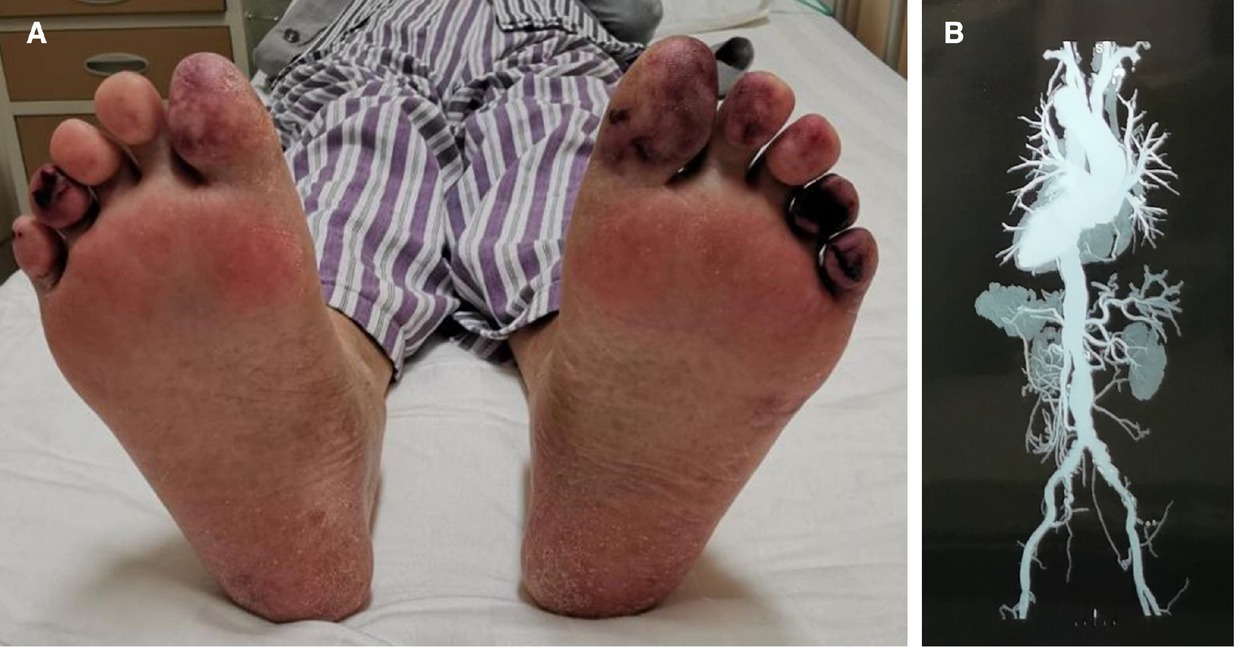
(A) blue toe. (B) The B shows calcified atherosclerotic plaque throughout the visualized thoracoabdominal aorta (arrow) on a three-dimensional computed tomography reconstruction.
CES is a systemic disease caused by showering of atherosclerotic plaque materials, such as cholesterol crystals (CCs), from the aorta and its major branches to distal branches, leading to ischemic and inflammatory damage to multiple organs.[1] CES is induced mostly by interventional and surgical procedures; however, it may also occur spontaneously.
It has been reported that the time from vascular interventional procedure to the appearance of clinical manifestations ranges from a few days to four months.[2] Kidney is a frequent target organ for cholesterol emboli because its proximity to abdominal aorta and it receives an enormous amount of blood flows.[3] Renal replacement therapy is required in 37–61% of CES patients.[4]
Although blue toe syndrome is a hallmark of CES, it can also occur in patients with vasculitis or endocarditis. CES may be considered as one of the “great imitators”. The manifestations of CES can resemble vasculitis with involvement of the skin (livedo-reticularis, purpura, blue toe), kidneys (acute kidney injury, uncontrolled hypertension), gastrointestinal tract (mesenteric ischemia), central nervous system (confusion, stroke) and eyes (involvement of retinal vessels, i.e., Hollenhorst plaques).[1] If a patient has a delayed-onset of acute kidney injury (AKI) together with cutaneous manifestations, such as livedo reticularis or blue-toe syndrome, a clinical diagnosis of CES can be established.[5]
It is very important to make a differential diagnosis between CES and systemic vasculitis because their treatments and prognoses are different. CES predominantly affects older adults with advanced atherosclerosis, hypertension, or diabetes, often following vascular interventions. CES causes acute or subacute renal failure due to crystal-induced ischemic glomerulopathy, often with eosinophiluria and modest proteinuria. Vasculitis typically induces rapidly progressive glomerulonephritis with active urinary sediment (dysmorphic red blood cells [RBCs], red cell casts) and significant protein-uria. Systemic vasculitis is associated with ANCA positivity (in small-vessel vasculitis), or anti-glomerular basement membrane [anti-GBM] antibodies. CES lacks autoantibodies but may show eosinophilia, thrombocytopenia, or hypocomplementemia. Definitive diagnosis of CES requires demonstration of cholesterol clefts in arterioles (e.g., skin, kidney, or muscle biopsy), often with minimal inflammation. Vasculitis shows leukocytoclastic or granulomatous vascular inflammation on biopsy. Atherosclerotic plaque burden on angiography or vascular imaging supports CES, while vasculitis may reveal aneurysms, stenoses, or vessel wall edema on magnetic resonance imaging and computed tomography (MRI/CT).[6]
The mortality rate associated with CES is high (64% to 81%), particularly patients who develop renal failure or multi-organ involvement.[7] Although it is difficult to completely eliminate the occurrence of cholesterol embolization syndrome, through the comprehensive management of risk factors (hypertension, hyperlipidemia, diabetes), careful medical procedures, and the use of anticoagulants and thrombolytics, can effectively reduce the incidence of CES.[8] Statins can reduce the volume of atherosclerotic plaque and stabilize the plaque, so. ameliorate the renal and patient’s prognosis. [9] Anticoagulant therapy in CES is controversial and is generally not recommended. Anticoagulation does not improve arterial patency in the presence of CC debris or inflammatory arterial occlusion.[10] In the short term, glucocorticoid treatment for CES patients improved their renal outcomes, but in the long term, the treatment was ineffective.[11] Experimental studies indicated that colchicine could reduce cardiovascular events in high-risk patients and affects CC formation and breakdown. Interleukin [IL]-6 and IL-1β inhibitors also show promise results.[12]
In conclusion, due to CES’s frequent clinical manifestations including blue toe, livedo reticularis, and acute renal insufficiency along with elevated acute phase inflammatory markers such as ESR and CRP observed in some patients, this condition often mimics primary systemic vasculitis, leading to frequent patient admissions to rheumatology departments. Rheumatologists should consider CSE in the differential diagnosis of systemic vasculitis, especially in patients with severe atherosclerosis and those who have recently undergone endovascular intervention, vascular surgery, anticoagulation or thrombolysis.
Funding statement: The authors did not receive support from any organization for the submitted work.
Acknowledgements
We thank Professor Xinping Tian from the Rheumatology Department of Peking Union Medical College Hospital for her guidance and help.
-
Author contributions
S. Ma: Original draft preparation and conceptualization; Jing Wang: Reviewing and Editing; D. Zuo and S. Yu: Supervision and investigation.
-
Ethical approval
Not applicable.
-
Informed consent
The participants of the study have consented to the submission and publication to the present journal. The authors confirm that all participants provided written informed consent for publication of the case report and any accompanying images.
-
Conflict of interest
The authors declare no conflict of interest.
-
Use of large language models, AI and machine learning tools
None declared.
-
Data availability statement
Additional data are available upon reasonable request.
References
[1] Saric M, Kronzon I. Cholesterol embolization syndrome. Curr Opin Cardiol. 2011 Nov;26(6):472–429.10.1097/HCO.0b013e32834b7fddSearch in Google Scholar PubMed
[2] Frock J, Bierman M, Hammeke M, et al. Atheroembolic renal disease: experience with 22 patients. Nebr Med J. 1994;79:317-321.Search in Google Scholar
[3] Meyrier A. Cholesterol crystal embolism: diagnosis and treatment. Kidney Int. 2006;69:1308–1312.10.1038/sj.ki.5000263Search in Google Scholar PubMed
[4] Agrawal A, Ziccardi MR, Witzke C, et al. Cholesterol embolization syndrome: An under-recognized entity in cardiovascular interventions. J Interv Cardiol. 2018;31:407–415.10.1111/joic.12483Search in Google Scholar PubMed
[5] Ozkok A. Cholesterol-embolization syndrome: current perspectives. Vasc Health Risk Manag. 2019;15:209–220.10.2147/VHRM.S175150Search in Google Scholar PubMed PubMed Central
[6] Maningding E, Kermani TA. Mimics of vasculitis. Rheumatology (Oxford). 2021;60:34–47.10.1093/rheumatology/keaa495Search in Google Scholar PubMed
[7] Li X, Bayliss G, Zhuang S. Cholesterol Crystal Embolism and Chronic Kidney Disease. Int J Mol Sci. 2017;18:1120.10.3390/ijms18061120Search in Google Scholar PubMed PubMed Central
[8] Ghanem F, Vodnala D, K Kalavakunta J, et al. Cholesterol crystal embolization following plaque rupture: a systemic disease with unusual features. J Biomed Res. 2017;31:82–94.10.7555/JBR.31.20160100Search in Google Scholar PubMed PubMed Central
[9] Scolari F, Ravani P. Atheroembolic renal disease. Lancet. 2010;375:1650–1560.10.1016/S0140-6736(09)62073-0Search in Google Scholar PubMed
[10] Kano Y, Shigehara Y. Blue toe syndrome caused by cholesterol crystal embolisation in a patient with warfarin use. BMJ Case Rep. 2023;16:e257927.10.1136/bcr-2023-257927Search in Google Scholar PubMed PubMed Central
[11] Nakayama M, Izumaru K, Nagata M, et al. The effect of low-dose corticosteroids on short- and long-term renal outcome in patients with cholesterol crystal embolism. Ren Fail. 2011;33:298–306.10.3109/0886022X.2011.560403Search in Google Scholar PubMed
[12] Denis Le Seve J, Gourraud Vercel C, Connault J, et al. [Update on cholesterol crystal embolism]. Rev Med Interne. 2020;41: 250–257.10.1016/j.revmed.2020.02.002Search in Google Scholar PubMed
© 2025 Jing Wang, Dachen Zuo, Shengnan Yu, Sha Ma, published by De Gruyter on behalf of NCRC-DID
This work is licensed under the Creative Commons Attribution 4.0 International License.
Articles in the same Issue
- Review
- Crystal deposition disease of the shoulder at uncommon sites: Diagnostic challenges and nomenclature issues in the absence of synovial fluid analysis
- Original Article
- Features of IgG4-related sclerosing mesenteritis: A Chinese cohort study and literature review
- CD209 gene polymorphism and its clinical correlation with susceptibility to rheumatoid arthritis among Egyptian patients: A case-control study
- Unveiling the dual nature of late-onset systemic lupus erythematosus: A cross-sectional study
- Letter to the Editor
- The mystery of the blue toe
- Spondyloarthritis recognition for primary care: A simplified diagnostic and referral pathway for general physicians
- Development and validation of the manual disease activity score (MDAS) for rheumatoid arthritis
- Images
- Hemorrhage or thrombosis? Adrenal involvements in a patient with antiphospholipid syndrome
Articles in the same Issue
- Review
- Crystal deposition disease of the shoulder at uncommon sites: Diagnostic challenges and nomenclature issues in the absence of synovial fluid analysis
- Original Article
- Features of IgG4-related sclerosing mesenteritis: A Chinese cohort study and literature review
- CD209 gene polymorphism and its clinical correlation with susceptibility to rheumatoid arthritis among Egyptian patients: A case-control study
- Unveiling the dual nature of late-onset systemic lupus erythematosus: A cross-sectional study
- Letter to the Editor
- The mystery of the blue toe
- Spondyloarthritis recognition for primary care: A simplified diagnostic and referral pathway for general physicians
- Development and validation of the manual disease activity score (MDAS) for rheumatoid arthritis
- Images
- Hemorrhage or thrombosis? Adrenal involvements in a patient with antiphospholipid syndrome
