The vanishing touch: Unveiling the tuft erosion in scleroderma
-
Hui Jiang


A 52-year-old woman presented to our clinic complaining of stiffness and shortened fingers. She had a 30-year history of swollen fingers, sclerodactyly, fingertip ulcers, telangiectasias, and subcutaneous calcification. In the last three years, she developed dyspnea, exercise intolerance, and gastroesophageal reflux. Physical examination revealed flexion contractures of the interphalangeal joints, and the distal part of her fingers disappeared. (Figure 1A, B). Laboratory tests showed positive anticentromere antibody. Hands X-ray revealed acro-osteolysis presenting a picture like a “pencil-incup” [1] Bilateral wrist X-ray showed mild joint space narrowing, while the metacarpophalangeal joints appeared unaffected (Figure 1C). Chest computer tomography (CT) disclosed severe interstitial lung disease and extensive destruction across both lungs (Figure 1D, E). The patient was treated with prednisone 30 mg daily, combined with mycophenolate mofetil 0.5 g twice daily, tadalafil 10 mg daily, and pirfenidone.
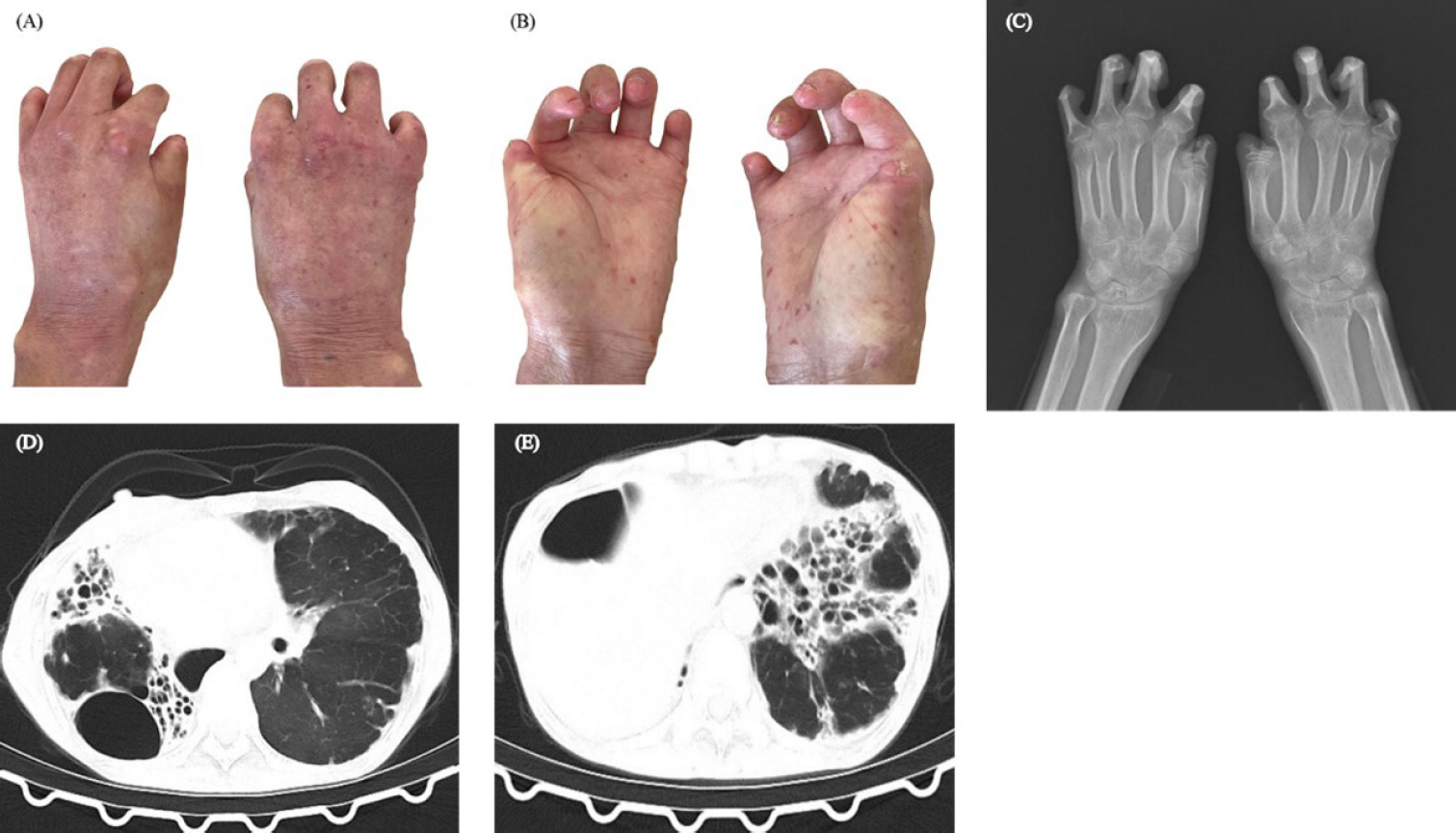
A, B: Flexion contractures of the interphalangeal joints. C: Hands X-ray presented acro-osteolysis. D, E: CT scan presented severe interstitial lung disease.
Acro-osteolysis, a typical complication of scleroderma, is caused by chronic ischemic changes of the digital tuft due to an extended period of Raynaud’s syndrome.[2,3] Acroosteolysis may lead to diminished tactile sensitivity and undermine the structural integrity of fingers, metaphorically described as “The Vanishing Touch”. Early recognition and treatment may potentially prevent extensive bone tissue destruction.
Funding statement: None.
Acknowledgement
The authors thank the patient for providing original source of image.
-
Author Contributions
Hui Jiang contributed to the original draft writing. Yangzhong Zhou contributed to paper revising and editing.
-
Informed Consent
The authors declare that the patient has given the consent for the images and other clinical information to be reported in the journal.
-
Ethical Statement
The study was approved by the Ethics Committee of PUMCH (Beijing, China; approval number: JS-2038).
-
Conflict of Interest
The authors declare that they have no competing interests.
-
Data availability statement
No additional data was generated. The data of this case are available from the corresponding author upon reasonable request.
References
[1] Avouac J, Guerini H, Wipff J, et al. Radiological hand involvementin systemic sclerosis. Ann Rheum Dis. 2006;65:1088–1092.Suche in Google Scholar
[2] Kemp SS, Dalinka MK, Schumacher HR. Acro-osteolysis. Etiologic and radiological considerations. JAMA. 1986;255:2058–2061.Suche in Google Scholar
[3] Avouac J, Mogavero G, Guerini H, et al. Predictive factors of hand radiographic lesions in systemic sclerosis: a prospective study. Ann Rheum Dis. 2011;70:630–633.Suche in Google Scholar
© 2024 Hui Jiang, Yangzhong Zhou, published by De Gruyter on behalf of NCRC-DID.
This work is licensed under the Creative Commons Attribution 4.0 International License.
Artikel in diesem Heft
- Editorial
- Early diagnosis and standardized treatment are critical to improve the prognosis of patients with Takayasu’s arteritis
- Guideline and Consensus
- Chinese guideline for the diagnosis and treatment of Takayasu’s arteritis (2023)
- Review
- The effect of anti-TNF drugs on the intestinal microbiota in patients with spondyloarthritis, rheumatoid arthritis, and inflammatory bowel diseases
- What can patients tell us in Sjögren’s syndrome?
- Amyopathic dermatomyositis may be on the spectrum of autoinflammatory disease: A clinical review
- Original Article
- Adalimumab in the management of psoriasis and psoriatic arthritis: Results from a Delphi investigation
- Clinical implications of seropositive and seronegative autoantibody status in rheumatoid arthritis patients: A comparative multicentre observational study
- Images
- The vanishing touch: Unveiling the tuft erosion in scleroderma
- Letter to the Editor
- Not all geriatric cachexia is cancer – The difficult lateonset rheumatoid arthritis
Artikel in diesem Heft
- Editorial
- Early diagnosis and standardized treatment are critical to improve the prognosis of patients with Takayasu’s arteritis
- Guideline and Consensus
- Chinese guideline for the diagnosis and treatment of Takayasu’s arteritis (2023)
- Review
- The effect of anti-TNF drugs on the intestinal microbiota in patients with spondyloarthritis, rheumatoid arthritis, and inflammatory bowel diseases
- What can patients tell us in Sjögren’s syndrome?
- Amyopathic dermatomyositis may be on the spectrum of autoinflammatory disease: A clinical review
- Original Article
- Adalimumab in the management of psoriasis and psoriatic arthritis: Results from a Delphi investigation
- Clinical implications of seropositive and seronegative autoantibody status in rheumatoid arthritis patients: A comparative multicentre observational study
- Images
- The vanishing touch: Unveiling the tuft erosion in scleroderma
- Letter to the Editor
- Not all geriatric cachexia is cancer – The difficult lateonset rheumatoid arthritis
