The Development of Skill Knowledge in Conservation
-
Irene Brückle
Irene Brückle is professor and director of the Study Programme Conservation of Works of Art on Paper, Archives and Library Materials at the Stuttgart State Academy of Art and Design since 2008. From 2005 to 2008, she was head of conservation at the Kupferstichkabinett, Staatliche Museen zu Berlin. From 1990 to 2004, she taught full-time at the Art Conservation Department at Buffalo State College and became a professor there in 1992. She holds an MA degree in art history from the State University of New York at Buffalo and a doctorate in art technology/art history from the Stuttgart Academy. In 2006, she received the Caroline Keck award for excellence in teaching from the American Institute for Conservation. She is co-author with G. Banik ofPaper and Water (2011, 2018) and member of the editorial board ofStudies in Conservation (IIC).

Abstract
In conservation, the practical ability to implement treatment on objects of cultural heritage requires skills as an essential part of conservation expertise and constitutes an fundamental part of learning in conservation education. The acquisition of practical skills, which include cognitive and practical elements, is governed by laws that are primarily explained by means of organizational psychology and medicine where they have evolved in the form of step models. Stages of explicit and implicit knowledge are distinguished as well as factual-theoretical and practical-performative knowledge. Forms of learning are, in addition to guided learning, the experiment, the emergency, case studies and implicit forms of problem solving. The development of the expert can also be traced by the development of practical skills in five stages from beginner to expert. The stages of skills acquisition can be explained by reference to the European Qualifications Framework for Lifelong Learning (EQF) and the skill levels defined by the European Confederation of Conservator-Restorers’ Organizations (E.C.C.O.).
Zusammenfassung
Die Entwicklung praktischer Fähigkeiten in der Restaurierung
In der Restaurierung ist die praktische Befähigung zur Umsetzung von Anwendungen an und mit Kulturgut als praktische Fähigkeiten essentieller Bestandteil restauratorischer Expertise und Teil des im Studium vermittelten Wissens. Der Erwerb praktischer Fähigkeiten, die kognitive und praktische Elemente beinhalten, unterliegt Gesetzmäßigkeiten, die vornehmlich anhand der Organisationspsychologie und der Medizin als Lehrfach in Form von Stufenmodellen erklärt und hier in Bezug auf die Restaurierung ausgewertet werden. Dabei werden Stadien des expliziten und impliziten Wissens ebenso unterschieden wie faktisch-theoretisches und praktisch-performatives Wissen. Formen des Lernens sind, neben angeleitetem Lernen das Experiment, der Notfall, Fallstudien und implizite Formen des Problemlösens. Die Entwicklung zum Experten lässt sich auch anhand der Entwicklung der praktischen Fähigkeiten in fünf Stadien vom Anfänger zum Experten nachvollziehen. Die Stadien des Kompetenzerwerbs lassen sich unter Bezugnahme auf den Europäischen Qualifikationsrahmen für lebenslanges Lernen (EQR) und mit den Kompetenzebenen der European Confederation of Conservator-Restorers’ Organisations (E.C.C.O.) erklären.
Résumé
La connaissance des compétences manuelles
Avant la seconde moitié du 20ème siècle, le don manuel est la compétence la plus importante pour réussir en restauration. La restauration moderne induit moins de traitement et est moins invasive que par le passé. Les objets du patrimoine culturel tirent bénéfice de notre conscience augmentée des différentes valeurs associées aux matériaux d’origine non altérés, leur âge, les signes d’emploi et d’intérêt futur. Cette énorme réussite constitue un changement exemplaire de la profession et est le résultat de son évolution savante-scientifique.
1 Introduction
Before the mid-twentieth century, skills associated with the interventive treatment of cultural heritage objects were the most important competences for conservation practitioners. In modern conservation that has undergone academization, less treatment is done and in a less invasive manner than in the past. Objects of cultural heritage benefit from our increased awareness of the many values associated with unaltered original materials, their ageing, signs of use and future interest. This enormous achievement constitutes a paradigmatic change in the profession and is the result of its scholarly-scientific evolution. In this intellectually broadened environment, skills necessarily receive only shared attention.
Depending on the context, the term “skill” refers to diverse abilities as disparate as language and manual dexterity (Merriam-Webster Online Dictionary 2015). Complex professions involve a variety of different skills, making specification necessary of the one targeted in a discussion, as pointed out in a recent review of practical skill learning in medicine (Vogel and Harendza 2016). The European Confederation of Conservator-Restorers Organizations (European Confederation of Conservator-Restorers’ Organisations E.C.C.O 2011) defined “skills” as a “proficiency, facility, or dexterity” required to “perform an activity”. The European Qualifications Framework (EQF 2008), which classifies learning outcomes for education and on which E.C.C.O.’s cited 2011 document leans, further differentiates skill. It lists two kinds, namely skills that are “cognitive (involving the use of logical, intuitive and creative thinking)” and skills that are “practical (involving manual dexterity and the use of methods, materials, tools and instruments)”. The fact that both are necessary in any competent professional performance is evident: an experienced but thoughtless use of tools can do as much damage as their creative but inexperienced use. Conservation skills ideally merge practical (technical) and cognitive (creative) abilities both of which are required in the treatment of objects (in the following: treatment skills). Skill forms part of the complementary “knowledge and skills” duo that every conservator must strive to improve continually, as spelled out by E.C.C.O.’s Code of Ethics (2003, Article 12), where knowledge concerns advanced, comprehensive, specialized and critical understanding of facts, principles and concepts also at the interface between different fields (European Communities 2008). Skill learning remains an essential part of conservation education today, though the term skill (relating to interventions on objects) is curiously absent from E.C.C.O.’s document on conservation education (2004).
There are persistent misconceptions about treatment skills. In the interdisciplinary contexts in which conservation largely operates, treatment skills are often praised as and at the same time are mistaken for an art or a craft (in which our work might be paid and valued less). This is unfortunate because professional conservation treatment skills, comparable to medical treatment skills, rest on a solid scientific-scholarly foundation that offsets them from an art or a craft. One may add that customers may not be sufficiently informed about these concepts.
Treatment skills are also in danger of being appendicised in theory-driven contexts or completely lost, as recently pointed out by Ashley-Smith (2016). In our digitally involved and multi-perspective field of action, it seems necessary to renew our attention to treatment skills and make a conscious claim for the time allotments required for skill learning and for skill practice at the expert level. To reiterate the obvious: skill qualifies as part of professional conservation only when the scientific-humanities knowledge framework underlies it in the overall scheme.
In re-evaluating treatment skills, I suggest that when it integrates theory and increases conservation knowledge, it can and must be considered part of scholarly work. It is the visible result of complex thinking processes. This approach seeks to overcome the divide between the recognised (art-technical or methodical) research and treatment. Ours is not the only profession where an increasing divide between theory and practice is bridged with a similar argument. In medicine, practitioners also find themselves on the defensive in a research-driven science context. This dilemma has led to a re-evaluation where “medical practice is a science because the physician’s individual thought processes (consciously or not) exemplify scientific reasoning” (Berg 1997, 30). In other words, systematic practice is as worthy as and can be a form of scientific research.
A discussion on skills must also consider treatment skill acquisition in the tutored environments of conservation education programmes. In such settings, controlled and simulated practice situations involve direct observation, imitation, a defined level of experimentation, as well as case studies. These curricular modules concern materials and their procedural handling, tool use, timing as well as managerial aspects on both large and small scales. It builds observational acuity while learning procedural adjustments. It increases the students’ understanding of minimising risks and optimising results. Moreover, it gradually increases their level of independence. Teaching skills is a significant investment because it requires specialised resources and real-world simulations. Time is the most universal factor because the time required is dictated most of all by the properties and the interactions of the materials and by the requirements of the cultural objects involved. Analogue processes on cultural objects cannot be speeded up to any significant extent.
I consider why skill knowledge is hard to communicate in some contexts and present a model that explains skill knowledge as a form of procedural knowledge relating to theoretical knowledge on the road to expertise. In doing so, I concentrate on the structural knowledge aspects in skill acquisition that matter in teaching conservation treatment practice. Selected studies from other fields are cited to illustrate or introduce related issues discussed for conservation.
2 Opinions about skill
Off-hand opinions about conservation treatment can occasionally be heard at public meetings. In a talk presented at a conference in 2004 that examined the contributions of science to conservation, a speaker commented, “Conservators do treatments by the seat of their pants.” [1] Mostly, the implication is that conservators are only lucky to succeed in their treatments, and when luck fails, they turn to science for help. Another comment, made in a private conversation at that same conference, revolved around the content of conservation conferences and concerned the presentation of treatment cases: “Conservation treatment talks are boring.” Both of the statements were made by conservation scientists. Since generally, conservators do not lack professional rigour and scientists are not rude, we can assume that the problem may lie elsewhere and perhaps remember that science also suffers from harsh critiques across interdisciplinary divides. Reflecting on the narrowness of scientific investigation and the loss of cohesion between technology and human experience, the art historian Barbara Stafford writes that in the
notorious Rembrandt Project, a battery of assaulting tests, not unlike those plumbing the pathology of the hospitalized patient, search for reliable symptoms of authenticity in Rembrandt’s disputed corpus of paintings. Considerations of facture and content disappear in the hyperinflated and expensive mechanical puzzle. (1996, 144)
Science, so it is insinuated, is wedded to the material world and cannot perceive its “spiritual” component, is concerned with particulars, misses the big picture and lacks the necessary passion to understand the arts.
The above-cited examples show that communication across interdisciplinary divides can be difficult and cause misunderstandings. It is difficult for conservation treatment in particular to be on (its deserved) equal footing with the sciences and the humanities for several reasons. The sciences and the humanities have a strong verbal tradition, manifested in established presentation formats where practical work is considered only a means to an end and so is rarely made a public focus. In treatment-focused areas of conservation, procedures and processes are very important for successful practice, but effectively relating treatment performance to scientists or, for that matter, art historians can be difficult when, as is often the case, their interest lies outside the focus of these intricate procedural aspects. One reason for examining the structural qualities of skill knowledge in conservation treatment is to gain a broader understanding of what makes treatment interesting and what might make it better understandable to outsiders.
3 Polanyi’s physical interaction model
When carrying out a familiar task, we hardly pay attention to the fact that this involves the coordination of complex actions. Only when we are suddenly made aware that we are performing a task do we realise its complexity, which may then cause us to freeze in our motion while we self-consciously ponder on its performative quality. Performing a task requires an understanding of the motoric sensibility of the human body and the physical structure and properties of the objects brought into relation with it. The skilful performance of a task is largely determined by how accurately we are able to gauge the properties of the actors participating in it – that is, ourselves and the objects we handle – their masses, volumes, shapes, strengths and surface characteristics. Some of the expert knowledge necessary to interact with the physical world concerns nonverbal (i.e., implicit or tacit) knowledge, as explained by the scientist and philosopher Michael Polanyi in his seminal and still frequently cited book The Tacit Dimension and discussed in the following paragraphs (Polanyi 1966, 10f).
3.1 Two terms of knowing
The first term of knowing concerns discrete details that are closely associated and thereby easily obscured by the second term of knowing, as illustrated by Polanyi in this example: A man who explores a dark cave using a stick as his only guide will initially concentrate on the sensation of the stick in his hand, the way it presses against his palm. Once he has become familiar with handling the stick, he begins to shift his concentration from feeling the stick in his hand to the objects touched by the far end of the stick. His awareness of the stick gradually transforms into a sense of the stick’s point touching the explored objects. If the man stays in the dark cave for a long time, he will have acquired a mastery that will almost make it seem as if the stick were an extension of his body. The connection between the stick and the hand will become subsumed in the task of cave exploration. The stick will, so to speak, disappear.
3.2 Directedness
The stick example also allows us to understand the directedness of implicit knowing. The first term of knowing is associated with the man’s body (the hand) and can be called “proximal”. The second term of knowing concerns the interface between the end of the stick and the cave. It can be called “distal”, the anatomical term for a body part that is distant from the torso (the arm is proximal; the hand is distal to the trunk). The cave explorer’s attention moves from the hand to the end of the stick, away from his body and towards the nearby objects. Polanyi states that “we attend from something for attending to something else” (1966, 10).
3.3 Bodily involvement
Although implicit knowing points from the body to the outside world, it is significant that the performance always originates from the body and never relinquishes its connection to the latter. Implicit knowing requires the continued involvement of the body; even in the process of performing a task, we do not pay attention to our physical sensations anymore. All of our knowledge of the world is mediated through our bodies.
3.4 Disattention
If a blind man, who is accustomed to navigating the world with a stick, is asked about his skilled use of it, he would likely pause, trying to figure out how to explain something so utterly familiar to him. Reflecting on the subject, he may be able to describe how he operates with the stick. However, some tasks cannot be performed while they are being described because any attempt to verbalise them interferes with their performance. This is especially the case with artistic performances. When asked how she uses her hands to perform a musical piece, the experienced pianist may momentarily be unable to play the music because she now has to direct her attention to the action of her hands. When she redirects her attention to the music, she is able to resume her performance. The first term of knowing has to remain unfocused so that the person can concentrate on the second term of knowing, in our example, the sound of the piano keys. Attention cannot be divided.
3.5 Recollection
Knowledge changes over time; it may diminish or disappear. The seeing man exploring the dark cave with a stick will forget the initial bodily sensation of the stick when he first became used to it. Much later, when he is asked about how he works with the stick, he might try to remember his early thoughts and observations. However, it is quite possible that his recollection will not be fully representative of the historical experience.
4 Physical interaction in conservation treatment
The different terms of knowing that occur in a conservation performance may not be as dramatic as they are in Polanyi’s (1966) example of a man exploring a cave but in principle, follow the same pattern. The examples described below deal with lifting a paper sheet out of a water bath and moistening a sheet by misting it.
4.1 Two terms of knowing in conservation skill performance
The conservator who touches the immersed paper sheet will first feel the wet paper and will be able to judge its properties. The sensation of touching the paper constitutes the first term, and the subsequent understanding of the properties of the wet paper constitutes the second term of knowing. Because touching the paper translates into an understanding of its properties, the first term of knowing is usually subsumed in the second one. Additionally, the professional conservator has background knowledge and is therefore more closely comparable to a scientific cave explorer than an accidental visitor. The experienced cave explorer is familiar with typical cave features, just as the conservator is well-informed about typical paper features. In either case, theoretical knowledge is essential for maximising benefits and minimising risks during the physical experience.
4.2 Directedness in conservation skill performance
If a tool, such as a screen, is used to lift the paper out of the bath, the conservator’s attention to the screen extends as far as is necessary to handle the paper safely. However, her focus will be the paper on the screen. She will pay attention to the way the water drains from the paper as it is lifted. In other words, the conservator will move the screen while attending to the paper. When an additional tool is involved, for example, when a blotter is used to absorb excess water, the directedness occurs from the body to the arm and then to the blotter and the blotted paper.
4.3 Bodily involvement in conservation skill performance
Treatment requires a physical performance. The body functions as a sensor in the exploration of the paper properties, which regulates the action. For example, moistening a very large paper sheet using a water spray bottle involves two joined motions to ensure an even water delivery throughout. While his arm moves the water sprayer from left to right and back again, the conservator takes single steps back so that each turn of the sprayer covers a different paper area. This action is more complex than it first seems, as suggested by the difficulty that novices may experience in coordinating the two simultaneous motions.
4.4 Disattention in conservation skill performance
Certain tasks become implicit (nonverbal) with experience. In our example of lifting a paper sheet out of a water bath, the required motions may have become so familiar that they do not have to be consciously considered anymore. The conservator then may already think about other treatment aspects while the lifting is still in progress. There are distinct limits to disattention because risk increases with it. The only conservation task where disattention can serve treatment concerns the overall aesthetic evaluation of an object in its entirety. This task shifts the focus away from specific areas of the object that were previously the centre of attention (e.g., during bleaching or retouching).
4.5 Recollection in conservation skill performance
If a treatment was done long ago and was a routine case, it may be difficult to recollect procedural details, such as lifting a paper out of a water bath, especially as these are usually not included in the project documentation. However, based on the documentation that lists immersion washing, the conservator is likely to recapitulate the details of a procedure especially if it followed a standard. Simulating procedural motions can be part of a recollection.
In sum, performative knowledge according to Polanyi’s (1966) model involves separate parts that function together. The performance of a treatment entails the following aspects:
Our involvement originates from and remains connected to our bodies.
Our attention is directed away from our bodies towards the object.
Our physical sensation assists our interpretation of the object’s properties.
Our skill knowledge may become more implicit as we gain experience.
5 Skill acquisition
To examine how treatment skills are acquired, we have to differentiate between explicit and implicit forms of knowledge and distinguish between theoretical and practical knowledge. [2] These elements are characteristic of professions that involve thinking and doing, that is, the “why” and the “how to” of task performances (Bromme 1992; Johnson 1988). For example, practical knowledge includes the conservator’s ability to carry out a washing treatment of an object. Theoretical knowledge involves factual knowledge of the technology of the materials involved, their ageing, their interaction with the treatment agents, the functions of the chosen treatment methods, how all of these can optimise the object’s preservation, and last but not least, humanities knowledge of the object values and the conservation ethics framework.
To illustrate how practical and theoretical knowledge function together in skill learning, we have to turn to the fields of psychology and organisation studies. In these domains, the structure of knowledge in human cognition, the acquisition of knowledge through learning, and its transfer from one person to another are explained. A model developed by the social psychologist Elisabeth Brauner (2002) can also explain some structural aspects of conservation knowledge.
5.1 Terms of knowledge and learning
Knowledge can be described by four terms that include both practical and theoretical forms (Anderson 1995). They comprise declarative knowledge, that is, factual knowledge about a task; procedural knowledge, meaning knowledge about how to perform a task; explicit knowledge, referring to knowledge that can be verbalised; and implicit knowledge, pertaining to knowledge that is not easily verbalised and corresponds to Polanyi’s (1966) implicit (tacit) knowledge.
The terms occur in the following four combinations that account for the spectrum of human cognition, each covering a different aspect (Figure 1) (Brauner 2002):
Explicit-declarative knowledge denotes conscious, verbalisable factual knowledge about things, for example, knowledge about a country’s capital.
Explicit-procedural knowledge means conscious knowledge about how processes function. It is verbalisable but does not require verbalisation, for example, how to travel to a country’s capital.
Implicit-procedural knowledge refers to knowledge about how processes function where no conscious thought process is needed, for example, knowledge of speech.
Implicit-declarative knowledge is knowledge about attitudes, cultural patterns and stereotypes that are learned through observation or communication, for example, the idea of beauty, determined in the West by ancient Greek civilisation.
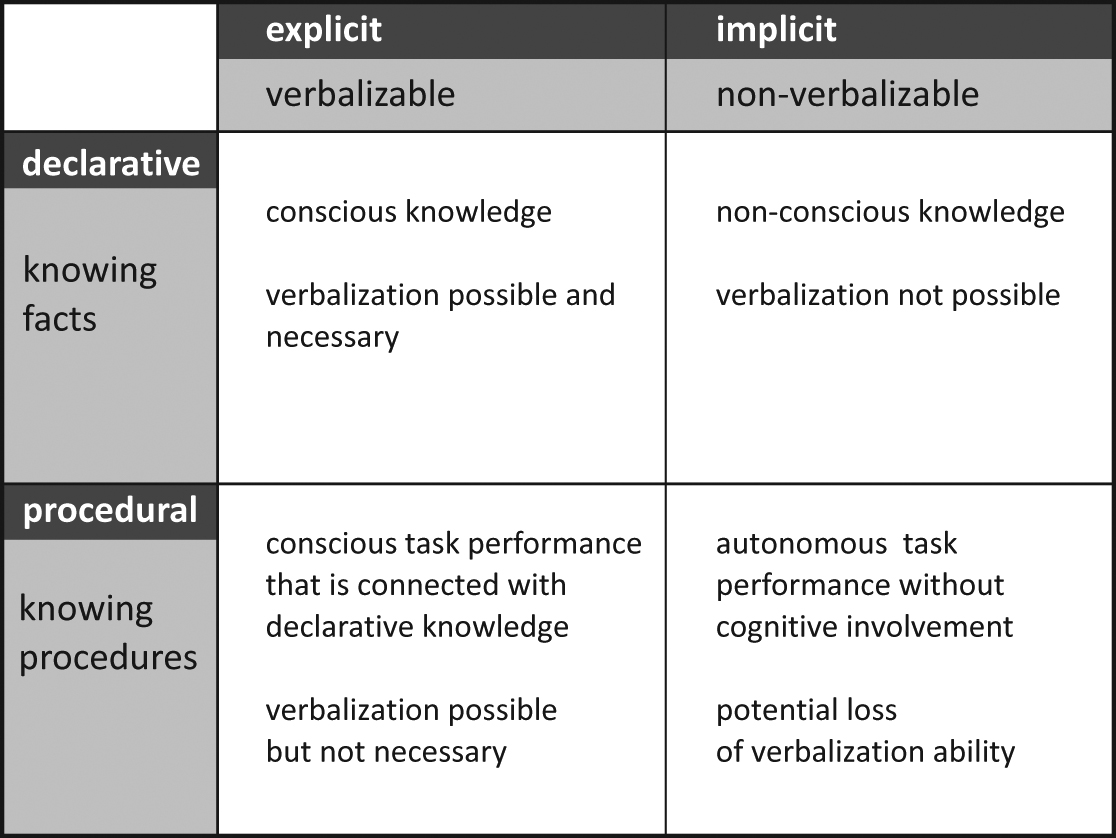
Knowledge terms in cognitive psychology, according to Brauner (2002).
According to cognitive psychology, pre-existing knowledge can be implicit-declarative and implicit-procedural. Pre-existing implicit knowledge can be difficult to verbalise spontaneously and cannot be “turned off” at will. For example, an ingrained cultural attitude, such as a sense of what is beautiful or ugly, may not be easily changed.
To illustrate skill learning, it is best to first look at an example that is familiar to most people – learning how to drive a car. Going through three stages (1–3), the student driver learns to change gears. Pre-existing knowledge makes learning easier (0):
Knowledge about the world. By walking or being driven as a child, the learner will have acquired knowledge of the layout and the navigation of the road system and the movement of vehicles and pedestrians on the roads.
Explicit-declarative stage. The learner will attend to each detail by following the instructor’s rules mechanically. The learner will be conscious of how the foot presses down on the clutch and the stick shift moves under the action of his hand.
Explicit-procedural stage. Once he is a bit familiar with how the clutch and the stick are manipulated, he does not recite the individual instructions while going through the motions of changing gears. He might only think that now he will change gears.
Implicit-procedural stage. Having fully mastered the task, the learner may not even think of changing gears but will automatically do so when he decides to change the speed of the car.
5.2 Learning conservation skills
Because guided learning is the generally accepted and practised way of skill acquisition, it is considered first, followed by other forms of learning that are unguided and occur through experimentation, in crisis situations and in case studies. It might be reiterated that theoretical (scientific-humanities) knowledge forms the backdrop to learning conservation treatment skills; it determines treatment goals and choices and keeps a treatment progressing in a corridor of accepted and desired results. In the scenarios presented in the following subsections, the focus remains on the acquisition of treatment skills, citing the already familiar example of lifting paper out of a water bath.
5.2.1 Guided learning
Similar to the driving student, the novice conservation student will go through three stages of learning (Figure 2). In the first stage, the student receives detailed step-by-step instructions with a demonstration of the process; then, guidance and feedback support the student’s performance.
Knowledge about the world. The student has experiential knowledge about the properties of liquid water. She may have already read about the properties of paper and water.
Explicit-declarative stage. The student thinks about the placement of her hands around the edges of the paper. She first lifts one corner above the water surface. Next, using both hands, she brings the entire paper edge into a vertical position above the water surface. Finally, she raises the whole paper sheet vertically until she holds it suspended above the water surface.
Explicit-procedural stage. The student remembers the steps and perhaps refers to her notes or a video (at the paper conservation programme at the Stuttgart Academy, instructional steps can be reviewed in videos). She then goes through the motion, blending the steps together.
Implicit-procedural stage. The student lifts the paper sheet out of the water bath without having to make a conscious effort to remember the individual steps and may think of related treatment aspects.
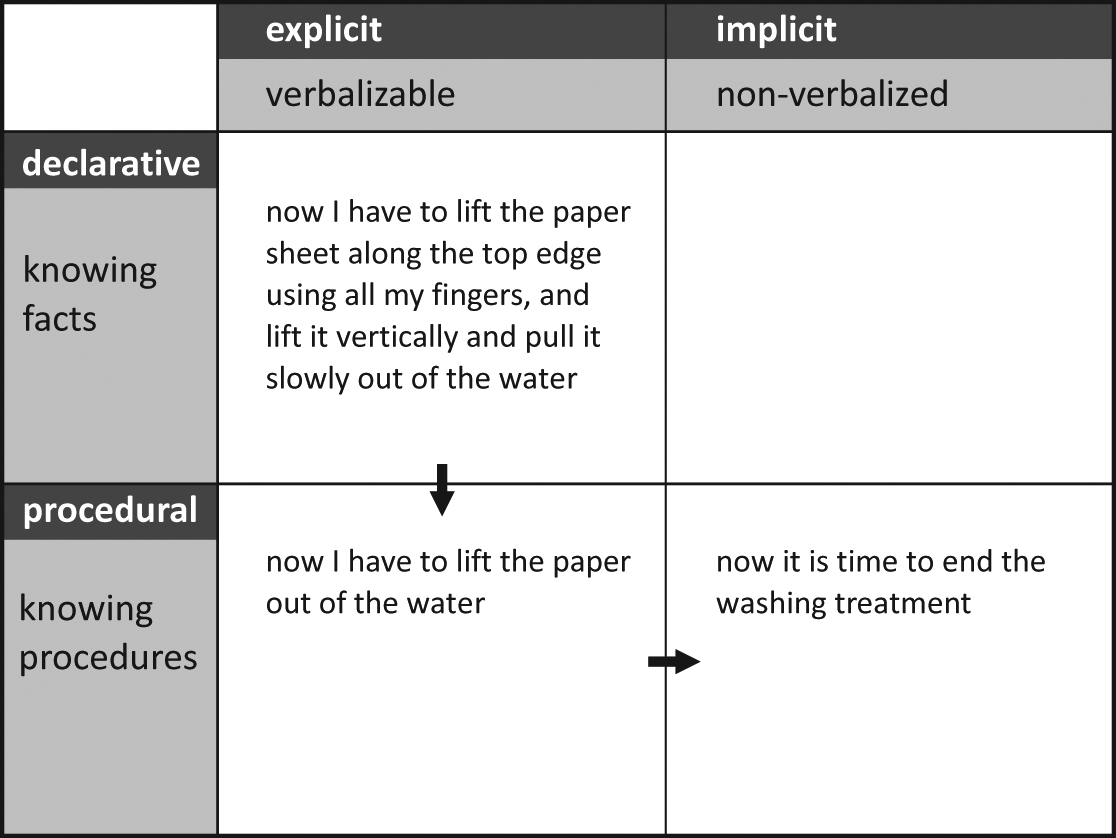
Evolution of thinking in learning how to lift a paper sheet out of a water bath.
Breaking down a treatment process into its procedural details makes the process more easily learnable and diminishes risks. Teaching one key method as the primary one creates a practical knowledge base and standard. Subsequent departures from it that are needed to accommodate specific requirements can be more easily identified as a variation. Naming the discrete elements of procedures also clarifies the complexity of the skill and the need for sufficient learning time. Many conservation tasks are learned in this way, for example, how to repair a tear, how to use retouching media, how to work with a scalpel and how to cut paper on a board shear. Finally, subdividing tasks means that you (e.g. as instructor) can create a system, whose elements you can use flexibly, speak about, explain and write about.
The student who knows the standard procedure (see the bullet list in the first paragraph of this subsection) can more easily gauge the behaviour of paper in more complex situations. She can consider how to handle a fragile paper on the support while lifting it out of a water bath or how to handle a paper in different washing methods, such as float washing. Soon, she will know the entire treatment sequence, consisting of moistening–washing–drying. The skills are organised into larger structures that subsume the individual smaller steps and lead to one coherent flow. A term introduced by the psychologist Csikszentmihalyi (1991), flow describes the fluid execution of a well-practised task whose elements blend together, an experience that (so he notes) creates a feeling of happiness. Complex motion is not merely adding up simpler motions but melting them together into a new, indivisible entity (Heuer 1983).
5.2.2 Learning by experimentation
The vexing question of how to solve a problem with no solution yet preoccupied Socrates, who, in Plato’s Meno dialogue, mentions that no one could fully know the problem that one would be researching on; otherwise, one would know the answer beforehand (Polanyi 1962). Socrates resorts to saying that the solution to a problem must have been given in a previous life, while Polanyi explains it as implicit knowledge. Setting aside questions about the nature of the unknown, experimentation as one inquiry method involves physical trial and error and processes that are begun, adjusted, modified, relinquished, reworked or started over. One might say that the experimenter “feels” his way to success (Polanyi 1962). Experimentation either advances knowledge frontiers in problem solving, for example, in graduate thesis work, where the supervisors’ expertise guides the research, or it is a deliberate part of learning established procedures. This may involve working with expendable materials. In the following example, a student experiments with moistening a thin paper (established methods exist), which involves explicit and implicit procedural modes:
Pre-existing knowledge. Existing knowledge about the involved materials and processes may help in broadening the methods considered; if the student has sufficient experience, only the best options might be selected.
Explicit and implicit procedural stage. The student tries out several methods. He may mist the paper while it lies on the table, immerse it in a water bath and then lift it with or without a support, or drain the water from the tray before removing the paper. Procedural details may suggest themselves in an implicit way.
Explicit-procedural stage. The student understands the patterns in the paper’s behaviour through skills gained during the process of testing the methods of handling the paper.
Explicit-declarative stage. The student is able to explain the reasons why one treatment method works better than another.
5.2.3 Learning from crises
Crises interrupt routines and often demand immediate action. In surgery, the crisis may involve a sudden change in the vital signs of the anaesthetised patient. In air navigation, the incident may be a rapid loss of cabin pressure. In the following hypothetical emergency during a washing treatment, a print needs to be removed from the water bath because its red-coloured printing ink suddenly shows signs of bleeding (such a situation can happen in rare cases where pre-treatment testing did not indicate any related risk). In such a situation, prior experience with the principal steps of the washing treatment, possibly even other emergency situations, will be a benefit. With sufficient expertise, the response may be quite intuitive (implicit); the print is moved out of the water in such a way as to avoid any colourant settling in undesired locations, followed by selective rinsing, blotting and/or preferential drying, to name a few possible options. Verbalising the process is more likely to occur in any extensive thoughtful way only after the emergency situation is over and the best possible outcome is achieved (Figure 3).
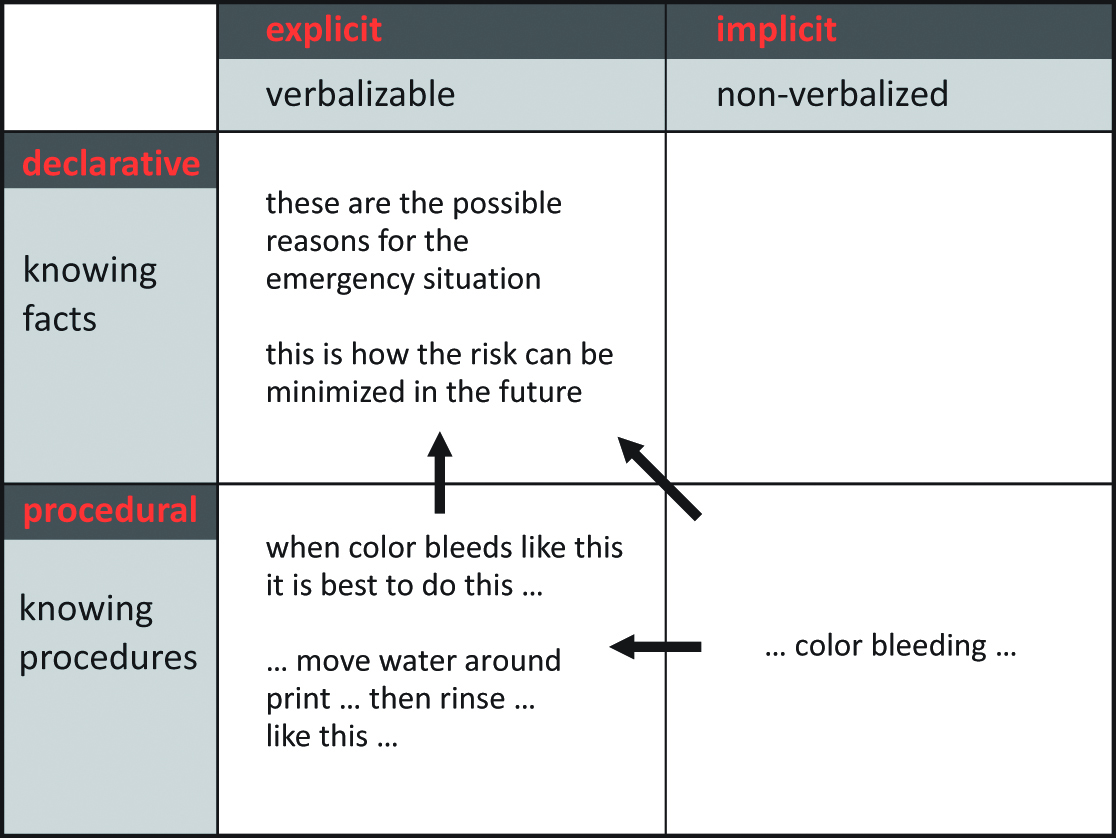
Knowledge structure in response to an emergency.
Crises are undesired, but we can learn from them subsequently by analysing them and devising strategies for diminishing any similar risk in future treatments. A nurse anaesthetist who reflects on past learning experiences involving mistakes notes,
When I make any mistake, this is bothering me. I think for myself: ‘What did I do wrong? … Why did this happen? I talk about it and think it over in detail. I think this is the only way to make it better next time’. (Brauner et al. 2005, 147)
In the wake of a washing emergency, we will search for the causes of the print’s unexpected water sensitivity, will have learned that the results of testing cannot fully foretell the behaviour of object components during treatment, will adjust treatment methods and will be warned that certain kinds of prints (of an artist, time period, manufacturing technology, condition, treatment history, etc.) carry the risk of ink bleeding that must be factored into treatment decision making.
5.2.4 Learning from cases
Concrete examples are important to learning. This issue was examined in a study that compared the performance of probands in a setting that required them to solve a problem related to a real-world situation (Johnson-Laird 1985). In the first part of the experiment, they had to decide which of the four envelopes had to be turned over to check whether the following statement was true or false: “If a letter is sealed, then it has a 50 lire stamp on it” (Johnson-Laird 1985, 183). They had no difficulty in selecting the correct envelopes. In the second part of the experiment, the same probands had to solve the same task on an abstract level, that is, without the physical presence of the envelopes. In this situation, they performed less successfully. This suggests that connecting a problem to a real-world experience (envelopes are provided) activates certain kinds of memory that are helpful in solving a problem.
Experience of concrete examples merges with other (theoretical and practical) knowledge, which creates a rich case-related knowledge base that serves future competent decision making. In conservation education, case knowledge is gained through personal experience in projects conducted under guidance as part of curricular work, during pre-program and student internships and post-graduate fellowships, by presenting case stories in lectures and discussing them in seminars.
5.2.5 Implicit problem solving
Solving problems occurs at different levels of learning and expertise but always requires some pre-existing knowledge so that the basics of the problem are sufficiently understood and the direction in which the solution must be sought can be gauged. Problem solving can be complex and occurs in stages. The mathematician Poincaré identified four stages of problem solving that included preparation, incubation, illumination and verification (Polanyi 1962). The incubation stage is of interest here because it relates to a phase in which the problem is not always in the foreground of our attention while we seek its solution.
Although unrelenting attention accelerates problem solving, it can be equally important to intersect periods of rest when the problem is allowed to recede into the back of our minds. It means stepping out of explicit action to allow an implicit mode that on the surface resembles disinterest. It can be illustrated by how one would search for a lost wallet that one believes was left in the car. If the wallet is not found in the car, fixing one’s attention exclusively on the car does not improve the search at this moment. One might then look around the car. If that fails, no other search locations come to mind, and there is no pressing need to continue the search immediately, it might be a good idea to get a cup of coffee nearby before thinking about the next steps of an extended search. Problem solving can benefit from taking a break just long enough to relieve the intellectual tension and the emotional strain.
In conservation, such situations occur when we are faced with a treatment we must prepare that involves a problem to which we have no solution yet. We may carry out tests, examine the object repeatedly, reread and search out new documentation about its technical makeup, call colleagues, check additional literature and organise and conduct additional testing or analyses. If these actions are insufficient for deciding on a course of action, we may turn our attention to other projects before re-examining the object. Often, an extended incubation stage leads to a solution, as shown in the case of a complex chine collé print for which a treatment solution was developed after a time of consideration wisely managed by Debra Evans, Head of Paper Conservation at the Fine Arts Museums of San Francisco (Murphy 1998). Such “latent” periods of problem-solving deserve recognition as part of conservation practice.
6 Becoming an expert
High-reliability professions, such as medicine and conservation, require a rich knowledge and skills base that enables practitioners to cope with a wide range of professional situations (Weick and Sutcliffe 2001). Expert knowledge is broad in content, is organised in large complex units, includes an abstract or a meta-level and is supported by knowledge of cases from real-life experiences. Experts are able to focus quickly on a small set of possible solutions to a problem and do not always know how they arrived at a solution. They are also able to manage practical concerns surrounding the problem to be solved (Bromme 1992). E.C.C.O. (2011) correlates the conservation expert level with post-M.A. graduation field experience or a doctorate study. According to the European Qualifications Framework (EQF 2008) on which E.C.C.O.’s 2011 definition is based, expert level involves “knowledge at the most advanced frontier of a field of work or study and at the interface between fields” and the “most advanced and specialized skills and techniques, including synthesis and evaluation, required to solve critical problems in research and/or innovation and to extend and redefine existing knowledge or professional practice”.
To explain why experts perform successfully, tests replicating practice situations were set up in several different fields. One such study involved the fields of medicine, chess playing, physics and teaching (Johnson et al. 1981). In the tests, the performance of experts was compared with that of less experienced practitioners. For example, the tests involved generating a patient’s anamnesis from a selection of data, replicating a chess constellation after briefly being allowed to view it, reviewing teaching performances through question protocols, and grouping a set of physics problems according to type. In the selection of expert participants for this study, the physicians were identified by their experience and by peer evaluation, the teachers by the length and success of their professional experience, the physicists by the doctoral level of their studies and the chess players by their achievement records. As for the less experienced group, the physicians and the physicists were selected among students or interns, and the teachers and the chess players were chosen among junior professionals. Despite differences in the fields of physicians, teachers, chess players and physicists, it was found that experts in any of these professions had certain common abilities that helped them to perform better than their less experienced counterparts. The expert physicians were able to sort out the information that was presented to them by its important and unimportant elements so that they arrived at a correct hypothesis about a disease quickly. The less experienced physicians identified the same number of symptoms but were unable to sort out the important from the unimportant ones. This difference indicated that it was not so much the amount of knowledge but its organisation that made the medical diagnosis successful. The knowledge of the clinically trained physicians was richly detailed and differentiated by the natural variants they had learned in the examination of patients. The expert chess players required fewer viewings of a set-up chess constellation to reproduce it than the non-experts. The experienced teachers were better able to handle a distraction in the classroom situation than their novice counterparts. The doctoral physics students sorted problems in their field according to the physics laws that pointed to the solutions, whereas the beginning students sorted them phenomenologically by the geometric forms featured in the problems.
Competent performers may overestimate their knowledge base as demonstrated in a study (Bromme 1992) in the medical profession. When confronted with x-ray images that had to be diagnosed, the novices and the clinically experienced professionals performed better than the physicians at intermediate stages of training. The novices interpreted the images without making use of information about the patient history and/or the variables of the radiographic technology but focused their diagnosis only on the features observed on the radiographic images. Although without depth, their diagnosis was less misdirected than that of intermediate physicians who took into account the provided context information but could not use it in the coherent way that it was used by the experts. The knowledge of the novices was coherent in a naïve sense; the knowledge of the intermediate physicians was incoherent because it was in transition from naïve knowledge to the deep, coherent knowledge of the expert.
S. E. Dreyfus, a specialist in industrial engineering and operations research, and H. L. Dreyfus, a philosopher, differentiated among five stages in the acquisition of expertise in a wide range of activities and fields – in driving a car, playing chess, lecture learning at the university, and practising the medical profession (Dreyfus and Dreyfus 2005). Their stages of expertise development are summarized in the following and correlated with E.C.C.O.’s definition of skill levels in learning conservation (E.C.C.O. 2011, 24–25):
The beginner or novice concentrates on rules that will allow him to carry out basic tasks. The rules are so general that they can be used even without much prior knowledge.
The advanced beginner will have seen enough examples to have learned, through his observations and the explanations provided, the facts that modify the basic rules. He will start to apply the rules in a more differentiated way.
E.C.C.O (2011) about basic skill: “only the ability to carry out basic tasks […] are unlikely to possess an in-depth knowledge of any subject area required to carry out the task unsupervised and may not be aware of many of the ethical rules that apply […]”
The competent performer will have seen yet more examples and will have a greater number of potentially relevant elements that will modify the basic rules that he learned initially. At this stage, performing a task can be confusing because all of the elements have to be sorted out to make a wise decision. A plan has to be made so that important elements can be separated from irrelevant ones.
E.C.C.O (2011) about intermediate skill: “higher level […] in terms of its breadth and depth […] basic skills across the whole field […] able to place different concepts within that field […] have knowledge of the rules […] are able to carry out basic […] tasks unsupervised”
The proficient performer has gained substantial experience by being involved with many examples and by having learned to discriminate more easily between important and unimportant elements. The competent performer’s reasoned approach will be replaced by an intuitive one and will be much more guided by the situation at hand rather than the abstract set of rules that initially guided the performance.
E.C.C.O (2011) about proficient skill : “adequate to carry out […] processes autonomously and understands the spirit of the rules that govern that field”
The expert or master recognises what needs to be achieved, and drawing from a vast repertoire of experience, will also know immediately how to achieve the goal. The response is intuitive, as the vast experiences are easily subdivided in the expert’s mind, so they allow him to decide on a course of action without a long deliberation phase.
E.C.C.O (2011) about expert skill: “comprehensive ability to carry out tasks and undertake processes […] also […] in associated fields […] apply knowledge […] in a new and innovative way […] adapt and create new methods”.
In sum, expert knowledge is characterised by its cognitive organisation, with the following features:
Quantity. Experts have more factual knowledge than beginners.
Organisation. Experts are able to respond quickly and accurately to situations because their knowledge is organised in patterns that condense it into “chunks” that allow quick retrieval of coherently structured and related facts.
Reduction of complexity. Experts tend to weigh a lesser number of options in their decision making because they reduce the parameters determining a situation to essential ones.
Integration of theory with practice. Experts do not replicate book learning in responding to real-life situations that require another schema from which determinations are made. Knowledge is not activated following the course of education but is customised for practice.
Coherence. Experts have a coherent knowledge of scientific theories that are enriched by their experienced cases.
Modular knowledge. Experts have knowledge areas that exist independently from one another and are coherent within themselves.
Case history knowledge. Experts can draw from experiences with case histories, observed personally or related by others. This knowledge is concretely bound to an object, a person or a place.
7 Review and final comments
Teaching conservation skills is an involved process that is governed ideally by learning that is guided through several stages of skill acquisition and that is accompanied by (theoretical) knowledge acquisition. In the academic setting (as practiced at Stuttgart), simulated and real-world learning situations involve the demonstration of skills, shown by the educator both in the flow of a normal-pace performance and deconstructed into single procedural features with sub-step explanations. The student who has observed the demonstration, performs it herself, initially supervised while feedback is given, which is followed by a defined level of experimentation and is supplemented by case studies where comprehension of the process is reviewed in dialogue (see Nikendei et al. 2014).
Furthermore, conservation treatment deserves attention. Skills that relate to treatment, and treatment itself, are part of scientific conservation work when they serve the expansion of knowledge. Treatment in most cases augments the knowledge gained through prior examination of an object and may concern appearance, structural details and material condition. It also increases procedural knowledge concerning the behavior of materials that increases skill expertise if it is reviewed critically and interpreted strategically. It has been argued in this article that a strict divide, though necessary for formulating professional strategies and perhaps even teaching curricula, does not reflect the integrative content of knowledge and skills in conservation. It is pertinent to consider the significance of theory for practice and practice for theory in teaching, learning and expert performance. Attempting to decide which is more important is as futile as deciding which came first, the hen or the egg. It will serve the profession to place more emphasis on the complex content of skill performance to bring into full view the complexity and responsibility associated with treatment.
In the broader scheme of the conservation field’s evolution, teaching skills does not become less important just because treatment is done less and less invasively than in the past. Quite the contrary: skill learning is necessary to prepare students for their later work as graduates. A proficient skill basis will allow them to work at a professional starting level with a critical ability to optimize treatments at low risk for the object, bearing in mind that treatment can alter objects more profoundly, quickly and irreversibly than any research examination. The academy today can and should preserve skill knowledge and can integrate this with innovate skill learning (Dieter et al. 2018).
The road to conservation expertise features many knowledge and skill areas that cover a great diversity of subjects, and skill, as discussed here, is of value not only for accomplishing treatments, but is in itself of value because it connects historical and modern technologies in a unique way. The fact that skill is rooted in the analogue world might make it appear arcane, but it can be given new interest whenever it is described in detail which also serves to demonstrate its distance from art, craft and amateur imitation.
About the author
Irene Brückle is professor and director of the Study Programme Conservation of Works of Art on Paper, Archives and Library Materials at the Stuttgart State Academy of Art and Design since 2008. From 2005 to 2008, she was head of conservation at the Kupferstichkabinett, Staatliche Museen zu Berlin. From 1990 to 2004, she taught full-time at the Art Conservation Department at Buffalo State College and became a professor there in 1992. She holds an MA degree in art history from the State University of New York at Buffalo and a doctorate in art technology/art history from the Stuttgart Academy. In 2006, she received the Caroline Keck award for excellence in teaching from the American Institute for Conservation. She is co-author with G. Banik of Paper and Water (2011, 2018) and member of the editorial board of Studies in Conservation (IIC).
Acknowledgements
The article is a reworked section of the author’s dissertation, “Practical and Theoretical Knowledge in Conservation: Working with Paper and Water” (Stuttgart State Academy of Art and Design 2006). A note of gratitude for dissertation advice gladly repeated here goes to Gerhard Banik, formerly from Stuttgart State Academy of Art and Design; as well as support from Elisabeth Brauner, from Brooklyn College, New York; and Albrecht Becker, from Innsbruck University.
References
Anderson, J. R.: Learning and memory, an integrated approach. New York: Wiley, 1995.Suche in Google Scholar
Ashley-Smith, J.: Losing the edge: the risk of a decline in practical conservation skills. Journal of the Institute of Conservation 39(2) (2016): 119–132.10.1080/19455224.2016.1210015Suche in Google Scholar
Berg, M.: Rationalizing medical work. Decision-support techniques and medical practices. Cambrigde, MA: MIT, 1997: 30.Suche in Google Scholar
Brauner, E.: Transactive knowledge systems in groups and organizations. Berlin: Humboldt University, 2002.Suche in Google Scholar
Brauner, E., Becker, A., Jordan, S.: Organizational learning: The interplay of routinization and crisis in practices. In: The passion for learning and knowing. Proceedings of the 6th International Conference on Organizational Learning and Knowledge, 1, S. Gherardi, D. Nicolini (eds.), Toronto: University of Toronto, 2005: 133–155.Suche in Google Scholar
Bromme, R.: Der Lehrer Als Experte. Zur Psychologie des professionellen Wissens. Bern: Hans Huber, 1992.Suche in Google Scholar
Csikszentmihalyi, M.: Flow: The psychology of optimal experience. New York: Harper and Row, 1991.Suche in Google Scholar
Dieter, S., Brückle, I., Masson, O., Dietz, G. J.: Print facsimile repairs on old master prints or: what we can learn from Schweidler. Journal of Paper Conservation 19(1) (2018): 5–17.10.1080/18680860.2018.1521030Suche in Google Scholar
Dreyfus, H. L., Dreyfus, S. E.: Expertise in real world contexts. Organization Studies 26(5) (2005): 779–792.10.1177/0170840605053102Suche in Google Scholar
European Communities. The European qualifications framework for lifelong learning (EQF). Brussels, 2008. https://ec.europa.eu/ploteus/sites/eac-eqf/files/leaflet_en.pdf (accessed 2. 11. 2019).Suche in Google Scholar
European Confederation of Conservator-Restorers’ Organisations (E.C.C.O.): Professional guidelines (II). Code of ethics. Brussels, 2003, http://www.ecco-eu.org/documents/ (accessed 20. 08. 2019).Suche in Google Scholar
European Confederation of Conservator-Restorers’ Organisations (E.C.C.O.): Professional guidelines (III). Education. Brussels, 2004, http://www.ecco-eu.org/documents/ (accessed 20. 08. 2019).Suche in Google Scholar
European Confederation of Conservator-Restorers’ Organisations (E.C.C.O.): Competences for access to the conservation-restoration profession. Brussels, 2011, http://www.ecco-eu.org/documents/ (accessed 20. 08. 2019).Suche in Google Scholar
Heuer, H.: Bewegungslernen. Stuttgart: Kohlhammer, 1983.Suche in Google Scholar
Johnson, E.: Expertise and decision under uncertainty: performance and process. In: The Nature of Expertise, M. Chi, R. Glaser and M. Farr (eds.), Hillsdale, NJ: Erlbaum, 1988: 209–228.Suche in Google Scholar
Johnson, P. E., Duran, A. S., Hassebrock, F., Moller, J., Prietula, M., Feltovich, P. J., Swanson, D. B.: Expertise and error in diagnostic reasoning. Cognitive Science 5 (1981): 234–283.10.1207/s15516709cog0503_3Suche in Google Scholar
Johnson-Laird, P. N.: Deductive reasoning ability. In: R. J. Sternberg, ed., Human Abilities. New York: W. H. Freeman and Company, 1985.Suche in Google Scholar
Merriam-Webster Online Dictionary. Merriam-Webster, Incorporated, Springfield, MA, 2015. https://www.merriam-webster.com/ (accessed 2. 11. 2019).Suche in Google Scholar
Murphy, C.: The treatment of an Odilon Redon chine collé lithograph: L’Art Celeste. Journal of the American Institute for Conservation 37 (1998): 272–281.10.1179/019713698806082787Suche in Google Scholar
Nikendei, C., Huber, J., Stiepak, J., Huhn, D., Lauter, J., Herzog, W., Jünger, J., Krautter, M. Modification of Peyton’s four-step approach for small group teaching – a descriptive study. BMC Medical Education 14(68) (2014): 10. https://bmcmededuc.biomedcentral.com/articles/10.1186/1472-6920-14-68#Tab2 (accessed 2. 11. 2019).10.1186/1472-6920-14-68Suche in Google Scholar
Polanyi, M.: Personal knowledge: Towards a post-critical philosophy. New York: Harper Torchbooks, 1962.Suche in Google Scholar
Polanyi, M.: The tacit dimension. New York: Doubleday, 1966.Suche in Google Scholar
Stafford, B. M.: Good looking. Essays on the virtue of images. Cambridge, MA: MIT Press, 1996.Suche in Google Scholar
Vogel, D., Harendza, S.: Basic practical skills teaching and learning in undergraduate medical education – a review on methodological evidence. GMS Journal for Medical Education 33(4) (2016): Doc64. 10.3205/zma001063. URN: urn:nbn:de:0183-zma0010637 (accessed 2. 11. 2019).Suche in Google Scholar
Weick, K. E., Sutcliffe, K. M.: Managing the unexpected – assuring high performance in an age of complexity. San Francisco, CA: Jossey-Bass, 2001.Suche in Google Scholar
© 2019 Walter de Gruyter GmbH, Berlin/Boston
Artikel in diesem Heft
- Frontmatter
- Preface
- Editorial
- Original Works
- The Development of Mounts and Mounting Techniques at the Albertina in Vienna from 1805 to 2018
- The Outline of the History of Mounting Art on Paper in Poland in the 19th and 20th Centuries
- Paper Conservation at the Wien Museum from 1978 to 1987 with Particular Emphasis on Bleaching Practices
- Resizing: A Brief Review of Restoration and Conservation Literature from the 17th to the 21st Century
- Johann Michael von Hermann (1793–1855): A predecessor of Max Schweidler?
- Teaching Book and Paper Conservation at the TH Köln – University of Applied Sciences, Cologne
- The Development of Skill Knowledge in Conservation
- Going Beyond the Bench - The Paper Conservator Today
- Recommendations Pertaining to the Education of Library and Archives Conservators
- Letter to the Editors
- Current Status and Future Directions for Library and Archive Conservation Education in the United States
Artikel in diesem Heft
- Frontmatter
- Preface
- Editorial
- Original Works
- The Development of Mounts and Mounting Techniques at the Albertina in Vienna from 1805 to 2018
- The Outline of the History of Mounting Art on Paper in Poland in the 19th and 20th Centuries
- Paper Conservation at the Wien Museum from 1978 to 1987 with Particular Emphasis on Bleaching Practices
- Resizing: A Brief Review of Restoration and Conservation Literature from the 17th to the 21st Century
- Johann Michael von Hermann (1793–1855): A predecessor of Max Schweidler?
- Teaching Book and Paper Conservation at the TH Köln – University of Applied Sciences, Cologne
- The Development of Skill Knowledge in Conservation
- Going Beyond the Bench - The Paper Conservator Today
- Recommendations Pertaining to the Education of Library and Archives Conservators
- Letter to the Editors
- Current Status and Future Directions for Library and Archive Conservation Education in the United States
