Volume fraction and width of ribbon-like crystallites control the rubbery modulus of segmented block copolymers
-
Matthias Nébouy


Abstract
We discuss the origin of the plateau modulus enhancement (χ) in semi-crystalline segmented block copolymers by increasing the concentration in hard segments within the chains (XHS). The message we deliver is that the plateau modulus of these thermoplastic elastomers is greatly dominated by the volume fraction (Φ) and the width (W) of crystallites according to χ–1 ~ ΦW in agreement with a recent topological model we have developed. We start by a quick review of literature with the aim to extract χ(Φ) for different chemical structures. As we suspected, we find that most of the data falls onto a mastercurve, in line with our predictions, confirming that the reinforcement in such materials is mainly dominated by the crystallite’s content. This important result is then supported by the investigation of copolymer mixtures in which Φ is fixed, providing a similar reinforcement, while the chains compositions is significantly different. Finally, we show that the reinforcement can be enhanced at constant Φ by increasing W for a given class of block copolymers. This can be done by changing the process route and is again in good agreement with our expectations.
Acknowledgments
All the authors thank Dimitris Vlassopoulos (FORTH) and Evelyne Van Ruymbeke (Univ. Louvain-la-Neuve) for enlightening discussions and technical support as well as Carel Fitié, Wilco Appel, Luna Imperiali, and Ashwinikumar Sharma (DSM Ahead) for providing the TPE. G.P.B. thanks Nino Grizzuti (Univ. Federico II, Naples) for his invitation to publish in the special issue of Journal of Polymer Engineering on industrial polymer rheology.
Funding: M.N. is thankful to the French Ministry of Research for funding his PhD. EU FP7 – ETN SUPOLEN, Grant Number: GA-607937.
Appendix 1: Details on the topological model – see Ref. [25]
The topological model to which we largely refer in this article considers the HS crystallites as local densifications of the amorphous network rather than independent objects. The reason for this resides in the fact that all the HS are directly connected to two SS through covalent bonds. Following this logic, we propose to count the extra-number of topological node induced by the crystallites and use the rubber elasticity theory to calculate the resulting reinforcement.
Because the rubbery modulus is driven by the density of entanglements in the amorphous melt, we assume that the extra reinforcement caused by the crystallites must be calculated from the same length scale. Our model lies in Appendix Figure 1 below in which:
Re is the tube diameter (tube model).
H and W are, respectively the height (along the chain axis) and the width (perpendicular to the chain axis) of the crystallite.
R is the section of the TPE molecule (=cell parameter) that we assume equal along
NH, NW, and NLe are the number of HS along the three directions, with Nce=NWNLe, (NH=1 by construction).
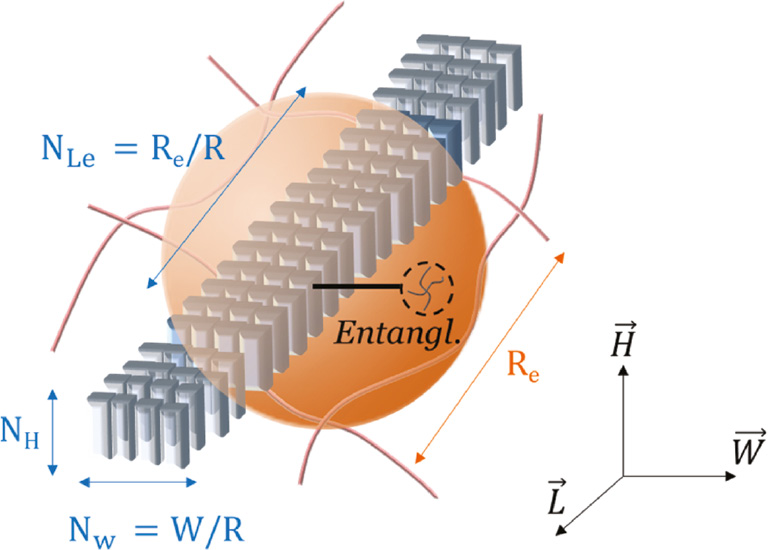
Schematic representation of the topological nodes present in a subspace of soft-phase crossed by a HS crystallite. By construction, the HS can stack along
Considering then the volume fraction in “reinforced” rubber, i.e. Φ and the inter-crystallites distance (periodicity) d*, our model leads to:
with:
where μ=1 or 3 (see full article) and W=Φd*2/μH. Then, by combining I and II and assuming Nce≫1, we obtain the following expression (two possible forms displaying d* or W):
Eq. (III) is the main output of our model describing the reinforcement as a function of the volume fraction in crystallites. It is also interesting to note that d* is usually seen to decrease with Φ such as d*~Φ−λ (with
We found Eq. (III) to be valid up to XHS=15 wt%. For higher values another equation was developed by considering non-Gaussian conformations of the SS. However, both models could be unified through the use of an empirical approximation such as:
with A an empirical value was found to be equal to 18.38 for T4T/PTHF samples. Note that keeping this value for the whole set of TPE in Figure 1 gives quite satisfactory results too.
References
[1] Drobny JG. Handbook of Thermoplastic Elastomers, Elsevier, Oxford, UK, 2014.10.1016/B978-0-323-22136-8.00013-2Search in Google Scholar
[2] Bates FS, Hillmyer MA, Lodge TP, Bates CM, Delaney KT, Fredrickson GH. Science 2012, 336, 434–440.10.1126/science.1215368Search in Google Scholar
[3] Rapra S. https://www.smithersrapra.com/market-reports/rubber-and-elastomer-industry/the-future-of-thermoplastic-elastomers-to-2024, 2019.Search in Google Scholar
[4] Okamoto K-I, Fuji M, Okamyo S, Suzuki H, Tanaka K, Kita H. Macromolecules 1995, 28, 6950–6956.10.1021/ma00124a035Search in Google Scholar
[5] Bondar V, Freeman B, Pinnau I. J. Polym. Sci. Part B Polym. Phys. 2000, 38, 2051–2062.10.1002/1099-0488(20000801)38:15<2051::AID-POLB100>3.0.CO;2-DSearch in Google Scholar
[6] Lim GT, Puskas JE, Reneker DH, Jakli A, Horton Jr WE. Biomacromolecules 2011, 12, 1795–1799.10.1021/bm200157bSearch in Google Scholar
[7] Li H, White JL. Polym. Eng. Sci. 2000, 40, 917–928.10.1002/pen.11219Search in Google Scholar
[8] Sharma A, Baeza GP, Imperiali L, Appel WPJ, Fitié C, Poel GV, van Ruymbeke E. Polym. Int. 2018, 68, 283–293.10.1002/pi.5713Search in Google Scholar
[9] Botterhuis NE, Van Beek D, van Gemert GM, Bosman AW, Sijbesma RP. J. Polym. Sci. Part A Polym. Chem. 2008, 46, 3877–3885.10.1002/pola.22680Search in Google Scholar
[10] van der Schuur M, Gaymans RJ. J. Polym. Sci. Part A Polym. Chem. 2006, 44, 4769–4781.10.1002/pola.21587Search in Google Scholar
[11] Vinogradov G, Dreval V, Malkin AY, Yanovsky YG, Barancheeva V, Borisenkova E, Zabugina M, Plotnikova E, Sabsai OY. Rheol. Acta 1978, 17, 258–263.10.1007/BF01535062Search in Google Scholar
[12] Miller JA, Lin SB, Hwang KKS, Wu KS, Gibson PE, Cooper SL. Macromolecules 1985, 18, 32–44.10.1021/ma00143a005Search in Google Scholar
[13] Nébouy M, de Almeida A, Brottet S, Baeza GP. Macromolecules 2018, 51, 6291–6302.10.1021/acs.macromol.8b01279Search in Google Scholar
[14] Appel WPJ, Portale G, Wisse E, Dankers PYW, Meijer EW. Macromolecules 2011, 44, 6776–6784.10.1021/ma201303sSearch in Google Scholar
[15] Castagna AM, Pangon A, Choi T, Dillon GP, Runt J. Macromolecules 2012, 45, 8438–8444.10.1021/ma3016568Search in Google Scholar
[16] Versteegen RM, Sijbesma RP, Meijer EW. Macromolecules 2005, 38, 3176–3184.10.1021/ma0478207Search in Google Scholar
[17] Pichon PG, David L, Méchin F, Sautereau H. Macromolecules 2010, 43, 1888–1900.10.1021/ma901602ySearch in Google Scholar
[18] Yilgör I, Yilgör E, Wilkes GL. Polymer 2015, 58, A1–A36.10.1016/j.polymer.2014.12.014Search in Google Scholar
[19] Buckwalter DJ, Dennis JM, Long TE. Progr. Polym. Sci. 2015, 45, 1–22.10.1016/j.progpolymsci.2014.11.003Search in Google Scholar
[20] Gaymans R, De Haan J. Polymer 1993, 34, 4360–4364.10.1016/0032-3861(93)90202-LSearch in Google Scholar
[21] Gaymans RJ. Progr. Polym. Sci. 2011, 36, 713–748.10.1016/j.progpolymsci.2010.07.012Search in Google Scholar
[22] Sijbrandi NJ, Kimenai AJ, Mes EPC, Broos R, Bar G, Rosenthal M, Odarchenko Y, Ivanov DA, Dijkstra PJ, Feijen J. Macromolecules 2012, 45, 3948–3961.10.1021/ma2022309Search in Google Scholar
[23] Alexander S. J. Phys. 1977, 38, 983–987.10.1051/jphys:01977003808098300Search in Google Scholar
[24] de Gennes P. Macromolecules 1980, 13, 1069–1075.10.1021/ma60077a009Search in Google Scholar
[25] Baeza GP. Macromolecules 2018, 51, 1957–1966.10.1021/acs.macromol.7b02208Search in Google Scholar
[26] Guffond M, Williams D, Sevick E. Langmuir 1997, 13, 5691–5696.10.1021/la970377rSearch in Google Scholar
[27] Ennis J, Sevick E, Williams D. Phys. Rev. E 1999, 60, 6906.10.1103/PhysRevE.60.6906Search in Google Scholar
[28] Lee HS, Park HD, Cho CK. J. Appl. Polym. Sci. 2000, 77, 699–709.10.1002/(SICI)1097-4628(20000718)77:3<699::AID-APP25>3.0.CO;2-HSearch in Google Scholar
[29] Ginzburg VV, Bicerano J, Christenson CP, Schrock AK, Patashinski AZ. J. Polym. Sci. Part B Polym. Phys. 2007, 45, 2123–2135.10.1002/polb.21213Search in Google Scholar
[30] Van Hutten PF, Mangnus RM, Gaymans RJ. Polymer 1993, 34, 4193–4202.10.1016/0032-3861(93)90176-BSearch in Google Scholar
[31] Husken D, Feijen J, Gaymans RJ. J. Polym. Sci. Part A Polym. Chem. 2007, 45, 4522–4535.10.1002/pola.22186Search in Google Scholar
[32] Bessell T, Hull D, Shortall J. J. Mater. Sci. 975, 10, 1127–1136.10.1007/BF00541393Search in Google Scholar
[33] Bensason S, Minick J, Moet A, Chum S, Hiltner A, Baer E. J. Polym. Sci. Part B Polym. Phys. 1996, 34, 1301–1315.10.1002/(SICI)1099-0488(199605)34:7<1301::AID-POLB12>3.0.CO;2-ESearch in Google Scholar
[34] Baeza GP, Sharma A, Louhichi A, Imperiali L, Appel WPJ, Fitié CFC, Lettinga MP, Ruymbeke EV, Vlassopoulos D. Polymer 2016, 107, 89–101.10.1016/j.polymer.2016.11.010Search in Google Scholar
[35] de Almeida A, Nébouy M, Baeza GP. Macromolecules 2019, 52, 1227–1240.10.1021/acs.macromol.8b01689Search in Google Scholar
[36] Krijgsman J, Husken D, Gaymans RJ. Polymer 2003, 44, 7573–7588.10.1016/j.polymer.2003.09.043Search in Google Scholar
[37] Biemond GJE, Feijen J, Gaymans RJ. J. Appl. Polym. Sci. 2007, 105, 951–963.10.1002/app.26202Search in Google Scholar
[38] Arun A, Gaymans RJ. Macromol. Chem. Phys. 2008, 209, 854–863.10.1002/macp.200700532Search in Google Scholar
[39] Niesten M, Feijen J, Gaymans R. Polymer 2000, 41, 8487–8500.10.1016/S0032-3861(00)00252-4Search in Google Scholar
[40] Fetters LJ, Lohse DJ, Colby RH. In Physical Properties of Polymers Handbook, Mark, JE, Eds., Springer, New York, 2007, pp. 447–454.10.1007/978-0-387-69002-5_25Search in Google Scholar
[41] Biemond GJE, Feijen J, Gaymans RJ. Polym. Eng. Sci. 2008, 48, 1389–1400.10.1002/pen.21115Search in Google Scholar
[42] Hirt VP, Herlinger H. Appl. Macromol. Chem. Phys. 1974, 40, 71–88.10.1002/apmc.1974.050400104Search in Google Scholar
[43] Sharma A. Synthesis and thermo-rheological properties of thermoplastic elastomers based on hydrogen-bonded hard segments, in Institute of Condensed Matter and Nanosciences, Université Catholique Louvain-la-Neuve, 2019.Search in Google Scholar
[44] Wegner G. In Thermoplastic Elastomers: A Comprehensive Review, Legge NR, Holden G., Schroeder HF, Eds., Carl Hanser Verlag, Munich, 1987, pp. 405–430.Search in Google Scholar
[45] Affdl JCH, Kardos JL. Polym. Eng. Sci. 1976, 16, 344–352.10.1002/pen.760160512Search in Google Scholar
[46] Genix A-C, Bocharova V, Kisliuk A, Carroll B, Zhao S, Oberdisse J, Sokolov AP. ACS Appl. Mater. Interfaces 2018, 10, 33601–33610.10.1021/acsami.8b13109Search in Google Scholar PubMed
©2019 Walter de Gruyter GmbH, Berlin/Boston
Articles in the same Issue
- Frontmatter
- Editorial
- Special issue: Polymer engineering rheology
- Material properties
- Volume fraction and width of ribbon-like crystallites control the rubbery modulus of segmented block copolymers
- Influence of trisilanol isooctyl POSS content on the structure, morphology and rheological properties of thermoplastic polyurethane (TPU)
- Engineering and processing
- Oscillating shear capillary rheometry (OSCAR) for polymer melts
- Plastic drawing response in the biaxially oriented polypropylene (BOPP) process: polymer structure and film casting effects
- A quantitative study on using digital photoelasticity for characterising the effect of the stretching speed on the necking phenomenon
- Effects of structure and processing on the surface roughness of extruded co-continuous poly(ethylene) oxide/ethylene-vinyl acetate blends
- Processability predictions for mechanically recycled blends of linear polymers
- Prediction of the maximum flow length of a thin injection molded part
Articles in the same Issue
- Frontmatter
- Editorial
- Special issue: Polymer engineering rheology
- Material properties
- Volume fraction and width of ribbon-like crystallites control the rubbery modulus of segmented block copolymers
- Influence of trisilanol isooctyl POSS content on the structure, morphology and rheological properties of thermoplastic polyurethane (TPU)
- Engineering and processing
- Oscillating shear capillary rheometry (OSCAR) for polymer melts
- Plastic drawing response in the biaxially oriented polypropylene (BOPP) process: polymer structure and film casting effects
- A quantitative study on using digital photoelasticity for characterising the effect of the stretching speed on the necking phenomenon
- Effects of structure and processing on the surface roughness of extruded co-continuous poly(ethylene) oxide/ethylene-vinyl acetate blends
- Processability predictions for mechanically recycled blends of linear polymers
- Prediction of the maximum flow length of a thin injection molded part
