Nietzsche’s Ariadne: On Asses’s Ears in Botticelli/Dürer – and Poussin’s Bacchanale
-
Babette Babich


Abstract
In what follows I raise the question of Ariadne and Dionysus for Nietzsche, including the relative size of Ariadne’s ears, as Dionysus observes at the close of “Ariadne’s Lament” [Klage der Ariadne]. Nietzsche’s references to ears invoke not only Nietzsche’s “selective” concern with having the right ears (both to hear what he says and with respect to his discovery regarding ancient Greek tragedy: hearing with one’s eyes, that is the relation of ancient Greek music in the word) but also the question of myth and genealogical context. Reading through myth is key not only in terms of the textual, lyric tradition but also painting and sculpture, including sarcophagi in antiquity. It makes all the difference to ask, as Karl Kerényi cites Nietzsche as asking: Wer weiß …was Ariadne ist? And not less: who was she to Dionysus? To this extent, Nietzsche’s concern with ears, small and long, is less incidental or furry fetish than hermeneutic attunement.
Dionysos
Be clever, Ariadne!
You have little ears, you have my ears:
Tuck a clever word into them! –
Must one not first hate oneself, if one is to love oneself? …
I am your labyrinth…
– Nietzsche, Klage der Ariadne
1 A problem like Ariadne
There is an established tradition of scholarship both on Nietzsche’s Ariadne, including extended musing on Nietzsche’s own ears, and regarding Dionysus and his ears, and on Ariadne and her ears, seemingly conclusive, although sometimes at variance on this or that conclusive point,[1] as well as a tradition of frustration.
As Adrian Del Caro puts it, the labyrinth seems emblematic: no sooner does one undertake to “try one’s hand” at it, thereby joining the ranks of the scholars who have had at “the problem of Nietzsche’s Ariadne” than one finds oneself abandoned to abandoning the project, lost, which is also to say: caught up in it. Del Caro offers a non-exhaustive roster: recounting the seeming fate of
many respected voices in Nietzsche scholarship who have closed the book on Ariadne, and in so doing have restricted access to one of the more obscure, secretive locations within the Nietzschean philosophical topography. Ariadne is Cosima Wagner, Cosima Wagner was Nietzsche’s secret and long-standing love, Wagner was Theseus (sometimes), Nietzsche was Dionysus […][2]
And so on and so on: Del Caro’s roster hardly exhausts the range of scholarly readings on offer.
Del Caro is judicious: he tells us that one needs “respected” scholarship, and recently one (analytically minded scholar) has connected Ariadne and Jordan Peterson (hard to make this up).[3] Claudia Crawford has an entire book[4] and other authors fix attention on the labyrinth per se,[5] and while others focus on the dithyramb, Richard Kuhns helps us connect von Hofmansthal and Nietzsche to illuminate Richard Strauss’ eponymous opera,[6] and David Farrell Krell mines again (and again) the insights of the most eminent of these respected names, Karl Reinhardt on Nietzsche’s “lament,”[7] in Krell’s Postponements.[8] And Ariadne is a standard reference for many feminist readings.[9] Everyone seems to know, everyone tells us.
Still the mystery of Ariadne remains and her relation to Dionysus, her husband, who as Pietro Benvenuti’s Bacchus and Ariadne shows, comes upon her, as she “sleeps,” remains (Figure 1).

Pietro Benvenuti, Bacchus and Ariadne, 1819. Private Collection, Rome. Fair Use.
Crawford mentions that Ariadne had a father, Midas, as she says: this is one reading, other traditions tell us that Ariadne’s father was Minos and there can be a conjunction via metonymy, the names sound or at least begin by sounding the same – think of the presocratic/preplatonic philosophers whose names begin Anax: Anaximander, Anaximenes, Anaxagoras[10] – but the difference is between Lydia and Crete, still there is ambiguity perhaps owing to the asses’s ears given that both Midas and Minos had them.
As a name, Minos requires disambiguation.[11] In addition, although the concept of matrilineality likewise needs clarification (it may not mean that women “rule”), Crete was matrilineal. The “Minos” in question who was related to Ariadne was brother to Rhadamanthus, another famous Cretan and both, I’ll come back to this, along with a third brother, Sarpedon, were judges of the underworld.
We know this from Virgil and other sources. Standing at the wide gates of hell in Dante’s Inferno, Minos is associated with a snake, here his own tail which he wraps around the damned, to measure judgment, sorting the damned to whatever correspondent level of hell – think the contortions of the sorting hat in the 2001 film, Harry Potter and the Philosopher’s Stone – wrapping it about himself in the case of Michelangelo’s Minos (Figure 2), so to judge himself.

Michelangelo, Minos detail from the Last Judgment, 1536–1541. Sistine Chapel, Rome. Public Domain.
Nietzsche tells us about Midas and Silenus in connection with reports it would be better “not to hear” in The Birth of Tragedy (BT §3). And, again, both Midas and Minos have the same attribute of long, asses’ ears, distinctive in Minos’ case, just as Michelangelo’s (discomfiting) painting of Minos shows (Figure 2).[12] Revelatory (in more than this instance) is Horst Bredekamp’s monumental Michelangelo.[13] Bredekamp does not per se analyse Minos as such but the tension is clear, telling us that Minos is set “literally” [buchstäblich] at the margins: “pressed against the edge.”[14] By considering the entire composition – a challenge, quintessentially so, when it comes to Michelangelo’s Last Judgment – one needs to reflect that the figure is set to the bottom right, thus counterbalancing Michelangelo’s Charon at the lower right, higher than the lowest figure on the left: Minos.
And what other ears might befit a man married to Pasiphae, the Cretan queen who afflicted him with ejaculate of scorpions and spiders and millipedes, so to covertly punish his human lovers, quite as the queen found herself paired with a consort-king who demanded a bloodthirsty tribute of human sacrifice – seven youths and seven maidens – thus the logical continuation of this career in his service in the underworld as judge (together, as noted above, with his brothers).[15] The connection with carnal sin is also emphasized.[16] The name Minos, again, a not-quite individual signifier (but what name is?): the king in a matrilineal kingdom has a role to play.[17]
I suggest that Minos matters for Titian’s Bacchus and Ariadne (1522–3), one of the most striking paintings of Ariadne, after being abandoned by Theseus, at the moment of a first encounter with Dionysus vaulting an awkward – contorted – vault, caught as it were in an impossibly strobe-light moment, avant la lettre. The painting (Figure 3) is ecstatic in composition,[18] including a sylvan/Pan figure, dark skin, widow’s peak, perhaps with horns as suggested by two white lines on either side of his head, perhaps with long ears, hard to tell with his wild hair: some identify this as a Laocoön figure (tho’ what this Trojan priest of Apollo might be doing revelling with Dionysus would be anyone’s guess) and others track the figure back to Catullus’ account, metonymically in either case, noting the struggle with serpents surrounding his body (and in his hands), or festooned about him (never mind the tensions in his torso), just as Michelangelo (Figure 2) shows Minos girt about by snakes, a signifier, as snakes commonly signify – think of Ixion – the venomous consequences of erotic excess. And this too was associated with Ariadne’s father, who may have been there, perhaps on loan from the underworld, metonymy reigns in painting as in myth, to give her away in marriage to Dionysus.

Titian, Bacchus and Ariadne, 1522–1523. National Gallery, London. Public Domain.
But where in the genealogical catalogue may one trace one’s ears? We know that male baldness is a trait inherited, usually, from one’s maternal grandfather. The length of ears hardly gets a mention from the genealogists. In any case, Ariadne has not got her father’s ears: she has small ears, like the tempter god, her husband, Dionysos.
We know that the ears are a divine punishment. Apollo, displeased with Midas’s judgment of Marsyas as victor, graces him (via Tmolus) with the ears of an ass to chastise him and show him up before all the world for his judgment, before going on to flay Marsyas alive for his skin.[19]
It was to illustrate the complexity of the god’s response to the contest (quite in addition to Nietzsche’s reflection on dissonance in tragedy and in music) that I set Bartolomeo Manfredi’s Apollo and Marsyas (Figure 4) on the cover of my Nietzsches Antike.

Bartolomeo Manfredi, Apollo and Marsyas, 1615–1620. St Louis Art Museum. Public Domain.
Manfredi’s painting is beautiful and calmly horrific at the same time. As a gloss on the title image, I explained that Marsyas, who played the double flute or aulos, had been designated victor in a contest against Apollo playing his lyre according to the judgment of Midas. As a “reward” for the satyr’s musical prowess, Apollo skinned the satyr alive to take his skin.[20] It is instructive to reflect regarding Greek musical instruments that Apollo’s lyre was made, almost exclusively, of animal body parts: from the sound box[21] wrought from the shells of the tortoises one can still see if one climbs the acropolis near Athens, covered taut with animal skin, to goat horns, strung with gut, fitted with findings of bone, ivory, and mother of pearl.[22] Apollo, impressed with the musical genius of the satyr, took his skin for his lyre. To this day, prize goats are “rewarded” with slaughter and animal skins are valued for drumheads and bagpipes.
Elsewhere I argue that scholars of antiquity tend to leave Nietzsche out of their research, sometimes with a certain amount of misguided anger. And this same tendency also affects Nietzsche scholarship as Nietzsche was not merely a child of his times but born as such between two contesting horns, still unreconciled to this day, of nineteenth-century philology. Scholars have thus misread Nietzsche’s essay on history for more than a hundred years, preferring to read the “monumental” and the “antiquarian” on their own terms. The monumental invokes Otto Jahn’s archaeological sensibility:[23] things, fragments, in their sparsity – Nietzsche speaks of “the barest remnants” [sparliche Reste]. Nor is Nietzsche the only one to make this observation, it is the more obvious point, as Mass and Snyder observe, after making it clear that they too hardly credit Nietzsche,
Whereas Egyptologists can study a number of harps, lutes, and lyres, as well as instruments of other kinds, often preserved in excellent condition, Hellenists have almost nothing except some ivory ornaments and facings, a few plektra, and fragments of tortoise shells.[24]
In what follows, I do not claim to solve the problem of Ariadne, which seems disappointingly similar to Bernstein’s empty song about “a problem like Maria,” but I seek to complicate it. I argue that the question of Ariadne be read in connection with Nietzsche’s gnomic aphorism “Adventavit asinus, pulcher et fortissimus” (BGE §8). These are the “convictions” of the philosophers as they make their “stage entrance” (ibid.) as this reference may invite us to read not only Ovid’s and Hyginus’s and Catullus’ Latin but Lucian’s Greek as we read Nietzsche.
2 Nietzsche and the furries
A clear depiction of the “advent” of the ass that might count as beautiful, complete with a mystery cult, is (Pseudo)Lucian’s Lucius and the Ass, a tale of scopic adventure and misadventure, complete with the same roses Midas uses to bind Silenus and about which we read as used as fetters in Lucian’s True History when the wanderers first encounter Rhadamanthus. Roses also matter for Archilochus as Nietzsche tells us and Nietzsche himself writes about roses, erotically, or quite as close as he comes to the erotic: wollt ihr meine Rosen Pflucken? – one rather needs the German – “do you want to pluck my roses?”[25]
We need a bit more as the ears and Nietzsche’s various references to them remain perplexing on a number of accounts and more than one discussion invokes Nietzsche’s obsession with his own ears. The claim seems to originate with Paul Deussen’s report that Nietzsche was overly anxious about finding himself, owing to whatever distraction, riding an ass rather than a horse. Thus, Deussen explained, assuming the key signifier to be the length of the animal’s ears, Nietzsche proceeded to measure them, to be certain.[26] Anecdotal reports, like much psychoanalytic art history, including speculations regarding Raphael’s management of his artistic/erotic capacities,[27] tend to share the same limitations that go along with diagnosing Nietzsche’s or his father’s illness (what on earth is the famous “softening of the brain”? It might mean any number of things which is another way of saying we do not know, lacking empirical evidence one way or the other: there is no patient to examine, no blood test to be done).
If, reading between Schelling and Nietzsche, John Ebert Wilson reminds us that the allegory with the ass and his ears appears in Luther,[28] we need more than the passing mention Wilson offers us. We need an image: we need the title-page wood-cut of Luther’s Wider das Papstthum zu Rom vom Teuffel gestifft,[29] featuring – it is fairly crowded (Figure 5) – the figure of the pope with long, asses’ ears, legs outstretched, hands folded in prayer, being carted off by demons as if seated in the church choir, as one also sees the apse including the arch of church windows behind the pope, likewise being carried off, the whole poised for a fall into the leviathan- or eel-like maw of hell, surrounded by hordes of demons with long ears (and horns), epitomized as “Papstesel mit langen Eselsohren und verdammtem Lügenmaul.”[30]

Martin Luther, Wider das Papstum zu Rom vom Teufel gestiftet, 1545. Wittenberg durch Hans Lufft. Cover after Lucas Cranach, 1545. Public Domain.
It is worth taking such “picture-book” references to what we have been exploring thus far. Hence, writing about Heidegger (and Heidegger’s lecture course on Nietzsche and art) rather than Nietzsche as such (and certainly rather than about Ariadne), Robert Bernasconi takes us back to Pliny as we should always remind ourselves to return to Pliny, to read about Apelles. Bernasconi’s essay is titled with Pliny’s proverb “Ne sutor ultra crepidam” as Bernasconi reads that other great Lucian enthusiast, Erasmus along with Dürer.[31] If we do not get to learn about Botticelli’s Apelles from Bernasconi, the description appears in Lucian[32] and Lucian is a dangerous source (for a host of reasons), but here he is key.
Thus, we have a picture, reversing Lucian’s locus classicus, his ekphrasis of Apelles. In fact, this being all about a painter, we have any number of such by any number of painters, just to count the ones detailing the ears belonging to a king, said to be King Midas, epitomized by Sandro Botticelli, Calunnia [The Calumny of Apelles] (ca. 1494).
Botticelli arguably outmatches many of the paintings recreating the lost painting of Apelles, even should we limit ourselves to those depicting Midas’s ears. Well-discussed in art history, and how could it not be, given that, here like the Laocoön first unearthed in a constellation involving Pliny along with Michelangelo and Vasari,[33] the subject of The Calumny of Apelles is a painter reported as blamelessly accused retold in Vasari’s Lives. [34] The “reverse” ekphrasis illustrates Lucian’s original ekphrasis of Apelles’ satirical painting in Lucian’s Slander, which last convoluted self-reference has inspired some scholars, as Rudolph Altrocchi has explained, to “accuse Lucian of inventing both the story and the description.”[35] Altrocchi repeats the admonishment offered by Lucian’s translator, A[ustin] M[orris] Harmon (1878–1950) of the Loeb edition, to underline that “the story is apocryphal.”[36] What is certain is that Lucian is the source for Vasari and thus for Botticelli and many others.[37] Similarly, via echo and repetition/revision, art historians trade accounts one from another.[38]
Now, and among other things, the challenge to readers – “what,” as Nietzsche says, “do the names matter?” – is that Lucian names Ptolemy as the king liable to be receptive to slanderous accounts, Ptolemy being a more plausible candidate for the second-century CE Syrian author than other names. Further, it can be noted that the painter as victim vanishes in the case of Shakespeare’s Othello, but the point remains that such sovereigns are less than “sovereign,” inasmuch as they are liable to having their ears turned, with uniformly catastrophic consequences.
To this and earlier than Luther’s attack on the pope (see, again, Figure 5), we may add Albrecht Dürer’s 1520–1521, Die Verläumdung des Apelles as all of Dürer’s characters (apart from the king) are labelled to make the derivation from Lucian clear (Figure 7, 9 and 10).

Sandro Botticelli, Calunnia. Ca. 1494. Uffizi, Florence. Public Domain.
In Dürer’s exoteric image, i.e., on display in the Nürnberg Rathaus, the king’s furry ears are unobscured in contrast to the hands-on tactics of the whisperers attending Botticelli’s king. And as Lucian says, nearly 2,000 years before the social media phenomenon of ASMR: “Somehow or other we all like to hear stories that are slyly whispered in our ear and are packed with innuendo.”[39] Thus, Lucian might seem to have anticipated the YouTube phenomenon of “autonomous sensory meridian response” as Lucian continues: “I know men who get as much pleasure from having their ears titillated with slander as some do from being tickled with feathers.”[40]
Dürer’s mural, like Botticelli, is a reverse (painterly) ekphrasis of Lucian’s ekphrasis of Apelles, Nietzsche would, like as not, have known, given its proximity, from direct experience. Today, we cannot know it: such is time and, more importantly, such is war.
It is not that we lack for restorations. This we have; the trouble is, as Robert Bernasconi highlights the complex notion of “verisimilitude” [Richtigkeit], or what in these days of “fake” truth can simply be called the “truth” of the restoration to the original, just given, and thus the need for art history, that the original itself had been (always already) “multiply” repainted prior to being bombed. Here, although Bernasconi is not invariably sympathetic to Heidegger’s notion of truth in his illustrated analysis of Dürer’s Young Hare, Bernasconi reads between Panofsky and Wölfflin in order to unpack the art philosophical convention of “verisimilitude,” recollecting Erasmus, again, Nietzsche’s antecedent in shared appreciation for Lucian in connection with Pliny’s account of Apelles.[41] At issue for Bernasconi as it is always an art historian’s worry – it was this manifold variety that Walter Biemel would emphasize in his own account of Heidegger’s “truth” – is the version of Dürer’s Hare (Figure 8) Heidegger had in mind when he tells us in his Nietzsche lectures that Dürer “makes Being visible: in a particular hare, the Being of the hare; in a particular animal, animality.”[42] Thereby Bernasconi reminds us that Dürer’s Hare is a watercolor with ears furry enough and photorealistic enough to justify Dürer’s characterization as a “master of verisimilitude.”[43]
In fact – this is not Bernasconi’s point – Dürer’s watercolor can inspire Easter Bunny associations and a connection is there to be made with Beatrix Potter’s illustrations. Keeping to the high ground of art history with Wölfflin, with Panofsky, Bernasconi asks “if Heidegger had only seen a black and white reproduction of the “Hare” so that he thought it was an engraving. Or perhaps he saw an engraving based on the watercolor.”[44] The problem is the “problem” of truth qua verisimilitude where Bernasconi is talking about “reproductions unfaithful to the original.” I note, and hence the relevance of the complex history and tissue of associated falsifications of the Laocoön, that the problem of “restoration” as the Laocoön is a restoration, is something else again. For his part, Bernasconi’s concern is with the question of “great art” quite as Heidegger argues that this declines “as aesthetics develops.”[45]
These, again, are “high” themes in art history as in philosophical aesthetics which means that this has been explored, if often one-sidedly, by many authors. Here, I draw on art that can, arguably, be regarded as less than great, although this hardly holds in the case of Dürer’s 1521–1522 allegory, following Lucian’s Slander, and judgment is complicated, historically speaking, given the absent original (multiply painted over in restorations).[46]
Both Botticelli and Dürer draw on Lucian via Vasari. Again, the theme is well-explored.[47] But it remains challenging even if everyone supposes themselves to know all about Vasari as source. Hence, Peter Hecht reflects in his review of David Cast’s The Calumny of Apelles,
Apelles’ painting, or rather Lucian’s concept, slipped from the artistic consciousness in the course of the eighteenth century, just as allegory in general was dismissed as being too literary.[48]
In the course of a review dedicated to the fairly Nietzschean theme of “pot-peeking,” that is: reading a painting (or, in Nietzsche’s case, one of his aphorisms) with a view to deciphering the inspiration from the artist’s (author’s) life, Hecht alludes to Dürer’s rendering of Aristotle being ridden by Phyllis, an image that inspired Charles Andler’s discussion of Nietzsche and Lou and Paul Rée, “reading” a photograph,[49] and subsequently David Blair Allison tracking the image back to woodcuts and tapestries,[50] but Hecht, I think rightly, not only brings allusions closer to Nietzsche’s locale (Hecht, to be clear, references neither Nietzsche nor Andler) but takes issue with Cast’s account as Hecht notes that,
Dürer also painted a scene of Aristotle and Phyllis in the Council Chamber at Nuremberg, but that was certainly not intended as a “model for the amorous games to be played out below” (p. 106), as Cast would have us believe. This particular subject was usually depicted quite straightforwardly. Aristotle is shown on his hands and knees with a bit in his mouth, allowing himself to be ridden by the woman he loved. Now that really was not what the councillors of Nuremberg got up to in public.[51]
Thus, Hecht brings in not the context of a repressed socio-political constellation but the older mythological motif, warning rulers/kings not to be, in effect, “asses,” specifically, not to lend their ears to slander.
Hence, the Nuremberg mural is of great interest – if only for the ears.
The subject of Dürer’s Verläumdung (Figure 7) is timely: slander or calumny is propaganda at a level where, as one might suppose, it might matter: whispering non-truth to power to those who have power, this is the “art of the courtier,” and ladies are typically imagined to play this role but where would Realpolitik be without Machiavelli?

Albrecht Dürer, Die Verläumdung des Apelles, 1521–22. Nürnberg: Rathaussaal. Multiply repainted, 1613 and 1904/1905. Destroyed (bomb strike), 1944/1945. Public domain.
The subtitle to Lucian’s Slander explicates: On Not Being Quick to Put Faith In It as this offers the Inbegriff of “ekphrasis.” As Harmon, Lucian’s translator, reminds us:
This essay is rhetoric pure and simple, and was probably written early in Lucian’s career. It is famous because it contains a vivid description of a picture by Apelles, which was again translated into paint by Botticelli in “La Calumnia.”[52]
It is worth reading Gary Shapiro’s extended reflections on ekphrasis (but also with respect to Nietzsche),[53] and it is relevant that Shapiro engages Raphael’s Transfiguration as Nietzsche describes this painting, as Tracy B. Strong also explicates with reference to no lesser locus than the New Testament.[54] Thereby Shapiro’s review of Foucault’s explication of Magritte echoes at least titularly Strong’s 1975 Friedrich Nietzsche and the Politics of Transfiguration [55] detailing “Nietzsche’s transfiguration of Raphael’s Transfiguration.”[56]
For its part, Dürer’s Calumny offers a bestiary of Nietzsche’s more unpleasant associative denunciations of women, not excluding truth who is here, very modestly as a lady in waiting in a good Christian spirit, set off to the side (Figure 10).

Albrecht Dürer, Young Hare, 1502. Albertina Vienna. Public domain.

Dürer, Verläumdung, detail.
But we know the Botticelli as Nietzsche likewise knew it, depicting the naked truth right alongside rue (or remorse) or, as we may read Dürer’s mural, repentance/penitence [poenitentia]:
Arguably, Nietzsche’s ekphrasis is not of Dürer’s modestly clothed truth but Botticelli’s more conventionally undraped truth (Figure 11) in Beyond Good and Evil:
Supposing truth is a woman – what then? Are there not grounds for the suspicion that all philosophers, insofar as they were dogmatists, have been very inexpert about women? (BGE i)
The image of woman as truth, the convention that holds truth as feminine, is not Nietzsche’s coin. There is the Greek Aletheia, just as Heidegger tells us, quite on the model of the Roman version of the same goddess, Veritas, as we also read in Dürer’s painting. The subtitle of the section invokes modern role-playing enthusiasts and visions of furries (possibly inspired by Tribbles, less plausibly by Wookiees, or, perhaps, to be laid at the feet of Tolkein and his hobbits). The point I am making is that Botticelli’s version is a remix as is Dürer’s version, a “cover” of Apelles’ allegory, as Lucian tells the tale of Slander (Figures 6 and 7).

Dürer, Verläumdung. Detail.

Botticelli, Calunnia. Detail.
Calumny, especially calumny at the court, is the art of besmirching, again this is Lucian’s clarification contra the king’s stupidity and gullibility, hence the long ears, pulled by the two ladies on either side (Figure 12), Ignorance and Suspicion, as the king is moved to extend his hand to Slander, escorted by Envy in the company of Treachery and Deceit.

Botticelli, Calunnia. Detail.
There are other depictions, for example, Federico Zuccaro circa 1569 along with Giorgio Ghisi, 1560. In Ghisi, as in Dürer, truth is a little more modest, and Girolamo Mocetto’s 1500 Calumny helpfully labels all the personages in Lucian’s dialogue, and we may add two by Raphael (Figures 13–16). Indeed, there are any number of these as the motif appealed to painters as Apelles himself was the innocent victim of jealousy and took his painterly revenge by showing the foolishness of kings who listen to calumny.

Federico Zuccaro, Calunnia di Apelle, 1569. Art Collection of the British Royal Family.

Giorgio Ghisi, Calunnia, 1560. Metropolitan Museum of Art, NYC. Public Domain.

Girolamo Mocetto, Calumnia, 1500. British Museum, London. Public Domain.

(a and b) Raphael, La Calomnie peinte par Apelles. British Museum, London. Public Domain.
The king in Botticelli’s painting is traditionally named Midas, the same Midas we have already met reading Nietzsche, who tortures the sylvan Silenus for the “truth” about what is best for the human being in The Birth of Tragedy. And as noted at the outset: one may read Midas for Minos, Ariadne’s father. The ears, a common attribute between them, are clear in Melchior Meier’s gruesomely detailed illustration of the beautiful and brutal god, Apollo displaying his prize before Midas who had judged in favor of the satyr’s playing (Figures 17).
Nietzsche also uses the metaphor of long ears in his Zarathustra book, nowhere less conspicuously perhaps than in his “Conversation with the Kings,” observing that he had long ago unlearned how to take consideration for “long ears,” to the interruption of the ass: “I-A”
Ich verlernte seit langem schon die Rücksicht auf lange Ohren. Wohlan! Wohlauf! (Hier aber geschah es, dass auch der Esel zu Worte kam: er sagte aber deutlich und mit bösem Willen I-A.) (KSA 4 306)
Midas – so it goes with associations with Dionysus – is said to have captured Silenus using wine, thus by ruse, Nietzsche writes early in The Birth of Tragedy yet, as Hyginus explains, the torture is largely symbolic: bound with roses and queried on “nature’s mysteries and the events of long ago.”[57] Midas keeps Silenus for ten days only to restore this forest companion to Dionysus who, in gratitude, grants him any wish (Figures 18 and 20).
Midas’ ears as painted in Poussin’s Midas and Bacchus (Figure 18) are less than clear. Certainly, it seems as if he had tucked them under his crown but maybe not: it is hard to tell. We do know that Midas was said to have tried to hide his ears under his hair, variously under a turban (see Floquet, Figure 19), or, as in this case, under his crown (and cf., too, Figure 33). If Apollo’s punishment was intended to show Midas’s lack of judgment to all the world as the one so adjudged, Midas hardly wanted the fact advertised and, typical of the subject of such a judgment, did not believe it.

Melchior Meier, Apollo and Marsyas and the Judgment of Midas, 1581. Metropolitan Museum of Art, NYC. Public Domain.

Nicolas Poussin, Midas and Bacchus, 1624. Alte Pinakothek, Munich. Public Domain.

Simon Floquet, Apollo and King Midas, 1634. Oil on copper. Private possession. Public Domain.
Trapped with wine and “tortured” – in his Florentinische Tractat über Homer und Hesiod – Nietzsche repeats the Greek “πᾶσαν μηχανὴν μηχανώμενοστο,” explaining that Midas uses every extreme device to extract an answer[58] – at stake as Nietzsche tells us in the Birth of Tragedy is the desire to learn the answer to the question of what would be best for the human. In his earlier text, Nietzsche cites repeatedly, and this is far from nihilism, the same me phynai we recognize from Hölderlin’s citation of Sophocles as motto for the second volume of his Hyperion.[59] In the Birth, the reference is set in quotation marks, and in his Florentinische Tractat, the reference is given to Aristotle’s dialogue Eudemus, with a parenthetical citation from Bernays.[60] We get no such citation in The Birth of Tragedy – apart from the quotation marks themselves – but the theme and the lines of argument are the same whereby the point in both texts is that the saying is to be attributed to a companion of Dionysus.[61]
Instructively, Poussin’s painting shows the reason Midas might have inspired the god’s sympathy, that is: beyond restoring a satyr, he had baited and captured in the first place which rationale also refers to the judgment he had made, contra Apollo in favor of Marsyas, we see a satyr, with ears similar to his own, playing the double aulos.
Bad judge as he happened in fact to have been, Midas, stunningly shortsightedly, asks that everything he touches turn to gold.
After realizing the fatality of this wish, Midas prays to Dionysus to take pity on him and the god answers his prayer. Poussin paints this sequence as well (Figure 20), twice as we know, whereby Dionysus takes Midas to bathe in the river Pactolus, so to wash “away his baneful powers,” depicting Midas washing at the source of the river with – the painting is a study in oblique angles – the body seen from the back, with musculature and fat, Dionysus, turned away from the viewer, complete with the river’s edge, clear water, and one clambering putto embracing two wine vessels on their sides, open to the river, with another more obscured putto securely placed (but Panofsky in 1936, in the second of two readings, here dedicated to the elegiac, and offering a lesson in Latin and not less historical context or hermeneutics, invokes as “cupids,” talking of Fragonard at the close of the second of discussions of Poussin’s Et in Arcadia Ego).[62]

Poussin, Midas se lavant à la source de la rivière Pactole, 1627/1630. Metropolitan Museum of Art, NYC. Public Domain.
Midas’ ears may be seen in Jacob Jordaens’ Apollo as Victor over Pan (Figure 21) who depicts the contest between Apollo and Marsyas, at the moment Apollo is crowned by Tmolus for his victory over the satyr Marsyas, for whom things are not to end well, with Midas who has already suffered the award of his ears sitting, old King Cole like, off to the right in the painting.

Jacob Jordaens, Apollo as Victor Over Pan, 1637. Museo del Prado, Madrid. Public Domain.
As we read Nietzsche, in the voice of Dionysus, he teases Ariadne, “Be clever [Sei klug], Ariadne, you have small ears, you have my ears…” a caution soon converted to the provocation of the aphorism, “On the beautiful and the ugly,” asking, recall again her bloodline, why her ears are not longer (GD, Streifzüge eines Unzeitgemässen 19; DD, KSA 6, 401; cf. KSA 13, 498). Ariadne, along with reflection on Minos/Midas and their respective ears, is thus a leitmotif for readings of Nietzsche hunting for his inspiration, as many scholars continue to search for an explanation other than the financial or iatrogenic injury that might explain what he writes.
Ariadne is also connected from the first of the Untimely Meditations with the labyrinth, and she is explicitly invoked at the end of Beyond Good and Evil (thus it is essential to explore the allusion to the mystery cult and the “beautiful” braying of the ass cited in the aphorism on the “convictions” of the philosopher [BGE §8]), as Dionysus emphasizes, Nietzsche quotes him:
“Under certain circumstances I love what is human” and with this he alluded to Ariadne who was present – “man is to my mind an agreeable, courageous, inventive animal that has no equal on earth; it finds its way in any labyrinth, I am well disposed towards him; I often reflect how I might yet advance him and make him stronger, more evil, and more profound than he is.” (BGE §295)
The ironic or satiric element is patent in the allegory quite including the long ears.
In addition, at the level of rhetoric, the elaborate clothing that may be striking in Botticelli can be read as metaphor for decking out the facts, a theme of some dedication in the literature of the philosophy of science, one also can speak of the “furniture” of the world, thus embroidering the truth, masking or concealing it and everything in the tangle of lies needed to destroy, we can again think of Othello and Iago – and the unjustly maligned Desdemona – the good name of others.
Nietzsche’s phrasing when it comes to truth as a woman has been inspiring. Thus, although Gerd Schank does not make a connection to Lucian, his essay on Ariadne is helpful[63] in highlighting a jewel of a small theater piece in Nietzsche’s text: this god, Dionysus, the one that philosophizes, makes an appearance when he chimes in, “resplendent in emerald beauty,” punctuating Ariadne’s lament.
Nietzsche sets Dionysus as response to Ariadne’s lament, a god’s reply that takes little account of what she says and yet, this is what deity does, answers her.
Ein Blitz.[64] Dionysos wird in smaragdener Schönheit sichtbar.
Dionysos:
Sei klug, Ariadne!. Du hast kleine Ohren, du hast meine Ohren:
steck ein kluges Wort hinein! –
Muss man sich nicht erst hassen, wenn man sich lieben soll?…
Ich bin dein Labyrinth… [65]
The figure of Dionysus is key but the ecliptic, elliptical, ecstatic element remains. Thus, in the pen and ink and brown wash, now said to be Romanelli (Figure 22), formerly said to be a Poussin sketch (as it continues to look to be), historians remark that one of the things Poussin does not do, in the wake of Titian, is to include an Ariadne figure and since there is one here, this is no Poussin.[66]

Giovanni Francesco Romanelli, Bacchus and Ariadne, 17th C. British Museum, London. Public Domain.
Malcolm Bull, putting his loyalties in his first line, recounting Anthony Blunt’s lament, tells us that almost as if the theme were Hölderlin’s Hyperion, Poussin’s Bacchus series
concentrates on Bacchus and his companions, Pan and Silenus; Ariadne, the companion of Bacchus in Annibale [Carracci]’s Triumph and the joint subject of Titian’s Bacchus and Ariadne, is absent from the series, although Hercules, a more surprising participant, appears in Poussin’s Triumph of Bacchus [67]
Bull’s point foregrounds the Dionysian procession for Poussin (Figure 23). Bull is concerned to add Rabelais to the reading of Poussin, an argument made by suggesting that “Poussin does not appear to have been following any one literary source very closely,”[68] a claim useful for the author who means to argue a case for his own reading, cobbled together with the ad hoc and reference to his patron (Figure 24).
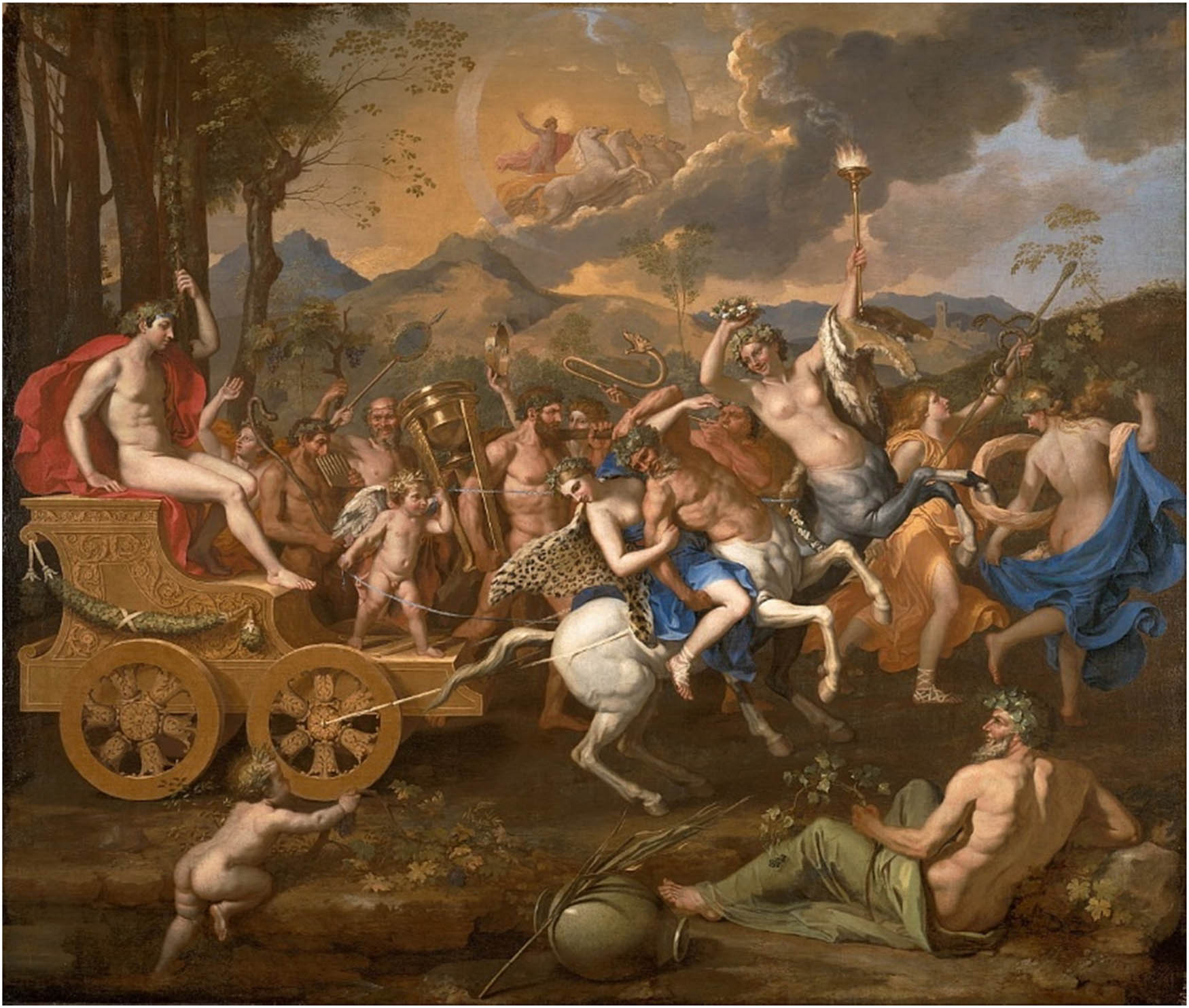
Nicolas Poussin, The Triumph of Bacchus, Ca. 1630. The Nelson-Atkins Museum of Art, Kansas City.

Annibale Carracci, The Triumph of Bacchus and Ariadne, 1595. Detail. Palazzo Farnese, Rome.
In Wendy Heller’s dispositional analysis of Bacchus and Ariadne in Carracci’s Triumph,[69] we have a staidly formal affair, not least by contrast with the earlier Titian and yet it can be helpful for the sake of a little more reflection on Poussin’s Bacchanale.
Here, the backstory is the story of apotheosis, easier to see in the line drawing for Carracci’s Triumph (Figure 25), as Ariadne is crowned as Diodorus Siculus tells us – here we see one of the several flying putti floating in with a crown of stars to set on her head (Figure 24) – in addition to the detail that she is riding in a parallel chariot pulled not by panthers, as in the case of Dionysus, but horned goats, along with the other companions, Pan on the ground with his own goat (and there seems to be plenty of contact there) and Silenus, lean and glorious with his staff.

Cesius after Carracci, The triumph of Bacchus and Ariadne, 1595. Queensland Art Gallery. Public Domain.
Heller emphasizes that there is no contact between Dionysus and Ariadne: no touching, no nothing. Yet, Heller adds that lovemaking there is, and in addition to Ovid, Heller cites Diodorus Siculus who notes that the god “considered her worthy of immortal honours because of the affection he had for her, and placed among the starts of heaven the Crown of Ariadne.”[70]
The disposition of Carracci’s Dionysus figure is reminiscent of Apollo in Poussin’s last painting, Apollo and Daphne (Figure 26), moreover: the recumbent figure of Ariadne, “sleeping” is not dissimilar to the fate of Daphne transformed, this is not for the adherents of a tree cult, a transformation that corresponds to life save as means of metamorphosis/translation/transfiguration.

Poussin, Apollon amoureé de Daphné, 1664. Louvre. Public Domain.
In 1982, thus well in the wake of Panofsky, Oskar Bätschmann offered a sustained discussion of the theme of death and its complications, including the motif of the tree as “Amictia” in his Nicolas Poussin: Dialectics of Painting, reading between Alberti and Montaigne and, as it is in dialogue with Blunt and again, Panofsky’s “Poussin’s Et in Arcadia Ego.”[71] In 1993, eleven years after the German and three years after the English translation of Bätschmann’s book, David Carrier in a trope – or authorly tic – so familiar as perhaps to be obligatory, claims that “little has been said about the relation of his last work … to his illness.”[72] Here, I am not following the reduction to the painter’s life circumstances, relevant as these may be, just as Carrier and as Bätschmann and others argue (i.e., and again: Carrier is unfair when he claims the question at issue for him has been little discussed), but I am concerned with the broader context as that can go unremarked, namely myth and its reception. Hence, scholars might advert to Ovid or Hyginus but I have been arguing that to read Vasari we need Lucian’s Greek, especially if we are reading Nietzsche in order to think through Ariadne (Figures 3, 24, 25, 31, 32).

Poussin, The Triumph of Silenus, ca. 1637. National Gallery, London. Public Domain.

Sarcophagus, Dionysus and Ariadne. British Museum, London. Public Domain.

Bacchus and Ariadne. Sarcophagus, 235, CE. Louvre, Paris, France.

Sarcophagus. Weddings of Dionysus and Ariadne, 190–200 CE. Walters Art Museum, Baltimore, Maryland. Public Domain.
The classicist James Porter is curiously silent on Silenus which not to say that he does not refer to the rubric of the “wisdom of the sylvan god,” this is done, throughout his book, but without discussion and certainly without naming him.[73]
This is to be contrasted with Poussin’s Triumph of Silenus (Figure 27).
The general problem that attends readings of myth is that we are liable to forget that in dealing with allegory not only are the figures as such mythical ones but so too the events themselves.
Hence, we may cite instances, as many of the art historians already quoted do, of the significance of the coming of Dionysus to Ariadne as itself emblematic of a translation, and is, I think, hard to be clearer than this, a matter of passing, of crossing over from life’s end to a life beyond life, the awakening of psyche, the soul, from its earthly death to a life eternal.[74]
Also to be seen in Rome, at the baths of the emperor, Diocletian, we find the Ariadne motif on a sarcophagus as the motif is very common (cf. Figures 28–30).
And as sleep is akin to death, the afterlife is akin to a wedding night.
Recall Hyginus’s fable: after Ariadne helps Theseus murder her brother, necessary to halt the tribute Minos demanded, a tribute which was to have included Theseus among the other sacrificial victims, Theseus takes Ariadne with him on his return to Athens but abandons her, “asleep” or “dead” on Naxos. Crucial to this account is a reflection on just what else he might have done with the daughter of the king who had demanded such a tribute for the hunger of her brother? Ariadne could not have been under any circumstances, even explaining the help she gave him in his escape/triumph, welcome in Athens. Thus, and this is a redemption, the only possible rescue for Ariadne: “Liber [Dionysos], falling in love with her, took her from there as his wife.”[75] For this same reason, it is to be underlined that the figure of Ariadne asleep has the same attributes as Ariadne in death, especially as depictions include as her attribute a shroud not only on sarcophagi but in many paintings, most particularly perhaps Bacchanale, the painting of Ariadne and Dionysus by Poussin, where her cloak, she always has one, or shroud as in this case, is black (Figure 31).

Nicolas Poussin, Bacchanale, 1626. Museo del Prado, Madrid. Public Domain.

Carle van Loo, Bacchus and Ariadne. Painted in Turin, 1732–1734.

The Judgment of Midas, Unknown Flemish artist, imitator of Hendrik van Balen, late sixteenth century hermitage.
This is what the coming of this particular tempter god signifies.
Certainly, Poussin’s Bacchanale (as I would suggest while noting that some enthusiasts object to the attribution) is more centered than Titian’s and, by the standards of the other “Triumphs” as Bull discusses these in the context of Richelieu, relatively calm, if somber (this is in keeping with Panofsky’s elegiac reading of Poussin). Here, Dionysus does not vault toward Ariadne nor does he shock or surprise her, as both aspects might be said to characterize Titian (Figure 3), but, with tenderness, lifts her into his chariot (Figure 31).
The gesture is that of saving, of transfiguration, it is that of a husband, not the gesture, thus the contrast with Titian, of ecstasy (Figures 31 and 3). At the same time, it is also worth noting the color black of Ariadne’s cloak and what can seem a white undergarment beneath or else she is nude, as she is also embraced and lifted by one of the putti.
When Heller contrasts Carracci and Titian (Figure 24 and 3), she foregrounds energeia: “Bacchus’s masculine energy commands the image as he leaps from the chariot.”[76] Thereby Heller’s question becomes the question of consent versus a supposed more Renaissance convention of rape or violation.
3 Dionysus to Ariadne: “You have small ears, you have my ears”
Do these reflections solve the problem of Ariadne or, indeed, her ears?
Not too likely for some, but perhaps for others.
We recall that Minos has long ears, his name-cousin Midas likewise. So maybe the argument can be made that her ears are a matter of genealogy? Certainly, we know a little more about Ariadne’s lament as Nietzsche writes: “Who still warms me,” she asks, “who still loves me?” I have sought to make the case that we need the half truth that it is to speak of one “half-dead.” Is Ariadne abandoned by Theseus, that is, is Ariadne “asleep” on Naxos? Is Ariadne “dead” – or is she not? I’ve argued that Ariadne is dead, qua abandoned, and that Dionysus, marrying her, saves or ‘transfigures’ her.
Heller wonders, citing other scholars who also wonder, why/how Ariadne could forget Theseus so quickly? The question is a little off, corresponding as it does to the kind of double standard women have to bear. It was Ariadne who fell for Theseus to begin with which is to say that she betrayed her native land, her father’s crown, her family, her brother, descendant as he was and as she was – the foregoing has made much of her lineage as daughter — of Minos who was himself the son of Zeus (in the form of a bull) and Europa (which explains Minos’ ears) as well as being her mother’s daughter, as her mother was the daughter of Helios.
Richmond Hathorn, after pointing out that by marrying her, Dionysus makes her a goddess, tells us that,
Ariadne is all probability means “the Very Holy One”; she is possibly the Potnia Labyrinthou, “the Lady of the Labyrinth,” referred to on a Linear B tablet. If so, her cult was very old; it was certainly rather widespread, in places rivalling and in other places merging with that of Aphrodite. In it there was much emphasis on the goddess’s deathy – she hanged herself from a tree, or she died in childbirth, or she was struck by Artemis’s arrows – and on her Sacred Marriage. In the myth her sleep on Naxos is a symbol of death, and her abandonment by Theseus is necessary to make way for her cultic union with Dionysus.[77]
Having arrived at this point of cruel human abandon (Theseus) and divine salvation (Dionysus), we are fairly distant from the contest between Homer and Hesiod of which Nietzsche writes. We are also seemingly at a distance from the folk elements of what Nietzsche named a “witches brew” of sensuality and cruelty in The Birth of Tragedy.
If our concern is with the “real” Cretan princess, Ariadne, mortal and bodily abandoned on Naxos, given the sensuality of Ariadne’s “Lament,” it is Nietzsche who writes of this physicality, telling us that Ariadne is cold: “Wer wärmt mich, wer liebt mich noch?”. Above I argue, nor am I the only one, that qua abandoned she is dead, not merely languishing/lamenting until rescued by a god (I’d make a similar argument in another context for the recumbent morphology of the figure of Narcissus in Poussin’s Echo and Narcisssus [Figure 34]).

Poussin, Echo and Narcissus, ca. 1629–1630, Louvre.
Talk of myth is talk of the gods, typically the “gods” we moderns neither believe nor disbelieve. If we are theists, our faith is in monotheism and if we name ourselves atheists, quite as Sartre reminds us, it is that very same single god we refuse. The old gods are no deities for us today.
It is for this reason as this was Nietzsche’s lament, that I close with a leveled out or “flattened” Parnassus, Christus im Olymp, a lost painting by Max Klinger (1857–1920) (Figure 35).

Max Klinger, Christus im Olymp (1890–1897). Destroyed, WWII. Public Domain. Museum of Fine Arts, Leipzig.
If Nietzsche remains iconic for certain readings of the political, Klinger was inspired by the theologico-political contrast that was Nietzsche’s, echoing Hölderlin’s more elegiac account of the old gods in the persons of Saturn/Kronos and Jupiter/Zeus. Hölderlin, who also sings To the Titans, names Saturn himself, the deposed, “the guiltless god of the golden age [Schuldlos der Gott der goldenen Zeit…] in his Nature and Art.” And Klinger was inspired by Nietzsche’s classically 19th century echoing reflection of Hölderlin’s more elegiac account. The cycling of gods parallels the decline of ages, gold to silver to bronze and iron, and in Die Titanen, Hölderlin inquires after these older gods, telling us that “we lack/song that loosens the mind [es fehlet/Gesang, der löset den Geist].”
I read this along with Nietzsche’s critical remonstration: “2000 years and not a single new god.”[78] It is the succession of gods to gods on the classicist Nietzsche’s account that inspires the artist’s peripety that is the deposition of the old depicted in Klinger’s Christ on Olympus (Figure 35). Damaged/destroyed in the second world war (and badly restored), Klinger’s painting shows the advent of the new god of the new order, that is the Christ contra the old gods. The figure of Psyche in supplication is crucial and needs explication, likewise the figure of Eros repelled. Here, we see Dionysus, “Nietzsche’s Yea-sayer,” offering, as the art historian, Elizabeth Tumosonis explains, “the central figure of Christ a cup of wine.”[79] This gesture also makes it plain that the cup is refused, thereby drawing the lineal focus, eye to eye, between the newest god and the old Zeus who is also the only godhead who directly meets Christ’s gaze.
Klinger’s painting dramatizes the ascendance of the new cult, the culmination of which Nietzsche predicts, in his first book, to parallel Socrates:
the new Orpheus who rose up against Dionysus and …put the powerful god to flight. The god, as when he fled Lycurgus, king of the Edoni, escaped into the depths of the sea, the mystical floods of a secret cult that was gradually to cover the whole world (BT §12)
Tumosonis tells us that “Klinger intended to create an allegory of Nietzschean thought, as he interpreted it, in Christ on Olympus.”[80] What Tumosonis does not tell us is what Klinger himself already knew from his reading of Nietzsche who wrote, already in 1886: “Christianity gave eros poison to drink – he did not die, to be sure, but degenerated into vice” (JGB §168) (Figure 35).

Franz von Stuck, Sphinx, 1904. Darmstadt, Hessisches Landesmuseum. Public Domain.
Elsewhere I trace the echoes of Lucian’s “atmospheres”[81] or “air,” as Nietzsche writes, as we may read in Die Wüste wächst, The Desert Grows
I sit here sniffing the finest air,
air of Paradise, truly,
bright, buoyant air, gold-streaked,
as good air as ever
fell from the moon –
came it by chance,
or did it happen by wantonness,
as the old poets tell.[82]
We can read Ariadne’s last verse in Nietzsche’s dithyramb before the gnomic reply comes with Dionysus “in glowing greenness,” another color of the afterlife, the answer from the “unknown god,” “veiled,” Nietzsche says here, and says it twice, “in lightning.” Ariadne cries as if she were calling to life itself, with all its torments, the same life to be affirmed: eternally: “Nein!/Komm zurück!” and we read, put in mind perhaps of Nietzsche’s Gay Science rhyme: Ecce Homo, where he tells us, seemingly speaking of himself, “ashes everything I leave,” [Kohle alles was ich lasse], “unsatiated, like the flame” [ungesättigt gleich der Flamme]:
All the streams of my tears
Run their course to you!
And the last flame of my heart,
It burns up to you.
Oh come back
My unknown god, my pain!
My last happiness.[83]
With Ariadne’s Lament, Nietzsche illuminates what he writes in his first book concerning the “Dionysian Greek,” effected by
the Dionysian Dithyramb, the human being is stimulated [gereizt] to the greatest intensification of all his symbolic capacities; something never-before-felt presses forward for expression – the destruction of the veil of Maya, the being-one as the genius of the race, indeed, of nature itself […] (GT §3)
Everything having to do with incarnate [eingefleischt], bodily being, will be needed for this:
A new world of symbols is necessary, including the whole bodily symbolism not only the symbolism of the mouth, the face, of words, including every limb in full, rhythmically moving disposition of the dance. (GT §3)
4 Postscript
The operatic and pop culture appeal of Nietzsche’s Ariadne is powerful, so too the threat or violence to women, so too the appeal to soft-porn predilection as can be seen on the cover illustration detail from Franz von Stuck’s Sphinx (Figure 36) on the Penguin edition of Reg Hollingdale’s classic translation of Nietzsche’s Beyond Good and Evil.
For Nietzsche scholarship, it matters that the prefaces to Nietzsche’s republications of Daybreak and the complete edition of The Gay Science along with Human, All too Human published in all its parts, and The Birth of Tragedy with its new titling “oder Griechenthum und Pessimismus” and its new preface: “Attempt at a Self-Critique” are all written together with the new publication that was Beyond Good and Evil, all published in 1886.
The prefaces are informative for ontic, real-world reasons as part of a strategy of republication.
Technically speaking, and it is uncanny, given his penury, that in the case of Nietzsche one rarely talks about his financial resources in any critical detail and one should, one really should, always do that. Thus, when it comes to mortal questions, what Nietzsche named “first and last things,” it makes a great deal of difference that Nietzsche’s Basel pension (1,000 francs, with supplements to a total of 3,000 per year, along with another small sum as supplement, all slated to expire after six years) happened to have been, seemingly accidentally, through administratorly oversight, extended from six to ten years, which means that the original limits were, as Janz puts it: “weit uberschritten.”[84] Hence, the circumstance of pending finitude, mortality, would be present to Nietzsche as finances tend to serve as metaphor for one’s resources, for one’s life. The factive overpayment together with the scheduled expiration of projected material support would have been quite present to Nietzsche.[85] To this same extent, Nietzsche’s intention to support himself as an author also entailed that new editions of his books were matters of practical urgency not vanity and arguably more crucial, qua income, than a search for readerly “impact.”[86] One must read at least some of the Dionysian Dithyrambs in this finite or mortal spirit. A similar, if more complex, argument can be made for his collapse (or “script” as Crawford puts it, cited above).
If we read this by way of Lucian’s Slander, the related themes of Oedipus’ eyes, and Odysseus’ stopped-up ears,[87] acquire a different sense. One may be deceived by having, as Hölderlin reflected, an eye too many, or via one’s own blindness or deafness. Thus, “forgetfulness” is ascribed to the Theseus who forgets (or “abandons”) Ariadne (a truth to life reality we have noted as striking for its plausibility: the Cretan princess so crucial in the context of the labyrinth – and the danger of the Minotaur – entails that she could not but be, as Theseus would also recognize, a liability in the after-story. She could not be, she would not be, welcomed by his family as his bride). Thus, her fate, her death, is as sealed as her need for a Dionysian redemption.
Nietzsche’s “madness,” real or feigned, likewise.
Acknowledgments
This essay was written in conversation, very much until the day he died, with Tracy Burr Strong (6 August 1943 – 11 May 2022), and it is dedicated to him. Other debts are indicated in the footnotes.
-
Conflict of interest: Author states no conflict of interest.
References
Allison, David Blair. Reading the New Nietzsche. Lanham: Rowman and Littlefield, 2000.Search in Google Scholar
Altrocchi, Rudolph. “The Calumny of Apelles in the Literature of the Quattrocento.” PMLA 36:3 (Sept. 1921), 454–91.10.2307/457203Search in Google Scholar
Andler, Charles. Nietzsche sa vie et sa pensée II. Le pessimisme esthétique de Nietzsche. La maturité de Nietzsche. Paris: Gallimard. [1920–1931], 1958.Search in Google Scholar
Andrews, P. B. S. “The Myth of Europa and Minos.” Greece & Rome 16:1 (Apr. 1968), 60–6.10.1017/S001738350001634XSearch in Google Scholar
Apesos, Anthony. “Titian’s ‘Flaying of Marsyas’: ‘Colorito’ Triumphant.” Artibus et Historiae, 39:77 (2018), 111–43.Search in Google Scholar
Babich, Babette. “Heidegger and Hölderlin on Aether and Life.” Études Phénoménologique, Phenomenological Studies 2 (2018), 111–133.Search in Google Scholar
Babich, Babette. “L’atmosphère, le Parfum et la Politique de L’utopie: Lucien, Nietzsche, et Illich.” Diogène. Revue Internationale des Sciences Humaines 273–274:janvier–juin 2021 (2022), 124–46.10.3917/dio.273.0124Search in Google Scholar
Babich, Babette. “Nietzsche’s Antichrist: The Birth of Modern Science out of the Spirit of Religion.” In Jahrbuch für Religionsphilosophie, edited by Markus Enders and Holger Zaborowski, 134–54. Freiburg i. Briesgau: Alber, 2014.Search in Google Scholar
Babich, Babette. “Reading Lou von Salomé’s Triangles.” New Nietzsche Studies, 8:3 and 4: Winter/Spring (2011/2012), 95–132.10.5840/newnietzsche2011/201283/47Search in Google Scholar
Babich, Babette. “Reflections on Greek Bronze and the ‘Statue of Humanity’: Heidegger’s Aesthetic Phenomenology and Nietzsche’s Agonistic Politics.” Existentia XVII:Fasc 5–6 (2007), 423–71.Search in Google Scholar
Babich, Babette. Nietzsches Antike: Beiträge zur Altphilologie und Musik. Berlin: Nomos/Academia, 2020.10.5771/9783896659217Search in Google Scholar
Babich, Babette. Nietzsches Plastik. Ästhetische Phänomenologie im Spiegel des Lebens. Vorträge und Aufsätze. Oxford/Berlin: Peter Lang, 2021.10.3726/b18103Search in Google Scholar
Barolini, Teodolinda. Dante and the Origins of Italian Literary Culture. New York: Fordham University Press, 2006.10.5422/fordham/9780823227037.001.0001Search in Google Scholar
Bätschmann, Oskar. Nicolas Poussin: Dialectics of Painting. London: Reaktion Books, 1999.Search in Google Scholar
Barolksy, Paul. “The Meanings of Michelangelo’s Minos.” Source Notes in the History of Art 25:4 (Summer 2006), 30–1.10.1086/sou.25.4.23207917Search in Google Scholar
Bassino, Paola. “Alcidamas’ Encomia: A Reassessment of the Sources.” Commentaria Classica 7 (2020), 61–78.Search in Google Scholar
Bernasconi, Robert. “Ne Sutor Ultra Crepidam: Erasmus and Dürer at the Hands of Panofksy and Heidegger.” In Heidegger in Question: The Art of Existing, 117–34. Atlantic Highlands: Humanities Press, 1996.Search in Google Scholar
Bertram, Ernst. Nietzsche: Attempt at a Mythology, translated by Robert E. Norton. Bloomington: University of Illinois Press. [1920], 2009.Search in Google Scholar
Borg, Barbara. “Bilder zum Hören – Bilder zum Sehen: Lukians Ekphraseis und Die Rekonstruktion antiker Kunstwerke.” Millennium 1 (2004), 25–57.10.1515/9783110180350.25Search in Google Scholar
Bredekamp, Horst. Michelangelo. Berlin: Wagenbuch, 2021.Search in Google Scholar
Bull, Malcolm. “Poussin’s Bacchanals for Cardinal Richelieu.” The Burlington Magazine 137:1102 (Jan., 1995), 5–11.Search in Google Scholar
Carrier, David. Poussin’s Paintings: A Study in Art-Historical Methodology. State College: Penn State Press, 1993.Search in Google Scholar
Colavito, Maria. The New Theogony: Mythology for the Real World. Albany: State University of New York Press, 1992.Search in Google Scholar
Crawford, Claudia. To Nietzsche: Dionysus, I Love You! Ariadne. Albany: State University of New York Press, 1995.Search in Google Scholar
Creese, David. The Origin of the Greek Tortoise Shell Lyre, PhD Diss. Dahlhousie University, 1997.Search in Google Scholar
Del Caro, Adrian. “Symbolizing Philosophy. Ariadne and the Labyrinth.” Nietzsche Studien 17 (1988), 125–57.10.1515/9783112418581-010Search in Google Scholar
Deleuze, Gilles. “Ariadne’s Mystery.” ANY: Architecture New York 5, Lightness:March/April (1994), 8–9.Search in Google Scholar
Derrida, Jacques. The Ear of the Other: Otobiography, Transference, and Translation, translated by Peggy Kamuf. New York: Schocken Books, 1985.Search in Google Scholar
Deussen, Paul. Erinnerungen an Friedrich Nietzsche. Leipzig: Brockhaus, 1901.Search in Google Scholar
Durant, Will. The Life of Greece. New York: Simon & Schuster, 1939.Search in Google Scholar
Flashar, Hellmut. “Die Klage der Ariadne.” Hyperboreus 16/17 (2010/2011), 501–12.Search in Google Scholar
Forsdyke, John, “Minos of Crete.” Journal of the Warburg and Courtauld Institutes 15:1/2 (1952), 13–9.10.2307/750110Search in Google Scholar
Förster, Richard. “Die Verläumdung des Apelles in der Renaissance.” Jahrbuch der Königlich Preussischen Kunstsammlungen 8 (1887) 29–56 and 89–113, and 15 (1894): 27–40, and 43 (1922) (1887), 126–36.Search in Google Scholar
Förster-Nietzsche, Elisabeth, ed. Der werdende Nietzsche. Autobiografische Aufzeichnungen. Munich: Musarion, 1924.Search in Google Scholar
Harries, Karsten. “Nietzscheʼs Labyrinths: Variations on the Ancient Theme.” In Nietzsche and “An Architecture of Our Minds, edited by Alexandre Kostka and Irving Wohlfarth, 35–52. Los Angeles: Getty, 1999.Search in Google Scholar
Hathorn, Richmond Yancey. Greek Mythology. Beirut: American University of Beirut Press, 1977.Search in Google Scholar
Hecht, Peter. “Review of David Cast, The Calumny of Apelles: A Study in the Humanist Tradition.” Simiolus: Netherlands Quarterly for the History of Art 13:1 (1983), 57–60.10.2307/3780608Search in Google Scholar
Heidegger, Martin. Nietzsche I. Frankfurt am Main: Vittorio Klostermann, 1961.Search in Google Scholar
Heller, Wendy. “Rescuing Ariadne.” Early Music 45:3 (August 2017), 377–391.10.1093/em/cax049Search in Google Scholar
Hyginus. Fabulae, edited by Peter K. Marshall. Munich/Leipzig: K. G. Saur Verlag, 2002.10.1515/9783110975512Search in Google Scholar
Janz, Curt Paul. Friedrich Nietzsche. Biographie. Kindheit, Jugend, Die Basler Jahre. Frankfurt am Main: Zweitausendeins, [1978], 1993.Search in Google Scholar
Kerényi, Karl. Dionysus. Urbild des unzerstörbaren Lebens. Stuttgart: Klett-Kotta, 1994.Search in Google Scholar
Kofman, Sarah. Explosion I. De l’« Ecce Homo » de Nietzsche. Paris: Galilée, 1992.Search in Google Scholar
Krell, David. Postponements: Woman, Sensuality and Death in Nietzsche. Bloomington: Indiana State Press, 1986.Search in Google Scholar
Kuhns, Richard. “The Rebirth of Satyr Tragedy in Ariadne auf Naxos: Hofmannsthal and Nietzsche.” The Opera Quarterly January 1 (1999), 435–48.10.1093/oq/15.3.435Search in Google Scholar
Lehmann-Hartleben, Karl and Erling C. Olsen. Dionysiac Sarcophagi in Baltimore. Baltimore: The Trustees of The Walters Art Gallery, 1942.Search in Google Scholar
Lucian. Slander, translated by A. M. Harmon, 359–94. Cambridge: Harvard University Press, 1913.10.4159/DLCL.lucian-slander.1913Search in Google Scholar
Lucian. Lucius or the Ass, transled by M. D. Macleod, 47–145. Cambridge: Harvard University Press, 1967.10.4159/DLCL.lucian-lucius_ass.1967Search in Google Scholar
Luther, Martin. Wider das Papstthum zu Rom, vom Teufel gestiftet. Wittemberg: Durch Hans Lufft, 1545.Search in Google Scholar
Mass, Martha and Jane Snyder. Stringed Instruments of Ancient Greece. New Haven: Yale University Press, 1989.Search in Google Scholar
Neer, Richard T. “Poussin, Titian and Tradition: The Birth of Bacchus and the Genealogy of Images.” Word & Image: A Journal of Verbal/Visual Enquiry 18 (2002), 267–281.10.1080/02666286.2002.10404994Search in Google Scholar
Nietzsche, Friedrich. Beyond Good and Evil/On the Genealogy of Morals, translated by Adrian Del Caro. Stanford: Stanford University Press, 2014.Search in Google Scholar
Nietzsche, Friedrich. “Der Florentinische Tractat Über Homer und Hesiod, Ihr Geschlecht und Ihren Wettkampf.” Rheinisches Museum für Philologie, XXV (1870): 528–540 and XXVIII (1873), 211–249.10.1515/9783110839678.271Search in Google Scholar
Nietzsche, Friedrich. Kritischen Studienausgabe, Band 5, Jenseits von Gut und Böse. Vorspiel einer Philosophie der Zukunft/Zur Genealogie der Moral. Eine Streitschrift, edited by Giorgio Colli and Mazzino Montinari. Berlin: De Gruyter, 1980.Search in Google Scholar
Nietzsche, Friedrich. Dionysus Dithyrambs, translated by R. J. Hollingdale. London: Anvil Press Poetry, 1984.Search in Google Scholar
Oliver, Kelly. Womanizing Nietzsche: Philosophy’s Relation to the “Feminine”. New York: Routledge, 1995.Search in Google Scholar
Otto, Walter F. Dionysus: Myth and Cult. Robert Palmer, Bloomington: Indiana, 1965.Search in Google Scholar
Panofsky, Erwin. “Et in Arcadia Ego: Poussin and the Elegiac Tradition.” In Philosophy and History: Essays Presented to Ernst Cassirer, edited by Raymond Klibansky and H. J. Paton, 295–320. Oxford: Oxford University Press, 1936.Search in Google Scholar
Podach, Erich F. Ein Blick in Notizbucher Nietzsches: Ewige Wiederkunft, Wille zur Macht, Ariadne. Heidelberg: Verlag Rothe Drucke, 1963.Search in Google Scholar
Porter, James I. The Invention of Dionysus. Redwood City: Stanford University Press, 2000.Search in Google Scholar
Reinhardt, Karl. “Nietzsches Klage der Ariadne.” in Reinhardt, Vermächtnis der Antike. Gesammelte Essays zur Philosophie und Geschichtsschreibung, 310–3. Göttingen: Vandenhoeck & Ruprecht, 1960.Search in Google Scholar
Ruehl, Martin. “A Master from Germany: Thomas Mann, Albrecht Dürer, and the Making of a National Icon.” Oxford German Studies 38:1 (2009), 61–106.10.1179/007871909x429897Search in Google Scholar
Schaberg, William H. The Nietzsche Canon: A Publication History and Bibliography. Chicago: University of Chicago Press, 1995.Search in Google Scholar
Schank, Gerd. “Dionysos und Ariadne im Gespräch: Subjektauflösung und Mehrstimmigkeit in Nietzsches Philosophie.” Tijdschrift Voor Filosofie 53:3 (1991), 489–589.Search in Google Scholar
Scheier, Claus-Artur. Ecce auctor: die Vorreden von 1886. Hamburg: Felix Meiner, 1990.Search in Google Scholar
Schmid, Holger. “Zur Epistemologie des Labyrinths.” Revue Internationale de Philosophie, Nietzsche 54:211 (March 2000), 135–47.Search in Google Scholar
Schmidt, Dennis J. On Germans and Other Greeks: Tragedy and Ethical Life. Bloomington: Indiana University Press, 2001.Search in Google Scholar
Shapiro, Gary. “The Absent Image: Ekphrasis and the ‘Infinite Relation’ of Translation.” Journal of Visual Culture 16:4 (2007), 13–24.10.1177/1470412907075065Search in Google Scholar
Shapiro, Gary. Archaeologies of Vision. Chicago: The University of Chicago Press, 2003.Search in Google Scholar
Sommer, Andreas Urs. Kommentar zu Nietzsches “Jenseits von Gut und Böse.” Berlin: de Gruyter, 2016.10.1515/9783110293357Search in Google Scholar
Stapleford, Richard. “Vasari and Botticelli.” Mitteilungen des Kunsthistorischen Institutes in Florenz 39. Bd., H:2/3 (1995), 397–408.Search in Google Scholar
Strong, Tracy Burr. “Philosophy of the Morning: Nietzsche and the Politics of Transfiguration.” The Journal of Nietzsche Studies 39:1(2010), 51–65.10.5325/jnietstud.39.1.0051Search in Google Scholar
Strong, Tracy Burr. Friedrich Nietzsche and the Politics of Transfiguration. Berkeley: University of California Press, 1975.Search in Google Scholar
Thorgeirsdottir, Sigridur. “Vom Krieg zur Liebe. Nietzsches Philosophieren über Männlichkeiten im Lichte von Gegenwartsdebatten.” Nietzsche-Studien 49 (2020), 52–70.10.1515/nietzstu-2020-0003Search in Google Scholar
Tumosonis, Elizabeth. “Klinger’s ‘Christ on Olympus’: The Confrontation between Christianity and Paganism.” RACAR: Revue d’art Canadienne/Canadian Art Review 20:1/2 (1993), 83–97.10.7202/1072761arSearch in Google Scholar
Turcan, Robert. Études D'archéologie Sépulcrale – Sarcophages Romains et Gallo-Romains. Paris: De Boccard, 2003.Search in Google Scholar
Ulieriu-Rostás, Theodor E. “Dionysiac Strings? Towards an Iconographic Reassessment of Late 5th and Early 4th Century Athenian Perceptions of Mousikē.” In Ultra Lyra e Aulos. Traduzioni Musicali e Genera Poetici, edited by Luigi Bravi, et al., 327–354. Pisa: Fabrizio Serra Editore, 2016.Search in Google Scholar
Vogel, Martin. “Der Schlauch des Marsyas.” Rheinisches Museum für Philologie, Neue Folge, 107: Bd., 1. H (1964), 34–56.Search in Google Scholar
West, Martin L. “The Contest of Homer and Hesiod.” The Classical Quarterly 17:2 (Nov., 1967), 433–450.10.1017/S0009838800028548Search in Google Scholar
Wilson, John Elbert. Schelling und Nietzsche zur Auslegung der frühen Werke Friedrich Nietzsches. Berlin: de Gruyter, 1996.10.1515/9783110812510Search in Google Scholar
Ziolkowski, Theodore. Minos and the Moderns: Cretan Myth in Twentieth-Century Literature and Art. Oxford: Oxford University Press, 2008.10.1093/acprof:oso/9780195336917.001.0001Search in Google Scholar
Zittel, Claus. “‘Gespräche mit Dionysos’. Nietzsches Rätselspiele.” Nietzsche Studien 47 (2018), 70–99.10.1515/nietzstu-2018-0004Search in Google Scholar
© 2022 Babette Babich, published by De Gruyter
This work is licensed under the Creative Commons Attribution 4.0 International License.
Articles in the same Issue
- Topical issue: Kant’s Transcendental Dialectic: A Re-Evaluation, edited by Michael Lewin and Rudolf Meer
- Introduction to the Topical Issue “Kant’s Transcendental Dialectic: A Re-Evaluation”
- Between Old and New Teleology. Kant on Maupertuis’ Principle of Least Action
- The Faculty of Ideas. Kant’s Concept of Reason in the Narrower Sense
- For a Dialectic-First Approach to Kant’s Critique of Pure Reason
- On the Concept of Real Use of Reason
- Where Do All These Ideas Come From? Kant on the Formation of Concepts Under the Guidance of Pure Reason
- Kant on the Status of Ideas and Principles of Reason
- The Collective Unity of Reason in the First Critique
- Determining and Grounding: The Twofold Function of the Transcendental Dialectic
- Towards a Unity of Theoretical and Practical Reason: On the Constitutive Significance of the Transcendental Dialectic
- Meillassoux’s Reinterpretation of Kant’s Transcendental Dialectic
- Semantic Anti-Realism in Kant’s Antinomy Chapter
- Reason, Its Real Use, and the Status of Its Ideas and Principles: Response to Caimi, Gava, and Lewin
- Topical issue: Conceptual Personae in Ontology, edited by Carlos A. Segovia
- Conceptual Personae in Ontology
- Socratic and Cartesian Personae: Undismembering and Liquidation
- Nietzsche’s Ariadne: On Asses’s Ears in Botticelli/Dürer – and Poussin’s Bacchanale
- The Mythical Absolute: The Fiction of Being
- Rivalry and Philosophy after Deleuze’s Reversal of Platonic Participation
- Rethinking Dionysus and Apollo: Redrawing Today’s Philosophical Chessboard
- The Witching Body: Ontology and Physicality of the Witch
- Topical issue: Ethics and Politics of TV Series, edited by Sandra Laugier
- Taking TV Series Seriously
- 1. Moral Education and the Limits of Ethics
- Fleabag’s Pedagogy of the Gimmick
- The Feelings We Feel: Care and Community in Mister Rogers’ Neighborhood
- Violence, Wars, and the Possibility of Ethical Life in an Apocalypse: A Kantian Reading of The Walking Dead
- On the Fear of the Void and Killing Babies in Pascal, Nabokov, and Game of Thrones
- 2. Technological Imagination
- Posthumanist Solidarity: The Political and Ethical Imaginations of Artificial Intelligence from Battlestar Galactica to Raised by Wolves
- The Dialogic Expansion of Garcia’s We: Chronotopes, Ethics, and Politics in The Expanse Series
- Ethics and Technology: An Analysis of Rick and Morty
- 3. Ontology and Genres
- Rewatching, Film, and New Television
- From Episodic Novel to Serial TV: The Handmaid’s Tale, Adaptation and Politics
- Series Under Threat
- New Screen Economies and Viewing Paradigms: The Ethics of Representation in Delhi Crime
- 4. TV Series as Political Weapons
- Television Series as Critical Theories: From Current Identitarianism to Levinas. American Crime, The Sinner, Sharp Objects, Unorthodox
- Black Earth Rising and Queen Sono: A Critical Decolonial Analysis
- Diversity, Identity, Oppression: The Construction of “Blackness” in Dear White People
- The Handmaid’s Tale: Reproductive Labour and the Social Embeddedness of Markets
- 5. Security Series
- The Bureau and the Realism of Spy Fiction
- The Veteran Reintegrated in You’re the Worst and One Day at a Time
- Topical issue: Home and Exile - Feminist Philosophy in Thought, History and Action: A Multi-Disciplinary Approach, edited by Nicole des Bouvrie and Laura Hellsten - Part II
- A Bite of the Forbidden Fruit: The Abject of Food and Affirmative Environmental Ethics
- A Phenomenological Look at the Orgasm Gap
- Home and Exile – Dancing in the Mess of Contradictions
- Selfhood in Question: The Ontogenealogies of Bear Encounters
- Epistemology, Political Perils and the Ethnocentrism Problem in Feminism
- Regular Articles
- Attentional Structure and Phenomenal Unity
- Divergences and Convergences of Perspective: Amerindian Perspectivism, Phenomenology, and Speculative Realism
- Second-Order Recursions of First-Order Cybernetics: An “Experimental Epistemology”
- On Truth and Lie in the Object-Oriented Sense
- “It’s Time for a Rent Strike”: COVID-19 Rent Strikes and the Absence of State Care
- Adversarial Democracy and the Flattening of Choice: A Marcusian Analysis of Sen’s Capability Theory’s Reliance Upon Universal Democracy as a Means for Overcoming Inequality
- The “Slicing Problem” for Computational Theories of Consciousness
Articles in the same Issue
- Topical issue: Kant’s Transcendental Dialectic: A Re-Evaluation, edited by Michael Lewin and Rudolf Meer
- Introduction to the Topical Issue “Kant’s Transcendental Dialectic: A Re-Evaluation”
- Between Old and New Teleology. Kant on Maupertuis’ Principle of Least Action
- The Faculty of Ideas. Kant’s Concept of Reason in the Narrower Sense
- For a Dialectic-First Approach to Kant’s Critique of Pure Reason
- On the Concept of Real Use of Reason
- Where Do All These Ideas Come From? Kant on the Formation of Concepts Under the Guidance of Pure Reason
- Kant on the Status of Ideas and Principles of Reason
- The Collective Unity of Reason in the First Critique
- Determining and Grounding: The Twofold Function of the Transcendental Dialectic
- Towards a Unity of Theoretical and Practical Reason: On the Constitutive Significance of the Transcendental Dialectic
- Meillassoux’s Reinterpretation of Kant’s Transcendental Dialectic
- Semantic Anti-Realism in Kant’s Antinomy Chapter
- Reason, Its Real Use, and the Status of Its Ideas and Principles: Response to Caimi, Gava, and Lewin
- Topical issue: Conceptual Personae in Ontology, edited by Carlos A. Segovia
- Conceptual Personae in Ontology
- Socratic and Cartesian Personae: Undismembering and Liquidation
- Nietzsche’s Ariadne: On Asses’s Ears in Botticelli/Dürer – and Poussin’s Bacchanale
- The Mythical Absolute: The Fiction of Being
- Rivalry and Philosophy after Deleuze’s Reversal of Platonic Participation
- Rethinking Dionysus and Apollo: Redrawing Today’s Philosophical Chessboard
- The Witching Body: Ontology and Physicality of the Witch
- Topical issue: Ethics and Politics of TV Series, edited by Sandra Laugier
- Taking TV Series Seriously
- 1. Moral Education and the Limits of Ethics
- Fleabag’s Pedagogy of the Gimmick
- The Feelings We Feel: Care and Community in Mister Rogers’ Neighborhood
- Violence, Wars, and the Possibility of Ethical Life in an Apocalypse: A Kantian Reading of The Walking Dead
- On the Fear of the Void and Killing Babies in Pascal, Nabokov, and Game of Thrones
- 2. Technological Imagination
- Posthumanist Solidarity: The Political and Ethical Imaginations of Artificial Intelligence from Battlestar Galactica to Raised by Wolves
- The Dialogic Expansion of Garcia’s We: Chronotopes, Ethics, and Politics in The Expanse Series
- Ethics and Technology: An Analysis of Rick and Morty
- 3. Ontology and Genres
- Rewatching, Film, and New Television
- From Episodic Novel to Serial TV: The Handmaid’s Tale, Adaptation and Politics
- Series Under Threat
- New Screen Economies and Viewing Paradigms: The Ethics of Representation in Delhi Crime
- 4. TV Series as Political Weapons
- Television Series as Critical Theories: From Current Identitarianism to Levinas. American Crime, The Sinner, Sharp Objects, Unorthodox
- Black Earth Rising and Queen Sono: A Critical Decolonial Analysis
- Diversity, Identity, Oppression: The Construction of “Blackness” in Dear White People
- The Handmaid’s Tale: Reproductive Labour and the Social Embeddedness of Markets
- 5. Security Series
- The Bureau and the Realism of Spy Fiction
- The Veteran Reintegrated in You’re the Worst and One Day at a Time
- Topical issue: Home and Exile - Feminist Philosophy in Thought, History and Action: A Multi-Disciplinary Approach, edited by Nicole des Bouvrie and Laura Hellsten - Part II
- A Bite of the Forbidden Fruit: The Abject of Food and Affirmative Environmental Ethics
- A Phenomenological Look at the Orgasm Gap
- Home and Exile – Dancing in the Mess of Contradictions
- Selfhood in Question: The Ontogenealogies of Bear Encounters
- Epistemology, Political Perils and the Ethnocentrism Problem in Feminism
- Regular Articles
- Attentional Structure and Phenomenal Unity
- Divergences and Convergences of Perspective: Amerindian Perspectivism, Phenomenology, and Speculative Realism
- Second-Order Recursions of First-Order Cybernetics: An “Experimental Epistemology”
- On Truth and Lie in the Object-Oriented Sense
- “It’s Time for a Rent Strike”: COVID-19 Rent Strikes and the Absence of State Care
- Adversarial Democracy and the Flattening of Choice: A Marcusian Analysis of Sen’s Capability Theory’s Reliance Upon Universal Democracy as a Means for Overcoming Inequality
- The “Slicing Problem” for Computational Theories of Consciousness
