
The rise of anti-vaccination legislation in two Midwestern US states: Implications for politics, policy, and society
-
Filip Viskupič
 ,
Zachary Liebl
,
Zachary Liebl

Abstract
During the COVID-19 pandemic in the United States, vaccination became a contested issue between politicians at both national and state levels as well as among the public, which became increasingly polarized over this matter. Across the country, a large number of bills were proposed in state legislatures that had the potential to reduce vaccination rates. This short commentary mapped the growth of anti-vaccination legislation in two Midwestern states: South Dakota and Minnesota. We documented the increased volume and scope of anti-vaccination bills and discussed the implications for politics, health, and society. More specifically, it is likely that similar anti-vaccination bills will be proposed in future legislative sessions, which will impose further challenges on public health officials seeking to restore the public’s trust in vaccines.
1 Introduction
The politicization of vaccination was one of the challenges to the management of the outbreak of COVID-19 in the United States. Particularly after COVID-19 vaccines became widely available to the public, vaccination became a contentious issue between the Republican and Democratic parties. While the communication from Democratic Party leaders was mostly in line with recommendations from public health authorities, some Republican Party leaders, including former President Trump, spread inaccurate information about COVID-19 vaccination. The partisan divide over COVID-19 vaccines and vaccination policy translated into state-level politics. Republican lawmakers in state legislatures nationwide proposed bills aimed at banning COVID-19 vaccination requirements, adding barriers to vaccinations, and providing vaccination exemptions.
The COVID-19 public health emergency ended on May 11, 2023. Even though the immediate threat from COVID-19 diminished, the 3-year experience of the pandemic likely had long-term consequences on matters of public health, particularly vaccination. Scholars warned that negative attitudes toward COVID-19 vaccines people developed during the pandemic might “spill over” into attitudes toward other vaccines [1]. They also noted that the experience of the past 3 years might have breathed new life into the anti-vaccine moment [2]. It is likely that we will see a greater number of anti-vaccination initiatives compared to the years prior to the COVID-19 pandemic. Given the high number of anti-vaccination proposals in recent years, state legislatures are an area where we could observe the growing opposition to vaccines.
This commentary had two goals. First, we mapped the increase in anti-vaccination bills introduced in the South Dakota and Minnesota state legislatures since the start of the COVID-19 pandemic. Second, we discussed the potential impacts of the growth of these legislative proposals on politics, public health policy, and society in these two Midwestern states.
2 Methodology
We utilized the LegiScan database to search for bills introduced in the South Dakota and Minnesota state legislatures during the 2013–2023 period. We used the following keyword combination to search for bills: (“Vaccine” OR “Vaccination” OR “Immunization”) NOT (“Naloxone” OR “Omnibus” OR “Animal” OR “AIDS” OR “HIV” OR “Vision” OR “Abortion” OR “Mammogram” OR “Opioid” OR “Veterinarian” OR “Tribal”). Next, we excluded those bills that did not appear to be related to vaccination policy. Afterward, the three authors independently coded all bills as either anti-vaccination or not anti-vaccination. Following the extant literature, we defined anti-vaccination bills as “having the potential to decrease vaccination rates” [3,4]. Figure A1 visualizes how the anti-vaccination bills were identified.
3 The rise of anti-vaccination legislation
The initial search yielded 248 bills – 22 from South Dakota and 226 from Minnesota. After excluding bills that appeared to be unrelated to vaccination policy, we obtained 207 bills – 20 from South Dakota and 187 from Minnesota. In the end, we classified 151 bills as anti-vaccination bills – 18 from South Dakota and 133 from Minnesota. Intercoder reliability was 81.2%, which is in line with similar studies [3]. Table A1 provides a complete list of all anti-vaccination bills from South Dakota and Minnesota.
Despite the differences in the political landscapes of the two states (the South Dakota legislature has half the members of the Minnesota legislature and South Dakota’s legislative session is no longer than 40 days), there was a very similar pattern in the proposed anti-vaccination legislation. First, none of the proposed bills became law. In South Dakota, where the Republican Party holds a supermajority in both the House and Senate, 83.3% of the proposed anti-vaccination bills failed to pass the chamber of origin, and the rest failed to win support in the other chamber. In Minnesota, where the two parties split the control of House and Senate during the period we examined (the Democratic Party currently has a slight majority in both chambers), 98% of the proposed anti-vaccination bills were defeated in committee and only 2% came up for vote in the chamber (pending bills in the current session excluded). Second, anti-vaccination bills were proposed overwhelmingly by Republican lawmakers – 94.4% of anti-vaccination bills in South Dakota and 96.2% of anti-vaccination bills in Minnesota had a primary sponsor from the Republican Party. Democratic Party lawmakers rarely served as co-sponsors – only 11.1% of anti-vaccination bills in South Dakota and 13.5% of anti-vaccination bills in Minnesota were co-sponsored by a Democrat.
Third, the majority of anti-vaccination bills were proposed after COVID-19 vaccines became widely available to the public and vaccination became the main policy to stop the spread of the virus. In South Dakota, there were only three anti-vaccination bills proposed between 2013 and 2020. Since 2021, when COVID-19 vaccinations became a subject of a heated political debate, there were 15 bills proposed in total, a fivefold increase. Eight anti-vaccination bills were proposed in the 2022 legislative session, and five in the 2023 session.
Over time, the proposed anti-vaccination bills in South Dakota became broader in scope and targeted a wider range of vaccinations. In 2022, six of the eight proposed bills were specific to COVID-19 vaccination, generally seeking to prohibit vaccine mandates for COVID-19. However, in 2023, four of the five proposed anti-vaccination bills targeted vaccination more broadly, including House Joint Resolution 5003 – a proposed constitutional amendment that would grant citizens the right to refuse any vaccine or medical treatment. The most sweeping of these proposals was Senate bill 130, which sought to dilute the religious exemption from providing evidence of doctrinal teaching of a parent’s religion to a “sincerely held religious or philosophical belief” held by an individual parent or guardian.
We uncovered a similar pattern among the anti-vaccination bills proposed in the Minnesota legislature. Between 2013 and 2020, there were 25 anti-vaccination bills proposed. Since 2021, when COVID-19 vaccines became widely available, 108 bills were proposed, more than a fourfold increase. The scope of these proposals became increasingly broad and went beyond COVID-19 vaccines. During the most recent legislative session, there have been 32 bills proposed, with only two being COVID-19 specific. One example is House bill 680, which established a “vaccine recipient bill of rights” with the right “to determine what is in the individual’s own best medical interest” in regard to vaccination.
Overall, we found an increase in anti-vaccination bills introduced since the start of the COVID-19 pandemic. There was a clear uptick in legislative activity on weakening well-established vaccination mandates for diseases beyond COVID-19. While COVID-19 vaccination was likely the catalyst for this flurry of legislative activity, the reach of the proposed legislation was far beyond COVID-19 vaccination policy into a policy sphere where we have traditionally seen bipartisan consensus. The remainder of this commentary discussed the broader implications of these developments.
4 Implications for politics
Although none of the proposed anti-vaccination measures has been enacted in law, the mere presence of a large number of such proposals already affected both states. Politics represents one area where we have already seen a significant impact. During the COVID-19 pandemic, anti-vaccination attitudes, which used to occupy the fringes, moved into mainstream politics. Vaccination policy became one of the main political cleavages between the Republican and Democratic parties.
Given the current political climate, politicians particularly at the local and state levels might now have more incentive to continue proposing laws that restrict access to vaccination or provide vaccination exemptions. As vaccination policy is becoming a major issue, lawmakers have an incentive to introduce legislative proposals even when they know that they have little chance of success. Such proposals might increasingly become part of a strategy to draw attention or raise funds. For example, Dr. Scott Jensen, a former Minnesota state senator, managed to secure the Republican Party nomination for the 2022 gubernatorial election after his anti-vaccination rhetoric brought him to national prominence [5].
It is likely that similar anti-vaccination bills will be proposed in future legislative sessions beyond South Dakota and Minnesota. Anti-vaccination legislature might over time become routinized. Given the overlap between anti-vaccination and general anti-science attitudes, there is a possibility that bills targeting other domains of health and health policy will be proposed in the near future.
5 Implications for public health officials and healthcare workers
The growth of anti-vaccination legislation during COVID-19 added to the challenges facing public health officials and healthcare providers. Some public health officials and healthcare providers already faced pressure and were targets of hate speech and online campaigns due to their involvement in promoting COVID-19 vaccination. The proposition of such anti-vaccination legislation created additional challenges in communicating to the public the benefits of vaccination.
The growth in increasingly broader anti-vaccination proposals creates challenges for public health officials as they prepare for future health emergencies. The creation, implementation, and evaluation of strategies to increase vaccination confidence will be challenging given the shifting legislative landscape. Reinforcing trust in the medical community, which was undermined due to the spread of misinformation during the COVID-19 pandemic, will be even more challenging in the context of the growing volume of anti-vaccination legislation.
6 Implications for society
The increase in anti-vaccination legislative proposals could negatively affect people’s confidence in vaccines. Given the fast pace of COVID-19 vaccine development and the perceived novelty of the mRNA technology, an understandable degree of concern already existed regarding their safety and effectiveness. The anti-vaccination proposals were covered extensively by the state and local media in both states [6,7], which could undermine people’s trust in vaccines, science, public health authorities, and healthcare workers. Scholars already documented a growth in anti-vaccine discourse on the social network X (formerly known as Twitter), targeting not only COVID-19 but also influenza vaccines [8]. Such developments are cause for concern, as research linked low trust in government and low trust in medical doctors to vaccine hesitancy [9].
Since the start of the COVID-19 pandemic, diphtheria, tetanus, pertussis (DTaP), polio, and measles, mumps, and rubella (MMR) vaccination rates among kindergarten-aged children have declined in South Dakota in the recent years. In addition, Minnesota recorded 22 cases of measles in 2022, which was the third-highest annual figure since 2000 [10]. The growing number of increasingly broader anti-vaccination legislative proposals could likely lead to a further decline in vaccination rates among vulnerable populations.
7 Conclusion
This brief commentary documented the rise of anti-vaccination legislation in South Dakota and Minnesota since the start of the COVID-19 pandemic. Anti-vaccination sentiment has always been present in society; however, it becomes particularly dangerous when it becomes part of mainstream politics. COVID-19 vaccination quickly became a contested issue between Republican and Democratic politicians, and we saw bills against mandatory COVID-19 vaccination and expanding exemptions. The legislative proposals became broader in scope and targeted multiple vaccines. We discussed the implications of the rise of anti-vaccination legislation for society, public health officials, and politics. Given the momentum that anti-vaccination activists and ideas gained in our study, the “anti-vaccination moment” is likely to remain in the coming future.
-
Funding information: The authors state no funding involved.
-
Author contributions: FV – conceptualization, methodology, formal analysis, data curation, writing – original draft, writing – review and editing, supervision. ZL – methodology, formal analysis, investigation, data curation, writing – original draft, writing – review and editing; DW – formal analysis, data curation, writing – original draft, writing – review and editing.
-
Conflict of interest: The authors state no conflict of interest.
-
Ethical approval: The conducted research is not related to either human or animal use.
-
Data availability statement: All data generated or analyzed during this study are included in this published article and its supplementary information file.
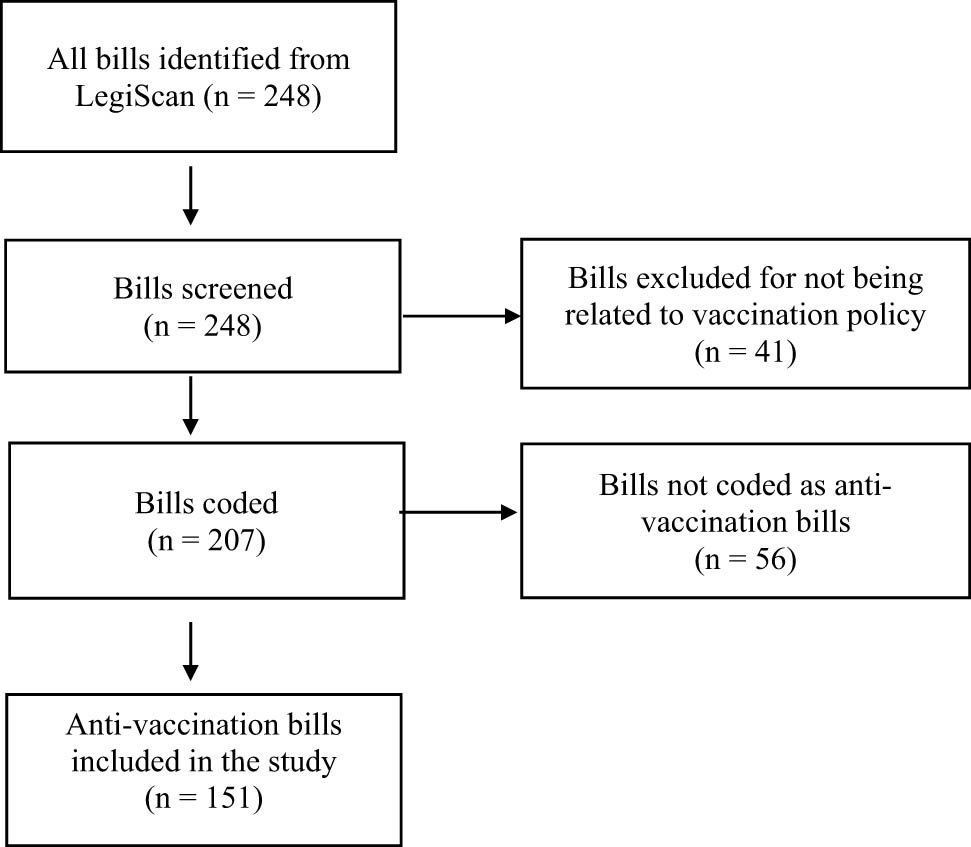
Flow diagram of the identification of anti-vaccination bills.
List of anti-vaccination bills, South Dakota and Minnesota, 2013–2023
| Minnesota | ||
|---|---|---|
| 2023 | ||
| HF 2720 | Employers prohibited from requiring or incentivizing public display of medical information, and civil and criminal penalties imposed | [Text] |
| SF 2638 | Commissioner of health prohibition from modifying immunization requirements for enrollment in an elementary or secondary school or child care facility to require immunizations against COVID-19 | [Text] |
| HF 2540 | Commissioner of health prohibited from modifying immunization requirements for enrollment in elementary or secondary school or child care facility to require immunizations against COVID-19 | [Text] |
| SF 923 | Government vaccine mandates enforcement prohibition; proof of natural antibodies as an alternative to vaccination allowance | [Text] |
| HF 1896 | Government vaccine mandate enforcement prohibited, and proof of presence of natural antibodies allowed as alternative to vaccination | [Text] |
| SF 1106 | Consent for vaccination requirement | [Text] |
| HF 1860 | Consent for vaccination required, consent coercion and discrimination prohibited, and criminal penalties imposed | [Text] |
| SF 2278 | Certain health care providers requirement to report adverse vaccination events and disclose certain information | [Text] |
| SF 1105 | Health care providers administering vaccines requirement to disclose certain information to patients | [Text] |
| HF 1879 | Health care providers administering vaccines required to disclose information to patients, reports of adverse reactions to vaccines required, and content of an informed consent form specified | [Text] |
| SF 2277 | Vaccination consent requirement | [Text] |
| SF 2279 | Vaccination consent addition to the Human Rights Act | [Text] |
| SF 204 | Vaccine requirements establishment prohibition | [Text] |
| HF 1226 | Establishment of vaccine requirements prohibited, and exceptions provided | [Text] |
| HF 1380 | Establishment of vaccine requirements prohibited, and exceptions provided | [Text] |
| SF 3263 | William Shegstad Healthcare Advocates Act establishment | [Text] |
| HF 3271 | William Shegstad Healthcare Advocates Act established, and civil penalties provided | [Text] |
| SF 488 | Vaccine recipient bill of rights establishment | [Text] |
| HF 680 | Vaccine recipient bill of rights established | [Text] |
| SF 2384 | Commissioner of human services rescinding public assistance benefits due to vaccination status prohibition | [Text] |
| HF 2545 | Commissioner of human services prohibited from rescinding public assistance benefits due to vaccination status | [Text] |
| SF 938 | Local enforcement of federal vaccine passports prohibition; civil cause of action establishment | [Text] |
| HF 1905 | Local enforcement of federal vaccine passports prohibited, and civil cause of action created | [Text] |
| SF 576 | Parent or legal guardian requirement to be present for vaccine administration to a minor | [Text] |
| HF 885 | Parent or legal guardian required to be present for vaccine administration to a minor | [Text] |
| SF 650 | State agencies and local units of government prohibition from offering vaccine incentives | [Text] |
| HF 954 | State agencies and local units of government prohibited from offering vaccine incentives | [Text] |
| SF 811 | Higher education immunizations exemption expansion | [Text] |
| HF 1953 | Exceptions from immunizations expanded | [Text] |
| SF 1076 | Limits establishment for contact tracing, digital contact tracing, immunizations, communicable disease testing, and the required disclosure of certain information | [Text] |
| HF 704 | Contact tracing, digital contract tracing, immunizations, communicable disease testing, and required disclosure of information limits established; destruction of data required, mandatory digital contact tracing by employers prohibited, and civil penalties provided | [Text] |
| SF 937 | Employers requiring or incentivizing public safety of medical information prohibition; civil and criminal penalties imposition | [Text] |
| 2021–2022 | ||
| HF 2530 | Vaccine passport, vaccine pass, and vaccine credentials for immunization status requirement prohibited | [Text] |
| SF 2610 | Vaccine credentials for immunization status prohibition | [Text] |
| HF 4046 | Discrimination based on vaccine status or immunity passport prohibited | [Text] |
| SF 2430 | Vaccine passports for COVID-19 immunization status requirement prohibition | [Text] |
| SF 2474 | Vaccine passports for COVID-19 immunization status requirement prohibition | [Text] |
| SF 2475 | Vaccine passports for COVID-19 immunization status requirement prohibition | [Text] |
| HF 2511 | COVID-19; immunization status vaccine passport requirement prohibited | [Text] |
| SF 3022 | Resolution for the State of Minnesota to protect its citizens against unconstitutional and medically irresponsible COVID-19 vaccine mandates | [Text] |
| HF 2348 | COVID-19; a resolution protecting against unconstitutional and medically irresponsible vaccine mandates | [Text] |
| HF 2899 | COVID-19 and influenza vaccine requirements prohibited | [Text] |
| SF 1172 | Disclosure of vaccine ingredients requirement and appropriation | [Text] |
| HF 1194 | Vaccine ingredient disclosure required, and money appropriated | [Text] |
| SF 2820 | Government vaccine mandates prohibition; proof of presence of natural antibodies as an alternative to vaccination establishment | [Text] |
| HF 2694 | Government vaccine mandate enforcement prohibited, and proof of presence of natural antibodies allowed as an alternative to vaccination | [Text] |
| SF 2394 | Consent for vaccination requirement; consent coercion and discrimination prohibition; criminal penalties imposition authorization | [Text] |
| HF 1245 | Vaccination consent required, consent coercion and discrimination prohibited, and criminal penalties imposed | [Text] |
| HF 2627 | Health care providers required to report adverse vaccination events and disclose information | [Text] |
| HF 2159 | Vaccination consent required, consent coercion and discrimination prohibited, and criminal penalties imposed | [Text] |
| SF 2612 | Consent for vaccination requirements | [Text] |
| SF 2607 | Health care provider vaccine disclosure requirements | [Text] |
| HF 26 | Health care providers administering vaccines required to disclose information to patients, adverse reactions to vaccines reports required, and informed consent form content specified | [Text] |
| HF 3711 | Health care providers administering vaccines required to disclose information to patients, adverse reactions to vaccines reports required, and content of an informed consent form specified | [Text] |
| HF 452 | Statutory immunization requirement exemption provided for sincerely held religious belief | [Text] |
| SF 292 | Statutory immunization requirements exemption for religious beliefs | [Text] |
| SF 2613 | Consent of vaccination requirement | [Text] |
| HF 1243 | Vaccination consent required | [Text] |
| HF 1244 | Human Rights Act vaccination consent added | [Text] |
| SF 2611 | Human Rights Act vaccination status discrimination addition | [Text] |
| HF 3214 | Vaccine requirement establishment prohibited, and exception provided | [Text] |
| SF 4489 | Establishment of vaccine requirements prohibition | [Text] |
| HF 3158 | COVID-19; vaccine requirement prohibited, and exceptions provided | [Text] |
| HF 4093 | Vaccination of minor consent of a parent or guardian required | [Text] |
| SF 4332 | William Shegstad Healthcare Advocates Act | [Text] |
| HF 4723 | William Shegstad Healthcare Advocates Act established, and civil penalties provided | [Text] |
| HF 2901 | Mandatory immunization damage cause of action established | [Text] |
| SF 3550 | Mandatory immunization damages cause for action establishment | [Text] |
| HF 4525 | Mandatory immunization damages cause of action established | [Text] |
| HF 3517 | COVID-19; state funding prohibited for public and private entities enforcing vaccine mandate or vaccine passport | [Text] |
| HF 2760 | COVID-19; vaccine mandate injuries cause of action provided | [Text] |
| HF 2759 | COVID-19; employer liability cause of action provided for injuries caused by vaccines | [Text] |
| HF 2843 | COVID-19; unemployment insurance benefits ensured for individual terminated for not adhering to vaccine mandate, and COVID-19 proof of recovery allowed as vaccination substitution | [Text] |
| SF 2424 | Employment discrimination based on vaccination status prohibition | [Text] |
| SF 2737 | Employment discrimination based on vaccination status prohibition | [Text] |
| HF 3423 | Discrimination based on vaccination status prohibited | [Text] |
| HF 2541 | Employment discrimination based on vaccination status prohibited | [Text] |
| SF 3475 | Discrimination based on an individual's vaccination status prohibition | [Text] |
| HF 3820 | Human rights; discrimination based on vaccination status prohibited | [Text] |
| HF 3841 | Natural immunity exemption provided in lieu of employer vaccination or testing requirements | [Text] |
| SF 3491 | Unemployment insurance benefits for an individual terminated for not adhering to the vaccination mandate authorization; proof of recovery from COVID-19 as a substitution for required vaccination establishment | [Text] |
| HF 2897 | Health freedom sanctuary established, governor's peacetime emergency powers limited, and mandatory vaccinations and school district mask requirements prohibited | [Text] |
| SF 2693 | Health freedom sanctuary establishment, governor's peacetime emergency powers limitations, and mandatory vaccinations and school district mask requirements prohibition | [Text] |
| SF 3035 | Health freedom sanctuary establishment, governor's peacetime emergency powers limitations, and mandatory vaccinations and school district mask requirements prohibition | [Text] |
| SF 4047 | COVID-19; employee injured by vaccination cause of action provided | [Text] |
| HF 3276 | Immunization requirement exemption modified for children in child care facilities and students in school and postsecondary education institution | [Text] |
| SF 3061 | Mandated vaccinations expansion | [Text] |
| SF 1589 | Communicable diseases contact tracing, digital contact tracing, immunizations, and required disclosures limits establishment; data destruction requirement; employer mandatory digital contact tracing prohibition; civil penalties | [Text] |
| HF 2347 | Vaccine recipient bill of rights established | [Text] |
| SF 3021 | Vaccine recipient bill of rights establishment | [Text] |
| SF 4581 | Immunizations exceptions expansion | [Text] |
| SF 1249 | A resolution memorializing the President and Congress to hold vaccine manufacturers liable for design defects that result in adverse side effects from vaccines | [Text] |
| HF 1330 | A resolution memorializing the President and Congress to hold vaccine manufacturers liable for design defects that result in adverse side effects from vaccines | [Text] |
| HF 667 | Employers prohibited from disciplining or discharging employees or applicants for immunization refusal, and civil action remedies provided | [Text] |
| SF 2431 | Contact tracing, digital contact tracing, immunizations, communicable disease testing, and certain information disclosure requirements limitation establishment; destruction of certain data requirement; mandatory digital contact tracing by employers prohibition | [Text] |
| HF 1583 | Contact tracing, digital contact tracing, immunizations, communicable disease testing, and information disclosure limits established; data destruction required; mandatory employer digital contact tracing prohibited; and civil penalties provided | [Text] |
| HF 261 | COVID-19; vaccine availability provided for school employees | [Text] |
| HF 2691 | Local enforcement of federal vaccine passports prohibited, and civil cause of action created | [Text] |
| HF 2685 | Parent or legal guardian required to be present for vaccine administration to a minor | [Text] |
| SF 2694 | Parent or legal guardian presence requirement for vaccine administration to a minor | [Text] |
| HF 533 | Employers prohibited from disciplining or discharging employees for immunization refusal, and civil action remedies provided | [Text] |
| SF 1264 | Employee immunization refusal employer discipline or discharge prohibition | [Text] |
| HF 4349 | COVID-19; vaccine mandate establishment prohibited | [Text] |
| SF 2559 | COVID-19 public health disaster response establishment; peacetime emergency declared in Executive Order No. 20-01 termination | [Text] |
| HF 2640 | COVID-19; public health disaster response established, and peacetime emergency declared in Executive Order No. 20-01 terminated | [Text] |
| HF 3736 | State agencies and local units of government prohibited from offering vaccine incentives | [Text] |
| HF 2801 | Medical information public display required or incentivized by employers prohibited, and civil and criminal penalties imposed | [Text] |
| SF 3666 | Right establishment for a patient or resident to choose to have support person while receiving care or services | [Text] |
| 2019–2020 | ||
| SF 2911 | Resolution memorializing the President and Congress to hold vaccine manufacturers liable for design defects that result in adverse side effects from vaccines | [Text] |
| HF 2862 | Vaccines; a resolution memorializing the President and Congress to hold vaccine manufacturers liable for design defects | [Text] |
| SF 3109 | Immunization refusal employers discipline or discharge of employee or applicant prohibition | [Text] |
| HF 2825 | Vaccines; a resolution memorializing the President and Congress to hold vaccine manufacturers liable for design defects that result in adverse side effects from vaccines | [Text] |
| SF 3814 | Immunization requirements for sincerely held religious beliefs exemption authorization | [Text] |
| SF 3110 | Vaccine minimum safety standards requirement for any vaccine required to enroll or remain enrolled in an elementary or secondary school | [Text] |
| HF 4208 | Statutory immunization requirement exemption provided for sincerely held religious belief | [Text] |
| HF 4348 | Vaccine minimum safety standards provided for any vaccine required to enroll or remain enrolled in elementary and secondary school | [Text] |
| HF 4287 | Employers prohibited from discipline or discharge for employee or applicant immunization refusal, and civil action remedies provided | [Text] |
| HF 41 | Vaccination consent required, consent coercion and discrimination prohibited, and criminal penalties imposed | [Text] |
| HF 40 | Vaccination consent required | [Text] |
| HF 42 | Human Rights Act; vaccination consent added | [Text] |
| HF 999 | Employers prohibited from discipline or discharge for employee or applicant immunization refusal, and civil action remedies provided | [Text] |
| SF 1916 | Employer discipline or discharge prohibition for employee or applicant refusal to immunize | [Text] |
| SF 2781 | Resolution memorializing the President and Congress to hold vaccine manufacturers liable for design defects that result in adverse side effects from vaccines | [Text] |
| SF 2831 | Resolution memorializing the President and Congress to hold vaccine manufacturers liable for design defects that result in adverse side effects from vaccines | [Text] |
| HF 3728 | Employers prohibited from disciplining or discharging employees for immunization refusal, and civil action remedies provided | [Text] |
| 2017–2018 | ||
| SF 143 | Vaccination and immunization exemption procedures modification | [Text] |
| HF 2005 | Health care providers administering vaccines required to disclose information to parents, reports of adverse reactions to vaccines required, and informed consent form content specified | [Text] |
| SF 2660 | Mandatory influenza vaccine requirements employee exemptions establishment; employee misconduct definition modification | [Text] |
| HF 96 | Immunization exemption procedures modified | [Text] |
| 2015–2016 | ||
| SF 1870 | Health care providers vaccination reporting and disclosure requirements | [Text] |
| HF 1978 | Health care providers required to report adverse vaccination events and disclose information | [Text] |
| 2013–2014 | ||
| HF 2170 | Immunization exemption procedures modified | [Text] |
| South Dakota | ||
|---|---|---|
| 2023 | ||
| SF 2544 | Immunization exemption procedures modification | [Text] |
| HB 1216 | Establish and revise requirements related to visitation policies and procedures for certain facilities | [Text] |
| SB 125 | Prohibit the imposition of additional immunization requirements on children | [Text] |
| HJR5003 | Proposing and submitting to the voters at the next general election a new section to Article VI of the Constitution of the State of South Dakota, relating to the right of a person to reject certain medical procedures | [Text] |
| HB 1235 | Provide a conscience exemption from a COVID-19 vaccination | [Text] |
| SB 130 | Provide for philosophical exceptions to required vaccinations | [Text] |
| 2022 | ||
| SB 211 | Protect an individual's conscience from entities requiring the COVID-19 vaccine | [Text] |
| HB 1262 | Prohibit discrimination based on a person's vaccination status or possession of an immunity passport and to declare an emergency | [Text] |
| HB 1258 | Protect an individual's conscience from entities requiring the COVID-19 vaccine | [Text] |
| HB 1212 | Prohibit certain activities related to a person's COVID-19 vaccination status and provide a penalty therefor | [Text] |
| HB 1256 | Establish employees' exemptions from employer-imposed COVID-19 vaccine requirements | [Text] |
| HB 1008 | Provide a cause of action for certain employees that are required to receive a vaccination as a condition of employment and to declare an emergency | [Text] |
| HB 1224 | Extend unemployment insurance benefits to individuals who are unemployed because of their refusal to obtain COVID-19 vaccination | [Text] |
| HB 1211 | Prohibit the enforcement of contracts limiting competition on certain matters of conscience | [Text] |
| 2021 | ||
| HB 1097 | Provide for philosophical exceptions to required vaccinations | [Text] |
| HB 1159 | Prohibit interference with the right to bodily integrity in contagious disease control | [Text] |
| 2020 | ||
| HB 1235 | Revise provisions regarding immunizations | [Text] |
| 2016 | ||
| SB 108 | Require notice if certain immunizations contain more than trace amounts of mercury | [Text] |
| 2015 | ||
| HB 1059 | Allow authorized entities to access immunization information in certain circumstances | [Text] |
| 2013 | ||
| SB 98 | Revise certain statutory immunization exemption requirements | [Text] |
References
[1] Motta M. Is partisan conflict over COVID-19 vaccination eroding support for childhood vaccine mandates? NPJ Vaccines. 2023;8(1):5.10.1038/s41541-023-00611-3Suche in Google Scholar PubMed PubMed Central
[2] Larson HJ, Gakidou E, Murray CJL. The vaccine-hesitant moment. N Engl J Med. 2022;387(1):58–65.10.1056/NEJMra2106441Suche in Google Scholar PubMed PubMed Central
[3] Estep K, Muse A, Sweeney S, Goldstein ND. Partisan polarization of childhood vaccination policies, 1995-2020. Am J Public Health. 2022;112(10):1471–9.10.2105/AJPH.2022.306964Suche in Google Scholar PubMed PubMed Central
[4] Goldstein ND, Suder JS, Purtle J. Trends and characteristics of proposed and enacted state legislation on childhood vaccination exemption, 2011-2017. Am J Public Health. 2019;109(1):102–7.10.2105/AJPH.2018.304765Suche in Google Scholar PubMed PubMed Central
[5] News C. Vaccine doubts fuel Dr. Scott Jensen’s Rise In Minnesota Governor Race. CBS News Minnesota. Vol. 2021; 2021 October.Suche in Google Scholar
[6] Haiar J. Anti-vaccine bill fails in South Dakota Senate committee. The Brookings Register; February 16, 2023.Suche in Google Scholar
[7] Mercer BSD. House rejects COVID vaccine exemption. KELO-TV; February 16, 2023.Suche in Google Scholar
[8] Ng QX, Lee DYX, Ng CX, Yau CE, Lim YL, Liew TM. Examining the negative sentiments related to influenza vaccination from 2017 to 2022: An unsupervised deep learning analysis of 261,613 twitter posts. Vaccines-Basel. 2023;11(6):1018.10.3390/vaccines11061018Suche in Google Scholar PubMed PubMed Central
[9] Viskupic F, Wiltse DL, Meyer BA. Trust in physicians and trust in government predict COVID-19 vaccine uptake. Soc Sci Quart. 2022;103(3):509–20.10.1111/ssqu.13147Suche in Google Scholar PubMed PubMed Central
[10] Olson J. Minnesota snuffed measles clusters in 2022, but risks remain. StarTribune; January 13, 2023.Suche in Google Scholar
© 2023 the author(s), published by De Gruyter
This work is licensed under the Creative Commons Attribution 4.0 International License.
Artikel in diesem Heft
- Research Articles
- Social factors related to depression during COVID-19
- Prevalence of diaper need and diaper dermatitis and associated risk factors among children aged 1–24 months in a referral hospital in Ghana: A cross-sectional study
- A gravity model approach to understand the spread of pandemics: Evidence from the COVID-19 outbreak
- Raising security of first responders with C-ITS?
- Recomposition of work and attitudes of family assistants within Covid-19 in Poland: A pilot study
- Allelic variants of CYP2B6 gene expression and its implication on the pathogenesis of malaria among a cohort of outpatients in North-Central Nigeria
- Impact of medically supervised fasting on the vitamin D, glycemic control, quality of life and need for medication among type 2 diabetes mellitus: Protocol for a randomized control trial (FAVIT Trial)
- A Tumblr thematic analysis of perinatal health: Where users go to seek support
- Assessing the significance of socioeconomic and demographic factors on COVID-19 cases in Turkey along with the development levels of provinces
- Economic burden and health-related quality of life in patients with neurofibromatosis type 1 in Greece
- Review Articles
- The current status of diversity among physician assistants in surgery: A systematic review
- Planting a path to kidney health: The vegetarian diet and diabetic nephropathy
- Short Communications
- World Heart Day: Clinical case to raise awareness on cardiovascular disease in women
- Preserving sight: Managing and preventing diabetic retinopathy
- The rise of anti-vaccination legislation in two Midwestern US states: Implications for politics, policy, and society
- Letter to the Editor
- Tranexamic acid and pre-hospital trauma setting: Is everything clear by now?
- Pneumocephalus was commonly evident and pneumorrhachis was very commonly evident among our peri-anesthesia patients whose peri-partum neurological symptoms had warranted radiological investigations
- Ventilator-associated pneumonia: Epidemiological changes or disregarded bundles?
- Special Issue on Public Health Resilience - Part I
- Editorial: Special issue on public health resilience
- Message framing, partisanship, and popular support for COVID-19 vaccine mandate for all adults: Evidence from a preregistered survey experiment
Artikel in diesem Heft
- Research Articles
- Social factors related to depression during COVID-19
- Prevalence of diaper need and diaper dermatitis and associated risk factors among children aged 1–24 months in a referral hospital in Ghana: A cross-sectional study
- A gravity model approach to understand the spread of pandemics: Evidence from the COVID-19 outbreak
- Raising security of first responders with C-ITS?
- Recomposition of work and attitudes of family assistants within Covid-19 in Poland: A pilot study
- Allelic variants of CYP2B6 gene expression and its implication on the pathogenesis of malaria among a cohort of outpatients in North-Central Nigeria
- Impact of medically supervised fasting on the vitamin D, glycemic control, quality of life and need for medication among type 2 diabetes mellitus: Protocol for a randomized control trial (FAVIT Trial)
- A Tumblr thematic analysis of perinatal health: Where users go to seek support
- Assessing the significance of socioeconomic and demographic factors on COVID-19 cases in Turkey along with the development levels of provinces
- Economic burden and health-related quality of life in patients with neurofibromatosis type 1 in Greece
- Review Articles
- The current status of diversity among physician assistants in surgery: A systematic review
- Planting a path to kidney health: The vegetarian diet and diabetic nephropathy
- Short Communications
- World Heart Day: Clinical case to raise awareness on cardiovascular disease in women
- Preserving sight: Managing and preventing diabetic retinopathy
- The rise of anti-vaccination legislation in two Midwestern US states: Implications for politics, policy, and society
- Letter to the Editor
- Tranexamic acid and pre-hospital trauma setting: Is everything clear by now?
- Pneumocephalus was commonly evident and pneumorrhachis was very commonly evident among our peri-anesthesia patients whose peri-partum neurological symptoms had warranted radiological investigations
- Ventilator-associated pneumonia: Epidemiological changes or disregarded bundles?
- Special Issue on Public Health Resilience - Part I
- Editorial: Special issue on public health resilience
- Message framing, partisanship, and popular support for COVID-19 vaccine mandate for all adults: Evidence from a preregistered survey experiment
