Metasurface spatial filters for multiple harmonic signals
-
Daeik Kim


Abstract
Nonlinear frequency mixings have shown an alternative way to create new electromagnetic sources in frequency ranges that are difficult to access with conventional techniques. To simultaneously use the fundamental frequency pump beam and multiple harmonic signals generated in the same channel, a device capable of separating each frequency component is required. Here, we propose and experimentally demonstrate metasurface-based spatial filters for the pump frequency and multiple harmonic frequencies. The metasurface was designed using eight different split ring resonator-based phase elements with 45° phase spacing, which allows wavefront shaping. The metasurface designed to have a one-dimensional gradient phase array produces cross-polarized reflection waves with different beam steering angles at the third- and fifth-harmonic frequencies (15 and 25 GHz) and operates as a metallic mirror at the fundamental frequency of 5 GHz. Our work suggests a new method to enable simultaneous use of broadband multi-frequency sources based on nonlinear frequency mixing.
1 Introduction
Frequency mixings based on nonlinear optical phenomena have been suggesting an alternative to developing new frequency light sources that are technically difficult to generate. In particular, studies using nonlinear optical responses have been conducted to develop light sources in the frequency range of 0.1–10 THz, called the THz gap. Recently, the possibility of using giant odd-order nonlinear optical susceptibilities due to the nonlinear conductance in monolayer graphene has been reported [1–4], and studies on odd-order harmonic generations using graphene monolayer have been reported [5, 6]. Due to the centrosymmetric structure of graphene, even-order harmonics cancel out and only odd-order harmonics f, 3f, 5f, …, can be generated [7]. In such system where multiple harmonic generations occur, a device capable of separating each harmonic frequency component is required to simultaneously use several frequency components including a fundamental frequency pump beam. One way to meet this requirement is to use a spatial filter for multiple harmonic frequencies that can spatially separate each frequency component.
Metasurfaces, consisting of an two-dimensional arrangement of subwavelength metallic or dielectric structures called meta-atoms, exhibit an ability to engineer the amplitude, phase, and polarization of scattered light from meta-atoms at a deeply subwavelength scale [8, 9]. Recently, the local control of the scattered light from metasurfaces have shown a new way to engineer the wavefront shaping and the beam-steering, leading to a new concept of “flat optics” that can replace conventional bulk optics. Based on the unique properties of metasurfaces, interesting applications of flat optics have been demonstrated such as flat lens [10], waveplate [11–13], and hologram [14, 15]. With periodical or non-periodical arrangements of meta-atoms, broadband metasurfaces for beam steering and beam forming have been studied [16–18]. The local phase and amplitude response of individual meta-atom can be adjusted by the designed structural parameters under the linearly polarized light. However, it is hard to cover fundamental frequency (FF) to high harmonic frequencies (HFs) due to the limitation of operation bandwidth by the intrinsic dispersion of resonance from meta-atoms [19–21].
In this work, we propose and experimentally demonstrate metasurfaces for spatially separating fundamental frequency (f) and two odd-high harmonic signals (3f and 5f). For the proof-of-concept demonstration, we used fundamental frequency of 5 GHz, third- and fifth-harmonic frequency of 15 and 25 GHz. The metasurface consist of split ring resonators with different gap sizes in reflection mode to control the phase and amplitude of electromagnetic (EM) wave at a broadband frequency range. In this work, we propose a new approach of using polarization conversion of meta-atom to overcome the bandwidth limitation. The polarization state of reflected wave from split ring-shaped particle can be controlled by changing structural parameters under linearly polarized wave. To cover the FF to high HFs, different polarization states were used for FF and high HFs. In this configuration, polarization state of the reflected wave at FF was designed to be the same as state of incident wave, and polarization states at high HFs were designed to be opposite state of the incident wave polarization. Each polarization states were affected on different resonances; therefore, the operating bandwidth can be tuned by the two resonances. This notable feature guarantees a wide bandwidth for engineering of local phase and amplitude that can cover FF to high HFs.
2 Multi-frequency beam steering metasurface design
Figure 1(a) shows a schematic of our multi-frequency beam steering metasurface that consists of split ring resonator (SRR) arrays designed at 5 GHz, 15 GHz, and 25 GHz, effectively working as a multi-frequency spatial filter. The SRR is a well-studied as a constituent meta-atom to control the local phase and it is polarization sensitive under the linearly polarized beam [17, 22]. Through optimization of SRR structure, we obtained SRR designs covering a broadband frequency range for high harmonic generation signals with reflection coefficients of nearly 1 using the polarization sensitive property. A unit cell design of the split ring resonator is shown in Figure 1(b). The split ring resonator arrays were patterned on a dielectric substate layer on a metal back plane. The dielectric substrate material was Taconic TLT-6 with a dielectric constant of 2.65, a loss tangent of 0.0006, and thickness of 2 mm. The phase and amplitude properties of reflected beam from the metasurface were tuned by adjusting the angle of α and β and the inner and outer radius of the SRR, r in and r out as shown in Figure 1(b). The design parameters of the SRR are provided in Table 1.
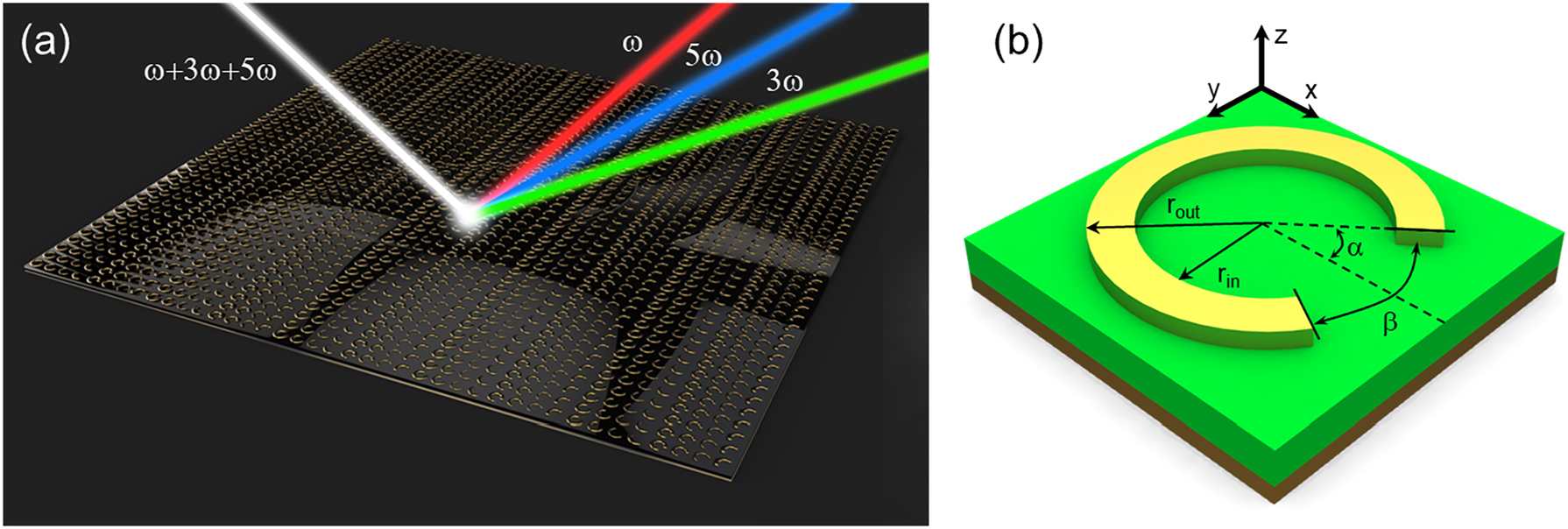
Multi-frequency beam steering metasurface. (a) Schematic illustration of the multi-frequency beam steering metasurface. The white beam indicates an incident beam with three frequency components of ω (FF), 3ω (THG), and 5ω (FHG). The red, green, and blue beam indicates reflected beams from the metasurface at FF, THG, and FHG, respectively. (b) Unit meta-atom structure with SRR. Local phase and amplitude of scattered wave from the meta-atom are controlled independently by varying the angles of α, β and the inner and outer radius of SRR, r in, and r out, respectively.
Design parameters of the eight meta-atom unit structures.
| No. of meta-atom | 1 | 2 | 3 | 4 | 5 | 6 | 7 | 8 |
|---|---|---|---|---|---|---|---|---|
| r in (mm) | 1.5 | 1.5 | 1.5 | 1.5 | 1.5 | 1.5 | 1.5 | 1.5 |
| r out (mm) | 2 | 2 | 2 | 2 | 2 | 2 | 2 | 2 |
| α (°) | 45 | 45 | 45 | 45 | −45 | −45 | −45 | −45 |
| β (°) | 50 | 94 | 137 | 170 | 50 | 94 | 137 | 170 |
Figure 2 shows the simulated local phase and reflection coefficient of the designed meta-atoms using by Commercial Software package (CST Microwave Studio). For wavefront engineering, eight different meta-atoms were designed and arranged to form a super cell. Figure 2(a) and (b) shows simulated magnitude and phase of reflection coefficients of the eight meta-atoms under the x-polarized input and the same polarized reflection output, indicated as r xx . In case of the r xx at 5 GHz, the reflection coefficients are nearly unity and reflection phase values are the same for the eight meta-atoms. Therefore, the super cell acts as a simple metallic mirror, leading to specular reflection at 5 GHz for the r xx component. Figure 2(c) and (d) shows simulated magnitude and phase of reflection coefficients of the eight meta-atoms under the x-polarized input and y-polarized reflection output, indicated as r yx . In case of the r yx , reflection coefficients are over 0.9 and 0.65 at 15 GHz and 25 GHz, respectively, for the eight meta-atoms and local phase values form eight different values with nearly 45 degrees of spacing at the two harmonic frequencies. Therefore, any arbitrary wavefront engineering is possible by using the eight phase element meta-atoms at the two harmonic frequencies. As shown in Table 1, four of two pairs of meta-atoms (1&5, 2&6, 3&7, and 4&8) have the same shape with a different in-plane orientation angle of 2α = 90°, where the cross-polarized reflection coefficient has the same magnitude as r yx , but there is a phase difference by π. To build spatial harmonic frequency filters, we designed a super cell structure with different beam steering angles by producing local phase gradients along the long axis of the super cell at 15 GHz and 25 GHz. According to the generalized Snell’s law, beam steering angle of a gradient phase metasurface can be expressed as [20]:
where ϕ is the phase difference between adjacent meta-atoms, λ is wavelength of incident EM wave and L is the lateral length of the unit cell. The calculated beam steering angles for the two harmonic frequencies using Equation (1) were −30° for 15 GHz and −17° for 25 GHz. The large beam steering angle difference for the two harmonic frequencies from the single super cell structure is mainly obtained by the large wavelength difference when properties of high reflection coefficients and uniform phase spacing at the two frequencies are guaranteed.
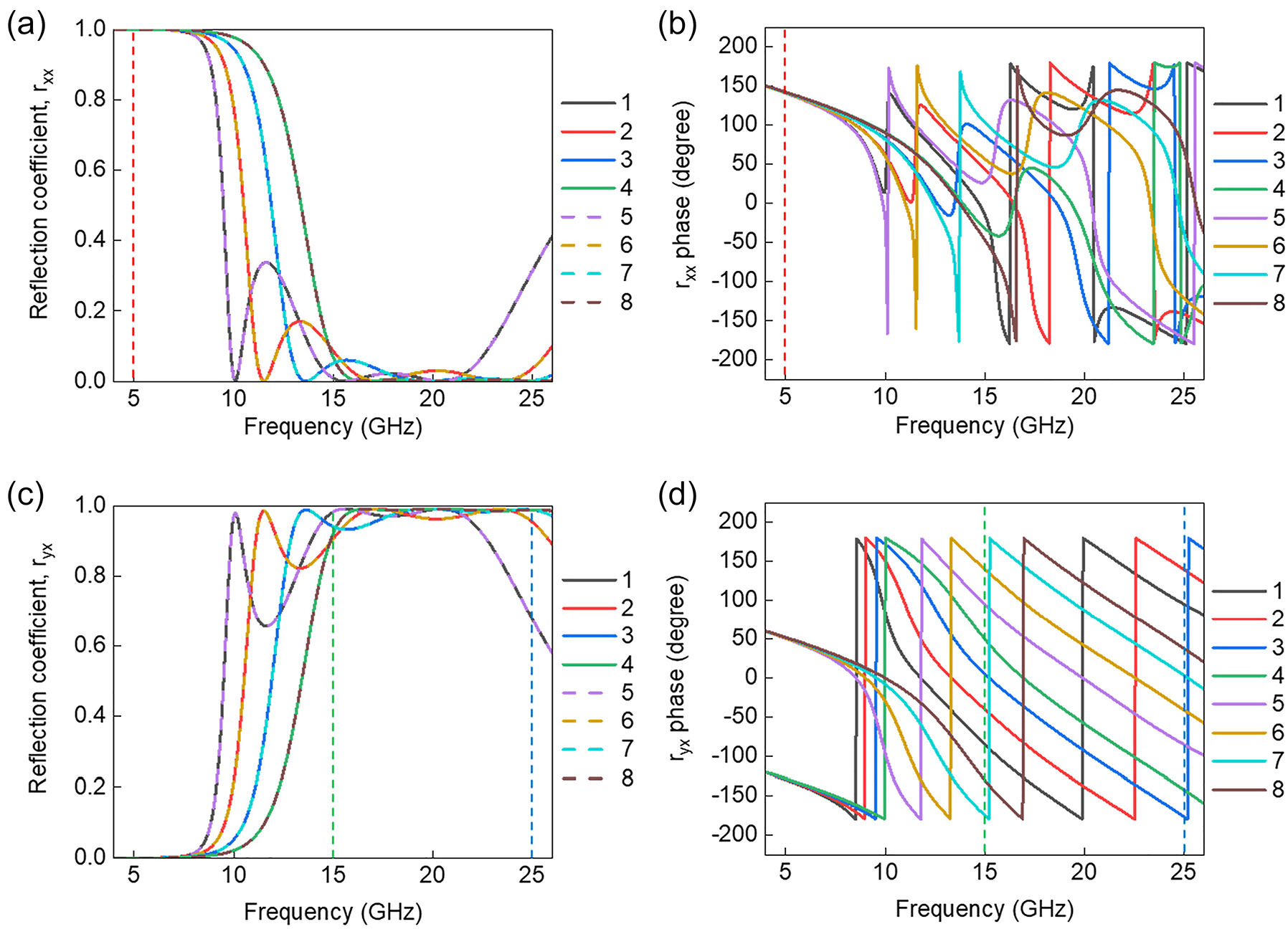
Simulated reflection coefficients of the eight meta-atoms. (a) and (b) Simulated (a) magnitude and (b) phase spectra of reflection coefficient for x-polarized reflection beam under the x-polarized incident beam, indicated as r xx . (c) and (d) Simulated (c) magnitude and (d) phase spectra of reflection coefficient for y-polarized reflection beam under the x-polarized incident beam, indicated as r yx .
3 Numerical and experimental results
Far-field radiation pattern simulations were conducted to confirm the steering angle of reflected beam from the designed metasurface under a normal incidence of a plain wave. Figure 3 show the 3D and 2D cross-section of simulated far-field radiation patterns at 5 GHz, 15 GHz and 25 GHz. The intensity radiation patterns at each frequency were normalized to the respective maximum intensity value for clear identification. At 5 GHz, the perpendicularly incident beam on the metasurface is reflected vertically as shown in Figure 3(a) and (d) and acts as metallic mirror. For normal incident waves at 15 GHz and 25 GHz, the beam angles reflected from the metasurface are steered to −30° and −17°, respectively. The numerical simulated and calculated results are matched very well. Therefore, when beams of three frequency components of 5, 15 (THG), 25 GHz (FHG) are incident vertically on the designed metasurface, they are steered to different reflection angles of vertical, −30° and −17°, respectively, and through the characteristics, the metasurface operates as a spatial frequency filter.
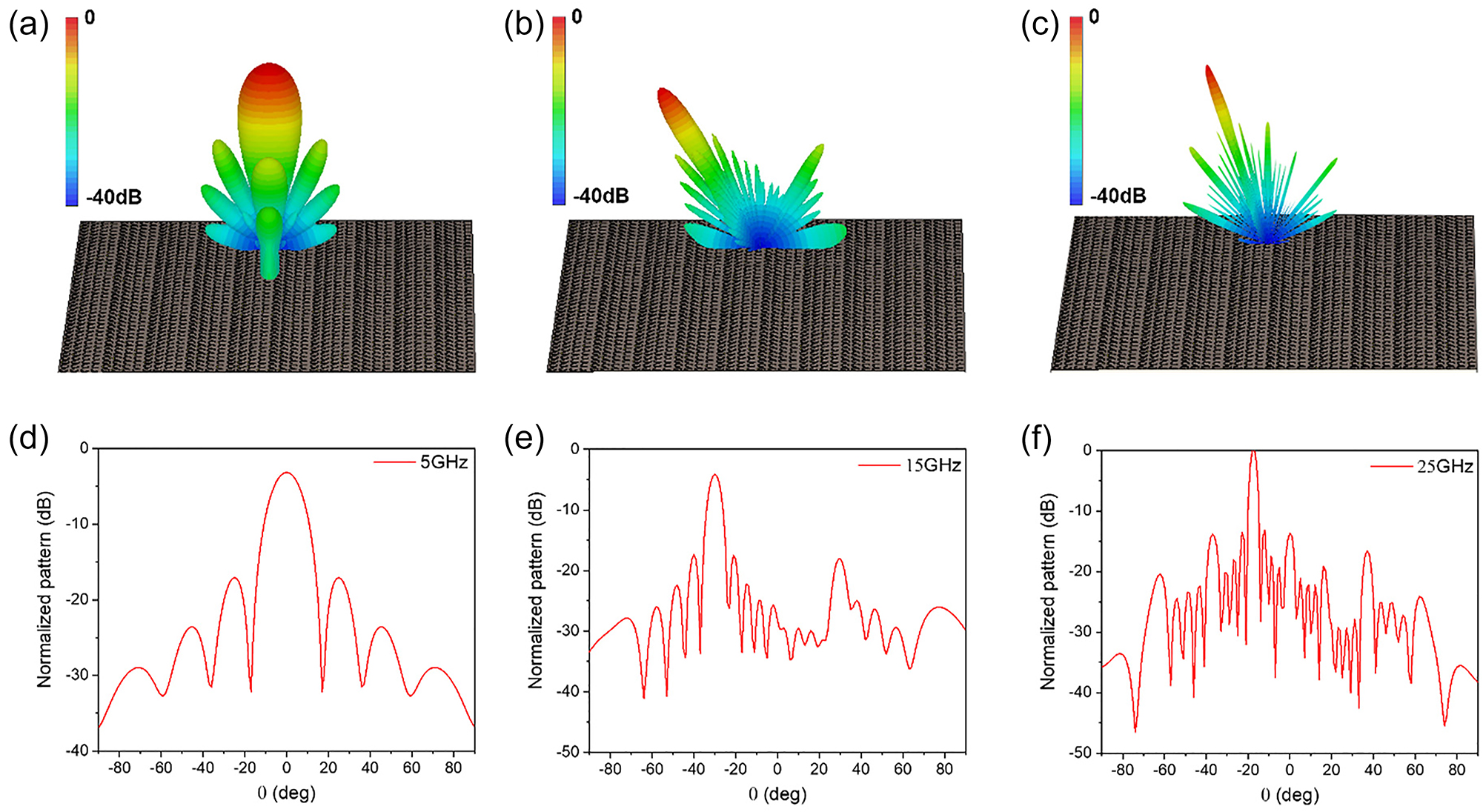
Simulation results of far-field scattering patterns from the metasurface. (a)–(c) Three dimensional scattered intensity patterns at (a) 5 GHz, (b) 15 GHz, and (c) 25 GHz under normal incidence wave. (d)–(f) Two-dimensional cross-section of the scattered intensity patterns at (d) 5 GHz, (e) 15 GHz, and (f) 25 GHz under normal incidence wave.
For experimentally demonstration of the proposed approach for multi-frequency beam steering, the designed metasurface was fabricated by using standard printed circuit board (PCB) process as shown in Figure 4(a). The thickness of substate is 2 mm and the size of metasurface is 600 mm × 400 mm. Figure 4(b) shows far-field measurement system. Scattering patterns reflected from the metasurface was measured in anechoic chamber to avoid background noise signals. In measurements, two different polarization-sensitive horn antennas were used to produce the two linearly polarized incident beams. The transceiver horn antenna (Tx antenna, x-polarized state) was tilted at +20° to avoid interference due to reflected signals, and the distance between the Tx antenna and the metasurface was set to 330 mm. The distance between receiver horn antenna and the metasurface was set to 2 m for collecting far-field radiation patterns. By rotating the mount of the Tx antenna and the metasurface with a 0.5° step, far field profiles of reflected signal from metasurface at the three frequencies were measured using the two ports antenna system.
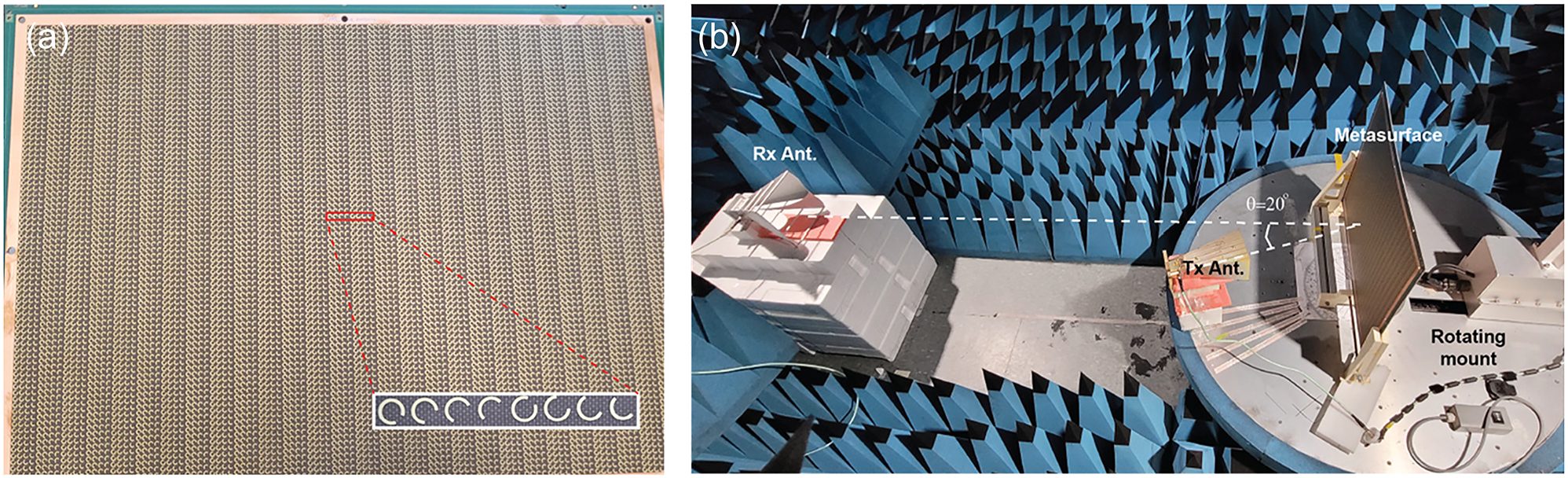
Processed metasurface and measurement setup. (a) Photograph of the fabricated sample and (inset) zoom-in view of the super unit cell image. (b) Experimental beam steering measurement setup consisting of the transceiver horn antenna (Tx Ant.), the metasurface, the receiver horn antenna (Rx Ant.) and the rotating mount.
The simulated and experimental results of multi-frequency beam steering metasurface at 5 GHz, 15 GHz, and 25 GHz are plotted in Figure 5. In the measurement, the polarization state of receiver horn antenna (Rx antenna) was fixed to x-polarized for 5 GHz measurement and fixed to y-polarized for 15 GHz and 25 GHz measurement. The red curve and black dotted curve represent measured and simulated far field radiation pattern from the metasurface, respectively. The incident angle of Gaussian beam from Tx antenna was set to 20°, therefore the calculated beam steering angles of the reflected beams from the metasurface were −20°, −50° and −37° for 5 GHz, 15 GHz, and 25 GHz, respectively. In numerical simulation, input sources exported from the horn antenna used in the measurements were used for correct and direct comparison between the simulated and measured results. At 5 GHz, the peak intensity of the reflected beam with r xx component was measured at an angle of about θ = −20°, which is equal to the angle of incidence as shown in Figure 5(a). We conducted the same measurement using a simple metal plate as shown in Figure 5(d), exhibiting the similar far field intensity pattern. It confirmed that the metasurface at 5 GHz is working as a metallic mirror. At 15 GHz and 25 GHz, the peak intensity of the reflected beams with r xy component was measured at angles of about θ = −50° and −36°, respectively, as shown in Figure 5(b) and (c). All the measured results were matched very well with the results of simulation. Compared to the calculation results in Figure 3, the secondary lobes were measured to be large, which is the result of including the near-field component because the distance between the Tx and Rx antennas was not sufficiently separated. From the measurement results, different reflected wave beam steering angles were formed at fundamental frequency 5 GHz and THG and FHG frequencies 15 and 25 GHz. It was confirmed that it operates as a multi-frequency spatial filter through the characteristic. The metasurface proposed in this study can be easily extended to higher frequency domains, and to demonstrate this, numerical simulations were performed in the 0.16 to 0.8 THz region. The simulation results are provided in Supplementary Material Figure S1 and S2.
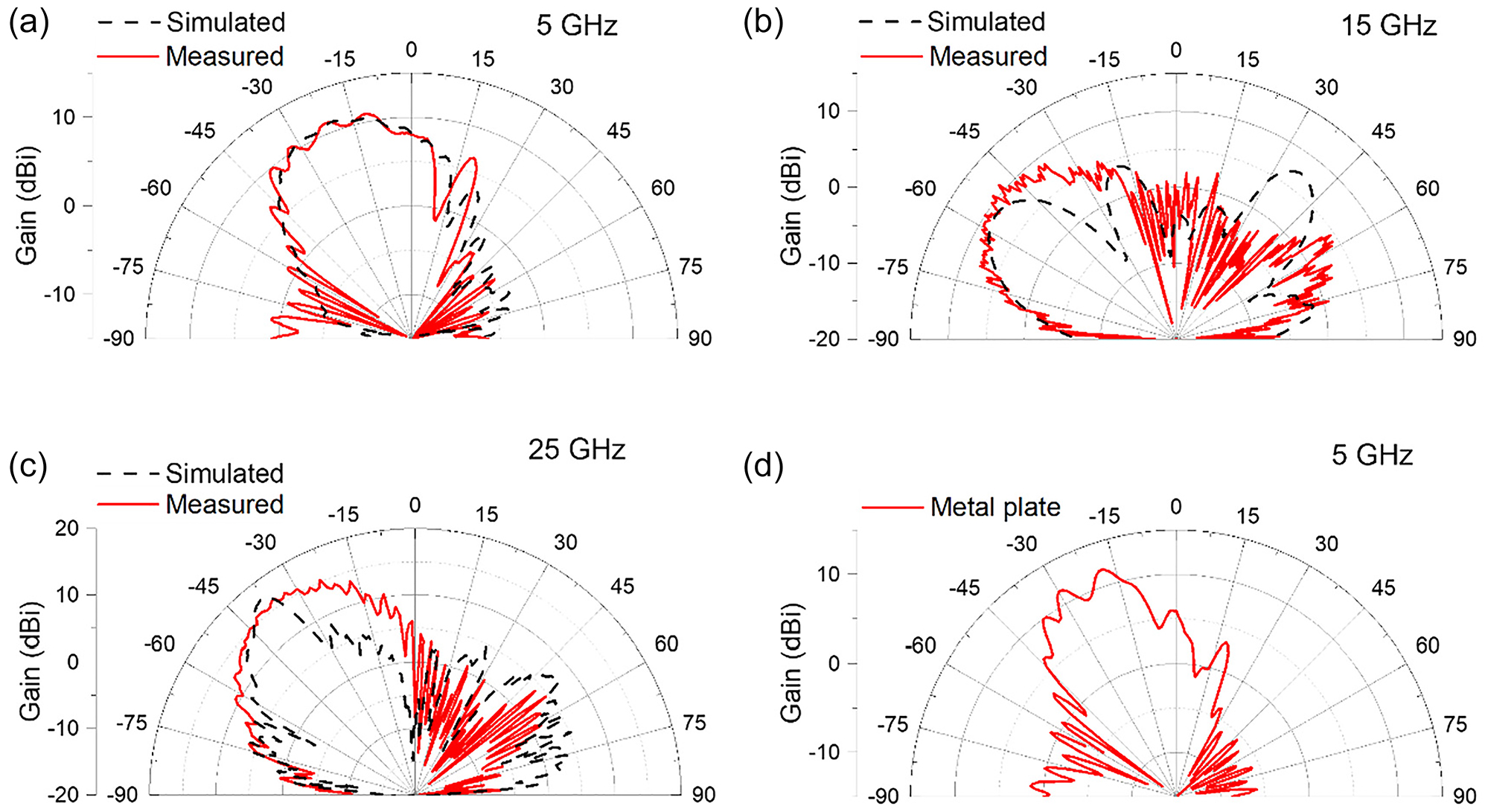
Experimental characterization of the multi-frequency beam steering metasurface with an incidence angle of 20°. (a)–(c) Simulation (black) and experimental (red) results of far-field radiation patterns at (a) 5 GHz, (b) 15 GHz, and (c) 25 GHz, respectively, under x-polarized wave excitation. (d) Experimental result of far-field radiation pattern of a metal plate with an incidence angle of 20°.
4 Conclusions
In this work, we have proposed and experimentally demonstrated multi-frequency beam steering metasurface for producing multi-frequency spatial filtering using the optimized split ring structure arrays. The polarization convert meta-atoms have the capacity of engineering local phase and amplitude profiles with extremely broadband that can cover fundamental frequency to fifth harmonic frequency. By arraying the designed meta-atoms, FF signals and high odd-harmonic signals are de-multiplexing to different direction at each frequency. The proposed metasurface can operate in a frequency range of more than 2 octaves, and this feature has never been implemented in previous multi-frequency metasurface studies (cf. Supplementary Material Table S2). The proposed approach in this work will provide an efficient device platform for potential applications, such as multi-frequency beam shaping, spatial filter for harmonic generations, and multi-frequency target tracking. In addition, the proposed approach may be applied as a spatial filter for multiple harmonic generation signals in the sub-terahertz or terahertz domain, which is higher frequency region, through structure optimization and scaling down.
Funding source: National Research Foundation of Korea
Award Identifier / Grant number: 2020R1A4A3079834
Funding source: National Research Foundation of Korea
Award Identifier / Grant number: 2022R1A2C301189812
-
Author contribution: D.K. designed the resonators, fabricated the device, and performed all experimental measurements and simulations. M.N. and G.B. assisted with the experimental measurement. J.L. conceived and developed the concept as well as planned and directed the research. D.K. and J.L. wrote the manuscript.
-
Research funding: This work was supported by the National Research Foundation of Korea (NRF) grant funded by the Korea government (MSIT) (No. 2020R1A4A3079834, 2022R1A2C301189812).
-
Conflict of interest statement: The authors declare no conflict of interest regarding this article.
References
[1] I. Al-Naib, M. Poschmann, and M. M. Dignam, “Optimizing third-harmonic generation at terahertz frequencies in graphene,” Phys. Rev. B, vol. 91, no. 20, p. 205407, 2015. https://doi.org/10.1103/physrevb.91.205407.Suche in Google Scholar
[2] I. Al-Naib, J. Sipe, and M. M. Dignam, “High harmonic generation in undoped graphene: interplay of inter-and intraband dynamics,” Phys. Rev. B, vol. 90, no. 24, p. 245423, 2014. https://doi.org/10.1103/physrevb.90.245423.Suche in Google Scholar
[3] S. A. Mikhailov, “Non-linear graphene optics for terahertz applications,” Microelectronics J., vol. 40, nos 4-5, pp. 712–715, 2009. https://doi.org/10.1016/j.mejo.2008.11.042.Suche in Google Scholar
[4] A. C. Neto, F. Guinea, N. M. Peres, K. S. Novoselov, and A. K. Geim, “The electronic properties of graphene,” Rev. Mod. Phys., vol. 81, no. 1, p. 109, 2009. https://doi.org/10.1103/revmodphys.81.109.Suche in Google Scholar
[5] J.-C. Deinert, D. Alcaraz Iranzo, R. l. Pérez, et al.., “Grating-graphene metamaterial as a platform for terahertz nonlinear photonics,” ACS Nano, vol. 15, no. 1, pp. 1145–1154, 2020. https://doi.org/10.1021/acsnano.0c08106.Suche in Google Scholar PubMed PubMed Central
[6] H. A. Hafez, S. Kovalev, J.-C. Deinert, et al.., “Extremely efficient terahertz high-harmonic generation in graphene by hot Dirac fermions,” Nature, vol. 561, no. 7724, pp. 507–511, 2018. https://doi.org/10.1038/s41586-018-0508-1.Suche in Google Scholar PubMed
[7] R. Boyd and B. Masters, Nonlinear Optics, 3rd ed. New York, Academic, 2008.Suche in Google Scholar
[8] H.-T. Chen, A. J. Taylor, and N. Yu, “A review of metasurfaces: physics and applications,” Rep. Prog. Phys., vol. 79, no. 7, p. 076401, 2016. https://doi.org/10.1088/0034-4885/79/7/076401.Suche in Google Scholar PubMed
[9] N. Yu and F. Capasso, “Flat optics with designer metasurfaces,” Nat. Mater., vol. 13, no. 2, pp. 139–150, 2014. https://doi.org/10.1038/nmat3839.Suche in Google Scholar PubMed
[10] M. Khorasaninejad, W. T. Chen, R. C. Devlin, J. Oh, A. Y. Zhu, and F. Capasso, “Metalenses at visible wavelengths: diffraction-limited focusing and subwavelength resolution imaging,” Science, vol. 352, no. 6290, pp. 1190–1194, 2016. https://doi.org/10.1126/science.aaf6644.Suche in Google Scholar PubMed
[11] F. Ding, Z. Wang, S. He, V. M. Shalaev, and A. V. Kildishev, “Broadband high-efficiency half-wave plate: a supercell-based plasmonic metasurface approach,” ACS Nano, vol. 9, no. 4, pp. 4111–4119, 2015. https://doi.org/10.1021/acsnano.5b00218.Suche in Google Scholar PubMed
[12] N. Yu, F. Aieta, P. Genevet, M. A. Kats, Z. Gaburro, and F. Capasso, “A broadband, background-free quarter-wave plate based on plasmonic metasurfaces,” Nano Lett., vol. 12, no. 12, pp. 6328–6333, 2012. https://doi.org/10.1021/nl303445u.Suche in Google Scholar PubMed
[13] Y. Zhao and A. Alù, “Tailoring the dispersion of plasmonic nanorods to realize broadband optical meta-waveplates,” Nano Lett., vol. 13, no. 3, pp. 1086–1091, 2013. https://doi.org/10.1021/nl304392b.Suche in Google Scholar PubMed
[14] L. Li, T. Jun Cui, W. Ji, et al.., “Electromagnetic reprogrammable coding-metasurface holograms,” Nat. Commun., vol. 8, no. 1, pp. 1–7, 2017. https://doi.org/10.1038/s41467-017-00164-9.Suche in Google Scholar PubMed PubMed Central
[15] G. Zheng, H. Mühlenbernd, M. Kenney, G. Li, T. Zentgraf, and S. Zhang, “Metasurface holograms reaching 80% efficiency,” Nat. Nanotechnol., vol. 10, no. 4, pp. 308–312, 2015. https://doi.org/10.1038/nnano.2015.2.Suche in Google Scholar PubMed
[16] G.-Y. Lee, G. Yoon, S.-Y. Lee, et al.., “Complete amplitude and phase control of light using broadband holographic metasurfaces,” Nanoscale, vol. 10, no. 9, pp. 4237–4245, 2018. https://doi.org/10.1039/c7nr07154j.Suche in Google Scholar PubMed
[17] L. Liu, X. Zhang, M. Kenney, et al.., “Broadband metasurfaces with simultaneous control of phase and amplitude,” Adv. Mater., vol. 26, no. 29, pp. 5031–5036, 2014. https://doi.org/10.1002/adma.201401484.Suche in Google Scholar PubMed
[18] H.-X. Xu, H. Liu, X. Ling, Y. Sun, and F. Yuan, “Broadband vortex beam generation using multimode Pancharatnam–Berry metasurface,” IEEE Trans. Antenn. Propag., vol. 65, no. 12, pp. 7378–7382, 2017. https://doi.org/10.1109/tap.2017.2761548.Suche in Google Scholar
[19] T. J. Cui, M. Q. Qi, X. Wan, J. Zhao, and Q. Cheng, “Coding metamaterials, digital metamaterials and programmable metamaterials,” Light Sci. Appl., vol. 3, no. 10, p. e218, 2014. https://doi.org/10.1038/lsa.2014.99.Suche in Google Scholar
[20] N. Yu, P. Genevet, M. A. Kats, et al.., “Light propagation with phase discontinuities: generalized laws of reflection and refraction,” Science, vol. 334, no. 6054, pp. 333–337, 2011. https://doi.org/10.1126/science.1210713.Suche in Google Scholar PubMed
[21] L. Zhang, S. Mei, K. Huang, and C. W. Qiu, “Advances in full control of electromagnetic waves with metasurfaces,” Adv. Opt. Mater., vol. 4, no. 6, pp. 818–833, 2016. https://doi.org/10.1002/adom.201500690.Suche in Google Scholar
[22] X. Zhang, Z. Tian, W. Yue, et al.., “Broadband terahertz wave deflection based on C‐shape complex metamaterials with phase discontinuities,” Adv. Mater., vol. 25, no. 33, pp. 4567–4572, 2013. https://doi.org/10.1002/adma.201204850.Suche in Google Scholar PubMed
Supplementary Material
This article contains supplementary material (https://doi.org/10.1515/nanoph-2022-0752).
© 2023 the author(s), published by De Gruyter, Berlin/Boston
This work is licensed under the Creative Commons Attribution 4.0 International License.
Artikel in diesem Heft
- Frontmatter
- Editorial
- Special issue: Metamaterials and plasmonics in Asia, a tribute to Byoungho Lee
- Memorandum
- In memory of Prof. Byoungho Lee
- Reviews
- Advances and applications on non-Hermitian topological photonics
- Topological phases and non-Hermitian topology in photonic artificial microstructures
- Recent advanced applications of metasurfaces in multi-dimensions
- Recent advances in oblique plane microscopy
- Research Articles
- A symmetry-protected exceptional ring in a photonic crystal with negative index media
- Highly angle-sensitive and efficient optical metasurfaces with broken mirror symmetry
- Multilayer all-polymer metasurface stacked on optical fiber via sequential micro-punching process
- Inverse design of high-NA metalens for maskless lithography
- Deterministic approach to design passive anomalous-diffraction metasurfaces with nearly 100% efficiency
- Metasurface spatial filters for multiple harmonic signals
- Multiple symmetry protected BIC lines in two dimensional synthetic parameter space
- Deep-learning-assisted reconfigurable metasurface antenna for real-time holographic beam steering
- On-chip integration of metasurface-doublet for optical phased array with enhanced beam steering
- Multi-frequency amplitude-programmable metasurface for multi-channel electromagnetic controls
- Broadband absorber with dispersive metamaterials
- Visible-mid infrared ultra-broadband and wide-angle metamaterial perfect absorber based on cermet films with nano-cone structure
- Vertical photon sorting by stacking silicon and germanium nanopillars for broadband absorbers
- Directive emission from polymeric fluorophore with epsilon-near-zero squaraine molecular film
- Chiral-magic angle of nanoimprint meta-device
- Fluorescence engineering in metamaterial-assisted super-resolution localization microscope
- Nano-shaping of chiral photons
- Design principles for electrically driven Luttinger liquid-fed plasmonic nanoantennas
- Ultrafast strong-field terahertz nonlinear nanometasurfaces
- Reconfigurable anomalous reflectors with stretchable elastic substrates at 140 GHz band
- Polarization-independent isotropic metasurface with high refractive index, low reflectance, and high transmittance in the 0.3-THz band
- Terahertz nanofuse by a single nanowire-combined nanoantenna
- Electrically tunable THz graphene metasurface wave retarders
- Ultra-thin grating coupler for guided exciton-polaritons in WS2 multilayers
- Reflection of two-dimensional surface polaritons by metallic nano-plates on atomically thin crystals
- A deep neural network for general scattering matrix
- Engineering isospectrality in multidimensional photonic systems
- Heterogeneously integrated light emitting diodes and photodetectors in the metal-insulator-metal waveguide platform
- DNA origami-designed 3D phononic crystals
- All-dielectric carpet cloaks with three-dimensional anisotropy control
Artikel in diesem Heft
- Frontmatter
- Editorial
- Special issue: Metamaterials and plasmonics in Asia, a tribute to Byoungho Lee
- Memorandum
- In memory of Prof. Byoungho Lee
- Reviews
- Advances and applications on non-Hermitian topological photonics
- Topological phases and non-Hermitian topology in photonic artificial microstructures
- Recent advanced applications of metasurfaces in multi-dimensions
- Recent advances in oblique plane microscopy
- Research Articles
- A symmetry-protected exceptional ring in a photonic crystal with negative index media
- Highly angle-sensitive and efficient optical metasurfaces with broken mirror symmetry
- Multilayer all-polymer metasurface stacked on optical fiber via sequential micro-punching process
- Inverse design of high-NA metalens for maskless lithography
- Deterministic approach to design passive anomalous-diffraction metasurfaces with nearly 100% efficiency
- Metasurface spatial filters for multiple harmonic signals
- Multiple symmetry protected BIC lines in two dimensional synthetic parameter space
- Deep-learning-assisted reconfigurable metasurface antenna for real-time holographic beam steering
- On-chip integration of metasurface-doublet for optical phased array with enhanced beam steering
- Multi-frequency amplitude-programmable metasurface for multi-channel electromagnetic controls
- Broadband absorber with dispersive metamaterials
- Visible-mid infrared ultra-broadband and wide-angle metamaterial perfect absorber based on cermet films with nano-cone structure
- Vertical photon sorting by stacking silicon and germanium nanopillars for broadband absorbers
- Directive emission from polymeric fluorophore with epsilon-near-zero squaraine molecular film
- Chiral-magic angle of nanoimprint meta-device
- Fluorescence engineering in metamaterial-assisted super-resolution localization microscope
- Nano-shaping of chiral photons
- Design principles for electrically driven Luttinger liquid-fed plasmonic nanoantennas
- Ultrafast strong-field terahertz nonlinear nanometasurfaces
- Reconfigurable anomalous reflectors with stretchable elastic substrates at 140 GHz band
- Polarization-independent isotropic metasurface with high refractive index, low reflectance, and high transmittance in the 0.3-THz band
- Terahertz nanofuse by a single nanowire-combined nanoantenna
- Electrically tunable THz graphene metasurface wave retarders
- Ultra-thin grating coupler for guided exciton-polaritons in WS2 multilayers
- Reflection of two-dimensional surface polaritons by metallic nano-plates on atomically thin crystals
- A deep neural network for general scattering matrix
- Engineering isospectrality in multidimensional photonic systems
- Heterogeneously integrated light emitting diodes and photodetectors in the metal-insulator-metal waveguide platform
- DNA origami-designed 3D phononic crystals
- All-dielectric carpet cloaks with three-dimensional anisotropy control
