Nonreciprocal total cross section of quantum metasurfaces
-
Nikita Nefedkin
 ,
Michele Cotrufo
,
Michele Cotrufo
 and
Andrea Alù
and
Andrea Alù

Abstract
Nonreciprocity originating from classical interactions among nonlinear scatterers has been attracting increasing attention in the quantum community, offering a promising tool to control excitation transfer for quantum information processing and quantum computing. In this work, we explore the possibility of realizing largely nonreciprocal total cross sections for a pair of quantum metasurfaces formed by two parallel periodic arrays of two-level atoms. We show that large nonreciprocal responses can be obtained in such nonlinear systems by controlling the position of the atoms and their transition frequencies, without requiring that the environment in which the atoms are placed is nonreciprocal. We demonstrate the connection of this effect with the asymmetric population of a slowly decaying dark state, which is critical to obtain large nonreciprocal responses.
1 Introduction
Combining the classical concepts of metasurfaces and metamaterials with quantum effects has attracted increasing attention over the past few years [1–5]. Recently, ensembles of cold atoms in free space have emerged as a novel platform to control light–matter interactions at the few-photon level. In these systems, often termed quantum metamaterials, exotic phenomena emerge due to interplay between the field radiated and scattered by multiple atoms [1, 6], [7], [8], [9], [10]. Moreover, these systems offer exciting opportunities for applications in quantum information processing and metrology in free space [6, 11], [12], [13].
Among the many desirable features for quantum and classical computation, there is a strong need for devices that support nonreciprocal wave propagation, i.e., systems in which light is transmitted along opposite directions with different efficiencies. Several approaches for nonreciprocity have been recently suggested in both the classical [14–16] and quantum realms [17–19]. In particular, in recent works it has been shown that nonreciprocal propagation or scattering can be obtained in nonlinear systems if they couple asymmetrically to different input/output channels. In classical electromagnetism, this approach has been demonstrated with resonators (such as optical cavities or radio-frequency circuits) coupled asymmetrically to two ports and loaded with Kerr-like nonlinearities, such that their resonant frequencies depend on the stored energy [20–24]. As a consequence, the transmission can be markedly different along the two directions. In parallel, similar behaviors have been shown in quantum devices by suitably combining quantum nonlinearities with breaking of spatial symmetry [25–32]. Fratini et al. have shown [27] that a system of two atoms, optimally detuned and positioned in a waveguide, can lead to large asymmetries between the signals transmitted along the two directions for a large range of input powers. Importantly, both classical and quantum approaches have the important advantage of not requiring any form of external bias, which makes their practical implementation much easier and compatible, for instance, with conventional platforms for quantum computing and processing. However, so far nonlinearity-induced nonreciprocity in free-space quantum systems has not been investigated to the best of our knowledge.
In this work, we investigate whether it is possible to obtain free-space nonreciprocity in quantum metasurfaces, adding an important tool to this rapidly emerging area of research. We consider a system formed by two parallel 2D arrays, each including a large number of atoms, excited by classical plane waves. We demonstrate that, by tailoring the system geometry, it is possible to leverage the quantum nonlinearity of the atoms and obtain large nonreciprocal scattered fields for power levels at which the atomic saturation becomes non-negligible. In particular, we show that the total cross section of the system can be made strongly dependent on the direction of the impinging wave, a feature that cannot be obtained in reciprocal systems. Importantly, here we obtain nonreciprocity by solely engineering the position and detuning of the atoms, without requiring that the electromagnetic environment in which the atoms are placed (i.e., free space) supports nonreciprocal wave propagation [33].
2 System and model
We consider a system composed of two squared 2D arrays of two-level atoms (Figure 1). The arrays are parallel to each other, orthogonal to the z direction, and separated by a distance L. We assume that each array contains N⊥ × N⊥ identical two-level atoms (where N⊥ is the number of atoms along each dimension). In each array (i = 1, 2) the atoms have the same transition frequency ω
i
and they are separated by a lattice pitch a
i
. Hence, the total number of atoms in the system is N ≡ 2 × N⊥ × N⊥. For simplicity, we assume that all atoms have the same transition dipole moment d = de
x
, directed along the x axis. We denote by |0
j
⟩ and |1
j
⟩ the ground and excited states of the jth atom (j = 1, …, N). In the following, we will find it useful to normalize the decay rates of the atomic collective modes by the decay rate of a single atom in free space (with frequency ω
i
and dipole moment magnitude d), which is given by

Sketch of two periodic atomic arrays separated by the distance L. Both arrays are parallel to the xy plane, and are composed of N⊥ × N⊥ identical atoms with frequency ω i , spatially separated by a lattice constant a i .
We are interested in modeling the response of this system to impinging classical monochromatic plane waves of arbitrary intensities. For simplicity, we focus here on the case of waves propagating perpendicular to the plane of the arrays, but the formalism can be easily generalized to tilted excitation directions. The impinging electric field is
A full quantum description of the system response would require to explicitly describe the temporal dynamics of the infinite free-space modes that the atoms can interact with, which would make any analytical or numerical solution very challenging. Following standard approaches [35, 36], it is possible to drastically simplify the system description by applying the Born-Markov approximation. Assuming that the typical relaxation time of the atoms is much slower than the time required by light to propagate between atoms, the photonic degrees of freedom can be traced out from the full Hamiltonian of the system, resulting into an effective master equation which involves only the atomic degrees of freedom. In our scenario, the validity of the Born-Markov approximation requires that 1/γmax ≫ amax/c, where γmax is the largest atomic decay rate and amax is the largest inter-atomic distance. The effective master equation reads [35, 36]
where we have assumed that, in the frequency range of interest, thermal excitations in the environment are negligible, and thus dissipation can only occur from the atomic system into the environment. For a general arrangement of atoms in free space excited by a classical EM field, the effective Hamiltonian (in the frame rotating at the frequency ω0 of the incident field) is [35, 37, 38]
where the indices k, i, j run over all the atoms. We defined the atom-field detuning, Δ
k
≡ ω
k
− ω0, and the interaction constant between the incident field and the kth atom,
where
and
The total electric field, given by the sum of the impinging field and the field scattered by the atoms, can be calculated using the input-output relations [37, 39],
The incident field operator is defined as
Equations (6) and (7) allow to calculate the operators associated to the electric field. Following standard approaches, the expectation value of any operator
3 Spectral analysis and fields generated by atomic collective states
In order to understand the scattering properties of this system, it is useful to first study its eigenstates. We initially focus on the single-excitation subspace of the full Hamiltonian. In order to study also the dissipation in the system, we recast the master equation Eq. (1) into a non-Hermitian Hamiltonian,
where the imaginary part accounts for dissipation. By introducing the so-called “quantum jump” terms,
3.1 Symmetric infinite arrays
For the general case in which the system does not obey parity symmetry (i.e. ω1 ≠ ω2 and/or a1 ≠ a2), it is challenging to diagonalize the Hamiltonian in Eq. (8) analytically. In order to gain insights on the system dynamics, we initially assume that the system is symmetric, i.e., ω1 = ω2 = ω, and a1 = a2 = a. Such symmetric double-array system was also investigated in ref. [11]. Assuming infinitely extended lattices, the eigenvalues and eigenstates of the Hamiltonian in Eq. (8) can be calculated analytically [11].
Following [11], we label each atom by a vector index j = (j⊥, j
z
), where j⊥ = [j
x
, j
y
] are integer numbers identifying the in-plane position of each atom,
where the sum runs over all the atoms in the system, |e
j
⟩ is the excited state of the atom identified by j, and ψn,j is a complex coefficient denoting the contribution of the j-th atom to the nth eigenstate of the system. Due to parity symmetry and translational invariance, the eigenstates of
The sums in Eq. (11) run over all the vectors Q = (2π/a)(m
x
+ m
y
) of the reciprocal lattice, where m
x
and m
y
are integers, and k ≡ ω/c. The decay rate of each eigenstate can be calculated from the imaginary part of the expression in Eq. (11),
Equation (12) can be further simplified when the lattice constant is smaller than the atomic wavelength, a < λ, and for eigenstates with zero momentum q
n
= 0. In this case the two eigenstates, corresponding to the two parity values p = ±1, have decay rates
3.2 Symmetric finite arrays
In the previous section, we have considered quantum metasurfaces formed by infinitely extended periodic arrays, which allowed us to calculate analytically the eigenstates of the atomic ensemble and to show the existence of dark and bright states. In the remainder of the paper, we will focus on systems of finite size. This is due to two reasons: first, we want to be sure that the predicted effects are observable in experimentally feasible atomic systems, which are currently limited to squared arrays with N⊥ × N⊥ ≤ 14 × 14 [41]. Second, considering finite and small arrays will facilitate the analysis of their nonlinear dynamics. When multiple collective excitations are created in the atomic system, analytical results are very challenging to obtain and we will therefore resort to numerical calculations, which are only feasible for small systems.
As discussed in [11], in finite symmetric arrays the collective decay rates are generally different from the ones calculated in infinite arrays Eq. (12). One can still identify bright and dark states by looking at eigenstates whose decay rate are much larger or smaller, respectively, than the decay rate of a single atom in free space. However, the decay rate of dark states in finite systems remains always larger than zero. In Ref. [11], the authors addressed this issue and minimized the decay rate of a dark state by assuming that the arrays are not planar but instead possess a Gaussian-like curvature, calculated based on the phase profile of a Gaussian mode. This allowed them to find analytical expressions for decay rates and frequency shifts of the eigenstates, and to express the eigenmodes as Hermit–Gaussian modes with |q n | close to 0.
In order to keep our system more realistic, we restrict ourselves to planar arrays, considering collective modes with arbitrarily large |q n |, and we calculate numerically the single-excitation spectrum of the effective Hamiltonian in Eq. (8). As an example, in Figure 2 we consider a system of two identical arrays, each of them with N⊥ × N⊥ = 10 × 10 atoms and we plot the amplitudes of the dark state (defined here as the eigenstate with the smallest decay rate) and the bright state (defined here as the eigenstate with the largest decay rate) at each atomic location in the first array.
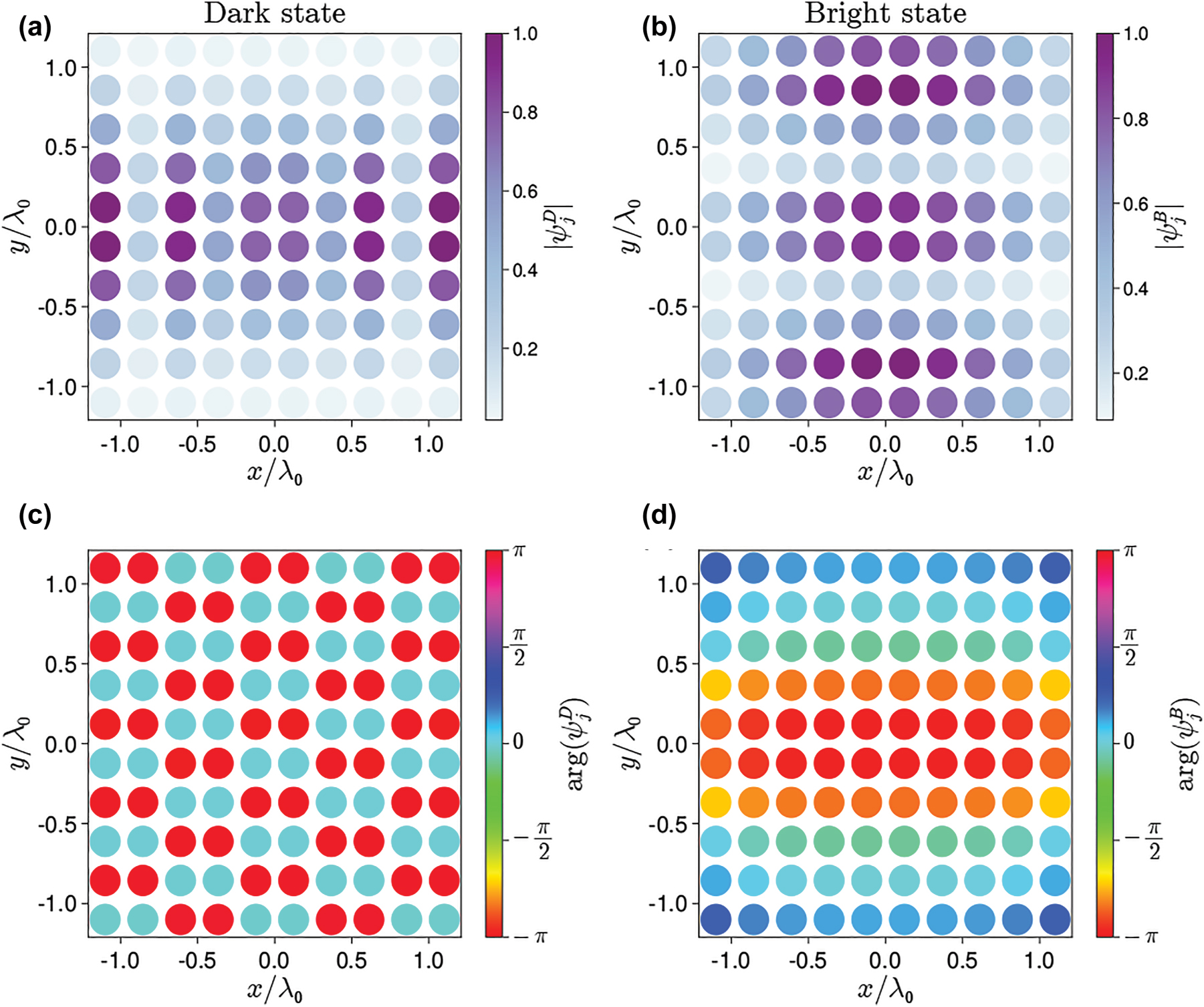
Dark (left panels) and bright (right panel) eigenstates of a two-array system with N⊥ × N⊥ = 10 × 10 atoms in each array obeying mirror symmetry (a1 = a2 = λ0/4, ω1 = ω2) for L = 0.6λ0. Panel (a) and (c) show the amplitude |ψ j | and phase arg(ψ j ) of the dark eigenstate at each atom in the first array. Panels (b) and (d) show the same quantities for the bright state. The amplitudes are the same in the second array, while all phases are shifted by π due to the parity parameter p n in Eq. (10) (pB,D = −1 in this case).
Assuming that the system is prepared in one of these eigenstates (and in absence of any impinging field), we can calculate the electric field intensity generated by the quantum metasurfaces. By using Eq. (7), the field intensity generated at any point is
Figure 3 shows the field intensity generated by the bright and dark states in the plane of the array (xy) and in a plane perpendicular to it (xz). The in-plane field profiles (Figure 3a–b) bears similarity to a Hermit–Gaussian mode [11]. As expected, the dark mode (i.e., an eigenstate with almost-zero decay rate) is associated to an almost-zero field far from the arrays (Figure 3c). On the other hand, the bright mode generates a strong field along the two directions perpendicular to the arrays (Figure 3d).

Field intensity in the dark and bright state: (a), (b) slices in xy plane; (c), (d) slices in xz plane.
While the decay rate of dark states in a finite atomic system will always be non-zero, it can be made arbitrarily small by increasing the number of atoms. In particular, as discussed in [37] the decay rate of the dark state is expected to scale as γ D ∼ N−3 for collective modes at the edge of the Brillouin zone, where N is the total number of atoms in the system. In Figure 4, we show the dependence of γ D on N, while all other parameters are left constant (see caption to Figure 2). We note that the decay rates of bright states fulfill the condition of applicability of the Born-Markov approximation discussed above, i.e., 1/γ D ≫ amax/c, for all the values of N considered here.

Dependence of the decay rate of the dark state on the number of atoms in the system. The black line is the fit γ D ∼ N−α, α = 2.5.
For the largest arrays considered here (N⊥ × N⊥ = 20 × 20, N = 800), γ D is about 10−7 smaller than the decay rate of a single atom in free space (γ0). The black curve in Figure 4 shows the fit of the decay rates of the dark state, γ D ∼ N−α, with α ≈ 2.5. This value is smaller than the one found in the case of one array [37], which we tentatively attribute to the interactions between the arrays at the parameters of choice. In a different geometry, L = λ0 and a = λ0/5, we found that α = 3. As suggested in Refs. [11, 37], such extremely subradiant atomic systems can be used as a quantum memory in network and information processing applications, and protocols for writing and reading states in these systems have been proposed [6, 11].
4 Nonreciprocal total cross section in asymmetric systems
4.1 Arrays with few atoms – quantum analysis
After having elucidated the spectral properties of symmetric systems, we now investigate under what conditions a two-array system can lead to nonreciprocity. As discussed in the introduction, we expect, based on general considerations [23], that a system can become electromagnetically nonreciprocal when geometric asymmetry is combined with a nonlinear optical response. When restricted to the single-excitation subspace, the dynamics of the two-array system is fully linear, and it is analogous to a system of classical dipoles. The two-level atoms, however, feature a saturable absorption. A nonlinear response is therefore obtained at sufficiently high excitation powers. The required geometric asymmetry can be obtained by relaxing the assumption that a1 = a2 and/or ω1 = ω2. Note that, when considering impinging fields with arbitrarily large power, we cannot use low-power approximations [37, 38] which neglect nonlinear terms.
In order to quantify the degree of nonreciprocity for a given geometry and input power, we calculate the total extinction cross section of the system (for both excitation directions), which can be readily obtained via the optical theorem. Following the formalism described above, we assume that the system is excited by a plane wave with spatial field distribution Ein(r) = E0e0exp(ik0r), where the impinging propagation direction is dictated by the wave vector
where f(k) is the scattering amplitude along the direction defined by k. By applying the optical theorem [42], the total extinction cross section of the system can be then calculated as
Note that in the following text we use the term ‘‘total cross section’’ to refer to the total extinction cross section. In our model, the scattering amplitude can be found by solving numerically the master Eq. (1) and calculating the expectation values of the dipole operators in steady-state. After that, the expectation value of the scattered field
We are interested in quantifying the nonreciprocal extinction of the system, i.e., how differently the system scatters and absorbs waves propagating along opposite directions. Following the forward (f)/backward (b) notation defined above, we define the forward total cross section,
For a reciprocal system,
We start by optimizing the geometry and input power to achieve large nonreciprocal extinction in a simple system composed of two dimers. That is, each array is composed of only two atoms separated along the x axis by a distance a
i
, and the two dimers are separated by a distance L along the z axis, see Figure 5c. We found that a maximum of

Two-dimer system. (a) Total cross section, (b) population of the dark state and (d) von Neumann entropy of the two-dimer system (with total number of atoms N = 4) when exciting along the forward direction (red line) and the backward direction (blue line), versus the amplitude of the incident field. The two-dimer system is sketched in panel (c). The black dashed line in panel (a) shows the corresponding value of the nonreciprocal extinction efficiency
To gain more insight on the system dynamics, we look at the steady-state density matrices of the dimer system for the two opposite propagation directions, denoted

The elements of the steady-state density matrices when the two-dimer system is excited along the forward (a) and backward (b) direction. In panels (a) and (b), the density matrix is plotted in the basis of the uncoupled atomic states (as described in the text). In panel (c), we plot the same density matrix as in panel (a), but with respect to the basis of the system eigenstates, |ψ n ⟩, enumerated from 1 to 16. The dark state corresponds to the eigenstate |ψ5⟩. The system parameters are Δ = −γ0, δ = a2 − a1 = λ0/10, a1 = λ0/3, L = λ0/10, |Ω R | = γ0/2.
Further insights can be gained by plotting the density matrix for forward excitation,
Such asymmetric state population is more clearly displayed in Figure 5b, which shows the population of the dark state, c D , versus impinging power for the forward and backward directions of excitation. For forward excitation direction the population of the dark state reaches 0.6 within the range of powers where nonreciprocity is large, while it drops to low values at both low and high impinging powers. In the same range of powers, the dark state population is below 0.1 for backward excitation, and it remains low throughout the range of impinging powers.
The dynamics of the system can be further analyzed with the help of the von Neumann entropy which, for any arbitrary state
The entropy SvN quantifies the degree of mixing of the state
The system considered in Figures 5 and 6 was obtained by optimizing the geometry and parameters of the atomic ensemble for a given input frequency ω0. As discussed above, here nonreciprocity is due to the asymmetrical excitation of a dark state. Thus, the nonreciprocal behaviour is expected to depend strongly on the excitation frequency (for a given set of system parameters). This is confirmed by the calculations shown in Appendix B, where we calculate the nonreciprocal efficiency
Having verified the emergence of nonreciprocal extinction in a small system composed of two dimers, we now consider a slightly bigger system, composed of two squared arrays with N⊥ × N⊥ = 2 × 2 atoms each. For this system we are unable to find the global maximum of the

Total field intensity, real part of
We emphasize that, in all the systems considered in this work, the difference between the total cross sections (i.e. the fact that
In conclusion, nonreciprocity arises in the system due to the realization of different routes of population transfer depending on the excitation direction. When the system is excited along the forward direction the population is partially trapped in the dark state, whereas for the opposite direction the system remains in the ground state. This asymmetric population in the system’s steady state (Figure 6) leads to nonreciprocal extinction, which manifests itself in different total cross sections, Figure 5.
4.2 Large arrays – semiclassical approach
In the previous section we have focused on systems composed of few atoms. Keeping the number of atoms small (N ≤ 10) allowed us to numerically solve the full master Eq. (1) without any approximation. However, as the number of atoms increases, the exponential increase of the dimension of the Hilbert space prevents us from using the full quantum formalism to calculate the dynamics of larger arrays. This is particularly challenging for the scenario considered in this work: as we are considering large excitation powers, we cannot truncate the Hilbert space to the single-excitation subspace. A common way to address this challenge, and to be able to describe systems composed of hundreds of atoms, is to employ the so-called semiclassical approximation. The core idea of this approximation is to neglect quantum correlations between atoms. In particular, one begins by writing down the Langevin–Heisenberg equations for the operators
where the first and second equations are the complex conjugated of each other. The semiclassical approximation allows us to use the optimization procedure described above (based on maximizing

Total field intensity, real part of
From Figure 8, we see a similar behavior of the scattered field as for the small arrays (compare with Figure 7) – the significant difference being the scattered field for the forward and backward directions of the excitation. When excited along the forward direction, the scattered field (Figure 8a, center panel) has a larger magnitude than when excited from the opposite direction. The perturbation to the total field is also more noticeable in the case of the forward direction of excitation (Figure 8a, left panel). As mentioned earlier, the direction along which the scattering is larger is set by the phase shift between the arrays and the specific in-plane geometry. For the particular set of optimal parameters considered here, differently from the small arrays considered earlier, for intermediate powers the system is trapped in the dark state when excited along the backward direction.
We can understand better the details of the scattering process by looking at 1D slices of the field distributions shown in Figure 8. Let us consider first the case of forward excitation direction (Figure 9a): the scattered field (red solid lines) has a high amplitude, comparable to the one of the incident field (E0, black dashed lines). For z < 0 the real parts of the incident and scattered fields are in phase, while the imaginary parts cancel each other. This leads to the emergence of a standing-wave pattern of the total field for z < 0 and to a large reflection level. For z > 0 the incident and scattered fields interfere destructively, and the total field is suppressed for λ0 < z < 3λ0. Beyond this region (i.e. for z > 3λ0), the total field increases and its magnitude becomes comparable to the incident field. This is due to the fact that, since the incident field is assumed to be an infinitely extended plane wave, diffraction of the impinging field from the edges of the array dominates the total field at large distances, where the scattered field is instead almost zero. For the backward excitation direction (Figure 9b) the incident and scattered fields interfere destructively for z < 0. However, due to the large difference between the amplitudes of these two fields, the total field is not fully canceled. For z > 0 the incident and scattered fields have a mutual phase shift of

Real part, imaginary part and absolute value of the x component of incident, total and scattered fields at x = 0, y = 0, for the same system as in Figure 8.
The nonreciprocal extinction in this large system is also confirmed by the total cross sections. In Figure 10, we plot the total cross sections for forward (red line) and backward (blue line) impinging directions versus the amplitude of the incident field. Similarly to what found in Figure 5a for the case of small arrays, we found that

Total cross section associated with the forward and backward direction of excitation versus the absolute interaction constant between the incident field and the atoms, |Ω
R
|/γ0, normalized by the total cross section of a single atom,
The connection between the nonreciprocal behavior and the excitation of a dark state can be further proved by analyzing the distribution of the amplitudes and phases of the dipole moments of each atom (given by arg(σ j )) in the steady state and at the power level where nonreciprocity is maximized. Figure 11 shows the phases of the dipoles in polar plots, while Figure 12 shows the amplitude and phase of each atom in cartesian color-coded scatter plots.

Phases of the atomic dipole moments in the steady state at optimal parameters for forward (panel a) and backward (panel b) direction of excitation. Red stars and blue crosses denote the average phases in the array 1 and array 2, respectively, N⊥ × N⊥ = 100. Parameters are the same as in Figure 8.

Absolute values and phases of the atomic dipole moments in the steady state at optimal parameters for forward (panel a) and backward (panel b) direction of excitation. N⊥ × N⊥ = 100, other parameters are the same as in Figure 9.
For forward impinging direction (Figure 11a), the phases of the dipoles are distributed over a large interval. On the contrary, for backward impinging direction (Figure 11b), the phases are tightly localized in a small interval around 3π/2. To quantify this phenomena, we define the average phase
When considering the backward direction, instead, we observe a strong phasing of the dipole moments [45, 46] both within each array and between array 1 and array 2. The average phases are equal for both arrays,
Thus, also within a semiclassical approximation approach, we found a clear connection between nonreciprocity and excitation of a dark state. This trapping manifests itself as phasing of the dipoles in both arrays when the system is excited from one direction. In addition, the dipoles in array 1 and array 2 have opposite phases, which also highlights the connection to a subradiant state.
5 Conclusions
In this work, we demonstrated large nonreciprocal extinction from asymmetric pairs of quantum metasurfaces composed of two-level atoms. Nonreciprocity is obtained by properly combining geometrical asymmetry and nonlinear response, hereby provided by the atoms saturable absorption. For a given number of atoms in the system, we optimized several parameters in the metasurface design to achieve the largest asymmetry between the total cross sections calculated when the system is excited from opposite directions. We have investigated systems composed of few atoms, which can be described by a fully quantum master equation approach, and also systems composed of hundreds of atoms, whereby the semiclassical approximation is required to keep the numerical calculations feasible. In both cases, we showed that the occurrence of nonreciprocal extinction is intimately related to the asymmetric population of a dark state, and it results in nontrivial features in the spatial distribution of the scattered and total fields. Moreover, we show that the nonreciprocal extinction, and the excitation of a dark state, also manifests peculiar phasing phenomena, whereby the phases of atomic dipoles condense near some common average phase within array 1 and array 2, and the phase shift between arrays is
Our results show that the dark state plays a key role in the emergence of nonreciprocity in complex free-space atomic systems, where atoms interact with each other through dipole-dipole interactions. We expect these results to stimulate experimental studies in atomic lattices of trapped cold atoms and quantum metasurfaces. Dark-state-induced nonreciprocity in atomic arrays may contribute to the development of quantum technologies that requiring efficient and tunable state transfer and state management at microscopic scale.
Funding source: Simons Foundation
Award Identifier / Grant number: Unassigned
Funding source: Air Force Office of Scientific Research
Award Identifier / Grant number: Unassigned
-
Author contributions: All the authors have accepted responsibility for the entire content of this submitted manuscript and approved submission.
-
Research funding: This work was supported by the Simons Foundation and the Air Force Office of Scientific Research.
-
Conflict of interest statement: The authors declare no conflicts of interest regarding this article.
Appendix A: Derivation of the total cross section for one atom
We consider a system consisting of a two-level atom, with transition frequency ω a and dipole moment d, located at r0 and excited by a classical monochromatic EM field with an arbitrary profile and frequency ω0. The Hamiltonian of this system reads
In order to get rid of the explicit time dependence, we rewrite the Hamiltonian in a frame rotating at the frequency of the incident field ω0. The can be obtained via a unitary transformation, described by the operator
and the Hamiltonian in the rotating frame is
where Δ = ω
a
− ω0, and
After applying Born and Markov approximations, we obtain the master equation in Lindblad form [34],
where
Following standard procedures, we can calculate the average value of the atom polarization as
We then substitute the average polarization
Appendix B: Further analysis of the dimer system
B.1 Spectral properties of the system
In the main text, the frequency of the incident field was fixed to a certain value ω0 and the system geometry and parameters where then optimized to maximize nonreciprocity. In this section we discuss the dependence of the total cross section, the von Neumann entropy of the system and the dark state population on the input frequency ω0, for the same parameters considered in the main text (see Section 4.1. and the caption of Figure 6). In the main text, the atoms were symmetrically detuned with respect to the incident EM field frequency, i.e., the input frequency was fixed to ω0 = ω1,2 ≡ (ω1+ω2)/2.
Figure 13 shows the dependence of the total cross sections, dark state populations and von Neumann entropy for the forward and backward directions of excitation on the frequency of the incident field (normalized by the average atomic frequency, ω1,2).

Two-dimer system: spectral properties. (a) Total cross section and nonreciprocal extinction efficiency, (b) population of the dark state, and (c) von Neumann entropy of the two-dimer system (with total number of atoms N = 4) when exciting along the forward direction (red line) and the backward direction (blue line), versus the frequency of the incident field. The black dashed line in panel (a) shows the corresponding value of the nonreciprocal extinction efficiency
The total cross sections have a spectral bandwidth determined by the dark state decay rate, γ
D
and, therefore, the nonreciprocity effect is observable within a comparable bandwidth Δω ≈ γ
D
,. At the same time, due to the optimization procedure described in the main text, the maximum of
B.2 Total and scattered fields
In the main text we studied nonreciprocity emerging in the simple dimer system (whose geometry is sketched in Figure 5c). Using the approach developed in the main text, we found the total field and the scattered field for the dimer system at the optimal parameters which maximize the nonreciprocal extinction efficiency (15), see the caption of Figure 6. In Figure 14, we show additional results for this system, namely the total intensity, scattered field and total field.

Total field intensity, real part of
From Figure 14, one can see that all the characteristic features of the fields behavior matches the case of a larger arrays shown in Figure 8.
B.3 Steady-state density matrix at the high power
Further let us have a look at the steady state of the system at high powers of excitation, i.e., when |Ω R | ≫ γ0. The corresponding density matrix is shown in Figure 15.

The elements of the steady-state density matrices when the two-dimer system is excited along either the forward and backward direction. The density matrix is plotted in the basis of the uncoupled atomic states. The system parameters are Δ = −γ0, δ = a2 − a1 = λ0/10, a1 = λ0/3, L = λ0/10, |Ω R | = 20γ0.
Here the density matrix is close to a diagonal form, i.e. all the nondiagonal elements are negligible. Moreover, the diagonal elements which are responsible for the populations of the correspondent states are all equal. This fact is reflected in the behavior of the von Neumann entropy, which reaches its maximum at the high power of the incident field, see Figure 5d.
References
[1] R. Bekenstein, I. Pikovski, H. Pichler, E. Shahmoon, S. F. Yelin, and M. D. Lukin, “Quantum metasurfaces with atom arrays,” Nat. Phys., vol. 16, p. 676, 2020. https://doi.org/10.1038/s41567-020-0845-5.Search in Google Scholar
[2] A. S. Solntsev, G. S. Agarwal, and Y. S. Kivshar, “Metasurfaces for quantum photonics,” Nat. Photonics, vol. 15, p. 327, 2021. https://doi.org/10.1038/s41566-021-00793-z.Search in Google Scholar
[3] K. Wang, J. G. Titchener, S. S. Kruk, et al.., “Quantum metasurface for multiphoton interference and state reconstruction,” Science, vol. 361, p. 1104, 2018. https://doi.org/10.1126/science.aat8196.Search in Google Scholar PubMed
[4] M. Sakhdari, M. Hajizadegan, M. Farhat, and P. Y. Chen, “Efficient, broadband and wide-angle hot-electron transduction using metal-semiconductor hyperbolic metamaterials,” Nano Energy, vol. 26, p. 371, 2016. https://doi.org/10.1016/j.nanoen.2016.05.037.Search in Google Scholar
[5] P. Y. Chen and M. Farhat, “Modulatable optical radiators and metasurfaces based on quantum nanoantennas,” Phys. Rev. B, vol. 91, p. 035426, 2015. https://doi.org/10.1103/physrevb.91.159904.Search in Google Scholar
[6] M. Reitz, C. Sommer, and C. Genes, “Cooperative quantum phenomena in light-matter platforms,” PRX Quantum, vol. 3, p. 010201, 2022. https://doi.org/10.1103/prxquantum.3.010201.Search in Google Scholar
[7] K. E. Ballantine and J. Ruostekoski, “Quantum single-photon control, storage, and entanglement generation with planar atomic arrays,” PRX Quantum, vol. 2, p. 040362, 2021. https://doi.org/10.1103/prxquantum.2.040362.Search in Google Scholar
[8] S. J. Masson, I. Ferrier-Barbut, L. A. Orozco, A. Browaeys, and A. Asenjo-Garcia, “Many-body signatures of collective decay in atomic chains,” Phys. Rev. Lett., vol. 125, p. 263601, 2020. https://doi.org/10.1103/physrevlett.125.263601.Search in Google Scholar PubMed
[9] K. E. Ballantine and J. Ruostekoski, “Unidirectional absorption, storage, and emission of single photons in a collectively responding bilayer atomic array,” Phys. Rev. Res., vol. 4, p. 033200, 2022. https://doi.org/10.1103/physrevresearch.4.033242.Search in Google Scholar
[10] D. Fernández-Fernández and A. González-Tudela, “Tunable directional emission and collective dissipation with quantum metasurfaces,” Phys. Rev. Lett., vol. 128, p. 113601, 2022. https://doi.org/10.1103/physrevlett.128.113601.Search in Google Scholar
[11] P. O. Guimond, A. Grankin, D. V. Vasilyev, B. Vermersch, and P. Zoller, “Subradiant Bell states in distant atomic arrays,” Phys. Rev. Lett., vol. 122, p. 093601, 2019. https://doi.org/10.1103/physrevlett.122.093601.Search in Google Scholar
[12] D. E. Chang, J. S. Douglas, A. González-Tudela, C. L. Hung, and H. J. Kimble, “Colloquium: quantum matter built from nanoscopic lattices of atoms and photons,” Rev. Mod. Phys., vol. 90, p. 031002, 2018. https://doi.org/10.1103/revmodphys.90.031002.Search in Google Scholar
[13] M. Manzoni, M. Moreno-Cardoner, A. Asenjo-Garcia, J. V. Porto, A. V. Gorshkov, and D. Chang, “Optimization of photon storage fidelity in ordered atomic arrays,” New J. Phys., vol. 20, p. 083048, 2018. https://doi.org/10.1088/1367-2630/aadb74.Search in Google Scholar PubMed PubMed Central
[14] C. Caloz, A. Alu, S. Tretyakov, D. Sounas, K. Achouri, and Z. L. Deck-Léger, “Electromagnetic nonreciprocity,” Phys. Rev. Appl., vol. 10, p. 047001, 2018. https://doi.org/10.1103/physrevapplied.10.047001.Search in Google Scholar
[15] H. Nassar, B. Yousefzadeh, R. Fleury, et al.., “Nonreciprocity in acoustic and elastic materials,” Nat. Rev. Mater., vol. 5, p. 667, 2020. https://doi.org/10.1038/s41578-020-0206-0.Search in Google Scholar
[16] S. Manipatruni, J. T. Robinson, and M. Lipson, “Optical nonreciprocity in optomechanical structures,” Phys. Rev. Lett., vol. 102, p. 213903, 2009. https://doi.org/10.1103/physrevlett.102.213903.Search in Google Scholar PubMed
[17] A. Mahoney, J. Colless, S. Pauka, et al.., “On-chip microwave quantum hall circulator,” Phys. Rev. X, vol. 7, p. 011007, 2017. https://doi.org/10.1103/physrevx.7.011007.Search in Google Scholar
[18] S. Zhang, Y. Hu, G. Lin, et al.., “Thermal-motion-induced non-reciprocal quantum optical system,” Nat. Photonics, vol. 12, p. 744, 2018. https://doi.org/10.1038/s41566-018-0269-2.Search in Google Scholar
[19] A. R. Hamann, C. Müller, M. Jerger, et al.., “Nonreciprocity realized with quantum nonlinearity,” Phys. Rev. Lett., vol. 121, p. 123601, 2018. https://doi.org/10.1103/physrevlett.121.123601.Search in Google Scholar
[20] D. L. Sounas and A. Alù, “Fundamental bounds on the operation of Fano nonlinear isolators,” Phys. Rev. B, vol. 97, p. 115431, 2018. https://doi.org/10.1103/physrevb.97.115431.Search in Google Scholar
[21] D. L. Sounas, J. Soric, and A. Alu, “Broadband passive isolators based on coupled nonlinear resonances,” Nat. Electron., vol. 1, p. 113, 2018. https://doi.org/10.1038/s41928-018-0025-0.Search in Google Scholar
[22] K. Y. Yang, J. Skarda, M. Cotrufo, et al.., “Inverse-designed non-reciprocal pulse router for chip-based LiDAR,” Nat. Photonics, vol. 14, p. 369, 2020. https://doi.org/10.1038/s41566-020-0606-0.Search in Google Scholar
[23] M. Cotrufo, S. A. Mann, H. Moussa, and A. Alù, “Nonlinearity-induced nonreciprocity-Part I,” IEEE Trans. Microwave Theory Tech., vol. 69, p. 3569, 2021. https://doi.org/10.1109/tmtt.2021.3079250.Search in Google Scholar
[24] M. Cotrufo, S. A. Mann, H. Moussa, and A. Alù, “Nonlinearity-induced nonreciprocity-Part II,” IEEE Trans. Microwave Theory Tech., vol. 69, p. 3584, 2021. https://doi.org/10.1109/tmtt.2021.3082192.Search in Google Scholar
[25] D. Roy, “Few-photon optical diode,” Phys. Rev. B, vol. 81, p. 155117, 2010. https://doi.org/10.1103/physrevb.81.155117.Search in Google Scholar
[26] D. Roy, “Cascaded two-photon nonlinearity in a one-dimensional waveguide with multiple two-level emitters,” Sci. Rep., vol. 3, p. 2337, 2013. https://doi.org/10.1038/srep02337.Search in Google Scholar PubMed PubMed Central
[27] F. Fratini, E. Mascarenhas, L. Safari, et al.., “Fabry-perot interferometer with quantum mirrors: nonlinear light transport and rectification,” Phys. Rev. Lett., vol. 113, p. 243601, 2014. https://doi.org/10.1103/physrevlett.113.243601.Search in Google Scholar
[28] F. Fratini and R. Ghobadi, “Full quantum treatment of a light diode,” Phys. Rev. A, vol. 93, p. 023818, 2016. https://doi.org/10.1103/physreva.93.023818.Search in Google Scholar
[29] C. Müller, J. Combes, A. R. Hamann, A. Fedorov, and T. M. Stace, “Nonreciprocal atomic scattering: a saturable, quantum Yagi-Uda antenna,” Phys. Rev. A, vol. 96, p. 053817, 2017. https://doi.org/10.1103/physreva.96.053817.Search in Google Scholar
[30] E. Mascarenhas, M. F. Santos, A. Auffèves, and D. Gerace, “Quantum rectifier in a one-dimensional photonic channel,” Phys. Rev. A, vol. 93, p. 043821, 2016. https://doi.org/10.1103/physreva.93.043821.Search in Google Scholar
[31] Y. L. L. Fang and H. U. Baranger, “Multiple emitters in a waveguide: nonreciprocity and correlated photons at perfect elastic transmission,” Phys. Rev. A, vol. 96, p. 013842, 2017. https://doi.org/10.1103/physreva.96.013842.Search in Google Scholar
[32] N. Nefedkin, M. Cotrufo, A. Krasnok, and A. Alù, “Dark-state induced quantum nonreciprocity,” Adv. Quantum Technol., vol. 5, p. 2100112, 2022. https://doi.org/10.1002/qute.202100112.Search in Google Scholar
[33] S. A. Hassani Gangaraj, L. Ying, F. Monticone, and Z. Yu, “Enhancement of quantum excitation transport by photonic nonreciprocity,” Phys. Rev. A, vol. 106, p. 033501, 2022. https://doi.org/10.1103/physreva.106.033501.Search in Google Scholar
[34] H. J. Carmichael, Statistical Methods in Quantum Optics 1: Master Equations and Fokker-Planck Equations, vol. 1, New York, Springer Science & Business Media, 1999.10.1063/1.883009Search in Google Scholar
[35] R. J. Bettles, M. D. Lee, S. A. Gardiner, and J. Ruostekoski, “Quantum and nonlinear effects in light transmitted through planar atomic arrays,” Commun. Phys., vol. 3, p. 141, 2020. https://doi.org/10.1038/s42005-020-00404-3.Search in Google Scholar
[36] D. S. Wild, “Algorithms and platforms for quantum science and technology,” Ph.D. thesis, Harvard University, 2020.Search in Google Scholar
[37] A. Asenjo-Garcia, M. Moreno-Cardoner, A. Albrecht, H. J. Kimble, and D. E. Chang, “Exponential improvement in photon storage fidelities using subradiance and “selective radiance” in atomic arrays,” Phys. Rev. X, vol. 7, p. 031024, 2017. https://doi.org/10.1103/physrevx.7.031024.Search in Google Scholar
[38] E. Shahmoon, D. S. Wild, M. D. Lukin, and S. F. Yelin, “Cooperative resonances in light scattering from two-dimensional atomic arrays,” Phys. Rev. Lett., vol. 118, p. 113601, 2017. https://doi.org/10.1103/physrevlett.118.113601.Search in Google Scholar PubMed
[39] H. T. Dung, L. Knöll, and D. G. Welsch, “Resonant dipole-dipole interaction in the presence of dispersing and absorbing surroundings,” Phys. Rev. A, vol. 66, p. 063810, 2002. https://doi.org/10.1103/physreva.66.063810.Search in Google Scholar
[40] F. Minganti, A. Miranowicz, R. W. Chhajlany, and F. Nori, “Quantum exceptional points of non-Hermitian Hamiltonians and Liouvillians: the effects of quantum jumps,” Phys. Rev. A, vol. 100, p. 062131, 2019. https://doi.org/10.1103/physreva.100.062131.Search in Google Scholar
[41] J. Rui, D. Wei, A. Rubio-Abadal, et al.., “A subradiant optical mirror formed by a single structured atomic layer,” Nature, vol. 583, p. 369, 2020. https://doi.org/10.1038/s41586-020-2463-x.Search in Google Scholar PubMed
[42] J. D. Jackson, Classical Electrodynamics, New York, American Association of Physics Teachers, 1999.Search in Google Scholar
[43] D. E. Chang, A. S. Sørensen, E. A. Demler, and M. D. Lukin, “A single-photon transistor using nanoscale surface plasmons,” Nat. Phys., vol. 3, p. 807, 2007. https://doi.org/10.1038/nphys708.Search in Google Scholar
[44] M. O. Scully and M. S. Zubairy, Quantum Optics, New York, American Association of Physics Teachers, 1999.10.1119/1.19344Search in Google Scholar
[45] N. Nefedkin, E. Andrianov, A. Zyablovsky, et al.., “Superradiance of a subwavelength array of classical nonlinear emitters,” Opt. Express, vol. 24, p. 3464, 2016. https://doi.org/10.1364/oe.24.003464.Search in Google Scholar
[46] N. Nefedkin, E. Andrianov, A. Pukhov, and A. Vinogradov, “Superradiance enhancement by bad-cavity resonator,” Laser Phys., vol. 27, p. 065201, 2017. https://doi.org/10.1088/1555-6611/aa6f6d.Search in Google Scholar
© 2022 the author(s), published by De Gruyter, Berlin/Boston
This work is licensed under the Creative Commons Attribution 4.0 International License.
Articles in the same Issue
- Frontmatter
- Editorial
- Quantum nanophotonics
- Reviews
- Nanowire-based integrated photonics for quantum information and quantum sensing
- Recent advances in the ab initio theory of solid-state defect qubits
- DNA as grabbers and steerers of quantum emitters
- Recent advances in quantum nanophotonics: plexcitonic and vibro-polaritonic strong coupling and its biomedical and chemical applications
- Perspectives
- Nanophotonic quantum sensing with engineered spin-optic coupling
- Degradation mechanisms of perovskite light-emitting diodes under electrical bias
- Research Articles
- Purcell enhancement and polarization control of single-photon emitters in monolayer WSe2 using dielectric nanoantennas
- Fabrication of single color centers in sub-50 nm nanodiamonds using ion implantation
- Tunable up-conversion single-photon detector at telecom wavelengths
- Photon number resolution without optical mode multiplication
- Rod and slit photonic crystal microrings for on-chip cavity quantum electrodynamics
- Photon-pair generation in a lossy waveguide
- Shaping the quantum vacuum with anisotropic temporal boundaries
- Maximum electromagnetic local density of states via material structuring
- Direct observation of quantum percolation dynamics
- Metasurface for complete measurement of polarization Bell state
- Jones-matrix imaging based on two-photon interference
- Nonreciprocal total cross section of quantum metasurfaces
- A broadband, self-powered, and polarization-sensitive PdSe2 photodetector based on asymmetric van der Waals contacts
- Deterministic nanoantenna array design for stable plasmon-enhanced harmonic generation
- Anomalous dips in reflection spectra of optical polymers deposited on plasmonic metals
Articles in the same Issue
- Frontmatter
- Editorial
- Quantum nanophotonics
- Reviews
- Nanowire-based integrated photonics for quantum information and quantum sensing
- Recent advances in the ab initio theory of solid-state defect qubits
- DNA as grabbers and steerers of quantum emitters
- Recent advances in quantum nanophotonics: plexcitonic and vibro-polaritonic strong coupling and its biomedical and chemical applications
- Perspectives
- Nanophotonic quantum sensing with engineered spin-optic coupling
- Degradation mechanisms of perovskite light-emitting diodes under electrical bias
- Research Articles
- Purcell enhancement and polarization control of single-photon emitters in monolayer WSe2 using dielectric nanoantennas
- Fabrication of single color centers in sub-50 nm nanodiamonds using ion implantation
- Tunable up-conversion single-photon detector at telecom wavelengths
- Photon number resolution without optical mode multiplication
- Rod and slit photonic crystal microrings for on-chip cavity quantum electrodynamics
- Photon-pair generation in a lossy waveguide
- Shaping the quantum vacuum with anisotropic temporal boundaries
- Maximum electromagnetic local density of states via material structuring
- Direct observation of quantum percolation dynamics
- Metasurface for complete measurement of polarization Bell state
- Jones-matrix imaging based on two-photon interference
- Nonreciprocal total cross section of quantum metasurfaces
- A broadband, self-powered, and polarization-sensitive PdSe2 photodetector based on asymmetric van der Waals contacts
- Deterministic nanoantenna array design for stable plasmon-enhanced harmonic generation
- Anomalous dips in reflection spectra of optical polymers deposited on plasmonic metals
