The maturing moral perception of crime: The development of moral correspondence and its association with emerging adults’ delinquent involvement
-
Georg Kessler


Abstract
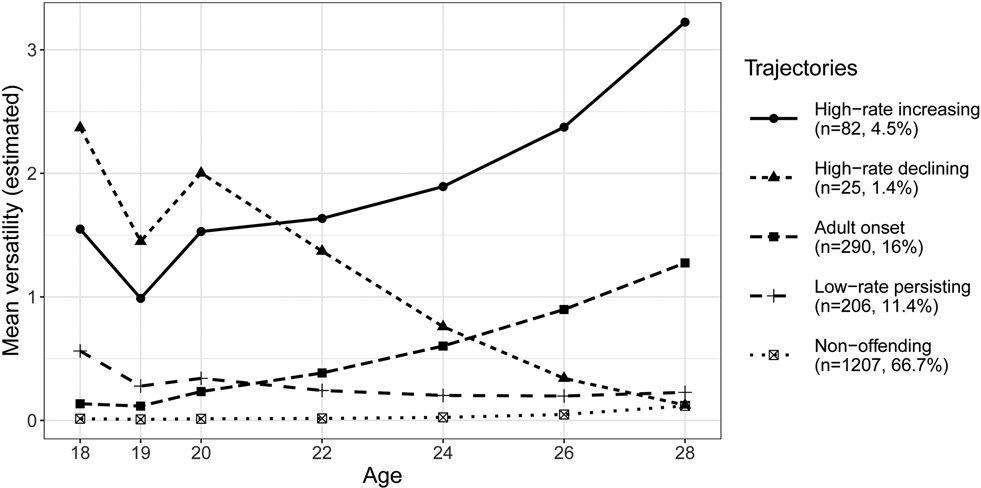
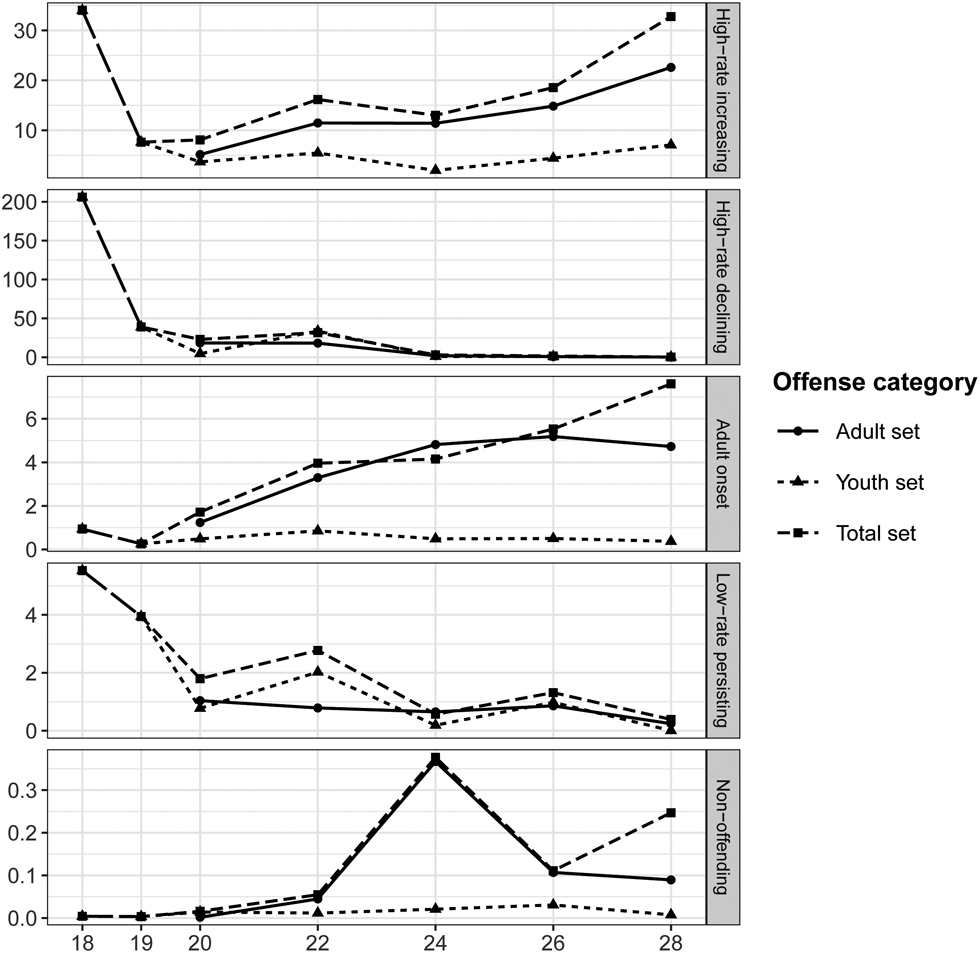
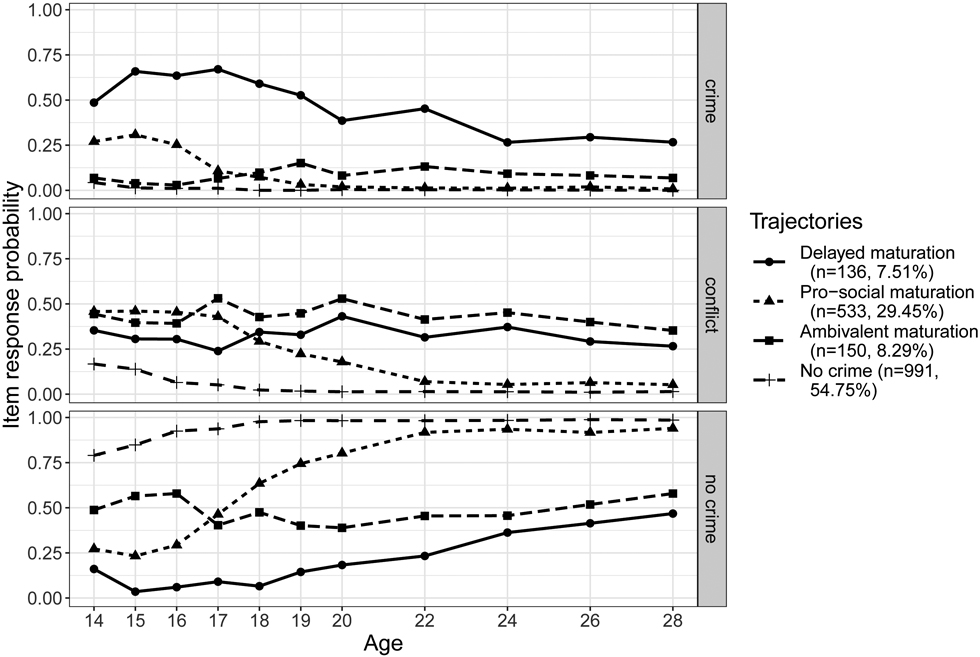
Purpose: This study scrutinizes Situational Action Theory’s (SAT) implications of how internal and external criminogenic factors concerning the rule of moral correspondence develop conjointly over the life-course and how this affects offending during emerging adulthood.Objectives: The main objective is to empirically explore whether the development of moral correspondence displays heterogeneity that can be theoretically linked to heterogeneous offending developments. Additionally, the paper also discusses unexpected co-occurrences arising specifically for the new opportunity structures to commit crimes in emerging adulthood via the broader developmental perspective proposed by the Developmental Ecological Action model of SAT (DEA).Methods: Results from two separate classification models (latent class growth analysis and repeated-measurement latent class analysis) following a German non-offender sample’s (N = 1810) transition between adolescence and emerging adulthood (ages 14 to 28) are cross-tabulated.Results: Five moral correspondence pathways differentiated by the timing, speed and completeness of achieving pro-social states can be extracted. The longer individuals resist this maturitation process during adolescence, the higher their chances are to follow a trajectory during emerging adulthood characterized by proclivities for youth crimes. However, these also follow a diminishing trend. Contrary, rising trajectories fueled by proclivities to commit adult crimes are less often associated by a remiss to maturity. Social selection into specific activity fields seems to play an important role in the availability and accessibility to either type of crime, thus, offering an explanation for these diverging results.Conclusion: SAT and its developmental framework DEA serve as useful blueprints to map the development of changes in crime and its related causes even with non-situational data through its analytical rigor to integrate micro-, meso-, and macro-levels of explanation.
References
Arnett, Jeffrey Jensen. 2000. »Emerging adulthood: A theory of development from the late teens through the twenties.« American Psychologist 55 (5): 469–80. https://doi.org/10.1037/0003-066X.55.5.469.10.1037/0003-066X.55.5.469Suche in Google Scholar
Boers, K., J. Reinecke, D. Seddig, and L. Mariotti. 2010. »Explaining the development of adolescent violent delinquency.« European Journal of Criminology 7 (6): 499–520. https://doi.org/10.1177/1477370810376572.10.1177/1477370810376572Suche in Google Scholar
Bosick, Stacey J., Bianca E. Bersani, and David P. Farrington. 2015. »Relating Clusters of Adolescent Problems to Adult Criminal Trajectories: a Person-Centered, Prospective Approach.« Journal of Developmental and Life-Course Criminology 1 (2): 169–88. https://doi.org/10.1007/s40865-015-0009-y.10.1007/s40865-015-0009-ySuche in Google Scholar
Bruinsma, G., L. Pauwels, F. Weerman, and W. Bernasco. 2015. »Situational Action Theory: Cross-Sectional and Cross-Lagged Tests of its Core Propositions.« Canadian Journal of Criminology and Criminal Justice 57 (3): 363–98. https://doi.org/10.3138/cjccj.2013.E24.10.3138/cjccj.2013.E24Suche in Google Scholar
Chrysoulakis, Alberto P. 2020. »Morality, delinquent peer association, and criminogenic exposure: (How) does change predict change?« European Journal of Criminology. https://doi.org/10.1177/1477370819896216.10.1177/1477370819896216Suche in Google Scholar
Collins, Linda, and Stephanie Lanza. 2010. »Latent Class and Latent Transition Analysis.« Wiley.10.1002/9780470567333Suche in Google Scholar
D’Unger, Amy V., Kenneth C. Land, Patricia L. McCall, and Daniel S. Nagin. 1998. »How many latent classes of delinquent/criminal careers? Results from mixed poisson regression analyses.« American Journal of Sociology 103 (6): 1593–1630. https://doi.org/10.1086/231402.10.1086/231402Suche in Google Scholar
Eggleston Doherty, Elaine. 2019. »Age of onset of offending behavior.« In The Oxford Handbook of Developmental and Life-Course Criminology, edited by David P Farrington, Lila Kazemian, and Alex R Piquero. New York: Oxford University Press.10.1093/oxfordhb/9780190201371.013.3Suche in Google Scholar
Eggleston, Elaine P., and John H. Laub. 2002. »The onset of adult offending: A neglected dimension of the criminal career.« Journal of Criminal Justice 30 (6): 603–22. https://doi.org/10.1016/S0047-2352(02)00193-9.10.1016/S0047-2352(02)00193-9Suche in Google Scholar
Elder, Glen. 1985. Life Course Dynamics: Trajectories and Transitions, 1968-1980. Cornell University Press.Suche in Google Scholar
Elzinga, Cees H., and Aart C. Liefbroer. 2007. »De-standardization of family-life trajectories of young adults: A cross-national comparison using sequence analysis.« European Journal of Population 23 (3-4): 225–50. https://doi.org/10.1007/s10680-007-9133-7.10.1007/s10680-007-9133-7Suche in Google Scholar
Farrington, David P, Jeremy W Coid, Louise M Harnett, Darrick Jolliffe, Nadine Soteriou, Richard E Turner, and Donald J West. 2006. Criminal Careers up to Age 50 and Life Success up to Age 48: New Findings from the Cambridge Study in Delinquent Development. November 2015.10.1037/e650712007-001Suche in Google Scholar
Gallupe, Owen, John McLevey, and Sarah Brown. 2019. »Selection and Influence: A Meta-Analysis of the Association Between Peer and Personal Offending.« Journal of Quantitative Criminology 35 (2): 313–35. https://doi.org/10.1007/s10940-018-9384-y.10.1007/s10940-018-9384-ySuche in Google Scholar
Giordano, Peggy C, Stephen A Cernkovich, and Jennifer L Rudolph. 2002. »Gender, Crime, and Desistance: Toward a Theory of Cognitive Transformation.« American Journal of Sociology 107 (4): 990–1064.10.1086/343191Suche in Google Scholar
Hardie, Beth. 2019. »Why Monitoring Doesn’t Always Matter: The Interaction of Personal Propensity with Physical and Psychological Parental Presence in a Situational Explanation of Adolescent Offending.« Deviant Behavior, 1–24. https://doi.org/10.1080/01639625.2019.1673924.10.1080/01639625.2019.1673924Suche in Google Scholar
Hirschi, Travis, and Michael Gottfredson. 1983. »Age and the Explanation of Crime Age and the Explanation of Crime.« American Journal of Sociology 89 (3): 552–84. http://www.jstor.org/stable/2779005 %5Cnhttp://about.jstor.org/terms.10.1086/227905Suche in Google Scholar
Kessler, Georg. 2020. »Delinquency in Emerging Adulthood: Insights into Trajectories of Young Adults in a German Sample and Implications for Measuring Continuity of Offending.« Journal of Developmental and Life-Course Criminology 6 (4): 424–47. https://doi.org/10.1007/s40865-020-00157-1.10.1007/s40865-020-00157-1Suche in Google Scholar
Kessler, Georg, and Jost Reinecke. 2021. »Dynamics of the causes of crime: A life-course application of Situational Action Theory for the transition from adolescence to adulthood.« Journal of Developmental and Life-Course Criminology.10.1007/s40865-021-00161-zSuche in Google Scholar
Koppen, M. Vere van. 2018. »Criminal Career Dimensions of Juvenile- and Adult-Onset Offenders.« Journal of Developmental and Life-Course Criminology 4 (1): 92–119. https://doi.org/10.1007/s40865-017-0074-5.10.1007/s40865-017-0074-5Suche in Google Scholar
Kroneberg, Clemens, and Sonja Schulz. 2018. »Revisiting the role of self-control in Situational Action Theory.« European Journal of Criminology 15 (1): 56–76. https://doi.org/10.1177/1477370817732189.10.1177/1477370817732189Suche in Google Scholar
Laub, John H., and Robert J. Sampson. 2003. Shared beginnings, divergent lives. Cambridge, Massachusetts,; London, England: Harvard University Press.Suche in Google Scholar
Le Blanc, Marc, and Marcel Fréchette. 1989. Male criminal activity from childhood through youth. New York: Springer.10.1007/978-1-4612-3570-5Suche in Google Scholar
Loeber, Rolf, and Marc Le Blanc. 1990. »Toward a Developmental Criminology.« Crime and Justice 12: 375–473.10.1086/449169Suche in Google Scholar
Mata, Andrea D., and Manfred H. M. van Dulmen. 2012. »Adult-Onset Antisocial Behavior Trajectories: Associations With Adolescent Family Processes and Emerging Adulthood Functioning.« Journal of Interpersonal Violence 27 (1): 177–93. https://doi.org/10.1177/0886260511416467.10.1177/0886260511416467Suche in Google Scholar
McLachlan, Geoffrey, and David Peel. 2000. Finite Mixture Models. Wiley & Sons, Inc.10.1002/0471721182Suche in Google Scholar
Muthén, Bengt. 2004. »Latent Variable Analysis Techniques for Longitudinal Data.« In The SAGE Handbook of Quantitative Methodology for the Social Sciences., edited by David Kaplan, 345–68. Thousand Oaks, Calif: Sage publication.Suche in Google Scholar
Muthén, Linda K., and Bengt O. Muthén. 1998–2019. Mplus User’s Guide. Eighth Edition. Los Angeles, CA: Muthén & Muthén.Suche in Google Scholar
Nagin, Daniel S., and Kenneth C. Land. 1993. »Age, Criminal Careers, and Population Heterogeneity: Specification and Estimation of a Nonparametric, Mixed Poisson Model.« Criminology 31 (3): 327–62. https://doi.org/10.1111/j.1745-9125.1993.tb01133.x.10.1111/j.1745-9125.1993.tb01133.xSuche in Google Scholar
Palmen, Hanneke, Femke Hilverda, Arjan A. J. Blokland, and Wim H J Meeus. 2014. »Pathways to adulthood and the relation between employment, education and criminal behaviour: A latent class analysis.« In Criminal Behaviour from School to the Workplace: Untangling the Complex Relations Between Employment, Education and Crime, edited by F. Weerman and C. C. J. H. Bijleveld, 108–21. Routledge.Suche in Google Scholar
Pöge, Andreas, and Debbie Schepers. 2019. »Die Entwicklung von Moralität im Kindes- und Jugendalter.« In Die Entwicklung von Devianz Und Delinquenz in Kindheit Und Jugend. Neue Ansätze Der Kriminologischen Forschung, edited by Susanne Wallner, Maren Weiss, Jost Reinecke, and Mark Stemmler, 235–58.10.1007/978-3-658-21234-6_12Suche in Google Scholar
Ramaswamy, Venkatram, Wayne S. Desarbo, David J. Reibstein, and William T. Robinson. 1993. »An Empirical Pooling Approach for Estimating Marketing Mix Elasticities with PIMS Data.« Marketing Science 12 (1): 103–24. https://doi.org/10.1287/mksc.12.1.103.10.1287/mksc.12.1.103Suche in Google Scholar
Reinecke, Jost, and Georg Kessler. 2021. »Entwicklungsverläufe von Jugend- und Erwachsenendelinquenz: Mischverteilungsmodelle mit Daten der CrimoC-Studie.« In Klassifikationsanalyen in Den Sozialwissenschaften, edited by Jost Reinecke and Christian Tarnai, 153–86. Waxmann.Suche in Google Scholar
Reinecke, Jost, and Cornelia Weins. 2013. »The development of delinquency during adolescence : a comparison of missing data techniques,« 3319–34. https://doi.org/10.1007/s11135-012-9721-4.10.1007/s11135-012-9721-4Suche in Google Scholar
Schepers, Debbie. 2017. »Causes of the causes of juvenile delinquency: Social disadvantages in the context of Situational Action Theory.« European Journal of Criminology 14 (2): 143–59. https://doi.org/10.1177/1477370816649622.10.1177/1477370816649622Suche in Google Scholar
Schwarz, B Y Gideon. 1978. »Estimating the Dimension of a Model.« The Annals of Statistics 6 (2): 461–64.10.1214/aos/1176344136Suche in Google Scholar
Seddig, Daniel. 2014. »Peer group association, the acceptance of norms and violent behaviour: A longitudinal analysis of reciprocal effects.« European Journal of Criminology 11 (3): 319–39. https://doi.org/10.1177/1477370813496704.10.1177/1477370813496704Suche in Google Scholar
Seddig, Daniel. 2016. »Crime-Inhibiting, Interactional and Co-Developmental Patterns of School Bonds and the Acceptance of Legal Norms.« Crime & Delinquency 62 (8): 1046–71. https://doi.org/10.1177/0011128715578503.10.1177/0011128715578503Suche in Google Scholar
Steffensmeier, Darrell J, Emilie Andersen Allan, Miles D. Harer, and Cathy Streifel. 1989. »Age and the Distribution of Crime.« American Journal of Sociology 94 (4): 803–31.10.1086/229069Suche in Google Scholar
Sullivan, Christopher J. 2013. »Change in offending across the life course.« In The Oxford Handbook of Criminological Theory, edited by Francis Cullen and Pamela Wilcox, 205–30. Oxford [u. a.].10.1093/oxfordhb/9780199747238.013.0011Suche in Google Scholar
Sweeten, Gary. 2012. »Scaling Criminal Offending.« Journal of Quantitative Criminology 28 (3): 533–57. https://doi.org/10.1007/s10940-011-9160-8.10.1007/s10940-011-9160-8Suche in Google Scholar
Sweeten, Gary, Alex R Piquero, and Laurence Steinberg. 2013. »Age and the Explanation of Crime, Revisited« 42: 921–38. https://doi.org/10.1007/s10964-013-9926-4.10.1007/s10964-013-9926-4Suche in Google Scholar
Treiber, Kyle. 2017. »Situational action theory and PADS+: Theoretical and methodological advances in the study of life course criminology.« In The Routledge International Handbook of Life-Course Criminology, 50–73. Routledge.10.4324/9781315747996-5Suche in Google Scholar
Warr, Mark. 2002. Companions in Crime: The Social Aspects of Criminal Conduct. Cambridge: Cambridge University Press. https://doi.org/DOI: 10.1017/CBO9780511803956.10.1017/CBO9780511803956Suche in Google Scholar
Wikström, Per-Olof. 2006. »Individuals, settings, and acts of crime: situational mechanisms and the explanation of crime.« In The Explanation of Crime, edited by Per-Olof Wikström and Robert J. Sampson, 61–107. Cambridge: Cambridge University Press. https://doi.org/10.1017/CBO9780511489341.004.10.1017/CBO9780511489341Suche in Google Scholar
Wikström, Per-Olof. 2014. »Why crime happens: A situational action theory.« In Analytical Sociology: Actions and Networks, 71–94. https://doi.org/10.1002/9781118762707.ch03.10.1002/9781118762707.ch03Suche in Google Scholar
Wikström, Per-Olof. 2019. »Explaining Crime and Criminal Careers: the DEA Model of Situational Action Theory.« Journal of Developmental and Life-Course Criminology, June. https://doi.org/10.1007/s40865-019-00116-5.10.1007/s40865-019-00116-5Suche in Google Scholar
Wikström, Per-Olof, Dietrich Oberwittler, Kyle Treiber, and Beth Hardie. 2012. Breaking Rules. Oxford: Oxford University Press.Suche in Google Scholar
Wikström, Per-Olof, and Kyle Treiber. 2019. »The Dynamics of Change.« In The Oxford Handbook of Developmental and Life-Course Criminology, edited by David P. Farrington, Lila Kazemian, and Alex R. Piquero, 271–94. Oxford University Press. https://doi.org/10.1093/oxfordhb/9780190201371.013.34.10.1093/oxfordhb/9780190201371.013.34Suche in Google Scholar
Appendix
| Age of inclusion | 1 | 2 | 3 | 4 | 5 | 6 | 7 | 8 |
| 13 – 28 | Graffities | Scratching | Vandalism | Machine theft | Shoplifting | Bicycle theft | Motor-vehicletheft | Theft out of vehicle |
| Purse snatching | Robbery | Burglary | Other thefts | Accepting-stolen goods | Aggrav. assaultw/o a weapon | Aggrav. assaultwith a weapon | Drug dealing | |
| 20 – 28 | Driving w/o permit | Hit and run | Partner violence | |||||
| 22 – 28 | Illegal-employment | Drunk driving | ||||||
| 24 – 28 | Ill. advantage-over employer | Ill. advantage-for employer | ||||||
| 26 – 28 | False claims(insurance) | False claims(public agency) | Tax evasion | False represent-tation(sale of goods) | Selling goods w/ointent to deliver | Fraudul.induce-mentto contract | ||
| 28 | Paying for service w/o bill | Illicit upload of proprietary media |
| Model | BIC | aBIC | Entropy | LMR p-value |
| C2 | 12145.86 | 12091.86 | 0.800 | 0.0000 |
| C3 | 11969.59 | 11902.88 | 0.713 | 0.0000 |
| C4 | 11937.06 | 11857.64 | 0.703 | 0.0189 |
| C5 | 11938.06 | 11845.92 | 0.714 | 0.2805 |
| C6 | 11923.49 | 11818.65 | 0.703 | 0.7984 |
© 2021 Walter de Gruyter GmbH, Berlin/Boston
Artikel in diesem Heft
- Frontmatter
- Frontmatter
- Corona und Compliance
- The maturing moral perception of crime: The development of moral correspondence and its association with emerging adults’ delinquent involvement
- Das Prostituiertenschutzgesetz im Lichte der Kriminalitätsstatistik
- Der sexuelle Missbrauch von Kindern und kinderpornografische Delikte – Längerfristige Entwicklungsverläufe und ein empirischer Vergleich verschiedener Fallgruppen
- Therapieauflagen und Nachsorge bei haftentlassenen Sexualstraftätern: Prädiktoren und Zusammenhänge mit der Rückfälligkeit
- Buchbesprechungen
- Beecken, Johanna: Weibliche Jugendstrafgefangene in Deutschland. Eine bundesweite Bestandsaufnahme mit vollzugspolitischen Reformvorschlägen
- Jörg Kinzig: Noch im Namen des Volkes? Über Verbrechen und Strafe Zürich: Orell Füssli Verlag, 2. Aufl. 2020
- Holger Schmidt: Ungerechtigkeit im Jugendstrafvollzug. Biographische Erkundungen einer sozialmoralischen Gefühlsregung
Artikel in diesem Heft
- Frontmatter
- Frontmatter
- Corona und Compliance
- The maturing moral perception of crime: The development of moral correspondence and its association with emerging adults’ delinquent involvement
- Das Prostituiertenschutzgesetz im Lichte der Kriminalitätsstatistik
- Der sexuelle Missbrauch von Kindern und kinderpornografische Delikte – Längerfristige Entwicklungsverläufe und ein empirischer Vergleich verschiedener Fallgruppen
- Therapieauflagen und Nachsorge bei haftentlassenen Sexualstraftätern: Prädiktoren und Zusammenhänge mit der Rückfälligkeit
- Buchbesprechungen
- Beecken, Johanna: Weibliche Jugendstrafgefangene in Deutschland. Eine bundesweite Bestandsaufnahme mit vollzugspolitischen Reformvorschlägen
- Jörg Kinzig: Noch im Namen des Volkes? Über Verbrechen und Strafe Zürich: Orell Füssli Verlag, 2. Aufl. 2020
- Holger Schmidt: Ungerechtigkeit im Jugendstrafvollzug. Biographische Erkundungen einer sozialmoralischen Gefühlsregung
