A minimalist approach to the emergence of ergativity in Austronesian languages
-
Edith Aldridge


Abstract
This paper proposes a novel reconstruction of Proto-Austronesian as a language with accusative alignment, in contrast to previous analyses, which have reconstructed PAn with some type of ergative system. The methodology employed in this paper also departs from previous work in basing the proposal on syntactic change rather than on phonological or morphological comparison. In the account of argument licensing in the Minimalist Program, nominative subjects are licensed by a higher functional head T than accusative objects, which value their case with the light verb v. This produces accusative alignment, with the corollary that ergative systems arise only when the unmarked licensing relations are disrupted. Specifically, I propose that this disruption involves the loss of transitive v’s ability to value accusative case on the object and the concomitant ability of this v to provide inherent licensing for the subject, thereby allowing T to exceptionally value nominative case on the object. The current paper argues that the ergative types of alignment observed in modern Formosan and Philippine languages are the result of consecutive innovations in high-order subgroups of the Austronesian family, being triggered first in irrealis clauses in a daughter of PAn, which I term “Proto-Ergative Austronesian”.
1 Introduction
It is now virtually uncontroversial that the homeland of the Austronesian language family is the island of Taiwan, Austronesian speakers migrating there from southeastern China roughly 6,000 years ago and subsequently proceeding to populate the Philippines, Indonesia/Malaysia, Madagascar, and the Pacific (Adelaar 2005; citing Bellwood 1997). Less agreement, however, is found on the question of high-order subgrouping among the languages spoken in Taiwan. This short article summarizes three proposals, each refining and developing previous approaches by successively expanding the range of data under consideration, from phonological to morphological and then to syntactic.
2 Phonology, morphology, and the question of nuclear Austronesian
Building on earlier work by Li (1981), Tsuchida (1976, 1982), and others, Blust (1999, 2009/2013) proposes ten primary subgroups of Austronesian, nine of which are comprised exclusively of languages which either are or were spoken only in Taiwan. The tenth subgroup is Malayo-Polynesian, containing all Austronesian languages spoken outside of Taiwan. Blust’s proposal is based entirely on phonological mergers and deletions, which are commonly acknowledged to be reliable indicators of subgrouping, since they are irreversible and consequently must be understood as innovations rather than retentions.
Austronesian (Blust 1999: 45)[1]
Puyuma
Rukai
Tsouic: Tsou, Kanakanavu, Saaroa
Northwest Formosan: Saisiyat, Kulon-Pazih
Atayalic: Atayal, Seediq
Western Plains: Thao, Taokas, Favorlang-Babuza, Papora, Hoanya
Bunun
Paiwan
East Formosan: Basay-Trobiawan, Kavalan, Amis, Siraya
Malayo-Polynesian: all extra-Formosan languages
Ross (2009, 2012) takes his primary evidence from morphosyntactic paradigms to argue that there are only four first-order subgroups, separating Puyuma, Rukai, and Tsou from a large subgroup called “Nuclear Austronesian” (NucAn), which encompasses all other Austronesian languages. Most of the subgroups listed in (2) are equivalent to Blust’s (1999) proposal, with the exception of Tsouic, which is split apart by NucAn: Kanakanavu and Saaroa are located inside NucAn, while Tsou proper is outside.
Austronesian (Ross 2009: 316)
Puyuma
Rukai
Tsou
Nuclear Austronesian
Kanakanavu, Saaroa
Northwest Formosan
Atayalic
Western Plains
Bunun
Paiwan
East Formosan
Malayo-Polynesian
The primary innovation which Ross attributes to Proto-NucAn is the reanalysis of embedded nominalizations as realis root clauses, revising an earlier proposal by Starosta et al. (1981, 1982), who assumed that this change is reflected in all first-order subgroups of Austronesian. Starosta et al. proposed that the origin of ergative alignment illustrated by Tagalog in (3a, b) can be accounted for if the transitive clauses are derived from copula constructions in which the nominative NP is the subject predicated of a headless relative clause containing all other material in the clause. The aspectual and applicative affixes appearing on transitive verbs in Philippine and most Formosan languages were reconstructed as nominalizers used in relative clause formation. The external argument appears inside the relative clause and is marked with genitive case, which is used for both ergative subjects (3b, c) and possessors (3d) in Philippine and most Formosan languages today.
Tagalog
| D<um>ating | ang | babae. |
| <INTR.PRV>arrive | nom | woman |
| “The woman arrived.” | ||
| [B<in>ili | ng | babae] | ang | isda. |
| <TR.PRV>buy | gen | woman | nom | fish |
| “The woman bought the fish.” | ||||
| [B<in>ilh-an | ng | babae | ng | isda] | ang | tindahan=ko. |
| <TR.PRV>buy-appl | gen | woman | gen | fish | nom | store=1.sg.gen |
| “The woman bought a/the fish at my store.” | ||||||
| isda | ng | babae |
| fish | gen | woman |
| “(the) woman’s fish” | ||
Ross’ main revision is to show that this reanalysis is not reflected in all first-order Austronesian subgroups. For example, Puyuma verbs in relative clauses are affixed with nominalizing morphemes, while verbs in root clauses take different affixes. The perfective aspect marker <in> in (4b) surfaces only on nominalized verbs in Puyuma, but appears on finite verbs in Tagalog, as in (3b, c). Note further the Puyuma nominalizer –an, which has been reanalyzed as a locative applicative in Philippine languages, as in (3c).
Puyuma
| tu=trakaw-aw | na | paisu | kan | isaw |
| 3.gen=steal-tr1 | def.nom | money | sg.obj | Isaw |
| “Isaw stole the money.” | ||||
| (Teng 2008: 147) | ||||
| ala | amuna | sadru | [[tu=tr<in>ekelr-an] | na | asi] |
| maybe | because | many | 3.psr=<PRV>drink-nmlz | def.nom | milk |
| “Maybe because the milk he drank is a lot.” | |||||
| (Teng 2008: 105) | |||||
As mentioned earlier, the main discrepancy between the Ross (2009) and Blust (1999) subgrouping hypotheses lies in accepting a Tsouic subgroup, which was first proposed by Tsuchida (1976) and has been adopted by Ho (1998), Blust (1999), and Sagart (2004, 2010). But Ross (2012) argues that several of the changes cited by Tsuchida (1976) are also observed in other subgroups and therefore could have been innovated independently in the languages in question, while other proposed innovations are more plausibly explained as instances of borrowing.
Ross (2012) further offers morphosyntactic evidence from Chang (2006) that Kanakanavu and Saaroabelong to the NucAn subgroup. For example, the latter languages reflect the reanalysis of nominalizations as root verbal categories. The perfective makers ni- and li- on the finite verbs in (5) are cognate with Puyuma’s nominal perfective marker in (4b). Note also the genitive subject in the transitive clause in(5b).
| ni-pia-pacai | cau | tutui |
| prv-caus-kill | person | pig |
| “Someone killed the pig.” | ||
| (Kanakanavu; Chang 2006: from Mei 1982: 221) | ||
| ƚi-ala | na | cucu’u | ka | vutukuƚu |
| prv-take | gen | person | nom | fish |
| “The person took the fish away.” | ||||
| (Saaroa; Chang 2006; from Li et al. 1997: 279) | ||||
By accepting with Ringe et al. (2002: 68), Thomason and Kaufman (1988: 52, 98), and Weinreich (1953: 32) that bound morphemes, in particular morphological paradigms, are neither easily borrowed nor independently innovated, Ross (2012) is able to establish with a reasonable amount of certainty that his proposed innovation was not the result of borrowing or independent developments in the languages in question. He is further able to determine the direction of the change, which is from nominalization to verb and not vice-versa, because the extra-NucAn languages reflect only the nominal use. However, when it comes to reconstructing the parent language of the entire family, deciding between retentions and innovations is far less simple, as the only evidence available can be found in the languages which are in turn descended from this proto-language. Ross (2012: 1255) refers to this as the “root-node limitation”.
One recourse in this case is to reconstruct the most commonly occurring forms in the daughter languages, the so-called “majority wins” strategy. Among the Austronesian languages of Taiwan and the Philippines, only Rukai has canonical accusative alignment, the others being characterized by a type of non-accusative alignment which has been labeled a “focus system”, “voice system”, or “ergative” (see Schachter 1976; Payne 1982; Gerdts 1988; de Guzman 1988; Shibatani 1988; Himmelmann 1999, 2005; Liao 2002, 2004; Aldridge 2004, 2008; Chang 2011; and others for views and discussion). The “majority wins” premise would suggest that PAn should be reconstructed with this non-accusative type of alignment, which is the choice opted for by Ross (2009, 2012).
On the other hand, majority rule is not an absolute deciding factor in reconstruction. Given that discrepancies among sister languages must be accounted for in terms of changes from the reconstructed parent language, it is important to posit changes which are cross-linguistically plausible. In the following section, I propose a revision of Ross’ (2009) high-order Austronesian subgrouping and reconstruction of PAn alignment. Specifically, I go against the grain of “majority wins” and reconstruct PAn as an accusative language and show how the change to ergative alignment reflected in Tsou, Puyuma, and NucAn was a natural change conditioned by syntactic factors. I refer to the subgroup defined by this innovation as “Ergative Austronesian” (EAn).

3 New proposal
Aldridge (2013, 2014) proposes that PAn was an accusative language and that this alignment is preserved in Rukai. Ergative alignment was first innovated in Rukai’s sister Proto-Ergative Austronesian in irrealis clauses, which I posit was the result of a commonly observed process of detransitivization in this clause type.
3.1 Morphology of irrealis in ergative Austronesian
I first consider morphological evidence for the connection between irrealis clauses and ergative alignment in EAn. According to Teng’s (2008) description, Puyuma is a language with ergative or split-ergative alignment. What she glosses as “intransitive” is a simple intransitive or an antipassive. [2] The three different transitive clause types differ in whether they are basic (“type 1”) transitives or applicative constructions. Applicatives are further divided into locative (“type 2 transitives”) and benefactive/instrumental (“type 3 transitives”) applicatives.
Puyuma realis (Teng 2008: 147)
| tr<em>akaw | dra | paisu | i | isaw |
| <INTR>steal | indef.obl | money | sg.nom | Isaw |
| “Isaw stole money.” | ||||
| tu=trakaw-aw | na | paisu | kan | isaw |
| 3.gen=steal-tr1 | def.nom | money | sg.obl | Isaw |
| “Isaw stole the money.” | ||||
| tu=trakaw-ay=ku | dra | paisu | kan | isaw |
| 3.gen=steal-tr2=1sg.nom | indef.obj | money | sg.obl | Isaw |
| “Isaw stole money from me.” | ||||
| tu=trakaw-anay | i | tinataw | dra | paisu |
| 3.gen=steal-tr3 | 3.sg.nom | his.mother | indef.obl | money |
| “He stole money for his mother.” | ||||
Another interesting fact about Puyuma is that, like many Formosan languages, it employs different affixes in realis and irrealis mood. (8) shows an array of focus affixes employed in imperative sentences.
Puyuma imperatives (Teng 2008: 216)
| trekelr |
| drink |
| “Drink!” |
| pilang-u | i | temuu | m-uka |
| take-tr1.imp | sg.nom | your.grandmother | intr-go |
| i drena-drenan | |||
| loc red-mountain | |||
| “Take your grandmother to the mountains.” | |||
| puka-i | dra | tidrul | dra | samaya |
| put-tr2.imp | indef.obl | wasp | indef.obl | some |
| “Put some wasps (in).” | ||||
Examining the paradigm in (9) reveals an interesting parallel between realis and irrealis (imperative, negative, and future) transitive suffixes. The transitive realis suffixes all include a, which is followed by a glide. The glides in turn bear striking resemblance to the vowel suffixes –u and -i in the irrealis forms. In fact, all of the realis forms can be derived by adding –a to the verb root or to the TR3 base V-an and subsequently affixing either –u (for TR1) or –i (TR2, TR3). [3]
| Puyuma verbal inflection (adapted from Ross 2009: 304) | ||||
| INTR | TR1 | TR2 | TR3 | |
| Realis | <em>V | V-aw | V-ay | V-anay |
| Imperative | V | V-u | V-i | V-an |
| Negative | <em>V | V-i | V-i | V-an |
| Future | RED-V | RED-V-i | RED-V-i | RED-V-an |
Regarding the origin and function of the pre-glide a, Ross (1995, 2002, 2009) reconstructs an *–a suffix as the PAn nonfinite type 1 transitive suffix. This is understandable, given the role of the reflex in Tsou as the type 1 transitive suffix which surfaces on nonfinite verbs. The only finite verb forms in Tsou are auxiliary verbs. These show a transitive/intransitive [4] dichotomy, but –a does not appear on auxiliaries.
Tsou (Chang 2011: 285; based on Zeitoun 2000: 93–94)
| mo | mo-si | ta | pangka | to | emi | ‘o | amo |
| intr.3s | intr-put | obl | table | obl | wine | abs | father |
| “Father put wine on the table.” | |||||||
| i-si | si-a | ta | pangka | to | amo | ‘o | emi |
| tr-3.sg | put-tr | obl | table | erg | father | abs | wine |
| “Father put the wine on the table.” | |||||||
Thus, Tsou offers compelling evidence that *-a attached to nonfinite verbs. Given the potential to further attach irrealis affixes, as in Puyuma, I reconstruct *-a as a nonfinite irrealis suffix, which I refer to simply as “subjunctive”. Further support comes from the fact that the reflex of *-a occurs on nonfinite, hortative, imperative, or subjunctive verbs in a variety of Formosan, Philippine, and Malayic languages, as noted by Ross (2009). Below are imperative examples from Rukai.
Tanan Rukai
| a. | k<u>anɨ-a |
| <M>eat-imp | |
| “Eat!” |
| b. | sila’-a | na | avava-su |
| seek-imp | ACC.DEF | toy-2sg | |
| “Look for your toy!” | |||
Regarding the vowels/glides, Tsou also has –i on TR2 and TR3 verbs, suggesting that this portion of the paradigm be reconstructed to a common ancestor of Puyuma and Tsou.
| INTR | TR1 | TR2 | TR3 | |
| Nonfinite | m-V | V-a | V-i | V-(n)eni |
At this point, we have arrived at the following reconstruction of the parent of Puyuma and Tsou. The non-accusative type of alignment found in modern Puyuma is reconstructed only for irrealis contexts. Tsou retains the subjunctive forms as the basic nonfinite paradigm. The affixes have been simplified somewhat, and this may be due to a process of monophthongization, given that modern Tsou does not have diphthongs. The first column in (13) is labeled “verb” rather than “intransitive”. This is because ergative alignment is not found in realis clauses, where *M-V would have appeared on either transitive or intransitive verbs.
| PEAn reconstruction | ||||
| Verb | TR1 | TR2 | TR3 | |
| Realis | *M-V | … | … | … |
| Subjunctive | *M-V-a | *V-a-u | *V-a-i | *V-an-a-i |
| Imperative | *V | *V-u | *V-i | *V-an-i |
I have tentatively attributed the reconstructions in (13) to Proto-Ergative Austronesian, so Nuclear Austronesian languages are also predicted to reflect the irrealis transitive suffixes, and indeed they do. The realis affixes in the Atayalic language Seediq are reflexes of PAn nominalizers, as proposed by Ross (2009). The irrealis affixes are clearly related to the transitive affixes in Tsou and Puyuma.
| Seediq realis vs irrealis (Holmer 1996: 38 [5]) | ||||
| INTR | TR1 | TR2 | TR3 | |
| Realis | <m>/<m>-V | V-un | V-an | s-V |
| Imperative | V | V-i | V-ani | ... |
| Negative | V | V-i | V-ani | ... |
On the other hand, Rukai has consistent accusative alignment and does not reflect the transitive affixes in (13), though it does retain the *-a subjunctive as an imperative, as shown above in (11).
Tanan Rukai
| uduri=aku | sa | bɨlbɨl |
| plant=1sg.nom | acc.indef | banana |
| “I plant bananas.” | ||
| labuwal=aku | kɨla |
| walk=1sg.nom | come |
| “I come walking.” | |
On this basis, it is reasonable to conclude that the transitive irrealis paradigm arose as the result of an innovation in Proto-Ergative Austronesian, meaning that PAn can be reconstructed with accusative alignment, which is retained in Rukai.
| PAn reconstruction | ||||
| Verb | TR1 | TR2 | TR3 | |
| Realis | *M-V | … | … | … |
| Subjunctive | *M-V-a | … | … | … |
| Imperative | *V | … | … | … |
Before proceeding, however, it must be acknowledged that Ross’ (2012) “root node limitation” makes it difficult to conclude with any certainty that irrealis suffixes were innovated. Another logical possibility is to attribute (13) to PAn and posit that Rukai lost the transitive irrealis suffixes. In the next subsection, I support the proposed reconstruction of PAn as accusative by positing a natural syntactic change to account for the innovation of ergative alignment in irrealis clauses in Proto-Ergative Austronesian.
3.2 Innovation in the irrealis in proto-ergtive Austronesian
Within the Minimalist Program of Chomsky (2001) and subsequent works, the functional heads finite T and transitive v value nominative and accusative case, respectively, with the first NP in their c-command domains. Consequently, nominative case generally appears on the structurally most prominent NP in the clause, specifically the subject, while accusative case is found on the highest NP within the VP, i.e. the object. In other words, this process results in accusative alignment, most notably the uniform assignment of nominative case to the first member of the verb’s argument structure.

In an ergative language, nominative case is not assigned uniformly to the subject. Rather, the subject in an intransitive clause shares the case of the object in a transitive clause.
Seediq
| Wada | kudurjak | ka | qedin=na. |
| past | flee | nom | wife=3s.gen |
| “His wife ran away.” | |||
| Wada | bube-un | na | Pihu | ka | dangi=na. |
| past | hit-tr | erg | Pihu | nom | friend=3s.gen |
| “Pihu hit his friend.” | |||||
This lack of uniformity requires a modification to the analysis in (17). A straightforward approach has been formulated by Legate (2008), which posits an exceptional type of v in transitive clauses to assign an inherent case to the subject. This v does not make accusative case available for the object, but since the subject does not require licensing from T, T is free to look past the subject and value nominative case on the object. See also Bok-Bennema (1991), Bittner and Hale (1996), Ura (2000), Alexiadou (2001), Aldridge (2004), Anand and Nevins (2006) for similar approaches.
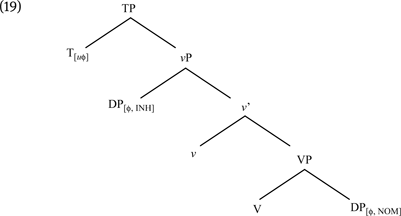
Aldridge (2012) has proposed that such a parametric distinction can account for the change from accusative to ergative alignment in nominalized clauses in Proto-Nuclear Austronesian. [6] The input to the reanalysis is a cleft construction embedding a reduced relative clause nP. Since n is a nominal category, it does not make accusative case available for the object. The object raises to the edge of nP in order to receive a focus interpretation and also be case licensed by T. The subject is assigned genitive case in its base position in nP. Ergative alignment results when the cleft is reanalyzed as a monoclausal construction after loss of the copula in T, which in turn results in relabeling (in the sense of Whitman 2000) of n as v.

Aldridge (2014) proposes that detransitivization of v in irrealis clauses accounts for the emergence of non-accusative alignment in Proto-Ergative Austronesian. Irrealis clauses are detransitivized in a number of languages, [7] in the sense that structural case is not available for the object. One example is the phenomenon known as “genitive of negation” in Slavic languages. In the following Russian examples, an object often receives genitive case in the scope of sentential negation, as in (21). Since inherent case is assigned to the object rather than the subject, alignment does not change, both transitive and intransitive subjects continuing to be marked nominative.
Russian (Harves 2002: 97)
| Anna | ne | kupila | knig. | |
| Anna.nom | neg | bought | books.gen | |
| “Anna did not buy any books.” | ||||
Under different conditions, the object can surface with nominative case. Objects in telic events in Finnic languages require structural licensing, [8] which is typically accusative case, as in (22a). In atelic events, objects are assigned partitive case, as in (22b). Note the object is also definite in a telic event, while it can be (and often is) indefinite in atelic events.
Estonian (Hiietam 2004)
| Poiss | luges | raamatu | läbi. |
| boy.NOM | read.PAST.3.SG | book.ACC | through |
| Poiss | luges | raamatut. |
| boy.NOM | read.PAST.3.SG | book.PART |
| “The boy was reading a/the book.” | ||
Hiietam (2004) shows that accusative case is not available in imperative clauses in Estonian. The object receives partitive case, as expected, in the atelic clause in (23a) but appears with nominative case in the telic clause in (23b). I interpret this as a consequence of the detransitivization of v, depriving it of the ability to value accusative case. When the object requires structural licensing in the telic event, it must undergo Agree with T and value nominative case.
Estonian (Hiietam 2004)
| Söö | võileiba! |
| eat.2.SG.IMP | sandwich.PART |
| “Eat some sandwich!/ i.e. Do some sandwich eating!” | |
| Söö | võileib | ära! |
| eat.2.SG.IMP | sandwich.NOM | up |
| “Eat the sandwich up!” | ||
The emergence of non-accusative alignment in irrealis clauses in Proto-Ergative Austronesian, as proposed above in (13), can be accounted for as a consequence of the detransitivization of irrealis v, coupled with the availability of inherent case for the subject. Note that subjects in transitive clauses in Puyuma are genitive, while the object is nominative, as shown in (24a). The object in the transitive clause is definite, while the object in the antipassive in (24b) is indefinite. This alternation also falls out naturally on the proposed analysis. Just as in Finnic languages, I assume that definite objects in telic events in PEAn required structural licensing, forcing the object to undergo Agree with T in irrealis clauses. But in atelic events, the indefinite object could be assigned inherent case. The transitive irrealis clauses were later reanalyzed as realis root clauses in Puyuma. The objects in these clauses are always definite and have nominative case (Teng 2008: 147). But the inherited realis clause type, with the verb inflected with a reflex of *M-, would have been retained in atelic events with inherently case marked indefinite objects. Put differently, this analysis accounts for why the reflex of *M- is found on intransitive or antipassive verbs in Formosan and Philippine languages today, while transitive clauses have a different diachronic source (irrealis in Puyuma and Tsou) and nominalization in NucAn languages.
Puyuma realis (Teng 2008: 147)
| tu=trakaw-aw | na | paisu | kan | isaw |
| 3.gen=steal-tr1 | def.nom | money | sg.obl | Isaw |
| “Isaw stole the money.” | ||||
| tr<em>akaw | dra | paisu | i | isaw |
| <INTR>steal | indef.obl | money | sg.nom | Isaw |
| “Isaw stole money.” | ||||
In this way, the emergence of ergative alignment in irrealis clauses in Proto-Ergative Austronesian can be understood as a natural and conditioned syntactic change, resulting from the detransitivization of v in irrealis clauses. As proposed in section 3.1, Tsou reflects the subjunctive of PEAn in embedded, nonfinite contexts. In Puyuma, the subjunctive was reanalyzed as a finite root clause type. Aldridge (2014) proposes that this was triggered by the loss of auxiliaries in this language, which are retained in Tsou. Evidence for the loss of the auxiliaries in Puyuma comes in the guise of clitic placement. Subject agreement markers in Tsou are all post-verbal (specifically, post-auxiliary), as can be seen in (25), as well as in (10).
Tsou
| te-ta | m-imo | ta | emi |
| will-3sg.bn | af-drink | obl | wine |
| "He will drink wine." | |||
| (Zeitoun 1996: 517) | |||
| te-ta | n’a | ana | ’e | naveu? |
| irr-3 | asp | eat.PF[9] | nom | rice |
| "Is she going to eat the rice (later)?" | ||||
| (Huang and Huang 2003: 10) | ||||
In contrast, weak pronominal subjects in intransitive clauses in Puyuma are enclitics, while they procliticize to the verb in transitive clauses. Note the lack of an auxiliary verb, the main verb occupying clause-initial position.
Puyuma
| bəray=ku | ɖa | kuraw | ɖa | ŋiaw |
| give=1.sg.nom | obl.indef | fish | obl.indef | cat |
| "I gave a fish to a cat." | ||||
| (Tan 1997: 11) | ||||
| tu=trakaw-aw | na | paisu | kan | isaw |
| 3.gen=steal-tr1 | def.nom | money | sg.obj | Isaw |
| “Isaw stole the money.” | ||||
| (Teng 2008: 147) | ||||
Starosta et al. (1982) and Ross (2002, 2006) have proposed that clitics in PAn were all enclitics and that proclitics in the languages that have them are the result of the loss of a clause-initial auxiliary verb. I adopt this analysis here and further suggest that the loss of the subjunctive-introducing auxiliary in Puyuma provided the trigger for the reanalysis of subjunctive to realis root clause in this language. Specifically, without the auxiliary, the child acquiring the language did not have evidence that the verb was nonfinite (or embedded, for that matter). Consequently, they chose the default parameter (in the sense of Roberts 1997, Roberts and Roussou 2003) setting and acquired these forms as finite root verbs.
4 Methodological summary
This article has summarized three approaches to high-order subgrouping in Austronesian languages. I have shown how subgrouping hypotheses have been refined by examining different kinds of linguistic evidence: sounds, morphology, and syntax. The basic methodology is the same in all three cases. First, forms are compared in an attempt to reconstruct the linguistic system in the language ancestral to all of the languages under consideration. When discrepancies are found among the related languages, reconstructions are chosen so as to account for synchronic variation by means of natural changes.
I have proposed a syntactic change that accounts for the emergence of ergative alignment in Austronesian languages through a commonly observed process of detransitivization. The naturalness of this change suggests that PAn should be reconstructed with accusative alignment, which is retained in Rukai, while ergative alignment was innovated in Rukai’s sister, Proto-Ergative Austronesian.
References
Adelaar, Alexander. 2005. The Austronesian languages of Asia and Madagascar: a historical perspective. In Alexander Adelaar & Nikolaus P. Himmelmann (eds.), The Austronesian languages of Asia and Madagascar, 1–42. London: Routledge.10.4324/9780203821121Search in Google Scholar
Aldridge, Edith. 2004. Ergativity and word order in Austronesian languages. Ithaca, NY: Cornell University dissertation.Search in Google Scholar
Aldridge, Edith. 2008. Phase-based account of extraction in Indonesian. Lingua 118(10). 1440–1469.10.1016/j.lingua.2007.08.006Search in Google Scholar
Aldridge, Edith. 2012. Nominalization source of ergativity in Tagalog. Paper presented at the 14th Diachronic Generative Syntax (DIGS) conference, University of Lisbon.Search in Google Scholar
Aldridge, Edith. 2013. Two origins of ergativity in Austronesian languages. Paper presented at A Minimalist Workshop on Austronesian Verbal Syntax, Institute of Linguistics, Academia Sinica, Taipei.Search in Google Scholar
Aldridge, Edith. 2014. Ergativity from subjunctive in Austronesian Languages. Paper presented at The 14th International Symposium on Chinese Languages and Linguistics, Academia Sinica, Taiwan.Search in Google Scholar
Alexiadou, Artemis. 2001. Functional structure in nominals. Amsterdam: John Benjamins.10.1075/la.42Search in Google Scholar
Anand, Pranav & Andrew Nevins. 2006. The locus of ergative case assignment: evidence from scope. In Alana Johns, Diane Massam & Juvenal Ndayiragije (eds.), Ergativity: emerging issues, 3–25. Dordrecht: Springer.10.1007/1-4020-4188-8_1Search in Google Scholar
Beavers, John & Cala Zubair. 2010. The interaction of transitivity features in the Sinhala involitive. In Patrick Brandt & Marco Garcia (eds.), Transitivity. Form, meaning, acquisition, and processing, 69–92. Amsterdam: John Benjamins.10.1075/la.166.03beaSearch in Google Scholar
Bellwood, Peter. 1997. Prehistory of the Indo-Malaysian archipelago, revised edition). Honolulu, HI: University of Hawai’i Press.10.1515/9780824874681Search in Google Scholar
Bittner, Maria & Ken Hale. 1996. The structural determination of case and agreement. Linguistic Inquiry 27. 1–68.Search in Google Scholar
Blust, Robert A. 1999. Subgrouping, circularity and extinction: some issues in Austronesian comparative linguistics. In Selected Papers from the eighth International Conference on Austronesian Linguistics (Symposium Series of the Institute of Linguistics), Elizabeth Zeitoun and Paul Jen-kuei Li (eds.), 31–94. Taipei: Institute of Linguistics (Preparatory Office), Academia Sinica.Search in Google Scholar
Blust, Robert A. 2009//2013. The Austronesian languages (Pacific Linguistics 602; 2nd Edn. Asia-Pacific Linguistics 8). Canberra: Research School of Pacific and Asian Studies.(2nd edn. Collage of Asia and the Pacific), Australian National University).Search in Google Scholar
Bok-Bennema, Reineke. 1991. Case and agreement in inuit. Berlin: Foris Publications.10.1515/9783110869156Search in Google Scholar
Chang, Henry Y. 2006. Rethinking the tsouic subgroup hypothesis: a morphosyntactic perspective. In Henry Y. Chang, Lillian M. Huang & Dah-an Ho (eds.), Streams converging into an ocean: festschrift in honor of professor Paul Jen-Kuei Li on His 70th birthday, 565–583. Taipei: Language and Linguistics.Search in Google Scholar
Chang, Henry Y. 2011. Transitivity, ergativity, and the status of O in Tsou. In Jung-hsing Chang (ed.), Language and cognition: festschrift in honor of James H-Y. Tai on His 70th birthday, 277–308. Taipei: Crane Publishing.Search in Google Scholar
Chomsky, Noam. 2001. Derivation by phase. In Michael Kenstowicz (eds.), Ken Hale: A life in language, 1–52. Cambridge, MA: MIT Press.Search in Google Scholar
De Guzman, Videa P. 1988. Ergative analysis for Philippine languages: an analysis. In Richard McGinn (ed.), Studies in Austronesian linguistics, 323–345. Athens, OH: Ohio University Center for International Studies.Search in Google Scholar
Denniss, Jessica. 2007. Antipassives in Yukulta. In Andreas Jäger & Rob Pensalfini (eds.), The University of Queensland working papers in linguistics. http://www.library.uq.edu.au/ojs/index.php/uqwpl/indexSearch in Google Scholar
Gerdts, Donna B. 1988. Antipassives and causatives in Ilokano: evidence for an ergative analysis. In Richard McGinn (ed.), Studies in Austronesian linguistics, 295–321. Athens, OH: Ohio University Center for International Studies.Search in Google Scholar
Gildea, Spike. 1998. On reconstructing grammar. New York: Oxford University Press.10.1093/oso/9780195109528.001.0001Search in Google Scholar
Harves, Stephanie. 2002. Genitive of negation and the syntax of scope. In M. van Koppen, E. Thrift, E.J. van der Torre & M. Zimmerman (eds.), Proceedings of ConSOLE. 96–110. http://www.leidenuniv.nl/hil/sole/Search in Google Scholar
Hiietam, Katrin. 2004. Case marking in Estonian grammatical relations. Leeds Working Papers in Linguistics and Phonetics. Vol. 10. University of Leeds. http://www.leeds.ac.uk/linguistics/WPL/WPL.htmlSearch in Google Scholar
Himmelmann, Nikolaus. 1999. The lack of zero anaphora and incipient person marking in Tagalog. Oceanic Linguistics 38(2). 231–269.10.1353/ol.1999.0010Search in Google Scholar
Himmelmann, Nikolaus P. 2005. The Austronesian languages of Asia and Madagascar: typological characteristics. In Alexander Adelaar & Nikolaus P. Himmelmann (eds.), The Austronesian languages of Asia and Madagascar, 110–181. New York: Routledge.Search in Google Scholar
Ho, Dah-an. 1998. Taiwan Nandaoyu De Yuyan Guanxi [genetic relationships among the Formosan languages]. Chinese Studies 16(2). 141–171.Search in Google Scholar
Holmer, Arthur. 1996. A parametric grammar of Seediq. Lund: Lund University Press.Search in Google Scholar
Hopper, Paul & Sandra Thompson. 1980. Transitivity in grammar and discourse. Language 56. 251–299.10.1353/lan.1980.0017Search in Google Scholar
Huang, Shuanfan & Huei-Ju Huang. 2003. On the status of reality marking in Tsou. Taiwan Journal of Linguistics 1(2). 1–34.Search in Google Scholar
Johns, Alana. 1992. Deriving ergativity. Linguistic Inquiry 23. 57–88.Search in Google Scholar
Kiparsky, Paul. 1998. Partitive case and aspect. In M. Butt, W. Geuder (eds.), The projection of arguments, 265–307. Stanford: CSLI.Search in Google Scholar
Legate, Julie. 2008. Morphological and abstract case. Linguistic Inquiry 39. 55–101.10.1162/ling.2008.39.1.55Search in Google Scholar
Li, Paul Jen-kuei. 1981. Reconstruction of proto-atayalic phonology. Bulletin of the Institute of History and Philology Academia Sinica 44(2). 311–338.Search in Google Scholar
Li, Paul Jen-kuei, Dah-an Ho, Mei-jing Huang, Elizabeth Zeitoun & Claire Saillard (eds.). 1997. Austronesian languages in Kaohsiung County. Kaohsiung: Kaohsiung County Government [in Chinese].Search in Google Scholar
Liao, Hsiu-chuan. 2002. The interpretation of Tu and Kavalan ergativity. Oceanic Linguistics 41(1). 140–158.10.1353/ol.2002.0022Search in Google Scholar
Liao, Hsiu-chuan. 2004. Transitivity and Ergativity in Formosan and Philippine Languages. Ph.D. Dissertation, University of Hawaii.Search in Google Scholar
Mei, Kuang. 1982. Pronouns and verb inflection in Kanakanavu. Tsinghua Journal of Chinese Studies, New Series 14. 207–232.Search in Google Scholar
Payne, Thomas. 1982. Role and reference related subject properties and ergativity in Yup’ip Eskimo and Tagalog. Studies in Language 6(1). 75–106.10.1075/sl.6.1.05paySearch in Google Scholar
Ringe, Don, Tandy Warnow & Ann Taylor. 2002. Indo-European and computational cladistics. Transactions of the Philological Society 100(1). 59–129.10.1111/1467-968X.00091Search in Google Scholar
Roberts, Ian. 1997. Directionality and word order change in the history of English. In Ans van Kemenade &Nigel Vincent (eds.), Parameters of morphosyntactic change, 397–426. Cambridge: Cambridge University Press.Search in Google Scholar
Roberts, Ian & Anna Roussou. 2003. Syntactic change: a minimalist approach to grammaticalization. Cambridge: Cambridge University Press.10.1017/CBO9780511486326Search in Google Scholar
Ross, Malcolm. 1995. Reconstructing proto-Austronesian verbal morphology: evidence from Taiwan. In Paul J.-K. Li, Cheng-hwa Tsang, Ying-kuei Huang, Dah-an Ho & Chiu-yu Tseng (eds.), Austronesian studies relating to Taiwan, 727–791. Taipei: Academia Sinica.Search in Google Scholar
Ross, Malcolm. 2002. The history and transitivity of western Austronesian voice and voice-marking. In Fay Wouk & Malcolm Ross (eds.), The history and typology and western Austronesian voice systems, 17–62. Canberra: Pacific Linguistics.Search in Google Scholar
Ross, Malcolm. 2006. Reconstructing the case-marking and personal pronoun systems of proto Austronesian. In Henry Y. Chang, Lillian M. Huang & Dah-an Ho (eds.), Streams converging into an ocean: festschrift in honor of professor Paul Jen-Kuei Li on His 70th birthday, 521–563. Taipei: Language and Linguistics.Search in Google Scholar
Ross, Malcolm. 2009. Proto Austronesian verbal morphology: a reappraisal. In K. Alexander Adelaar & Andrew Pauley (eds.), Austronesian historical linguistics and culture history: a festschrift for Robert Blust (Pacific Linguistics 601)), 295–326. Canberra: Research School of Pacific and Asian Studies, Australian National University.Search in Google Scholar
Ross, Malcolm. 2012. In defense of nuclear Austronesian (and against Tsouic). Language and Linguistics 13(6). 1253–1330.Search in Google Scholar
Sagart, Laurent. 2004. The higher phylogeny of Austronesian and the position of Tai-Kadai. Oceanic Linguistics 43(2). 411–444.10.1353/ol.2005.0012Search in Google Scholar
Sagart, Laurent. 2010. Is puyuma a primary branch of Austronesian? Oceanic Linguistics 49(1). 194–204.10.1353/ol.0.0070Search in Google Scholar
Schachter, Paul. 1976. The subject in Philippine languages: topic, actor, actor-topic, or none of the above. In Charles Li (ed.), Subject and topic, 491–518. New York: Academic Press.Search in Google Scholar
Shibatani, Masayoshi. 1988. Voice in Philippine languages. In Masayoshi Shibatani (ed.), Passive and voice, 85–142. Amsterdam: John Benjamins.10.1075/tsl.16.06shiSearch in Google Scholar
Starosta, Stanley, Andrew K. Pawley & Lawrence A. Reid. 1981. The evolution of focus in Austronesian. Paper presented at the 3rd International Conference on Austronesian Linguistics, Bali.Search in Google Scholar
Starosta, Stanley, Andrew K. Pawley & Lawrence A. Reid. 1982/2009. The evolution of focus in Austronesian. In Amran Halim, Lois Carrington & S.A. Wurm (eds.), Papers from the third international conference on Austronesian linguistics. Vol. 2: tracking the travellers (Pacific Linguistics C-65), 145–170. Canberra: Research School of Pacific and Asian Studies, Australian National University.(republished in Elizabeth Zeitoun (ed.), Formosan linguistics: Stanley Starosta’s contributions. Vol. 2: Publications on Formosan languages (Language and Linguistics Monograph Series C6-65). Taipei: Institute of Linguistics, Academia Sinica, 297-328 [with an expanded version of the paper, with the same title, published for the first time in the same volume, 329–481]).Search in Google Scholar
Tan, Cindy Ro-lan. 1997. A study of puyuma simple sentences. Taipei: National Taiwan Normal University MA Thesis.Search in Google Scholar
Teng, Stacy Fang-ching. 2008. A reference grammar of puyuma, an Austronesian language of Taiwan (Pacific Linguistics 595). Canberra: Research School of Pacific an Asian Studies, Australian National University.Search in Google Scholar
Thomason, Sarah Grey & Terrence S. Kaufman. 1988. Language contact, creolization and genetic linguistics. Berkeley, CA: University of California Press.10.1525/9780520912793Search in Google Scholar
Tsuchida, Shigeru. 1976. Reconstruction of Proto-Tsouic phonology. Ph. D. dissertation, Yale University. New Haven. Tokyo: Study of Languages & Cultures of Asia & Africa, Monograph Series No.5.Search in Google Scholar
Tsuchida, Shigeru. 1982. A comparative vocabulary of Austronesian languages of Sinicized ethic groups in Taiwan, Part 1: West Taiwan. Memoirs of the Faculty of Letters, No. 7. Tokyo: University of Tokyo.Search in Google Scholar
Ura, Hiroyuki. 2000. Checking theory and grammatical functions in universal grammar. New York: Oxford University Press.10.1093/oso/9780195118391.001.0001Search in Google Scholar
Weinreich, Uriel. 1953. Languages in contact: findings and problems. New York: Linguistic Circle of New York.Search in Google Scholar
Whitman, John. 2000. Relabelling. In Susan Pintzuk, George Tsoulas & Anthony Warner (eds.), Diachronic syntax: models and mechanisms, 220–238. Oxford: Oxford University Press.Search in Google Scholar
Whitman, John & Yuko Yanagida. 2012. The formal syntax of alignment change. In Charlotte Galves, Sonia Cyrino, Ruth Lopes, Filomena Sandalo & Juanito Avelar (eds.), Parameter theory and dynamics of change, 177–195. Cambridge: Oxford University Press.10.1093/acprof:oso/9780199659203.003.0010Search in Google Scholar
Zeitoun, Elizabeth. 1996. The Tsou Temporal, aspectual, and modal system revisited. Bulletin of the Institute of History and Philology 67(3). 503–531.Search in Google Scholar
Zeitoun, Elizabeth. 2000. A Tsou reference grammar. Taipei: Yuanliou Publishing Co. Series on Formosan Languages, 7. (in Chinese).Search in Google Scholar
©2015 by De Gruyter Mouton
Articles in the same Issue
- Frontmatter
- Editorials/From the Editors
- From the Drawing Board
- Phonetics & Phonology
- Can we use rendaku for phonological argumentation?
- Toward completely automated vowel extraction: Introducing DARLA
- Induced speech errors as a tool for language description: a case study from Xong “prenasalized consonants”
- Real-time articulatory biofeedback with electromagnetic articulography
- Allomorphs of French de in coordination: a reproducible study
- Morphology & Syntax
- Interactional Construction Grammar
- Evidence Based on a dynamic source: Database support for a theory of transitive reciprocals
- Three open questions in experimental syntax
- The complexity of inflectional systems
- Investigating “periphery” from a functionalist perspective
- Semantics & Pragmatics
- Language structure and social agency: Confirming polar questions in conversation
- What can historical linguistics and experimental pragmatics offer each other?
- Language Documentation & Typology
- Directionals, episodic structure, and geographic information systems: Area/punctual distinctions in Ahtna travel narration
- Hidden complexity – The neglected side of complexity and its implications
- Semantic typology: New approaches to crosslinguistic variation in language and cognition
- Psycholinguistics & Neurolinguistics
- Discovering prominence and its role in language processing: An individual (differences) approach
- The Influence of Word Retrieval and Planning on Phonetic Variation: Implications for Exemplar Models
- Language Acquisition & Language Learning
- Second language acquisition and linguistics: A bidirectional perspective
- Sociolinguistics & Anthropological Linguistics
- An end of egalitarianism? Social evaluations of language difference in New Zealand
- Sounding the depths at the confluence of numerosity and language
- Connecting linguistic variation and non-linguistic behaviour
- Extending ELAN into variationist sociolinguistics
- I think your going to like me: Exploring the role of errors in email messages on assessments of potential housemates
- Computational & Corpus Linguistics
- Data “big” and “small” – Examples from the Australian lexical database
- The importance of robust corpora in providing more realistic descriptions of variation in English grammar
- Historical Linguistics
- A minimalist approach to the emergence of ergativity in Austronesian languages
- Cognitive Linguistics
- What makes a metaphor an embodied metaphor?
- Meaning change in a petri dish: constructions, semantic vector spaces, and motion charts
Articles in the same Issue
- Frontmatter
- Editorials/From the Editors
- From the Drawing Board
- Phonetics & Phonology
- Can we use rendaku for phonological argumentation?
- Toward completely automated vowel extraction: Introducing DARLA
- Induced speech errors as a tool for language description: a case study from Xong “prenasalized consonants”
- Real-time articulatory biofeedback with electromagnetic articulography
- Allomorphs of French de in coordination: a reproducible study
- Morphology & Syntax
- Interactional Construction Grammar
- Evidence Based on a dynamic source: Database support for a theory of transitive reciprocals
- Three open questions in experimental syntax
- The complexity of inflectional systems
- Investigating “periphery” from a functionalist perspective
- Semantics & Pragmatics
- Language structure and social agency: Confirming polar questions in conversation
- What can historical linguistics and experimental pragmatics offer each other?
- Language Documentation & Typology
- Directionals, episodic structure, and geographic information systems: Area/punctual distinctions in Ahtna travel narration
- Hidden complexity – The neglected side of complexity and its implications
- Semantic typology: New approaches to crosslinguistic variation in language and cognition
- Psycholinguistics & Neurolinguistics
- Discovering prominence and its role in language processing: An individual (differences) approach
- The Influence of Word Retrieval and Planning on Phonetic Variation: Implications for Exemplar Models
- Language Acquisition & Language Learning
- Second language acquisition and linguistics: A bidirectional perspective
- Sociolinguistics & Anthropological Linguistics
- An end of egalitarianism? Social evaluations of language difference in New Zealand
- Sounding the depths at the confluence of numerosity and language
- Connecting linguistic variation and non-linguistic behaviour
- Extending ELAN into variationist sociolinguistics
- I think your going to like me: Exploring the role of errors in email messages on assessments of potential housemates
- Computational & Corpus Linguistics
- Data “big” and “small” – Examples from the Australian lexical database
- The importance of robust corpora in providing more realistic descriptions of variation in English grammar
- Historical Linguistics
- A minimalist approach to the emergence of ergativity in Austronesian languages
- Cognitive Linguistics
- What makes a metaphor an embodied metaphor?
- Meaning change in a petri dish: constructions, semantic vector spaces, and motion charts
