Ecology in politics: a multimodal eco-critical analysis of environmental discourse
-
Amany Al Shazly
Prof. Amany Al Shazly is a Professor of Linguistics and Translation at Faculty of Arts, Helwan University, and former Head of the English Department. She supervised tens of M.A. and PhD dissertations in linguistics and translation. Her research interests include studies in stylistics, ecolinguistics, discourse analysis, pragmatics, and translation studies.
 und
Lubna A. Sherif
und
Lubna A. Sherif
Dr. Lubna A. Sherif is an Assistant Professor of Linguistics and Translation at the Arab Open University, Egypt. Her previous publications have looked at verbal and visual texts from a multimodal and discourse analytic perspective. Her current research interests focus on interdisciplinary and cross-disciplinary studies in linguistics and translation.


Abstract
The Grand Ethiopian Renaissance Dam (GERD), established on the Blue Nile, is the largest contemporary hydroelectric power project in Africa. It caused a geopolitical tension between the downstream countries (Egypt and Sudan) and Ethiopia; thus, the various narratives accounting for this environmental issue are worth exploration to promote the understanding of the link between language and the environment. Ecolinguistics is theoretical framework, which addresses pressing ecological issues to promote humans’ understanding of the link between languages and the environment. Thus, the present study investigates the Facebook posts of the official accounts of the Ethiopian Prime Minister, the Egyptian Ministry of Foreign Affairs, and the Egyptian Cabinet to identify the different framings of the GERD. It reveals the interplay between the different modes of communication through an eclectic framework, which integrates the visual analytical model (Kress & van Leeuwen) to Stibbe’s (2015. Ecolinguistics: Language, ecology and the stories we live by. London & New York: Routledge) ecolinguistic framework. The study concludes that the different framings over the GERD reflect different perceptions on environmental discourse, which promote constructive discourse on the management of water resources.
1 Introduction
Human beings have for ages abused the environment and faced several ecological crises (e.g., climate change, deforestation, and water shortage). Such a situation promoted the role of science in the preservation of the environment. Since language is a pivotal element in shaping people’s attitudes, behaviors, and even policies toward ecological conservation, its contribution to the construction of narratives shapes humans’ environmental values (Stibbe 2015). This situation has facilitated the rise of a relatively new interdisciplinary field, which studies the interrelation between language and ecology, namely Ecolinguistics. In this respect, the role of Ecolinguistics in promoting ecological sustainability through linguistic analysis explores how language reflects humans’ perceptions of the natural world, ecological issues, and sustainability (Dash 2019).
Water, as an indispensable element, is crucial for the survival of both humans and animals. Any disruption to water access endangers the lives of all creatures on the planet. In this respect, Halliday (2001) argues that people consume capital resources such as freshwater supplies and calls for the preservation of such a resource. Water is, thus, a critical issue in ecology because any imbalance to the environment can result in either desertification or flood, which can also exacerbate conflicts and wars between countries over water use and allocation. The role of ecolinguists is to study the linguistic patterns that enhance understanding of environmental issues and promote positive discourse on the environment (Stibbe 2015), which could result in mobilizing action toward sustainable water practices.
Striving for economic development and poverty alleviation, Ethiopia established the Grand Ethiopian Renaissance Dam (GERD) to promote sustainable development by addressing energy shortages and managing water resources more effectively. The downstream countries (Egypt and Sudan), however, perceive the GERD as a potential threat to their water resources, guaranteed under the 1959 bilateral agreement of the Nile River. The GERD would also endanger the cultivated lands, fisheries, and infrastructure along the Nile. The Nile River, the longest river in the world, originates from Lake Victoria. It flows through Uganda into Sudan (at the city of Khartoum), where it meets the Blue Nile, which originates from Lake Tana in Ethiopia (Kamara et al. 2022). It flows in the lands of 11 African countries: Tanzania, Uganda, Rwanda, Burundi, Ethiopia, Kenya, Eritrea, the Democratic Republic of Congo, Sudan, South Sudan, and Egypt (Abou Samra and Ali 2021). In its pursuit to attain sustainable development and economic expansion, Ethiopia (one of the Nile basin countries) embarked the construction of the Grand Ethiopian Renaissance Dam (GERD) in 2011. The GERD is expected to be the largest hydroelectric power generator in Africa, capable of generating around 16 TWH of energy per year (Wheeler et al. 2020). Figure 1 illustrates the location of the GERD on the Blue Nile.
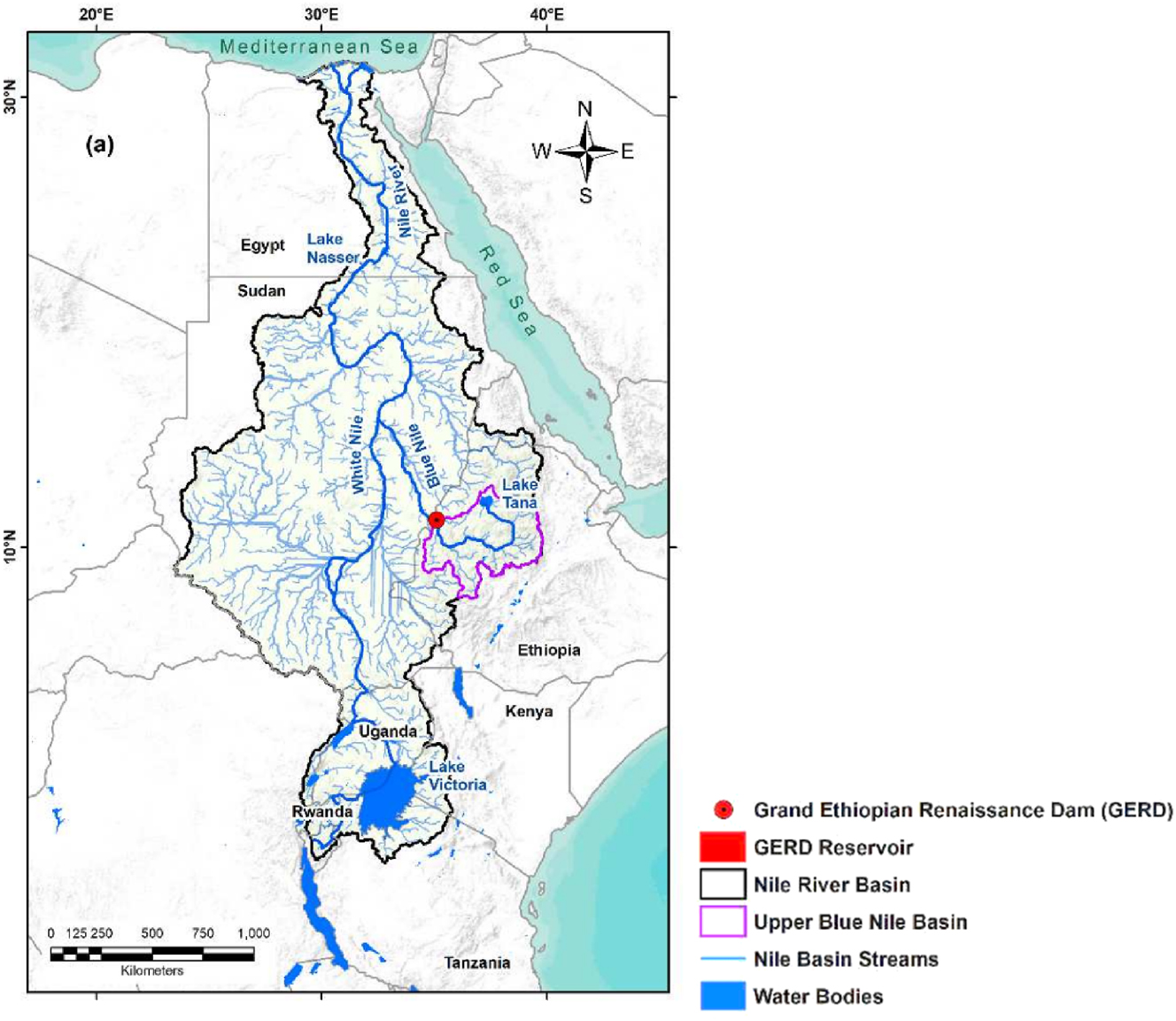
Spatial distribution of the Nile River within the Nile River basin and location of GERD, major lakes, and the Upper Blue Nile (UBN) sub-basin (Kamara et al. 2022: 2).
The red spot in the map highlights that the GERD is located 15 km to the east of the Ethiopian border with Sudan. The first filling of the GERD started on 8 July 2020, and the second filing was on July 19, 2021.
The downstream countries of Egypt and Sudan depend on the Nile (generated from the main tributaries: the White Nile and the Blue Nile) as a source of clean water, electricity, and food security. The construction of the GERD, therefore, poses a threat to the water and hydropower supply of Egypt and Sudan, especially with the rapid growth of population, global warming, and groundwater depletion. Several studies have asserted the disastrous impact of the GERD filling and operation on the water security of Egypt and Sudan; nevertheless, the Ethiopian authorities and government confirm that the GERD will not have any drastic impact on the downstream riparian countries (Egypt and Sudan) as it brings welfare to everyone.
The opposing views regarding the GERD have led to interstate tension between Ethiopia and Egypt on the access to the Nile’s water. This study investigates the various framings (social construction of reality) in selected Facebook posts, available at the official accounts of the Ethiopian Prime Minister Abiy Ahmed Ali and the official pages of the Egyptian Ministry of Foreign Affairs (MFA) and the Egyptian Cabinet. It primarily employs Stibbe’s (2015) ecolinguistic analytical framework alongside the grammar of visual design (Kress and van Leeuwen 2006) to attempt answering the following questions:
How do the Ethiopian Prime Minister, the Egyptian Ministry of Foreign Affairs, and Egyptian Cabinet construct their ideological framings of the GERD in terms of linguistic and multimodal discourse?
What ecolinguistic strategies are used by the abovementioned stakeholders to construct narratives that frame the GERD’s impact in the ecosystem as either destructive or protective?
The study, therefore, aims to uncover how each stakeholder frames the “stories-we-live-by” and to what extent they encourage environmental destruction or preservation.
2 Review of literature: Ecolinguistics
“Ecolinguistics,” a term that emerged in the 1990s, blends ecology and linguistics to explore how language interacts with the environment. It addresses pressing issues “such as environmental justice, water scarcity, energy security, and in general, the gradual destruction of the ecological systems that support life” (Stibbe 2014b: 584) to expose how society is the true environment of language. “Ecology,” a key term in Ecolinguistics derived from the Greek word “oikos” (Bowers 2008), is used to establish a relationship between the individual as a participant and the cultural and environmental context. The scope of Ecolinguistics addresses linguistic discourse from an ecological perspective (Bowers 2008; Fill and Mühlhäusler 2001; Halliday 2001; Stibbe 2014a, 2015). Moreover, Ecolinguistics explores the interaction between language and the environment by encompassing two complementary strands: “ecology of language” and “ecological linguistics,” where the ecology of language alone emphasizes the socio-ecological context that reveals how language interacts with the social, cultural, political, and environmental factors (Fill 2018; Haugen 1972). It, therefore, traces the impact of environmental changes on linguistic practices.
Ecological linguistics, on the other hand, aims at clarifying the shared linguistic practices of a given society (Hodges 2007). Both strands, accordingly, have different methodological bases: The ecology of language focuses on the context in which language functions when users are related to each other and to nature while ecological linguistics discloses the different values and trajectories formed on the individual and societal levels. In addition, Critical Discourse Analysis (CDA) integrates these strands to analyze discourse in social context and discourse in relation to society, including environmental discourse, known as Eco-Critical Discourse Analysis (Dash 2019).
The aim of Ecolinguistics is, therefore, two-fold: (a) develop linguistic theories in which humans become part of the larger ecosystem and (b) provide a means to address various ecological issues (Dash 2019). The linguistic aspect of Ecolinguistics to investigate how language contributes to the creation of “the stories-we-live-by” (Stibbe 2015: 6). These stories have become available for various challenges and interpretations from an ecological perspective. They can also protect the ecological system using language to solve global crises by “harnessing, developing, and promoting both language and ecology” (Dash 2019: 381).
3 Ecolinguistic analytical framework
3.1 Ecosophy
The analysis of ecolinguistic discourse draws from (Naess 1996) ecosophy, which is defined as “a normative set of principles and assumptions about relationships among humans, other forms of life and the physical environment” (Stibbe 2015: 202). In other words, it is a set of values used by the analysts (the criteria used for evaluation) to foster the protection of the ecosystem and demote any discourse aiming at the destruction of the environment to underscore the philosophy of ecological harmony and equilibrium. Ecosophy is equated with “living” (Stibbe 2015) to emphasize the worth of species and the need for sustainable practices for future generations. Ecolinguistics explores the relationship between language and ecology, focusing on different types of online data, yet often neglecting platforms such as social media that have a larger audience and wider impact. In this respect, this study adopts Stibbe’s (2015) framework to analyze selected Facebook posts on the GERD to address this politically disputed ecological issue.
Various linguistic tools are integrated into Ecolinguistics to explore the literal sense and metaphorical senses of ecology, revealing the relationships between organisms and the physical environment. Central to this exploration is the notion of “stories-we-live-by” which are “cognitive structures in the minds of individuals which influence how they perceive the world” (Stibbe 2015: 6). These stories are constructed “in the minds of multiple individuals across a culture” (6). The ecolinguistic aspects realizing the “stories-we-live-by” are clarified in Figure 2.

Ecolinguistic analytical model, adapted from Stibbe (2015).
The first key elements outlined in the framework are ideology, framing, and reframing; ideology represents shared worldviews within societies. There is a difference between frame, framing, and reframing: “A frame is a story about an area of life that is brought to mind by particular trigger words” (Stibbe 2015: 47) while framing involves constructing narratives (frames) on a specific aspect of life, triggered by certain words; finally, reframing provides a new perspective on existing narratives (framing). The frames of these stories can be analyzed in terms of being constructive or destructive.
Metaphors within these frames propose a unique conceptualization of various areas of life whereas conviction refers to the certainty or uncertainty of these stories and descriptions of people’s minds (Stibbe 2015). Certain linguistic tools such as modality, authority, quantifiers, hedges, lexical choices, presuppositions, and appositions are utilized to uncover these convictions. In addition, Ecolinguistics describes identity as a form of a story that constitutes one’s individual sense (Stibbe 2015). Evaluation plays a key role in the analytical framework to assess whether a story is judged as constructive or destructive. Hence, appraisal patterns are used to elucidate these evaluations and highlight how language emphasizes certain aspects while marginalizing others.
In this respect, salience and erasure are complementary elements in the framework (Stibbe 2015). Salience is a form of a story that represents an area of life as significant and worth exploration. In contrast, erasure is a “story in people’s minds [showing] that an area of life is unimportant or unworthy of consideration” (Stibbe 2015: 146). There are three kinds of erasure: the void, the mask, and the trace. When something important is deleted or excluded from the text, a void occurs. The second type is the mask when the item is presented in a distorted version rather than being erased. The trace is when something is presented but partially erased. Erasure can be linguistically traced via nominalization, metonymy, passive voice, hyponymy, co-hyponymy, transitivity, pronoun use, and massification. Ecolinguistics, hence, utilizes various linguistic tools to examine how narratives shape perceptions of ecology to reveal their impact on societal and environmental discourse.
3.2 Analytical ecosophy
With a belief that ecolinguistics searches for new discourses “which promote being more rather than having more, wellbeing rather than growth and respecting rather than conquering nature” (Stibbe 2018: 165), the ecosophy adopted in the study is derived from Stibbe (2015) to analyze the verbal and visual framing of the “stories-we-live-by” over the GERD dispute (Figure 3):

Adopted ecolinguistic analytical ecosophy revealing the framing of the GERD dispute.
Central to this approach is the evaluation of the “stories-we-live-by” since most discourses entail negative evaluation of the problems facing the environment. To give voice to ecology, the study adopts Martin and White’s (2005) Appraisal Theory to the analysis of evaluation to assess whether certain attitudes and values are viewed as positive or negative. It, therefore, promotes the study of the interrelation between people, nature, and economic growth, which dictates how people act toward the ecosphere.
The Appraisal Theory exposes the attitudes, feelings, and values displayed in texts, where appraisal is equated with evaluation of the negotiated attitudes (Martin and White 2005). Recognize three kinds of Attitude: (1) Affect, which focuses on the meaning constructing emotional reactions to events through quality, processes, and modal adjuncts; (2) Judgment, which refers to the meanings constructing positive or negative attitudes to people and their behavior into social esteem and social sanctions; and (3) Appreciation, which shows the assessment with regards to how objects, texts, and affairs are socially ascribed values. Since Attitude analysis demonstrates how text producers express their opinions, feelings, and outlooks to establish rapport between themselves and those who support/oppose them, it is the focal point of the analysis of the selected data.
Metaphorical framings also contribute to the expression of viewpoints on ecological issues, creating “ecological metaphors” (Fill and Muhalhauser 2001) that promote the understanding of human language and shape one’s perception of the ecosystem. The nonphysical is conceptualized in terms of the physical, and the target domain is understood in terms of the source domain so that a concept can be understood in terms of another (Lakoff and Johnson 2003). The study, therefore, addresses Stibbe’s ecosophy of metaphors to offer an interpretation of the modes of thought and reveal their cultural and political implications in shaping social realities.
In addition to verbal linguistic analysis, Ecolinguistics has recently paid attention to the semiotic modes of discourse. The study, in this respect, explores selected images accompanying the posts to uncover the role of language and visuals in shaping perceptions and mobilizing responses toward ecological issues. Using Kress and van Leeuwen’s (2006) representational and interactive metafunctions, it investigates how visuals contribute to narrative construction. The representational dimension entails the Narrative pattern, examined to reveal how actions and events depict participants connected by a vector (a line formed by the elements in the image). Kress and van Leeuwen (2006) divide the Narrative pattern into various process types: (a) Reactional where the vector is formed by an eyeline and creates a reaction; (b) Action, which depicts a physical action; and (c) Speech and Mental, which is shown by the thought and dialog balloons.
The interactive metafunction involves the following parameters: image act, social distance, perspective, and modality (Kress and van Leeuwen 2006). The image act features the gaze, which is either a “demand” when the participant’s gaze demands something from the viewer or an “offer” when the represented participant(s) do(es) not look directly at the viewer. The social distance relates the represented participants to the viewer(s); this relation can be social, personal, or impersonal depending on the frame size of the shot, which is further subdivided into close-up, medium close, medium long, and the very long shot. In addition, the perspective includes two angles: horizontal, which is either frontal revealing involvement or oblique showing detachment, or vertical with a high angle denoting superiority to the interactive participant(s) or with low angle indicating superiority to the represented participant(s).
The present study traces the “stories-we-live-by,” promoted by the Egyptian and Ethiopian sides on the GERD construction, filling, and operation. These stories are explored verbally and visually via an eclectic ecolinguistic framework, primarily derived from Stibbe’s (2015) model to provide a thorough account of the framing of both sides. The adopted framework identifies and analyses Stibbe’s (2015) notions of Metaphor, the Attitude system under Evaluation, in addition to the representational and interactive metafunctions to demonstrate the constructed framing of each side, and whether ecology is discussed in a positive or negative manner.
4 Data collection and procedures
4.1 Data collection
The adopted ecosophy seeks to incorporate the official “stories-we-live-by” in framing the GERD issue. The data were collected from the official Facebook account of the Ethiopian Prime Minister Abiy Ahmed Ali and the official pages of the Egyptian Ministry of Foreign Affairs (MFA) and the Egyptian Cabinet, exemplified in Figure 4:

The official Facebook accounts under analysis.
Only the official statements published on these accounts addressing the construction, filling, and operation of the GERD are examined. The corpus comprises a total of 11 posts: five by the Ethiopian Prime Minister Abiy Ahmed Ali, three by the Ministry of Foreign Affairs (MFA), and three by the Egyptian Cabinet. Ali’s posts are written in three languages: two in Arabic, two in English, and one in Ethiopian, whereas all the posts from MFA and the Egyptian Cabinet are in Arabic. The posts are chronologically analyzed to trace the development of the framing. It is noteworthy that accompanying photos in the selected posts are visually analyzed although their inclusion is not a selection criterion.
4.2 Procedures
This study investigates the framing of “the stories-we-live-by” on the verbal and visual levels. The adopted multilayered approach attempts to understand how meaning is constructed via integrating tools from Stibbe’s (2015) ecolinguistic model and visual semiotics (Kress and van Leeuwen 2006). Through the analysis of metaphors, the overall framing of each side is investigated on both the textual and visual levels to reveal the worldviews. To identify the attitudes and emotions in selected examples from the data, the study investigates the Attitude appraisal system (Martin and White 2005). Besides, aspects from Kress and van Leeuwen’s (2006) representational and interactive metafunctions are utilized to visually the metaphor and the appraisal system. Finally, the analysis highlights the interrelation between the metaphorical framing, the appraisal system, and the visual representation in constructing the framing of the GERD narrative for both sides to offer a comprehensive understanding of environmental issues. It is important to note that English translation of the Arabic posts is provided to facilitate understanding of the content.
5 Analysis of data
5.1 Ecological conflict and sustainability
The socio-historical framing of the GERD reflects the entanglement of Egypt and Ethiopia in a strife. On one end stands Egypt and Sudan staunchly defending their historical right to water shares as a vital natural resource. Alternatively, Ethiopia propagates a historic account of ever suffered famines and asserts its relentless drive to development and resources enhancement to farewell poverty. This framing introduces the GERD as a scarce resource with a historical entitlement, which demonstrates how language “construe reality in a certain way” (Halliday 2001: 193) to stress the link between language and ecology where environmental degradation is reflected in language. In line with (Stibbe 2014a: 123), this study addresses the interplay between “social injustice and ecological destruction” as exemplified in the Egyptian-Ethiopian feud over water supply. Examining the verbal and the visual modes, the study explores how these framings are constructed to shape perceptions on water resources.
5.2 The Ethiopian framing of the GERD
5.2.1 Posts published after the second filling
The framing of the Ethiopian context emphasizes the role of the GERD as a catalyst for social and economic growth without posing any harm or threat to others. The first two Arabic posts for the Ethiopian Prime Minister were published on 22 July, 2021 following the second filling of the GERD[1] and on 15 July 2023, following talks held on the GERD issue in Cairo between the Ethiopian Prime Minister and the Egyptian President Sissy.[2] In both posts, Prime Minister Ali reassures the peoples of Egypt and Sudan that the GERD will not cause them any harm.
The Ethiopian Prime Minister adopts a cordial tone in the first sentence of the first post in which he directly addresses the peoples of Egypt and Sudan using the following vocative:
إلى أخوتي وأخواتي في دول المصب [To my brothers and sisters in the downstream countries]
The choice of Appreciation situates the addressees within their geographical location and context, implying enduring friendly relations between Ethiopia and Egypt and Sudan that would transcend the tension over the GERD’s filling in July 2021. This Appreciation is coupled with the affective behavioral processes below:
أود أن أطمئنكم مرة أخرى بأن هذا الملء سوف لن يؤدي بضرر لأي من بلداننا
[I would like to assure you once again that this filling will not cause harm to any of our countries]
The Prime Minister (the first Actor) asserts his authority to reassure the peoples of Egypt and Sudan regarding that there will be no potential negative impact for the GERD (the second Actor) on their water resources. The processes foreground a positive social esteem Judgment of the GERD in the post’s conclusion:
مكسبا ورمزا حقيقيا للنمو الاقتصادي والتعاون المشترك
[a real benefit and a symbol for economic growth and joint cooperation]
Judgment positions the GERD not only as a pivotal project fostering economic welfare and development in Ethiopia but also across neighboring states. Hence, the intricate dialog suggested by Appreciation, the affective behavioral processes, and the social esteem Judgment engages the peoples of Egypt and Sudan directly and addresses their concerns about the GERD’s potential risks. He seeks to replace anxiety and fear with optimism and a promise of a better future.
A similar message of reassurance is conveyed in the second Arabic post:
ستظل إثيوبيا تراعى هذه الأمانة وتشارك جيرانها هذه الهبة الربانية
[Ethiopia will guard and share with its neighbors this Divine gift]
ونؤكد لأخواننا بأن هذا الالتزام قد تعزز أكثر من أى وقت مضى
[We assure our brothers and sisters that this commitment is more pressing than any other time]
اثيوبيا شعبا وحكومة لن تلحق ضررا بأشقائها
[Ethiopia, the people and the government, will not cause their brothers and sisters any harm]
In these affective behavioral processes, Ethiopia assumes the role of the Actor, not merely as a geographical entity but also as a collective entity encompassing its state, people, and government. This portrayal imposes a moral obligation on Ethiopia to protect Egypt and Sudan from any potential harm resulting from the filling and operation of the GERD. Also, the use of positive Affect, underscored by the repetition of “brothers and sisters,” fosters a sense of fraternity and solidarity.
These interpersonal bonds are further strengthened through a historical reference to Abyssinia (ancient Ethiopian lands) during the Islamic era:
وإن هذه الهبة الربانية ستكون فائدتها للجميع أن قيم المسؤولية والعدالة التي تتميز بها أثيوبيا، قد وجدت اعترافا وتقديرا من سيدنا محمد -صلي الله عليه وسلم- عندما قال للصحابة: اذهبوا إلى أرض الحبشة فإن فيها ملكا لا يظلم عنده أحدا… وهو ما يتم تأكيده اليوم بأن اثيوبيا شعبا وحكومة، لن تلحق ضررا بأشقائها.
[And that this Divine gift will be of benefit to everyone. The values of responsibility and justice that characterize Ethiopia have been acknowledged and appreciated by Prophet Muhammad (PBUH) when he told his disciples: Go to the land of Abyssinia as its king never oppresses anyone… This is what is being asserted today that Ethiopia, people and government, will not harm its brothers and sisters.]
Ethiopia is the Actor in the affective behavioral process, “Ethiopia will not harm its brothers and sisters,” thereby committing itself once more to safeguard the downstream countries. Ethiopia also aligns itself with the principles of responsibility and justice, indicated by the passive voice in “have been acknowledged and appreciated.” The social sanction Judgment underscoring Ethiopia’s longstanding moral obligation to protect others is affirmed by Appreciation in “acknowledged and appreciated” and the reference to a historical and religious figure (Prophet Muhammad). This framing is characterized by timelessness, where the past and present converge to morally bind Ethiopia not only to protect Egypt but also to safeguard the Nile, described using positive Affect as “Divine gift” that promises development and benefit to Ethiopia and Africa as a whole.
5.2.2 Posts addressing the benefits of the GERD
In 2022, Prime Minister Ali published three posts. The first was on 20 January, which discusses the benefits of the GERD for Ethiopia and Africa.[3] Ali utilizes Appreciation in the title, framing the GERD as “a site of cooperation,” where “cooperation” signals optimism for the future. The GERD is featured in the post as the Actor in several affective behavioral processes:
The GERD does not consume water
In Sudan, for example, the GERD provides ample protection against devastating floods….
It will help the Sudanese water infrastructure to be operated optimally as they receive regulated flow.
The GERD also brings more energy to the already interconnected systems of Sudan and Ethiopia as well as to others.
The GERD also helps to prevent future spillage that overtops the Aswan Dam.
Globally and in the Nile region, the GERD as a clean renewable energy source would help to reduce emission that could avoid up to 10.6 million tons of greenhouse gases….
The GERD has a potential to stabilize energy mix….
It will also enable affordable energy
These processes assert the GERD’s capabilities as an Actor and overlook any dispelling concerns, further reinforced by the interplay between present and future tenses, which underscores immediate outcomes and long-term aspirations.
Furthermore, Prime Minister Ali imbued the GERD with significant value through Appreciation in the following instances: “an ambition,” “modern economy,” “clean environment,” “resilient ecosystem,” “comparative advantage,” “good example,” “multiple benefits,” “the location ideal to maximize electricity generation,” “reducing floodings and augmenting dry flow,” “ample protection against devastating floods,” “more electricity,” “reliable water supply for people, agriculture, and the ecology,” “more energy,” “important role in meeting and increasing renewable energy generation share toward Sustainable Development (SDG) Goal 7 and better water management of Goal 6 of the SDGs, as well as meeting many targets of Africa’s Agenda 2063,” and “our three countries of Ethiopia, Egypt and Sudan to nurture the narrative toward building peace, cooperation, mutual co-existence, and development of all our people without harming one another.” Appreciation of the values signified by the GERD, especially establishing peace and cooperation with other partners in the African region are asserted by numerating the benefits of this construction. The positive Affect indicated by the use of adjectives like “good,” “comparative,” “resilient,” and “clean” promote Appreciation as adjectives introduce the GERD as an opportunity for growth and investment rather than a threat, a framing that stimulate “cooperation.”
The second post in 2022 was on 22 February when Prime Minister Ali announced the operation of the GERD.[4] The GERD is attributed agency as “Africa’s largest power generation renaissance dam” since it facilitates the implementation of Ethiopia’s developmental plan and meeting the standards set by SDGs 6 and 7. The GERD’s functional independence is clarified as an Actor albeit reliant on human efforts. Affect in phrases like: “the day of light for Ethiopia” and “the holiday of new year for Ethiopia” evokes Ethiopia’s optimism for the GERD’s contribution to solving electricity shortages—necessary for development marks the rebirth of contemporary Ethiopia that seeks to farewell destitution via the GERD. Finally, Ali concludes the post by “I congratulate all Ethiopians,” which emphasizes the beginning of a new phase in Ethiopia’s history. Through Appreciation, he expresses his positive evaluation of the GERD’s significance to national development as it is marked as a national day for them. Notably, Ali uses inclusive language to involve Ethiopia’s African partners:
This is a good news for our Ashagur and for those downstream countries who want to work with them and benefit together
This is good news for our continent as well as the downstream countries with whom we aspire to work together
As a Senser in affective mental processes, the downstream countries are promised a share in the GERD’s benefits; thus, it is regarded as a “site of cooperation.”
The last post follows the third filling of the GERD on 12 August 2022. It is written in Ethiopian, and Facebook Translator was used to generate the English version.[5] Positive Affect evident in the festive tone suggested by “Congratulations” and “happy” affirms the veracity of the promised welfare and development, made by the Ethiopian government. Ali celebrates the fulfillment of the government’s promises of sustainability as he addresses “children of Abay,” thus asserting Ethiopia’s long-term developmental plan. This is further asserted by the social sanction Judgment in “successfully,” which implies a positive outcome and an achievement. It means that the aspired for standards are met while conforming to the socio-ecological framework. Completing the GERD “at the expected time” further highlights the successful implementation of a long-term investment for “the children of Abay,” the primary beneficiaries from the GERD and promises them a better future as well as operational progress and efficiency. It can, thus, be deduced that Ethiopia’s long-term development plan is in progress.
Focusing on expanding investment and development does not mean that the Prime Minister ignores the preservation of the ecosystem and the environment. Ali highlights to Abay’s children the GERD’s role in improving the ecosystem, evidenced in the affective behavioral process: “it reduces the destruction of resources, and the number of lives lost.” “It” refers to the Actor (GERD), that is obligated to preserve both resources and lives. This commitment is underscored by Appreciation in “beautiful appearance,” where the GERD is expected to generate electricity and enhance the environment’s aesthetics.
The GERD’s role once again involves the regional partners who have shared historical and geographical ties with Ethiopia:
When we want to get the benefit we deserve, we are also thinking that the other gifts of Abay – Sudan and Egypt will benefit from the river.
Just like the river Abay has connected the three countries for thousands of years, the dam that is built on it will enable us to coexist with our neighbors.
When we say let us get the benefit we deserve to get like Ethiopia Abaya’s other gifts – Sudan and Egypt should be used as a way to deliver them from the river.
Abaya river has been connecting three countries and making us live together for thousands of years, the link built on it will allow us to live with our neighbors.
Ali employs social esteem Judgment to stress the GERD’s capability to make growth a reality in the three countries. This is further promoted by positive Affect suggested by “benefit,” “other gifts of Abay,” “our neighbors,” “Abay’s other gifts,” “live together for thousands of years,” and “live with our neighbors,” which stresses Ethiopia’s commitment to establishing synergy and development in the whole region. This framing also demonstrates Ethiopia as proactive and cooperative neighbor that gives priority to regional cooperation over geopolitical considerations.
5.3 The Egyptian framing of the GERD
5.3.1 Egyptian cabinet posts
Ethiopia’s framing of the GERD promotes it as a catalyst for economic welfare for all the involved parties, Egypt, nevertheless, views the GERD as a threat that reduces its water share. Egypt’s concerns prompted it to escalate the whole matter to the United Nations Security Council in the Ministerial Cabinet’s post on 19 June 2020.[6] This statement involves several affective behavioral processes in which Egypt is the Actor:
مصر تحيل أزمة سد النهضة الأثيوبي إلى مجلس الأمن بالأمم المتحدة
[Egypt refers the Ethiopian Renaissance Dam crisis to the United Nations Security Council.]
أعلنت جمهورية مصر العربية اليوم الجمعة الموافق ١٩ يونيو ٢٠٢٠ أنها تقدمت بطلب إلى مجلس الأمن بالأمم المتحدة حول سد النهضة الأثيوبي
[The Arab Republic of Egypt announced today, Friday, June 19, 2020, that it has submitted a request to the United Nations Security Council regarding the Ethiopian Renaissance Dam, calling on the Council to intervene]
وقد اتخذت جمهورية مصر العربية هذا القرار
[The Arab Republic of Egypt has made this decision]
وتؤكد مصر مجددا على حرصها على التوصل إلى اتفاق يحقق مصالح الدول الثلاث
[Egypt reiterates its keenness to reach an agreement that achieves the interests of the three countries]
The Actor is given different naming styles. The official name of Egypt “Arab Republic of Egypt” underscores the formality associated with the referral to the Security Council as opposed to a less formal tone using the short name “Egypt,” upon discussing its readiness for negotiations with Ethiopia. The Ethiopian stance in the following instances is described using social sanction Judgment that reveals its stubbornness:
أزمة [crisis]
إجراءات أحادية [unilateral procedures]
تهدد الأمن والسلم الدوليين [threatening international peace and security]
تعثر المفاوضات [faltering of negotiations]
للمواقف الأثيوبية غير الإيجابية [the non-positive Ethiopian stances]
والذي قوبل بالرفض من أثيوبيا [that was rejected by Ethiopia]
ملء سد النهضة بشكل أحادي بالمخالفة لاتفاق إعلان المبادئ الموقع بين الدول الثلاث
[unilateral filling of the Renaissance Dam in violation of the Declaration of Principles, signed by the three states]
Social sanction Judgment depicts Ethiopia as a noncooperative partner and identifies the reasons behind Egypt’s fear. It gives a sense that Ethiopia’s messages of inclusion did not succeed in replacing fear with tranquility and legitimizes Egypt’s appeal to the Security Council to safeguard its water supplies.
Ethiopia proceeds the unilateral filling of the GERD, so the Egyptian Cabinet published a statement by MFA[7] in 2021 to express its deepest concern to the effect of these actions. There is a principal affective behavioral process – “مصر ترفض أي إجراءات أحادية قد تتخذها إثيوبيا اتصالا بسد النهضة” [Egypt rejects any unilateral procedures taken by Ethiopia concerning the Renaissance Dam]—in which Egypt assumes the role of an Actor to assert its position against Ethiopia’s trespassing Egypt’s water resources. This is further ascertained by social sanction Judgment of the morality of the Ethiopian actions:
الاستمرار في ملء السد بشكل أحادي خلال موسم الفيضان
[to continue the unilateral filling of the Dam during flood season]
اعتزام إثيوبيا استكمال ملء سد النهضة حتى لو لم تصل الدول الثلاث إلى اتفاق حول ملء وتشغيل سد النهضة
[Ethiopia’s intention to continue filling the Renaissance Dam even if the three countries did not reach an agreement on the filling and operation of the Renaissance Dam]
سوء نية إثيوبيا وسعيها لإجهاض الجهود الجارية من قبل وسطاء دوليين وأفارقة من أجل حل أزمة سد النهضة
[Ethiopia’s bad faith and its attempt to abort the current efforts by international and African mediators to resolve the Renaissance Dam crisis]
فرض الأمر الواقع على دولتي المصب
[impose the status quo on the downstream countries]
إلا أن الجانب الإثيوبي انتهج سياسة تقوم على المماطلة والتسويف أدت إلى فشل كافة مسارات المفاوضات
[the Ethiopian side adopted a policy based on procrastination, which led to the failure of all negotiations paths]
تصرف غير مسئول [an irresponsible action]
مخالفة صريحة لأحكام اتفاق إعلان المبادئ
[a clear violation of the Declaration of Principles Agreement]
It is evident from these instances that Ethiopia is unwilling to reach an agreement in contrast to praising Egypt’s genuine interest in pursuing the negotiation track through social esteem Judgment: “الدولة المصرية ملتزمة بالحفاظ على حقوق مصر ومصالحها المائية وحمياتها ومنع إيقاع الضرر بها صوناً لمقدرات الشعب المصري” (The Egyptian state is committed to safeguarding Egypt’s right and water resources to protect it from any danger to preserve the destiny of the Egyptian people). The use of Judgment in such a way introduces a positive image of Egypt’s attitude toward negotiations to establish good connections with the international community to support its claim; nonetheless, it showcases Ethiopia’s constant violation of all the agreements and insistence on ignoring Egypt’s concerns.
5.3.2 Ministry of foreign affairs posts
The MFA published two posts in 2022: the first on 20 February[8] and the second on 29 July.[9] These posts are, in fact, press statements revealing Egypt’s reaction to the unilateral filling of the GERD. The first post entails social sanction Judgment:
تؤكد جمهورية مصر العربية على أن هذه الخطوة تُعد إمعاناً من الجانب الإثيوبي في خرق التزاماته بمقتضى اتفاق إعلان المبادئ لسنة ٢٠١٥، الموقع من قِبَل رئيس الوزراء الإثيوبي.
[The Arab Republic of Egypt stresses that this act constitutes a further violation by the Ethiopian side of its obligations under the 2015 Declaration of Principles agreement, signed by the Ethiopian Prime Minister.]
This is another instance of lack of propriety in which Egypt (using its official name) which criticizes Ethiopia’s violation of the 2015 Declaration, signifying potential dangers. In the second post, the Minister of Foreign Affairs, Sameh Shoukry, announced that he sent a letter to the Security Council to seek intervention after the unilateral filling of the Dam. Egypt’s objection is articulated again by social sanction Judgment:
هو ما يعد مخالفة صريحة لاتفاق إعلان المبادئ المبرم عام 2015 وانتهاكاً جسيماً لقواعد القانون الدولي واجبة التطبيق، والتي تلزم إثيوبيا، بوصفها دولة المنبع، بعدم الإضرار بحقوق دول المصب
[This is considered a clear violation to the 2015 Declaration of Principles and a serious violation to the applicable rules of international law which obligate Ethiopia as an upstream country not to harm the right of downstream countries.]
إلا أن إثيوبيا قد أفشلت كافة الجهود والمساعي التي بذلت من أجل حل هذه الأزمة
[however, Ethiopia has failed all the efforts and endeavors made to resolve the conflict]
Lack of propriety through the repetition of “violation” to refer to Ethiopia’s actions, foreshadowing Ethiopia’s role in failing “all the efforts and endeavors made to resolve the conflict,” thus underscoring the illegitimacy of Ethiopia’s actions and violation of the 2015 Declaration of Principles. It also reveals two different attitudes toward the GERD: Egypt’s attitude denotes fear and deep concern for decrease in water share and keenness on respecting the signed agreement. On the other side, Ethiopia continues to violate the agreements and overlooks any threat to the downstream countries for the sake of Ethiopia’s development.
In the rest of the post, Egypt asserts its consequential reaction toward the Ethiopian actions. Egypt is presented as the principal Actor in three affective behavioral processes:
إلا أن الدولة المصرية لن تتهاون مع أي مساس بحقوقها أو أمنها المائي أو أي تهديد لمقدرات الشعب المصري الذي يمثل نهر النيل شريان الحياة الأوحد له
[however, the Egyptian state will not tolerate any infringement on its rights or water security or any threat to the destiny of the Egyptian people, for whom the Nile represents their only vein of life]
وتُشدِّد مصر على مطالبتها لإثيوبيا بالتحلي بالمسؤولية والامتثال لقواعد القانون الدولي والمبادئ الحاكمة للمجاري المائية عابرة الدول، وفي مقدمتها تجنب الضرر ذي الشأن، وتُحملها كامل المسؤولية عن أي ضرر ذي شأن على المصالح المصرية قد ينجم عن انتهاك إثيوبيا لالتزاماتها المُشار إليها
[Egypt stresses its demand that Ethiopia should be responsible and comply with the rules of international law and the principles governing transnational water courses, foremost among which is avoiding significant harm, and holds it fully responsible for any significant harm to Egyptian interests that may result from Ethiopia’s violation of its aforementioned obligations.]
كما تحتفظ جمهورية مصر العربية بحقها الشرعي المكفول في ميثاق الأمم المتحدة باتخاذ كافة الإجراءات اللازمة لضمان وحماية أمنها القومي، بما في ذلك إزاء أية مخاطر قد تتسبب بها مستقبلاً الإجراءات الأحادية الإثيوبية
[The Arab Republic of Egypt also reserves its legitimate right guaranteed in the United Nations Charter to take all necessary measures to ensure and protect its national security, including against any risks that may be caused in the future by Ethiopian unilateral measures.]
The Actor is given agency through several naming practices, ranging from the most informal “Egypt” in its request to Ethiopia to stop harming the water resources to the semi-formal name “the Egyptian state” through which Egypt asserts its capability to take action, if necessary, to the most formal address form “The Arab Republic of Egypt” associated with the reference to Egypt’s right to seek the intervention of the Security Council to end the breach of the 2015 Declaration. The use of Appreciation on describing the Nile as the “only vein of life” signals its value to Egyptians, being its only water resource. Therefore, it reflects Egypt’s sense of resolve and determination to exercise its control over it.
Finally, the two posts published in 2023 follows the unilateral fourth filling of the GERD, on 10 September,[10] and the failure of the last stage of negotiations on 19 December.[11] In the first post, social sanction Judgment of lack of propriety is used in “فإن ذلك يعد استمرارا من جانب إثيوبيا في انتهاك إعلان المبادئ الموقع بين مصر وإثيوبيا والسودان عام ٢٠١٥” [This is considered a continuation by Ethiopia in violating the Declaration of Principles, signed between Egypt, Ethiopia, and Sudan in 2015], further elaborated by negative Affect suggested by “آثار سلبية” [negative effects] and “عبئاً” [burden] to focus on the drastic consequences of Ethiopia’s actions and reveal the vulnerability of Egypt in facing water shortage threat. In addition, the last post depicts Egypt, through affective behavioral processes, as an Actor: “وتؤكد جمهورية مصر العربية أنها سوف تراقب عن كثب عملية ملء وتشغيل سد النهضة” (Egypt affirms that it will closely monitor the filling and operation of the GERD) and “مصر تحتفظ بحقها المكفول بموجب المواثيق الدولية للدفاع عن أمنها المائي والقومي في حاله تعرضه للضرر” (Egypt reserves its right, in accordance with international charters and accords, to defend its water and national security in case of being harmed to proclaim Egypt’s condemnation to Ethiopia’s violation of the 2015 Declaration and the failure of the last stage of the negotiations). It also validates its claim as a powerful nation to protect its interests.
5.4 Metaphorical representations
The seesawed alternation of the Egyptian-Ethiopian stance and the dispute over life threatening resources can be viewed through the framing of the cognitive metaphor WATER IS MONEY. Like Lakoff and Johnson’s (2003) association of time with money via the metaphoric expression TIME IS MONEY and following Liebert (2001) constructed metaphor involving money and water, water can be reconstructed in terms of idealized cognitive models. Liebert (2001: 102) also argues that:
Metaphorical images such as the complex distribution of water by means of canals and money taps are projected onto the cognitive model of societal money flow and in ICM theory are regarded as actually given projections of cognitive knowledge and experiential structures.
This equates central water supply with social money supply. Also, Fill and Mühlhäusler (2001: 5) echo Liebert, emphasizing that “[t]he history of the metaphor ‘money is water’ illustrates how language adapts to new environmental conditions.”
This conceptual metaphor tackles water as a financial resource, indispensable for economic development—essential for the understanding of the construction of the GERD and the feud between Ethiopia and Egypt. Like money, water (represented by the Nile) is a valuable resource to sustain life, industry, agriculture, and ecosystem. Ethiopia invested in its infrastructure by constructing the GERD to optimize water use efficiency as the GERD is expected to contribute to Ethiopia’s development by generating electricity. Selling electricity and making new developmental projects generate money, which boost Ethiopia’s economy.
On the other hand, Egypt and Sudan heavily rely on the Nile for domestic water supply, causing them to be concerned over the GERD construction, for water shortage means prospective economic losses. Any potential reduction of water share would negatively impact industry, agriculture, and the lives of people and result in financial loss. The negotiations between Ethiopia and Egypt and Sudan aim at managing their water resources, where economic development is guaranteed to Ethiopia by the filling and operation of the GERD while ensuring a fair and equal share of water to the downstream countries, declared in the 2015 Declaration of Principles.[12] Such an agreement, hence, seeks to balance the financial benefits of money for both parties: Water, recurrent in the GERD, would implement Ethiopia’s economic development while ensuring the economic stability of Egypt and Sudan.
The metaphor WATER IS MONEY can be further elaborated visually via the examination of the GERD’s photos after its operation on 20 February 2020:
The GERD is the only Actor, and water is the Goal. The Actor uses the Goal to generate hydropower to draw a relationship between water as a natural resource and its economic value. The absence of human participants, the high angle, and the long shot showcase water flow as an active force used to produce energy and cultivate lands so that water is not only a life-sustaining resource but also a dynamic source of economic benefit. Consequently, GERD is the concrete representation of the conceptual metaphor WATER IS MONEY, whereby water becomes a commodity that embodies Ethiopia’s economic growth and interstate feud between Ethiopia and the downstream countries over their water share. In other words, Ethiopia cannot boost its economy without operating the GERD to generate electricity, whereas water scarcity to Egypt and Sudan means loss of cultivated land and lives.
6 Discussion
The primary aim of the study was to identify the framing of the “stories-we-live-by,” represented by Ethiopia and Egypt as propagated in 11 Facebook posts tackling the GERD construction and operation on the visual and verbal modes. The Ethiopian Egyptian entangle concretizes the GERD as an ecological concern and a cultural code promoted on both sides. It clarifies how both parties react to the ecological system that life depends on, and what stories are constructed to maintain rights. For Egypt, water scarcity threatens millions of its citizens leaving tens of thousands of acres uncultivated. To the Ethiopians, however, the ecosystem involves flooding among other environmental threats, which can only be regulated through the construction and operation of the GERD.
The framing social injustice is advocated by the oppressed poverty-stricken Ethiopians and the reach out for energy security maintained by the GERD as opposed to another story of “hit hard” and life threat on the part of the Egyptians. As such, the ecolinguistics strategies used in the stories of both sides promote two different “cultural codes” where the linguistic features cluster to form particular world views. A cultural code is “a compact package of shared values, norms, ethos, and social beliefs” (Gavriely-Nuri 2013: 29); it is responsible for constructing and reflecting on the common sense and norms of the society. In this respect, the Attitude system reveals power relations in discourse, and the linguistic study elucidates “cultural codes” and frames economic growth as vital for both nations. Ethiopia describes the GERD using Positive Affect and Judgment, which glorify it and promote it as a means for national development and poverty reduction. On the other hand, Egypt’s framing features the GERD as an ecological damage and threat to its water resources. This is linguistically expressed through the strategies of Negative Affect and Judgment, which describe it as “an existential threat” and an “environmental degradation.”
The multimodal ecolinguistic analysis asserts this feud in terms of the conceptual metaphor (Lakoff and Johnson 2003) WATER IS MONEY. This metaphor affects people’s cognition and convictions by introducing water, cloaked behind the GERD, as the third stakeholder in this strife so that people’s behaviors toward it are revisited and redirected. The persuasive power of the conceptual metaphor is further reinforced by the Attitude system. Ethiopia uses positive Affect, social esteem Judgment, and Appreciation to highlight the economic stability promised by the GERD; nonetheless, negative Affect, social sanction Judgment, and Appreciation are employed to reveal the GERD’s potential threat to Egypt’s water resources, thus instilling fear and anxiety. The analysis of the Attitude system as such “could potentially help protect and preserve the conditions that support life” (Stibbe 2014a: 119). Consequently, the Ethiopian framing triggers happiness and admiration to induce Ethiopians to protect this construction to secure their future and investments. On the other hand, the negative qualities ascribed by the Egyptian framing evoke fear and danger as the GERD might lead to water scarcity, thus urging the state to take necessary measures to protect its water resources.
Besides, the interplay between verbal and visual analysis not only elaborates the conceptual metaphor but also encourages people to adopt a more positive attitude toward the environment. It connects the grandeur of nature and the environment with technological advancement and investment to further accentuate that commodifying ecology is the best means to alleviate poverty and attain economic growth. Figure 5 depicts water as a commodity that Ethiopians perceive it as a catalyst for profit and welfare for all the parties involved, especially that the GERD is “a site of cooperation.” The Egyptians, however, perceive this commodity as a potential threat to their water supply, thus leading to desertification and draught. The framings of both parties, therefore, position environmental care and economic development on equal par to urge people to protect ecology and maintain their prosperity.

7 Conclusions
Social media communication about the environment aims at producing and disseminating knowledge on pressing ecological issues to shape people’s attitudes and behaviors toward nature. The Facebook posts published by the Ethiopian Prime Minister, the Egyptian Ministry of Foreign Affairs, and the Egyptian Cabinet introduce different “stories-we-live-by” whose framings highlight the socio-political conflicts surrounding the recurrent ecological crisis over the uncontrolled ecosystem exploitation. The Ethiopian framing, which employs positive Affect and Appreciation toward the GERD, resists conventional usages of natural resources; nonetheless, the Egyptian framing relies on negative Affect and social sanction Judgment in tackling the GERD, which depicts humans as guardians of nature.
The GERD, therefore, represents a means of fully utilizing unused “capital resources,” such as “the freshwater supplies and the agricultural soils, which we can’t live without” (Halliday 2001: 192) are fully utilized. In this context, GERD is situated within a debate over whether it should be regarded as a natural right or a commodity. It is viewed as a natural right when associated with the ecological value of water resources conservation to sustain human lives. Conversely, it is a commodity when consumption, production, and employment are involved. The interplay between Positive Discourse Analysis, conceptual metaphor, and visual analysis also shapes the water values of Egypt and Ethiopia and reconfigures the public opinion. These discourses represent the public as powerful, active agents that can mitigate or aggravate any form of environmental degradation. Consequently, the language used to tackle water management highlights the role of Ecolinguistics in understanding the geopolitical dynamics that may marginalize or overshadow concerns over ecological sustainability and the socio-economic impacts on the Egypt and Ethiopia.
About the authors
Prof. Amany Al Shazly is a Professor of Linguistics and Translation at Faculty of Arts, Helwan University, and former Head of the English Department. She supervised tens of M.A. and PhD dissertations in linguistics and translation. Her research interests include studies in stylistics, ecolinguistics, discourse analysis, pragmatics, and translation studies.
Dr. Lubna A. Sherif is an Assistant Professor of Linguistics and Translation at the Arab Open University, Egypt. Her previous publications have looked at verbal and visual texts from a multimodal and discourse analytic perspective. Her current research interests focus on interdisciplinary and cross-disciplinary studies in linguistics and translation.
-
Conflict of interest: The authors declare no potential conflicts with respect to the research, authorship, and/or publication of this article.
-
Research funding: The authors received no financial support for the research, authorship, and/or publication of this article.
References
Abou Samra, Rasha M. & Rafat R. Ali. 2021. Detection of the filling phases of the Grand Ethiopian Renaissance Dam using sentinel-1 SAR data. The Egyptian Journal of Remote Sensing and Space Sciences 24. 991–997. https://doi.org/10.1016/j.ejrs.2021.11.006.Suche in Google Scholar
Bowers, Chet A. 2008. Why the George Lakoff and Mark Johnson theory of metaphor is inadequate for addressing cultural issues related to the ecological crises. Green Theory & Praxis: The Journal of Ecopedagogy 2. 1–10.Suche in Google Scholar
Dash, Rajendra Kumar. 2019. What is Ecolinguistics? Language in India 19. 379–384.Suche in Google Scholar
Fill, Alwin. 2018. Introduction. In Alwin Fill & Hermine Penz (eds.), The Routledge handbook of ecolinguistics, 1–9. London & New York: Routledge.10.4324/9781315687391-1Suche in Google Scholar
Fill, Alwin & Peter Mühlhäusler. 2001. Introduction. In Alwin Fill & Peter Mühlhäusler (eds.), The ecolinguistics reader: Language, ecology and environment, 1–13. London: Continuum.Suche in Google Scholar
Gavriely-Nuri, Dalia. 2013. The normalization of war in Israeli discourse, 1967–2008. Plymouth: Lexington Books.Suche in Google Scholar
Halliday, Michael. 2001. New ways of meaning: The challenge to applied linguistics. In Alwin Fill & Peter Mühlhäusler (eds.), The ecolinguistics reader: Language, ecology and environment, 175–203. London & New York: Continuum.Suche in Google Scholar
Haugen, Einar. 1972. The ecology of language. California: Stanford University Press.Suche in Google Scholar
Hodges, Bert H. 2007. Good prospects: Ecological and social perspectives on conforming, creating, and caring in conversation. Language Sciences 29. 584–604. https://doi.org/10.1016/j.langsci.2007.01.003.Suche in Google Scholar
Kamara, Ahmed, Mohamed Ahmed & Arturo Benavides. 2022. Environmental and economic impacts of the Grand Ethiopian Renaissance Dam in Africa. Water 14. 312–330. https://doi.org/10.3390/w14030312.Suche in Google Scholar
Kress, Gunther & Theo van Leeuwen. 2006. Reading images: The grammar of visual design. London & New York: Routledge.10.4324/9780203619728Suche in Google Scholar
Lakoff, George & Mark Johnson. 2003. Metaphors we live by. Chicago: University of Chicago Press.10.7208/chicago/9780226470993.001.0001Suche in Google Scholar
Liebert, Wolf-Andreas. 2001. The sociohistorical dynamics of language and cognition: The emergence of the metaphor model ‘money is water’ in the nineteenth century. In Alwin Fill & Peter Mühlhäusler (eds.), The ecolinguistics reader: Language, ecology and environment, 101–109. London & New York: Continuum.Suche in Google Scholar
Martin, James Robert & Peter R. White. 2005. The language of evaluation: Appraisal in English. New York: Palgrave Macmillan.Suche in Google Scholar
Naess, Arne. 1996. The shallow and the long range, deep ecology movement. In Alan Drengson & Yuichi Inoue (eds.), The deep ecology movement: An introductory anthology, 3–10. Berkeley: North Atlantic Books.Suche in Google Scholar
Stibbe, Arran. 2014a. An ecolinguistic approach to critical discourse studies. Critical Discourse Studies 11. 117–128. https://doi.org/10.1080/17405904.2013.845.Suche in Google Scholar
Stibbe, Arran. 2014b. Ecolinguistics and erasure: Restoring the natural world to consciousness. In Hart Christopher & Cap Piotr (eds.), Contemporary critical discourse studies, 583–602. London: Bloomsbury Academic.10.5040/9781472593634.ch-025Suche in Google Scholar
Stibbe, Arran. 2015. Ecolinguistics: Language, ecology and the stories we live by. London & New York: Routledge.Suche in Google Scholar
Stibbe, Arran. 2018. Positive discourse analysis: Rethinking human ecological relationship. In Alwin Fill and Hermine Penz (eds.), The Routledge handbook of ecolinguistics, 165–178. London & New York: Routledge.10.4324/9781315687391-12Suche in Google Scholar
Wheeler, Kevin G., Marc Jeuland, Jim W. Hall, Edith Zagona & Dale Whittington. 2020. Understanding and managing new risks on the Nile with the Grand Ethiopian Renaissance Dam. Nature Communication 11. 1–10. https://doi.org/10.1038/s41467-020-19089-x.Suche in Google Scholar
© 2025 the author(s), published by De Gruyter on behalf of Soochow University
This work is licensed under the Creative Commons Attribution 4.0 International License.
Artikel in diesem Heft
- Frontmatter
- Reconstructing and translating regional cultural ideo-symbols through comparative glocalism: the case of Jiangsu
- Discourse patterns of affective stance in paediatric online consultative encounters
- Ecology in politics: a multimodal eco-critical analysis of environmental discourse
- A multimodal discourse analysis of in-text images of Nigerian literature texts for primary schools
- Decolonizing the teaching of foreign languages in multicultural communities: a case study of the teaching of English in Togo (West Africa)
- Pan-indexicality and prompt: developing a teaching model for AI-mediated academic writing
- The Orient and Morgenland in German discourse: a semiotic and postcolonial analysis
Artikel in diesem Heft
- Frontmatter
- Reconstructing and translating regional cultural ideo-symbols through comparative glocalism: the case of Jiangsu
- Discourse patterns of affective stance in paediatric online consultative encounters
- Ecology in politics: a multimodal eco-critical analysis of environmental discourse
- A multimodal discourse analysis of in-text images of Nigerian literature texts for primary schools
- Decolonizing the teaching of foreign languages in multicultural communities: a case study of the teaching of English in Togo (West Africa)
- Pan-indexicality and prompt: developing a teaching model for AI-mediated academic writing
- The Orient and Morgenland in German discourse: a semiotic and postcolonial analysis
