Discourse patterns of affective stance in paediatric online consultative encounters
-
Ezekiel Opeyemi Olajimbiti
Ezekiel Opeyemi Olajimbiti lectures in the Department of English and Literary Studie, Federal University Lokoja, Nigeria. He has authored a considerable number of articles published in international journals, including
Discourse Studies, Languages, Journal of Media Research, Journal for Discourse Studies, Language and Semiotic Studies, Africology: The Journal of Pan African Studies among others. He has chapter contributions to some books. Dr. Olajimbiti is a fellow of the George Forster Fellowship, Alexander von Humboldt Foundation Germany.
 und
Samuel Olayiwola Ayoola
und
Samuel Olayiwola Ayoola
Samuel Olayiwola Ayoola, PhD, is a Lecturer in the Department of English and Literary Studies, Ladoke Akintola University of Technology, Ogbomoso. His areas of interest are pragmatics, discourse analysis and grammar.

Abstract
The paediatric online consultative forum, where putative patients interact with physicians, has become a lifesaver for many, especially during the COVID-19 lockdown era in Nigeria. Examining the affective stance expressed by mothers in this asynchronous discourse from the linguistic perspective adds to the few existing studies on telemedicine and reveals the plight of mothers and their children in Nigeria. This study examines the discourse patterns of affective stance and its linguistic markers in online consultative encounters. Using the purposive random sampling method, 80 posts on the Facebook account “Ask the Paediatricians” between May and June 2020 and analysed using stance theory. Findings show that mothers express affectivity as interrogative, attention and hypothetical markers to project their concerns, worries, and curiosity about their children’s health status, e.g., breastfeeding, immunization, stools abnormalities, nutrition, fever, refluxing babies among others. Self-mentions and attitude markers are the two linguistic markers predominantly deployed in expressing affective stance. While the instances of self-mentions index affective representation, attitude markers, on the other hand, foreground affective attitude toward the propositions expressed. The above implies the level of emotional conditions of motherhood and sociocultural experiences of Nigerian women in the context of telemedicine encounters in child health studies.
1 Introduction
The unprecedented crisis of the COVID-19 pandemic necessitated a dramatic shift in traditional doctor-patient interactions to digitally-enabled remote consultations even in developing countries, like Nigeria. The pandemic necessitated a virtual healthcare system to reach patients and physicians who were refraining from in-person visits to avoid infection. Online health discussion forums are used by different patient groups to share advice and information. Therefore, this paradigm has significantly changed the way health information is sought (Yang and Gao 2018). Recently, online health communities have become an important channel for users to seek health information and share their experiences with medical treatments. Patients do not only interact with peers, who have similar experiences but also consult doctors about their diseases in online communities which form a new communication channel between patients and doctors nowadays. Meanwhile, searching for health or medical information is one of the most popular online activities for healthcare consumers (Akerkar and Bichile 2004; Gallant et al. 2007). E-encounter is a two-way, web-based exchange of clinical information between a patient and their caregiver that involves a closed-loop conversation about a specific clinical question or problem the patient is experiencing. It can be initiated by either the patient or the caregiver. Moderated (mediated) health forums, where healthcare professionals provide accurate information, are an alternative that has been shown to be superior to repeated consultations (Sinha et al. 2018). Online forums offer quick and friendly access to physicians and the opportunity for a large number of people to comment on a topic. Sinha et al. (2018) argue that the Internet is a widely available source of health-related information. Recent research has also found that approximately 70 % of Internet users have used the Internet to search for health information, underscoring the public’s high demand for medical information. It is therefore not surprising that paediatrics has been included in this telemedicine initiative. This study focuses on the issues of online paediatrics in Nigeria.
Nigerian children face myriad health problems such as malnutrition, malaria, pneumonia, diarrhoea, measles, cholera, convulsion, acute respiratory infections, vaccine-preventable diseases and other harmful traditional practices leading to high infant mortality (Balogun et al. 2021; UNICEF 2021). According to UNICEF (2021), “more than 2, 300 Nigerian children die every day from diseases that can easily be treated or prevented.” This is because some of the patients do not have access to treatment due to shortages in health care. This is the reason one in seven Nigerian children die before their fifth birthday. Olaniyan and Sunkanmi (2012) point out that the likelihood of seeking healthcare increases with household size and that the demand for healthcare for children in Nigeria is not linear. These are all serious problems for Nigerian paediatricians who are specially trained in child health, well-being and development.
One of the ways to find solutions to the myriad health problems of Nigerian children, in the face of bottlenecks in access to hospitals and physicians is through the online consultative forum, especially during the COVID-19 pandemic. Balogun et al. (2021) confirm this by arguing that “the COVID-19 lockdown posed challenges to accessing health services for a significant proportion of women”. The above background justifies why this study is interested in online child health encounters by examining the linguistic resources of Nigerian mothers’ affective stance in expressing their worries about their children’s health status in asynchronous discourse. It is given that the children’s sickness can be very stressful for parents, especially for mothers, who are saddled with the responsibility of child rearing in Africa. They often await consultation with the paediatricians with apprehension. A few studies have examined the experiences of mothers in paediatric encounters. Gemmiti et al. (2017), for example, investigate whether the medical interview in the paediatric context generates a stressful response in parents. The study concludes that the medical encounter was stressful for parents; and that paediatricians’ affective communication can modulate this stress through supportive communication. In this connection, scholars have argued that online space needs to be continuously studied from a linguistic perspective, to see how interactions change and how social actors take a stance on health issues (Diessel & Coventry 2020). Stance, a discourse concept of positioning, is conceived as an umbrella term for expressions of opinions, evaluations, judgments, attitudes, feelings, and emotions in texts. Stancetaking in this study describes how social actors position themselves with others through their words or assume a stance on paediatrics-related matters. Zhang (2020) argues that the e-healthcare context is ideal for studying the affective aspect of communication between doctors and patients/patients’ caregivers. In this study, the affective expressions of mothers in paediatric interactions on Facebook are examined.
The Facebook account of the online paediatrics consultative forum examined for this study represents asynchronous communication where both parties do not need to be “live” at the same time. It is, therefore, less disruptive and more accessible for both physicians and patients. In the Nigerian context, perhaps, it facilitates patients to have easier, more direct access to physicians because of the usual unnecessary bureaucracy associated with the on-site situation. Previous studies on online health consultative forums have only documented the range of health-related behaviours and content of health-related discourse on social media to the exclusion of linguistic behaviour in both child health and telemedicine studies. The present study complements these studies and focuses on the linguistic resources on affective stance in the discourse. However, it does not presume to identify the actual internal states of the speakers (mothers) on the basis of affective forms they may or may not employ; rather, it analyses these forms as linguistic realisations of affective stances in the online forum.
1.1 Online health consultative forum
The online health consultative forum, also known as teleconsultation, is described by the World Health Organization (2010) as, “the interactions that happen between a clinician and a patient to provide diagnostic or therapeutic advice through electronic means”. As mentioned earlier, existing studies show that people use cyberspace to get information, solve their problems, get clear instructions or clear up their doubts. This allows better access to care and counselling. It can be useful when it is difficult or inappropriate to physically bring the desired participants together and allows participants to contribute in their own time. It removes barriers such as time, cost, mobility or geography that prevent participation. It enables feedback from stakeholders or beneficiaries that can inform research direction or priorities. Recent research suggests that the Internet has enabled patients to manage their health more proactively.
Health professionals’ concerns about whether this online forum is replacing formal clinical services have triggered many studies. One of these is the study by Smailhodzic et al. (2016), which clearly shows that patients do not use social media to bypass healthcare professionals, but rather use it as a complement to healthcare professionals’ services to meet patients’ needs that cannot be met by healthcare professionals. The study further argues that the relationship between patients and healthcare professionals is viewed by patients as a more clinical relationship where healthcare professionals provide their expertise on the disease and recommend treatment based on their medical knowledge, but not their first-hand experience. In the Nigerian context, there are so many online health consultative forums spread across various social media platforms, but this study focuses on the Facebook platform. Why the Facebook platform? Boyd (2007) states that Facebook encourages social interactions and dissemination of information due to its multiple communication channels and complex networks. Siemens (2006) claims that Facebook is based on the connectivism framework of knowledge production that values connected networks, the co-generation of knowledge by novices and experts and the use of complex, and adaptive systems for knowledge generation. The dialogic complexity of Facebook lies in the flexibility that communicators often have when it comes to where they post their messages, who they interact with, and what language they use during interactions. In Nigeria, there are a plethora of such forums on Facebook such as Nigeria Health Professionals, Public Health Education Forum, Nigerian Doctors Forum, Ask Your Dietician, and many others, but the focus of this study is on “Ask the Paediatricians”.
Paediatric issues are common health problems among children. During the COVID-19 lockdown period, mothers used online health forums in addition to formal medical therapies. On such platforms, doubts are clarified, and treatment recommendations are shared. In clinical terms, the information provided on this platform can help medical professionals to offer therapies to both patients/mothers and other members of the group. Thus, the discourse on the Facebook platform shows how people from different backgrounds express their opinions on paediatric issues.
1.2 Computer-mediated discourse
The rapid development of communication technologies has led to a rapid growth of various genres of social interaction through computer-mediated communication (CMC). Herring (2001) claims that computer-mediated discourse (CMD) examines language use in computer-networked environments and differs from the broader field of CMC as it employs methods of discourse analysis to set its focus. CMD primarily distinguishes between asynchronous and synchronous communication. Asynchronous communication refers to network-based communication via digital messages between two or more users, whereby the participants do not have to be online at the same time, as the messages are stored on a server. Synchronous communication, on the other hand, describes network-based digital communication in real-time between two or more users in which the participants are online at the same time. Data for this study are classified as asynchronous communication, as social actors, paediatricians and patients on Facebook, do not communicate simultaneously.
2 Stance in online encounters
The study adopts the views of Du Bois (2007) and Kiesling et al. (2018) on stance as a theoretical framework. Stance is a veritable tool in applied linguistics to determine a speaker’s position on the subject of discourse. Biber and Finegan (1988) describe stance as “the linguistic features of the expression of the attitudes of writers or speakers towards their proposition”. Similarly, Du Bois (2007: 139) suggests that stance can be viewed as a linguistically articulated form of social action whose meaning is to be construed within the larger framework of language, interaction and socio-cultural value. He further argues that stance is not something one has, not a property of the interior psyche, but something one does - something one takes. That is why, a stance is a public act by a social actor, achieved dialogically through overt communicative means, of simultaneously evaluating objects, positioning subjects (self and others), and aligning with other subjects, with respect to any salient dimension of the sociocultural field (p. 171). In sum, a stance is an act of evaluation owned by a social actor. In his stance triangle, Du Bois claims that there are three important aspects in taking a stance, namely stance subject, stance predicate and stance object. The stancetaker: evaluates an object, positions a subject (usually the self), and aligns with other subjects (p. 163). It is therefore both a linguistic and a social act. In Du Bois’ sense, stancetaking refers to the speaker’s relationship to the topic of discussion, to the interlocutor or audience, and to the conversation itself.
Kiesling et al. (2018) suggest that stance should be investigated in technological encounters. In online encounters, especially in asynchronous discourse such as the Facebook forum considered in this study, social actors such as mothers enact certain stances when presenting their distress. Some general classifications of stance available in literature are the epistemic stance (Biber and Finegan 1989; Biber 2004), evidential stance (Chafe and Nichols 1986), the evaluative stance (Du Bois 2007; Hunston and Thompson 1999), and the affective stance (Du Bois 2007; Ochs and Schieffelin 1989). The epistemic stance refers to how social actors present themselves as knowledgeable or ignorant; and the certainty of social actors about what is being expressed. The evidential stance describes the social actor’s attitude towards reality and the assessment of the reliability of the source of information being expressed. The evaluative stance indexes how a stancetaker orients to an object of stance and characterises it as having some specific qualities or values.
The affective stance indicates the feelings and beliefs of social actors and the degree of engagement with the interlocutors. Ochs (1996: 410) defines affective stance as “a mood, attitude, feeling and disposition, as well as the degree of emotional intensity vis-à-vis some focus of concern.” He further argues that in all communities, affective stances are socio-culturally linked to social acts in the minds of speakers (illocutionary acts), of hearers (perlocutionary acts), or of both speakers and hearers. According to Logren (2024), “affective stance is particularly salient in storytelling, in which the tellers display the emotional valence of the events they experienced, and thus provides means for the recipient to understand what it was like to experience it.” This study examines the expressions of affective stance in Nigerian mothers’ Facebook posts in describing their children’s health conditions. While previous studies on affective stance have captured assessments and rejections (Du Bois and Karkkainen 2012), refusals and compliance (Goodwin et al. 2012), complaining, blaming and pain displays (Robles and Weatherall 2021), the present study examines how mothers express “worry” and “concern” in an effective manner in online paediatric interactions. In this case, the study contextualises affective expressions as lexical resources that describe affective states of speakers in positioning themselves to objects in the discourse. In addition, Hyland’s (2005) linguistic stance markers are used to foreground the analysis.
Hyland (2005) identifies four linguistic stance markers: hedges, boosters, attitude markers and self-mention. Hedges are words such as would, could, possible, which emphasise that a statement is presented based on a writer’s interpretation rather than a fact. They are used to indicate tentativeness in communication and lessen the degree of confidentiality. Boosters involve words like actually, surely, clearly, which emphasize or de-emphasize certainty by allowing social actors to avoid conflicting views. Attitude markers clearly express social actors’ opinions or affective attitudes towards the proposition that convey importance, surprise, frustration, etcetera (Hyland 2005). Self-mention indicates the degree of overt social actors’ presence in the utterance, thereby projecting authorial identity. The specific objectives of the study are: to determine the discourse patterns of affective stance and examine the linguistic stance markers that foreground affective stance in this discourse. This sociolinguistic contextual framework is used to highlight the social experiences of Nigerian mothers in dealing with paediatric issues in telemedicine encounters. Consequently, it complements the studies on telemedicine and child health in linguistic scholarship.
3 Methodology
Data for the study included 80 Facebook posts collected between May and June 2020 on the group account of paediatricians tagged “Ask the Paediatricians”. One of us had to join the group to make the data accessible. The choice of this focus is justified by the fact that paediatric issues account for about 40 percent of health problems in Nigeria (UNICEF 2021) and that Nigerian children are particularly vulnerable to health challenges due to inadequate health facilities, especially during the pandemic. Therefore, the months studied were the peak period of the COVID-19 pandemic in Nigeria when a strict lockdown was in place. The group is an online health consultative forum, created by Nigerian paediatricians as a platform to interact with Nigerian mothers whose children have health-related issues to provide professional answers to their questions and rightly educate them on their concerns. The group has more than 600 thousand members, and the information of the group is as follows:
Ask The Paediatricians Facebook group is a forum for the Children’s doctors-Paediatricians and other children’s health care professionals to provide professional answers to child-health related questions. We provide health education and information to mums, dads and everyone involved in caring for children. Our goal is to improve child survival by promoting child health intelligence. Kindly read this POST and click the relevant links for detailed information to avail yourself all the benefits of joining us. here: https://m.facebook.com/groups/askthepaed/permalink/2581473795471389/. To visit our website www.askthepaediatricians.com
A total of 40 posts, by the concerned mothers, were randomly selected and captured through screenshots for each month. Only the mothers’ posts were considered in this study because their posts are obviously public, whereas the paediatricians often prefer to respond privately to mothers’ posts. In most cases, they ask the posts authors to contact them privately. Using the Brandfolder online text extractor, text was extracted from each of the screenshots. Substantively, the posts are predominantly centred on issues like breastfeeding/weaning, childhood immunization, stools abnormalities, child nutrition, malaria, child development, refluxing babies, sleep-related matter, paediatric surgery, and fever among others. The study adopted a qualitative descriptive-analytic method to investigate the linguistic features of affective stance in this discourse. Methodologically, the study adopted the overt lexical and syntactic design of stance. The study examines the discourse pattern of affective stance and the stance markers used by Nigerian mothers in describing the health status of their children.
4 Analysis and findings
In line with the objectives of the study, the analysis is conducted in two sections. The first (4.1) deals with the discourse patterns of affective stance, and the second (4.2) is concerned with the linguistic markers of affective stance in the sampled online platform. Two lexical items, “worry” and “concern”, underscore the construction of affective stance as post-writers’ oriented features in the sections of the analysis. The discourse patterns and linguistic markers are analysed in turn with specific excerpts as representatives of the entire corpus.
4.1 Discourse patterns of affective stance
Mothers as social actors in online paediatric consultative encounters predominantly express affective stance in their posts using a variety of emotional linguistic resources and patterns to achieve their intentions. These linguistic resources which capture cognition, perception, desire, and affect are: worry, scare, concern, think, pain, afraid, curious, desperate, fear, feel and so on. Specifically, these affective expressions are used in different styles. Three patterns identified in this study show affective stance as interrogative, attention, and hypothetical markers. These are discussed in turn.
4.1.1 Affective stance as interrogative markers
This refers to the act of expressing affective stance in an interrogative manner with the intention to know how to treat the health condition of a child. Suffice it to emphasise that Nigerian mothers use interrogative markers to express their affectivity to show concerns, curiosity and emotional feelings about the health status of their children. Two distinct interrogative patterns were identified: the use of interrogative pronouns and the use of verbs in the interrogative mood.
Through interrogative pronoun
The most frequently used interrogative pronoun is “what”. This specific informational interrogative particle is used, in this context, to know what to do and to know what the problem is in connection to the health condition of their children. Excerpts 1 and 2 illustrate the interrogative pattern through “what”.
Excerpt 1

Excerpt 2:
Good evening everyone. Please my children always scratch their bodies especially my boy of 7months who scratches the tummy. Please what could that be and what do I do?. Cw as at 6 months. 7kg.
Added by admin
#allergies
In addition to the affectionate greeting, which is also observed in most of the posts examined for this study, as shown in Excerpt 1 above, the stancetaker expresses worries for her 10-month-old son who refuses to eat any food other than his mother’s breastmilk. She claims that she has exhausted all other options available to her without achieving the desired, result and therefore needs the paediatricians to tell her what to do. The expression “what can I do cos I’m really worried” depicts affective stance as an interrogative sentence; although the post writer fails to indicate the question mark, the omission of this is understandable. Online health consultative platforms are usually where the majority of participants pay more attention to conveying ideas and feelings than to grammatical rules. The interrogative pronoun, “what” is deployed here to ask for the paediatrician’s opinion because she claimed to be really worried. The marginal clause, “cos I’m really worried” is not only to express affectivity but also to attract considerable empathy and prompt response from the doctors in this online encounter. In this sense, the mother expresses emotion about the propositional content presented earlier in the communicative context. In “I’m really worried”, the pronoun “I” represents the stance subject and the stancetaker as the possessor of the quality of anxious uneasiness marked by “worried” in the stance object. This indicates the stancetaker’s affective position to the proposition earlier expressed. In other instances, post writers also use “what” to ask for specific medication to be used to address certain ailments noticed in their children.
Similarly, Excerpt 2 reveals the use of “what” as an interrogative pronoun to know (for sure) what the problem is. The excerpt reflects the concern of a mother who wishes to know what is wrong with her daughter because of the symptoms she has noticed. Implicitly, “what” is functionally used in this context to raise concern. Generally, this wh-element is deployed in the sampled data to show the curiosity of concerned mothers.
Through verb in the interrogative mood
Usually, the verb is in the interrogative mood when the operator precedes the subject of a sentence. In this system, two patterns evident in the sampled data are the use of the modal auxiliary verb “should” and the third person singular of the present tense of be- “is”. These are used by Nigerian mothers in the online paediatric encounters to express affective stance. It is important to note that these patterns are constructed to show strong emotions related to worry. Excerpt 3 instantiates the use of the modal auxiliary verb “should” and the use of “is” is illustrated in Excerpt 4.
Excerpt 3:

Excerpt 4:
Good afternoon Dr. Pls my son of one month and three weeks tongue does not go up when he cries. Is it something I should be worried about.
The post reflects a mother’s concern about her child’s stool abnormality. The stance focus in the post is on “worry”, which is why the mother wants to know whether she should be worried or not. Corroborating the use of “should” in stancetaking, Algi (2012) claims that it conveys “the speaker’s degree of authority/or conviction, or the urgency of advice”. It appears that this mother would be worried if the symptoms are fever signals than if it is “jedi jedi”. “Jedi jedi” literally means something eating up the anus and is medically described as “haemorrhoids” (swollen veins in the anus and lower rectum, diahrroea, and anus fissures). As well, it is often described as dysentery/pile. So, to Nigerian mothers, especially from the Southern states, “haemorrhoids” does not seem to be a dreaded disease, as traditional herbs are used to cure it. The interrogative sentence, “should I be worried?” is not just a sentence of inquiry but also expresses affective stance because the use of “worry” reinforces affectivity. The pronominal “I” as the stance subject is the possessor of the stance verb “should” indicating the emotional condition of “worried” as the stance object which marks the anxious uneasiness of the stancetaker. Excerpt 4 illustrates the use of “is”.
The third-person singular of the present tense of be –“is” is given attention in the excerpt. The verb form is essentially the dominant element through which social actors ask questions on the platform. It occurs 75 times in the entire 80 posts sampled for this study. In the excerpt above, the mother expresses what she has observed in her son, which is the non-movement of the tongue when he cries. In this connection, she asks whether it is something she should be worried about or not. Again, the use of “worry” in the interrogative sentence does not only imply affectivity but also captures the topography of feelings. In sum, affective stance is expressed as an interrogative marker in the way the social actors raise concerns, express worries, and curiosity.
4.1.2 Affective stance as attention markers
This refers to the use of linguistic expressions that indicate feelings, dispositions, moods, and attitudes to draw the interlocutor’s consideration, sympathy and attention. Theoretically, there is an argument as to whether emotional expressions send a deliberate message or not, because stance may not always be treated as a product of a single individual speaker. However, once a position expressing either emotion, mood, or attitude is taken or implied in a communicative context vis-à-vis a particular content, such an argument cannot be sustained. Some of the posts sampled reveal how mothers deploy attention-captivating mechanisms toward the propositional content while expressing the affective stance. Structurally, they construct affective expressions as stance subject, stance object and simple sentence.
Excerpt 5:

Excerpt 6:
Good evening everyone. My son turns 2 years next month 25th his currently having diarrhea due to teething. My concern is his bums which are so red and swollen, the pain of having to hear him cry when changing his diaper breaks my heart. I’ve tried almost everything I could think off to help stop the diarrhea and get his bum back to normal with ointments we got from over the counter and doctors prescriptions including all the antibiotics his been drinking. Please could you assist.
Excerpt 7:
In Excerpt 5, the expression, “My worry now is that she is stulling (stooling)” is an example of an affective stance because it expresses the emotional feelings of the speaker to the propositional information. This is consistent with Du Bois’ (2007) view that stance as a position or orientation towards an object that may be optionally communicated by a subject (the speaker) to another subject. In this case, “My worry” clearly serves as the stance subject, “is” is the stance predicate and “that she is stooling” as the stance object. The stance subject is the possessor noun phrase with a direct object of the propositional content. The noun “worry” is a strong emotional word that denotes a problem one thinks about, and which makes one unhappy. The sources of the worry as indicated in the post are symptoms of fever and diarrhoea of the post writer’s child. Naturally, these symptoms in a child are enough to make any mother worried, especially in the Nigerian context but affective stance may not impact the truth-conditional meaning of the utterance. Nevertheless, emphasising the word “worry” as the subject of the proposition is not only a way of expressing affective stance, but also to invoke the attention of the paediatricians for consideration and urgent attention to her feelings (worry), in order to save the life of the sick child.
Excerpt 6 captures a mother’s emotional experience about her son suffering from diarrhoea. The background knowledge reveals the sociocultural belief of Nigerian mothers that teething is associated with diarrhoea; even though paediatricians have repeatedly described this belief as unscientific and mere myth (DenBesten 2000). The post writer tactically asserts that her “concern” is not just the diarrhoea but its effect on her son’s bums. “Concern” is synonymous with “worry” which has been earlier described as a strong emotional type reflecting one’s thoughts and unhappiness. In this affective expression, “My concern is his bums which are so red and swollen”. “My concern” is the stance subject (Noun Phrase = modifier and the headword). This NP evaluates the object of the stance, “his bums which are red and swollen”, which is what the speaker expresses an overt emotional reaction to. Similarly, the following expression, “the pain of having to hear him cry when changing his diaper breaks my heart”, also manifests affective stance. In this SVO sentence pattern (subject, verb, object), the stance object is strategically loaded with information to describe the emotional content of the word pain. In this context, “pain” maps out the lexical field of great discomfort and it is attributed to the mother as a result of having to hear her son cry when changing his diaper. The stance predicate, “breaks” incrementally reflects the emotions of unhappiness, sadness and unpleasant nature of the mother. The possessor NP, “my heart”, shows the writer’s deep affectivity. To summarise, both the structure of the NPs and the affective content of linguistic elements such as “worry” “concern”, “pain”, “break”, and “heart” all reflect affectivity and are significantly used to a considerable extent to achieve the communicative intention of attracting the attention of online paediatricians.
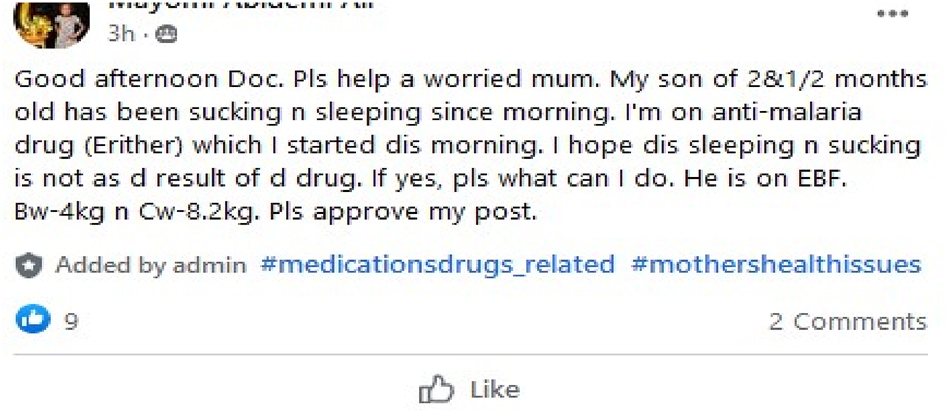
Excerpt 7 presents an instance of affective stance expression as depicted in, “Pls help a worried mum.”, as a stance object. Du Bois (2007) claims that “the object of a stance may be the proposition itself, a particular object in the discourse”. Being the initial sentence in the post, coming immediately after the usual phatic expression, seems strategic in the way the writer of the post intends to attract the attention of the online paediatricians. Aside from the initial positioning of the structure, its content is equally significant. The sentence has a covert stance subject, and the politeness markers, “please”; “help” serves as the stance predicate indicating the stance object, “a worried mother”. The lexical item, “worried”, as an attributive adjective in this instance captures the affective content of the mother, who perhaps uses the word not only to show how emotionally disturbed she is but also to attract prompt response and considerable attention for her proposition. The propositional scope affecting the stancetaker is thereafter presented to show a mutual relationship between the mother and the child in relation to their emotional feelings in line with the circumstantial propositional content. The mother is only able to communicate this experience better than the child but the fact is that both are affected.
Excerpt 8:

Two cardinal issues are highlighted in Excerpt 8. These are the stance focus and the stance lead. The stance focus is worry; in this case, the stancetaker orients to affective stance through “worried” as an adjective. The expression “I am worried” reflects the emotional feelings of the stancetaker but the cause of this emotional experience is the stance lead. In this case, the stance lead is the frustration of the stancetaker who is concerned about her daughter’s weight, the sudden change in her feeding habit and vomit. By saying “I had to introduce formula but to no avail” accentuates her frustration as a concerned mother. A striking strategy as an attention marker in the excerpt is repetition. The repetition of the affective stance statement seems to be a deliberate communicative strategy to achieve the stancetaker’s intention of attracting the attention of the paediatricians.
4.1.3 Affective as hypothetical markers
This relates to the expressive nature of affective stance where the stancetaker thinks, imagines and suggests ideas or situations based on supposition rather than fact. In a hypothetical situation, the verb is usually in the subjunctive mood, which means that the verb is used to express indications. Therefore, in subjunctive sentences, there are two essential elements, which are the indicative verb and the hypothetical scenario. The data show that Nigerian mothers express emotional feelings to online paediatricians in hypothetical ways. Some of them use hypothetical markers such as “hope”, and “wish” to express their concern and worry about the health status of their children.
Excerpt 9:

The post captures the affective expression of the emotion of a mother who is afraid because of the appearance of her child’s umbilical cord, and thereby hypothetically expresses her feelings. The stance focus, in this context, is fear, which evokes an unpleasant feeling of the stancetaker. The reason for this concern is what she observed in her child’s navel. Even when she is not sure whether what she has observed is normal or abnormal, she had expressed her feeling- “I am afraid”. Concerning this, she expresses her fear and concern hypothetically by saying “Hope is not infection”, which is a combination of an indicative verb and the hypothetical scenario. In this way, the stancetaker becomes suggestive in relation to the observed symptom and invariably implies how she expresses her fear. Therefore, the hypothetical marker “hope” is one of the ways Nigerian women express affective stance in online paediatric encounters.
Excerpt 10:

Excerpt 10 in particular shows the affectivity of a mother who expresses her concern about the health of her baby in a Nigerian hospital in the context of the COVID-19 pandemic. Specifically, the stance focus here is the stancetaker’s concern about her child are the diagnosed health condition (water in the brain), her inaccessibility to the hospital and to meet with doctors due to the COVID-19 pandemic and symptoms she observes in her child.
The expression “Pls, I hope the prolonged waiting is not gonna worsen her situation?” implies an affective stance expressed hypothetically. Here, “I” serves as the stance subject, “hope”, a feeling of desire, is the stance predicate and the “the prolonged waiting not gonna worsen her situation” as the stance object. In the light of this, as said earlier that in the context of affectivity, the object of evaluation (stance object) is what a person expresses as an overt emotional reaction to, or which one displays an affective orientation toward. The stancetaker orients towards the likely effect of “the prolonged waiting” on the health of her child as a concern.
The affective stance as hypothetical markers is one of the patterns Nigerian women use in online paediatric encounters to raise concerns about their children’s health in an attempt to get medical help, as analysed above.
4.2 Linguistic markers for the expression of affectivity
The predominant linguistic markers identified in the sample data are self-mentions and attitude markers. These are used to express an affective stance regarding concerns or worries about their children’s health. While the instances of self-mentions project affective representation, attitude markers foreground the affective attitude towards the proposition expressed.
4.2.1 Self-mention marker
Hyland (2007) explains that words that contain an explicit reference to the author are categorised as self-mentions in the stance scholarship. In this study, pronouns such as “I”, “my”, and “we” are identified. These functionally denote the degree to which mothers (post-writers) manifest themselves in their posts through first-person pronouns and possessive adjectives, which ultimately constitute authorial identity. They show the commitment of the self to the emotional feelings expressed in the proposition.
The first-person singular pronoun (I) indexing linguistic act of commitment
This is the most frequent self-mention element used in the sampled data. It is used as a marker of occurrent thoughts, intentions and feelings. Below are some of the instances.
“I am worried right now”
“I am scared”
“I am concerned about my ten-year-old male”
In each of the above expressions, the speaker presents herself as the author and agent of the linguistic act of possessing the affectivity or emotional feeling expressed in the proposition. They are not only the reference to the self but also overtly indexing perspectives of consciousness within the pragmatic context.
Possessive adjective indexing connection
The possessive adjective, “my” is deployed in the sampled data to present and establish the connection between the speaker and object towards which stance focus is directed. Instances are: “my son…”, “my baby of four months and…”, “my concern is …”, “my worry now is…”. In summation, mothers in this online platform use “my” to present their plight and presuppose that the health condition of their children is equally their problems in an affectionate and sympathetic context.
“we” indexing inclusiveness
The first person plural pronoun is used in this discourse of mothers to indicate that the speaker and the spouse (mother–father bond) and the speaker and the child (mother–child bond) are included in terms of affectivity. “We noticed it was choking her and …”, in this instance, the mother refers to herself and the spouse. In other instances such as: “we are on EBF.”, “we are on breastmilk and water…”, “we” is used to refer to the mother and the child.
In general, instances of the self-mentions as a linguistic marker of affectivity in this study represent stance subject, a marker of presentation of self, reference to the agent of emotional feelings to overtly index commitment to the propositional content and the stance focus.
4.2.2 Attitude markers
The attitude markers identified in this study are classified as deontic verbs, attitude adverbs, attitude adjectives, and cognitive verbs. They are used to express the speaker’s attitude towards the affective situations described or depicted. Examples of deontic verbs used to express the attitudinal desire for proposition expressed are “can”, “hope” and “would”. Instances of attitude adjectives, “worried”, “concerned”, “desperate”, mark out the degree of affectivity. Cases of attitude adverbs, “much”, “eventually”, “really”, “recently”, “slightly”, “urgently”, show the speaker’s attitude to the state of affectivity about the health condition of the children. Through these, mothers project their attitudinal expressions of disaffection towards the health conditions of their children in their respective posts.
5 Conclusions
This study examined the discourse patterns and linguistic markers of Nigerian mothers’ affective stance in online paediatric encounters. The findings of the study suggest that the extensive use of affective stance in the discourses examined reveals the social experiences of Nigerian mothers in dealing with paediatric issues and the pattern of inquiry in telemedicine encounters. In particular, the dominant presence of highly emotive words, worry and concern, justifies the use of affective stance by mothers who use the platform to pour out their feelings and ask for help. Linguistically, the self-mentions as a linguistic marker of affectivity in this study represent the stance subject, a marker of presentation of self, reference to the agent of emotional feelings to overtly index commitment to the propositional content and the stance focus. The attitude markers identified in this study are classified as deontic verbs, attitude adverbs, attitude adjectives, and cognitive verbs. They are used to express the speaker’s attitude towards the affective situations being described or presented. Furthermore, some grammatical infidelities in the composition of the sampled posts obviously show a cyber language and style. Perhaps, due to technological factors and anxiety, the emphasis is more on the message or idea being conveyed rather than the grammatical rules. The data also project Nigerian English usage with lexical items that point to specific socio-cultural realities of ailments common to children in Nigeria and the linguistic behaviour of mothers when faced with paediatric-related issues; especially how they use indigenous linguistic codes to describe the symptoms of the illnesses. The data also reveal the culture of respect and politeness marked by affectionate greetings and the predominant use of “please”. The study thus adds to the existing literature on telemedicine and child health studies in linguistic scholarship. As with any other study, there are some limitations to this study that could be considered in further studies. In the present study, due to its focus, only the features of affective stance in the posts of the mothers were considered. Future research could expand this scope and look at the interactional stancetaking of both mothers and the doctors from a pragmatic perspective to unfold stancetaking in the flow of action interaction.
About the authors
Ezekiel Opeyemi Olajimbiti lectures in the Department of English and Literary Studie, Federal University Lokoja, Nigeria. He has authored a considerable number of articles published in international journals, including Discourse Studies, Languages, Journal of Media Research, Journal for Discourse Studies, Language and Semiotic Studies, Africology: The Journal of Pan African Studies among others. He has chapter contributions to some books. Dr. Olajimbiti is a fellow of the George Forster Fellowship, Alexander von Humboldt Foundation Germany.
Samuel Olayiwola Ayoola, PhD, is a Lecturer in the Department of English and Literary Studies, Ladoke Akintola University of Technology, Ogbomoso. His areas of interest are pragmatics, discourse analysis and grammar.
Acknowledgements
The authors are grateful to the blind reviewers of this paper for their invaluable comments.
References
Akerkar, Shashank & Lata S. Bichile. 2004. Health information on the internet: Patient empowerment or patient deceit? Indian Journal of Medical Sciences 58(8). 321–326.Suche in Google Scholar
Algi, Sedef. 2012. Hedges and boosters in L1 & 2 argumentative paragraphs: Implications for teaching L2 academic writing. Published MA thesis, Middle East Technical University.Suche in Google Scholar
Balogun Mobolanle, Banke-Thomas Aduragbemi, Sekoni Adekemi Boateng Godfred, Yesufu Victoria Wright Ololade, Ubani Osinachi Abayomi Akin, Afolabi Bosede Ogunsola Folasade. 2021. Challenges in access and satisfaction with reproductive, maternal, newborn and child health services in Nigeria during the COVID-19 pandemic: A cross-sectional survey. PLoS One 16(5). e0251382. https://doi.org/10.1371/journal.pone.0251382.Suche in Google Scholar
Biber, Douglas & Edward Finegan. 1988. Adverbial stance types in English. Discourse Processes 11(1). 1–34. https://doi.org/10.1080/01638538809544689.Suche in Google Scholar
Biber, Douglas & Edward Finegan. 1989. Styles of stance in English: Lexical and grammatical marking of evidentiality and affect. Text 9(1). 93–124. https://doi.org/10.1515/text.1.1989.9.1.93.Suche in Google Scholar
Biber, Douglas. 2004. Historical pattern for the grammatical marking of stance: A cross-register comparison. Journal of Historical Pragmatics 5(1). 107–136. https://doi.org/10.1075/jhp.5.1.06bib.Suche in Google Scholar
Boyd, Danah. 2007. Social netork sites: Public, private, or what? The Knowledge Tree 13 (1). 1–7.Suche in Google Scholar
Chafe, Wallace & Nichols, Johanna. 1986. Evidentiality: The linguistic coding of Epistemology. Norwood: Ablex.Suche in Google Scholar
DenBesten, Pamela. 2000. Is teething associated with diarrhea? Western Journal of Medicine 173(2). 137. https://doi.org/10.1136/ewjm.173.2.137.Suche in Google Scholar
Diessel, Holger & Renny Coventry. 2020. Demonstratives in Spatial language and social interaction: An interdisciplinary review. Frontiers in Psychology 11. 1–14. https://doi.org/10.3389/fpsyg.2020.555265.Suche in Google Scholar
Du Bois, John W. 2007. The stance triangle. In R. Englebretson (ed.), Stancetaking in discourse: Subjectivity, evaluation, interaction, 139–182. Amsterdam: John Benjamins.10.1075/pbns.164.07duSuche in Google Scholar
Du Bois, John W. & Elise Kärkkäinen. 2012. Taking a stance on emotion: Affect, sequence, and intersubjectivity in dialogic interaction. Text & Talk 32(4). 433–451. https://doi.org/10.1515/text-2012-0021.Suche in Google Scholar
Gallant, Linda, Cynthia Irizarry & Gary Kreps. 2007. User-centric hospital ebsites: A case for trust and personalization. e-Service Journal 5(2). 5–26. https://doi.org/10.2979/esj.2007.5.2.5.Suche in Google Scholar
Gemmiti, Marco, Selei Hamed, Anna Lauber-Biasn, Johannes Wildhaber, Casette Pharisa & Petra Klumb. 2017. Pediatricians’ affective communication behaviour attenuates parents’ stress response during the medical interview. Patient Education and Counselling 100(3). 480–486.10.1016/j.pec.2016.09.006Suche in Google Scholar
Goodwin, Marjorie, Asta Cekaite & Charles Goodwin. 2012. Emotion as stance. In Marja-Leena Sorjonen & Anssi Peräkylä (eds.), Emotion in interaction, 16–42. New York: Oxford University Press.10.1093/acprof:oso/9780199730735.003.0002Suche in Google Scholar
Herring, Susan C. 2001. Computer-mediated discourse. In Deborah Tannen, Deborah Schiffrin & Heidi Hamitton (eds.), Handbook of discourse analysis. Oxford: Blackwell.Suche in Google Scholar
Hunston, Susan & Thompson Geoff (eds). 1999. Evaluation in text: Authorial stance and the construction of discourses. New York: Oxford University Press.10.1093/oso/9780198238546.001.0001Suche in Google Scholar
Hyland, Ken. 2005. Stance and engagement: A model of interaction in academic discourse. Discourse Studies 7. 173–192. https://doi.org/10.1177/1461445605050365.Suche in Google Scholar
Hyland, Ken. 2007. Applying a gloss: Exemplifying and reformulating in academic discourse. Applied Linguistics 28(2). 266–285. https://doi.org/10.1093/applin/amm011.Suche in Google Scholar
Kiesling, Scott, Umashanthi Pavalanathan, Jim Fitzpatrick, Xiaochuang Han & Jacob Eisenstein. 2018. Interactional stancetaking in online forums. Computational Linguistics 44(4). 683–718. https://doi.org/10.1162/coli_a_00334.Suche in Google Scholar
Logren, Aija. 2024. Affective stance. In Alexandra Gubina, Elliott M. Hoey & Chase Wesley Raymond (eds.), Encyclopedia of terminology for conversation analysis and interactional linguistics. Los Angeles: International Society for Conversation Analysis (ISCA). Available at: https://doi.org/10.17605/OSF.IO/WV3H4.Suche in Google Scholar
Ochs, Elinor & Bambi Schieffelin. 1989. Language has a heart. Text 9(1). 7–25. https://doi.org/10.1515/text.1.1989.9.1.7.Suche in Google Scholar
Ochs, Elinor. 1996. Linguistic resources for socializing humanity. In J. J. Gumperz & S. C. Levinson (eds.), Rethinking linguistic relativity, 407–437. Cambridge: Cambridge University Press.Suche in Google Scholar
Olaniyan, Olanrewaju & Odubunmi Sunkanmi. 2012. Demand for child healthcare in Nigeria. Global Journal of Health Science 4(6). 129–140. https://doi.org/10.5539/gjhs.v4n6p129.Suche in Google Scholar
Robles, Jessica S. & Ann Weatherall. 2021. How emotions are made in talk. Amsterdam: John Benjamins.10.1075/pbns.321Suche in Google Scholar
Siemens, George. 2006. Connectivism: Learning and knowledge today. Global Summit 2006: Technology connected futures. http://admin.edna.edu.au/dspace/bitstream/2150/34771/1/gs2006_siemens.pdf.Suche in Google Scholar
Sinha, Ashnish, Tom Porter & Andrew Wilson. 2018. The use of online health forums by patients with chronic cough: Qualitative study. Journal of Medical Internet Research 20(1). 1–9. https://doi.org/10.2196/jmir.7975.Suche in Google Scholar
Smaihodzic, Edin, Wyanda Hoojsma, Albert Boonstra & David Langley. 2016. Social media use in healthcare: A systematic review of effects on patients and on their relationship ith healthcare professionals. BMC Health Services Research 16. 442. https://doi.org/10.1186/s12913-01691-0.Suche in Google Scholar
UNICEF. 2021. Situation of women and children in Nigeria. https://www.unicef.org/nigeria/situation-women-and-children-nigeria.Suche in Google Scholar
World Health Organization. 2010. Telemedicine: Opportunities and development in Member States: Report on the second global survey on eHealth. https://apps.who.int/iris/handle/10665/44497.Suche in Google Scholar
Yang, Hangzhou & Huiying Gao. 2018. Toward sustainable virtualized healthcare:Extracting medical entities from Chinese online health consultations using deep neural networks. Sustainability 10. 3292. https://doi.org/10.390/su10093292.10.3390/su10093292Suche in Google Scholar
Zhang, Yu. 2020. Affective-discursive practice in online medical consultations in China: Emotional and empathic acts, identity positions, and power relations. PhD Thesis. Hong Kong Baptist University.Suche in Google Scholar
© 2025 the author(s), published by De Gruyter on behalf of Soochow University
This work is licensed under the Creative Commons Attribution 4.0 International License.
Artikel in diesem Heft
- Frontmatter
- Reconstructing and translating regional cultural ideo-symbols through comparative glocalism: the case of Jiangsu
- Discourse patterns of affective stance in paediatric online consultative encounters
- Ecology in politics: a multimodal eco-critical analysis of environmental discourse
- A multimodal discourse analysis of in-text images of Nigerian literature texts for primary schools
- Decolonizing the teaching of foreign languages in multicultural communities: a case study of the teaching of English in Togo (West Africa)
- Pan-indexicality and prompt: developing a teaching model for AI-mediated academic writing
- The Orient and Morgenland in German discourse: a semiotic and postcolonial analysis
Artikel in diesem Heft
- Frontmatter
- Reconstructing and translating regional cultural ideo-symbols through comparative glocalism: the case of Jiangsu
- Discourse patterns of affective stance in paediatric online consultative encounters
- Ecology in politics: a multimodal eco-critical analysis of environmental discourse
- A multimodal discourse analysis of in-text images of Nigerian literature texts for primary schools
- Decolonizing the teaching of foreign languages in multicultural communities: a case study of the teaching of English in Togo (West Africa)
- Pan-indexicality and prompt: developing a teaching model for AI-mediated academic writing
- The Orient and Morgenland in German discourse: a semiotic and postcolonial analysis
