
A multimodal analysis of Piggyvest’s animated advertisement videos
-
Toluwani Deborah Odedeyi
Toluwani Deborah Odedeyi holds a Bachelor of Arts degree in Linguistics from the Department of Linguistics and Nigerian Languages, Adekunle Ajasin University, Akungba Akoko, Nigeria. She has just completed her Master of Arts degree in Linguistics in the Department of Linguistics and African Languages, University of Ibadan. Her interest intersects language and context.
Temitope Michael Ajayi, PhD, is a recipient of the postdoctoral fellowship of the African Humanities Program, US, and the Georg Forster Postdoctoral Fellowship of the Alexander von Humboldt Foundation, Germany. He teaches linguistics in the Department of Linguistics and African Languages, University of Ibadan, Nigeria. His areas of interest include (forensic) pragmatics, discourse analysis, sociolinguistics, and applied linguistics. He has several articles in reputable journals across the globe.


Abstract
This study examines the persuasive strategies in selected animated advertisement videos by Piggyvest, the first and one of the fastest-growing online savings platforms in Nigeria, whose modus operandi is quite different from those of the conventional banking system. Drawing insights from Kress and van Leeuwen’s (2006. Reading images: The grammar of visual design, 2nd edn. New York: Routledge) Multimodal Discourse Analytic framework, 12 samples of Piggyvest’s animated videos (for advertisements) were randomly sampled out of the 30 videos initially purposively sampled. Findings reveal metaphorisation of financial management and discipline, playing around gender-related ideas on finances, foregrounding of aspirations and financial decisions, depiction of cognitive strength and weakness on money matters, and striking a connection between money and relationships are persuasive strategies deployed in the animated advertisement videos by Piggyvest to appeal to their target audience.
1 Introduction
Since the advent of the social media, a lot of businesses have been confronted with the question of how to deploy it for advertisement and marketing purposes, particularly in relation to animation. Automating the local piggy bank (kóló[1]) saving culture, Piggyvest, launched in 2016, is the pioneering and leading online savings and investment platform in Nigeria. Piggyvest (which evolved from its founding name PiggyBankNG) is driven by its quest to meet the everyday needs of its users – flexible savings and investments, among others. Piggyvest operates using an application that is available on both Android and iOS. It requires no deposit or monthly fees, and the interface of both the web and mobile applications is user-friendly. Piggyvest has a variety of products for savings. The five features include: Piggybank, Safelock, Targets, Flex Naira, and Flex Dollar. Operators of Piggyvest use social media accounts, especially Instagram, TikTok, and Twitter to persuasively advertise their products and services to their customers who are predominantly young Nigerians.
Given the pivotal role persuasive language plays in advertisements, it has received adequate attention from language scholars, particularly as it relates to telecommunications products, foods and beverages, and household materials, among others. However, with the emergence of the use of the social media in the advertisement of products, there has been a new dimension to advertisements, as textual and animated resources (multimodal resources) have been carefully harnessed by advertisers to appeal to and persuade their target audience. This study is an attempt to demonstrate how multimodal resources are combined in the animated advertisements of sensitive products and services in the financial technology space on social media, with particular reference to Piggyvest. As such, this study’s objectives include the identification and description of the multimodal elements deployed in Piggyvest animated advertisements; and a demonstration of how textual and visual resources are strategically connected in Piggyvest’s advertisements as a persuasive strategy to win customers.
2 Review of relevant studies
Social Media was first used in 2004. It is the form of electronic communications through which users create online communities to share information, ideas, personal messages, photographs and other content (Merriam Webster Dictionary 2014). According to Rainie and Wellman (2012), virtual communities like Facebook, Twitter, WhatsApp, etc. are basically for socialising as well as getting current information on events while LinkedIn is a business interaction platform; and Instagram is a social bookmarking tool for finding specific information, news, and images, etc. With the growing usage of the Internet and smartphones, social media platforms have become essential marketing and advertising tools in the contemporary world. Marketing practitioners have been using various social media platforms to promote their products and alter consumer attitudes and buying behavior toward their brands.
Social media marketing involves the creation of appealing content on different social media sites to create awareness and gain new and existing customers’ attention; it is marketing through online communities and social networks as opposed to traditional marketing channels like television, radio and print media (Olotewo 2016). Karjaluoto et al. (2015) conduct a survey of 60 companies and identified three key sections where social media may assist organisations. They used a case study to highlight the power of social media, which is establishing a relationship with clients, assisting with turnover (sales), and raising awareness. Järvinen and Tarminen (2016) also carry out a study on how companies employ social networking sites for promotion. They concluded that companies that provide informative, funny, and relevant information on their social media accounts make more money than those that do not. Similarly, Khan and Karodia (2013) reveal that more than 94 percent of South African big businesses use social media methods when targeting customers in a study on the usability of social networks for advertisement. Accordingly, 71 % agreed that the platform was beneficial for creating business awareness. Observable in advertisement of products is the strategic use of persuasive language. Persuasion is the use of messages to influence an audience (Asemah 2012). Nweke (2001) says persuasion is a systematic and skilful method of creating awareness aimed at changing or strengthening opinions, attitudes, beliefs, or values, for a more positive outcome. This perhaps explains why Ugande (2001) claims that persuasion is a skilful presentation of ideas and messages to various publics, with the intention of producing the desired result.
Animation is one of the ways to make social media advertisements interesting, persuasive, and effective. Goel and Upadhyay (2017) define animation as the sequencing of a series of static images to create the illusion of movement. Animation is a common phenomenon in the use of social media, and the internet in general. Simply adding animated web banners on websites makes it more interactive and attractive for the visitors (Stock et al. 2007). The use of rich media in online advertising helps in breaking through the clutter on the Internet. Rich media commercials use multimedia (e.g. motion, sound, animation, and interaction) and sophisticated technology that exploits sensory traits such as video, audio, and animation (Rosenkrans 2010). The growing necessity to scrutinise meaning beyond just the ordinary level of language use in several communication contexts, such as advertisements, the notion of multimodality has been developed and explored to explain textual structure, not by single mode of composition, but visually through layout, color, and typography both at the level of text and that of discourse (Liu 2013).
Machin and Thornborrow (2003) investigate the use of multimodality to communicate globalisation (global branding) in Cosmopolitan Magazine’s 44 national localised editions, which are disseminated worldwide. They used a multimodal discourse analytic strategy to comprehend global branding in the context of globalisation. They particularly investigated whether the localised versions of Cosmopolitan (Cosmo) symbolised globalisation. They were able to demonstrate how the magazine produced a fantasy world via the use of low-modality imagery, which enabled a certain kind of agency, primarily sex, to represent authority. They extrapolated that the multimodal manifestations of Cosmo discourse allowed women to signal their affiliation with the Cosmo world through means such as the cafés they frequented, the clothing they wore, and the way they danced.
Chouliaraki (2004) also investigates multimodality using the semiotic components (pictures) and the verbal accounts of the film “11 September.” In her argument, the use of video footage including pictures (as a representation of semiotic components) to accompany a vocal report (as a representation of spoken language) of three themes with distinct temporal dimensions might provide meaning and influence the moral horizon of the viewer. She identified the ways in which the television spectacle engaged the emotive capacities of the viewer. Bezemer and Kress (2008) explore the presentation of multimodality in learning materials, including textbooks, digital resources, and teacher-created materials. They suggested that both written and moving visuals played essential roles in creating meaning for learning materials. They confirmed that the uses and forms of writing had undergone significant changes over the past few decades, and that, as a result, digital media as a representation of the semiotic account of designing learning materials had supplanted the (text) book and demonstrated a greater distribution of learning resources. They also found that there was a shift from writing to images as the primary medium of representation. Similar to the two earlier research works, Bezemer and Kress (2008) limit their discussion to the topic of multimodality in educational learning resources.
While the present study draws analytical insights from extant studies on multimodality, especially in the Nigerian context, it is significantly different in that it focuses on the persuasive use of multimodal elements in the Nigerian financial context, particularly in relation to Piggyvest, the foremost and fast-growing online savings platform that has attracted a lot of Nigerian youths. Given the sensitive nature of finance and money matters among Nigerians particularly, a study of this nature reveals how Piggyvest has been able to pragmatically project itself as a financial institution capable of managing the monetary/financial life of Nigerians (and particularly the youths). The study further demonstrates the important nexus between textual and non-textual materials in advertisement communications.
3 Theoretical framework
This study benefits from the tenets of multimodal discourse analysis (MDA). MDA is concerned with how different semiotic systems complement one another in the creation of meaning (Matthiessen 2007; Vovilas et al. 2010). These semiotic systems are usually referred to as multimodal resources and are effective tools for achieving communicative goals. The contextual approach of MDA introduced by Kress and Van Leeuwen (2006) is adopted for this study, given its usefulness in unpacking the various textual and non-textual elements in the data analysed in this study. This approach is based on Halliday’s (1978) socio-semiotic approach to text, society and culture. A Social Semiotic approach to multimodality directly theorises the possible ways in which meanings can be potentially created using different semiotic resources. Multimodality focuses on how semiotic resources can be combined in texts to communicate meanings.
Social semiotics is rooted in the semiotic theory of representation, informed by De Saussure (1916) and defined as “the study of signs and sign processes and meaningful communication” (de Saussure 1916). However, semiotics has metamorphosed from the study of signs in philosophy to include social semiotics in Linguistics. Halliday (1978, 1985 regards language as a set of semiotic resources, an approach that is concerned with representing ideas, people and concepts and identifying how these resources can form a range of meanings, and explaining how they are used for specific purposes in social contexts (Machin and Mayr 2012: 11). Based on Halliday’s (1978) Systemic-Functional Linguistics, Kress and van Leeuwen in their joint work Reading images – The Grammar of visual design, created a visual social semiotic approach, to describe meanings made by images along with their writings.
Halliday proposed three metafunctions in systemic-functional linguistics. Adami (2015) states that three metafunctions of Halliday define and describe the resources through which visual texts can:
Tell something about the world such as thing, person, place, etc. (Ideational)
Tell something about the participants such as authors and addresses. (Interpersonal)
Through cohesive, thematic devices and lexis look upon structure and different truth values. (Textual)
According to Halliday (1978), language is a system and mode to realise the three Metafunctions. It means that multimodality looks at the language combined with writing excluding other semiotic resources. On the other hand, Kress and van Leeuwen (1996) argue that ‘Multimodality’ as a term refers to several types of modes in human communication such as visual, audio, written, oral, and spatial (1996, 2003; Pan 2015). In this way, Kress and van Leeuwen introduced their own three metafunctions (representational, interactional and compositional) by extending Halliday’s three metafunctions (ideational, interpersonal and textual) to all semiotic resources present in a context to understand the meaning-making process of all the modes. The metafunctions extended by Kress and van Leeuwen (1996) help a researcher in breaking down an image or multimodal elements into pieces of information to understand the meaning of a context suggested by them. Thus, according to Kress and van Leeuwen, the visual social semiotics approach can tell us something about:
The world such as people, things, and places based on narrative image and conceptual image, classification process, analytical process, and symbolic process. (representational)
Relationship between participants and the audience based on distance, contact, and attitude. (interactional)
The text and structure through placement, salience, and framing of several elements. (compositional).
3.1 Representational metafunction
Representational metafunction investigates how actions and ideas are chosen in images (see Stoian 2015). In other words, the realisation of individuals, events (processes), and related conditions is shown by the representational metafunctions. As noted by Kress and van Leeuwen (2006), two different kinds of representational processes are narrative and conceptual processes. Narrative processes, which are concerned with actions, emotions, cognition, and speech, are the first category of representational processes. Both transactional and non-transactional storytelling processes are possible for the categories of the narrative process. The distinction between these two categories (actor/goal, reactor/phenomenon) hinges on whether the viewers can see both participants. The conceptual process is the second kind of representational process. Participants who are being represented are gathered in groups to convey to the viewers who or what they stand for. Symbolic processes are one type of conceptual process. This kind just establishes an image’s symbolic meaning. This procedure may be symbolic attribute or symbolic suggestive.
3.2 Interactional metafunction
Interactional metafunction describes the connection between representational and interactive participants (viewers). The subtypes of this metafunction include touch, social distance, gaze, and modality (Motta-Roth and Nascimento 2009). Demand and offer are two interaction categories. The distinction between these two types relies on whether or not representational and interactive players make eye contact. This metafunction’s second category is social distance. The social distance defines the gap between individuals who are depicted and those who are interactive. Five degrees of social distance exist: near personal (close shot), distant personal (medium-close shot), medium-long shot, long shot, and public distances. Gaze is the third type of interactional metafunction. The target of gaze is unaware of the current viewer during the stare. There are five types of gazes: spectator’s gaze, intra-diegetic gaze, extradiegetic gaze, averted gaze, and camera look. The spectator’s gaze represents the gaze of interactive participants towards the portrayed participants. Intra-diegetic gaze depicts the gaze of depicted characters toward other represented characters. Thirdly, extra-diegetic gaze refers to the gaze of represented participants toward interactive participants. When one of the depicted individuals avoids the gaze of the other represented participants, the averted gaze occurs. Finally, the look of camera indicates how the camera saw the portrayed individuals. The fourth category of the interactional metafunction is attitude (perspective). In subjective image, there are two prominent and simultaneous choices: involvement/detachment and power. When designers present participants from a frontal point of view to the viewer, they make involvement between them. On the other hand, when designers present participants from an oblique point of view to the viewer, they make a separation between them. With respect to power, there are three possible choices: viewer superiority, viewer inferiority, and viewer equality. If the represented participants are presented from a high angle the viewer is looking down at the represented participants (bird’s eye view). If the represented participants are placed in place of power, they are looking down at the viewers (ant’s-eye view). In eye level point of view, there is equality between both represented participants and the viewers.
Finally, modality (credibility) refers to the degree of normality of images. Colors and contextualization are two modality markers. According to Kress and van Leeuwen (2006), contextualization is a “scale running from absence of background to the most fully articulated and detailed background” (p. 165). Color saturation, color differentiation, and color modulation are three scales of color. Kress and van Leeuwen (2006) define the color saturation as the scale which begins with full color saturation and finishes with the absence of color as in black and white. Also, they define color differentiation as the scale which begins with a maximally diversified range of colors and finishes in monochrome. Finally, color modulation scale begins from fully modulated color to unmodulated or flat color (e.g. different shades of blue).
3.3 Compositional metafunction
Compositional metafunction indicates “the way in which representational and interactive elements are made to relate to each other; the way they are integrated into a meaningful whole” (Kress and van Leeuwen 2006: 176). Three elements are categorised under the compositional classification: information value, framing, and salience. The information value relates to the relative position of different elements to each other. These locations may be polarised and centered. In the first kind, designers position the information’s core in the middle and its peripherals around it (circular). In other types, designers situate the information’s core in the middle and its peripherals on the right and left. The designer places information horizontally (given/new) and vertically (real/ideal) in polarized information value.
The second type of compositional metafunction is framing. This categorisation assesses the degree to which the verbal and visual layers are connected or disconnected. Finally, salience is the ability which allows viewers to judge the importance of various elements in relation to each other. The degree of saliency is determined by size, color contrast, tonal contrast, and sharpness of focus. The first salience indicator is the size; thus larger objects are most salient than other objects. The second salience indicator is sharpness of focus. As such, objects which are more easily noticed by the eyes are more sharply focused and most salient than other objects. The third salience indicator is the tonal contrasts. The tonal areas are more salient than other areas, for example black borders are placed on white spaces. The fourth salience indicator is the color contrast. The contrast which exists between highly saturated colors and softer colors.
Essentially, elements of these three metafunctions drive our data analysis and discussion in this study.
4 Methodology
This study is qualitative in nature. Data (Figures 2–13) comprised 12 randomly sampled (out of the initial 30 purposively sampled videos) animated advertisement videos on Piggyvest’s TikTok page where animated videos, acknowledgement images, lexical items, colors, and numerous other semiotic modes through which social meanings are negotiated to persuade customers are posted. These videos were used for the brand’s advertisement from January 2022 to January 2023. TikTok was selected as the research context because it is the most widely used social media platform for the posting of animated advertisements by Piggyvest. The figures analysed in the study were such connected by persuasive elements. The animated videos were carefully watched; categorised based on their pictorial and textual contents and presented for analysis in this study based on their persuasive strategies. Relevant images were screenshot and presented as samples for analysis. Data were subjected to multimodal discourse analysis (MDA), with particular reference to Kress and van Leeuwen’s (2006) metafunction elements of MDA. Figure 1 represents the homepage of Piggyvest’s TikTok account where data were sourced.
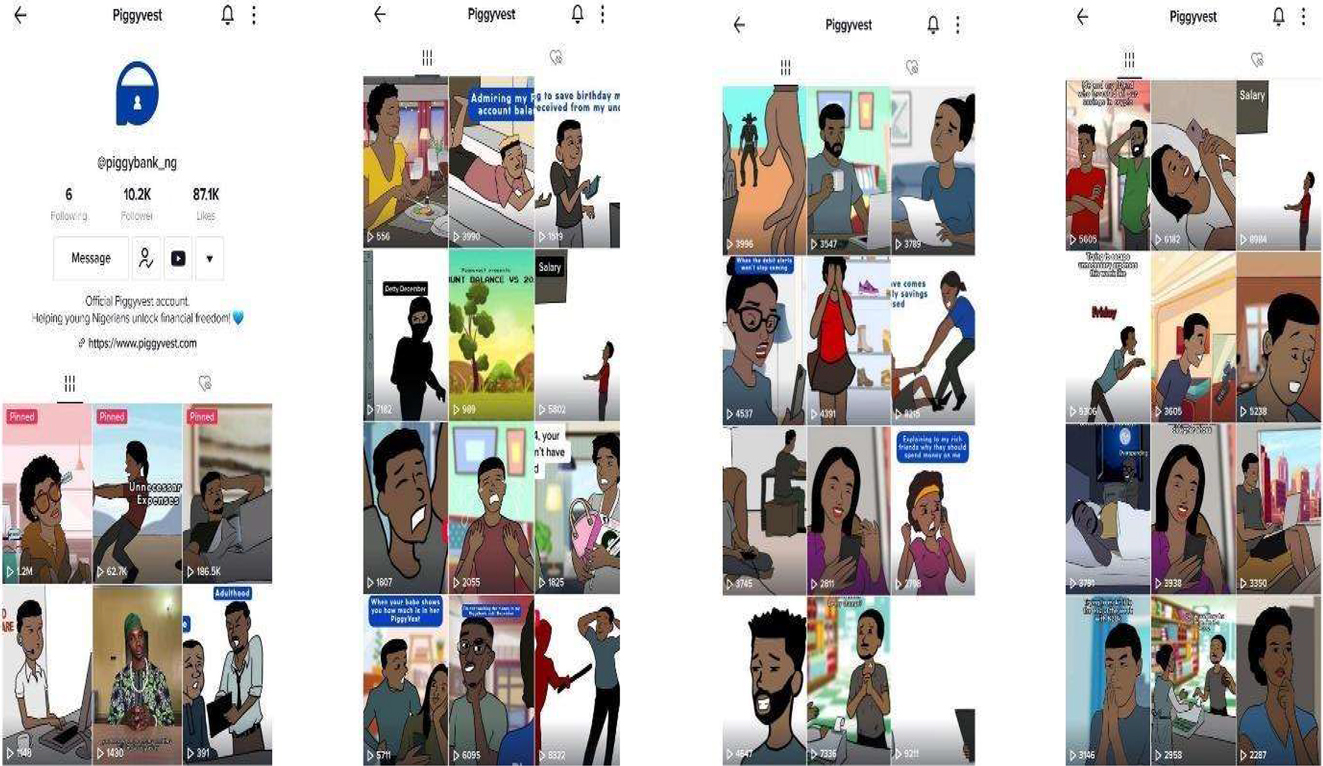
A picture showing the homepage of Piggyvest’s TikTok account.
5 Data presentation and analysis
This section of the study focuses on the textual and pictorial analyses of the sampled data. Our discussion is predicated on the argument that an image can bear a myriad of messages; hence they are the center of attraction because visual components are more effective than the words (Olowu and Akinkurolere 2015). This is in line with Hopkins’s (1923: 23) submission that “Don’t think that those millions will read your advertisements to find out if your product interests (them). They will decide by a glance – by your headline or your pictures” (Pan 2015). Thus, an image can have a great effect on people because such image is designed to be attention-grabbing, and it is quicker in conveying messages and meanings than the words.
5.1 Metaphorisation of financial management and discipline
Piggyvest adopts the metaphorical strategy or approach of representing the concept of financial management or discipline in their animated adverts. The animated adverts associated with this concept are identified and analysed below:
Figure 2 is multimodal because it has both verbal and visual layers. In Figure 2(a), the subject is the bank account being represented by a bound, unhappy individual who is being extorted forcefully by two other participants represented as “Detty December” and “Enjoyment”. These two participants are presented as robbers, who have forcefully made their way into a bank account. In Figure 2(b), the subject is presented as Piggyvest, being represented by a calm, fearless individual who cannot be robbed by “Detty December” and “Enjoyment”. Detty December is a common Nigerian slangy expression that means a pleasure-driven December. December, especially during Christmas and New Year celebrations, is a time when a lot of Nigerians lavishly and impulsively spend money on food, partying, enjoyment and lots more (Ajayi 2020). Characteristically, many people, having lavishly spent their savings for Christmas and New Year celebrations in Decembers, end up going bankrupt in the following month (Januaries). An individual that however saves his money with Piggyvest does not go through this frivolous spending that comes with the festive season.
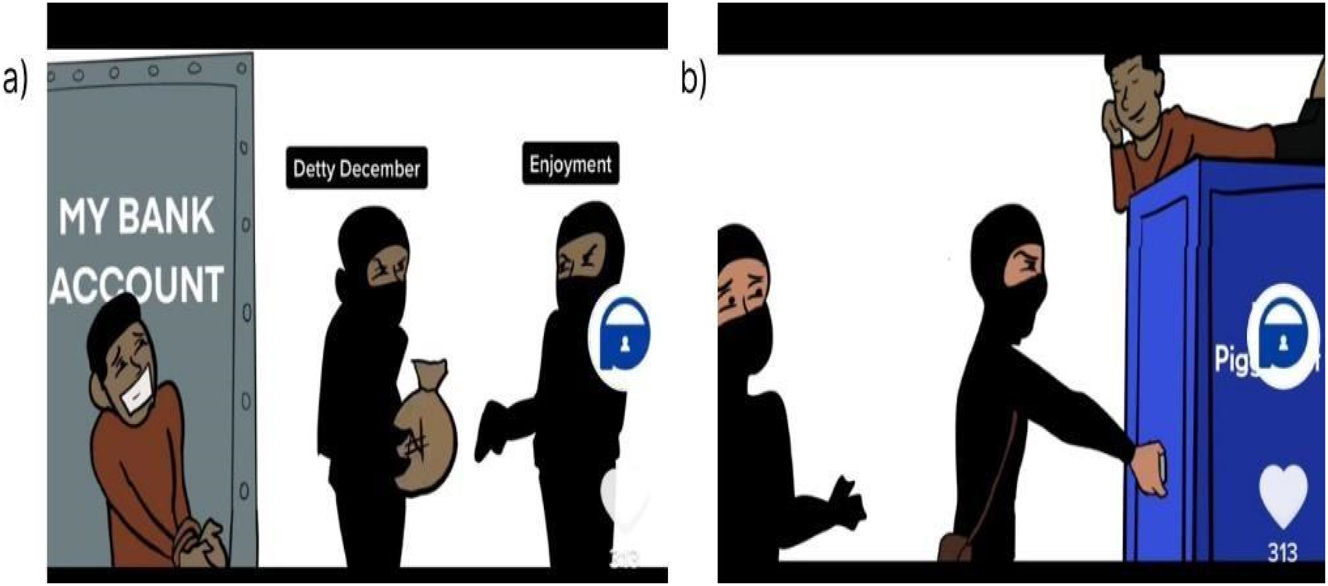
Piggyvest as a rescuer.
At the representational metafunction level, figures (a) and (b) have both the narrative process and the conceptual process. The narrative process has both actional and reactional processes. In terms of the actional, the viewers can see the robbers, Detty December and Enjoyment (actors) carrying out a robbery act on a bank account (goal). In terms of the reactional, the viewers can see the Bank Account and Piggyvest (reactors) who are looking at the robbers (phenomenon). Moreover, the unhappy and fearful face of the bank account shows that money is not safe from unnecessary spending, while the calm and fearless face of Piggyvest shows that one’s money is safe and secure from unnecessary spending and expenses when saved with Piggyvest. At the conceptual process level, the images in figures (a) and (b) are metaphorical. The individual in figure (a) metaphorically represents a bank account from which the money (savings) is being spent on enjoyment and frivolities, which is actually against the purpose for which it was kept there, hence the reason for the sad and fearful face the individual wears. For figure (b), the individual metaphorically representing the money kept in Piggyvest, exhibits calmness and fearlessness birthed by the confidence that his money would not be affected by the frivolities and lavish spendings that come with Decembers. This persuasively foregrounds the fact money saved in Piggyvest is safe, especially in situations when people get involved in uncontrolled and impulsive spendings.
At the interactional metafunction level, figures (a) and (b) are offers, because none of the represented participants looks directly at the viewers. Also, the images are subjective and are captured by a horizontal frontal angle, and the viewers are involved with the represented participants. While this persuasively dissuades viewers/target audience from saving money in flexible bank accounts which could be accessed at will by the depositor, it encourages them to choose Piggyvest, where their saved money is safe till the period automatedly indicated for withdrawal. The power view between the represented participants and the viewers is equal. Furthermore, there are four kinds of gazes in this image, including the spectator’s gaze, intra-diegetic gaze, the look of the camera, and the averted gaze. With respect to social distance, this image is shot at a medium-close far personal distance. For modality, Detty December and Enjoyment are shown to wear dark-colored clothes (metaphorically representing evil as commonly believed among Nigerians); Piggyvest is represented in blue, Piggyvest’s brand color, implying freedom and safety.
At the compositional metafunction level, the information value of these figures shows that it is center-based. The bank account and Piggyvest are the nucleus of information, while the other participants are placed beside them. Although the designers of the animations place both the text and the image in separate frames, the animations are strategically superimposed on the text in the bigger frame to make a connection between the text and the image. From the Salience perspective, the boxes representing bank account and Piggyvest are foregrounded, (made bigger than other images) which confirms the fact that the advert is mainly about finances.
Figure 3 comprises both verbal and visual layers. The subject of this image is a man in his youthful age, who is attacked in the street by three dangerous-looking individuals. Inscribed on their shirts are: “Unnecessary Expenses”, “Overpriced Items”, and “Wasteful Spending”. The young man is left alone after the trio discovers that he has no money on him. He later meets with “Piggyvest”, metaphorically represented by an individual wearing “blue”. He asks about the safety of his money and Piggyvest responds his money is intact. The import of the scenario presented in this figure is that, the man in question makes a wise decision by saving his money with Piggyvest, hence it has been impossible for the ferocious trio of “Unnecessary Expenses”, “Overpriced Items”, and “Wasteful Spending” to cart away his money when they visit him. The narration on the figure depicts the fact that in the everyday living of an average young Nigerian, “Unnecessary Expenses”, “Overpriced Items”, and “Wasteful Spending” are like thieves or armed robbers that unexpectedly show up with the aim robbing one of one’s financial possessions, but a wise person who saves with Piggyvest will be free from such untoward experience because there will be no cash available to be stolen from one. Behind the represented participants, viewers can see buildings, traffic lights, tarred roads, and trees. All of these suggest that, while going about the day’s business in the streets, one may be faced with some unexpected financial situations. Saving one’s money with Piggyvest, however, prevents, protects or saves one from these unexpected spendings. At the representational metafunction level, Figure 3 uses the narrative process. In the narrative process, the represented participants make an actional kind of narration. Thus, the figure has three actors (“Unnecessary Expenses”, “Overpriced Items”, and “Wasteful Spending”) carrying out an act on a specific goal (the young man).
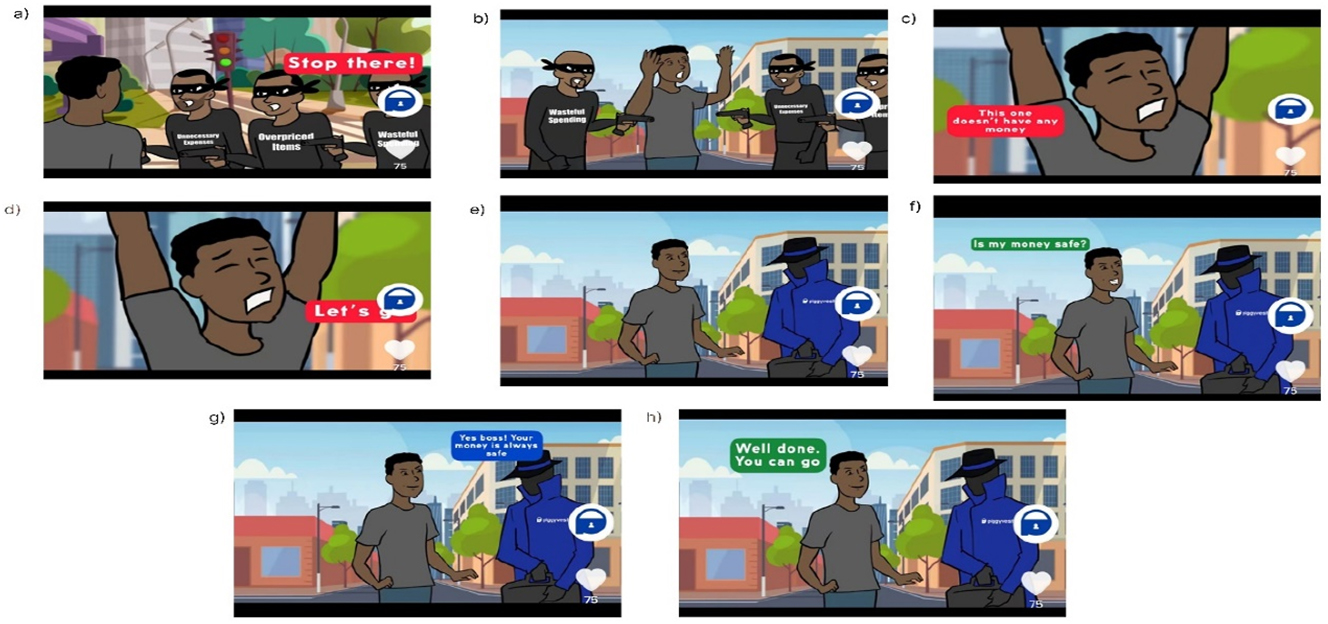
Piggyvest as a provider of financial security.
At the interactional level, the figure is an offer, because none of the represented participants looks directly at the viewers. This figure is taken from a frontal angle and has a high level of involvement with the viewers. This engenders an easy understanding of the subject’s emotions by the viewers. From the power or perspective view, none of the represented participants is dominant on the viewers. There are three types of gazes observed, including the spectator’s gaze, intra-diegetic gaze, and the look of the camera. The image is shot at a medium-close distance, in which the viewers can see the represented participant’s face and other parts to the waist. This makes their emotions and body language more visible and easily felt by the viewers. The figure is relatable because it shows how colorful the streets look, making it possible to establish between the image and the real life. The designer of this figure shows the background, the road, in a hazy manner, such that he places the participants in front of the visual to attract the viewer’s attention.
At the compositional level, designers place both the text and the image in separate frames, but both referentially connect to indicate the conversational or dialogic relationship between them. The connection shows that the texts in the figure (both linguistic and non-linguistic) are conversations made by the participants. For salience, the texts from the participants presented as robbers are placed in a red frame, to show negativity, danger (as believed in the Nigerian context). The text from the individual being accosted or attacked is placed in a green frame while the text from Piggyvest is placed in a blue frame, being Piggyvest’s brand color.
5.2 Playing on gender-related ideas on finances
A critical assessment of a good number of Piggyvest’s animated advertisements reveals they are centered on gender-related ideologies about money making, savings and money spending. Taking a general look at the adverts, it is observed that women are portrayed to be frugal and more money-saving-oriented (hence richer) relative to men. The animated adverts associated with this concept are identified and analysed below:
Figure 4 also features both verbal and visual resources. This figure shows the gestural expression of a man when he views his lover’s Piggyvest savings account. Seeing the huge amount saved in the account, the man expresses shock and surprise because the amount in the account is far higher than what he ever envisaged. The focused participant in the figure is the man, as evident in his size, which speaks of his salience in the image. The lady has a look and composure that shows satisfaction and confidence.
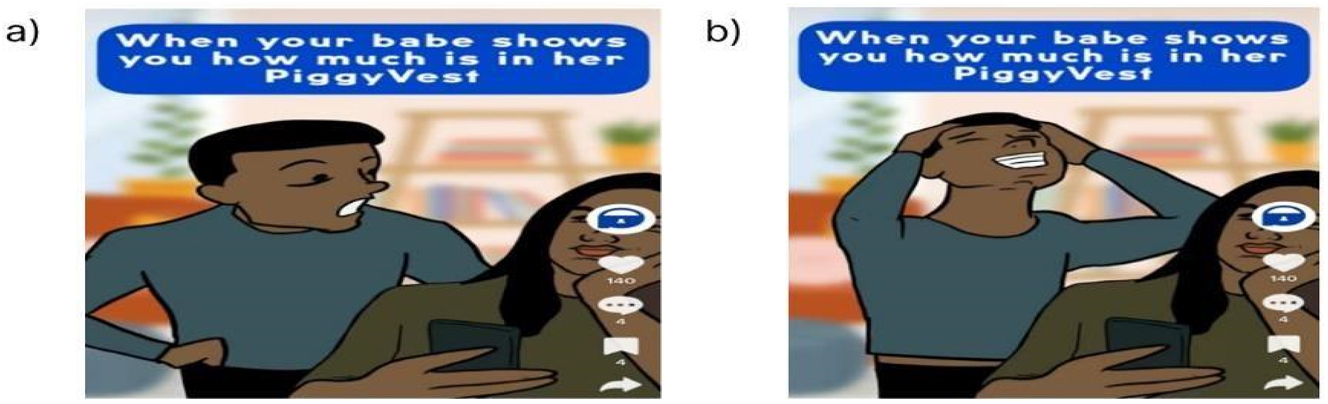
Women and money matters.
At the representational metafunction level, Figure 4 adheres to both the narrative and the conceptual patterns. The narrative process has the actional process; the viewers can see the man (actor) looking at the woman’s phone (goal). For the conceptual pattern, this figure is symbolic because it shows a young woman with a good saving culture. The woman is the carrier of satisfaction, which comes with having a good saving culture, which is depicted to be common among Nigerian women. All elements or details of participants, such as the shirts, phone, hair and environment show that they pertain to the younger age.
At the interactional level, the figure is an offer, because none of the represented participants looks directly at the viewers. This visual is taken from a frontal angle and has a high level of involvement with the viewers. This enables a clearer view of the participant’s face, thereby making their emotions more evident to the viewers. From the power or perspective view, none of the represented participants is dominant on the viewers. There are three types of gazes observed in the figure, including the spectator’s gaze, the intra-diegetic gaze, the averted gaze, and the look of the camera. The image is shot at a medium-close social distance, in which the viewers can see the represented participant’s face and other parts to the waist. This makes their emotions and body language more visible and easily felt by the viewers.
At the compositional level, designers place both text and image in separate frames, but the frames are put together in a bigger frame to make a connection between the text and image, to show that the text is the description of the reason for the man’s facial expression. For salience, the text from the participant is placed in a blue frame to strategically foreground the positivity that comes with saving with Piggyvest.
Figure 5 is designed around a woman whose work schedule allows her to work from home. The laptop on the table and the notepad typify the typical setting of an employee working from home. The man in the figure is the woman’s husband (as evident in his reference to the lady as babe) who checks her bank notification and notices she has just two thousand Naira in her account with one of the conventional banks in Nigeria. However, when he checks her Piggyvest account, Piggyflex (a flexible saving feature on Piggyvest), he observes she has one hundred and fifty thousand Naira in the account; and when he checks further he notices another savings feature, Safelock, on her account and observes the sum of two million, two hundred thousand Naira in the account. He becomes highly surprised his wife whom he had thought was broke, has such huge amount of money in her account. But the wife, in her reaction to her husband’s shock, notes the money is saved in the account for emergencies, a statement which immediately suggests to the man that even though the wife has so much money in her account, she is not ready to spend it on frivolities, as she claims the money is saved for special purposes. This graphically paints the picture of the common notion among couples in the Nigerian context that, no matter how self-sufficient the woman is in a spousal relationship, she always gives her husband the impression she is broke and as such depends on the man to foot her bills and that of the family. This figure pictorially presents Nigerian women as being prudent and stringent with money, as they save a lot of their income in Piggyvest and not the regular bank accounts. This gender representation is simply a strategic move to play on the emotions of the women in Nigeria who already have accounts with Piggyvest to continue to trust it with their money, and persuasively encourage those yet to do so to join the fray.
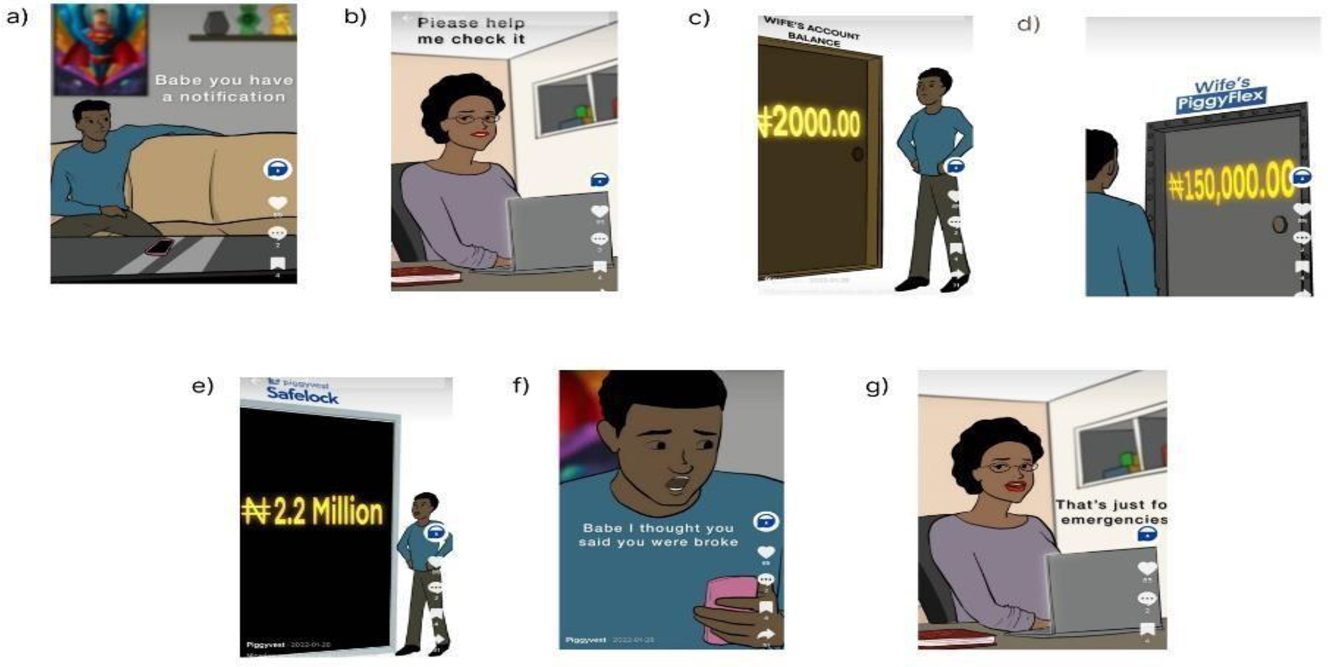
Women and frugality.
At the representational metafunction level, the figure adheres to the narrative pattern. The narrative process has both actional and reactional processes. In terms of the actional, the viewers can see the man (actor) checking his wife’s phone (goal). In terms of the reactional, the viewers can also see the woman (reactor) responding to the man’s observation (phenomenon).
There is no eye-to-eye interaction between the participants and the viewers. Hence, the interactional resource of the figure is an offer. This figure is taken from a frontal angle and has a high level of involvement with the viewers. From the power or perspective view, none of the represented participants is dominant on the viewers. There are four types of gazes, namely the spectator’s gaze, the intra-diegetic gaze, the averted gaze and the look of the camera. The figure is shot at a medium-close distance, in which the viewers can see the represented participants’ faces and other parts of the bodies to the waist level. This makes their emotions and body language more visible and easily felt by the viewers. The visual is attractive, because it is colorful and has natural types of colors which make a connection with the real life. The designer of this image shows the background to be a comfortable apartment; the phone to be feminine, being presented in color pink.
At the compositional level, the verbal part of the image is placed close to the participants. Designers of this figure place the verbal part in one frame and the visual part in another, with the images are not superimposed on the text. For salience, the text above the Piggyvest accounts is rendered in color blue, Piggyvest’s brand color.
5.3 Foregrounding aspirations and financial decisions
There is an element of intentionality in Piggyvest’s use of animated adverts, with particular focus on getting the young Nigerians to “dream” while saving or setting more ambitious savings goals. Some of the animated adverts that portray the relationship between aspirations and financial decisions are analysed below.
Figure 6 is equally multimodal in nature. The figure shows the hope and the planning culture that saving with Piggyvest gives to its users. A young woman with a happy and confident look is shown to be making a choice of the car she wants to buy after saving a minute percent of what she needs to buy the car. She makes a funny color choice: “Ribena Purple”; this is done by Piggyvest to show how different colors exist in the world of women. The import of this image is that with Piggyvest, customers are able to make proper planning, meet their yearnings and aspirations that require funds, and generally live a comfortable and pleasurable life devoid of pressure and financial stress.

Women are careful in their selections with the use of Piggyvest.
At the representational metafunction level, the figure conforms to the narrative and the conceptual patterns. The narrative process has the actional process, in which the viewers can see the young woman (actor) scrolling through her phone (goal). For the conceptual pattern, the figure is symbolic because it shows the hope and confidence that saving with Piggyvest gives to its customers.
At the interactional level, the figure represents an offer, because the represented participant does not look directly at the viewers. From the power or perspective view, the represented participant is dominant on the viewers. There are two types of gazes, including the spectator’s gaze and the look of the camera. The image is shot at a close social distance; hence the viewers can see the represented participant’s face. This makes her emotions and facial expression more visible and easily felt by the viewers.
At the compositional level, designers of the animated image place both text and figure in separate frames, but both are strategically placed in the bigger frame to make a connection between the text and the visual; to show that the text is the description of the action in the figure.
Figure 7 has both verbal and visual layers. The figure, more like Figure 6, shows the hope and planning ability that saving with Piggyvest gives to its users. A young man with a happy and excited look is shown to be admiring his Piggyvest’s account balance. With a balance of ten thousand, seven hundred and forty-nine Naira, he joyfully thinks of the kind of house he will get with the money. Piggyvest uses the colored hair and posture on the bed to prove that he is truly of a younger age. This is better appreciated when the shared situational knowledge of how many Nigerian youths wear colored hair as a mark of fashion and being in vogue.
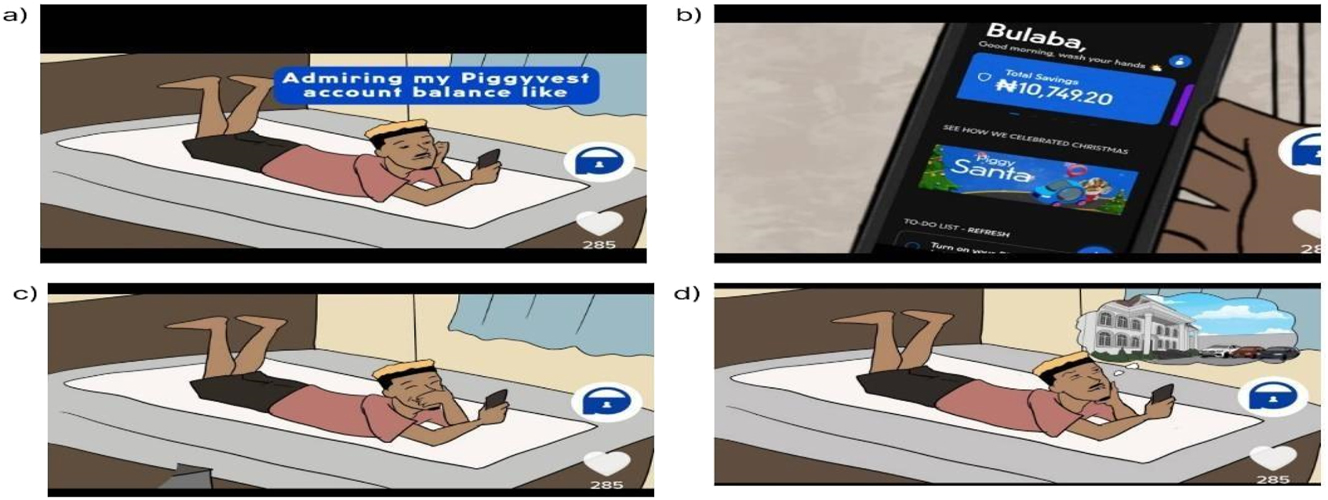
Piggyvest and constructive planning.
At the representational metafunction level, the figure conforms to the narrative and the conceptual patterns. The narrative process has the actional process, in which the viewers can see the young man (actor) checking his Piggyvest account balance on his phone (goal). For the conceptual pattern, this figure is symbolic because it shows the hope, ability and confidence to plan for the future and live a life of one’s dream that investing with Piggyvest affords. In other words, with one’s savings with Piggyvest, one has the assurance of living an enjoyable life. That the picture presented in this figure is that of a young man is a strategic persuasive strategy by the designer to appeal to the emotional sentiments of the youths to trust Piggyvest with their money for a beautiful future.
At the interactional level, the figure is an offer, because the represented participant does not look directly at the viewers. From the power or perspective view, the represented participant is not dominant on the viewers. There are two types of gazes, the spectator’s gaze and the look of the camera. The image is taken from a long social distance angle as it is possible to see the participant’s full appearance, sharing his emotions with the viewers. At the compositional level, the designer places both text and visual in separate frames, with both being placed in the bigger frame to make a connection between them; to show that the text is the description of the action in the figure.
5.4 Depiction of cognitive weakness and strength on money matters
Piggyvest, in some of their animated advertisements, portray that actions and intentionality are the most effective when it comes to financial decisions. Some of the animated adverts that portray that “talk is cheap” are analysed below.
Figure 8 depicts multimodal elements, as it features both verbal and visual layers. This figure shows the inconsistency in financial plans that one who does not save with Piggyvest exhibits. The advert is used by Piggyvest to describe how it becomes difficult for people to stick to promises and plans without automated savings – Piggyvest describes this by showing how people easily forget their plans and goals to be actualised with money when the money eventually comes. This is represented in this figure as the act of commonsense leaving one when one receives salary alerts. In such a situation, one, who has been left by commonsense, a demonstration or sign of cognitive weakness on money matters, often spends their money on luxury and unnecessary items, instead of spending the money in executing their goals and plans.
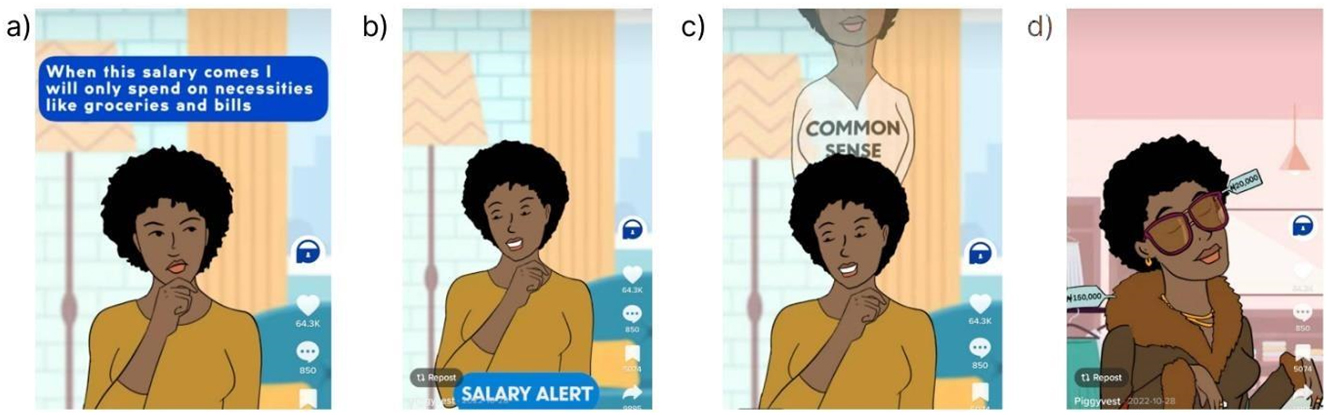
Piggyvest prevents unnecessary spendings.
At the representational metafunction level, the figure aligns with the conceptual pattern. This figure is symbolic because it depicts the fact that financial plans and promises are hard to follow without using Piggyvest’s automated savings features.
At the interactional level, the figure represents an offer, because the participant being represented does not look directly at the viewers. There are two types of gazes: the spectator’s gaze and the look of the camera. The image is a close-shot one in which the viewers can see the upper body of the subject participant, projecting a higher level of involvement by the viewers.
At the compositional level, the designers place both text and image in separate frames, but they are placed in a bigger frame to make a connection between the text and the visual, strategically demonstrating the fact that the text is the description of the participants’ actions and expressions.
Figure 9 depicts the inconsistency that could come up with someone who saves regularly with Piggyvest, but without the “Safelock” feature. This figure is created primarily to advertise the “Safelock” feature of Piggyvest and persuade its customers to use it. Safelock is a feature of Piggyvest that allows users to lock their funds for a specific period to avoid the pressure that often comes with having unrestricted access to the money (which could result in spending the money aimlessly and lavishly). The main participant in the figure is seen making a promise to himself about not touching the money he saved in his Piggyvest until December. The next frame however shows that he could not keep up with this promise. He is subsequently seen gallivanting on his way, going to touch the money for the 5th time before the December period he earlier planned to utilise the fund. However, in the next frame (c), another participant, representing Piggyvest, is seen, with a sober look, advising and pleading with the young man to use “Safelock” while saving his money next time.
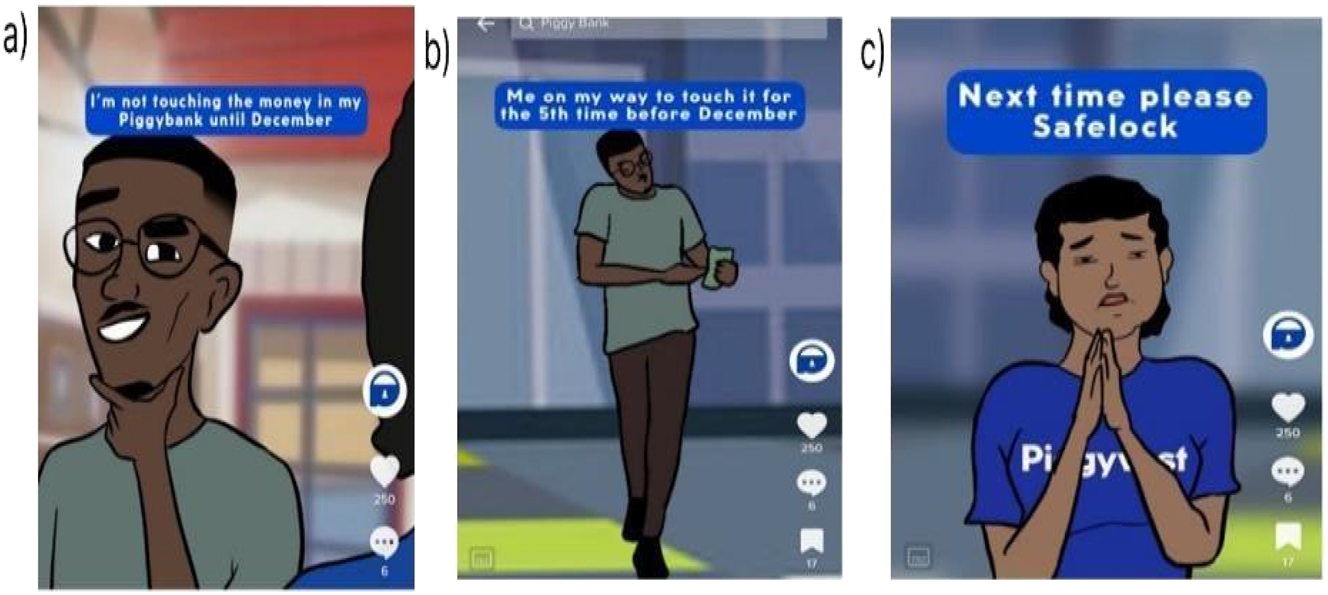
Piggyvest and safelock.
At the representational metafunction level, the figure complies with the conceptual pattern. This figure is symbolic because it echoes the fact that Safelock is the feature of Piggyvest that allows individuals to exhibit discipline in their savings culture, and as such save for a specific time and purpose. At the interactional level, the figure is a demand, because the participant representing Piggyvest looks directly at the viewers. There are three gaze forms observed, namely the spectator’s gaze, the extra-diegetic gaze, and the look of the camera. The image is shot at near social distance (close-shot) distant personal (medium-close shot) and frontal (medium-long shot) angles, implying the viewers can see from the waist up, depicting the full body of the subject participant, and a high level of involvement with the viewers.
At the compositional level, designers place both the text and the image in separate frames, with both being placed in a bigger frame to make a connection between the text and the visual; with the aim of demonstrating that the text is the description of the participants’ actions and expressions. For salience, the text from the participant is placed in a blue frame because it is associated with saving with Piggyvest.
5.5 Striking a connection between money and relationships
In relationships, ranging from parental to kinship and to romantic relationships, money matters cannot be overlooked. The people involved in these sets of relationships and their disposition to money are identified in comparison to the functions of Piggyvest in the figure below.
Figure 10 is embellished with textual and verbal resources for persuasive effects. The subjects in the figure are a young man and a woman who are involved in an argument. The man comes up with excuses that the woman finds unacceptable. She suspects that her partner is trying to create issues just in an attempt to avoid buying her gifts during the Valentine’s Day celebration. Piggyvest uses this advert to indirectly persuade people to use its products to save towards special days like Valentine’s Day so as to avoid creating unnecessary arguments that would cause them to dodge giving gifts to loved ones on such special days.
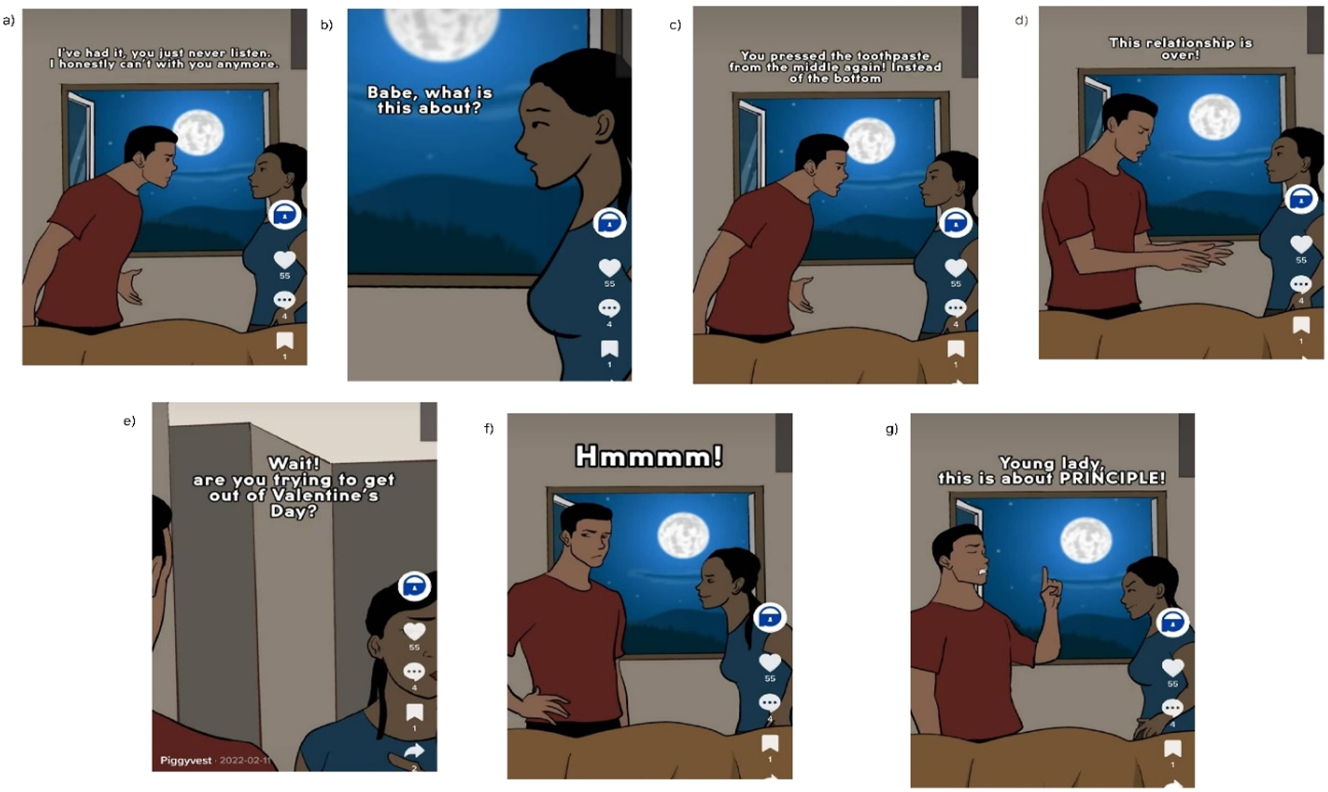
Piggyvest protects relationships.
At the representational metafunction level, the figure aligns with both the narrative and the conceptual patterns. For the narrative pattern, in terms of actional, the viewers can see the man (actor) arguing with his lover, the woman (goal). According to Kress and van Leeuwen (2006), the conceptual pattern is classified into three groups, including the analytic, classical, and symbolic. This figure is symbolic because it shows a relationship where the man is broke (being short of cash). The symbolic figure has a carrier; the relationship is a carrier of misunderstanding caused by lack of finances. There is a disconnection between the partners because of the disagreement. All elements or details of participants, such as facial expression, gestures and texts show that they are not in good terms due to the man’s financial status.
At the interactional metafunction level, the figure is an offer, because none of the represented participants looks directly at the viewers. Also, the images are subjective and are captured from a horizontal frontal angle, with the viewers being involved with the represented participants. This encourages viewers to understand the messages and emotions being displayed by the participants. The power view between the represented participants and the viewers is equal. Furthermore, there are four kinds of gazes in this image, viz the spectator’s gaze, the intra-diegetic gaze, the look of the camera, and the averted gaze, all deployed to catch the attention of the target audience. With respect to social distance, the image is shot at a medium-close social distance, making it possible for the viewers to see the represented participants’ faces and other parts of their bodies to the waist. This makes their emotions and body language more visible and easily felt by the viewers. For modality, it is depicted that what is represented in the video happened at night, given the dark mode and moon that can be seen through the window of the house.
At the compositional metafunction level, the information value of these figures shows that it is center-based. The young man and woman are the nucleus of the information passed. The designers of the animations place both text and image in separate frames, with both being presented in the bigger frame to make a connection between the text and the image.
Figure 11, like the other ten figures analysed earlier, is multimodal in nature, comprising both the verbal and the visual layers. In this advert, a young boy is trying to save for his birthday from the money he received from his uncle. His mum shows up with a promise she would help him keep the money. The boy puts up a sad facial expression while handing over the money to her. Many young Nigerians would easily identify with this advert. It is a common practice for mothers to take money from their children with the promise of helping them save it but would never fulfil their promise. Piggyvest utilises this advertisement to persuasively demonstrate to customers and yet-to-be customers, that, unlike Nigerian mothers who would promise their children to help them save their money and end up not giving them back, it has “Safelocks” that cannot be broken, hence young people’s money is safe with it and can have their money when needed. Accordingly, Piggyvest would genuinely save the money, and one can track how it is finally spent. The narrative in the figure has the pragmatic import of making Piggyvest’s customers and customers-to-be feel assured that, with Piggyvest, their money is safe.
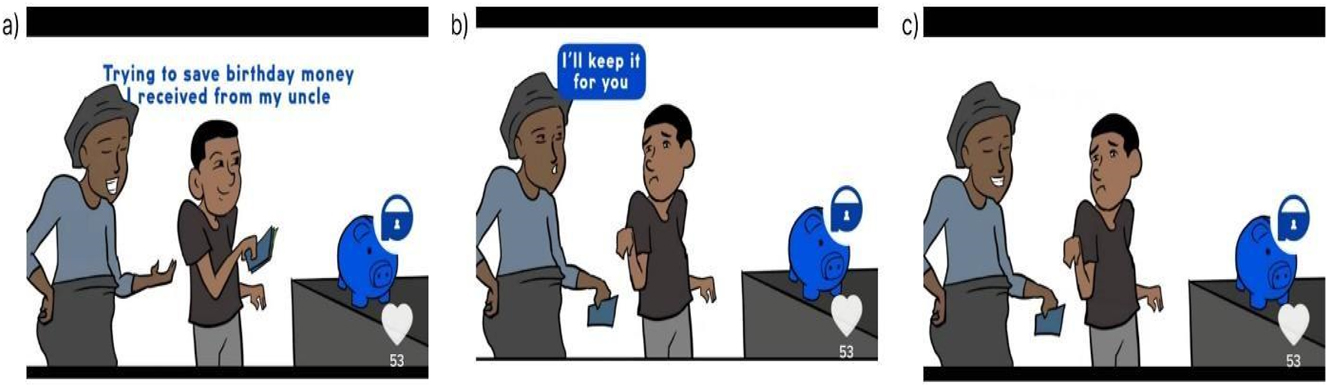
Piggyvest in more reliable in keeping money.
At the representational metafunction level, this figure adopts the narrative pattern and its process is actional. The viewers can see the young boy (actor) handing over his money to his mother (goal).
At the interactional metafunction level, the figure is an offer, because none of the represented participants looks directly at the viewers. Also, the images are subjective and are captured from a horizontal frontal angle, and the viewers are involved with the represented participants. The power view between the represented participants and the viewers is equal. Furthermore, figure is a composite of three forms of gaze, including the spectator’s gaze, the intra-diegetic gaze and the look of camera. The image is shot at a medium-close distance, as viewers can see the represented participant’s face and other parts to the waist. This makes their emotions and body language more visible and are easily felt by the viewers.
At the compositional metafunction level, the information value of this figure shows that it is center-based. The young boy and his mother are the nucleus of information. The designers of the animations place both text and image in separate frames, although both are placed in the bigger frame to make a connection between the text and the image.
5.6 Stressing the significance of self-discipline in attaining financial literacy
A look through the animated adverts of Piggyvest shows that they intentionally tell stories that revolve around self-discipline and conscious planning, being significant in helping young people attain financial literacy. The adverts that tell this story are identified and analysed below:
Figure 12 features both verbal and visual elements. The figure shows the lifestyle of a man who does not save after getting his salary. He lavishly spends on shopping and even dashes out his balance (rendered as change in the Nigerian English context). Then, a few days after his pay-day, he returns to the same place looking sad, haggard, and unwilling to leave his little balance as it is his transport fare back home. On his pay-day, he communicates in Standard English with the receptionist and 10 days after when he returns broke, he communicates in Nigerian Pidgin English. This is a funny way of Piggyvest showing that one’s financial status may affect the way one communicates in public. In the figure, while speaking in Standard English signals a state of financial prosperity, speaking in Nigerian Pidgin is a mark of being broke. This figure, which expresses the two states of being explained above, particularly in relation to money, is used by Piggyvest to demonstrate what happens to people who do not set apart a portion of their income for savings, especially with Piggyvest, in order to persuade them to have a change of attitudinal practice regarding savings.
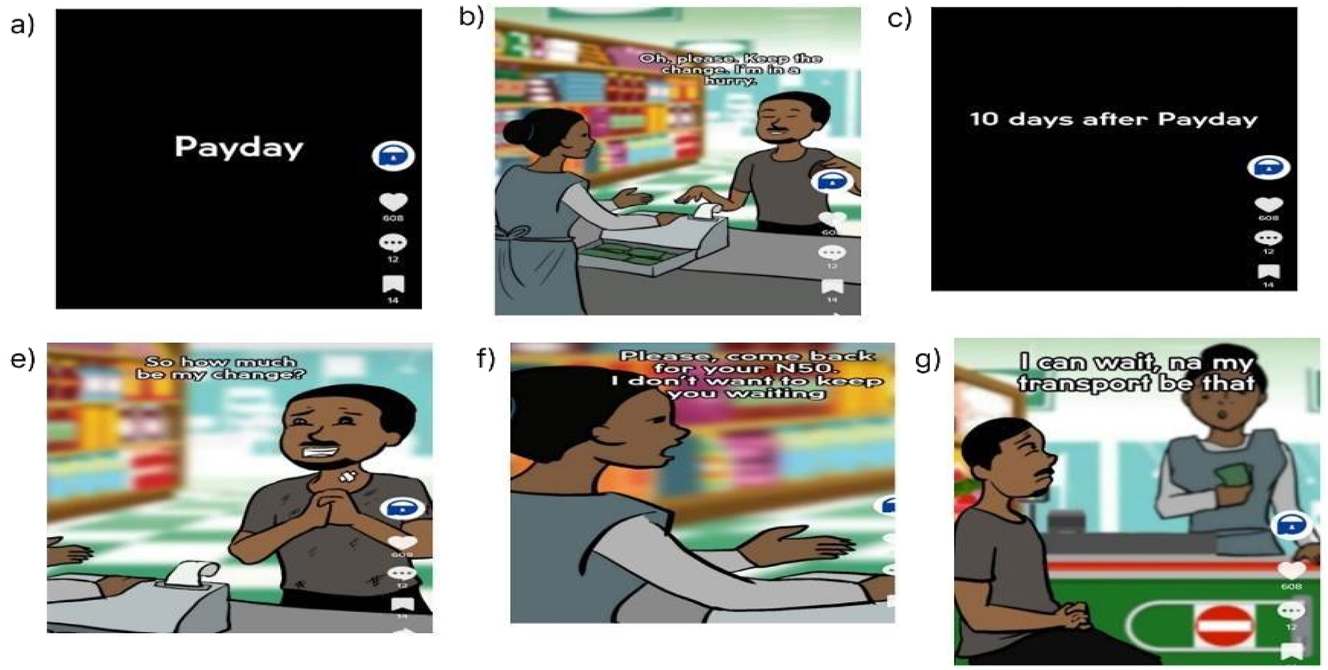
Piggyvest and financial discipline.
At the representational metafunction level, the figure complies with the narrative pattern. The narrative pattern has the actional process, in which the viewers can see the man (actor) talking to the receptionist (goal).
At the interactional level, the figure is an offer, because none of the represented participants looks directly at the viewers. From the power or perspective view, none of the represented participants is dominant on the viewers. There are three gaze types: the spectator’s gaze, the intra-diegetic gaze, and the look of the camera, all geared towards catching the attention of would-be customers. The image is shot at medium-close social distance, in which the viewers can see the represented participant’s face and other parts to the waist. This makes their emotions and body language more visible and easily felt by the viewers. The background is colorful and hazy, depicting a supermarket setting with goods arranged on a shelf and a payment equipment on the slab before the receptionist.
At the compositional level, the designers of the figures place both the texts and the visuals in separate frames, but the two are placed in the bigger frame to make a connection between them, in order to show that the texts are the description of the action in the figures.
In Figure 13(a–f), the subject is a young man who is working on his laptop but keeps getting distracted by the thoughts to spend money on things he does not need. This distraction is represented by a Genie, ‘Jinni’, a magical creature that is capable of granting wishes when summoned. During this process, the young fellow gets overwhelmed to the point of almost yielding to the tempting voice of the Genie, telling him “You only live once” a consolation ideological statement that many Nigerians often make reference to in order to justify their impulsive spending action and essentially console themselves when they are about to make impulsive decisions, including money spending. He however gets slapped back to reality (evident in ‘e’) by Piggyvest’s Autosave feature which is represented by a well-built man in the figure. This persuasively portrays Piggyvest as being a ‘force’ that prevents aimless and thoughtless spending. This is particularly made possible by the Autosave feature of Piggyvest which makes it possible for people to automatically save their money for the period of time once configured. Piggyvest uses this advert to persuade their customers to make use of the Autosave feature to avoid accidental or impulsive spending.
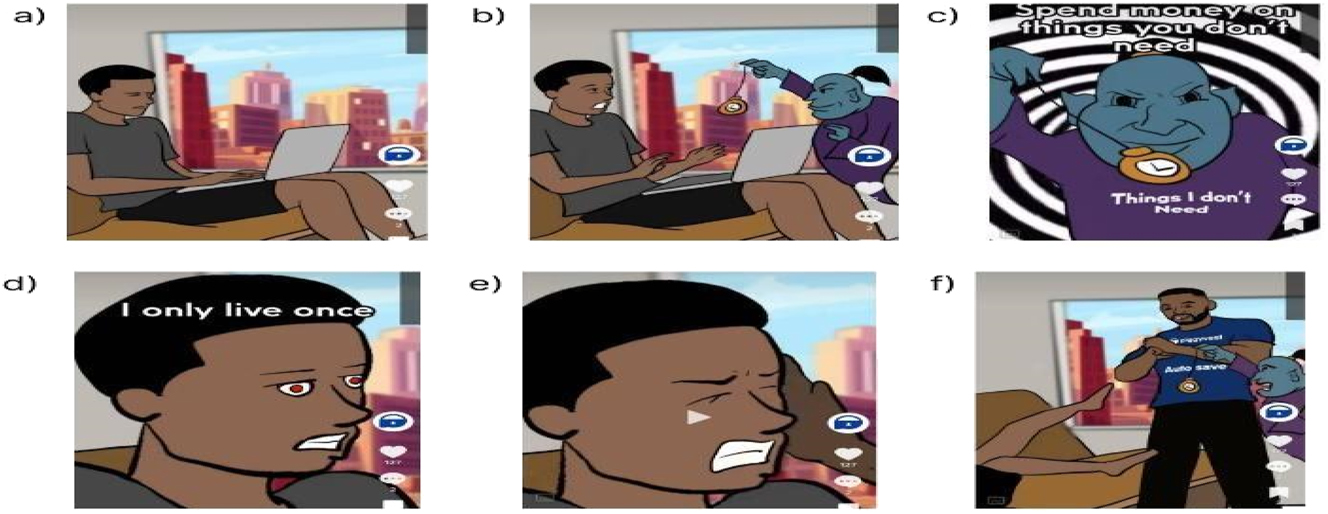
Piggyvest prevents unnecessary financial distractions.
At the representational metafunction level, both frames (a) and (b) of the figure have both the narrative process and the conceptual process. The narrative process has actional processes. In terms of the actional, the viewers can see a young man (actor) working on his laptop (goal). At the conceptual process, the Genie and big-bodied man are symbolic. The Genie symbolises distracting thoughts of spending money on things that are not needed. These thoughts often overwhelm young people when they have random money in their bank accounts. The big-bodied man symbolises Piggyvest’s Autosave feature that prevents one from getting carried away by thoughts to spend money unplannedly and impulsively.
At the interactional metafunction level, frames (a–f) are offers, because none of the represented participants looks directly at the viewers. Also, the images are subjective and are captured from a horizontal side and frontal angle, and the viewers are involved with the represented participants. This encourages viewers to activate the Autosave feature of Piggyvest that keeps them from spending on things that are not needed. The power view between the represented participants and the viewers is equal. Furthermore, gaze types: the spectator’s gaze, the intra-diegetic gaze, the look of the camera, and the averted gaze are observed in the figures. The image is shot at a medium-close distance, making it possible for the viewers to see the represented participant’s face and other parts to the waist. This makes their emotions and body language more visible and easily related to. For modality, Autosave is shown to be in blue color, which suggests the financial safety associated with Piggyvest.
At the compositional metafunction level, the information value of these figures shows that it is center-based. The young man and his distracting thoughts are the nucleus of information and other participants are placed beside them. The designers of the animations place the text and the image in separate frames, with both occupying the bigger frame to establish a connection between the text and the image. From the Salience perspective, the Genie and the big-bodied man are magnified in the figures, as they depict the thoughts of many people on finances and the role of Piggyvest in saving people from unnecessary spending, respectively.
6 Conclusions
This study has attempted a multimodal analysis of Piggyvest’s animated advertisement videos on the social media, with particular reference to TikTok. The study is guided by the tenets of Kress and van Leeuwen’s (2006) Multimodal Discourse Analytic framework. The study’s objectives include the identification and description of the multimodal elements deployed in Piggyvest’s animated advertisements; and a demonstration of how textual and visual resources are strategically connected in Piggyvest’s advertisements as a persuasive strategy to win customers. A critical engagement of the sampled data reveals how the designer(s) of Piggyvest’s animated videos deploy both pictorial and textual resources as persuasive strategies to appeal to their yet-to-be customers, and sustainedly maintain and increase their customer-base. Specifically, metaphorisation of financial management and discipline, playing around gender-related ideas on finances, foregrounding of aspirations and financial decisions, depiction of cognitive strength and weakness on money matters, and striking a connection between money and relationships are persuasive strategies deployed in the animated advertisement videos by Piggyvest to appeal to their target audience. It would be interesting to see future studies explore how textual and non-textual elements combine in the advertisements by the conventional banking system in Nigeria.
About the authors
Toluwani Deborah Odedeyi holds a Bachelor of Arts degree in Linguistics from the Department of Linguistics and Nigerian Languages, Adekunle Ajasin University, Akungba Akoko, Nigeria. She has just completed her Master of Arts degree in Linguistics in the Department of Linguistics and African Languages, University of Ibadan. Her interest intersects language and context.
Temitope Michael Ajayi, PhD, is a recipient of the postdoctoral fellowship of the African Humanities Program, US, and the Georg Forster Postdoctoral Fellowship of the Alexander von Humboldt Foundation, Germany. He teaches linguistics in the Department of Linguistics and African Languages, University of Ibadan, Nigeria. His areas of interest include (forensic) pragmatics, discourse analysis, sociolinguistics, and applied linguistics. He has several articles in reputable journals across the globe.
References
Adami, Elisabetta. 2015. Multimodality. In Ofeila Garcia, Nelson Flores & Massimiliano Spotti (eds.), Oxford handbook of language and society, 451–472. Oxford: Oxford University Press.10.1093/oxfordhb/9780190212896.013.23Suche in Google Scholar
Ajayi, Temitope. 2020. Beyond joking: A pragmatic (de)construction of “Nigerian realities” in selected humour-evoking Facebook memes. Israeli Journal of Humor Research 9(2). 47–71.Suche in Google Scholar
Asemah, Ezekiel. 2012. Integrated marketing communication as a strategy for persuading consumers towards product purchase. Benin Mediacom Journal 5. 120–135.Suche in Google Scholar
Bezemer, Jeff & Gunther Kress. 2008. Writing in multimodal texts: A social semiotic account of designs for learning. Written Communication 25(2). 166–195. https://doi.org/10.1177/0741088307313177.Suche in Google Scholar
Chouliaraki, Lilie. 2004. Watching 11 September. Discourse & Society 15(2–3). 185–198. https://doi.org/10.1177/0957926504041016.Suche in Google Scholar
de Saussure, Ferdinand. 1916. Course in general linguistics (trans. Wade Baskin). London: Fontana/Collins.Suche in Google Scholar
Goel, Deeksha & Rajesh Upadhyay. 2017. Effectiveness of use of animation in advertising: A literature review. International Journal of Scientific Research in Network Security and Communication 5(3). 146–159.Suche in Google Scholar
Halliday, Michael A. K. 1978. Language as social semiotic: The social interpretation of language and meaning. London: Edward Arnold.Suche in Google Scholar
Halliday, Michael A. K. 1985. An introduction to functional grammar, 1st edn. London: Edward Arnold.Suche in Google Scholar
Hopkins, Claude. 1923. Scientific advertising. http://www.backchannelmedia.com/documents/ScientificAdvertising-ClaudeHopkins1923.pdf (accessed 10 February 2023).Suche in Google Scholar
Järvinen, Joel & Heini Taiminen. 2016. Harnessing marketing automation for B2B content marketing. Industrial Marketing Management 54. 164–175. https://doi.org/10.1016/j.indmarman.2015.07.002.Suche in Google Scholar
Khan, Shaheen & Anis Karodia. 2013. The effectiveness of using social media networking technology for marketing in South Africa. Singapore Journal of Business Economics and Management Studies 2(3). 10–17. https://doi.org/10.12816/0003857.Suche in Google Scholar
Karjaluoto, Heikki, Nora Mustonen & Pauliina Ulkuniemi. 2015. The role of digital channels in industrial marketing communications. Journal of Business & Industrial Marketing 30(6). 703–710. https://doi.org/10.1108/jbim-04-2013-0092.Suche in Google Scholar
Kress, Gunther & Theo van Leeuwen. 2006. Reading images: The grammar of visual design, 2nd edn. New York: Routledge.10.4324/9780203619728Suche in Google Scholar
Kress, Gunther & van Leeuwen, Theo. 1996. Reading images: The grammar of visual design. London: Routledge.Suche in Google Scholar
Liu, Jing. 2013. Visual images interpretive strategies in multimodal texts. Journal of Language Teaching and Research 4(6). 1259–1263. https://doi.org/10.4304/jltr.4.6.1259-1263.Suche in Google Scholar
Machin, David & Andrea Mayr. 2012. How to do critical discourse analysis: A multimodal introduction. London: Sage Publications.Suche in Google Scholar
Machin, David & Joanna Thornborrow. 2003. Branding and discourse: The case of cosmopolitan. Discourse & Society 14(4). 453–471. https://doi.org/10.1177/0957926503014004003.Suche in Google Scholar
Matthiessen, Christian. 2007. The multimodal page: A systemic functional exploration. In Terry D. Royce & Wendy L. Bowcher (eds.), New directions in the analysis of multimodal discourse, 1–62. London: Lawrence Erlbaum Associates.Suche in Google Scholar
Merriam-Webster Dictionary. 2014. https://www.merriamwebster.com (accessed 21 January 2023).Suche in Google Scholar
Motta-Roth, Désirée & Fábio S. Nascimento. 2009. Transitivity in visual grammar: Concepts and applications. Linguagem & Ensio 12(2). 319–349.10.15210/rle.v12i2.15713Suche in Google Scholar
Nweke, Onye. 2001. Public relations, practice and concepts. Enugu: Hamson Publishers.Suche in Google Scholar
Olotewo, John. 2016. Social media marketing in emerging markets. International Journal of Marketing Research (IJOMR) 2(2). 10–19. https://doi.org/10.5455/ijomr.2016254411.Suche in Google Scholar
Olowu, Ayodeji & Susan Akinkurolere. 2015. A multimodal discourse analysis of selected advertisement of malaria drugs. English Review: Journal of English Education 3(2). 166–173.Suche in Google Scholar
Pan, Li. 2015. Multimodality and contextualisation in advertisement translation: A case study of billboards in Hong Kong. The Journal of Specialised Translation 23. 205–222.Suche in Google Scholar
Rainie, Lee & Barry Wellman. 2012. Networked: The new social operating system. USA: MIT Press.10.7551/mitpress/8358.001.0001Suche in Google Scholar
Rosenkrans, Ginger. 2010. Maximizing user interactivity through banner ad design. Journal of Promotion Management 16(3). 265–287. https://doi.org/10.1080/10496490903582586.Suche in Google Scholar
Stoian, Claudia E. 2015. Analysing images: A social semiotic perspective. Transactions on Modern Languages 14(1). 23–30.10.59168/VBYT1151Suche in Google Scholar
Stock, Oliviero, Carlo Strapparava & Alessandro Valitutti. 2007. Moving creative words. In Francesco Mele, Giuliana Ramella, Silvia Santillo & Francesco Ventriglia (eds.), Advances in brain, vision, and artificial intelligence. BVAI 2007. Lecture Notes in Computer Science, vol. 4729. Berlin, Heidelberg: Springer.Suche in Google Scholar
Ugande, Godwin. 2001. Public relations activities in the local governments in Benue State. Makurdi: Benue State University Unpublished M.A. Dissertation.Suche in Google Scholar
Vovilas, George, Thanassis Karalis & Konstatinos Ravanis. 2010. Applying multimodal discourse analysis to learning object user interface. Contemporary Educational Technology 1(3). 255–266.10.30935/cedtech/6031Suche in Google Scholar
© 2023 the author(s), published by De Gruyter, Berlin/Boston
This work is licensed under the Creative Commons Attribution 4.0 International License.
Artikel in diesem Heft
- Frontmatter
- Peirce Study
- Biosemiotics and Peirce
- Culture and Communication
- A skeptic’s guide to “intercultural communication”—debunking the “intercultural” and rethinking “culture”
- Cultural unit blue in the Old Testament
- The influence of semantic predictability on transposition effects in Chinese and English
- Multimodal Signs
- Visual representation of ASUU strikes in Nigeria: a semiotic analysis of cartoons in selected Nigerian newspapers
- A multimodal analysis of Piggyvest’s animated advertisement videos
- “The soro-soke [speak up] generation”: multimodality and appraisal choices in selected #EndSars civil protest-related memes in Nigeria
Artikel in diesem Heft
- Frontmatter
- Peirce Study
- Biosemiotics and Peirce
- Culture and Communication
- A skeptic’s guide to “intercultural communication”—debunking the “intercultural” and rethinking “culture”
- Cultural unit blue in the Old Testament
- The influence of semantic predictability on transposition effects in Chinese and English
- Multimodal Signs
- Visual representation of ASUU strikes in Nigeria: a semiotic analysis of cartoons in selected Nigerian newspapers
- A multimodal analysis of Piggyvest’s animated advertisement videos
- “The soro-soke [speak up] generation”: multimodality and appraisal choices in selected #EndSars civil protest-related memes in Nigeria
