Visual representation of ASUU strikes in Nigeria: a semiotic analysis of cartoons in selected Nigerian newspapers
-
Peter Oyewole Makinde is a lecturer in the Department of Linguistics, Faculty of Arts, Nnamdi Azikiwe University, Awka, Anambra State, Nigeria. He is also a doctoral student in the Linguistics Department, University of the Western Cape, South Africa. His research interests are in the areas of Stylistics, Social Semiotics and Multimodality.


Abstract
Until recently, the study of language and meaning of cartoons, the media discourses they generate, and their analysis as a creative means of exploring meaning-making processes as semiotic resources have not received much scholarly attention in Nigeria. Although cartoons that involve the use of satire and humour as visual representations of reality have gained prominence across many media platforms in Nigeria, only a few scholars have examined this from a social semiotics perspective. This has created a gap in the literature, thus creating room for a paradigm shift in the field of social semiotics. This study explores the semiotics of cartoons in selected Nigerian newspapers to examine the meaning-making resources employed in the visual representation of ASUU strikes in Nigeria. The study, therefore, examines how cartoonists manipulate symbols, signs, and other semiotic resources to convey specific meanings through visual and textual representations. The study adopts a qualitative research design; data comprising cartoons sourced from selected Vanguard Newspapers and websites are analyzed using Kress and Van Leeuwen’s visual semiotics and interpreted from the standpoints of Halliday’s Systematic Functional Linguistics (SFL) approach and O’Halloran’s position on metaphorical constructions of meaning. Here, metaphorical manipulation and representation of visual elements in the selected cartoons are interrogated. Findings from the study show the use of semiotic resources in the portrayer of reality in the context of the seemingly intractable ASUU strikes and their consequences on academic activities in Nigeria. This scholarly intervention deserves attention as it significantly contributes to the field of social semiotics through its visual representation in portraying challenges faced by the educational systems in Nigeria vis-à-vis poor government funding.
1 Introduction
Until recently, the study of language and meaning of cartoons, the media discourses they generate, and their analysis as a creative means of exploring meaning-making processes as semiotic resources have not received much scholarly attention in Nigeria (Agu 2017; Feng and O’Halloran 2013; Hand 2017; Ifechelobi and Ilodinso 2021; Kaula 2015; Kövecses 2002; Makinde and Mgbodi 2022). Although cartoons that involve the use of satire and humour as visual representations of reality have gained prominence across many media platforms in Nigeria, only a few scholars have examined this from a social semiotics perspective. This has created a gap in the literature, thus creating room for a paradigm shift in the field of social semiotics.
In their study on political cartoons as a vehicle for setting social agendas, Sani et al. (2012) emphasize the importance of language in media communication. According to them, journalists use linguistic and nonlinguistic resources as devices, techniques, or skills of manipulating language efficiently and persuasively to create effect and impression in a literary or dramatic work such as cartoons and to evoke a particular response from the audience.
In recent times, studies have shown the application of social semiotics to an array of data analyses. Traced to the work of Halliday (1978), studies on social semiotics have concerned themselves with meaning-makers and meaning-making. By drawing on qualitative analysis, social semiotics focuses on the media of dissemination and the modes of communication used and developed by people to represent their understanding of the world and shape power relations with others. This also has brought about the application of multimodal artefacts involving various means of representations which have become dominant modes of communication.
Given the foregoing, this study, therefore, aims at investigating the various ways in which cartoonists project the portrayer of reality in the context of the seemingly intractable ASUU strikes in Nigeria. It examines how cartoonists manipulate texts, symbols and signs to convey specific meanings. The study also looks at the semiotic artefacts employed by cartoonists in their representation of meaning. It examines various ways in which cartoonists employ metaphorical manipulation in their visual representation as it concerns the educational systems in Nigeria vis-à-vis poor government funding.
2 Conceptual overview
2.1 ASUU strikes in Nigeria
The Academic Staff Union of Universities is an academic staff union of Nigerian universities founded in 1978. ASUU evolved from the Nigerian Association of University Teachers (NAUT). This organization was made up of only five universities: the University of Ibadan, the University of Nigeria, Nsukka, Ahmadu Bello University, Zaria, the University of Ife, and the University of Lagos, which was founded in 1965. The purpose of ASUU’s formation was to represent the interests of all academic staff in Nigeria’s federal and state universities. ASUU is a trade union whose goals include regulating relations between academic staff and employers, encouraging its members to participate in the affairs of the university system and the nation, and protecting and advancing the country’s socioeconomic and cultural interests.
Since its formation, ASUU has embarked on a series of strikes which can be summed up to over 50 months. The first of its kind was the five months strike in 1999, followed by three months in 2001, among others. Reacting to the poor funding of the public universities in Nigeria, in 2009, the Federal Government of Nigeria reached an agreement with ASUU regarding improving the educational system in Nigeria. It is sad to note that within the last seven years, ASUU has embarked on a cumulated 19 months strike. These strikes resulted from the Nigerian Government’s refusal to uphold the agreement signed with ASUU in 2009 and other renegotiations in 2018 and 2020. The strike is a move by the Union to force the Government into a response. However, this has only yielded negative results as the challenges faced by the educational systems in Nigeria vis-à-vis poor government funding remained unresolved, while students have remained at home; lecturers’ salaries were unpaid.
It is needful to point out here that to resolve the constant ASUU strikes in Nigeria, a number of committees had been constituted to bring an end to the problems but all to non-avail. The lingering issues persist due to the insincerity of the Federal Government vis-à-vis its representatives in proffering solutions to some of the demands of ASUU. Some of such demands include the revitalization of public universities, earned academic allowances (EAA), the poor salary of university staff, and the deployment of the University Transparency and Accountability Solution (UTAS) for payment of university lecturers as against the Government’s insistence to adopt the Integrated Payroll and Personnel Information System (IPPIS). On February 14, 2022, ASUU called out its members over the non-implementation of the Memorandum of Action (MoA) it signed with the Federal Government. As of October 2022, the lingering ASUU strike is still on, with students staying idle at home.
2.2 Cartoons
A cartoon can be a satirical or humorous drawing, a series of illustrations (also called a comic strip), or an animated film. Many kids grow up watching new and classic cartoons on TV. Political cartoons combine an often complex idea in a transparent panel. When you criticize a character or a real person for being a cartoon, you mean that they are overly simplified or exaggerated.
A cartoon is a type of illustration typically drawn, sometimes animated, in an unrealistic or semi-realistic style. The specific meaning has evolved, but modern usage usually refers to an image or series of images intended for satire, caricature or humour; or a motion picture that relies on a sequence of illustrations for animation. On this note, Hühn (2009) sees cartoons as constructed, ritualistic, interpretive texts. From the narrative point of view, cartoons are devices involving the synoptic or sequential selection, ordering, structuring, positioning, segmenting and communication of happenings (Hühn 2009). Thus, the use of symbols and visual metaphors to simplify and communicate complicated ideas and concepts is a common phenomenon in the representation of cartoons (Eko 2010).
As Farwell and Henning (1989: 9) noted, cartoons and caricatures are usually considered part of the same genre because they both display the ‘distortions and exaggerations that characteristically puncture pretension or single out vulnerable features in a target…’. One of the powers of the cartoon, therefore, lies in ‘its ability to crystallize complex issues into a simple metaphor’ (Harrison 1981: 14). In another view, Meister and Schönert (2009: 11) see cartoon as a popular, journalistic narrative paradigm and ‘like any representation, it reduces the complexity of its reference domain to the carrying capacity of its medium and to the processing capacity of its senders and receivers. As visual narrative texts, therefore, cartoons take the form of satiric political chronicles, editorials, creative cultural creations, and moral statements all rolled into one. They are designed to present the subject of their ridicule as adversely as possible to wreak as much psychological havoc as possible (Roberts 1998). Humour is considered a sine qua non for cartoons (Tsakona 2009). A cartoon, therefore, as Samson and Huber (2007) posit, is a joke told in a picture. According to Attardo and Chabanne (1992: 167–168), the cartoon as a kind of joke text involves a mixed-code message. This, therefore, leads to the idea of the portrayal of cartoons as visual representations.
2.3 Visual representation as a metaphorical expression
Visual representation involves the direct or symbolic use or reflection of artefacts in the form of photos, images, graphics and memes to represent something, a person, a place, or a situation. It also includes any visual depiction made or produced by electronic, mechanical, or other means, such as photographs, film, video, digital image, picture or computer or computer-generated image or picture. Höhne and Bernstein (1986) see visual representations as using interpolation schemes to compute data at positions between defined grid points.
It is necessary to point out here that visual representation can also take the form of metaphorical expressions and, by extension, serves as a semiotic resource. Such representation, according to Forceville (2009), Goatly (2007) and Kövecses (2002), is realizable both in language and via other modes of communication such as visual image, gesture and architecture. Given the above view, El Refaie (2003: 80) asserts that “there seems to be a whole range of different forms through which metaphorical concepts can be expressed visually”. In this way, visual metaphors are seen as the pictorial expression of metaphorical thinking.
As it concerns this study, in the representation of ASUU strikes in Nigeria, many images are employed to portray challenges faced by the educational systems in Nigeria. Therefore, many metaphorical representations are incorporated into visual representations to project the ills in society. Here, metaphorical pictures depicting the ordeals of university lecturers and students are highlighted. This way, visual metaphors are used as semiotic resources to portray the ASUU strike in Nigeria.
3 Methodology
In portraying the visual representation of ASUU strikes in the selected cartoons in Nigeria, the study adopts a qualitative research design. Data comprising pictures/images sourced from selected Vanguard Newspapers (June 25, 2022; December 23, 2018; Nov 11, 2017; December 11, 2013), Punch Newspaper (January 18, 2022), Nairaland (June 13, 2022 and June 23, 2022) and other websites such as Opinion Nigeria February 8, 2022; Encomium.ng (October 3, 2013) were collected for analysis.
3.1 The theoretical basis for the study
Theoretically, this study is analysed using Kress and Van Leeuwen’s visual semiotics and interpreted from the standpoints of Halliday’s Systematic Functional Linguistics (SFL) approach and O’Halloran’s position on metaphorical constructions of meaning. As a social semiotic theory where the meaning is seen to be context-dependent, SF theory is well-suited to offer theoretical tools for multimodal discourse analysis (MDA), a theory that calls for the development of theoretical and practical approaches for analysing written, printed, and electronic texts, three-dimensional sites and other domains of activity where semiotic resources combine to make meaning (Halliday 1978; O’Halloran 2008). As O’Halloran (2008) noted, there is a connection between SF and MDA. This link concerns the theory and practice of analysing meaning resulting from using multiple semiotic resources in discourses. Therefore, using Hallidayan’s (1978, 2004 SFL and its metafunctional principle, which provides an integrating platform for theorising how semiotic resources interact to create meaning of “what is represented, to whom and with what means linguistically”, this study is anchored on the tenets of SFL, which involves a means of representing patterns of experience that enables humans to build a mental picture of reality, to make sense of their experience of what goes on around them and inside them as the basis for analysis.
The study of semiotics concerns itself with the processes of how the representation of language, images, and objects in their broad sense generate, comprehend, or attribute meanings. Reflecting on this, Curtin (2009: 51) avers that from the standpoint of visual images, or visual and material culture, semiotics is an inquiry that is wider than the study of symbolism. Therefore, the use of semiotic analysis challenges concepts such as naturalism and realism (the notion that images or objects can objectively depict something), and intentionality (the notion that the meaning of images or objects is produced by the person who created them). Drawing from the view of Hjelmslev (1961: 109), semiotics can be understood as a system of signs and sign systems operating in society and describing and regulating the internal organization of social relations, as well as a scientific method describing signs and sign systems. This is in line with the dynamic nature of what is being represented. In this case, the significance of images or objects is a product of complex inter-relationships between individuals, images or objects and other factors such as culture and society.
4 Data presentation and analysis
4.1 Cartoons as tools for interrogating metaphorical manipulation and representation of visual elements in Nigeria
According to Kaplan (2005), visual metaphor refers to how a particular event, person or place is represented in a visual image that indicates a kind of association with a particular thing through resemblance or similarity. Within the visual representation, a concept or an idea is portrayed visually as a target and compared with something that belongs to another category. In this way, there is a virtual association through mapping one source with another. Carroll (1996) sees visual metaphor as a visual fusion of elements from two different areas into one single entity. In the analysis of the study under consideration, semiotic resources embedded in selected cartoons are used to examine the meaning-making resources that are employed in the visual representation of ASUU strikes in Nigeria.
4.1.1 Metaphorical representation of legislature and lecturer’s salary
In the words of Tsakona (2009), earlier research has claimed that cartoons convey messages via their humorous representation of and comment on reality. In cartoons, meaning is produced either via two semiotic modes, the verbal and the visual, or solely via the visual mode. In the above cartoons, two modes, visual and verbal, convey the intended message. Figure 1a metaphorically represents two participants, a Legislature and a lecturer, as depicted in their attires. CLOTH is used as a semiotic resource in the representation. The lecturer, an ASUU man, is seen putting on an academic gown while the legislature is shown wearing a native dress agbada. Observable in Figure 1a is a comparative view of both legislatures and lecturers in Nigeria.
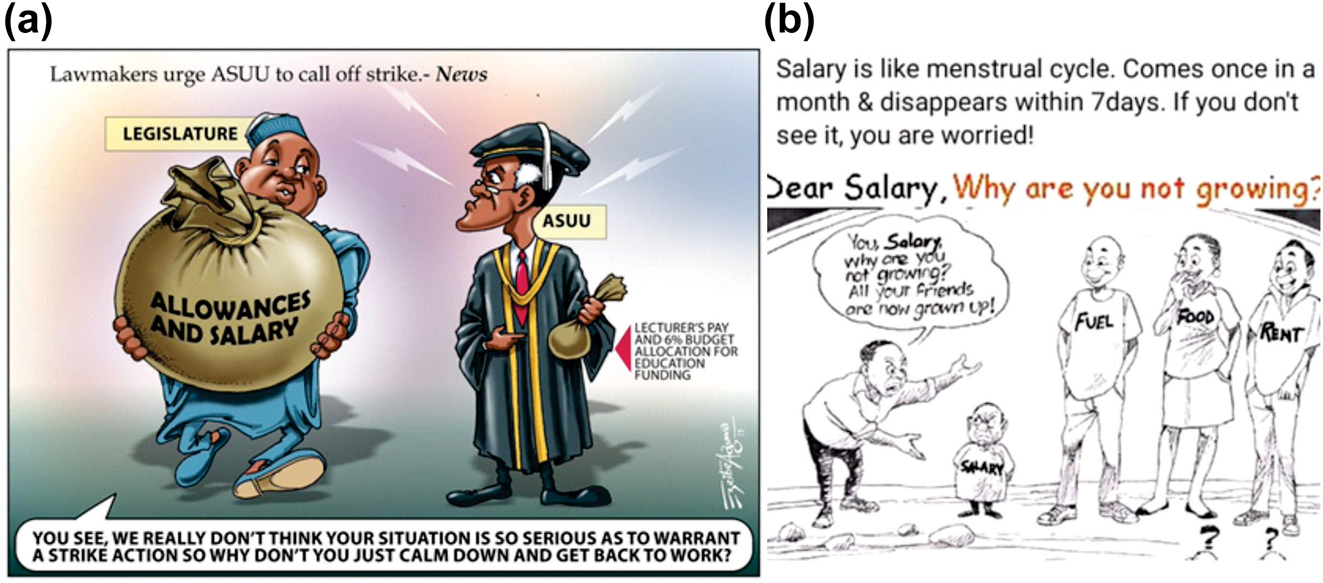
Metaphorical representation of legislature and lecturer's salary. (a) Representation of Lawmakers and ASUU Conversation. (b) Representation of Academic staff salary in Nigeria.
Source: Vanguard Newspaper, June 25, 2022 (https://www.vanguardngr.com/2022/06/asuu-strike-gangrene/).
Another semiotic resource employed in the representation above is the use of SIZE. Visual images of bags in the hands of the two participants, as tagged in Figure 1a, use size to represent the mega take home of a legislature in Nigeria and the sekele or meagre allowance of the lecturer. While the legislature was seen carrying a big bag represented by “ALLOWANCES AND SALARY” with both hands, the ASUU man, as depicted in the cartoon, was seen holding his salary with his left hand. Worthy of note here is the legislature’s size compared with the slim Professor with his long neck as evidence of underpaid salary and poor funding of education in Nigeria.
In Figure 1a, it can be deduced that the legislators never embark on strike because they are overpaid. The lecturers embark on strike because they are underpaid and tertiary institutions are underfunded. However, the legislator urges ASUU to sheathe their swords and go back to work. In Figure 1b, there is a visual representation comparing salary and other daily necessities. The cartoonist posed a question thus: “Salary, Why are you not growing?”. While salary remains dwarfed, fuel, food and rent have grown. This means that while the cost of every other thing has increased in the past years due to the economic situation in the country, the salary of university staff members remains the same. While “Fuel” and “Rent” were represented with masculine characters, “Food” receives feminine characters. In addition, the textual representation “Salary is like menstrual cycle. Comes once in a month and disappears within 7 day. If you do not see it, you are worried!” makes a comparison between Salary and the menstrual cycle. In this way, Salary is likened to a woman’s monthly cycle that must be expected monthly. There is repurposing, resemiotization, remediation and re-use of the menstrual cycle in this context.
4.1.2 Visual representation of FG’s attitude towards ASUU
In Figures 2 and 3, several visual codes and texts coupled with gestures, colours, comics and other artefacts have been employed as semiotic resources in the ongoing FG/ASUU deliberations regarding the strike. As Gee (2003: 18) noted, a semiotic domain is “any set of practices that recruits one or more modalities (e.g. oral or written language, images, equations, symbols, sounds, gestures, graphs, artefacts, among others) to communicate distinctive types of meaning”. In this way, Samson and Hempelmann (2006), Hempelmann and Samson (2007) observed that the visual code and its interaction with the verbal one result in the non-linearity of cartoon messages, affecting thus the cognitive processing of cartoons.
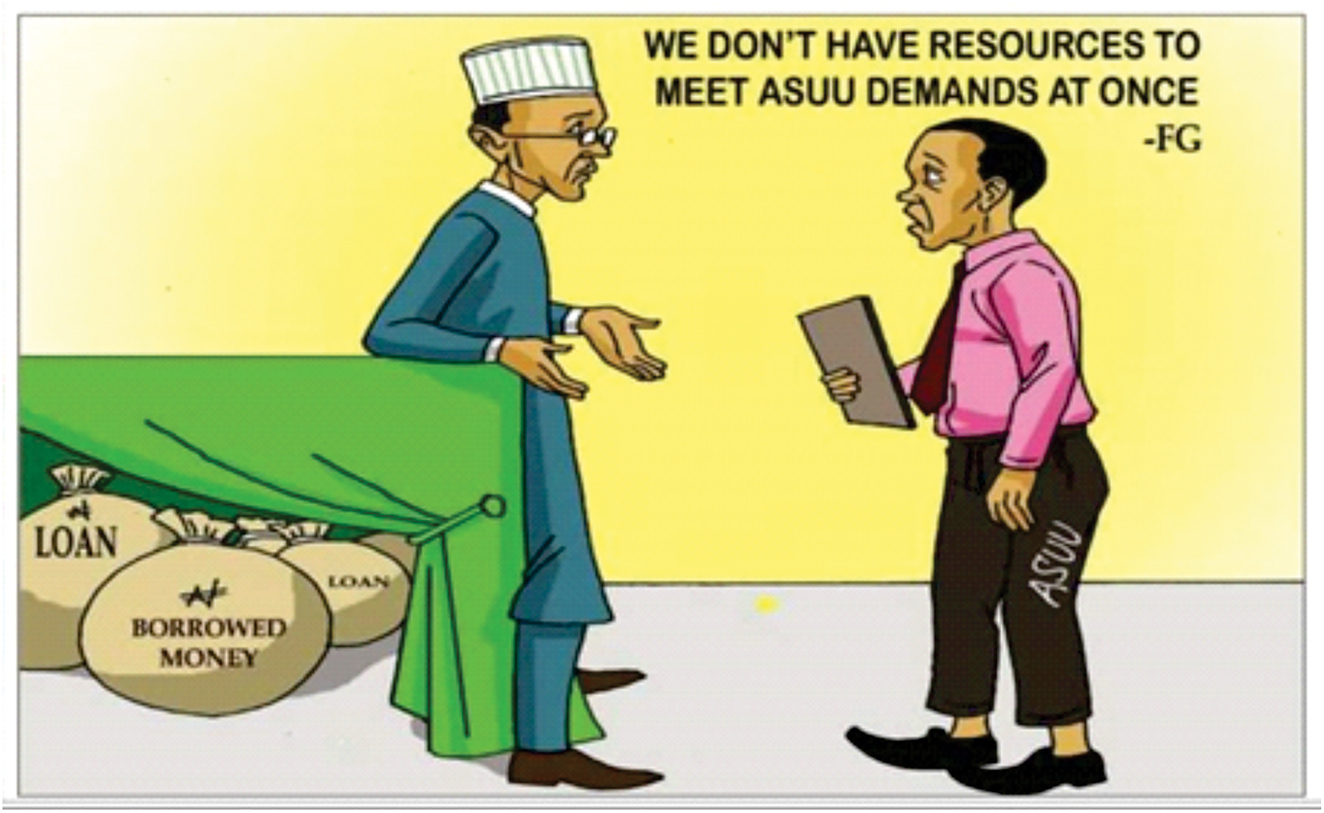
Showing FG/ASUU’s dialogue.
Source: Punch Newspaper, January 18, 2022 (https://ms-my.facebook.com/punchnewspaper/posts/cartoon-flakes/5131123650259089/).
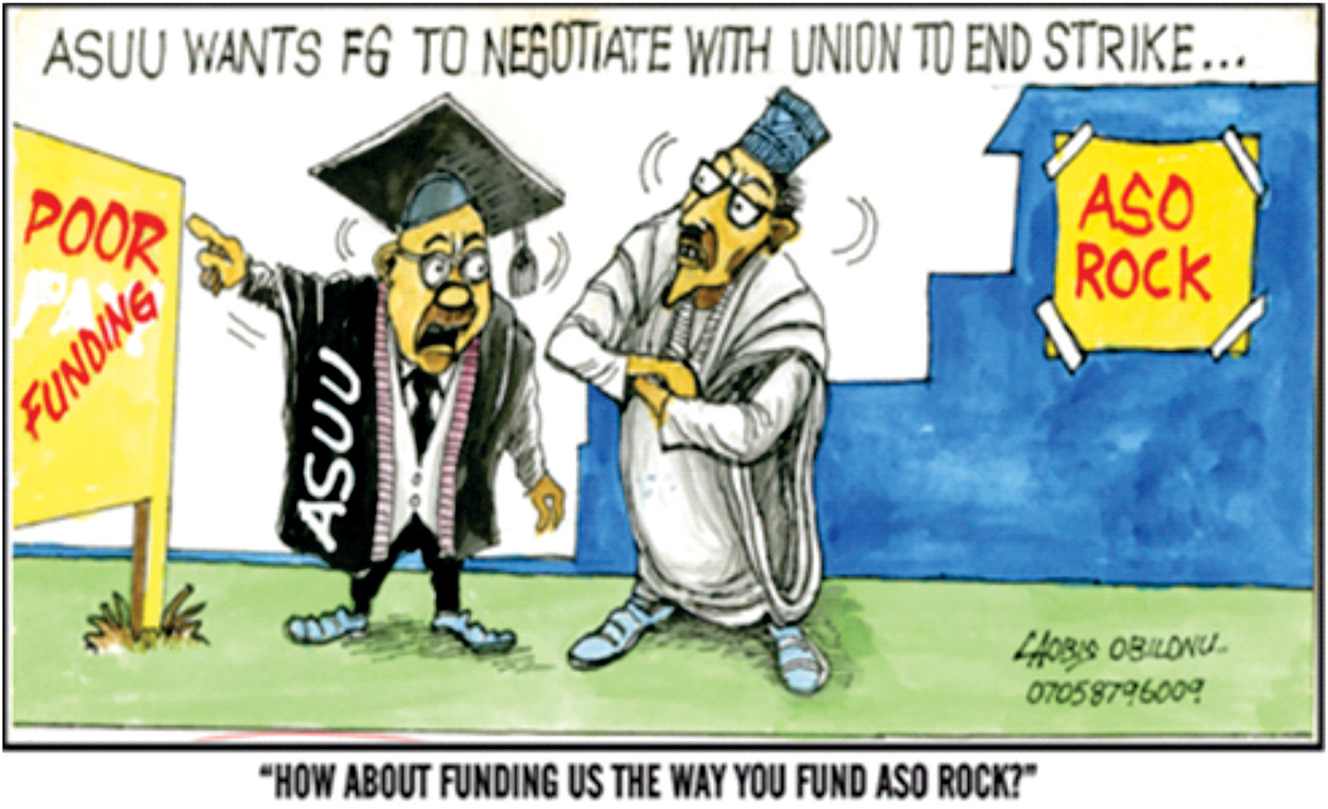
Showing ASUU’s insistence for proper funding.
Source: Vanguard, December 2018 (https://www.vanguardngr.com/2018/12/strike-asuu-may-not-honour-further-calls-by-fg-national-president/).
Figure 2 shows a contrast between the textual mode and the image represented. First, the text depicting FG’s statement, “We don’t have resources to meet ASUU demands at once”, is in contrast with the hidden bags of money labeled “
N
LOAN” and “
N
BORROWED MONEY” behind Mr. President. This view supports Figure 3 regarding the conversation between ASUU and FG as represented textually by “POOR FUNDING” on the signpost. In Figure 2, the Federal Government has some hidden money in the form of “Loan” and “Borrowed money”, which to the Government is not for funding education. Likewise, in Figure 3, the heading “ASUU WANTS FG TO NEGOTIATE WITH UNION TO END STRIKE…” reflects ASUU’s request for education funding in Nigeria. Below the picture in Figure 3 is the inscription “HOW ABOUT FUNDING US THE WAY YOU FUND ASO ROCK?” This text depicts a comparison/contrast between ASO ROCK’s funding and Nigeria’s education. On this note, ASUU requests that FG should spend on education as the Government spends on Aso Rock.
The FG, in the two data above as shown in their posture, show unconcerned attitude in their gestures, spreading of hand by Mr. President portraying “We don’t have resources to meet ASUU demands at once” and the folding of hands by the FG representative in the second image, as if he is truly paying attention to ASUU’s request while on the contrary, the opposite is the case. The cartoonist has metaphorically manipulated and represented visual elements in a bid to convey his message.
4.1.3 Visual representation on the looting of Federal Government’s account
According to Kress and van Leeuwen (2006, 2020, visual images fulfill the metafunctions of representing the experiential world (representational meaning), interacting with viewers (interactive meaning) and arranging the visual resources (compositional meaning). In Figure 4, there is the realization of representational meaning by the configuration of processes (e.g. actions) represented by non-funding of education/embezzlement; participants (e.g. actors) comprise FG, ASUU, Ex-NCDC Boss and Accountant General of the Federation; and circumstances (e.g. locations) represented by Federal Account.
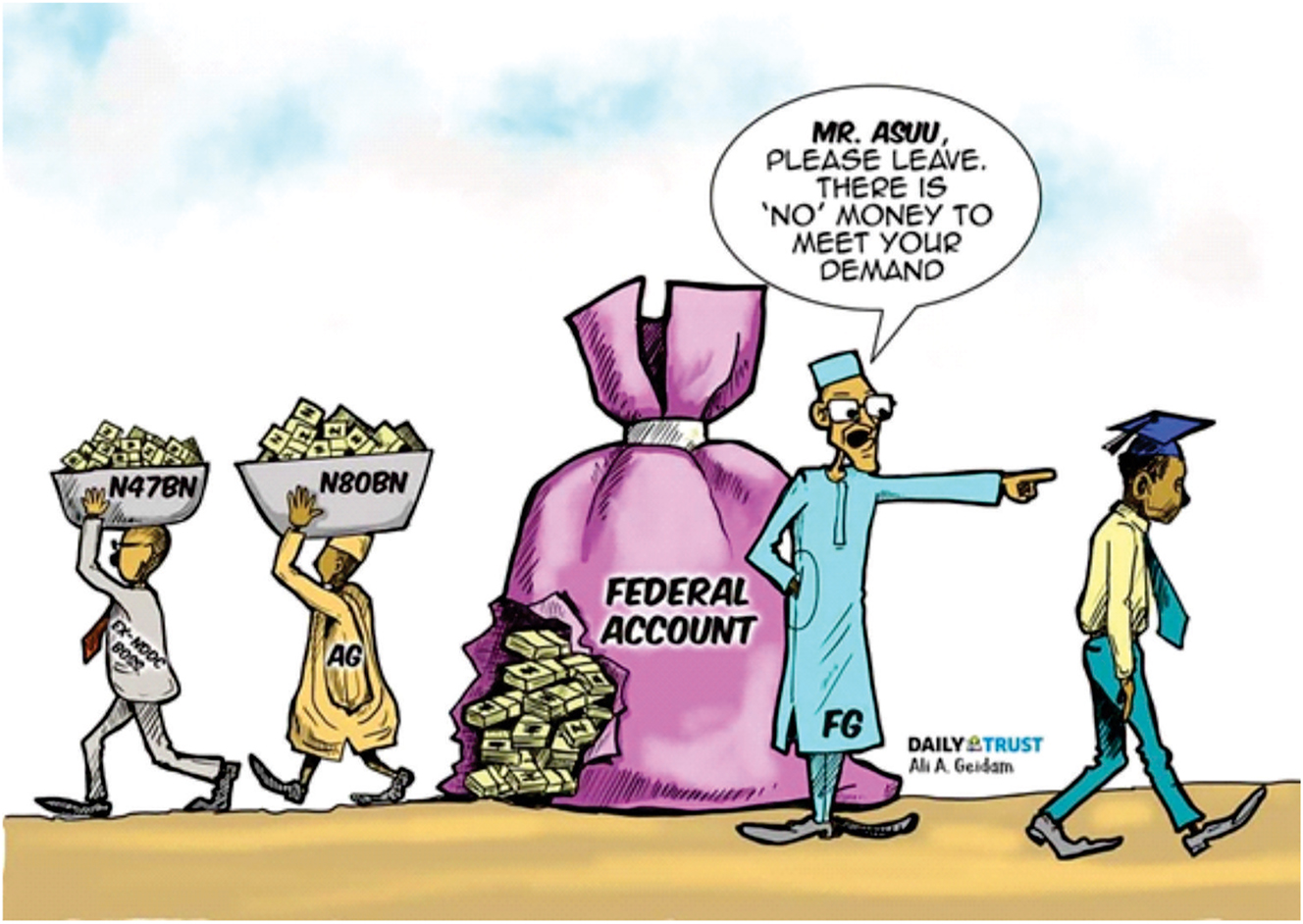
Showing persons with access to FG account.
Source: Nairaland, June 13, 2022 (https://www.nairaland.com/7172332/nigeria-state-nation-cartoons/1).
Foregrounding here is the setting projecting Federal Account being guarded by Mr. President. In the previous figures, it could be recalled that FG had informed ASUU of the non-availability of a fund to finance the educational system in the country. On the contrary, Figure 4 captures the sacked Accountant General of the Federation walking away with N80BN, while the Ex-NCDC Boss was also seen carrying N47BN on his heading without the knowledge of Mr. President. In this way, the cartoonist has, in a metaphorical manner, humorously manipulated the lopsidedness and high level of misappropriation of funds under the current FG administration.
We could recall that the Accountant General of the Federation and the Ex-NCDC Boss have previously been accused of misappropriation and embezzlement. As a result, the cartoonist has been able to mobilize what Kress and van Leeuwen (2006) refer to as narrative and conceptual representations, which involve the “unfolding of actions and events, processes of change” (narrative) combined with “generalized, stable, and timeless essence” (conceptual).
4.1.4 Visual representation of ASUU’s resilience and FG’s frustration
In semiotic domains encoded via verbal and visual means (cartoons, comics, plays, films, sitcoms, among others), meanings are produced, and scripts can be activated and opposed by both (Tsakona 2009: 1172). In the above data, texts such as “OVER FOUR MONTHS OF ASUU STRIKE…”, “STRIKE CONTINUES”, “GO BACK TO CLASSES OR GET FIRED!” and visual images represented by ASUU official, Education Minister, FG Official, Gun, Postal are semiotic resources employed in the cartoon above. In this way, semiotic resources are communicatively shaped to convey the cartoonist’s desired message. This is portrayed via the dominance of power discourse between the Federal Government and ASUU. First, in Figure 5, a figure is seen walking away from the action scene. At the same time, another image depicting the Minister for Education is shown carrying an AK47, threatening/forcing ASUU to return to class or get fired. The third picture represents ASUU climbing the billboard to remove the FG’s banner directing them (ASUU) to get back to work. Here, both images and texts are used to relay the intended message by the cartoonist.
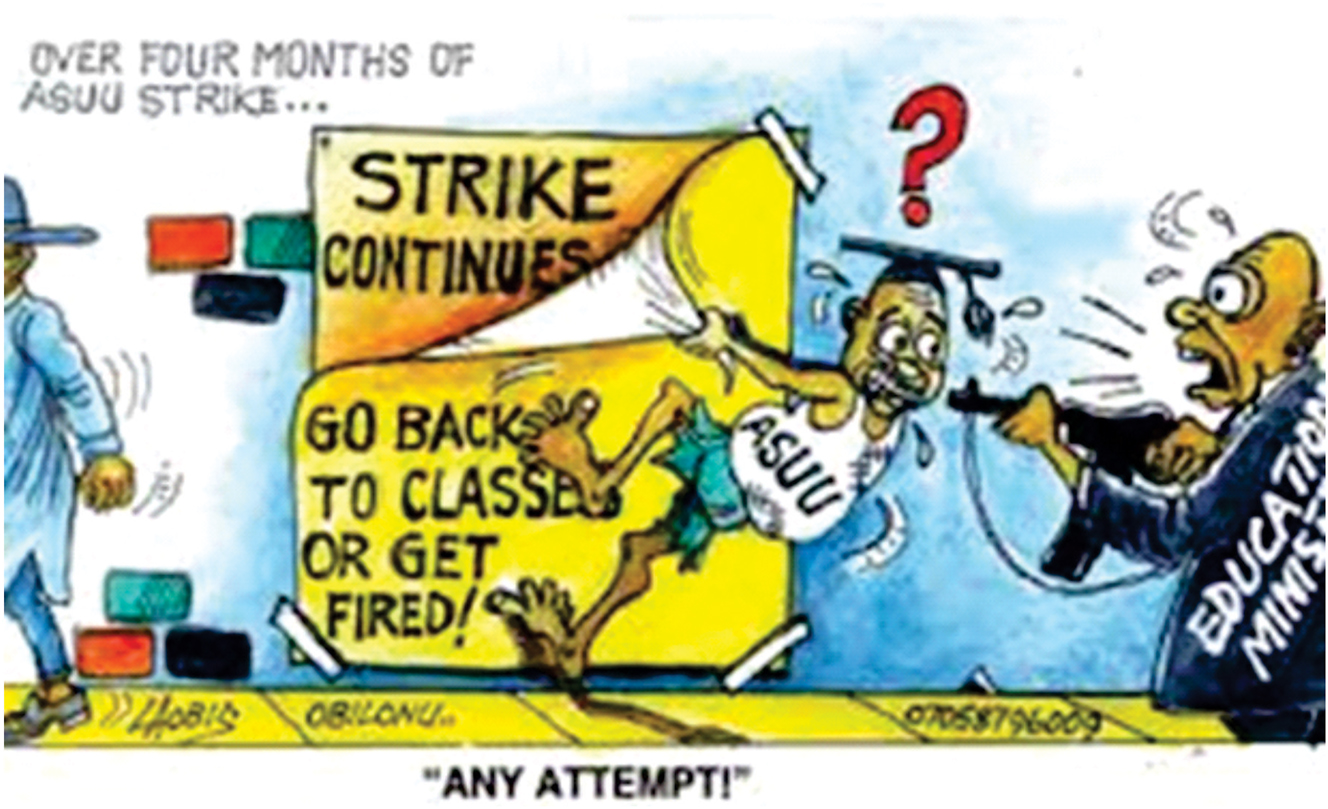
Showing ASUU’s insistence on strike and FG threat.
Source: Vanguard Newspaper, December 11, 2013 (https://www.vanguardngr.com/2013/12/elechi-calls-scrapping-asuu/).
According to van Leeuwen (2005: 3), semiotic resources are “the actions and artefacts we use to communicate; whether they are produced physiologically with our vocal apparatus, with the muscles we use to create facial expressions and gestures, among others”. Such semiotic resources are traditionally regarded as “signs” in which a gun pointing at the ASUU man above and the facial expression of the Education Minister with mouth and eyeball opened will be regarded as signs of threat and power dominance. In van Leeuwen’s view, the sign is the principal notion of semiotics. The next image further reflects the dominance of power relation between the Federal Government of Nigerian and the Academic Staff Union of Universities.
4.1.5 Visual representation of deliberate breach of agreement by the FG
As O’Halloran (2009: 444) noted, the metafunctional principle is the principle that semiotic resources simultaneously provide the tools for constructing ideational meaning (i.e. experiential meaning and logical relations) and for enacting social relations (i.e. interpersonal meaning). To O’Halloran (2009), therefore, these metafunctions are enabled through the organisation of the discourse, which is the textual metafunction of semiosis. Here, the metafunctional principle provides a basis for examining the functionalities of semiotic resources and for analysing how semiotic choices interact in multimodal discourses to fulfill particular objectives.
Following O’Halloran’s (2009) view, Figure 6 provides semiotic resources that simultaneously employ conversation analysis tools in the dialogue between FG and ASUU. In this context, ASUU has always used the tool of a strike to enforce the FG support for education funding. On the contrary, FG has employed deception laced with empty promises. Therefore visual and textual semiotic resources in terms of visual representation of FG and ASUU, ASUU’s demands represented by “OUR AGREEMENT…N” and the spreading of hand by ASUU in anticipation to receive the “PAYMENT OF EARNED ACADEMIC ALLOWANCES”. FG’s response follows this, “JUST CLOSE YOUR EYES, I WANT IT TO COME TO YOU AS A SURPRISE PACKAGE!”. The FG’s package is a mere “PROMISE! PROMISE!!” Of course, ASUU is not unaware of the empty promise from the Federal Government. Therefore, the text and image show that ASUU is prepared for another round of strikes, symbolised by a weapon hidden behind the participant represented as ASUU.
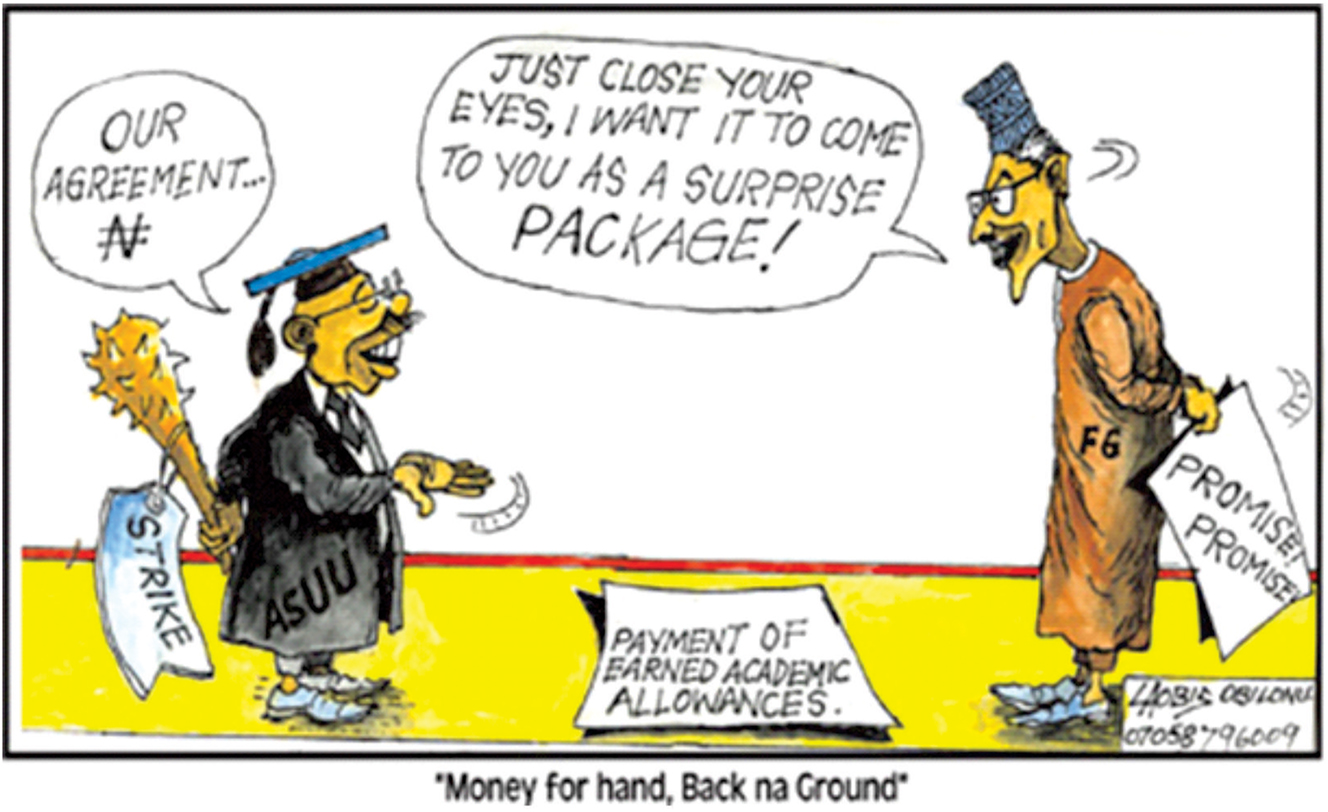
Showing FG’s schemes and ASUU’s supposed corrective tool.
Source: Vanguard, November 11, 2017 (https://www.vanguardngr.com/2017/11/buhari-asuu-promises/).
Figure 7 is a follow-up on Figure 6. Here, the cartoonist successfully gives a metaphorical visual representation of how FG was able to, once again, through his empty promise, outsmart ASUU. There is now a change in the pictorial position of FG and ASUU, with the ASUU man lamenting his unachievable efforts. The textual undertone in the use of Pidgin in the expression “Pikin wey no allow him mama sleep, e no go sleep too” which literarily means “a child that will not allow his mother to sleep will not rest as well” sums up the pictorial dialogue in Figure 6 on how language has been used as a semiotic resource in the ongoing metaphorical representation of ASUU strike in Nigeria.
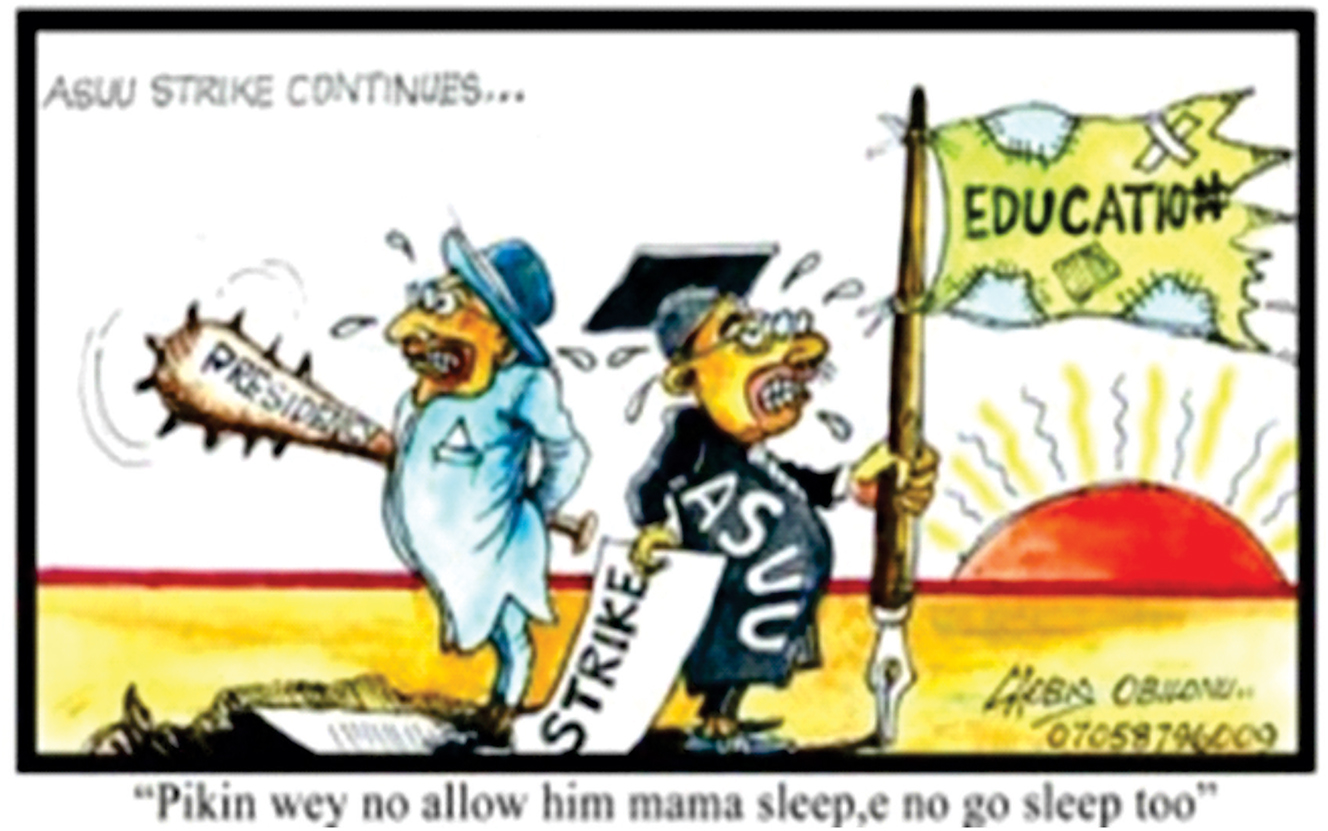
Showing outwitting of ASUU by FG.
Source: Encomium.ng (October 3, 2013) (http://encomium.ng/nigerians-creative-jokes-on-asuu-strike/asuu-strike-cartoon/).
4.1.6 Visual representation of non-impact of ASUU strike on Nigerian politicians’ homes
Figure 8 represents participants with different affordances. Using slicing as a tool for framing, the predominant participants are a father and son in a foreign university at an oversea graduation ceremony. Foregrounded in the image above is a group of graduates celebrating their graduation ceremony. The first participant here is the father, a Nigerian politician. One observes a disposition of interaction between the man and his son. The politician in his native attire agbada is presented condemning ASUU for their incessant strikes. The textual mode “CAN YOU IMAGINE ASUU IS EMBARKING ON FRESH INDEFINITE STRIKE?” furnishes the viewers with information about the Academic Staff Union of the University’s strike action. The conversation was brought to a hurt based on the son’s response, who is unaware of what ASUU stands for. Therefore, the textual mode “DADDY WHAT IS ASUU?” depicts the son’s lack of awareness of the ordeals of the indigent students whose parents could not afford overseas education.
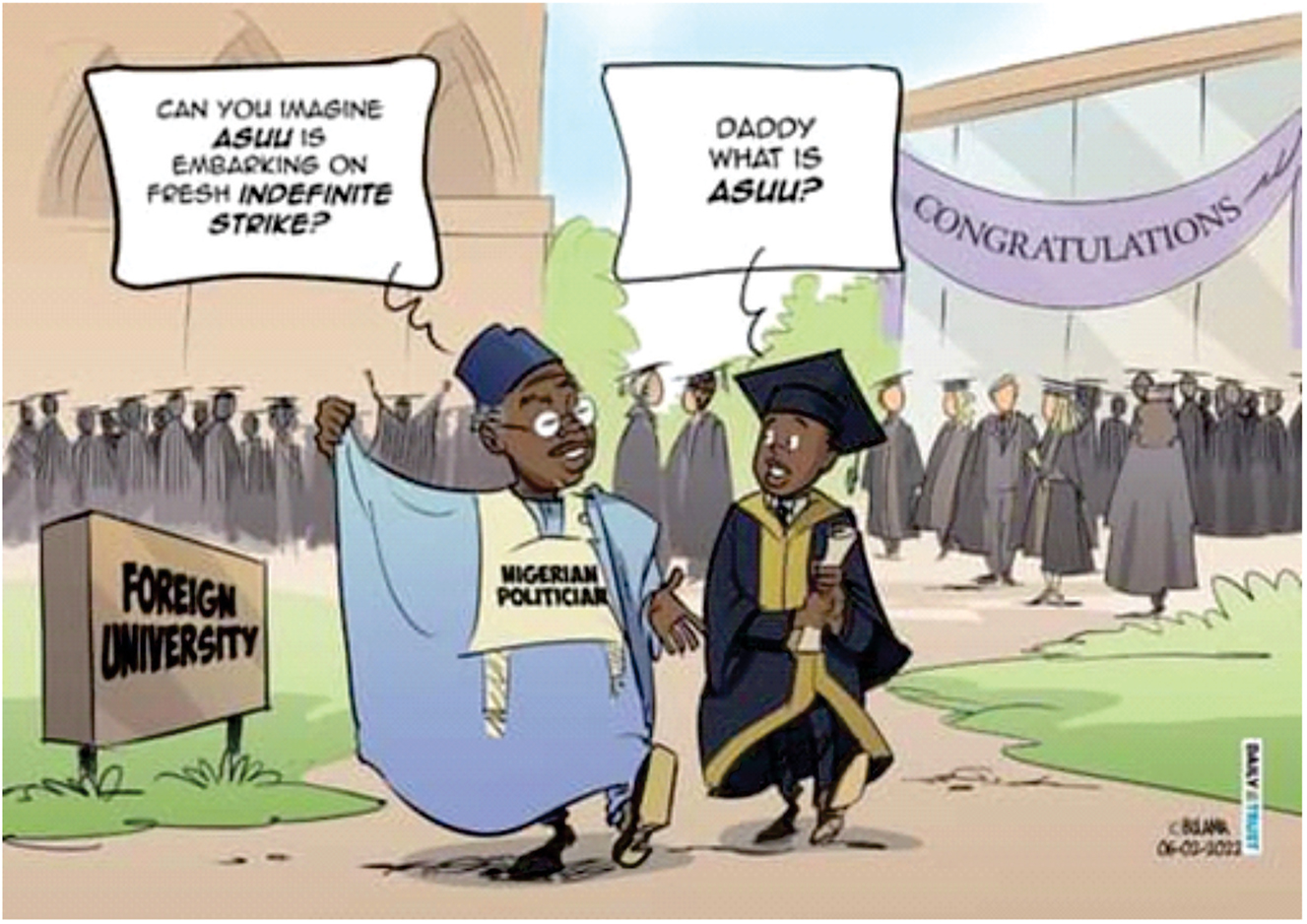
Showing conversation between father and son in a foreign Institution.
Source: Opinion Nigeria February 8, 2022. https://www.opinionnigeria.com/as-asuu-strike-looms-who-is-to-blame-for-playing-with-our-future-by-abdulrasaq-isiaq-mustapha/.
The four major represented participants in Figure 9 are categorized into two families. The participants are a politician and his son, then a farmer and his son. The participants are represented in three domains: abroad, city and rural areas, with the domain further divided into foreign land and Nigeria. The cartoon also depicts power relations and dominance in terms of status in the framing above. In support of Kress and van Leeuwen’s (2020) upper and bottom on the information value of images, the picture in Figure 8 is an instance of dominance and power relations. Here, the cartoonist positioned the politician and his son in the upper part of the picture, depicting the power relation. On the other hand, the farmer and his son are positioned in the lower part of the picture.
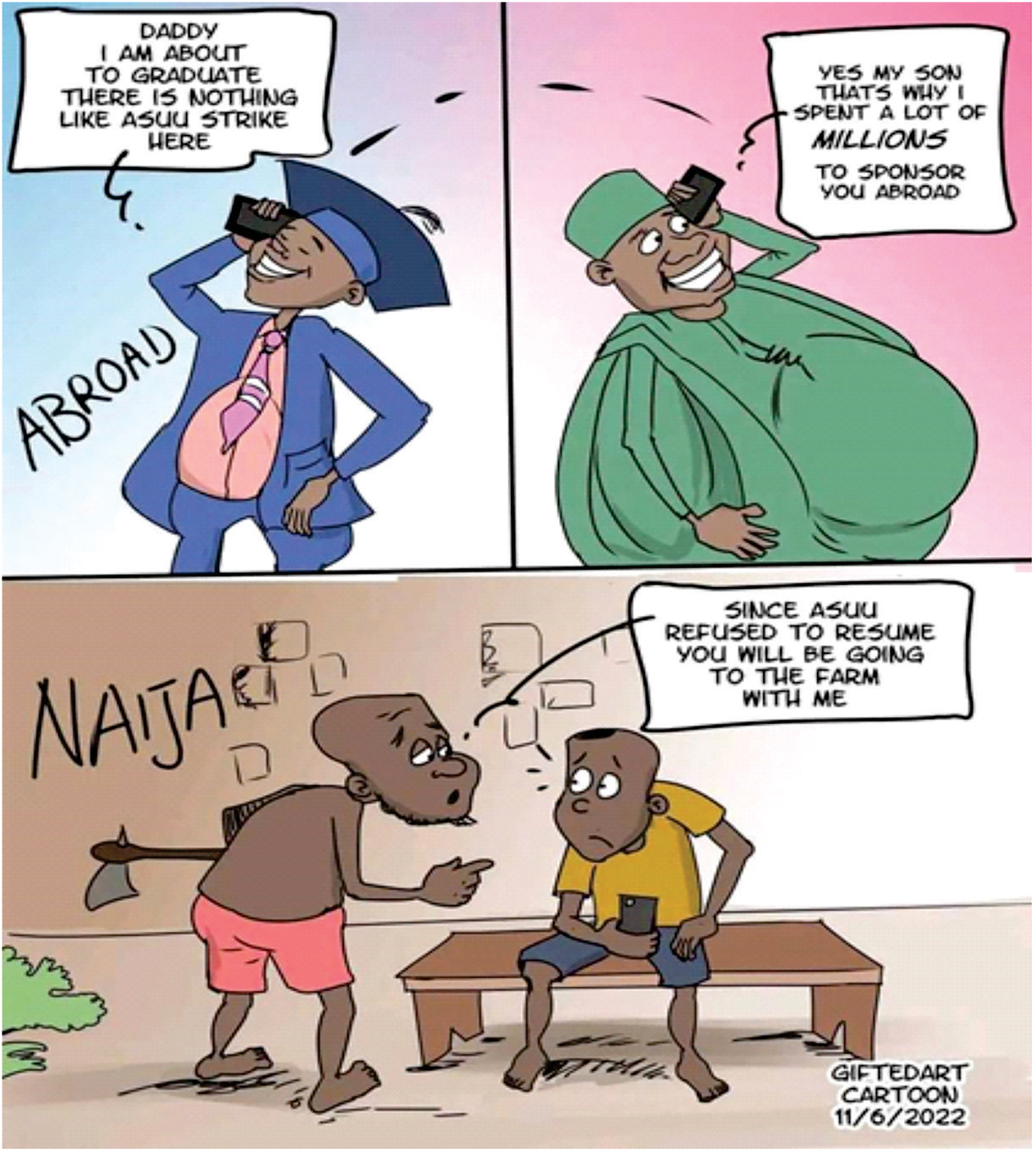
Showing conversations in two different Nigerian families.
Source: Nairaland.com, June 23, 2022 (https://www.nairaland.com/7172332/nigeria-state-nation-cartoons/5).
The use of multiple modes in the above cartoon manifests in the various visual and textual modes. The textual modes in the first frame are “DADDY I AM ABOUT TO GRADUATE. THERE IS NOTHING LIKE ASUU STRIKE HERE” and “YES MY SON THAT’S WHY I SPENT A LOT OF MILLIONS TO SPONSOR YOU ABROAD”. The two modes give viewers information about the educational system’s stability overseas. Unlike the scenario painted in the second frame of the cartoon with the textual mode “SINCE ASUU REFUSED TO RESUME YOU WILL BE GOING TO THE FARM WITH ME”. Both frames depict a conversation between the two fathers and their sons. The first is the outcome of the oversea study, and the second is the outcome of the ASUU strike necessitated by poor education funding by the Federal Government of Nigeria. The question now is, had the oversea universities failed to spend on their educational system, would the Nigerians be able to send their children abroad? This question is left unanswered.
4.1.7 Visual representation of imminent end to education in Nigeria
In Figure 10, four important visual metaphorical are highlighted as semiotic resources: First is the image of two hands representing FG as shown by ‘F’ and ‘G’ holding a knife; secondly, we have a hardcover book with the inscription ‘EDUCATION’; the third visual representation is that of a university lecturer and finally, a visual portrayal of a university student all situated within a context. There are also textual representations in terms of “POOR FUNDING”, “STRIKE”, “ASUU STRIKE CONTINUES…”, ‘F’ and ‘G’ representing the Federal Government, as well as “!?”.
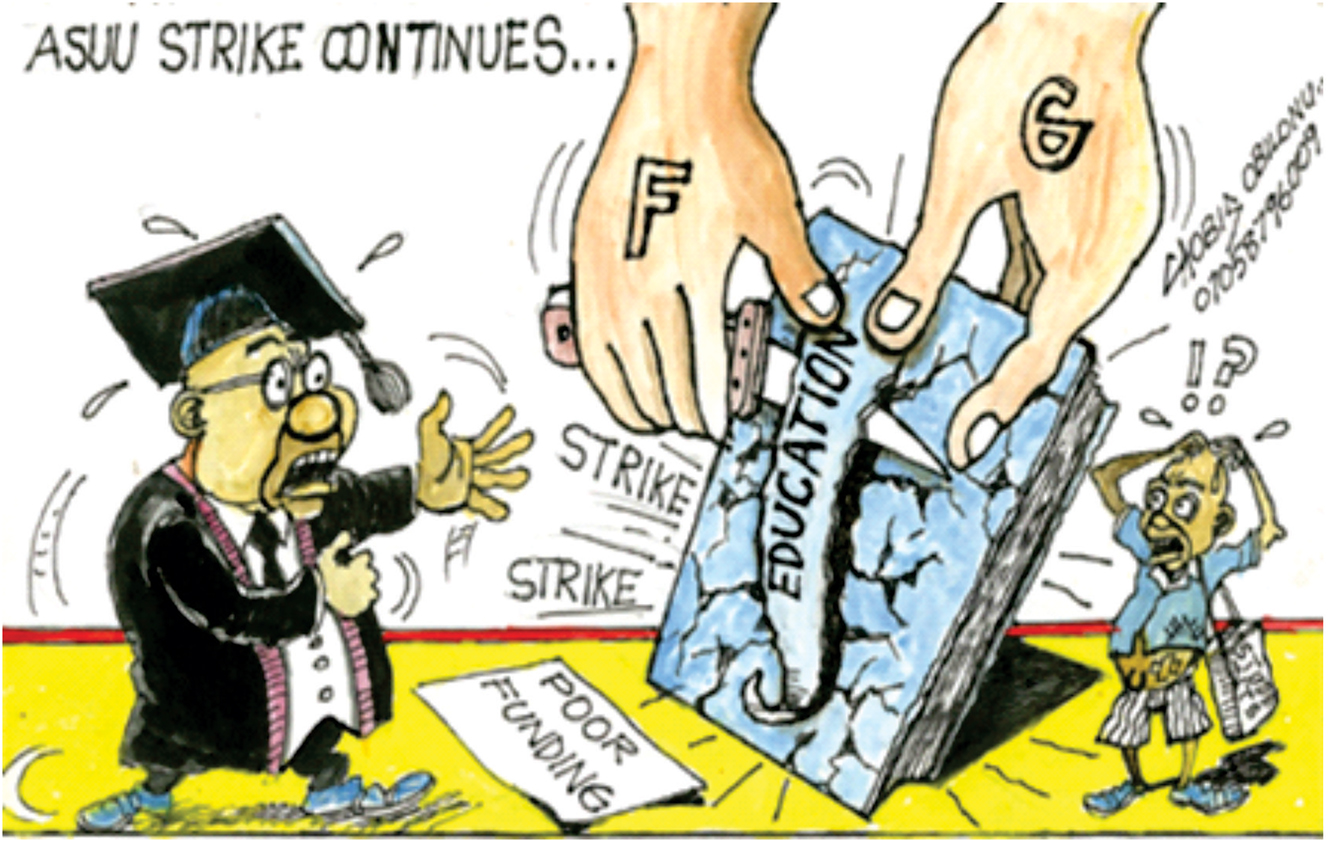
Showing scraping of education in Nigeria.
Source: Vanguard, December 23, 2018 (https://www.vanguardngr.com/strike-we-want-to-say-govt-has-continually-falsely-raised-hopes-of-nigerian-public-asuu/).
The two hands are visually represented and given superordinate dominance in this context. The hands are strategically positioned at the top, projecting the biblical mighty hands from above “heaven”. With the aid of the knife, the hand is seen scraping EDUCATION as a sign of elimination. Initially, the Academic Staff Union of the University accused the Federal Government of poor funding of education, but the worse scenario is taking place at this point. As a result, the ASUU man and student were shocked by removing/cutting off the education, which signifies a nonchalant attitude of the Government regarding education in Nigeria. The pictorial signs of shock and exclamatory/question marks above the student’s head serve as semiotic resources that reflect the Government’s attitude towards the educational system in Nigeria.
There are animate and inanimate objects functioning as represented participants in Figure 11. These are a man carrying a shovel, a book and a signage with the textual mode “EDUCATION: 1840–2022”. The pictorial view in Figure 11 metaphorically depicts the Federal Government’s attitude towards education. Here, everything about education in Nigeria, from the inputs of missionaries in 1840 to the point of ASUU’s struggles in 2022, is about to be buried by the Federal Government. The man in the picture is seen performing an action known as the “going on” thing in SFL. The action of the FG is happening in an era when other countries of the world are busy investing in the educational system in their various home countries in the areas of technology, research and innovation for the advancement of their societal well-being.
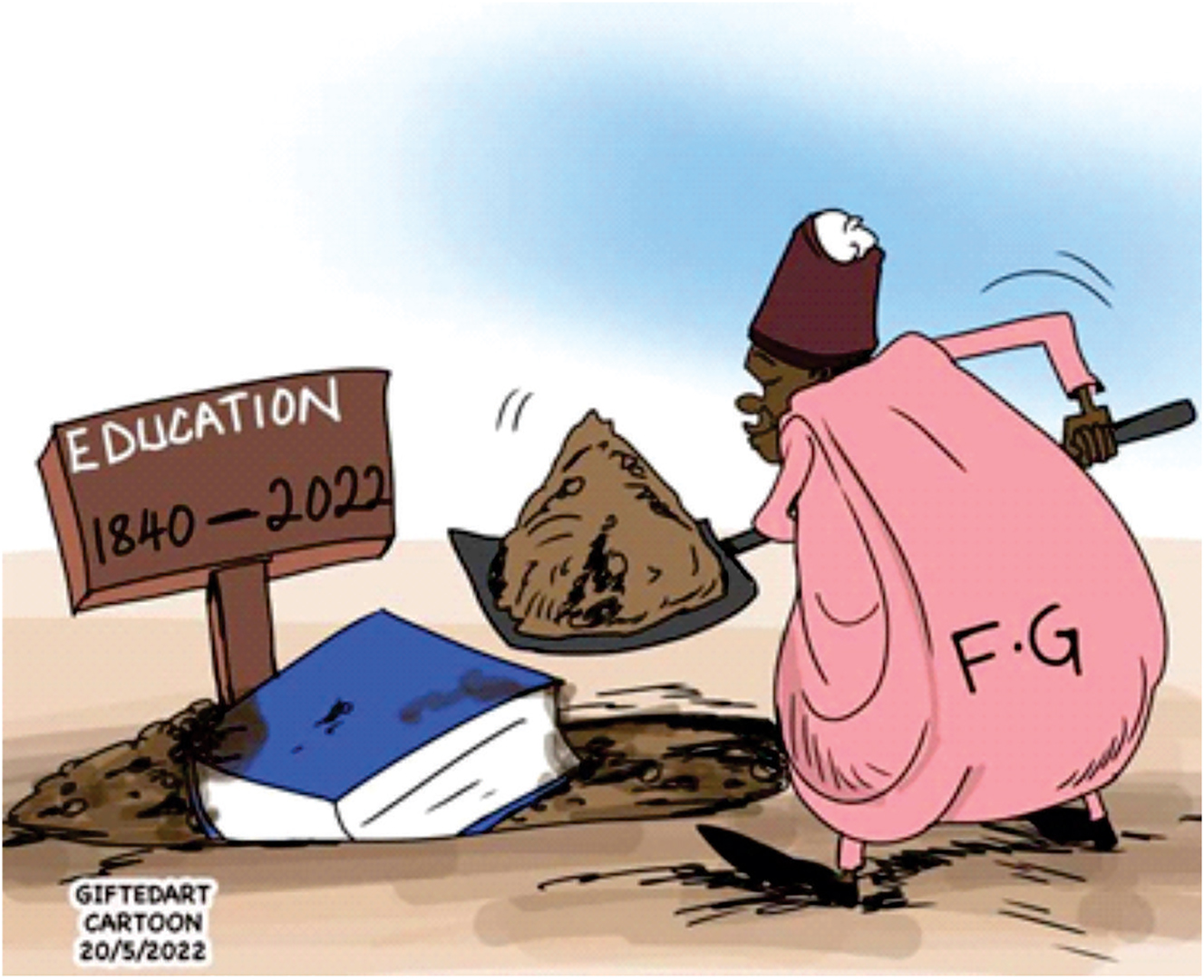
Showing the burial of Education in Nigeria May 20, 2022.
5 Discussion of findings
Findings from the study show that the impact of cartoons in correcting social ills cannot be overlooked. Cartoons serve as tools for the representation of societal issues in a humorous way. Its use of symbols and visual metaphors to simplify and communicate complicated ideas and concepts is brought to the fore. In this way, complex issues are crystallized into a simple metaphor and, by extension, the intended meaning that words alone may not be enough to express is communicated. In a country where freedom of speech has eluded many Nigerians, and many a citizen is not allowed to voice their opinions for fear of incarceration; in such a situation, cartoons have become the vehicle with which the truth is made known.
Therefore, this study significantly impacts the public in that Nigerians are made to understand through the use of cartoons what is going on in the country; the study also helps to lend voices to the ASUU struggles and enhances the effect the strike was meant to give. Furthermore, the finding shows that semiotic communication of this nature has helped portray the Federal Government’s non-challant attitude towards the educational system in Nigeria, as seen in their deliberate breach of agreement with ASUU. Although the ASUU strike does not have much impact on Nigerian politicians’ homes, it is necessary to point out here that ASUU’s struggle is majorly for the poor masses (students) whose parents could not afford overseas education. Therefore, a study of this nature which employed semiotic communication in projecting the portrayer of reality in the context of the seemingly intractable ASUU strikes in Nigeria should be encouraged.
6 Conclusion
From the discussion, there is no doubt that cartoons have contributed to the ongoing representation of societal issues in a humorous way. In this way, cartoonists have been able to contextualize the ills in society via visual and verbal representation. The study shows that cartoons that use satire and humour as visual representations of reality have gained prominence across many media platforms. As a result, many semiotic resources coupled with visual metaphors are employed to portray reality in the context of the seemingly intractable ASUU strikes and their consequences on academic activities in Nigeria. As evidenced in this study, cartoonists have repurposed, re-used, recontextualized and resemiotized the happenings in society. This is done metaphorically to portray their personal views on the ASUU strike, inadequate education funding, government mismanagement of national resources and the high corruption and embezzlement among political officeholders to the detriment of the well-being of those they govern.
About the author
Peter Oyewole Makinde is a lecturer in the Department of Linguistics, Faculty of Arts, Nnamdi Azikiwe University, Awka, Anambra State, Nigeria. He is also a doctoral student in the Linguistics Department, University of the Western Cape, South Africa. His research interests are in the areas of Stylistics, Social Semiotics and Multimodality.
References
Agu, Nonyerem Margaret. 2017. A pragmatic analysis of ‘leadership’ cartoons in selected Nigerian dailies. ANSU Journal of Language and Literary Studies 1(2). 106–118.Search in Google Scholar
Attardo, Salvatore & Jean-Charles Chabanne. 1992. Introduction: Humor research east of the Atlantic. Humor 5(1–2). 1–6. https://doi.org/10.1515/humr.1992.5.1-2.1.Search in Google Scholar
Carroll, Noël Edward. 1996. A note on film metaphor. Journal of Pragmatics 26(6). 809–822.10.1016/S0378-2166(96)00021-5Search in Google Scholar
Curtin, Brian. 2009. Semiotics and visual representation. Semantic Scholar. 51–62.Search in Google Scholar
Eko, Lyombe. 2010. The art of criticism: How African cartoons discursively constructed African media realities in the post-cold war era. Critical African Studies 2(4). 65–91. https://doi.org/10.1080/20407211.2010.10530758.Search in Google Scholar
Farwell, Beatrice & Robert Henning. 1989. The charged image: French lithographic caricature 1816–1848. Santa Barbara: Santa Barbara Museum of Art.Search in Google Scholar
Feng, Dezheng & Kay L. O’Halloran. 2013. The visual representation of metaphor: A social semiotic approach. Review of Cognitive Linguistics 11(2). 320–335. Published under the auspices of the Spanish Cognitive Linguistics Association. https://doi.org/10.1075/rcl.11.2.07fen.Search in Google Scholar
Forceville, Charles J. 2009. Nonverbal and multimodal metaphor in a cognitivist framework: Agendas for research. In Charles J. Forceville & Eduardo Urios-Aparisi (eds.), Multimodal metaphor, 19–42. Berlin: Mouton de Gruyter.10.1515/9783110215366Search in Google Scholar
Gee, James Paul. 2003. What video games have to teach us about learning and literacy. New York: Palgrave Macmillan.10.1145/950566.950595Search in Google Scholar
Goatly, Andrew. 2007. Washing the brain: Metaphor and hidden ideology. Amsterdam: John Benjamins.10.1075/dapsac.23Search in Google Scholar
Halliday, Michael Alexander Kirkwood. 1978. Language as social semiotic: The social interpretation of language and meaning. London: Edward Arnold.Search in Google Scholar
Halliday, Michael Alexander Kirkwood. 2004. An introduction to functional grammar, 3rd edn., rev. by C.M.I.M. Matthiessen. London: Arnold.Search in Google Scholar
Hand, Martin. 2017. Visuality in social media: Researching images, circulations and practices. In Luke, Sloan & Anabel, Quan-Haase (eds.),The SAGE handbook of social media research methods, 217–231. London: Sage.10.4135/9781473983847.n14Search in Google Scholar
Harrison, Randall. 1981. The cartoon: Communication to the quick. Beverly Hills: Sage.Search in Google Scholar
Hempelmann, Christian F. & Andrea Samson. 2007. Visual puns and verbal puns: Descriptive analogy or false analogy? In Diana Popa & Salvatore Attardo (eds.), New approaches to the Linguistics of humor, 180–196. Galat¸ i: Academica.Search in Google Scholar
Hjelmslev, Louis. 1961 [1943]. Prolegomena to a theory of language. Madison: University of Wisconsin Press.Search in Google Scholar
Hohne, Karl Heinz & Ralph Bernstein. 1986. Shading 3D-images from CT using gray-level gradients. IEEE Transactions on Medical Imaging 5(1). 45–47.10.1109/TMI.1986.4307738Search in Google Scholar
Hühn, Peter. 2009. Introduction. In Peter Hühn, Wolf Schmid & Jörg Schönert (eds.), Point of view, perspective and focalization: Modeling mediation in narrative, 1–8. Berlin: Walter de Gruyter GmBH.10.1515/9783110218916.0.1Search in Google Scholar
Ifechelobi, Jane & Chiamaka Rosemary Ilodinso. 2021. Multimodal study of selected cartoons in Nigerian newspapers. Awka Journal of English Language and Literary Studies 8(1). 142–148.Search in Google Scholar
Kaplan, E. Ann. 2005. Trauma culture: The politics of terror and loss in media and literature. New Jersey: Rutgers University Press.Search in Google Scholar
Kaula, Salome K. 2015. language and style in cartoons: A case study of Ben 10. Doctoral dissertation, University of Nairobi.Search in Google Scholar
Kövecses, Zoltán. 2002. Cognitive-linguistic comments on metaphor identification. Language and Literature 11(1). 74–78.10.1177/096394700201100107Search in Google Scholar
Kress, Gunther & Theo Van Leeuwen. 2006. Reading images: The grammar of visual design, 2nd edn. London: Routledge.10.4324/9780203619728Search in Google Scholar
Kress, Gunther & Theo Van Leeuwen. 2020. Reading images: The grammar of visual design, 3rd edn. London: Routledge.10.4324/9781003099857Search in Google Scholar
Makinde, Peter Oyewole & Lynda Uju Mgbodi. 2022. A social semiotic discourse analysis of gender expressions in selected Nigerian newspapers. Language in India 22(5). 175–189.Search in Google Scholar
Meister, Jan Christoph & Jörg Schönert. 2009. The DNS of mediacy. In Peter Hühn, Wolf Schmid & Jörg Schönert (eds.), Point of view, perspective and focalization: Modeling mediation in narrative, 11–40. Berlin: Walter de Gruyter GmBH.10.1515/9783110218916.1.11Search in Google Scholar
Nairaland.com. June 13, 2022a. Available at: https://www.nairaland.com/7172332/nigeria-state-nation-cartoons/1.10.29173/cjfy29648Search in Google Scholar
Nairaland.com. June 23, 2022b. Available at: https://www.nairaland.com/7172332/nigeria-state-nation-cartoons/5.Search in Google Scholar
O’Halloran, Kay L. 2008. Systemic functional-multimodal discourse analysis (SF-MDA): Constructing ideational meaning using language and visual imagery. Visual Communication 7(4). 443–475. https://doi.org/10.1177/1470357208096210.Search in Google Scholar
O’Halloran, Kay L. 2009. Multimodal analysis and digital technology. In Interdisciplinary perspectives on multimodality: Theory and practice, Proceedings of the third international conference on multimodality. Campobasso: Palladino.Search in Google Scholar
Opinion Nigeria.com. Available at: https://www.opinionnigeria.com/as-asuu-strike-looms-who-is-to-blame-for-playing-with-our-future-by-abdulrasaq-isiaq-mustapha/.Search in Google Scholar
Punch Newspaper. January 18, 2022. Available at: https://ms-my.facebook.com/punchnewspaper/posts/cartoon-flakes/5131123650259089/.Search in Google Scholar
Refaie, Elisabeth El. 2003. Understanding visual metaphor. Visual Communication 2(1). 75–95. https://doi.org/10.1177/1470357203002001755.Search in Google Scholar
Roberts, Helene (ed.). 1998. Encyclopedia of comparative iconography. Chicago: Fitzroy Dearborn Publishers.Search in Google Scholar
Samson, Andrea C. & Christian F. Hempelmann. 2006. Introduction to cartoon research. Paper presented at the 18th conference of the international society for humor studies, July 3–7, 2006. Copenhagen, Denmark.Search in Google Scholar
Samson, Andrea Christiane & Oswald Huber. 2007. The interaction of cartoonist’s gender and formal features of cartoons. Humor 20(1). 1–25. https://doi.org/10.1515/HUMOR.2007.001.Search in Google Scholar
Sani, Iro, Mardziah Hayati Abdullah, Faiz Sathi Abdullah & Afida Mohamad Ali. 2012. Political cartoons as a vehicle of setting social agenda: The newspaper example. Asian Social Science 8(6). 156. https://doi.org/10.5539/ass.v8n6p156.Search in Google Scholar
Tsakona, Villy. 2009. Language and image interaction in cartoons: Towards a multimodal theory of humor. Journal of Pragmatics 41(6). 1171–1188. https://doi.org/10.1016/j.pragma.2008.12.003.Search in Google Scholar
Vanguard. Nov 11, 2017. Available at: https://www.vanguardngr.com/2017/11/buhari-asuu-promises/.Search in Google Scholar
Vanguard. December 23, 2018a. Available at: https://www.vanguardngr.com/strike-we-want-to-say-govt-has-continually-falsely-raised-hopes-of-nigerian-public-asuu/.Search in Google Scholar
Vanguard. 2018b. Available at: https://www.vanguardngr.com/2018/12/strike-asuu-may-not-honour-further-calls-by-fg-national-president/.Search in Google Scholar
Vanguard Newspaper. December 11, 2013. Available at: https://www.vanguardngr.com/2013/12/elechi-calls-scrapping-asuu/.Search in Google Scholar
Vanguard Newspaper. June 25, 2022. Available at: https://www.vanguardngr.com/2022/06/asuu-strike-gangrene/.Search in Google Scholar
Van Leeuwen, Theo. 2005. Introducing social semiotics. London: Psychology Press.10.4324/9780203647028Search in Google Scholar
© 2023 the author(s), published by De Gruyter, Berlin/Boston
This work is licensed under the Creative Commons Attribution 4.0 International License.
Articles in the same Issue
- Frontmatter
- Peirce Study
- Biosemiotics and Peirce
- Culture and Communication
- A skeptic’s guide to “intercultural communication”—debunking the “intercultural” and rethinking “culture”
- Cultural unit blue in the Old Testament
- The influence of semantic predictability on transposition effects in Chinese and English
- Multimodal Signs
- Visual representation of ASUU strikes in Nigeria: a semiotic analysis of cartoons in selected Nigerian newspapers
- A multimodal analysis of Piggyvest’s animated advertisement videos
- “The soro-soke [speak up] generation”: multimodality and appraisal choices in selected #EndSars civil protest-related memes in Nigeria
Articles in the same Issue
- Frontmatter
- Peirce Study
- Biosemiotics and Peirce
- Culture and Communication
- A skeptic’s guide to “intercultural communication”—debunking the “intercultural” and rethinking “culture”
- Cultural unit blue in the Old Testament
- The influence of semantic predictability on transposition effects in Chinese and English
- Multimodal Signs
- Visual representation of ASUU strikes in Nigeria: a semiotic analysis of cartoons in selected Nigerian newspapers
- A multimodal analysis of Piggyvest’s animated advertisement videos
- “The soro-soke [speak up] generation”: multimodality and appraisal choices in selected #EndSars civil protest-related memes in Nigeria
