The Fame of Trajan: A Late Antique Invention
-
 ,
,

Summary
Trajan’s status as a model emperor is perhaps most famously expressed in Eutropius’ catchphrase “More fortunate than Augustus, better than Trajan” (Eutr. Brev. 8.5.3). Modern scholarship has similarly stressed Trajan’s exemplary status, assuming that Trajan’s virtues were already a point of departure by which to measure second- and third-century emperors. This article challenges that notion; it argues that Trajan’s status as a model emperor was a late-antique literary construct. Trajan only entered the repertoire of exemplary emperors during the course of the fourth century to become the model emperor in the very late-fourth- and early-fifth century. This development depended on the historical context and ideological demands, as well as on the availability of the then-existing material discussing and depicting the historical Trajan.
Introduction
In his panegyric on the fourth consulship of Honorius (398 C.E.), Claudian explicitly put forward Trajan as the major model for the boy emperor. The idea is flagged from the start of the poem: “Not unworthy of reverence nor only just acquainted with war is the family of Trajan and that Spanish house which has showered diadems upon the world”.[1] It reaches a climax towards the middle of the poem, in the form of an imagined speech of advice to the young emperor Honorius from his father Theodosius:[2]
“The fame of Trajan will never die, not so much because thanks to his victories on the Tigris conquered Parthia became a Roman province, not because he broke the might of Dacia and let their chiefs in triumph up the slope of the Capitol, but because he was kindly to his country. Fail not to make someone like him your example, my son.”[3]
Trajan’s status as a model emperor is perhaps most famously expressed in Eutropius’ catchphrase “More fortunate than Augustus, better than Trajan”. In fact, the Roman historian continues: “To such an extent has the reputation of his goodness lasted that it provides those who either (wish to) flatter or to praise him sincerely with the opportunity to use him as the most outstanding model.”[4] It was hardly surprising that authors like Claudian and Eutropius used earlier Roman emperors to praise their contemporary ruler. The importance of exemplarity in Roman society meant that emperors were often compared against their predecessors. Behaviour of some of the earlier emperors was evaluated so positively that it became normative for the behaviour of consequent rulers.[5] Those earlier emperors were the cornerstones against which later emperors were measured. By the fourth century, Trajan was clearly among this group of model rulers.[6] Modern scholarship often assumes that Trajan’s virtues were already a point of departure to measure second- and third-century emperors.[7] This article challenges that notion. Instead, it argues that Trajan’s status as a model emperor was a late-antique literary construct. Trajan was not a model emperor from the word go; rather, he only entered the repertoire of exemplary emperors during the course of the fourth century, to become the model emperor in the very late-fourth and early-fifth century. This development depended on the historical context and ideological demands of the late-fourth century, as well as on the availability of the then-existing material discussing and depicting the historical Trajan.
In order to analyse to what extent, when, why and to whom Trajan became a model emperor, this article traces references to Trajan in different literary and material sources. Importantly, it distinguishes between two different types of references. On the one hand are explicit references to Trajan as an exemplary ruler, on the other more implicit references to historical presentations of Trajan in his role of emperor. For instance, mentions of the title optimus princeps are often taken as evidence for Trajanic exemplarity but are much more ambiguous than directly naming the emperor. Similarly, continuation of the use of specific Trajanic iconographies or reuse of Trajanic elements may sometimes have referred to Trajan, but need not always have done so. This article will focus on the different sources that testify to Trajan’s posthumous reputation. The first section will focus on ancient literary evidence, in particular on panegyric and historiography. This is the material in which explicit references are most pronounced. They show clear attempts to establish Trajan as a model emperor during his reign, which were only properly taken up in the fourth century. Even then, it seems Trajan was not the model emperor per se, but part of a larger group of exemplary leaders. The second part of the article focuses on references to the emperor in material sources, particularly inscriptions, coins, portraits, and monuments. These are characterised by implicit references to Trajan. They show a similar pattern as the literary evidence does: Trajan only entered the repertoire of exemplary leaders in the fourth century, specifically under Constantine, and his exemplary status was further boosted during the reign of Theodosius.
Literary sources
The idea that Trajan would become a model for future emperors was there from the start of his reign. In his famous Panegyricus addressed to Trajan on 1 September 100 C.E., Pliny the Younger made explicit that with his speech he intended “good rulers to recognize what they have done and bad ones learn what they ought to do”[8]. Or, as he phrased it in one of his “Letters”: “to encourage our emperor in his virtues through sincere praise”, and, in doing so, “to advise future emperors by means of example”.[9]
Setting up Trajan as a role model for his successors seems not to have been immediate successful. This becomes clear from the historiographical accounts published in the century after his death. For example, in the preface to the history of the Parthian wars that Fronto started to write around 165 C.E. in order to celebrate the exploits of Lucius Verus, the author is rather ambivalent about Trajan. Not only does Fronto note that Trajan’s “own glory was likely to have been more important to him than the blood of his soldiers”, he also points out that, in terms of justice and clemency, “Trajan was not equally cleared in the eyes of all”[10]. Similarly, in the second-century historiographical accounts of Tacitus, Cassius Dio, and Herodian, Trajan appears far from universally positive: there is much implied criticism on Trajan’s rule in Tacitus’ writing; Herodian mentions the emperor only twice (as often as Nero and Domitian who figure as explicitly negative examples for bad emperors); instead Herodian refers five times to Augustus as a positive example of imperial rulership and is focusing on Marcus as an exemplary ruler. Dio’s presentation of Trajan is ambivalent and portrays the emperor as paying respect to elite classes and being generous to the people, but with an affinity for wine and boys. Because Dio’s “Roman History” survives only incompletely, comparison of Dio’s image of Trajan to that of other emperors is possible only to a limited extent, but again it seems that other emperors such as Augustus and Marcus Aurelius played a more important role as positive examples of imperial rulership.[11]
Even as late as the fourth century, Trajan is hardly the most used model to parallel reigning emperors with. The use of Trajan as an exemplary emperor in late-antique imperial panegyric seems to consist of two phases: there are implicit references to the emperor in the first half of the fourth century and explicit references in the second half of the fourth century.
Implicit references encompass thematic similarities between the early fourth-century speeches and Pliny’s Panegyricus and, as the intertextual record has established, are the consequence of the availability of Pliny’s speech in Gaul at that time.[12]
“Plinian strategies’ can be seen at work in Pan. VII(6) to Maximian and Constantine 307 C.E. Pliny’s speech may be recalled in the orator’s use of two father-figures for Constantine: his real father Constantius and his father-in-law Maximian, who mirror Trajan’s biological father Trajan and adoptive father Nerva.”[13]
Similarly, in the fragmentary speeches of Symmachus, Valentinian’s characterization of a skilled soldier before he became an emperor may recall Pliny’s Trajan.[14]
Although the orators may have been familiar with Pliny, the influence of his Panegyricus remained relatively minor in their speeches. Selected themes and adapted phrases of his speech are joined and often outnumbered by those of other writers. Moreover, Pliny is never mentioned, in contrast to Cicero, Virgil and Fronto.[15] As pointed out by Gavin Kelly: “the Panegyricus is an intertext for use rather than ostentation […] it is easier to see its techniques […] being followed and adapted than […] an allusion summoning up a comparison to Trajan.”[16]
This generic use of Pliny’s Panegyricus seems to have turned to a more political use in the middle of the fourth century in the schools in Gaul. It has been argued that with the rise of a new senatorial class in the provinces, Pliny’s speech became the subject of renewed appreciation, in particular because it praised a pro-senatorial emperor.[17] Such political use of the Panegyricus is reflected in Panegyricus III(11) from 362 C.E. by the orator Claudius Mamertinus and II(12) from 389 C.E. by Pacatus. Speaking before senatorial audiences, both orators made a particular play of their emperors’ ciuilitas, a virtue which had not been praised in extant panegyric since Pliny’s Panegyricus. Like Trajan, Julian and Theodosius’ ciuilitas was mainly demonstrated by means of their attitude towards the senatorial elite, and in particular by their decision to walk alongside the consuls unprotected during public events.[18]
From the time of Constantine onwards, Pliny’s writings seems to have influenced the image of Trajan in the emerging genre of Christian historiography. Eusebius set the tone by pointing out that, following Pliny’s observation that Christians did “nothing wicked or illegal except that they rose at dawn to sing to Christ as though a God”, Trajan had put an end to the persecutions.[19] Such idiosyncratic readings of Pliny’s “Letters” allowed Christian historiographers to integrate Trajan into a Christian narrative by presenting him as an emperor who, although being a pagan, at least showed sound judgement.[20]
In the first half of the fourth century, however, references to Trajan remained mostly implicit. Additionally, a survey of explicit references to Roman emperors in fourth-century panegyrics shows that comparisons with Augustus are made much more frequently. Trajan is used as an example about as often as Marcus Aurelius, Antoninus Pius and (in the negative sense) Nero (Table 1):[21]
Explicit mentions of past emperors as exempla in imperial panegyrics delivered between the accession of Diocletian in 284 C.E. and the death of Theodosius in 395 C.E.
|
Greek |
Latin |
||||||||
|
Julian. |
Lib. |
Them. |
Total |
Pan. Lat. |
Symm. |
Auson. |
Total |
Grand Total |
|
|
Augustus |
0 |
0 |
11 |
11 |
5 |
1 |
1 |
7 |
18 |
|
Marcus Aurelius |
0 |
0 |
11 |
11 |
0 |
1 |
0 |
1 |
12 |
|
Trajan |
0 |
0 |
7 |
7 |
2 |
0 |
2 |
4 |
11 |
|
Antoninus Pius |
0 |
0 |
4 |
4 |
3 |
1 |
2 |
6 |
10 |
|
Nero |
0 |
0 |
10 |
10 |
0 |
0 |
0 |
0 |
10 |
|
Titus |
0 |
0 |
4 |
4 |
1 |
0 |
1 |
2 |
6 |
|
Domitian |
0 |
0 |
4 |
4 |
0 |
0 |
1 |
1 |
5 |
|
Tiberius |
0 |
0 |
3 |
3 |
0 |
1 |
0 |
1 |
4 |
|
Hadrian |
0 |
0 |
1 |
1 |
2 |
0 |
0 |
2 |
3 |
|
Carus |
1 |
0 |
0 |
1 |
0 |
0 |
0 |
0 |
1 |
|
Gallienus |
0 |
0 |
0 |
0 |
1 |
0 |
0 |
1 |
1 |
|
Nerva |
0 |
0 |
0 |
0 |
1 |
0 |
0 |
1 |
1 |
|
Probus |
0 |
0 |
0 |
0 |
1 |
0 |
0 |
1 |
1 |
|
Severus Alexander |
0 |
0 |
1 |
1 |
0 |
0 |
0 |
0 |
1 |
The first explicit reference to Trajan in fourth-century panegyric appears in a Greek literary context, in the speeches of Themistius. In his 364 C.E. speech in praise of Jovian, for example, Themistius celebrates the restoration of philosophy under that emperor, drawing attention to previous emperors who had promoted the discipline, including Trajan:
“So too the fathers of your rule promoted my predecessors in this discipline – Augustus the famous Arius, Tiberius Thrasylus, the great Trajan, Dio the Golden-Tongued, the two Antonines Epictetus – I omit the others save him who long ago took his name from the same deity as you and the founder of my house. By adopting philosophy in the sight of all, you [Jovian] follow in these men’s footsteps.”[22]
This is typical for the use of Trajan in Themistius’ panegyrics. Trajan is primarily remembered for promoting philosophy and philosophers (in particular Dio Chrysostom), and, more importantly is always named together with other emperors, most notably Antoninus Pius and Marcus Aurelius.[23] This is also the case in the two occasions at which Trajan is named explicitly in the Latin panegyrics. In 379 C.E., Ausonius praised Gratian for his remission of debts in the provinces, drawing attention to similar financial measures undertaken by Trajan and Marcus Aurelius.[24] Similarly, praising Theodosius in 389 C.E., Pacatus includes Trajan in an even longer list of emperors:
“Are these the thanks you give me for longing for you even when I was in a flourishing state, for thinking, when gentle Nerva, Titus, the darling of the human race, and Antoninus, memorable for his piety, were in charge of me, when Augustus was adorning me with walls, Hadrian instructing me in the law, and Trajan extending my frontiers, that my happiness was less than complete because I was not yours?”[25]
Interestingly, this is the first time that Trajan’s military exploits are explicitly mentioned in fourth-century panegyric, which mainly focused on his civil qualities. In contrast to the panegyrics, the emperor’s military reputation provides the main way through which he is remembered in fourth-century historiography.[26] But in these, too, Trajan remains ‘a’ model emperor rather than ‘the’ model emperor. This is clear, for instance, from the more extensive descriptions of Julian’s Caesares (362 C.E.) or Ammianus Marcellinus’ Res Gestae (390s C.E.).
In his satirical Caesares, Julian describes a contest between Alexander the Great, Julius Caesar, and the Roman emperors Augustus, Trajan, Marcus Aurelius, and Constantine, before the assembled Olympian gods. As all six were deemed exemplary leaders, the contest allowed Julian to pass judgement on his predecessors and reflect on what ideal emperorship constituted in his period.[27] Trajan is described as constantly carrying around the trophies of his wars with the Dacians and the Parthians. Additionally, it was his virtue of clemency that the gods found most favourable, but he is also mocked for his love of wine and young boys, and his inability to speak eloquently.[28] In the end, Trajan finishes near the top, but he does not win. Rather, it is the philosopher-emperor Marcus Aurelius, whom Julian most admired, who wins the contest.[29]
Ammianus’ account of Trajan’s reign has unfortunately been lost, so his attitude towards the optimus princeps can only be observed through references to Trajan in his later books. These include fifteen references to Trajan, most of which appear in his narrative of Julian, and chiefly deal with his military reputation.[30] Similar to panegyrics, Trajan is named together with other emperors.[31] At one point, the similarity between the list of good emperors mentioned by Ammianus and by Pacatus is striking:
“For with rapid strides he grew so conspicuous at home and abroad that in his foresight he was esteemed a second Titus, son of Vespasian, in the glorious progress of his wars as very like Trajan, mild as Antoninus Pius, and in searching out the true and perfect reason of things in harmony with Marcus Aurelius, in emulation of whom he moulded his conduct and character.”[32]
Trajan was the model emperor in the fifth century. But the image of Trajan followed different trajectories in different sorts of literary sources. In panegyrics, the military image of the emperor solidified. Claudian’s version of Trajan is extremely military. Claudian explicitly recommends Honorius to follow Trajan’s example, primarily because of his wars against the Parthians and the Dacians (the Goths in Claudian’s time).[33] Similarly, in his praise of Avitus, Sidonius Apollinaris selects Trajan as the ultimate model to live up to. The Gallic orator depicts a scene in which the goddess Roma seeks out Jupiter in an attempt to regain her former glory. Roma recounts a long list of Roman emperors from the past, and explicitly stops at Trajan. Jupiter then gives her Avitus, who is explicitly cast as a new Trajan:
“Then came Trajan, by whose doing Agrippina became a terror to the Sygambrians, an emperor gallant, faithful, righteous and vigorous. In my captivity I pray for such another. I know not if anyone can match Trajan – unless perchance you, Gaul, should once more send forth a man who should even surpass him.”[34]
As an interim conclusion it can be stated that panegyric and historiography tell a straightforward story of Trajan’s posthumous popularity. There was no instant notion of his idealised emperorship. Rather, Trajan featured only minimally up to the fourth century, when he became integrated into a group of exemplary emperors. Trajan became the emperor to look up to only in the very late fourth or early fifth century. This is a markedly different trajectory than one in which second- and third-century emperors were deemed to follow in Trajan’s footsteps as a matter of course. Material sources such as coins, inscriptions, portraits and monuments support the interpretation that Trajan featured as exemplary ruler only from the fourth century onwards.
Material sources
Material sources come with their own set of obstacles when dealing with the question to what extent Trajan served as a model for later emperors. In contrast to panegyric and historiography, material culture could hardly make the relationship between Trajan and his successors explicit. Epigraphic sources present Trajan as an imperial ancestor without assigning a particularly prominent role to him. Interestingly, a closer look at material sources reveals that there were relatively few posthumous dedications to Trajan throughout the Roman Empire.[35] His presence in Roman imperial statue groups, for instance, pales in comparison to that of Alexander the Great, Augustus, or Hadrian. A similar pattern emerges when looking at explicit references to Trajan on coins. Only at the earliest stage of Hadrian’s rule does Trajan’s name appear explicitly on imperial coins.[36] These coins were meant to convey the transition of power that occurred in 117 C.E., thereby legitimising Hadrian’s claim to the emperorship. Just like in imperial statue groups, Trajan’s posthumous presence in imperial coinage was short-lived.
Explicit references to Trajan would not return until more than a century later. These belong to the reign of the emperor Decius (249–51 C.E.), who even went as far as to adopt Trajan’s name.[37] Decius’ choice to associate himself with this particular second-century predecessor was made early in his reign, with IMP TRAIANVS DECIVS AVG already appearing on his coins struck in 249 C.E. The association was strengthened by having the imperial formula appear in the dative on some of his bronzes.[38] The dative was more often used on coins struck for divi and members of the imperial family. For living emperors, however, it had only been common practice for coin legends of Trajan.[39] Trajan Decius was the first emperor to be styled in the dative again. The adoption of the name and the use of the dative in coin legend, then, are likely to be seen as following this emperor’s emulation of the optimus princeps.[40]
Other references to Trajan found in Decius’ coinage were more implicit. A substantial number of types bear the legend DACIA (FELIX) and show an image of the personification of this province together with a military standard (Fig. 1).[41] These coins might reflect a motive of Decius for closely associating himself with the emperor who won two successful battles against the Dacians: by means of indirectly referring to Trajan’s military successes through this DACIA propaganda on his coins, which is difficult to explain otherwise, Decius surrounded himself with an aura of victory in a period characterized by continuous military strife, in particular in the lower Danube region. Additionally, the fact that the legions stationed in Moesia and Pannonia, regions which were also important for Trajan, hailed Decius emperor might have played a role in his decision to directly connect himself with Trajan.[42]

Silver Antoninianus of Trajan Decius, Rome, 249–51 C.E. RIC IV, Trajan Decius 37B. ©American Numismatic Society.
In Decius’ coinage we thus find clear examples of how Trajan’s military reputation could resonate in ideological expressions of his successors. Nevertheless, this was a rather isolated case. Literary sources do not note a particular Trajanic exemplarity for the third-century emperors and in material sources there is otherwise a near absence of explicit references to Trajan. Even Decius’ own consecration coins attest to the fact that Trajan was among a number of emperors who were worthy of memory.[43] In the following section we largely focus on implicit references to Trajan in material sources. Since inscriptions, coins, portraits, and monuments relied on the ancient viewers’ knowledge of the attributes, titles, and symbols that were associated with Trajan, we also open up the question to what extent implicit references to Trajan would have been intended and recognized as such.
Perhaps the most obvious implicit reference to Trajan would be by referring to him as optimus. The epithet optimus princeps was granted to Trajan by the Roman senate in 100 C.E. Although Trajan remained the only emperor officially honoured by that title, a survey of epigraphic and numismatic sources shows that the epithet did not turn into a reference to exemplary emperorship before the fourth century. On the contrary, the use of the epithet optimus princeps was anything but innovative even in the second century. Referring to a prominent and powerful person as optimus princeps was based on a much older tradition going back to the late Roman Republic.[44] Even in Trajan’s own time, Pliny was well aware of the fact that the epithet was used earlier on and he himself addressed Trajan as optimus princeps and optimus imperator even before the epithet was officially granted to the emperor by the senate.[45]
When scanning epigraphic material for the use of the epithet optimus princeps, Trajan’s reign appears as a watershed. The epithet was already used to address various emperors during the early Principate, although compared to Trajan only in relatively small numbers.[46] After Trajan, it appears very frequently in inscriptions, for some emperors in even higher numbers than for Trajan, but was extended by other epithets soon after Trajan’s reign (Fig. 2). The underlying reference to Trajan may still have been perceived by later generations, but became increasingly blurred over time.[47] On coins, later emperors would abstain from using the epithet optimus princeps in a similarly emphatic way. Nevertheless, a few emperors had a couple of coin types issued that used this title along with a reverse image that had also appeared for Trajan before, yet which otherwise featured no references to Trajan.[48]
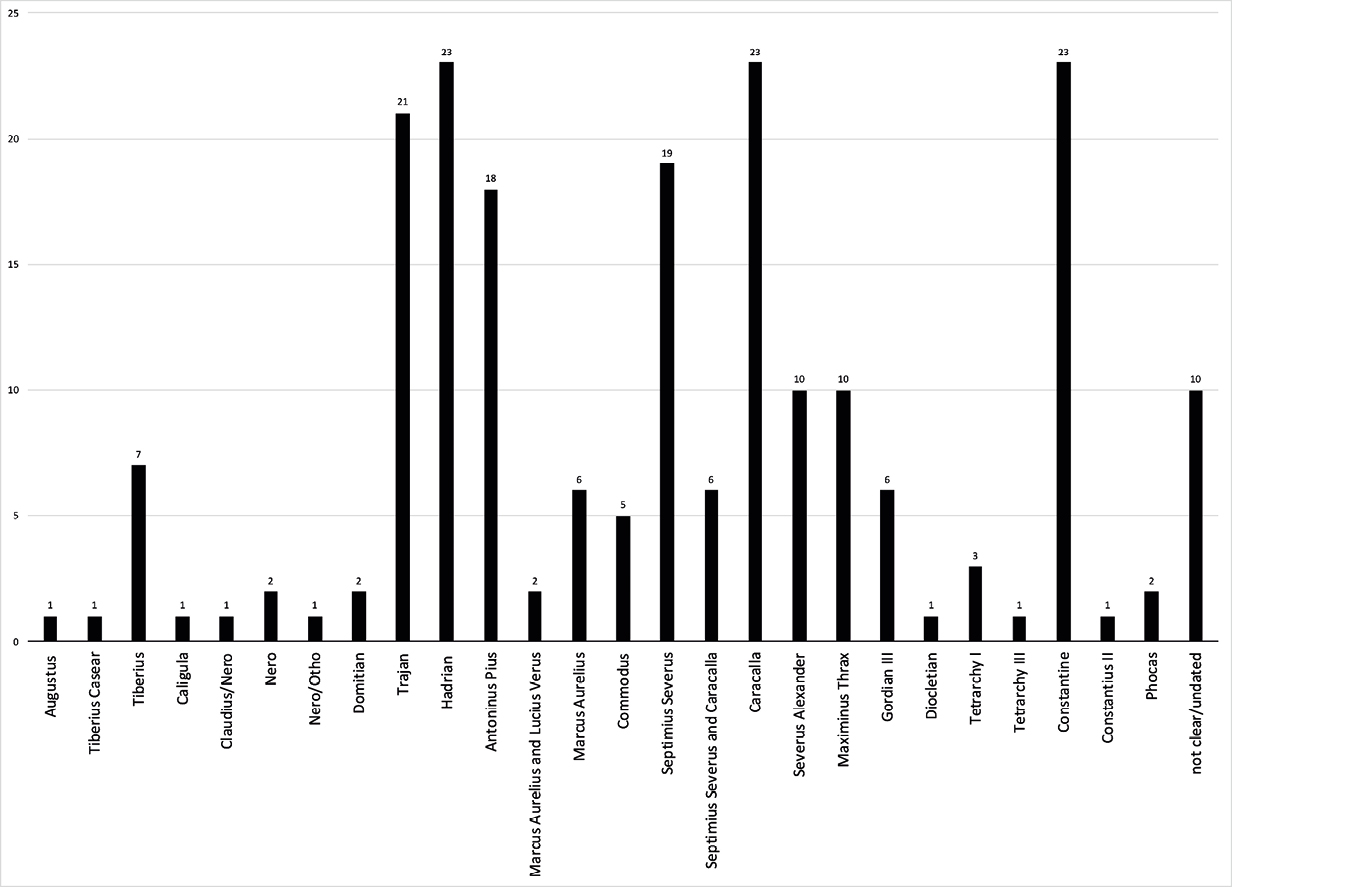
Overview of Roman emperors referred to as optimus princeps in inscriptions. The diagram is drawn up on the basis of the data gathered in the Appendix (total no. of 206 inscriptions).
In the second half of the third century the epithet temporarily disappeared from coins and inscriptions, but the title optimus saw a revival under Constantine. Not only was Constantine addressed as rerum humanarum optimus princeps in inscriptions, his coinage also clearly borrowed Trajanic messages.[49] His coins showed three military standards surrounded by the legend SPQR OPTIMO PRINCIPI. This reverse type had not appeared for about two centuries and was part of other Constantinian attempts to emulate Trajan.[50] They undoubtedly meant to reminisce of the original optimus princeps as the legend SPQR OPTIMO PRINCIPI had appeared in a sloganesque way on the reverse of Trajan’s coins between 103/104 and 114 C.E. (Figs. 3 and 4).[51]

Gold Aureus of Trajan, Rome, 112–4 C.E. RIC II, Trajan 296. ©American Numismatic Society
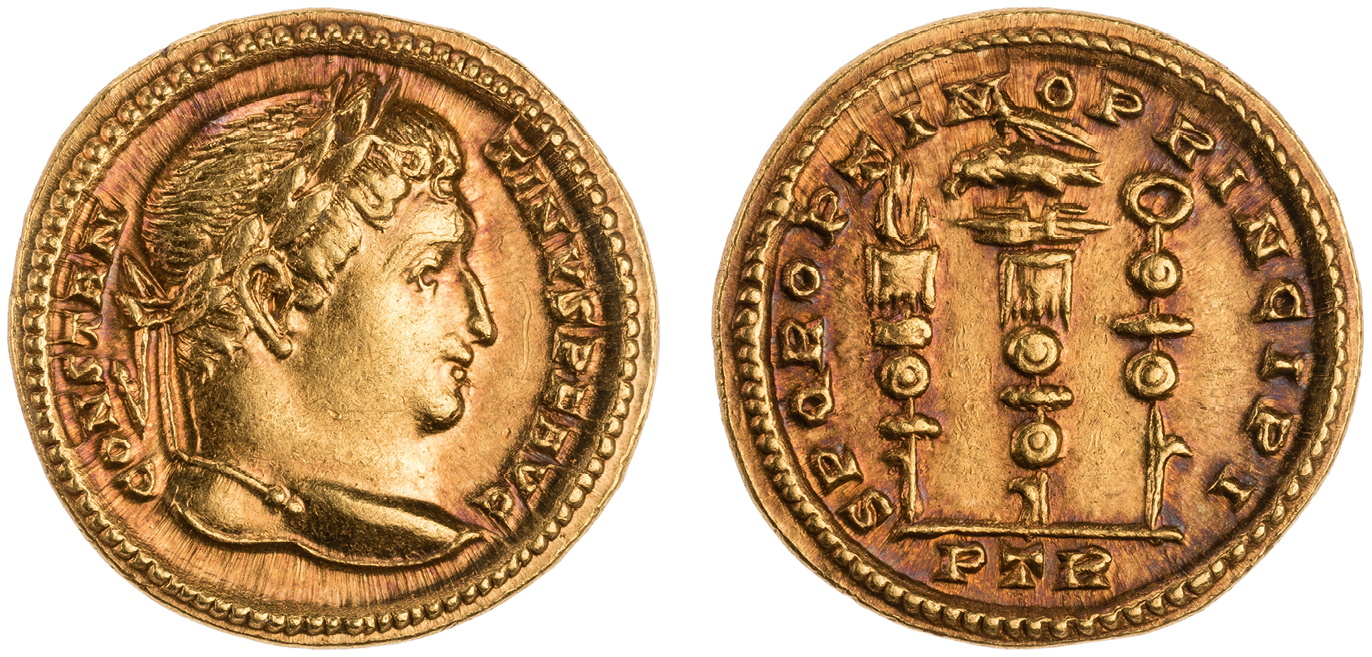
Gold Solidus of Constantine I, Trier, 310–3 C.E. RIC VI Treveri 815. ©American Numismatic Society
As the Trajanic models had long disappeared from circulation, the SPQR OPTIMO PRINCIPI coins of Constantine should be seen in the context of the political climate of the day, perhaps as reaction to the tendency of Constantine’s rival Maxentius to call himself princeps – in unprecedented fashion – in his official media.[52] In this respect it is notable that references to Trajan date to the period around the Battle of the Milvian Bridge and are restricted to western mints. As soon as Constantine moved away from the West to settle in the eastern part of the empire, these references to Trajan disappeared.
A similar emphasis on implicit references to Trajan, which only became more pronounced in late antiquity, can be observed in imperial portraiture and monumental art. Trajan’s portraiture situated the emperor in line with the early Julio-Claudians. Trajan is presented in his portraits as a mature man in his early thirties, with comma-shaped locks of hair on his forehead. Interestingly, imperial portraiture changes rather significantly after Trajan’s reign. The coiffure of his successor Hadrian is characterized by short, wavy, curling locks of hair. Moreover, Hadrian’s numismatic and sculpted portraits present the emperor with a short, curly beard, consistently throughout his reign, in contrast to Trajan’s beardless appearance. Although both Trajan and Hadrian exerted substantial influence in the realm of private portraiture, it was Hadrian who made a lasting impact on the visual appearance of Roman emperors thereafter.[53] All of Hadrian’s successors until Caracalla chose to follow the general characteristics of the portraits of Hadrian.[54] Trajan’s portraiture, in contrast, marks the end of the characteristic portrait style of the early Principate.
It is only at the time of Maxentius at the beginning of the fourth century that Trajanic influences resurface again in imperial portraiture. On Maxentius’ preserved portraits, comma-shaped locks are visible which are reminiscent of those of Trajan (Figs. 5 and 6).[55] Maxentius’ classicizing image was meant to deviate from the abstract, cubistic style of the Tetrarchs. Like Maxentius, Constantine is presented with the comma-shaped locks on his forehead. Moreover, Constantine’s portrait was clean-shaven, which was the first time an adult emperor presented himself without a beard since Trajan (Fig. 7).
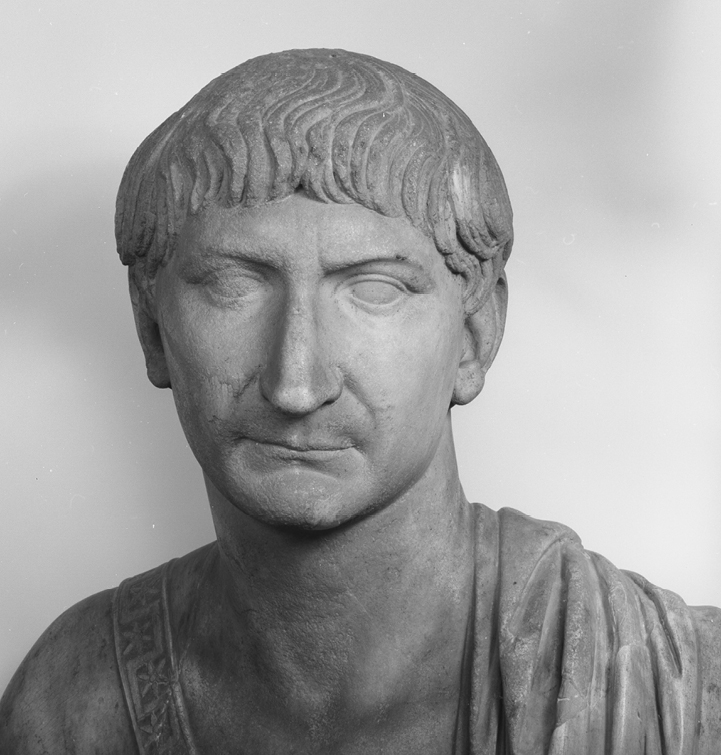
Portrait head of Trajan. Rome, Musei Capitolini, Palazzo dei Conservatori, Braccio Nuovo, Sala III 15, inv. 438. © G. Fittschen-Badura, https://arachne.dainst.org/entity/138103

Portrait head of Maxentius. Stockholm, Nationalmuseum, inv. Nm Sk 106. ©Nationalmuseum Stockholm

Portrait head of Constantine. Grottaferrata, Abbazia Greca di San Nilo, inv. 1149. ©D-DAI-ROM-38.578
However, it is important to emphasize that the classicizing style of Maxentius and Constantine’s portraiture was not explicitly Trajanic. It shared features with Julio-Claudian/Augustan, and – in the case of Constantine – Maxentian portraiture as well.[56] The first time Constantine appeared as his younger, beardless self, was, after all, in the build-up to the final confrontation with Maxentius at the Battle of the Milvian Bridge (312 C.E.). The portrait style of Maxentius and Constantine was part of a complex program of political rhetoric that only implicitly referred back to Trajan as part of a series of Rome-centred emperors. In the period thereafter, Constantine’s classicizing image set the norm for the portraiture of most of his successors. As recently argued by Guidetti, it is especially in the portraiture of the Theodosian Age that the classicizing style of Constantine resurfaces.[57] However, the lack of individual imperial portrait types and the absence of more explicit references to Trajan, for example via coiffure patterns, make it difficult to accept that these portraits were meant to evoke an association with Trajan in particular. Like in the example of Constantine above, it probably positioned Theodosius in a certain tradition of emperorship, which in Theodosius’ case was more likely to evoke a connection with Constantine. In short, if Trajan’s portrait served as an example for later emperors it was only during a brief period in the time of Constantine at the beginning of the fourth century.
The Constantinian age is also marked by a resurfacing of implicit references to Trajanic modes of representation in monuments and architecture. In fourth-century Rome, the outcomes of the heavy monumentalisation undertaken during Trajan’s rule still dominated the city.[58] The resilience of Trajan’s memories in the cityscape of Rome even influenced the production of new fourth-century monumental landmarks in Rome and Constantinople.
The Arch of Constantine in Rome, for instance, included recycled reliefs and sculptures taken from monuments of Trajan, Hadrian and Marcus Aurelius (Fig. 8).[59]

Arch of Constantine: reused elements in different colors. Image by Marsyas. Shared under CC BY-SA 2.5 license, reworked by Mike Glüsing.
The interpretation of these spolia as ideological allusions can be nuanced by several considerations.[60] First of all, the presence of multiple hints to earlier rulers in the visual language of the Arch makes Trajan less of a specific point of reference.[61] The Arch, instead, seems to be positioned within a longer tradition of imperial monumentality, aimed at presenting the Roman emperor in his different canonical roles.[62] Secondly, the reuse of earlier sculptural decorations was not necessarily intended as a conscious attempt to refer to the ‘good emperors’ of the past.[63] Beside the desire to present iconographical continuity, external factors such as the need to rapidly build an arch and the fourth-century artistic taste for eclectism could have motivated the choice to integrate spolia in the sculptural décor of the Arch.[64] The aforementioned large availability of Trajanic monuments, rather than the status of Trajan, may have been a factor behind which material was to be recycled. Furthermore, the heterogeneity and pristine conditions of the recycled sculptural elements seem to indicate their provenance from storage, which will have loosened the association of these materials with Trajanic monumentality.[65] Also, different audiences of the monument will have looked at the monument with very different cultural backgrounds, creating very diverse experiences and perceptions.[66] It is unlikely that they (all) recognised Trajanic imagery. Trajanic, Hadrianic and Aurelian pieces were decontextualized from their original settings and placed at approximately eleven meters of height, re-carved and therefore not displaying previous emperor’s likenesses. These will not have been immediate clear references for most passers-by.[67] The question whether implicit references to earlier rulers and to Trajan in particular were recognized as such by contemporary viewers of the Arch remains open.
In the age of Constantine, attention to Trajan’s monumentality was not confined to Rome. Most notably, in Constantinople, Constantine’s circular forum included some visual allusions to Trajanic monuments, such as a colossal Column.[68] Before assuming that Constantine’s porphyry Column specifically referred to that of Trajan in Rome, the creation of such a monument needs to be understood within broader trends in fourth-century Constantinopolitan monumentality. Under the Tetrarchy, the tradition of dedicating columns in honour of emperors knew a significant revival with the creation of monuments such as the colossal column in honour of Diocletian in Alexandria, the so-called “Fünfsäulendenkmal” on the forum Romanum in Rome, and the Column of Constantine in Constantinople itself.[69] The creation of the Column of Constantine, moreover, was part of a larger urbanistic program. Aiming at legitimizing the new status of Constantinople as capital of the empire, this restyling of the city entailed the replication of iconic imperial monuments of Rome, among which were the colossal columns honouring Trajan and Marcus Aurelius.[70] Once again, the Trajanic example seems to have been part of a larger set of models.[71]
The analysis of the possible presence of implicit references to Trajan in the material record is troubled by important methodological limitations. The motivations behind the re-use of Trajanic iconographies and/or architectonical solutions, together with the ancient viewers’ perception and level of understanding of these references, remain elements difficult to disentangle. Differently from previous periods, however, during the Theodosian age, the citations of Trajanic monumentality seem to thicken. Considered in tandem with the explicit appreciation of Trajan attested in the contemporary literary evidence, the higher frequency of implicit references to this emperor in late-fourth and early fifth-century monumentality seems to point to a significant increase of Trajan’s model popularity.
Under Theodosius, the monumentalisation of Constantinople recovered momentum, following on trends previously set by Constantine. Redesigned and dedicated to the new emperor, the forum Tauri was dominated by a colossal Column recalling the similar monument at the centre of Constantine’s forum.[72] Even more than the Column of Constantine, the monument of Theodosius closely resembled the columnae historiatae and cochlides of Trajan and Marcus Aurelius in Rome.[73] Beside the Column, Theodosius’ plaza featured other elements also present in Trajan’s forum in Rome, like a large basilica, imperial equestrian statues and a massive arch characterized by iconographic references to Hercules, patron deity of Trajan and Hadrian (Fig. 9 and 10).[74] The forum was framed by arches surmounted by statues of the emperor’s sons Honorius and Arcadius, which were placed at its western and eastern sides.[75] Focusing on the commemoration of the Theodosian dynasty, the monumental display at Theodosius’ forum incorporated implicit visual references to monuments marking the cityscape of imperial Rome, and to Trajanic monuments in particular.[76]
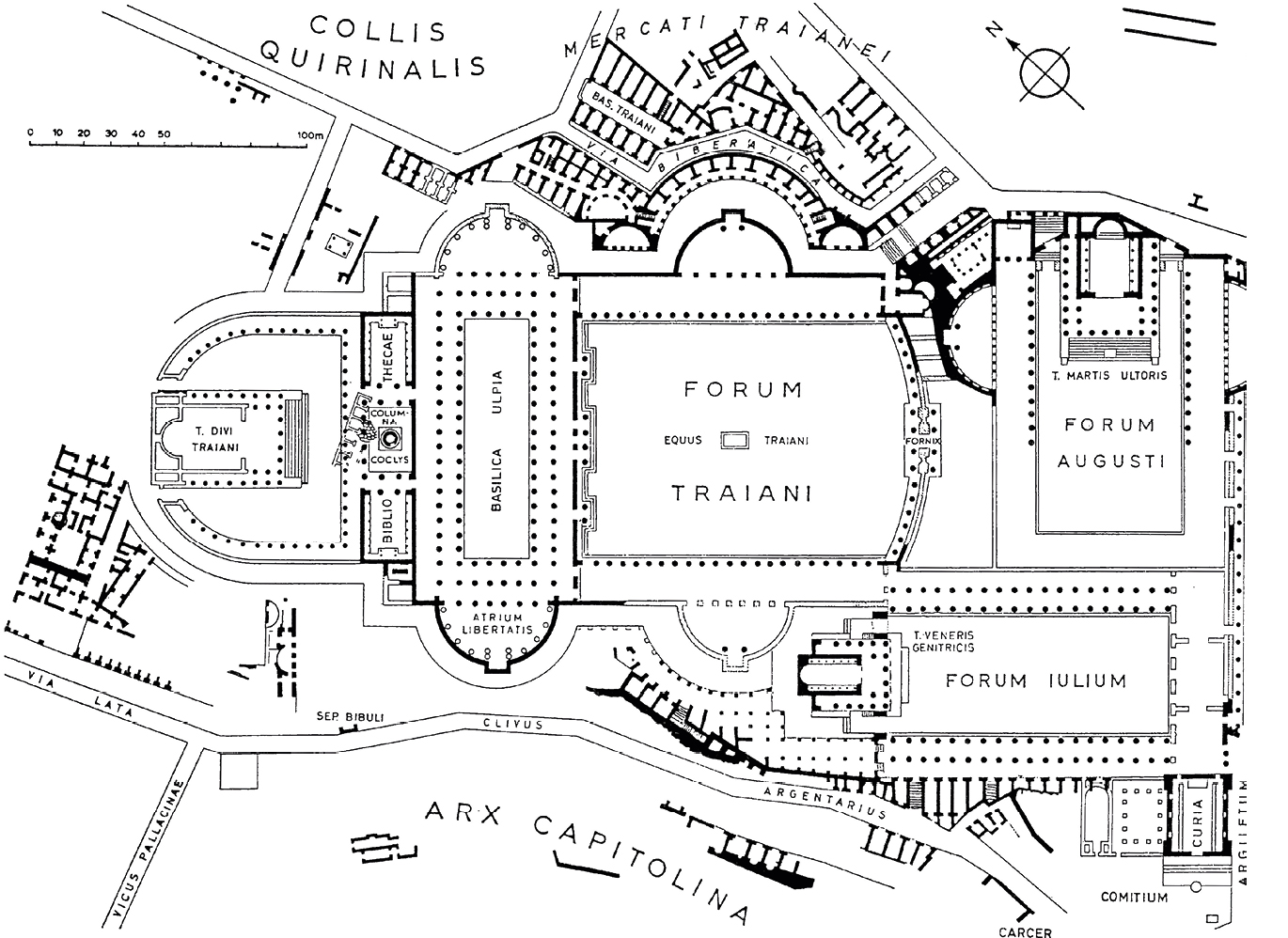
Reconstruction of the plan of Trajan’s forum in Rome. From: Bauer 1996, 80, fig. 34, reworked by Mike Glüsing.

Reconstruction of the plan of Theodosius’ forum in Constantinople. From: Bauer 1996, 194, fig. 63, reworked by Mike Glüsing.
Implicit references to Trajanic monumentality recurred at other sites of Theodosian Constantinople. Similarly to the forum Tauri, Arcadius’ forum featured a colossal Column. As for the case of Constantine’s and Theodosius’ monuments, the Column of Arcadius took inspiration from those of Trajan and of Marcus Aurelius.[77] Even more, like the Column of Trajan, Arcadius’ Column also functioned as imperial burial site.[78] Moreover, several Byzantine literary accounts make reference to the display at the Milion of a now lost statue group featuring bronze likenesses of several members of the Theodosian imperial family as well as of Trajan and Hadrian.[79] It is important to notice, however, that the mention of the statues of Trajan and Hadrian in these later sources could have been the result of a misunderstanding of likenesses of the Theodosian lineage with those of earlier emperors.[80] Nevertheless, this indication attests to at least a later idea of some connection between the Theodosian family and Trajan and Hadrian as central to the Theodosian propaganda. Outside Constantinople, at Ephesus, a statue group was set up at the Curetes street during the Theodosian age. This was a site of major local importance for the commemoration of the most relevant institutions and personalities. The group included twelve reused bronze statues of Nike, a bronze likeness of the empress Aelia Flacilla, a statue of the emperor’s father Flavius Theodosius, and probably an equestrian monument of Theodosius I. This statue group was placed in front of the so-called ‘temple of Hadrian’, thereby turning a site previously dedicated to the honouring of Trajan and Hadrian into a ‘lieu de mémoire’ of the Theodosian dynasty.[81] Meanwhile, in Rome, statues of Theodosius I and his son Honorius were built at the forum of Trajan and this site was reactivated as a space for imperial commemoration.[82]
Conclusion
By the time of Claudian, it was safe to state that Trajan’s fame would never die. The emperors Honorius and Arcadius seem to have appreciated the reference to their famous predecessor. In return, they commanded that a statue for Claudian was erected in Trajan’s forum, on the pedestal of which the poet is compared to Virgil and Homer.[83] These were individuals that had been exemplary for centuries. The same cannot be said for Trajan. Although Pliny’s Panegyric already aimed to raise Trajan to the level of a model emperor, this was initially without result. There is a conspicuous absence of posthumous positive references to Trajan in second- and third-century literature. This somewhat shifts in the first half of the fourth century, but explicit comments on Trajan as an exemplary ruler only surface properly in the second half of that century. Other evidence does not alter that trajectory, and often confirms it. Only Trajan Decius uses Trajan as an explicit reference.
Still, modern scholarship has often assumed immediate popularity of Trajan as a (if not ‘the’) model ruler. One reason for this is his immense late-antique popularity, which is assumed to have been a continuous phenomenon from his death onwards, as Pliny had intended. More importantly, implicit references that seem to refer to Trajan are assumed to have systematically done so. The best point in case is the use of optimus princeps, which is often considered as a Trajanic title. Yet numismatic and especially epigraphic evidence makes clear that the title was in use well before Trajan, gained prominence under Trajan, and remained in use after his death, only to fall out of use in the second half of the third century. A direct link to Trajan often cannot be established. There are, moreover, pronounced regional and medial differences, making it almost impossible to relate emperor and title directly. Even the use of optimus in fourth-century panegyric need not always refer to Trajan.[84]
Under Constantine and his opponent Maxentius matters seem to have shifted. From 306 C.E. onwards, a series of implicit references to Trajan re-appear after a long period of absence. A return to Trajanic portraiture, and to iconographic choices on coins and historical reliefs that were specific to Trajan’s reign, coincide with an increased use of optimus princeps, in the very specific setting of Constantine as the sole ruler of the West. This seems to have been the tipping point for Trajan’s posthumous popularity. During the Constantinian dynasty, Trajan became part of a fixed set of ideal emperors, alongside Augustus, Hadrian, Antoninus Pius and Marcus Aurelius. Constantine’s portraits and monuments in Rome and Constantinople are exemplary in this regard. They contained implicit references to Trajan, but did so as part of much larger field of references that included other exemplary rulers. From the late-fourth century onwards, Trajan’s exemplary status seems to have solidified, as indicated prominently by Theodosius’ Forum in Constantinople which refers to Trajan at several levels, though only implicitly and through the mediation of Constantine’s echoing of second-century monumentality.
Noticeably, Trajan’s civil qualities are emphasized as often as his military accomplishments. Over time, a remarkable shift can be observed and his military accomplishment became dominant, perhaps unsurprisingly in a time at which the Roman Empire had to fight Trajan’s wars over again, with less success than in the second century. The need to absolve Trajan for persecuting Christians is another indication of his risen status as model emperor. By this stage, implicit and explicit references to Trajan as exemplary emperor cohere closely. This makes it likely that contemporary audiences will have understood implicit references to Trajan. Trajan had risen beyond most of his fellow-emperors, much like Pliny had intended. It had, however, taken two and a half centuries – probably more than Pliny had expected.
Appendix
Optimus princeps before Trajan
|
Emperor |
Reference |
Place |
Province |
Date |
Epithet |
|
Augustus |
CIL II 472 |
Mérida / Augusta Emerita |
Lusitania |
25/20 BCE |
optimus princeps |
|
Tiberius Caesar |
CIL XI 3517 = ILS 145 |
Civitavecchia / Centumcellae |
Regio VII (Etruria) |
15 BCE to 4 CE |
optimus princeps |
|
Tiberius |
CIL VI 93 = CIL VI 39832 = AE 1953, 89 |
Rome |
31 |
optimus ac iustissimus princeps |
|
|
CIL VI 902 |
Rome |
31/32 |
optimus princeps |
||
|
CIL VI 904 |
Rome |
31 |
optimus princeps |
||
|
CIL XI 3872 = ILS 159 |
Capena / Ad Vicesimum |
Regio VII (Etruria) |
32 |
princeps optimus |
|
|
SEG 26, 1392 = SEG 28, 1212 = SEG 31, 1286 = SEG 36, 1208 = AE 1976, 653 = AE 1978, 789 = AE 1989, 727 = AE 2013, 38 = AE 2014, 75 = AE 2014, 1362 |
Burdur / Praetoria |
Asia |
14/15 |
princeps optimus Αὐτοκρατόρων μέγιστος |
|
|
CIL VI 3675 = CIL VI 30856 = CIL VI 39833 = ILS 3783 |
31 |
optimus ac iustissimus princeps |
|||
|
IGR I 864 |
Chersonesos |
Moesia Inferior |
Ca. 15 |
μέγιστος Aὐτoκράτωρ |
|
|
Caligula |
AE 2014, 510 |
Brescia / Brixia |
Regio X (Venetia et Histria) |
37–41 |
princeps optimus |
|
Claudius/Nero |
CIL X 1401 = ILS 6043 = AE 2000, 68 = AE 2001, 72 |
Herculaneum |
Regio I (Latium et Campania) |
44/63 |
optimus princeps |
|
Nero |
IG VII 2713 |
Akraiphia |
Achaia |
67 |
Aὐτoκράτωρ μέγιστος |
|
IG II/III2 3277 |
Athens |
Achaia |
61–62 |
Aὐτoκράτωρ μέγιστος |
|
|
Nero/Otho |
CIL X 7852 = ILS 5947 = AE 1983, 447 = AE 1989, 353 = AE 1993, 836a-b = AE 2000, 68 = AE 2004, 123 = AE 2009, 444 |
Serri / Biora |
Sardinia |
69 |
optimus maximusque princeps |
|
Domitian |
CIL X 444 = ILS 3546 = AE 2005, 97b |
Caposele |
Regio I (Latium et Campania) |
94 |
optimus princeps |
|
CIL XVI 12 = ILS 9059 = AE 1910, 75 = AE 1911, 25 = AE 1911, 212 = AE 1912, 264 = AE 1912, 287 = AE 1934, 1 = AE 1950, 240 |
Al-Fayyum / Krokodilopolis |
Egypt |
81–96 |
optimus princeps |
Trajan as optimus princeps
|
Emperor |
Reference |
Place |
Province |
Date |
Epithet |
|
Trajan |
CIL III 567 (p. 987) = CIL III 7303 = CIG 1711 = FDelphes III 4, 294 = AE 2002, 1334 |
Delphi |
Achaia |
110 |
optimus princeps |
|
FDelphes III 4, 292 = AE 1904, 161 = AE 2002, 1333 |
Delphi |
Achaia |
110 |
optimus princeps, ἄριστος Αὐτοκράτωρ, μέγιστος Αὐτοκράτωρ |
|
|
CIL XI 1147 = ILS 6675 = AE 1991, 710 = AE 1992, 38 = AE 1992, 624 = AE 1993, 727 = AE 1994, 630 = AE 1996, 672 = AE 1997, 39 = AE 2001, 67 = AE 2001, 610 = AE 2001, 978 = AE 2001, 979 = AE 2003, 666 |
Velleia Romana / Veleia |
Aemilia / Regio VIII |
optimus maximusque princeps |
||
|
AE 2006, 1669 |
Bled Segui |
Africa Procos |
optimus princeps |
||
|
CIL VIII 25902 = ILTun 1303 = AE 1897, 48 = AE 1897, 151 = AE 1898, 137 = AE 1962, 375 = AE 1988, 1096 = AE 1993, 1756 = AE 1998, 1509 = AE 1998, 1579 |
Mettich, Hr. / Mappalia Siga |
Africa Procos |
princeps totiusque domus divinae optimi |
||
|
AE 2006, 329 = Brindisi 12 |
Brindisi / Brundisium |
Apulia et Calabria / Regio II |
optimus indulgentissimus princeps |
||
|
CIL IX 1455 = ILS 6509 = TermeDiocleziano II, p. 113 = TermeDiocleziano I, p. 452 = AE 1958, 154 = AE 1959, 190 |
Macchia / Ligures Baebiani |
Apulia et Calabria / Regio II |
optimus maximusque princeps |
||
|
CIL IX 215 |
Mesagne / Scamnum / Uria |
Apulia et Calabria / Regio II |
indulgentissimus optimus maximusque princeps |
||
|
CIL III 376 = IK 25, 14 |
Kemer / Parion / Parium |
Asia |
103–117 |
optimus princeps |
|
|
CIL II 5, 846 = CIL II 2010 |
Abdalagis, Sierra de / Valle de Abdalajis / Nescania |
Baetica |
113–114 |
optimus maximusque princeps |
|
|
CIL II 5, 730 = CIL II 2054 = ILS 304 |
Cauche el Viejo / Aratispi |
Baetica |
118 |
optimus maximusque princeps |
|
|
CIL XI 3309 = AE 2000, 569 |
Bracciano / Forum Clodii |
Etruria / Regio VII |
109–117 |
optimus et indulgentissimus princeps |
|
|
AE 1993, 472 = AE 1993, 473 = AE 1994, 426d–e = AE 1996, 424 |
Miseno / Misenon / Misenoi / Misenum |
Latium et Campania / Regio I |
optimus maximusque princeps |
||
|
CIL X 1633 |
Pozzuoli / Puteoli |
Latium et Campania / Regio I |
112 |
optimus princeps |
|
|
CIL VIII 7967 = ILAlg II/1, 13 |
Skikda / Ras Skikda / Philippeville / Rusicade |
Numidia |
optimus ac maximus princeps |
||
|
IK 64, 97 = AE 2004, 1372 |
Sinop / Kiren Tsukuru / Kumbet / Sinope |
Pontus et Bithynia |
optimus princeps |
||
|
CIL VI 955 = ILS 286 |
Rome |
Rome |
103 |
princeps optimus |
|
|
CIL VI 956 |
Rome |
Rome |
103–104 |
optimus princeps |
|
|
CIL VI 961 |
Rome |
Rome |
102–116 |
optimus princeps |
|
|
SEG 43, 911 |
Kaisareia (Cappadocia) |
Cappadocia |
after 138 |
μέγας Αὐτοκράτωρ |
|
|
SEG 41, 1112 |
Sebastopolis (Cappadocia) |
Cappadocia |
104 |
μέγιστος Αὐτοκράτωρ |
Optimus princeps after Trajan
|
Emperor |
Reference |
Place |
Province |
Date |
Epithet |
|
Hadrian |
RAL 1969, 88 = AE 1969/70, 167 |
Benevento / Beneventum |
Apulia et Calabria / Regio II |
125 bis 126 |
optimus et liberalissimus princeps |
|
CIL II 1371 = CILA II 3, 929 |
El Coronil |
Baetica |
127–128 |
optimus princeps |
|
|
CILA II 4, 1068 = HEp 1993, 358° = AE 1966, 182a |
Villanueva del Rio y Minas / Castillo de (la) Mulva / Mulva / Munigua |
Baetica |
optimus maximusque princeps |
||
|
CIL II 3239 = CILA III 1, 244 = HEp 1993, 241 = AE 1902, 1 = AE 1989, 472 |
Santisteban del Puerto / Ilugo |
Hispania Citerior |
optimus maximusque princeps |
||
|
CIL X *463 = Horster p. 280 |
Capua / Casilinum |
Latium et Campania / Regio I |
indulgentissimus optimusque princeps |
||
|
CIL X 676 = ILS 312 = SIPSurrentum 5 |
Sorrento / Surrentum |
Latium et Campania / Regio I |
optimus maximusque princeps |
||
|
AnalEpi p. 107c |
Teano / Teanum Sidicinum |
Latium et Campania / Regio I |
optimus maximusque princeps |
||
|
CIL X 4782 |
Teano / Teanum Sidicinum |
Latium et Campania / Regio I |
optimus maximusque princeps |
||
|
CIL II 478 = EE VIII 2, p. 361 = EE IX, p. 25 = ERAEmerita 67–76 = ERAEmerita 78 = Espectaculos I 45 = CIIAEmerita 37, 47 |
Merida / Emerita |
Lusitania |
optimus princeps |
||
|
CIL III 586 = CIL III 12306 = ILS 5947a |
Lamia, Zeitoun / Lamia |
Macedonia |
optimus maximusque princeps |
||
|
IG XII 8, 243 |
Samothrake (Thracia) |
Thrace |
132 |
ἄριστος (without addition) |
|
|
SEG 47, 163 |
Athen (Achaia) |
Achaia |
132–138 |
μέγιστος τῶν ἀείποτe βασιλέων, Ὀλύμπιος Ζεὺς Πανελλήνιος |
|
|
F.Delphes III 4, 308 |
Delphi (Achaia) |
Achaia |
132 |
Ὀλύμπιος Πα[νελλήνι]ος Πύθιος; μέγιστος καὶ θειότητος Αὐτοκράτωρ |
|
|
IG V 2, 533 |
Megalopolis (Achaia) |
Achaia |
117–138 |
ἄριστος, εὐεργέτης καὶ σωτὴρ τῆς οἰκουμένης, κτίστης |
|
|
CIG 2347d |
Syros (Achaia) |
Achaia |
119–129 |
ἄριστος |
|
|
IG IV 758 (Z.5) |
Troizen (Achaia) |
Achaia |
117–138 |
μέγιστος |
|
|
IG XII 6, 1221 |
Oinoe auf Ikaria (Asia) |
Asia |
117–138 |
μέγιστος, ἄριστος, σωτὴρ καὶ κτίστης |
|
|
MAMA VI 60 |
Trapezopolis (Asia) |
Asia |
117–138 |
μέγιστος |
|
|
AE 2007, 1593 = SEG 57, 1702 = |
Kestros (Cilicia) |
Cilicia |
129–138? |
ἄριστος, κύριος γῆς καὶ θαλάσσης, vέος Ἥλιος |
|
|
IGR III 1347 = |
Gerasa (Arabia) |
Arabia |
130 |
ἀγαθὸς κύριος |
|
|
Kraeling, Gerasa 425 no. 145 |
Gerasa (Arabia) |
Arabia |
130 |
ἀγαθὸς κύριος |
|
|
Col.Memnon 30 |
Theben (Aegyptus) |
Aegyptus |
20.11.130 |
μέγας |
|
|
SEG 33, 893 |
Ephesus |
Asia |
μεγιστ[—] [— Α]ὐτοκράτορος |
||
|
Antoninus Pius |
CIL VIII 12513 = ILS 345 = ILTun 890 = LBIRNA 167 |
Carthage |
Africa Procos |
optimus maximusque princeps |
|
|
CIL VIII 27776 = AE 1908, 168 |
Medeina, Hr. / Mdeina / Mada’inah / Althiburos |
Africa Procos |
optimus princeps |
||
|
IK 12, 282 = AE 1966, 428 |
Ephesus |
Asia |
139 |
optimus et indulgentissimus princeps |
|
|
CIL II 1282a = CIL IX *628 = CILA II 3, 930°= |
Utrera / Salpensa |
Baetica |
princeps optimus |
||
|
CIL XI 1924 = ILS 5503 |
Perugia / Perusia |
Etruria / Regio VII |
166 |
optimus maximusque princeps |
|
|
CILA III 1, 84 = EAOR VII 13 = Espectaculos I 26 = Actes I, p. 332 = HEp 1995, 424 = AE 1976, 351 |
Linares / Cazlona / Castulo |
Hispania Citerior |
optimus maximusque princeps |
||
|
CIL III 5654 = CIL III 11795 = ILLPRON 900 |
Traismauer / Trigisamum / Augustiana |
Norcium |
140–144 |
optimus princeps |
|
|
CIL VI 1001 = ILS 341 |
Rome |
Rome |
141 |
optimus maximusque princeps |
|
|
CIL XI 5694 = ILS 2666a |
Albacina / Tuficum |
Umbria / Regio VI |
141 |
optimus maximusque princeps |
|
|
CIL V 532 = ILS 6680 = InscrIt X 4, 31 = RSH 30 = AE 1975, 423 |
Trieste / Tergeste |
Venetia et Histria / Regio X |
138–161 |
optimus princeps |
|
|
CIL II 5232 = ILS 6898 = Epigraphica-2016–57 |
Leiria / Collippo |
Lusitania |
167 |
optimus ac sanctissimus omnium saeculorum priniceps |
|
|
SEG 15, 531 |
Chios (Asia) |
Asia |
139–161 |
μέγιστος Αὐτoκράτωρ |
|
|
TAM V 2, 1231 |
Kamai (Asia) |
Asia |
138–161 |
ἄριστος καὶ μέγιστος, γῆς καὶ θαλάσσης [δεσπότης] |
|
|
I.Laodikeia am Lykos I 65 |
Laodikeia am Lykos (Asia) |
Asia |
Soon after 138 (Bönisch-Meyer 2021, 477) |
μέγιστος Αὐτoκράτωρ |
|
|
I.Milet VI 1, 233 |
Milet (Asia) |
Asia |
138–161 |
μέγιστος Αὐτoκράτωρ |
|
|
I.Milet VI 3, 1106 |
Milet (Asia) |
Asia |
148–161 |
μέγιστος καὶ θειότατος Αὐτoκράτωρ |
|
|
SEG 29, 741 |
Mytilene auf Lesbos (Asia) |
Asia |
138–161 |
μέγιστος καὶ ἐνφανέστατος τῶν ἀπ ᾿ αἴωνος [πρίγκεπς] |
|
|
AE 1933, 279 |
Pergamon (Asia) |
Asia |
138–161 |
ἄριστος, τῆς πατρίδος καὶ τῆς οἰκουμένης καὶ ἑαυτοῦ εὐεργέτης |
|
|
Marcus Aurelius and Lucius Verus |
IG V 1, 1237 |
Kainepolis (Achaia) |
Achaia |
166–169 |
μέγιστοι Αὐτοκρατόρες |
|
SEG 45, 2026A |
Rawwafah (Arabia) |
Arabia |
166–169 |
θειότατοι κοσμοκρατόρες, μέγιστοι |
|
|
Marcus Aurelius |
CIL XIV 4003 = ILS 6225 |
Cesarina / Casale Cesarina / Caesarina / Ficulea |
Latium et Campania / Regio I |
optimus et indulgentissimus princeps |
|
|
CIL X 3340 = ILS 2841 |
Miseno / Misenon / Misenoi / Misenum |
Latium et Campania /Regio I |
optimus princeps |
||
|
CIL VI 2092 = CFA 84 |
Rome |
Rome |
164–169 |
optimus maximus princeps |
|
|
CIL VI 2093 = CIL VI 32383°= CFA 85 |
Rome |
Rome |
169–177 |
optimus maximus princeps |
|
|
CIL VI 32383b = CFA 86 = AE 1892, 125 |
Rome |
Rome |
170–176 |
optimus maximus princeps |
|
|
SEG 39, 456 |
Thespiai (Achaia) |
Achaia |
169–172 |
μεγ[ιστος καὶ θει]ότατος |
|
|
Commodus |
EAOR III, 83 = AE 1958, 179 |
Rugge / Rudiae |
Apulia et Calabria / Regio II |
optimus maximus fortissimusque princeps |
|
|
CIL VI 2099 = CIL VI 32386 = CFA 94 = ILS 5047 |
Rome |
Rome |
183 |
optimus maximusque princeps |
|
|
CIL VI 2100 = CFA 95a–b |
Rome |
Rome |
optimus maximusque princeps |
||
|
IGBulg III 2, 1552 |
Augusta Traiana (Thracia) |
Thrace |
187 |
θειότατος καὶ μέγιστος Αὐτοκράτωρ |
|
|
IG II/III2 1792 |
Eleusis (Achaia) |
Achaia |
185–192, poss. 188/189 |
μέγιστος Αὐτοκράτωρ |
|
|
Septimus Severus |
Libyca 1954, 379 |
Annaba / Bone / Hippone, Ruines d’ / Hippo Regius |
Africa Procos |
optimus maximus fortissimusque princeps |
|
|
CIL VIII 26179 = Actes 11/2, p. 371 = AE 1896, 88 = AE 1991, 1680 |
Thibar / Tibar / Belloum / Thibaris |
Africa Procos |
198 |
optimus maximusque princeps |
|
|
CIL XI 3201 = ILS 416 |
Nepi / Nepet / Nepete |
Etruria / Regio VII |
194 |
optimus fortissimusque princeps |
|
|
CIL XII 4346 |
Narbonne / Narbo |
Gallia Narbonensis |
195–198 |
optimus felicissimus fortissimus princeps |
|
|
CIL II 3343 = CILA III 2, 607 |
Baeza / Vivatia |
Hispania Citerior |
optimus fortissimusque princeps |
||
|
CIL II 693 = CPILCaceres 118 = ERCCaceres 38 = CILCaceres I 113 = AE 1919, 88 |
Caceres / Norba |
Lusitania |
194 |
optimus fortissimus providentissimusque princeps |
|
|
CIL VIII 6305 = CIL VIII 19294 = ILAlg II 3, 9437 |
Bou Foua / Ain Foua / Ain Phua / Castellum Phuensium |
Numidia |
optimus fortissimusque princeps |
||
|
ILAlg II 3, 7803 = AE 1917/18, 70 |
Djemila / Cuicul |
Numidia |
optimus fortissimus princeps |
||
|
ILAlg II 3, 7804 |
Djemila / Cuicul |
Numidia |
optimus fortissimus princeps |
||
|
ILAlg II 1, 3394 |
El Meraba / Kherba / Khorba Beni Welban / Castellum Celtianum / Celtianis |
Numidia |
198–199 |
optimus fortissimusque princeps |
|
|
BCTH 1901, 107 |
Turnier |
Numidia |
optimus fortissimusque princeps |
||
|
CIL VI 32326 |
Rome |
Rome |
sanctissimus piissimusque princeps noster optimus piissimusque princeps noster |
||
|
IGBulg II 620 |
Nikopolis am Istros (Moesia inf.) |
Moesia Inferior |
202–205 |
μέγιστος καὶ θειότατος |
|
|
IGBulg II 628 |
Nikopolis am Istros (Moesia inf.) |
Moesia Inferior |
209–211 |
μέγιστος καὶ θειότατος |
|
|
IGBulg III 2, 1553 |
Augusta Traiana (Thracia) |
Thrace |
197–198 (?) |
Αὐτοκράτωρ μέγιστος |
|
|
IG X 2, 2, 218 |
Pelagonia (Macedonia) |
Macedonia |
193–211 |
μέγιστος καὶ θειότατος |
|
|
IG XII 8, 634 |
Skiathos (Macedonia) |
Macedonia |
193–211 |
μέγιστος καὶ θειότατος |
|
|
IGR IV 611 |
Dokimeion (Asia) |
Asia |
199–211 |
μέγιστος καὶ θεῖος, γῆς καὶ θαλάσσης δεσπότης |
|
|
IG XII 2, 216 |
Mytilene (Asia) |
Asia |
193–211 |
μέγιστος Αὐτοκράτωρ, γᾶς καὶ θαλάσσας δεσπότας |
|
|
Septimius Severus and Caracalla |
SEG 35, 706 |
Amphipolis (Macedonia) |
Macedonia |
197–211 |
μέγιστος καὶ θειότατος |
|
IG III 1, 633 |
Eleusis (Achaia) |
Achaia |
203 |
μέγιστοι καὶ θειότατοι |
|
|
I.Rhod.Per. 158 |
Thyssanos (Asia) |
Asia |
210 |
μέγιστοι Αὐτοκράτορες |
|
|
I.Rhod.Per. 160 |
Thyssanos (Asia) |
Asia |
210 |
μέγιστος Αὐτοκράτωρ |
|
|
IGR IV 881 |
Takina (Lycia et Pamphylia) |
Lycia et Pamphylia |
ca. 202–205 |
μέγιστοι καὶ νίκητοι Αὐτοκρατόρες |
|
|
IGR III 826 |
Syedra (Cilicia) |
Cilicia |
197–211 |
κύριοι ἡμῶν μέγιστοι καὶ θειότατοι καὶ ήττητοι Αὐτοκράτορες |
|
|
Caracalla |
CIL VIII 23708 |
Ain Zouza, Hr. / Ain Zuza, Hr. / Cuttilula |
Africa Procos |
optimus maximusque princeps |
|
|
CIL VIII 966 = CIL VIII 12447 |
Bir Bou Rekba / Bi’r Bu Ruqbah / Ksar el-Zit / Ksar ez Zit / Gasr Essitt / Qasr az Zayt / Siagu / Civitas Siagitana |
Africa Procos |
optimus princeps |
||
|
CIL VII 24092 = AE 1900, 36 |
Hammamet / Souk el-Abiod / Souh el-Abiod / Pupput |
Africa Procos |
optimus maximus invictus princeps? |
||
|
CIL VIII 1615 = CIL VIII 15721 |
Nibber |
Africa Procos |
211–217 |
optimus maximusque princeps |
|
|
AE 1990, 1036a |
Sidi Abd El Basset, Hr |
Africa Procos |
211–217 |
optimus maximusque princeps |
|
|
CIL VIII 12209 = CIL VIII 23794 |
Sidi Marched |
Africa Procos |
211–217 |
optimus princeps |
|
|
CIL VIII 1798 = CIL VIII 16466 = ILS 437 = LBIRNA 449 |
Zanfour / Az Zunfur / Zannfour / Assuras |
Africa Procos |
211–217 |
optimus maximusque princeps |
|
|
Piso 2018, p. 756 |
Buciumi |
Dacia |
optimus felicissimusque princeps |
||
|
CIL III 795 |
Ilisua / Arcobara / Arcobadara |
Dacia |
213 |
optimus maximusque princeps |
|
|
CIL III 1378 = IDR III 3, 57 |
Vetel / Vecel / Witzel / Micia |
Dacia |
211–217 / 211–222 |
optimus maximusque princeps |
|
|
CIL VIII 15669 = ILS 6807 = ILTun 1580 |
Kaoussat, Hr. / Gaoussat / Kaussat / Gousset / Gosset / El Gouesset / Pont-Raomein / Pont Romain / Ucubi |
Numidia |
optimus maximusque princeps |
||
|
CIL VI 1033 = CIL VI 31230 = CIL VI 36881 = ILS 425 |
Rome |
Rome |
203 |
optimus fortissimusque princeps |
|
|
CIL VI 31349 |
Rome |
Rome |
216–217 |
optimus maximusque et super omnes indulgentissimus princeps |
|
|
IGBulg III 2, 1554 |
Augusta Traiana (Thracia) |
Thrace |
197–198 (?) |
μέγιστος |
|
|
IG XII 8, 382 |
Thasos (Thracia) |
Thrace |
213–217 |
μέγιστος καὶ θειότατος |
|
|
CIG 1735 |
Elateia (Achaia) |
Achaia |
211–217 |
μέγιστος |
|
|
IG IV2 1, 611 |
Epidauros (Achaia) |
Achaia |
211–217 |
θειότατος, μέγιστος, σωτὴρ τῆς οἰκουμένης |
|
|
IG IV2 1, 612 (I) |
Epidauros (Achaia) |
Achaia |
211–217 |
ὁσιώτατος, μέγιστος, σωτὴρ τῆς οἰκουμένης |
|
|
IG IV 707 |
Hermione (Achaia) |
Achaia |
211–213 |
μέγιστος, νείκητος |
|
|
SEG 11, 965 |
unknown |
Achaia |
200–211 |
μέγιστος |
|
|
IGR III 92 |
Abonutheichos (Pontus et Bithynia) |
Pontus et Bithynia |
211–217 |
μέγιστος καὶ θειότατος |
|
|
MAMA IV 11 |
Synnada (Asia) |
Asia |
197–211 |
μέγιστος |
|
|
SEG 50, 1312 |
Sagalassos (Galatia) |
Galatia |
undated |
κύριος ἡμῶν, μέγιστος καὶ νείκητος καὶ θειότατος Αὐτοκράτωρ |
|
|
Severus Alexander |
CIL II 5, 442 = CIL II 1554 |
Espejo / Ucubi |
Baetica |
222–235 |
optimus princeps noster |
|
CIL III 797 |
Ilisua / Arcobara / Arcobadara |
Dacia |
222–235 |
optimus maximusque princeps |
|
|
IScM V, 269 = AE 1977, 761 |
Isaccea / Noviodunum |
Moesia Inferior |
234 |
optimus princeps |
|
|
PLINovae p. 118 = GeA 454 = AE 1999, 1330 |
Swischtow / Svishtov / Svistov / Staklen / Novae |
Moesia Inferior |
227 |
optimus princeps |
|
|
IGBulg II 637 |
Nikopolis am Istros (Moesia inf.) |
Moesia Inferior |
222–235 |
μέγιστος καὶ θειότατος |
|
|
IGBulg I2 70 |
Odessos (Moesia inf.) |
Moesia Inferior |
227 |
[θειότα]τος κ[αὶ μέ]γιστος καὶ νείκητος |
|
|
IGBulg IV 1992 |
Egerica (Thracia) |
Thrace |
222–235 |
μέγιστος καὶ θειότατος |
|
|
IGBulg II 488 |
Mezdra (Thracia) |
Thrace |
222–235 |
μέγιστος καὶ θειότατος |
|
|
SEG 36, 415 |
Chaironeia (Achaia) |
Achaia |
222–235 |
μέγιστος καὶ θειότατος |
|
|
IG IV2 1, 612 (II) |
Epidauros (Achaia) |
Achaia |
222–235 |
θειότατος, μέγιστος |
|
|
Maximinus Thrax |
CIL XVII 2, 453 = CIL XIII 8984 |
Bayeux / Augustodurum |
Gallia Lugdunensis |
237 |
optimus maximusque princeps noster |
|
CIL XVII 2, 454 = CIL XIII 8985 = |
Bayeux / Augustodurum |
Gallia Lugdunensis |
237 |
optimus maximusque princeps |
|
|
CIL XVII 2, 455 = CIL XIII 8986 = |
Bayeux / Augustodurum |
Gallia Lugdunensis |
235–238 |
optimus maximusque princeps |
|
|
CIL XVII 2, 456 = CIL XIII 8987 |
Bayeux / Augustodurum |
Gallia Lugdunensis |
235–238 |
optimus maximusque princeps noster |
|
|
CIL XVII 2, 312 = CIL XIII 8861 = |
Feurs / Forum Segusiavorum |
Gallia Lugdunensis |
236–237 |
optimus maximusque princeps noster |
|
|
CIL XVII 2, 313 = CIL XIII 8862 |
Feurs / Forum Segusiavorum |
Gallia Lugdunensis |
236–237 |
optimus maximusque princeps noster |
|
|
CIL XVII 2, 316 = CIL XIII 8864 |
Feurs / Forum Segusiavorum |
Gallia Lugdunensis |
236–237 |
optimus maximusque princeps noster |
|
|
CIL XVII 2, 317 = CIL XIII 8866 |
Moingt / Aquae Segetae |
Gallia Lugdunensis |
236–237 |
optimus maximusque princeps noster |
|
|
CIL XVII 2, 471 = CIL XIII 8953 = AE 1892, 55 |
Rennes / Condate |
Gallia Lugdunensis |
236–237 |
optimus maximusque princeps noster |
|
|
CIL XVII 2, 472 = CIL XIII 8954 |
Rennes / Condate |
Gallia Lugdunensis |
236–237 |
optimus maximusque princeps noster |
|
|
Gordian III |
ICilicie 79 = AE 1990, 991 |
Ayas / Elaussa-Sebaste / Aegae |
Cilicia |
optimus fortissimusque princeps noster |
|
|
NSA 1953, 20 |
Capena / Leprignano / Ad Vicesimum |
Etruria / Regio VII |
238–239 |
optimus maximusque princeps |
|
|
CIL II 4606 = IRC I 135 = IRC V, p. 25 |
Badalona / Baetulo |
Hispania Citerior |
optimus maximusque princeps |
||
|
CIL X 1117 |
Atripalda / Abellinum |
Latium et Campania / Regio I |
optimus fortissimusque princeps |
||
|
CIL VI 1090 |
Rome |
Rome |
239–240 |
optimus fortissimusque princeps |
|
|
CIL VI 1611 = CIL VI 31831 |
Rome |
Rome |
241–242 |
optimus indulgentissimusque princeps |
|
|
Diocletian |
IK 12, 305 = AE 1967, 477 |
Ephesus |
Asia |
optimus clementissimusque princeps |
|
|
Tetrarchy, I |
CIL III 14149 = AE 1895, 182 = AE 1897, 125 |
Kerak / Qasr Bshir |
Arabia |
292–305 |
optimus maximusque princeps |
|
CIL VI 40723 = CIL VI 36997 |
Rome |
Rome |
294–295 |
optimus maximusque princeps |
|
|
CIL V 2817 = ILS 614 = RSH 165 |
Padova / Patavium |
Venetia et Histria / Regio X |
284–305 |
optimus maximusque princeps |
|
|
Tetrarchy, III |
CIL III 326 = ILS 650 = TAM IV 1, 31 |
Kocaeli / Nicomedia |
Pontus et Bithynia |
294–296 |
optimus benignissimusque princeps |
|
Constantine |
CIL XI 6657 |
Parma |
Aemilia / Regio VIII |
326–327 |
rerum humanarum optimus princeps |
|
CIL XI 6638 |
Savignano Mare |
Aemilia / Regio VIII |
326–327 |
rerum humanarum optimus princeps |
|
|
CIL VIII 14363 |
Ad Duwayrat / El-Duwayrat / Douirat, Hr. / Durat, Hr. / Ain Dourat / Uccula |
Africa Procos |
optimus et super omnes princeps |
||
|
CIL V 8079 = CIL V 8080 = MiliariXIRegio 33 = MiliariXIRegio 34 = AlpCott 44 |
Oulx / Ulcium / Ad Martis |
Alpes Cottiae |
327 bis 328 |
rerum humanarum optimus princeps |
|
|
AE 1996, 674 |
Casale Monferrato / Vardagate / Vardacate |
Liguria / Regio IX |
humanarum rerum optimus princeps |
||
|
SupIt-13-V, 2 |
Casale Monferrato / Vardagate / Vardacate |
Liguria / Regio IX |
humanarum rerum optimus princeps |
||
|
SupIt-16-FV, 3 = AE 1998, 652 |
Cavour / Cavorre / Forum Vibii Caburrum |
Liguria / Regio IX |
humanarum rerum optimus princeps |
||
|
CIL III 3705 = CIL III 10617 = ILS 732 |
Sremska Mitrovica / Mitrovicz / Sirmium |
Pannonia inferior |
optimus maximusque princeps |
||
|
MiliariXIRegio 41 = IAugPraetoria 80 = AE 1989, 335 = AE 1992, 856 |
Aosta / Augusta Praetoria |
Transpadana / Regio XI |
326–328 |
rerum humanarum optimus princeps |
|
|
CIL V 8069 = MiliariXIRegio 21 |
Chivasso |
Transpadana / Regio XI |
rerum humanarum optimus princeps |
||
|
CIL V 8070 |
Chivasso |
Transpadana / Regio XI |
rerum humanarum optimus princeps |
||
|
MiliariXIRegio 47 = SupIt-27-L, 1 = AE 1964, 129 = AE 1992, 769 |
Lodi Vecchio / Laus Pompeia |
Transpadana / Regio XI |
327 |
rerum humanarum optimus princeps |
|
|
CIL V 8059 = MiliariXIRegio 4 = MiliariXIRegio 5 = AE 1981, 464 = AE 1992, 781 |
Pavia / Ticinum |
Transpadana / Regio XI |
327–328 |
rerum humanarum optimus princeps |
|
|
SupIt-09-T, 10 |
Pavia / Ticinum |
Transpadana / Regio XI |
rerum humanarum optimus princeps |
||
|
BSPSP-2004-199 |
Pieve del Cairo / Laumellum |
Transpadana / Regio XI |
327–328 |
rerum humanarum optimus princeps |
|
|
CIL V 8072 = MiliariXIRegio 23 |
Torino / Augusta Taurinorum |
Transpadana / Regio XI |
rerum humanarum optimus princeps |
||
|
MiliariXIRegio 22 |
Torino / Augusta Taurinorum |
Transpadana / Regio XI |
rerum humanarum optimus princeps |
||
|
CIL V 8065 = ILVercel 62 = MiliariXIRegio 14 |
Trino / Rigomagus / Vercellae |
Transpadana / Regio XI |
327–328 |
rerum humanarum optimus princeps |
|
|
CIL V 8004 = MiliariVenetia 76 |
Altino / Altinum |
Venetia et Histria / Regio X |
327 |
rerum humanarum optimus princeps |
|
|
CIL V 8041 = InscrIt X 5, 1267 = MiliariVenetia 8 |
Brescia / Brixia |
Venetia et Histria / Regio X |
327 |
rerum humanarum optimus princeps |
|
|
CIL V 8011 = ILS 697 = MiliariVenetia 57 |
Capra |
Venetia et Histria / Regio X |
327 |
rerum humanarum optimus princeps |
|
|
CIL V 8005 = MiliariVenetia 75 = AE 2011, 405 |
Murano |
Venetia et Histria / Regio X |
327 |
rerum humanarum optimus princeps |
|
|
MiliariVenetia 19 = SupIt XXIX Ar 4 = AE 1939, 23 |
Sirmione / Sirmio |
Venetia et Histria / Regio X |
329 |
rerum humanarum optimus princeps |
|
|
Constantius II |
CIL III 13392 |
Đurđevac |
Savia |
337/361 |
optimus maximusque princeps |
|
Phocas |
CIL VI 1200 = CIL VI 31259 = ILS 837 |
Rome |
608 |
optimus clementissimus felicissimusque princeps |
|
|
CIL VIII 10529 = CIL VIII 12479 |
Carthage |
Africa Procos |
optimus clementissimus felicissimusque princeps |
||
|
not clear/ undated |
CILPCart 1 |
Carthage |
Africa Procos |
optimus princeps |
|
|
CIL XII 3164 = ILS 1048 |
Nimes / Nemausus |
Gallia Narbonensis |
Trajan? Antoninus Pius or later? |
optimus princeps |
|
|
CIL XII 3165 = ILS 5680 |
Nimes / Nemausus |
Gallia Narbonensis |
Trajan? Antoninus Pius or later? |
optimus princeps |
|
|
CIL XII *77 |
Tarascon |
Gallia Narbonensis |
optimus princeps |
||
|
CIL X 3903 |
Capua / Casilinum |
Latium et Campania / Regio I |
optimus et munificentissimus princeps |
||
|
RAA p. 193 |
Ain Zana / Ain Beda / Mergueb el-Zana / Mergueb ez-Zana / Diana Veteranorum |
Numidia |
optimus maximus sanctissimus fortissimus [- - -]ss[i]/mus indulgentissimusque princeps |
||
|
AE 1941, 130 |
unknown |
unknown |
optimus princeps |
||
|
CIL VI 40577 = CIL VI 32743 |
Rome |
Rome |
101/130 |
princeps optimus et maximus |
|
|
CIL V 5127 = AE 1984, 435 = SupIt XVI B 4 |
Bergamo / Bergomum |
Transpadana / Regio XI |
118/200 |
optimus maximusque princeps |
|
|
CIL V 1966 = IGLTreviso 11 = RSH 138 |
Oderzo / Opitergium |
Venetia et Histria / Regio X |
118/180 |
optimus maximusque princeps |
Optimus in combination with imperial titles other than princeps
Optimus Augustus
|
Emperor |
Reference |
Place |
Province |
Date |
Epithet |
|
Iulia Augusta |
SCPisone-A, p. 10 = HEp 1994, 831z = HEp 1995, 727 = HEp 1996, 881 = HEp 1997, 927 = HEp 1998, 479 = HEp 1999, 525 = HEp 2006, 332 |
El Saucejo / Irni |
Baetica |
20 |
Iuliae Aug(ustae) optime |
|
CIL II 5, 900 = SCPisone-B, p. 23 = HEp 1994, 831z = HEp 1995, 727 = HEp 1996, 881 = HEp 1997, 927 = HEp 1998, 479 = HEp 1999, 525 = HEp 2006, 332 |
El Tejar / Gemella |
Baetica |
20 |
Iuli[ae Aug(ustae) optime |
|
|
Claudius |
IG XII 3 Suppl. 1395 |
Thera |
Asia |
41/54 |
Σεβαστὸς καὶ μέγιστος καὶ κράτιστος |
|
Trajan |
CIL III 552 = CIL III 7278 = InscrAtt 5 = ILS 845 = ILGR 131 = IG II 3451 |
Athens |
Achaia |
114 to 116 |
optimus Augustus |
|
Corinth VIII 3, 100 |
Corinthus (Corinth) |
Achaia |
114 to 116 |
optimus Augustus |
|
|
ILGR 156 = AE 1969/70, 589 |
Epitalio |
Achaia |
114 to 115 |
optimus Augustus |
|
|
AE 2013, 1424 |
Ipsilantis |
Achaia |
optimus Augustus |
||
|
AE 2013, 1423 |
Mavrogia |
Achaia |
116 to 118 |
optimus Augustus |
|
|
IG V 2, 458 = ILGR 155 |
Megalopoli |
Achaia |
116/117 |
Trai/anus (o)pt<i=U>mus Aug(ustus) |
|
|
Patras 27 |
Patras / Patrai / Patrae |
Achaia |
115 |
[opti]mus Aug(ustus) |
|
|
CIL XI 421 = ILS 6662 |
Rimini / Ariminum |
Aemilia / Regio VIII |
opt(imi) Aug(usti) |
||
|
AE 2016, 1888 |
Bir Magra / Thibica |
Africa Procos |
117 |
optimo Au[g(usto)] |
|
|
CIL VIII 10556 = CIL VIII 14300 = AE 1973, 591 |
Djal, Hr. / Jal / Uzali Sar |
Africa Procos |
op[timi] Aug(usti) |
||
|
CIL VIII 5289 = ILAlg I 178 |
Guelma / Calama |
Africa Procos |
[o]ptimi Aug(usti) |
||
|
ILAlg I 238 |
Guelma / Calama |
Africa Procos |
optim[o Aug(usto) |
||
|
ILAlg I 1230 = LBIRNA 75 = AE 1909, 239 |
Khemissa / Khamissa, Hr. / Thubursicu Numidarum |
Africa Procos |
Au[g(usti) Germ(anici) Dac(ici) optimi] |
||
|
ILAlg I 1231 = LBIRNA 76 = AE 1906, 4 = AE 1906, 5 = AE 1909, 238 |
Khemissa / Khamissa, Hr. / Thubursicu Numidarum |
Africa Procos |
Aug(usto) Germ(anico) Dac(ico) optimo] |
||
|
ILAlg I 1232 = LBIRNA 77 |
Khemissa / Khamissa, Hr. / Thubursicu Numidarum |
Africa Procos |
Aug(usti) Germ(anici) Dac(ici) optimi |
||
|
CIL VIII 621 = CIL VIII 11798 = LBIRNA 79 |
Maktar / Makthar / Mactar / Makthars / Mactaris |
Africa Procos |
optimo Aug(usto) |
||
|
IMustis 1 = LBIRNA 80 = AE 1968, 599 |
Mest, Hr. / Mist / el-Oust, Hr. / El Ust / el-Berrouigue, Hr. / Ain Gueliane / Mustis |
Africa Procos |
optimo Aug(usto) |
||
|
CIL VIII 10117 = ILS 293 = LBIRNA 74 |
Shimtu / Chimtou / Chemtou / Simitthus |
Africa Procos |
optimus / [Au]g(ustus) |
||
|
CIL IX 1558 CIL IX 5998 = ILS 296 |
Benevento / Beneventum |
Apulia et Calabria / Regio II |
optimo Aug(usto) |
||
|
CIL III 14150, 11 = Samra 11 |
Amman / Philadelphia |
Arabia |
114 |
optimus Aug(ustus)] |
|
|
Samra 2 |
Busra / Bostra |
Arabia |
[optimus Aug(ustus)] |
||
|
Samra 4 |
Busra / Bostra |
Arabia |
optim[us] / Aug(ustus) |
||
|
Samra 5 |
Busra / Bostra |
Arabia |
[optimus Aug(ustus)] |
||
|
Samra 7 |
Busra / Bostra |
Arabia |
opti[mus Aug(ustus) |
||
|
Samra 8 |
Busra / Bostra |
Arabia |
optimus Aug(ustus) |
||
|
Samra 10 |
Busra / Bostra |
Arabia |
o]ptimus / [Aug(ustus) |
||
|
AE 1968, 510 |
Pokr Vedi / Artaxata |
Armenia |
116 |
optimus A[u]g(ustus) |
|
|
CIL II 7 887a |
Azuaga / Municipium Flavium V[] |
Baetica |
115 |
optimo Aug(usto) |
|
|
CIL II 7, 888 = CIL II, 1028 = CIL II, 5543 = AE 1971, 170b = AE 1993, 1016 = HEp 1995, 50 |
Azuaga / Municipium Flavium V[] |
Baetica |
115–116 |
optimo Aug(usto) |
|
|
CIL II 7, 889 = CIL II 2341 = CIL II 5546 |
Azuaga / Municipium Flavium V[] |
Baetica |
115–116 |
optimi Aug(usti) |
|
|
CIL II 7, 890 = CIL II 5549 |
Azuaga / Municipium Flavium V[] |
Baetica |
115 |
optimi / Aug(usti) |
|
|
CIL II 7, 891 = CIL II 2340 = CIL II 5545 = EE 9, p. 94 |
Azuaga / Municipium Flavium V[] |
Baetica |
115 |
optimi / Aug(usti) |
|
|
CIL II 5, 730 = CIL II 2054 ILS 304 |
Cauche el Viejo / Aratispi |
Baetica |
118 |
opt<i=U>mo / Aug(usto) |
|
|
HEp 1990, 267 = AE 1987, 499 |
Olvera / Gades |
Baetica |
116 |
[optimo A]ug(usto) |
|
|
CIL II 5, 295 = CIL II 2097 = ILS 297 |
Zambra / Cisimbrium |
Baetica |
113–114 |
op/timo Aug(usto) |
|
|
AE 1990, 868 |
Bilhorod-Dnistrowskyj |
Barbaricum |
115–116 |
opt(imo)] / Aug(usto) |
|
|
IOSPE III 1, 24 |
Bilhorod-Dnistrowskyj |
Barbaricum |
114–117 |
[optimo Aug(usto) |
|
|
AE 2012, 1188 |
Sandorfalva |
Barbaricum |
op]timus Aug(ustus) |
||
|
FVSarmiz 1 = ILD 237 = CERom-21/24, 1011 = AE 1998, 1084 = AE 2006, 1139 = AE 2007, 1203 |
Sarmizegetusa / Sarmizegethusa / Burgort / Varhely |
Dacia |
116–117 |
opt(imus) Aug(ustus)] |
|
|
IDR III 2, 135 = FVSarmiz 4 = ILD 239 = CERom 21/24, 1013 = AE 2003, 1515 |
Sarmizegetusa / Sarmizegethusa / Burgort / Varhely |
Dacia |
106/117 |
[opti]mo(?) [Au]g(usto) |
|
|
CIL III 15021 = CIL III 15034 = AE 1908, 193 |
Burnum |
Dalmatia |
113 |
optimo / Aug(usto) |
|
|
CIL III 6359 = ILS 2665 = IDRE II 305 = CILGM 2 |
Risan / Risano / Risinium |
114/117 |
Aug(usto) / Germ(anico) Dac(ico) Parthico / optimo |
||
|
CIL III 8684 |
Solin / Salona |
102/116 |
optimi Aug(usti) |
||
|
CIL XII 3169 = INimes 21 = IDRE I 183 = AE 1982, 678 |
Nimes / Nemausus |
Gallia Narbonensis |
101–102 |
optimi Aug(usti) |
|
|
CIL XIII 11981 |
Remagen / Rigomagus |
Germania inferior |
optimo Au[g(usto) |
||
|
RSKoblenz 39 = AE 1995, 1108 |
Remagen / Rigomagus |
Germania inferior |
98/114 |
o[ptimo Aug(usto) |
|
|
CIL XVI 63 = CIL XIII 6822 |
Mainz / Mogontiacum |
Germania inferior |
116 |
optimus Augustus |
|
|
CIL XVI 62 = CIL XIII 7573 = ILS 301 |
Wiesbaden / Aquae Mattiacorum |
Germania inferior |
116 |
optim(us) / Aug(ustus) |
|
|
AquaeFlaviae 1997, 455 = MiliariHispanico 504 |
A Pobra de Trives / Puebla de Trives |
Hispania citerior |
opti[mus] / [Aug(ustus)] |
||
|
CIL XIV 3447 = CIL XV 7895a1 = AE 1892, 138 |
Affile / Afilae |
Latium et Campania / Regio I |
optimi Aug(usti) |
||
|
CIL X 6887 |
Ferentino / Ferentinum |
Latium et Campania / Regio I |
optimus Aug(ustus) |
||
|
CIL X 90 |
Fiumicino / Portus |
Latium et Campania / Regio I |
112/117 |
[optimo Aug(usto) |
|
|
SupIt XXV L 2 = AE 2003, 340 = AE 2010, 314 |
Literno / Liternum |
Latium et Campania / Regio I |
113/116 |
[optimi A]ug(usti) |
|
|
CIL XIV 4486a |
Ostia Antica |
Latium et Campania/ Regio I |
optimo Aug[usto] |
||
|
CIL X 1634 = ILS 300 |
Pozzuoli / Puteoli |
Latium et Campania / Regio I |
optimo Aug(usto) |
||
|
HEp 1994, 1077 = FE 162 = AE 1990, 491 |
Ponte de Sor / Aritium Vetus |
Lusitania |
114/115 |
op[timus] / [Aug(ustus) |
|
|
Caracalla and Geta |
IGR IV 1722 |
Samos |
Asia |
209/211 |
Σεβαστοὶ μέγιστοι |
|
Not clear/undated |
CIL VIII 27753 |
Embarek Ben Sla |
Africa Procos |
optimo / Augusto |
|
|
CIL VIII 15436 |
Thibar / Tibar / Belloum / Thibaris |
Africa Procos |
A]ug(usto) op[timo |
||
|
IK-12, 265b = AE 1967, 475 |
Ephesus |
Asia |
] optimo [Augusto(?) |
Optimus Imperator
|
Emperor |
Reference |
Place |
Province |
Date |
Epithet |
|
Trajan |
CIL III 25 = CIG 4713e = ILS 2612 |
Deir Wadi Umm Hussein / Wadi Umm Husayn / Gebel Fatireh / Mons Claudianus |
Aegyptus |
98–117 |
ab optimo Imp(eratore) Traiano |
|
RMD IV, 226 = RMM 16 = ILD 12 = RMD V p. 700 = CERom 21/24, 969 |
unknown |
unknown |
114 |
optimus // Imp(erator) |
|
|
Hadrian |
CIL X 6090 = CIL XIV *410 = ILS 6295 = EAOR IV, 20 |
Formia / Formiae |
Latium et Campania / Regio I |
117–138 |
optimus Imperator |
|
CIL VI 207 = CIL VI 30715 |
Rome |
Rome |
128 |
optimo Maximo Im[p(eratore) Traiano Aug(usto) |
|
|
Antoninus Pius |
IK-64, 102 = AE 1916, 120 = AE 1969/70, 592 |
Sinop / Kiren Tsukuru / Kumbet / Sinope |
Pontus et Bithynia |
138–161 |
ad optimum Maximumque / bis Imp(eratorem) Caesar(em) T(itum) Aelium Hadrianum / Antoninum Aug(ustum) Pium |
|
CIL IX 2860 = ILS 5178 |
Vasto / Histonium |
Samnium / Regio IV |
138–150 |
ab / Imp(eratori) optimo Antonino Aug(usto) Pio |
|
|
CIL XI 5694 = ILS 2666a |
Albacina / Tuficum |
Umbria / Regio VI |
141 |
optimus Imp(erator) n(oster) |
|
|
CIL XI 5697 = ILS 5891 |
Albacina / Tuficum |
Umbria / Regio VI |
142 |
optimo Imp(eratori) T(ito) Aelio / Antonino Aug(usto) Pio |
|
|
CIL XI 5632 = ILS 2735 = BritRom-05, 12 |
Camerino / Camerinum |
Umbria / Regio VI |
138–161 |
optimi Maximique Imp(eratoris) |
|
|
Marcus Aurelius and Lucius Verus |
AE 1972, 576 = AE 1979, 601 = IK 13, 811 = IK 59, 128 |
Ephesus |
Asia |
166–167 |
optimis / maximisque Imperatorib(us) |
|
CIL II 1180 = ILS 1403 = CILA II 1, 23 = IDRE I 179 = CERom-18, 759 = AE 1965, 237 = AE 1971, 171 = AE 1991, 993 |
Sevilla / Hispalis |
Baetica |
161–169 |
optimis Maximisque / Imp(eratoribus) |
|
|
Severus Alexander |
CIL X 3856 = ILS 1173 |
Capua / Casilinum |
Latium et Campania / Regio I |
223–235 |
ab op[timo Imp(eratore) |
Funding: Funder Name: Nederlandse Organisatie voor Wetenschappelijk Onderzoek, Funder Id: http://dx.doi.org/10.13039/501100003246, Grant Number: 277-50-003
Bibliography
Alföldi 1963: M. R. Alföldi, Die Constantinische Goldprägung. Untersuchungen zu ihrer Bedeutung für Kaiserpolitik und Hofkunst, Mainz 1963.Search in Google Scholar
Anderson 1936: W. B. Anderson, Sidonius, Poems, Books 1 – 2, Cambridge (MA) 1936.10.2307/2084675Search in Google Scholar
Bardill 2011: J. Bardill, Constantine, Divine Emperor of the Christian Golden Age, New York 2011.Search in Google Scholar
Bassett 2004: S. Bassett, The Urban Image of Late Antique Constantinople, Cambridge 2004.Search in Google Scholar
Bauer 1996: F. A. Bauer, Stadt, Platz und Denkmal in der Spätantike. Untersuchungen zur Ausstattung des öffentlichen Raums in den spätantiken Städten Rom, Konstantinopel und Ephesos, Mainz 1996.Search in Google Scholar
Becatti 1960: G. Becatti, La colonna coclide istoriata, Rome 1960.Search in Google Scholar
Beckmann 2002: M. Beckmann, The columnae coc(h)lides of Trajan and Marcus Aurelius, Phoenix 56, 2002, 348–357.10.2307/1192605Search in Google Scholar
Beckmann 2011: M. Beckmann, The Column of Marcus Aurelius. The Genesis and Meaning of a Roman Imperial Monument, Chapel Hill 2011.10.5149/9780807877777_beckmannSearch in Google Scholar
Berger 1988: A. Berger, Untersuchungen zu den Patria Konstantinupoleos, Bonn 1988.Search in Google Scholar
Berger 1966: A. Berger, Tauros e Sigma: due piazze di Costantinopoli, in: C. Barsanti – M. della Valle – A. Guiglia Guidobaldi – A. Iacobini – C. Pantanella – A. Paribeni (eds.), Bisanzio e l’Occidente: arte, archeologia, storia; studi in onore di Fernanda de’ Maffei, Rome 1966, 17–31.Search in Google Scholar
Bergmann 2006: M. Bergmann, Konstantin und der Sonnengott. Die Aussagen der Bildzeugnisse, in: A. Demandt – J. Engemann (eds.), Konstantin der Grosse. Geschichte-Archäologie Rezeption, Trier 2006, 143–162. Search in Google Scholar
Betjes – Heijnen 2018: S. Betjes – S. Heijnen, The Usurping Princeps. Maxentius’ Image and Its Constantinian Legacy, Journal of Ancient History and Archaeology 5, 2018, 5–23.10.14795/j.v5i3.340Search in Google Scholar
Bird 1993: H. W. Bird, Eutropius. Breviarum, Liverpool 1993.10.3828/978-0-85323-208-7Search in Google Scholar
Bird 1994: H. W. Bird, Aureius Victor. De Caesaribus, Liverpool 1994.10.3828/978-0-85323-218-6Search in Google Scholar
Blonce 2020: C. Blonce, Liberator Vrbis et Fundator Quietis: Constantin nouveau Trajan et nouvel Hadrien?, in: S. Benoist – A. Gautier – C. Hoët-van Cauwenberghe – R. Poignault (eds.), Mémoires de Trajan, mémoires d’Hadrien, Villeneuve d’Ascq 2020, 99–117.10.4000/books.septentrion.92138Search in Google Scholar
Bönisch-Meyer 2021: S. Bönisch-Meyer, Dialogangebote. Die Anrede des Kaisers jenseits der offiziellen Titulatur, Leiden – Boston 2021.10.1163/9789004443747Search in Google Scholar
Braund 1998: S. Braund, Praise and Protreptic in Early Imperial Panegyric. Cicero, Seneca, Pliny, in: M. Whitby (ed.), The Propaganda of Power. The Role of Panegyric in Late Antiquity, Leiden – Boston 1998, 51–76.10.1163/9789004351479_004Search in Google Scholar
Brenk 1987: B. Brenk, Spolia from Constantine to Charlemagne. Aesthetics versus Ideology, DOP 41, 1987, 103–109.10.2307/1291549Search in Google Scholar
Brilliant 1984: R. Brilliant, Visual Narratives. Storytelling in Etruscan and Roman Art, New York 1984.Search in Google Scholar
Brilliant 2011: R. Brilliant – D. Kinney, Reuse Value. Spolia and Propriation in Art and Architecture from Constantine to Sherrie Levine, Farnham 2011.Search in Google Scholar
Burgersdijk 2013: D. Burgersdijk, Pliny’s Panegyricus and the Historia Augusta, Arethusa 46, 2013, 289–312.10.1353/are.2013.0014Search in Google Scholar
Burgersdijk 2021: D. Burgersdijk, Constantine’ Arch. A Reassessment in the Light of Textual and Material Evidence, in: M. P. Garicá Ruíz – A. J. Quiroga Puertas (eds.), Emperors and Emperorship in Late Antiquity. Images and Narratives, Leiden – Boston 2021, 53–75.10.1163/9789004446922_004Search in Google Scholar
Burns 1994: T. S. Burns, Barbarians within the Gates of Rome. A Study of Roman Military Policy and the Barbarians, ca. 375–425 AD, Bloomington 1994.Search in Google Scholar
Calcani 1996–1997: G. Calcani, I tondi adrianei dell’arco di Costantino, RIA 19–20, 1996–1997, 174–201.Search in Google Scholar
Calza 1959–1960: R. Calza, Un problema di iconografia imperiale nell’arco di Costantino, RPAA 32, 1959–1960, 133–161.Search in Google Scholar
Cameron 1970: A. Cameron, Claudian. Poetry and Propaganda at the Court of Honorius, Oxford 1970.Search in Google Scholar
Cameron – Long 1993: A. Cameron – J. Long, Barbarians and Politics at the Court of Arcadius, Berkeley 1993.Search in Google Scholar
Cary 1927: E. Cary, Dio Cassius, Roman History, IX: Books 71–80, Cambridge (MA) 1927.Search in Google Scholar
Chambers 1968: H. Chambers, Exempla virtutis in Themistius and the Latin panegyrists, Diss. Indiana University 1968.Search in Google Scholar
Chenault 2012: R. Chenault, Statues of Senators in the Forum of Trajan and the Roman Forum in Late Antiquity, JRS 102, 2012, 103–132.10.1017/S0075435812000020Search in Google Scholar
Claridge 1993: A. Claridge, Hadrian’s Column of Trajan, JRA 6, 1993, 5–22.10.1017/S1047759400011442Search in Google Scholar
Clarke 2003: J. R. Clarke, Art in the Lives of Ordinary Romans. Visual Representation and Non-Elite Viewers in Italy, 100 BC–AD 315, Berkeley 2003.Search in Google Scholar
Coarelli 2000: F. Coarelli, The Column of Trajan, Rome 2000.Search in Google Scholar
Coulston 1988: J.C.N. Coulston, Trajan’s Column. The Sculpting and Relief Content of a Roman Propaganda Monument, Diss. Newcastle University 1988.Search in Google Scholar
Croke 2010: B. Croke, Reinventing Constantinople. Theodosius I’s Imprint on the Imperial City, in: S. McGill – C. Sogno – E. Watts (eds.), From the Tetrarchs to the Theodosians. Later Roman History and Culture, 284–450 CE, New York 2010, 341–364.10.1017/CBO9780511712296.013Search in Google Scholar
Davenport – Manley 2014: C. Davenport – J. Manley, Fronto. Selected Letters, London 2014.10.5040/9781350284784Search in Google Scholar
Davies 1997: P.J.E. Davies, The Politics of Perpetuation. Trajan’s Column and the Art of Commemoration, AJA 101, 1997, 41–65.10.2307/506249Search in Google Scholar
Davies 2000: P.J.E. Davies, Death and the Emperor. Roman Imperial Funerary Monuments from Augustus to Marcus Aurelius, Cambridge 2000.Search in Google Scholar
Deppmeyer 2008: K. Deppmeyer, Kaisergruppen von Vespasian bis Konstantin. Eine Untersuchung zu Aufstellungskontexten und Intentionen der statuarischen Präsentation kaiserlicher Familien, Hamburg 2008.Search in Google Scholar
Dmitriev 2004: S. Dmitriev, ‘Good Emperors’ and Emperors of the Third Century, Hermes 132, 2004, 211–224.Search in Google Scholar
Doyen 2020: J. M. Doyen, SPQR OPTIMO PRINCIPI: Trajan et Hadrien comme modèles iconographiques de Gallien (260–268 apr. J.-C.), in: S. Benoist – A. Gautier – C. Hoët van Cauwenberghe – R. Poignault (eds.), Mémoires de Trajan, mémoires d’Hadrien, Villeneuve d’Ascq 2020, 121–152.10.4000/books.septentrion.92148Search in Google Scholar
Durry 1938: M. Durry, Pline le Jeune, Panégyrique de Trajan, Paris 1938.Search in Google Scholar
Elsner 1998: J. Elsner, Imperial Rome and Christian Triumph. The Art of the Roman Empire AD 100–450, New York 1998.Search in Google Scholar
Elsner 2000: J. Elsner, From the Culture of spolia to the Cult of Relics. The Arch of Constantine and the Genesis of Late Antique Forms, PBSR 68, 2000, 149–184.10.1017/S0068246200003901Search in Google Scholar
Elsner 2003: J. Elsner, Iconoclasm and the Preservation of Memory, in: R. S. Nelson – M. Olin (eds.), Monuments and Memory, Made and Unmade, Chicago 2003, 209–231.Search in Google Scholar
Evers 1992: C. Evers, Betrachtungen zur Ikonographie des Maxentius: zu einer neuen Porträt-Replik im Kestner-Museum Hannover, Niederdeutsche Beiträge zur Kunstgeschichte 31, 1992, 9–22.Search in Google Scholar
Faedo 1997: L. Faedo, Considerazioni sull’arco di Teodosio a Costantinopoli, Corsi di Cultura sull’Arte Ravennate e Bizantina 63, 1997, 323–345.Search in Google Scholar
Fell 1992: M. Fell, Optimus princeps? Anspruch und Wirklichkeit der imperialen Programmatik Kaiser Traians, Munich 1992.Search in Google Scholar
Frei-Stolba 1969: R. Frei-Stolba, Inoffizielle Kaisertitulaturen im 1. und 2. Jahrhundert n. Chr., MH 26, 1969, 18–36.Search in Google Scholar
Galinier 2007: M. Galinier, La Colonne Trajane et les Forums Impériaux, Rome 2007.10.4000/books.efr.1671Search in Google Scholar
García Ruiz 2013: M. P. García Ruiz, Rethinking the Political Role of Pliny’s Panegyricus in the Panegyrici Latini, Arethusa 46, 2013, 195–216.10.1353/are.2013.0009Search in Google Scholar
García Ruiz 2020: M. P. García Ruiz, The Caesars. A Myth on Julian’s Emperorship, in: M. P. García Ruiz – A. J. Quiroga Puertas (eds.), Emperors and Emperorship in Late Antiquity. Images and Narratives, Leiden – Boston 2020, 95–111.10.1163/9789004446922_006Search in Google Scholar
Gibson 2013: B. Gibson, Managing the Past. Plinian Strategies in the Panegyrici Latini, Arethusa 46, 2013, 217–240.10.1353/are.2013.0011Search in Google Scholar
Gibson 2018: B. Gibson, Gratitude to Gratian. Ausonius’ Thanksgiving for his Consulship, in: D. Burgersdijk – A. Ross (eds.), Imagining Emperors in the Later Roman Empire, Leiden – Boston, 270–288.Search in Google Scholar
Gillet 2012: A. Gillet, Epic Panegyric and Political Communication in the Fifth-Century West, in: L. Grig – G. Kelly (eds.), Two Romes. Rome and Constantinople in Late Antiquity, Oxford 2012, 265–290.10.1093/acprof:oso/9780199739400.003.0012Search in Google Scholar
Giuliano 1955: A. Giuliano, Arco di Costantino, Milan 1955.Search in Google Scholar
Gregori 2017: G. Gregori – G. Bianchini, Principi optimo. Un aspetto della propaganda imperiale da Augusto a Traiano nelle fonti letterarie ed epigrafiche, in: S. Segenni (ed.), Epigrafia e politica: il contributo della documentazione epigrafica allo studio delle dinamiche politiche nel mondo romano, Milan 2017, 229–244.Search in Google Scholar
Guidetti 2020: F. Guidetti, Between Expressionism and Classicism. Stylistic Choices as Means of Legitimisation in Late Fourth-Century Imperial Portraits, in: M. P. García Ruiz – A. J. Quiroga Puertas (eds.), Emperors and Emperorship in Late Antiquity. Images and Narratives, Leiden – Boston 2020, 139–176.10.1163/9789004446922_008Search in Google Scholar
Haines 1920: C. R. Haines, Fronto, Correspondence II, Cambridge (MA) 1920.10.2307/4107482Search in Google Scholar
Hammond 1957: M. Hammond, Imperial Elements in the Formula of the Roman Emperors during the First Two and a Half Centuries of the Empire, MAAR 25, 1957, 17–64.10.2307/4238646Search in Google Scholar
Hannestad 1986: N. Hannestad, Roman Art and Imperial Policy, Aarhus 1986.Search in Google Scholar
Heather – Moncur 2001: P. Heather – D. Moncur, Politics, Philosophy, and Empire in the Fourth Century. Select Orations of Themistius, Liverpool 2001.10.3828/978-0-85323-106-6Search in Google Scholar
Hekster 2015: O. J. Hekster, Emperors and Ancestors. Roman Rulers and the Constraints of Tradition, Oxford 2015.10.1093/acprof:oso/9780198736820.001.0001Search in Google Scholar
Hekster 2022: O. J. Hekster, Caesar Rules. The Emperor in the Changing Roman World (ca. 50 BC–AD 565), Cambridge 2022.10.1017/9781009226776Search in Google Scholar
Holloway 2004: R. Holloway, Constantine and Rome, New Haven 2004.10.12987/yale/9780300100433.001.0001Search in Google Scholar
Hölscher 2000: T. Hölscher, Die Säule des Marcus Aurelius. Narrative Struktur und ideologische Botschaft, in: V. Huet – J. Scheid (eds.), La colonne Aurélienne. Autour de la colonne Aurélienne. Geste et image sur la colonne de Marc Aurèle à Rome, Turnhout 2000, 89–105.10.1484/M.BEHE-EB.4.00979Search in Google Scholar
Huttner 2006: U. Huttner, Zwischen Traditionalismus und Totalitarismus. Zur Ideologie und Praxis der Regierung des Kaisers Decius, in: K. P. Johne – T. Gerhardt – U. Hartmann (eds.), Deleto Paene Imperio Romano. Transformationsprozesse des Römischen Reiches im 3. Jahrhundert und ihre Rezeption in der Neuzeit, Stuttgart 2006, 37–56.Search in Google Scholar
Iannantuono 2021: K. Iannantuono, A Christian Emperor between ‘Pagan’ Gods. The Late-Antique Fate of the Reliefs of the ‘Temple of Hadrian’ at Ephesus and Possible Approaches to Contested Monuments, Journal of Applied History 3, 2021, 3–46.10.1163/25895893-bja10013Search in Google Scholar
Janin 1964: R. Janin, Constantinople byzantine: développement urbain et répertoire topographique, Paris 1964.Search in Google Scholar
Jordan-Ruwe 1995: M. Jordan-Ruwe, Zur Rekonstruktion und Datierung der Markussäule, Boreas 13, 1995, 53–69.Search in Google Scholar
Jung 1984: H. Jung, Zur Vorgeschichte des spätantoninischen Stilwandels, Marburger Winckelmann-Programm, 1984, 59–103.10.1515/juru.1984.1984.8.309Search in Google Scholar
Jussen 2021: D. Jussen, Following in the Footsteps of Trajan. A Note on Traditional Emperorship in Fourth-Century Panegyric, CPh 116, 2021, 125–134.10.1086/711888Search in Google Scholar
Kaldellis 2016: A. Kaldellis, The Forum of Constantine in Constantinople. What Do We Know about Its Original Architecture and Adornment?, GRBS 56, 2016, 714–739.Search in Google Scholar
Kelly 2013: G. Kelly, Pliny and Symmachus, Arethusa 46, 2013, 261–287.10.1353/are.2013.0013Search in Google Scholar
Kemezis 2014: A. Kemezis, Greek Narratives of the Roman Empire under the Severans. Cassius Dio, Philostratus and Herodian, Cambridge 2014.10.1017/CBO9781107477308Search in Google Scholar
Kienast 1996: D. Kienast, Römische Kaisertabelle. Grundzüge einer römischen Kaiserchronologie, Darmstadt 1996.Search in Google Scholar
Kiilerich 1998: B. Kiilerich, The Obelisk Base in Constantinople. Court Art and Imperial Ideology, Rome 1998.Search in Google Scholar
Kinney 1995: D. Kinney, Rape or Restitution of the Past. Interpreting spolia, in: S. C. Scott (ed.), The Art of Interpreting, Pennsylvania 1995, 53–67.Search in Google Scholar
Klotz 1911: A. Klotz, Studien zu den Panegyrici Latini, RhM 66, 1911, 513–572.Search in Google Scholar
Kollwitz 1941: J. Kollwitz, Oströmische Plastik der theodosianischen Zeit, Berlin 1941.10.1515/9783110840537Search in Google Scholar
Konrad 2001: C. B. Konrad, Beobachtungen zur Architektur und Stellung des Säulenmonumentes in Istanbul-Cerrahpasa – ‘Arkadiossäule’, MDAI(I) 51, 2001, 319–401.Search in Google Scholar
Lake 1926: K. Lake, Eusebius, Ecclesiastical History, I: Books 1–5, Cambridge (MA) 1926.Search in Google Scholar
Lampinen 2016: A. Lampinen, A Helping Hand from the Divine. Notes on the Triumphalist Iconography of the Early Theodosians, Acta Byzantina Fennica 4, 2016, 9–38.Search in Google Scholar
La Rocca – Zanker 2007: E. La Rocca – P. Zanker, Il ritratto colossale di Constantino dal Foro di Traiano, in: A. Leone – D. Palombi – S. Walker (eds.), Res bene gestae. Ricerche di storia urbana su Roma antica in onore di Eva Margarita Steinby, Rome 2007, 145–168.Search in Google Scholar
Leander Touati 1987: A. M. Leander Touati, The Great Trajanic Frieze, Stockholm 1987.Search in Google Scholar
Lepper – Frere 1988: F. Lepper – S. Frere, Trajan’s Column. A New Edition of the Cichorius Plates, Gloucester 1988.Search in Google Scholar
Liebeschuetz 1990: J.H.G.W. Liebeschuetz, Barbvarians and Bishops. Army, Church, and State in the Age of Arcadius and Chrysostom, Oxford 1990.10.1093/oso/9780198148869.001.0001Search in Google Scholar
Lightfoot 1990: C. Lightfoot, Trajan’s Parthian War and the Fourth-Century Perspective, JRS 80, 1990, 115–126.10.2307/300283Search in Google Scholar
Liverani 2004: P. Liverani, Reimpiego senza ideologia. La lettura antica degli spolia dall’arco di Costantino all’età carolingia, MDAI(R) 111, 2004, 383–434.Search in Google Scholar
Liverani 2011: P. Liverani, Reading spolia in Late Antiquity and Contemporary Perception, in: R. Brilliant – D. Kinney (eds.), Reuse value. Spolia and Appropriation in Art and Architecture from Constantine to Sherrie Levine, Burlington 2011, 33–51.Search in Google Scholar
L’Orange 1939: H. P. L’Orange, Der spätantike Bildschmuck des Konstantinsbogens, Berlin 1939.10.1515/9783110876529Search in Google Scholar
Manders 2012: E. Manders, Coining Images of Power. Patterns in the Representation of Roman Emperors on Imperial Coinage, A.D. 193–284, Leiden – Boston 2012.10.1163/9789004224001Search in Google Scholar
Mango 1990: C. Mango, Le développement urbain de Constantinople (IV–VII siècle), Paris 1990.Search in Google Scholar
Mango 1993: C. Mango, Studies on Constantinople, Brookfield 1993.Search in Google Scholar
Marlowe 2006: E. Marlowe, Framing the Sun. The Arch of Constantine and the Roman Cityscape, ABull 88, 2006, 223–242.10.1080/00043079.2006.10786288Search in Google Scholar
Matthews 2012: J. Matthews, Viewing the Column of Arcadius at Constantinople, in: D. Brakke – D. Deliyannis – E. Watts (eds.), Shifting Cultural Frontiers in Late Antiquity, Farnham 2012, 211–223.Search in Google Scholar
Mattingly 1940: H. Mattingly, Coins of the Roman Empire in the British Museum, London 1940.Search in Google Scholar
McCormick 1986: M. McCormick, Eternal Victory. Triumphal Rulership in Late Antiquity, Byzantium and the Early Medieval West, Cambridge 1986.Search in Google Scholar
Méthy 2003: N. Méthy, Une critique de l’optimus princeps. Trajan dans les ‘Principia historiae’ de Fronton, MH 60, 2003, 105–123.Search in Google Scholar
Millar 1964: F. Millar, A Study of Cassius Dio, Oxford 1964.Search in Google Scholar
Mitchell 2015: S. Mitchell, A History of the later Roman Empire: AD 284–641, Malden 2015.Search in Google Scholar
Mitthof – Schörner 2017: F. Mitthof – G. Schörner (eds.), Columna Traiani – Traianssäule: Siegesmonument und Kriegsbericht in Bildern, Vienna 2017.10.15661/tyche/specials.09.columnaSearch in Google Scholar
Müller-Wiener 1977: W. Müller-Wiener, Bildlexikon zur Topographie Istanbuls, Tübingen 1977.10.3817/0377031172Search in Google Scholar
Naumann 1976: R. Naumann, Neue Beobachtungen am Theodosiusbogen und Forum Tauri in Istanbul, MDAI(I) 26, 1976, 117–141.Search in Google Scholar
Nixon – Saylor Rodgers 1994: C.E.V. Nixon – B. Saylor Rodgers, In Praise of later Roman Emperors. The Panegyrici Latini, Berkeley 1994.10.1525/9780520342828Search in Google Scholar
Omissi 2018: A. Omissi, Damnatio memoriae or creatio memoriae? Memory Sanctions as Creative Process in the Fourth Century AD, CCJ 62, 2018, 170–199.10.1017/S1750270516000038Search in Google Scholar
Ousterhout 2014: R. Ousterhout, The Life and Afterlife of Constantine’s Column, JRA 27, 2014, 304–326.10.1017/S1047759414001251Search in Google Scholar
Pace 2004: V. Pace, Da Costantino a Foca: osservazioni marginali su temi centrali dell’arte a Roma fra tarda antichità e primo medioevo, in: A. Marcone (ed.), Società e cultura in età tardoantica, Grassina 2004, 210–228.Search in Google Scholar
Packer 1997: J. Packer, The Forum of Trajan in Rome. A Study of the Monuments, Berkeley 1997.Search in Google Scholar
Pensabene – Panella 1999: P. Pensabene – C. Panella, Arco di Costantino: tra archeologia e archeometria, Rome 1999.Search in Google Scholar
Pensabene 2017: P. Pensabene, Architectural spolia and Urban Transformation in Rome from the fourth to the thirteenth Century, in: S. Altekamp – C. Marcks-Jacobs – P. Seiler (eds.), Perspektiven der Spolienforschung, 2: Zentren und Konjunkturen der Spoliierung, Berlin 2017, 177–234.Search in Google Scholar
Pirson 1996: F. Pirson, Style and Message on the Column of Marcus Aurelius, PBSR 64, 1996, 139–79.10.1017/S0068246200010370Search in Google Scholar
Platnauer 1922: M. Platnauer, Claudian I, Cambridge (MA) 1922.Search in Google Scholar
Portmann 1988: W. Portmann, Geschichte in der spätantiken Panegyrik, Frankfurt 1988.Search in Google Scholar
Quatember 2018: U. Quatember, Der sogenannte Hadrianstempel an der Kuretenstraße, Vienna 2018.10.2307/j.ctv8d5thmSearch in Google Scholar
Radice 1969a: B. Radice, Pliny, Letters, I: Books 1–7, Cambridge (MA) 1969.Search in Google Scholar
Radice 1969b: B. Radice, Pliny, Letters, II: Books 8–10, Panegyricus, Cambridge (MA) 1969.Search in Google Scholar
Rees 2004: R. Rees, Praising in Prose. Vergil in the panegyrics, in: R. Rees (ed.), Romane memento. Vergil in the Fourth Century, London 2004, 33–46.Search in Google Scholar
Rees 2011: R. Rees, Afterwords of Praise, in: P. Roche (ed.), Pliny’s Praise. The Panegyricus in the Roman World, Cambridge 2011, 175–188.10.1017/CBO9780511920578.010Search in Google Scholar
Rives 1999: J. B. Rives, The Decree of Decius and the Religion of Empire, JRS 89, 1999, 135–154.10.1017/S0075435800060068Search in Google Scholar
Roberto 2008: U. Roberto, L’eredità di Traiano: la vicenda di Lusius Quietus nel pensiero di Temistio (Or. XVI 204D–205A), in: A. Castaldini (ed.), L’eredità di Traiano: La tradizione istituzionale romano-imperiale nella storia dello spazio romeno, Bucharest 2008, 72–90.Search in Google Scholar
Roche 2011: P. Roche (ed.), Pliny’s Praise. The Panegyricus in the Roman World, Cambridge 2011.10.1017/CBO9780511920578Search in Google Scholar
Rolfe 1940: J. C. Rolfe, Ammianus Marcellinus, History, II: Books 20–26, Cambridge (MA) 1940.10.4159/DLCL.amminanus_marcellinus-history.1950Search in Google Scholar
Rolfe 1950: J.C. Rolfe, Ammianus Marcellinus, History, I: Books 14–19, Cambridge (MA) 1950.Search in Google Scholar
Roller 2018: M. B. Roller, Models from the Past in Roman Culture. A World of Exempla, Cambridge – New York 2018.10.1017/9781316677353Search in Google Scholar
Roman – Rémy – Riccardi 2009: Y. Roman – B. Rémy – L. Riccardi, Les intrigues de Plotine et la succession de Trajan à propos d’un aureus au nom d’Hadrien César, REA 111, 2009, 508–517.10.3406/rea.2009.6641Search in Google Scholar
Roueché 2009: C. Roueché, The Kuretenstraße. The Imperial Presence in Late Antiquity, in: S. Ladstätter (ed.), Neue Forschungen zur Kuretenstraße von Ephesos, Vienna 2009, 155–169.Search in Google Scholar
Ryberg 1967: I. S. Ryberg, Panel Reliefs of Marcus Aurelius, New York 1967.Search in Google Scholar
Sande 2012: S. Sande, The Arch of Constantine. Who Saw What?, in: S. Birk – B. Poulson (eds.), Patrons and Viewers in Late Antiquity, Aarhus 2012, 277–290.10.2307/jj.608309.15Search in Google Scholar
Schmidt-Hofner 2012: S. Schmidt-Hofner, Trajan und die symbolische Kommunikation bei kaiserlichen Rombesuchen in der Spätantike, in: R. Behrwalf – C. Witschel (eds.), Rom in der Spätantike. Historische Erinnerung im städtischen Raum, Stuttgart 2012, 33–59.Search in Google Scholar
Schultz 2019: V. Schultz, Deconstructing Imperial Representation. Tacitus, Cassius Dio, and Suetonius on Nero and Domitian, Leiden – Boston 2019.10.1163/9789004407558Search in Google Scholar
Seelentag 2004: G. Seelentag, Taten und Tugenden Traians. Herrschaftsdarstellung im Principat, Stuttgart 2004.Search in Google Scholar
Settis 2005: S. Settis, La Colonna Traiana. L’imperatore e il suo pubblico, in: F. Bertini (ed.), Giornate filologiche ‘Francesco della Corte’ IV, Genoa 2005, 65–86.Search in Google Scholar
Stephenson 2010: P. Stephenson, Constantine. Roman Emperor, Christian Victor, New York 2010.Search in Google Scholar
Stichel 2009: R.H.W. Stichel, Kaiser Theodosius I. ‘Melior Traiano’. Ein Deutungsversuch zur Ausstattung des Forum Tauri in Konstantinopel (mit einem Exkurs zum Zerstörungsdatum der Theodosius-Säule), in: R. Einicke (ed.), Zurück zum Gegenstand: Festschrift für Andreas E. Furtwängler I, Langenweißbach 2009, 151–158.Search in Google Scholar
Strobel 1984: K. Strobel, Untersuchungen zu den Dakerkriegen Trajans. Studien zur Geschichte des mittleren und unteren Donauraumes in der Hohen Kaiserzeit, Bonn 1984.Search in Google Scholar
Syme 1971: R. Syme, Emperors and Biography. Studies in the Historia Augusta, Oxford 1971.Search in Google Scholar
Taddei 2019: A. Taddei, Il revival della colonna coclide quale strumento di propaganda all’epoca di Teodosio I (379–395). Appunti sullo stato della ricerca, Bisanzio e l’Occidente 2, 2019, 43–58.Search in Google Scholar
Thienes 2015: E. M. Thienes, Remembering Trajan in fourth-century Rome. Memory and Identity in Spatial, Artistic, and Textual Narratives, Diss. University of Missouri 2015.Search in Google Scholar
Thill 2018: E. W. Thill, Setting War in Stone. Architectural Depictions on the Column of Marcus Aurelius, AJA 122, 2018, 277–308.10.3764/aja.122.2.0277Search in Google Scholar
Van Nuffelen 2012: P. van Nuffelen, Orosius and the Rhetoric of History, Oxford 2012.10.1093/acprof:oso/9780199655274.001.0001Search in Google Scholar
Varner 2014: E. Varner, Maxentius, Constantine, and Hadrian. Images and the Expropriation of Imperial Identity, in: S. Birk – T. Kristensen – B. Poulsen (eds.), Using Images in Late Antiquity, Oxford 2014, 48–77.10.2307/j.ctvh1dwzx.8Search in Google Scholar
Varner 2020: E. Varner, Innovation and Orthodoxy in the Portraiture of Constantine and his Sons, in: N. Baker-Brian – S. Tougher (eds.), The Sons of Constatine, AD 337–361, Cham 2020, 97–132.10.1007/978-3-030-39898-9_4Search in Google Scholar
Ward-Perkins 2012: B. J. Ward-Perkins, Old and New Rome Compared. The Rise of Constantinople, in: L. Grig – G. Kelly (eds.), Two Romes. Rome and Constantinople in Late Antiquity, Oxford 2012, 53–78.10.1093/acprof:oso/9780199739400.003.0003Search in Google Scholar
Ware 2012: C. Ware, Claudian and the Roman Epic Tradition, Cambridge 2012.10.1017/CBO9781139004152Search in Google Scholar
Ware 2013: C. Ware, Learning from Pliny. Claudian’s Advice to the Emperor Honorius, Arethusa 46, 2013, 313–331.10.1353/are.2013.0016Search in Google Scholar
Waters 1974: K. Waters, Trajan’s Character in the Literary Tradition, in: J. Evans (ed.), Polis and Imperium. Studies in Honour of Edward T. Salmon, Toronto 1974, 233–252.Search in Google Scholar
Whatley 1984: G. Whatley, The Uses of Hagiography. The Legend of Pope Gregory and the Emperor Trajan in the Middle Ages, Viator 15, 1984, 25–69.10.1484/J.VIATOR.2.301432Search in Google Scholar
Wienand 2012: J. Wienand, Der Kaiser als Sieger. Metamorphosen triumphaler Herrschaft unter Constantin I, Berlin 2012.10.1524/9783050059044Search in Google Scholar
Wilson Jones 1993: M. Wilson Jones, One Hundred Feet and a Spiral Stair. The Problem of Designing Trajan’s Column, JRA 6, 1993, 23–38.10.1017/S1047759400011454Search in Google Scholar
Wolff 2020: E. Wolff, L’image de Trajan dans l’Antiquité tardive et jusqu’au début du VIIIe siècle, in: S. Benoist – A. Gautier – C. Hoët-van Cauwenberghe – R. Poignault (eds.), Mémoires de Trajan, mémoires d’Hadrien, Villeneuve d’Ascq 2020, 221–232.10.4000/books.septentrion.92203Search in Google Scholar
Woytek 2010: B. Woytek, Die Reichsprägung des Kaiser Traianus (98–117), Vienna 2010.10.1553/0x0022e047Search in Google Scholar
Yoncaci-Arslan 2015: P. Yoncaci-Arslan, Christianizing the Skyline. Appropriation of the Pagan Honorary Column in Early Constantinople, Diss. University of California 2015.Search in Google Scholar
Yoncaci-Arslan 2016: P. Yoncaci-Arslan, Towards a New Honorific Column. The Column of Constantine in Early Byzantine Urban Landscape, Middle East Technical University: Journal of the Faculty of Architecture 33, 2016, 121–145.10.4305/METU.JFA.2016.1.5Search in Google Scholar
Zecchini 1993: G. Zecchini, Ricerche di storiografia latina tardoantica, Rome 1993.Search in Google Scholar
© 2022 the author(s), published by De Gruyter.
This work is licensed under the Creative Commons Attribution 4.0 International License.
Articles in the same Issue
- Titelseiten
- Aufsätze
- Zeus’ Herrschaft über Reichtum und Glück. Antikes Wirtschaften im Spiegel der Orakelanfragen von Dodona
- Lampito in Aristophanes’ Lysistrata and the Reasons of a Choice
- Why Markets? The Provisioning of Classical Greek Military Forces on the Move through Friendly, Allied, and Neutral Territory
- Alexander und die κήτεα des Okeanos
- Not Only “invincible in arms, a glorious warrior” (Plut. Pyrrh. 11.8). Pyrrhus and the Administration of the Epirote Kingdom
- Publius at Naupaktos: The First Macedonian War and Phlegon of Tralles’ anti-Roman Prophecies in De Mirabilia 3
- Caesar’s First Consulship and Rome’s Democratic Decay
- Imperialism and Social Engineering: Augustan Social Legislation in the Gnomon of the Idios Logos
- The Fame of Trajan: A Late Antique Invention
- On the Road Again. Hadrians Reise von Ägypten nach Athen (131) im Lichte neuer Quellenfunde
- Literaturkritik
- Athena Kirk, Ancient Greek Lists. Catalogue and Inventory Across Genres, Cambridge (Cambridge University Press) 2021, 217 S., ISBN 978-1-108-84113-9 (geb.), £ 75,–
- Hans Lohmann, Teichos: Vom endneolithischen Wehrdorf zum spätosmanischen Tambouri. 5000 Jahre Festungswesen in Attika, Wiesbaden (Harrassowitz Verlag) 2021 (Philippika 151), 496 S., 273 Abb., 1 Tab., 10 Taf., ISBN 978-3-447-11614-5 (geb.), € 128,–
- Constanze Graml, The Sanctuary of Artemis Soteira in the Kerameikos of Athens, Wiesbaden (Harrassowitz Verlag) 2020 (Philippika – Altertumswissenschaftliche Abhandlungen / Contributions to the Study of Ancient World Cultures 136), 226 S., 9 Kart., 2 Abb. s/w, 63 Taf. s/w, 4 Tab., ISBN 978-3-447-11286-4 (geb.), € 128,–
- Christopher de Lisle, Agathokles of Syracuse. Sicilian Tyrant and Hellenistic King, Oxford (Oxford University Press) 2021 (Oxford Classical Monographs), 384 S., ISBN 978-0-198-86172-0 (geb.), £ 90,–
- Josiah Osgood, Rome and the Making of a World State, 150 BCE–20 CE, Cambridge (Cambridge University Press) 2018, X, 274 S., ISBN 978-1-107-02989-7 (geb.), £ 72,99
- Aline Estèves, Poétique de l’horreur dans l’épopée et l’historiographie latines, Bordeaux (Ausonius Éditions) 2020 (Collection Scripta Antiqua 127), 471 S., ISBN 978-2-35613-366-3 (brosch.), € 30,–
- 10.1515/klio-2022-0023
- Justin Leidwanger, Roman Seas. A Maritime Archeology of Eastern Mediterranean Economies, New York – London (Oxford University Press) 2020, XII, 323 S., ISBN 978-0-19-008365-6 (geb.), £ 61,–
- Tabea L. Meurer, Vergangenes verhandeln. Spätantike Statusdiskurse senatorischer Eliten in Gallien und Italien, Berlin (De Gruyter) 2019 (Millennium-Studien 79), XII, 418 S., ISBN 978-3-11-064327-5 (geb.), € 109,95
- Alexander K. Gavrilov (Hg.), A Biographical Dictionary of St. Petersburg Classicists in the 19th – Early 20th Centuries, St. Petersburg (St. Petersburg Institute for History, RAS) 2021 (Bibliotheca Classica Petropolitana), 1051 S., ISBN 978-5-4391-0715-5
Articles in the same Issue
- Titelseiten
- Aufsätze
- Zeus’ Herrschaft über Reichtum und Glück. Antikes Wirtschaften im Spiegel der Orakelanfragen von Dodona
- Lampito in Aristophanes’ Lysistrata and the Reasons of a Choice
- Why Markets? The Provisioning of Classical Greek Military Forces on the Move through Friendly, Allied, and Neutral Territory
- Alexander und die κήτεα des Okeanos
- Not Only “invincible in arms, a glorious warrior” (Plut. Pyrrh. 11.8). Pyrrhus and the Administration of the Epirote Kingdom
- Publius at Naupaktos: The First Macedonian War and Phlegon of Tralles’ anti-Roman Prophecies in De Mirabilia 3
- Caesar’s First Consulship and Rome’s Democratic Decay
- Imperialism and Social Engineering: Augustan Social Legislation in the Gnomon of the Idios Logos
- The Fame of Trajan: A Late Antique Invention
- On the Road Again. Hadrians Reise von Ägypten nach Athen (131) im Lichte neuer Quellenfunde
- Literaturkritik
- Athena Kirk, Ancient Greek Lists. Catalogue and Inventory Across Genres, Cambridge (Cambridge University Press) 2021, 217 S., ISBN 978-1-108-84113-9 (geb.), £ 75,–
- Hans Lohmann, Teichos: Vom endneolithischen Wehrdorf zum spätosmanischen Tambouri. 5000 Jahre Festungswesen in Attika, Wiesbaden (Harrassowitz Verlag) 2021 (Philippika 151), 496 S., 273 Abb., 1 Tab., 10 Taf., ISBN 978-3-447-11614-5 (geb.), € 128,–
- Constanze Graml, The Sanctuary of Artemis Soteira in the Kerameikos of Athens, Wiesbaden (Harrassowitz Verlag) 2020 (Philippika – Altertumswissenschaftliche Abhandlungen / Contributions to the Study of Ancient World Cultures 136), 226 S., 9 Kart., 2 Abb. s/w, 63 Taf. s/w, 4 Tab., ISBN 978-3-447-11286-4 (geb.), € 128,–
- Christopher de Lisle, Agathokles of Syracuse. Sicilian Tyrant and Hellenistic King, Oxford (Oxford University Press) 2021 (Oxford Classical Monographs), 384 S., ISBN 978-0-198-86172-0 (geb.), £ 90,–
- Josiah Osgood, Rome and the Making of a World State, 150 BCE–20 CE, Cambridge (Cambridge University Press) 2018, X, 274 S., ISBN 978-1-107-02989-7 (geb.), £ 72,99
- Aline Estèves, Poétique de l’horreur dans l’épopée et l’historiographie latines, Bordeaux (Ausonius Éditions) 2020 (Collection Scripta Antiqua 127), 471 S., ISBN 978-2-35613-366-3 (brosch.), € 30,–
- 10.1515/klio-2022-0023
- Justin Leidwanger, Roman Seas. A Maritime Archeology of Eastern Mediterranean Economies, New York – London (Oxford University Press) 2020, XII, 323 S., ISBN 978-0-19-008365-6 (geb.), £ 61,–
- Tabea L. Meurer, Vergangenes verhandeln. Spätantike Statusdiskurse senatorischer Eliten in Gallien und Italien, Berlin (De Gruyter) 2019 (Millennium-Studien 79), XII, 418 S., ISBN 978-3-11-064327-5 (geb.), € 109,95
- Alexander K. Gavrilov (Hg.), A Biographical Dictionary of St. Petersburg Classicists in the 19th – Early 20th Centuries, St. Petersburg (St. Petersburg Institute for History, RAS) 2021 (Bibliotheca Classica Petropolitana), 1051 S., ISBN 978-5-4391-0715-5
