Leukoderma with perifollicular sparing: a diagnostic clue of cutaneous onchocerciasis
-
Austin B. Ambur

 and
Timothy A. Nyckowski
and
Timothy A. Nyckowski

A 52-year-old woman presented to our global health outreach clinic in Uganda in May 2018 with complaint of a pruritic rash of three years duration. She denied ocular symptoms, fevers, chills, or additional systemic symptoms. Cutaneous examination revealed diffuse depigmentation with follicular sparing on the lower right dorsal distal extremity (Figure 1). A total of two skin snips were completed and demonstrated microfilariae. The patient was then diagnosed with cutaneous onchocerciasis and treated with oral ivermectin.
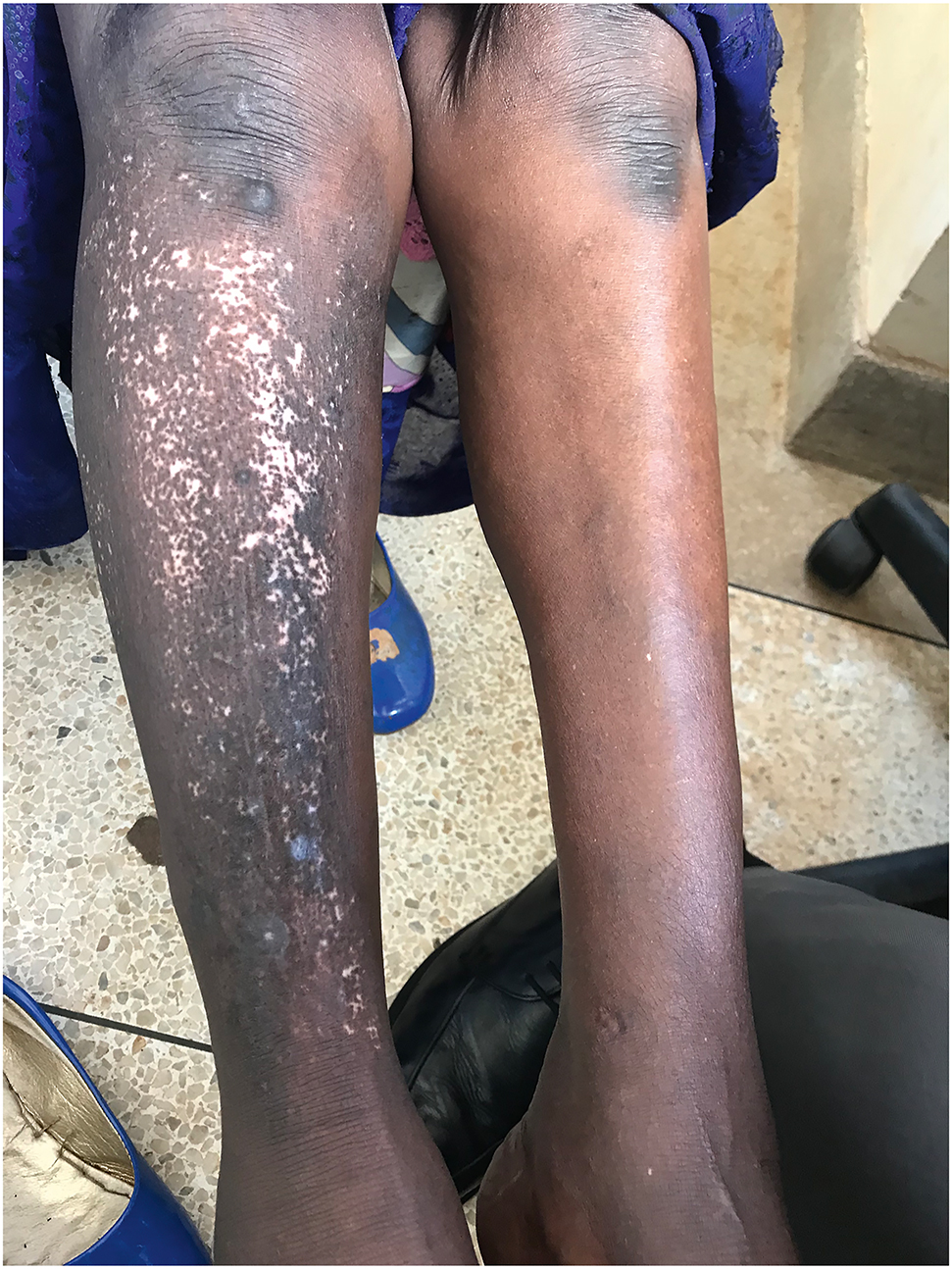
Diffuse depigmentation with follicular sparing on the lower right dorsal distal extremity.
Onchocerciasis, also known as “river blindness,” is caused by the filarial nematode Onchocerca volvulus. The larvae is transmitted to humans via the bite of a Simulium fly which serves as a vector. Invading larvae then develop into male or female adult worms. The female worm becomes encapsulated within the subcutaneous tissue forming skin nodules that the male will migrate to and fertilize the female [1]. Offspring microfilariae are released from these nodules and move through the subcutaneous, dermal, ocular tissues and the lymphatic system, provoking minimal immune response [1]. When the microfilariae die, they incite an inflammatory response in the affected tissues [1]. Infection primarily occurs in rural villages located near fast-flowing rivers and streams in Africa [2]. It is a major cause of blindness, epilepsy, and cutaneous disease in endemic areas. It is vital for clinicians to understand and accurately identify the cutaneous manifestations of the disease to prevent long-term complications. Though rarely encountered within North America, it is important for clinicians to recognize the disease as it may present in immigrants and long-term travelers from endemic areas [3]. The cutaneous manifestations of onchocerciasis are commonly generalized pruritis followed by inflammatory papules and nodules. Cutaneous depigmentation is a unique clinical finding that classically displays depigmented patches with perifollicular sparing. The differential diagnosis of leukoderma with perifollicular sparing may include onchocerciasis, scleroderma, and vitiligo. Diagnosis of cutaneous disease includes skin snips. Additional investigation that supports the diagnosis includes peripheral eosinophilia, hypergammaglobulinemia, and the presence of microfilariae within the anterior chamber of the eye on slit-lamp examination. Treatment should consist of ivermectin 150 mcg/kg as a single dose and should be repeated every three to six months until the patient is asymptomatic [4].
-
Research funding: None reported.
-
Author contributions: Both authors provided substantial contributions to conception and design, acquisition of data, or analysis and interpretation of data; both authors drafted the article or revised it critically for important intellectual content; both authors gave final approval of the version of the article to be published; and both authors agree to be accountable for all aspects of the work in ensuring that questions related to the accuracy or integrity of any part of the work are appropriately investigated and resolved.
-
Competing interests: None reported.
-
Informed consent: The patient described in this report provided written informed consent.
References
1. Burnham, G. Onchocerciasis. Lancet 1998;351:1341–6. https://doi.org/10.1016/S0140-6736(97)12450-3.Search in Google Scholar PubMed
2. World Health Organization. Progress report on the elimination of human onchocerciasis; 2016–2017. Available from: https://www.who.int/publications/i/item/who-wer9245 [Accessed 1 Aug 2022].Search in Google Scholar
3. Norman, FF, Pérez de Ayala, A, Pérez-Molina, JA, Monge-Maillo, B, Zamarrón, P, López-Vélez, R. Neglected tropical diseases outside the tropics. PLoS Neglected Trop Dis 2010;4:e762. https://doi.org/10.1371/journal.pntd.0000762.Search in Google Scholar PubMed PubMed Central
4. Gardon, J, Boussinesq, M, Kamgno, J, Gardon-Wendel, N, Demanga-Ngangue, Duke, BO. Effects of standard and high doses of ivermectin on adult worms of onchocerca volvulus: a randomised controlled trial. Lancet 2002;360:203–10. https://doi.org/10.1016/S0140-6736(02)09456-4.Search in Google Scholar PubMed
© 2022 the author(s), published by De Gruyter, Berlin/Boston
This work is licensed under the Creative Commons Attribution 4.0 International License.
Articles in the same Issue
- Frontmatter
- Behavioral Health
- Case Report
- Successful buprenorphine transition while overlapping with a full opioid agonist to treat chronic pain: a case report
- General
- Original Article
- How did the dietary habits of patients with chronic medical conditions change during COVID-19?
- Medical Education
- Original Article
- Is cadaveric dissection essential in medical education? A qualitative survey comparing pre-and post-COVID-19 anatomy courses
- Musculoskeletal Medicine and Pain
- Commentary
- Advancing care and research for traumatic brain injury: a roadmap
- Neuromusculoskeletal Medicine (OMT)
- Original Article
- Concussion-related visual memory and reaction time impairment in college athletes improved after osteopathic manipulative medicine: a randomized clinical trial
- Public Health and Primary Care
- Review Article
- A narrative review of nine commercial point of care influenza tests: an overview of methods, benefits, and drawbacks to rapid influenza diagnostic testing
- Original Article
- Disparities in seasonal influenza vaccine uptake and language preference among Hispanic US adults: an analysis of the 2017–2020 BRFSS
- Clinical Images
- Posterior cortical atrophy
- Leukoderma with perifollicular sparing: a diagnostic clue of cutaneous onchocerciasis
Articles in the same Issue
- Frontmatter
- Behavioral Health
- Case Report
- Successful buprenorphine transition while overlapping with a full opioid agonist to treat chronic pain: a case report
- General
- Original Article
- How did the dietary habits of patients with chronic medical conditions change during COVID-19?
- Medical Education
- Original Article
- Is cadaveric dissection essential in medical education? A qualitative survey comparing pre-and post-COVID-19 anatomy courses
- Musculoskeletal Medicine and Pain
- Commentary
- Advancing care and research for traumatic brain injury: a roadmap
- Neuromusculoskeletal Medicine (OMT)
- Original Article
- Concussion-related visual memory and reaction time impairment in college athletes improved after osteopathic manipulative medicine: a randomized clinical trial
- Public Health and Primary Care
- Review Article
- A narrative review of nine commercial point of care influenza tests: an overview of methods, benefits, and drawbacks to rapid influenza diagnostic testing
- Original Article
- Disparities in seasonal influenza vaccine uptake and language preference among Hispanic US adults: an analysis of the 2017–2020 BRFSS
- Clinical Images
- Posterior cortical atrophy
- Leukoderma with perifollicular sparing: a diagnostic clue of cutaneous onchocerciasis
