On implementation of Stickel's key exchange protocol over max-min and max-T semirings
-
Sulaiman Alhussaini
 und
Sergeĭ Sergeev
und
Sergeĭ Sergeev

Abstract
Given that the tropical Stickel protocol and its variants are all vulnerable to the generalized Kotov–Ushakov attack, we suggest employing the max-min semiring and, more generally, max-
1 Introduction
A key exchange protocol is the process in which two parties (commonly called Alice and Bob) exchange messages in order to jointly compute a shared secret key that cannot be directly intercepted by an eavesdropper (Eve). In public key cryptography, it is common to use various structures in algebra and geometry (such as elliptic curves) to implement such key exchange protocols. The most popular protocol is that of Diffie and Hellman [1], and Stickel’s protocol [2], whose unusual implementation is discussed in our study, is essentially a two-sided variation of Diffie-Hellman’s protocol.
Tropical cryptography was first proposed by Grigoriev and Shpilrain [3] as an alternative framework for cryptographic protocols such as Stickel’s since it enjoys several advantages such as efficiency and resistance to some general attacks. In particular, Grigoriev and Shpilrain developed a tropical version of the original Stickel key exchange protocol, the original version of which was vulnerable to common linear algebraic attacks. Their motivation came from the non-invertible nature of matrices in tropical algebra, making the tropical implementation resistant to attacks resembling the ones faced by the original Stickel protocol. It can also be observed that the tropical implementation of cryptographic protocols is faster to execute (since the arithmetic operations can be executed faster). The tropical Stickel protocol was then attacked by Kotov and Ushakov [4]. The Kotov–Ushakov attack was generalized in the study by Muanalifah and Sergeev [5] where it was shown how to apply the same idea to other implementations of Stickel’s protocol based on matrix commutativity. Also, Grigoriev and Shpilrain [6] proposed two protocols based on tropical semi-direct product, but one of them was shown to be invalid by Isaac and Kahrobaei [7] and the other was successfully attacked by the same authors as well as by Muanalifah and Sergeev [8] and Rudy and Monico [9]. This highlights the challenges in implementing a secure protocol in the tropical framework.
The main idea of the present study is to consider implementations of Stickel’s protocol over max-
We are using the term “max-
This work is organized as follows: Section 2 gives the preliminaries and basic definitions, particularly concerning the max-min semiring and, more generally, max-
2 Preliminaries
In this section, we present the standard definitions for the matrix algebra over the max-min semiring. We will use
Definition 2.1
(Max-Min semiring and associated matrix algebra). The max-min (fuzzy) semiring is defined as
The max-min addition
The max-min multiplication of two matrices is also similar to the “traditional” algebra. Namely, we define
Definition 2.2
(Max-min matrix powers). For
By definition, any max-min square matrix to the power 0 equals the max-min identity.
Definition 2.3
(Max-min identity). The max-min identity matrix
We subsequently define the matrix polynomials over the max-min semiring.
Definition 2.4
(Matrix polynomials). Matrix polynomial is a function of the form
Here
Note that any two matrix polynomials of the same matrix commute in the max-min algebra, as in the classical and tropical cases. Consequently, max-min polynomials can be utilized to create a version of Stickel protocol, exploiting this commutativity property to form a shared secret key.
We also present the modified
Definition 2.5
(Upper
where
Definition 2.6
(Max-
Definition 2.7
(
Remark 2.1
(On max-
3 Stickel protocol over max-min and other semirings
In this section, we introduce the Stickel key exchange protocol over the max-min semiring using polynomials (Protocol 1) and modified circulants (Protocol 2), and examine their applicability.
Protocol 1
(Max-min Stickel protocol)
Alice and Bob agree on public matrices
Alice chooses two random max-min polynomials
Bob chooses two random max-min polynomials
Alice computes her secret key using Bob’s message
Bob also computes his secret key using Alice’s message
Note that
Initially, one might assume that this protocol is vulnerable to exhaustive search attacks because max-min operations do not generate new numbers, making the shared key seemingly easy to guess. However, we argue otherwise. By considering a wide range for both matrix entries and polynomial coefficients, along with a sufficiently large polynomial degree, the protocol yields an extensive array of possibilities, thereby mitigating susceptibility to brute-force attacks.
The following experiment (Figure 1) shows the average number of unique elements in the shared key. The dimension of the matrices is 10 with entries and polynomial coefficients chosen randomly from
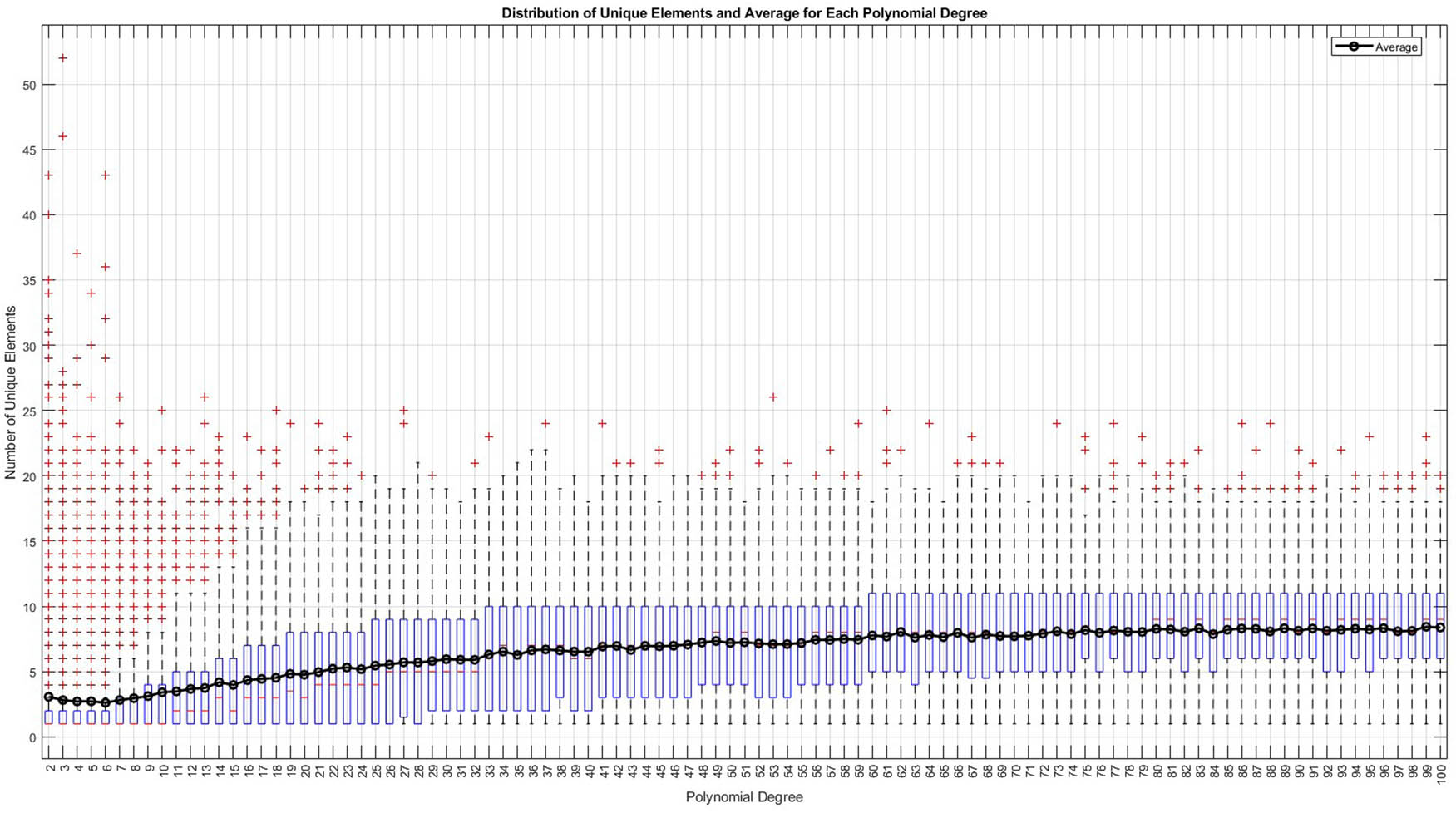
Key randomness for Protocol 1.
Protocol 2
(Max-min Stickel protocol based on modified circulants)
Alice and Bob agree on
Alice generates two matrices
Bob generates two matrices
Alice calculates
Bob calculates
Similarly, note that
We also demonstrate the behavior of the shared key as the matrix dimension increases (Figure 2), assessing whether there is adequate variability to prevent brute-force attacks.
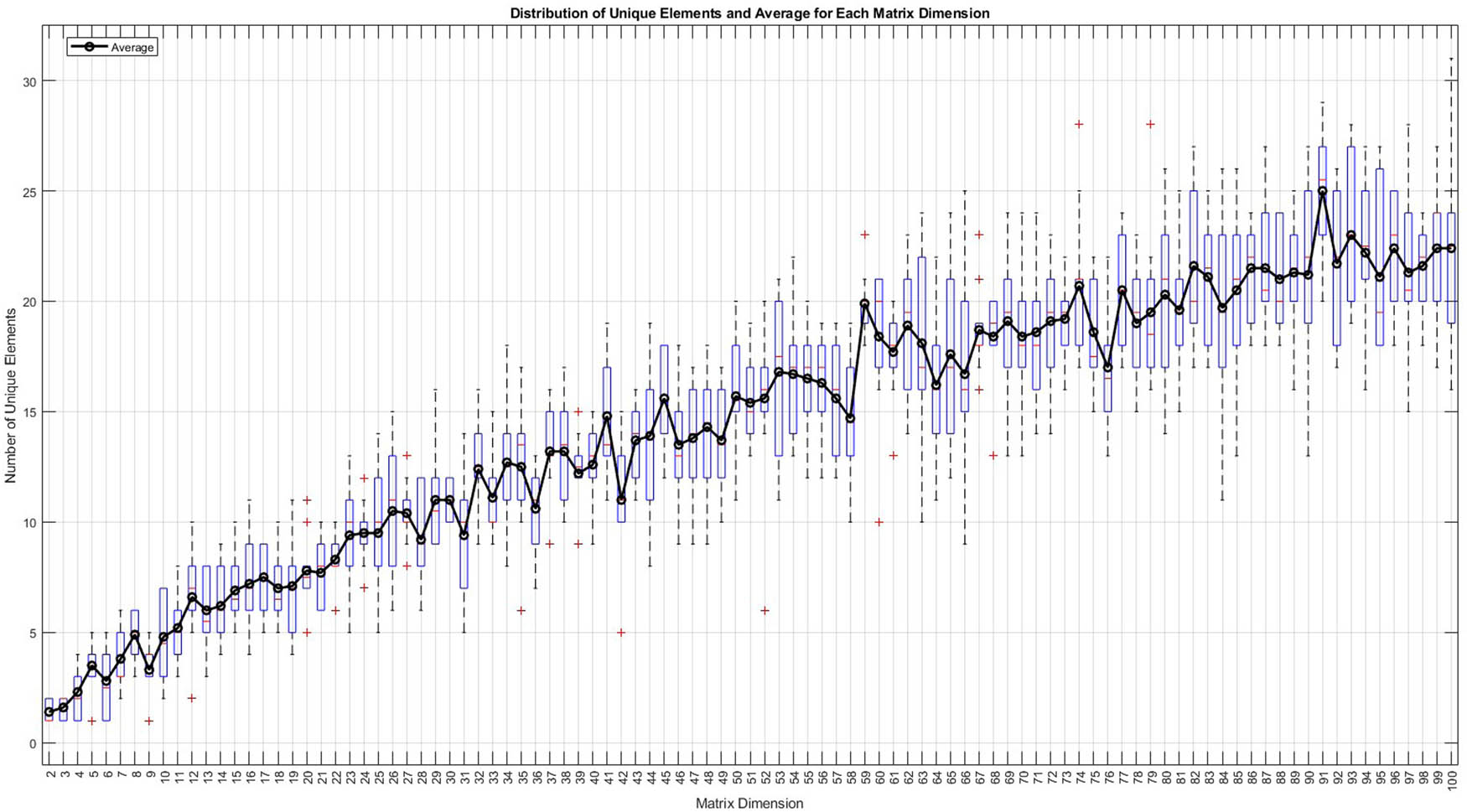
Key randomness for Protocol 2.
The average number of unique elements within the matrix increases with matrix dimension. This similarly results in a vast array of possible arrangements for these elements, making simple exhaustive search attacks unfeasible.
Remark 3.1
Both matrix polynomials and upper
Due to the commutativity of matrix polynomials and modified circulants, both Protocol 1 and Protocol 2 can be implemented using matrix algebra over any semiring, including any max-
4 Security analysis of the proposed protocols
In this section, we introduce a max-min/max-
Similar to the original tropical Kotov–Ushakov attack [4] (or the tropical generalized Kotov–Ushakov attack [5]), in order to attack Protocol 1 or Protocol 2, our objective is to find the polynomial coefficients or the circulant parameters
where
Note that for max-
We know from the protocols that
Then, combining the two summations and rearranging the coefficients, we obtain
We then denote
This is of the form of max-min/max-
Thus, we need to scan all solutions to equation (3) and pick a solution that satisfies
Proposition 4.1
(e.g., [13,14]) Over the max-min semiring, system (3) has a finite set of minimal solutions and just one maximal solution, which is the greatest solution. With the number of minimal solutions denoted by r, the whole solution set is represented as
where
According to Di Nola et al. [12], this Proposition also extends to max-
In order to break Stickel’s protocol over max-
Attack 1
(Max-min/max-
(1) Compute the maximum solution
(2) Compute all minimal solutions
Find a minimal solution
(4)is solvable.
Thus, system (4) can equivalently be written as
The value of the parameter
We now prove that Attack 1 works, due to it producing
Proposition 4.2
Let U be the message that Alice sent to Bob in Protocol 1 or Protocol 2. Then, Attack 1 yields
such that X and Y satisfy
Proof
Since
Since Attack 1 is computationally very heavy, it might not be practical, especially when Alice and Bob use very high polynomial degrees or matrix dimensions (see in the numerical experiments below). An attacker then would consider a heuristic version of the attack. One possible heuristic, which we are presenting only for the max-min case, would be as shown in Attack 2, where the attacker checks for a vector that solves system (4) (or equivalently system (5)) in just one box, where the lowest corner of the box is the lower bound
5 Implementations and numerical experiments
We now implement the attacks on Protocols 1 and 2, analyzing their behavior and execution time. We also compare the resistance of the two proposed max-min protocols with their tropical counterparts.
In our series of experiments, we investigate the behavior of Attack 1 in which we count the number of enumerated minimal solutions, and how many of them were tested to recover the shared key. We also measure the time taken by this attack to break the protocol. It appears that the number of enumerated and tested minimal solutions is much higher than the tropical case (as reported by Kotov and Ushakov experiment [4]). Furthermore, as the degree of polynomial or the matrix dimension increases, the number of minimal solutions skyrockets, leading to significantly prolonged attack times, often spanning several hours already for low dimensions. Such instances tend to occur more frequently as the degree increases, likely attributed to the high number of minimal solutions driven by the increase in key randomness. We expect that the max-min protocols require significantly more time to compromise compared to their tropical counterparts, primarily due to the increased number of enumerated and tested minimal solutions, in addition to having to solve a harder optimization problem (we have to solve a linear programming problem in the case of tropical Stickel protocol, compared with mixed-integer linear programming for the max-min case).
We used a ten-dimensional matrix and a polynomial degree from 2 to 10 for the case of Protocol 1, and a matrix dimension from 2 to 10 for the case of Protocol 2, and both matrix entries and polynomial coefficients are in
Performance of Attack 1 on the protocol based on polynomials
| Degree | 2 | 3 | 4 | 5 | 6 | 7 | 8 | 9 | 10 |
|---|---|---|---|---|---|---|---|---|---|
| Number of minimal solutions | 5 | 11 | 54 | 664 | 439 | 3,198 | 12,493 | 20,834 | 27,342 |
| Number of tested minimal solutions | 1 | 1 | 54 | 1 | 43 | 1,261 | 1 | 199 | 373 |
| Time taken (s) | 0.01 | 0.04 | 0.34 | 2.9 | 52.4 | 986 | 1,545 | 12,204 | 14,924 |
Performance of Attack 1 on the protocol based on circulants
| Dimension | 2 | 3 | 4 | 5 | 6 | 7 | 8 | 9 | 10 |
|---|---|---|---|---|---|---|---|---|---|
| Number of minimal solutions | 4 | 6 | 16 | 3,125 | 5,040 | 6,480 | 22,400 | 32,256 | 40,000 |
| Number of tested minimal solutions | 1 | 4 | 12 | 31 | 1 | 1 | 709 | 5,351 | 6,321 |
| Time taken (s) | 0.01 | 0.03 | 0.1 | 11.4 | 32.5 | 47.1 | 1,121 | 10,362 | 14,073 |
To compare these results with the efficiency of Kotov–Ushakov attack in the tropical case, we demonstrate here the results of our numerical experiments (Figure 3) presented previously by Alhussaini et al. [23].
![Figure 3
Time taken for Kotov–Ushakov attack to break tropical Stickel protocol based on polynomials (left) and modified circulants (right) [23].](/document/doi/10.1515/jmc-2024-0014/asset/graphic/j_jmc-2024-0014_fig_003.jpg)
Time taken for Kotov–Ushakov attack to break tropical Stickel protocol based on polynomials (left) and modified circulants (right) [23].
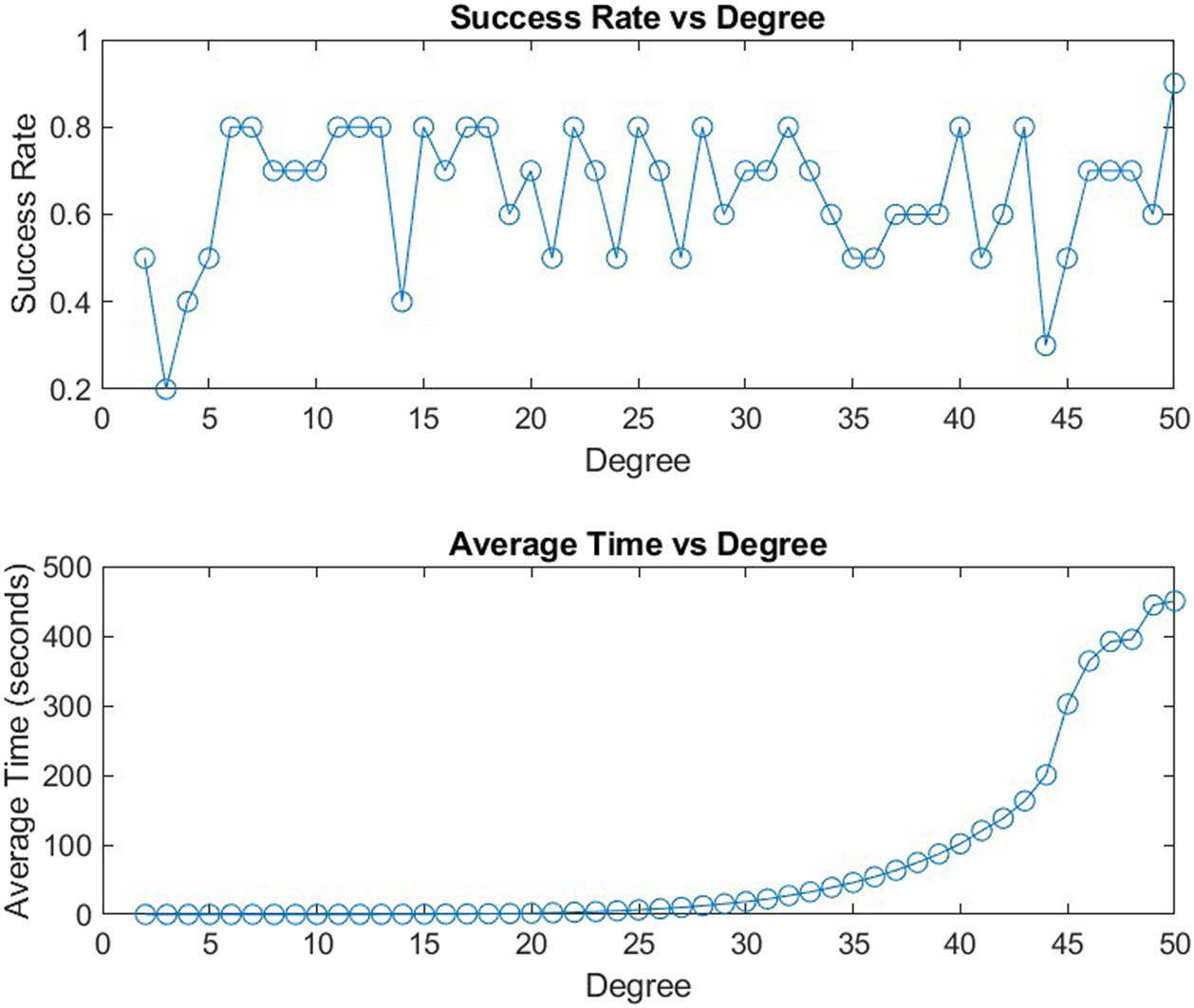
Figure 4 shows the success rate and time spent by Attack 2 on Protocol 1 (which is a heuristic version of the Kotov–Ushakov attack). Unfortunately, this attack performs very poorly against Protocol 2, with success rate dropping to 0% already for very low dimensions. Obviously, this heuristic is much faster than Attack 1 since it avoids enumerating all minimal solutions.
Another advantage for max-min protocols over the tropical ones is that the max-min protocols demonstrate greater resilience against the two-sided discrete logarithm attacks. This is attributed to the rarity of a single monomial dominating in the polynomial, unlike the tropical version where such dominance is much more common. To assess the frequency of single monomial dominance in both max-min and tropical cases, we conducted a simple numerical experiment where we sampled the matrix entries and polynomial coefficients from
6 Conclusion
In this work, we have suggested to implement Stickel protocol over max-
It may be concerning that the max-min semiring does not produce new numbers and therefore, the keys generated by Alice and Bob have only a small number of different entries. While this tends to be the case (especially when compared with the tropical versions of the same protocols), the number of different entries is significant and in general does not allow for a quick brute-force attack. Potentially, an implementation using a different
The max-min implementation seems more resistant to the existing attacking techniques such as the Kotov–Ushakov attack mostly because of the much bigger number of minimal solutions, which skyrockets as the degree of polynomial or the dimension of the circulant increases.
The attack method presented in this study represents the “default” approach for addressing the hard underlying problem posed by the targeted protocols: finding a special solution among all possible solutions to a system of the form “
We believe that there are alternative approaches that could more efficiently target the suggested protocols, avoiding the direct engagement with the underlying hard problem of minimal solutions enumeration. These strategies, while potentially not guaranteed to always succeed, could offer significant improvements. We leave the exploration of such methods to future research.
The future research could also focus on picking some interesting classes of
Acknowledgement
The authors are grateful to the anonymous referees for careful reading and comments which helped to improve our article.
-
Funding information: Authors state no funding involved.
-
Author contributions: Both authors have accepted responsibility for the entire content of this manuscript and approved its submission.
-
Conflict of interest: The authors state no conflict of interest.
Appendx
A.1 Upper
s
-circulant matrices commute [18]
Let
where
We can simplify these equations, remembering that the subscripts are always integers, therefore, if
Therefore, in general we have
Here and below we will assume
In a similar manner, we find a general formula for
We note the solutions to
As
Thus, any two upper
A.2 Upper
s
-circulant matrices are a semiring [18]
Recall that
We observe that
So, we have
As we have shown that all entries on the same diagonal of
Using our general formula, we see that
We also have
Therefore, we have shown that
Using the above equations we can see that
This is an upper
References
[1] Diffie W, Hellman M. New directions in cryptography. IEEE Trans Inform Theory. 1976;22(6):644–54. 10.1109/TIT.1976.1055638Suche in Google Scholar
[2] Stickel E. A new method for exchanging secret keys. In: Third International Conference on Information Technology and Applications (ICITA’05). Vol. 2; 2005. p. 426–30. 10.1109/ICITA.2005.33Suche in Google Scholar
[3] Grigoriev D, Shpilrain V. Tropical cryptography. Commun Algebra. 2013;42:2624–32. https://api.semanticscholar.org/CorpusID:6744219. 10.1080/00927872.2013.766827Suche in Google Scholar
[4] Kotov M, Ushakov A. Analysis of a key exchange protocol based on tropical matrix algebra. J Math Cryptol. 2018;12(3):137–41. https://doi.org/10.1515/jmc-2016-0064, [cited 2023-11-26]. Suche in Google Scholar
[5] Muanalifah A, Sergeev S. Modifying the tropical version of Stickel’s key exchange protocol. Appl Math. 2020 Dec;65:727–53. 10.21136/AM.2020.0325-19Suche in Google Scholar
[6] Grigoriev D, Shpilrain V. Tropical cryptography II: Extensions by homomorphisms. Commun Algebra. 2019;47(10):4224–9. 10.1080/00927872.2019.1581213. Suche in Google Scholar
[7] Isaac S, Kahrobaei D. A closer look at the tropical cryptography. Int J Comput Math Comput Syst Theory. 2021;6(2):137–42. 10.1080/23799927.2020.1862303. Suche in Google Scholar
[8] Muanalifah A, Sergeev S. On the tropical discrete logarithm problem and security of a protocol based on tropical semidirect product. Commun Algebra. 2022;50(2):861–79. 10.1080/00927872.2021.1975125. Suche in Google Scholar
[9] Rudy D, Monico C. Remarks on a tropical key exchange system. J Math Cryptol. 2020;15(1):280–3. 10.1515/jmc-2019-0061Suche in Google Scholar
[10] Nitica V, Sergeev S. Tropical convexity over max-min semiring. In: Litvinov GL, Sergeev SN, editors. Tropical and idempotent mathematics and applications. Vol. 616 of Contemporary Mathematics. Providence, RI, USA: American Mathematical Society; 2014. p. 241–60. 10.1090/conm/616/12301Suche in Google Scholar
[11] Gavalec M, Němcová Z, Sergeev S. Tropical linear algebra with the Łukasiewicz T-norm. Fuzzy Sets Syst. 2015;276:131–48. Theme: Logic and Algebra. https://www.sciencedirect.com/science/article/pii/S0165011414005119. 10.1016/j.fss.2014.11.008Suche in Google Scholar
[12] Di Nola A, Pedrycz W, Sessa S. Fuzzy relation equations under LSC and USC T-norms and their Boolean solutions. Stochastica. 1987;11(2–3):151–83. Suche in Google Scholar
[13] Higashi M, Klir GJ. Resolution of finite fuzzy relation equations. Fuzzy Sets Syst. 1984;13:65–82. 10.1016/0165-0114(84)90026-5Suche in Google Scholar
[14] Klir GJ, Yuan B. Fuzzy sets fuzzy logic. Theory and Applications. Saddle River, NJ, United States: Prentice Hall; 1995. Suche in Google Scholar
[15] Di Nola A, Lettieri A. Finite BL algebras. Discrete Math. 2003;269:93–112. 10.1016/S0012-365X(02)00754-9Suche in Google Scholar
[16] Huang H, Li C, Deng L. Public-key cryptography based on tropical circular matrices. Appl Sci. 2022;12(15):7401. https://www.mdpi.com/2076-3417/12/15/7401. 10.3390/app12157401Suche in Google Scholar
[17] Amutha B, Perumal R. Key exchange protocols based on tropical circulant and anti-circulant matrices. AIMS Math. 2023;8(7):17304–34. 10.3934/math.2023885Suche in Google Scholar
[18] Collett C. Public key cryptography in max-plus algebra. MSc Dissertation. Birmingham, UK: University of Birmingham; School of Mathematics; 2023. Suche in Google Scholar
[19] Gavalec M. Solvability and unique solvability of max-min fuzzy equations. Fuzzy Sets Syst. 2001;124(3):385–93. Fuzzy logic. https://www.sciencedirect.com/science/article/pii/S0165011401001087. 10.1016/S0165-0114(01)00108-7Suche in Google Scholar
[20] Zahariev Z. Solving max-min fuzzy linear systems of equations. Algorithm and software. Annual of “Informatics” section Union of Scientists in Bulgaria. 2013;6:1–16. http://e-university.tu-sofia.bg/e-publ/files/12485_SUB-Informatics-2013-6-001-016.pdf. Suche in Google Scholar
[21] Peeva K, Kyosev Y. Fuzzy relational calculus - theory, applications and software (with CD-ROM). Advances in fuzzy systems - applications and theory. Vol. 22. Singapore: World Scientific Publishing Company; 2004. 10.1142/5683Suche in Google Scholar
[22] De Schutter B, Heemels WPMH, Bemporad A. On the equivalence of linear complementarity problems. Operat Res Let. 2002;30(4):211–22. 10.1016/S0167-6377(02)00159-1Suche in Google Scholar
[23] Alhussaini S, Collett C, Sergeev S. Generalized Kotov–Ushakov attack on tropical Stickel protocol based on modified tropical circulant matrices; 2023. https://eprint.iacr.org/2023/1904. Cryptology ePrint Archive, Paper 2023/1904. https://eprint.iacr.org/2023/1904. Suche in Google Scholar
© 2024 the author(s), published by De Gruyter
This work is licensed under the Creative Commons Attribution 4.0 International License.
Artikel in diesem Heft
- Regular Article
- The dihedral hidden subgroup problem
- Characterizing the upper bound on the transparency order of (n, m)-functions
- Tropical cryptography III: Digital signatures
- A security analysis of two classes of RSA-like cryptosystems
- On the quantum security of high-dimensional RSA protocol
- On implementation of Stickel's key exchange protocol over max-min and max-T semirings
- Revocable policy-based chameleon hash using lattices
- Revisiting linearly extended discrete functions
- Special Issue based on CIFRIS23
- Special issue based on the CIFRIS 2023 conference
- On linear codes with random multiplier vectors and the maximum trace dimension property
- Group structure of elliptic curves over ℤ/Nℤ
- mRLWE-CP-ABE: A revocable CP-ABE for post-quantum cryptography
- On the Black-Box impossibility of multi-designated verifiers signature schemes from ring signature schemes
- Searchable encryption with randomized ciphertext and randomized keyword search
- Differential experiments using parallel alternative operations
- On a generalization of the Deligne–Lusztig curve of Suzuki type and application to AG codes
- Automatic boomerang attacks search on Rijndael
- Efficiency of SIDH-based signatures (yes, SIDH)
- Cryptanalysis of a privacy-preserving authentication scheme based on private set intersection
Artikel in diesem Heft
- Regular Article
- The dihedral hidden subgroup problem
- Characterizing the upper bound on the transparency order of (n, m)-functions
- Tropical cryptography III: Digital signatures
- A security analysis of two classes of RSA-like cryptosystems
- On the quantum security of high-dimensional RSA protocol
- On implementation of Stickel's key exchange protocol over max-min and max-T semirings
- Revocable policy-based chameleon hash using lattices
- Revisiting linearly extended discrete functions
- Special Issue based on CIFRIS23
- Special issue based on the CIFRIS 2023 conference
- On linear codes with random multiplier vectors and the maximum trace dimension property
- Group structure of elliptic curves over ℤ/Nℤ
- mRLWE-CP-ABE: A revocable CP-ABE for post-quantum cryptography
- On the Black-Box impossibility of multi-designated verifiers signature schemes from ring signature schemes
- Searchable encryption with randomized ciphertext and randomized keyword search
- Differential experiments using parallel alternative operations
- On a generalization of the Deligne–Lusztig curve of Suzuki type and application to AG codes
- Automatic boomerang attacks search on Rijndael
- Efficiency of SIDH-based signatures (yes, SIDH)
- Cryptanalysis of a privacy-preserving authentication scheme based on private set intersection
