China in the Bulgarian State Archive: The Visit to the PRC of Stoyan Raynov and the Evergreen People’s Commune for Chinese-Bulgarian Friendship Then and Now
-
Evelina Hein


Abstract
The paper presents little-known information about a visit to China in 1959 of Stoyan Raynov—one of the founders of the modern Bulgarian ceramic art. Data from the personal archive of the artist is regarded as part of the bigger picture of the cultural and ideological exchange between Bulgaria and China in the 1950s. Focusing on two sites, visited by Stoyan Raynov during his time in Beijing—the new Beijing Railway Station and the Evergreen People’s Commune for Chinese-Bulgarian friendship, the paper presents the development of the commune into the 21st century, including the visit of Pat Nixon and most recently the birth of the town of Sijiqing—the modern successor of the preceding commune.
The present article reflects my work in the Bulgarian State Archives on the topic of China, which began some time ago. In a previous article,[1] written as a result of these research, I had presented part of the personal archive of distinguished Bulgarian graphic artist Vasil Zahariev, related to his 45-day trip to China in 1955. In the current text, I aim to present some of the impressions on “New China” of another Bulgarian artist, Stoyan Raynov (1894–1987), recognized as one of the creators of the modern Bulgarian ceramics school, who visited the People's Republic of China (PRC) four years later, in 1959.
The year 1959 is the year of the 10th anniversary of the founding of the PRC, so the archival materials from Stoyan Raynov’s visit offer today’s researchers of both modern China and Chinese-Bulgarian relations a good opportunity to feel the pulse of the young socialist Chinese state at that time. In actual fact, Stoyan Raynov’s report on his visit to China, the letters to his family, his photographs from numerous visits around the whole country, as well as his article on Chinese applied arts published in Bulgarian “Izkustvo” (Art) magazine in 1960 (Raynov, 1960), not only trace China’s path during this first decade of the PRC’s existence, but also reflect the perspective imposed by the ideological framework of the epoch, from which the Bulgarian artist observes and comments the distant but in his own words “fraternal socialist China”. From the perspective of the already 73 years of Chinese-Bulgarian diplomatic relations, a look at the impressions of notable Bulgarians of the first years of China provided an opportunity for comparisons, reflections and lessons concerning the path followed since then in China, as well as in Bulgaria.
Here is a summary of the life of ceramics artist Stoyan Raynov: He was the younger and lesser-known brother of the acclaimed Bulgarian writer Nikolai Raynov. At first Stoyan Raynov established himself as a graphic artist, but later made the ceramics art his primary field. He specialized in the Czech Republic, Germany and France, and after his return to Bulgaria in 1932 he worked as a lecturer at the Academy of Arts. In 1937 he was appointed professor there, and between 1952 and 1960 he was the Dean of the Faculty of Applied Arts. Stoyan Raynov has made many successful solo exhibitions of ceramic works and over the years established himself as the founder of the contemporary Bulgarian artistic ceramics movement—“with roots in tradition, but also with a modern flavor” (Georgiev, 2019). In the 1950s Stoyan Raynov initiated the introduction of artistic ceramics in the construction of large public buildings in the capital, e.g. the building of the Council of Ministers. In 1956 he personally managed the entire artistic ceramic arrangement of Sofia’s famous Central Department Store. A lot has been written by specialists about the role of Stoyan Raynov in Bulgarian art and about his contribution to the Bulgarian Ceramics School,[2] therefore, this topic is not explored in the present paper. The events in Prof. Raynov’s 1959 visit to China and the way these are reflected in his personal archive, as well as Chinese documentary evidence from that epoch, hereby are the subject of my commentary being a connoisseur of China with interests in the socio-political and ethno-cultural aspects of the contacts between Bulgaria and China in the period after the founding of the PRC.
Stoyan Raynov left for China in 1959 under the framework of an Agreement on cultural exchange between the People’s Republic of Bulgaria and China in the midst of the “Great Leap Forward” (1958–1960). When Prof. Raynov received the invitation to visit China, he was already 65 and in a mature state in his career and creativity. His rich erudition and his internationally recognized authority of a creative artist and educator allowed him, through live meetings with the Chinese artistic tradition and practice, to arrive at competent assessments and record what he experienced in the respective cultural-historical context. While in China from November 9 to December 11, 1959, Stoyan Raynov visited a great number of cultural sites and sites of the socialist construction in the cities of Beijing, Shanghai, Hangzhou, Nanchang, Canton (Guangzhou), Jingdezhen, Shiyan and Foshan (Raynov, 1953–1969). All these places and his impressions of them deserve a detailed presentation that would exceed the specified volume of the present text, so this may be presented in the future as a separate exposition. Here, with a view of the sought parallels and lessons, emphasis is placed only on two places visited by Stoyan Raynov during his stay in China.
One of them is the New Beijing Railway Station[3], which he visited on the second day of his arrival to the Chinese capital. Raynov was filled with great admiration and enthusiasm by what he saw and by what he learned about this railway station, and this was not at all by chance. In the construction of the station, all the forces of the young Chinese socialist state had been harnessed. As one of the 10 monumental buildings[4] erected in the year 1959 on the occasion of the 10th anniversary of the founding of the PRC, the new Beijing Railway Station was built in less than eight months (from January 20 to September 15) and was opened by the then supreme party and state leader Mao Zedong (1893–1976), who symbolically bought the first train ticket and personally wrote in his calligraphy style the name “Beijing Railway Station”. The passenger flow at that time was 200,000 people a day, and the waiting rooms accommodated 14,000 passengers daily. For its time, the station demonstrates the most cutting-edge technological equipment, including four escalators in one of the waiting rooms. These escalators were the first in the whole of Beijing (actually they were moved from a big shopping center in Shanghai, where the escalators at the entrance were disassembled and then reassembled in Beijing). The building of the Beijing station even had a dedicated hall with beds for the children of long-waiting passengers: something unheard of and unseen by that time, and even now in the regular railway stations in China. The 35 meters-high dome in the central waiting room, the installed system of television information screens, as well as the automated platform telephones were also the first in the country (Jin & Ma, 2019).
Here is what Stoyan Raynov shared in the letter to his wife and children from November 12, 1959:
“I can’t help but express my admiration for modern Chinese architecture. Everything is monumental. As big as China itself. Very modern, stylish in their national architecture, but completely updated … The best railway station in the world is theirs and it is in Beijing … Here one can see the attention, the care for the old man, for the mother, for the sick man and for the human being in general. The waiting rooms … for all “ethnic groups” from China, are displayed in the spirit of each ethnicity. Each of them has study-rooms, libraries with relevant literature, all kinds of entertainment: cinema, TV halls for small groups of 50 people. Special TV sets, where at the moment everyone can find out about everything related to his trip … Reception hall … most luxuriously furnished. Special carpets, furniture, shop windows with works of art: ceramics, sculptures from precious stones–jade, agate and other decorative paintings. Furniture made of ebony wood …”.
The new Beijing Railway Station from 1959 was an exceptional for its time architectural, engineering and logistical achievement, and as such sent clear signals about the strengthening power of the newly created Chinese socialist state. From 1959 until today some 23 billion and 250 million passengers have passed through the Beijing Railway Station. The Beijing Railway Station is no more the cutting edge of technology in China. However, on September 25, 2019, another new page was turned in the history of logistics and transport in China, with the opening of a new miracle of high technology: the largest airport in the world today—the new Daxing International Airport, designed by the world-famous architect Zaha Hadid. Just as in 1959 with the “New Station”, so does Daxing Airport 70 years later send a clear signal about the speed and the direction of the development of the Chinese state.
The other high profile place for its epoch, visited by the Bulgarian guest the very next day after his visit to the Beijing Railway Station, was the Evergreen People’s Commune for Chinese-Bulgarian Friendship. Here is the background and the circumstances around the establishment of this commune:
In the late 1950s and early 1960s, in accordance with the usual practice of reciprocity in the socialist camp, ten communes of friendship between the peoples were established in the suburbs of Beijing. These were meant to carry out the mission of people’s diplomacy with the countries of the socialist camp. In the specified period, the communes around Beijing had the highest level of mechanization in the entire agricultural sector of China and served as a model and driving force for all other people’s communes as key productive and administrative-territorial units in the country. Among the people’s communes for friendship established around Beijing with the countries of the socialist camp (the Union of Soviet Socialist Republics, Democratic People’s Republic of Korea, Hungarian People’s Republic, German Democratic Republic, People’s Republic of Romania, People’s Republic of Bulgaria, Republic of Cuba, Democratic Republic of Vietnam, etc.) was also the People’s Commune for the Chinese-Bulgarian Friendship. It was established in August 1958 as the Evergreen People’s Commune through the merging of eight cooperatives, some of which are nowadays known as Beijing districts Sijiqing, Xiangshan and Yuquan. In October 1958, the commune was renamed Evergreen People’s Commune for Chinese-Bulgarian Friendship (Liu, 2019). In fact, the history of the Evergreen People’s Commune for Chinese-Bulgarian Friendship and the moment when it was “baptized” in October 1958 demonstrate a great gesture of respect and solidarity by the leadership of China to the People’s Republic of Bulgaria at that historical moment. Against this background, it becomes clear why Stoyan Raynov was taken to a visit there, even though he was a man of art, not an agricultural or political figure. It would be valuable to present the events around the creation and existence of this commune in greater detail as they illustrate well the dramatic changes in China’s recent history and at the same time serve as an instructive example of the flexibility and entrepreneurship that have always played a leading role in the public life of the Chinese people.
The predecessor of “our” commune was the Evergreen Agricultural Cooperative, established in May 1955, when the Greenhouse production cooperative of the famous rural worker Li Molin[5], founded in 1952[6] after the land reform, was merged with two other neighboring cooperatives (Yi, 2013). Interesting details are contained in the preserved information about one of the initial proposals: to name the newly created unit “Michurinsk Agricultural Cooperative” as a token of gratitude for the support of the USSR by the young China and as a sign of respect for the achievements of the then famous Soviet biologist and botanist Ivan Michurin. In the end, however, the stakeholders drew the line at the name Evergreen Agricultural Cooperative (Yi, 2013).
After another consolidation in 1956, the Evergreen became the largest agricultural cooperative on the western outskirts of Beijing. In August 1958, this mega-cooperative merged with seven others and in this way, in unison with the Party and State ordinance by virtue of the “Great Leap Forward”, it marked the beginning of the Evergreen People’s Commune. As early as October 1958, it was renamed to People’s Commune for Chinese-Bulgarian Friendship, after it had already established friendly relations with a Labor Cooperative Agrarian Farm (LCAF) in the municipality of Elin Pelin near Sofia, Bulgaria. In this case the Bulgarian LCAF is interesting for us because in the autumn of 1955 it was given a Chinese name (in Bulgarian transcription): “Дун Фан Хун” (i.e. Dongfang Hong), derived from the popular at that time song “Dawn of the East”, praising Chairman Mao (Hristov, 1956; Vutev, 2006).
We draw information about the naming of the Chinese-Bulgarian commune from a publication in the Chinese newspaper People’s Daily from October 27, 1958, where under the title “Chinese-Bulgarian friendship crystallized in a People’s Commune. A meeting was held to choose a name for the People’s Commune for Chinese-Bulgarian friendship”, we read that from the Bulgarian side the meeting was attended by the Ambassador of the People’s Republic of Bulgaria to China Panchevski[7] and employees of the Bulgarian embassy in Beijing, as well as a delegation of Bulgarian agricultural activists, led by Bachvarov, designated as a member of the Central Committee of the Bulgarian Communist Party, in charge of agriculture.[8] From the Chinese side the meeting was attended by the Minister of Agriculture of the People’s Republic of China Liao Luyan (廖鲁言, 1913–1972) and his Deputy Yang Xiandong (杨显东, 1902–1998), as well as by the Beijing Deputy Mayor Wu Han (吴晗, 1909–1969). People’s Daily announced that Ivan Bachvarov on behalf of the Bulgarian Ministry of Agriculture and Forestry presented as gifts to the People’s Commune an electric centrifugal pump, an electric hoe with five plates, a sprayer for vineyards, a fodder cutting machine, a calculator, a radio set and other gifts. Bulgaria’s Ambassador Panchevski pointed out that numerous Bulgarian specialists had visited China and successfully transferred to Bulgaria the Chinese experience in growing rice, tomatoes and sweet potatoes. Ambassador Panchevski expressed hope that the twinning of the People’s Commune for Chinese-Bulgarian friendship with the Bulgarian LCAF “Dongfang Hong” will remain as a monument to fraternal friendship and mutual assistance between the Bulgarian and the Chinese people (People’s Daily 1958).
This brief overview of the history of the Evergreen People’s Commune from its founding until 1959 provides the relevant background to understand why the Chinese hosts wanted to demonstrate to their Bulgarian guest Stoyan Raynov exactly this People’s commune.
Stoyan Raynov was sincerely impressed by the commune. In the first letter to his family, which he started on the same day (November 12, 1959) and finished only four days later, shortly after the description of the Beijing Railway Station he wrote about “our” commune:
“… The commune for Chinese-Bulgarian friendship–formed last year, when regrouping eight collective farms into a common agricultural commune – one of the leaps that are made in China. This is the largest commune in Beijing. Very interesting data, which I will talk about when I come. Something remarkable. They have 55 thousand decares of agricultural land, 31 thousand decares of fruit culture, 45 thousand decares of cotton, and the number of labor force is only 775 people. They have many children, remarkably many. A whole “ant-hill” … a chemical factory, which is now being constructed next to the factory for Persian carpets (a type of Persian, but are purely Chinese), 151 kindergartens, 30 elementary schools, three secondary schools, two repair plants, 136 canteens with permanently hot food, 287 agricultural machines and 167 of the most modern ploughs. All members of the commune daily receive hot food for free, and furthermore annually they also receive a salary of 540 yuan (each yuan is more than one ruble) … I got into the details as if I am going to make a report to you. But one can’t help getting excited about their industriousness … I forgot to say that they have six maternity homes. We also visited a kindergarten, where children study for 2, 3 and 4 years. Very kind and interesting, extremely disciplined …” (Raynov, 1953–1969).
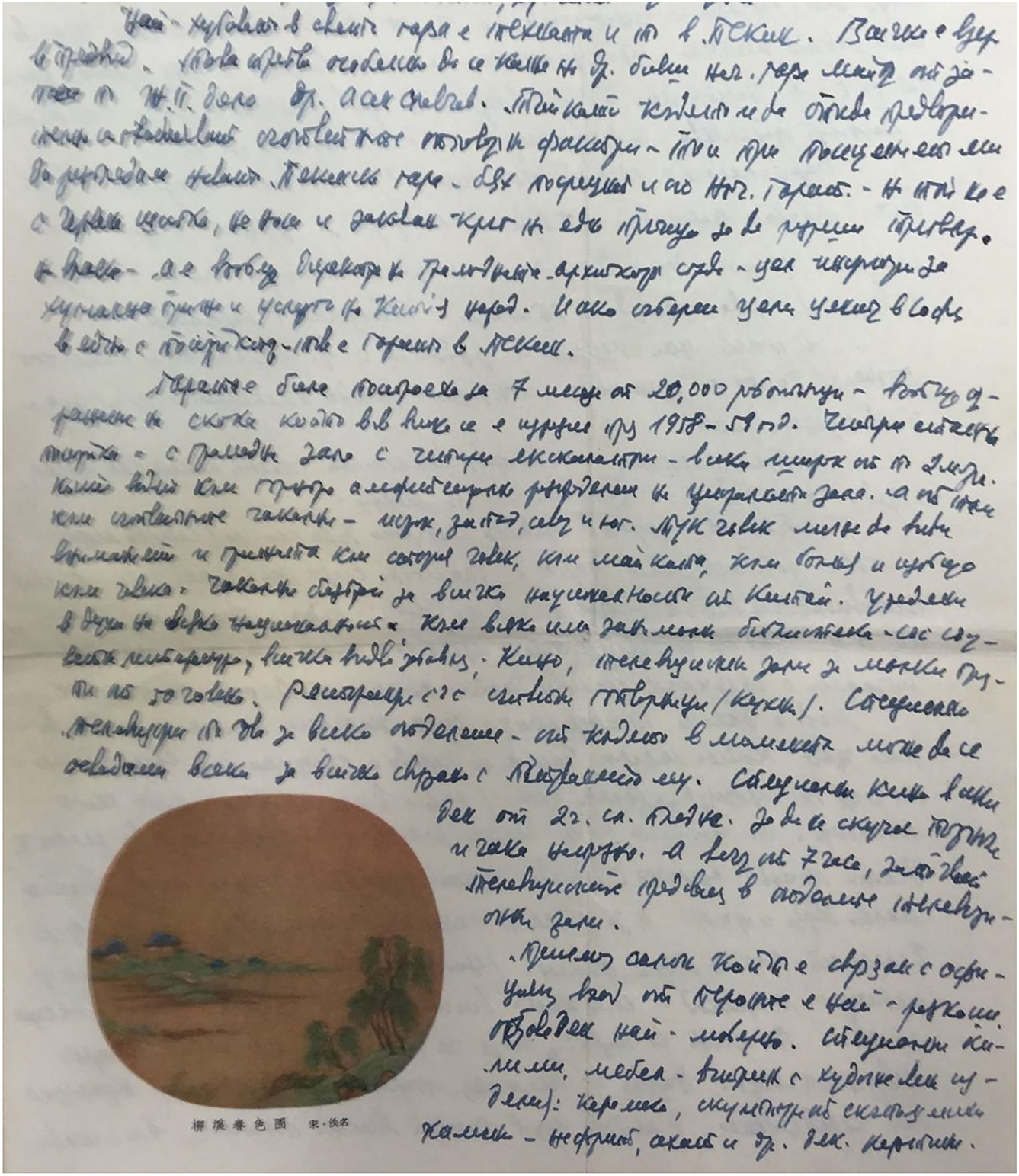
The first letter of Stoyan Raynov from China (source: Stoyan Raynov. Personal and family archive).
The visit to the People’s Commune for Chinese-Bulgarian friendship is duly covered, although quite dryly, in “Prof. Raynov’s Report on the work carried out in China in connection with the 1959 Cultural Agreement: “12.11.–Visit to the agricultural commune “Chinese-Bulgarian friendship”. Getting acquainted with the structure, organization and successes of the Commune” (Raynov, 1953–1969).

The first letter of Stoyan Raynov from China: description of the Chinese-Bulgarian Commune (source: Stoyan Raynov. Personal and family archive).
Although the information in the letter has yet to be verified, it is worth noting here the sharp contrast between the immediate, vivid and at times truly excited language of the man of art Stoyan Raynov with his vast life experience, which fills up his letters to his family and the dry administrative style of the official reports and comments of Raynov as a Faculty Dean and envoy of socialist Bulgaria about his visit to China. The ideological clichés used in the documents are the ones used in the spirit of that time. Whether out of caution, or out of fatigue accumulated over the years,[9] Stoyan Raynov’s comments about the visit give us as much a sense of the professional argumentation of the writing person, as well as the ideological environment of the People’s Republic of Bulgaria, in which the Bulgarian guest is completely immersed. In his official comments Raynov is constantly emphasizing that the most valuable thing in art is its service to the people and the opportunity to turn it into a people’s product. All historical references made by Raynov in the reports are based on the “Liberation”, given the Civil War and the Chinese Communist Party (CCP) victory in 1949, so the comments on the achievements of China create the impression of a certain deliberate lack of historicity. Stoyan Raynov, being a ceramics artist, well acquainted with world art history, seems to be deliberately trying to keep silent about the period before the “Liberation”, so his praise for pre-1949 Chinese art is obviously sparing.
In such a spirit are also sustained his stories about the visits to all museums, workshops and educational institutions, as well as his overview article on Chinese applied arts published in the Bulgarian magazine “Izkustvo” (Art) in 1960. In this sense, the results of the visit of the official figure Stoyan Raynov in China are predictable and fit into the clear line of the “Bulgarian-Chinese friendship”, predestined at the highest state level at that historical moment.
In a human and concrete plan, however, it is more interesting what happened to “our” Commune after Stoyan Raynov’s visit there, so I have sought out and found a range of evidence of its fate to present day.
A 1960s photograph of schoolgirls working at the field has been preserved with the caption reading “1960–students from 44th secondary school weeding the vegetable fields in the Evergreen People’s Commune for Chinese-Bulgarian Friendship.[10]
On September 9, 1963, Bulgarian newspaper “Naroden Dnevnik”[11] reported that on September 8, at the Evergreen People’s Commune for Chinese-Bulgarian Friendship a screening of the Chinese military film “After Armistice”[12] took place to mark 19 years of the “socialist revolution” in Bulgaria. Later that evening, the commune staff handed over to the Bulgarian Ambassador Stoychev a congratulatory letter to the Bulgarian LCAF “Dongfang Hong” in the municipality of Elin Pelin (People’s Daily, 1963). Obviously, the warm feelings between the two cooperatives were still maintained at that time.
We also learn about the Evergreen People’s Commune for Chinese-Bulgarian Friendship that in 1965 it was included in the Beijing Telephone Directory, which stated that the commune was registered as a subscriber of a telephone exchange in the Haidian District together with 12 other people’s communes.[13] Indicative of the glory of “our” commune in those years is the fact that on February 9, 1965 a large-scale work “Greenery Throughout the Year” was performed on the stage of the Chinese Musical Theater in the genre of “Pingju”, with the participation of some of the greatest masters in the genre. The performance in its turn contributed to the celebration of the commune throughout China, although the plot includes only the dramatic events of 1955 related to the establishment and strengthening of the Evergreen Agricultural Cooperative, without mentioning the international status of the commune as its heir (Pingju Qupuwang, 2011).
In general, no other essential information has been found so far for Bulgarian participation in the life of the commune after the naming connected to Bulgaria, which can be assumed to indicate that Bulgaria’s participation was only nominal. The only information indirectly related to Bulgaria is in a historical essay from 2013, published on the official page of the agricultural cooperatives in China, where a passing reference is made to the fact that in the 1960s the commune not only supplied one-quarter of Beijing’s vegetable needs, but also transferred cutting-edge experience in growing vegetables to North China, Northeast China, Mongolia and the countries of Eastern Europe (Yi, 2013). It is possible that part of the international contacts with Eastern Europe may refer also to the twinned LCAF “Dongfang Hong” in the People’s Republic of Bulgaria, but so far these are only assumptions that need to be supported with evidence that would require additional research work.
Regardless of the changes in the relations within the socialist camp, the People’s commune discussed here not only did not cease to exist, but in practice turned into the business card that China, on its way to communism, offered to the outside world. Thus, the fate of the Evergreen People’s Commune is also associated with the historical visit of US President Richard Nixon to China in February 1972. Noteworthy is the fact that a tour of this particular commune was included in the program for the visit of US First Lady Pat Nixon in Beijing, along with a visit to the Forbidden City and a walk around the center of the Chinese capital (Anthony, 2014). Unfortunately, in the materials studied so far regarding the entry of the commune onto the scene of international politics, there is no information when the name “People’s Commune for Chinese-Bulgarian Friendship” was abandoned. Yet, it can be concluded that by that time (the 1970s), the Bulgarian connection had already been relegated to the background, or possibly even entirely missing. Thus, in the most famous photograph, which captured a moment from Pat Nixon’s walking tour in the commune on February 23, 1972, parallel inscriptions at the entrance of an administrative building can clearly be seen: “Revolutionary Committee of the Evergreen People’s Commune in Haidian District, Beijing city” and “Committee of the Chinese Communist Party in the Evergreen People’s Commune in Haidian District, Beijing city”. The missing part “Chinese-Bulgarian Friendship” in the name may be explained with the overall state of the relations between China and the other countries of the socialist camp in the 1960s and 1970s: a topic that deserves special attention and goes beyond the scale and the focus of the present exposition.
In May 1973, apparently in direct connection with the historic visit of US President Nixon to China the previous year, the Evergreen People’s Commune welcomed even more American guests: a delegation of scientists were on a visit there and met the children at the local elementary school.
Overall, however, the existence of the Evergreen People’s Commune in the following years was in line with the fate of all people’s communes in China, which after 1984 finally left the historical scene. On December 30, 1983, the commune was officially transformed into an administrative unit Sijiqing Township (Haidian Library, 2020). It turned out to be adjacent to China’s first high-tech zone, Zhongguancun, and participated as a shareholder in three of the most successful companies in this zone. The initial capital of 20,000 yuan for the most famous company “Sitong”[14] was provided precisely by the Sijiqing Township (Mengin, 2004, p. 66), and the first chairman of the company was the mayor of that same township (Haidian Library, 2020). Another impressive milestone in Sijiqing’s dash towards modernization and prosperity was the building of the five-star hotel “Shangri La-Beijing” in 1984[15] on the territory of the former Evergreen People’s Commune with funds from one of Beijing’s first joint venture associations with foreign participation (Zhang, 2019). In the name of the hotel, along with the usual association with the mythical paradise country, one can also trace the bucolic idealization of the once glorious commune that “turned winter into spring” (Haidian Library, 2020) and provided in the 1960s fresh vegetables for the meals of millions of families in Beijing and neighboring areas.
In the 1990s, the Sijiqing Township completely lost its position as a major source of vegetables for the capital because it was too small to meet the needs of growing Beijing, and besides new competitive producers and suppliers of vegetables for the city entered the market. On the other hand, the township found out new ways to continue its path to modernity, maintaining its “green glory”. Thus, in 1999, the township was officially joined administratively to the territory of Beijing as part of “the first green zone” within the city (Haidian Library, 2020), and in October 2000 it was included also in the project for the creation of a “green valley-oxygen bar” for Beijing (People’s Daily Online, 2000).
In September 2004, Sijiqing District was declared a town-district center 镇 with an area of almost 41 sq. km and became a hub of enterprises mainly in the field of services, tourism, recreation and modern agriculture (Oriental Wisdom, 2020). In 2020, according to official data the degree of landscaping and parks cover of the town of Sijiqing is already over 70% and it can really be said that the greenery in the region is year-round. The focus, though, had long ago shifted from vegetables to providing Beijing with a green protective belt that generates 300,000 tons of oxygen per year and takes up and retains 4.2 million tons of fine dust particles (Haidian Library, 2020).
In summary, it is visible in the modern development of Sijiqing that this area has the ambition to be a traditional haven in the bosom of nature, and the leitmotif for “year-round greenery” is also preserved at the birth of the modern town of Sijiqing. This town is also cited as an example of successful urban development in the portfolio of the consulting company “Oriental Wisdom” 东方智鼎, specialized in offering business solutions for rural and sparsely urbanized areas in the process of the intensifying economic and social reforms in the country (Oriental Wisdom, 2020).
The place that gave birth to the former Evergreen People’s Commune has long ago lost all connections with the Chinese-Bulgarian friendship, but for us, the observers from Bulgaria, this story serves as concrete example of progressive and upward development without a radical abandonment of the past. Such stories should provoke thoughts on the development of the Chinese state and society, as well as on the Bulgarian state and society, and should lead to a reconciliation of what has been achieved in the past, what opportunities have been missed and what may be desired for the future.
References
Anthony, C. (2014, March 17). American first ladies in China, A fascinating, untold saga (Part 2). National First Ladies’ Library. http://www.firstladies.org/blog/american-first-ladies-in-china-a-fascinating-untold-saga-part-2/ Search in Google Scholar
Georgiev, E. (2019). Po-malkiyat brat na Nikolay Raynov [The younger brother of Nikolay Raynov]. Ploshtad Slaveykov. https://www.ploshtadslaveikov.com/po-malkiyat-brat-na-nikolaj-rajnov/ Search in Google Scholar
Haidian Library. (2020). 四季青曾经在北京名声有多大?看了这些图才知道 [How famous was Sijiqing in Beijing? Just look at these pictures]. http://zyk.hdggwh.com/zyk/d/cultural/details?id=18 Search in Google Scholar
Hristov, P. (1956, April 30). “东方红”农业生产合作社 [“Dongfanghong” agricultural production cooperative cooperative]. People’s Daily. https://cn.govopendata.com/renminribao/1956/4/30/3/ Search in Google Scholar
Jin, K., & Ma, J. (2019, September 15). 中国铁路第一站, 60 岁生日快乐 [The first stop of Chinese railway, happy 60th birthday]. Beijing Diary. https://baijiahao.baidu.com/s?id=1644745243621500940&wfr=spider&for=pc Search in Google Scholar
Liu, Z. (2019). 找到了, 北京郊区的这些中外友好人民公社, 原来在这里 [Finally found, these Sino-foreign friendly people’s communes on the outskirts of Beijing were here]. https://kknews.cc/zh-hk/agriculture/gja5a3y.html Search in Google Scholar
Manolov, Z. (1970). Stoyan Raynov [Stoyan Raynov]. Publishing house Balgarski hudozhnik.Search in Google Scholar
Mengin, F. (Ed.). (2004). Cyber China: Reshaping national identities in the age of information. Palgrave Macmillan.Search in Google Scholar
Miteva, M. (2013). Kam problema za evolyutsiyata na dekorativnoto v keramikata na Stoyan Raynov (1894–1978) [On the problem of evolution of the decorative element in the ceramic art of Stoyan Raynov (1894–1978)]. Izkustvovedski Cheteniya, 8, 418–428.Search in Google Scholar
Miteva, M. (2014). Stoyan Raynov (1894 – 1978) predi keramikata [Stoyan Raynov (1894 – 1978) before the ceramic art]. NBU.Search in Google Scholar
Oriental, Wisdom. (2020). 独具特色的四季青镇 [Unique Sijiqing town]. http://dfzd365.com/singlepage.php?cid=17 Search in Google Scholar
People’s, Daily. (1958, October 27). 中保人民友谊的结晶 中保友好人民公社举行命名大会 [The crystallization of the friendship between the people of China and Bulgaria, China-Bulgaria friendship people’s commune holds naming conference]. https://cn.govopendata.com/renminribao/1958/10/27/2/#208148 Search in Google Scholar
People’s, Daily. (1963, September 9). 庆祝保加利亚社会主义革命十九周年 中保友好人民公社举行电影晚会 [Celebrating the 19th anniversary of Bulgaria’s socialist revolution, the China-Bulgaria friendship people’s commune held a film party]. https://cn.govopendata.com/renminribao/1963/9/9/5/#312190 Search in Google Scholar
People’s Daily, Online. (2000). 京西崛起绿谷生态小区 [The rise of green valley ecological community in the west of Beijing]. http://www1.peopledaily.com.cn/GB/channel1/907/20001010/264970.html Search in Google Scholar
Pingju Qupuwang. (2011). 评剧《四季常青》[Pingju Siji Changqing]. www.pingju. http://www.pingju.com.cn/bbs/viewthread.php?tid=6507 Search in Google Scholar
Raynov, S. (1953–1969). Raynov Stoyan. Lichen i semeen arhiv [Stoyan Raynov. Personal and family archive]. Raynov (TsDA, f.2288, op.1).Search in Google Scholar
Raynov, S. (1960). Kitayskite prilozhni izkustva [The Chinese applied arts]. Izkustvo, 4, 10–19.Search in Google Scholar
Vutev, S. (2006). Advanced experience: Tschelen opit: Stanete Kitaytsi [Let us become Chinese]. Old duma. http://old.duma.bg/2006/0606/260606/iskam/isk-1.html Search in Google Scholar
Yi, X. (2013). “四季青”溯源 [Find the origin of Sijiqing]. http://nyhzsw.org/bencandy.php?fid=42&id=4016 Search in Google Scholar
Zhang, Q. (2019). 共读海淀农业的历史长诗 [Read the long historical poems of Haidian agriculture together]. Sohu. https://www.sohu.com/a/304770780_99965635 Search in Google Scholar
Zhivkova, N., & Balcheva, M. (2019). Stoyan Raynov: prikazki ot glina [Stoyan Raynov: Fairy tales made of clay]. SGHG.Search in Google Scholar
© 2022 the author(s), published by De Gruyter, Berlin/Boston
This work is licensed under the Creative Commons Attribution 4.0 International License.
Articles in the same Issue
- Frontmatter
- Articles
- Nature, Culture and COVID-19—Towards a Global History of Pandemics
- The Global Meaning of the Pluralistic Chinese Cultural Tradition
- China in the Bulgarian State Archive: The Visit to the PRC of Stoyan Raynov and the Evergreen People’s Commune for Chinese-Bulgarian Friendship Then and Now
- Book Reviews
- Michael Keevak: Becoming Yellow: A Short History of Racial Thinking
- Thomas E. LaFargue: China’s First Hundred: Educational Mission Students in the United States, 1872–1881
- Introduction of Major Institutions
- The Research Institute of Buddhist Culture of China
- The Beijing Center: Fostering Mutual Understanding between China and the World
- Research Academy Chengdu, University of International Business and Economics
Articles in the same Issue
- Frontmatter
- Articles
- Nature, Culture and COVID-19—Towards a Global History of Pandemics
- The Global Meaning of the Pluralistic Chinese Cultural Tradition
- China in the Bulgarian State Archive: The Visit to the PRC of Stoyan Raynov and the Evergreen People’s Commune for Chinese-Bulgarian Friendship Then and Now
- Book Reviews
- Michael Keevak: Becoming Yellow: A Short History of Racial Thinking
- Thomas E. LaFargue: China’s First Hundred: Educational Mission Students in the United States, 1872–1881
- Introduction of Major Institutions
- The Research Institute of Buddhist Culture of China
- The Beijing Center: Fostering Mutual Understanding between China and the World
- Research Academy Chengdu, University of International Business and Economics
