The Research Institute of Buddhist Culture of China
-
Sheng Kai


The Research Institute of Buddhist Culture of China (RIBCC) was established in 1987. It is a Buddhist cultural research institute affiliated with the Buddhist Association of China, and serves as a gateway to conduct activities of Buddhist cultural exchange both at home and abroad.
On April 23rd in 1987 when the Research Institute of Buddhist Culture of China was officially established in Guangji Temple, Zhao Puchu was appointed as the honorary director while Zhou Shaoliang as the director. Famous scholars such as Liang Shuming, Qigong, Chang Renxia, Chang Shuhong, Wu Xiaoling, Chen Mingyuan, Wu Baihui, Pan Jiezi, Yuyu, Jin Weinuo, Su Yuanlei, Su Jinren, Wangsen, Wangyao were engaged as the initial group of contributing researchers at the institute.
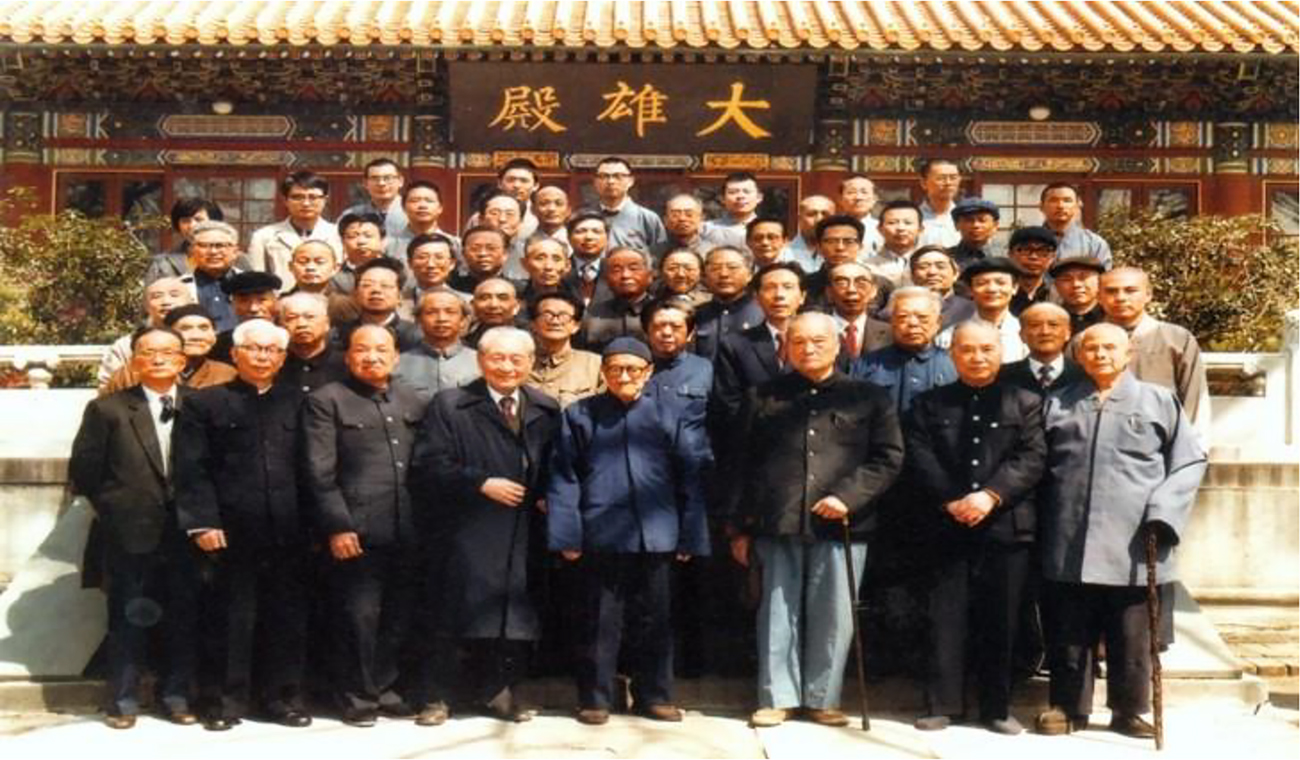
The picture shows all the members participating in the inaugural meeting taking a group photo in front of the Great Hall of Guangji Temple, Beijing.

The Research Institute of Buddhist Culture of China formulates both long and short-term research plans by complying with the principal tenets of the Buddhist Association of China and running in cooperation with Chinese Buddhist circles whose guiding principles are to consolidate self-construction, to develop Buddhist education and to enhance the overall quality of the fourfold Buddhist community.
Its aims are as follows:
To unite Buddhist scholars within and outside Buddhist circles to conduct studies on Buddhist history, teachings and current situations. One of the important tasks is to compile and publish the Encyclopedia of Chinese Buddhism in both Chinese and English. This encyclopedia is based on more than 400 entries written by the Chinese Buddhist circles for the English version of the Encyclopaedia of Buddhism of Sri Lanka in the 1950s. All the entries in the English version at that time were sorted out, approved and printed, in order to provide a set of general works that can reflect the full picture of Chinese Buddhism for the English Buddhist community.
To strengthen its cooperative relationship with higher educational institutions, Buddhist monasteries and colleges, Buddhist research organisations across the country. The Origins of the Chan School was published by China Social Science Press in 1998, in consequence of its application for the National “Eighth Five-Year Plan” Social Science Research Project. In 2017, the institute undertook the research project of the State Administration of Religious Affairs “Research on Properly Solving the Commercialisation of Buddhism”, the high-end think tank project of the United Front of the Central Institute of Socialism “Study on the Relationship between Han and Tibetan Buddhism in the Yuan Dynasty” and “Study on the Exchange of Han and Tibetan Buddhism in the Qing Dynasty”.
To consolidate its relationship with regional Buddhist organisations, Buddhist educational institutions and Buddhist scholars in Hong Kong, Macau and Taiwan. In order to promote the research on Humanistic Buddhist Thought, the Research Institute of Buddhist Culture of China and Buddhist Academy of Zhejiang collaborated on the application for the establishment of the inaugural research base on Humanistic Buddhist Thought in the name of the Buddhist Association of China at Mount Xuedou in the year 2020.
To reinforce its relationship with international Buddhist organisations, Buddhist educational institutions and Buddhist scholars. Since now, sixteen Sino-Japanese Buddhist academic exchange conferences have been held. “Symposium on Humanistic Buddhist Thought” has been held annually since 2015.
To make a positive contribution towards the development of Buddhist cultural undertakings, the national unification, the consolidation of understanding and friendship between the people and the nation, the spread and practice of Humanistic Buddhism, the promotion of national culture and the construction of the socialist material and spiritual civilisation, by means of conducting Buddhist academic conferences, carrying out a variety of Buddhist academic, cultural and artistic activities, publishing periodic journals such as Journal of Buddhist Studies (bi-monthly), Journal of Buddhist Culture (bi-monthly), Library of Humanistic Buddhist Thought, Research Collection on Humanistic Buddhism, Library of the Three Periods, committing to expand Buddhist academic and cultural exchange, promoting Buddhist research and improving its academic standards.
Since 2017, Journal of Buddhist Studies of the institute has been modified into a semi-annual publication, which has passed the review by Chinese Social Sciences Research Evaluation Center as an extended version of source journal of Chinese Social Sciences Citation Index (CSSCI). It consequently has become one of philosophical source journals of the National Social Sciences Database (NSSD).
The Research Institute of Buddhist Culture of China sincerely hopes to gain support, guidance and various kinds of assistance from local and international scholars, friendly Buddhist organisations, Buddhist educational and research institutions as well as people from all walks of life.
Address: The Research Institute of Buddhist Culture of China, No. 27 Beichangjie, Beijing, China, Postal Code: 100031.
© 2022 Sheng Kai, published by De Gruyter, Berlin/Boston
This work is licensed under the Creative Commons Attribution 4.0 International License.
Articles in the same Issue
- Frontmatter
- Articles
- Nature, Culture and COVID-19—Towards a Global History of Pandemics
- The Global Meaning of the Pluralistic Chinese Cultural Tradition
- China in the Bulgarian State Archive: The Visit to the PRC of Stoyan Raynov and the Evergreen People’s Commune for Chinese-Bulgarian Friendship Then and Now
- Book Reviews
- Michael Keevak: Becoming Yellow: A Short History of Racial Thinking
- Thomas E. LaFargue: China’s First Hundred: Educational Mission Students in the United States, 1872–1881
- Introduction of Major Institutions
- The Research Institute of Buddhist Culture of China
- The Beijing Center: Fostering Mutual Understanding between China and the World
- Research Academy Chengdu, University of International Business and Economics
Articles in the same Issue
- Frontmatter
- Articles
- Nature, Culture and COVID-19—Towards a Global History of Pandemics
- The Global Meaning of the Pluralistic Chinese Cultural Tradition
- China in the Bulgarian State Archive: The Visit to the PRC of Stoyan Raynov and the Evergreen People’s Commune for Chinese-Bulgarian Friendship Then and Now
- Book Reviews
- Michael Keevak: Becoming Yellow: A Short History of Racial Thinking
- Thomas E. LaFargue: China’s First Hundred: Educational Mission Students in the United States, 1872–1881
- Introduction of Major Institutions
- The Research Institute of Buddhist Culture of China
- The Beijing Center: Fostering Mutual Understanding between China and the World
- Research Academy Chengdu, University of International Business and Economics
