‘[A]nd he won over the rest as allies by offering them gifts’: A thesis on the origins of electrum coinage
-
John Mooring


Abstract
In this article, I demonstrate that electrum is an unusual material for a monetary medium and that the common explanation that this material was chosen for the manufacture of the first coins to make a profit does not suffice. Electrum as raw material was typically used to produce luxury items, which rather connects with two elements of Lydian culture, namely the feudal character of its society and the offering of gifts to ensure support. Therefore, I connect the appearance of coinage with the switch from gift exchange to market exchange, the war-permeated Middle Lydia period and the rise of mercenaries. In conclusion, I sketch the change over from gift to monetary medium.
Although coinage is sometimes labeled as a Greek invention and Ionia might be a region where coinage was first struck, this honor is usually bestowed upon Lydia. In addition to the pre-Socratic philosopher Xenophanes[1], Herodotos states: ‘And they [the Lydians] were the first people of whom we have knowledge who struck and used coinage of gold and silver’.[2] Unfortunately, the written sources cannot be corroborated by the archaeological record as most electrum coins of the Archaic period are known from commerce and only a comparative few come from a properly recorded scientific excavation. Therefore, the sanctuary of the Ephesian Artemis, where in total 108 electrum coins have been excavated,[3] is the most important single site for the study of early electrum coinage. The most interesting finds are the so-called ‘foundation deposit’, which contained 24 electrum coins besides several hundred small objects, most of them jewelry made of gold, silver, electrum, ivory and amber, and the so-called ‘pot hoard’, a sealed jug holding 17 electrum coins. Not only were coins found, but also 35 pieces of electrum and seven dumps of silver, which might have been coin blanks for striking fractions of a stater as their weights would fit the Lydo-Milesian weight standard.[4] As the coins from different find contexts in the Artemision could be related to each other by die-sharing and type-sharing, the dedications appear to be close in time, around 640 to 620 BC.[5] The fact that both simple, smooth and striated coins were found together with rather sophisticated types, and that these hoards contained coins from different mints with various denominations, indicates that the deposits were made some time after the first coins appeared, which could then perhaps be dated to around the middle of the seventh century.[6] It is likely that these coins were brought together during the building of the temple by one or more donors from different parts of Asia Minor.
The origins of electrum coins of the Archaic period have long been a question of great interest in a wide range of fields and it is still a challenge faced by many researchers.[7] The aim of this essay, which builds on insights from my dissertation, is to answer two basic questions: why were the first coins made of electrum and for what purpose were they minted? Here I provide an alternative and extended thesis on how coins came into existence, based on several aspects of Lydian society and historical developments. My analysis helps to solve the difficult problem of a monetary instrument made of electrum, because it is difficult to conceive that a metal, hard to work and impractical for everyday use beyond the aesthetic, would begin to circulate as money because people had incrementally or spontaneously converged on its use. In what follows, I start by describing the commonly used explanation of why early coinage was made of electrum and why this is no longer tenable due to recent insights. I then move on to present the different purposes suggested for the invention of coinage and the related difficulties. After that, I present two elements of Lydian culture, its feudal character and the way of building support, which underpin a firm interpretation of coinage as a form of gift exchange. In conclusion, I outline the implications of my thesis for the placing of coinage in the historical developments of the seventh century and discuss in more detail the maturation of coins from gift to monetary medium.
I Electrum as basic material
Electrum is an alloy, which can contain varying percentages of gold and silver both naturally and artificially. Until quite recently, electrum coinage was seen as the product of the natural riches of Lydia. It was thought that electrum was panned out of the Pactolus River, which then served as the basic material for electrum coins. The foundation of this theory has been swept away by the finding that the Pactolus, in Greek literary sources known as chrysorroas, ‘golden stream’,[8]contained placer gold of 97 % to 99.5 % fineness.[9] In fact, scientists have discovered that Lydian coinage contained varying quantities of lead. This is an indication that the silver used for the alloy was mined in different locations. This suggests that the Lydian electrum was composed from gold and silver from various sources, probably from the Troad and Mysia.[10] The alloy of Lydian coins contains a relatively high gold content (54 % to 60 %),[11] but to increase the golden hue of some electrum coins, copper was added to the mixture.[12]
These (possibly dishonest) practices meant that the composition of the alloy and with that the intrinsic value of electrum coins was hard to determine. Assessing the quality of electrum or, to put it differently, the percentage of gold in the alloy, could be done in several ways:
Parting. Gold and silver can be separated from each other. The alloy is treated with acidic salts and then heated, so the silver in the alloy converts to silver chloride, which is absorbed by powdered brick or the walls of coarse earthenware in which the mixture is heated. This technique was already known from the first half of the second millennium.[13]
Heating. Gold can be assessed by melting it and letting it cool down. Pure gold does not change color, but if silver is present the alloy treated becomes white, and if lead is present, it turns black.[14]
Archimedes Method. This method of assaying depends on the specific density of gold, which is nearly twice as much as that of silver.[15]
Touchstone. The metal is rubbed onto the surface of a piece of smooth, fine-grained, slightly abrasive, black stone. The color of the streak produced is compared with those obtained from standard alloys. The use of the touchstone was noted by numerous authors, including in the sixth century by the Greek poet Theognis.[16]
Aside from the use of a touchstone, which was possibly available to professionals working with money, these methods were very labor-intensive and often destructive. Therefore, they were unsuitable for use in daily monetary transactions. There is also a difference of opinion in modern scholarship whether various compositions of electrum are visible to the naked eye;[17] but even if the differences are visible, the exact composition of the alloy cannot be determined.
For a monetary medium, this is a big disadvantage, because uncertainty about the value of a coin hinders the smooth flow of money. The question remains why this material was chosen to produce a monetary medium. The common answer given to this question is: profitability. It is argued that a fixed price for these hard-to-value pieces of precious metal, guaranteed by the minting authority, would solve the problem and would be responsible for the introduction of coinage.[18] The minting authority would yield a profit to exchange coins for a higher nominal (extrinsic) value than the actual material (intrinsic) value. Bolin even qualified ‘the introduction of coinage as an imposture, a large-scale swindle.’[19]This bold statement is rejected nowadays as it was based on inaccurate data and assumptions,[20] but the hypothesis is still not off the table yet. Velde pinpointed the problem when he wrote that it was easy to explain the supply of such a coinage as it was a profitable proposition for the issuer to pass off a coin at a significantly higher value than it cost to produce it. However, he continued, it would be difficult to explain the demand for such a coinage.[21] Despite this difficulty, recent literature has tended to focus on a closed economy setting, where a single issuer, the Lydian king, either could have imposed overvaluation by force of law or by promising some kind of redemption value.[22]The sheer oddity of electrum as the raw material for coins still troubles scholars; for instance, recently Bresson drew the same conclusion as Wallace, namely that coinage made of electrum was introduced by the government of states of western Asia Minor to stabilize the value of precious metal.[23] This was criticized by Schaps with the observation that electrum coins lack any sign or numeral to represent their nominal value.[24]
I find fault with this reasoning on four grounds. First, if profit was the primary motivation to mint, variations in the weight of the coins would be equally practicable and would also deliver a profit. However, the weights of electrum coins adhere remarkably close to the Lydo-Milesian weight standard.[25]Secondly, economic modelling does not sustain profitability. Melitz built a model to understand early coinage and found that seigniorage – a well-known minting practice during the Middle Ages in which the difference between the face value of money and what it costs to produce it was taken by the minter as a fee – must have been low.[26]Thirdly, electrum was not attuned to any known monetary tradition such as the use of gold in the Late Bronze Age or the use of silver in the Near East. Unlike the introduction of silver coinage, there is only one hoard which contains both ‘electrum bullion’ and electrum coins.[27] It is telling that the lead tablet that Hogarth excavated in fragments from the foundations of the Kroisos temple at Ephesus in 1904/5, the only known text that is related to early electrum coinage due to its findspot, does not mention electrum, but quantities of gold and silver to be assembled for the Artemision.[28] The argument that the temple treasurers banned electrum coins,[29] while 108 electrum coins were found on the premises, is not convincing. The structure of the text rather points to gold as the primary monetary metal.[30] The last reason against profitability as the cause for the development of coinage is more intuitive and has already been raised by Wallace: ‘Why should mercenaries, or the state, have insisted on payment only in this doubtful substance? Why should citizens even have accepted these coins, valued at some arbitrary and possibly inflated amount?’[31]
The most obvious finding to emerge from these discussions is that electrum is an unusual material for a monetary medium and that the common explanation that this alloy was used to make a profit does not suffice. In the Near East, electrum was not used for monetary purposes, but for ceremonial and prestige purposes such as decoration of buildings and furniture, adornment of high-ranked people and gifts and offerings in both religious and secular contexts.[32]Lydian jewelry – like diadems, necklaces, earrings, brooches, fibulae, knobbed pins, and cloth appliqués – was made from gold, silver or electrum and used by both men and women.[33]Accessories were found in funerary contexts, although from the over 500 extant tumuli only four burials have been discovered in undisturbed contexts. The largest collection is the so-called Lydian Treasury, which was brought together by looters from several tumuli (primarily Aktepe, İkiztepe, and Toptepe near the town of Güre in eastern Lydia) in the 1960 s.[34] It contains 432 objects of which 201 were made of gold and 24 of electrum, such as a necklace, pendants, fibulae, pins, bracelets, and finger rings.[35]Unfortunately, this is a group composed from several burials. The objects display parallels with a wide range of cultures (Hittite, Phrygian, Neo-Hittite, Assyrian, Persian and even from the prehistoric Balkans) and have to be dated from the seventh century to the Persian period.[36]Many artifacts depict lions, which is generally connected to the royal Lydian house, although such animals were common motifs for (Neo-)Hittite, Assyrian, and Persian art, too. Striking, however, is the scene on a seal ring of a lion attacking a bull (Fig. 1),[37]a theme well-known from Kroisos’ coinage (Fig. 2).

Weight-shaped seal with silver mounting. Side view of bottom surface with carved lion and bull in combat. From Sardis, Tomb 18 (Photo courtesy of the Vedat Nedim Tör Museum, Istanbul).
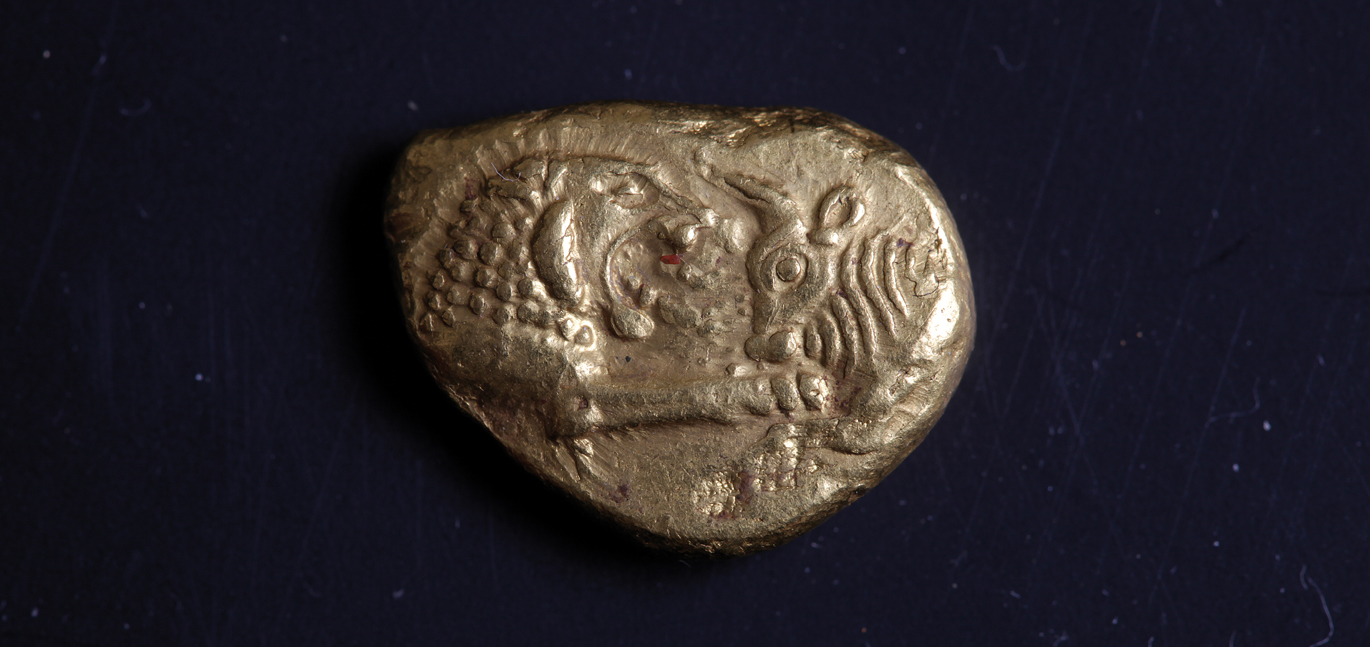
Gold Croeseid stater, found at Sardis (Photo courtesy of the Vedat Nedim Tör Museum, Istanbul).
Given the prevalence of electrum in Lydian ornamental objects, it is plausible to posit a direct association between Lydian electrum coinage and jewelry production. This connection is further substantiated by the co-occurrence of coins and jewelry within identical archaeological strata at the Artemision, as well as by the adherence of coins to iconographic conventions established by Ancient Near Eastern seals.[38] In Mesopotamian contexts, jewelry makers were classified within the broader professional category of gold-, silver-, and blacksmiths.[39] Notwithstanding the absence of prosopographical data regarding die-sinkers from this period, evidence supports a linkage between jewelry artisans and die engravers. For instance, Euainetos – a Greek engraver active during the late fifth to early fourth century – whose signature is present on coinage from Syracuse, Kamarina, and Katana, was concurrently a goldsmith and silversmith.[40] Similarly, Phrygillos, another contemporary die-sinker, produced both signed coins and engraved gemstones.[41] Stylistic parallels and shared technological processes suggest a significant overlap between these crafts.[42]
Moreover, Lydian jewelry exhibits decorative motifs analogous to those found on early coinage, including representations of griffins, bull heads, beetles, bees, birds, human figures, as well as undecorated (plain) surfaces. When the production of coinage is interpreted as an extension of jewelry traditions, the simultaneous presence of smooth or striated coins alongside figurative types becomes logically consistent. In contrast, such coexistence is more difficult to rationalize when coinage is viewed purely as a developmental progression of monetary instruments. Furthermore, certain Lydian coins are known to have undergone surface enrichment, a metallurgical process (also known as depletion gilding) wherein silver is selectively removed from the alloy, resulting in a gold-enriched surface layer.[43]This practice is more coherently explained when coins are understood as ornamental objects akin to jewelry, rather than solely as monetary media.
The question of why electrum was selected for the production of both jewelry and coins remains unresolved. It is likely that the rationale lies within cultural or social contexts rather than economic factors. Regrettably, there has been no comprehensive analysis comparing gold, silver, and electrum jewelry. However, potential factors could include variations in gender, social status, ethnicity, or religious significance. Additionally, the material's hardness might also play a role, although this remains speculative.
II Coins for paying soldiers
For over a century, scholars have been debating the reasons why coinage was introduced.[44]As coinage is a monetary medium, most explanations were based upon economically motivated grounds. Recently, van Alfen distinguished three groups: by minting coins an authority could pursue profit from coin production, facilitate both local and international markets or meet public debts or expenditures.[45]The first explanation has been dealt with in the first section of this article and has to be dismissed, at least for the seventh century. The second explication is hard to prove from numismatic data and has little direct support in primary sources.[46]The interpretation for coin production in the Greek world currently adhered to by most scholars is expenditure and then especially military expenses.[47]One of the first scholars who argued this was Cook who, based on the limited data then available, ingeniously inferred that coinage was invented to make many uniform payments of considerable value. He concluded that the purpose of coinage was the payment of mercenaries and that it was likely the king of Lydia who made these payments. He imagined a paymaster preparing dumps with some casual mark and later the official seal of the royal house, the lion. Cook conceived that ‘[t]he earliest coins were, then, intended only for the single payment and were regarded as bullion. But gradually they passed into circulation as money’.[48] Price criticized Cook’s theory as he found it ‘doubtful whether mercenaries would happily have accepted overvalued lumps of electrum as payment’,[49] but actually he elaborated on Cook’s theory and posed that electrum coins were produced for standardized bonus payments at the end of service, which were far more akin to gifts than to coins.[50]
The Assyriologist Radner made two observations regarding the introduction of coinage, which are quite interesting in this context. The first one was that the Lydian king Gyges (ca. 668–644), in the Annals of Ashurbanipal referred to as Gugu, king of Luddi, sent gifts to the Assyrian king. These gifts were transported by a messenger on horseback, so they had to be small. Even though the Assyrian source does not mention what these gifts were, the Assyrian king was very impressed by it, which led Radner to suggest that the gifts were possibly electrum coins.[51]A weak spot in her reasoning is that Lydian kings were known to send lavish gifts such as statues made of gold (see below), not so much small pieces of electrum.Her other observation attune the hypotheses of Cook and Price, that coinage was introduced to facilitate the payment of mercenaries. Radner discussed the habit of rewarding Assyrian soldiers with silver ‘medals’ of standardized values.[52]In fact, this was an ancient tradition, which has been attested for the Old Babylonian period. These medals, according to Radner, could have inspired the Lydians to strike coins.[53]
More recently Meadows concluded, in his review of the publication White Gold, that the invention of coinage must be regarded as part of a military revolution in western Asia Minor.[54] Based on the dating of the history of the Artemision, the variety and condition of the coins found there and the die-linked Kukalim and Walwet coins,[55]he argued that electrum coinage was introduced during the reign of Gyges.[56]He and his successors were locked in a fierce struggle with the raiding Cimmerians, but they also expanded Lydian territory at the expense of neighboring peoples such as the Ionians, Aeolians, Carians, Mysians and Phrygians. For those purposes the Lydians needed military reinforcements, which they found in hiring mercenaries. Traditionally, mercenaries were rewarded with land or booty conquered from enemies;[57]but the Cimmerians were horse-riding nomads without settlements or treasuries to loot. According to Meadows, it is possible that the Lydian kings took advantage of the natural riches of the country to hire mercenaries and that Greek communities followed suit. Some issues of the first coins were large, well-regulated productions of up to half a million pieces each.[58] But in seventh and sixth centuries, which were plagued by war, these numbers are not so extreme as they may look. Calculating with Meadows’ own numbers and assumptions, the early ‘Milesian’ series were, for example, enough to hire mercenaries for 14,000 man-years.[59] Given that Miletus was at war with Lydia from the reign of Gyges down to its conquest by Kroisos, this quantity of coins would have financed an army of less than a thousand mercenaries.[60]The seasonal campaigns might also have caused the many small, occasional emissions of early electrum coinage.[61]
Although Meadows has provided a sound grasp of the beginning of electrum coinage, Wallace’s question is still unanswered: ‘why should anyone have accepted a lump of metal at some inflated value’?[62]As already examined, the intrinsic value of electrum coins was hard to determine. How then were these coins for military pay transformed into regulated payment objects? Van Alfen argues that the artificially fixed price required high levels of trust, if not outright coercion and enforcement to maintain.[63]The coercive powers of states in Archaic Anatolia must have been rather limited, given the feudal character of the Lydian empire and the fact that large Ionian cities such as Ephesos and Miletos faced a time of war and turmoil.[64] Furthermore, in times of war, coins tended to be made of gold as this was the most trustworthy material.[65]In sum, the cause of coinage’s introduction by the Lydian kings might well be military expenditure, but still not all questions are answered satisfactorily.
III Two characteristics of Lydian culture
After the connection of electrum with jewelry and the linkage of coinage with military expenses, let me take a third step to understand the environment in which coinage came into existence. Lydia is a land-locked region neighboring Ionia to the west, Mysia to the north, Phrygia to the east and Caria to the south. After the turmoil which ended the Hittite empire, Lydia was ruled by the kings of the Heraclid dynasty for five centuries. From the early seventh century, Lydia prospered under the command of the Mermnad dynasty during the Middle Lydian period (early seventh through mid-sixth centuries). According to Herodotos, this dynasty was defined by five kings reigning in hereditary succession, from Gyges (680 to 644) to Ardys (ca. 644 to the late seventh century) and Sadyattes (late seventh century to ca. 610), followed by Alyattes (ca. 610 to 560) and Kroisos (ca. 560 to 546). However, there are debates about the correctness of these historical data, e. g., FischerBossert, Payne and Wintjes follow Nicolaus of Damascus in naming the second king Alyattes instead of Ardys[66] and Wallace redates the beginning of Kroisos’ reign to the 580s[67], while Dale places the ascension of Alyattes much earlier by assuming that the reigns of Ardys and Sadyattes were much shorter.[68] The capital Sardis emerged as the regional center of Lydia, which expanded at the expense of its neighbors. At the same time, the Lydian kings had to withstand the invasions of the Cimmerians, a nomadic people from the Pontic steppe who had invaded western Asia and destroyed the kingdom of Phrygia. The Cimmerians were dreaded adversaries known from Neo-Assyrian sources; Bel-ušezib warned his king, Esarhaddon, about the untrustworthy Cimmerian warriors: ‘they are barbarians who recognise no oath sworn by god and no treaty!’[69] Sardis was sacked twice and the Lydian king Gyges was killed in battle. Dale even imagines that Ardys or Sadyattes, who are hardly known from the historical sources, might have met the same fate as Gyges.[70]
In these violent times, the Lydian kings created power and influence with gift-giving made possible by the natural resources of their country.[71] Nicolaus of Damascus narrates that Gyges, after he had killed the last Heraclid king Sadyattes I (also called Candaules or Myrsilus) in his sleep, assembled the Lydian nobility:
At dawn he [Gyges] calmly summoned each of his friends and enemies as if the king demanded; he killed those who he thought to be his adversaries and won over the rest as allies by offering them gifts.[72]
Gyges employed this tactic also outside of Lydian territory. Gyges not only fêted the Assyrian king Ashurbanipal with lavish gifts and sent mercenaries to assist the Egyptian king Psammetichus I in establishing control over Lower Egypt, but the Greeks and their gods were the foremost beneficiaries. By means of massive donations, the Mermnad dynasty supported friendly factions in Greek city-states and created the basis for new alliances.[73]Gyges offered to the Pythian Apollo six golden vessels (Ath. 6.231E). His great grandson Alyattes built two new temples for Athena at Assessos as compensation for the burning of the old temple by his troops, which also assisted in creating a truce with Miletos (Hdt. 1.20–22).[74]Kroisos, the last renowned monarch of Lydia, bestowed a golden spear and shield upon the hero Amphiaraos in Thebes (Hdt. 1.52). He also dedicated a golden tripod at Thebes in Boeotia to Apollo of Ismenus (Hdt. 1.92), and presented a golden statue of Apollo to the Spartans to secure their alliance (Hdt. 1.69). Additionally, Kroisos offered numerous items to Apollo at Delphi, including a golden lion weighing over 260 kg, a golden statue of a woman, and large vessels made of gold and silver (Hdt. 1.50–51). The offerings at Branchidae of the Milesians matched those at Delphi in weight and type (Hdt. 1.92). Furthermore, Lydian artifacts were discovered in the Athena temple in Smyrna and the Heraion of Samos.[75] When electrum coins are perceived as akin to jewelry, those discovered in the Artemision would serve well as dedications to convey gratitude or as commutative gifts—where an item is given with the expectation of receiving something in return, as encapsulated by the Latin phrase do ut des (“I give so that you give”). However, if these coins were merely a standard medium of payment, the rationale behind their dedication becomes less apparent.
Domestically, the royal house in Lydia depended upon a sort of feudal structure,[76] where semi-autonomous noble landowners supported the central government with agricultural produce, but also backed the king with military resources, such as its famous cavalry.[77] It is important to stress that in principle money was hardly required for these exchanges.[78]It is conceivable that the Lydian suzerains rewarded the noblemen with gifts bearing royal emblems, just as they bought the alliances with Greek sanctuaries and poleis. It is possible that these artefacts were inspired by the medals given to soldiers to honor them for special merits, a tradition already existing for over a millennium in Mesopotamia. The first coins were then rather luxury objects of which the intrinsic value of the material was subordinate to the extrinsic value, which consisted of the honor of serving the king and earning his royal gratitude.
Returning to Van Alfen’s hypothesis and its economics motives, he also suggested another one based on political grounds, driven by political survival. By that, he meant that the decision to strike coins might be related to the objective of producing a medium to generate loyalty to the sovereign. His assumption that coin-like objects might not always have been intended to be what we think of as money[79]echoed the conclusion that Seaford drew earlier: ‘The use of the very first coinage might have been quite different from its subsequent rapid and widespread adoption.’[80]The reasoning, that coins were produced for social and political reasons and for gaining support in the life-and-death struggle with the Cimmerians, is strengthened by the developments that took place in the middle of the first millennium to which I presently turn.[81]
IV Historical developments related to coinage
I would like now to broaden my perspective and connect the previous sections with two currents in the eastern Mediterranean in the seventh century: the role of reciprocity in the pre-Classical world and the advent of mercenaries. When analyzing the benefactions of the Lydian kings, two twentieth-century academics have provided important insights. The French sociologist Mauss studied the form and reason for gift-exchange based on anthropological research. He postulated that before market-exchange there existed a phase, where social relations were based on the giving and receiving of presents and the reciprocation of the gifts received.[82] According to Mauss, money’s origins lie in people’s extension of credit to one another – doing favors and giving gifts without the expectation of immediate return.[83] The Hungarian economist Polanyi took this idea further and separated the modern, market-dominated society from the non-capitalist, pre-industrial societies, where livelihood was based on redistribution and reciprocity. He also coined the term special-purpose money in contrast with general-purpose money. Early money is special-purpose money, where different kinds of objects are employed in distinct utilizations of money.[84]Rather than being used to acquire things, special-purpose money is mainly used to rearrange relationships between people.[85]Although these ideas are not universally accepted, it has become evident that before the monetization of the Near East and the Greek world in the sixth century,[86] reciprocity played an important role in economic exchange.[87] This observation supports the hypothesis that the Lydian kings used electrum coins – if these objects even can be denoted as coins – in traditional gift-giving to strengthen their power in a feudal society. Indeed, Assyrian medals or other jewelry could have inspired these artifacts.
As elaborated earlier, coinage is sometimes thought to be used for military expenses. Therefore, it is proper to scrutinize the structure of the Lydian army. The governors of Lydian regions were probably expected to raise locally armed contingents and provide them to the king when he felt the need.[88]Lydia was especially famous for its cavalry; Mimnermus, a Greek elegiac poet supposedly from Smyrna, describes how a Greek soldier defended himself on the plain of Hermos against the onslaught of Lydian cavalry (Stob. 3.7.11). Herodotos also praised the cavalrymen, ‘carrying long spears, the men being excellent in horsemanship.’ (Hdt. 1.79). Given that there were not enough troops to carry out large-scale military campaigns beyond local interventions, the Lydians had to resort to external forces.[89]At least Alyattes and Kroisos, but maybe even their predecessors, entered into treaties (συμμαχία) with their Greek and Anatolian peers, such as the sovereigns of Miletos, Ephesos, Colophon, Caria, Phrygia, Troas and Mysia.[90] This guest friendship (ξενία) between the ruling ‘friends’ prescribed the parties having to lend each other mutual assistance and the sending of military contingents at request. These were paid at the expense of the sending party.[91]Herodotos wanted to inform his readers about the presence of these foreign troops in the Lydian army – men not paid by the Lydian power and not ethnically related to the Lydian people – by using the word ξεινικοί; for the paid auxiliary troops of the Lydian king he used the term ἐπικούροι, usually translated as mercenaries.[92] The latter needs more clarification.
The last twenty years a heated debate has taken place on the characteristics of these first mercenaries. Were they a handful of aristocrats or a substantial number of soldiers of fortune? Were they the first hoplites fighting in a phalanx formation or piratical raiders? Were they sought for their skills or hardly present in the Neo-Assyrian army, the eastern superpower in the seventh century?[93]When reading these publications carefully, it is striking that different opinions are based upon the same shreds of evidence.[94]Unfortunately, the conclusions drawn are often diametrically opposed to each other. However, taking all the evidence together, the picture emerges that mercenary services developed from guest-friendship relations between aristocrats.[95] Consequently, the bond between a soldier of fortune and his patron held greater significance than the monetary remuneration.[96]In the seventh century the phenomenon was still limited and incidental as illustrated by the story of the bronze men handed down by Herodotos:
But after a short time, Ionians and Carians, voyaging for plunder, were forced to put in on the coast of Egypt, where they disembarked in their armor of bronze [...] he [Psammetichus] made friends with the Ionians and Carians, and promised them great rewards if they would join him and, having won them over, deposed the eleven kings with these allies and those Egyptians who volunteered.[97]
Later, in the sixth century, eastern monarchs increasingly depended on mercenaries.[98]The growing number of mercenaries is reflected in the written sources such as the hiring of 30,000 Carian and Ionian mercenaries by Apries in his struggle with Amasis (Hdt. 2.163). It is therefore perfectly possible that the reward for those soldiers was at first a share in the booty after the battle, but more and more they were paid an agreed-upon amount, especially when the mercenaries were engaged in a defensive assignment which would not deliver much booty.[99]In the Near East and Egypt that payment was possibly carried out with Hacksilber, consisting among other things of pieces of old jewelry; in Anatolia this could have been done with electrum coins.
Among these hirelings, the difference between Greeks, Carians and Lydians was hard to discern, because the populations of these regions were in contact with each other for centuries, a process which ultimately led to a certain degree of assimilation.[100] Lydian society exhibited significant ethnic diversity.[101] Miletos was home to Carian inhabitants,[102]while in Sardis, both Greek and Carian artifacts, including graffiti and inscriptions, have been discovered.[103]Additionally, Kroisos had a Carian mother and his half-brother Pantalion had a Greek mother (Hdt. 1.92). In this hybridizing environment, there are some hints that the origins of the mercenary profession lay in Caria. Greek tradition has it that Carians were the first to think of making a trade of war and to serve as soldiers for pay, to fit arm-straps to their shields and to fix plumes on their helmets (Ael. NA 12.30). Gyges staged his coup with the help of Arselis of Mylasa (in Caria) (Plut. Quaest. Graec. 45). Although Konuk, an authority on Carian numismatics, has the view that no electrum coins were minted in Caria, it is striking that during the pre-Roman period, Caria was notably prolific and active in minting and coin production. In comparison, its northern neighbor Ionia had approximately a dozen mints, whereas Caria boasted four times that number.[104]In this sense, one of the noteworthy characteristics of electrum coinage is the large number of incerti, unattributed electrum coins that cannot be tied with any certainty to a single political authority.[105]It is therefore entirely possible that coins were struck in Caria in the seventh century, perhaps adorned with the helmeted head of a soldier (Fig. 3), or with roosters (Figs. 4 and 5), reflecting Caria’s widely known reputation for mercenaries with their crested helmets.[106]

Obverse of electrum 1/48 stater (0.38 g) with helmeted head. The coin, dated to a period between 625 and 520 BCE, was acquired by the Ashmolean Museum as a donation from E. S. G. Robinson, who had purchased it from the art trade (accession number HCR109859 © Ashmolean Museum, University of Oxford).
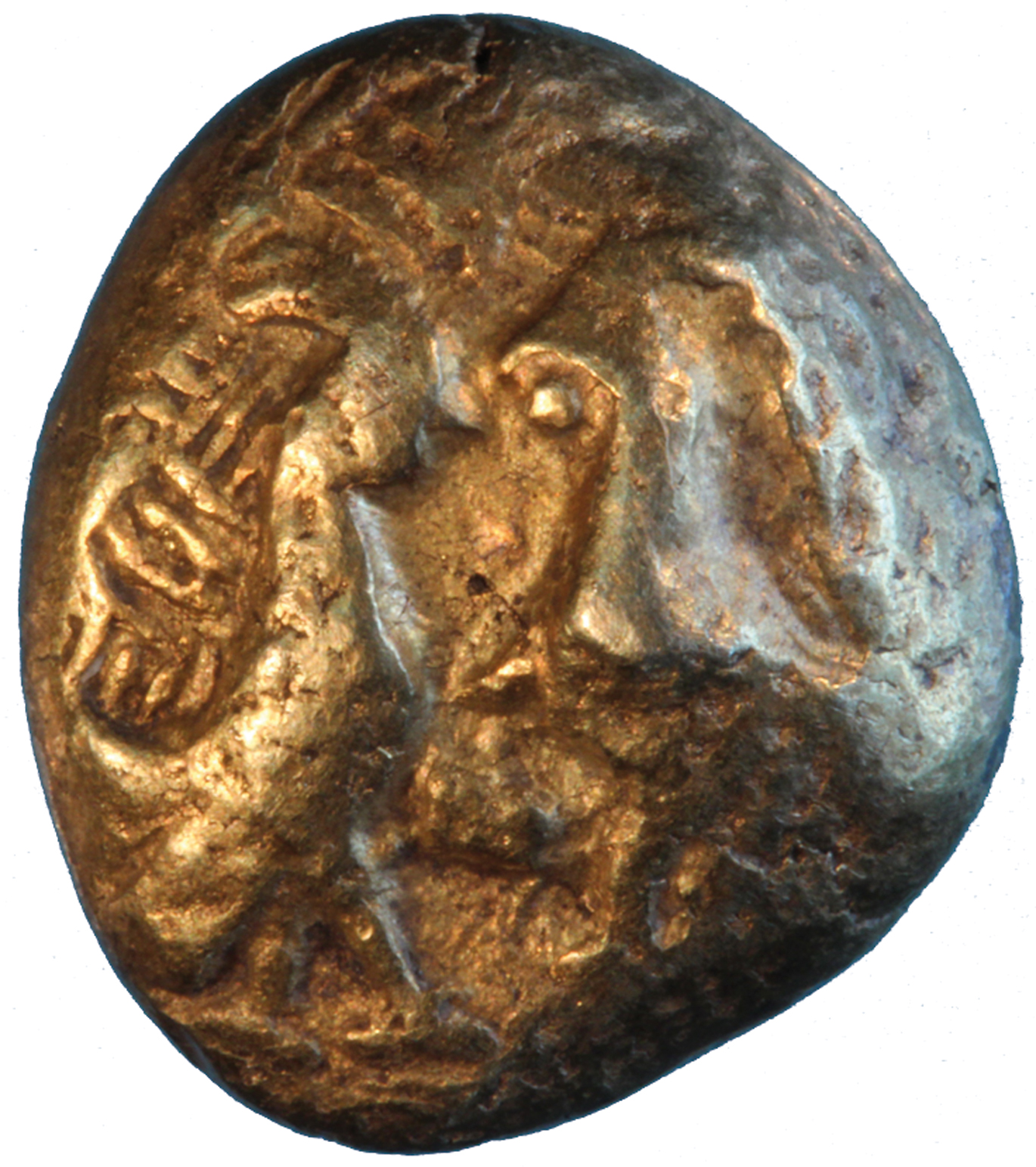
Obverse of electrum ½ stater (7.14 g) with two cocks face to face; between them an uncertain oblong object on striated surface. Object found as part of the pot hoard inside naos 2 of the Artemision of Ephesos and dated 640 to 620 BC. Kerschner and Konuk (2020), coin # 36. Photo courtesy of the Vedat Nedim Tör Museum, Istanbul.
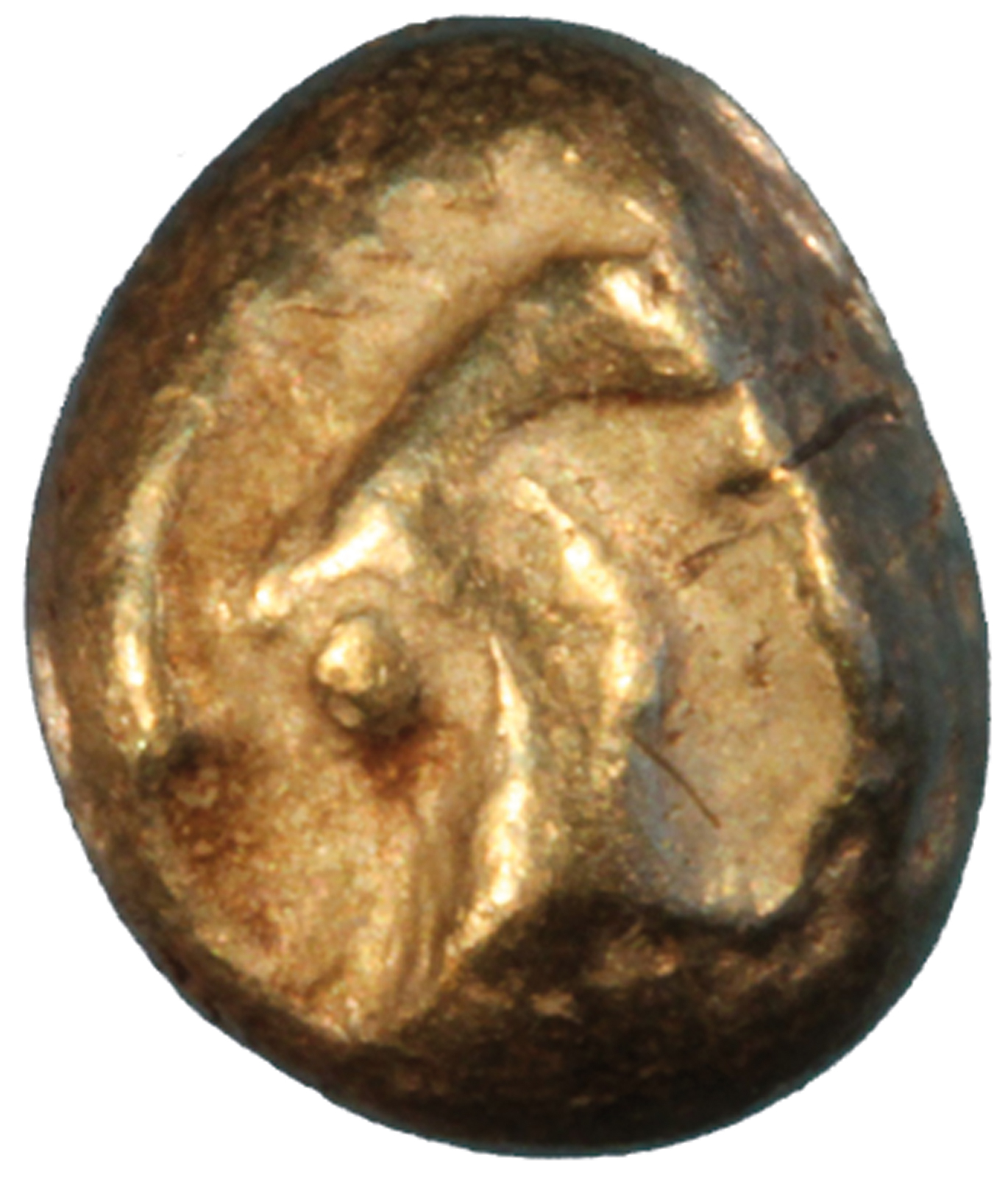
Obverse of electrum 1/12 stater (1.19 g) with the heads and necks of two cocks, face to face. Object found as part of the pot hoard inside naos 2 of the Artemision of Ephesos and dated 640 to 620 BC. Kerschner and Konuk (2020), coin #46. Photo courtesy of the Vedat Nedim Tör Museum, Istanbul.
From the 108 coins found in the Ephesian Artemision, twelve (11 %) specimens in several denominations of the Lydo-Milesian weight standard (1/2, 1/3, 1/6 and 1/12 stater) were decorated with two cocks[107]; compare this to the twenty-three coins (21 %) bearing the image of a lion’s head attributed to the Lydian mint.[108]It may well be that Gyges took advantage of Carian or Greek troops in his battles against the Cimmerians or in realizing his imperial aspirations, and that those troops were rewarded either directly by the Lydian king or through their local leaders as mercenaries did not fight individually but as collective units.[109]As noted earlier, this might have been done with electrum coins which instead of state emblems bear rather generic or private symbols, suggesting that the issues were to a certain extent not state undertakings.[110]In sum, the development of coinage and the rise of mercenaries went hand in hand, which may account for the rapid spread of coins throughout Anatolia. Nevertheless, it is questionable whether the payment of mercenaries has to be seen as the catalyst of coinage as Meadows has suggested.[111]Rather, these were two parallel yet separate developments which not merely coexisted but actively reinforced one another.[112]
To recapitulate, the Lydian army consisted of three groups: the troops assembled by the governors of the Lydian regions, the forces sent upon request by allied sovereigns as agreed in treaties and the bands of mercenaries arising from guest-friendship relationships between aristocrats. The common denominator behind these three groups were the social bonds, which were strengthened and maintained with gifts.[113] The Mermnad dynasty drew heavily on this reciprocity as the Lydian kings had an urgent need for soldiers, not only to increase their military machine to withstand Cimmerian incursion, but also to realize their imperial ambitions.[114] The opponents of Lydian expansion,[115] such as the Ionian and Aeolian poleis on the Aegean coast, used the same tools in their defense;[116]in that sense, electrum coinage could be designated as special-purpose money. The belligerent circumstances, or ‘arms race’ as Meadows aptly characterized it,[117]boosted the rise of mercenarism and of coinage.
V The maturation of coinage
Regrettably, there are no indications about how electrum coins grew into a monetary medium.[118]But one can take inspiration from a similar development that took place in early medieval England. In the fifth and sixth centuries AD, the monetization of the Roman era had completely vanished and little coin circulated as money and exchange systems collapsed.[119] But in the seventh century AD coinage slowly reappeared. Desan, skeptical about the development of money as a result of economic transactions, investigated how money emerges without assuming the exchange it is supposed to enable. She explained the reappearance of coinage in the creation of tokens awarded by rulers to represent actual resources that had been given to them. The token was issued to quantify the amount of goods or labor contributed and it would subsequently exempt the holder from a contribution of equivalent magnitude. This was an effective way to mobilize goods and services because the tokens entailed real value. Desan described this development as a clear and logical process:
Money is created when a stakeholder uses its singular location at the hub of a community to mark the disparate contributions of individuals in a common way. The moment occurs when the stakeholder takes contributions from people before they are due and gives out uniform receipts in return, each a token intended to document the early contribution. That token, turned in later at a time of reckoning, operates to convert goods and services that were not previously interchangeable or fungible – the variety of contributions due to the center – into matters counted in a standard unit. The initiative requires only one more twist to make money fully operational: if the stakeholder recognizes the receipt and takes it from anyone's hand as an item that exonerates the person holding it from making a contribution otherwise due, the receipt can travel from hand-to-hand and maintain its worth as an item that pays off the center. The result is a token that fixes or entails value in a way that both the stakeholder and individuals can use, a novel accomplishment in a world without an agreed-upon way to measure and transfer resources.[120]
Remarkably, she also stressed that these tokens did not have to be costly and are expounded by modern scholars as gifts:
The Anglo-Saxon kings may have experimented with money made of wood, revitalized old Roman tokens, or tried other ways of recording credits, leaving no permanent record of a contemporary money. Those media could have circulated among selective circles, elites for example, creating cultures that would later be lumped under ‘gift-exchange’ because the ‘money’ made there fits only awkwardly with our more monochromatic expectation about what ‘money’ is.[121]
Although Desan focused on liabilities and in the case of electrum coins it was rather a matter of gifts, a comparable series of events may have taken place in Anatolia in the seventh century. The gifts exchanged by the Lydian kings (but also by other rulers) were precious items. As concluded earlier, it was not possible to establish the exact, numerical value of the coins due to the use of electrum, but in gift economies objects are not valued cardinally but ordinally.[122]This means that two half staters were not equal to one stater, but the first were possibly appropriate gifts for, e. g., a common soldier and the latter for a higher ranked officer.[123] As Desan described, if the inhabitants of Lydia, Ionia, Aeolia and other parts of Anatolia recognized the value of these objects, they could be exchanged for other valuables such as a bag of seeds, payment of a debt or the settlement of an obligation. Consequently, the donation expanded into a monetary medium. Logically, the transition from gift to payment, so the detachment of personal relations in gift exchange to depersonalized market exchange by means of money, took a long time.[124]It is remarkable that some of the few Lydian coins excavated in a non-hoard context, were found near the remains of casualties, probably from the Persian capture of Sardis in 547.[125]These coins were struck in silver, the next development in coinage, while the context was (still) military. It is not inconceivable that the division of gold and silver coinage, which is traditionally ascribed to Kroisos, was a consequence of the creeping use of coins as payment instruments and that he had the intention to fit in with the Near Eastern monetary system. Although speculative, this may have been connected to the fact that Kroisos began to exact annual tribute from all conquered states to his west[126]and the golden croeseids were perhaps still used as gifts as they were only found in scientific excavations in Sardis and Persepolis (IGCH 1789) and in Egypt (IGCH 1632).
In conclusion, I have demonstrated that electrum is an unusual material for a monetary medium as the alloy complicates its valuation. The common explanation that this material was chosen for the manufacture of the first coins to make a profit does not suffice. Electrum as a raw material was typically used to produce luxury items, which rather connects with two salient features of Lydian culture, namely the feudal character of its society and the offering of presents to ensure support. I emphasized the importance of gift exchange in Lydian culture, drawing on the work of anthropologists like Mauss. The thesis posits that electrum coins may have served as gifts to solidify alliances and reinforce social bonds rather than functioning solely as currency. This perspective aligns with the broader understanding of economic exchanges in ancient societies, where reciprocity played a crucial role in maintaining social structures. Thereafter, I sketched the historical context of coinage's emergence in relation to military expenditures and the hiring of mercenaries. This perspective is supported by evidence that aligns the introduction of coinage with the need for standardized payments in a feudal society under threat from external forces, such as the Cimmerians. Finally, I described in broad outline the change over from gift to monetary medium. The evolution of coinage represents a significant innovation shaped by the historical and social dynamics of the time, illustrating a shift from personal relationships to more impersonal market exchanges. In that sense the coming into existence of coinage is a good example of path dependency in innovation.
Acknowledgements
I wish to warmly thank Nick Cahill who truly inspired me to write this article and provided me with Figures 1 and 2, Koray Konuk for granting me permission to use his photographs as Figures 4 and 5 and Peter van Alfen for mending my broken English. I am indebted to Beverly Mazze, Genevra Kornbluth, Alan M. Stahl, Gary Farney and the famous anonymous reviewer for their invaluable suggestions and comments, but of course, I remain completely responsible for any remaining mistakes.
Bibliography
Blet-Lemarquand, M. and F. Duyrat. “Elemental analysis of the Lydo-Milesian electrum coins of the Bibliotheque Nationale de France Using LA-ICP-MS.” In Van Alfen and Wartenberg (2020), 337–368.Search in Google Scholar
Bloch, M. Feudal Society. New York: Routledge, 1961.Search in Google Scholar
Bolin, S. State and Currency in the Roman Empire to 300 AD. Stockholm: Almquist and Wiksell, 1958.Search in Google Scholar
Bresson, A. “The choice of electrum monometallism: when and why.” In Van Alfen and Wartenberg (2020), 477–496.Search in Google Scholar
Cahill, N. and J. Kroll. “New Archaic coin finds at Sardis.” AJArch. 109 (2005): 589–617.10.3764/aja.109.4.589Search in Google Scholar
Cahill, N., J. Hari, B. Önay and E. Dokumaci. “Depletion gilding of Lydian electrum coins and the sources of Lydian gold.” In Van Alfen and Wartenberg (2020), 291–336.Search in Google Scholar
Cahill, N., W. Bruce, J. Kroll, J. Kim, E. Frank, B. Castriota, A. Grant, S. Şimşek, İ. Güngör and Y. Erdal. “A new find of Croeseid coins from Sardis.” Hesp. 94 (2025): 143–183.10.2972/hes.2025.a963374Search in Google Scholar
Cook, R. “Speculations on the origins of coinage.” Hist. 7 (1958): 257–262.Search in Google Scholar
Crielaard, J. “The Ionians in the Archaic period. Shifting identities in a changing world.” In Ethnic Constructs in Antiquity, edited by T. Derks and N. Roymans, 37–84. Amsterdam: Amsterdam U. P., 2009.Search in Google Scholar
Curtis, C. Sardis 13. Jewelry and Gold Work 1. 1910-1914. Rome: Sindacato Italiano Arti Grafiche, 1925.Search in Google Scholar
Dale, A. “WALWET and KUKALIM. Lydian coin legends, dynastic succession, and the chronology of Mermnad kings.” Kadmos 54 (2015): 151–166.10.1515/kadmos-2015-0008Search in Google Scholar
Davis, G. and F. Albarède. “Making money out of making money in ancient Athens.” Archaeometry 66 (2023): 238–246.10.1111/arcm.12926Search in Google Scholar
De Callataÿ, F. “Money and its ideas: state control and military expenses.” In A Cultural History of Money in Antiquity, edited by S. Krmnicek, 43–61. London: Bloomsbury Academic, 2019.10.5040/9781474206808.ch-002Search in Google Scholar
Desan, C. Making Money. Oxford: Oxford U. P., 2014.10.1093/acprof:oso/9780198709572.001.0001Search in Google Scholar
Dezsö, T. and Á. Vér. “Assyrians and Greeks: the nature of contacts in the 9th-7th centuries BC.” Acta Antiqua Academiae Scientiarum Hungaricae 53 (2013): 325–359.10.1556/AAnt.53.2013.4.1Search in Google Scholar
Fantalkin, A. “Naukratis as a contact zone: revealing the Lydian connection.” In Kulturkontakte in antiken Welten, edited by R. Rollinger and K. Schnegg, 27–51. Leuven: Peeters, 2014.Search in Google Scholar
Fantalkin, A. “Did Ionian or other Greek and Carian mercenaries serve in the Neo-Assyrian army?” In Ionians in the West and East, edited by G.Tsetskhladze, 27–51. Leuven: Peeters, 2022.10.2307/j.ctv2zx9ptt.20Search in Google Scholar
Fischer-Bossert, W. “Electrum coinage of the 7th century BC.” In Second International Congress on the History of Money and Numismatics in the Mediterranean World, edited by O. Tekin, 15–23. Antalya: Koç Üniversitesi AKMED, 2018.Search in Google Scholar
Fischer-Bossert, W. “Phanes: a die study.” In Van Alfen and Wartenberg (2020), 423–476.Search in Google Scholar
Fischer-Bossert, W. “Greek gold coinage before Alexander the Great.” In AVREVS, edited by A. Suspène, M. Blet-Lemarquand, F. Duyrat and S. Nieto-Pelletier, 75–90. Bordeaux: Ausonius, 2023.Search in Google Scholar
Fischer-Bossert, W. “ϜΑΛϜΕΤ and ΚΥΚΑΛΙΜ.” In Proceedings of the XVI International Numismatic Congress, edited by J. Bodzek, A. Bursche and A. Zapolska, 405–411. Turnhout: Brepols, 2025.Search in Google Scholar
Forrer, L., editor. Biographical Dictionary of Medallists. Vol. 2. London: Spink & Son, 1904.Search in Google Scholar
Forrer, L., editor. Biographical Dictionary of Medallists.Vol. 4. London: Spink & Son, 1909.Search in Google Scholar
Gitler, H., Y. Goren, K. Konuk, O. Tal, P. Van Alfen and D. Weisburd. “XRF analysis of several groups of electrum coins.” In Van Alfen and Wartenberg (2020), 379–422.Search in Google Scholar
Godley, A., editor. Herodotus. Loeb Classical Library. Cambridge: Harvard U. P., 1920.Search in Google Scholar
Graeber, D. Debt. New York: Melville House, 2011.Search in Google Scholar
Greaves, A. The Land of Ionia. Malden: Wiley-Blackwell, 2015.Search in Google Scholar
Hale, J. “Not patriots, not farmers, not amateurs: Greek soldiers of fortune and the origins of hoplite warfare.” In Men of Bronze, edited by D. Kagan and G. Viggiano, 176–193. Princeton: Princeton U. P., 2013.10.2307/j.ctt2855dr.15Search in Google Scholar
Henry, O. and K. Konuk, editors. Karia arkhaia. Istanbul: Institut Français d’Études Anatoliennes Georges Dumézil, 2019Search in Google Scholar
Iancu, L. “Greek and other Aegean mercenaries in the Archaic age: aristocrats, common people, or both?” Studia Hercynia 20 (2016): 9–29.Search in Google Scholar
IGCH = Thompson, M., editor. An Inventory of Greek Coin Hoards. New York: ANS, 1973.Search in Google Scholar
Jones, D. “Mechanism design approach to Lydian coinage.” In Van Alfen and Wartenberg (2020), 517–535.Search in Google Scholar
Kaplan, P. “The social status of the mercenary in Archaic Greece.” In Oikistes, edited by V. Gorman and E. Robinson, 229–243. Leiden: Brill, 2002.10.1163/9789004350908_014Search in Google Scholar
Kaplan, P. “Cross-cultural contacts among mercenary communities in Saite and Persian Egypt.” Mediterranean Historical Review 18 (2003): 1–31.10.1080/09518960412331302193Search in Google Scholar
Kaplan, P. “Dedications to Greek sanctuaries by foreign kings in the eighth through sixth centuries BCE.” Hist. 55 (2006): 129–152.10.25162/historia-2006-0008Search in Google Scholar
Kerschner, M. “Lydische Weihungen in griechischen Heiligtümern.” In Stranieri e non cittadini nei santuari Greci, edited by A. Naso, 253–291. Florence: Edumond Le Monnier, 2006.Search in Google Scholar
Kerschner, M. and K. Konuk “Electrum coins and their archaeological context: the case of the Artemision of Ephesus.” In Van Alfen and Wartenberg (2020), 83–190.Search in Google Scholar
Kleber, K. “As skillful as Croesus: evidence for the parting of gold and silver by cementation from second and first millennium Mesopotamia.” In Van Alfen and Wartenberg (2020), 17–34.Search in Google Scholar
Konuk, K. “The electrum coinage of Samos in the light of a recent hoard.” In Neue Forschungen aus Ionia, edited by E. Schwertheim, 43–56. Bonn: Dr. Rudolf Habelt, 2005.Search in Google Scholar
Konuk, K. “Archaic and Classical coins of Caria.” In The Carians, edited by O. Henry and A. Belgin-Henry, 240–251. Istanbul: Yapi Kredi Yaymlan, 2020.Search in Google Scholar
Kornbluth, G. Engraved Gems of the Carolingian Empire. University Park: Pennsylvania State U. P., 1995.Search in Google Scholar
Kornbluth, G. “Rock crystal in the early middle ages. Merovingian amulets and Carolingian intaglios.” In Magic Rock Crystal, edited by M. Beer, 232–250. München: Hirmer, 2022.Search in Google Scholar
Krčmářová, A. The Jewellery of The Lydian Treasure. Master’s thesis at the Masaryk University, Brno, 2014 [unpublished].Search in Google Scholar
Kroll, J. “The inscribed account on lead from the Ephesian Artemisium.” In Van Alfen and Wartenberg (2020), 49–64.Search in Google Scholar
Kroll, J. “Issue identification, dynastai, and the plethora of types in early electrum coinage.” In Van Alfen and Wartenberg (2020), 537–545.Search in Google Scholar
Leloux, K. La Lydie d’Alyatte et Crésus. Un royaume à la croisée des cités grecques et des monarchies orientales. Recherches sur son organisation interne et sa politique extérieure. PhD Thesis at the University of Liège, 2018 [unpublished].Search in Google Scholar
Luraghi, N. “Traders, pirates, warriors: the proto-history of Greek mercenary soldiers in the eastern Mediterranean.” Phoenix 60 (2006): 21–47.Search in Google Scholar
Maurer, B. “Money orders—and it’s done! Activating. Theories of money’s origins and orders.” In Money and Coinage in the Middle Ages, edited by R. Naismith, 41–59. Boston: Brill, 2018.10.1163/9789004383098_004Search in Google Scholar
Maus, M. The Gift. London: Routledge, 1990 [Originally published in French under the title Essai sur le don, Sociologie et Anthropologie, Presses Universitaires de France, 1950].Search in Google Scholar
Mazze, B. “The technique of gem-engraving and its relationship to medals and coins.” Medailles 53 (1987): 66–71.Search in Google Scholar
Meadows, A. “Tout ce qui brille ... electrum and the origins of western coinage.” RN 178 (2021): 443–470.Search in Google Scholar
Melitz, J. “A model of the beginnings of coinage in antiquity.” European Review of Economic History 21 (2016): 83–103.10.1093/ereh/hew018Search in Google Scholar
Melville Jones, J. Testimonia Numaria. Vol. 1. London: Spink, 1993.Search in Google Scholar
Melville Jones, J. Testimonia Numaria. Vol. 2. London Spink, 2007.Search in Google Scholar
Moorey, P. Ancient Mesopotamian Materials and Industries. Oxford: Clarendon, 1994.Search in Google Scholar
Morris, I. “Gift and commodity in Archaic Greece.” Man 21 (1986): 1–17.10.2307/2802643Search in Google Scholar
Morris, I. “The growth of Greek cities in the first millennium BC.” In Urbanism in the Preindustrial World, edited by G. Storey, 27–51. Tuscaloosa: University of Alabama, 2006.10.2307/jj.30347275.7Search in Google Scholar
Mouritz, D. East Greek pottery and Graeco-Anatolian Mercenaries in the Southern Levant in Iron Age IIC (ca. 600 BCE). PhD thesis from the University of Melbourne, 2018 [unpublished].Search in Google Scholar
Müller, H. “Zur Erschließung antiker Kriegskosten.” Marburger Beiträge zur Antiken Handels-, Witschafts- und Sozialgeschichte 26 (2009): 185–207.Search in Google Scholar
Oddy, A. “Assaying in antiquity.” Gold Bulletin 16 (1983): 52–59.10.1007/BF03214624Search in Google Scholar
Parmentier, E. and F. Barone, editors. Nicolas de Damas. Paris: Les Belles Lettres, 2011. Search in Google Scholar
Payne, A. and J. Wintjes. Lords of Asia Minor. Wiesbaden Harrassowitz, 2016.10.2307/j.ctvc5pfx2Search in Google Scholar
Payne, E. The Craftsmen of the Neo-Babylonian Period: A Study of the Textile and Metal Workers of the Eanna Temple. Dissertation of Yale University, 2007 [unpublished].Search in Google Scholar
Polanyi, K. The Great Transformation. Boston: Beacon, 1957.Search in Google Scholar
Price, M. “Thoughts on the beginnings of coinage.” In Studies in Numismatic Method Presented to Philip Grierson, edited by C. Brooke, B. Stewart, J. Pollard and T. Volk, 1–10. Cambridge: Cambridge U. P., 1983.10.1017/CBO9780511562389.004Search in Google Scholar
Pritchard, D. “Sold: Griechisch.” In Militärgeschichte der griechisch-römischen Antike Lexikon = DNP 12, edited by L. Burckhardt and M. Speidel, 969–973. Stuttgart: Metzler, 2022.Search in Google Scholar
Pritchett, W. The Greek State at War. Vol. 5. Berkeley: University of California, 1991.Search in Google Scholar
Psoma, S. “White gold and electrum in literary sources and inscriptions.” In Van Alfen and Wartenberg (2020), 65–82.Search in Google Scholar
Radner, K. “Zu den frühesten lydischen Münzprägungen aus der Sicht Assyriens.” In Brückenland Anatolien?, edited by H. Blum, 45–58. Tübingen: Attempto, 2002.Search in Google Scholar
Roosevelt, C. The Archaeology of Lydia, from Gyges to Alexander. Cambridge: Cambridge U. P., 2009.Search in Google Scholar
Roosevelt, C. “Iron Age western Anatolia: the Lydian Empire and dynastic Lycia.” In A Companion to the Archaeology of the Ancient Near East, Vol. 2, edited by D. Potts, 896–913. Chichester: Wiley-Blackwell, 2012.10.1002/9781444360790.ch48Search in Google Scholar
Rumscheid, F. “Überlegungen zur materiellen Kultur Mylasas in archaischer Zeit.” In Henry and Konuk (2019), 309–326.Search in Google Scholar
Schaps, D. The Invention of Coinage in Lydia, in India, and in China.http://www.helsinki.fi/iehc2006/papers1/Schaps.pdf [accessed on May 29, 2012].Search in Google Scholar
Seaford, R. Money and the early Greek Mind. Cambridge: Cambridge U. P., 2004.10.1017/CBO9780511483080Search in Google Scholar
Tandy, D. Warriors into Traders. Berkeley: University of California, 1997.10.1525/9780520926264Search in Google Scholar
Termeer, M. Latin Colonization in Italy before the End of the Second Punic War. Groningen: University of Groningen, 2015.Search in Google Scholar
Trundle, M. Greek Mercenaries. Oxford: Routledge, 2004.10.4324/9780203323472Search in Google Scholar
Trundle, M. “The business of war: mercenaries.” In The Oxford Handbook of Warfare in the Classical World, edited by B. Campbell and L. Tritle, 330–350. Oxford Oxford U. P., 2013.10.1093/oxfordhb/9780195304657.013.0017Search in Google Scholar
Van Alfen, P. “Problems in the political economy of Archaic Greek coinage.” In Notae numismaticae / Zapiski numizmatyczne 7 (2012): 13–36.Search in Google Scholar
Van Alfen, P. “Muddle wrestling: grappling for conceptual clarity in Archaic Greek money.” In Ancient Greek History and Contemporary Social Science, edited by M. Canevaro, A. Erskine, B. Gray and J. Ober, 485–511. Edinburgh: Edinburgh U. P., 2018.10.3366/edinburgh/9781474421775.003.0018Search in Google Scholar
Van Alfen, P. “The role of ‘the state’ and early electrum coinage.” In Van Alfen and Wartenberg (2020), 547–568.Search in Google Scholar
Van Alfen, P. “Payment, profit, or prestige? The political economy of Achaemenid coin production.” Phoenix 76 (2022): 32–44.10.1353/phx.2022.a914302Search in Google Scholar
Van Alfen, P. and U. Wartenberg, editors. White Gold. New York/Jerusalem: American Numismatic Society and Israel Museum, 2020.Search in Google Scholar
Van Alfen, P. and U. Wartenberg. “White gold and the beginnings of coinage: an introduction to the current state of research.” In Van Alfen and Wartenberg (2020), 1–15. 2020 a.Search in Google Scholar
Van Der Spek, R., J. Dercksen, K. Kleber and M. Jursa. “Money, silver and trust in Mesopotamia.” In Money, Currency and Crisis, edited by R. van der Spek and B. van Leeuwen, 102–131. Oxford: Routledge, 2018.10.4324/9781315210711-5Search in Google Scholar
Velde, F. “A quantitative approach to the beginnings of coinage.” In Van Alfen and Wartenberg (2020), 497–516.Search in Google Scholar
Von Reden, S. Money in Classical Antiquity. Cambridge: Cambridge U. P., 2010.10.1017/CBO9780511763069Search in Google Scholar
Wallace, R. “The origin of electrum coinage.” in AJArch. 91 (1987): 385–397.10.2307/505360Search in Google Scholar
Wallace, R. “Redating Croesus: Herodotean chronologies and the dates of the earliest coinages.” JHS 136 (2016): 168–181.10.1017/S0075426916000124Search in Google Scholar
Wartenberg, U. “Was there an Ionian Revolt coinage? Monetary patterns in the Late Archaic period.” In Van Alfen and Wartenberg, 569–640.Search in Google Scholar
Zararsiz, A., L. Özen and M. Aydin. “Uşak Müzesi̇ Li̇dya Eserleri̇ (Karun Hazi̇neleri̇), Metal Anali̇zleri̇.” In III. ODTÜ Çalıştayı – Türkiye Arkeolojisinde Metal, edited by P. Ayter, 49–59. Ankara: ODTÜ, 2013.Search in Google Scholar
Zurbach, J. “Miletus, a great city and the social tensions of the Archaic period.” In Henry and Konuk (2019), 247–256.Search in Google Scholar
© 2025 the author(s), published by Walter de Gruyter GmbH, Berlin/Boston
This work is licensed under the Creative Commons Attribution 4.0 International License.
Articles in the same Issue
- Frontmatter
- Frontmatter
- ‘[A]nd he won over the rest as allies by offering them gifts’: A thesis on the origins of electrum coinage
- Thucydides’ Account of Casualties in the Egyptian Expedition
- Volunteer Soldiers in the Roman Republic: The Case of Scipio Africanus’ Veterans
- Reconsidering and Reconstructing the First Meeting of the Parthians and Romans: The Cappadocian Affair of the Middle 90 s BCE
- Reconstructing the Nile: climate, agriculture, and socio-economic change in Roman Egypt
- Magnus Maximus: a Nicene usurper
- How well did Julian know Latin? Julian, Suetonius and Aurelius Victor
Articles in the same Issue
- Frontmatter
- Frontmatter
- ‘[A]nd he won over the rest as allies by offering them gifts’: A thesis on the origins of electrum coinage
- Thucydides’ Account of Casualties in the Egyptian Expedition
- Volunteer Soldiers in the Roman Republic: The Case of Scipio Africanus’ Veterans
- Reconsidering and Reconstructing the First Meeting of the Parthians and Romans: The Cappadocian Affair of the Middle 90 s BCE
- Reconstructing the Nile: climate, agriculture, and socio-economic change in Roman Egypt
- Magnus Maximus: a Nicene usurper
- How well did Julian know Latin? Julian, Suetonius and Aurelius Victor
