Recovery of molybdenum from alkali leaching solution of low-grade molybdenum concentrate by ion exchange
-
Zhaoguo Gao
Zhaoguo Gao obtained his Master’s degree from Northeastern University, China. Currently, he works at Zhengzhou Institute of Multipurpose Utilization of Mineral Resources, Chinese Academy of Geological Sciences, and mainly engages in exploitation of low-grade vanadium ore, low-grade tungsten and molybdenum ores.
Bo Zhang obtained his doctorate from Northeastern University in 2013. Currently, he works at Zhengzhou Institute of Multipurpose Utilization of Mineral Resources, Chinese Academy of Geological Sciences. His primary research interests include rare earth functional materials and hydrometallurgy.
 ,
Hongzhao Liu
,
Hongzhao Liu
Hongzhao Liu is a senior engineer at Zhengzhou Institute of Multipurpose Utilization of Mineral Resources, Chinese Academy of Geological Sciences. He mainly engages in evaluation and multipurpose utilization of polymetallic ore.
Wei Wang obtained his doctorate from Changchun Institute of Applied Chemistry, Chinese Academy of Sciences in 2012. Currently, he works at Zhengzhou Institute of Multipurpose Utilization of Mineral Resources, Chinese Academy of Geological Sciences. His primary research interests include the rare earth extraction process, and comprehensive utilization of gold smelting slag.
Yaohua Cao is a research fellow at Zhengzhou Institute of Multipurpose Utilization of Mineral Resources, Chinese Academy of Geological Sciences. She mainly engages in hydrometallurgy, and chemical engineering. She has received many awards, such as the Technological Progress Award of Ministry of Land and Resources of China.

Abstract
In order to extract molybdenum (Mo) from alkali leaching solution of low-grade Mo concentrate, static and dynamic ion exchange experiments were performed. The static experiments results indicated that the adsorption capacity of D201 resins reached 93.50% at pH 3.5, while the adsorption capacity of D314 resins was 95.47%. Therefore, D314 resin was adopted for further experiments. The dynamic experiments results indicated that the adsorption capacity of Mo reached 96.77% when the flow rate of leaching solution was 1 ml/min. The loaded resin could be desorbed by 10% ammonia solution. In consequence, the maximum concentration of Mo in eluate was 122 g/l. In the precipitation process, the Mo recovery reached 97.81%, and the obtained Mo oxide products met the requirement of YMo 55 national standard in GB/T24482-2009 and Grade A standard of ASTM A146-04 (2014).
1 Introduction
Molybdenum (Mo) is a refractory metallic element which is widely used in steel, chemical, electronic, aerospace, biological medicine, agriculture and national defense constructions because of its superior properties [1–8]. With the vigorously growing demand of Mo, high-grade Mo ores have been gradually exhausted in recent years. Currently, a number of investigations are being conducted to extract Mo from low-grade Mo ores [9–15]. Among these methods, ion exchange has great potential because it has many advantages, such as higher recovery and less pollution [16–23]. Consequently, ion exchange could be regarded as a promising method for effective recovery of Mo from low-grade Mo concentrate.
This paper investigated the Mo recovery from the alkali leaching solution of low-grade Mo concentrate by ion exchange. The main influencing factors of static and dynamic ion exchange experiments were studied. The loading capacity of Mo at the optimum loading conditions was determined. Furthermore, the precipitation process of Mo was investigated and the recovery percentage of Mo was reported.
2 Materials and methods
2.1 Experimental materials
The flow chart of Mo recovery from alkali leaching solution of low-grade Mo concentrate is presented in Figure 1. The refractory Mo ores was from Henan province and the Mo grade was 0.12% in raw ore. After the beneficiation process, the low-grade Mo concentrate was obtained and its main mineral compositions are shown in Table 1.
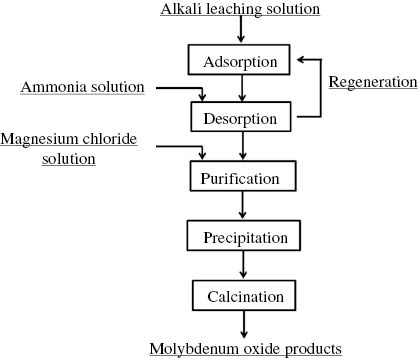
The flow chart of molybdenum recovery from alkali leaching solution of low-grade molybdenum concentrate.
Main compositions of the low-grade molybdenum concentrate (wt.%).
| Mo | Pb | S | Al2O3 | SiO2 | C | Fe | K2O | CaO | BaO |
|---|---|---|---|---|---|---|---|---|---|
| 2.50 | 2.05 | 24.74 | 4.22 | 27.92 | 8.64 | 23.82 | 4.41 | 1.24 | 1.33 |
In the pretreatment process of Mo concentrate, roasting at 600°C for 1.5 h followed by the alkali leaching step were employed to dissolve Mo to be recovered. The alkali leaching process was conducted under the following conditions: sodium carbonate dosage was 40%, liquid solid ratio was 3, leaching temperature was 85°C and leaching time was 1 h. The main compositions of the obtained alkali leaching solution were Mo 4.96 g/l, S 3.48 g/l, P 0.08 g/l.
2.2 Ion exchange procedure
The resins were firstly soaked for 24 h in deionized water to make the resins swell sufficiently, then converted in 4% NaOH solution for 8 h, and rinsed with deionized water until the pH of the washing solution was close to neutral. Furthermore, the resins were soaked and stirred in 2 mol/l HCl solution to exchange the resins from OH type to Cl type.
The static tests were carried out in a beaker containing 5 g resins and 500 ml alkali leaching solution. The beaker was heated to a specific temperature while being magnetically stirred. After the required time, the Mo content in the adsorption solution was analyzed by inductively coupled plasma atomic emission spectroscopy to calculate the adsorption capacity.
The dynamic tests were conducted in an ion exchange column (Ф20×200 mm). Treated resins (20 g) were poured into the column, and the operation was performed by downstream flow at a constant flow rate which was controlled by a pump. Samples were collected periodically from the column effluent and analyzed to determine Mo concentration. Then, the loaded resins were rinsed with deionized water and desorbed using 10% ammonia solution.
The feed solution in both static and dynamic experiments was 4.96 g/l Mo. The Mo concentration loaded into resin was obtained by mass balance. Adsorption percentage of Mo was calculated by Eq. (1):
where θ is the adsorption capacity, α is the Mo concentration in initial solution (g/l) and β is the Mo concentration in adsorbed solution (g/l).
According to previous investigations, D201 and D314 resins were employed in adsorption and desorption experiments. D201 and D314 resins are weak basic anion exchange resins. The chemical and structural properties of the resins are shown in Table 2.
The chemical and structural properties of D201 and D314 resins.
| Resins | Functional group | Ionic form | Structure | Volume exchange capacity (mmol/l) | Water content (%) | Visual density in wet state (g/ml) | True density in wet state (g/ml) |
|---|---|---|---|---|---|---|---|
| D201 | -N(CH3)3OH | Cl- | Macroporous | ≥1.20 | 50–60 | 0.65–0.73 | 1.06–1.10 |
| D314 | -N(R2) | Cl- | Macroporous | ≥2.20 | 50–60 | 0.70–0.80 | 1.08–1.18 |
The ion exchange resins of D201 and D314 obtained from Zibo Dongda Chemical Company (Zibo, Shandong, China) were used in this study. All chemical reagents used in this study were of analytic grade.
3 Results and discussion
3.1 Static tests for adsorption
The pH value of alkali leaching solution was about 11, and hydrochloric acid was adopted to adjust the pH value for the requirement of the experiments. The effect of pH value on adsorption capacity of Mo is shown in Figure 2.
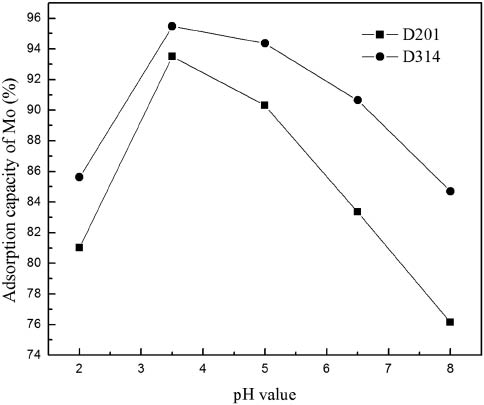
Effect of pH value on static tests for adsorption capacity of molybdenum (Mo).
From Figure 2, it can be observed that the pH value of the alkali leaching solution significantly affected the adsorption capacity of Mo for D201 and D314 resins. With increasing pH value from 2 to 3.5, the adsorption capacity linearly increased and reached the maximum value of 93.50% and 95.47% when the pH value was 3.5. This is because when the pH value was low, Mo existed as poly-molybdate salt ions state, which could be easily adsorbed on the resins [24, 25]. Nevertheless, with further increase of pH value, the adsorption capacity gradually decreased.
According to above results, it could be concluded that the adsorption capacity of D314 was higher than that of D201. Therefore, D314 resin was chosen for further experiments.
3.2. Dynamic tests for adsorption
For the alkali leaching solution, hydrochloric acid was adopted to adjust the pH value to 3.5, and the flow rates were 1 ml/min and 2 ml/min, controlled by a constant flow pump. The dynamic adsorption curve of D314 resin is shown in Figure 3.

The dynamic adsorption curve of D314 resin.
It can be seen that Mo concentration in effluent at 2 ml/min was much higher than at 1 ml/min, which indicated that the flow rate of the alkali leaching solution should be slow. For the flow rate of 1 ml/min, the average Mo concentration in effluent was 0.16 g/l when Mo concentration in the leakage point was 0.35 g/l. Consequently, it could be calculated that the adsorption capacity of Mo was 96.77% in dynamic tests.
3.3 Desorption tests
Ammonium solution (10%) was adopted to deposit Mo ions, which were released to the desorption solution as ammonium molybdate. The elution curve of D314 resin is presented in Figure 4.
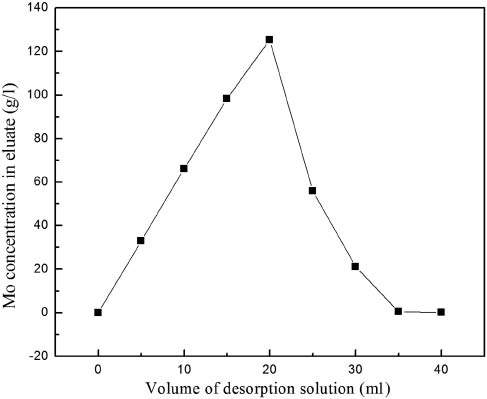
The deposition curve of D314 resin.
It can be seen that 10% ammonium solution performed excellently in depositing Mo ions. The results indicated that the maximum value of Mo concentration in eluate was 122 g/l. When the volume of desorption solution was double the size of the resins, the desorption process basically completed, while Mo concentration in eluate was 0.07 g/l.
3.4 Precipitation tests
The main compositions of desorption solution were Mo 59.21 g/l, P 1.26 g/l and S 0.94 g/l, wherein P content was too high to disrupt the precipitation process. Therefore, P was eliminated by magnesium chloride saturated solution under the following conditions: stirring temperature 50°C, final pH value 8.3–8.5 and stirring time 1 h. As a result, P was barely observed in the desorption solution.
After P was removed, 50% nitric acid solution was added to the desorption solution until the pH value reached 2.5 under a stirring temperature 50°C. The desorption solution continued to be stirred for 20 min, and the residue was filtered. Furthermore, the obtained residue was put into the resistance furnace at 550°C for 1 h, and the Mo oxide products were finally obtained. The main compositions of Mo oxide products are shown in Table 3.
Main compositions of molybdenum oxide products (wt.%).
| Compositions | Mo | S | P | Cu | Pb |
|---|---|---|---|---|---|
| Molybdenum oxide products | 55.75 | 0.01 | 0.003 | 0.001 | 0.002 |
| YMo 55 national standard | ≥55 | ≤0.1 | ≤0.05 | ≤0.28 | ≤0.1 |
| Grade A standard of ASTM A146-04 | ≥55 | ≤0.25 | ≤0.05 | ≤1.0 | – |
It could be observed that the content of Mo was 55.75% and the amounts of impurities such as S and P were rather low. The quality of Mo oxide products met the requirement of YMo 55 national standard in GB/T24482-2009 and Grade A standard of ASTM A146-04 (2014). In conclusion, the Mo recovery was 97.81% in the precipitation process.
4 Conclusions
The static experiments results indicated that the adsorption capacity of D201 resins reached 93.50% at pH 3.5, while the adsorption capacity of D314 resins was 95.47%. Therefore, D314 resin was adopted for further experiments.
The dynamic experiments results indicated that the adsorption capacity of Mo reached 96.77% when the flow rate of the leaching solution was 1 ml/min. Ammonium solution (10%) was adopted to deposit Mo ions. The results indicated that the maximum value of Mo concentration in eluate was 122 g/l. When the volume of the desorption solution was double the size of the resins, Mo concentration in eluate was 0.07 g/l, which demonstrated that almost all Mo ions were deposited in the desorption solution.
In the precipitation process, P was removed firstly, and the obtained Mo oxide products met the requirement of YMo 55 national standard in GB/T24482-2009 and Grade A standard of ASTM A146-04 (2014). The Mo recovery was 97.81% in the precipitation process.
About the authors

Zhaoguo Gao obtained his Master’s degree from Northeastern University, China. Currently, he works at Zhengzhou Institute of Multipurpose Utilization of Mineral Resources, Chinese Academy of Geological Sciences, and mainly engages in exploitation of low-grade vanadium ore, low-grade tungsten and molybdenum ores.

Bo Zhang obtained his doctorate from Northeastern University in 2013. Currently, he works at Zhengzhou Institute of Multipurpose Utilization of Mineral Resources, Chinese Academy of Geological Sciences. His primary research interests include rare earth functional materials and hydrometallurgy.

Hongzhao Liu is a senior engineer at Zhengzhou Institute of Multipurpose Utilization of Mineral Resources, Chinese Academy of Geological Sciences. He mainly engages in evaluation and multipurpose utilization of polymetallic ore.

Wei Wang obtained his doctorate from Changchun Institute of Applied Chemistry, Chinese Academy of Sciences in 2012. Currently, he works at Zhengzhou Institute of Multipurpose Utilization of Mineral Resources, Chinese Academy of Geological Sciences. His primary research interests include the rare earth extraction process, and comprehensive utilization of gold smelting slag.

Yaohua Cao is a research fellow at Zhengzhou Institute of Multipurpose Utilization of Mineral Resources, Chinese Academy of Geological Sciences. She mainly engages in hydrometallurgy, and chemical engineering. She has received many awards, such as the Technological Progress Award of Ministry of Land and Resources of China.
Acknowledgments
The authors express sincere thanks to the National Natural Science Foundation of China (NSFC) 51404220 for financial support.
References
[1] Matsumoto M, Kawabata D, Takatani T, Yoshida Y, Kondo K. Solvent Extr. Ion Exch. 2014, 32, 111–118.Search in Google Scholar
[2] Cao ZF, Zhong H, Qiu ZH, Liu GY, Zhang WX. Hydrometallurgy 2009, 99, 2–6.10.1016/j.hydromet.2009.05.001Search in Google Scholar
[3] Valverde IM, Paulino JF, Afonso JC. J. Hazard. Mater. 2008, 160, 310–317.Search in Google Scholar
[4] Zhang LB, Xie F, Li SW, Yin SH, Peng JH, Ju SH. Green Process. Synth. 2015, 4, 3–10.Search in Google Scholar
[5] Nguyen TH, Sohun SH, Lee MS. Mater. Trans. 2013, 54, 1750–1754.Search in Google Scholar
[6] Yin SH, Zhang LB, Peng JH, Li SW, Ju SH, Zhang LB. Chem. Eng. Process. 2015, 91, 1–6.Search in Google Scholar
[7] Lee MS, Sohn SH, Lee MH. Bull. Korean Chem. Soc. 2011, 32, 3687–3691.Search in Google Scholar
[8] Lu XY, Huo GS, Liao CH. Trans. Nonferrous Met. Soc. China 2014, 24, 3008–3013.10.1016/S1003-6326(14)63438-5Search in Google Scholar
[9] Fernandez OI, Fernandez JL, Irabien A. Sep. Purif. Technol. 2007, 56, 118–125.Search in Google Scholar
[10] Huo GS, Peng C, Song Q, Lu XY. Hydrometallurgy 2014, 147–148, 217–222.10.1016/j.hydromet.2014.05.015Search in Google Scholar
[11] Zeng L, Cheng CY. Hydrometallurgy 2009, 98, 10–20.10.1016/j.hydromet.2009.03.012Search in Google Scholar
[12] Joo SH, Kim YU, Kang JG, Kumar JR, Yoon HS, Parhi PK, Shin SM. Mater. Trans. 2012, 53, 2034–2037.Search in Google Scholar
[13] Wang XW, Wang MY, Shi LH, Hu J, Qiao P. Hydrometallurgy 2010, 104, 317–321.10.1016/j.hydromet.2010.06.012Search in Google Scholar
[14] Li QG, Zhang QX, Zeng L, Xiao LS, Yang YN. Trans. Nonferrous Met. Soc. China 2009, 19, 735–739.10.1016/S1003-6326(08)60342-8Search in Google Scholar
[15] Kalyakina OP, Kononova ON, Kachin SV, Kholmogorov AG. Bull. Korean Chem. Soc. 2004, 25, 79–84.Search in Google Scholar
[16] Zhao ZW, Zhang JL, Chen XY, Liu XH, Li JT, Zhang WG. Hydrometallurgy 2013, 140, 120–127.10.1016/j.hydromet.2013.09.014Search in Google Scholar
[17] Griffith CS, Luca V. Chem. Mater. 2004, 16, 4992–4999.Search in Google Scholar
[18] Liu WP, Xu H, Yang XY, Shi XC. Miner. Eng. 2011, 24, 1580–1585.Search in Google Scholar
[19] Cao ZF, Hong Z, Qiu ZH. Hydrometallurgy 2009, 97, 153–157.10.1016/j.hydromet.2009.02.005Search in Google Scholar
[20] Lasheen TA, El-Ahmady E, Hassib HB, Helal AS. Miner. Process. Extr. M. 2015, 3, 145–173.Search in Google Scholar
[21] Xiao LS, Zhang QX, Gong BF, Huang SY. Rare Metals 2003, 22, 81–85.Search in Google Scholar
[22] Kononova ON, Kholmogorov AG, Kachin SV, Kalyakina OP, Sadovskaya EV. Hydrometallurgy 2003, 68, 83–87.10.1016/S0304-386X(02)00170-6Search in Google Scholar
[23] Li QG, Zeng L, Xiao LS, Yang YA, Zhang QX. Hydrometallurgy 2009, 98, 287–290.10.1016/j.hydromet.2009.05.014Search in Google Scholar
[24] Zhang AY, Wei YZ, Kumagai MK. Solvent Extr. Ion Exc. 2003, 21, 591–611.Search in Google Scholar
[25] Nguyen TH, Lee MS, Seung M. Hydrometallurgy 2013, 136, 65–70.10.1016/j.hydromet.2013.03.007Search in Google Scholar
©2015 by De Gruyter
This article is distributed under the terms of the Creative Commons Attribution Non-Commercial License, which permits unrestricted non-commercial use, distribution, and reproduction in any medium, provided the original work is properly cited.
Articles in the same Issue
- Frontmatter
- In this issue
- Editorial
- Electrification of chemistry – what is the synergy between plasma synthesis and chemical plant modularization?
- Original articles
- Optimization of biodiesel synthesis under simultaneous ultrasound-microwave irradiation using response surface methodology (RSM)
- The synthesis of optically enriched 2-benzyl- 3-nitropropionic amide
- Cobalt, nitrogen-codoped carbon quantum dots as a synergistic catalyst for oxygen reduction reaction
- Sulfonated poly (arylene ether sulfone) proton exchange membranes for fuel cell applications
- Preparation of high surface area activated carbon from Eupatorium adenophorum using K2CO3 activation by microwave heating
- An environmental procedure to extract titanium components and metallic iron from Ti-bearing blast furnace slag
- Recovery of molybdenum from alkali leaching solution of low-grade molybdenum concentrate by ion exchange
- Impacts of ultrasound on leaching recovery of zinc from low grade zinc oxide ore
- Study on the calcination experiments of rare earth carbonates using microwave heating
- Conference announcement
- Conferences 2015–2017
Articles in the same Issue
- Frontmatter
- In this issue
- Editorial
- Electrification of chemistry – what is the synergy between plasma synthesis and chemical plant modularization?
- Original articles
- Optimization of biodiesel synthesis under simultaneous ultrasound-microwave irradiation using response surface methodology (RSM)
- The synthesis of optically enriched 2-benzyl- 3-nitropropionic amide
- Cobalt, nitrogen-codoped carbon quantum dots as a synergistic catalyst for oxygen reduction reaction
- Sulfonated poly (arylene ether sulfone) proton exchange membranes for fuel cell applications
- Preparation of high surface area activated carbon from Eupatorium adenophorum using K2CO3 activation by microwave heating
- An environmental procedure to extract titanium components and metallic iron from Ti-bearing blast furnace slag
- Recovery of molybdenum from alkali leaching solution of low-grade molybdenum concentrate by ion exchange
- Impacts of ultrasound on leaching recovery of zinc from low grade zinc oxide ore
- Study on the calcination experiments of rare earth carbonates using microwave heating
- Conference announcement
- Conferences 2015–2017
