Giving voice to space: the grammar of Northern Alta spatial roots
-
Alexandro Xavier Garcia-Laguia


Abstract
Recent cross-linguistic studies on spatial language reveal a great diversity in the way languages encode spatial information. Yet, given that there are not many spatial studies that have systematically targeted languages with a Philippine-type voice system, it is not clear how spatial expression is structured in such languages. The aim of this study is to address this knowledge gap through an in-depth investigation of Northern Alta, a language presenting such a voice system. The study combines data from stimulus-based tasks with a modern documentation corpus of the language and elicited data to examine the linguistic strategies deployed in four different spatial subdomains: location, disposition, orientation, and routes. The results show that each subdomain favors a distinct set of derivational affixes and a particular set of lexical roots. It is argued that the morphological system of the language plays a crucial role in the structuring of spatial expression. It allows roots with spatial meanings such as ‘front’, ‘side’, ‘top’, and ‘back’ to derive a variety of spatial verbs that are key in several spatial domains. The study also shows that Philippine-type languages have important information to contribute to cross-linguistic studies of spatial language.
1 Introduction
In recent decades, studies on spatial language have benefited substantially from the examination of under-researched languages across the world. Careful examination of different languages has shown that spatial expression is much more diverse than expected and has contributed to the development of semantic typology and grammar-of-space theory (Ameka and Levinson 2007; Levinson and Wilkins 2006). For example, while earlier literature assumed that adpositions played a central role in certain subdomains of spatial description (Landau and Jackendoff 1993: 223), recent research has shown that languages with small or no inventories of adpositions display alternative means of expressing spatial relations (Brown 2006; Schultze-Berndt 2006).
Northern Alta – a Philippine language of the South-Central Cordilleran branch spoken by c. 200 people in eastern Luzon – is such a language without spatial adpositions. In addition, the language presents a feature of special interest for the typology of spatial expression: spatial roots (i.e. terms expressing relations such as front, top, side, upstream, and downstream) exhibit exceptionally regular and productive derivational morphology, which allows them to derive verbs of different sorts and integrate them into the language’s voice system. This study explores a strategy of spatial categorization that has so far received little attention and investigates how it is deployed in different subdomains of spatial expression. In addition, considering that Northern Alta’s voice system and elaborate morphology are also found in typologically similar languages, i.e. the so-called ‘Philippine-type languages’, this is one of the first studies that aims to contribute to grammar of space theory by addressing the question of how a language with a Philippine-type voice system structures different subdomains of spatial expression.
The paper is organized as follows: after providing the relevant theoretical background in Sections 2 and 3, I discuss the methods and data used in Section 4. Sections 5 and 6 outline the grammatical context necessary to facilitate understanding of the analysis presented. Section 7 presents Northern Alta’s basic locative construction (BLC) and the role of spatial roots in these constructions. Section 8 discusses the use of spatial roots and verbal morphology in four different domains of spatial expression, i.e. location, disposition, orientation, and routes. Sections 9 and 10 summarize the results and present the conclusions. In addition, the morphological potential of spatial roots is illustrated in a paradigm of verbal derivations in the Appendix.
2 General background
2.1 The study of the grammar of space
One of the starting points of research on the way languages express spatial relations is related to the observation that all languages have ‘where is X’ questions. Levinson (2003: 64) notes that these questions “tend to elicit answers in which the location of a figure is specified as in some relation to a ground”, where the ‘figure’ is the entity to be located, and the ‘ground’ is the entity with respect to which it is located.[1] Levinson and Wilkins (2006: 3) distinguish a domain in which the figure is static (‘stasis’) from a domain in which the figure is moving (‘kinesis’). The stasis domain is further subdivided depending on whether the strategy utilized to locate the figure relies on the selection of one of the facets of the ground object to specify an angle between the two elements, in which case it is considered to belong to the ‘angular domain’, also known as ‘frames of reference’ (FoR), or ‘coordinate systems’. Strategies not involving such specifications belong to the ‘non-angular’ domain, which includes the subdomain ‘topology’. These two partitions (stasis vs. kinesis, angular vs. non-angular) result in a number of specific subdomains that, taken together with the variety of linguistic strategies used to express them, represent the backbone of the ‘grammar of space’ of a given language (Figure 1).
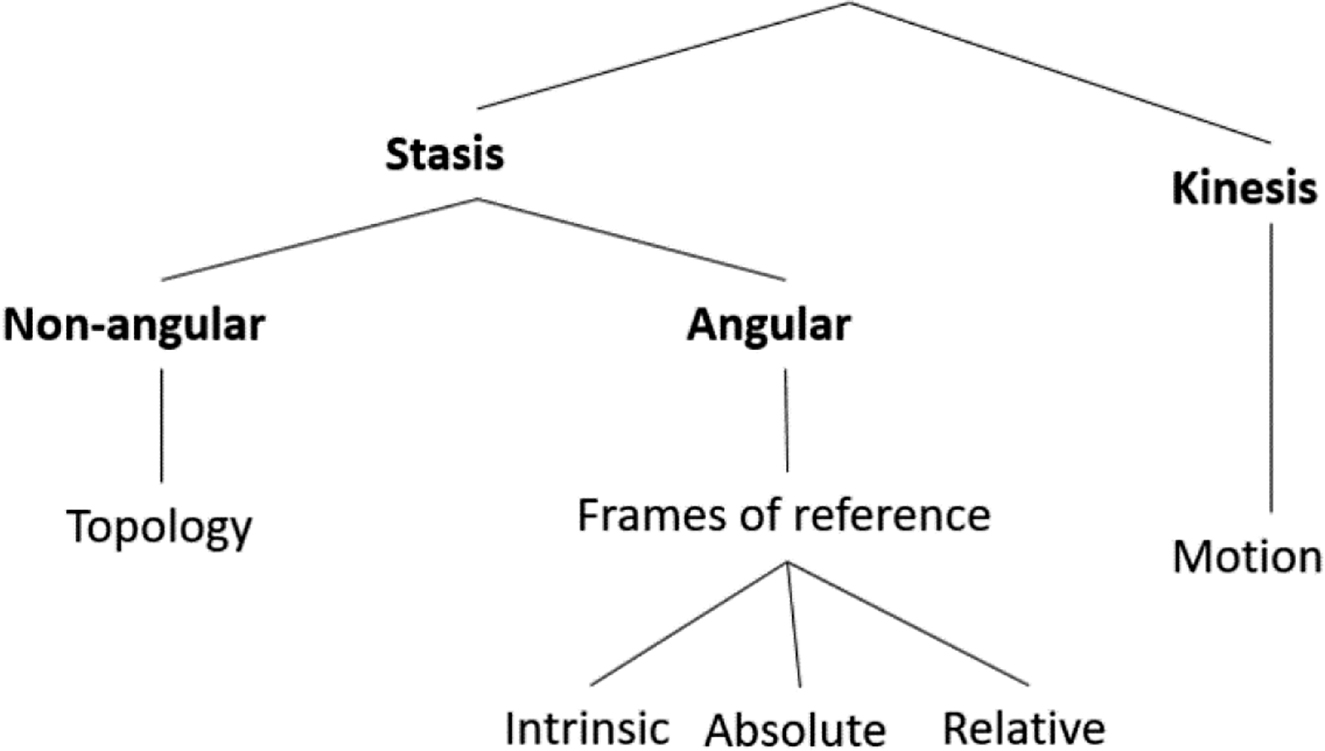
Conceptual subdivisions of the spatial domain (Levinson and Wilkins 2006: 3).
The comparative research presented by Levinson and Wilkins (2006) shows that there is considerable variation in the strategies used in spatial expression. On the basis of this variation, the authors question earlier generalizations in this field, arguing that they originate from studies of familiar languages such as English. Levinson and Wilkins observe that “the majority of languages do not code topological distinctions in adpositions, do not have satellite-framed motion systems, and do not have an intrinsic plus relative frame-of-reference inventory” (2006: 550). In the particular case of topological relations (i.e. relations expressed by the English prepositions in, at, near, between, etc.), the results of the study demonstrate that such notions are not universally encoded in specific parts of speech but are distributed throughout the clause. For example, languages with small or minimal sets of adpositions may express spatial relations with other resources within their grammar and lexicon. A well described example is the case of the Mayan language Tzeltal, in which the derivational morphology and small set of roots allow the production of nouns and verbs expressing topological relations (Brown 2006: 234).
More recent studies on the world’s languages have contributed to developing the field of the grammar of space in different directions. For example, the investigation of Mayan languages has contributed to positing new partitions of the spatial domain, as reflected in Bohnemeyer’s (2017) classification of spatial concepts. The classification builds on the stasis versus kinesis division, and distinguishes between static “inherent and essential” properties (i.e. shape, size) and static “variable” properties (2017: 327).[2] The different types of variable static properties form three subdivisions that will be explored in Section 8: ‘location’, which specifies the location of a figure in relation to a ground; ‘disposition’, which is concerned with features of the figure’s position, configuration, or shape;[3] and ‘orientation’, which refers to the alignment of one of the figure’s facets with a cue.[4] Bohnemeyer’s classification also presents subtypes of kinesis, which include one of the subdomains explored here: spatial descriptions of ‘routes’.
2.2 The morphology of Philippine-type languages
Philippine languages are known to exhibit elaborate systems of verbal morphology. For example, Ilocano is a Northern Philippine language for which Rubino (2000: xviii–xxi) lists more than 450 different verbal affixes. Rubino (2005: 329) notes that all roots derive verbal and nominal forms, and that most verbs can be decomposed into a root and an affix. As a result, roots from unexpected domains, such as onomatopoeic roots, can be “thoroughly integrated into the highly productive derivational and inflectional morphology of the language” (Rubino 2001: 303). Another set of roots for which these verbal derivations are possible is the set of roots with spatial meanings, as evidenced by dictionaries of Ilocano (Rubino 2000) and Tagalog (English 1986). This derivational pattern is observed for Tagalog in Fortis (2003), which describes it as a mechanism that allows the “incorporation of spatial relations in verbal semantics”, but it has not been explored in subsequent studies on spatial expression in Philippine languages.[5] The aim of this paper is to contribute to previous spatial research by investigating this pattern of expression in the Philippine language Northern Alta.
The productivity of such morphological systems appears to be a feature, not only of Philippine languages, but also of Philippine-type languages,[6] for which Blust (2013: 453) notes that it is not unusual to have 200–300 distinct affixes or affix combinations. One of the most relevant features of the verbal morphology of these languages is their system of verbal alternations, also known as the Philippine-type voice system (Himmelmann 2005: 113). Such systems exhibit a subset of affixes that appear on verbs and determine whether the subject is an actor or a patient. One of the characteristics of such systems is that they distinguish at least two and sometimes three different non-actor voices, the so-called ‘undergoer voices’. Note that not all voices are available to any particular root (Reid 1992: 67–68), and that some derivations produce idiosyncratic meanings (Latrouite 2011: 198). For these reasons, voice affixes are most often treated as derivational. The question arises which voice forms are available to spatial roots and how these combinations are used in the Northern Alta spatial language.
3 The spatial domain in a Philippine-type voice system: research questions
One of the implications of the fact that any spatial root may derive a spatial verb is that a language of the Philippine type, such as Northern Alta, would be able to incorporate in the predicate any kind of spatial information that is lexified in the language. As a consequence, the language in question would provide additional evidence for the claim that spatial information is not limited to a specific part of speech but is distributed over the clause, and it would perhaps increase our understanding of the grammar of space theory. Levinson and Wilkins (2006: 5) note that there are no simple generalizations as to where exactly in the clause spatial information is encoded. They provide the following tendencies: the shape of figure objects is normally encoded in locative predicates and occasionally in adpositions, whereas the shape and geometry of grounds is typically encoded in adpositions and spatial nominals; in addition, the spatial relation between figure and ground may be encoded in locative verbs and case but is especially to be found in adpositions and spatial nominals. Levinson and Wilkins (2006: 5) also point out that the distribution of this information varies across languages. A major aim of this study is to examine whether the distribution of spatial information is determined by the language’s voice system. In relation to these issues, I will consider the following questions:
Which voice forms may derive from spatial roots?
What kinds of spatial information do these verbs convey when functioning as predicates?
What is the relationship between particular voice forms and spatial subdomains?
What role do verbs derived from spatial roots play in spatial expression? I.e. how do they relate or compete with other lexical resources?
4 Methods and materials
This study employs a multi-method approach aiming at a balance between naturalistic, elicited, and stimulus-based data. Such an approach benefits from the fact that the different types of data complement each other. For example, the documentation corpus was the starting point for a semantic analysis of the spatial roots. The semantic analysis was subsequently complemented with data from stimulus-based tasks, as these provide examples of the use of these roots in different spatial contexts. Similarly, the semantic analysis of the voice-marking affixes was developed using the documentation corpus and was subsequently expanded with stimulus-based tasks, given that the latter allow us to identify the preferred voice forms in each spatial subdomain and observe the meanings yielded by the voice derivations of spatial roots. Finally, the documentation corpus provided the first layer of derivations of spatial roots presented in the Table in the Appendix. The table was completed using stimulus data and elicited data. All data types are recorded and annotated with ELAN.
The Northern Alta Language Documentation Corpus (Garcia-Laguia 2017) is the only annotated multimedia corpus of Northern Alta. It includes 17 hours of annotated video recordings. The corpus was compiled between 2014 and 2019 with the assistance of 43 speakers of the language and is currently hosted at the ELAR archive. The corpus contains examples of spatial roots in both their nominal and verbal forms. The spatial datasets presented below are considered separately from the documentation corpus.
The Topological Relations Picture Series (TRPS, Bowerman and Pederson 1993) is a stimulus-based task consisting of a series of 71 drawings. Each picture shows figure and ground objects in different configurations, i.e. a cup on a table, a ring on a finger, an apple in a bowl, or a tree on a mountain. Each of the drawings was shown to one native speaker who had to respond to the question ‘where is (the figure) X’. This dataset provides a sample of the lexical and grammatical resources for the expression of topological relations in Northern Alta.
The Picture Series for Positional Verbs task (PSPV, Ameka et al. 1999) is a series of 68 photos in which nine different objects are placed in more or less canonical positions (sitting, standing, lying, leaning, planted, etc.) in relation to seven different grounds. The task was conducted with one native speaker and provides data on the expression of disposition.
The Man and Tree task (M&T, CARG 1992) is a matching task. Two speakers separated by a curtain or screen receive an identical set of 16 cards, in which a man and a tree appear in different configurations. The speaker playing the role of the director picks one card and describes it to the matcher, who must rely on what the director says to find the corresponding card. I used a version of M&T developed by Ann Senghas in 1999 and conducted the task with five pairs of different speakers. The M&T task provided abundant data on frames of reference and orientation descriptions.
The Route Description Task is a task I developed specifically for this study, which consists of a series of questions of the type ‘how to go from point A to point B’, where both points are located within the Alta ancestral domain. The dataset was collected from one native speaker and comprises a sample of the linguistic resources used in the expression of routes.
Elicitation sessions on the derivational morphology of spatial roots include 11 audio-recorded elicitation sessions targeted at investigating the derivational morphology of spatial roots. The sessions were conducted with one speaker using elicitation techniques such as language manipulation, review elicitation, and, in some cases, reverse translation (Chelliah and De Reuse 2011: 367–378). The data contributed to refining the semantic analysis of spatial roots and developing the derivational paradigm presented in the Appendix.
5 Grammatical preliminaries
Northern Alta is an Austronesian language spoken by approximately two hundred Philippine Negritos in the north-eastern part of Luzon Island. Reid (1991) reports two different Alta languages, Northern and Southern Alta, which form one of the high nodes of the Northern Luzon languages together with the South-Central Cordilleran subgroup. Recent work on the language includes a grammatical description (Garcia-Laguia 2018) and a language documentation corpus (Garcia-Laguia 2017). Northern Alta is a Philippine-type language. It exhibits a voice system in which one actor voice and three different undergoer voices are distinguished. Subjects[7] and other clause constituents are case-marked: person pronouns and demonstratives inflect for case, as shown by the absolutive[8] pronoun in (1). Determiner Phrases[9] carry a case-marking determiner at the leftmost edge of the phrase, as illustrated in (4), (6), and (7), which show DPs marked in locative, oblique, and absolutive case, respectively. Predicates appear in initial position except when a constituent is topicalized; in this case, a predicate marker (PM) precedes the predicate, as in (2). The language distinguishes three basic clause types: equational, existential/locative, and voice-marked. Equational clauses have either a noun, a proform, or a non-verbal phrase in predicate position,[10] (1)–(2) are examples of two equational clauses with a noun as their predicate.
| ʔurkid=sila=sija |
| orchid=also=3s.abs |
| ‘it is also an orchid’ (101.772[11]) |
| sija | ʔaj | ʔalta | ||
| 3s [12] | pm | Alta.person | ||
| ‘as for him, he is an Alta’ (100.12) | ||||
Existential and locative clauses are headed by an existential operator or the locative copula ʔisaj ‘be at’, respectively. Both clause types take a predicative complement, which expresses an existing entity in existential clauses, as in (3), or a location in locative clauses, as in (4).
| maj | [ʔapuj]=na | ta | disalad | |||
| have | fire=already | loc | under | |||
| ‘there is a fire underneath (the charcoal pile)’ (100.644) | ||||||
| ʔisaj=ʔami | [ta | dibbuluan] | ||
| be.at=1pe. abs | loc | Dibbuluan | ||
| ‘we are in Dibbuluan’ (100.387) | ||||
Voice-marked clauses constitute the third basic clause type. These clauses are characterized by an affix that marks the verb for voice; they come in two types depending on whether the subject expresses an actor or an undergoer. The first type is called ‘actor-voice’ (AV) clause, as shown in (5)–(7), and the second ‘undergoer-voice’ (UV) clause. UV clauses come in three types, ‘patient voice’ (PV), ‘locative voice’ (LV), and ‘conveyance voice’ (CV), shown in (8)–(10), respectively. The different voices presented in the examples below represent the Northern Alta voice system.[13]
| l<um>idəp=gul=sija |
| < av 1>dive=indeed=3s. abs |
| ‘he indeed dives’ (126.22) |
| mən-huli=sija | [ti | ʔiʔan=i] | ||
| av 2-hunt=3s. abs | obl | fish=sp | ||
| ‘he catches some fish’ (85.68) | ||||
| məŋ-ʔijan | [ʔin | pun=na] | ||
| av3-yield | abs | trunk=3s.gen | ||
| ‘its trunk bears (root crops)’ (95.216) | ||||
| təgtəg-ən=mu=sija |
| crush- pv =2s.gen=3s. abs |
| ‘you crush it’ (93.523) |
| ʔəʔ-ʔulas-an=na | in | bəgas | ||
| prg-wash- lv =3s.gen | abs | rice | ||
| ‘she is washing the rice’ (106.222) | ||||
| ʔi-saku=mi=d=jaj |
| cv -back=1pe.gen=already=dist.dem. abs |
| ‘we put that (the charcoal) in a sack’ (100.639) |
The semantics of the voice affixes presented in (5)–(10) is discussed in Section 6. In broad terms, AV1 refers to punctual actions, whereas AV2 and AV3 are more durative. The UV affixes can be distinguished in terms of the semantic role and affectedness of the undergoer: in PV the subject (i.e. the undergoer) is more affected, i.e. it undergoes a change of state. In LV, the subject is superficially affected, and in CV, it typically expresses a theme, i.e. an entity moved across space. The verbs presented in (5)–(10) are examples of dynamic verbs, i.e. they involve an actor that is volitional or in control of the event, and contrast with potentive and stative verbs. Potentive verbs express that the actor is not volitional or does not have full control of the action, and stative verbs refer to states or properties. Verbs may be marked for aspect: completive aspect is marked with the infix <in>, whereas progressive aspect involves some form of reduplicating affix, as in (9).
Finally, Northern Alta distinguishes four cases: absolutive, genitive, oblique, and locative. In addition to their role as actor in UV clauses, as in (8)–(10), genitive constituents may also function as modifiers expressing the possessor (as in [27]). Oblique constituents may express a variety of roles, including an undergoer in AV clauses, as in (6), and also instrument, manner, time, location, or duration in any clause type. Locative constituents generally express definite locations, as in (4), and may also express an undergoer in AV clauses.
6 Semantics of Northern Alta derivational affixes
This section introduces the semantics of the voice-marking affixes used in spatial expressions and thus it facilitates the understanding of the analysis presented in Sections 8 and 9. The AV məŋ- prefix presented in (7) will not be further discussed given its non-occurrence in my spatial data. On the other hand, the AV stative mə- and the directional prefix pa- will be presented. All the affixes presented in this section are derivational, and thus, as discussed in Section 2.2, the meanings they yield are not always predictable.
6.1 Actor voice stative mə-
Stative AV verbs are formed with the prefix mə-. Clauses headed by stative verbs in actor voice express states of affairs (e.g. bilaj ‘life’ – məbilaj ‘alive’) or properties (e.g. biʔət ‘laziness’ – məbiʔət ‘lazy’), and have an experiencer as their subject, as shown in (11) and (12) respectively.
| mə-ʔantiŋ=əʔ=nən |
| st.av-fear=1s.abs=already |
| ‘I’m afraid’ (100.696) |
| mə-ʔapsut=sija |
| st.av-sourness=3s.abs |
| ‘it (the guava) is sour’ (94.391) |
In spatial contexts, AV stative verbs may express the location of the subject (e.g. bəŋli ‘middle’ – məbəŋli ‘to be in the middle’), its orientation (e.g. saʔlaŋ ‘front’ – məsalaŋ ‘to face’), disposition (e.g. saŋil ‘act of leaning’[14] – məsaŋil ‘to lean’), or manner of motion, as in (13).
| kuŋ | mə -bilis=ʔa | ʔa | mən-laʔad | |||
| if | st.av-speed=2s.abs | lk | av2-walk | |||
| ‘if you walk fast’ (123.285) | ||||||
6.2 Actor voice 1 <um>
With roots that denote properties or states, the AV1 infix <um> produces verbs expressing the acquisition of the property/state denoted by the root (e.g. baʔik ‘smallness’ – bumaʔik ‘to become small’, ʔiŋəl ‘anger’ – ʔumiŋəl ‘to get angry’), as in (14). Verbs derived with <um> are also used in meteorological expressions, such as ʔuddən ‘rain’ – ʔumuddən ‘it rains’. With roots denoting actions, AV1 verbs express the initiation of an event or action (e.g. lbut ‘act of boiling’ – lumbut ‘to boil’) or the completion of an action (e.g. datəŋ ‘arrival’ – dumatəŋ ‘to arrive’).
| mə-dali=sija | ʔa | d<um>əʔəl | ʔ<um>adu | |||
| st.av-easiness=3s.abs | lk | <av1>bigness | <av1>many | |||
| ‘(if this Tiger orchid manages to live) it grows and multiplies easily’ (101.517) | ||||||
In their spatial uses, AV <um> verbs express that the subject assumes a location, as (15), an orientation (e.g. saʔlaŋ ‘front’ – sumaʔlaŋ ‘to face’), or a disposition (e.g. ʔitnud ‘act of sitting’ – ʔumitnud ‘to sit’). Such verbs also appear in the domain of routes, in which they express the initiation or completion of a movement.
| g< um >gəsaʔ=sin | dilud=i | pa-ʔaj | ta | diŋatu | ||||
| prg<av1>outside=prox.dem.loc | downstream=sp | dir-go | loc | upstream | ||||
| ‘it (the sun) gets out here, downstream, and goes towards the upstream direction’ (155.94) | ||||||||
6.3 Actor voice 2 men-
AV2 mən- verbs express an action associated with the referent of the root, e.g. laʔad ‘walk’ – mənlaʔad ‘to walk’, bilaj ‘life’ – mənbilaj ‘to live’, latih ‘rattan’ – mənlatih ‘to collect rattan’, saʔluŋ ‘hut’ – mənsaʔluŋ ‘to live in a hut’, butag ‘betelnut’ – mənbutag ‘to chew betelnut’. AV2 men- verbs contrast with AV1 <um> verbs (Section 6.2) in that the latter are more punctual, whereas the former are more durative. AV2 mən- verbs may describe two kinds of situations: middle situations, i.e. situations in which “the development of an action is confined within the agent’s personal sphere so that the action’s effect accrues on the agent itself” (Shibatani 2006: 234), as shown in (16). AV2 verbs may also describe active situations, i.e. situations in which the action extends beyond the personal sphere, in which case they may take an object marked in the oblique or locative case, as in (17).
| mən- sumə=ʔami=d | ti | dəʔəl=i | ʔa | bətuh | ||||
| av2-hide=1pe.abs=already | obl | big=sp | lk | stone | ||||
| ‘we hide in big stones’ (83.250) | ||||||||
| mən- tanud=ʔami | ni | imil |
| av2-wait=1pe.abs | loc | Emil |
| ‘we wait for Emil’ (86.133) | ||
AV2 mən- middle verbs are used in the expression of routes (ʔusul ‘act of going downstream’ – menʔusul ‘to go downstream’) whereas those describing active situations are used in the expression of orientation (e.g. saʔlaŋ ‘front’ – mensaʔlaŋ ‘to face’).
6.4 Patient voice -ən
Verbs derived with the PV suffix -ən form clauses in which the subject is affected in some way. PV verbs are the most unmarked subtype of UV verbs in that their perfective form only carries the perfective infix <in>, as shown in (19), whereas in LV and CV the perfective is formed by combining their voice affix with the perfective infix <in>, as shown in (20) and (40) respectively. PV verbs may denote a change of state (e.g. ʔətul ‘act of cutting’ – ʔətulən ‘to cut something’), communication (e.g. ʔujug ‘act of mocking’ – ʔujugən ‘to mock someone’), cognition (e.g. ʔisip ‘thought’ – ʔisipən ‘to think about something’) or perception (e.g. ʔalub ‘smell’ – ʔalubən ‘to smell something’). (18) shows a PV clause in which the subject undergoes a change of state.
| ʔəg-gajat -ən =na=i | in | kamatis | ||
| prg-chop-pv=3s.gen=sp | abs | tomato | ||
| ‘she is chopping the tomato’ (106.125) | ||||
| ʔ< in >alat | ni | laman=i | ||
| < prf.pv >bite | gen | wild.pig=sp | ||
| ‘he was bitten by a/the wild pig’ (92.521) | ||||
PV verbs are used in the expression of orientation (saʔlaŋ ‘front’ – saʔlaŋən ‘to face something’) and in the domain of routes (laʔad ‘walk’ – laʔadən ‘to walk a certain distance/to walk to a certain place’).
6.5 Locative voice -an
Verbs formed with the LV suffix -an express an action that is oriented towards a location. The subject of LV clauses expresses a superficially affected patient, as in (9). It may also express a goal (e.g. suli ‘act of returning’ – sulian ‘to return somewhere’), a recipient (e.g. ʔatəd ‘act of giving’ – ʔatədan ‘to give someone’), a stimulus (e.g. ʔinta ‘act of seeing’- ʔitan [15] ‘to see something’), or an addressee (e.g. biddə ‘act of saying’ – biddan ‘to tell someone’). (20) below shows an LV verb in which the subject expresses a goal.
| b<in>iʔen -an =əʔ=də=d |
| <prf>proximity-lv=1s.abs=3p.gen=already |
| ‘they approached me’ (100.70) |
LV forms are used in the expression of orientation (liʔud ‘back’ – liʔudan ‘to turn your back on something’) and routes (dman ‘act of passing’ – dmanan ‘to pass somewhere’).
6.6 Conveyance voice ʔi-
The subject of a CV verb is an entity that is moved across space by an agent marked in the genitive case. Thus, these verbs can be understood as expressing caused motion. The motion may be concrete (e.g. sumə ‘act of hiding’ – ʔisumə ‘to hide something’) or abstract (e.g. puluŋ ‘word’ – ʔipuluŋ ‘to say something’). In some verbs, motion results in a change of state (e.g. gisa ‘act of stewing’ – ʔigisa ‘to stew something’[16]). In the case of verbs expressing concrete motion, the movement can be translational, i.e. shifting from one point in space to another, as in (21), or non-translational, as in (22), in which the verb describes the action of rotating the open part of a hut towards the shade, so that the thatched roof can protect it from the sun.[17]
| ʔi -digdig=mu=d |
| cv-side=2s.gen=already |
| ‘put it (the card) on the side!’ (126.145) |
| ʔi -har ap=də=i | ti | diŋatu=i | |||||||
| cv-front=3p.gen=sp | obl | upstream=sp | |||||||
| ‘(if the sun is downstream), they face it (the front of the hut) upstream’ (155.253) | |||||||||
As shown in the preceding examples, the result of the caused motion can be a new location, as in (21), or a new orientation, as in (22). The result of caused motion may also be a new disposition, as will be shown in Section 8.2.
6.7 Directional pa-
The directional affix pa- is not part of the voice system, but it is a derivational affix that also appears in a number of spatial descriptions. It may combine with spatial roots (e.g. taʔpu ‘top’ – pataʔpu ‘towards the top’), place names (e.g. ditiʔi ‘Diteki village’ – paditiʔi ‘towards Diteki’), or roots expressing motion (e.g. suli ‘act of returning’ – pasuli ‘returning, on the way back’). Directionals formed with pa- can function as adverbial modifiers or heads of predicates, as in the first and second parts of (23) respectively, and also as nominals, as in (24).
| [higup-ən=əʔ=nən | [ʔa | pa- disalad]] | [ pa- disalad=əʔ] | |||
| suck-pv=1s.abs=already | lk | dir-inside | dir-inside=1s.abs | |||
| ‘I was sucked down, I was sinking’[18] (100.796) | ||||||
| pa- ʔaj=ʔin=d | ta | dimani | ||
| dir-go=prox.dem.abs=already | loc | Dimani | ||
| ‘that is (the way) towards Dimani’ (100.796) | ||||
Directional pa- forms are used in orientation descriptions, as in (48), and in routes, as in (49).
7 Northern Alta basic locative constructions
A concept crucial to the ensuing analysis is the so-called ‘Basic Locative Construction’ (BLC), which is defined in Levinson and Wilkins (2006) as the most unmarked construction used to answer ‘where is X’ questions. Identifying a language’s BLC involves distinguishing it from other locational constructions by investigating how all these constructions relate to each other in terms of their distribution. The result of this process provides a picture of the structuring of grammatical and lexical resources for spatial expression in a particular language, which will be discussed for Northern Alta in Sections 8 and 9.
7.1 Location questions
In Northern Alta, ‘where is X’ questions can be verbless, simply formed with the interrogative pronoun ʔadinu ‘where’ and the subject, as in (25). The interrogative pronoun ʔadinu may also be followed by the locative copula ʔisaj ‘to be at’, as in (26).
| ʔadinu | ʔin | laʔaj=mu | ||
| where | abs | husband=2s.gen | ||
| ‘where is your husband?’ (100.199) | ||||
| ʔadinu | ʔisaj | ʔin | ʔitnudan | |||
| where | be.at | abs | chair | |||
| ‘where is the chair?’ (03-01.04) | ||||||
7.2 Basic locative construction (BLC)
Northern Alta uses the construction headed by the locative copula ʔisaj ‘to be at’ as its BLC.[19] In these constructions, the subject represents the figure and the constituent marked in oblique or locative case, as in (27) and (28) respectively, expresses the ground.[20] Oblique ground phrases typically have an indefinite reading, whereas locative phrases are definite and can be headed by place names.
| ʔisaj=sija | tən | bəli=na | |||
| be.at=3s.abs | obl | house=3s.gen | |||
| ‘it (the dog) is at his house’ (170.52, TRPS 6) | |||||
| ʔisaj=ʔitam=sipla | ta | dimanaŋla | ||
| be.at=1pi.abs=still | loc | Dimanangla | ||
| ‘we were still in Dimanangla’ (85.084) | ||||
Although oblique and locative phrases may express locations, none of them specify the nature of the spatial relationship between the figure and the ground object. Speakers instead resort to the set of spatial roots presented in the following section.
7.3 Set of spatial roots
Spatial roots are a class of roots that express spatial relations such as coincidence, propinquity, contact or containment between figure and ground, and angular relations, i.e. relations involving the use of a coordinate system. Spatial roots may occur in their bare form as nouns and may also take many of the affixes presented in Section 6 (see Appendix). As shown in Table 1, most spatial roots form binary oppositions, i.e. pairs of terms that are opposite in meaning.
Northern Alta spatial roots (similarly to Palmer et al. (2017), I follow the approach of classifying spatial terms. In this case, the terms are classified on the basis of the spatial subdomains and frames of reference they express (see the description of spatial roots below, as well as Section 8)).
| Form | Gloss | Form | Gloss | |
|---|---|---|---|---|
| Front-Back-Side | saʔlaŋ | front | liʔud | back, behind |
| tagidlid | side | |||
| Left-right | ʔawili | left hand, left | diwanan | right hand, right |
| Contiguity | disalad | inside, under | gəsaʔ | out, outside |
| bəŋli | middle | lawis | extremity | |
| digdig | edge, beside | ʔibabaw | surface | |
| ʔalajun | region, area | parti | region, part | |
| Vertical | taŋʔal | height, upper part | təpdəʔ | lowness, bottom |
| taʔpu | peak, top | siduŋ | underneath, below | |
| Near-far | biʔən | near | ʔaddiu | far |
| Stream terms | diŋatu | upstream | dilud | downstream |
| dipaniŋ | across | dəbbəliw | opposite side |
‘Front-Back-Side’ (FBS) roots express location when occurring as nouns, but differ from the other subcategories in that their verbal derivations have an orientational reading. Such FBS-derived verbs are crucial in the expression of orientation (see Section 8.3).
Left-right terms most often refer to inherent facets of figure objects, as in the expression ‘to the man’s left’, but they are sometimes used from the perspective of the viewer, as in ‘to the man’s left (from our perspective)’. Contiguity is the label for a subcategory of spatial terms expressing relations of contact and coincidence. It includes the pairs ‘inside-outside’ and ‘middle-extremity’. Note that the term disalad evokes both notions of ‘inside’ and ‘under’, and thus it would also match the vertical category. The term digdig refers to landscape features such as a seashore or riverbank but also to regions projected from the side of an object (i.e. digdig ni bəli ‘beside a house’). The term digdig differs from the FBS term tagidlid ‘side’ in that its stative derivation has a locational (non-orientational) reading ‘to be beside’, as in (32).
Vertical terms come in two subsets with different uses. The term taʔpu ‘top’ is most often used in its nominal form and usually refers to mountain peaks. It is sometimes used to refer to the highest point in the sky, and to the upper part of the man’s body, in the Man and Tree task. As to the term taŋʔal, in its nominal form, it refers to the property of height and often derives stative verbs that can be used to describe both concrete things (e.g. ‘tall trees’) and more abstract concepts (e.g. ‘high prices’ or ‘high blood pressure’). As for təpdəʔ and siduŋ, the former expresses the property of lowness and can be used to refer to lower regions of objects (i.e. the lower part of a door), whereas siduŋ can only refer to areas underneath objects but not to low regions.
The category ‘stream terms’ includes the pair diŋatu ‘upstream’ – dilud ‘downstream’, which play an important role in several domains of Northern Alta spatial expression. The term dipaniŋ ‘across’ is mainly used to refer to the area across a river, but can also refer to a river located across a mountain. It can also be used in smaller scale settings and refer to ‘the other hand of a person’ or ‘the other side of a person’. As to dəbbəliw ‘opposite side’, it is only used in large-scale settings and may refer to a place on the other side of a sea, a river, or a village. Finally, sunset-sunrise terms are used in spatial descriptions but are not included in Table 1 because they are not roots but rather derived terms: ʔalaŋan ni sinag ‘sunrise place, the coming place of the sun’ and əlbugan ‘sunset place, sinking place’.
7.4 Spatial roots in ground phrases
The lexical head of the BLC ground phrase can be a noun or a place name, as in (27) and (28), respectively. Ground phrases may thus be headed by a spatial root occurring as a noun, as with gəsaʔ ‘outside’ in (29). The spatial noun may also be possessed by a genitive phrase indicating the ground. In such cases, the spatial noun refers to a part of the ground or to a region projected from it. (30) shows a ground phrase with the spatial noun disalad ‘inside’ possessed by the noun bəli ‘house’.[21]
| ʔisaj=sija | [ta | gəsaʔ] | ||
| be.at=3s.abs | loc | outside | ||
| ‘it (the dog) is outside’ (170. 53, TRPS 6) | ||||
| ʔisaj=sija | [tən | disalad | [nən | bəli]] | ||||
| be.at=3s.abs | obl | inside | gen | house | ||||
| ‘it (the dog) is inside the house’ (171.562, TRPS 71) | ||||||||
8 Distribution of spatial terms across domains of spatial expression
In the following discussion, we explore four different subdomains of spatial expression in Northern Alta: location, disposition, orientation, and routes.[22] Each of the following subsections focuses on the formal strategies of spatial expression in each subdomain and considers the use of spatial terms, voice affixes, and voice alternations (actor-undergoer voice).
8.1 Location
Location can be of two types, depending on whether the strategy employed relies on the specification of an angle or not. The locative construction, the Northern Alta BLC (see Section 7.2), is the preferred construction in both angular and non-angular descriptions.
8.1.1 Topology
Topological relations are a type of non-angular description concerned with spatial relations of coincidence, proximity, contact, or containment. The data for this subdomain was collected using the TRPS task (see Section 4). Most of the scenes in the dataset show BLC ground phrases in which spatial roots occur as nouns and indicate a part of the ground, as with (30) above. (31) below is the description of a picture showing a cup on a table.
| ʔisaj=sija | [tən | ʔibabaw | [nən | lamisa]] | ||||
| be.at=3s.abs | obl | surface | gen | table | ||||
| ‘it (the cup) is on the surface of the table’ (170.09, TRPS 1) | ||||||||
Location can also be expressed with voice-marked clauses, but these constructions are rare in the TRPS as well as in most datasets presented in Section 4, except for the elicitation sessions. Such clauses are formed with a stative AV verb derived from a non-FBS (‘front’/‘back’/‘side’) spatial root, as for example, mədigdig ‘to be beside’ or məlawis ‘to be at the end’, presented in (32) and (33) respectively.
| mə<ʔəd>digdig =na | dija | ʔin | pun | nən | ʔajuh | |||||
| st.av<prg>side=already | 3s.loc | abs | trunk | gen | tree | |||||
| ‘the tree trunk is beside it (the church)’ (171.257, TRPS 49) | ||||||||||
| maj | saləŋ | tapus | mə<ʔəb>bitin=sila | mə<ʔəl>lawis | ||||
| have | light | and | st.av<prg>hang=also | st.av<prg>end | ||||
| ‘there is a light, and (it) is also hanging, (it is) at the end (of the wire)’ (171.297, TRPS 7) | ||||||||
The relationship between the BLC and the locational stative construction is further discussed in Section 9.3.
8.1.2 Frames of reference
The data collected for the domain of frames of reference (in which descriptions specify an angle) comes from the M&T task (see Section 4). The dataset shows that, of the three different frames of reference (FoR) distinguished in Levinson (2003), (i.e. intrinsic, relative, and absolute), the intrinsic frame is used in 63.3% of the descriptions, the absolute frame in 12.6% of the cases, and the relative frame in 8.5%.[23] Formally, locative expressions using any kind of FoR are expressed with the BLC.
Levinson and Wilkins (2006) describe the intrinsic FoR as a strategy that involves the partition of a ground object or landmark into facets, on which search domains can be projected (e.g. the expression ‘the man is in front of the church’ relies on the front facet of the church to project a search domain). In the case of the data collected with M&T, the most common strategy treats the man as the ground for which it distinguishes a front facet, a back facet, and two sides. Such a strategy locates the tree in a region determined by one of the man’s facets. Thus, the resulting intrinsic expressions have ground phrases in which the search domain is defined by FBS or left-right terms, as in (34)–(35) respectively.
| ʔisaj=sila | ti | saʔlaŋ =na=i | ʔin | pun | nən | ʔajuh | ||||||
| be.at=also | obl | front=3s.gen=sp | abs | trunk | gen | tree | ||||||
| ‘the tree is in front of him’ (142.137, M&T R33) | ||||||||||||
| ʔisaj | ti | diwanan =na | ʔin | ʔajuh | ||||
| be.at | obl | right=3s.gen | abs | tree | ||||
| ‘the tree is on his right’ (142.185, M&T R12) | ||||||||
The absolute frame of reference uses arbitrary fixed bearings as the anchor of the coordinate system (Levinson 2003: 48). Such bearings may be defined by elements such as the sun’s path, wind directions, mountain slopes, river drainages, etc. Speakers of Northern Alta sometimes use the local river as the anchor of the coordinate system to disambiguate M&T cards, and thus rely on the set of stream terms to define a search domain. (36) shows two such absolute descriptions, with the man and the tree respectively treated as figures, and the tree and the man as respective implicit grounds.
| ʔisaj | ti | diŋatu | ʔin | taʔu | ʔisaj | ti | dilud | |||||||||||||
| be.at | obl | upstream | abs | man | be.at | obl | downstream | |||||||||||||
| ʔin | ʔajuh | |||||||||||||||||||
| abs | tree’ | |||||||||||||||||||
| ‘the man is upstream (of the tree), the tree is downstream (of the man)’ | ||||||||||||||||||||
| (147.281, M&T R32) | ||||||||||||||||||||
Speakers of Northern Alta may also rely on the bearings defined by the sun’s path, even though such a system is not found in M&T descriptions of location. A number of orientational descriptions use the sunset-sunrise locations as fixed bearings; these could arguably be described as using an absolute FoR, as in (48) in Section 8.3.2 below.
As to the relative frame of reference, it involves a mapping of the axes of the observer’s body onto the ground, as in the expression ‘the tree is to the right of the church (from my perspective)’. Unlike the intrinsic description presented in (35), such a relative expression would not remain true if the observer walked around the scene (Levinson and Wilkins 2006). Most descriptions of M&T locations rely on the observer’s lateral axis, thus their ground phrases have regions defined by left-right terms. As shown in (37), relative expressions using left-right terms are formally identical to their intrinsic counterparts presented in (35): in both cases, the ground can be expressed as a possessor. Both (35) and (37) describe the scene presented in Figure 2.
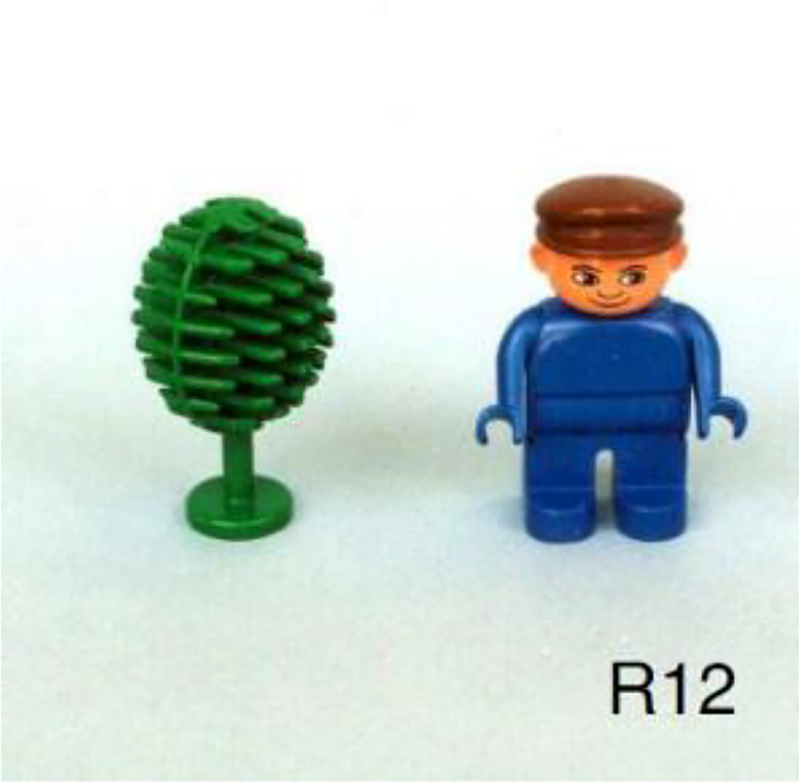
M&T card R12.
| ʔisaj | ti | ʔawili =na=i | ʔin | pun | ʔa | ʔajuh | ||||||
| be.at | obl | left=3s.gen=sp | abs | trunk | lk | tree | ||||||
| ‘the tree is to his left (of the man’) (137.30, M&T R12) | ||||||||||||
8.2 Disposition
Brown (2006: 231) defines dispositional terms as terms that encode features of space, shape, configuration, or position.[24] Northern Alta exhibits a set of least 30 roots to express such dispositional features. The data collected with the PSPV task (see Section 4) clearly shows that most scenes are described with AV stative verbs formed with such dispositional roots. (38) and (39) show stative derivations of the roots ʔedsaŋ ‘lie’, pajuŋ ‘stand’ and saŋil ‘lean’.
| ʔin | duwa | mə<ʔəʔ>ʔədsaŋ | at | ʔin | limma | mə<ʔəp>pajuŋ | ||||||
| abs | two | st.av<prg>lie | and | abs | five | st.av<prg>stand | ||||||
| ‘the two (cassavas) are lying and the five (cassavas) are standing’ (172.58, PSPV 5) | ||||||||||||
| mə<ʔəs>saŋil | ʔin | ʔistik | tən | ʔajuh | ||||
| st.av<prg>lean | abs | stick | obl | tree | ||||
| ‘the stick is leaning on a tree’ (172.09, PSPV 1) | ||||||||
CV derivations of dispositional roots are also used in certain scenes of the PSPV task. Clauses headed by CV dispositional verbs involve an actor that caused the object to be in a certain disposition. Such constructions appear in pictures in which the figure is perceived as being in an atypical position, as with the pot in Figure 3, which is described in (40).
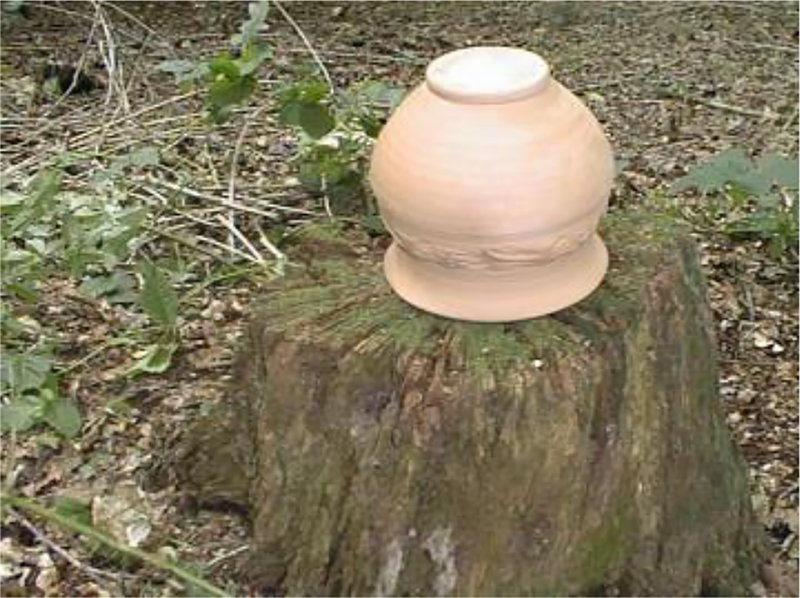
PSPV picture 12.
| ʔin | bəŋa | ʔ<in>i-saʔəb =də | tən | tuʔud | ||||
| abs | pot | <prf>cv-face.down=3p.gen | obl | stump | ||||
| ‘the pot, it was placed face down on the stump by them’ (172.159, PSPV 12) | ||||||||
Table 2 provides a sample of dispositional roots, together with their stative AV and dynamic CV derivations, all of which were collected with the PSPV task.
Some dispositional roots and their stative AV and dynamic CV derivations.
| Form | Gloss | Stative AV ‘to be in X disposition’ |
Dynamic CV ‘to cause Y to be in X’ |
|---|---|---|---|
| patuŋ | lie | məpatuŋ | ʔipatuŋ |
| sabit | hang | məsabit | ʔisabit |
| sampaj | hang on a line (clothes) | məsampaj | ʔisampaj |
| saŋil | lean | məsaŋil | ʔisaŋil |
| bilad | exposed to the sun to dry | məbilad | ʔibilad |
| saʔəb | face down | məsaʔeb | ʔisaʔəb |
| ʔədsaŋ | lie | məʔədsaŋ | ʔiʔədsaŋ |
8.3 Orientation
The data for the domain of orientation was collected using the M&T task and involves two different strategies: one that describes the man in relation to the tree and the other in relation to a cue located outside the picture (picture-internal vs. picture-external cue).[25] The two strategies differ in the grammatical treatment assigned to two types of cues.
8.3.1 Orientation with a picture-internal cue
This type of strategy involves one of the man’s facets, either the front, the back, or the sides, with no clear preference for a particular facet. Orientation with a picture-internal cue is mostly expressed with verbal derivations of any of the three FBS terms in either their stative or dynamic forms; within the dynamic examples, both AV and UV derivations are attested. The main difference is that AV clauses mark the cue (i.e. the tree) in oblique case and select the man as the subject, as in (41) and (42), whereas UV clauses treat the tree as the subject, as in (43) and (44).
| mə<ʔəl>liʔud | tən | pun | nən | ʔajuh | ||||
| st.av <prg>back | obl | trunk | gen | tree | ||||
| ‘he is turning his back to a tree’ (142.72, M&T R42) | ||||||||
| mən-tagidlid =sila=sija | ti | pun | ni | ʔajuh=i | ||||
| av2-side=also=3s.abs | obl | trunk | gen | tree=sp | ||||
| ‘he stands sideways on to a tree’ (145.108, M&T R12) | ||||||||
| ʔəs-saʔlaŋ-ən =na | in | ʔajuh | |||
| prg-front- pv =3s.gen | abs | Tree | |||
| ‘the tree is faced by him’ (146.21, M&T R22) | |||||
| t<in>agidlid-an =na=sila | ʔin | pun | ||||
| <prf>side- lv =3s.gen=also | abs | trunk | ||||
| ‘he stood sideways on to the trunk’ (140.79, M&T R21) | ||||||
Orientation is sometimes expressed with verbs that are not derived from spatial roots; these include perception verbs (e.g. ‘see’, ‘look’) and motion verbs (e.g. ‘go’, ‘leave’, and ‘return’). Verbs like ‘see’ and ‘look’ presuppose eyes on a front facet and thus imply the man’s orientation. As to verbs expressing motion, they occur when a speaker describes the man as if he was moving away from or towards the tree, a strategy that also implies the man’s orientation, as shown in (45). Both types of verbs appear in stative and dynamic forms, and in the latter case in both actor and undergoer voice derivations. Attested derivations of perception verbs include stative AV, as in məʔəlseŋ ‘to be looking’, or dynamic LV, as in ʔəlsəŋan ‘to look at something’ or ʔitan ‘to see something’. Motion verbs are found in actor voice (AV1), as in umʔəgʔaŋ ‘to leave’ or ʔumuli ‘to return home’, and in LV, as in (45).
| suli-an =na=d=mannən | ʔin | ʔajuh | ||||||
| return- lv =3s.gen=already=again | abs | tree | ||||||
| ‘he returns to the tree again (he faces the tree)’ (138.75, M&T R44) | ||||||||
8.3.2 Orientation with picture-external cues
The most striking feature of orientation with picture-external cues is that verbal derivations of FBS terms are never found in undergoer voice, and thus, there are no descriptions of orientation that treat external cues as the undergoer. In addition, this orientation strategy does not use the man’s side facets and thus only relies on front-back terms, with roughly 75% of the examples relying on the man’s front facet and 25% on the back facet. As to external cues, they come in different types: the speakers use a local landmark in 35.5% of the descriptions (the local river), one of the stream terms in 30%, one of the sun path terms in 21%, and they also use themselves as cues in 1.5% of the descriptions. The data further includes 8% of instances I refer to as ‘directional’ (e.g. ‘the man leaves the tree’) and 3% of instances in which the angular description is implicit (e.g. ‘the man thinks about the tree’ = ‘the man faces the tree’). (46) and (47) show derivations of the FBS terms in stative and dynamic AV respectively, and (48) shows a directional pa- form derived from the stream term diŋatu ‘upstream’. Finally, similar to picture-internal descriptions (see Section 8.3.1), perception and motion verbs are also attested.
| mə<ʔəl>liʔud | ta | ʔalbugan | |||||||
| st.av <prg>back | loc | sunset | |||||||
| ‘he is turning his back to the place where the sun sets’ (142.55, M&T R32) | |||||||||
| mən<sa>saʔlaŋ | ta | diŋatu | ʔin | taʔu | |||||||
| av2<prg>front | loc | upstream | abs | man | |||||||
| ‘the man is facing the upstream direction’ (144.203, M&T R33) | |||||||||||
| pa-diŋatu =sija | mən-laʔad=wada=d | ta | diŋatu | |||||||
| dir -upstream=3s.abs | av2-walk=perhaps=already | loc | upstream | |||||||
| ‘he is headed upstream, he walks upstream’ (143.95, M&T R44) | ||||||||||
8.4 Routes
Routes contrast with location, disposition, and orientation in that the latter three are static. The data for this domain was collected using a route description task consisting of a series of 13 questions of the type ‘how to go from point A to point B’, with the constraint that the path description must avoid local roads. The purpose of this constraint was to obtain verbs describing actions like ‘going up a hill’ or ‘crossing a river’ and to verify whether verbs derived from the set of spatial roots are used in this context. The dataset reveals that Northern Alta consistently favors the use of an additional set of roots, complementary[26] to the set of spatial roots presented in Table 1: the set of path roots. Table 3 presents the set in relation to their spatial counterparts.
Path roots and corresponding spatial roots.
| Path roots | Corresponding spatial roots | ||
|---|---|---|---|
| Root | Gloss | Root | Gloss |
| ʔuddiʔ | act of going upstream | diŋatu | upstream |
| ʔusul | act of going downstream | dilud | downstream |
| ʔəlwas | act of crossing river | dipaniŋ | across stream |
| ʔugsad | act of going down | təpdəʔ | bottom |
| saʔpat | act of climbing | taʔpu | (mountain) top |
| sədəp | act of entering | disalad | inside |
| dudul | act of going beside | tagidlid | side |
Path roots involve a figure moving in relation to a ground, e.g. ʔuddiʔ ‘go upstream’ presupposes a figure that moves along a particular path determined by the river, and dudul ‘to go beside’ presupposes a figure that reaches a particular goal, i.e. the side of a ground object. Verbs derived from these roots can be referred to as path verbs in the sense of Rau et al. (2012: 5), i.e. “verbs that express a trajectory of the figure with respect to the ground”.
In addition to the predicate, path and goal can also be expressed elsewhere in the clause. In AV clauses, path and goal can be expressed in locative or oblique DPs, whereas in PV or LV both path and goal can be treated as the subject and thus expressed in absolutive DPs. Manner of motion is expressed by stative verbs that function as either modifiers of the predicate, as in (13) above, or as heads of oblique DPs. As for the figure, it is expressed by absolutive DPs in clauses with AV path verbs or by genitive DPs in UV clauses, as in (50) and (51) respectively (both examples are further discussed below). Due to space limitations, it is unfortunately not possible to provide a more complete depiction of the available strategies for expressing the components of motion.
The data collected with the route description task shows that verbs derived from path roots appear in three forms: AV <um> (42%), directional pa- (30%), and, to a lesser extent, AV2 men- verbs (13%), with only two instances of PV or LV verbs. In many of the route descriptions, we find a directional pa- verb (see Section 6.7) at the beginning or at the end of the description. In most descriptions, the directional form is followed or preceded by sequences of clauses headed by AV2 and AV1 verbs, with AV2 expressing durative movement and AV1 expressing the completion of a movement. The alternation of directionals, of AV2 and AV1 verbs forms the structure of most route descriptions. (49) is the last part of a route description from a village called Kalapnit to a coastal village named Dibut, which is only accessible by boat or mountain hike. In order to reach Dibut, the traveller has to follow a stream towards the source, climb a hill, and finally descend towards Dibut village:
| mən- ʔuddiʔ =ʔa | s<um>aʔpat =ʔa | ti | muduŋ | ||||
| av2-go.upstream=2s.abs | < av1>climb=2s.abs | obl | mountain | ||||
| ‘you go upstream, you climb the mountain’ | |||||||
| pa -ʔugsad =nən | ta | dibut | |||||
| dir -go.down=already | loc | Dibut | |||||
| ‘then (you go) down towards Dibut’ (175.128–129, Routes task) | |||||||
As to the limited use of UV verbs, (50) and (51) show an AV-PV alternation of the verb ʔəlwas ‘cross a river’. (50) has a predicate headed by the AV1 derivation, the figure is the subject, and the ground entity defining the path is marked in the locative case (the ground phrase is delimited by square brackets). In (51), we find a predicate with a PV form of the same root. The subject of the clause is the ground entity, and the figure is marked in the genitive case.
| ʔ<um>əlwas =əʔ[=sin | wagət=i | ʔa | dəʔəl] | |||
| < av1>cross=1s.abs=prox.dem.loc | river=sp | lk | big | |||
| ‘I cross a big river here’ (175.111, Routes task) | ||||||
| [ʔiʔin | wagət | ni | diabubu=i] | ʔəlwas-ən =ʔu | ||||
| prox.dem.abs | river | gen | diabobo=sp | cross- pv =1s.gen | ||||
| ‘this Diabobo river, I cross it’ (175.111, Routes task) | ||||||||
9 Elements of Northern Alta grammar of space
After exploring the most relevant patterns of expression across four spatial subdomains, the following subsections further discuss the results in relation to the research questions presented in Section 3. A summary of the results is provided in Figure 4.
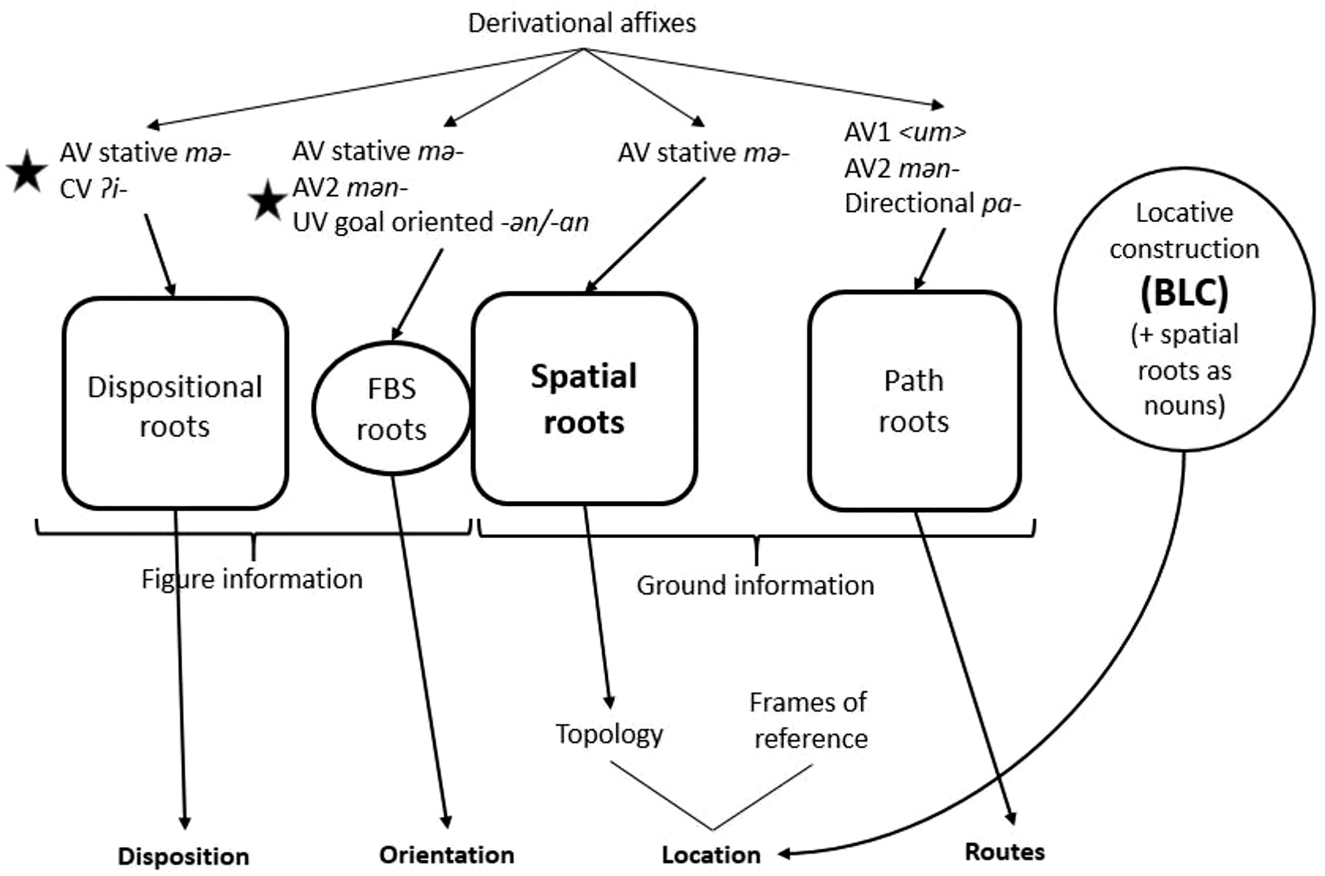
Lexical and grammatical components of Northern Alta spatial expressions.
9.1 The role of spatial roots in spatial expression
In relation to research question 4, which is concerned with spatial roots and their relation to other lexical resources, the preceding subsections show that the spatial domains explored rely on three different sets of roots: spatial roots (Table 1), dispositional roots (Table 2), and path roots (Table 3). The data also shows that each set of roots is predominantly used in one particular subdomain. Spatial roots differ from the two other sets in that they may occur in both nominal and verbal forms. In their nominal form, spatial roots play a central role in the expression of location, appearing as heads of the BLC’s ground phrases in both topological and coordinate systems. As to their occurrence as verbs in the expression of location, it is attested but marginal. On the other hand, verbs derived from FBS roots (a subtype of spatial roots) form predicates that are fundamental in the expression of orientation.
Disposition is expressed with verbs derived from dispositional roots, whereas routes are expressed with verbs derived from path roots, a set of roots that is complementary to spatial roots. Verbs derived from the three sets of roots are represented in the central part of Figure 4, and they are linked with an arrow to the spatial domain in which they operate. On the other hand, the nominal occurrence of spatial roots in the BLC is represented by a circle located on the right side of Figure 4. The circle is linked to the subdomain of location, in which the BLC and spatial roots (in ground phrases) play a central role.
9.2 Figure and ground information
In relation to the issue of the distribution of spatial information in the clause (research question 2), we observe that Northern Alta is a language that expresses ground information in spatial nominals, in path-verb predicates, and less importantly, in stative locational predicates. The language may also express figure information in predicates headed by FBS and dispositional verbs.
Starting with ground information, it is clear that the locative verb ʔisaj, which is the head of the BLC predicate, can be used with any kind of figure and thus does not specify any kind of figure-related information. The BLC ground phrase, on the other hand, is headed by spatial nominals that convey information on the ground. For example, the term saʔlaŋ ‘front’ presupposes a faceted ground, whereas the term siduŋ ‘underneath’ entails an elevated volume that generates a sheltered space underneath (i.e. the crown of a tree or the seat of a chair). In addition, due to the derivational pattern discussed in Section 2 and further explored in the Appendix, ground information, such as volumetric properties, axial properties or topographic features, may also be expressed in the predicate when it is headed by one of the path verbs presented in Section 8.4 or by a locational stative verb. For example, the path verb mən-ʔuddiʔ ‘go upstream’ implies a body of water such as a river or a stream which flows, and the stative verb mə-disalad ‘to be inside’ involves a ground with a hollow space.
As for information on the figure’s shape or geometry, it is encoded in both stative dispositional and orientational predicates (Sections 8.2 and 8.3 respectively). For example, the stative orientational verb mə-saʔlaŋ ‘to be facing’ presupposes a figure (not a ground) with a front facet, whereas the dispositional verb mə-ʔədsaŋ ‘to be lying’ entails a figure with an axis longer than the other one, with the long axis displayed horizontally.
Thus, Northern Alta is a language in which both figure and ground information can be expressed in the predicate. This particular distribution of spatial information is illustrated in Figure 4, in which the figure and ground information are represented with horizontal lines placed under the different types of spatial predicates.[27]
9.3 Voice alternations in spatial expression
Concerning the relationship between voice (voice-marking form and voice alternations) and the different spatial subdomains (research question 3), the data suggests that each subdomain favors a particular subset of voice affixes and that voice-marked constructions play two different roles in subdomains of spatial expression: they express pragmatic markedness of locations or dispositions, and the centrality of cues/grounds in orientation and route descriptions.
In the domain of location, there are two competing constructions. The locative clause (Section 7.2) is the most common device in the expression of location and, like the BLC, it is the most unmarked construction.[28] Location can also be expressed by voice-marked clauses in stative AV, as shown in (32) and (33). Our elicitation sessions confirm the locational semantics of such forms and their morphological productivity, which can be observed in the second column of the table in the Appendix. As a non-default type of locational clause, such voice-marked locative clauses are pragmatically more marked than the BLC. A possible reading of such statives is that the location of the figure is highlighted because it is perceived as nontypical, similarly to what happens with disposition (see Section 8.2), but for the domain of location, such a possibility still needs to be investigated in future work. As to the domain of disposition, the data shows that most scenes are expressed with voice-marked constructions. The preferred construction in this domain is a clause with the predicate headed by an AV stative derivation of a dispositional root. As shown in Section 8.2, when a particular setting is perceived as atypical (see Figure 3), speakers use a construction headed by a CV dynamic derivation of a dispositional root. Both dispositional constructions treat the figure as the subject and mark the ground in oblique or locative case, but differ in the fact that the CV dynamic derivation introduces an additional participant: the causer.
Moving on now to orientation, it is the subdomain expressed with the widest variety of constructions, several of which are voice-marked (Section 8.3). Orientational voice-marked expressions include clauses with predicates headed by AV verbs, either stative or dynamic, and dynamic verbs in undergoer voices, including PV and LV. The alternation between stative and dynamic verbs in the M&T task may be explained in terms of whether the spatial array is construed as a state of affairs or as a situation involving an animate agent that willfully orients his body towards a tree (a situation that is also described with the perception verbs ‘see’, ‘look’ presented in Section 8.3). Among the instances of dynamic verbs, we find two undergoer voices that sometimes alternate with actor voice: PV and LV. We have seen that such UV forms only appear in picture-internal orientation descriptions (i.e. those in which the tree is the cue) but not in picture-external descriptions. A possible explanation for this difference is that in picture-internal descriptions, the same cue appears in every card. This recurrence increases the possibility of treating the cue as a central element and selecting it as the subject of the orientational predicate. On the other hand, the cue in picture-external descriptions is variable and thus is perceived as less salient and is more likely to be marked in a case that has a non-definite reading, i.e. the oblique case in an AV clause. We have seen that the subject argument in LV constructions can take different semantic roles, such as stimulus or goal, as in (20) above, whereas in PV the subject is a more affected patient. Thus, considering the semantics of these affixes, LV constructions are more to be expected than PV in orientation descriptions, given that the cue/tree is only superficially affected, if affected at all. A difference between these two types of predicates is that PV forms only rely on the man’s front facet so that only the cards in which the man faces the tree are described in PV. A possible reading of these PV forms is that the tree is perceived as an obstacle that the man has to overcome or as something that is about to undergo a change of state (i.e. cut or hit in some way).
Finally, we have seen that in the domain of routes, most constructions are headed by verbs formed with a path root and the affixes AV1 <um>, AV2 mən-, and directional pa- (Section 8.4), and that the alternation between AV2 and AV1 verbs structures route descriptions. Examples of undergoer voice are scarce in this domain, but (50) shows a ground (the river) that is expressed in a locative phrase at the first mention and becomes more central at the second mention, as in (51), in which it is treated as the subject of the PV clause.
Figure 4 lists the types of affixes used in each spatial subdomain and uses stars to represent voice alternations in the domains in which they are most relevant: disposition and orientation.
10 Concluding remarks
This paper has explored spatial expression in Northern Alta, a Philippine-type language without spatial adpositions. It has identified a set of lexical and grammatical resources that are deployed in spatial expressions, summarized in Figure 4. Such resources include the locative clause (the language’s BLC) and a variety of constructions headed by spatial verbs, a type of verb that is formed by deriving roots from the three explored sets: spatial, dispositional, and path roots. The formation of such verbs is made possible by the productive morphological system of language, which allows the incorporation of both figure and ground information into the predicate. Such a distribution of spatial information makes Northern Alta (and Philippine-type languages in general) interesting from the perspective of the grammar of space. Furthermore, the morphological system allows the integration of spatial roots and spatial relations into the voice system. In this regard, the paper has shown that voice-marked constructions play at least two different roles in the spatial domains investigated: they contribute to the expression of different degrees of pragmatic markedness in locations and dispositions and they can also convey the centrality of cues in expressions of orientation and grounds in route descriptions.
The logical next step towards a more thorough grammar of space would include an examination of the spatial domains for which less data is available. These include motion and spatial deixis. An in-depth examination of motion could provide new insight into the use of voice constructions and would also provide sufficient data to address the question of the difference between verbs derived from path roots and those derived from their corresponding spatial roots. The data available shows that the former are clearly preferred in route descriptions, but this point has not been pursued any further. As to spatial deixis, it is perhaps the most promising avenue of future research given that Northern Alta exhibits a five-way contrast in its demonstrative system (Garcia-Laguia 2018: 123). Recent cross-linguistic research on demonstrative semantics observes that systems with four or more distinctions always involve additional parameters in addition to distance, including switching of anchorage, evidential distinctions, or frame of reference distinctions (Levinson et al. 2018: 37). A fine-grained analysis of demonstratives would shed light on their spatial semantics and would help to determine their possible non-spatial features.
Acknowledgements
My special gratitude goes to the speakers of Northern Alta and to Niclas Burenhult for their support and inspiration. I also wish to thank the editors and anonymous reviewers for their feedback. The research was supported by two grants from the Wenner-Gren Foundation (grant nos. UPD2019-0003 and UPD2020-0193).
Glossing abbreviations
- 1/2/3
-
first/second/third person
- abs
-
absolutive case
- av1
-
actor voice prefix 1
- av2
-
actor voice prefix 2
- av3
-
actor voice prefix 3
- cv
-
conveyance voice
- dem
-
demonstrative
- dir
-
directional
- dist
-
distal
- dp
-
determiner phrase
- gen
-
genitive case
- lk
-
linker
- loc
-
locative case
- lv
-
locative voice
- med
-
medial
- obl
-
oblique case
- p
-
plural
- pe
-
plural exclusive
- pi
-
plural inclusive
- pm
-
predicate marker
- prf
-
perfective
- prg
-
progressive
- prox
-
proximal
- pv
-
patient voice
- s
-
singular
- sp
-
specificity marker
- st
-
stative
Appendix: Table of verbal derivations of Northern Alta spatial terms
In relation to the voice forms that can be derived from spatial roots (research question 1), the table below provides a systematic account of the possible root-affix combinations. The table draws from all the datasets presented in Section 4. In the first stage, the forms appearing in the existing corpus were added. Subsequently, the table was completed with forms collected with the stimulus tasks. Finally, I conducted a number of elicitation sessions with a native speaker to test the forms that were missing. The elicited forms can be easily detected because of the numbers that follow them, which indicate the degree of acceptability of the speaker. For several reasons, such elicited forms must be taken with caution. Firstly, they were collected from only one native speaker, and judgments from other speakers have not been collected yet. Second, these elicitation sessions were not designed using standard methods for judgment tasks, such as the ones presented in Shütze and Sprouse (2013: 31–36). The scale used below is based on my own perception of the speaker’s reactions, in which (1) represents a form that was clearly rejected, and (5) means that a proposed form is accepted. Third, given that these examples are elicited, it is not clear to what extent they are representative of the language’s spatial expression. Nevertheless, the table provides an opportunity to observe the derivational pattern we are concerned with in this paper: the fact that those spatial terms can be regularly ‘verbed’ in different ways.
? = not probed
rejected
not rejected but provided an alternative form
accepted but with a recommended alternative form
accepted without alternative form
accepted with ʔuʔu ‘yes
| Actor voice | Undergoer voice | ||||||
|---|---|---|---|---|---|---|---|
| Root form | Stative | AV1 | AV2 | Locative voice | Patient voice | Conveyance voice | Directionals |
|
saʔlaŋ
‘front’ |
məsaʔlaŋ | sumaʔlaŋ | mənsaʔlaŋ (4) | saʔlaŋan | saʔlaŋən | ʔisaʔlaŋ | pasaʔlaŋ |
|
liʔud
‘back’ |
məliʔud | lumiʔud | mənliʔud (2) | liʔudan | ? | ʔiliʔud | paliʔud |
|
tagidlid
‘side’ |
mətagidlid | tumagidlid | məntagidlid | tagidlidan | tagidlidən (2) | ʔitagidlid | patagidlid |
|
digdig
‘side’ |
mədigdig | dumigdig | məndigdig | digdigan | digdigən | ʔidigdig | padigdig |
|
ʔawili
‘left’ |
məʔawili | ʔumawili | mənʔawili | ? | ? | ʔiawili | paʔawili |
|
diwanan
‘right’ |
mədiwanan (4) | dumiwanan | məndiwanan | ? | diwananən (4) | ʔidiwanan | padiwanan |
|
disalad
‘inside’ |
mədisalad | dumisalad | məndisalad (3) | ? | ? | ʔidisalad | padisalad |
|
gəsaʔ
‘outside’ |
məgəsaʔ (2) | guməsaʔ | məngəsaʔ (2) | ? | gəsaʔan | ʔigəsaʔ | pagəsaʔ (2) |
|
beŋli
‘middle’ |
məbəŋli (4) | buməŋli | mənbəŋli (1/4) | ? | (1) | ʔibəŋli | pabəŋli |
|
lawis
‘extremity’ |
məlawis | lumawis | mənlawis | lawisan | lawisən | ʔilawis | palawis |
|
taŋʔal
‘up’ |
mətaŋʔal | tumaŋʔal | (1) | taŋʔalan | taŋʔalən | ʔitaŋʔal | pataŋʔal |
|
təpdəʔ
‘down’ |
mətəpdəʔ | tuməpdəʔ | məntəpdəʔ(2-4) | ʔatəpdəʔan | ? | ʔitəpdəʔ | patəpdəʔ |
|
taʔpu
‘top’ |
mətaʔpu | tumaʔpu | məntaʔpu (3) | taʔpuan | ? | ʔitaʔpu | pataʔpu |
|
siduŋ
‘underneath’ |
məsiduŋ | sumiduŋ | mənsiduŋ (2) | siduŋan | ? | ʔisiduŋ | pasiduŋ |
|
diŋatu
‘upstream’ |
mədiŋatu (3) | dumiŋatu | məndiŋatu | diŋatuan (2) | ? | ʔidiŋatu | padiŋatu |
|
dilud
‘downstream’ |
mədilud (3) | dumilud | məndilud (4-1) | ? | ? | ʔidilud (3) | padilud |
|
dipaniŋ
‘across stream’ |
mədipaniŋ | dumipaniŋ | məndipaniŋ (1-3) | ? | (1) | ʔidipaniŋ | padipaniŋ |
|
dəbbəliw
‘opposite side’ |
mədəbbəliw | duməbbəliw | məndəbbəliw (4) | əddəbəlian (2) | əddəbəliən | ʔidəbbəliw | padəbbəliw (2) |
References
Ameka, Felix K. & Stephen C. Levinson. 2007. The typology and semantics of locative predicates: Posturals, positionals, and other beasts. Linguistics 45(5–6). 847–871. https://doi.org/10.1515/ling.2007.025.Search in Google Scholar
Ameka, Felix, Carlein de Witte & David P. Wilkins. 1999. Picture series for positional verbs: Eliciting the verbal component in locative descriptions. In David P. Wilkins (ed.), Manual for the 1999 field season, 48–56. Nijmegen: Max Planck Institute for Psycholinguistics.Search in Google Scholar
Blust, Robert. 2013. The Austronesian languages, revised edn. Canberra: Asia-Pacific Linguistics.Search in Google Scholar
Bohnemeyer, Jürgen. 2017. Organization of space. In Judith Aissen, Nora C. England & Roberto Zavala Maldonado (eds.), The Mayan languages, 327–347. London: Routledge.10.4324/9781315192345-12Search in Google Scholar
Bohnemeyer, Jürgen & Penelope Brown. 2007. Standing divided: Dispositionals and locative predications in two Mayan languages. Linguistics 45(5–6). 1105–1151. https://doi.org/10.1515/ling.2007.033.Search in Google Scholar
Bowerman, Melissa & Eric Pederson. 1993. Topological relations picture series. In Eve Danziger & Deborah Hill (eds.), Manual for the space stimuli kit 1.2, 40–50. Nijmegen: Max Planck Institute for Psycholinguistics.Search in Google Scholar
Brown, Penelope. 2006. A sketch of the grammar of space in Tzeltal. In Stephen C. Levinson & David P. Wilkins (eds.), Grammars of space: Explorations in cognitive diversity, 230–272. Cambridge: Cambridge University Press.10.1017/CBO9780511486753.008Search in Google Scholar
CARG (Cognitive Anthropology Research Group). 1992. Space stimuli kit 1.2. Nijmegen: Max Planck Institute for Psycholinguistics.Search in Google Scholar
Chelliah, Shobhana L. & Willem J. de Reuse. 2011. Handbook of descriptive linguistic fieldwork. Dordrecht: Springer.10.1007/978-90-481-9026-3Search in Google Scholar
Chen, Victoria & Bradley McDonnell. 2019. Western Austronesian voice. Annual Review of Linguistics 5. 173–195. https://doi.org/10.1146/annurev-linguistics-011718-011731.Search in Google Scholar
English, Leo J. 1986. Tagalog-English dictionary. Manila: National Book Store.Search in Google Scholar
Fortis, Jean-Michel. 2003. Voix et relations spatiales en tagalog [Voice and spatial relations in Tagalog]. Bulletin de la Société de Linguistique de Paris 98(1). 455–484. https://doi.org/10.2143/bsl.98.1.503785.Search in Google Scholar
Gallego, Maria Kristina S. 2018. Directional systems in Philippine languages. Oceanic Linguistics 57(1). 63–100. https://doi.org/10.1353/ol.2018.0002.Search in Google Scholar
Garcia-Laguia, Alexandro X. 2017. Documentation of Northern Alta, a Philippine Negrito language. Endangered Languages Archive. http://hdl.handle.net/2196/00-0000-0000-000F-BF5C-0 (accessed 31 May 2022).Search in Google Scholar
Garcia-Laguia, Alexandro X. 2018. Documentation of Northern Alta: Grammar, glossary and texts. Barcelona: University of Barcelona dissertation.Search in Google Scholar
Himmelmann, Nikolaus P. 2005. The Austronesian languages of Asia and Madagascar: Typological characteristics. In Nikolaus P. Himmelmann & Alexander Adelaar (eds.), The Austronesian languages of Asia and Madagascar, 110–181. London: Routledge.Search in Google Scholar
Himmelmann, Nikolaus P. 2008. Lexical categories and voice in Tagalog. In Peter Austin & Simon Musgrave (eds.), Voice and grammatical functions in Austronesian languages, 247–293. Stanford: Center for the Study of Language and Information.Search in Google Scholar
Huang, Shuanfan & Michael Tanangkingsing. 2006. Reference to motion events in six Western Austronesian languages: Toward a semantic typology. Oceanic Linguistics 44(1). 307–340.10.1353/ol.2005.0035Search in Google Scholar
Klimenko, Sergey. 2012. Motion verbs in Tagalog, Ilokano, and Tuwali Ifugao. Manila: University of the Philippines Diliman MA thesis.Search in Google Scholar
Landau, Barbara & Ray, Jackendoff. 1993. “What” and “where” in spatial language and spatial cognition. Behavioral and Brain Sciences 16(2). 217–238. https://doi.org/10.1017/s0140525x00029733.Search in Google Scholar
Latrouite, Anja. 2011. Voice and case in Tagalog: The coding of prominence and orientation. Düsseldorf: Heinrich Heine University Düsseldorf dissertation.Search in Google Scholar
Levinson, Stephen C. 2003. Space in language and cognition: Explorations in cognitive diversity. Cambridge: Cambridge University Press.10.1017/CBO9780511613609Search in Google Scholar
Levinson, Stephen C., Sarah Cutfield, Michael J. Dunn, Nick J. Enfield & Sérgio Meira (eds.). 2018. Demonstratives in cross-linguistic perspective. Cambridge: Cambridge University Press.10.1017/9781108333818Search in Google Scholar
Levinson, Stephen C. & David P. Wilkins (eds.). 2006. Grammars of space: Explorations in cognitive diversity. Cambridge: Cambridge University Press.10.1017/CBO9780511486753Search in Google Scholar
Osborne, Dana. 2015. Negotiating the hierarchy of languages in Ilocandia: The social and cognitive implications of massive multilingualism in the Philippines. Tucson, AZ: The University of Arizona dissertation.Search in Google Scholar
Palmer, Bill, Jonathon Lum, Jonathan Schlossberg & Alice Gaby. 2017. How does the environment shape spatial language? Evidence for sociotopography. Linguistic Typology 21(3). 457–491. https://doi.org/10.1515/lingty-2017-0011.Search in Google Scholar
Rau, D. Victoria, Chun-Chieh Wang & Hui-Huan Ann Chang. 2012. Investigating motion events in Austronesian languages. Oceanic Linguistics 51(1). 1–17. https://doi.org/10.1353/ol.2012.0006.Search in Google Scholar
Reid, Lawrence A. 1991. The Alta languages of the Philippines. In Harlow Ray (ed.), VICAL 2, Western Austronesian and contact languages: Papers from the Fifth International Conference on Austronesian Linguistics (ICAL) (Te Reo Special Publication), 265–297. Auckland: Linguistic Society of New Zealand.Search in Google Scholar
Reid, Lawrence A. 1992. On the development of the aspect system in some Philippine languages. Oceanic Linguistics 31(1). 65–91. https://doi.org/10.2307/3622966.Search in Google Scholar
Rubino, Carl R. G. 2000. Ilocano dictionary and grammar: Ilocano-English, English-Ilocano (PALI Language Texts). Honolulu: University of Hawai‘i Press.10.1515/9780824850494Search in Google Scholar
Rubino, Carl R. G. 2001. Iconic morphology and word formation in Ilocano. In F. K. Erhard Voeltz & Christa Kilian-Hatz (eds.), Ideophones (Typological Studies in Language 44), 303–320. Amsterdam: John Benjamins Publishing.10.1075/tsl.44.24rubSearch in Google Scholar
Rubino, Carl R. G. 2005. Iloko. In Nikolaus P. Himmelmann & Adelaar Alexander (eds.), The Austronesian languages of Asia and Madagascar, 326–349. London: Routledge.Search in Google Scholar
Schultze-Berndt, Eva. 2006. Sketch of a Jaminjung grammar of space. In Stephen C. Levinson & David P. Wilkins (eds.), Grammars of space: Explorations in cognitive diversity, 63–114. Cambridge: Cambridge University Press.10.1017/CBO9780511486753.004Search in Google Scholar
Schütze, Carson T. & Jon Sprouse. 2013. Judgment data. In Robert J. Podesva & Devyani S. Sharma (eds.), Research methods in linguistics, 27–50. Cambridge: Cambridge University Press.10.1017/CBO9781139013734.004Search in Google Scholar
Shibatani, Masayoshi. 2006. On the conceptual framework for voice phenomena. Linguistics 44(2). 217–269. https://doi.org/10.1515/ling.2006.009.Search in Google Scholar
Talmy, Leonard. 1975. Figure and ground in complex sentences. Berkeley Linguistics Society 1. 419–430.10.3765/bls.v1i0.2322Search in Google Scholar
Terrill, Angela & Niclas Burenhult. 2008. Orientation as a strategy of spatial reference. Studies in Language 32(1). 93–136. https://doi.org/10.1075/sl.32.1.05ter.Search in Google Scholar
© 2022 the author(s), published by De Gruyter, Berlin/Boston
This work is licensed under the Creative Commons Attribution 4.0 International License.
Articles in the same Issue
- Frontmatter
- Articles
- How do middle voice markers and valency reducing constructions interact? Typological tendencies and diachronic considerations
- The acoustics of plosives and the formation of prosodic structure in Polish
- Bi-absolutive constructions in Chechen
- Giving voice to space: the grammar of Northern Alta spatial roots
- Grammatically unstable placeholders and morpho-syntactic remedies: evidence from East Asian languages
- Nonconvergence toward the standard: the maintenance of a distinctive use of rhotics among the Santomean diaspora in Portugal
- Discussion
- Adpositions and their distribution: a reply to Zygmunt Frajzyngier’s ‘Toward a functional typology of adpositions: theoretical implications’
- Meaning encoded in the grammatical system: a rejoinder
- Review Article
- On Dixon’s ‘dangerous idea’
- Book Reviews
- Tibor Laczkó: Lexicalising clausal syntax: The interaction of syntax, the lexicon and information structure in Hungarian
- Juho Ruohonen and Juhani Rudanko: Infinitival vs gerundial complementation with afraid, accustomed, and prone: Multivariate corpus studies
- Laura Becker: Articles in the world’s languages
- Ana Werkmann Horvat: Layers of modality: On double modal constructions by the example of Croatian
- Veronika Hegedűs & Katalin É. Kiss (eds.): Syntax of Hungarian: postpositions and postpositional phrases
Articles in the same Issue
- Frontmatter
- Articles
- How do middle voice markers and valency reducing constructions interact? Typological tendencies and diachronic considerations
- The acoustics of plosives and the formation of prosodic structure in Polish
- Bi-absolutive constructions in Chechen
- Giving voice to space: the grammar of Northern Alta spatial roots
- Grammatically unstable placeholders and morpho-syntactic remedies: evidence from East Asian languages
- Nonconvergence toward the standard: the maintenance of a distinctive use of rhotics among the Santomean diaspora in Portugal
- Discussion
- Adpositions and their distribution: a reply to Zygmunt Frajzyngier’s ‘Toward a functional typology of adpositions: theoretical implications’
- Meaning encoded in the grammatical system: a rejoinder
- Review Article
- On Dixon’s ‘dangerous idea’
- Book Reviews
- Tibor Laczkó: Lexicalising clausal syntax: The interaction of syntax, the lexicon and information structure in Hungarian
- Juho Ruohonen and Juhani Rudanko: Infinitival vs gerundial complementation with afraid, accustomed, and prone: Multivariate corpus studies
- Laura Becker: Articles in the world’s languages
- Ana Werkmann Horvat: Layers of modality: On double modal constructions by the example of Croatian
- Veronika Hegedűs & Katalin É. Kiss (eds.): Syntax of Hungarian: postpositions and postpositional phrases
