The Role of Sunk Cost and Slack Resources in Innovation: A Conceptual Reading in an Entrepreneurial Perspective
-
Salvatore Esposito De Falco


Abstract
This paper proposes a conceptual reading of the interplay between sunk costs and slack resources in innovation, adopting an entrepreneurial perspective. Antecedent literature mostly depicts the relationship between slack and innovation as an inverse u-shaped curve. However, this approach is way too unrealistic and it does not take in account both the different impact of heterogeneous types of slack and of sunk costs. We argue that not all slacks positively contribute to innovation and, hence, the u-shaped relationship is merely verified in case of highly flexible slack resources. In addition, the presence of sunk costs is a friction factor, which makes the first part of the curve less steep. Therefore, entrepreneurs are solicited to innovation by the presence of some easy recoverable slack types, as financial or knowledge ones. On the converse, a consistent level of sunk cost may discourage their innovative activity. In this setting, absorbed slack resources increase the level of sunk costs.
1 Introduction
The aim of the current conceptual model is to shed a light on slack resources dynamics in innovation, in presence of sunk costs. We distinguish the effect of slack on innovation, according to the level of flexibility of underlying resources, and in case of presence -or absence – of sunk costs. The relationship among innovation, sunk costs, and organizational slack is characterized by an extreme complexity, because of the casual ambiguity among variables. Previous literature agrees on the counteracting role of sunk costs on innovation, but, differently, the effect of slack is still not clear. In addition, studies concerning the effects of both variables on innovation are rather scant.
According to an epistemological orientation, we can distinguish between two approaches to sunk costs: one that is collective and more intrinsic value based; and another one that is more psychological and individual. The latter stream mainly refers to the sunk costs effect (Arkes and Blumer 1985; Arkes 1991; Kahneman et al. 1991; Arkes 1996), for what people prefers maintaining the status quo over the change.
The consequence is the innovation results, at least, postponed; while already in being projects or technology are kept, mostly with an escalation of commitment. On the opposite, and according to an intrinsic value perspective, other extant researches argue that the evaluation of sunk costs is somewhat rational (Friedman et al. 2007; O’Brian and Folta 2009): decision makers have to weigh the switching to something new, considering the total cost of transition, including costs deriving from irreversible investments. Innovation itself is a sunk cost.
Disregard the epistemological orientations, all scholars mostly agree on the negative impact of sunk costs on innovation. Thereby, major delays in innovation are mostly due to sunk costs. The scholarly panorama is much more manifold for what concerns the interplay between slack of resources and innovation. Organizational slack is that amount of exceeding resources, eventually available for managerial discretionary use (March 1981; Bourgeois, 1981; Moses, 1992). Nohria and Gulati (1996, 1997) depict a u-shaped relation between slack and innovation, looking at innovation as a path dependent phenomenon, which is linked to slack search. The more the resource underlying the slack is flexible, as instance as financial resources or knowledge with alternative uses, the more it leverages innovation. That part of slack labeled as absorbed, according to the easy-of recovery taxonomy, negatively interact with innovation. After a given threshold of slack, an excess of costs has a detrimental impact on the generation of something new.
As emerging from this brief introduction to the topic, there’s such an ambiguity when considering at the same time both slack and sunk cost effects on innovation. Thus, the study of innovation drivers is in the need of a unified framework for the two mentioned effects, sunk costs and organizational slack. This kind of studies has several implications. At a scholar level, one of the long-standing issue is the role of slack resources. In our opinion, a better understanding of slack dynamics stems from the clarification of its nature, as default unrecoverable cost – and, hence, sunk costs – or as usable fuel for new projects and investments. Second, at a practicing level, entrepreneurs have to deal with the trade-off between sunk costs and slack, when making a decision to innovate. Hence, knowing ex ante which one of the two role is played by slack in innovation, if sunk cost or potential opportunity, is a valuable tool for optimizing decisions. In other terms, the prevalence of the cost role over the inventory role for slack, could lead to opt for the status quo and efficiency maneuvers. A greater flexibility of resources makes alternative plans’ gains loom larger than potential losses linked to sunk costs.
Therefore, in the current paper we propose our conceptual interpretation of the relationship between slack and sunk costs in innovation, revising the classic u-shaped curve relationship. The paper is structured as follows: first, we make a recognition of the main literature’s antecedents; second, we discuss our conceptual model, posing the ground for future empirical tests. In the last section, we propose our conclusions and some hints for future further investigations.
2 Path Dependent Factors, Innovation and the Entrepreneur Role
The idea of entrepreneur as an innovator is central in Schumpeter’ works (Schumpeter 1934, 1939). Historically, literature has seen entrepreneurs as a particular category of individuals, endowed with specific characteristics that let them modify the environment, and seeing, trough the forest, those opportunities that deserve to be pursued: hence, this visionary attitude, coupled with a particular ability to read the environment, let entrepreneurs carry the risk of new ventures, in face of uncertainty. For Kirzner (1979), this special attitude to detect external signals is the given by the “alertness”.
Consistently, in a resource-based approach, entrepreneurs are those individuals who have the capabilities to recognize new opportunities and to assemble resources accordingly (Alvarez and Busenitz 2001). Therefore, they catch the value of resources’ heterogeneity, detecting existing unexploited opportunities (Kirzner 1979; Casson 1982), thanks to individual belief and heuristics that impact the decision making process differently from managers (Wright et al. 2000).
However, if, on one hand, entrepreneurs take advantage of innovative resources’, resembling them, as it happens in case of slack resources and innovation; on the other hand, they have to face the presence of sunk costs. This last factor creates entry barriers, reducing market contestability (Baumol et al. 1982). To understand why entrepreneurs decide to pursue a new initiative, carrying the risk in spite of uncertainty and sunk cost, literature have often recurred to the idea for what that they have a different perception of risk than other individuals, and they use different cognitive schemas (Baron 2004). More than riskier, they weigh risk less than average individuals (Kahneman and Lovallo 1994). In addition, according to a model named pattern recognition, they are able to catch salient stimuli, and, namely, uncovered opportunities, which are organized in a complex array (Baron 2004). The complex array of stimuli can arise as a bundle of slack resources: in fact, “Persistant slack implies the existence of entrepreneurial opportunities” (Leibenstein 1968, 75). Therefore, for Leibenstein (1968) the endowment of slack resources affects entrepreneurs’ attention and perception. Miller (2011) standpoint partly deviates from this argument: the entrepreneur does not intake environmental stimuli, and, hence, slack resources act as a store that allows a more mechanical approach.
3 Sunk Costs as an Innovation Inhibitor Factor
By definition, sunk costs are already incurred expenses, that cannot be recovered. They are the consequence of a previous effort, made in order to obtain a certain goal. Under a rational setting, they should not be considered when evaluating alternative courses of action; but, as a matter of fact, their existence is a driver of organizational inertia and inhibits change (Arkes and Blumer 1985; Stiglitz et al. 1987; Garland and Conlon, 1998; O’Brian and Folta 2009). Thereby, sunk costs are generally considered a barrier to innovation (O’Brian and Folta 2009; Mànez et al. 2009).
It is possible two distinguish two main streams in literature, according to study’s epistemological orientation: a subjective view, at an individual level, which takes into consideration the mental accounting for sunk cost, in a psychological perspective; and an objective and collective view, at an organizational level; basically anchored to project’s intrinsic value. In the behavioral stream, scholars investigates how the presence of sunk costs affect the decision making process, causing judgments errors that let the subject prefers the old over the new (Arkes and Blumer 1985; Arkes 1991; Kahneman et al. 1991; Arkes 1996), with disregard to the effectiveness of the previous course of actions. On the converse, the intrinsic value perspective to sunk costs assumes that is perfectly rational to evaluate this kind of cost, before making a new investment decision (Friedman et al. 2007; O’Brian and Folta 2009). Festinger (1957), in its Theory of Cognitive Dissonance, argue there’s some resistance to admit a failure, at the basis of the entrapment in an ineffective path. For Tversky and Kahneman (1981, 457) “a sunk cost effect arises when a decision is referred to an existing account in which the current balance is negative”. Hence, in case of failure, an individual prefers to make further attempts to recoup sunk costs (Arkes 1991), with an escalation of efforts, before quitting the previous course of action. The psychological root is that actors refuse to admit their wastefulness (Arkes 1996). As a consequence, this situation determines what is known as house-money effect (Thaler and Johnson 1990), for what sunk costs cause the unwillingness of an individual to accept a new gamble. According to a different interpretation, sunk costs increase the need for project completion (Lichtenstein et al. 1982), that is the other side of the escalation of commitment (Kanodia et al. 1989).
4 Slack Resources and Innovation
Innovation is the result of a learning process, that could assume different shapes, from learning by doing, to learning by searching (Rosenberg 1982). Thus, the generation of new knowledge can happen both when exploring alternative uses or new combinations for existing resources, and when exploring for an ad-hoc new solution for an existing problem. Moreover, the more the world become interconnected, the more also this process becomes “open”, to include the external dimension of socialization and the contribute of lead users (von Hippel 2005; Chesbrough 2003). The recombination of old and new or the co-building of a new knowledge, in cooperation with external subjects, require a certain degree of resource flexibility and coordination flexibility (Sanchez 1995, 1997), or the possibility of multiple reconfigurations of the same resource in different process and with different employments. In this sense, innovation can be intended as a path dependent process, where resources already owned by the firm, opportunely recombined, can lead to a new knowledge, usable to reach or keep the competitive advantage. In particular, only flexible and recoverable resources can be employed in the generation of something new, whilst absorbed resources have already deployed their value, depleting their function with investments’ idiosyncrasy.
We argue that this is properly the role of some slack resources. For Levinthal and March (1993), slack resources are a sort of knowledge inventories, without a clear destination, eventually available in facing of external uncertainty and environmental dynamicity. Their flexibility in employment and availability is a characteristic of the so-called discretionary slack (Sharfman and Dean 1997; Sharma 2000). A further prerogative of slack is its exceeding nature, with regard to business continuity requirements (Moses 1992): according to an institutional perspective, organizational slack arises from the “disparity between the resources available to the organization and the payments required to maintain coalition” (Cyert and March 1963, 61). Mostly, antecedent literature attribute a role of buffer under uncertainty to slack resources (Thompson 1967; March 1981; Bourgeois, 1981).
It is possible to classify slack resources according to different criteria. Basing on the ontological dimension, slack can be endogenous or exogenous or characterized by different degrees of recoverability (George 2005; Bourgeois and Singh 1983; Sharfman et al. 1988). One useful taxonomy classifies slack basing on its “easy-of-recovery” (Mishina et al. 2004), distinguishing among the unabsorbed slack, the absorbed slack, and the potential slack (Bourgeois, 1981; Singh 1986): the first one is mostly liquid and is available for alternative plans; the latter one is already employed, but is eventually recoverable after efficiency maneuvers; the last one is mostly linked to firm’s capability of attracting further financial resources in the future. Scholars have contrasting opinions on the role of slack in firms development: part of them suggest that slack has a positive influence on firm performance, including the consideration of strategic growth trough innovation (Singh 1986; Sanchez 1995); others argue that it magnifies organizational inertia and it is a waste of resources, due to firm’s inefficiency (Thompson 1967; Jensen 1986; Nohria and Gulati 1996). In innovation, slack resources could play the positive role of buffer for uncertainty (Bourgeois 1981; Freeman et al. 1983; O’Brien 2003), fostering the origination or the adoption of a novelty. Nohria and Gulati (1996) suggest that slack have both a positive and a negative role in innovation, depicting this relationship as a u-shaped curve. Burgelman (1983) links the slack to internal corporate venturing and R&D initiatives, arguing that there’s a lag time between the formation of slack and its noticing by decision makers.
5 A Conceptual Model for the Relationship among Sunk Cost, Slack Resources and Innovation
As emerging from previous literature’s findings, slack resources have an ambiguous nature, and their ultimate impact on firm’s performance and on innovation is still a an unattained research objective. Taking the spark from Nohria and Gulati (1996) insights on the trade-off between slack and innovation, we propose a conceptual revision for the u-shaped curve, considering the role of sunk costs. To fill the literature gap, first, we adopt the “easy-of recovery” taxonomy, to the end of categorizing the slack’s role, according to each pattern of recoverability. Second, we take in consideration the presence of sunk costs. We adopt the entrepreneurial view to resource re-combination and opportunities catching, as described in the first section. Hence, the entrepreneur originally reassembles different types of slack to catch an uncovered opportunity. However, he has to face the presence of sunk costs, both from a subjective standpoint and from an intrinsic value perspective. The model is discussed in the following paragraphs.
The Relationship Between Slack Resources and Innovation Adopting the Easy-of-Recovery Classification of Slack Types.
Slack resources are characterized by different degrees of recoverability. For this reason, it is possible to categorize slack as unabsorbed slack; absorbed slack; and potential slack. In our model, we argue the ambiguous role of slack can be investigated considering the impact on innovation of each single type of slack, at a time. In particular, we suggest the more linked resources are flexible, the greater is slack’s usefulness in innovation and growth plans. Naturally, the most flexible slack is the financial one. More in general, the unabsorbed slack includes other types of flexible resources, as knowledge with multiple destination of use. According to a hierarchical order of flexibility, it follows the potential slack, and, finally, the absorbed slack. Therefore, considering the relationship stated in the u-shaped curve, innovation is an increasing function of both immediate slack and potential slack, whilst it is a decreasing function of absorbed slack. The reason relies in the answer to the question of “what is the optimum amount of slack?”. Of course, there isn’t any a priori “one best fit” measure for all firms, but we suggest the criteria to distinguish the positive and negative slack is strictly ingrained in its recoverability. In fact, the absorbed slack is a manifestation of firm inefficiency, due to an ineffective resource allocation. More time and effort is required to recover this slack, than appropriate with the aim of efficiency recovering. As a consequence, this kind of slack mainly flows into those non-recoverable expenses named sunk costs. On the converse, immediate slack is available for other employments, and it must be timely employed, in further projects, as innovation ones. Therefore, innovation can be definitely fostered by the presence of this kind of slack. Finally, potential slack is somewhat predictor of future financial resources available for the firm: consequently, also this kind of slack is useful for soliciting exploration and external innovation’s acquisition.
So, the first assumption is that both unabsorbed and potential slack are innovation’s supporters, confirming the inverse u-shaped relationship. In fact, the more is their amount, the more is the potentiality to pursue innovation patterns. However, after a certain threshold, the relationship becomes negative. The described dynamics of the relationship between available slack resources and innovation is depicted as follows (Figure 1). According to the agency theory interpretation of Nohria and Gulati (1996, 1997), the shape of the curve depends on the fact that after a certain level of slack, managers can have opportunistic behaviors. So, slack can both financing innovation and lead to distortive behaviors.

The inverse u-shaped relationship between innovation propensity and available slack resources.
Differently, absorbed slack can be mainly considered as a sunk cost, because it refers to resources already employed. Hence, absorbed slack is chiefly an inhibitor of innovation (Figure 2).

The inverse relationship between innovation and absorbed slack.
Recoverability of Slack Resources, Sunk Costs, and Innovation: A Clarification and Revision of the Inverse U-Shaped Curve
Sunk costs are itself an inhibitor of innovation, either if we consider them from a subjective standpoint or from an intrinsic value perspective. Thereby, also in case of available slack resources, usable to foster innovation, their presence is an obstacle for entrepreneurial activity. Available slack can be absorbed in the attempt to recoup sunk cost. Hence, the greater is the level of sunk cost or the sunk cost effect, the less is the probability that slack resources will be employed in the innovation development. According to this consideration, we propose a revision of the u-shaped curve. In particular, adding sunk cost to the conceptual model, we have that available slack will be firstly used in the attempt to recoup sunk cost. For high level of unabsorbed slack, the innovation can be pursued employing slack resources. So, there’s a part of the entrepreneur’s propensity to innovation that is independent by the level of slack. But, at the same time, before they engage a new challenge, exploiting slack resources, they tend to firstly employ them to recoup sunk costs. Hence, part of slack resources end to determine an escalation of commitment (Figure 3).
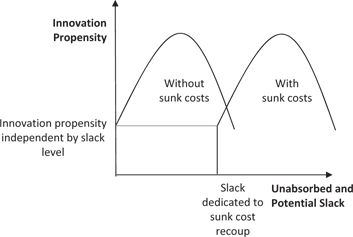
The relationship among innovation, slack resources and sunk costs.
That means, decisions assumed by entrepreneurs are critical to define the impact of unabsorbed slack on innovation, whether positive or negative. In a path dependent logic, the effects of current entrepreneurial decisions act on future possible uses of the unabsorbed slack. From this point of view, the entrepreneurial capability to anticipate future produces effects on actual possibilities of innovation, basing on their ability to optimize resource allocation. Hence, the u-shaped curve is not only explained by the presence of agency costs, but also adopting a path dependent logic. Therefore, the linkage between entrepreneurship and innovation propensity could have a more coherent explanation adopting a path dependent logic, than merely the agency theory.
6 Concluding Remarks
The current paper suggests that the role of slack resources in innovation can have a more clear explanation, if we consider single types of slack at a time, and also the presence of sunk costs. Unabsorbed and potential slack positively interact with entrepreneurial propensity to innovation, differently from absorbed slack. However, the presence of sunk costs can be a reducing factor for their positive influence. Previously, the u-shaped relationship between slack and innovation was explained mostly adopting the agency theory and the possibility of opportunistic behaviors by managers. However, this logic does not takes in consideration the entrepreneurial role. We propose a resource-based and path dependent approach to the u-shaped curve, to fit with the role of entrepreneur. The u-shaped curve considers also the presence of a negative relationship between slack and innovation. Future research might focus on finding a clear explanation of this last effect. many factors can contribute to the negative dynamics between slack resources and innovation. As instance, the problem could be addressed in terms of opportunity-cost. That means, there’s a risk -return trade-off between increasing slack resources and innovation propensity: after certain levels of slack, an excess of risk could reduce the innovation propensity, even triggering a negative effect. Scholars are called for having a more in-depth vision of the phenomenon, and for finding further explanations of the possibility of a negative relationship between slack and innovation, trough robust testing, and adopting an entrepreneurial logic.
References
Alvarez, S. A., and L. W.Busenitz. 2001. “The Entrepreneurship of Resource-Based Theory.” Journal of Management27 (6):755–75.10.1177/014920630102700609Search in Google Scholar
Arkes, H. R.1991. “Costs and Benefits of Judgment Errors: Implications for Debiasing.” Psychological Bulletin110 (3):486.10.1037/0033-2909.110.3.486Search in Google Scholar
Arkes, H. R.1996. “The Psychology of Waste.” Journal of Behavioral Decision Making9 (3):213–24.10.1002/(SICI)1099-0771(199609)9:3<213::AID-BDM230>3.0.CO;2-1Search in Google Scholar
Arkes, H. R., and C.Blumer. 1985. “The Psychology of Sunk Cost.” Organizational Behavior and Human Decision Processes35 (1):124–40.10.1016/0749-5978(85)90049-4Search in Google Scholar
Baron, R. A.2004. “The Cognitive Perspective: A Valuable Tool for Answering Entrepreneurship’s Basic “Why” Questions.” Journal of Business Venturing19 (2):221–39.10.1016/S0883-9026(03)00008-9Search in Google Scholar
Baumol, W. J., J.Panzar, and R.Willig. 1982. Contestable Market and the Theory of Industrial Structure. New York: Harcout Brace Javanovich Ltd.Search in Google Scholar
Bourgeois, L. J.1981. “On the Measurement of Organizational Slack.” Academy of Management Review6 (1):29–39.10.2307/257138Search in Google Scholar
Bourgeois, L. J., and J. V.Singh. 1983 Organizational Slack and Political Behavior Among Top Management Teams. In Academy of Management Proceedings, vol. 1983, no. 1, pp. 43–47. Academy of Management.10.5465/ambpp.1983.4976315Search in Google Scholar
Burgelman, R. A.1983. “Corporate Entrepreneurship and Strategic Management: Insights From a Process Study.” Management Science29 (no. 12):1349–64.10.1287/mnsc.29.12.1349Search in Google Scholar
Casson, M. C. (1999)/(1982). The entrepreneur: An economic Theory, Oxford: Martin Robertson, 2nd ed. Edward, Elgar.Search in Google Scholar
Cheng, J. L. C., and I. F.Kesner. 1997. “Organizational Slack and Response to Environmental Shifts: The Impact of Resource Allocation Patterns.” Journal of Management23 (1):1–18.10.1177/014920639702300101Search in Google Scholar
Chesbrough, H. W.Open Innovation: The New Imperative for Creating and Profiting From Technology. Harvard Business Press, 2003.Search in Google Scholar
Cyert, R. M., and J. G.March. 1963. A Behavioral Theory of the Firm., 2. Englewood Cliffs, NJ: Prentice-Hall.Search in Google Scholar
Festinger, L.1957. A Theory of Dissonance Cognitive. Evanston: Row.Search in Google Scholar
Freeman, J., G. R.Carroll, and M. T.Hannan. 1983. “The Liability of Newness: Age Dependence in Organizational Death Rates.” American Sociological Review48 (5):692–710.10.2307/2094928Search in Google Scholar
Friedman, D., K.Pommerenke, R.Lukose, G.Milam, and B. A.Huberman. 2007. “Searching for the Sunk Cost Fallacy.” Experimental Economics10 (1):79–104.10.1007/s10683-006-9134-0Search in Google Scholar
Garland, H., and D. E.Conlon. 1998. “Too Close To Quit: The Role of Project Completion in Maintaining Commitment1.” Journal of Applied Social Psychology28 (22):2025–48.10.1111/j.1559-1816.1998.tb01359.xSearch in Google Scholar
George, G.2005. “Slack Resources and the Performance of Privately Held Firms.” Academy of Management Journal48 (4):661–76.10.5465/amj.2005.17843944Search in Google Scholar
Hambrick, D. C., and R. A.D‘Aveni. 1988. “Large Corporate Failures as Downward Spirals.” Administrative Science Quarterly33 (1):1–23.10.2307/2392853Search in Google Scholar
Jensen, M. C.1986. “Agency Cost of Free Cash Flow, Corporate Finance, and Takeovers. Corporate Finance, and Takeovers.” American Economic Review76 (2):323–29.Search in Google Scholar
Kahneman, D., J. L.Knetsch, and R. H.Thaler. 1991. “Anomalies: The Endowment Effect, Loss Aversion, and Status Quo Bias.” The Journal of Economic Perspectives5 (1):193–206.10.1257/jep.5.1.193Search in Google Scholar
Kahneman, D., and D.Lovallo. 1993. “Timid Choices and Bold Forecasts: A Cognitive Perspective on Risk Taking.” Management Science39 (1):17–31.10.1287/mnsc.39.1.17Search in Google Scholar
Kanodia, C., R.Bushman, and J.Dickhaut. 1989. “Escalation Errors and the Sunk Cost Effect: An Explanation Based on Reputation and Information Asymmetries.” Journal of Accounting Research27 (1):59–77.10.2307/2491207Search in Google Scholar
Kirzner, I. M.1979. “Knowing About Knowledge: A Subjectivist View of the Role of Information.” In Perception, Opportunity, and Profit: Studies in the Theory of Entrepreneurship, edited by I.Kirzner, 137–53. Chicago: University of Chicago.Search in Google Scholar
Kirzner, I. M.1979. Perception, Opportunity and Profit. Chicago: University of Chicago.Search in Google Scholar
Leibenstein, H.1968. “Entrepreneurship and Development.” The American Economic Review58 (2):72–83.Search in Google Scholar
Levinthal, D. A., and J. G.March. 1993. “The Myopia of Learning.” Strategic Management Journal14 (S2):95–112.10.1002/smj.4250141009Search in Google Scholar
Lichtenstein, S., B.Fischoff, and L.Phillips. 1982. “Calibration of Probabilities: The State of the Art to 1980.” In Judgement Under Uncertainty: Heuristics and Biases, edited by D.Kahneman, P.Slovic, and A.Tversky, 306–34, Cambridge: Cambridge University Press.Search in Google Scholar
March, J. G.1981. “Footnotes to Organizational Change.” Administrative Science Quarterly26 (4):563–77.10.2307/2392340Search in Google Scholar
Mañez, J. A., M. E.Rochina-Barrachina, A.Sanchis-Llopis, and J. A.Sanchis. 2009. “The Role of Sunk Costs in the Decision to Invest in R&D.” The Journal of Industrial Economics57 (4):712–35.10.1111/j.1467-6451.2009.00398.xSearch in Google Scholar
Miller, D.2011. “Miller (1983) Revisited: A Reflection on EO Research and Some Suggestions for the Future.” Entrepreneurship Theory and Practice35 (5):873–94.10.1111/j.1540-6520.2011.00457.xSearch in Google Scholar
Mishina, Y., T. G.Pollock, and J. F.Porac. 2004. “Are More Resources Always Better for Growth? Resource Stickiness in Market and Product Expansion.” Strategic Management Journal25 (12):1179–97.10.1002/smj.424Search in Google Scholar
Moses,O. D.1992. “Organizational Slack and Risk-Taking Behaviour: Tests of Product Pricing Strategy.” Journal of Organizational Change Management5 (3):38–54.10.1108/09534819210018045Search in Google Scholar
Nohria, N., and R.Gulati. 1996. “Is Slack Good or Bad for Innovation?” Academy of Management Journal39 (5):1245–64.10.2307/256998Search in Google Scholar
Nohria, N., and R.Gulati. 1997. “What Is the Optimum Amount of Organizational Slack?: A Study of the Relationship Between Slack and Innovation in Multinational Firms.” European Management Journal15 (6):603–11.Search in Google Scholar
O‘Brien, J. P.2003. “The Capital Structure Implications of Pursuing a Strategy of Innovation.” Strategic Management Journal24 (5):415–31.10.1002/smj.308Search in Google Scholar
O‘Brien, J., and T.Folta. 2009. “Sunk Costs, Uncertainty and Market Exit: A Real Options Perspective.” Industrial and Corporate Change57 (4):14.10.1093/icc/dtp014Search in Google Scholar
Rosenberg, N.Inside the Black Box: Technology and Economics. Cambridge University Press, 1982.10.1017/CBO9780511611940Search in Google Scholar
Sanchez, R.1995. “Strategic Flexibility in Product Competition.” Strategic Management Journal16 (S1):135–59.10.1002/smj.4250160921Search in Google Scholar
Sanchez, R.1997. “Preparing for an Uncertain Future: Managing Organizations for Strategic Flexibility.” International Studies of Management & Organization27 (2):71–94.10.1080/00208825.1997.11656708Search in Google Scholar
Schumpeter, J. A.1934. The Theory of Economic Development: An Inquiry Into Profits, Capital, Credit, Interest, and the Business Cycle. Neww Brunswick (N.J): Transaction publishers.Search in Google Scholar
Schumpeter, J. A.1939. Business Cycles, Vol. 1. New York: McGraw-Hill.Search in Google Scholar
Sharfman, M. P., and J. W.Dean Jr. 1997. “Flexibility in Strategic Decision Making: Informational and Ideological Perspectives.” Journal of Management Studies34 (2):191–217.10.1111/1467-6486.00048Search in Google Scholar
Sharfman, M. P., W.Gerrit, R. B.Chase, and D. A.Tansik. 1988. “Antecedents of Organizational Slack.” Academy of Management Review13 (4):601–14.10.5465/amr.1988.4307484Search in Google Scholar
Sharma, S.2000. “Managerial Interpretations and Organizational Context as Predictors of Corporate Choice of Environmental Strategy.” Academy of Management Journal43 (4):681–97.10.2307/1556361Search in Google Scholar
Singh, J. V.1986. “Performance, Slack, and Risk Taking in Organizational Decision Making.” Academy of Management Journal29 (3):562–85.10.2307/256224Search in Google Scholar
Stiglitz, J. E., D.McFadden, and S.Peltzman. 1987. “Technological Change, Sunk Costs, and Competition.” Brookings Papers on Economic Activity87 (3):883–947.10.2307/2534456Search in Google Scholar
Thaler, R. H., and E. J.Johnson. 1990. “Gambling with the House Money and Trying to Break Even: The Effects of Prior Outcomes on Risky Choice.” Management Science36 (6):643–60.10.1287/mnsc.36.6.643Search in Google Scholar
Thompson, J. D.1967. “Organizations in Action: Social Science Bases of Administration.” Organizations in Action: Social Science Bases of Administration. New York: McGraw-Hill.Search in Google Scholar
Tversky, A., and D.Kahneman. 1981. “The Framing of Decisions and the Psychology of Choice.” Science211 (4481):453–8.10.1126/science.7455683Search in Google Scholar
von Hippel, E.2005. “Democratizing Innovation: The Evolving Phenomenon of User Innovation.” Journal Für Betriebswirtschaft55 (1):63–78.10.1007/s11301-004-0002-8Search in Google Scholar
Wright, M., R. E.Hoskisson, L. W.Busenitz, and J.Dial. 2000. “Entrepreneurial Growth Through Privatization: The Upside of Management Buyouts.” Academy of Management Review25 (3):591–601.10.2307/259312Search in Google Scholar
©2015 by De Gruyter
Articles in the same Issue
- Frontmatter
- Editors’ Corner
- The Role of Sunk Cost and Slack Resources in Innovation: A Conceptual Reading in an Entrepreneurial Perspective
- Competitive Research Articles
- Identify Innovative Business Models: Can Innovative Business Models Enable Players to React to Ongoing or Unpredictable Trends?
- Public Research Support for an Innovative Integrated Payment Model of Service Delivery
- Balancing Risk and Learning Opportunities in Corporate Venture Capital Investments: Evidence from the Biopharmaceutical Industry
Articles in the same Issue
- Frontmatter
- Editors’ Corner
- The Role of Sunk Cost and Slack Resources in Innovation: A Conceptual Reading in an Entrepreneurial Perspective
- Competitive Research Articles
- Identify Innovative Business Models: Can Innovative Business Models Enable Players to React to Ongoing or Unpredictable Trends?
- Public Research Support for an Innovative Integrated Payment Model of Service Delivery
- Balancing Risk and Learning Opportunities in Corporate Venture Capital Investments: Evidence from the Biopharmaceutical Industry
