Design, simulation and performance analysis of photovoltaic solar water pumping system
-
Ali O. M. Maka

 ,
Mubbashar Mehmood
,
Mubbashar Mehmood

Abstract
The solar photovoltaic system is one of the technologies which is used to pump water in rural, isolated and desert areas where electric connection to the main grid is a problem. The study area is selected because of its higher natural resources of solar radiation over the year. Thus, that encourages us to adopt this study in order to understand the effects of various operating parameters on performance behaviour, which leads to enhancing the system design. This paper aims to assess the solar water pump system’s design and estimated performance in real environmental conditions. The PVsyst has been used to design and simulate a system which allows us to analyse the operating behaviour of a photovoltaic solar water pumping system. The solar PV pumping system design is considered; the photovoltaic module has characteristics and the pumping system characteristics. The photovoltaic array losses due to temperature were estimated about −14.3% and the soiling losses represented approximately −5%. The results showed that performance losses were significant variance in the months of the summer season from May to July. Therefore, their implication on the water flow rates significantly decreases throughout the months of the summer season from May to July, respectively.
Introduction
Renewable energy development has increased rapidly in recent years to fulfil the rising global energy needs and tackle global warming (Ali, Shafiullah, and Urmee 2018; Owusu and Asumadu-Sarkodie 2016; te Heesen, Herbort, and Rumpler 2019). The world is moving toward exploiting renewable resources in order to reduce reliance on traditional energy sources. Consequently, solar energy is deemed one of the clean/renewable energy sources that can generate electricity; thus, in the direct application of sunlight absorptions and adoption of semiconductor materials in photovoltaic devices (Bhatia and Gupta 2019; Bradford 2008). Solar PV technology has recently had large deployment worldwide (Maka and Alabid 2022). Solar phot; ovoltaic pumping systems have been used successfully in rural, outback and isolated regions. Thus, this has become one of the most important and rapidly growing renewable energy sources in solar PV applications (Ali et al. 2016; Aliyu et al. 2018; Maka et al. 2019).
The desert is one of the most viable sustainable energy resources globally; thus, it has a great potential for solar and winds energy over the year. Therefore, this may be achieved by utilising all available opportunities for sustainable development in rural and outback areas (Maka et al. 2019; Mohamed 2014). So, the water is an important element for the flourishment of plants, animals and human beings. The application of water pumping is one of the most effective solar PV applications for providing water to residents in rural parts (Aliyu et al. 2018; Maka et al. 2019; Yahyaoui et al. 2015). Therefore, among the most important PV usage in developing countries is photovoltaic (PV) water pumping, which can be a great catalyst for economic and social development (Benghanem, Daffallah, and Almohammedi 2018; Chilundo, Mahanjane, and Neves 2018). The water pumping for drinking and irrigation in remote areas equipped with PV water pumping systems applications have been subject to various experimental and analytical investigations by some scholars. For example, Sharma, Sharma, and Tiwari (2020) investigated the performance assessment of solar water pumping a system located at Karansar, Jaipur (Rajasthan); thus, using existing local data with the help of simulation. Hence, has been present an optimisation of the solar PV system. Furthermore, the simulation of this study has been used for system characteristics and operation.
Allouhi et al. (2019) examined an optimum configuration system of solar PV that can power energy to solar submersible pump systems in order to fulfil the needs of domestic water to 5 remote area houses located in Morocco. Also, compared economic analysis and revealed the suggested systems are cost-competitive with a traditional water source. Ghoneim (2006) presented a performance optimisation of a solar photovoltaic water pumping system according to Kuwait’s climate conditions. The system consists of direct coupling of the photovoltaic water pumping system, including the photovoltaic array, DC motor, centrifugal pump, and water storage tank. A developed computer program is used to determine the performance of a suggested system in Kuwait. In that model, five performance parameters are considered to model the performance of amorphous silicon solar cell modules. In addition, the orientation of the photovoltaic array, the size of the photovoltaic array and pump-motor-hydraulic system characteristics are all optimized to provide the optimum performance for the developed framework. Odeh, Yohanis, and Norton (2006) introduced a transient model using the TRNSYS simulation program for photovoltaic water pumping systems. That work analysis considered the fellows’ aspects: (i) gain average performance ratios for a system, the mean efficiencies and a photovoltaic array over time and under various operating situations; (ii) explain the effect of system characteristics and mismatch of pump characteristics; (iii) investigate the impact of the frequency distribution of insolation on the system performance, and (iv) performing life span cost studies to determine the optimal size of a photovoltaic array. Campana et al. (2015) proposed a novel optimisation technique, which considers not only the availability of groundwater resources and the impacts of water supply on crop harvest. Basically, the model has been simulated by combining the dynamics of the photovoltaic water pumping system, water supply, groundwater level, crop yield and crop water demand. The consequence is displayed the optimal configuration that can guarantee ongoing operations, leading to a significant decrease in the size of photovoltaic arrays, the capital investment expense, and the payback period.
Benghanem, Daffallah, and Almohammedi (2018) presented experimental data for the Madinah site’s solar water pumping experiment facility in Saudi Arabia. So, that helps to add value to the studies of sizing the photovoltaic water pumping systems. The results have shown a nonlinear relationship between solar power and water flow rate that experimentally has been obtained. Also, there was an increase in the flow rate with the rise of pump power for different heads. Shebani and Iqbal (2017) modelled a sizing of Libya’s solar water pumping system, that is based on a daily demand assessed using HOMER software. The dynamic modelling of a solar photovoltaic water pumping system is considered using a Permanent Magnet DC (PMDC) motor presented in the Matlab/Simulink. The results showed improvement in the system efficiency attained while the PMDC motor runs at a particular speed instead of the ultimate photovoltaic power point. Nasir (2019) presented a design/simulation of a solar photovoltaic water pumping system for irrigation of a potato farm located southwest of Ethiopia. The system was designed by taking into account the geography of the location and local meteorological data. The PV system was designed in such a way that it could irrigate a hectare-sized potato farm with daily water needs. In addition, it has been studying the economics and environmental characteristics of solar photovoltaic water pumping systems. Azzain and Lali (2016) compared the conventional pumping costs and solar pumping for water agriculture in Awjila, Libya. The results displayed the water flows of the proposed site by using smaller solar pumping systems and the lowest cost. Also, solar pumping systems have a significant economic gain over traditional systems in both the medium and long term. Chahartaghi and Nikzad (2021) studied the environmental, performance assessments and exergy of a solar water pump system. A COMPASS software was used to analyse the overall system performance on a one-hectare area of land. Therefore, the suggested solar water pumping system has the highest exergy efficiencies of 3.56% and the lowest of 0.27%, that based on the resrech findings.
Therefore, based on the studies mentioned above, this work aims to assess the design and performance of solar PV photovoltaic pumping systems in a normal operating environment. The selected area has a great water resources reservoir, and it has great potential for solar energy resources throughout the year. Subsequently, that will lead to gain sustainable development. Hence, the significance of this work is to comprehend the effects of various operating parameters on performance behaviour, which in turn leads to enhancing the system design. The scope of this work is detailed as follows: Introduction presents the introduction, and Methods is for materials and methods, including the area of study and the theoretical analysis. Results and discussions presents results and discussions, including PV module characteristics and pumping characteristics. Lastly, Conclusions summarised the conclusions and suggested future works.
Methods
In this study, PVsyst software has been used to design and simulate the operating behaviour of a photovoltaic solar water pumping (PVWP) system. This package has good features for characterising the performance design of PV systems. It also assists in the system’s design, which allows for estimating the quantity of energy generated. To fulfil the required daily water needs, it is important to consider the environmental data of the selected area. Numerous factors affect the selection of (PV) photovoltaic solar water pumping systems, such as; (i) water need, (ii) water source, (iii) solar irradiation and (iv) dynamic head. Accordingly, these factors are considered in the investigation of this current study.
Area of study
Mourzuq is an oasis located in the southwest region of Libya; its inhabitants are actively famous in the agriculture profession. Figure 1 displays its geographic location in Libya. The desert climate is predominant over the year, so hot and dry in the summer and winter seasons, and it is rarely rainy. The western wind and local wind, so-called “Gebli”, prevail in the region and normally carry dust particles in months from February to July. The selected area has a great water resources reservoir; therefore, the regions are located in the Mourzuq basin. Also, there is a great available potential for solar energy resources throughout the year. Therefore, the utilisation of solar photovoltaics to power water pumping systems is considered to be one of the promising PV applications. However, installing photovoltaic water pumping (PVWP) systems is required because of enough potential for sunlight and a water source.

The map specifies the location of the study area in Libya.
The required Mateo data for the Mourzuq city used in the study is derived from Meteonorm software; the database offers the monthly meteorological data for any location on the earth. The area altitude is 455 m above sea level, it is latitude 25.55°S, and longitude 13.56°N. Figure 1. Illustrates the location of Mourzuq city in the south west region of Libya. It is rich of sunshine hours on a daily basis/yearly and has a great source of underground water.
Environment factors such as ambient temperature, solar radiation, and wind speed cloud significantly influence the performance of solar photovoltaic systems, and these environmental elements should be carefully monitored when designing such systems (Allouhi et al. 2019; Maka, Salem, and Mehmood 2021). The optimum yearly energy production from a conventional Poly-Si module is considered. Although the tilt angle usually corresponds to the latitude of the area, in terms of yearly energy output, there is no significant difference within ±5 degrees of the optimal tilt angle (Allouhi et al. 2019). Therefore, for this study area site, the optimum design tilt angle is about 30°.
Table 1. details the monthly meteorological data of the study area. The average monthly global solar radiation is 187 kWh/m2; hence, the high values were shown from the months (April–August), and the estimated annual global solar radiation is about 2293 kWh/m2. The average monthly diffuse solar radiation is about 46 kW/m2and the annual diffuse solar radiation is about 563 kWh/m2. The average monthly wind speed is about 3.8 m/s. The average monthly ambient temperature is about 26 °C; whereas for months from May to September, the average temperature reaches 30 °C.
Monthly meteorological data.
| Global radiation kWh/m2 | Diffuse radiation kWh/m2 | Wind speed m/s | Ambient temperature oC | |
|---|---|---|---|---|
| January | 140.3 | 25.89 | 3.1 | 13.13 |
| February | 151.6 | 30.11 | 3.4 | 16.39 |
| March | 196.3 | 50.03 | 3.9 | 22.08 |
| April | 214.4 | 61.08 | 4.2 | 26.43 |
| May | 236.6 | 68.45 | 4.4 | 31.70 |
| June | 236.3 | 62.41 | 4.5 | 33.99 |
| July | 244.4 | 58.55 | 4.5 | 35.81 |
| August | 234.0 | 53.64 | 4.3 | 35.14 |
| September | 175.4 | 62.38 | 3.9 | 32.58 |
| October | 145.5 | 42.76 | 3.5 | 27.66 |
| November | 145.5 | 25.01 | 3.1 | 20.19 |
| December | 131.5 | 23.68 | 2.8 | 15.65 |
The solar radiation is specified in terms of the units as kilowatts per square meter (kW/m2) (Morales and Busch 2010). The sun’s energy photons hit the photovoltaic panels made of P-N semiconductor material, then generate electron-hole pairs and accumulate charges on the opposite plate, ultimately resulting in power generation. The environmental temperature is one of the climate parameters that ought to be considered, hence, having a negative impact on the semiconductor material. Hence, as a result of the high environmental temperature with a high cell temperature coefficient, in turn, leads to a drop in cell performance efficiency (Allouhi et al. 2019; Mohamed et al. 2021). The design of solar photovoltaics must match the energy requirement of the pump. Therefore, the solar PV array size is investigated by two regulation methods as DC-DC converter with MPPT and direct coupling (Allouhi et al. 2019; Ba et al. 2018; Hoang 2019; Ramulu et al. 2016). The system operating control is an MPPT-DC converter equipped with an (MMPT) maximum power point tracking. The minimum MPP voltage is 30 V, and maximum MPP voltage is 300 V, and the maximum input current is 13 A. The hydraulic installation/design and the well characteristic parameters are detailed in Table 2.
Well characteristic parameters.
| Parameters | Values/unit |
|---|---|
| Static depth | 40 m |
| Maximum pump depth | 45 m |
| Piping length | 60 m |
| Piping type | PE 50, (54 mm) |
| Elbows | 1 |
Theoretical analysis
The estimated hydraulic load determines the size of a photovoltaic water pumping system. Different types of pumps are typically distinguished by their head versus flow rate characteristics (Ghoneim 2006). The hydraulic energy requirement is specified as the energy required by the water pump for daily water demand through the dynamic head. The hydraulic energy requirement of the system can be calculated by using Eq. (1) (Action 2015):
Generally, the total head or the hydraulic head (H) is the sum of the three key terms, the static head, the friction losses, and the draw-down water level, as expressed by Eq. (2) (Allouhi et al. 2019):
where H s is the static head, Hdd is the draw-down water level, and H f is friction losses in the hydraulic circuit. It is important to be considered mechanical friction factors such as elbow friction. The volumetric flow rates as a function of head and hydraulic energy can be expressed by Eq.(3) (Taoufik et al. 2014). That includes both hydraulic energy system efficiency and photovoltaic efficiency.
where H is the hydraulic head, ɳ is system efficiency, g is gravity, and ρ is density. More, the overall system efficiency is given in Eq. (4). The efficiency is the main parameter for the design and performance analysis of solar PV systems.
where ɳ is system efficiency, ɳpump is the hydraulic pump efficiency, and ɳpv is the PV photovoltaic efficiency given Eq. (5).
where Pmax is the maximum output power produced from the solar cell, Pin is the quantity of incident power on the solar cell Isc is the short current and Voc is open-circuit voltage, and FF is the fill factor. The pump efficiency can be defined as the ratio of hydraulic energy to the electric power induced from the solar energy:
The estimated output power (P) gained from the solar module of the unit PV module is given Eq. (7):
where, V is the voltage, and I is the current. The requirement of solar PV is given the ratio of the requirement of hydraulic energy to the average of daily solar irradiation, as given Eq. (Action 2015):
Therefore, in the design system, practical is important to know the number of solar PV modules based on their size, capacity and efficiency. The number of solar PV modules can be determined using Eq. (9) (Sharma, Sharma, and Tiwari 2020).
Results and discussions
PV module characteristics
In practical, solar PV cells/modules’ performances depend on the operating conditions, environmental conditions, and design parameters. Photovoltaic systems have become more affordable over the last three decades, and they are currently accessible in every country. Solar photovoltaic technology is reliable if it is carefully designed and mounted, as well as if local infrastructure is established for a long range of service maintenance. In this context, four performance parameters are commonly used to determine solar cell characteristic curves. These four parameters determining the I–V equation are the light current, the series resistance, and diodes characteristics and voltage. The voltage-current characteristics of solar cells/modules are used virtually to assess their performance behaviour.
Meanwhile, the output voltage and current of a solar cell depend on the temperature and radiation level as it is a nonlinear power source. Therefore, the operating point of the solar cell varies as the climatic conditions change. For estimating the performance of the solar cell, several photovoltaic modelling programmes have been developed (Ghoneim 2006). The module consisted of 54 cells linked together; the system was structured of 12 modules, and each 6 of them is connected in series. The maximum power point current is approximately 8.16 A; the power temperature coefficient is about −0.40%/oC, cell efficiency is 16.4%, and the fill factor is about 0.73.
Figure 2. shows I–V curve characteristics of the solar module used in the PV panel. The cell temperature is 25 °C, and the incident irradiance is 1000 W/m2, the air mass is 1.5. It is equipped with a one-diode, the series resistance Rs is 0.340 Ω, the shunt resistance is 200 Ω, and the produced maximum power is 215.5 W. Therefore, the module efficiency is about 14.4%, the maximum point voltage is 26.5 V, maximum point current is 8.13 A. Figure 3. shows the P–V curve characteristics of the solar module used in the PV panel. The module temperature is 25 °C, the incident irradiance is 1000 W/m2; the series resistance is about 0.340 Ω, the shunt resistance is 200 Ω, and the maximum power is 215.5 W. Table 3 specifies the details of solar photovoltaic modules that are used in this study also, the electrical performance parameters. The silicon polycrystalline (Si-poly) PV solar modules are used with nominal power is 215 Wp. It also included key design parameters of short circuit current (Isc) and open-circuit voltage (Voc).
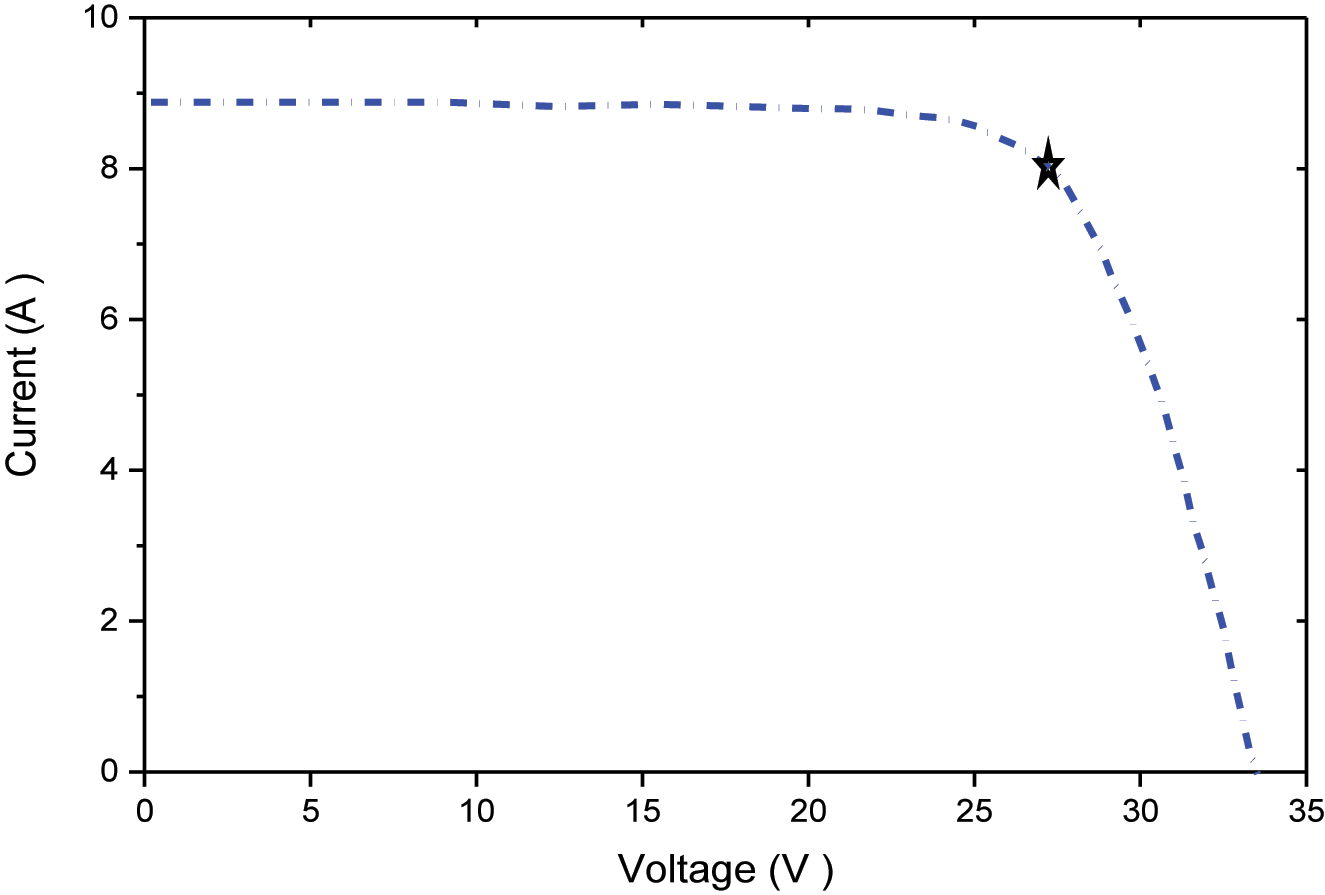
I–V curve characteristics of solar PV module at standard test conditions STC.
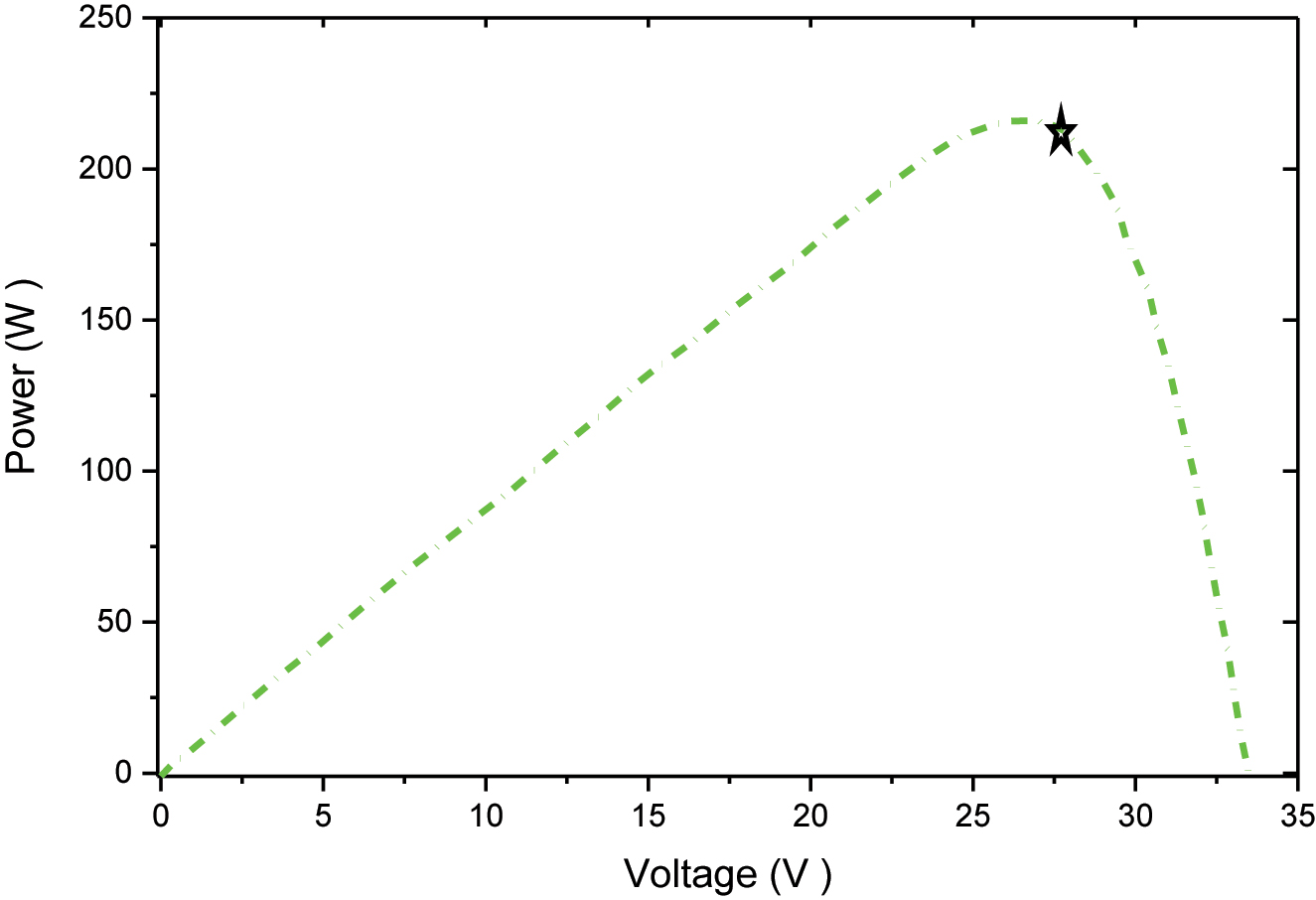
P–V curve characteristics of solar PV module at standard test conditions STC.
PV module chrematistics.
| Parameters | Values/unit |
|---|---|
| PV module type | Si-poly |
| Nominal power | 215 Wp |
| Short-circuits current | 8.80 A |
| Open-circuit voltage | 33.5 V |
Pumping characteristics
The solar PV device is the prime-mover to operate the pump to lift the water to the surface. Based on the water source, the kind of pump and mounting could be surface mount, floating, or submersible. The water pumps have become more efficient, and their usage is increasing rapidly; consequently, pumps will become one of the energy consumption devices.
In the photovoltaics solar pumping system, hydraulic load and pump flow rate change over time. Hence, to assess the effectiveness of a solar PV water pumping system, one must investigate the well’s characteristics during the system’s operation. Various pump types are typically distinguished by their head versus flow rate pattern (Ghoneim 2006). The design for the well utilized in this study takes into account the dynamics of the water during pumping. The estimated hydraulic load determines the size of a solar photovoltaic pumping system. Figure 4 shows a schematic of solar PV pumping system configurations.

Schematic of solar PV pumping system configurations.
A pump is a machine that transmits kinetic work into liquid power energy. It is integrally connected to the electric motor and has torque, speed, and flow characteristics (Amira, Tahar, and Abdelkrim 2021). The pumps can be divided into two types based on their operating principles: positive displacement and dynamic pumps. The latter, dynamic pumps, act by boosting the velocity and pressure of a liquid in a diffusing flow path.
The selection of a pumping system for a specific application is an important decision. This will be based on the required energy needs and discharge, head, performance, possible maintenance in the future, financial costs, etc. Consequently, numerous kinds of pumps with various classifications (the most common types are centrifugal and positive displacement pumps) are utilised in a specialised field (Alshamani 2018). The efficiency of centrifugal pumps powered by solar energy systems is a function of solar intensity, pumping head and flow rate.
The volume of water flow per day and the distance the water must be delivered are the initial steps in designing a photovoltaic water pumping system; however, it is important to keep in mind that water consumption forecasts. The pump type is SQF 0.6–2 submersible pump was suggested for this operating condition. Table 4 details the estimated hydraulic and the installation within the well/pump characteristics. Also, the optimum system pumping head is 42 m, and the pump’s services voltage ranges from 3–300 V.
listed pump chrematistics.
| Parameter | Values/unit |
|---|---|
| Pump type | SQF 0.6–2 |
| Average head | 42 m |
| Average of water needs | 50 m3/day |
| Power | 1.4 kW |
| Voltage range | 3–300 V |
The solar panel’s desired power is determined by the quantity of energy needed to run the pump. Therefore, the power needed to run the pump has an approximately capacity of power 4328 kWh. Consequently, the estimated annual pumped water is about 133,669 m3/year; the system efficiency was about 80.7%, Table 5 lists details of the energy system.
listed the annual energy system.
| Parameter | Values/unit |
|---|---|
| Water pumped | 133,669 m3/year |
| Water needs | 18,250 m3/year |
| Missing water | 26.7% |
| Energy at pump | 4328 kWh |
| Specific energy | 0.32 kW/m3 |
| System efficiency | 80.7% |
Tables 4 and 5. show that the total water demand is 18,250 m3/year, which is 50 m3/day. While designing the piping system, it is important to consider an adequate pipe size to gain the required flow rates. This also helps to avoid the losses that might occur due to energy loss in exit from pipes and bends or elbows. Figure 5 shows the daily dynamics flow rates from sunshine to sunset and its flow rates as a function of the magnitude of solar intensity. Hence, the maximum flow rates are shown at noontime, which was approximately 5.2 m3/h; the overall average flow rate is about 3.8 m3/daily. Thus, as a result of the increase in solar irradiance, the flow pump rate increases linearly.

Estimation of daily flow rates.
Moreover, the sun is in a perpendicular position during the noontime as the natural sun movement. While, during the sunrise and sunset, the solar intensity is lower values. Therefore, it is recommended to install a tracker system to track sun movement on daily basis hours, that in order to have high efficiency. Also, another tracker should be applied to track the seasonal changes in the sun’s position. As predicted, the high values of power result in high values of flow rates; hence, at the value of 420 W, the equivalent value of 1.1 m3/h at the designed pumping head of 42 m. While at 50 W power, the flow rates approach zero flow. Therefore, the influence of changes in the pumping head from (30–70 m) significantly leads to decreases in the discharge flow rate values, as shown in Figure 6. Thus, the power rate of the pump displays various operating characteristics.

The water flow rate versus power at different pumping heads.
It is important to mention here the performance of solar water pumping systems is largely affected by variations of the solar radiation intensity and total lead (Tiwari and Kalamkar 2018).
The performance of the pumping system is proportional to the incident solar radiation and the pumping head. The best pump efficiency is obtained at the low dynamic head and high solar intensity. The optimised solar PV array achieved the maximum power rate of the submersible pump at the optimum pumping head. Figure 7 illustrates annual normalised array production, subsequently from February–March is the highest value, and June and September are the lowest values. Thus, despite the highest values of solar radiation intensity during the months April–July, as depicted in Table 1., the photovoltaic array losses occurred due to temperature losses, estimated to be −14.3%; the thermal loss factor is about 20 W/m2 K, and the soiling losses represent approximately −5%.

Annual normalised array production.
It is vital to consider the system reliability and lifetime of solar water pumping before investment. Based on the analysis performed in the research design presented in reference (Kumar et al. 2022); it is also anticipated that the project investment will be sustainable for 25 years if solar photovoltaic is applied to a water-pumping system, with or without a subsidy.
The annual normalized system losses are shown in Figure 8. which presents a cumulative analysis of total system losses that occurred during power generation. Therefore, the summer season has shown a high level of system performance losses, particularly in the months of (June–August), due to a drop in array productivity, high environmental temperature and soiling (dust/sands/dirt’s), which is accumulating on PV module surface. Whereas in the winter, autumn, and spring seasons months, the system performance losses are relatively low. To increase the productivity and for better performance of solar PV systems in desert regions, it is recommended that the system installation should have a regular clearing from soiling accumulations (Maka et al. 2019; Mohamed and Hasan 2012). Thus, many techniques are available to clean the photovoltaic modules to boost their potency. To name a few, either dry cleaning or wet cleaning is more effective than manual cleaning or an automatic approach.

Annual normalised system losses.
Figure 9 shows the variance in the annual performance ratio during the summer season months. Hence, the decline in average flow rates, increased ambient temperature, and losses in arrays productions are due to performance degradation. However, the winter month has shown a good performance ratio due to fewer system losses. For more details, the performance ratio is illustrated in Figure 8; hence it showed that the high-performance ratio PR was about 72% obtained in the months of January and December. On the other hand, the low-performance ratio was approximately 61% and obtained in the month of July, although the mean PR for the annual is about 66%. It is important to be mentioned here the reduction in the capacity of the power system is due to various types of losses that occurred at the operations. Therefore, the performance ratio (PR) is defined as the ratio of the actual yield of the solar photovoltaic system to the reference yield, as given in Eq. (10) (Sharma, Sharma, and Tiwari 2020):
where Y a is the actual yield of the solar photovoltaic system and Y r is the reference yield. The performance ratio represents the entire influence of system losses due to ambient site conditions, installation component efficiencies, and system installation angles on the systems-rated output. Thus, the performance ratio shows how near a solar photovoltaic system’s performance is ideal in the actual situation (Oloya, Gutu, and Adaramola 2021; Sun, Tu, and Wang 2019).

Annual system performance ratio.
There was a variance in the average running flow rates throughout the year; thus, the average flow rate depends on various factors such as pumping heads, PV energy yields and operating conditions, etc. The flow rate over the year deteriorated during June; hence, it gradually decreased from March to April. However, July improved and slightly increased due to system performance losses, as depicted in Figure 10 (a). Moreover, Figure 10. (b) displays the pump’s hydraulic energy behaviour over the year. As a result of system performance losses, the pump energy and deterioration during April so gradually decreased during June and September were the highest rates of losses recorded; although there was a bit of improvement in July and August and from October to December, steady flows. Therefore, that deterioration has been reflected in pumping annual flow rate patterns.

Annual pump performance, (a) average yearly running flow rates, (b) yearly pump hydraulic energy.
Hence, as a result, hydraulic efficiency decreases, so hydraulic load losses are significant whenever the solar irradiation is high. Furthermore, once the water flow rate is substantial, the hydraulic load losses are substantial; thus, the hydraulic loss is proportional to the flow rate. Finally, the consequence of mismatching the pumping heads and pumping rated heads leads to substernal losses in efficiency; this may happen due to inadequate design.
Notwithstanding, the optimal pumping head for maximum photovoltaic efficiency might not be the same as the optimum head for the greatest system efficiency. Nevertheless, on the other hand, the optimal pumping head is the one that gives the highest average system efficiency (Odeh, Yohanis, and Norton 2006). Figure 11 displays the annual performance of the designed system to work all year, so the maximum flow rate is about 5.4 m3/h. The number of operating hours is more during the summer season; it can operate from 8 am to 6 pm. In the winter, autumn and spring season months (January, February, March, April, September, October, November and December), the operating hours are 9:30 am to 5 pm.

Annual pumping performance by considering the average water pumping flow rate as a function hour of the day.
There is a different comparison approach as the prime-mover of a pumping system. Therefore, Verma et al. (2021) compared the diesel-pump water pump and solar PV pumping system; and concluded that solar PV systems are more reliable, environmental-friendly and economical, particularly in developing countries.
However, in the months from May to July, there were about 19% losses in water flow. Therefore, as mentioned before, most of the photovoltaic array losses occurred due to temperature. Physically interpreted, as the cell temperature rises, the energy band gap will decrease, which leads to an increase in the cell current and decrease in voltage, then the power will drop and the efficiency. Hence, the temperature effects on the solar PV can be mitigated by two methods:
The operations and maintenance framework solution by adopting cooling techniques. So, this is considered impractical from the point-view of some scholars and would be relatively expensive and increase overall system cost. Moreover, despite high wind speed during those months, the PV modules don’t cool passively through natural convection due to high ambient temperature.
The design perspective solution can be developed by installing modern PV modules with the technology of half-cut cell modules to mitigate temperature effects (Dolan et al. 2019; Zhang et al. 2017). These prototypes of PV modules have lower-temperature coefficients and their capability to operate at minimum performance losses in hot environments, i.e., lower temperature coefficients will lead to fewer power losses from the PV modules.
The method that reduces the power loss in the PV modules is the technology of half-cut cell modules that have been developed in the industry. Consequently, cutting the cell into two segments will reduce the current level of the cell string by reducing the resistance loss (Zhang et al. 2017). The dust accumulation on the PV modules is an issue that can be solved by regular cleaning of PV modules (Mohamed and Hasan 2012). Hence, the weekly cleaning schedule is early in the sunrise or sunset; it is easy to perform and will not be extra cost-related. Thus, the system itself will pump the water from the down well to the surface. For high operating performance with high reliability and availability of the solar photovoltaic system, PVWP applications are significant in considering environmental conditions in remote areas. Hence, the average PV array output powers depend on solar radiation only, but it depends on combining the whole parameters of environmental conditions.
Conclusions
This work presented the design and performance analysis of the PVWP system in Mourzuq, located in the south-west of Libya. The performance investigated was significantly displayed; hence, photovoltaic array losses due to temperature losses were estimated approximately −14.3%, and the soiling was about −5%. The design perspective considers solar PV modules with low-temperature coefficients that can withstand hot environments. This investigation gives the developers of solar photovoltaic water pumping systems an overview of the average daily flow rate value; that can be delivered for a specific head and photovoltaic configuration prior to installing a photovoltaic water pumping system in a specific site. Hence as demonstrated, the high-performance ratio PR was approximately 72% gain in January and December. On the other hand, the low-performance ratio was approximately 61% and obtained in the month of July, although the mean PR for the annual is around 66%.
The yields from PVsyst software are valuable results for performance assessment and comprehending the whole approach to systems design. This study uses simple mathematical equations to assist scholars, developers, and technicians understand the design method of solar water pumping systems. Solar water pumping systems or water pumps that use other sustainable energy are clearly appropriate for rural and isolated regions. These applications might contribute to the regional communities’ social and economic growth. The future suggested work is to adopt inclusive research of PVWP with a study of techno-economic feasibility and investigate a big size of PVWP systems for agriculture purposes. Also, study the use of high potency solar PV modules such as the bifacial technique.
-
Author contributions: All the authors have accepted responsibility for the entire content of this submitted manuscript and approved submission.
-
Research funding: Many grateful thanks to the Libyan Authority for Research Science and Technology, and many thanks to the staff in the Libyan Centre for Research and Development of Sahrain Communities. Also, many thanks to the anonymous reviewers for their constructive comments in improving this paper.
-
Conflict of Interest: The authors declare that they have no known competing financial interests or personal relationships that could have appeared to influence the work reported in this paper.
References
Action, P. 2015. Solar Photovoltaic Water Pumping. Also available at https://www.pseau.org/outils/ouvrages/practical_action_solar_photovoltaic_water_pumping_2014.pdf.Search in Google Scholar
Ali, H. M., M. Mahmood, M. A. Bashir, M. Ali, and A. M. Siddiqui. 2016. “Outdoor Testing of Photovoltaic Modules during Summer in Taxila, Pakistan.” Thermal Science 20 (1): 165–73, https://doi.org/10.2298/tsci131216025a.Search in Google Scholar
Ali, I., G. M. Shafiullah, and T. Urmee. 2018. “A Preliminary Feasibility of Roof-Mounted Solar PV Systems in the Maldives.” Renewable and Sustainable Energy Reviews 83: 18–32, https://doi.org/10.1016/j.rser.2017.10.019.Search in Google Scholar
Aliyu, M., G. Hassan, S. A. Said, M. U. Siddiqui, T. A. Alawami, and I. M. Elamin. 2018. “A Review of Solar-Powered Water Pumping Systems.” Renewable and Sustainable Energy Reviews 87: 61–76, https://doi.org/10.1016/j.rser.2018.02.010.Search in Google Scholar
Allouhi, A., M. S. Buker, H. El-houari, A. Boharb, M. B. Amine, T. Kousksou, and A. Jamil. 2019. “PV Water Pumping Systems for Domestic Uses in Remote Areas: Sizing Process, Simulation and Economic Evaluation.” Renewable Energy 132: 798–812, https://doi.org/10.1016/j.renene.2018.08.019.Search in Google Scholar
Alshamani, A. 2018. “Design and Modelling of a Large-Scale Solar Water Pumping System for Irrigation in Saudi Arabia.” MSc. thesis, Memorial University of Newfoundland.10.1109/IEMCON.2017.8117176Search in Google Scholar
Amira, L., B. Tahar, and M. Abdelkrim. 2021. “Design and Analysis of Solar Water Pumping System.” Advanced Research in Solar Energy 01. Book Series: Research Transcripts in Energy.Search in Google Scholar
Azzain, G., and I. Lali. 2016. “An Economical -Technical Comparison of Solar Electrical Water Pumping System versus Conventional Electrical Water Pumping System for Agricultural Purposes in the Area of “Awjila”.” Solar Energy and Sustainable Development 5 (1): 30–43, https://doi.org/10.51646/jsesd.v5i1.64.Search in Google Scholar
Ba, A., E. Aroudam, O. E. Chighali, O. Hamdoun, and M. L. Mohamed. 2018. “Performance Optimization of the PV Pumping System.” Procedia Manufacturing 22: 788–95, https://doi.org/10.1016/j.promfg.2018.03.112.Search in Google Scholar
Benghanem, M., D. Ko, and A. Almohammedi. 2018. “Estimation of Daily Flow Rate of Photovoltaic Water Pumping Systems Using Solar Radiation Data.” Journal Results in Physics 8: 949–54, https://doi.org/10.1016/j.rinp.2018.01.022.Search in Google Scholar
Bhatia, S. C., and R. K. Gupta. 2019. Textbook of Renewable Energy: Woodhead Publishing India PVT. Limited, 1st ed.: WPI Publishing.Search in Google Scholar
Bradford, T. 2008. Solar Revolution: The Economic Transformation of the Global Energy Industry: MIT Press. https://doi.org/10.7551/mitpress/6331.001.0001.Search in Google Scholar
Campana, P. E., H. Li, J. Zhang, R. Zhang, J. Liu, and J. Yan. 2015. “Economic Optimization of Photovoltaic Water Pumping Systems for Irrigation.” Journal Energy Conversion and Management 95: 32–41, https://doi.org/10.1016/j.enconman.2015.01.066.Search in Google Scholar
Chahartaghi, M., and A. Nikzad. 2021. “Exergy, Environmental, and Performance Evaluations of a Solar Water Pump System.” Sustainable Energy Technologies and Assessments 43: 100933, https://doi.org/10.1016/j.seta.2020.100933.Search in Google Scholar
Chilundo, R. J., U. S. Mahanjane, and D. Neves. 2018. “Design and Performance of Photovoltaic Water Pumping Systems: Comprehensive Review Towards a Renewable Strategy for Mozambique.” Journal of Power and Energy Engineering 6 (7): 32–63, https://doi.org/10.4236/jpee.2018.67003.Search in Google Scholar
Dolan, D. S. L., V. Prodanov, P. Salter, F. Cheein, and J. Dolan. 2019. “Reducing Performance Loss Due to Backtracking Error through Use of Half Cut Cell Modules.” In Paper Presented at the 2019, 9th International Conference on Power and Energy Systems (ICPES).10.1109/ICPES47639.2019.9105393Search in Google Scholar
Ghoneim, A. A. 2006. “Design Optimization of Photovoltaic Powered Water Pumping Systems.” Energy Conversion and Management 47 (11–12): 1449–63, https://doi.org/10.1016/j.enconman.2005.08.015.Search in Google Scholar
Hoang, M. L. 2019. “Photovoltaic System Optimization by New Maximum Power Point Tracking (MPPT) Models Based on Analog Components Under Harsh Condition.” Energy Harvesting Systems 6 (3–4): 57–67, https://doi.org/10.1515/ehs-2020-0001.Search in Google Scholar
Kumar, L. A., C. N. Lakshmiprasad, G. Ramaraj, and G. Sivasurya. 2022. “Design, Simulation of Different Configurations and Life-Cycle Cost Analysis of Solar Photovoltaic–Water-Pumping System for Agriculture Applications: Use Cases and Implementation Issues.” Clean Energy 6 (2): 1100–17, https://doi.org/10.1093/ce/zkac018.Search in Google Scholar
Maka, A. O. M., and M. J. Alabid. 2022. “Solar Energy Technology and its Roles in Sustainable Development.” Clean Energy 6 (3): 476–83, https://doi.org/10.1093/ce/zkac023.Search in Google Scholar
Maka, A. O. M., S. Salem, and M. Mehmood. 2021. “Solar Photovoltaic (PV) Applications in Libya: Challenges, Potential, Opportunities and Future Perspectives.” Cleaner Engineering Technology 5: 100267, https://doi.org/10.1016/j.clet.2021.100267.Search in Google Scholar
Maka, A. O., T. N. Chaudhary, A. Hasan, and G. Ahmed. 2019. “In-situ Performance Evaluation of Photovoltaic Solar Water Pumping System in the Rural Region.” Journal of Mechanical Energy Engineering 3 (1): 69–76, https://doi.org/10.30464/jmee.2019.3.1.69.Search in Google Scholar
Mohamed, A. O. 2014. “Exploitation of Windmills for Water Pumping Application in Rural Region: Southern Region of Libya.” In 5th International Renewable Energy Congress IREC.Search in Google Scholar
Mohamed, A. O., and A. Hasan. 2012. “Effect of Dust Accumulation on Performance of Photovoltaic Solar Modules in Sahara Environment.” Journal of Basic applied scientific research 2 (11): 11030–6.Search in Google Scholar
Mohamed, E. T., A. O. M. Maka, M. Mehmood, A. L. M. Direedar, and N. Amin. 2021. “Performance Simulation of Single and Dual-Junction GaInP/GaAs Tandem Solar Cells Using AMPS-1D.” Sustainable Energy Technologies and Assessments 44: 101067, https://doi.org/10.1016/j.seta.2021.101067.Search in Google Scholar
Morales, T. D., and J. Busch. 2010. “Design of Small Photovoltaic (PV) Solar-Powered Water Pump Systems.” Journal Portland Oregon.Search in Google Scholar
Nasir, A. 2019. “Design and Simulation of Photo-Voltaic Water Pumping System for Irrigation.” Advances in Applied Sciences 4 (2): 51–63, https://doi.org/10.11648/j.aas.20190402.14.Search in Google Scholar
Odeh, I., Y. G. Yohanis, and B. Norton. 2006. “Influence of Pumping Head, Insolation and PV Array Size on PV Water Pumping System Performance.” Solar Energy 80 (1): 51–64, https://doi.org/10.1016/j.solener.2005.07.009.Search in Google Scholar
Oloya, I. T., J. L. T. Gutu, and S. M. Adaramola. 2021. “Techno-economic Assessment of 10 MW Centralised Grid-Tied Solar Photovoltaic System in Uganda.” Case Studies in Thermal Engineering 25: 100928, https://doi.org/10.1016/j.csite.2021.100928.Search in Google Scholar
Owusu, P. A., and S. Asumadu-Sarkodie. 2016. “A Review of Renewable Energy Sources, Sustainability Issues and Climate Change Mitigation.” Cogent Engineering 3 (1): 1167990, https://doi.org/10.1080/23311916.2016.1167990.Search in Google Scholar
Ramulu, C., P. Sanjeevikumar, R. Karampuri, S. Jain, H. A. Ertas, and V. Fedak. 2016. “A Solar PV Water Pumping Solution Using a Three-Level Cascaded Inverter Connected Induction Motor Drive.” Engineering Science Technology, an International Journal 19 (4): 1731–41, https://doi.org/10.1016/j.jestch.2016.08.019.Search in Google Scholar
Sharma, R., S. Sharma, and S. Tiwari. 2020. “Design Optimization of Solar PV Water Pumping System.” Journal Materials Today: Proceedings 21: 1673–9, https://doi.org/10.1016/j.matpr.2019.11.322.Search in Google Scholar
Shebani, M. M., and T. Iqbal. 2017. “Dynamic Modeling, Control, and Analysis of a Solar Water Pumping System for Libya.” Journal of Renewable Energy 2017, https://doi.org/10.1155/2017/8504283.Search in Google Scholar
Sun, G., X. Tu, and R. Wang. 2019. “Research on the Potential-Induced Degradation (PID) of PV Modules Running in Two Typical Climate Regions.” Journal Clean Energy 3 (3): 222–6, https://doi.org/10.1093/ce/zkz007.Search in Google Scholar
Taoufik, M., H. Karima, S. Lassaad, and G. Abdessattar. 2014. “Photovoltaic Water Pumping System with Three-Level NPC Inverter.” International Journal of Engineering Sciences 3 (10): 99–108.Search in Google Scholar
te Heesen, H., V. Herbort, and M. Rumpler. 2019. “Performance of Roof-Top PV Systems in Germany from 2012 to 2018.” Solar Energy 194: 128–35, https://doi.org/10.1016/j.solener.2019.10.019.Search in Google Scholar
Tiwari, A. K., and V. R. Kalamkar. 2018. “Effects of Total Head and Solar Radiation on the Performance of Solar Water Pumping System.” Renewable Energy 118: 919–27, https://doi.org/10.1016/j.renene.2017.11.004.Search in Google Scholar
Verma, S., S. Mishra, S. Chowdhury, A. Gaur, S. Mohapatra, A. Soni, and P. Verma. 2021. “Solar PV Powered Water Pumping System–A Review.” Materials Today Proceedings 46: 5601–6, https://doi.org/10.1016/j.matpr.2020.09.434.Search in Google Scholar
Yahyaoui, I., T. Giuseppe, C. Maher, and F. Tadeo. 2015. “Design and Evaluation of a Renewable Water Pumping System.” IFAC-PapersOnLine 48 (30): 462–7, https://doi.org/10.1016/j.ifacol.2015.12.422.Search in Google Scholar
Zhang, H. X., H. Zhuang, X. F. Gou, Q. S. Huang, L. K. Jiang, and Z. Y. Chen. 2017. “Study on the Benefit of Half-Cut Cells towards Higher Cell-To-Module Power Ratio.” Power and Electrical Engineering 978–1, https://doi.org/10.12783/dteees/epee2017/18123.Search in Google Scholar
© 2022 Walter de Gruyter GmbH, Berlin/Boston
Articles in the same Issue
- Frontmatter
- Research Articles
- An improved intermittent power supply technique for electrostatic precipitators
- PZT and PVDF piezoelectric transducers’ design implications on their efficiency and energy harvesting potential
- Hybrid optimization for optimal positioning and sizing of distributed generators in unbalanced distribution networks
- Implementation of cascaded H-bridge DC-link inverter for marine electric propulsion drives
- Design of control system for solar power generation based on an improved bat algorithm for an island operation
- Review
- Hybrid renewable energy resources accuracy, techniques adopted, and the future scope abetted by the patent landscape – a conspicuous review
- Research Articles
- Modelling and analysis of green hydrogen production by solar energy
- An economic and technological analysis of hybrid photovoltaic/wind turbine/battery renewable energy system with the highest self-sustainability
- Experimental investigation of Segregated Dry Municipal Solid Waste (SDMSW) and biomass blends in the gasification process
- Energy harvesting for mobile agents supporting wireless sensor networks
- Innovative high-speed method for detecting hotspots in high-density solar panels by machine vision
- Design, simulation and performance analysis of photovoltaic solar water pumping system
- “Design and development of magnetic field harvester to power wireless sensors in smart Grid”
- Modelling of a piezoelectric beam with a full-bridge rectifier under arbitrary excitation: experimental validation
- Multi capacitor modeling for triboelectric nanogenerators with multiple effective parameters
- Sizing electrolyzer capacity in conjunction with an off-grid photovoltaic system for the highest hydrogen production
- A novel SGD-DLSTM-based efficient model for solar power generation forecasting system
- A numerical study of water based nanofluids in shell and tube heat exchanger
- Design of an efficient MPPT optimization model via accurate shadow detection for solar photovoltaic
- Power flow control and power oscillation damping in a 2-machine system using SSSC during faults
Articles in the same Issue
- Frontmatter
- Research Articles
- An improved intermittent power supply technique for electrostatic precipitators
- PZT and PVDF piezoelectric transducers’ design implications on their efficiency and energy harvesting potential
- Hybrid optimization for optimal positioning and sizing of distributed generators in unbalanced distribution networks
- Implementation of cascaded H-bridge DC-link inverter for marine electric propulsion drives
- Design of control system for solar power generation based on an improved bat algorithm for an island operation
- Review
- Hybrid renewable energy resources accuracy, techniques adopted, and the future scope abetted by the patent landscape – a conspicuous review
- Research Articles
- Modelling and analysis of green hydrogen production by solar energy
- An economic and technological analysis of hybrid photovoltaic/wind turbine/battery renewable energy system with the highest self-sustainability
- Experimental investigation of Segregated Dry Municipal Solid Waste (SDMSW) and biomass blends in the gasification process
- Energy harvesting for mobile agents supporting wireless sensor networks
- Innovative high-speed method for detecting hotspots in high-density solar panels by machine vision
- Design, simulation and performance analysis of photovoltaic solar water pumping system
- “Design and development of magnetic field harvester to power wireless sensors in smart Grid”
- Modelling of a piezoelectric beam with a full-bridge rectifier under arbitrary excitation: experimental validation
- Multi capacitor modeling for triboelectric nanogenerators with multiple effective parameters
- Sizing electrolyzer capacity in conjunction with an off-grid photovoltaic system for the highest hydrogen production
- A novel SGD-DLSTM-based efficient model for solar power generation forecasting system
- A numerical study of water based nanofluids in shell and tube heat exchanger
- Design of an efficient MPPT optimization model via accurate shadow detection for solar photovoltaic
- Power flow control and power oscillation damping in a 2-machine system using SSSC during faults
