Cathodic protection and sulphate-reducing bacteria: a complex interaction in offshore steel structures
-
Thomas Glorieux
 ,
Razieh Tavassolian
,
Razieh Tavassolian
 and
Kim Verbeken
and
Kim Verbeken

Abstract
Microbiologically influenced corrosion (MIC) caused by sulphate-reducing bacteria (SRB) is an important issue, particularly in the offshore industry where cathodic protection (CP) is commonly used to prevent the corrosion of steel structures. However, its relation with MIC remains unclarified, as the interaction between CP and microbial activity is still far from understood. Under overprotection conditions, the water reduction reaction can lead to atomic hydrogen uptake, which may result in hydrogen embrittlement (HE). This uptake is influenced by calcareous deposits, i.e. inorganic compounds formed during CP. Additionally, SRB are argued in literature to enhance hydrogen uptake. This review explores various perspectives on the interaction between microbial activity, particularly SRB, and CP, as well as their individual and combined impact on hydrogen uptake in an offshore context.
Nomenclature
- AD
-
Anodic dissolution
- AIDE
-
Adsorption-induced dislocation emission
- AISI
-
American Iron and Steel Institute
- APB
-
Acid-producing bacteria
- APS
-
Adenosine phosphosulphate
- ASR
-
Assimilated sulphate reduction
- ASTM
-
American Society for Testing and Materials
- ASW
-
Artificial seawater
- ATP
-
Adenosine triphosphate
- BCSR
-
Biocatalytic cathodic sulphate reduction
- CDT
-
Cathodic depolarisation theory
- CMIC
-
Chemical microbiologically influenced corrosion
- CP
-
Cathodic protection
- CSE
-
Copper/copper-sulphate reference electrode
- DET
-
Direct electron transport
- DSR
-
Dissimilatory sulphate reduction
- E
-
Potential
- EAC
-
Environmentally assisted cracking
- EET
-
Extracellular electron transfer
- EIS
-
Electrochemical impedance spectroscopy
- EMIC
-
Electrical microbiologically influenced corrosion
- EPS
-
Extracellular polymeric substances
- F
-
Faraday’s constant
- HAC
-
Hydrogen-assisted cracking
- HE
-
Hydrogen embrittlement
- HEDE
-
Hydrogen-enhanced decohesion
- HELP
-
Hydrogen-enhanced localised plasticity
- HER
-
Hydrogen evolution reaction
- HIC
-
Hydrogen-induced cracking
- ICCP
-
Impressed current cathodic protection
- IOB
-
Iron-oxidising bacteria
- IRB
-
Iron-reducing bacteria
- MET
-
Mediated electron transport
- MFC
-
Microbial fuel cell
- MIC
-
Microbiologically influenced corrosion
- MICI
-
Microbially influenced corrosion inhibition
- NRB
-
Nitrate-reducing bacteria
- OCP
-
Open circuit potential
- OWS
-
Offshore wind power structures
- PDP
-
Potentiodynamic polarisation
- Rp
-
Polarisation resistance
- SACP
-
Sacrificial anode cathodic protection
- SCC
-
Stress corrosion cracking
- SCE
-
Saturated calomel electrode
- SEM
-
Scanning electron microscopy
- SHE
-
Standard hydrogen electrode
- SOB
-
Sulphur-oxidising bacteria
- SRB
-
Sulphate-reducing bacteria
- SSC
-
Sulphide stress cracking
- SSRT
-
Slow strain rate testing
- WE
-
Working electrode
- XRD
-
X-ray diffraction
- ΔG
-
Gibbs free-energy change
1 General introduction
Carbon steel is widely used in offshore applications, such as oil and gas platforms and offshore wind power structures (OWS), due to its good and tunable mechanical properties and low price (Dehghani and Aslani 2019; Price and Figueira 2017; Refait et al. 2020). However, the marine environment where these structures operate is highly corrosive because of its complex chemical composition and is influenced by other environmental factors such as pH, salinity, temperature, oxygen supply, water velocity and presence of microbial life (López-Ortega et al. 2019; Melchers and Asce 2006). Corrosion can result in intense damage and deterioration of the offshore structure performance (Price and Figueira 2017; Xu et al. 2020). In the North Sea, catastrophic failures that occurred in the past such as the Piper Alpha disaster in 1988 (Singh et al. 2010) and the Alexander L. Kielland platform disaster in 1980 (Almar-Naess et al. 1984) give a strong reminder of why corrosion maintenance and prevention within the offshore industry remain crucial. The former disaster for example caused 167 deaths out of 226 persons and had a damage cost of more than $3 billion (U.S.) (Paté-Cornell 1993). Cathodic protection (CP) serves as a widely used technique to prevent the corrosion of structures within a seawater environment, which involves the application of an external current to the considered structure by making it the cathode of an electrochemical cell. In this way, corrosion of the structure can be controlled by lowering the steel potential and, therefore, its corrosion rate can be diminished (Ashworth 2010; Carré et al. 2020). This technique is often combined with the use of coatings, which decreases the required current compared to CP of a bare steel surface without coating and offers long-term protection (Dexter and Lin 1992; T. Zhang et al. 2018b). In practice, two methods can be used for CP, which are sacrificial or galvanic anodes CP (SACP or GACP) and impressed current CP (ICCP) (Ashworth 2010).
When CP is applied, two reduction reactions on the steel surface are stimulated: the dissolved oxygen reduction reaction, Equation (1), and the water reduction reaction or hydrogen evolution reaction (HER), Equation (2) (Yang et al. 2015).
Especially during cathodic overprotection conditions, a large amount of atomic hydrogen is generated at the steel surface (Gurrappa et al. 2015; Lazzari and Pedeferri 2018; T. Zhang et al. 2018b). This will result in more atomic hydrogen being absorbed by the steel, which can subsequently diffuse within the bulk (Sun and Frank Cheng 2022). Besides hydrogen-induced cracking (HIC) and hydrogen surface blistering, which typically occur as hydrogen-induced damage in the absence of an external stress, hydrogen embrittlement (HE) can occur in the presence of stress. HE is considered as a type of environmentally assisted cracking (EAC) (Lynch 1994), and it will result in the reduction of the mechanical strength and toughness of the steel by the introduction of atomic hydrogen, resulting in a loss of ductility and increased brittleness (Dwivedi and Vishwakarma 2018; Laadel et al. 2022). Therefore, HE can typically lead to fracture initiation, subcritical crack growth and finally catastrophic failures at stresses below the yield stress (Dwivedi and Vishwakarma 2018). High strength steels in particular have a high susceptibility to HE (Kirchheim and Pundt 2014). The most frequently quoted mechanisms to explain HE are hydrogen-enhanced decohesion (HEDE) (Oriani 1972), hydrogen-enhanced localised plasticity (HELP) (Birnbaum and Sofronis 1994) and adsorption-induced dislocation emission (AIDE) (Lynch 1988).
Furthermore, hydroxyl ions (OH−) are released by reduction reactions, according to Equation (1) and Equation (2), resulting in a pH increase at the steel–seawater interface (Xu et al. 2021). This facilitates the precipitation of inorganic compounds such as calcium carbonate (CaCO3) and magnesium hydroxide (Mg(OH)2) according to Equations (3)–(5), which are also known as resulting in calcareous deposits (Simoni et al. 2017).
These deposits are very advantageous, considering the efficiency and effectiveness of CP. Due to their deposition, active metal sites are blocked and, moreover, they provide a physical barrier against the diffusion of dissolved oxygen towards the steel surface. Furthermore, they are insulating and, therefore, decrease the required current density to maintain a given protection potential (Barchiche et al. 2003; Guezennec 1994; Simoni et al. 2017; Yang et al. 2015).
For example, in a SACP system the sacrificial anode consumption, needed to maintain efficient protection, is reduced in this way (Barchiche et al. 2003). Consequently, calcareous deposits are often considered as inexpensive and environmentally friendly natural coatings for corrosion control, particularly in seawater environment (Smith and Paul 2015; Yang et al. 2015). However, these deposits also have their drawbacks. A first drawback is their precipitation within, e.g. heat exchangers, boilers and cooling water systems. This can lead to economic losses, because of reduced efficiency of heat exchange and decreased water flow due to a reduced tube diameter. Frequent shutdowns of the industrial installation may happen due to a needed cleaning (Abdel-Gaber et al. 2008; Kavitha et al. 2011; Piri and Arefinia 2018). A second drawback is the potential disbonding of coatings due to the deposit formation underneath them (Edyvean et al. 1992). Moreover, the deposits may even initiate pitting corrosion of the metal, being similar to pitting caused by the formation of salt layers on stainless steel within a hot seawater solution (Xin and Li 2014). The deposition, i.e. nucleation and growth, composition, morphology and protectiveness of the calcareous deposits are dependent on several factors such as pH (Neville and Morizot 2002; Orozco-Cruz et al. 2023), solution composition (Barchiche et al. 2003, 2004; Neville and Morizot 2002; Liu et al. 2011), applied potential (Barchiche et al. 2003; Simoni et al. 2017; Xu et al. 2021), applied current (Xing et al. 2021; Yang et al. 2015), exposure time (Akamine and Kashiki 2022; Carré et al. 2020), temperature (Barchiche et al. 2004; Kunjapur et al. 1987; Li et al. 2014) and flow rate (Deslouis et al. 2000; Hartt et al. 1984). Both CaCO3 and Mg(OH)2 are the predominantly formed calcareous deposits in seawater environment; however, their nature and behaviour are different from each other (Carré et al. 2020). CaCO3 has different allotropic forms, of which the anhydrous ones are the most thermodynamically stable, i.e. calcite, aragonite and vaterite. Mg(OH)2, on the other hand, has only brucite as a crystallographic form (Carré et al. 2020). The more compact and dense aspect of CaCO3 results in a decrease of the current density during CP (Carré et al. 2020; Deslouis et al. 1998). Alternatively, the gelatinous nature of Mg(OH)2 gives a typical non-blocking behaviour on the metal surface and, therefore, the current density during CP remains high (Carré et al. 2020; Deslouis et al. 2000). Besides their role in the CP efficiency, these deposits also influence the hydrogen uptake and subsequent HE. However, it is still a debate whether they have a blocking or an accelerating role in HE (Simoni et al. 2017; Xu et al. 2021).
Further, microbial life is omnipresent in a seawater environment. Sulphate-reducing bacteria (SRB) are one of the most common microorganisms, which are associated with microbiologically influenced corrosion (MIC) within the offshore industry (Lunarska et al. 2007). However, it is still not completely understood whether CP is effective against this type of corrosion, and the mutual interaction between CP and microbial life, in particular SRB, is an important aspect to consider (Lv and Du 2018). Moreover, SRB themselves have a specific impact on hydrogen uptake and HE, because their metabolism is based on the sulphate (SO4 2−) reduction reaction into sulphide (S2−) and subsequent production of hydrogen sulphide (H2S). Due to H2S corrosion of the steel, iron sulphide corrosion products (FexSy) are also able to form (De Romero et al. 2005; Tian et al. 2019).
Analogous to calcareous deposits, their influence on hydrogen uptake is also of a dual nature (Huang et al. 2017; Monnot et al. 2017; Zheng et al. 2013). Since both CP and SRB have an individual role in hydrogen uptake and occurrence of HE, they have a combined influence in a possible synergistic way, which is still far from understood.
This review gives an overview of the mechanisms governing the interaction between CP and microbial life, in particular SRB. Besides the individual influence of CP, calcareous deposits in particular and SRB on hydrogen uptake, potentially leading to HE, their combined effect is also discussed in this review. Furthermore, a short overview of MIC is given with an emphasis on SRB and some of the common corrosion mechanisms.
2 Microbiologically influenced corrosion
2.1 Introduction
Microbiologically influenced corrosion (MIC) is a specific type of electrochemical corrosion where the corrosion process is influenced by the activity of microorganisms (Javaherdashti 2011; Loto 2017; Skovhus et al. 2017). It is also known under other names such as microbial corrosion, biological corrosion and biodegradation (Skovhus et al. 2017). It is a relevant concern in a wide range of industries and infrastructures such as the oil, petroleum and gas industry (Skovhus et al. 2017), recirculated cooling systems (Ilhan-Sungur and Çotuk 2010), wastewater treatment and sewage plants (Stanaszek-Tomal and Fiertak 2016), marine infrastructures (Procópio 2019), chemical processing and power generation plants (Chajduk and Bojanowska-Czajka 2016; El-Shamy 2020) and underground pipelines (Li et al. 2000). MIC is believed to be responsible for more than 20 % of corrosion-related costs (Jia et al. 2019). Different metals such as carbon steel (Xu et al. 2012), stainless steel (Zhang et al. 2015), aluminium alloys (Dai et al. 2016), magnesium (Liang et al. 2022), copper (Reyes et al. 2008) and other materials such as concrete (Harbulakova et al. 2013) are susceptible to this type of corrosion. Titanium and its alloys are the most resistant against MIC (Javaherdashti 1999). MIC can be caused by the activities of biological agents, i.e. biological organisms and microorganisms: i) prokaryotes, i.e. Archaea (Davidova et al. 2012) and bacteria and ii) eukaryotes, such as fungi (Khan et al. 2021; Little and Lee 2009; Planý et al. 2021). In general, all microorganisms need both water and nutrients, including carbon (C), nitrogen (N), sulphur (S) and phosphorus (P), for their growth. Moreover, an electron donor and electron acceptor are needed for their energy metabolism (Khan et al. 2021; Little and Lee 2009). It is important to indicate that MIC typically interacts synergistically with other corrosion types such as pitting corrosion (Starosvetsky et al. 2001), crevice corrosion (Zhang et al. 2021), stress-corrosion cracking (SCC) (Wu et al. 2015b) and corrosion fatigue (Thomas et al. 1987). Figure 1 illustrates typical examples of the consequences of MIC. Corrosion pits (Figure 1a) and corrosion products, i.e. tubercles (Figure 1b) on a galvanised steel tube and rusticles (Figure 1c) on the Royal Mail Ship (RMS) Titanic, can be observed (Li et al. 2000; Little and Lee 2009).
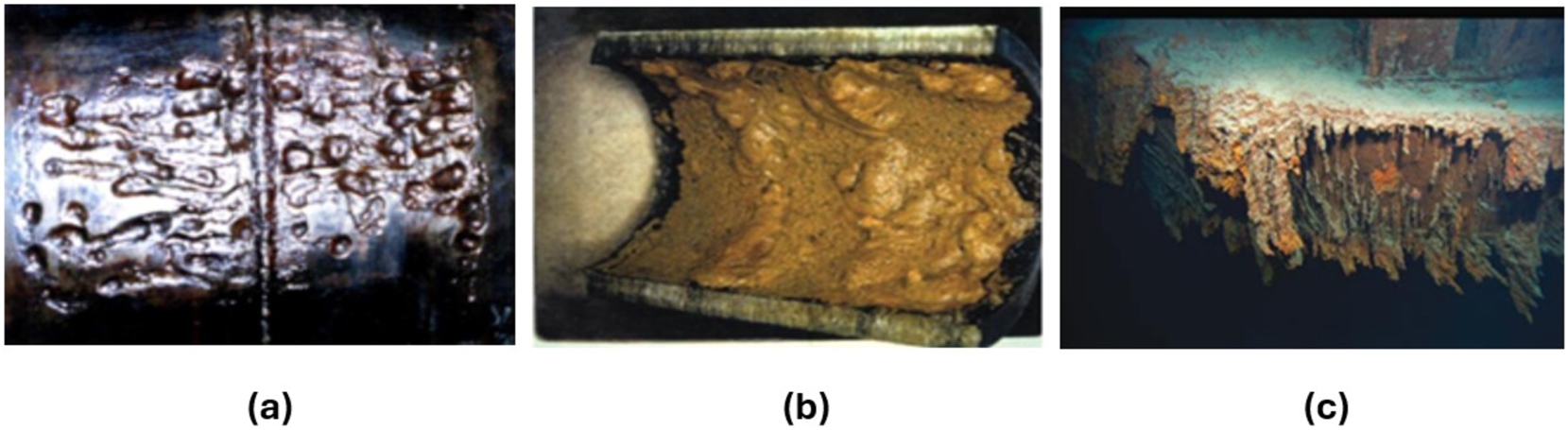
Examples of MIC consequences: (a) corrosion pits, (b) formation of tubercles and (c) rusticles. (a) Microbiologically influenced corrosion of underground pipelines under the disbonded coatings, Li et al., Metals and Materials International, 6, Springer Nature, 2000, reproduced with permission from Springer Nature Costumer Service Center (SNCSC); (b) and (c) Reprinted from Little and Lee (2009), with permission from John Wiley & Sons. Kirk-Othmer Encyclopedia of Chemical Technology. Copyright John Wiley & Sons, Inc. All rights reserved.
When bacteria are responsible for MIC, they can be classified into different groups according to different characteristics: i) shape and appearance of the bacterial cells, ii) temperature, iii) oxygen consumption, iv) energy source, v) carbon source, vi) electron donor and vii) electron acceptor. These categories are summarised in Table 1 (Javaherdashti 2017; Khan et al. 2021).
Classification of bacteria according to different characteristics (Javaherdashti 2017; Khan et al. 2021).
| Feature | Classification | Name |
|---|---|---|
| Shape and appearance of bacterial cells | Comma-shaped Rod-shaped Round-shaped Filamentous fungi-like cells |
Vibrio
Bacillus Coccus Myces |
|
|
||
| Temperature | Bacteria that grow best at 20–35 °C Bacteria that grow best above 40 °C |
Mesophile Thermophile |
|
|
||
| Oxygen consumption | No functioning in the presence of oxygen Require oxygen for their metabolism Functioning in the presence or absence of oxygen Use of low levels of oxygen Anaerobes that are not affected by the presence of oxygen |
Strict anaerobes Aerobes Facultative anaerobes Micro-aerophiles Aero-tolerants |
|
|
||
| Energy source | Light Chemical species |
Phototrophic Chemotrophic |
|
|
||
| Carbon source | CO2
Organic substances |
Autotrophic Heterotrophic |
|
|
||
| Electron donor | Inorganic substances Organic substances |
Lithotrophic Organotrophic |
|
|
||
| Electron acceptor | Oxygen Nitrite (NO2 −) or nitrate (NO3 −) Sulphate (SO4 2−) or CO2 |
Aerobic Anoxic Anaerobic |
Besides the classification according to their features, the bacteria can also be categorised according to how they operate, which is already clear by their name. The most common bacteria involved in MIC are sulphate-reducing bacteria (SRB) (Hamilton 1985), sulphur-oxidising bacteria (SOB) (Little et al. 2000; Okabe et al. 2007), iron-oxidising bacteria (IOB) (Liu et al. 2016; Singh et al. 2018; Wang et al. 2014), iron-reducing bacteria (IRB) (Duan et al. 2008; Herrera and Videla 2009), acid-producing bacteria (APB) (Sowards and Mansfield 2014; Xu et al. 2016), nitrate-reducing bacteria (NRB) (Jia et al. 2017; D. Xu et al. 2013a) and methanogenic bacteria (Uchiyama et al. 2010). Table 2 summarises some specific failure cases where MIC occurred, which shows the corroded equipment and the involved microorganisms. More information on the analysis methods used to evaluate the specific corrosion cases can be found in the relevant references. Moreover, there are more dedicated review papers on MIC case studies (Olszewski 2007; Spark et al. 2020; Starosvetsky et al. 2001). Because the emphasis is on SRB, these will be described in more detail later.
Practical examples of MIC-induced failures.
| Corroded equipment | Involved microorganisms | Reference |
|---|---|---|
| Dead leg bypass line of crude oil transmission pipeline | Acetogens or other fermentative microorganisms producing acetate and methanogens | Sharma et al. (2022) |
|
|
||
| Pipe spool from otter oil production system | Methanogenic archaea, sulphate-reducing bacteria and sulphate-reducing archaea | Skovhus et al. (2017) |
|
|
||
| Crude cooler and reboilers in Saudi Aramco refinery | Sulphate-reducing bacteria and iron-oxidising bacteria | Khanfar and Sitepu (2021) |
|
|
||
| Piping system seal rings of floating production storage and offloading facility (FPSO) | Sulphide-producing prokaryotes, acid-producing bacteria and iron-oxidising bacteria | Salgar-Chaparro et al. (2020) |
|
|
||
| Steel bridge piles in Florida waters | Sulphate-reducing bacteria, slime-forming bacteria, iron-reducing bacteria and acid-producing bacteria | Permeh et al. (2017) |
|
|
||
| Thermo-fluid heat exchanger (TFHX) and cooling water system of fast breeder test reactor (FBTR) | Iron-reducing bacteria, iron-oxidising bacteria and sulphate-reducing bacteria | Rao et al. (2009) |
The formation of a biofilm is one of the main features of microorganisms. A biofilm is a group of immobilised or sessile microorganism cells sticking together on a surface, in particular a metal surface, which consequently modifies the metal surface–solution interface (Chitra et al. 2014; Khan et al. 2021). Its formation occurs in different stages, which is schematically represented in Figure 2. The formation initiates with a conditioning film (stage a), being important in its nature and distribution on the surface, through the electrostatic arrangement of various proteins and other organic substances. The bacteria are still in their planktonic state, which means they are still ‘floating around’ within the solution. Subsequently, planktonic bacterial cells start to attach to the surface via the conditioning film. They start to form colonies and become sessile bacterial cells by the formation and excretion of extracellular polymeric substances (EPS) (stage b). These EPS are actually a self-produced matrix consisting of organic substances such as proteins, polysaccharides, lipids and nucleic acids, which bind the sessile bacteria together in a three-dimensional matrix and, furthermore, provide structural and functional integrity and mechanical stability. The EPS typically consist of two forms: on the one hand, soluble EPS, e.g. slimes and colloids, which are dissolved within the solution or weakly bound to the bacterial cells, and, on the other hand, bound EPS, e.g. condensed gels, being strongly attached to the bacterial cells. The formation of EPS results in the irreversible attachment or anchoring of sessile bacterial cells. A real biofilm layer is forming and growing in thickness by replication of different sessile species (stage c), which is possible through the consumption of available nutrients. As a consequence, it will start to function as a kind of net for trapping both organic and inorganic particles (stage d). The conditions beneath the biofilm, such as pH, dissolved oxygen concentration, etc., are significantly different compared to the conditions within the bulk solution. Finally, the maturation of a steady-state biofilm layer starts and some bacterial cells are able to detach and disperse (stage e) from the biofilm’s outer surface. Some areas, which are not covered by the biofilm, can eventually be recolonised by planktonic bacterial cells or even adjacent sessile bacterial cells (stage f) (Chitra et al. 2014; Hamilton 1985; Javaherdashti 2017; Khan et al. 2021; Lv and Du 2018).
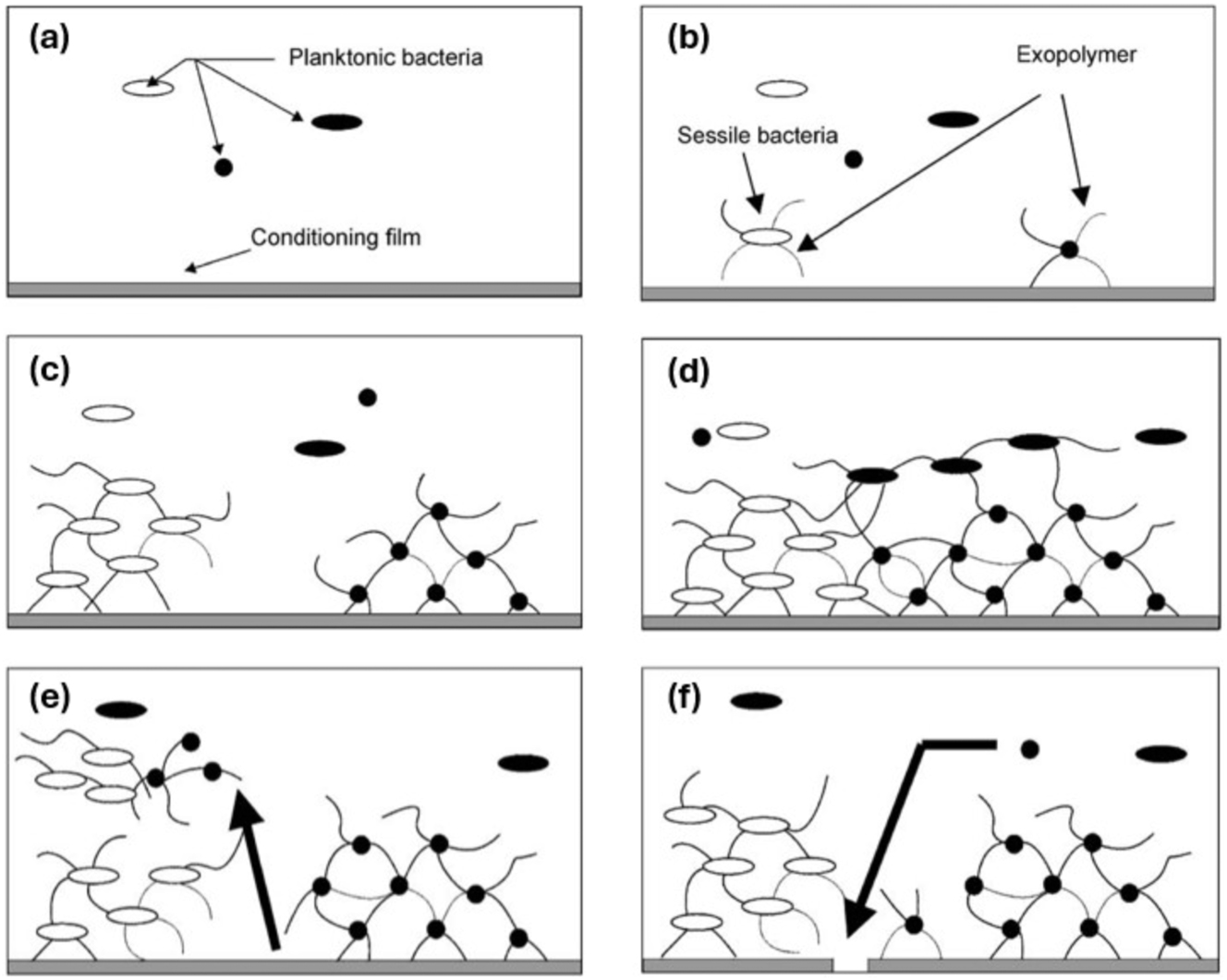
Different stages of biofilm formation. Microbiologically influenced corrosion: An engineering insight (2nd edition), Javaherdashti, Engineering Materials and Processes, Springer Nature, 2017, adapted with permission from Springer Nature Costumer Service Center (SNCSC).
2.2 Mechanisms
There are several possible mechanisms for MIC. Two mechanisms, i.e. concentration cell formation and metabolite MIC, are explained in more detail in the next sections. The corrosion mechanisms under the influence of SRB will be described in more detail later.
2.2.1 Concentration cell formation
As explained before, microorganisms colonise a metal surface through the formation of a biofilm. This results in the creation of concentration cells. A biofilm is believed to be rather non-uniform due to, among others, the presence of different bacterial species and the open structure. Therefore, it is assumed to consist of discrete microcolonies separated by interstitial voids, making the creation of gradients and concentration cells possible due to the straightforward mass transport of gases and matter (Lewandowski et al. 1995). Consequently, for example, oxygen concentration cells can be formed, when respiring aerobic bacteria form colonies on a metal surface, as they can deplete the oxygen concentration at the metal surface by consuming the oxygen for their energy metabolism. This favours the growth of anaerobic bacteria such as SRB. Consequently, the depleted oxygen region under the colony becomes an anode, while the surrounding area becomes a cathode. Biofouling, which involves the accumulation of microorganisms (and sometimes macroorganisms) and the formation of a biofilm, is sufficient by itself to establish oxygen concentration cells. An oxygen concentration gradient is indeed created through thickness from the outside towards the inside of the biofilm. Furthermore, tubercles, which are corrosion products containing magnetite (Fe3O4) and goethite (α-FeO(OH)), can also form on pipes (see Figure 1b). They can shield the metal surface from oxygen and, therefore, they can also establish oxygen concentration cells. The created oxygen concentration cells can give rise to localised corrosion types such as pitting corrosion and crevice corrosion due to local acidification within the deaerated zone (Iverson 1987; Javaherdashti 2017; Little and Lee 2009; Martins and Nunes 2006; Procópio 2019). Figure 3 illustrates how pitting corrosion of iron can result from the formation of an oxygen concentration cell (Jia et al. 2019). Besides oxygen concentration cells, metal concentration cells are also able to form by the EPS that are able to bind metals by their functional groups (Chitra et al. 2014).
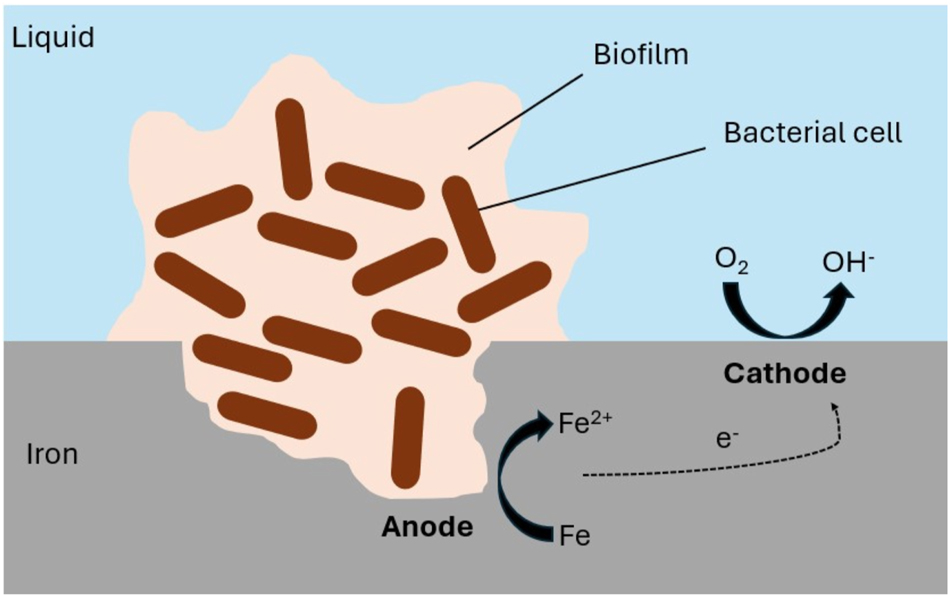
Pitting corrosion caused by the creation of an oxygen concentration cell, based on Jia et al. (2019).
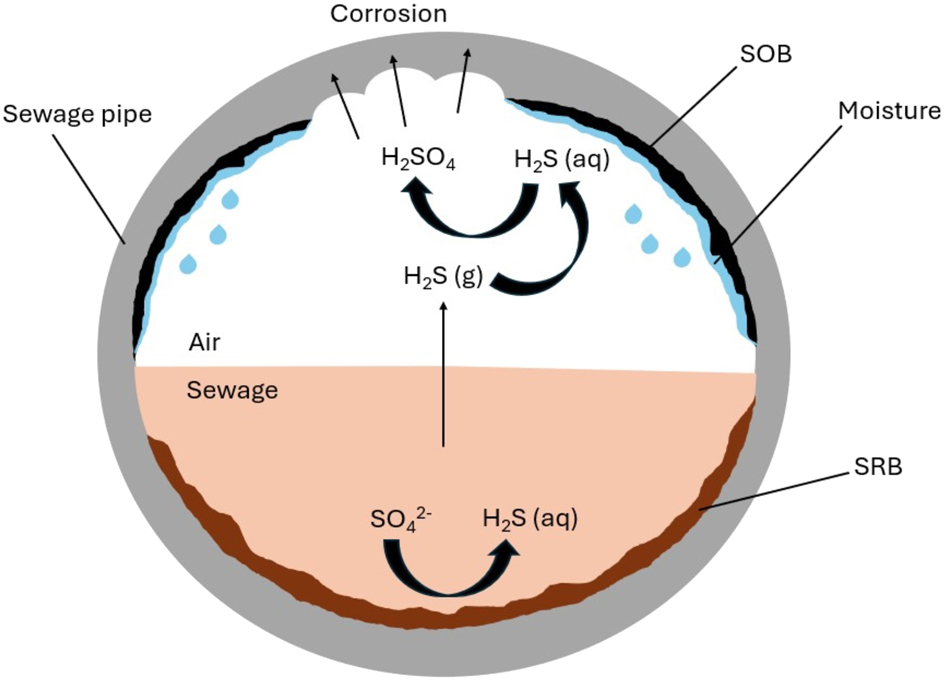
H2SO4 corrosion of a sewage pipe by the combined action of SRB and SOB, based on Little et al. (2000) and Wu et al. (2020).
2.2.2 Metabolite microbiologically influenced corrosion
Metabolite MIC (M-MIC), also known as chemical microbiologically influenced corrosion (CMIC) and often denoted as type II MIC within anaerobic conditions, is a very important indirect corrosion type of MIC (Enning and Garrelfs 2014; Li et al. 2018; Zhang et al. 2015). It involves the fact that the microorganisms secrete metabolites, which are corrosive and act as oxidants, attacking the metal often in a very localised way. These metabolites cause corrosion in an extracellular way, i.e. outside the cell of the microorganism. This type of MIC is strongly related to abiotic conventional chemical corrosion, which occurs without the presence of a biofilm with microorganisms (Li et al. 2018; Zhang et al. 2015). The only difference is that the metabolites or oxidants are now secreted by the microorganisms themselves (Zhang et al. 2015). There are several secreted metabolites that can be corrosive to the metal, as summarised here.
Acids: Both organic and inorganic acids can be very corrosive. Examples are inorganic sulphuric acid (H2SO4) secreted by sulphur-oxidising bacteria (SOB) (Okabe et al. 2007), fatty acids produced by marine bacteria (Lyles et al. 2014), organic acids produced by fungi (Y. Zhang et al. 2022a) and volatile fatty acids and organic acids produced by the anaerobic fermentation of acid-producing bacteria (APB) (Khan et al. 2021; Sowards and Mansfield 2014; Xu et al. 2016).
Sulphur-containing compounds : Sulphur-containing compounds, such as sulphide, bisulphide, hydrogen sulphide, thiosulphate, polythionate and mercaptan, are known to be corrosive (Iverson 1987; Videla 2000). Hydrogen sulphide (H2S) can be very corrosive to iron, especially under low pH and anaerobic conditions (Iverson 1987). The secreted H2S by SRB may cause H2S-induced cracking, also known as sulphide stress cracking (SSC), by catalysing and improving the hydrogen penetration and hydrogen uptake (Little et al. 2000), as will be discussed below. Some sulphur species may also induce the intergranular SCC of sensitised austenitic stainless steels (Cragnolino and Macdonald 1982). Wet solid elemental sulphur (S), in contact with iron, is also very aggressive, especially in the presence of an electroconductive iron sulphide layer (Little et al. 2000). Thiosulphate (S2O3 2−) can cause pitting corrosion and can accelerate transgranular cracking of stainless steel, even in absence of chlorides (Tian et al. 2018; Videla 2000). The combined action of SRB, which reduce sulphate (SO4 2−) and secrete volatile H2S, and SOB, which oxidise condensed H2S to H2SO4, can lead to rapid and aggressive H2SO4 corrosion within a sewage pipe (Stanaszek-Tomal and Fiertak 2016), as is illustrated in Figure 4 (Little et al. 2000; Wu et al. 2020).
There are self-evidently other mechanisms for MIC such as protective film disruption, e.g. by the disruption of passive films or coatings, breakdown of corrosion inhibitors, e.g. by acting as nutrients for the microorganisms, and ennoblement (Iverson 1987). The latter is described as the displacement of the corrosion potential to more positive, i.e. more noble, potentials resulting in, for example, an increased pitting susceptibility (Javaherdashti 2017).
3 Sulphate-reducing bacteria
3.1 Introduction
Sulphate-reducing bacteria (SRB) are the most commonly associated bacteria with anaerobic MIC and are considered to be strict anaerobes. They can cause serious corrosion issues at offshore structures such as marine steel pilings and offshore wind farms (Enning and Garrelfs 2014). Seawater is in general oxygenated, but other aerobic, e.g. iron-oxidising bacteria (IOB), and facultative anaerobic bacteria can reduce the oxygen content within the seawater environment to certain concentrations in which SRB are able to grow (Battersby et al. 1985). Furthermore, they are able to survive within the anoxic regions of a biofilm or slime layer containing other bacteria that consume oxygen (Battersby et al. 1985) or under macrofouling deposits and marine sediments such as seabed sediment and sea mud (Batt et al. 2002; Guezennec 1994; Zhu et al. 2007). Exposure to oxygen will alter the activity and behaviour of SRB, and the formed biofilm’s compactness and homogeneity (Cypionka 2000; Sigalevich and Cohen 2000; Wan et al. 2010). Other environments where SRB can be found are oil and gas fields (Cord-Ruwisch et al. 1987; Liu et al. 2018), sewers and sewage treatment plants (Oviedo et al. 2012; Stanaszek-Tomal and Fiertak 2016) and buried pipelines (Enning and Garrelfs 2014). They typically survive in a temperature range of 5–50 °C and a pH range of 5–10 (Javaherdashti 1999).
SRB obtain the energy for their metabolism by an electron donor–electron acceptor pair, i.e. via a redox reaction, as is generally the case for bacteria (Li et al. 2018). Their electron donors, energy sources and carbon providers are usually organic carbons such as pyruvate, lactate, acetate, propionate, alcohols and higher fatty acids (Cord-Ruwisch et al. 1987; Hamilton 1985; Little et al. 2000). Saturated and unsaturated hydrocarbons available in oil pipelines, among others, can also be used (Xu and Gu 2014). The SRB can typically be divided into two nutritional groups. On the one hand, those that do an incomplete oxidation of the organic sources with acetate as the end product and, on the other hand, those that do a complete oxidation of the organic sources into CO2 (Cord-Ruwisch et al. 1987; Hamilton 1985). Moreover, hydrogenase-positive SRB such as Desulfovibrio vulgaris (D. vulgaris) and Desulfovibrio desulfuricans (D. desulfuricans), which contain the enzyme hydrogenase, can use molecular hydrogen (H2) as an electron donor and they will use the oxidation of hydrogen for their growth. Therefore, it is clear that, in general, SRB can obtain electrons by the degradation of organic matter or H2. Some SRB can also grow autotrophically through the use of CO2 and H2 (Xu and Gu 2014).
Besides its consumption and use as a possible substrate, hydrogen can also be produced by SRB as demonstrated by Martins and Pereira (2013) who tested the H2 production by the hydrogenase-active D. vulgaris through dark fermentation of three different substrates.
The metabolism of SRB is based on anaerobic respiration, which makes use of an external oxidant as a terminal electron acceptor. This oxidant is not oxygen compared to aerobic respiration (Gu and Galicia 2012). The terminal electron acceptor is usually sulphate (SO4 2−) but can also be sulphite (SO3 2−), thiosulphate (S2O3 2−) and even elemental sulphur (S) (Li et al. 2018). The latter acceptor is for example used by the Desulfuromonas acetoxidans (Hamilton 1985). Because of the different possible acceptors besides SO4 2− and the fact that sulphide (S2−) is produced, a better description of these bacteria is sulphidogenic (Hamilton 1985).
When SO4 2− is used as an electron acceptor, its reduction can happen through two different pathways, i.e. assimilated sulphate reduction (ASR) and dissimilatory sulphate reduction (DSR). The latter is considered to be the main pathway and is illustrated in Figure 5. The SO4 2− is first activated by the reaction with adenosine triphosphate (ATP) resulting in the formation of adenosine phosphosulphate (APS) under the catalysis of ATP sulfurylase. This APS is further reduced to SO3 2− by a two-electron transfer catalysed by APS reductase and subsequently SO3 2− is reduced to S2− by a six-electron transfer catalysed by sulphite reductase. Instead of the six-electron transfer, three two-electron transfers through trithionate (S3O6 2−) and thiosulphate (S2O3 2−) as intermediates are also possible (Hamilton 1985; He et al. 2023; Little et al. 2000; P. Zhang et al. 2015; Z. Zhang et al. 2022b).
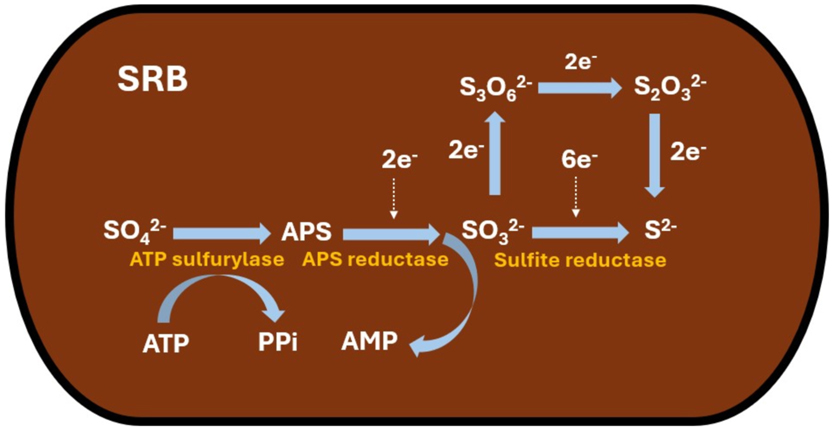
Dissimilatory sulphate reduction (DSR) by SRB, based on P. Zhang et al. (2015) and Z. Zhang et al. (2022b).
The generated S2− can be further hydrolysed into H2S (Little et al. 2000). H2S is known to have an unpleasant odour, while at high concentrations it cannot be smelled and is extremely toxic when inhaled (Cord-Ruwisch et al. 1987; Li et al. 2000). It is reported that it causes the souring of oil reservoirs and contamination of fuel gas and fuel oil (Cord-Ruwisch et al. 1987; Hamilton 1985). It is also responsible for the massive killing of fish within marine environments and even the killing of sewer workers (Javaherdashti 2011). Furthermore, it can act as an inhibitor for SRB growth because of its intrinsic toxicity (Reis et al. 1992). When dissolved in an aqueous solution, H2S becomes a weak acid and is known to be very corrosive to ferrous metals, inducing sour corrosion (Banakhevych et al. 2009; Li et al. 2000; King 2017). The general corrosion reaction is represented by Equation (6) (King 2017).
The formed iron sulphide corrosion products are in the more general form FexSy. Their structure, protectiveness, relative amount and corrosion rate are dependent on environmental parameters such as H2S concentration, pH, temperature, composition of the solution and the presence of oxygen (Banakhevych et al. 2009; Huang et al. 2017; Jack et al. 1998; King 2017). They are for example able to plug injection wells and are typically recognised as voluminous black precipitates (Cord-Ruwisch et al. 1987). Figure 6 shows the surface of a pipe under a disbonded coating that is covered with these products (Li et al. 2000). Iron sulphides are typically electroconductive and they are more noble than iron, which makes them more cathodic (Lazzari and Pedeferri 2018). If the integrity and protectiveness of an iron sulphide layer are disrupted, a galvanic coupling between this layer, acting as the cathode, and the bare iron or steel spots, acting as the anode, can result in localised corrosion because of the large cathode and small anode area (Lazzari and Pedeferri 2018; Lv and Du 2018; Rebak and Perez 2017).
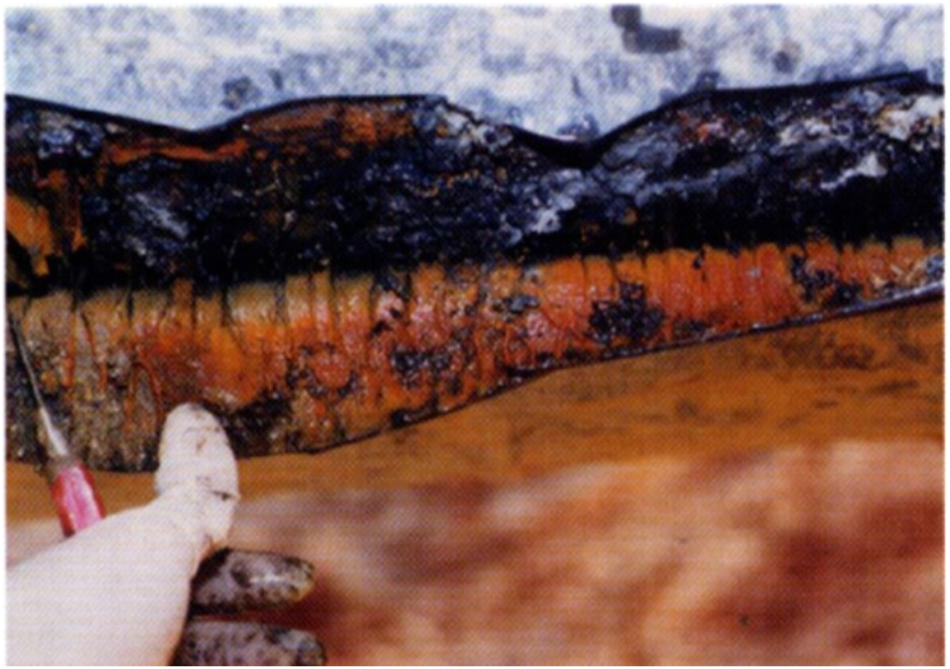
Black iron sulphide corrosion products on the surface of a pipe underneath a disbonded coating. Microbiologically influenced corrosion of underground pipelines under the disbonded coatings, Li et al., Metals and Materials International, 6, Springer Nature, 2000, reproduced with permission from Springer Nature Costumer Service Center (SNCSC).
Liu et al. (2018) investigated the corrosion of X80 pipeline steel caused by the combined effect of SRB and CO2 corrosion, also known as sweet corrosion (King 2017), within simulated CO2-saturated oilfield-produced water. FeCO3 was replaced by FeS as the dominant corrosion product when SRB-containing biofilms were present.
It should be mentioned that the problem of H2S corrosion and iron sulphide corrosion products is, besides SRB-containing environments, also very relevant to industries where abiotic H2S is present such as the oil and gas industry (Amani and Almodaris 2016; Asmara 2018; Marriott et al. 2016), geothermal industry (Banaś et al. 2007; Marshall and Hugill 1957) and the pulp industry (Chudnovsky 2008).
3.2 Corrosion mechanisms
In general, in anoxic and near-neutral systems, the oxidation of iron according to Equation (7) is a slow process because the proton (H+) reduction reaction, being dominant in the absence of oxygen, is a slow reaction and kinetically impeded at a pH value higher than 6, due to a low availability of protons. However, the presence of microorganisms such as SRB will accelerate the corrosion kinetics (Enning and Garrelfs 2014; Kato 2016).
Kuang et al. (2007) studied the influence of SRB on the corrosion of D36 carbon steel in seawater by potentiodynamic polarisation (PDP) and electrochemical impedance spectroscopy (EIS) as electrochemical measurement systems. They concluded by PDP that the anodic process and thus the corrosion rate were largely increased within SRB-inoculated seawater compared to seawater without SRB. This was caused by the accumulation of sulphide metabolite, rather than the active number of SRB. Furthermore, a decrease of the polarisation resistance (Rp) was observed by EIS.
There are several mechanisms proposed for MIC under the influence of SRB. Four mechanisms, namely the cathodic depolarisation theory (CDT), King’s mechanism (iron sulphides), biocatalytic cathodic sulphate reduction (BCSR) theory and extracellular electron transfer (EET) are explained in more detail here.
3.2.1 Cathodic depolarisation theory
A first mechanism is the cathodic depolarisation theory (CDT) already proposed by von Wolzogen Kühr and van der Vlugt in 1934 (Von Wolzogen Kuehr and van der Vlugt 1934). This mechanism is considered as the classical theory. It can be explained according to three main aspects, which are the metal, the solution and the microorganism, i.e. SRB, itself. The aspects (A, B and C) and reactions (Equation (8) – Equation (14)) are given below. The corrosion process of iron (Fe) occurs as follows (Javaherdashti 2011).
The metal (iron)
(8)The solution
(9)(10)Microorganism (SRB)
(11)(12)(13)
Overall reaction
It is clear that the corrosion of the iron proceeds due to the removal and consumption of cathodically adsorbed hydrogen (Hads) on the metal surface by the SRB and gets further metabolically oxidised. This oxidation is done by an enzyme called hydrogenase (Javaherdashti 2011). In general, hydrogenase is known to catalyse the reversible oxidation of molecular hydrogen (H2) as given by Equation (15) (Stott 1993). After the water dissociation (Equation (9)), the produced protons (H+) are adsorbed on the metal surface through the cathodic reaction (Equation (10)), which results in the polarisation of the surface. Subsequently, they are removed by hydrogenase for the needed sulphate (SO4 2−) reduction, which results in depolarisation (Equation (11)) (Javaherdashti 2011). The depolarisation indirectly causes an acceleration of the corrosion process by the stimulation of the cathodic processes (King and Miller 1971; Lv and Du 2018). Therefore, iron is forced to dissolve at the anode (Equation (8)) (Little et al. 2000). The depolarisation can be further considered as a kind of equivalent for the decrease in the activation energy needed for hydrogen removal and, therefore, it bypasses the high activation energy needed for the recombination of hydrogen atoms (Li et al. 2018; Videla 2000). Equation (12) and Equation (13) show that iron sulphide (FeS) and iron hydroxide (Fe(OH2)) corrosion products are, respectively, produced. Equation (14) represents the overall reaction, and the mechanism of CDT is schematically illustrated in Figure 7 (Mori et al. 2010).
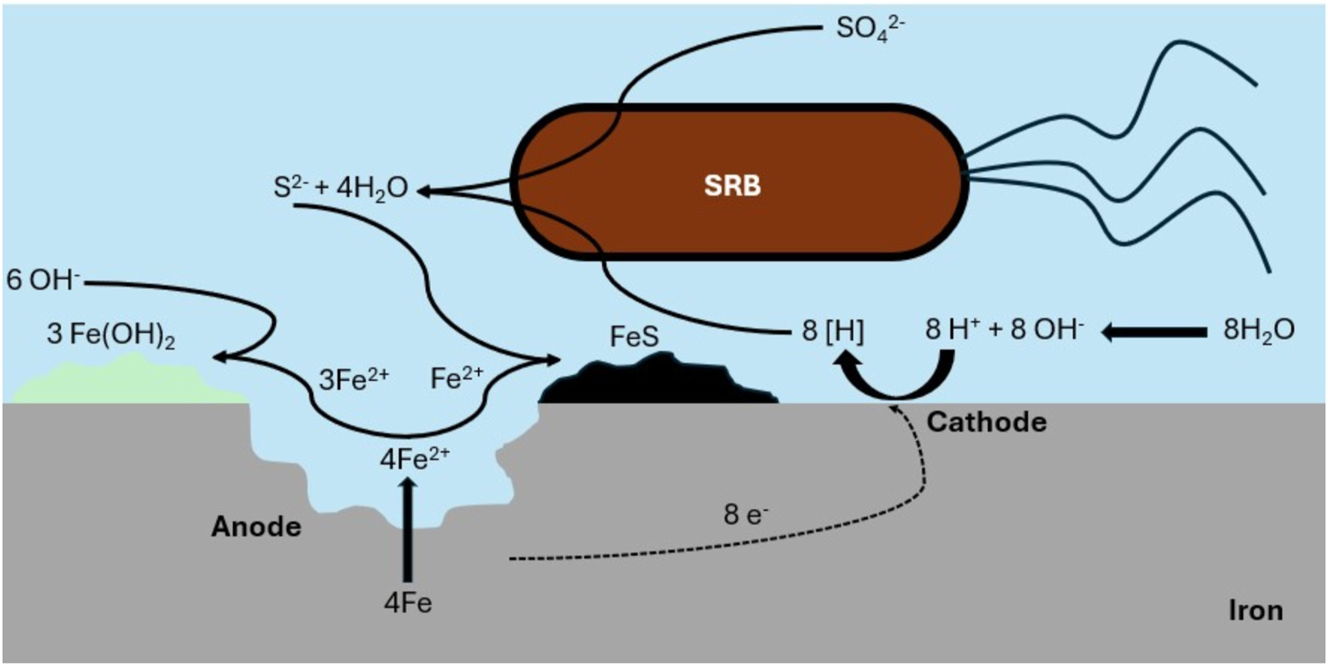
Schematic illustration of the cathodic depolarisation theory (CDT), based on Mori et al. (2010).
Even though CDT is a well-known theory, it has some important shortcomings. Equation (8) and Equation (12) show that the ratio of the iron that is corroded (Fe2+) to the generated iron sulphide corrosion product (FeS) is 4:1. However, in practice, this ratio is typically in the range of 0.9–1 (Tiller 1983). This can be considered as a first shortcoming. A second shortcoming is the fact that the enzyme hydrogenase cannot play a role within the cathodic depolarisation by the removal of atomic hydrogen because it actually cannot work on atomic hydrogen but works on molecular hydrogen instead. It is further unclear how hydrogenase, present within the periplasm of the SRB cell, is able to ‘pull’ the hydrogen away from the extracellular cathode surface (Stott 1993). A third shortcoming is the unclear influence of iron sulphide corrosion products, which are more cathodic compared to iron and could probably play a role in iron dissolution (Videla 2000). Furthermore, it is clear that CDT is only applicable for hydrogenase-positive SRB containing the enzyme hydrogenase and, therefore, CDT is in general assumed to be a lithotrophic (see Table 1) concept (Enning and Garrelfs 2014).
3.2.2 King’s mechanism (iron sulphides)
A second mechanism, which tried to eliminate the shortcomings of CDT, was proposed by King and Miller in 1971 (King and Miller 1971). They focused more on the role of iron sulphide corrosion products as depolarising agents and absorbers of hydrogen within the corrosion mechanism; however, they still attributed a role to the enzyme hydrogenase (Stott 1993; Videla 2000). The iron sulphide is initially, when the concentration of Fe2+ is low, present under the form of mackinawite (Javaherdashti 2017; Rickard and Luther 2007) (tetragonal FeS1-x: FeS0.93-0.96), which limits the diffusion of Fe2+ and inhibits the corrosion by acting as a thin adherent and protective layer (Iverson 1987). Therefore, the corrosion rate in this case is still low and is typically influenced by the growth rate of the SRB (Hamilton 1985). Later, this layer ruptures or cracks by an increase of Fe2+ concentration into other forms of iron sulphide, which are typically greigite (Rickard and Luther 2007) (cubic Fe3S4) or smythite (Rickard and Luther 2007) (rhombohedral Fe9S11) and pyrrhotite (Javaherdashti 2017; Rickard and Luther 2007) (hexagonal Fe1-xS: Fe0.875-1S) (Videla 2000). A loss of the protective nature and a high corrosion rate typically follow this process. As such, the corrosion rate becomes independent on the SRB growth rate but becomes dependent on the iron sulphide corrosion product and its protectiveness. Bulky black iron sulphide precipitates are typically formed, which are non-adherent and cause in this specific case the cathodic depolarisation (Iverson 1987; Videla 2000). If sufficient iron sulphide is present, a galvanic corrosion cell is established with the iron sulphide as the cathode and iron as the anode, which is also illustrated in Figure 8a (King and Miller 1971). Moreover, the CDT is again schematically illustrated in Figure 8b (King and Miller 1971), which does not indicate the role of iron sulphide as the cathode. As already mentioned, iron sulphide is considered to be cathodic with respect to iron; however, it is not a permanent cathode and high corrosion rates remain by the continuous reformation of the iron sulphide by the precipitation of produced S2− and HS− and the removal of hydrogen by the enzyme hydrogenase (King and Miller 1971). This is because it is generally believed that the activity of the iron sulphide is reduced due to the bonding of atomic hydrogen within its crystal structure and, therefore, the hydrogen removal by hydrogenase can restore the sulphide’s activity (King and Miller 1971).
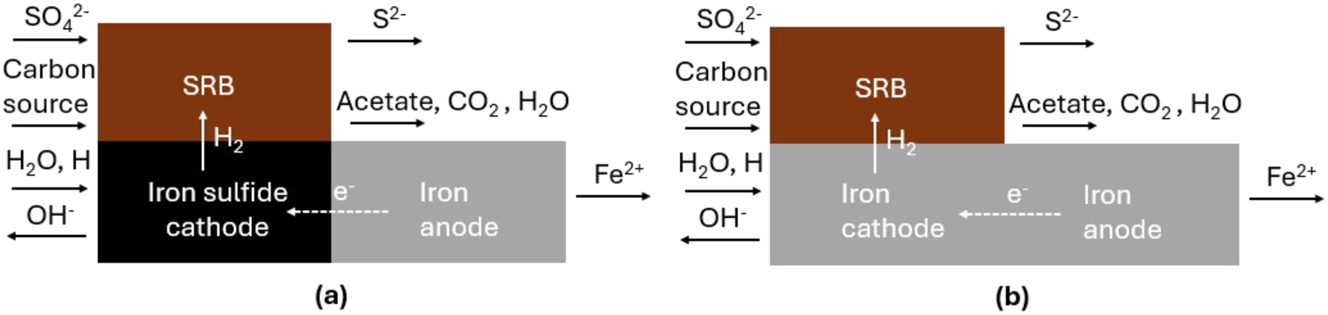
Representation of King’s mechanism (a) and cathodic depolarisation theory (CDT) (b), based on King and Miller (1971).
Ocando et al. (2007) reported the relation between Fe2+, iron sulphides, H2S and pH during the corrosion process of iron sheets by D. desulfuricans. Both pH and H2S concentrations were measured by the use of microelectrodes. On the one hand, it was observed that the presence of Fe2+ within the SRB-inoculated medium caused more severe corrosion, which resulted in a dense mass of amorphous iron sulphide precipitates. Moreover, some intergranular corrosion attack was observed. On the other hand, within the SRB-inoculated medium without Fe2+, a clean biofilm structure and iron sulphides formed, which protected the iron sheet and avoided consumption of H+ by the corrosion process.
3.2.3 Biocatalytic cathodic sulphate reduction theory and extracellular electron transfer
A third mechanism, which is the biocatalytic cathodic sulphate reduction (BCSR) theory, was proposed by Gu et al. in 2009 (Gu et al. 2009). This theory uses as first the principle of bioenergetics to explain the MIC mechanism by SRB. As was mentioned before, lactate for example can be used as an electron donor for the SRB metabolism, as indicated by Equation (16). However, when there is a limitation in the diffusion of the lactate, there will be a lack of both electron donor, energy source, and carbon provider. As a consequence, the SRB must make use of another electron donor for the sulphate reduction and the creation of energy. Therefore, a limitation in the diffusion can be caused by the biofilm, because it will act as a barrier against mass transfer and will even consume some of the lactate resulting in a lower supply for the SRB sessile cells at the bottom of the biofilm (Li et al. 2018). This results in a local lactate or carbon source starvation of the sessile cells being situated the closest to the metal surface (Xu and Gu 2014). In this case, elemental iron (Fe) can be used as an electron donor, according to the oxidation Equation (17). Xu and Gu (2014) observed that the corrosion of carbon steel by D. vulgaris was more severe under carbon source starvation. The sulphate reduction reaction is given by Equation (18) (Zhang et al. 2015). Both the lactate oxidation (Equation (16)), iron oxidation (Equation (17)) and sulphate reduction (Equation (18)) have their redox potentials, denoted as E0 under the conditions of 25 °C, a pH of 7, 1 M solute concentration and 1 bar partial pressure for the gases, i.e. CO2. Therefore, the cell potentials (Ecell) for the lactate oxidation/sulphate reduction pair and iron oxidation/sulphate reduction pair are 213 mVSHE and 230 mVSHE, respectively, resulting in a Gibbs free energy change (ΔG) of −164 kJ/mol and −178 kJ/mol, respectively, according to Equation (19) with n the number of involved electrons in the redox reaction, being eight, and F Faraday’s constant (96,485 C/mol). Both coupled lactate oxidation/sulphate reduction and iron oxidation/sulphate reduction are thermodynamically favourable; however, the latter releases more energy under the same conditions (Xu and Gu 2014). This shows that corrosion can occur spontaneously via the iron oxidation reaction. However, it is important to mention that in this case, although there is a driving force for corrosion, this does not imply that corrosion will occur because the kinetics can be unfavourable (Lv and Du 2018). The sulphate reduction needs in general a high activation energy and, therefore, it has a slow reaction rate. However, the biocatalysis provided by the SRB acting as a biocathode accelerates its kinetics. This idea of a biocathode is based on the microbial fuel cell (MFC) technology (Zhou et al. 2013). It should be noted that there is not actually a real cathode on which the sulphate reduction occurs because it happens within the SRB cell itself, i.e. within the cytoplasm, and, therefore, the SRB should be seen as a kind of imaginary biocathode (Lv and Du 2018).
Figure 9 illustrates the difference between the reaction mechanism when lactate (Figure 9a) or iron (Figure 9b) is used as electron donors. It is clear that the lactate oxidation (Equation (16)) happens within the SRB cytoplasm because the lactate is soluble and diffusible (Jia et al. 2019; Li et al. 2018). However, the iron is not because it is a solid-state electron donor (Philips et al. 2016). Therefore, iron cannot be incorporated within SRB cell and, consequently, its oxidation (Equation (17)) happens extracellularly (Kato 2016; Xu and Gu 2014). The sulphate reduction reaction (Equation (18)) on the other hand occurs intracellularly within the cytoplasm (Li et al. 2018). This implies that the released extracellular electrons of the iron oxidation, being used for the intracellular sulphate reduction, have to be transported through the SRB cell wall into its cytoplasm (Xu and Gu 2014).
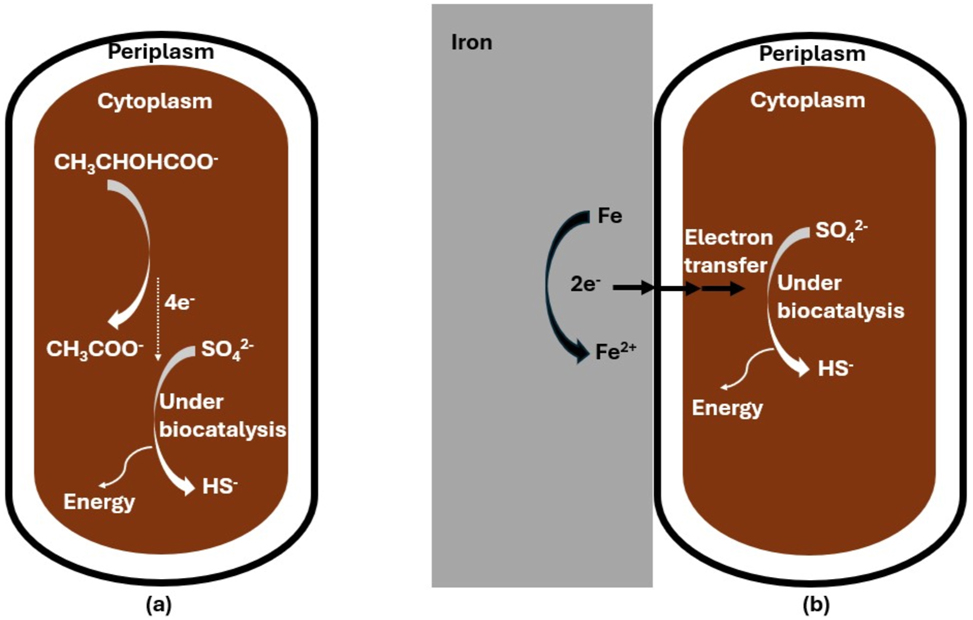
Sulphate reduction under biocatalysis with lactate (a) and iron (b) as electron donors, based on Li et al. (2018).
It is known that electrons cannot ‘swim’ freely within the aqueous solution from the iron to the SRB cytoplasm and, therefore, electron transfer across the cell wall is needed. This so-called extracellular electron transfer (EET), i.e. the electron transport between the metal surface and SRB cell, can happen in two ways: direct electron transport (DET) and mediated electron transport (MET) (Zhang et al. 2015). The SRB that are capable of doing this EET, such as Desulfopila corrodens, are called electrogenic and, therefore, the MIC caused by these SRB is called electrical microbiologically influenced corrosion (EMIC), which is also known as type I MIC within anaerobic conditions (Enning and Garrelfs 2014; Jia et al. 2019; Zhang et al. 2015). According to DET on the one hand, the SRB attach to the iron surface, thereby making direct contact via which they will directly transport and take away the electrons (Kato 2016; Philips et al. 2016). This can be typically realised in different ways. The first one is the use of redox protein-based structures to connect the SRB cell with the iron surface such as membrane-bound c-type cytochrome (Cyc1 and Cyc2) and rusticyanin (Mehanna et al. 2009; Kato 2016; Philips et al. 2016). A second possibility is the use of conductive filamentous apparatus, i.e. outer membrane extensions and pili, which are also denoted as nanowires (Kato 2016; Philips et al. 2016). These nanowires are used as the electrical connections needed for the DET (Reguera et al. 2005).
According to MET, on the other hand, soluble and diffusible redox species are used, also called electron mediators or electron shuttles, which can carry the released electrons from the iron surface to the SRB cell. The mediator is reduced by accepting the released electrons from the iron surface and will subsequently diffuse to the SRB cell, where it is oxidised to donate the electrons needed for the sulphate reduction reaction. Subsequently, they can diffuse back to the iron surface, ready for a new cycle (Kato 2016; Philips et al. 2016). The SRB self-secreted inorganic or organic molecules such as phenazine compounds (e.g. pyocyanin and phenazine-1-carboxamide) and flavine derivates (e.g. riboflavin and flavin adenine dinucleotide) can serve as mediators or artificial mediators can be added, such as methyl viologen (MV), anthraquinone-2,6-disulfonate (AQDS) and ferrocene derivates (Jia et al. 2017; Kato 2016; Philips et al. 2016; Zhang et al. 2015). Hydrogenase-positive SRB can use molecular hydrogen (H2) as an electron mediator. Consequently, the classical CDT mechanism actually is an electron transfer mechanism using H2 as the electron mediator, which implies that hydrogenase-negative SRB can only use the DET mechanism or other electron mediators than H2 (Xu and Gu 2014; Zhang et al. 2015). Furthermore, precipitated iron sulphide corrosion products are believed to also mediate the electron transfer due to their electroconductive properties (Enning et al. 2012; Guan et al. 2016). Both the DET and MET mechanisms are schematically illustrated in Figure 10 (Gu et al. 2019; Li et al. 2018).
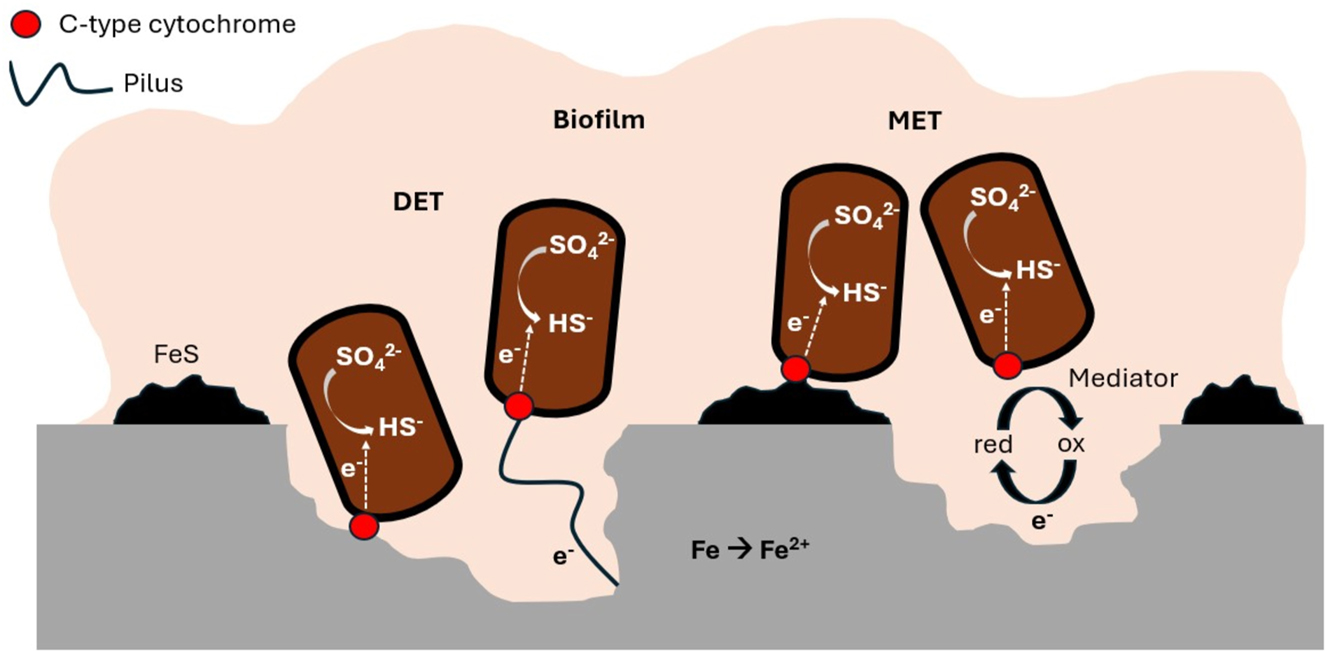
Schematic representation of EET (extracellular electron transfer): DET (direct electron transport) and MET (mediated electron transport), based on Gu et al. (2019) and Li et al. (2018).
Besides the described mechanisms, other mechanisms are corrosive metabolic products or CMIC (H2S and volatile phosphorous compound (1983)), Fe-binding exopolymers (1995), three stages or Romero mechanism (2005), anodic depolarisation theory (ADT) (1984) and sulphide and hydrogen-induced SCC (1995) (Kakooei et al. 2012; Lv and Du 2018). Comparing EMIC and CMIC for example, the cathodic reaction is, respectively, stimulated by the consumption of cathodic electrons or by secreted corrosive metabolic products (Kato 2016). Furthermore, the reduction of the oxidant in the latter, which attacks the metal, happens extracellularly without the need for biocatalysis (Li et al. 2018). The already mentioned H2S corrosion serves as a nice illustration for this case.
4 Interplay between applied cathodic protection and sulphate-reducing bacteria
4.1 General interaction between cathodic protection and microbial life
An applied potential of, e.g. −0.85 V with respect to Saturated Calomel Electrode (VSCE) is in general sufficient to protect offshore carbon steel structures within aerated seawater against corrosion. However, if microbial life is involved such as SRB within anaerobic environments, the potential needed for CP should be lower, i.e. around −0.95 VSCE and optimally around −1.03 VSCE (Guan et al. 2016). Therefore, the interaction between CP and microbial life should be considered for offshore structures (Lunarska et al. 2007). Permeh et al. (2020) performed field condition tests, to evaluate the CP behaviour in the presence of SRB and crevices and, therefore, to elucidate localised corrosion associated with macro and microfouling on submerged steel bridge piles under CP in marine environment. Moreover, laboratory tests were conducted through potentiostatic polarisation tests in SRB-inoculated solution, to evaluate the cathodic reactions occurring under compact and porous crevices, which represented the real marine fouling. Both field conditions tests and laboratory tests were consistent with each other and showed that localised corrosion can still occur under crevice environments during CP, enhanced by the presence of SRB. This shows that even when CP is applied, its efficiency is affected by the presence of SRB, marine fouling and coverage by calcareous deposits. These are typical surface irregularities, which result in non-uniform polarisation conditions and thus the occurrence of localised corrosion.
Gordon et al. (1981) showed that the attachment of two different marine bacteria strains, named B27–5 and B27-13, on copper was increased by CP. However, Dhar et al. (1982) illustrated that the attachment of the marine bacteria Vibrio anguilarum (V. anguilarum) and Pseudonoma atlantica (P. atlantica) on tin oxide and titanium cathodes decreased during CP within both artificial and natural seawater. A decreased settlement and attachment during CP were also observed by Edyvean et al. (1992) for aerobic bacteria on 304 stainless steel and 50 D structural steel.
There is in general a mutual interaction between CP, in particular calcareous deposits, and microbial life. On the one hand, CP will alter the solution chemistry and conditions at the metal surface and, therefore, also the settlement and attachment of the microorganisms. CP will typically affect the growth and reproduction of the microorganisms (He et al. 2023). The consumption of oxygen by CP at the polarised surface (Equation (1)) may result in a decreased reproduction of aerobic bacteria (Edyvean et al. 1992). The production of hydrogen during CP (Equation (2)) is favourable for the growth of hydrogenase-positive SRB, which consume this hydrogen (Guezennec 1994). This hydrogen consumption combined with the precipitation of iron sulphide corrosion products, being more cathodic than steel, will result in an increased current demand for CP to maintain a certain level of protection (Guezennec 1994). Esquivel et al. (2011) concluded that a potential of – 0.950 V with respect to copper/copper-sulphate electrode (VCSE) was not enough to control MIC of XL 52 steel by SRB and some localised corrosion was observed. This was attributed to both the hydrogen consumption by the SRB and the deposition of iron sulphide corrosion products causing a galvanic corrosion effect. Microorganisms and their biofilm will also interfere with the occurring electrochemical reactions, i.e. oxygen reduction (Equation (1)) and hydrogen evolution (Equation (2)), and, therefore, will also change the current demand for CP (De Gómez Saravia et al. 1997). A biofilm on the metal surface can for example, similar to calcareous deposits, act as a barrier against oxygen diffusion (Guezennec 1994). Secreted metabolic products, such as extracellular enzymes, exopolymer substances and acids, will also alter the solution chemistry at the metal surface and can, therefore, affect the deposition and nature of calcareous deposits (Edyvean et al. 1992; Guezennec 1994). Acid-producing bacteria (APB) that secrete acetic acid for example can dissolve protective calcareous deposits on stainless steel and, therefore, can cause an increase in the current density demand (De Gómez Saravia et al. 1997).
Guezennec (1994) reported that the production of volatile fatty acids such as acetic and butyric acids by the slime-producing bacterium V. natriegens prevented Mg deposition under the form of brucite due to a pH decrease and, therefore, only allowed aragonite to form as a calcareous deposit. Furthermore, if a Mg-rich deposit is already present, a pH decrease can induce its dissolution and, therefore, the bacteria may act as a kind of nuclei for the breakdown of the calcareous deposit. Tian et al. (2019) investigated the combined effect of CP and sulphur-based species on the formation of calcareous deposits on low carbon bainite E690 steel within deaerated ASW with a pH of four and a varying amount of thiosulphate (S2O3 2−) concentration. This S2O3 2− tried to simulate SRB as a H2S producer within an acidic solution. They observed that at 0.01 M S2O3 2−, aragonite precipitation was hindered at potentials of −850, −1,050 and −1,200 mVSCE. This could be attributed to three reasons: i) Other cathodic reactions were dominating, such as reduction reactions of sulphur-based species, thereby not producing OH− needed for the precipitation of the calcareous deposit; ii) HS− was formed, which had a more favourable adsorption on the steel surface compared to CO3 2− and OH−; and iii) there was an enhanced hydrogen evolution within the solution with S2O3 2−, for which H2 bubbles inhibited the available deposit growth sites and increased the crystal growth time and, therefore, impeded aragonite nucleation. The formation of brucite was also suppressed via this mechanism; however, at a potential of −1,200 mVSCE, its deposition became possible and brucite was detected by both scanning electron microscopy (SEM) and X-ray diffraction (XRD). Furthermore, Dexter and Lin (1992) investigated the influence of a pre-existing biofilm of marine bacteria on the formation of calcareous deposits under CP of stainless steel within filtered seawater. They concluded that at all used current densities, i.e. 20, 50, and 100 μA/cm2, this pre-existing biofilm created more uniform and better distributed calcareous deposits by providing an increase in nucleation sites compared to the situation without biofilm. However, the combined behaviour of the biofilm and calcareous deposits varied depending on the applied current density. At 100 μA/cm2, i.e. high current density, the combination of biofilm and calcareous deposits acted as a barrier. The interfacial pH was high enough to deactivate the bacteria’s metabolism, enhancing CP efficiency by actually making the calcareous deposit a more efficient barrier and making the potential more active compared to the situation without biofilm. On the other hand, at 20 μA/cm2, the interfacial pH was not high enough to deactivate the bacteria and, therefore, allowed cathodic depolarisation and ennoblement to occur as dominant effects. In this way, the oxygen reduction was enhanced and the CP efficiency decreased, as such increasing the loss of protection compared to the situation without biofilm. It is clear that the bacteria’s metabolism can lead to changes in the Ca/Mg ratio, stability and protectiveness of the calcareous deposit and, therefore, the required current demand for CP (Guezennec 1994).
There are several theories that could explain the improved attachment or improved detachment of bacteria when CP is applied. An overview is provided in the next subsections.
4.1.1 Electrostatic-chemical theory
A first theory that explains the influence of CP on the attachment of bacteria is the electrostatic-chemical theory (Javaherdashti 2017). Zobell (1943) and Marshall et al. (1971) described the formation of microbial surface colonies as a two-step sequence:
Reversible sorption: this describes an initial instantaneous attraction to the metal surface. The bacterial cells are somehow weakly attracted by the charge of the metal surface and other forces. However, they have still a Brownian motion.
Irreversible sorption: this describes a stable adhesion to the metal surface caused by the production of EPS after several hours.
The reversible sorption phase describes electrostatic interactions. CP will cause the metal surface to be negatively charged, by the creation of a negatively charged OH− diffusion layer. This repels negatively charged bacterial cells upon their approach (Edyvean et al. 1992; Lv and Du 2018). The fact that the cells have a negative charge should be attributed to the cell walls made up of biopolymers, e.g. peptidoglycan, which contain a wide range distribution of negatively charged groups, such as ionised phosphoryl and carboxylate substituents (Wilson et al. 2001). During the irreversible sorption, e.g. negatively charged acidic polysaccharide glycocalyx within the EPS is produced, which can also cause the electrostatic repelling from the negatively charged metal surface during CP (Edyvean et al. 1992). As illustrated in Figure 11, bacterium 1 undergoes a higher repulsive force due to the negatively charged surface compared to bacterium 2. However, if a bacterium, such as bacterium 3, is very close to the negatively charged metal surface, i.e. within a distance of 0.4 nm or less, attractive forces are created, which provide the attachment of the bacterium on the surface (Javaherdashti 2017).
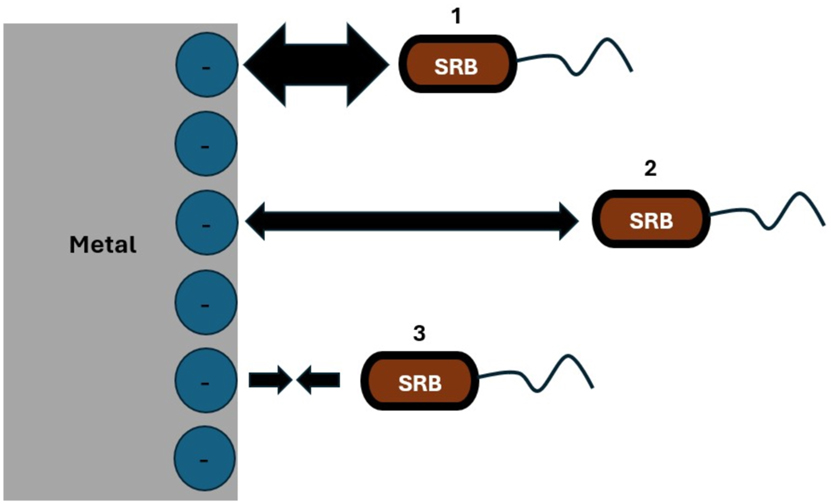
Interaction of bacteria with a negatively charged metal surface, based on Javaherdashti (2017).
Poortinga et al. (2001) for example found that applying an impressed cathodic current resulted in the desorption of bacterial strains on an indium tin oxide electrode because of both electrostatic repulsion and electrophoretic force, i.e. the force proportional to the electrophoretic mobility of bacteria and the strength of the electric field. (Hong et al. 2008) noticed the same findings when a cathodic current of 15 μA/cm2 was applied. Furthermore, Busalmen and de Sánchez (2001) concluded that below potentials of −0.2 V and −0.5 V with respect to Ag/AgCl reference electrode (VAg/AgCl), the bacterial adhesion of Pseudomonas fluorescens on a gold film was inhibited. However, it should be noted that the surface charge of the bacterial cells is a function of the interfacial pH, because the latter will have an influence on the protonation degree of the functional and ionogenic groups of the cell wall or glycocalyx polysaccharide within the EPS, as mentioned above (Edyvean et al. 1992). De Gómez Saravia et al. (1997) reported that the isoelectric point of many aerobic bacteria corresponds to a pH value within the acidic region, while that of SRB corresponds to a pH value within the alkaline region. Therefore, at a neutral and an alkaline pH, the aerobic bacteria would have a negative charge and, therefore, will be repelled by a negatively charged metal surface, while the SRB are not.
Electrostatic repulsion is obviously the electrostatic part of the electrostatic-chemical theory. However, there is also a chemical part coupled with this theory. As was already mentioned before, CP will result in an increase of the interfacial pH, due to reduction reactions producing OH− ions, as given by Equation (1) and Equation (2) (Javaherdashti 2017). For an anaerobic environment, such as for SRB, Equation (2) is of course dominating. This alkalisation actually is a negative factor for the bacteria and several studies were also done considering its influence. Pérez et al. (1994) studied the influence of a potential of −0.82 VSCE and −1.10 VSCE on the biofouling within a metal-anticorrosive paint-seawater system of two species, i.e. Balanus amphitrite and Polydora ligni. A decreased attachment of the former with more negative potential was observed due to an increased interfacial pH. However, the attachment of the latter was not affected. The bacteria that generally would adhere to the metal surface, despite the electrostatic repulsion, will nevertheless die because of the increased interfacial pH, if its value is of course sufficiently high (Javaherdashti 2017).
4.1.2 H2O2-production
There is a second effect of CP that plays an important role. The oxygen reduction reaction (Equation (1)), being a four-electron pathway, can be divided into two steps, according to Equation (20) (step 1) and Equation (21) (step 2), being each a two-electron pathway (Barchiche et al. 2003). According to step 1, i.e. the partial reduction of oxygen, hydrogen peroxide (H2O2) is generated. This H2O2 is generally considered as a biocide (Linley et al. 2012) and, therefore, possibly decreases the bacterial attachment.
Istanbullu et al. (2012) found that H2O2 was produced on 316 L stainless steel surfaces at potentials more negative than −400 mVSCE and concluded that negatively polarised surfaces prevented the biofilm growth of Pseudomonas aeruginosa, while it could occur on non-polarised surfaces. Furthermore, deposited cell debris could be observed on the polarised surfaces and not on the non-polarised ones, which indicated the biocidal role of H2O2. Dhar et al. (1982) attributed the decreased attachment of the bacteria in their study to H2O2-production as a possible factor as well.
4.1.3 Chemical bridge theory and supply of excessive electrons
Another theory, which does not consider electrostatic forces, is the chemical bridge theory (Javaherdashti 2017). It is generally accepted that bacteria may attach to negatively charged surfaces by the use of divalent cations such as Ca2+ and Mg2+. They will use these cations as ‘bridges’, actually bypassing the influence of electrostatic repulsion caused by the negatively charged metal surface (Edyvean et al. 1992; Javaherdashti 2017). However, as already mentioned, because of an increased pH during CP caused by Equation (1) and Equation (2), calcareous deposits such as CaCO3 and Mg(OH)2 can precipitate as described by Equations (3)–(5). Due to their precipitation, there is a decrease of Ca2+ and Mg2+ at the metal interface. Because of this decrease, the bacteria do not have these ions anymore to attach to the surface via ‘bridge’ formation (Edyvean et al. 1992). Eashwar et al. (2009) observed a reduction of biofilm density on a stainless steel cathode polarised at −0.70 VSCE within coastal Indian seawater with mild steel and zinc anodes. This was attributed to the deposition of calcareous deposits, mainly CaCO3 and Mg(OH)2.
Liu and Cheng (2017) studied the influence of CP and SRB, i.e. D. desulfuricans, on the corrosion behaviour of X70 pipeline steel within extracted soil solution. They observed that the application of CP did not affect the planktonic bacterial cells; however, when the applied potential was more negative, there was an increase in the number of sessile cells and thus in the bacterial attachment. This was caused by the fact that the bacteria could use the excessive electrons, supplied by the power source of CP, as an electron donor instead of steel. A potential of −850 mVCSE was not sufficient to protect the steel from uniform corrosion, compared to −1,000 mVCSE. However, the shielding effect of the biofilm when the cells were adhered at −1,000 mVCSE caused fluctuations in the potential. This means that if locally the potential, and thus the electron supply, is not sufficient, the SRB can use the steel again as an electron donor. As a consequence, pitting corrosion could occur at −1,000 mVCSE. The situation is illustrated in Figure 12. The use of excessive electrons provided by CP is an argument for an improved bacterial attachment (Lv and Du 2018).
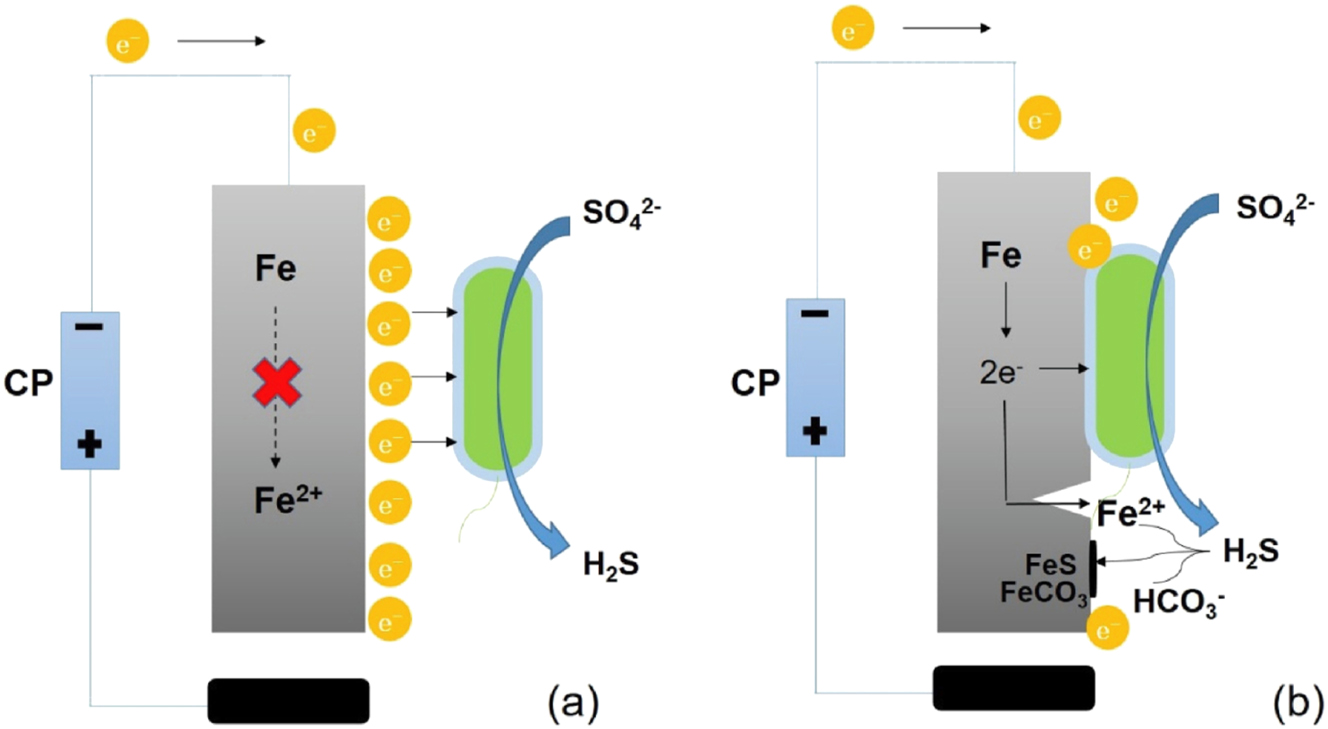
Use of electrons supplied by CP as electron donor (a) and possible pitting corrosion because of shielding (b). Reprinted from Journal of Alloys and Compounds, 729, Liu and Cheng, The influence of cathodic protection potential on the biofilm formation and corrosion behaviour of an X70 steel pipeline in sulphate reducing bacteria media, 180–188, Copyright (2017), with permission from Elsevier.
The corrosion behaviour of L360 N steel by SRB, i.e. Desulfovibrio, under CP was reported by He et al. (2023). On the one hand, at a potential of −0.85 VSCE, an increased corrosion rate and anodic dissolution (AD), even higher than at open circuit potential (OCP) conditions, were observed due to the acceleration of the SRB growth and their metabolism by the promotion of the hydrogen proton (H+) reduction into adsorbed hydrogen, being consumed by the SRB, due to an increased electron supply. The local corrosion rate, under the form of pits, was accelerated and deeper pits were created compared to OCP. On the other hand, at −0.95 VSCE, the SRB growth and metabolism were inhibited due to a higher alkalisation on the metal surface, creating conditions unsuitable for SRB adhesion. In this case, the corrosion was slowed down. Moreover, due to the higher alkalisation and thus higher interfacial pH, CaCO3 calcareous deposits could precipitate, giving less Ca2+ available as possible ‘bridges’ for the SRB adsorption on the metal. In this way, CaCO3 formed a protective film and any form of local corrosion could not be observed in this case. Lastly, at −1.05 VSCE, the SRB could receive a large number of ‘free’ electrons by the supply of excessive electrons and, therefore, the SRB growth and metabolism were promoted again. However, calcareous deposits were also able to form, thus giving a lower corrosion rate compared to the situation at −0.85 VSCE. The local corrosion rate under the form of pits was in this case low and fewer deep pits were created compared to OCP and −0.85 VSCE. A similar study was done by Guan et al. (2016) on high strength EQ 70 steel and by using D. caledoniens at the same potentials. At −0.85 VSCE, an increased corrosion rate was observed compared to OCP conditions. This was attributed to a promoted SRB metabolic activity. Corrosion cracks were observed on the surface consisting of a biofilm with SRB and corrosion products. After the removal of the surface products, bigger and deeper corrosion pits were observed compared to OCP conditions. At −0.95 VSCE, the corrosion rate was decreased compared to −0.85 VSCE; however, this potential was still insufficient to prevent corrosive attack by the SRB metabolism and corrosion cracks were again observed. After the removal of the products, there were again corrosion pits, however, more rounded compared to −0.85 VSCE. Lastly, at −1.05 VSCE, the specimen was effectively protected and calcareous deposits were observed on the surface, suggesting a restraining on the SRB metabolic activity. After the removal of the products, only a few pits were observed. It was suggested that, on the one hand, at −0.85 VSCE, the SRB metabolism was promoted by the DET mechanism, as was discussed before. It is believed that the SRB could obtain electrons for their metabolism, i.e. the sulphate reduction (Equation (18)), more easily by the cathodic polarised electrode via the use of protein-based structures or conductive nanowires. The situation is illustrated schematically in Figure 13. MET is also mentioned via the use of hydrogen and electron mediators (med) in general. At −1.05 VSCE, the calcareous deposits and alkalisation were not suitable for the SRB metabolism and growth, and the deposits also hindered the DET mechanism.
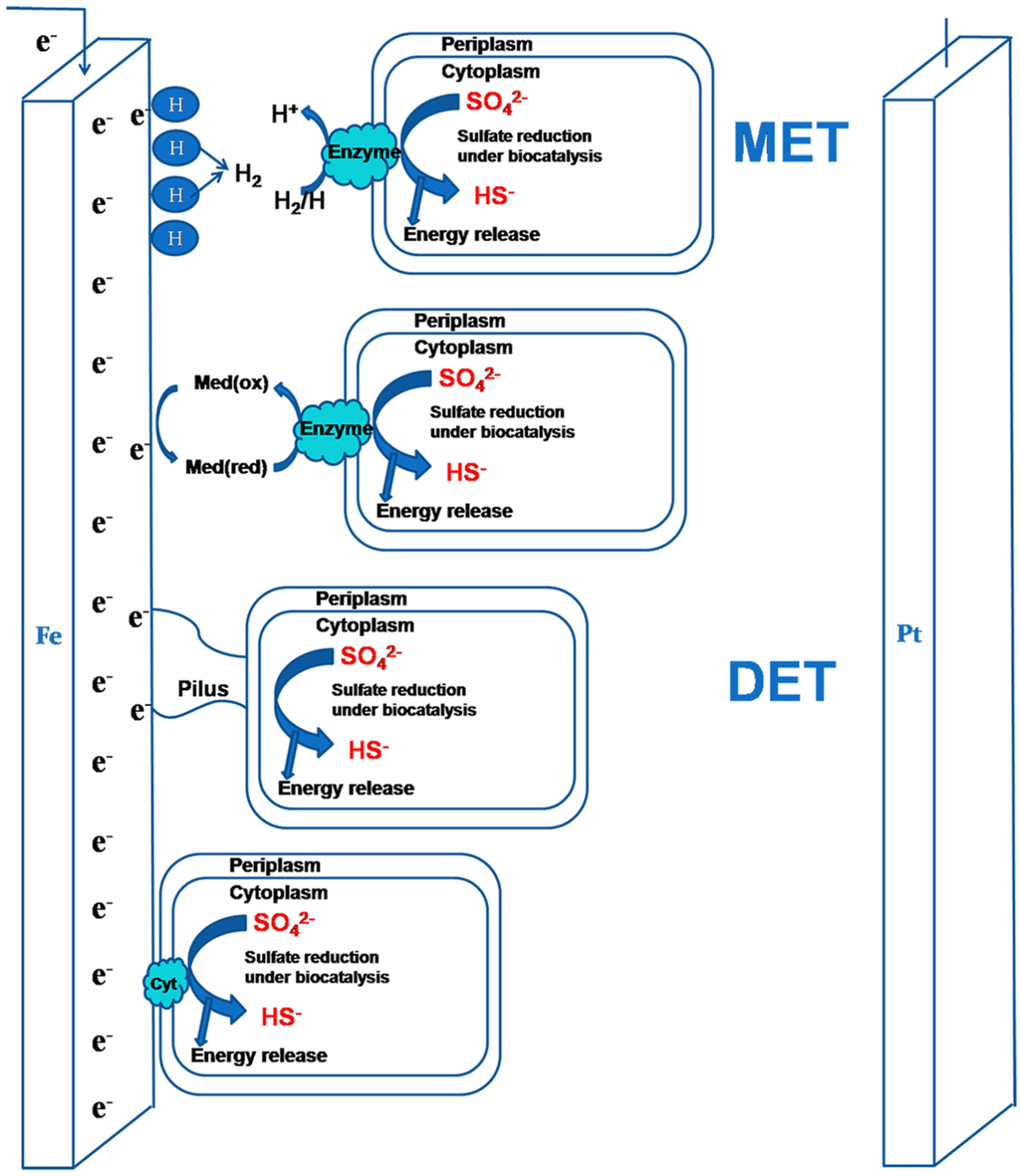
Electron transfer between a negatively polarised surface and SRB via MET and DET. Reprinted from Guan et al. (2016), CC BY 4.0 license: https://creativecommons.org/licenses/by/4.0/, not adapted.
Lv et al. (2022) examined the corrosion behaviour of X65 steel by Pseudomonas, i.e. an IOB species, under CP within a simulated seawater solution at two different potentials, i.e. −850 mVSCE and −1,050 mVSCE. They concluded that at −1,050 mVSCE, the protective effect against IOB-induced corrosion, in the form of pitting, was larger compared to −850 mVSCE and OCP conditions. This was attributed to both an increased electrostatic repulsion between the steel surface and bacteria, an increase in pH value, a decrease in the amount of dissolved oxygen and the precipitation of calcareous deposits, i.e. CaCO3 and Mg(OH)2, the latter forming a protective barrier against bacterial attachment. Contrary, at −850 mVSCE, these effects were still too low, and even more, an increased production of EPS, as a response to ‘damage’ caused by cathodic polarisation, could increase the adhesion of bacteria cells and could resist the electrostatic repulsion. Therefore, localised corrosion and the formation of corrosion products could still occur. Even more, at −1,050 mVSCE, the bacteria still showed tolerance, and due to the thickening of the calcareous deposit layer, the electrostatic repulsion weakened and, therefore, led to a heterogeneous biofilm because of re-attachment of IOB, which could facilitate pitting. Therefore, this also clearly shows the competition between a MIC-promoting effect of the bacteria’s metabolism and biofilm formation on the one hand and a MIC-inhibitory effect of CP on the other hand. Furthermore, it was stated that CP affects less the growth and reproduction of planktonic bacteria, because they are further away from the protected surface compared to sessile bacteria within the biofilm attached to the metal surface. It is clear from the abovementioned studies that the influence of CP on bacteria will be different for different species and their metabolism, which affects the distribution of the biofilm, corrosion products and calcareous deposits and, therefore, the occurrence of localised corrosion.
4.2 The influence of cathodic protection on hydrogen uptake
As was already mentioned above, cathodic overprotection will result in an increased generation of hydrogen at the steel surface (Gurrappa et al. 2015; Lazzari and Pedeferri 2018). In general, if CP is applied such that the potential is more negative than the hydrogen reduction potential of the metal, the Volmer reaction occurs, which is given by Equation (22) for alkaline or neutral solutions and Equation (23) for acidic solutions with M the metal’s free surface and MHads the hydrogen atom adsorbed at the metal’s surface. It is clear that adsorbed hydrogen can be generated by the electrochemical reduction of water (H2O) or a hydrated hydrogen ion (H3O+) within alkaline/neutral solutions and acidic solutions (Dafft et al. 1979; Lasia and Grégoire 1995), respectively. For seawater, which is buffered by chemical species with an average pH of 8.2 and displays a pH variation between 7.5 and 8.3, an alkaline situation can be expected (Orozco-Cruz et al. 2023).
After the adsorption of hydrogen by the Volmer reaction, there are three possibilities. First, the adsorbed hydrogen atom (MHads) can recombine with another adsorbed hydrogen atom (MHads) through the Tafel reaction, given by Equation (24). This is a chemical recombination or desorption (Xu et al. 2021).
Second, recombination or desorption can also occur electrochemically, through the Heyrovsky reaction. In an alkaline/neutral solution, as represented by Equation (25) involving water (H2O), while for an acidic solution, it involves a hydrated hydrogen ion (H3O+), as represented by Equation (26) (Dafft et al. 1979; Lasia and Grégoire 1995).
It should be clear that in both cases, i.e. the chemical recombination by Tafel and electrochemical recombination by Heyrovsky, hydrogen gas molecules (H2) are produced. If the Volmer reaction is followed by the Tafel reaction, it is called the Volmer–Tafel reaction pathway. If the Volmer reaction is followed by the Heyrovsky reaction, it is called the Volmer–Heyrovsky reaction pathway (Popov et al. 2018). Third, the adsorbed hydrogen atom (MHads) can enter the metal and absorbs into the metal’s inner surface (MHabs), as shown by Equation (27). This absorbed hydrogen can subsequently diffuse in the bulk of the metal (Sun and Frank Cheng 2022).
Atomic hydrogen will diffuse via an interstitial lattice diffusion, driven by Fick’s law according to a concentration gradient (Sun et al. 2019; Sun and Frank Cheng 2022). The diffusing atomic hydrogen may also accumulate in hydrogen traps, with both reversible or weak and irreversible or deep traps possible, such as grain boundaries, dislocations, vacancies and precipitates (Koyama et al. 2017). Moreover, when atomic hydrogen is present within a microvoid or an inclusion, e.g. MnS, it may recombine with another hydrogen atom to form molecular hydrogen (H2). This can result in either hydrogen-induced cracking (HIC) or hydrogen surface blistering, which can occur in the absence of an external load (Lazzari and Pedeferri 2018; Popov et al. 2018). However, in the presence of stress hydrogen-assisted cracking (HAC) can occur (Cabrini et al. 2011; T. Zhang et al. 2018b).
In general, an optimum balance is needed between a low level of corrosion, which means no underprotection, and an allowable risk of HE, thus no high overprotection (Batt et al. 2002). T. Zhang et al. (2018b) investigated the influence of CP on the hydrogen permeation, through the Devanathan-Stachurski cell (Devanathan and Stachurski 1962), of three different pipeline steels, i.e. X70, X80 and X100, within simulated seawater, according to ASTM standard D1141 (An American National Standard 2003). The results showed that the hydrogen permeation current density and subsurface hydrogen concentration increased with a more negative potential. Furthermore, fracture morphologies of the specimen after slow strain rate testing (SSRT) and polarisation curves at slow and fast sweep rates showed that HE fulfilled a more important role at the crack tip compared to anodic dissolution (AD) when a more negative potential was applied. This was also clear from the transition from a ductile fracture to a more brittle fracture with more negative potential.
Besides their role in the efficiency of CP, calcareous deposits influence the hydrogen uptake of steel. It is, however, still an open debate whether their role is promoting or retarding. It is logical to reason that because of the formation of calcareous deposits, less effective steel surface area is available for the water reduction reaction (Equation (2)) and, therefore, results in a lower current density and lower hydrogen uptake. However, by providing a barrier to the diffusion of dissolved oxygen, the increase in interfacial pH is limited and, therefore, they may promote hydrogen uptake. Moreover, slowing down the recombination reaction or diffusion of molecular hydrogen (H2) away from the steel surface is also given as argument for an increased hydrogen ingress by calcareous deposits (Hartt 2006; Hinds and Turnbull 2005).
L. Zhang et al. (2018a) investigated the influence of Ca2+ on the formation of calcareous deposits and on the hydrogen permeation of X80 high strength pipeline steel. This was done by performing permeation tests and thermal desorption tests within 0.1 M NaNO3 and 0.1 M Ca(NO3)2 solutions under galvanostatic charging. They concluded that the permeation rate of hydrogen atoms, sub-surface hydrogen concentration and hydrogen content were larger in the Ca(NO3)2 solution compared to the NaNO3 solution. This was attributed to the formation of Ca(OH)2 deposits, which would enhance the efficiency of hydrogen absorption according to Lillard et al. (2000) by lowering the rate constant for hydrogen desorption, hindering the escape of hydrogen bubbles (H2) and increasing the rate constant for hydrogen absorption. Therefore, it was believed that Ca-rich deposits had an acceleration effect on hydrogen entry and hydrogen permeation. Ma et al. (2021) examined the hydrogen permeation under galvanostatic charging of X65 steel within simulated Canadian groundwater (NS4) solution and compared it with the hydrogen permeation behaviour within a modified NS4 solution without Ca2+ and Mg2+. They concluded that the hydrogen permeation current and the hydrogen concentration on the charging side were higher in the NS4 solution compared to the modified one. This was attributed to the formation of a dense thin Mg(OH)2 layer with scattered CaCO3 cubic and snowflake-like crystals on it, which were assumed to inhibit the hydrogen recombination reaction and to promote the hydrogen absorption within the steel. As a consequence, the risk of HE under CP could be increased. Gao et al. (2016) proposed that calcium deposits on 16Mn steel in seawater environment inhibited the diffusion of molecular hydrogen to the solution, resulting in an increase of the concentration of hydrogen at the metal surface and, therefore, inhibited the Tafel reaction (Equation (24)) directly and the Volmer reaction (Equation (22)) indirectly.
Contrary, Ou and Kuo Wu (1997) published opposite results. They performed hydrogen permeation tests on cold rolled milled steel at 25 °C at different cathodic current densities under galvanostatic charging within different solutions: solution A: synthetic seawater; solution B: synthetic seawater without CaCl2, NaHCO3 and MgCl2; and solution C: synthetic seawater without CaCl2 and NaHCO3. They concluded that the hydrogen permeation rate at a certain cathodic current density was the lowest for solution C, intermediate for solution A and the highest for solution B. Solution B did not form calcareous deposits, while the calcareous deposits in solution A were CaCO3 and Mg(OH)2, and loose Mg(OH)2 deposits for solution C. Both the thick Ca-rich deposit layer for solution A and a thin Mg(OH)2 loose deposit for solution C were considered to act as hydrogen diffusion barriers, with the latter giving higher barrier efficiency and lower hydrogen absorption. These calcareous deposits were, therefore, beneficial for the resistance against HE. Lucas and Robinson (1986) observed a decrease in the hydrogen flux for carbon-manganese steel within ASW despite successive lowering of the potential. This was believed to be caused by the formation of Ca-rich and Mg-rich deposits, which were protective and impermeable to hydrogen. Further, Hinds and Turnbull (2005) reported that the formation of calcareous deposits, being CaCO3 in the form of aragonite needles, decreased the hydrogen uptake of super martensitic stainless steel within ASW at −1 VSCE compared to permeation tests within deaerated 3.5 % NaCl solution. Smith and Paul (2015) also observed a reduction of the hydrogen ingress for high-strength low-alloy steel under a potential of −1.1 VSCE within synthetic seawater compared to 3.5 % NaCl solution. This was attributed to the decrease of exposed surface needed for the water reduction reaction, caused by brucite formation.
Simoni et al. (2017) compared the hydrogen permeation behaviour for API 5CT P110 steel at potentials of −1 VSCE and −1.5 VSCE in ASW solution, ASW solution without Ca2+ and Mg2+, and 3.5 % NaCl solution. A competition was proposed between a surface effect of the calcareous deposits, caused by the blocking of available adsorption sites for the hydrogen reduction reaction, and hydrogen overpotential, being larger if the local pH is lower. At −1 VSCE, on the one hand, a lower hydrogen uptake within the ASW solution was observed compared to the two other solutions, i.e. ASW without Ca2+ and Mg2+, and 3.5 % NaCl. This was attributed to the compensation of the higher hydrogen overpotential, because of buffer reactions within ASW, by the surface effect caused by double-layered deposits consisting of a brucite inner layer and an aragonite outer layer. At −1.5 VSCE, on the other hand, a higher hydrogen uptake within the ASW solution was observed compared to the other solutions. This was attributed to the dominating difference in hydrogen overpotential, making the surface effect insignificant. Moreover, the deposits consisted now mainly of porous brucite, being more detached due to the destructive influence of intensive hydrogen bubbling and, therefore, it made the surface effect even less crucial.
Xing et al. (2021) investigated the hydrogen permeation behaviour of X80 steel under impressed cathodic current density within the range of 10–125 mA/cm2 within a simulated soil environment. The sub-surface hydrogen concentration increased and subsequently decreased under an increased current density, with a maximum at 75 mA/cm2. When the current density was below 75 mA/cm2, the deposit mainly consisted of porous CaCO3, and at 75 mA/cm2, a squamous structure with a lot of gap interfaces was formed, promoting the hydrogen permeation. When the current density was above 75 mA/cm2, the deposit consisted of a dense Mg(OH)2 film, inhibiting the hydrogen permeation. Furthermore, the hydrogen permeation was also galvanostatically evaluated within three different solutions: simulated soil solution, simulated soil solution without CaCl2 and NaHCO3 and simulated soil solution without CaCl2, NaHCO3 and MgCl2. The sub-surface hydrogen concentration was the highest within the simulated soil solution with Ca2+ and Mg2+, and the lowest within the simulated soil solution without Ca2+. An intermediate situation was observed for the solution without Ca2+ and Mg2+, where deposits could not form on the steel surface. For the simulated soil solution with Ca2+ and Mg2+, this finding was attributed to porous CaCO3 crystal deposit, where the hydrogen atoms were trapped within cavities under the crystals or within the gaps between the crystals. The Volmer reaction (Equation (22)) could easily occur within these cavities and gaps. Moreover, the Tafel recombination reaction (Equation (24)) was inhibited by a decrease in its rate constant, because it was difficult for the molecular hydrogen (H2), due to its larger volume compared to hydrogen atoms, to diffuse out of the cavities or gaps. Therefore, the coverage of the hydrogen atoms on the cavity or gap interface was increased, which promoted the absorption rate constant and reduced the desorption rate constant. For the simulated soil solution without Ca2+, the observation was attributed to amorphous and dense Mg(OH)2. This deposit reduced the hydrogen adsorption sites and, therefore, decreased the hydrogen uptake. In this situation, the desorption or recombination step was according to the Heyrovsky reaction (Equation (25)). The different discussed situations are schematically illustrated in Figure 14.
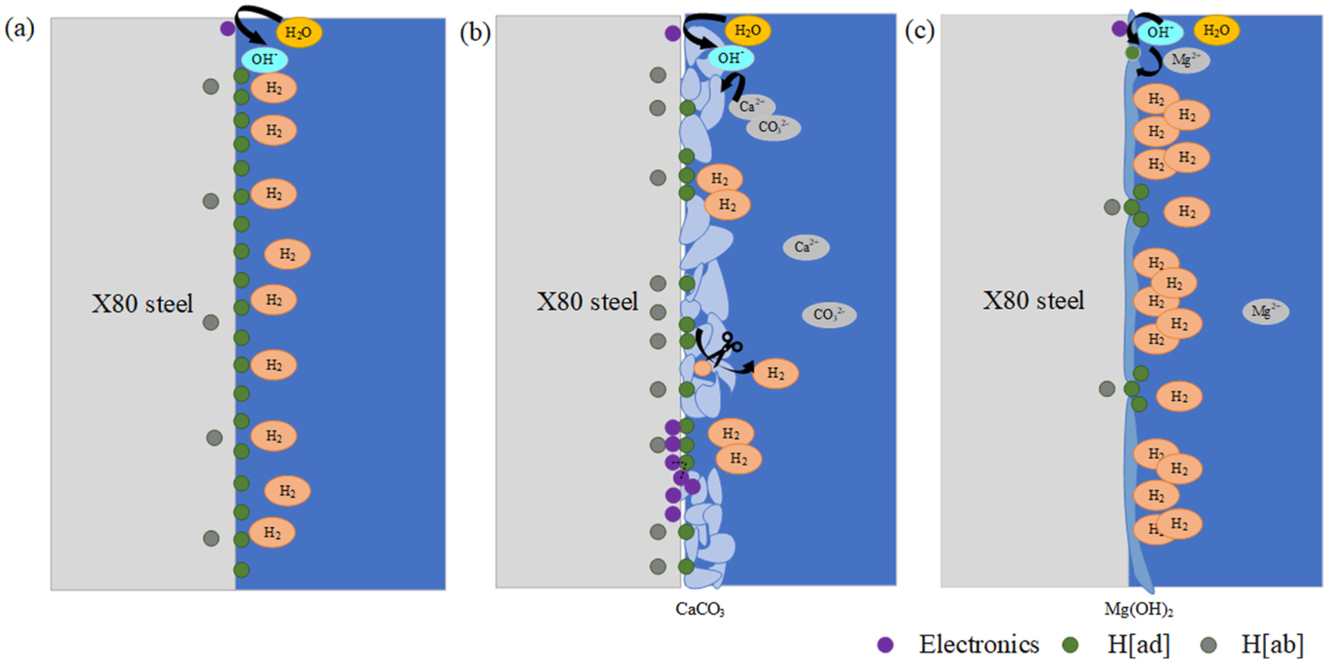
Influence of the calcareous deposits on the hydrogen uptake for (a) simulated soil solution without Ca2+ and Mg2+, (b) simulated soil solution with Ca2+ and Mg2+ and (c) simulated soil solution without Ca2+. Reprinted from International Journal of Hydrogen Energy, 46, Xing et al., Effect of surface calcareous deposits on hydrogen uptake of X80 steel under strong cathodic current, 4,555–4,566, Copyright (2021), with permission from Elsevier.
Furthermore, Xu et al. (2021) examined the role of previously precipitated calcareous deposits, formed by the application of potentials ranging from −0.8 VSCE to −1.2 VSCE, on the subsequent hydrogen permeation behaviour of AISI 4135 steel under galvanostatic conditions in synthetic seawater. Therefore, the direct influence of the calcareous deposits on the hydrogen permeation could be elucidated. It was concluded that the calcareous deposits facilitated hydrogen permeation compared to a bare steel surface. This was attributed to the inhibition role of the deposits on the hydrogen recombination, both the Tafel reaction (Equation (24)) and Heyrovsky reaction (Equation (25)), and, therefore, they hindered the escape of hydrogen molecules from the steel surface. However, it was noted that the hydrogen permeation rate was related in a proportional way to the integrity and the compactness of the calcareous deposit. The highest difference in hydrogen permeation efficiency between bare steel and steel with deposits was obtained for the deposit formed at −1.0 VSCE, because it had a very good integrity and compactness, being double-layered with an intact brucite inner layer and cluster-shaped aragonite outer layer. A decrease in the efficiency difference at the more negative potentials −1.1 VSCE and −1.2 VSCE was attributed to a weakening of the integrity and compactness. At both potentials, the brucite layer was more porous, showing a honeycomb-like structure with clear cracks. Furthermore, the aragonite at −1.2 VSCE consisted of smaller and sparsely distributed bouquet-shaped deposits. At −1.2 VSCE, hydrogen evolution under the deposit layer could also occur, making a calcareous deposit of low integrity due to induced stress and causing flaky or blistered and non-adherent deposits. This realised more pathways for the hydrogen molecules to escape and oxygen molecules to diffuse to the steel surface, reducing the importance of the Volmer reaction (Equation (22)) among other possible cathodic reactions. The situation is schematically illustrated in Figure 15.
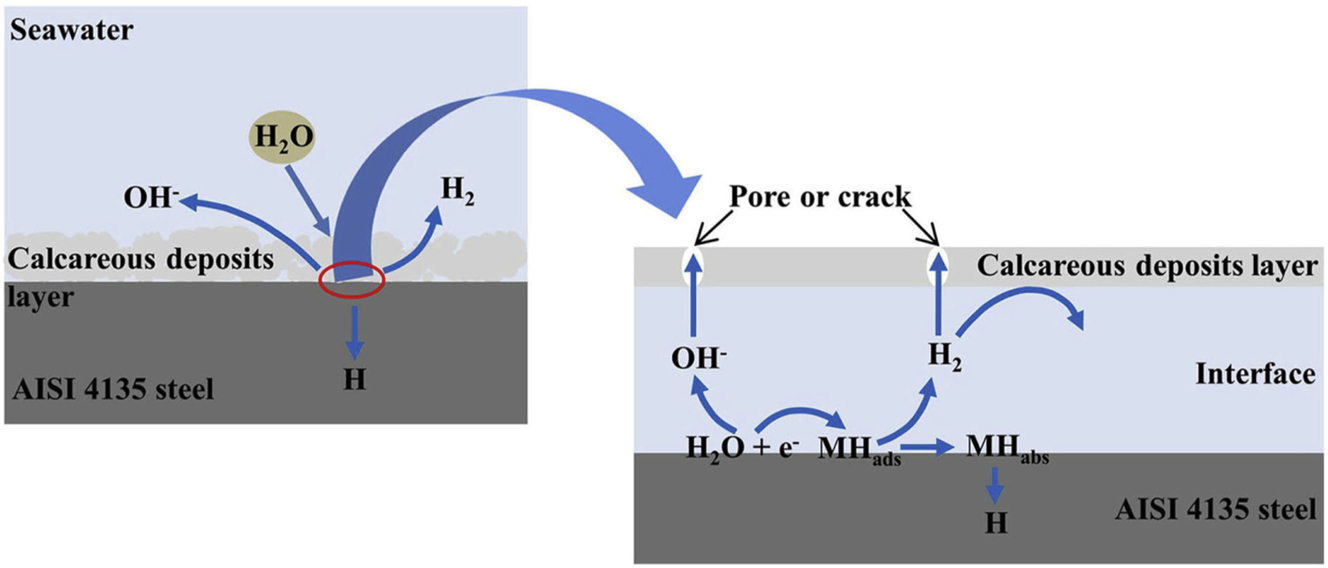
Schematic of the influence of calcareous deposit on the hydrogen permeation and the relation with integrity and compactness. Reprinted from International Journal of Hydrogen Energy, 46, Xu et al., Investigation of the calcareous deposits formation controlled by interfacial pH and its effect on the hydrogen entry into AISI 4135 steel in seawater, 5,824–5,841, Copyright (2021), with permission from Elsevier.
It is clear that the integrity of the calcareous deposit is indeed a very important factor. Piri and Arefinia (2018) studied the influence of potential, bicarbonate (HCO3 −) concentration and temperature on the CaCO3 deposition within an artificial solution of 0.20 g/L NaHCO3 and 1.16 g/L CaCl2. The variation in HCO3 − concentration and temperature were studied at a potential of −1.0 VSCE. By chronoamperometry curves, i.e. current as a function of immersion time, they concluded that a shift towards more negative potential, increase of HCO3 − concentration and increase of temperature all individually increased both the residual current density and calcareous deposit scaling time. They attributed this to a dominant effect of hydrogen evolution for all three cases. Created hydrogen bubbles caused detachment and spalling of the calcareous deposit and led to an increased porosity and a reduced compactness of the scale. The influence of hydrogen bubbles on calcareous deposits was further examined by Salvago et al. (2003), by testing different metals under cathodic polarisation within both artificial and natural seawater. By PDP curves, different situations could be observed: a) The hydrogen evolution via macroscopically visible bubbles, b) the adherence of calcareous deposits to the hydrogen gas bubbles and suspension of deposit particles within the solution and c) the detachment of the calcareous deposit due to the hydrogen evolution. These events occurred at more negative potentials and cathodic current densities, respectively.
It is clear from the abovementioned studies that the findings are contradictory, and, therefore, the role of calcareous deposits in hydrogen uptake remains unclear and the underlying mechanism remains unresolved. As stated by Tavassolian et al. (2025), the origin of the contradictory results can be first of all attributed to the different factors influencing the deposition, morphology and protectiveness of the calcareous deposits. These were mainly the solution composition (basically related to the presence of only Ca2+, only Mg2+, both of them or none of them), the applied potential and the applied current density in the abovementioned literature studies. Such different conditions can alter the hydrogen permeation behaviour to a large extent. It is clear that the separate effect of the calcareous deposit constituents, i.e. predominantly CaCO3 and Mg(OH)2, on hydrogen uptake should be more isolated, to minimise the influence of other ions within the electrolyte or other constituents within the deposit. Therefore, simplified solutions should be used for a more controlled assessment of the influence on hydrogen uptake and the underlying mechanism. A second reason is related to the duration of the performed experiments, being often (too) short. The duration influences both the compactness, number of crystals and thickness of the calcareous deposits, thereby affecting also the hydrogen uptake. As concluded from experiments by Rousseau et al. (2010) in natural seawater under CP, for a maximum of 12 months, densification of the deposit’s microstructure was observed as the immersion time was longer. During a short-term experiment, hydrogen saturation of the metal may occur faster than the deposition of a full-covered calcareous deposit, thereby affecting the results. Therefore, after a longer immersion time, the calcareous deposit may act as a protective coating and can block hydrogen uptake.
Tavassolian et al. (2025) already examined the role of calcite on the hydrogen permeation of S235JR steel by performing CP within a simplified artificial seawater solution consisting of NaCl, CaCl2 and NaHCO3, therefore, isolating the effect of CaCO3, under the form of calcite, on hydrogen uptake. On the one hand, it was shown that both short-term immersion and lower CP current density facilitated hydrogen uptake, because of fine and porous calcite formation. On the other hand, long-term immersion, i.e. by using preformed deposit samples, and higher CP current density reduced hydrogen uptake, because the calcite acted as a protective coating. The results were confirmed by both SEM and in situ EIS analysis. The latter serves as a very powerful technique since it provides information regarding the coverage, compactness and morphology of the deposits, and it gives a correlation with the observed hydrogen permeation behaviour.
To evaluate further the individual influence of Mg(OH)2 and the combined influence of both CaCO3 and Mg(OH)2 on hydrogen uptake, a similar approach with simplified solutions and investigation of parameters, such as immersion time and current density, individually, should be used. Besides these parameters, other parameters or experimental conditions such as applied potential, temperature and applied stress could be examined, since they are all relevant for e.g. offshore applications. All these parameters can affect the composition, morphology, compactness or porosity and thickness of the deposits, which all affect the subsequent hydrogen uptake.
4.3 The influence of sulphate-reducing bacteria on hydrogen uptake
Besides cathodic overprotection, corrosion, caused by SRB in particular, is the main source of hydrogen uptake of steel within a seawater environment (Robinson et al. 1998). It is stated that SRB could aggravate hydrogen uptake and, therefore, HAC of jack-up offshore installations (Mathisen 2024). As already mentioned, H2S corrosion can occur in the presence of SRB because of their metabolism based on the sulphate reduction reaction. During the corrosion process, atomic hydrogen can be generated at the steel surface, as it involves several cathodic reactions consisting of a series of depolarisation processes involving both H2S, HS− and H+ (Wen et al. 2018; Zhang et al. 2012). As was already clear, this atomic hydrogen can be partially absorbed within the steel (Carneiro et al. 2003). HIC and sulphide stress cracking (SSC) are typical problems encountered for pipelines within H2S-containing environments (Huang et al. 2017). SSC is generally defined as ‘the cracking of a metal under the combined action of tensile stress and corrosion in the presence of water and hydrogen sulphide’ (NACE 2002; Zhou et al. 2020). It is generally accepted that it is caused by HE, in particular for high-strength steels (Berkowitz and Heubaum 1984; King 2017). Several factors influence the hydrogen uptake within H2S-containing environments.
First of all, H2S and other related sulfidic species such as S2− and HS− act as hydrogen recombination poisons, by inhibiting the transformation of hydrogen atoms into hydrogen molecules being possible via the Tafel or Heyrovsky reaction. Therefore, hydrogen absorption and diffusion are promoted, which can result in hydrogen-related failures (Huang et al. 2017; Lazzari and Pedeferri 2018). Furthermore, H2S has a catalytic action and, therefore, accelerates the proton discharge, i.e. Volmer reaction, within the cathodic reaction mechanism (Banakhevych et al. 2009).
Second, iron sulphide corrosion products (FexSy) will also influence hydrogen uptake. However, it is still unclear whether their role is accelerating or inhibiting. This is closely related to their protectiveness and compactness influenced by the layer thickness, morphology, porosity and composition (Karimi et al. 2023a), which in turn depend on several factors such as temperature (Zheng et al. 2013), H2S concentration (Tang et al. 2010), pH (Huang et al. 2017), flow (Anyanwu 2019) and applied stress (Ge et al. 2020). Huang et al. (2017) reported that pre-formed FexSy films had an increased blocking effect on hydrogen permeation with an increase in H2S concentration and a decrease in pH value. The highest blocking effect was given by a mixed corrosion product consisting of both mackinawite and crystalline FeS. Hao et al. (2011) concluded that a mackinawite-dominated scale and a pyrrhotite-dominated scale promoted and reduced the hydrogen steady-state permeation flux, respectively. However, despite their possible role as a diffusion barrier, FexSy products are typical corrosion products that are well conductive, as mentioned before, and, therefore, provide active surface sites for the hydrogen reduction reaction or Volmer reaction (Kim et al. 2012). Furthermore, FexSy products possessing ion-selectivity are also reported as determining factors for hydrogen permeation (Wan et al. 2023; Zhao et al. 2005). It should be noted that the dual role of these FexSy corrosion products on the hydrogen uptake during H2S corrosion is very analogous to the dual role of calcareous deposits on the hydrogen uptake during CP.
As is clear, SRB will influence the hydrogen permeation process. The hydrogen permeation of high strength steel was in situ monitored by Y. Xu et al. (2022a) for 3 months in different marine corrosion zones, i.e. marine-atmospheric zone, splash zone, tidal zone and immersion zone, to get insight into the hydrogen permeation behaviour within a marine environment. The results showed a positive correlation between the corrosion rate of the steel, dependent on the marine zone, and hydrogen permeation current density. Within the immersion zone, a high hydrogen permeation current density was attributed to iron sulphide corrosion product produced by the metabolic activity of SRB. Zhu et al. (2007) investigated the influence of SRB on the hydrogen permeation of API X56 steel by comparing the permeation within a sterile sea mud solution and a SRB-inoculated sea mud solution. They observed that the hydrogen permeation current density within SRB-inoculated sea mud solution was three times larger compared to the sterile sea mud solution. H2S, HS− and S2− were the main products of the SRB metabolism affecting the hydrogen permeation, by catalysing the Volmer reaction (Equation (23)), but inhibiting the Tafel reaction (Equation (24)). Therefore, the hydrogen concentration at the steel surface was increased and hydrogen permeation thus accelerated. Furthermore, the cathodic depolarisation reaction (Equation (11)) was stated as another reason for the improved hydrogen permeation by SRB. Lunarska et al. (2007) observed an increase in the hydrogen permeation and diffusible hydrogen content of hot rolled steel at a certain potential within a SRB-inoculated seawater solution compared to a sterile seawater solution. This was attributed to both generated S2−, acting as a promotor for hydrogen entry, and to the increase in polarisation current due to the formation of less protective calcareous deposits with a patched appearance. These less protective deposits should result from their decreased adhesion attributed to biofilm formation.
D. Wang et al. (2017a) found a correlation between the hydrogen permeation behaviour, the occurrence of hydrogen blisters on the surface and the SRB activity of X80 steel within Yingtan simulated soil solution. On the one hand, hydrogen permeation was investigated at OCP conditions within both sterile solution and SRB-inoculated solution with the bacteria in their stable growth phase. The steady-state hydrogen permeation current was three times higher within the SRB-inoculated solution compared to the sterile solution. Furthermore, clear hydrogen blisters were observed on the steel surface after immersion within the SRB-inoculated solution, while less frequent and less serious blisters were observed after immersion within the sterile solution. On the other hand, the hydrogen permeation and blistering were investigated at OCP conditions during specific phases of the SRB growth curve: at 4 days, i.e. in their logarithmic growth phase, at 8 days, i.e. in their stable growth phase, and at 14 days, i.e. in their residual phase. The typical growth curve of the SRB is illustrated in Figure 16. The highest hydrogen permeation current density and most severe blistering, under the form of dense and uniform blisters, were observed for the situation of 8 days, because the most active SRB cells were then present and the most sulphide was produced by their metabolism. The lowest hydrogen permeation current density and least hydrogen blistering were observed for 14 days, because most SRB cells had apoptosis, i.e. cell death, and a low amount of sulphide was present within the solution. An intermediate situation was observed for 4 days, for which the hydrogen permeation current density and severity of hydrogen blistering were intermediate between 8 days and 14 days. It should be mentioned, however, that during all three discussed situations regarding the SRB growth curve, the hydrogen permeation current density and blistering were still higher compared to the sterile solution. The increased hydrogen permeation within SRB-inoculated solution was again attributed to the catalysing effect of sulphide species (H2S, HS− and S2−) on the Volmer reaction and inhibition of the Tafel reaction by their poisoning effect. Furthermore, the cathodic depolarisation by the sulphate reduction reaction was again an argument.
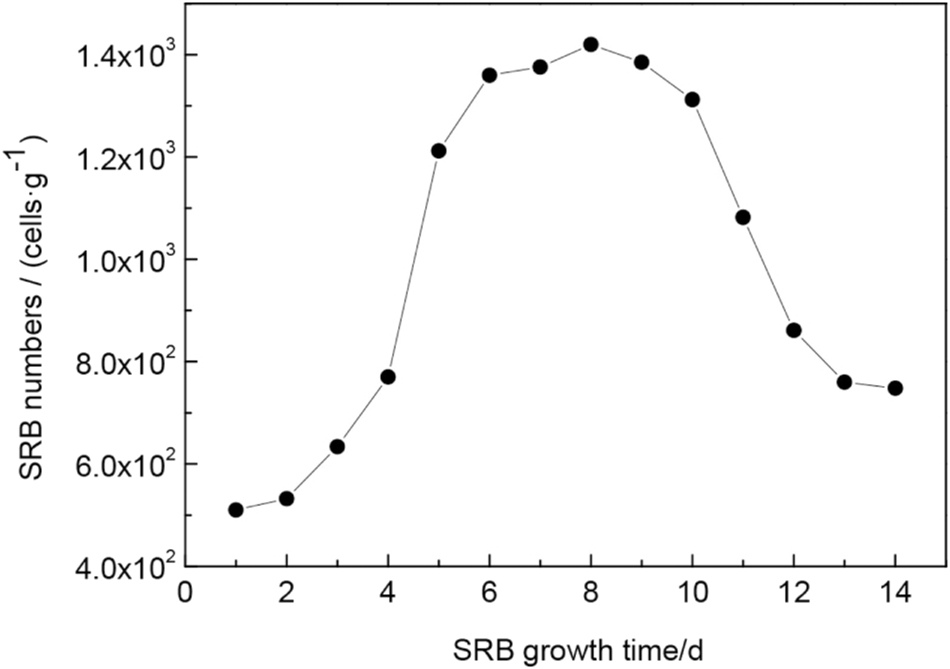
Typical growth curve for SRB. Reprinted from International Journal of Hydrogen Energy, 42, D. Wang et al., The effect of sulphate-reducing bacteria on hydrogen permeation of X80 steel under cathodic protection potential, 27, 206–27213, Copyright (2017), with permission from Elsevier.
Bueno et al. (2014) simulated the influence of H2S produced by SRB on API 5 L grade X60 steel by adding thiosulphate (S2O3 2−) to NS4 synthetic soil solution. Ductility loss was observed through SSRT if more S2O3 2− was added to the standard NS4 solution, which was attributed to HE. Furthermore, a higher degree of hydrogen permeation was observed when the S2O3 2− was added. Therefore, a catalytic effect of H2S on the Volmer reaction and hydrogen concentration within the steel was again concluded.
Further, a competition between the hydrogen promotion effect by H2S and the hydrogen blocking effect by mackinawite was observed by Tian et al. (2018). The influence of S2O3 2− concentration (10−4, 10−3 and 10−2 M), simulating again H2S production by SRB, was investigated within acidic deaerated ASW on the hydrogen permeation behaviour of E690 steel under OCP conditions. It was concluded that the hydrogen permeation was higher at 10−4 M compared to 10−3 M and 10−2 M because within the latter environments formed mackinawite corrosion product inhibited the hydrogen uptake. According to the SCC behaviour, HE fulfilled the dominating role at the lower concentration, while severe pitting corrosion or anodic dissolution (AD) was dominating at the higher concentrations of S2O3 2−.
The formed biofilm can also have an influence on the hydrogen evolution and hydrogen absorption reaction (Lunarska et al. 2007). However, it is reported that it has a dual role. On the one hand, it can disrupt a present protective oxide layer or passive film and, therefore, it allows hydrogen to have direct access to the metal surface (Cai et al. 2025). On the other hand, it is believed that the biofilm itself can block the hydrogen uptake (De Romero et al. 2005; Li et al. 2022; Lunarska et al. 2007).
Within the abovementioned research studies, sulphide metabolites and FexSy corrosion products are always the only reported species regarding hydrogen uptake within a SRB-inoculated solution. However, other metabolites can also be secreted by SRB, which influence hydrogen uptake. Besides sulphide metabolites produced by the sulphate reduction reaction, there are of course also produced metabolites by the oxidation reaction. As mentioned in Section 3.1, several electron donors, besides iron according to the biocatalytic sulphate reduction theory (Section 3.2.3), can be used by SRB. Such a donor, which is typically an organic species, e.g. pyruvate, lactate, acetate, etc., can be incompletely oxidised with acetate (CH3COO−) as the end product or completely oxidised with CO2 as the end product. Moreover, upon the oxidation of these organic species, hydrogen is generated, as can be seen for example in Equation (16) for lactate, which could promote hydrogen permeation (Zhang et al. 2024).
On the one hand, acetate as a product may affect the hydrogen permeation process. Duvall Deffo Ayagou et al. (2019) for example showed that acetate could increase the hydrogen permeation, because it competed with H2S to react with Fe2+. In this way, the formation of protective iron sulphide was delayed and disrupted, and iron acetate corrosion product (Fe(CH3COO)2) formed, which had higher solubility in an aqueous medium and, therefore, was less protective. This decreased protectivity could facilitate hydrogen entry. Moreover, acetate may also be used as an electron donor itself, and its oxidation by SRB may result in the formation of HCO3 − (Z. Zhang et al. 2022b), which will affect hydrogen permeation as will be mentioned below.
On the other hand, CO2 as a product can also affect the hydrogen permeation process, caused by its corrosive action, which is also known as sweet corrosion. When CO2 is dissolved in an aqueous solution, it can form carbonic acid (H2CO3). In analogy to H2S, during the corrosion process, atomic hydrogen can be generated at the steel surface, as it involves several cathodic reactions consisting of depolarisation processes involving both H2CO3, HCO3 − and H+ (S. Wang et al. 2017b). However, hydrogen uptake is promoted to a lesser extent compared to H2S because of two reasons. The first one is the fact that in a CO2 environment, hydrogen generation through dissociation reactions includes one more step, i.e. the dissolution of the CO2 in the aqueous medium to form H2CO3, while H2S can dissociate directly. The second one is related to the extra role of H2S, HS− and S2− acting as hydrogen recombination poisons (Karimi et al. 2023b). Moreover, upon CO2 corrosion of typical mild steel with high carbon content and a ferritic-pearlitic structure, corrosion products such as iron carbide or cementite (Fe3C) and iron carbonate (FeCO3) are able to form (Kahyarian et al. 2017). The corrosion process usually initiates with selective ferritic dissolution, giving rise to a thick porous Fe3C network. This is attributed to Fe3C being conductive and, therefore, it acts as a cathodic site compared to ferrite, resulting in galvanic coupling. When its surface area increases, the dissolution of the ferrite can accelerate and, therefore, the corrosion process is accelerated. However, FeCO3 can precipitate in between the Fe3C particles and, therefore, these will act as a kind of anchor points for the former one, which can form a protective layer against corrosion and can affect hydrogen uptake, possibly blocking it (Karimi et al. 2023a). This precipitation is affected by the morphology, size, distribution and fraction of Fe3C. Moreover, these parameters also affect the hydrogen uptake of Fe3C, because they affect its hydrogen diffusivity and solubility, as reported by several researchers (Karimi et al. 2023b; Ogawa et al. 2022; Ramunni et al. 2006; Skilbred et al. 2022). In the presence of SRB, FeCO3 was reported by Alabbas et al. (2013).
Da Silva et al. (2019) studied the hydrogen permeation of both pre-corroded Fe3C-rich API 5 L X65 steel and pre-corroded FeCO3-rich API 5 L X65 steel, formed within CO2-saturated 3.5 wt% NaCl solution with different temperature, pH and immersion time for both. The former had five as much hydrogen, while the latter had twice as much hydrogen, compared to a wet-ground sample without a corrosion layer. On the one hand, the promoting effect of Fe3C was attributed to its promotion role in the hydrogen reduction reaction, its porosity and negligible hydrogen trapping. On the other hand, the promoting effect of FeCO3 was attributed to its non-barrier role due to the presence of voids along its surface, being beneficial sites for hydrogen saturation and permeation, despite its ability to weaken cathodic reactions. In practice, the combined influence of both H2S/iron sulphide product and CO2/iron carbonate product, which in general act competitively in the hydrogen permeation process, is studied by several researchers, mostly within the context of oil and gas industry where both corrosive species are present (Bai et al. 2016; Karimi et al. 2023b; Plennevaux et al. 2013; Skilbred et al. 2022; S. Wang et al. 2017b; Zhou et al. 2020). For example, Zhou et al. (2020) performed hydrogen permeation experiments for X80 pipeline steel in both CO2, H2S and CO2/H2S containing solutions and stated that the permeation was influenced by the mutual coupling of both the extent of hydrogen promotion of CO2 and H2S, the promotion or hindrance by corrosion products, i.e. being porous or dense, and hydrogen evolution of the corrosion reaction. However, the presence of both iron sulphide and iron carbonate products is also relevant for SRB in an environment where CO2 and HCO3 − are present in solution, among others within a marine environment (Enning et al. 2012) or oil field (Liu et al. 2018). Competitive adsorption between sulphur compounds (e.g. HS− and S2−) and bicarbonates (HCO3 −) or carbonates (CO3 2−) is generally stated (Plennevaux et al. 2013).
Further, as is clear from the SRB corrosion mechanism of the cathodic depolarisation theory (CDT) (Section 3.2.1), Fe(OH)2 corrosion product is also able to form besides iron sulphide corrosion product. It is generally stated that iron-oxygen (Fe–O) species such as FeOHads, i.e. an oxy-hydride species, and FeO or Fe3O4 products have a promoting role in hydrogen entry. This can be attributed both to the acceleration of the hydrogen evolution reaction (HER) or the promotion of hydrogen adsorption, i.e. the Volmer reaction. The former can be linked in analogy to the electrolytic catalyst activity of transition metal oxides, e.g. IrO2 and RuO2, towards the HER, while the latter can be linked to a blocking role on the recombination reaction, thereby acting as a recombination poison. More detailed information on the related mechanisms can be found in (Flis-Kabulska et al. 2007; Heyden et al. 2005; Kodintsev and Trasatti 1994).
Furthermore, phosphine (PH3) is stated to be a possible metabolic product, based on the corrosion mechanism of volatile phosphorus compound (Iverson 2001), which is also mentioned in Section 3.2. This phosphine has been reported to enhance the hydrogen permeation rate (Lillard et al. 2000). Furthermore, upon reaction with iron, iron phosphide corrosion product can form, such as Fe3P (Schreibersite), which is known to have a catalytic effect on HER (Wu et al. 2017; Y. Xu et al. 2013b).
4.4 Synergism of sulphate-reducing bacteria and cathodic protection on hydrogen uptake
Since both CP and SRB separately affect the hydrogen uptake in steel, often negatively, a synergistic effect can be expected. A synergistic effect can be defined as (Sun et al. 2019): ‘an effect of different multiple factors acting together being stronger than the sum of either of these factors acting alone’. The improved hydrogen uptake by SRB under CP can be seen as a two-step process. As a first step, adsorbed atomic hydrogen is created on the steel surface under CP according to the Volmer reaction, being more intensive to overprotection conditions. As a second step, sulphide metabolites secreted by SRB inhibit the recombination of atomic hydrogen and, therefore, increase the hydrogen surface coverage and stimulate the hydrogen absorption within the steel (Robinson et al. 1998).
Wu et al. (2015b) studied the influence of SRB on the near-neutral SCC susceptibility and permeable hydrogen concentration of X80 pipeline steel under different potentials during CP. SSRT was performed for both a sterile soil solution and SRB-inoculated soil solution under the following potentials: OCP (−725 mVSCE), −976 mVSCE and −1,176 mVSCE. Moreover, the SRB-inoculated soil solution was tested under different pre-incubation times. These authors found that after a pre-incubation time of 3 days, i.e. when the SRB were in their cellular exponential growth phase, the potential of −976 mVSCE and the SRB had a synergistic effect on the SCC occurrence. However, the synergistic effect decreased when the potential was −1,176 mVSCE. It was suggested that both AD, enhanced by the formed S2−, and HE were the responsible mechanisms for the SCC. HE was supposed to be caused and enhanced on the one hand by the poisoning effect of secreted sulphide metabolites (S2−, HS− and H2S) on the chemical Tafel reaction (Equation (24)) and electrochemical Heyrovsky reaction (Equation (26)), while they promoted the Volmer reaction (Equation (23)). On the other hand, a more negative potential generated more hydrogen atoms at the steel surface, which promoted also the Volmer reaction and the hydrogen entering the steel and, therefore, enhanced HE. The Volmer reaction was also promoted by a pH decrease, caused by the SRB, which consequently increased the amount of protons on the steel surface. Furthermore, SCC could be enhanced by the SRB due to localised pitting, resulting in stress concentrations near the bottom of the pit, which could be attributed to DET and sulphur compounds. The formation of highly electroconductive and porous FeS acting as an enhancer of electron transfer could be a reason for this DET (Sun et al. 2018; Xie et al. 2021). Moreover, pitting could also be caused by the heterogeneity of the biofilm and the EPS, resulting in the formation of concentration cells as already mentioned (Xie et al. 2021). The decreased synergistic effect at −1,176 mVSCE could be attributed to alkalisation at this potential, which prevented the growth of the SRB. Fracture surface analysis indicated that the SRB-inoculated solutions caused more quasi-cleavage fracture at a certain potential compared to sterile solutions, which had a more ductile dimpled fracture. Moreover, the ratio of quasi-cleavage over dimpled fracture area increased at −976 mVSCE compared to OCP, while at −1,176 mVSCE, pure brittle rupture or cleavage fracture was observed. A direct relationship between plasticity loss and permeable hydrogen concentration was suggested.
Li et al. (2022) investigated both the hydrogen permeation and SCC behaviour of X100 pipeline steel in a simulated marine mud environment, being both sterile and inoculated with SRB. A synergistic effect was again observed for the applied CP and SRB on both SCC and hydrogen permeation and specifically on the diffusible hydrogen concentration, hydrogen diffusion flux and SCC sensitivity. However, there was no synergistic effect on the hydrogen diffusion coefficient. The effect weakened again when the potential was too negative, due to alkalisation and subsequent reduced bioactivity of the SRB. Similar reasons for the synergistic effect were quoted as in the work of Wu et al. (2015b). Moreover, it was stated in their research that SRB accelerated cathodic polarisation, providing more corrosion pits and, therefore, led to an improved SCC susceptibility.
The combined effect of CP and SRB was also investigated by other studies, where anodic dissolution (AD) or pitting and HE were the dominating and competing mechanisms (Sun et al. 2018; Xie et al. 2021). In general, corrosion pits are the typical sites where the nucleation of microcracks and SCC starts because of stress concentrations or localised acidification (Sun et al. 2018; Xie et al. 2021). The crack tip can serve as an anode, while the crack wall can serve as a cathode with a larger area, which results in a kind of galvanic corrosion cell between the crack tip and the crack wall, which promotes the crack propagation (Sun et al. 2018).
Further, the synergistic effect of CP and S2O3 2−, simulating SRB as a H2S producer, was investigated by Tian et al. (2019). A competition was concluded between the hydrogen promotion ability of sulphur species, i.e. H2S and HS−, and an increase in the interfacial pH. The increase in S2O3 2− concentration, on the one hand, facilitated the hydrogen permeation in two ways: an increased production of H+ ions by increased H2S and/or HS− at the metal–solution interface and the poisoning effect of these sulphide products on the hydrogen recombination step, leaving more hydrogen within the atomic state. The increase in the interfacial pH at more negative potentials, on the other hand, led to a decrease in the hydrogen permeation due to the competitive adsorption of brucite, which had a blocking effect on the hydrogen entry. Moreover, the local alkalisation weakened the availability of H+, causing a decrease in H2S proportion and a decrease in the possible adsorption sites of hydrogen due to competitive OH− adsorption. The maximum hydrogen flux and the highest synergistic effect were observed for a S2O3 2− concentration of 0.01 M and a potential of −850 mVSCE.
The influence of both the presence of S2− and CP on the HE of 2,205 duplex stainless steel in deaerated acidic artificial seawater (AASW) with a pH of 6.5 was examined by Zucchi et al. (2006) by the use of SSRT. Different concentrations of S2−, i.e. 1, 10 and 30 ppm, and different potentials, i.e. −0.9 VSCE, −1.0 VSCE and −1.2 VSCE, were used. When no S2− was present, the HE susceptibility increased at −0.9 VSCE and −1.0 VSCE compared to OCP within both AASW and air. However, at −1.2 VSCE, a calcareous deposit, consisting mainly of brucite, was formed, which could reduce the HE. Alternatively, when S2− was present, the HE susceptibility increased and the effect was larger at higher S2− concentrations and more negative potentials. At −1.2 VSCE, the promoting action of S2− on HE surpassed the blocking effect of the brucite, which resulted in the highest HE susceptibility.
Wu et al. (2015a) examined the simultaneous effect of present superficial stress, introduced through mechanical abrading, the presence of SRB and CP on the hydrogen permeation behaviour of X80 steel within a simulated soil solution. A synergistic effect between superficial stress and the presence of SRB on the apparent hydrogen concentration and hydrogen permeation flux was concluded at a CP potential of −1,176 mVSCE. This could be attributed to more aggregation of SRB on an abraded surface, because of its higher surface roughness and free energy, and coupled sulphide metabolite production improving the hydrogen uptake. Moreover, larger surface area, surface roughness and free energy were assumed to increase the activity of iron sulphide product, which increased the active surface sites for hydrogen reduction and thus absorption, due to its catalytic action. In general, it is known that the presence of stress influences the hydrogen permeation behaviour, as is clear from several studies (Van den Eeckhout et al. 2020; Zhao et al. 2016; Z. Xu et al. 2022b). This is very relevant, since, e.g. submarine pipelines are exposed to both present complex load, e.g. within sea mud, and the presence of anaerobic SRB. The combined influence of tensile stress, within both the elastic and plastic regions of the examined steel, and the presence of SRB and/or iron sulphide layer on the hydrogen permeation behaviour has been examined (Ge et al. 2020; Kim et al. 2012; Sun et al. 2019). Further details on the exact mechanism governing the effects of both stress and SRB are considered to be outside of scope.
5 Conclusion and outlook
This review provides an overview of the interaction between cathodic protection (CP) and microbial life, in particular sulphate-reducing bacteria (SRB), and their individual and combined influence on hydrogen uptake and subsequent hydrogen embrittlement (HE). The following conclusions can be drawn:
The mutual interaction between CP, providing long-term protection against steel corrosion in, e.g. the offshore industry, and microbial life is still not completely understood. It remains unclear to which extent CP is effective against microbiologically influenced corrosion (MIC).
CP, especially under overprotection conditions, will stimulate the hydrogen generation on the steel surface. Furthermore, the resulting hydrogen uptake is influenced by the presence of calcareous deposits, which are known to be very efficient during the CP process. However, it remains unresolved whether they have a promoting or blocking effect on hydrogen uptake. Their role is strongly related to their integrity and compactness, which in turn depend on several factors such as solution composition, applied potential and applied current. The use of simplified solutions, in order to isolate the individual role of calcareous deposit constituents in hydrogen uptake, serves as a first step towards a better understanding of the underlying mechanism. Moreover, an individual assessment of the influence of immersion time and other parameters on the composition, morphology, compactness and thickness of the deposits is needed, since they affect largely the subsequent hydrogen uptake.
SRB will stimulate hydrogen uptake through the secretion of sulphide metabolites such as H2S, HS− and S2−, which have a promoting role in hydrogen generation at the steel surface and a poisoning effect on hydrogen recombination. Moreover, iron sulphide corrosion products (FexSy) form through the H2S corrosion process, which also influence hydrogen uptake. Similar to calcareous deposits, their exact role in hydrogen uptake also remains unclear and is strongly related to their protectiveness and compactness, which again depend on several factors such as H2S concentration, pH and temperature. Furthermore, cathodic depolarisation through the sulphate reduction reaction typically stimulates hydrogen uptake. Besides sulphide metabolites and FexSy products, other metabolites such as acetate (CH3COO−), CO2, phosphine (PH3) and related corrosion products such as iron hydroxide (Fe(OH)2), iron carbonate (FeCO3), iron carbide (Fe3C) and iron phosphide (Fe3P) could influence hydrogen uptake and, therefore, need to be considered.
Besides their individual role, CP and SRB have a combined influence synergistically assisting the hydrogen uptake. The extent of this synergistic effect is influenced by parameters affecting both the CP process and the SRB growth and metabolism.
It is clear that a profound understanding of the interaction between CP and SRB is still lacking, especially on how the different environmental parameters could affect them. This is a prerequisite for a better understanding of the synergistic effect on the hydrogen uptake and HE. In particular, the exact role of both calcareous deposits and FexSy corrosion products within the hydrogen uptake mechanism remains unresolved, and a more detailed investigation of their formation and integrity is required in view of improved knowledge on the resulting hydrogen uptake. Moreover, the influence of other present microorganisms, their metabolites and generated corrosion products on hydrogen uptake serves as an important future outlook. Interdisciplinary research between corrosion engineering and molecular biology remains necessary, in order to understand the complex interactions between microorganisms and their corrosive actions, possibly mitigated or exacerbated, within a marine environment. Furthermore, because of the unclear effectiveness of CP against MIC, the development of other new and effective MIC mitigation strategies, such as the use of advanced coatings, green corrosion inhibitors, biocide mixtures and microbially influenced corrosion inhibition (MICI) or a combination of them are needed. However, the effectiveness on a large scale, such as within seawater, should be evaluated.
Funding source: Bijzonder Onderzoeksfonds UGent
Award Identifier / Grant number: BOF/GOA/026
Award Identifier / Grant number: BOF/STA/025
-
Research ethics: Not applicable.
-
Informed consent: Not applicable.
-
Author contributions: All authors have accepted responsibility for the entire content of this manuscript and approved its submission. T. Glorieux: investigation, conceptualisation, writing-original draft. R. Tavassolian: investigation, conceptualisation, writing-review and editing. T. Depover: conceptualisation, project administration, funding acquisition, supervision, writing-review and editing. K. Verbeken: conceptualisation, project administration, funding acquisition, supervision, writing-review and editing.
-
Use of Large Language Models, AI and Machine Learning Tools: None declared.
-
Conflict of interest: The authors state no conflict of interest.
-
Research funding: Special Research Fund (BOF) of Ghent University (grants BOF/GOA/026 and BOF/STA/025).
-
Data availability: Not applicable.
References
Abdel-Gaber, A.M., Abd-El-Nabey, B.A., Khamis, E., and Abd-El-Khalek, D.E. (2008). Investigation of fig leaf extract as a novel environmentally friendly antiscalent for CaCO3 calcareous deposits. Desalination 230: 314–328, https://doi.org/10.1016/j.desal.2007.12.005.Search in Google Scholar
Akamine, K. and Kashiki, I. (2022). Corrosion protection of steel by calcareous electrodeposition in seawater (Part 2)-Mechanism of growth. Zair.Kankyo 51: 496–501, https://doi.org/10.3323/jcorr1991.52.401.Search in Google Scholar
Alabbas, F.M., Williamson, C., Bhola, S.M., Spear, J.R., Olson, D.L., Mishra, B., and Kakpovbia, A.E. (2013). Microbial corrosion in linepipe steel under the influence of a sulfate-reducing consortium isolated from an oil field. J. Mater. Eng. Perform. 22: 3517–3529, https://doi.org/10.1007/s11665-013-0627-7.Search in Google Scholar
Almar-Naess, A., Haagensen, P.J., Lian, B., Moan, T., and Simonsen, T. (1984). Investigation of the Alexander L. Kielland failure–metallurgical and fracture analysis. J. Energy Resour. Technol. 106: 24–31, https://doi.org/10.1115/1.3231014.Search in Google Scholar
Amani, M. and Almodaris, M. (2016). Safe practices in drilling and completion of sour gas wells. J. Petrol. Environ. Biotechnol. 7: 293, https://doi.org/10.4172/2157-7463.1000293.Search in Google Scholar
An American National Standard (2003). Standard practice for the preparation of substitute ocean water (D 1141-98). ASTM International, West Conshohocken, United States.Search in Google Scholar
Anyanwu, E.J. (2019). The Effect of Flow on the Development and Retention of iron sulfide corrosion product layers, Ph.D thesis. Athens, Ohio University.Search in Google Scholar
Ashworth, V. (2010). Principles of cathodic protection. Shreir’s Corros. 4: 2747–2762, https://doi.org/10.1016/B978-044452787-5.00152-9.Search in Google Scholar
Asmara, Y.P. (2018). The roles of H2S gas in behavior of carbon steel corrosion in oil and gas environment: a review. J. Tek. Mesin 7, https://doi.org/10.22441/jtm.v7i1.2279.Search in Google Scholar
Bai, P.P., Liang, Y.X., Liu, L.W., Zhou, C.S., Zheng, S.Q., and Chen, C.F. (2016). Effect of CO2 on the permeation of hydrogen in carbon steel in H2S environment. Mater. Sci. Forum 847: 490–496, https://doi.org/10.4028/www.scientific.net/MSF.847.490.Search in Google Scholar
Banakhevych, Y.V., Hembara, O.V., and Andreikiv, O.E. (2009). Numerical analysis of the kinetics of propagation of hydrogen blisters in the oil-and-gas equipment. Mater. Sci. 45: 626–637, https://doi.org/10.1007/s11003-010-9224-1.Search in Google Scholar
Banaś, J., Lelek-Borkowska, U., Mazurkiewicz, B., and Solarski, W. (2007). Effect of CO2 and H2S on the composition and stability of passive film on iron alloys in geothermal water. Electrochim. Acta 52: 5704–5714, https://doi.org/10.1016/j.electacta.2007.01.086.Search in Google Scholar
Barchiche, C., Deslouis, C., Festy, D., Gil, O., Refait, P., Touzain, S., and Tribollet, B. (2003). Characterization of calcareous deposits in artificial seawater by impedance techniques: 3 – deposit of CaCO3 in the presence of Mg(II). Electrochim. Acta 48: 1645–1654, https://doi.org/10.1016/S0013-4686(03)00075-6.Search in Google Scholar
Barchiche, C., Deslouis, C., Gil, O., Refait, P., and Tribollet, B. (2004). Characterisation of calcareous deposits by electrochemical methods: role of sulphates, calcium concentration and temperature. Electrochim. Acta 49: 2833–2839, https://doi.org/10.1016/j.electacta.2004.01.067.Search in Google Scholar
Batt, C., Dodson, J., and Robinson, M.J. (2002). Hydrogen embrittlement of cathodically protected high strength steel in sea water and seabed sediment. Br. Corros. J. 37: 194–198, https://doi.org/10.1179/000705902225006606.Search in Google Scholar
Battersby, N.S., Stewart, D.J., and Sharma, A.P. (1985). Microbiological problems in the offshore oil and gas industries. J. Appl. Bacteriol. 59: 227–235, https://doi.org/10.1111/j.1365-2672.1985.tb04902.x.Search in Google Scholar
Berkowitz, B.J. and Heubaum, F.H. (1984). The role of hydrogen in sulfide stress cracking of low AI loy steels. Corrosion 40: 240–245, https://doi.org/10.5006/1.3581948.Search in Google Scholar
Birnbaum, H.K. and Sofronis, P. (1994). Hydrogen-enhanced localized plasticity-a mechanism for hydrogen-related fracture. Mater. Sci. Eng.: A 176: 191–202, https://doi.org/10.1016/0921-5093(94)90975-X.Search in Google Scholar
Bueno, A.H.S., Moreira, E.D., Siqueira, P., and Gomes, J.A.C.P. (2014). Effect of cathodic potential on hydrogen permeation of API grade steels in modified NS4 solution. Mater. Sci. Eng.: A 597: 117–121, https://doi.org/10.1016/j.msea.2013.12.033.Search in Google Scholar
Busalmen, J.P. and de Sánchez, S.R. (2001). Adhesion of Pseudomonas fluorescens (ATCC 17552) to nonpolarized and polarized thin films of gold. Appl. Environ. Microbiol. 67: 3188–3194, https://doi.org/10.1128/AEM.67.7.3188-3194.2001.Search in Google Scholar PubMed PubMed Central
Cabrini, M., Lorenzi, S., Marcassoli, P., and Pastore, T. (2011). Hydrogen embrittlement behavior of HSLA line pipe steel under cathodic protection. Corros. Rev. 29: 261–274, https://doi.org/10.1515/CORRREV.2011.009.Search in Google Scholar
Cai, Z., Wei, B., Xu, J., Yu, C., and Sun, C. (2025). The role of hydrogen gas in SRB-induced degradation of X80 pipeline steel in hydrogen-blending environments. Electrochim. Acta 509: 145301, https://doi.org/10.1016/j.electacta.2024.145301.Search in Google Scholar
Carneiro, R.A., Ratnapuli, R.C., and de Freitas Cunha Lins, V. (2003). The influence of chemical composition and microstructure of API linepipe steels on hydrogen induced cracking and sulfide stress corrosion cracking. Mater. Sci. Eng.: A 357: 104–110, https://doi.org/10.1016/S0921-5093(03)00217-X.Search in Google Scholar
Carré, C., Zanibellato, A., Jeannin, M., Sabot, R., Gunkel-Grillon, P., and Serres, A. (2020). Electrochemical calcareous deposition in seawater. A review. Environ. Chem. Lett.: 1193–1208, https://doi.org/10.1007/s10311-020-01002-z.Search in Google Scholar
Chajduk, E. and Bojanowska-Czajka, A. (2016). Corrosion mitigation in coolant systems in nuclear power plants. Prog. Nucl. Energy 88: 1–9, https://doi.org/10.1016/j.pnucene.2015.11.011.Search in Google Scholar
Chitra, S., Anand, B., Vaidiyanathan, R., and Balasubramanian, V. (2014). A review on microbial mediated corrosion on mild steel by inactivating the extracellular polysaccharide secreted by aerobic/anaerobic microorganism. Chem. Sci. Rev. Lett. 2: 423–429.Search in Google Scholar
Chudnovsky, B.H. (2008). Corrosion of electrical conductors in pulp and paper industrial applications. IEEE Trans. Ind. Appl. 44: 932–939, https://doi.org/10.1109/TIA.2008.921403.Search in Google Scholar
Cord-Ruwisch, R., Kleinitz, W., and Widdel, F. (1987). Sulfate-reducing bacteria and their activities in oil production. J. Petrol. Technol. 39: 97–106, https://doi.org/10.2118/13554-PA.Search in Google Scholar
Cragnolino, G. and Macdonald, D.D. (1982). Intergranular stress corrosion cracking of austenitic stainless steel at temperatures below 100 C – a review. Corrosion 38: 406–424, https://doi.org/10.5006/1.3577354.Search in Google Scholar
Cypionka, H. (2000). Oxygen respiration by Desulfovibrio species. Annu. Rev. Microbiol. 54: 827–848, https://doi.org/10.1146/annurev.micro.54.1.827.Search in Google Scholar PubMed
da Silva, S.C., de Souza, E.A., Pessu, F., Hua, Y., Barker, R., Neville, A., and da Cunha Ponciano Gomes, J.A. (2019). Cracking mechanism in API 5L X65 steel in a CO2-saturated environment. Eng. Fail. Anal. 99: 273–291, https://doi.org/10.1016/j.engfailanal.2019.02.031.Search in Google Scholar
Dafft, E.G., Bohnenkamp, K., and Engell, H.J. (1979). Investigations of the hydrogen evolution kinetics and hydrogen absorption by iron electrodes during cathodic polarization. Corros. Sci. 19: 591–612, https://doi.org/10.1016/S0010-938X(79)80130-4.Search in Google Scholar
Dai, X., Wang, H., Ju, L.K., Cheng, G., Cong, H., and Newby, B.min Z. (2016). Corrosion of aluminum alloy 2024 caused by Aspergillus niger. Int. Biodeterior. Biodegrad. 115: 1–10, https://doi.org/10.1016/j.ibiod.2016.07.009.Search in Google Scholar
Davidova, I.A., Duncan, K.E., Perez-Ibarra, B.M., and Suflita, J.M. (2012). Involvement of thermophilic archaea in the biocorrosion of oil pipelines. Environ. Microbiol. 14: 1762–1771, https://doi.org/10.1111/j.1462-2920.2012.02721.x.Search in Google Scholar PubMed
De Gómez Saravia, S.G., de Mele, M.F.L., Videla, H.A., and Edyvean, R.G.J. (1997). Bacterial biofilms on cathodically protected stainless steel. Biofouling 11: 1–17, https://doi.org/10.1080/08927019709378317.Search in Google Scholar
De Romero, M., Duque, Z., Rodríguez, L., de Rincón, O., Pérez, O., and Araujo, I. (2005). A study of microbiologically induced corrosion by sulfate-reducing bacteria on carbon steel using hydrogen permeation. Corrosion 61: 68–75, https://doi.org/10.5006/1.3278162.Search in Google Scholar
Dehghani, A. and Aslani, F. (2019). A review on defects in steel offshore structures and developed strengthening techniques. Structures 20: 635–657, https://doi.org/10.1016/j.istruc.2019.06.002.Search in Google Scholar
Deslouis, C., Festy, D., Gil, O., Rius, G., Touzain, S., and Tribollet, B. (1998). Characterization of calcareous deposits in artificial sea water by impedance techniques-I. Deposit of CaCO3 without Mg(OH)2. Electrochim. Acta 43: 1891–1901, https://doi.org/10.1016/S0013-4686(97)00303-4.Search in Google Scholar
Deslouis, C., Festy, D., Gil, O., Maillot, V., Touzain, S., and Tribollet, B. (2000). Characterization of calcareous deposits in artificial sea water by impedances techniques: 2-deposit of Mg(OH)2 without CaCO3. Electrochim. Acta 45: 1837–1845, https://doi.org/10.1016/S0013-4686(99)00403-X.Search in Google Scholar
Devanathan, M.A.V. and Stachurski, Z. (1962). The adsorption and diffusion of electrolytic hydrogen in palladium. Proc. Roy. Soc. Lond. Series A, Math. Phys. Sci. 270 (1934–1990): 90–102, https://doi.org/10.1098/rspa.1962.0205.Search in Google Scholar
Dexter, S.C. and Lin, S.-H. (1992). Effect of marine biofilms on cathodic protection. Int. Biodeterior. Biodegrad. 29: 231–249, https://doi.org/10.1016/0964-8305(92)90046-Q.Search in Google Scholar
Dhar, H.P., Howell, D.W., and Bockris, J.O. (1982). The use of in situ electrochemical reduction of oxygen in the diminution of adsorbed bacteria on metals in seawater. J. Electrochem. Soc. 129: 2178–2182, https://doi.org/10.1149/1.2123471.Search in Google Scholar
Duan, J., Wu, S., Zhang, X., Huang, G., Du, M., and Hou, B. (2008). Corrosion of carbon steel influenced by anaerobic biofilm in natural seawater. Electrochim. Acta 54: 22–28, https://doi.org/10.1016/j.electacta.2008.04.085.Search in Google Scholar
Duvall Deffo Ayagou, M., Joshi, G.R., Tribollet, B., Tuyet Mai Tran, T., Mendibide, C., and Kittel, J. (2019). Corrosion and hydrogen permeation of low alloy steel in H2S-containing environments : the effect of test buffer solution chemistry. Eurocorr 2019, Seville, Spain, Sep 2019.Search in Google Scholar
Dwivedi, S.K. and Vishwakarma, M. (2018). Hydrogen embrittlement in different materials: a review. Int. J. Hydrogen Energy 43: 21603–21616, https://doi.org/10.1016/j.ijhydene.2018.09.201.Search in Google Scholar
Eashwar, M., Subramanian, G., Palanichamy, S., Rajagopal, G., Madhu, S., and Kamaraj, P. (2009). Cathodic behaviour of stainless steel in coastal Indian seawater: calcareous deposits overwhelm biofilms. Biofouling 25: 191–201, https://doi.org/10.1080/08927010802670267.Search in Google Scholar PubMed
Edyvean, R.G.J., Maines, A.D., Hutchinson, C.J., Silk, N.J., and Evans, L.V. (1992). Interactions between cathodic protection and bacterial settlement on steel in seawater. Int. Biodeterior. Biodegrad. 29: 251–271, https://doi.org/10.1016/0964-8305(92)90047-R.Search in Google Scholar
El-Shamy, A.M. (2020). A review on: biocidal activity of some chemical structures and their role in mitigation of microbial corrosion. Egypt. J. Chem. 63: 5251–5267, https://doi.org/10.21608/ejchem.2020.32160.2683.Search in Google Scholar
Enning, D. and Garrelfs, J. (2014). Corrosion of iron by sulfate-reducing bacteria: new views of an old problem. Appl. Environ. Microbiol. 80: 1226–1236, https://doi.org/10.1128/AEM.02848-13.Search in Google Scholar PubMed PubMed Central
Enning, D., Venzlaff, H., Garrelfs, J., Dinh, H.T., Meyer, V., Mayrhofer, K., Hassel, A.W., Stratmann, M., and Widdel, F. (2012). Marine sulfate-reducing bacteria cause serious corrosion of iron under electroconductive biogenic mineral crust. Environ. Microbiol. 14: 1772–1787, https://doi.org/10.1111/j.1462-2920.2012.02778.x.Search in Google Scholar PubMed PubMed Central
Esquivel, R.G., Olivares, G.Z., Gayosso, M.J.H., and Trejo, A.G. (2011). Cathodic protection of XL 52 steel under the influence of sulfate reducing bacteria. Mater. Corros. 62: 61–67, https://doi.org/10.1002/maco.200905426.Search in Google Scholar
Flis-Kabulska, I., Flis, J., and Zakroczymski, T. (2007). Promotion of hydrogen entry into iron from NaOH solution by iron-oxygen species. Electrochim. Acta 52: 7158–7165, https://doi.org/10.1016/j.electacta.2007.05.053.Search in Google Scholar
Gao, Z., Liu, X., Wen, L., and Kang, W. (2016). Effect of calcareous sediments on hydrogen evolution potential of 16Mn steel in seawater. Int. J. Electrochem. Sci. 11: 3007–3023, https://doi.org/10.1016/S1452-3981(23)16160-8.Search in Google Scholar
Ge, F.Y., Huang, F., Yuan, W., Peng, Z., Liu, J., and Cheng, Y.F. (2020). Effect of tensile stress on the hydrogen permeation of MS X65 pipeline steel under sulfide films. Int. J. Hydrogen Energy 45: 12419–12431, https://doi.org/10.1016/j.ijhydene.2020.02.149.Search in Google Scholar
Gordon, A.S., Gerchakov, S.M., and Udey, L.R. (1981). The effect of polarization on the attachment of marine bacteria to copper and platinum surfaces. Can. J. Microbiol. 27: 698–703, https://doi.org/10.1139/m81-108.Search in Google Scholar PubMed
Gu, T. and Galicia, B. (2012) Can acid producing bacteria Be responsible for very fast MIC pitting? In: Corrosion 2012 (NACE-2012-1214). NACE, Houston, TX.10.5006/C2012-01214Search in Google Scholar
Gu, T., Zhao, K., and Nesic, S. (2009) A new mechanistic model for mic based on a biocatalytic cathodic sulfate reduction theory. In: Corrosion 2009 (NACE-09390). NACE, Houston, TX.10.5006/C2009-09390Search in Google Scholar
Gu, T., Jia, R., Unsal, T., and Xu, D. (2019). Toward a better understanding of microbiologically influenced corrosion caused by sulfate reducing bacteria. J. Mater. Sci. Technol. 35: 631–636, https://doi.org/10.1016/j.jmst.2018.10.026.Search in Google Scholar
Guan, F., Zhai, X., Duan, J., Zhang, M., and Hou, B. (2016). Influence of sulfate-reducing bacteria on the corrosion behavior of high strength steel EQ70 under cathodic polarization. PLOS ONE 11, https://doi.org/10.1371/journal.pone.0162315.Search in Google Scholar PubMed PubMed Central
Guezennec, J.G. (1994). Cathodic protection and microbially induced corrosion. Int. Biodeterior. Biodegrad. 34: 275–288, https://doi.org/10.1016/0964-8305(94)90088-4.Search in Google Scholar
Gurrappa, I., Yashwanth, I.V.S., and Mounika, I. (2015). Cathodic protection technology for protection of naval structures against corrosion. Proc. Natl. Acad. Sci. India Sect. A – Phys. Sci. 85: 1–18, https://doi.org/10.1007/s40010-014-0182-0.Search in Google Scholar
Hamilton, W.A. (1985). Sulphate-reducing bacteria and anaerobic corrosion. Annu. Rev. Microbiol. 39: 195–217, https://doi.org/10.1146/annurev.mi.39.100185.001211.Search in Google Scholar PubMed
Hao, W., Yang, J., Ding, J., Zhang, L., Li, H., and Lu, M. (2011) Effect of H2S/CO2 corrosion scale on hydrogen permeation. In: Corrosion 2011 (NACE-11293). NACE, Houston, TX.10.5006/C2011-11293Search in Google Scholar
Harbulakova, V.O., Estokova, A., Stevulova, N., Luptáková, A., and Foraiova, K. (2013). Current trends in investigation of concrete biodeterioration. Proc. Eng. 65: 346–351, https://doi.org/10.1016/j.proeng.2013.09.053.Search in Google Scholar
Hartt, W.H. (2006). Discussion: does calcareous scale formation on cathodically protected steel affect hydrogen uptake? Corrosion 62: 947–949, https://doi.org/10.5006/1.3278232.Search in Google Scholar
Hartt, W.H., Culberson, C.H., and Smith, S.W. (1984). Calcareous deposits on metal surfaces in seawater-A critical review. Corrosion 40: 609–618, https://doi.org/10.5006/1.3581927.Search in Google Scholar
He, G., Qin, M., Liao, K., Zhao, S., Ye, N., and Zhang, S. (2023). Corrosion behavior of L360N steel in the presence of sulfate-reducing bacteria under three cathodic potentials. J. Mater. Eng. Perform. 33: 4765–4780, https://doi.org/10.1007/s11665-023-08281-x.Search in Google Scholar
Herrera, L.K. and Videla, H.A. (2009). Role of iron-reducing bacteria in corrosion and protection of carbon steel. Int. Biodeterior. Biodegrad. 63: 891–895, https://doi.org/10.1016/j.ibiod.2009.06.003.Search in Google Scholar
Heyden, A., Peters, B., Bell, A.T., and Keil, F.J. (2005). Comprehensive DFT study of nitrous oxide decomposition over Fe-ZSM-5. J. Phys. Chem. B 109: 1857–1873, https://doi.org/10.1021/jp040549a.Search in Google Scholar PubMed
Hinds, G. and Turnbull, A. (2005). Technical note: does calcareous scale formation on cathodically protected steel affect hydrogen uptake? Corrosion 61: 835–837, https://doi.org/10.5006/1.3280652.Search in Google Scholar
Hong, S.H., Jeong, J., Shim, S., Kang, H., Kwon, S., Ahn, K.H., and Yoon, J. (2008). Effect of electric currents on bacterial detachment and inactivation. Biotechnology and Bioengineering 100: 379–386, https://doi.org/10.1002/bit.21760.Search in Google Scholar PubMed
Huang, F., Cheng, P., Zhao, X.Y., Liu, J., Hu, Q., and Cheng, Y.F. (2017). Effect of sulfide films formed on X65 steel surface on hydrogen permeation in H2S environments. Int. J. Hydrogen Energy 42: 4561–4570, https://doi.org/10.1016/j.ijhydene.2016.10.130.Search in Google Scholar
Ilhan-Sungur, E. and Çotuk, A. (2010). Microbial corrosion of galvanized steel in a simulated recirculating cooling tower system. Corros. Sci. 52: 161–171, https://doi.org/10.1016/j.corsci.2009.08.049.Search in Google Scholar
Istanbullu, O., Babauta, J., Duc Nguyen, H., and Beyenal, H. (2012). Electrochemical biofilm control: mechanism of action. Biofouling 28: 769–778, https://doi.org/10.1080/08927014.2012.707651.Search in Google Scholar PubMed PubMed Central
Iverson, W.P. (1987). Microbial corrosion of metals. Adv. Appl. Microbiol. 32: 1–36, https://doi.org/10.1016/S0065-2164(08)70077-7.Search in Google Scholar
Iverson, W.P. (2001). Research on the mechanisms of anaerobic corrosion. Int. Biodeterior. Biodegrad. 47: 63–70, https://doi.org/10.1016/S0964-8305(00)00111-6.Search in Google Scholar
Jack, T.R., Wilmott, M., Stockdale, J., Van Boven, G., Worthingham, R.G., and Sutherby, R.L. (1998). Corrosion consequences of secondary oxidation of microbial corrosion. Corrosion 54: 246–252, https://doi.org/10.5006/1.3284850.Search in Google Scholar
Javaherdashti, R. (1999). A review of some characteristics of MIC caused by sulfate-reducing bacteria: past, present and future. Anti-Corrosion Methods and Mater. 46: 173–180, https://doi.org/10.1108/00035599910273142.Search in Google Scholar
Javaherdashti, R. (2011). Impact of sulphate-reducing bacteria on the performance of engineering materials. Appl. Microbiol. Biotechnol. 91: 1507–1517, https://doi.org/10.1007/s00253-011-3455-4.Search in Google Scholar PubMed
Javaherdashti, R. (2017). Microbiologically influenced corrosion: an engineering insight, 2nd ed. Springer, London.10.1007/978-3-319-44306-5Search in Google Scholar
Jia, R., Yang, D., Xu, D., and Gu, T. (2017). Electron transfer mediators accelerated the microbiologically influence corrosion against carbon steel by nitrate reducing Pseudomonas aeruginosa biofilm. Bioelectrochemistry 118: 38–46, https://doi.org/10.1016/j.bioelechem.2017.06.013.Search in Google Scholar PubMed
Jia, R., Unsal, T., Xu, D., Lekbach, Y., and Gu, T. (2019). Microbiologically influenced corrosion and current mitigation strategies: a state of the art review. Int. Biodeterior. Biodegrad. 137: 42–58, https://doi.org/10.1016/j.ibiod.2018.11.007.Search in Google Scholar
Kahyarian, A., Achour, M., and Nesic, S. (2017) CO2 corrosion of mild steel. In: El-Sherik, A.M. (Ed.). Trends in Oil and Gas Corrosion Research and Technologies: Production and Transmission. Woodhead Publishing, Cambridge, pp. 149–190.10.1016/B978-0-08-101105-8.00007-3Search in Google Scholar
Kakooei, S., Ismail, C., and Ariwahjoedi, B. (2012). Mechanisms of microbiologically influenced corrosion: a review. World Appl. Sci. J. 17: 524–531.Search in Google Scholar
Karimi, S., Taji, I., Hajilou, T., Palencsár, S., Dugstad, A., Barnoush, A., Verbeken, K., Depover, T., and Johnsen, R. (2023a). Role of cementite morphology on corrosion layer formation of high-strength carbon steels in sweet and sour environments. Corros. Sci. 214: 111031, https://doi.org/10.1016/j.corsci.2023.111031.Search in Google Scholar
Karimi, S., Taji, I., Palencsár, S., Dugstad, A., Hajilou, T., Barnoush, A., Verbeken, K., Johnsen, R., and Depover, T. (2023b). Evaluation of microstructural and environmental effects on the hydrogen uptake and desorption in high-strength carbon steels: a thermal desorption spectroscopy study. Corros. Sci. 219: 111210, https://doi.org/10.1016/j.corsci.2023.111210.Search in Google Scholar
Kato, S. (2016). Microbial extracellular electron transfer and its relevance to iron corrosion. Microbial Biotechnol. 9: 141–148, https://doi.org/10.1111/1751-7915.12340.Search in Google Scholar PubMed PubMed Central
Kavitha, A.L., Vasudevan, T., and Gurumallesh Prabu, H. (2011). Evaluation of synthesized antiscalants for cooling water system application. Desalination 268: 38–45, https://doi.org/10.1016/j.desal.2010.09.047.Search in Google Scholar
Khan, M.A.A., Hussain, M., and Djavanroodi, F. (2021). Microbiologically influenced corrosion in oil and gas industries: a review. Int. J. Corros. Scale Inhib. 10: 80–106, https://doi.org/10.17675/2305-6894-2021-10-1-5.Search in Google Scholar
Khanfar, H.S. and Sitepu, H. (2021). Lab case study of microbiologically influenced corrosion and rietveld quantitative phase analysis of X-ray powder diffraction data of deposits from a refinery. ACS Omega 6: 11822–11831, https://doi.org/10.1021/acsomega.0c04770.Search in Google Scholar PubMed PubMed Central
Kim, S.J., Jung, H.G., and Kim, K.Y. (2012). Effect of tensile stress in elastic and plastic range on hydrogen permeation of high-strength steel in sour environment. Electrochim. Acta 78: 139–146, https://doi.org/10.1016/j.electacta.2012.05.147.Search in Google Scholar
King, R.A. (2017) Sulfide stress cracking. In: El-Sherik, A.M. (Ed.). Trends in Oil and Gas Corrosion Research and Technologies: Production and Transmission. Woodhead Publishing, Cambridge, pp. 271–294.10.1016/B978-0-08-101105-8.00011-5Search in Google Scholar
King, R.A. and Miller, J.D.A. (1971). Corrosion by the sulphate-reducing bacteria. Nature 233: 491–492, https://doi.org/10.1038/233491a0.Search in Google Scholar PubMed
Kirchheim, R. and Pundt, A. (2014) Hydrogen in metals. In: Laughlin, E. D., and Hono, K. (Eds.). Physical metallurgy: fifth edition, Vol. 3. Elsevier, Oxford, pp. 2597–2705, https://doi.org/10.1016/B978-0-444-53770-6.00025-3.Search in Google Scholar
Kodintsev, I.M. and Trasatti, S. (1994). Electrocatalysis of H2 evolution on RuO2 + IrO2 mixed oxide electrodes. Electrochim. Acta 39: 1803–1808, https://doi.org/10.1016/0013-4686(94)85168-9.Search in Google Scholar
Koyama, M., Rohwerder, M., Tasan, C.C., Bashir, A., Akiyama, E., Takai, K., Raabe, D., and Tsuzaki, K. (2017). Recent progress in microstructural hydrogen mapping in steels: quantification, kinetic analysis, and multi-scale characterisation. Mater. Sci. Technol. 33: 1481–1496, https://doi.org/10.1080/02670836.2017.1299276.Search in Google Scholar
Kuang, F., Wang, J., Yan, L., and Zhang, D. (2007). Effects of sulfate-reducing bacteria on the corrosion behavior of carbon steel. Electrochim. Acta 52: 6084–6088, https://doi.org/10.1016/j.electacta.2007.03.041.Search in Google Scholar
Kunjapur, M.M., Hartt, W.H., and Smith, S.W. (1987). Influence of temperature and exposure time upon calcareous deposits. Corrosion 43: 674–679, https://doi.org/10.5006/1.3583848.Search in Google Scholar
Laadel, N.E., Mansori, M. E., Kang, N., Marlin, S., and Boussant-Roux, Y. (2022). Permeation barriers for hydrogen embrittlement prevention in metals – a review on mechanisms, materials suitability and efficiency. Int. J. Hydrogen Energy 47: 32707–32731, https://doi.org/10.1016/j.ijhydene.2022.07.164.Search in Google Scholar
Lasia, A. and Grégoire, D. (1995). General model of electrochemical hydrogen absorption into metals. J. Electrochem. Soc. 142: 3393–3399, https://doi.org/10.1149/1.2050267.Search in Google Scholar
Lazzari, L., and Pedeferri, M. (Eds.) (2018). Corrosion science and engineering. Springer, Nature Switzerland AG, Cham.Search in Google Scholar
Lewandowski, Z., Stoodley, P., and Altobelli, S. (1995). Experimental and conceptual studies on mass transport in biofilms. Water Sci. Technol. 31: 153–162, https://doi.org/10.1016/0273-1223(95)00163-H.Search in Google Scholar
Li, S., Kim, Y., Jeon, K., and Kho, Y. (2000). Microbiologically influenced corrosion of underground pipelines under the disbonded coatings. Met. Mater. Int. 6: 281–286, https://doi.org/10.1007/BF03028224.Search in Google Scholar
Li, C., Du, M., Qiu, J., Zhang, J., and Gao, C. (2014). Influence of temperature on the protectiveness and morphological characteristics of calcareous deposits polarized by galvanostatic mode. Acta Metall. Sin. 27: 131–139, https://doi.org/10.1007/s40195-013-0010-6.Search in Google Scholar
Li, Y., Xu, D., Chen, C., Li, X., Jia, R., Zhang, D., Sand, W., Wang, F., and Gu, T. (2018). Anaerobic microbiologically influenced corrosion mechanisms interpreted using bioenergetics and bioelectrochemistry: a review. J. Mater. Sci. Technol. 34: 1713–1718, https://doi.org/10.1016/j.jmst.2018.02.023.Search in Google Scholar
Li, J., Xie, F., Wang, D., Ma, C., and Wu, M. (2022). Synergistic effect of sulfate-reducing bacteria and cathodic protection potential on hydrogen permeation and stress corrosion cracking of X100 steel in the maritime mud environment. Metall. Mater. Trans. A 53: 1682–1692, https://doi.org/10.1007/s11661-022-06622-4.Search in Google Scholar
Liang, T., Zhang, H., Pan, H., and Zhao, Y. (2022). Insight into microbiologically induced corrosion performance of magnesium in tryptic soy broth with S. aureus and E. coli. J. Mater. Sci. Technol. 115: 221–231, https://doi.org/10.1016/j.jmst.2021.11.030.Search in Google Scholar
Lillard, R.S., Enos, D.G., and Scully, J.R. (2000). Calcium hydroxide as a promoter of hydrogen absorption in 99.5% Fe and a fully pearlitic 0.8% C steel during electrochemical reduction of water. Corrosion 56: 1119–1132, https://doi.org/10.5006/1.3294397.Search in Google Scholar
Linley, E., Denyer, S.P., McDonnell, G., Simons, C., and Maillard, J.Y. (2012). Use of hydrogen peroxide as a biocide: new consideration of its mechanisms of biocidal action. J. Antimicrob. Chemother. 67: 1589–1596, https://doi.org/10.1093/jac/dks129.Search in Google Scholar PubMed
Little, B.J. and Lee, J.S. (2009). Microbiologically influenced corrosion. Kirk-Othmer Encycl. Chem. Technol.: 1–42, https://doi.org/10.1002/0471238961.micrlitt.a01.Search in Google Scholar
Little, B.J., Ray, R.I., and Pope, R.K. (2000). Relationship between corrosion and the biological sulfur cycle: a review. Corrosion 56: 433–443, https://doi.org/10.5006/1.3280548.Search in Google Scholar
Liu, T. and Cheng, Y.F. (2017). The influence of cathodic protection potential on the biofilm formation and corrosion behaviour of an X70 steel pipeline in sulfate reducing bacteria media. J. Alloys Compd. 729: 180–188, https://doi.org/10.1016/j.jallcom.2017.09.181.Search in Google Scholar
Liu, F.G., Wu, S.R., and Lu, C.S. (2011). Characterisation of calcareous deposits on freely corroding low carbon steel in artificial sea water. Corros. Eng. Sci. Technol. 46: 611–617, https://doi.org/10.1179/147842210X12754747500487.Search in Google Scholar
Liu, H., Gu, T., Zhang, G., Cheng, Y., Wang, H., and Liu, H. (2016). The effect of magneticfield on biomineralization and corrosion behavior of carbon steel induced by iron-oxidizing bacteria. Corros. Sci. 102: 93–102, https://doi.org/10.1016/j.corsci.2015.09.023.Search in Google Scholar
Liu, H., Gu, T., Zhang, G., Liu, H., and Cheng, Y.F. (2018). Corrosion of X80 pipeline steel under sulfate-reducing bacterium biofilms in simulated CO2-saturated oilfield produced water with carbon source starvation. Corros. Sci. 136: 47–59, https://doi.org/10.1016/j.corsci.2018.02.038.Search in Google Scholar
López-Ortega, A., Bayón, R., and Arana, J.L. (2019). Evaluation of protective coatings for high-corrosivity category atmospheres in offshore applications. Materials 12: 1325, https://doi.org/10.3390/ma12081325.Search in Google Scholar PubMed PubMed Central
Loto, C.A. (2017). Microbiological corrosion: mechanism, control and impact–a review. Int. J. Adv. Manuf. Technol. 92: 4241–4252, https://doi.org/10.1007/s00170-017-0494-8.Search in Google Scholar
Lucas, K.A. and Robinson, M.J. (1986). The influence of lattice hydrogen content on the hydrogen-assisted cracking of high strength steel. Corros. Sci. 26: 705–717, https://doi.org/10.1016/0010-938X(86)90034-X.Search in Google Scholar
Lunarska, E., Birn, J., and Domzalicki, P. (2007). Hydrogen uptake by structural steels at cathodic protection in sea water inoculated with sulfate reducing bacteria. Mater. Corros. 58: 13–19, https://doi.org/10.1002/maco.200603980.Search in Google Scholar
Lv, M. and Du, M. (2018). A review: microbiologically influenced corrosion and the effect of cathodic polarization on typical bacteria. Rev. Environ. Sci. Biotechnol. 17: 431–446, https://doi.org/10.1007/s11157-018-9473-2.Search in Google Scholar
Lv, M., Li, Z., Du, M., Li, G., Wang, J., and Xu, T. (2022). Corrosion of X65 steel by Pseudomonas sp. in planktonic and sessile states and inhibition effect of cathodic polarization. Corros. Communications 8: 58–69, https://doi.org/10.1016/j.corcom.2022.05.003.Search in Google Scholar
Lyles, C.N., Le, H.M., Beasley, W.H., McInerney, M.J., and Suflita, J.M. (2014). Anaerobic hydrocarbon and fatty acid metabolism by syntrophic bacteria and their impact on carbon steel corrosion. Front. Microbiol. 5: 114, https://doi.org/10.3389/fmicb.2014.00114.Search in Google Scholar PubMed PubMed Central
Lynch, S.P. (1988). Environmentally assisted cracking: overview of evidence for an adsorption-induced localized-slip process. Acta Metall. 36: 2639–2661, https://doi.org/10.1016/0001-6160(88)90113-7.Search in Google Scholar
Lynch, S.P. (1994). Failures of structures and components by environmentally assisted cracking. Eng. Fail. Anal. 1: 77–90, https://doi.org/10.1016/1350-6307(94)90009-4.Search in Google Scholar
Ma, H.C., Zagidulin, D., Goldman, M., and Shoesmith, D.W. (2021). Influence of iron oxides and calcareous deposits on the hydrogen permeation rate in X65 steel in a simulated groundwater. Int. J. Hydrogen Energy 46: 6669–6679, https://doi.org/10.1016/j.ijhydene.2020.11.129.Search in Google Scholar
Marriott, R.A., Pirzadeh, P., Marrugo-Hernandez, J.J., and Raval, S. (2016). Hydrogen sulfide formation in oil and gas. Can. J. Chem. 94, https://doi.org/10.1139/cjc-2015-0425.Search in Google Scholar
Marshall, T. and Hugill, A.J. (1957). Corrosion by low-pressure geothermal steam. Corrosion 13: 59–67, https://doi.org/10.5006/0010-9312-13.5.59.Search in Google Scholar
Marshall, K.C., Stout, R., and Mitchell, R. (1971). Selective sorption of bacteria from seawater. Can. J. Microbiol. 17: 1413–1416, https://doi.org/10.1139/m71-225.Search in Google Scholar PubMed
Martins, J.I. and Nunes, M.C. (2006). Reconsidering differential aeration cells. Electrochim. Acta 52: 552–559, https://doi.org/10.1016/j.electacta.2006.05.056.Search in Google Scholar
Martins, M. and Pereira, I.A.C. (2013). Sulfate-reducing bacteria as new microorganisms for biological hydrogen production. Int. J. Hydrogen Energy 38: 12294–12301, https://doi.org/10.1016/j.ijhydene.2013.07.044.Search in Google Scholar
Mathisen, C. (2024). Hydrogen assisted cracking of jack-up installations. Force Technology, Norway and Denmark.Search in Google Scholar
Mehanna, M., Basseguy, R., Delia, M.L., and Bergel, A. (2009). Role of direct microbial electron transfer in corrosion of steels. Electrochem. Commun. 11: 568–571, https://doi.org/10.1016/j.elecom.2008.12.019.Search in Google Scholar
Melchers, R.E. and Asce, M. (2006). Recent progress in the modeling of corrosion of structural steel immersed in seawaters. J. Infrastruct. Syst. 12, https://doi.org/10.1061/(ASCE)1076-0342(2006)12:3(154).10.1061/(ASCE)1076-0342(2006)12:3(154)Search in Google Scholar
Monnot, M., Nogueira, R.P., Roche, V., Berthomé, G., Chauveau, E., Estevez, R., and Mantel, M. (2017). Sulfide stress corrosion study of a super martensitic stainless steel in H2S sour environments: metallic sulfides formation and hydrogen embrittlement. Appl. Surf. Sci. 394: 132–141, https://doi.org/10.1016/j.apsusc.2016.10.072.Search in Google Scholar
Mori, K., Tsurumaru, H., and Harayama, S. (2010). Iron corrosion activity of anaerobic hydrogen-consuming microorganisms isolated from oil facilities. J. Biosci. Bioeng. 110: 426–430, https://doi.org/10.1016/j.jbiosc.2010.04.012.Search in Google Scholar PubMed
NACE international (2002). Glossary of corrosion related terms (item No. 26012). NACE International. The Corrosion Society, USA.Search in Google Scholar
Neville, A. and Morizot, A.P. (2002). Calcareous scales formed by cathodic protection-an assessment of characteristics and kinetics. J. Cryst. Growth 243: 490–502, https://doi.org/10.1016/S0022-0248(02)01532-4.Search in Google Scholar
Ocando, L., de Romero, M.F., Pérez, O., de Rincón, O.T., León, E., Atencio, L., and Ortiz, R. (2007) Evaluation of pH and H2S on biofilms generated by sulfate-reducing bacteria: influence of ferrous ions. In: Corrosion 2007 (NACE-07528). NACE, Houston, TX.10.5006/C2007-07528Search in Google Scholar
Ogawa, Y., Nishida, H., Nakamura, M., Olden, V., Vinogradov, A., and Matsunaga, H. (2022). Dual roles of pearlite microstructure to interfere/facilitate gaseous hydrogen-assisted fatigue crack growth in plain carbon steels. Int. J. Fatig. 154: 106561, https://doi.org/10.1016/j.ijfatigue.2021.106561.Search in Google Scholar
Okabe, S., Odagiri, M., Ito, T., and Satoh, H. (2007). Succession of sulfur-oxidizing bacteria in the microbial community on corroding concrete in sewer systems. Appl. Environ. Microbiol. 73: 971–980, https://doi.org/10.1128/AEM.02054-06.Search in Google Scholar PubMed PubMed Central
Olszewski, Albert M. (2007). Avoidable MIC-related failures. J. Fail. Anal. Prev. 7: 239–246, https://doi.org/10.1007/s11668-007-9047-z.Search in Google Scholar
Oriani, R.A. (1972). A mechanistic theory of hydrogen embrittlement of steels. Berichte der Bunsengesellschaft für Phys. chem. 76: 848–857, https://doi.org/10.1002/bbpc.19720760864.Search in Google Scholar
Orozco-Cruz, R., Bohórquez-Rico, J., Marin, D., Almeraya-Calderón, F., Espinoza-Vázquez, A., Carmona-Hernández, A., and Galván-Martínez, R. (2023). Effect of seawater pH variation on the growth of calcareous deposits and its effect on an impressed current cathodic protection system. J. Solid State Electrochem. 27: 3003–3016, https://doi.org/10.1007/s10008-023-05581-z.Search in Google Scholar
Ou, K.C. and Kuo Wu, J. (1997). Effect of calcareous deposits formation on the hydrogen absorption of steel. Mater. Chem. Phys. 48: 52–55, https://doi.org/10.1016/S0254-0584(97)80076-4.Search in Google Scholar
Oviedo, E.R., Johnson, D., and Shipley, H. (2012). Evaluation of hydrogen sulphide concentration and control in a sewer system. Environ. Technol. 33: 1207–1215, https://doi.org/10.1080/09593330.2011.618932.Search in Google Scholar PubMed
Paté-Cornell, M.E. (1993). Learning from the piper Alpha accident: a postmortem analysis of technical and organizational factors. Risk Anal. 13: 215–232, https://doi.org/10.1111/j.1539-6924.1993.tb01071.x.Search in Google Scholar
Pérez, M., Gervasi, C.A., Armas, R., Stupak, M.E., and Di Sarli, A.R. (1994). The influence of cathodic currents on biofouling attachment to painted metals. Biofouling 8: 27–34, https://doi.org/10.1080/08927019409378257.Search in Google Scholar
Permeh, S., Lau, K., Tansel, B., and Duncan, M. (2020). Surface conditions for microcosm development and proliferation of SRB on steel with cathodic corrosion protection. Constr. Build. Mater. 243: 118209, https://doi.org/10.1016/j.conbuildmat.2020.118209.Search in Google Scholar
Permeh, S., Reid, C., Echeverría Boan, M., Lau, K., Tansel, B., Duncan, M., and Lasa, I. (2017). Microbiological influenced corrosion (MIC) In Florida marine environment: A case study. In Corrosion 2017 (NACE-9536). NACE, Houston, TX.10.5006/C2017-09536Search in Google Scholar
Philips, J., Verbeeck, K., Rabaey, K., and Arends, J.B.A. (2016) Electron transfer mechanisms in biofilms. In: Scott, K., and Hao Yu, E. (Eds.). Microbial Electrochemical and Fuel Cells: Fundamentals and Applications. Woodhead Publishing, Cambridge, pp. 67–113.10.1016/B978-1-78242-375-1.00003-4Search in Google Scholar
Piri, M. and Arefinia, R. (2018). Investigation of the hydrogen evolution phenomenon on CaCO3 precipitation in artificial seawater. Desalination 444: 142–150, https://doi.org/10.1016/j.desal.2018.05.018.Search in Google Scholar
Planý, M., Pinzari, F., Šoltys, K., Kraková, L., Cornish, L., Pangallo, D., Jungblut, A.D., and Little, B. (2021). Fungal-induced atmospheric iron corrosion in an indoor environment. Int. Biodeterior. Biodegrad. 159: 105204, https://doi.org/10.1016/j.ibiod.2021.105204.Search in Google Scholar
Plennevaux, C., Kittel, J., Frégonèse, M., Normand, B., Ropital, F., Grosjean, F., and Cassagne, T. (2013). Contribution of CO2 on hydrogen evolution and hydrogen permeation in low alloy steels exposed to H2S environment. Electrochem. Commun. 26: 17–20, https://doi.org/10.1016/j.elecom.2012.10.010.Search in Google Scholar
Poortinga, A.T., Smit, J., van der Mei, H.C., and Busscher, H.J. (2001). Electric field induced desorption of bacteria from a conditioning film covered substratum. Biotechnol. Bioeng. 76: 395–399, https://doi.org/10.1002/bit.10129.Search in Google Scholar PubMed
Popov, B.N., Lee, J.W., and Djukic, M.B. (2018) Hydrogen permeation and hydrogen-induced cracking. In: Kutz, M. (Ed.). Handbook of Environmental Degradation Of Materials, 3rd ed. William Andrew, New York, pp. 133–162.10.1016/B978-0-323-52472-8.00007-1Search in Google Scholar
Price, S.J. and Figueira, R.B. (2017). Corrosion protection systems and fatigue corrosion in offshore wind structures: current status and future perspectives. Coatings 7: 25, https://doi.org/10.3390/coatings7020025.Search in Google Scholar
Procópio, L. (2019). The role of biofilms in the corrosion of steel in marine environments. World J. Microbiol. Biotechnol. 35: 73, https://doi.org/10.1007/s11274-019-2647-4.Search in Google Scholar PubMed
Ramunni, V.P., Coelho, T.D.P., and de Miranda, P.E.V. (2006). Interaction of hydrogen with the microstructure of low-carbon steel. Mater. Sci. Eng.: A 435–436: 504–514, https://doi.org/10.1016/j.msea.2006.07.089.Search in Google Scholar
Rao, T.S., Kora, A.J., Chandramohan, P., Panigrahi, B.S., and Narasimhan, S.V. (2009). Biofouling and microbial corrosion problem in the thermo-fluid heat exchanger and cooling water system of a nuclear test reactor. Biofouling 25: 581–591, https://doi.org/10.1080/08927010903016543.Search in Google Scholar PubMed
Rebak, R.B. and Perez, T.E. (2017) Effect of carbon dioxide and hydrogen sulfide on the localized corrosion of carbon steels and corrosion resistant alloys. In: Corrosion 2017 (NACE-2017-8933). NACE, Houston, TX.10.5006/C2017-08933Search in Google Scholar
Refait, P., Grolleau, A.-M., Jeannin, M., Rémazeilles, C., and Sabot, R. (2020). Corrosion of carbon steel in marine environments: role of the corrosion product layer. Corros. Mater. Degrad. 1: 198–218, https://doi.org/10.3390/cmd1010010.Search in Google Scholar
Reguera, G., McCarthy, K.D., Mehta, T., Nicoll, J.S., Tuominen, M.T., and Lovley, D.R. (2005). Extracellular electron transfer via microbial nanowires. Nature 435: 1098–1101, https://doi.org/10.1038/nature03661.Search in Google Scholar PubMed
Reis, M.A.M., Almeida, J.S., Lemos, P.C., and Carrondo, M.J.T. (1992). Effect of hydrogen sulfide on growth of sulfate reducing bacteria. Biotechnol. Bioeng. 40: 593–600, https://doi.org/10.1002/bit.260400506.Search in Google Scholar PubMed
Reyes, A., Letelier, M.V., De la Iglesia, R., González, B., and Lagos, G. (2008). Microbiologically induced corrosion of copper pipes in low-pH water. Int. Biodeterior. Biodegrad. 61: 135–141, https://doi.org/10.1016/j.ibiod.2007.06.001.Search in Google Scholar
Rickard, D. and Luther, G.W. (2007). Chemistry of iron sulfides. Chem. Rev. 107: 514–562, https://doi.org/10.1021/cr0503658.Search in Google Scholar PubMed
Robinson, M.J., Kilgallon, P.J., and Stacey, A. (1998) Review of the effects of sulphate reducing bacteria in the marine environment on corrosion fatigue and hydrogen embrittlement of high strength steels. In: Proceedings of 17th International Conference on Offshore Mechanics and Arctic Engineering. ASME, New York.Search in Google Scholar
Rousseau, C., Baraud, F., Leleyter, L., Jeannin, M., and Gil, O. (2010). Calcareous deposit formed under cathodic protection in the presence of natural marine sediments: a 12 month experiment. Corros. Sci. 52: 2206–2218, https://doi.org/10.1016/j.corsci.2010.02.047.Search in Google Scholar
Salgar-Chaparro, S.J., Darwin, A., Kaksonen, A.H., and Machuca, L.L. (2020). Carbon steel corrosion by bacteria from failed seal rings at an offshore facility. Sci. Rep. 10: 12287, https://doi.org/10.1038/s41598-020-69292-5.Search in Google Scholar PubMed PubMed Central
Salvago, G., Maffi, S., Magagnin, L., Benedetti, A., Pasqualin, S., and Olzi, E. (2003). Calcareous deposits, hydrogen evolution and pH on structures under cathodic polarization in seawater. In: Proceedings of The Thirteenth (2003) International Offshore and Polar Engineering Conference. The International Society of Offshore and Polar Engineers (ISOPE), Honolulu, Hawaii.Search in Google Scholar
Sharma, M., Liu, H., Tsesmetzis, N., Handy, J., Place, T., and Gieg, L.M. (2022). Diagnosing microbiologically influenced corrosion at a crude oil pipeline facility leak site – a multiple lines of evidence approach. Int. Biodeterior. Biodegrad. 172: 105438, https://doi.org/10.1016/j.ibiod.2022.105438.Search in Google Scholar
Sigalevich, P. and Cohen, Y. (2000). Oxygen-dependent growth of the sulfate-reducing bacterium Desulfovibrio oxyclinae in coculture with marinobacter sp. strain MB in an aerated sulfate-depleted chemostat. Appl. Environ. Microbiol. 66: 5019–5023, https://doi.org/10.1128/AEM.66.11.5019-5023.2000.Search in Google Scholar PubMed PubMed Central
Simoni, L., Caselani, J.Q., Ramos, L.B., Schroeder, R.M., and de Fraga Malfatti, C. (2017). The influence of calcareous deposits on hydrogen uptake and embrittlement of API 5CT P110 steel. Corros. Sci. 118: 178–189, https://doi.org/10.1016/j.corsci.2017.02.007.Search in Google Scholar
Singh, B., Jukes, P., Poblete, B., and Wittkower, B. (2010). 20 Years on lessons learned from Piper Alpha. The evolution of concurrent and inherently safe design. J. Loss Prev. Proc. Ind. 23: 936–953, https://doi.org/10.1016/j.jlp.2010.07.011.Search in Google Scholar
Singh, V.K., Singh, A.L., Singh, R., and Kumar, A. (2018). Iron oxidizing bacteria: insights on diversity, mechanism of iron oxidation and role in management of metal pollution. Environ. Sustain. 1: 221–231, https://doi.org/10.1007/s42398-018-0024-0.Search in Google Scholar
Skilbred, E.S., Palencsár, S., Dugstad, A., and Johnsen, R. (2022). Hydrogen uptake during active CO2-H2S corrosion of carbon steel wires in simulated annulus fluid. Corros. Sci. 199: 110172, https://doi.org/10.1016/j.corsci.2022.110172.Search in Google Scholar
Skovhus, T.L., Eckert, R.B., and Rodrigues, E. (2017). Management and control of microbiologically influenced corrosion (MIC) in the oil and gas industry–overview and a North Sea case study. J. Biotechnol. 256: 31–45, https://doi.org/10.1016/j.jbiotec.2017.07.003.Search in Google Scholar PubMed
Smith, W.R. and Paul, S. (2015). Natural deposit coatings on steel during cathodic protection and hydrogen ingress. Coatings 5: 816–829, https://doi.org/10.3390/coatings5040816.Search in Google Scholar
Sowards, J.W. and Mansfield, E. (2014). Corrosion of copper and steel alloys in a simulated underground storage-tank sump environment containing acid-producing bacteria. Corros. Sci. 87: 460–471, https://doi.org/10.1016/j.corsci.2014.07.009.Search in Google Scholar
Spark, A., Wang, K.R., Cole, I., Law, D.W., and Ward, L. (2020). Microbiologically influenced corrosion: a review of the studies conducted on buried pipelines. Corros. Rev. 38: 231–262, https://doi.org/10.1515/corrrev-2019-0108.Search in Google Scholar
Stanaszek-Tomal, E. and Fiertak, M. (2016). Biological corrosion in the sewage system and the sewage treatment plant. Proc. Eng. 161: 116–120, https://doi.org/10.1016/j.proeng.2016.08.507.Search in Google Scholar
Starosvetsky, D., Armon, R., Yahalom, J., and Starosvetsky, J. (2001). Pitting corrosion of carbon steel caused by iron bacteria. Int. Biodeterior. Biodegrad. 47: 79–87, https://doi.org/10.1016/S0964-8305(99)00081-5.Search in Google Scholar
Stott, J.F.D. (1993). What progress in the understanding of microbially induced corrosion has been made in the last 25 years? A personal viewpoint. Corros. Sci. 35: 667–673, https://doi.org/10.1016/0010-938X(93)90202-R.Search in Google Scholar
Sun, Y. and Frank Cheng, Y. (2022). Hydrogen-induced degradation of high-strength steel pipeline welds: a critical review. Eng. Fail. Anal. 133: 105985, https://doi.org/10.1016/j.engfailanal.2021.105985.Search in Google Scholar
Sun, D., Wu, M., and Xie, F. (2018). Effect of sulfate-reducing bacteria and cathodic potential on stress corrosion cracking of X70 steel in sea-mud simulated solution. Mater. Sci. Eng.: A 721: 135–144, https://doi.org/10.1016/j.msea.2018.02.007.Search in Google Scholar
Sun, D., Wu, M., Xie, F., and Gong, K. (2019). Hydrogen permeation behavior of X70 pipeline steel simultaneously affected by tensile stress and sulfate-reducing bacteria. Int. J. Hydrogen Energy 44: 24065–24074, https://doi.org/10.1016/j.ijhydene.2019.07.111.Search in Google Scholar
Tang, J., Shao, Y., Guo, J., Zhang, T., Meng, G., and Wang, F. (2010). The effect of H2S concentration on the corrosion behavior of carbon steel at 90 °C. Corros. Sci. 52: 2050–2058, https://doi.org/10.1016/j.corsci.2010.02.004.Search in Google Scholar
Tavassolian, R., Verbeken, K., and Depover, T. (2025). Unravelling the role of calcareous deposits on hydrogen uptake: the duality in the calcite behavior. Corros. Sci. 242: 112586, https://doi.org/10.1016/j.corsci.2024.112586.Search in Google Scholar
Thomas, C.J., Edyvean, R.G.J., Brook, R., and Austen, I.M. (1987). The effects of microbially produced hydrogen sulphide on the corrosion fatigue of offshore structural steels. Corros. Sci. 27: 1197–1204, https://doi.org/10.1016/0010-938X(87)90108-9.Search in Google Scholar
Tian, H., Wang, X., Cui, Z., Lu, Q., Wang, L., Lei, L., Li, Y., and Zhang, D. (2018). Electrochemical corrosion, hydrogen permeation and stress corrosion cracking behavior of E690 steel in thiosulfate-containing artificial seawater. Corros. Sci. 144: 145–162, https://doi.org/10.1016/j.corsci.2018.08.048.Search in Google Scholar
Tian, H., Xin, J., Li, Y., Wang, X., and Cui, Z. (2019). Combined effect of cathodic potential and sulfur species on calcareous deposition, hydrogen permeation, and hydrogen embrittlement of a low carbon bainite steel in artificial seawater. Corros. Sci. 158: 108089, https://doi.org/10.1016/j.corsci.2019.07.013.Search in Google Scholar
Tiller, A.K. (1983). Electrochemical aspects of microbial corrosion: an overview. Microbial corros.: 54–65.Search in Google Scholar
Uchiyama, T., Ito, K., Mori, K., Tsurumaru, H., and Harayama, S. (2010). Iron-corroding methanogen isolated from a crude-oil storage tank. Appl. Environ. Microbiol. 76: 1783–1788, https://doi.org/10.1128/AEM.00668-09.Search in Google Scholar PubMed PubMed Central
Van den Eeckhout, E., De Baere, I., Depover, T., and Verbeken, K. (2020). The effect of a constant tensile load on the hydrogen diffusivity in dual phase steel by electrochemical permeation experiments. Mater. Sci. Eng.: A 773: 138872, https://doi.org/10.1016/j.msea.2019.138872.Search in Google Scholar
Videla, H.A. (2000). An overview of mechanisms by which sulphate-reducing bacteria influence corrosion of steel in marine environments. Biofouling 15: 37–47, https://doi.org/10.1080/08927010009386296.Search in Google Scholar PubMed
Von Wolzogen Kuehr, C.A.H. and van der Vlugt, L.S. (1934). Graphitization of cast iron as an electrobiochemical process in anaerobic soils. Water 18: 147–165.Search in Google Scholar
Wan, Y., Zhang, D., Liu, H., Li, Y., and Hou, B. (2010). Influence of sulphate-reducing bacteria on environmental parameters and marine corrosion behavior of Q235 steel in aerobic conditions. Electrochim. Acta 55: 1528–1534, https://doi.org/10.1016/j.electacta.2009.10.009.Search in Google Scholar
Wan, H., Wang, Z., Song, D., Liu, R., Zhao, B., and Chen, C. (2023). A study on preparation of sulfur-iron compounds and their electrochemical and hydrogen barrier properties. Int. J. Hydrogen Energy 48: 20762–20772, https://doi.org/10.1016/j.ijhydene.2023.03.016.Search in Google Scholar
Wang, H., Ju, L.K., Castaneda, H., Cheng, G., and Zhang Newby, B.M. (2014). Corrosion of carbon steel C1010 in the presence of iron oxidizing bacteria Acidithiobacillus ferrooxidans. Corros. Sci. 89: 250–257, https://doi.org/10.1016/j.corsci.2014.09.005.Search in Google Scholar
Wang, D., Xie, F., Wu, M., Sun, D., Li, X., and Ju, J. (2017a). The effect of sulfate-reducing bacteria on hydrogen permeation of X80 steel under cathodic protection potential. Int. J. Hydrogen Energy 42: 27206–27213, https://doi.org/10.1016/j.ijhydene.2017.09.071.Search in Google Scholar
Wang, S., Wang, L., Liu, X., Bao, M., Liu, L., Wang, X., and Ren, C. (2017b). Influence of CO2 and H2S concentration on hydrogen permeation behavior of P110 steel. Int. J. Electrochem. Sci. 12: 10317–10337, https://doi.org/10.20964/2017.11.29.Search in Google Scholar
Wen, X., Bai, P., Luo, B., Zheng, S., and Chen, C. (2018). Review of recent progress in the study of corrosion products of steels in a hydrogen sulphide environment. Corros. Sci. 139: 124–140, https://doi.org/10.1016/j.corsci.2018.05.002.Search in Google Scholar
Wilson, W.W., Wade, M.M., Holman, S.C., and Champlin, F.R. (2001). Status of methods for assessing bacterial cell surface charge properties based on zeta potential measurements. J. Microbiol. Methods 43: 153–164, https://doi.org/10.1016/S0167-7012(00)00224-4.Search in Google Scholar
Wu, T., Yan, M., Zeng, D., Xu, J., Sun, C., Yu, C., and Ke, W. (2015a). Hydrogen permeation of X80 steel with superficial stress in the presence of sulfate-reducing bacteria. Corros. Sci. 91: 86–94, https://doi.org/10.1016/j.corsci.2014.11.005.Search in Google Scholar
Wu, T., Yan, M., Zeng, D., Xu, J., Sun, C., Yu, C., and Ke, W. (2015b). Stress corrosion cracking of X80 steel in the presence ofsulfate-reducing bacteria. J. Mater. Sci. Technol. 31: 413–422, https://doi.org/10.1016/j.jmst.2014.08.012.Search in Google Scholar
Wu, Z., Li, X., Liu, W., Zhong, Y., Gan, Q., Li, X., and Wang, H. (2017). Materials chemistry of iron phosphosulfide nanoparticles: synthesis, solid state chemistry, surface structure, and electrocatalysis for the hydrogen evolution reaction. ACS Catal. 7: 4026–4032, https://doi.org/10.1021/acscatal.7b00466.Search in Google Scholar
Wu, M., Wang, T., Wu, K., and Kan, L. (2020). Microbiologically induced corrosion of concrete in sewer structures: a review of the mechanisms and phenomena. Constr. Build. Mater. 239: 117813, https://doi.org/10.1016/j.conbuildmat.2019.117813.Search in Google Scholar
Xie, F., Li, J., Zou, T., Wang, D., Wu, M., and Sun, X. (2021). Stress corrosion cracking behavior induced by Sulfate-reducing bacteria and cathodic protection on X80 pipeline steel. Constr. Build. Mater. 308: 125093, https://doi.org/10.1016/j.conbuildmat.2021.125093.Search in Google Scholar
Xin, S.S. and Li, M.C. (2014). Electrochemical corrosion characteristics of type 316L stainless steel in hot concentrated seawater. Corros. Sci. 81: 96–101, https://doi.org/10.1016/j.corsci.2013.12.004.Search in Google Scholar
Xing, Y., Sun, Y., Wang, X., Wang, Z., Du, Y., Lu, M., Qiao, L., and Zhang, L. (2021). Effect of surface calcareous deposits on hydrogen uptake of X80 steel under strong cathodic current. Int. J. Hydrogen Energy 46: 4555–4566, https://doi.org/10.1016/j.ijhydene.2020.10.264.Search in Google Scholar
Xu, D. and Gu, T. (2014). Carbon source starvation triggered more aggressive corrosion against carbon steel by the Desulfovibrio vulgaris biofilm. Int. Biodeterior. Biodegrad. 91: 74–81, https://doi.org/10.1016/j.ibiod.2014.03.014.Search in Google Scholar
Xu, D., Wen, J., Fu, W., Gu, T., and Raad, I. (2012). D-amino acids for the enhancement of a binary biocide cocktail consisting of THPS and EDDS against an SRB biofilm. World J. Microbiol. Biotechnol. 28: 1641–1646, https://doi.org/10.1007/s11274-011-0970-5.Search in Google Scholar PubMed
Xu, D., Li, Y., Song, F., and Gu, T. (2013a). Laboratory investigation of microbiologically influenced corrosion of C1018 carbon steel by nitrate reducing bacterium Bacillus licheniformis. Corros. Sci. 77: 385–390, https://doi.org/10.1016/j.corsci.2013.07.044.Search in Google Scholar
Xu, Y., Wu, R., Zhang, J., Shi, Y., and Zhang, B. (2013b). Anion-exchange synthesis of nanoporous FeP nanosheets as electrocatalysts for hydrogen evolution reaction. Chem. Communications 49: 6656–6658, https://doi.org/10.1039/c3cc43107j.Search in Google Scholar PubMed
Xu, D., Li, Y., and Gu, T. (2016). Mechanistic modeling of biocorrosion caused by biofilms of sulfate reducing bacteria and acid producing bacteria. Bioelectrochemistry 110: 52–58, https://doi.org/10.1016/j.bioelechem.2016.03.003.Search in Google Scholar PubMed
Xu, Y., Zhou, Q., Liu, L., Zhang, Q., Song, S., and Huang, Y. (2020). Exploring the corrosion performances of carbon steel in flowing natural sea water and synthetic sea waters. Corros. Eng. Sci. Technol. 55: 579–588, https://doi.org/10.1080/1478422X.2020.1765476.Search in Google Scholar
Xu, Y., Huang, Y., Yang, D., Kunte, H.J., De Marco, R., and Wang, X. (2021). Investigation of the calcareous deposits formation controlled by interfacial pH and its effect on the hydrogen entry into AISI 4135 steel in seawater. Int. J. Hydrogen Energy 46: 5824–5841, https://doi.org/10.1016/j.ijhydene.2020.11.040.Search in Google Scholar
Xu, Y., Huang, Y., Cai, F., Wang, Z., Lu, D., Wang, X., and Yang, L. (2022a). Evaluation of hydrogen permeation into high-strength steel during corrosion in different marine corrosion zones. Appl. Sci. 12: 2785, https://doi.org/10.3390/app12062785.Search in Google Scholar
Xu, Z., Zhang, P., Zhang, B., Lei, B., Feng, Z., Shao, Y., Wang, Y., and Meng, G. (2022b). Effect of tensile stress on the hydrogen adsorption of X70 pipeline steel. Int. J. Hydrogen Energy 47: 21582–21595, https://doi.org/10.1016/j.ijhydene.2022.04.266.Search in Google Scholar
Yang, Y., Scantlebury, J.D., and Koroleva, E.V. (2015). A study of calcareous deposits on cathodically protected mild steel in artificial seawater. Metals 5: 439–456, https://doi.org/10.3390/met5010439.Search in Google Scholar
Zhang, G.A., Zeng, Y., Guo, X.P., Jiang, F., Shi, D.Y., and Chen, Z.Y. (2012). Electrochemical corrosion behavior of carbon steel under dynamic high pressure H2S/CO2 environment. Corros. Sci. 65: 37–47, https://doi.org/10.1016/j.corsci.2012.08.007.Search in Google Scholar
Zhang, P., Xu, D., Li, Y., Yang, K., and Gu, T. (2015). Electron mediators accelerate the microbiologically influenced corrosion of 304 stainless steel by the Desulfovibrio vulgaris biofilm. Bioelectrochemistry 101: 14–21, https://doi.org/10.1016/j.bioelechem.2014.06.010.Search in Google Scholar PubMed
Zhang, L., Shen, H., Sun, J., Sun, Y., Fang, Y.C., Cao, W., Xing, Y., and Lu, M. (2018a). Effect of calcareous deposits on hydrogen permeation in X80 steel under cathodic protection. Mater. Chem. Phys. 207: 123–129, https://doi.org/10.1016/j.matchemphys.2017.12.015.Search in Google Scholar
Zhang, T., Zhao, W., Li, T., Zhao, Y., Deng, Q., Wang, Y., and Jiang, W. (2018b). Comparison of hydrogen embrittlement susceptibility of three cathodic protected subsea pipeline steels from a point of view of hydrogen permeation. Corros. Sci. 131: 104–115, https://doi.org/10.1016/j.corsci.2017.11.013.Search in Google Scholar
Zhang, T., Wang, J., Li, G., and Liu, H. (2021). Crevice corrosion of X80 carbon steel induced by sulfate reducing bacteria in simulated seawater. Bioelectrochemistry 142: 107933, https://doi.org/10.1016/j.bioelechem.2021.107933.Search in Google Scholar PubMed
Zhang, Y., He, J., Zheng, L., Jin, Z., Liu, H., Liu, L., Gao, Z., Meng, G., Hongfang, L., and Liu, H. (2022a). Corrosion of aluminum alloy 7075 induced by marine Aspergillus terreus with continued organic carbon starvation. Npj Mater. Degrad. 6: 27, https://doi.org/10.1038/s41529-022-00236-2.Search in Google Scholar
Zhang, Z., Zhang, C., Yang, Y., Zhang, Z., Tang, Y., Su, P., and Lin, Z. (2022b). A review of sulfate-reducing bacteria: metabolism, influencing factors and application in wastewater treatment. J. Clean. Prod. 376: 134109, https://doi.org/10.1016/j.jclepro.2022.134109.Search in Google Scholar
Zhang, T., Xu, Z., Wan, H., Wang, G., Wu, H., Chen, X., and Liu, H. (2024). Localized corrosion and brittle fracture of X80 carbon steel under tensile stress induced by sulfate reducing bacteria. Electrochim. Acta 497: 144598, https://doi.org/10.1016/j.electacta.2024.144598.Search in Google Scholar
Zhao, J.M., Wei, Z., Zuo, Y., and Zhao, X.H. (2005). Effects of some ions on ion-selectivity of ferrous sulfide film. J. Appl. Electrochem. 35: 267–271, https://doi.org/10.1007/s10800-004-6704-8.Search in Google Scholar
Zhao, W., Zhang, T., He, Z., Sun, J., and Wang, Y. (2016). Determination of the critical plastic strain-induced stress of X80 steel through an electrochemical hydrogen permeation method. Electrochim. Acta 214: 336–344, https://doi.org/10.1016/j.electacta.2016.08.026.Search in Google Scholar
Zheng, S., Zhou, C., Wang, P., Chen, C., and Chen, L. (2013). Effects of the temperature on the hydrogen permeation behaviours of L360NCS pipeline steel in 1MPa H2S environments. Int. J. Electrochem. Sci. 8: 2880–2891, https://doi.org/10.1016/S1452-3981(23)14357-4.Search in Google Scholar
Zhou, M., Wang, H., Hassett, D.J., and Gu, T. (2013). Recent advances in microbial fuel cells (MFCs) and microbial electrolysis cells (MECs) for wastewater treatment, bioenergy and bioproducts. J. Chem. Technol. Biotechnol. 88: 508–518, https://doi.org/10.1002/jctb.4004.Search in Google Scholar
Zhou, C., Fang, B., Wang, J., Hu, S., Ye, B., He, Y., Zheng, J., and Zhang, L. (2020). Effect of interaction between corrosion film and H2S/CO2 partial pressure ratio on the hydrogen permeation in X80 pipeline steel. Corros. Eng. Sci. Technol. 55: 392–399, https://doi.org/10.1080/1478422X.2020.1737384.Search in Google Scholar
Zhu, Y., Huang, Y., Zheng, C., and Yu, Q. (2007). The hydrogen permeation investigation of API X56 steel in sea mud. Mater. Corros. 58: 447–451, https://doi.org/10.1002/maco.200604030.Search in Google Scholar
Zobell, C.E. (1943). The effect of solid surfaces upon bacterial activity. J. Bacteriol. 46: 39–56, https://doi.org/10.1128/jb.46.1.39-56.1943.Search in Google Scholar PubMed PubMed Central
Zucchi, F., Grassi, V., Monticelli, C., and Trabanelli, G. (2006). Hydrogen embrittlement of duplex stainless steel under cathodic protection in acidic artificial sea water in the presence of sulphide ions. Corros. Sci. 48: 522–530, https://doi.org/10.1016/j.corsci.2005.01.004.Search in Google Scholar
© 2025 the author(s), published by De Gruyter, Berlin/Boston
This work is licensed under the Creative Commons Attribution 4.0 International License.
Articles in the same Issue
- Frontmatter
- Reviews
- Recent findings on lignin-based wear and corrosion resistance coatings
- Progress in the study of micro-arc oxidation film layers on biomedical metal surfaces
- A review on internal corrosion of pipelines in the oil and gas industry due to hydrogen sulfide and the role of coatings as a solution
- Cathodic protection and sulphate-reducing bacteria: a complex interaction in offshore steel structures
- Original Articles
- Correlation between synthesis conditions and corrosion behavior of nickel–aluminum layered double hydroxide (LDH)-sealed anodized aluminum
- Impact of plastic deformation on the corrosion behavior of S32304 duplex steel in a simulated industrial solution
- Corrigendum
- Corrigendum to: Corrosion of stainless steels and corrosion protection strategies in the semiconductor manufacturing industry: a review
Articles in the same Issue
- Frontmatter
- Reviews
- Recent findings on lignin-based wear and corrosion resistance coatings
- Progress in the study of micro-arc oxidation film layers on biomedical metal surfaces
- A review on internal corrosion of pipelines in the oil and gas industry due to hydrogen sulfide and the role of coatings as a solution
- Cathodic protection and sulphate-reducing bacteria: a complex interaction in offshore steel structures
- Original Articles
- Correlation between synthesis conditions and corrosion behavior of nickel–aluminum layered double hydroxide (LDH)-sealed anodized aluminum
- Impact of plastic deformation on the corrosion behavior of S32304 duplex steel in a simulated industrial solution
- Corrigendum
- Corrigendum to: Corrosion of stainless steels and corrosion protection strategies in the semiconductor manufacturing industry: a review
