Managing corrosion in desalination plants
-
Michael Schorr is a professor (Dr. honoris causa) at the Institute of Engineering, Universidad Autonoma de Baja California. He has a BSc in chemistry and a MSc in materials engineering from the Technion-Israel Institute of Technology. From 1986 to 2004, he was the editor of
Corrosion Reviews . He is acquainted with the appreciation of VCI in industrial environments. Additionally, is a corrosion consultant and professor in Israel, US, Latin America and Europe. He has published 490 scientific and technical articles on materials and corrosion. ,
,
Benjamín Valdez was the director of the Institute of Engineering during 2006–2013, Universidad Autonoma de Baja California. He has a BSc in chemical engineering, a MSc and PhD in chemistry and is a member of the Mexican Academy of Science and the National System of Researchers in Mexico. He was a guest editor of
Corrosion Reviews , in which he produced two special issues on corrosion control in geothermal plants and the electronic industry, including VCI uses. He is a full professor at the University of Baja California. His activities include corrosion research, consultancy and control in industrial plants and environments.Amir Eliezer is the director of the Corrosion Research Center, Nano-Bio & Advanced Materials and a faculty member of both civil engineering and mechanical engineering at the Sami Shamoon College of Engineering, Israel. He is active in the NACE Europe Area, is a board member of the World Corrosion Organization, is an EFC member and CAMPI chair, as well as a faculty advisor of the NACE Israel Negev student section.
Ricardo Salinas is a mechatronic engineer; he received his diploma from the Institute of Technology, Mexicali. He obtained his MSc degree in corrosion control from the Institute of Engineering of the University of Baja California in 2015. Now he is working on his PhD project in the area of deicing and becoming familiar with CI for corrosive salts.
Carlos Lora graduated as a mechanical engineer at the Institute of Technology, Mexicali. He obtained his MSc degree in corrosion control from the Institute of Engineering, University of Baja California, Mexico, in 2016. Now he is devoting his time to his PhD, on the application of corrosion from plants of the desertic region of Baja California.

Abstract
Environment quality, clean energy and worldwide water scarcity have been established today as central disciplines in modern science, engineering and technology. The innovative desalination technology of saline water (SW) contributes to alleviate these problems by producing fresh water from SW, mainly seawater and brackish water. Desalination plants (DPs) have a high level of corrosion risk as they handle and process aggressive SW under severe operating conditions, which include filtration, heat exchange, distillation, evaporation, agitation and circulation and high flow velocities, often turbulent. These SW, that is, sea, brackish and brines, cause localized corrosion such as pitting, crevice, galvanic and stress corrosion. In addition, biological fouling and mineral scaling are frequent nuisances that alter the equipment surface performance and induce corrosion. Two main technologies are used to obtain potable water and a brine for disposal: thermal evaporation and membrane separation, called reverse osmosis. The main way to minimize corrosion is the correct selection of corrosion-resistant materials for the fabrication of DP equipment, structures, installations and machinery. To protect the DP materials, industrial paints, polymeric coatings and rubber linings compatible with the DP fluids are applied. Cathodic protection with sacrificial anodic metals and/or impressed direct electrical current and corrosion inhibitors are supplied.
1 Introduction
Nowadays, humankind is afflicted by three crucial problems: the worldwide water scarcity, the generation of clean energy without greenhouse emissions and the production of food for a population of about eight billion people.
Corrosion and pollution are pernicious processes that impair the quality of the environment and the durability of structure engineering materials. They are intertwined phenomena as many pollutants accelerate corrosion and corrosion products: rust, oxides, and salts contaminate water bodies, e.g. lakes, rivers, and aquifers, that supply water for human consumption. The viable solution for this grievous situation is the desalination of saline water (SW) to obtain fresh water (Schorr, 2011).
Fresh water is used in three vital sectors of human life and economy: domestic for body and home sanitation; agricultural for irrigation of crops to grow grains and fruits; and industrial production of food for human and animal nutrition. Figure 1 shows the global water distribution.
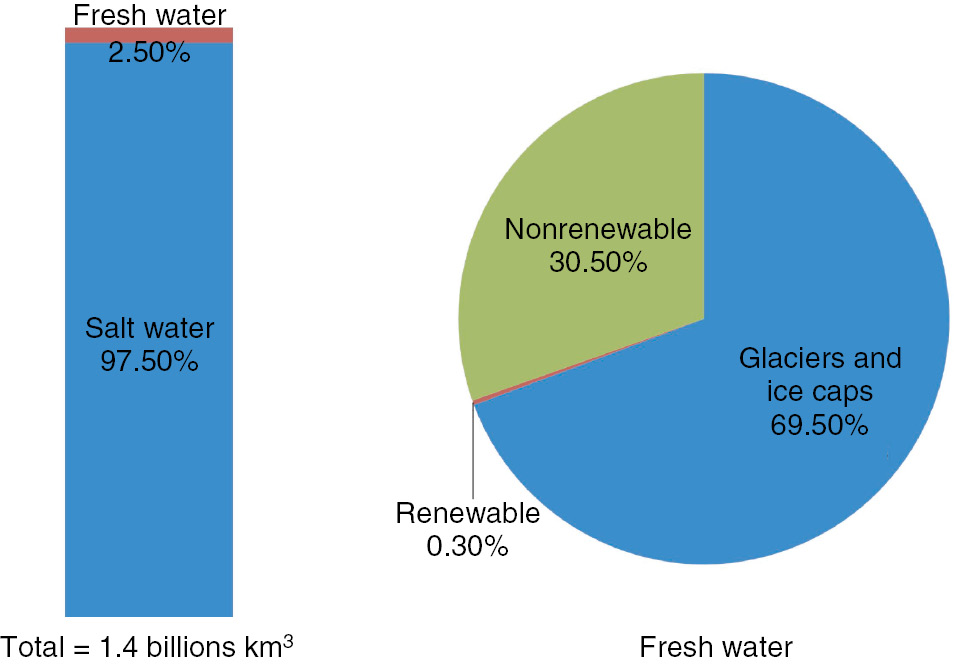
Distribution of world water.
A desalination plant (DP) is a complex, huge organized structure managing physicochemical processes. DP involve operations comprising filtration, distillation evaporation, agitation, circulation, and heat exchange employing diverse equipment such as pumps, pipelines valves, turbines, and compressors and using corrosion-resistant materials, metallic and non-metallic, to manufacture this equipment. This whole structure exhibits a high level of corrosion, handling corrosive SW, under continuous turbulent and regular motion of fluids, sometimes at elevated temperatures. Corrosion control methods and techniques are implemented to prevent, mitigate and avoid corrosion.
Numerous national and international professional associations of chemists, engineers and economists; research and development centers, institutes and universities and global industrial enterprises dealing with the diverse aspects of the desalination industry (DI) demonstrate the economic and social importance and relevance of this worldwide industry. The European Desalinization Society organizes congress, conferences and courses on all the scientific, technical and economic aspects, dealing with the central subject of application of engineering materials. The cooperation of government, academy and industry authorities will assure the supply of fresh water demanded by the inhabitants of our planet (Table 1).
Associations and organizations dealing with desalination science, engineering and technology.
| Association/organization | Website | |
|---|---|---|
| International Desalination Association | IDA | www.ida.bm |
| European Desalination Society | EDS | www.edsoc.com |
| American Desalting Association | ADA | www.webrom.com/ada |
| Asociación Española de Desalación y Reutilización | AEDyR | www.adeyr.com |
| Middle East Desalination Research Center | MEDRC | www.medrc.org |
| IDE Technologies, Israel | IDE | www.ide-tech.com |
| Middle East and North Africa | MENA | www.ecomena.org |
| Balaban Desalination Publications | www.desline.com | |
| Encyclopedia of Desalination and Water Resources | www.desware.net | |
| Israel Desalination Society | IDS | www.ids.org.il |
To prevent the dangers of bioterrorism by poisoning water, private safety and security organizations are looking after the DPs. Moreover, the science, engineering and technology of desalination is treated in a great number of books and journals, including the management and control of corrosion in DPs (Table 2).
Journal on saline water desalination.
| Title | Editorial | Address |
|---|---|---|
| Desalination | Elsevier | www.journalelsevier.com |
| Desalination & Water Treatment | Taylor & Francis | www.dewater.com |
| Desalination & Water Reuse | International Desalination Association | www.idasal.org |
| IDA Newsletter | IDA | www.ida.bm |
| Water Reuse and Desalination | IWA Publishing | www.jwrd.iwaponline.com |
Because of the great abundance of scientific and technical information, editorials, publishers and educational authorities use reviews as a practical tool for dissemination of knowledge. These reviews devote a section to the analysis of the corrosion issues and their solutions, in the relevant industries. The authors of the present work have already published reviews in this journal on corrosion management in industries such as SW (Charrach et al., 1990), geothermal wells (Valdez et al., 1999), petrochemical corrosion (Schorr, 1996), phosphoric acid corrosion control (Schorr & Valdez, 2016), corrosion in electronics devices, corrosion in natural gas facilities (Valdez et al., 2015) and corrosion inhibitor applications (Cheng et al., 2018), in boiler corrosion (Charrach et al., 1990).
2 Water: fresh and saline
As the world’s population grows, fresh water resources are getting increasingly scarce. Nevertheless, there is plenty of water around, in oceans and seas, but they are salty, not suitable for human consumption, therefore driving a global boom for the desalination industry (Habib et al., 2001).
The significant difference in chemical composition between fresh and SW determines the diverse corrosion performance of the engineering materials utilized in the sectors of a DP, which treats and manages these waters (Table 3; IDE Technologies, 2004, 2014; IDE Newsletter, 2014).
Chemical composition of fresh and saline waters.
| Water | Component |
|||||||||
|---|---|---|---|---|---|---|---|---|---|---|
| Na+ | K+ | Mg2+ | Ca2+ | Cl− |
|
|
SiO2 | ECa | TDSa | |
| Fresh (mg/l) | 6.3 | 2.3 | 4.1 | 15.0 | 7.8 | 58.4 | 11.2 | 2-5 | 150 | |
| Sea (g/l) | 10.7 | 0.2 | 1.3 | 0.41 | 19.3 | 0.14 | 2.71 | 10 | 50–60 | 35 |
| Brackish (mg/l) | 820 | 47 | 198 | 315 | 1816 | 292 | 614 | 29 | 5.9 | 4100 |
| Dead Sea (g/l) | 36 | 7.8 | 45.9 | 17.6 | 67 | 200 | 250 | |||
-
aEC, Electrical conductivity; TDS, total dissolved solids.
The US Geological Survey groups SW in three salinity categories: low 1000–3000 ppm; moderate 3000–10,000 ppm and high 10,000–35,000 ppm. Some SW are slightly alkaline because of the presence of carbonate, bicarbonate and hydroxide compounds.
ASTM Standard D 1129 deals with the “Definition of Terms Relating to Water” (Annual Book of ASTM International Standards). It classifies SW in three categories: seawater, brackish water (BW) and brines; it presents the characteristics and properties of water, the phenomena typical of water behavior such as corrosion, erosion, scaling and fouling, the water soluble salts, suspensions and sediments and more.
The oxidation-reduction potentials of water measures the ratio of the activities of the oxidized to the reduced species present in water. This value (in volts) is determined applying the ASTM standard D1498 (ASTM D 1498).
BW have oxidation-reduction potential (also called redox potential) values in the range of 0.10–0.60 V, but when they are contaminated with H2S, the values decrease to electronegative values: −0.28 to −0.50 V (Charrach, 1990, p. 335).
2.1 Seawater
The main characteristics of SW, from the corrosion point of view, are salinity, chlorinity and dissolved oxygen (DO), which ranges from 4 to 8 mg/l depending on temperature, depth and the volume of rivers’ fresh water discharging into them. The Baltic Sea salinity is 2.0%, but in the Red Sea, a semiclosed water body, salinity reaches 4.0% in hot summer, with temperatures reaching 40°C.
Seawater is slightly alkaline, having a pH 8.0, but it decreases when seawater absorbs CO2 from the atmosphere, particularly in coastal areas where power stations burning fossil fuels are located. The following equilibrium is established:
then the seawater displays a slight acidity.
2.2 Brackish waters
The vast deserts and arid regions of the world occupy about 40% of this planet lands, with scarce rains, high summer and low winter temperatures and salty waters. In some places, BWs are feed for desalination in DPs (Charrach, 1990).
BWs contain chloride, carbonate and sulfate salts with a total dissolved salt of 4.1 g/l (Table 3). Additionally, they include dissolved gases, ppm: H2S 1–6; O2 1–3 and CO2 10–40. A high level of H2S implies a low content of oxygen, as it oxidizes H2S to elemental sulfur:
which appears in the soil of the oxidation ponds (Schorr et al., 2006).
In the last decades, BW are being used, after a pretreatment and H2S removal, as feed water for desalination plants. The main source of H2S in underground BW is the acidic attack on pyrite and other mineral sulfides by organic acids, e.g. humic and fulvic and CO2. H2S is responsible for lowering the pH of BW and for an acidic corrosion mechanism with cathodic depolarization and increased anodic dissolution. The corrosion products and the ionic species encountered in BW, namely, Cl−, H2S, HS− and S2−, are displayed in a more complex Fe-Cl-S-H2O Purbaix diagram of Fe electrode potential-pH. The pH values of BW are in the range of 4.5–7.5, depending on the level of H2S, CO2 and the nature and amount of acidic or alkaline salts. The BW delivered to the DP is practically H2S-free saturated with oxygen.
2.3 Brine
Brines, natural and industrial, are aqueous, concentrated solutions of salts, mainly NaCl, with a salt content of 3.5% up to 26%, a saturated solution such as waters of the Great Salt Lake, Utah, US and the Dead Sea, Jordan-Israel (Table 3; ASTM D 3875).
Natural brines are located at salt lakes, around salty lands (salar in Spanish) and in arid regions formed by strong evaporation. Industrial brines are used in the food industry for conservation and in power plant cooling fluids, for deicing of frozen roads.
Brine is a byproduct of DPs, which is disposed by conducting it back into the sea, near the coast, or into solar evaporation ponds and probably for industrial application of their salt. Brine disposal constitute an ecological issue as it may affect vegetable and animal life; therefore, these ponds are lined with flexible, impermeable rubber or plastic sheets to avoid infiltration into the aquifer. Brines are disposed in accordance with the environmental regulations of the countries involved (Ahmed et al., 2000).
An interesting aspect is the corrosion behavior of metals in salt concentrated and saturated brines. Figure 2 depicts the relation between salt concentration and steel corrosion rate (CR). It increases to a maximum at seawater content (3.5%) and then decreases nearing cero at the saturation content (25%) e.g. Great Salt Lake and Dead Sea, because DO reaches values near zero: 0.1 mg/l. (Figure 2)
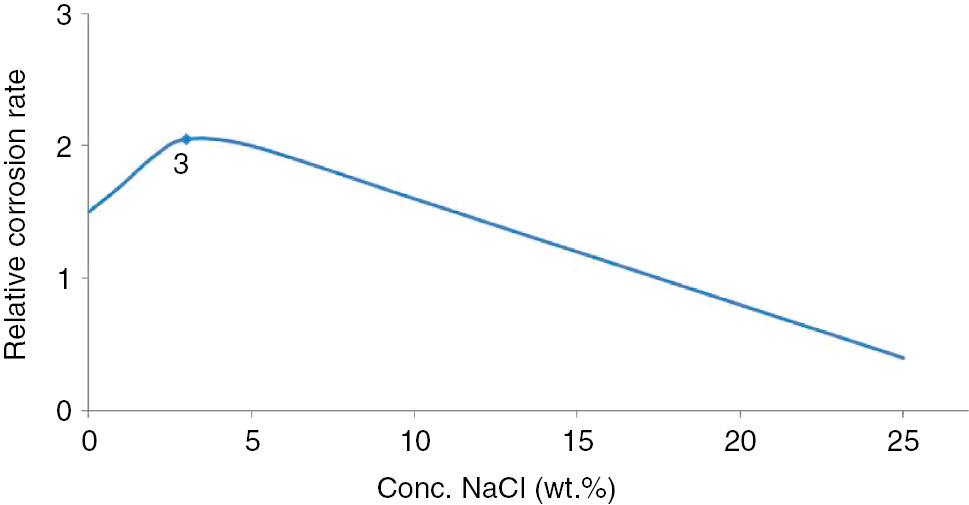
Effect of sodium chloride concentration on corrosion of iron in aerated solutions at room temperature.
On the basis of this knowledge, the carbon steel barges harvesting the salts in the evaporation pounds and the pipelines conducting the salt slurry to the salt treatment plants, are non-protected with industrial paints and other corrosion protection systems.
3 Desalination industry
Desalination, transforming SW into potable water, did not start yesterday; it is know from biblical times. The people of Israel, wandering in the Sinai desert was desperately searching for water, then their leader Moses found bitter water. In an act of magic he threw a piece of wood into the water that become fresh water (Exodus 15:22–25). Is this an ancient practice for water treatment, whose procedure has been lost in the eons of history?
The ancient nations of the Middle East and the Mediterranean Sea: Hebrews, Egyptians, Mesopotamians, Phoenicians, Greeks and Romans built public water works: flood control facilities, aqueducts, canals, reservoirs, pipelines made from corrosion-resistant stone and wood for the supply of fresh water for their population.
The US created the Office of Water Research and Technology and in 1952 the Congress passed “The Saline Water Act” to promote the DI, particularly in the southwest arid/desertic regions.
The DI is spread out in five continents: America, Europe, Asia, Africa and Australia, in many countries but for the shake of brevity the DI is presented only in Mexico, USA and Israel. These nations possess a strong economy, a modern agriculture; a high-tech industry and a dynamic society. These countries comprehend vast regions of dry arid/desertic climate, high temperatures, low level of rains, and ground BW, therefore they are erecting DPs. Their Universities and R&D institutes manage materials and corrosion departments and laboratories that implement methods and techniques for corrosion control in natural environments and industrial facilities (Balaban, 2004).
The DI is in the middle of an expansion and modernization program designed to construct more efficient and larger DPs that will reduce production costs. The maintenance of its infrastructure assets requires a robust understanding of the integration between global climate change and the materials engineering-structure-climate-interaction, induced by variations in humidity, temperature, solar radiation, drought and pluvial precipitation mainly during extreme events (Roberge, 2010). The Institute of Materials, Minerals and Mining (IOM3) London has published a special issue of its journal: Corrosion Engineering, Science and Technology, which brings together papers examining climate change induced corrosion (Valdez et al., 2010, 2011; Schorr, 2011).
Mexico is a vast, maritime country, surrounded by seas and oceans, having a complicated distribution of water resources, with plenty of water in the southeast region whereas in the northwest there is water scarcity, e.g. the State of Baja California. Extraction of underground water in areas near to the sea coast causes saline contamination of the underground aquifer. The cities of Rosarito, Tijuana, Ensenada and Hermosillo had installed some DPs and other huge desalination projects are in the planning stage.
The national Autonomous University of Mexico (UNAM) has created a Project for Multidisciplinary Investigation for Leadership and Academic Improvement (its Spanish acronym IMPULSA), with SW desalination as its central activity, applying renewable sources of energy. Impulsa maintains cooperation links with desalination institutes in Spain, Israel and USA (Hirart et al., 2013).
The southwest US states constitute a dry/desertic region, affected by frequent droughts; then supplies of clean water becomes scarce. To overcome this crucial situation, the largest DP in the Western Hemisphere, applying the Reverse Osmosis (SWRO) process, was built at Carlsbad, CA, that will provide 200 K m3/day of fresh water to the whole area (Figure 3). This was the result of an international cooperation, with American, Israeli and Spanish desalination enterprises covering the financial, technical, equipment and engineering materials aspects of this special DP. Because of the continuing drought in California, the plant completion was advanced to late 2015. The US DI continues to expand, technologies are being innovated and high quality water is supplied to the nation (The Carlsbad Desalination Project, 2014).
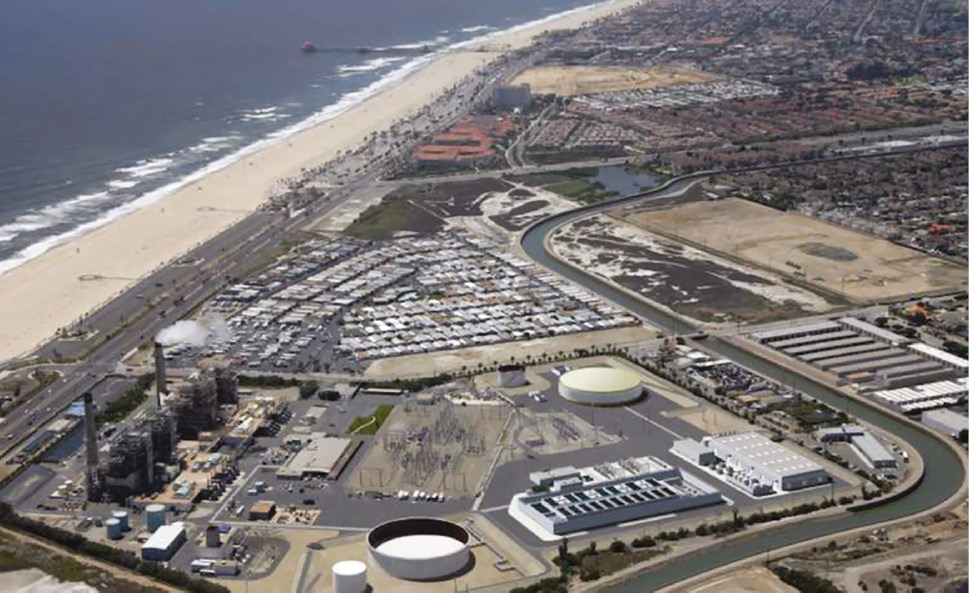
Carlsbad, CA, the largest desalination plant in the Western Hemisphere.
The DI started in Israel with the construction of DPs around 1960, establishing a cooperation between Mekorot-the National water company and IDE Technologies, the national desalination enterprise, installing thermal DP in several parts of the country, in particular in the southern arid region; reaching the Red Sea (Hofman, 2011; Tenne, 2011).
At its beginning IDE erected a desalination pilot plant at the premises of Israel Mining Industries (IMI), in Haifa. The IMI corrosion Laboratory assisted IDE in the selection of corrosion resistant alloys (CRA), carried out corrosion tests and evaluated corrosion problems in the pilot plant.
Today, IDE Technologies is considered as one of the prominent desalination companies developing, designing and erecting DPs worldwide following the BOT-Built-Operate-Transfer system. Table 4 lists the DPs operating now in Israel, supplying potable water to the whole country.
Israel desalination plants.
| Water cost (NIS/m3) | Location | Capacity (million m3/year) | Opened |
|---|---|---|---|
| 2.60 | Ashkelon | 120 (as of 2010) | August 2005 |
| 2.90 | Palmachin | 45 | May 2007 |
| 2.60 | Hadera | 127 | December 2009 |
| 2.01–2.19 | Soreq | 150 (expansion up to 300 approved) | 2013 |
| 2.40 | Ashdod | 100 (expansion up to 150 possible) | September 2014 |
From 1998 the Israeli Desalination Society (IDS), helds yearly conferences on desalination science, technology and engineering, including corrosion management of DPs. Dr. Miriam Balaban, director of the European Desalinization Society and editor of desalination journals, organizes conferences and courses on desalination over the world, including prevention and avoidance of corrosion (Israel Desalination Society).
IDE technologies focuses on the development, engineering construction and operation of membrane and thermal desalination facilities delivering 3 million m3/day of high quality water, worldwide.
4 Desalination processes, plants and equipment
Two main technologies are applied to desalinate SW: thermal evaporation, which converts SW into steam and separates the salt; and membrane separation, e.g. RO, a filtering process utilizing special plastic membranes (Asociacion Española de Desalacion y Reutilizacion; Ophir & Lokiec, 2005).
All these DPs use corrosion-resistant materials (CRM), metallic and non-metallic for the fabrication of the varied equipment employed in the production of pure water (Tables 5 and 6). DPs present a high level of corrosion risk as they handle and process aggressive SW under reverse conditions operating dynamic and static parameters:
Membrane and thermal desalination processes.
| Process | Characteristics |
|---|---|
| Membrane | |
| Reverse osmosis (RO) | Pressure is applied to the SW forcing it through a semipermeable plastic membrane that separates brine form water. |
| Thermal | |
| Multistage flash distillation (MFD) | SW is heated; the pressure is lowered in several stages, so the water flashes into steam,to be cooled. |
| Multi-effect distillation (MED) | Low-pressure steam, 60°C, is handled in a train of evaporative condensers (effects) with heat rejection condensers. |
| Mechanical vapor compression (MVC) | Distillation is effected by an electrically driven centrifugal compressor mounted on the evaporator |
Equipment for desalination plants.
| Mechanical equipment | Thermal equipment |
|---|---|
| Pipes, tubes and ducts | Evaporators |
| Saline water pumps, vertical and centrifugal | Vapor condensers, diesel engines |
| Valves, diverse types | Flash cambers |
| Gasketed plate-and-frame HE | Demisters |
| Fittings and flanges | Condensers |
| Steam and gas turbines | Deaerators |
| Compressors | Chlorinators |
| Control and flow instrumentation | Storage tanks |
Membrane separation processes apply semipermeable and ion-selective membranes to desalt seawater, using relatively high hydraulic pressure and the driving force for the separation between pure water and salts. Some RO membranes are manufactured from high-grade polymeric PVDF, which are very durable and less prone to damage. Such membranes impede the adhesion of foulants such as bacteria, proteins and mineral crystals (Malik et al., 2006; Figure 4).
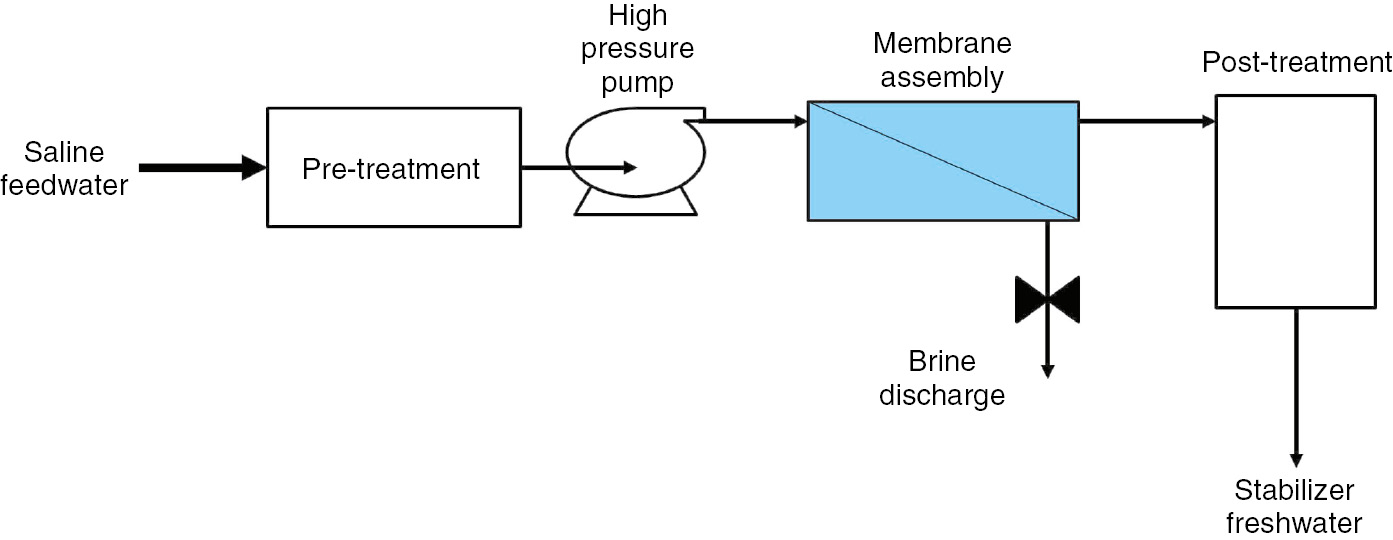
Diagram of desalination process by reverse osmosis.
Thermal desalting involves operations of boiling and evaporation. They are based on improved stages of distillation, compression and condensation with the purpose of saving energy and to produce water with a low content of total dissolved salt and a low cost for the potable water. Such processes are made more efficient by the application of multiple steps and the employment of vacuum, e.g. multiple effects distillation and multiple flash processes (Table 5; Malik & Al-Fozan, 2011).
It should be emphasized that these elevated temperatures and circulation of hot water and vapor require the use of metallic CRA for the prevention, mitigation and avoidance of corrosion damage (see Section 8). Furthermore, there is no universal desalination process; every type of SW requires a process adapted to its properties, characteristics and performance.
A DP converts SW into two products: a desirable potable water and disposable salty brine. The great variety of equipment, being handled in a DP, might be classified in two groups: mechanical and thermal equipment, in accordance with their particular operation. All the motion of the plant fluids is managed mainly by pipes, tubes, ducts, and valves to regulate their flow and velocity, vertical and horizontal pumps and all kind of storage tanks to contain different liquids. The thermal equipment, e.g. steam generators, condensers, flash chambers, heat exchangers, and distillation towers, handle hot and boiling water and vapor at different temperatures.
These varied equipment request CRM that display a reasonable endurance to the DP fluids, which are described in Section 6.
5 Corrosion, scaling and fouling
The three central problems that occupy maintenance engineers of DPs are corrosion, scaling and fouling of the equipment. Sometimes they occur simultaneously, are interrelated and influence each other. These phenomena, their extent and intensity depend on the chemical and biological properties of the feed SW and the DP streams (stagnant or circulating) and the thermal and mechanical conditions of operation (Roberge, 2000; Valdez & Schorr, 2010a,b,c; Valdez et al., 2012).
DPs suffer from diverse types of corrosion, e.g. uniform, general or localized, that appears in a specific part of the equipment, such as water boxes, heat exchangers of tubes or plates, demisters, pump impellers and more. Combined mechanical erosion and electrochemical corrosion are encountered in pump hubs and bends in pipelines conveying liquids and slurries at high velocities (Roberge, 2008; Schorr et al., 2011).
In hostile atmosphere, near the seacoast or in tropical areas, with high temperature and humidity due to heavy rains and with airborne chlorides, the DP installations and equipment should be protected with industrial paints and coatings.
Dissolved and suspended salts, such as carbonates and silicates, tend to sediment on the equipment surfaces forming hard, thick scales. To prevent this nuisance, feed SWs are acidified to dissolve the carbonates, which converts into CO2 emitted into the air. Some BWs that contain weak acid, e.g. H2S, are neutralized by alkaline Na2CO3 (Semiat et al., 2000).
Under complex organic and calcareous, porous scales, microbiologically influenced corrosion (MIC) develops, producing severe corrosion damage. To avoid these phenomena, scale inhibitors that impede the formation of crystals and corrosion inhibitors that slow down either the corrosion anodic or cathodic reaction, or both, or form a protective film on the equipment surface are added to the relevant DP streams under corrosion risk.
SWs, with their rich content of gases, minerals and organics, such as live plankton, constitute an adequate medium for the growth of bacteria, fungi, mollusk and algae, forming colonies strongly adhered to the metal surface. Under these colonies, corrosion develops as these organisms secrete acidic chemicals (Al-Muhanna & Habib, 2016).
To combat this grievance, many biocides are applied: gaseous chlorine (Cl2), sodium hypochlorite (NaOCl), chlorine dioxide (ClO2) and bromine salts, e.g. NaBr as they avoid the formation and accumulation of biological fouling (Moncmanova, 2007).
Mechano-chemical cleaning of equipment surfaces is done with weak solutions of acids: citric, sulfuric and phosphoric or alkalis, depending on the chemical and physical nature of the fouling sediments. A special method, called cleaning in place, permits the removal of foulants without suspending the equipment operations, which is adequate for heat-exchanging metallic surfaces.
6 Corrosion-resistant materials
One of the main activities in the development of a DP, particularly during the design stage, is the selection of CRM, which assures a continuous efficient operation without shutdowns, a low expense in maintenance and in replacement of corroded equipment (Schorr et al., 2005, 2012a,b).
The central aim of this section is to assess the CRMs considered as suitable for DPs. Moreover, cases of corrosion occurring in the diverse sectors of a DP are presented as a warning and alert for DP designers and constructors, to prevent such occurrences (Malik et al., 2015; Neroufel et al. 2017).
The numerous engineering materials listed are classified into two large groups: metallic alloys and plastic, which include polymers, rubbers, elastomers and composites (Table 7; Malik, 2001a,b; Malik et al., 2010).
Corrosion-resistant materials used in desalination plants.
| Alloys, UNSa | Chemical composition (%) |
|---|---|
| G 10080 | Fe-C(ASTM A 242, AISI 1080) |
| A 95052 | Al-2.5Mg |
| C 70600 | 90Cu-10Ni |
| S 30400 | Fe-18Cr-10Ni |
| S 31600 | Fe-18Cr-12Ni-3Mo |
| S 08028 | Fe-27Cr-31Ni-3Mo |
| S 31700 | Fe-18Cr-8Ni-3Mo |
| S 31254 | Fe-20Cr-18Ni-6.1Mo |
| S 31803 | Fe-25Cr-5.7Ni-2.8Mo |
| N 06035 | 2Fe-33Cr-58Ni-8.1Mo |
| N 08904 | Fe-20 Cr-25Ni-4.5Mo |
| N 06030 | Fe-20Cr-5.5Mo |
| R 52400 | Ti-0.15Pd |
| Plastic | |
| PVC | Polyvinychloride |
| PE | Polyethylene |
| PVDF | Polyvinylidene fluoride |
| Rubber | Natural and synthetic |
| Composite | |
| RC | Steel reinforced concrete |
| FGRP | Fiberglass-reinforced polyester |
-
aUNS, Unified Numbering System.
6.1 Metallic materials
The CRAs are associated in several groups: general alloys (carbon steel, Al and Cu), stainless steels (SS), Ni-base-alloys and Ti alloys (Table 7), all identified by the Unified Numbering System (Habib et al., 2001; Encyclopedia of Desalination and Water Reuse, 2010).
Carbon steel is the main structural alloy not only for a DP but also for water storage and conveying ducts. It is preferred because of its mechanical properties, easy handling and welding. Its limited corrosion resistance is improved by painting and coating and for huge equipment by corrosion protection.
Some waters treated in carbon steel and cast iron equipment acquire a red-brown tint because of the dissolution and/or suspension of iron-corrosion products, e.g. hematite Fe2O3×H2O. These waters are called “rouge” water; the corrosion products should be separated by filtration (Taylor et al., 2006).
Al tubes are used in thermal desalination processes for the fabrication of huge heat exchangers to cool water vapor with seawater. The corrosion resistance of Al alloys derives from the formation of a passive layer of Al2O3. Navy and coast guard vessels of many nations are manufactured from Al-2.5 Mg, highly resistant to sea water (Eliezer et al., 2010). In a multi-effect desalination process, the huge heat exchanger is made from Al alloys tubes, and the steel evaporator body is coated with epoxy resin (Ahmed et al., 2000; Ophir & Lokiec, 2005).
Cu-Ni, Cu-Sn (bronze) and Cu-Zn (brass) alloys are useful in DPs for pumps and pipes to transport seawater and other waters circulation, particularly for heating and evaporating process for seawater and to obtain distillate water for steam generators and for potable water (Abouswa et al. 2007). The green, blue, and brown corrosion products are Cu salts that do not provide protection and should be removed periodically by chemical cleaning (Abouswa et al., 2007).
Diverse SS treat fresh and SW, with different concentration of NaCl, at ambient and high temperature, in membrane and thermal DPs, worldwide. The formation of an adhered, thin passive layers of oxides, in the presence of air and moisture, assures their corrosion resistance (Farkash et al., 1989; Valdez & Schorr, 2010a,b,c).
Ni alloys, with Ni concentrations increasing from 5.7% to 58%, find important applications in thermal DP for high-pressure pumps, heat exchanger, and brine concentrator at elevated temperatures (Larche et al., 2015).
As a general rule, Al-Mg alloys serve in heat-transferring equipment operations, but when the DP processes highly corrosive BWs, geothermal brines and waters produced from oil fields, tubes and plates H-X are fabricated from Ti or Ti-Pd alloys, with augmented corrosion resistance (Schorr, 1999; Schorr et al., 2009, 2012).
Corrosion experts are being asked frequently by the designer of DP equipment, which are the suitable CRA, to be used according to the Cl− content of the feed SW. Table 8 displays selected adequate SS and Ni-base alloys; their chemical composition is integrated into Table 7 (Schorr et al., 2005).
Corrosion-resistant alloys for use in saline waters.
| Cl− content (ppm) | CRA, UNSa |
|---|---|
| 2000 | N 06030, S 31803 |
| 1500 | N 06035, S 31254 |
| 1000 | N 08904, S 31700 |
| 500 | S 31600, S 31400 |
-
aUNS, Unified Numbering System.
6.2 Plastic materials
Plastic engineering materials, derived from petroleum components, are polymerized and converted into solid materials with the form of sheets, plates, tubes, pipes, etc., for the manufacture of corrosion-resistant equipment. They comprise thermoplastics and thermosets and natural or synthetic rubbers (Table 7).
Rigid plastics such as PVC, PE, PP, and FGRP are utilized for the construction of pipelines and storage tanks. Some containers are fabricated from epoxy resins reinforced with carbon fibers, but because of their relatively high cost, their use is limited.
Some carbon steel tanks are internally lined with flexible sheets of rubber or plasticized PVC. Rubbers are also employed as packing seals for valves, pipelines, heat exchangers and O-rings of pumps.
Steel-reinforced concrete is used to construct the base and containers for huge tanks for liquid storage and for drainage channels. Concrete is attacked by brines; sometimes the concrete is protected by special paints or flexible rubber sheets.
7 Corrosion protection and control
It is widely accepted by corrosion institutions and professionals that corrosion protection and control technologies for industrial facilities and natural environments are based on four general methods:
Proper selection of corrosion-resistant engineering materials: metallic, plastic, ceramic and composites for the fabrication of the DP structures, installations, machinery and equipment, to assure a long-live service.
Application of industrial paints, polymeric coatings and rubber linings, compatible with the DP fluids, to protect the basic materials of construction.
Corrosion protection with sacrificial anodic metals such as aluminum and magnesium or employing impressed direct electrical current.
Use of corrosion inhibitor (CI) that hinder the corrosion reactions or form an absorbed protective film on metal surfaces or annihilate the DO in water systems. A new family of CI called “green” CI has entered service in industrial systems (Sastry, 2011; Cheng et al., 2018).
8 Conclusion and recommendations
Desalination is the most viable solution to the 21st century’s shortage of fresh water, to be attained from sources of SW. Actual innovative desalination technology is less energy-consuming and more environmentally friendly.
Corrosion resistance is the main property to be considered in the choice of CRM for DPs, but the final selection must be comprised between technological and economical factors. The selected CRM should be able to perform its function safely for a reasonable period of time and at a reasonable cost.
The surface of desalination equipment should be maintained clean and smooth to avoid mineral scale and to diminish the propensity of biological fouling. Mechano-chemical cleaning is implemented to remove scale and fouling.
Corrosion testing at the service of DPs mainly consists of several phases: laboratory test, desalination pilot plant and exposing specimens in DPs. Performing ASTM and NACE International standard tests is recommended, so these numerical and experimental results might be compared with those of similar test in other DPs (ISO M845, 1995; Al-Muhanna & Habib, 2016; Annual Book of ASTM International Standards, Vol. 03, 02).
Modern DPs that are constructed from CRMs and follow recognized methods of corrosion protection and control can expect prolonged equipment service life and relative freedom from corrosion.
About the authors

Michael Schorr is a professor (Dr. honoris causa) at the Institute of Engineering, Universidad Autonoma de Baja California. He has a BSc in chemistry and a MSc in materials engineering from the Technion-Israel Institute of Technology. From 1986 to 2004, he was the editor of Corrosion Reviews. He is acquainted with the appreciation of VCI in industrial environments. Additionally, is a corrosion consultant and professor in Israel, US, Latin America and Europe. He has published 490 scientific and technical articles on materials and corrosion.
Benjamín Valdez was the director of the Institute of Engineering during 2006–2013, Universidad Autonoma de Baja California. He has a BSc in chemical engineering, a MSc and PhD in chemistry and is a member of the Mexican Academy of Science and the National System of Researchers in Mexico. He was a guest editor of Corrosion Reviews, in which he produced two special issues on corrosion control in geothermal plants and the electronic industry, including VCI uses. He is a full professor at the University of Baja California. His activities include corrosion research, consultancy and control in industrial plants and environments.

Amir Eliezer is the director of the Corrosion Research Center, Nano-Bio & Advanced Materials and a faculty member of both civil engineering and mechanical engineering at the Sami Shamoon College of Engineering, Israel. He is active in the NACE Europe Area, is a board member of the World Corrosion Organization, is an EFC member and CAMPI chair, as well as a faculty advisor of the NACE Israel Negev student section.

Ricardo Salinas is a mechatronic engineer; he received his diploma from the Institute of Technology, Mexicali. He obtained his MSc degree in corrosion control from the Institute of Engineering of the University of Baja California in 2015. Now he is working on his PhD project in the area of deicing and becoming familiar with CI for corrosive salts.

Carlos Lora graduated as a mechanical engineer at the Institute of Technology, Mexicali. He obtained his MSc degree in corrosion control from the Institute of Engineering, University of Baja California, Mexico, in 2016. Now he is devoting his time to his PhD, on the application of corrosion from plants of the desertic region of Baja California.
References
Abouswa K, Elshawesh F, Elrage O, Elhood A. Corrosion investigation of Cu-Ni Tube desalination plant. Desalination 2007; 205: 140–146.10.1016/j.desal.2006.05.013Search in Google Scholar
Ahmed M, Shayya WH, Hoey D, Mahendran A. Use of evaporation ponds for brine disposal in desalination plants. Desalination 2000; 130: 155–168.10.1016/S0011-9164(00)00083-7Search in Google Scholar
Al-Muhanna K, Habib K. Marine biofouling of different alloys exposed to continuous flowing fresh seawater by EIS. J Saudi Chem Soc 2016; 20: 391–396.10.1016/j.jscs.2012.07.008Search in Google Scholar
American Society of Testing and Materials (ASTM). Annual book of ASTM International Standards, ASTM D1129-13. Standard Technology Relating to Water. West Conshohocken, PA: ASTM, 11(01), 2013.Search in Google Scholar
American Society of Testing and Materials (ASTM). Annual book of ASTM International standards, Vol. 03,02, Wear and erosion; metal corrosion, Standards G3, G4, G5, G31. West Conshohocken, PA: ASTM, 2006.Search in Google Scholar
American Society of Testing and Materials (ASTM). ASTM D 1129, standard definition of terms related to water. West Conshohocken, PA: ASTM.Search in Google Scholar
American Society of Testing and Materials (ASTM). ASTM D 1498, standard test method for oxidation-reduction potential of water. West Conshohocken, PA: ASTM.Search in Google Scholar
American Society of Testing and Materials (ASTM). ASTM D 3875, standard test method for alkalinity in brackish water, seawater and brines. West Conshohocken, PA: ASTM.Search in Google Scholar
Balaban Desalination Publications. Desalination directory, Israel, 2004. www.desline.com. Accessed June 2018.Search in Google Scholar
Charrach J, Schorr M, Weintraub E. Corrosion and scaling behavior in Dead Sea basin saline waters. Corros Rev 1990; 9: 293–357.10.1515/CORRREV.1990.9.3-4.293Search in Google Scholar
Cheng N, Valdez B, Schorr M, Salinas J. Vapor inhibitors for corrosion protection in humid and saline, natural and industrial environments. In: Alifkhazraci M, editor. Corrosion inhibitors, principles and recent applications. Rijeka, Croatia: InTechOpen, 2018.10.5772/intechopen.72815Search in Google Scholar
Eliezer A, Valdez B, Schorr M. Corrosion of naval aluminum in seawater. Mater Performance 2010; 49: 62–66.10.5006/MP2010_49_9-62Search in Google Scholar
Encyclopedia of Desalination and Water Reuse. Materials selection and corrosion, 2010. www.desware.net. Accessed June 2018.Search in Google Scholar
Farkash A, Fleischer I, Schorr M, Weintraub E, Cytermann R. Corrosion control in industrial boilers. Corros Rev 1989; 8: 333–388.10.1515/CORRREV.1989.8.3-4.333Search in Google Scholar
Habib K, Fakhral-Deen A. Risk assessment and evaluation of materials commonly used in desalination plants. Desalination 2001; 139: 249–253.10.1016/S0011-9164(01)00316-2Search in Google Scholar
Hiriart G, Espindola S, Beltran H. Seawater desalination in Mexico – IMPULSA Project. National Autonomous University of Mexico, 2013. www.gwri-ic.technion.ac.il/pdf/IDS/151.pdf. Accessed June 2018.Search in Google Scholar
Hofman D. Implementation of water desalinations in Israel. Israel Authority for Water and Sewage, January 2011, Weizmann Institute Solar Tower, www.weizmann.ac.il. Accessed June 2018.Search in Google Scholar
IDE Technologies. Fresh water from the sea. Israel, 2004. www.ide-tech.com. Accessed June 2018.Search in Google Scholar
IDE Technologies/Desalination, 2014. www.desalination.com, www.ideorg.org. Accessed June 2018.Search in Google Scholar
IDE Newsletter, IDE News, Periodical Publication, contact@ide-tech.com, 2014, E.D.S.Search in Google Scholar
ISO M845. Corrosion of metals and alloys – general minerals for corrosion testin, 1995.Search in Google Scholar
Israel Desalination Society. Desalination in Israel, 2010. www.water.gov.il. Accessed June 2018.Search in Google Scholar
Larche N, Boillot P, Dezerville P, Johansson E, Lardon JM, Thierry D. Crevice corrosion performance of high-alloy stainless steels and Ni-based alloy in desalination industry. Desalin Water Treat 2015; 55: 2491–2501.10.1080/19443994.2014.968906Search in Google Scholar
Malik A. Case histories in the failure of pipelines in desalination plans. Riyadh, Saudi Arabia: Saline Water Conversion Corporation, 2001a.Search in Google Scholar
Malik A. Corrosion and materials selection in desalination plants. Riyadh, Saudi Arabia: Saline Water Conversion Corporation, 2001b.Search in Google Scholar
Malik A, Al-Fozan S. Corrosion and materials selection in MSF desalination plants. Corros Rev 2011; 29: 153–175.10.1515/CORRREV.2011.026Search in Google Scholar
Malik A, Andijani I, Mobin M, Ahmad S. Corrosion behavior of materials in RO water containing 250–350 ppm chloride. Desalination 2006; 193: 149–159.10.1016/j.desal.2005.12.010Search in Google Scholar
Malik A, Andijani I, Mobin M, Al-Fozan S, Al-Muaili F, Al-Hajiri M. An overview of the localized corrosion problems in seawater desalination plants – some recent case studies. Desalin Water Treat 2010; 20: 22–34.10.5004/dwt.2010.1479Search in Google Scholar
Malik AU, Al-Fozan SA, Al-Muaili F. Corrosion of heat exchanger in thermal desalination plants and current trends in material selection. Desalin Water Treat 2015; 55: 2515–2525.10.1080/19443994.2014.940642Search in Google Scholar
Moncmanova A, editor. Environmental deterioration of materials, Boston: WIT Press, 2007.10.2495/978-1-84564-032-3/02Search in Google Scholar
Neroufel A, Larche N, Al Fozan S. Crevice corrosion behavior of stainless steel and Ni-based alloys in the natural seawater effect of crevice geometry, temperature and seawater world location. Desalin Water Treat 2017; 69: 202–209.10.5004/dwt.2017.0448Search in Google Scholar
Ophir A, Lokiec F. Advanced MED process for most economical seawater desalination. Desalination 2005; 182: 187–198.10.1016/j.desal.2005.02.026Search in Google Scholar
Roberge P. Handbook of corrosion engineering. New York: McGraw-Hill, 2000.Search in Google Scholar
Roberge P. Corrosion engineering, principles and practice. New York: McGraw-Hill, 2008: 185–192.Search in Google Scholar
Roberge P. Impact of climate change on corrosion risk. New York: McGraw-Hill, 2010.10.1179/174327809X442621Search in Google Scholar
Sastry VS. Green corrosion inhibitors. New York: Wiley, 2011.10.1002/9781118015438Search in Google Scholar
Schorr M. Corrosion control in the petrochemical industry: a review. Corros Rev 1996; 14: 3–4.10.1515/CORRREV.1996.14.3-4.183Search in Google Scholar
Schorr M. Titanium expenses in the chemical industry. Stainless Steel World, May 1999: 59–63.Search in Google Scholar
Schorr M, editor. Desalination trends and technologies. Rijeka, Croatia: InTech, 2011.10.5772/583Search in Google Scholar
Schorr M, Valdez B. The phosphoric acid industry: equipment, materials and corrosion. Corros Rev 2016; 34: 85–102.10.1515/corrrev-2015-0061Search in Google Scholar
Schorr M, Valdez B, Hernandez G, Puga D. CRA for corrosion control in the desalination industry. Stainless Steel World, 2005.Search in Google Scholar
Schorr M, Valdez B, Quintero-Nez M, Zlatev R. Effect of H2S on corrosion in polluted water. Corros Eng Sci Techn 2006; 41: 221–227.10.1179/174327806X132204Search in Google Scholar
Schorr M, Valdez B, Ocampo J. Erosion-corrosion in industrial turbines. Mater Performance 2009; 48: 62–65.10.5006/MP2009_48_9-62Search in Google Scholar
Schorr M, Valdez B, Ocampo J, Eliezer A. Corrosion control in the desalination industry. In: Schorr M, editor. Desalinations, trends and technologies. Rijeka, Croatia: InTech, 2011: 334.10.5772/14054Search in Google Scholar
Schorr M, Valdez , Ocampo J, So A, Eliezer A. Materials and corrosion control in desalination plants. Mater Performance 2012; 51: 56–61.10.5006/MP2012_51_5-56Search in Google Scholar
Schorr M, Valdez B, So A, Flores J. Erosion-corrosion in industrial turbomachinery. Mater Performance 2012; 51: 46–50.10.5006/MP2012_51_2-46Search in Google Scholar
Semiat S, Hason D, Sutzkover I. Technique for evaluating silica scaling and its inhibition in reverse osmosis desalting. Orlando: NACE Corrosion Conference, 2000.10.5006/C2000-00310Search in Google Scholar
Taylor J, Tang Z, Xiao W, Hong S. Monitoring of distribution water qualities under various source water blending. Environ Monit Assess 2006; 117: 59–71.10.1007/s10661-006-7672-8Search in Google Scholar PubMed
Tenne A. The master plan for desalination in Israel, 2020. Israel Water Authority, October 2011, www.water.gov.il. Accessed June 2018.Search in Google Scholar
The Carlsbad Desalination Project, April 2014. www.carlsbad-desal.com. Accessed June 2018.Search in Google Scholar
Valdez B, Schorr M. Corrosion control in desalination industry. Zurich, Switzerland: Trans Tech Publications, 2010a: 29–32.10.4028/www.scientific.net/AMR.95.29Search in Google Scholar
Valdez B, Schorr M. Stainless steel for corrosion control in desalination plants. Stainless Steel World, 2010b: 40–44.10.5772/14054Search in Google Scholar
Valdez B, Schorr M, editors. Relationship of corrosion with global warming and climate change. Corr Eng Sci Techn 2010c; 45: 1.10.1179/147842210X12635511700839Search in Google Scholar
Valdez B, Schorr M, Sampedro J, Rosas N. Corrosion of steel by drilling muds in geothermal wells. Corros Rev 1999; 17: 237.10.1515/CORRREV.1999.17.3-4.237Search in Google Scholar
Valdez B, Schorr M, Quintero M, García R, Rosas N. Effect of climate change in the durability of engineering materials in hydraulic infrastructure: an overview. Corros Eng Sci Techn 2010; 45: 34–41.10.1179/147842209X12559428167526Search in Google Scholar
Valdez B, Schorr M, Eliezer A, Haddad J. Corrosion characteristics of natural and industrial brines. Stockholm, Sweden: Eurocorr, 2011.Search in Google Scholar
Valdez B, Schorr M, Zlatev R, Carrillo M, Stoytcheva M, Alvarez L, Eliezer A, Rosas N. Corrosion control in industry. In: Valdez B, Schorr M, editors. Environmental and industrial control. Rijeka, Croatia: InTech, 2012.10.5772/51987Search in Google Scholar
Valdez B, Schorr M, Bastidas JM. The natural gas industry, equipment, material and corrosion. Corros Rev 2015; 33: 175–185.10.1515/corrrev-2015-0012Search in Google Scholar
©2019 Walter de Gruyter GmbH, Berlin/Boston
Articles in the same Issue
- Frontmatter
- In this issue
- Reviews
- Organic green corrosion inhibitors (OGCIs): a critical review
- Managing corrosion in desalination plants
- Study on corrosion investigations in industrial effluents: a review
- Corrosion and corrosion prevention in heat exchangers
- Lead-silver anode behavior for zinc electrowinning in sulfuric acid solution
- Original article
- Sensitization of an austenitic stainless steel due to the occurrence of δ-ferrite
Articles in the same Issue
- Frontmatter
- In this issue
- Reviews
- Organic green corrosion inhibitors (OGCIs): a critical review
- Managing corrosion in desalination plants
- Study on corrosion investigations in industrial effluents: a review
- Corrosion and corrosion prevention in heat exchangers
- Lead-silver anode behavior for zinc electrowinning in sulfuric acid solution
- Original article
- Sensitization of an austenitic stainless steel due to the occurrence of δ-ferrite
