Lead-silver anode behavior for zinc electrowinning in sulfuric acid solution
-
Wei Zhang
Wei Zhang has 31 years experience in electrochemical behavior and corrosion-related research. He has in-depth knowledge of corrosion science and corrosion engineering, including technologies for corrosion mitigation, and scientific techniques for corrosion research. Also, he has a solid background in materials science and engineering, and a variety of materials processing technologies. He got his Master’s and PhD degrees from the University Laval in 2005 and 2010, respectively.
 ,
Sanae Haskouri
,
Sanae Haskouri

Abstract
In recent years, a renewed interest in studying the electrochemical corrosion behavior of lead anodes during zinc electrowinning is probably due to the particularly high sulfuric acid concentrations in zinc electrolyte where lead alloy anodes have high cell voltage and high corrosion rate of lead. The high corrosion rate of lead alloy resulted in Pb contamination on zinc deposit. In zinc electrometallurgy, the electrolyte from a zinc-rich ore contains a significant amount of Mn2+. Mn2+ in the zinc electrolyte results in forming an oxide film on lead anodes during electrolysis. Pb-0.7% Ag anode is generally used in the zinc industry. To improve the technical performance and decrease product cost, other anodes, such as Pb-Ca or Pb-Ag-Ca or Pb-Ag-Ti or Pb-Ag-Se alloys were tested. Till now, none of them has succeeded in the substitution of Pb-Ag anodes in the zinc electrowinning. As an alloying element, silver in small quantities is considered because of the benefits that generates on the anode during electrolysis. During zinc electrolysis, lead dissolution into the zinc electrolyte can be harmful to the quality of zinc deposit. However, the lead silver alloy anode can decrease the lead content in the zinc deposit by pre-treated methods such as blasting and preconditioning.
1 Introduction
Electrowinning, also called electroextraction, is the electrodeposition of metals from their ores that have been put in solution via a process commonly referred to as leaching. Even though lead is the anode material of choice in many major electrowinning processes, such as copper, zinc, and manganese, there are some difficulties in their use that can create problems; one is concerned with the incorporation of lead corrosion products in the deposit at the cathode, which decreases the purity. Lead anodes are not stable as they will dissolve in sulfuric acid solution. Also, the oxygen overpotential is relatively high, which increases the cell voltage and decreases energy efficiency. Because of these problems, there is always interest in finding ways to improve anode performance and minimize the corrosion and overpotential problems (Yu & O’Keefe, 1999).
Zinc metallurgy appeared in continental Europe in the early 19th century and was developed in the region of Liège, Belgium, in 1810 (University of Liège). The method, based on the hot reduction of zinc oxide by carbon, is still used today. In the early 20th century, electrometallurgy of zinc ores appeared and has grown considerably since that time. Today, 94% of the world production is obtained by this technique. The process of zinc electrodeposition from a sulfate medium provides direct access to the pure zinc. Purity greater than 99.995 is commonly obtained (Porter, 1991).
A sphalerite or zinc sulfide (ZnS) concentrate contains 50–60% zinc, ~30% sulfur, and other gangue components, impurities, and minor metals. Several steps are used to make high-purity zinc from ZnS. First, the zinc sulfide must be roasted to burn off the sulfur, leaving the zinc in the form of impure zinc oxide (ZnO). Second, the zinc oxide must be reduced to metallic zinc, and this always requires the use of large quantities of energy as zinc is a highly reactive metal. Finally, the zinc must be separated from the gangue, other impurities, and from minor metals (Rosenqvist, 1992).
The extractive metallurgy is used to produce the zinc metal. Zinc sulfide (sphalerite) minerals are concentrated by the “froth flotation” method, and then, “pyrometallurgy” method is usually used to oxidize the zinc sulfide to zinc oxide. The zinc oxide is leached in several stages to keep strong sulfuric acid. Iron is usually removed as jarosite or geothite; other impurities also are removed at the same time. It is the final purification that uses zinc dust to remove copper, cadmium, and cobalt. The zinc is then extracted from the zinc sulfuric acid solution during zinc electrowinning (large-scale electroplating) as cathodic deposits (Bodsworth, 1994).
Most of the present metal electrowinning processes are carried out in sulfuric acid solutions. Oxygen evolution is the main reaction on the surface of the anode through water decomposition. In zinc electrometallurgy, oxygen evolution is generated on the anode surface, and the cathode is the negative aluminum plate on which the zinc content in the electrolyte is reduced. The electrolyte from a zinc-rich ore contains a significant amount of Mn2+. In sulfuric acid solutions, the predominant anode materials are lead alloys. The electrocatalytic active layer is lead dioxide, which possesses a high overpotential for oxygen evolution, thus, causing a significant increase in energy consumption during zinc electrowinning (Ivanov et al., 2000; Ivanov & Stefanov, 2002).
Many research studies are devoted to these batteries and zinc electrowinning from the fundamental point of view and for applications (Pavlov et al., 1998). Many of these studies were carried out in the famous known field of batteries, leading to significant improvements in battery area such as capacity/volume and capacity/weight ratios, etc. (Niu et al., 2004). The use of lead anodes for zinc electrowinning became very important as that for batteries. Pure lead tends to creep and warp during its use. It has also poor corrosion resistance in sulfuric acid solution. Therefore, addition of alloy elements is a current practice to pure lead, and leads to improve its mechanical properties and corrosion behavior.
Insoluble anodes are widely used in industrial hydrometallurgical processes, and a useful anode material must meet three requirements: electrical conductivity, electrocatalysis, and stability. Good electrical conductivity is essential for energy efficiency. High electrocatalytical properties are necessary to improve product yield. Long-term stability is also an important property as electrode wear and corrosion may cause product contamination, and increase in energy consumption, material, and additional labor costs for periodic maintenance (Ivanov et al., 2000)).
To consider technical performance and production cost, other anodes, such as, for example, Pb-Ca alloy or Ti substrates coated with a deposit of PbO2, or composite electrodes, were tested (Lai et al., 2010). However, none of them has led, until now, to substitute the Pb-Ag anodes on different industrial sites. The zinc industry generally uses anodes in Pb-Ag (0.5–1%) (Zhang & Houlachi, 2010). Literature indicates that silver is an alloying element in the lead, in small quantities, because of the beneficial effects that it generates on the anode during electrolysis (Rerolle & Wiart, 1996).
Small amounts of Ag (0.7–1.0%) alloyed with lead decrease the oxygen overvoltage and increase the corrosion resistance of material. A well-established custom in all electrolytic zinc plants is to use Pb-Ag alloys containing 0.7–1.0% Ag as the anode material. The resulting benefits are a longer anode life and a lower Pb content in the zinc deposit (Lander, 1958; Tikkanen & Hyvarinen, 1984).
It is generally acknowledged that zirconium has an excellent resistance to corrosion in acid sulfate solution due to the formation of a layer of its metal oxide (Pourbaix, 1974). According to Charlesby (1953), the anodic passive film is made up of cubic ZrO2 in the case of polarization in dilute acid sulfate solution. The addition of ~0.1% Ca in this ternary alloy hinders the transfer of Pb in the cathode (Ivanov et al., 2000)). Also, the addition of ~0.1% Ca content resulted in a decrease in the electrode potential for the alloyed anode containing silver (Umetsu et al., 1985). The electrochemical behavior of the anode during zinc electrowinning is very important for the anodic reactions as well as for the quality of zinc deposit.
The objective of this paper is to explore the performance of conventional lead alloy anodes in sulfuric acid solution. Also, the effects of factors such as Mn additive, pH, temperature, agitation on the performance of lead alloy anodes in sulfuric acid solution contents are discussed. Moreover, the development of lead alloy anodes is evaluated for further investigations.
2 Definition and kinetics of zinc electrowinning
2.1 Basis of zinc extractive metallurgy
Electrowinning is a process of transferring a metal ion in the electrolyte to an elemental metal by the passage of electrical current through a conducting circuit consisting of electrolyte, anode, cathode, and connecting wire. The basic features of an electrowinning cell are shown in Figure 1. The zinc electrolyte is contained in an electrolytic cell. The cell is fitted with electrodes that are immersed in the electrolyte. The external electrical circuit connected to the electrodes causes an electrical current to flow in a controlled manner between the electrodes through the electrolyte (Woollacott & Eric, 1994). These results in electrochemical reactions occur at the interfaces between the electrolyte and the electrodes. Zinc is deposited on the cathode through the transfer of electrons to zinc ions (Nguyen & Atrens, 2009).
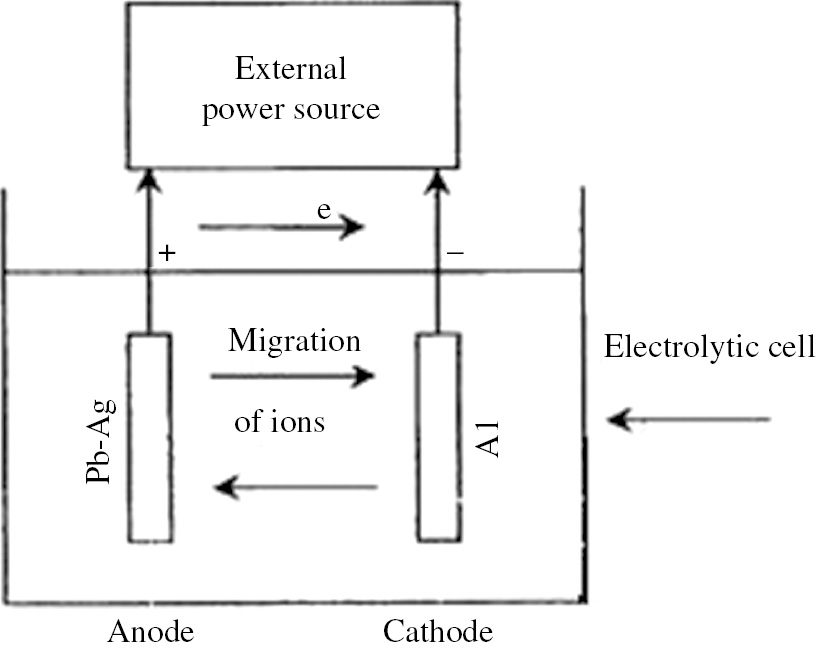
Basic features of an electrowinning cell at 38°C (Nguyen & Atrens, 2009). Permission granted by T. Nguyen.
In zinc electrowinning, zinc is deposited on the cathode, and oxygen evolution is on the anode. Inert Pb-alloys and aluminum are often used as anode and cathode, respectively. The main reaction on the cathode involves the conversion of the zinc ions to a zinc metal by an electron-transfer process. There are also other reactions on the cathode beside the hydrogen evolution during the zinc electrowinning process due to the presence of other ionic species in the zinc electrolyte.
The products during zinc electrowinning are (i) zinc metal at the cathode, (ii) oxygen gas at the anode, and regenerated sulfuric acid in the solution (Nguyen, 2007). In practice, a considerably large amount of energy is required due to overcome factors such as electrical resistance in the circuit, ionic resistance, as well as polarization at the surfaces of the anode and the cathode. These occurred voltage requirements are called overpotentials.
As obvious economic reasons, industrial practice is particularly concerned for the energy efficiency of electrolysis and the quality of the zinc deposit. Other important factors such as design, cleaning anodes and cells, life period, and possibly premature disposal of certain anodes are considered to minimize production costs. Manufacturers have found it appropriate to clean the anodes weekly, then leading to the disruption of the progress of the cathodic process. It is important to indicate that in a similar stop, during the period of anode packaging, the Faraday efficiency of zinc deposition decreases, leading to zinc contamination by lead (Nguyen, 2007).
2.2 Behavior of pure lead in sulfuric acid solution
Figure 2 shows the potential-pH diagram of the Pb-H2O system; its essential reactions under acidic conditions are (Pourbaix, 1974):
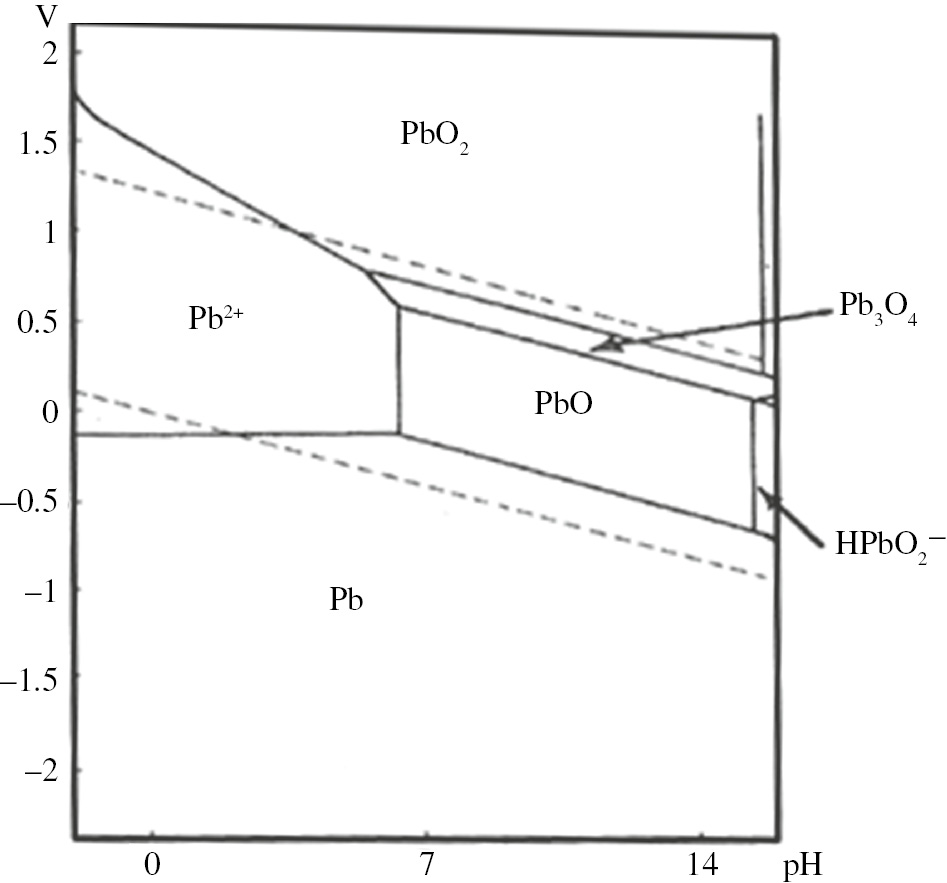
Potential-pH diagram of the Pb-H2O system at 25°C (Pourbaix, 1974). Permission granted by M. Pourbaix.
As pure lead anodes have low mechanical behavior and high corrosion rate during zinc electrowinning, it is not applied alone in practice. However, the pure lead reactions in sulfuric acid should be considered.
The following reactions in sulfuric acid electrolytic solution show the formation of PbSO4, which is only slightly soluble (about 3 mg/l lead at 28°C) and lead oxide. The main reactions to be considered in an acid medium are (Barnes & Mathieson, 1963):
2.3 Potentiokinetic curves of pure lead in sulfuric acid solution
Figure 3 shows a typical polarization curve obtained from a lead electrode in a sulfuric acid solution. The plateau in the solution is clearly observed, in which PbSO4 is with negative voltages with respect to ENH. Then, the electrode is passive, and the current becomes low, except for a slight re-increase in the current of +50 mV/ENH. The current remains low until voltages reached at above +1900 mV/ENH, and finally, the release of oxygen was observed (Dawson, 1979).
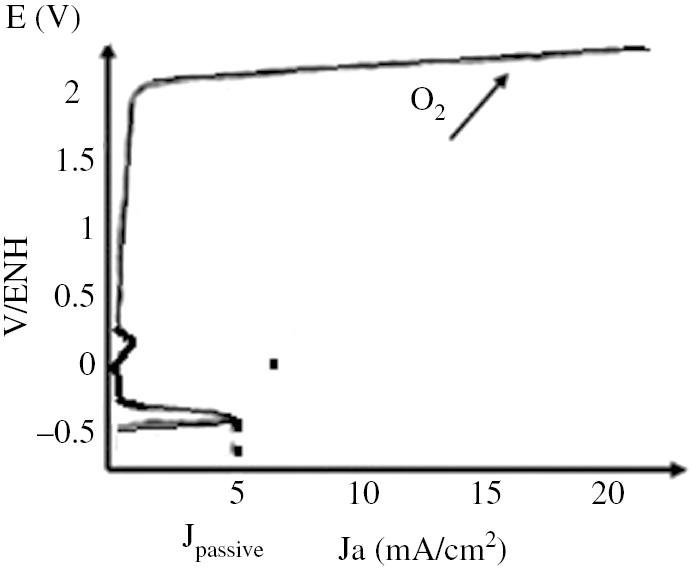
Potentiokinetic curve showing qualitatively the overall behavior of pure lead anode in a sulfuric acid solution bubbled with air (Dawson, 1979). Permission granted by J.L. Dawson.
The construction of the anode layers in the field at low voltages, corresponding to potentials between 900 and 1100 mV, is independent of the nature of the substrate, regardless of the composition of the electrolyte. A pure lead anode behaves in the same way and shows the same effect as Pb-Ag alloy (0.5%). It can, therefore, conclude that the Ag plays no role in the construction of anodic oxide coatings in the mentioned potential range (Varela et al., 1995).
2.4 Galvanostatic study of pure lead in sulfuric acid solution
Figure 4 shows the evolution of galvanic voltage of anode during a switching constant current density (0.5 mA/cm2) on lead alloy anode electrodes. It seems that the first voltage remains for a time tp, and the potential level is set by the couple of Pb/PbSO4/PbO2 (with a peak of about 0.15 V) and then increases slightly when the oxygen evolution becomes visible. There is first, a removal of absorbed oxygen and, then, decreasing the voltage of the electrode to drop through a series of intermediate levels with more or less marked stages (Pavlov, 1984).
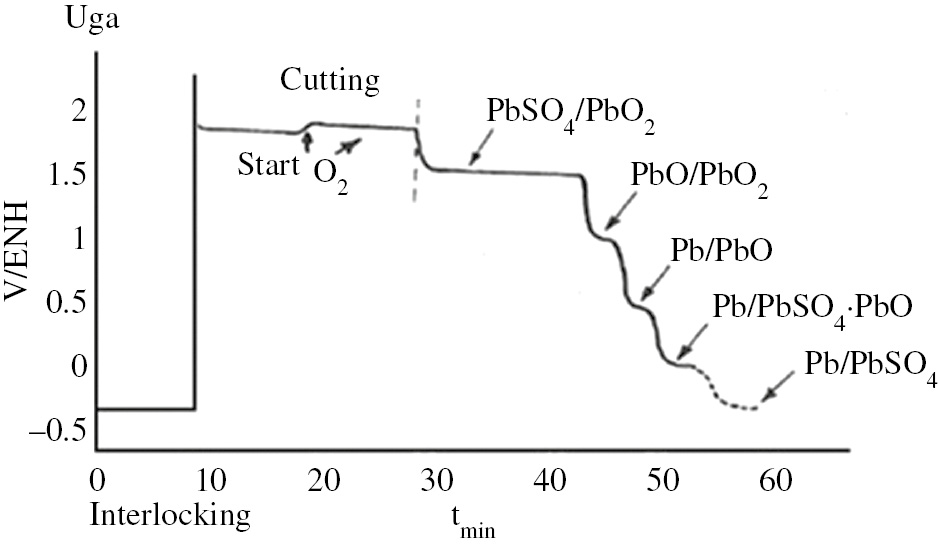
Curve showing the anodic galvanostatic voltage evolution of a pure lead electrode in a deaerated concentrated sulfuric acid solution at J=0.5 mA/cm2 (Pavlov, 1984). Permission granted by D. Pavlov.
2.4.1 Anodic oxidation steps of Pb
During electrolysis, the anodic current increases the lead oxide products on the anode (Pavlov, 1984).
First, Pb→Pb2++2e accompanied Pb2++SO42−→PbSO4 (PbSO4 formation in the solution) then Pb+SO42−→PbSO4+2e (lead oxidation at the metal-sulfate interface=anodization)
Then, forming PbO2 following Pb→Pb2++2e accompanied by Pb2++2H2O→PbO2+4H++2e (PbO2 obtained from PbSO4 initiated closing of the pores between the PbSO4 crystals and their metal surface)
Then, direct: PbSO4+2H2O→PbO2+SO42−+4H++e−
Finally, H2O→1/2O2+2H++2e (oxygen evolution at the surface of PbO2).
During the discharge of the electrode due to power failure, there is a coupling of the oxide and reduction reactions, following the successive steps:
2.4.2 Reduction reactions
First,
when the anodic surface is completely covered with PbSO4, H2SO4 slowly diffuses, and the lead sulfate may appear. The reactions are as follows (Dawson, 1979):
followed by
2.4.3 Oxidation reactions
3 Electrochemical behavior of zinc electrowinning anode
3.1 Electrochemical behavior of pure lead
In the electrorefining of metals in sulfuric acid solution, it is recommended that the anodes must have the following characteristics (Msindo, 2010): (a) Inertia, or at least good resistance to protect the anode from corrosion in the electrolyte; (b) good electrical properties, physical and mechanical performances; (c) the cathode of minimum contamination by its decomposition or its reaction products; (d) low prices.
In the zinc industry, lead is usually used as anodes. Lead metal as insoluble anodes are the most common anode material for Zn electrowinning in sulfuric acid solutions. During electrolysis, lead oxidizes to its highest valence, and then, the active surface of the electrode is covered with a deposit of conductor PbO2, which is adhering and smooth on the surface of lead. However, pure lead is weak material, and it tends to creep and warp during use in electrowinning (Ivanov et al., 2000)). Lead is a good electrical conductor (=20.64·cm) and shows good chemical inertness. It changes instantly to passive state on contact with many corrosive environments (e.g. chromates, sulfates, carbonates, phosphates).
Lead was widely used in some processes, such as electrowinning, operating in sulfuric acid in the type of pure, alloyed with silver (95% Pb-0.5% Ag), which decreases the oxygen evolution overvoltage or with other metals (e.g. Sn, Bi, Sb, Te) to improve its mechanical properties and corrosion resistance. Indeed, the metal corrosion rate at 25°C in contact with sulfuric acid at 50% is 130 mm/year. When subjected to an anodic current density of 1 kA m−2 in the acid, it was found that its low melting point (327.5°C) is associated with a high coefficient of thermal expansion (30×10−6·K−1). This low point explains its lack of mechanical strength, which causes problems during operational periods of electrolysis. Lead anodes covered with PbO2 supplanted the graphite in the production of chlorates and perchlorates in 1950. They were used in hydrometallurgy as an oxygen evolution anode for electroplating of zinc and copper from sulfuric acid solutions (Barnes & Mathieson, 1963).
Lead anodes are not stable as they will dissolve in sulfuric acid solution and contribute in lower metal purity due to the corrosion of lead in sulfuric acid solution, and they also exhibit a high oxygen overvoltage, which increases the cell overvoltage and decreases energy efficiency (Marshall & Haverkamp, 2012). During polarization, the lead anode forms a stable protective coating of PbO2 layer on the surface of the anode. The formation of the stable PbO2 layer is a slow process on the normally utilized lead-silver anodes. In the process of forming a PbO2 layer, a competitive oxidation reaction also takes place at the surface of the anode to cause small fine particles of PbO2, which are not adherent, to detach from the surface of the anode and become suspended in the electrolyte from where they contaminate the cathode with lead (Prengaman & Siegmund, 2000).
However, pure lead is very soft, and the anodes have an effective surface area. It is undergoes significant internal tensions due to corrosion products. Also, it tends to deform because of creep. This can lead, on one hand, to short circuits and, on the other hand, a breakage or cracks in the protective anodic layer, involving an increase in the anodic corrosion of lead. To improve its mechanical strength and corrosion performance, lead is alloyed with silver (Newham, 1992).
3.2 Electrochemical behavior of lead alloy anodes
It can be stated that the first goal of the alloying elements is to improve the mechanical properties of lead, which is known to flow under its own weight at room temperature. Therefore, it is necessary to seek both to increase its elastic limit and breaking load, to obtain a higher hardness and, also, in some cases, to improve its flow ability (Ivanov et al., 2000)).
The first alloys considered for both batteries and electrowinning were the lead-antimony alloy (4–12% Sb), which were already widely known in the printing industry. They remained a very frequent use. For reasons of low ability, tin-lead alloys (0.4% 0.18) were considered but did not seem to have been met with great success. Some works show that lead alloys with alloy elements have interesting properties for corrosion resistance. There is, moreover, a series of patents covering these alloys and others involving copper, silicon, calcium, cerium, and aluminum. Ternary lead alloys are also considered. The results are often disappointing in practice, but show considerable influence of microstructure on the corrosion process (Pavlov, 1984).
Table 1 presents the influence of alloying elements with lead on corrosion rate. Some are commonly used in electrolytic zinc extraction, while other alloys show negative impact on corrosion rate.
The loss of the mass of lead anode with different alloys in the electrolysis at 400 A/M2 in 1 m H2SO4 (Kiryakov & Stender, 1951).
| Composition of the anodic alloy (in % by weight) | Time (h) |
||
|---|---|---|---|
| 167 |
334 |
500 |
|
| Loss in weight (g−2) | |||
| Pb | 850 | 2040 | 3250 |
| Pb-Ag1 | 169 | 416 | 760 |
| Pb-Ag0.5 | 260 | 540 | 880 |
| Pb-Ti2 | 197 | 500 | 804 |
| Pb-Ti9 | 60 | 220 | 410 |
| Pb-Ag0.5-Ti0.2 | 175 | 410 | 620 |
| Pb-Ag0.5-Ti0.5 | 110 | 388 | 760 |
| Pb-Ag0.5-Ti1 | 20 | 29 | 80 |
| Pb-Ag0.5-Ti1.5 | 13 | 26 | 90 |
| Pb-Ag0.5-Ti2 | 10 | 20 | 45 |
| Pb-Ag0.5-Ti9 | 11 | 18 | 30 |
| Pb-Ag0.5-Te0.2 | 230 | 550 | 820 |
| Pb-Ag0.5-Te0.5 | 188 | 540 | 820 |
| Pb-Ag0.5-Se2 | 76 | 143 | 170 |
| Pb-Ag0.5-Bi2 | 239 | 420 | 810 |
| Pb-Ag0.5-Ca0.5 | +4 | 123 | 330 |
| Pb-Au1 | 596 | – | – |
| Pb-Ag1-Hg1 | 620 | – | – |
Table 2 shows the effect of chloride ions on the lead corrosion in the presence of different alloys, in the case of 100 mg/l of chloride ions, less mass loss for lead-silver alloys was observed for Pb-1% Ag than that of 500 mg/l (Kiryakov & Stender, 1951). Generally, the presence of 500 mg/l shows important corrosion rates of corrosion for the studied alloys.
Mass loss of lead anode alloyed with different elements for 167 h during electrolysis at 400 A/m2 in 1 m H2SO4, containing 0, 100, or 500 mg/l chloride ions (Kiryakov & Stender, 1951).
| Composition of the anodic alloy (in % by weight) | Chloride ion addition (mg/l) |
||
|---|---|---|---|
| 0 |
100 |
500 |
|
| Loss in weight (g−2) |
|||
| Pb | 850 | 3300 | – |
| Pb-Ag1 | 169 | 120 | 472 |
| Pb-Ag0.5-Ti0.2 | 175 | – | 73 |
| Pb-Ag0.5-Ti1.5 | 13 | – | 489 |
| Pb-Ag1-Ti0.1 | 140 | +9 | – |
| Pb-Ag1-Ti2 | 5 | +5 | – |
| Pb-Ag0.5-Se2 | 76 | – | 719 |
| Pb-Ag0.5-As0.5 | +4 | – | 650 |
Anodic dissolution is an important factor to be considered as the dissolved Pb2+ ions migrate and diffuse, and can co-deposit with zinc on the cathode. The lead dissolution rate was analyzed according to different parameters, primarily by weight loss measurements. The beneficial role of the presence of silver in a lead anode material is widely demonstrated in numerous studies (Tables 2 and 3).
The total amount of lead dissolved in the solution and deposited on the cathode from the lead anode and its alloys during electrolysis at 400 A/m2 in 1 m H2SO4 (Kiryakov & Stender, 1951).
| Composition of the anodic alloy (in % by weight) | The quantity of chloride ions in electrolyte (mg l−1) | Total quantity (g) of Pb passed in the solution and on the cathode for 100 Ah electrolysis (167 h) |
|---|---|---|
| Pb | Non | 0.095 |
| Pb | 100 | 0.103 |
| Pb-Ag1 | Non | 0.033 |
| Pb-Ag1 | 100 | 0.030 |
| Pb-Ag1-Ti2 | 100 | 0.026 |
| Pb-Ag0.5-As0.1 | 100 | 0.012 |
| Pb-Ag1-As0.1-Ba0.5 | Non | 0.011 |
| Pb-Ag1-As0.1-Ba0.5 | 100 | 0.007 |
| Pb-Ag1-As0.1 | 100 | 0.009 |
| Pb-Ag1-Sn0.3-Co0.02 | Non | 0.003 |
Pavlov (1984) showed, in particular, that the presence of silver in lead improves corrosion resistance and reduces the anode voltage, based on the fact that using a pure lead electrode in a solution containing silver ions, generates, on the contrary, an increase in the rate of lead dissolution, while the decrease in the overvoltage is continued. The action mode of silver on the anodic process depends differently on whether this element is present in solution or in the substrate (Pavlov, 1984). Table 3 shows the effect of chloride ions on the dissolution of lead alloys in H2SO4 solution. It can be concluded that there is no dramatic effect of chloride ions in the zinc electrolyte (Kiryakov & Stender, 1951).
Table 4 shows that the dissolution rate of lead increases with time. It was found that Pb-1% Ag-1% Ca had the least weight loss among the seven samples followed by Pb-Ag1-Ti2, Pb-Ag1-Se1, Pb-Ag1-Se0.1, Pb-Ag1-Ti0.1, Pb-Ag1-Ca0.1, and Pb-Ag1 after 334 and 500 h of polarization.
The mass loss of the lead anode alloys for different durations of electrolysis at 400 A/m2 in 1 m H2SO4 solution containing 100 mg/l [Cl−] (Kiryakov & Stender, 1951).
| Composition of the anodic alloy (in % by weight) | Time (h) |
||
|---|---|---|---|
| 167 |
334 |
500 |
|
| Loss in weight (g−2) |
|||
| Pb-Ag1 | 120 | 350 | 610 |
| Pb-Ag1-Ti0.1 | +9 | 170 | 280 |
| Pb-Ag1-Ti2 | +5 | 130 | 190 |
| Pb-Ag1-Ca0.1 | 105 | 320 | 550 |
| Pb-Ag1-Ca1 | +67 | 10 | 86 |
| Pb-Ag1-Se0.1 | 19 | 155 | 280 |
| Pb-Ag1-Se1 | 70 | 309 | 250 |
The commonly used anodes in copper electrowinning are the Pb-6% Sb alloys. This lead-antimony anode is extremely dimensionally stable and is the dominant anode alloy for use in copper electrowinning. It was found that Sb increases the rate of oxidation of Pb at the grain boundaries and at the surface (Prengaman, 2005). Sb promotes the growth of hard, dense, glassy α-PbO2 (Prengaman, 1984). An increase in the Sb content increases the rate of corrosion (Tshimwanga et al., 2011) and increases the thickness of the oxide layer (Ivanov et al., 2000)). However, antimony lowers the anode oxygen overvoltage (Nguyen & Atrens, 2009). Also, it was reported that the dissolution of Sb in the Pb-Sb alloy is helpful in the formation of PbO and the lead sulfates underneath the PbSO4 layer in anodic polarization. It also promotes the transformation of PbO→3PbO·PbSO4·H2O→PbO·PbSO4·H2O→PbSO4 in the negative potential region, and the large PbSO4 crystals are easily formed in the transformation (Sun & Guo, 2000).
Studies showed that the addition of Co2+ to the electrolyte in a conventional cell leads to an even more pronounced decrease in oxygen overvoltage on the Pb-Sb anode. It was found that the addition of Co2+ ions to the electrolyte significantly reduces the corrosion rate of the anode, as well as the cathode contamination with Pb (Eggett & Naden, 1975; Gendron et al., 1975). It is reported that after 96 h of polarization at 45°C, the potential on the Pb-Co3O4 anode was about 40 mV lower than that on Pb-Sb. Also, it was found that after polarization, the corrosion rate of the Pb-Co3O4 anode was lower by 40% than that of the Pb-Sb anode (Hrussanova et al., 2004).
New alloys of Pb with Ca and/or Sr were developed to reduce the rate of spalling of PbO2 from the anode compared with the conventional Pb-Sb and, thus, to decrease the Pb level in the cathode. The quantity of Ca and Sr in these alloys must be carefully controlled to produce a fine-grained structure with minimal alloy segregation (Prengaman, 1980). The Pb-Ca and Pb-Sr alloys are relatively weak; for this reason, Sn is added to improve the mechanical properties and to decrease the creep rate. The rolled non-antimony alloys show high corrosion resistance, with more evident effect when Co2+ ions are added into the electrolyte. The Pb-Ca-Sn anodes are strong, uniform, dross, and crack free, with a fine-grained structure. Moreover, they show uniform corrosion (Hrussanova et al., 2002). Compared to the conventional lead antimony anode, the lead anode with calcium has a lower rate of spalling of PbO2, and therefore, there is a lower lead level in the copper cathode (Prengaman, 1984). However, the production of the ternary Pb-Ca-Sn alloy is more complicated than the binary lead alloys.
Other lead alloy with low levels of Sb and Sn were developed for use as an anode (Prengaman, 1980). This alloy shows a uniform fine-grained structure. As the Sb content is sufficiently low, there is no interconnecting network of Sb, and corrosion is reduced. There is sufficient Sb, however, to produce the more adherent β-PbO2 phase, which prevents passivation. It combines the advantages of the ordinary high Sb alloys and the non-antimonial Pb-Sr and Pb-Ag-Ca alloys (Yang et al., 2013a),b).
For lead alloys, the electrocatalytical active layer is lead dioxide, which possesses a high overpotential toward oxygen evolution, thus, causing a significant increase in energy use during metal production. Other problems encountered with lead alloys are high cost of some alloying elements such as silver, corrosion and subsequent contamination of cathodes, bending and warping of anodes, uneven power distribution, and necessity to clean anodes, to remove lead and manganese oxide deposits (Ivanov et al., 2000)).
3.3 Influence of fabrication mode on the metallurgy of Pb alloys
When the anodes are chosen to be used in zinc electrowinning industry, it is important to optimize their characteristics. They are manufactured by the industrial method of casting molten metal (550°C). There are two types of molding that give either a smooth or serrated anode (Prengaman & Siegmund, 2000). The advantage of the casting anode is to increase the active surface of the electrode, such as its robustness, and also reduce the amounts of lead and silver dissolved during electrolysis. It is due to better adhesion of the anodic deposit. It has the disadvantage of making it more difficult for anode cleaning.
Thickness of oxides must have a minimum value, typically 8 mm, and corrosion rate should be well controlled. To minimize the anodic dissolution of lead, some industrial methods are used to treat the electrodes to accelerate the formation of a compact anode layer, adherent to the substrate before performing in industrial electrolysis (Prengaman, 1980).
Prengaman and Siegmund (2000) reported that anodes with oriented texture in the rolling direction could produce a grain structure, which is more difficult to corrode and leads to an adherent layer of PbO2. For example, the rolling surface of anode technologies developed a method to produce a surface on the anode, through controlled rolling and alloying, to which a hard, dense layer of PbO2 adheres very quickly. So, the different levels of rolling during fabrication can influence the microstructure of these Pb-Ag alloys (Prengaman & Siegmund, 2000). Petrova et al. (1996) reported that the rolled Pb-Ag alloys possess a higher corrosion resistance and lower anodic polarization compared to the cast lead-silver ones due to the structural fineness and homogeneity of the plastic deformed anodes (Petrova et al., 1996). Pb3Ca precipitation in the solid solution is caused by the plastic deformation of ternary alloys with a calcium content of 0.06%. The hot-rolled alloys form an α-solid solution of Pb3Ca with fine-grain structure, deformed through the rolling direction. The cold-rolled alloys possess a clearly expressed oriented structure also through the rolling direction. It was stated that the ternary rolled (Pb-0.5% Ag-0.11% Ca) alloys have equal corrosion and electrochemical properties to that of the practically used Pb-Ag anodes. However, the Pb-0.2% Ag-0.2% Sb anode showed good current efficiency with specific energy consumptions similar to traditional anodes in the early days of the run, but presents limited chemical stability, which inhibits its use for a period longer than 14 days (Lupi & Pilone, 1997).
There are two methods to roll the Pb-Ag-Ca anodes: hot rolled and cold rolled. Also, it can be observed that the hot-rolled alloys form an α-solid solution of Pb3Ca with fine-grained structure, deformed through the rolling direction. The cold-rolled alloys possess clearly expressed oriented structures also through the rolling direction (Petrova et al., 1996). Generally, it can be stated that cold-rolled and hot-rolled Pb-Ag alloys possess higher corrosion resistance and lower anodic polarization than cast lead-silver alloys.
The Pb-Ag-Nd anodes were manufactured by two methods, the cast and rolled fabrications. It was found that the anodic layer formed on the rolled anode is more stable toward the electrolyte than that formed on the cast anode, reducing the corrosion of metallic substrate during current interruption. Hence, the rolled anode has a higher corrosion resistance than the cast anode. However, the anodic potential of the rolled anode was slightly higher than that of the cast anode after 72 h of galvanostatic polarization (Zhong et al., 2015).
3.4 Stability and corrosion rates of lead-silver anodes
Small amounts of Ag (0.7–1.0%) alloyed with lead decrease the oxygen overvoltage and increase the corrosion resistance of the material (McGinnity & Nicol, 2014). Also, the beneficial effect can be achieved by better mechanical properties or by a more fine-grained and more homogeneous microstructure. Pb-Ag alloy anodes were found to be the predominant anode materials for zinc electrowinning in acid sulfate solutions. However, there are also some problems on the lead-silver alloy anode; one is concerned with the incorporation of corrosion products in cathode, which decreases the purity of zinc deposition; the other is that the oxygen overpotential is relatively high, which increases the cell voltage and decreases the energy efficiency (Forsen et al., 1992). In practice, most electrolytic zinc plants are employing Pb-Ag alloys containing 0.7–1.0% Ag as the anode material. The resulting benefits are a longer anode life and a lower Pb content in the cathodic zinc (Tikkanen & Hyvarinen, 1969).
The lead-silver alloy anode in sulfuric acid solution bath has many favorable features, for example, alloying of silver in the alloys resulted in the suppression of the anodic oxidation of the materials, decrease in the anode potential, formation of dense oxide layer closely adhering to the electrode, and appearance of β-PbO2 composition in the anodic oxide layer. Consequently, the lead-silver alloy anodes are considered in electrolytic production of zinc for these 50 years (Umetsu et al., 1985).
The stability of the anodes is related to the cathode quality – the lead contamination level of the cathode deposits. To improve the performance of the lead anodes, some manufactories of insoluble anodes, such as RSR Technologies (USA), changed the composition and the process of the anodes, for example, adding Ca or Sn in the Pb-Ag alloy and rolling the anode plates to diminish the number of the holes, voids, and laps (Prengaman & Siegmund, 2000). However, there are some difficulties in their use that can create problems: one is concerned with the incorporation of lead corrosion products in the cathode, which decreases the purity. Also, the oxygen overpotential becomes relatively high, which increases the cell voltage and decreases energy efficiency. Because of these problems, there is always an interest in finding ways to improve anode performance and minimize the corrosion and overpotential problems (Yu & O’Keefe, 1999).
Silver meets the main requirements – especially the improvement of lead corrosion resistance and decreasing the oxygen overpotential. An appropriate concentration, widely used in practice, is 0.8% to 1%. It has been reported, generally, that the increase in the silver content in the lead alloy leads to a decrease in corrosion and anodic polarization (Osorio et al., 2013). The corrosion resistance of Pb and Pb-alloy anodes (determined by the decrease of their weight) was studied during electrolysis in 1 m H2SO4 at a current density of 400 A/m2 and 25°C. The experiments show that the Pb-Ag (1%) alloy is considerably more resistant compared to pure Pb and Pb-Ag (0.5%). The resistance of Pb-Ag alloy containing a large amount of Se (2%) increases. Low concentrations of 0.5% Ca or 0.2% Se improve the resistance, but their action decreases with time (Hine et al., 1988).
Several authors showed that the lead-silver alloys (usually less than 1% by weight) have excellent corrosion resistance properties. It appears that the oxygen overpotential of these alloys is lowered by approximately 0.15 V relative to pure lead, and this could justify the remarkable stability of the passive film (Kiryakov & Stender, 1951).
The alloyed silver has the advantage of reducing the anode overvoltage and decreasing the corrosion rate (Gui et al., 2015). However, it was further established that the silver migrates through the anode layer. During electrolysis, Pb dissolution from the lead anode is observed.
It is important to examine the corrosion rate as function of current density and content of alloyed silver. Figure 5A shows the corrosion rate as a function of current density and gives the change in corrosion rate of pure lead in sulfuric acid, while Figure 5B illustrates the variation in lead corrosion rate in sulfuric acid in the presence of various Ag quantities of lead (0.5%, 1%, and 2%). For both cases, the corrosion rate is almost zero at zero current and increases with the current density up to 5000 A/m2, thereby, indicating that the current density is an important factor. On the other hand, the corrosion rate is almost unchanged by changing the current density in the range above 500A/m2 (Hine et al., 1988) Therefore, the electrolysis was conducted at high current densities, mostly at 600 A/m2.
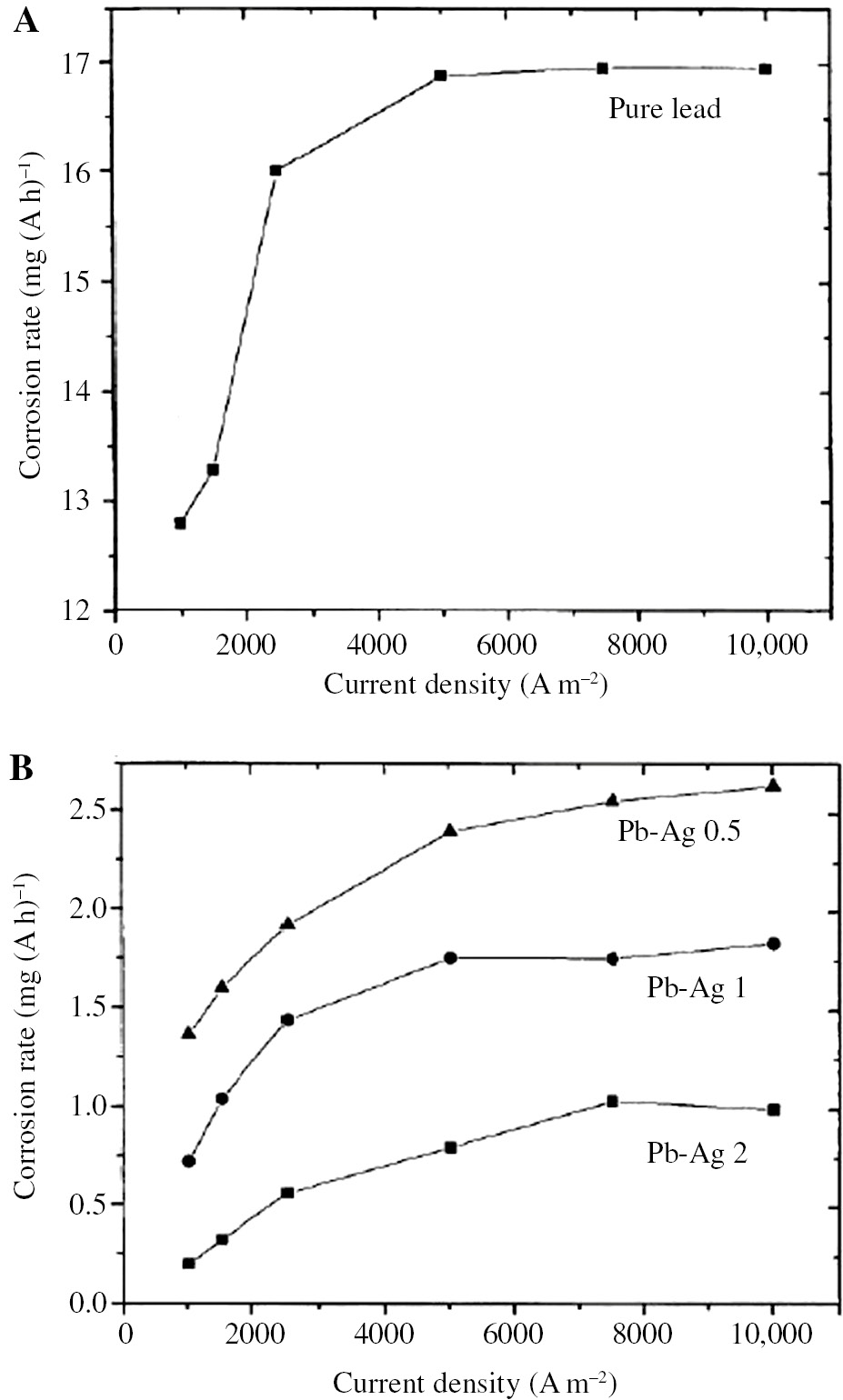
Corrosion rate in 1 m H2SO4 at 30°–60°C as function of current density: (A) pure Pb; (B) lead-Ag anodes (Hine et al., 1988). Permission granted by F. Hine.
From the results shown in Figure 5, the positive effect of silver (Ag) on the corrosion rate can be stated as the higher the percentage of silver in the lead alloy, the lower corrosion rate for the lead alloys (Figure 5B) (Hine et al., 1988).
3.5 Development of zinc electrowinning anodes
To save energy and improve the quality of zinc deposits, researchers try, presently, to find new anode materials instead of silver in Pb anodes. Li et al. (2011) found that MnO2 content has obvious influence on the corrosion rate of Pb/Pb-MnO2 composite anodes. Higher MnO2 content in the anode increased effectively the corrosion resistance. Further, the corrosion process of Pb/Pb-MnO2 anodes will stand a period of heavy intergranular corrosion, which could lead to form a preferable stationary, dense, and fine-grained PbO2-MnO2 composite anodic layer compared to that of the Pb and Pb-Ag anodes. Aluminum is employed as a substrate because of its good electrical conductivity and mechanical strength, and then, this is coated by lead as the basic material.
The Pb-Ag anode is widely used as they have good electrochemical behavior in zinc electrowinning. As Ag is an expensive metal, extensive research in its replacement was carried out or decreasing its quantity in the Pb alloy without changing the properties of the standard anodes in industry. To improve the properties of Pb-Ag anodes, cobalt attracted many investigations to examine its influence on the performance of lead-based anodes. For example, coatings of Pb-Ag-Co and Pb-Co were introduced (Yang et al., 2014). Recently, Zhang et al. (2014) found that several other metal elements such as Ag, Ca, Co, Bi, Sr, and Sb could improve its corrosion resistance and decrease the oxygen evolution overpotential.
Most currently proposed systems utilize an oxide-coated anode (OCA) based on a titanium substrate coated with a material that is catalytic toward oxygen evolution. The most common base used for OCAs is titanium (Brungs et al., 1996). Dimensionally stable anodes (DSA) consist of mixed metal-oxide coatings, usually on titanium or nickel substrates, which were attributed to their chemical stability that allows them to maintain nearly constant dimensions during the life of the anode even when operating in an environment with low pH values (Msindo, 2010). These oxide coatings could include tantalum oxide (Ta2O5), iridium oxide (IrO2), ruthenium oxide (RuO2), and tin oxide (SnO2) (Morimitsu et al., 2000). Titanium anode coated with Pt, IrO2, and/or RuO2 showed the best properties of low-energy consumption and high current efficiency. The modification of titanium electrodes by a metallic oxide may lead to the preparation of the well-known OCAs.
4 PbSO4 and PbO2 formation on Pb and Pb-Ag anodes
4.1 Formatting and composition of the anodes
4.1.1 PbSO4 growth
In an acidic medium, when the pH value is around 0, the lead ion valence of lead oxide is first Pb2+, then Pb4+, obtained with increasing anode potential. When the electrolyte is a zinc sulfate acid medium, the lead anode is successively covered with a deposit of PbSO4 and PbO2 depending on the potential value (Dawson, 1979).
The mechanism of construction of the layer of PbSO4 from a lead substrate in a sulfuric acid was the subject of many studies. Two growth modes were proposed: one is the direct formation of PbSO4 on the electrode, which is sensitive to conditions of transportation and depends on hydrodynamic conditions of the environment and the other is by an ion dissolution-precipitation mechanism of Pb2+ in PbSO4. Also, the influence of the initial surface condition and properties of the electrode should be considered in the construction of this layer (Pavlov, 1984).
4.1.2 Formation of PbO2
Cyclic voltammetry studies were employed to monitor the appearance of these layers depending on the acidity of the solution and temperature influence on the formation of anodic deposition. The X-ray diffraction is to find an intermediate phase PbO and PbO2 with two structures α and β (Czerwinski et al., 2000).
The crystallographic structures of these phases and their physical mechanism are described in the literature. The α and β phases of PbO2 have orthorhombic and tetragonal structures, respectively, and are both very conductive, unlike the lead sulfate, which is an insulator. Certain studies indicate that PbO is orthorhombic, and the others consider it as tetragonal. These studies also indicate that the tetragonal PbO observed during the oxidation of the lead anode is sometimes a semiconductor n-type with a gap equal to 1.9 eV, sometimes a semiconductor p type. According to Burbank (1957), it was found, in fact, that the semiconductor n or p gets the type properties according to the chemical composition of the aqueous medium in which it is formed.
We now recall the different formation mechanisms of these acidic medium layers involved when the field was changed from PbSO4 to PbO2. The concern for the formation and growth of PbO2 essentially resulted from scanning electron microscopy and transmission, as well as X-ray diffraction methods of investigation. Table 5 summarizes the various stages of formation of lead corrosion layers as described by Pavolv and its focus on this section whose potential is greater than 900 mV, where two crystal structures of PbO2, α and β, were obviously observed (Pavlov, 1984).
The different stages of formation of corrosion layers of lead, according to the potential I/ESS (Pavlov, 1984).
| Pb/PbSO4/H2SO4 |
Pb/PbO/PbSO4/H2SO4 |
Pb/PbOn/PbSO4/H2SO4 |
Pb/α&βPbO2/H2SO4 |
Pb/α PbO2/H2SO4 |
|---|---|---|---|---|
| −0.97<E<−0.4 V/ESS | −0.4<E<0.9 V/ESS | 0.9<E<1.2 V/ESS | 1.2<E<1.5 V/ESS | E>1.5 V/ESS |
| Maintenance of electroneutrality of the solution to pore bottom→PbO | Vacancy mechanism→PbOn | (n>1.4)→α PbO2 Dissolution mechanism Oxidation precipitation β PbO2 |
α PbO2 covers the entire surface of the lead electrode | |
From 900 mV, α-PbO2 is formed on the PbO/PbSO4 interface by a vacancy mechanism. Oxidation of PbOαPbO2 involves diffusion through the porosity of PbSO4 to PbO, O atoms, and/or O2− radicals formed at the conductive interface layer/electrolyte, and migration into the sub-layer of PbO, from the metal to the solution of oxygen vacancies PbOv2+. These processes are illustrated in Figure 6 (Pavlov, 1984).
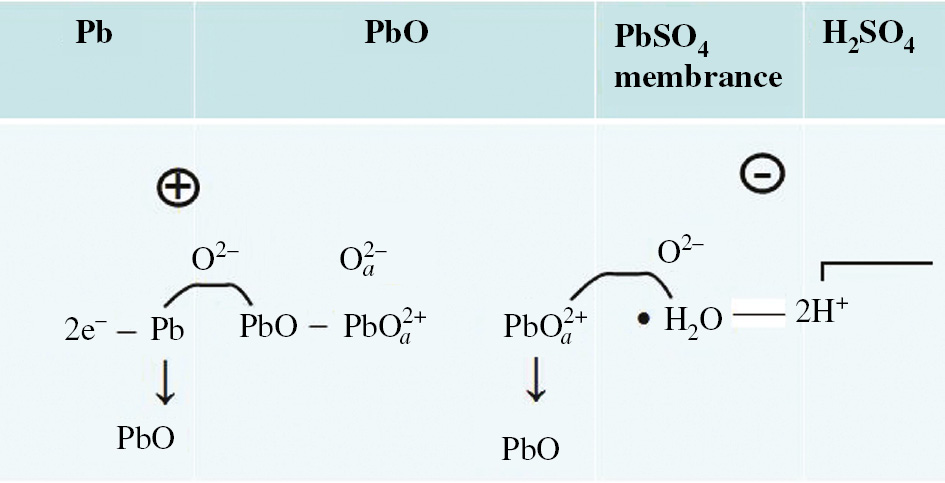
Construction under layer of PbO by a vacancy mechanism (Pavlov, 1984). Permission granted by D. Pavlov.
Figure 7 shows β-PbO2 schematically for the region between 1200 mV and 1500 mV and the infiltration of the electrolyte through the porosity of the deposits. Diagram (A) represents the electrode covered by the layers of PbO and PbSO4. It can be stated that some conclusions from Figure 7B to F on the PbO2 form process give rise to a model that describes the formation mechanism of the α phase and β-PbO2. It is clear that silver promotes the growth of the β phase of PbO2, but the exact role of this element in the layers of the construction process is unclear. According to the investigation from X-ray diffraction, the composition of the surface film changes as follows: From −306 to 350 mV/SHE: PbSO4 is only visible, from 350 to 1550 mV/SHE includes tetragonal PbO and PbSO4 mainly with a light PbO·PbSO4, 3PbO·PbSO4·H2O, 5PbO·H2O, PbO, and PbO2 orthorhombic α (Pavlov & Rogachev, 1986). Above 1550 mV/ENH, the amount of α-PbO2 increases at the extent of the other constituents; above 1850 mV/ENH, β-PbO2 appears and becomes predominant. In addition, Valeriote et al. (1991) recently showed that the potential of the PbO2 area is formed, the current density is controlled sequentially by at least three scattering mechanisms followed by at least two stages of crystallization and yet other diffusion steps. These authors believe that precipitation begins with PbO2, α-PbO2 below +1.7 V/ENH. When the electrode voltage is lower than this value, the reaction stops. Above this value, β-PbO2 can be formed, and the reaction continues with β-PbO2 outside the electrode in zinc electrolyte (Valeriote et al., 1991).
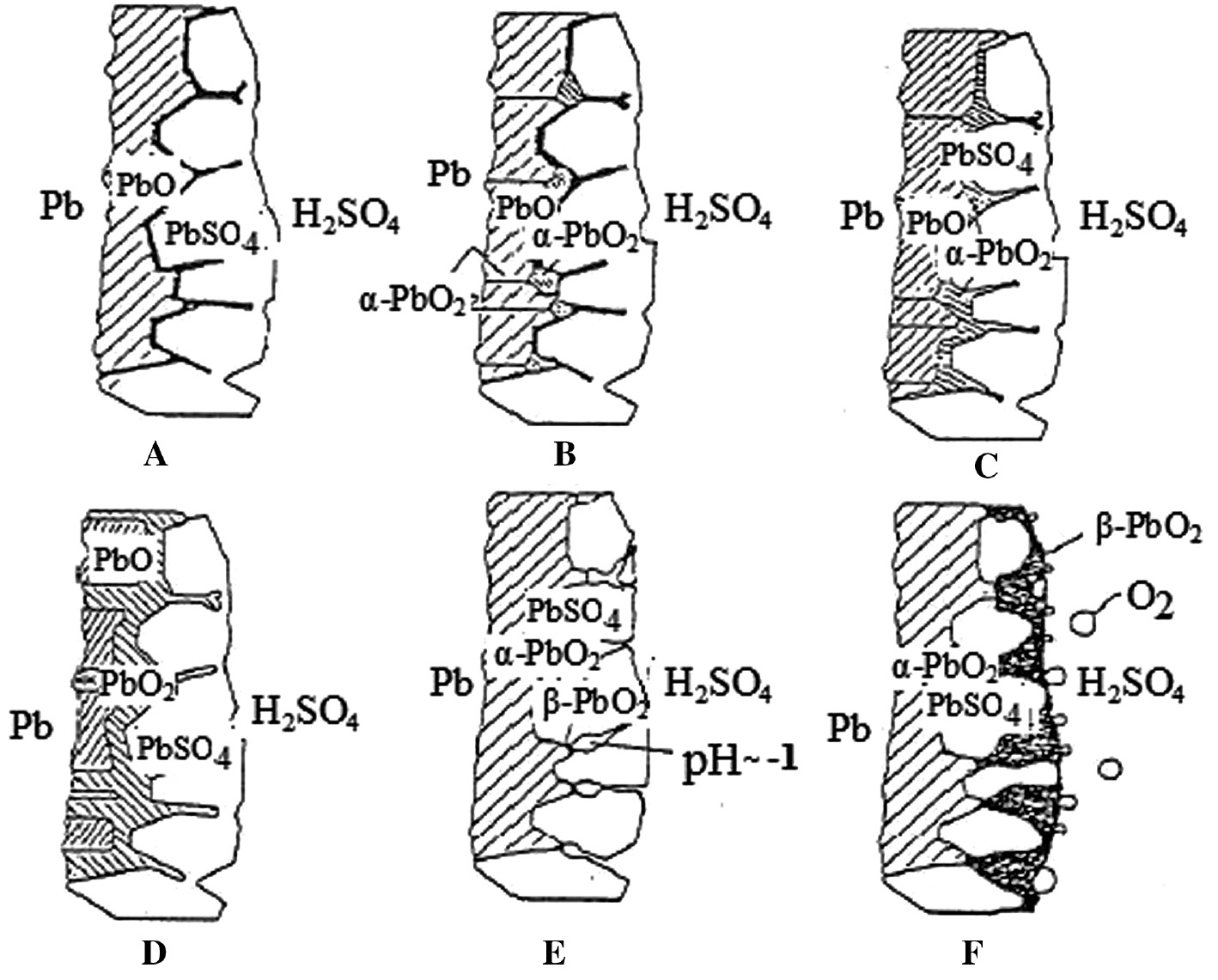
Construction of the anode layers of corrosion: (A) Pb/PbSO4/H2SO4; (B–Ð) Pb/α-PbO2/PbSO4; (E, F) formation of β-PbO2 (Pavlov, 1984). Permission granted by D. Pavlov.
A lead fluoride coating for passivating 0.8% Ag alloy of the lead anodes is formed through a preconditioning process. The anodic polarization in the sulfuric acid solution with F− ion produces a thin F-PbF2 layer, which affects the catalytic conversion of the PbSO4 isolation layer in the protective β-PbO2 layer and hinders the α-PbO2 crystallization, which causes much less corrosion of the Pb base possibilities (Jaksic et al., 1987).
4.2 The effect of Ag on the formation of β-PbO2 for lead-silver alloys in acid solutions
It was stated that Ag promotes the occurrence of β-PbO2 in the oxide film (Pavlov, 1984). The curves in Figure 8A and B show the intensity values for Pb and Pb-2.5% Ag as a function of the anode potential, which were measured after 24 h of exposure. It is evident that on pure Pb, α-PbO2 is the main constituent of a fine anodic layer at potentials higher than +1800 mV. Silver increases the relative amount of β-PbO2 and broadens its stability region (Tikkanen & Hyvarinen, 1969).
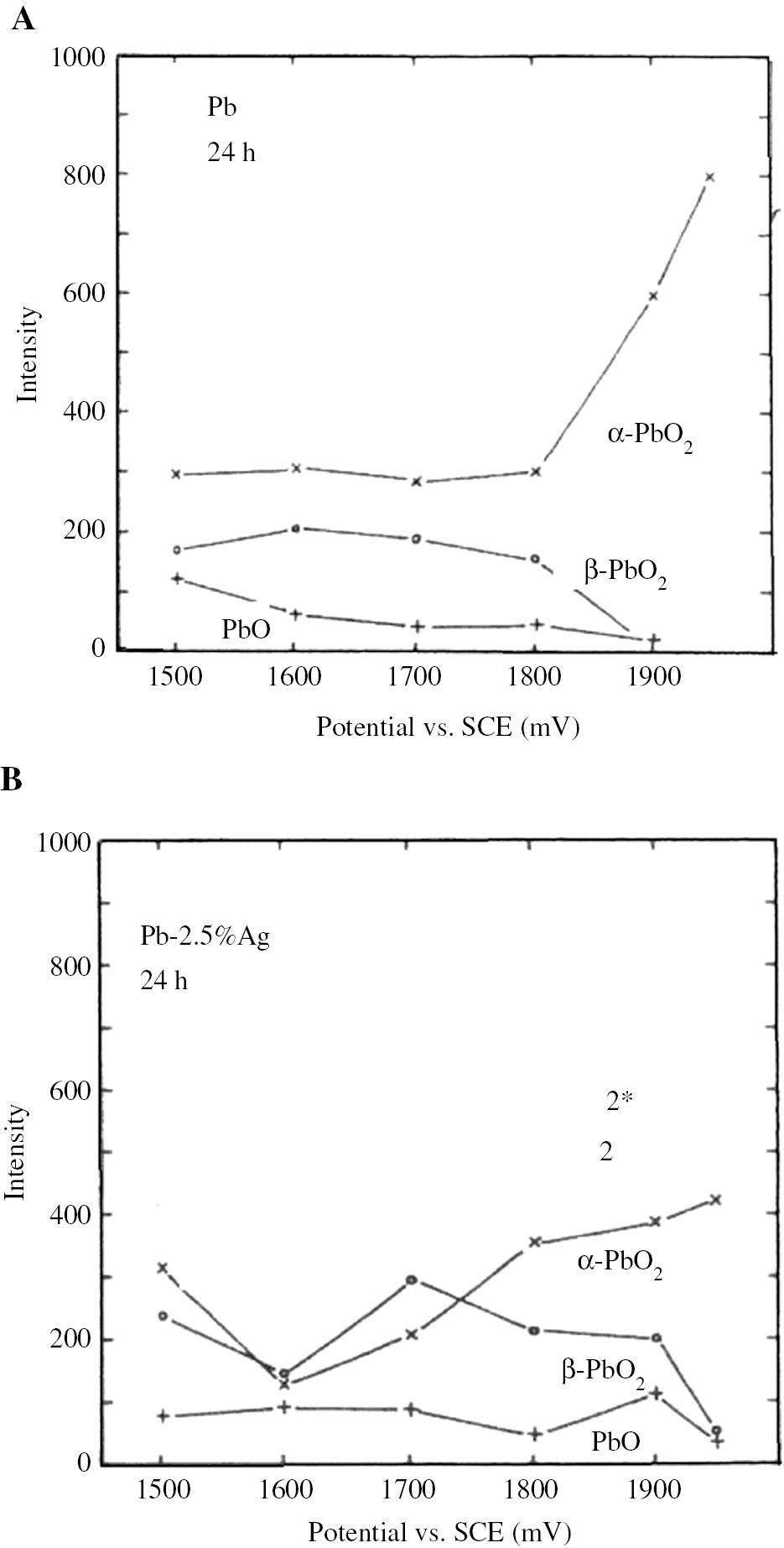
X-ray diffraction intensity vs. electrode potential curves for (A) Pb-2.5% Ag alloy and (B) Pb in 2 N H2SO4 at 25°C and 24 h (Tikkanen & Hyvarinen, 1969). Permission granted by M.H. Tikkanen.
Tikkanen and Hyvarinen (1969) stated that there is evidence that alloying Ag into the lead base promotes β-PbO2 formation. This can increase its relative proportion in the oxide phase and broaden its stability region toward higher anodic potentials. Furthermore, silver helps to transform the morphology from inter-crystalline of the typical pure lead into a more planar one of the lead-silver alloy.
Considering the practical consequence of the results, it is clearly shown that alloying lead with Ag gives rise to a converted material surface with β-PbO2 more easily than that of pure Pb during the electrolytic process. The stability of the β-PbO2 film is also increased; it is a factor of utmost importance in the electrolysis of zinc where the anodic current density is a regulating factor (Tikkanen & Hyvarinen, 1969). Ruetschi and Cahan (1958) reported that electrodepositing β-PbO2 exhibited a stable potential about 7 mV below that of α-PbO2 in 4.4 m H2SO4. β-PbO2 electrodes, prepared by pressing β-PbO2 power into a perforated lead sheet, also exhibited potentials lower than those of α-PbO2 prepared in the same manner. However, these electrodes exhibited limited stability due to the self-discharge effects.
It was reported also that the formation free energy of α-PbO2 would be higher than that of β-PbO2 (Bone et al., 1961). Hence, a higher electrode potential would be expected for α-PbO2 than that for β-PbO2. The manufacture of rolled samples can influence the α and β PbO2 layer of Pb-0.8% Ag anodes. Yang et al. (2013a,b) stated that for Pb-0.8% Ag anode, the β-PbO2 layer can be increased, and α-PbO2 layer decreased with increasing electrolysis time.
5 Effect of some factors on electrochemical behavior of lead anodes in sulfuric acid solution
5.1 Effect of pH on lead alloy passivation
Takehara and Kanumura (1987) studied the effect of H2SO4 concentration on the processes of PbSO4 oxidized to PbO2. They found that the oxidation rate of PbSO4 increased with ascending H2SO4 concentration. The fitted result revealed that the Pb (II) resistance increases with increasing H2SO4 concentration, and the growth of the high-resistance PbO film was encouraged with a descending pH value, according to Takehara and Kanumura (1987).
It was reported that Li et al. (2011) employed the electrochemical impedance spectroscopy to investigate the Pb0.8Sn electrode in 4.5 m H2SO4 solution at different temperatures. It was found that the semicircle increased with the decrease in pH value, implying the increased film protection. By analysis of the equivalent electron circuit, it can be noticed that the resistance of the PbSO4 film, PbO film and the transfer resistance increased with an increment of H2SO4 concentration.
The influence of H2SO4 on the Pb0.8Sn alloy in H2SO4 was studied by potentiodynamic measurements. It was revealed that the Pb0.8Sn electrode was in the passive state in all kinds of solutions with a passive potential region from about 0.94 V–1.7 V, the passive potential regions slightly enlarged with increasing H2SO4 concentration. While for the steady passive currents of Pb0.8Sn electrode in 0.5 m, 1.5 m, 2.5 m, 3.5 m, and 4.5 m H2SO4, the solutions decreased from 4.75E-4, 3.6E-4, 3.08E-4, 2.42 E-4, and 1.77E-4 A cm−2, respectively. It means that the protection of the passive oxide film on Pb0.8Sn alloy can be increased with H2SO4 concentration from 0.5 to 4.5 m (Li et al., 2011).
5.2 Effect of temperature on lead alloy in sulfuric acid solution
By the study of the Pb0.8Sn electrode in 4.5 m H2SO4 solution at different temperatures via the potentiodynamic technique, it was found that the Pb0.8Sn alloy was in the passive state from about 0.013–1.5 V. The passive state was related to the formation of the protective film on the PbSn alloy, the passive potential regions significantly decreased with increasing temperature, and the steady passive currents at 25°C, 40°C, 55°C, 70°C, and 80°C were 1.77E-4, 2.02E-4, 2.79E-4, 3.41E-4, and 4.71E-4 A/cm2, respectively. It means that they increased with increasing temperature; this indicated also that the protective effect of the anodic film on the Pb0.8Sn alloy decreased with temperature. Also, the electrochemical impedance spectroscopy method was employed to investigate the Pb0.8Sn electrode in 4.5 m H2SO4 solution at different temperatures, and it can be observed that the semicircle decreased with an increase in the temperature. Obviously, the corrosion rate of PbSn increased by 166% with an increase in the temperature from 25°C to 80°C (Li et al., 2011).
The effect of temperature on the corrosion rate of the Pb-0.7% Ag anode in sulfuric acid solution was reported. It was obtained that the corrosion rates of the Pb-0.7% Ag anode increased with an increase in temperature. The corrosion rate of the Pb-0.7% Ag anode at 25°C, 38°C, and 55°C were 0.89, 1.04, and 1.51 μA cm-2 after 5 h of potential decay following 5 h of electrolysis at 50 mA/cm2, respectively (Zhang & Houlachi, 2010).
5.3 Influence of cobalt ions on the anodic oxidation of lead alloy
The presence of cobalt ions (500 ppm) in electrolyte changed the structure, morphology, and chemical composition of the surface film from a loose porous film with a substantial PbO2 content, to a thin dense film. This change in surface film is interpreted as the cause for the decreased rate of oxidation of the lead anode in the presence of cobalt ions. Also, the addition of cobalt to electrolyte facilitates oxygen evolution and improves the anode life service. However, it was found that the presence of cobalt ions (500 ppm) increases the imperviousness of the α-PbO2 layer in hindering the oxidation of metallic lead to α-PbO2 and also in hindering the oxidation of PbSO4 to β-PbO2 (Nguyen & Atrens, 2009).
6 Effect of Mn2+ and Cl− on lead alloy in sulfuric acid solution
6.1 In the presence of manganese in sulfuric acid solution
Zinc electrowinning was performed in a H2SO4-ZnSO4 electrolyte with a significant amount of Mn2+ ions. In industrial conditions, the main anodic reaction of oxygen evolution is accompanied by several other reactions, which permit, on one hand, to form the lead oxidation layers (PbSO4, PbO2) and, on the other hand, to oxidize the Mn2+ ions in the solution (Huang et al., 2010).
The oxidation of Mn2+ ions involves the formation of an anodic layer of MnO2 that influences the morphology of the lead electrode. It also causes the formation of various other ions, complex or simple, in the electrolyte (Ivanov et al., 2000)).
Mn2+ ions, which diffuse into solution and arrive to the interface, cause the current dependence of the hydrodynamic condition of the environment. This diffusion partially controls the current condition, as it is also exercised through the layer of MnO2, and adds it to that of the SO42− ions in the layer of PbSO4 (Yu & O’Keefe, 2002).
The oxidation reaction of Mn2+ into the MnO2 causes transfer resistance through the sub-layer of PbO. Moreover, this charge transfer, which probably involves two successive stages, can also generate an additional capacitive effect (Yu & O’Keefe, 2002; Tunnicliffe et al., 2012).
During polarization, Mn2+ ions in the electrolyte could be oxidized to MnO4− (Vereecken & Winand, 1972). Newham, 1992 established that the corrosion rate of Pb-Ag anodes in 1.8 m H2SO4 decreases with the presence of Mn2+. It was found that the presence of Mn2+ in the electrolyte causes the formation of a thin layer of MnO2 on the anode. Ivanov & Stefanov (2002) found that addition of 1.5–3 Mn2+ g dm−3 to the zinc electrolyte can minimize the corrosion of lead anodes and reduce the contamination of the cathodic zinc with lead (Zhang & Hua, 2009). Zhang & Houlachi (2010) found that the addition of manganese sulfate from 4 to 8 g dm−3 Mn2+ to the zinc electrolyte gave almost the same overpotentials and then increased for 10 and 12 g dm−3 for the lead-silver anode. Also, the corrosion rate of the Pb-Ag alloy anode decreased with the MnSO4 addition. In addition, adding MnSO4 to the zinc electrolyte could improve the structure of the zinc deposit at a low concentration but decreased the current efficiency by a few percent when the concentration exceeded 10 g dm−3 (Zhang & Cheng, 2007). However, higher concentrations of manganese in the electrolyte can cause a significant decrease in current efficiency. Also, with longer operation times, the formation of MnO2 may increase the corrosion of the lead anode (Yu & O’Keefe, 2002; Schmachtel et al., 2009).
6.2 Effect of chloride ion on lead dissolution
Lead dissolution increased using an industrial electrolyte without manganese, which contains various impurities, including chloride ions that are probably the most dangerous. We can assume that chloride ions attack the anodic layer of MnO2. This could weaken it until the loss of its protective role (Ivanov et al., 2000)).
An anode with low silver content is much more exposed for dissolution phenomenon in sulfuric acid solution without Mn2+ in the presence of chloride ions, which was proved by Pb dissolution of the Pb-Ag (0.52%) anode. The decrease in the percentage of silver in the material engendered an increase in lead dissolution. This increase is more pronounced in zinc electrolysis (Umetsu et al., 1985). The silver content of the material is, therefore, a key factor against anodic dissolution of lead (Ivanov et al., 2000)).
For each type of lead anodes, the presence of Mn2+ ions in the electrolyte reduces lead dissolution, even for the lead silver anode with low silver content. These results imply that the anodic oxide layer of MnO2 is a protective barrier against the leakage of Pb2+ ions in solution. However, it was demonstrated that the impurities contained in industrial electrolyte, and perhaps more specifically chloride ions, annihilate the protective layer by the MnO2 (Ivanov et al., 2000)). Newham, 1992 investigated the effect of chloride ions on the anodic dissolution of lead in sulfuric acid solution. It was shown that in the absence of manganese in solution, these ions do not have much effect, but on the other hand, they cause an increase in the rate of lead dissolution in the presence of manganese in sulfuric acid solution.
Finally, industrial electrolyte showed a similar behavior of the electrode and giving the same results as in the zinc electrolyte with MnSO4. It can then be concluded that either chloride ions present in the industrial electrolyte or other elements play a role in the construction of the electrode layers at low anodic polarization (Ivanov et al., 2000)). It was reported also that after 15 days of galvanostatic electrolysis in the zinc electrolyte containing 600 mg l−1 of ions, the presence of the chloride ion had significantly an effect on the formation and stabilization of the Pb-0.8%Ag anodic oxide layer; the α-PbO2 was more stable than β-PbO2 (Yang et al., 2014).
6.3 The formation of MnO2 on lead electrode
In the supporting electrolyte containing MnSO4, the presence of Mn2+ ions in solution generates a different behavior of the electrode. Above 940 mV, the oxidation of these ions was corresponding to a type of electrode Pb/PbO/MnO2. The overall behavior of the electrode will then result in areas of Pb/PbO/PbSO4 and Pb/PbO/MnO2, which share the active surface of the anode (Yu & O’Keefe, 2002).
The potential range corresponding to the high polarization begins at 1160 mV vs. SHE, and is characterized by a strong evolution of oxygen evolution reaction from water at the anode. It becomes the major reaction on the lead electrode, covered with a porous conductive deposit of PbO2 with MnO2 if the electrolyte contains manganese. By increasing the anodic potential, it was found consistently that a pink coloration of the electrolyte occurred at the more anodic potential for the small silver content in lead: the solution becomes pink at E=1320 mV for silver grades 0.5% (Varela et al., 1995).
In the presence of Mn2+ ions in solution, permanganate ions are formed on the electrode [reaction (16)], and then diffuse into the solution. Manganese dioxide is also formed, both electrochemically on the lead electrode [reaction (17)] and chemically within the solution [reaction (18)]:
The MnO2 precipitates in the solution, allows the co-precipitation of impurities, and forms the anodic slime that settles at the bottom of the cells. These, then, require regular cleaning. This MnO2 chemically formed can also precipitate on the cathode (Ivanov et al., 2000)).
The anodic deposition is, itself, comprised of a mixed film of PbO2/MnO2 having an adhesive inner layer to the anode and a poorly adhering outer layer. Palvov et al. (1998) studied the formation rate of the anodic deposition of MnO2, depending on the nature of the electrode. It was shown that the MnO2 layers are formed on the Pb-Ag anode more quickly than on a pure lead electrode. However, no difference in MnO2 structure was observed for both anodes, despite their difference in morphology (coarse for pure lead, and small grains for Pb-Ag) (Pavlov et al., 1998).
The manganese dioxide that was formed electrochemically on the anode produces conditions of operation of the lead electrode. The mixed film of PbO2/MnO2 helps to slow the diffusion of Pb2+ ions to the electrolyte. The part of MnO2 provides the adherent deposit. A critical amount of electrodeposited MnO2 (the anode crust) dissociates from the electrode, increasing the anode slimes and the amount of lead co-deposited zinc. Other studies analyzed the value of the oxygen overvoltage on the β-PbO2 and MnO2 on the surface of lead alloy anodes. It was proven that the oxygen overvoltage is lower on the MnO2 than that on the β- PbO2. In fact, the presence of Mn2+ ions in solution is beneficial for the anodic process, with the formation of a MnO2, which is electrochemically deposited on the electrode, but dangerous to the cathodic process, as the MnO2 precipitates chemically throughout the cell (Yu & O’Keefe, 2002).
At the potential of oxygen evolution, it is reported that there was an anodic formation of various species other than PbO2 and MnO2, forming the oxidation layer of the lead anode in the sulfuric acid medium containing manganese (Nijjer, 2000). Further, the anodic polarization in the cells of zinc electrolysis in the presence of Mn2+ ions created glassy deposits of mixed oxides, MnO2, β-PbO2, which presented the advanced protective film and extends the life of the allied electrodes Pb for 2, 6, or 10 years, respectively (Rajkovic et al., 1998).
The presence of permanganate ions is to induce a coloration in the solution, and Mn3+ ion is not precluded. The formation of these species depends on the initial E0=0.851 V at the concentration of Mn2+ ions in the electrolyte. If there is an excess of Mn2+ ions in solution, reaction (19) is followed by reactions (20) and (21), involving the formation of the Mn3+ and MnO2 species in the electrolyte (Mohammadi & Alfantazi, 2015):
If [Mn2+] ≤200 mg/l, the oxidized MnO4− is the most stable form, while for [Mn2+] ≥1 g/l, the oxidized Mn3+ state is the most stable. The other secondary species proved to be capable of generating a decrease in the yield of electro crystallization of zinc on the cathode, and it is even more clear when the initial concentration of Mn2+ is high (Nijjer, 2000).
7 Influence of impurities on zinc deposit
7.1 Lead contamination in sulfuric acid solution
The electro crystallization of zinc in sulfuric acid solution has already been the subject of numerous publications. It is important to determine the mechanism of formation and growth of the deposit, as to analyze the effects of impurities contained in the electrolyte on the cathodic deposit process (Joao et al., 1995).
Anodic dissolution is an important factor to be considered because the Pb2+ ions that go into solution can diffuse and intervene in the cathodic process. The lead dissolution rate was analyzed according to different parameters, primarily by weight loss measurements. It seems important to detect the deposits such as PbO2/MnO2, which protect the electrode. The preforming of anode treatment is, in this sense, a remedy against the dissolution of lead (Ivanov et al., 2000)).
Under industrial conditions of polarization, the value of the anode potential enables the formation of hydrogen oxide that can then diffuse into solution to reach the cathode where the harmful effect of Pb ion was demonstrated (Bozhkov et al., 1990).
The dissolution of lead to form a Pb2+ ion implies their reduction at the cathode. Mansfeld & Gilman (1970) showed that traces of lead on the cathode were beneficial for inhibiting the dendritic growth process of the deposit. Mackinnon et al. (1979) claimed that the lead co-deposited with zinc causes a change in orientation of the zinc crystals and increases cathodic polarization.
There are other secondary species anodically formed, as the original electrolyte containing manganese. These species may influence the cathodic process. Figures 9 and 10, respectively, show the Pb-Ca-Ag and Pb-Ag anodes. The two figures show the amount of Pb in zinc with time. It notes that the anode contains silver as an additive, and without pretreatment (Figure 10), the amount of lead present in the electrolyte is higher, if compared to other cases (Umetsu et al., 1985).
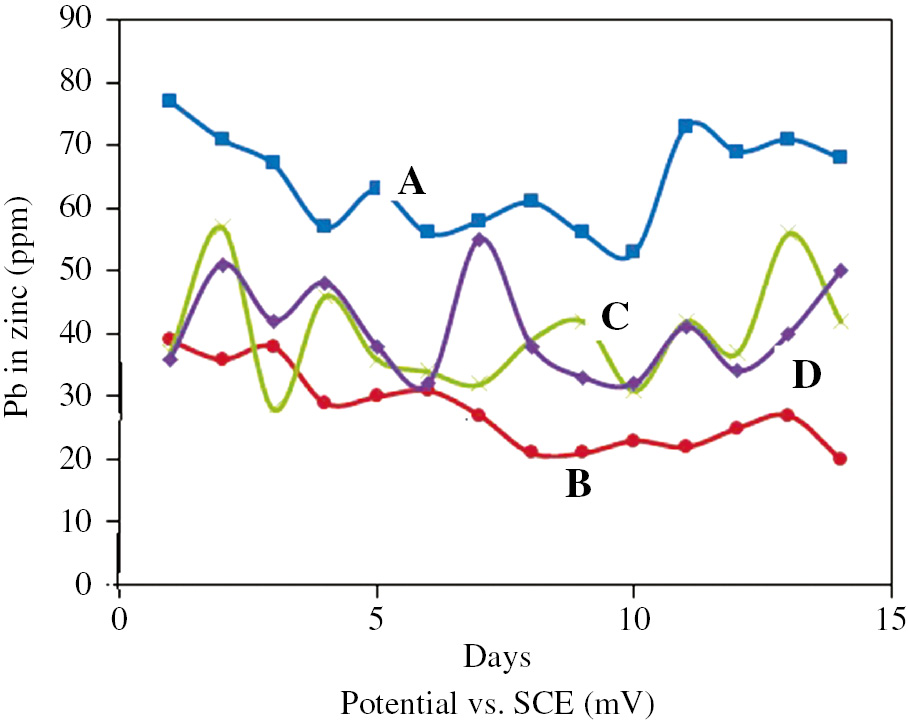
Zinc contamination from the Pb-Ca-Ag anodes during zinc electrolysis for 24 h at a current density of 660 A/m2 (anode), 580 A/m2 (cathode), and 40°C. (A) Untreated: no precon, (B) untreated: precon 2 h, (C) sandblasted: no precon, (D) sandblasted: precon 12 h (Umetsu et al., 1985) (Here: precon means preconditioning). Permission granted by Y. Umetsu.

Zinc contamination from the Pb-Ag anodes during zinc electrolysis for 24 h at current density of 660 A/m2 (anode), 580 A/m2 (cathode), and 40°C. (A) Untreated: no precon, (B) untreated: precon 2 h, (c) sandblasted: no precon, (D) sandblated: 8 h (Umetsu et al., 1985) (Here: precon means preconditioning). Permission granted by Y. Umetsu.
The best results obtained with the anodes Pb-Ag-Ca were performed with the preconditioning (cleaning), particularly for short periods from 2 to 4 h (Table 6). The average lead content in zinc is 27–25 ppm, respectively. Results of the sandblasted surface (41 ppm) competed favorably with longer periods of preconditioning (8, 12, and 24 h), where the average lead content in zinc ranged from 32 to 40 ppm. Also, it was not beneficial for the combination of preconditioning and sandblasting (Umetsu et al., 1985).
The 14-day tests carried out on Pb-Ag-Ca anodes during zinc electrolysis: 580 A/m2 (cathode), 660 A/m2 (anodes), and 40°C (Umetsu et al., 1985).
| Treatment method | Preconditioning | Test duration (h) | Cell volts (V) | Cumulative sludge (kg/m2) | Cumulative oxidation (kg/m2) | Corrosion (g Pb/m2/day) | Pb in Zn (p.p.m) |
|---|---|---|---|---|---|---|---|
| None | None | 330 | 3.18 | 10.12 | 5.80 | 11.0 | 64 |
| Sandblasted | None | 330 | 3.14 | 1.31 | 0.65 | 9.9 | 38 |
| None | 700 A/m2 (anode), 60°C, 2 h | 330 | 3.17 | 2.25 | 0.68 | 55.7 | 27 |
| None | 700 A/m2 (anode), 60°C, 4 h | 330 | 3.19 | 2.70 | 0.90 | 61.2 | 25 |
| None | 658 A/m2 (anode), 60°C, 8 h | 327 | 3.15 | 4.27 | 1.28 | 65.2 | 40 |
| None | 658 A/m2 (anode), 60°C, 12 h | 328 | 3.16 | 4.11 | 1.42 | 93.0 | 39 |
| None | 65 A/m2 (anode), 60°C, 24 h | 329 | 3.16 | 2.91 | 1.16 | 68.6 | 32 |
| Sandblasted | 658 A/m2 (anode), 60°C, 12 h | 328 | 3.14 | 3.63 | 0.67 | 138.8 | 41 |
For the Pb-Ag anodes, it expected that the blasting preconditioning resulted in lower contamination for only the sandblasted sample; the trend is similar to that obtained with the Pb-Ag-Ca anodes. Preconditioning of Pb-Ag anodes (Table 7) seems also to be more effective by sandblasting in minimizing lead contamination in the initial period.
The 14-day tests carried out on Pb-Ag anodes during zinc electrolysis: 580 A/m2 (cathode), 660 A/m2 (anodes), and 40°C (Umetsu et al., 1985).
| Treatment method | Preconditioning | Test duration (h) | Cell volts (V) | Cumulative sludge (kg/m2) | Cumulative oxidation (kg/m2) | Corrosion (g Pb/m2/day) | Pb in Zn (p.p.m) |
|---|---|---|---|---|---|---|---|
| None | None | 323.8 | 3.05 | 8.04 | 4.91 | 6.0 | 72 |
| Sandblasted | None | 323.8 | 3.03 | 2.04 | 1.02 | 23.8 | 45 |
| Sandblasted | 440 A/m2 (anode), 60°C, 2 h | 328.4 | 3.04 | 1.80 | 0.47 | 51.9 | 34 |
| Sandblasted | 440 A/m2 (anode), 60°C, 2 h | 328.4 | 3.06 | 2.83 | 0.44 | 106.5 | 33 |
7.2 Nickel and cobalt impurities in sulfuric acid solution
The effects of other impurities present in solution, and the insoluble additive behavior of the cathode during electrolysis, were studied. Many authors analyzed the effects of the impurities present in solution on the cathode behavior during electrolysis (Mackinnon et al., 1979). In acid electrolytes, it contains certain metal impurities, such as Ni and Co. During a certain period, zinc deposits are uniform, fully adherent to the cathode, and the current efficiency of zinc is around 95%. Subsequently, a “self-dissolution” spontaneous zinc dissolution occurs, accompanied by a strong release of hydrogen. When the zinc deposit is completely dissolved, the filling process restarts. The deposition cycle/dissolution can occur several times in 24 h (Muresan et al., 1996).
It is often mentioned in the literature that an induction period is observed under acidic electrolytes containing certain metal impurities, such as Ni or Co. During this period, zinc deposits are uniform, fully adhered to the cathode, and the yield of zinc current efficiency is 95%. Subsequently, a “self-dissolution” spontaneous zinc deposition occurs, accompanied by a strong release of hydrogen. When the zinc cathode is relatively dissolved, the filling process restarts. The deposition cycle/dissolution can occur several times in 24 h (Mackinnon et al., 1979).
Nickel impurity in the zinc electrolyte causes the process of dissolving zinc in activating the hydrogen release. The bubbles generated by this reaction create the electrolytes confined to the areas where the micro cells are located between the couples Zn2+/Zn and Ni2+/Ni. The self-dissolution of zinc occurs when the potential of the confined environment of the two couples reached the corrosion potential (Mackinnon et al., 1979). Nickel causes the process of dissolving zinc in activating the hydrogen release as bubbles by this reaction in the zinc electrolyte. This is confined by areas where the microcells are located between the couples Zn2+/Zn and Ni2+/Ni (Bozhkov et al., 1990). The self-dissolution of zinc occurs when the potential of the confined environment of the two couples reaches the corrosion potential (Bozhkov et al., 1990).
Many impurities present in solution, other than nickel, have a negative effect on the cathodic process. There are 15 impurities influencing the electrometallurgy of zinc. They showed, in particular, that Ge and Sb instantly ease the reduction of the hydrogen ions at the cathode, while inhibiting the zinc deposition process. Under industrial conditions of polarization, the value of the anode potential enables the formation of hydrogen peroxide, which can then diffuse in solution to reach the cathode where the harmful effect of this compound was demonstrated (Mackinnon et al., 1979).
7.3 Lead removal from zinc electrolyte
Lead can be detrimental to the properties of zinc deposit, so it is important to control its concentration in various deposition processes. In the electrolytic extraction of zinc, it is desirable to minimize the lead to insure an acceptable purity for high-grade applications. One specific example of the adverse influence of lead in zinc is the poor adhesion, which gives electrogalvanized steel. When the lead content is too high, the zinc coating can be easily removed from the steel substrate after heating in the temperature range of 215°C–280°C. Insoluble lead-silver anodes and the source of lead in the zinc electrolyte, whether in the form of metal or compound, are possible sources of lead contamination (Zhang et al., 2009).
For instance, good quality zinc oxide or special high-grade zinc contains enough lead to supply 2 mg/l of lead in an electrolyte containing 100 mg l−1 of zinc (Srinivasan et al., 1990). As the theoretical reduction potential of the lead ions at 10 mg l−1 present in the electrolyte is −0.223 V (SHE), it leads to co-deposits with zinc. The deposition rate of lead may be quite low, as it will be depositing at its limiting current density at such low concentrations (Ault & Frazer, 1988).
It is a common practice to add strontium carbonate or similar chemicals to the electrolyte to control the lead content in sulfuric acid solution during zinc electrowinning, where lead anodes are used. Therefore, the solutions, which contain 80 g l−1 of zinc and 10 mg l−1 of lead at pH 1.5, were treated with strontium carbonate at 55°C, and the solution was analyzed for lead. It is important to note that in all cases, filtering the electrolyte is necessary in order to achieve a reduction in the level of lead in solution. When 20 mg l−1 of strontium carbonate was added into the zinc electrolyte; no decrease in the lead content was noted until the solution was filtered, giving a final concentration of 4 mg l−1 of lead. A 100 mg l−1 of strontium carbonate addition, followed by stirring for 5 min and filtering, reduced the lead content below the detection limit (Bratt & Smith, 1965).
Deposits were also prepared for adhesion testing in electrolytes initially containing 10 mg l−1 of added lead but which had also been treated by strontium carbonate. A 20-mg/l of strontium addition with 5 min of agitation, whether followed by filtration or not, did not remove lead to the threshold lever needed (i.e. approximately 4–5 mg/l to prevent failure). A 100 mg/l of strontium carbonate addition in the absence of filtration did not prevent poor hot adhesion; however, the deposit made from the electrolyte after filtration exhibited good adhesion after heating. The actual chemical form of the lead present in the electrolyte was not determined, but at the levels used, it was assumed to be ionic, rather than as a particulate compound (Bratt & Smith, 1965).
Depending on the electrolysis conditions, one or several organic additives may be added to the electrolyte in order to counteract the detrimental effects caused by impurities (Gonzalez & Lew, 1995). The effect of organic additives in the electrolyte on the nature of the crystallization presents one of the important aspects. Additives could be adsorbed preferentially on the cathode to completely alter the growth of the deposit. Additives also reduce the grain size by creation of more nucleation sites during the electrodeposition (Sato, 1959). However, they are also susceptible to decomposition by the presence of a large amount of Mn2+, which is gradually oxidized to MnO4− or MnO2; this also can cause further alterations in the electro-crystallization (Sorour et al., 2015).
Glues and gelatin are the most commonly used additives in the industry to prompt the deposit growth and minimize the negative effect of metallic impurities (Robinson & O’Keefe, 1976). The addition of gelatin into the electrolyte led to very good results in increasing current efficiency, reducing overpotentials, producing better smooth and compact deposits in presence of antimony traces (Lafront et al., 2009). Sodium lauryl sulfate (SLS), as additive at low concentrations in the zinc electrolyte containing Sb (III), was examined (Tripathy et al., 1997). It showed good results in increasing current efficiency, reducing power consumption, and improving surface morphology. In addition, triethyl benzylammonium (TEBA) (Ivanov, 2004), 1-butyl-3-methylimidazolium hydrogen sulfate [BMIM]HSO4 (Zhang & Hua, 2009), and perfluorinate surfactant were employed as additives to study their effects on the electrodeposition characteristics of zinc from the zinc electrolytes (Cachet & Wiart, 1990).
8 Conclusions
The strong and weak points of the Pb alloy anodes could be explained as follows:
Pb anodes encounter problems such as high overpotential, anodic dissolution of lead, and Pb contamination of zinc deposit. Alloying Ag or other elements to the Pb substrate can decrease these problems.
(a) In zinc electrowinning, zinc is deposited on the cathode, and oxygen evolution is on the anode. Inert Pb-alloys and aluminum are often used as the anode and the cathode, respectively.
(b) The composition of the surface film would change depending on potential regions: from 306 to 350 mV/SHE: PbSO4 is only visible, from 350 to 1550 mV/SHE include tetragonal PbO and PbSO4 mainly with slight PbO·PbSO4, 3PbO·PbSO4·H2O, 5PbO·H2O, PbO, and PbO2 orthorhombic α.
(a) Lead anodes are not stable as they will dissolve in sulfuric acid solution, alloying the elements to improve the mechanical properties and corrosion resistances of lead.
(b) Small amounts of Ag (0.7–1.0%) alloyed with lead decrease the oxygen overvoltage (~300 mV) and increase the corrosion resistance of material (approximately nine times).
(c) To improve the properties of Pb-Ag anodes, cobalt attracted many investigations to examine its influence on the performance of lead-based anodes.
(a) In an acidic medium, when the pH value is around 0, the lead oxide is first Pb2+, then Pb4+ with increasing anode potential. When the electrolyte is a zinc sulfate acid medium, the lead anode is successively covered with a deposit of PbSO4 and PbO2 depending on the potential value.
(b) β-PbO2 electrodes, prepared by pressing β-PbO2 power into a perforated lead sheet also exhibited potentials lower than those of α-PbO2 prepared in the same manner. The α and β phases of PbO2, respectively, have an orthorhombic and tetragonal structure and are both very conductive, unlike the lead sulfate, which is an insulator.
The electrochemical parameters during zinc electrolysis influence the quality of zinc deposit:
(a) The protection of the passive film on the Pb0.8Sn alloy can be increased with H2SO4 concentration, as the steady passive currents of Pb0.8Sn electrode in 0.5 m, 1.5 m, 2.5 m, 3.5 m, and 4.5 m H2SO4 solutions decreased to 0.48, 0.36, 0.31, 0.24, and 0.18 mA cm−2, respectively.
(b) The corrosion rates of Pb-0.7% Ag anode increased with the increase in temperature. The corrosion rate of Pb-0.7% Ag anode at 25°C, 38°C, and 55°C were 0.89, 1.04, and 1.51 μA cm−3 after 5 h potential decay following 5 h electrolysis at 50 mA/cm2.
(a) Addition of 1.5–3 Mn2+ g dm−3 to the zinc electrolyte can minimize the corrosion of lead anodes and reduce the contamination of the cathodic zinc with lead.
(b) In the presence of Mn2+ ions in solution, MnO2 construction on the anode is accompanied by the formation of soluble and oxidized manganese species. MnO2 protects the lead alloy anode and decreases the Pb contamination of the zinc deposit. However, Pb contamination still exists in the zinc deposit.
During zinc electrolysis, lead dissolved into the zinc electrolyte can be harmful to the quality of zinc deposit. However, pre-treated Pb-Ag anodes such as blasting and preconditioning of lead silver alloy anode can decrease lead content in the zinc deposit. Also, organic additives may be added to the electrolyte in order to counteract the detrimental effects caused by impurities.
Funding source: Natural Sciences and Engineering Research Council of Canada
Award Identifier / Grant number: RDCPJ 428402
Funding statement: The authors are grateful to Hydro-Quebec, CEZ, and the Natural Sciences and Engineering Research Council of Canada (NSERC) (Grant No. RDCPJ 428402) for their financial support.
About the author

Wei Zhang has 31 years experience in electrochemical behavior and corrosion-related research. He has in-depth knowledge of corrosion science and corrosion engineering, including technologies for corrosion mitigation, and scientific techniques for corrosion research. Also, he has a solid background in materials science and engineering, and a variety of materials processing technologies. He got his Master’s and PhD degrees from the University Laval in 2005 and 2010, respectively.
References
Ault AR, Frazer EJ. Effects of certain impurities on zinc electrowinning in high-purity synthetic solutions. J Appl Electrochem 1988; 18: 583–589.10.1007/BF01022254Search in Google Scholar
Barnes SC, Mathieson RT. Electrochemical properties of lead alloys in sulfuric acid solution. In: Collins DH, editor. Batteries. New York, Pergamon Press, 1963: 41–54.Search in Google Scholar
Bodsworth C. The extraction and refining of metals, Boca Raton, FL, USA, CRC Press, ISBN0849344336, 1994: 148–161.Search in Google Scholar
Bone SJ, Singh KP, Wynne-Jones WFK. Some potential and exchange studies of α-lead dioxide. Electrochim Acta 1961; 4: 292–297.10.1016/0013-4686(61)80023-6Search in Google Scholar
Bozhkov C, Petrova M, Rashkov S. The effect of nickel on the mechanism of the initial stages of zinc electrowinning from sulfate electrolytes. Part II. Investigations on aluminum cathodes alloyed with iron impurities. J Appl Electrochem 1990; 20: 17–22.10.1007/BF01012465Search in Google Scholar
Bratt GC, Smith WN. The effects of strontium compounds and related materials in electrolytic production of zinc. Electrochemistry 1965; 7: 939–948.10.1016/B978-1-4831-9831-6.50075-8Search in Google Scholar
Brungs A, Haddadi-Asl V, Skyllas-Kazacos M. Preparation and evaluation of electrocatalytic oxide coatings on conductive carbon-polymer composite substrate for use as dimensionally stable anodes. J Appl Electrochem 1996; 26: 1117–1123.10.1007/BF00243736Search in Google Scholar
Burbank J. Anodization of lead and lead anode alloys in sulfuric acid. J Electrochem Soc 1957; 104: 693–701.10.1149/1.2428455Search in Google Scholar
Cachet C, Wiart R. Zinc deposition and passivated hydrogen evolution in highly acidic sulfate electrolytes: depassivation by nickel impurities. J Appl Electrochem 1990; 20: 1009–1014.10.1007/BF01019581Search in Google Scholar
Charlesby A. Ionic currents in thin films of zirconium oxide. Acta Met 1953; 1: 340–347.10.1016/0001-6160(53)90110-2Search in Google Scholar
Czerwinski A, Zelazowska M, Grden M, Kuc K, Milewski JD, NowackiA, Wojcik G, Kopczyk M. Electrochemical behaviour of lead in sulfuric acid solution. J Power Sources 2000; 85: 49–55.10.1016/S0378-7753(99)00381-XSearch in Google Scholar
Dawson JL. Principles of lead corrosion in sulfuric acid. In: Kuhn AT, editor. The electrochemistry of lead. New York, USA, Academic Press, 1979.Search in Google Scholar
Eggett G, Naden D. Developments in anodes for pure copper electrowinning from solvent ex traction produced electrolytes. Hydrometallurgy 1975; 1: 123–137.10.1016/0304-386X(75)90003-1Search in Google Scholar
Forsen O, Kukkonen JJ, Aromaa J, Ylasaari S. Improved technologies for rational use of energy in the non-ferrous industry in Europe. In: European Seminar, Milan, Italy, 1992: 125–129.Search in Google Scholar
Gendron AS, Ettel VA, Abe S. Effect of cobalt added to electrolyte on corrosion rate of Pb-Sb anodes in copper electrowinning. Can Metall Quart 1975; 14: 59–61.10.1179/000844375795050436Search in Google Scholar
Gonzalez-Dominguez JA, Lew RW. Evaluating additives and impurities in Zinc electrowinning. JOM, 1995; 47: 34–37.10.1007/BF03221128Search in Google Scholar
Gui JF, Jiang LX, Zhong XC, Yu XY, Lai YQ, Li J, Liu YX. Effects of Ag and RE contents on electrochemical performance of Pb-Ag-RE alloy anode. Chinese J Nonferr Met 2015; 25: 111–118.Search in Google Scholar
Hine F, Ogata Y, Yasuda M. Consumption of lead-silver alloy anodes in sulfuric acid solution. B Electrochem 1988; 4: 61–65.Search in Google Scholar
Hrussanova A, Mirkova L, Dobrev TS. Electrochemical properties of Pb-Sb, Pb-Ca-Sn and Pb-Co3O4 anodes in copper electrowinning. J Appl Electrochem 2002; 32: 505–512.10.1023/A:1016591810240Search in Google Scholar
Hrussanova A, Mirkova L, Dobrev T, Vasilev S. Influence of temperature and current density on oxygen overpotential and corrosion rate of Pb-Co3O4, Pb-Ca-Sn, and Pb-Sb anodes for copper electrowinning: part I. Hydrometallurgy 2004; 72: 205–213.10.1016/j.hydromet.2003.07.004Search in Google Scholar
Huang H, Zhou JY, Chen BM, Guo ZC. Polyaniline anode for zinc electrowinning from sulfate electrolytes. Trans Nonferrous Met Soc China 2010; 20: s288–s292.10.1016/S1003-6326(10)60058-1Search in Google Scholar
Ivanov I. Increased current efficiency of zinc electrowinning in the presence of metal impurities by addition of organic inhibitors. Hydrometallurgy 2004; 72: 73–78.10.1016/S0304-386X(03)00129-4Search in Google Scholar
Ivanov I, Stefanov Y. Electroextraction of zinc from sulfate electrolytes containing antimony ions and hydroxyethylated-butyne-2-diol-1,4: part 3. The influence of manganese ions and a divided cell. Hydrometallurgy 2002; 64: 181–186.10.1016/S0304-386X(02)00039-7Search in Google Scholar
Ivanov I, Stefanov Y, Noncheva Z, Petrova M, Dobrev T, Mirkova L, Vermeersch R, Demaerel JP. Insoluble anodes used in hydrometallurgy: part I. Corrosion resistance of lead and lead alloy anodes. Hydrometallurgy 2000; 57: 109–124.10.1016/S0304-386X(00)00097-9Search in Google Scholar
Jaksic M, Rajkovic M, Stanojevic D. Development and application of the preconditioned alloyed lead anode for zinc electrowinning. I. Theoretical basis of the preconditioning process. Hem Ind 1987; 41: 226–232.Search in Google Scholar
Joao M, Rodrigues S, Eward H, Meyer O. Influence of impurities in the electrolyte on zinc deposition. Miner Met Mater Soc 1995; 47: 78–83.Search in Google Scholar
Kiryakov GZ, Stender VV. The study of electrochemical properties of different lead alloys in sulfuric acid solution. J Appl Chem (Russian) 1951; 24: 1263–1272.Search in Google Scholar
Lafront AM, Zhang W, Ghali E, Houlachi G. Effect of gelatin and antimony on zinc electrowinning by electrochemical noise measurements. Can Metall Quart 2009; 48: 337–346.10.1179/000844309794238865Search in Google Scholar
Lai YQ, Jiang LX, Lie J, Zhong SP, Lu XJ, Peng V, Liu YX. A novel porous Pb–Ag anode for energy-saving in zinc electrowinning: part II: preparation and pilot plant tests of large size anode. Hydrometallurgy 2010; 102: 73–80.10.1016/j.hydromet.2010.02.012Search in Google Scholar
Lander JJ. Silver, cobalt, and positive-grid corrosion in the lead-acid battery. J Electrochem Soc 1958; 105: 289–292.10.1149/1.2428831Search in Google Scholar
Li DG, Chen DR, Wang JD, Chen HS. Influence of temperature, H2SO4 concentration and Sn content on corrosion behaviour of PbSn alloy in sulfuric acid solution. J Power Sources 2011; 196: 8789–8801.10.1016/j.jpowsour.2011.06.082Search in Google Scholar
Lupi C, Pilone D. New lead alloy anodes and organic depolarizer utilization in zinc electrowinning. Hydrometallurgy 1997; 44: 347–358.10.1016/S0304-386X(96)00060-6Search in Google Scholar
Mackinnon DJ, Brannen JM, Kerby RC. The effect of lead on zinc deposit structures obtained from high purity synthetic and industrial acid sulfate electrolytes. J Appl Electrochem 1979; 9: 55–70.10.1007/BF00620587Search in Google Scholar
Mansfeld F, Gilman S. The effect of lead ions on the dissolution and deposition characteristic of a zinc single crystal in 6 N KOH. J Electrochem Soc 1970; 117: 588–592.10.1149/1.2407584Search in Google Scholar
Marshall AT, Haverkamp RG. Nanoparticles of IrO2 or Sb-SnO2 increases the performance of iridium oxide DSA electrodes. J Mater Sci 2012; 47: 1135–1141.10.1007/s10853-011-5958-xSearch in Google Scholar
McGinnity JJ, Nicol MJ. The role of silver in enhancing the electrochemical activity of lead and lead-silver alloy anodes. Hydrometallurgy 2014; 144–145: 133–139.10.1016/j.hydromet.2014.02.005Search in Google Scholar
Mohammadi M, Alfantazi A. The performance of Pb-Ag anode in 2 Mn(II) – containing sulphuric acid electrolyte solutions. Hydrometallurgy, 2015; 153: 134–144.10.1016/j.hydromet.2015.02.009Search in Google Scholar
Morimitsu M, Tamura H, Matsunaga M, Otogawa R. Polarization behaviour and lifetime of IrO2–Ta2O5–SnO2/Ti anodes in p-phenolsulfonic acid solutions for tin plating. J Appl Electrochem 2000; 30: 511–514.10.1023/A:1003977928651Search in Google Scholar
Msindo ZS. An investigation of the electrorefining of copper with dimensionally stable titanium anodes and conventional lead alloy anodes. Master’s thesis, Chemical Engineering, Johannesburg, South Africa: University of the Witwatersrand, 2010: 205.Search in Google Scholar
Muresan L, Maurin G, Oniciu L, Gaga D. Influence of metallic impurities on zinc electrowinning from sulfate electrolyte. Hydrometallurgy 1996; 43: 345–354.10.1016/0304-386X(96)00012-6Search in Google Scholar
Newham AH. Corrosion rates of lead based anodes for zinc electrowinning at high current densities. J Appl Electrochem 1992; 22: 116–124.10.1007/BF01023812Search in Google Scholar
Nguyen TKT. A study of the mechanism by which cobalt ions minimize corrosion of lead alloy anodes during electrowinning of base metals. Ph.D. Thesis, Australia: University of Queensland, 2007.Search in Google Scholar
Nguyen T, Atrens A. Composition and morphology of the film formed on a lead alloy under conditions typical of the electrowinning of copper. Hydrometallurgy 2009; 96: 14–26.10.1016/j.hydromet.2008.07.014Search in Google Scholar
Nijjer S, Deposition and reduction of manganese dioxide on alternative anode materials in zinc electrowinning. Doctoral thesis, Trondlheim: Norwegian University of Science and Technology, 2000: 35–46.10.1016/S0013-4686(00)00597-1Search in Google Scholar
Niu J, Conway BE, Pell WG. Comparative studies of self-discharge by potential decay and float-current measurements at c double-layer capacitors and battery electrode. J Power Sources 2004; 135: 332–343.10.1016/j.jpowsour.2004.03.068Search in Google Scholar
Osorio WR, Peixoto LC, Garcia A. The effects of Ag content and dendrite spacing on the electrochemical behaviour of Pb-Ag alloys for Pb-acid battery components. J Power Sources 2013; 238: 324–335.10.1016/j.jpowsour.2013.03.099Search in Google Scholar
Pavlov D. Mechanism of the processes of the processes during anodic oxidation of a lead electrode in sulfuric acid solutions. In: Bullock KR, Pavlov D, editors. Proceedings of the Symposium on Advances in Lead-Acid Batteries, Battery Division, Electrochemical Society, New Orleans, 1984; 1: 110–122.Search in Google Scholar
Pavlov D, Rogachev T. Mechanism of the action of Ag and As on the anodic corrosion of lead and oxygen evolution at the Pb/PbO(2−x)/H2O/O2/H2SO4 electrode system. Electrochim Acta 1986; 31: 241–249.10.1016/0013-4686(86)87115-8Search in Google Scholar
Pavlov D, Monahov B, Petrov D. Effect of Ag element on the formation of lead oxide layer. In: 6th European Lead Battery Conference, Prague, 1998; 21–25: 3–6, Abstracts.Search in Google Scholar
Petrova M, Noncheva Z, Dobrev T, Rashkov St, Kounchev N, Petrov D, Vlaev St, Mihnev V, Zarev S, Georgieva L, Buttinelli D. Investigation of the processes of obtaining plastic treatment and electrochemical behaviour of lead alloys in their capacity as anodes during the electroextraction of zinc I. Behaviour of Pb-Ag, Pb-Ca and Pb-Ag-Ca alloys. Hydrometallurgy 1996; 40: 293–318.10.1016/0304-386X(95)00009-6Search in Google Scholar
Pourbaix M. Atlas of electrochemical equilibria in aqueous solutions, New York, USA: Pergamon Press, 1974.Search in Google Scholar
Prengaman RD. Structural control of non-antinational lead alloys via alloy additions, heat treatment and cold work. In: Lead Development, 7th International Lead Conference, Madrid, 1980: 34–47.Search in Google Scholar
Prengaman RD. The metallurgy of lead alloys for electrowinning anodes. In: Robinson DJ, James SE, editors. Proceedings of the Sessions sponsored by The Electrolytic Processes Committee of the Metallurgical Society of AIME, The Metallurgical Society of AIME, Los Angeles, California, 1984; 28: 49–56.Search in Google Scholar
Prengaman RD. Improvements to active material for VRLA batteries. J Power Sources 2005; 144: 426–437.10.1016/j.jpowsour.2004.11.004Search in Google Scholar
Prengaman RD, Siegmund A. New wrought Pb-Ag-Ca anodes for zinc electrowinning to protective oxide coating rapidly, LEAD-ZINC 2000. In: Dutrizac JE, Gonzalez JA, Henke DM, James SE, Siegmund AH-J, Warrendale PA, editors. The Metallurgical Society of AIME, 2000: 589–597.10.1002/9781118805558.ch39Search in Google Scholar
Porter F. In: Faulkener LL, editor. Zinc handbook, New York: Marcel Dekker, ISBN9780824783402, 1991.Search in Google Scholar
Rajkovic MB, Vladisavljevic GT, Ristic NM, Jaksic MM. A preconditioning process for extended passivation of alloyed lead anodes in zinc electrowinning. Bull Electrochem 1998; 14: 107–114.Search in Google Scholar
Rerolle C, Wiart R. Kinetics of oxygen evolution on Pb and Pb-Ag anodes during zinc electrowinning. Electrochem Acta 1996; 41: 1063–1069.10.1016/0013-4686(95)00439-4Search in Google Scholar
Robinson DJ, O’Keefe TJ. On the effects of antimony and glue on zinc electrocrystallization behaviour. J Appl Electrochem 1976; 6: 1–7.10.1007/BF01058863Search in Google Scholar
Rosenqvist T. Principles of extractive metallurgy, 2nd ed. New York, USA, Tapir Academic Press, ISBN8251919223, 1992: 7–16.Search in Google Scholar
Ruetschi PJ, Cahan BD. Electrochemical properties of PbO2 and the anodic corrosion of lead and lead alloys. J Electrochem Soc 1958; 105: 369–376.10.1149/1.2428866Search in Google Scholar
Schmachtel S, Toiminen M, Kontturi K, Forsén O, Barker MH. New oxygen evolution anodes for metal electrowinning: MnO2 composites electrodes. J Appl Electrochem 2009; 39: 1835–1848.10.1007/s10800-009-9887-1Search in Google Scholar
Sorour N, Zhang W, Gabra G, Ghali E, Houlachi G. Electrochemical studies of ionic liquid additives during the zinc electrowinning process. Hydrometallurgy 2015; 157: 261–269.10.1016/j.hydromet.2015.09.003Search in Google Scholar
Srinivasan VS, Cuzmar JS, O’Keefe TJ. The effects of lead on the electrochemical and adhesion behaviour of zinc electrodeposits. Metall Trans B 1990; 21B: 81–86.10.1007/BF02658118Search in Google Scholar
Sun QJ, Guo YG. Effects of antimony on the formation process of 3PbO·PbSO4·H2O on Pb and Pb-Sb electrodes. J Electroanal Chem 2000; 493: 123–129.10.1016/S0022-0728(00)00328-4Search in Google Scholar
Takehara Z, Kanumura K. The effect of the sulfuric acid concentration on the oxidation of PbSO4 to PbO2. J Electrochem Soc 1987; 134: 1604–1610.10.1149/1.2100721Search in Google Scholar
Tikkanen MH, Hyvarinen O. Tall. Dep., Inst. Technol., Otaniemi, Finland. Ed: Hamner, Norman E. Proc. Int. Congr. Metal. Corros., 4th (1972), Meeting Date 1969, pp. 669–675. Publisher: Nat. Ass. Corrosion. Tomas, L., Chem. Prum. (Czech.) 1984; 34: 286–291.Search in Google Scholar
Tripathy BC, Das SC, Hefter GT, Singh P. Zinc electrowinning from acidic sulfate solutions part I: effects of sodium lauryl sulfate. J Appl Electrochem 1997; 27: 673–678.10.1023/A:1018431619595Search in Google Scholar
Tshimwanga N, Maweja K, Tshula K. Efficacy of polyacrylamide and protein flocculants in preventing anode depassivation induced Pb-contamination of copper electrowinning cathodes. Hydrometallurgy 2011; 105: 240–245.10.1016/j.hydromet.2010.10.011Search in Google Scholar
Tunnicliffe M, Mohammadi F, Alfantazi A. Polarization behaviour of lead-silver anodes in zinc electrowinning electrolytes. J Electrochem Soc 2012; 159: C170–C180.10.1149/2.055204jesSearch in Google Scholar
Umetsu Y, Nozoka H, Tozawa K. Anodic behaviour of Pb-Ag alloys in sulfuric acid solution. In: Proceedings of the International Symposium on Extract. Metall. Zinc, MMJ, Tokyo, Japan, 1985: 265–279.Search in Google Scholar
Valeriote EML, Heim A, Ho MS. Variables affecting the deep-cycling characteristics of expanded-grid lead/acid battery plates. J Power Sources 1991; 33: 187–212.10.1016/0378-7753(91)85059-6Search in Google Scholar
Varela FE, Codaro EN, Vilche JR. Electrochim Acta 1995; 40: 1183–1188.10.1016/0013-4686(94)00321-QSearch in Google Scholar
Vereecken J, Winand R. Influence of manganese (II) ions on the anodic oxidation of methanol. Electrochim Acta 1972; 17: 121–278.10.1016/0013-4686(72)85028-XSearch in Google Scholar
Woollacott LC, Eric RH. Electrometallurgy, mineral and metal extraction: an overview, Johannesburg: The South African Institute of Mining and Metallurgy, 1994: 371–379.Search in Google Scholar
Yang HT, Liu HR, Guo ZC, Chen BM, Zhang YC, Huang H, Li XL, Fu RC, Xu RD. Electrochemical behaviour of rolled Pb-0.8%Ag anodes. Hydrometallurgy 2013a; 140: 144–150.10.1016/j.hydromet.2013.10.003Search in Google Scholar
Yang HT, Liu HR, Zhang YC, Chen BM, Guo ZC. Electrochemical behaviour of Pb-Ag-Sb-Ca quaternary alloys anodes for zinc electrowinning. J Kuming Univ Sci Technol 2013b; 8: 7–11.Search in Google Scholar
Yang HT, Guo ZC, Chen BM, Liu HR, Zhang YC, Huang H, Li XL, Fu RC, Xu RD. Electrochemical behaviour of rolled Pb-0.8% Ag anodes in an acidic zinc sulfate electrolyte solution containing chloride ions. Hydrometallurgy 2014; 147–148: 148–156.10.1016/j.hydromet.2014.05.004Search in Google Scholar
Yu P, O’Keefe TJ. Evaluation of lead anode reactions in acid sulfate electrolytes. I. Lead alloys with cobalt additives. J Electrochem Soc 1999; 146: 1361–1369.10.1149/1.1391771Search in Google Scholar
Yu P, O’Keefe TJ. Evaluation of lead anode reactions in acid sulfate electrolytes, II. Manganese. J Electrochem Soc 2002; 149: A558–A569.10.1149/1.1464882Search in Google Scholar
Zhang WS, Cheng CY. Manganese metallurgy review, Part III: Manganese control in zinc and copper electrolytes. Hydrometallurgy 2007; 89: 178–188.10.1016/j.hydromet.2007.08.011Search in Google Scholar
Zhang QB, Hua YX. Effect of Mn2+ ions on the electrodeposition of zinc from acidic sulfate solutions. Hydrometallurgy 2009; 99: 249–254.10.1016/j.hydromet.2009.09.002Search in Google Scholar
Zhang W, Houlachi G. Electrochemical studies of the performance of different Pb-Ag anodes during and after zinc electrowinning. Hydrometallurgy 2010; 104: 129–135.10.1016/j.hydromet.2010.05.007Search in Google Scholar
Zhang W, Lafront AM, Ghali E, Houlachi G. Influence of malonic acid and triethylbenzylammonium chloride on Zn electrowinning in zinc electrolyte. Hydrometallurgy 2009; 99: 181–188.10.1016/j.hydromet.2009.08.003Search in Google Scholar
Zhang YC, Chen BM, Yang HT, Huang H, Guo ZC. Anodic behaviour and microstructure of Al/Pb-Ag-Co anode during zinc electrowinning. J Cent South Univ 2014; 21: 83–88.10.1007/s11771-014-1919-2Search in Google Scholar
Zhong XC, Yu XY, Liu ZW, Jiang LX, Li J, Liu YX. Comparison of corrosion and oxygen evolution behaviours between cast and rolled Pb-Ag-Nd anodes. Int J Miner Metall Mater 2015; 22: 1067–1075.10.1007/s12613-015-1169-9Search in Google Scholar
©2019 Walter de Gruyter GmbH, Berlin/Boston
Articles in the same Issue
- Frontmatter
- In this issue
- Reviews
- Organic green corrosion inhibitors (OGCIs): a critical review
- Managing corrosion in desalination plants
- Study on corrosion investigations in industrial effluents: a review
- Corrosion and corrosion prevention in heat exchangers
- Lead-silver anode behavior for zinc electrowinning in sulfuric acid solution
- Original article
- Sensitization of an austenitic stainless steel due to the occurrence of δ-ferrite
Articles in the same Issue
- Frontmatter
- In this issue
- Reviews
- Organic green corrosion inhibitors (OGCIs): a critical review
- Managing corrosion in desalination plants
- Study on corrosion investigations in industrial effluents: a review
- Corrosion and corrosion prevention in heat exchangers
- Lead-silver anode behavior for zinc electrowinning in sulfuric acid solution
- Original article
- Sensitization of an austenitic stainless steel due to the occurrence of δ-ferrite
