Names and Symbols of the Elements With Atomic Numbers 113, 115, 117, and 118

Provisional Recommendations are drafts of IUPAC recommendations on terminology, nomenclature, and symbols, made widely available to allow interested parties to comment before the recommendations are finally revised and published in IUPAC’s journal Pure and Applied Chemistry. Full text is available online.
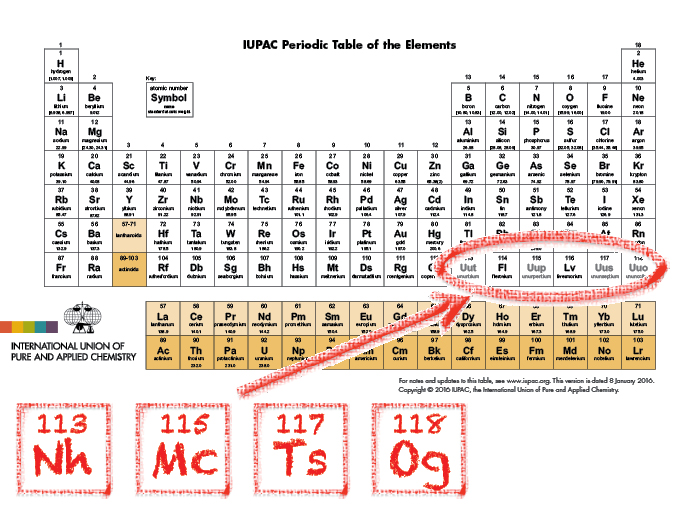
Following earlier reports that the claims for discovery of these elements have been fulfilled [1,2], the discoverers have been invited to propose names and the following are disclosed for public review:
nihonium and symbol Nh, for the element with Z = 113,
moscovium and symbol Mc,for the element with Z = 115,
tennessine and symbol Ts, for the element with Z = 117,
oganesson and symbol Og, for the element with Z = 118.
The IUPAC Inorganic Chemistry Division has reviewed and considered these proposals and recommends these for acceptance. A five-month public review is set, expiring 8 November 2016, prior to the formal approval by the IUPAC Council.
The guidelines for naming the elements were recently revised [3] and shared with the discoverers to assist in their proposals. Keeping with tradition, newly discovered elements can be named after:
a mythological concept or character (including an astronomical object),
a mineral or similar substance,
a place, or geographical region,
a property of the element, or
a scientist.
The names of all new elements in general would have an ending that reflects and maintains historical and chemical consistency. This would be in general “-ium” for elements belonging to groups 1-16, “-ine” for elements of group 17, and “-on” for elements of group 18. Finally, the names for new chemical elements in English should allow proper translation into other major languages.
For the element with atomic number 113, the discoverers at RIKEN Nishina Center for Accelerator-Based Science (Japan) proposed the name nihonium and the symbol Nh. Nihon is one of the two ways to say “Japan” in Japanese, and literally means “the Land of Rising Sun”. The name is proposed to make a direct connection to the nation where the element was discovered. Element 113 is the first element to have been discovered in an Asian country.
For the element with atomic number 115, the name proposed is moscovium with the symbol Mc and for element with atomic number 117, the name proposed is tennessine with the symbol Ts. These are in line with tradition, honoring a place or geographical region, and are proposed jointly by the discoverers at the Joint Institute for Nuclear Research, Dubna (Russia), Oak Ridge National Laboratory (USA), Vanderbilt University (USA), and Lawrence Livermore National Laboratory (USA).
Moscovium is in recognition of the Moscow region and honors the ancient Russian land that is the home of the Joint Institute for Nuclear Research, where the discovery experiments were conducted using the Dubna Gas-Filled Recoil Separator in combination with the heavy ion accelerator capabilities of the Flerov Laboratory of Nuclear Reactions.
Tennessine is in recognition of the contribution of the Tennessee region, including Oak Ridge National Laboratory, Vanderbilt University, and the University of Tennessee at Knoxville, to superheavy element research, including the production and chemical separation of unique actinide target materials for superheavy element synthesis at ORNL’s High Flux Isotope Reactor and Radiochemical Engineering Development Center.
For the element with atomic number 118, the collaborating teams of discoverers at the Joint Institute for Nuclear Research, Dubna (Russia) and Lawrence Livermore National Laboratory (USA) proposed the name oganesson and symbol Og. The proposal is in line with the tradition of honoring a scientist and recognizes Professor Yuri Oganessian (born 1933) for his pioneering contributions to transactinoid elements research. His many achievements include the discovery of superheavy elements and significant advances in the nuclear physics of superheavy nuclei, including experimental evidence for the “island of stability”.
Comments by 8 November 2016
Corresponding Author: Jan Reedijk, reedijk@chem.leidenuniv.nl
References
1. P.J. Karol, R.C. Barber, B.M. Sherrill, E. Vardaci, T. Yamazaki, (2016) Pure Appl. Chem.88:139; http://dx.doi.org/10.1515/pac-2015-050210.1515/pac-2015-0502Suche in Google Scholar
2. P.J. Karol, R. C. Barber, B. M. Sherrill, E. Vardaci, T. Yamazaki, (2016) Pure Appl. Chem.88:155; http://dx.doi.org/10.1515/pac-2015-050110.1515/pac-2015-0501Suche in Google Scholar
3. W.H. Koppenol, J. Corish, J. Garcia-Martinez, J. Meija, J. Reedijk, (2016) Pure Appl. Chem.88:401; http://dx.doi.org/10.1515/pac-2015-080210.1515/pac-2015-0802Suche in Google Scholar
©2016 by Walter de Gruyter Berlin/Boston
Artikel in diesem Heft
- Masthead - Full issue pdf
- Contents
- Features
- The Art of Building Small
- Chemistry for the Future Solvay Prize
- CAMEO: The Science in Art
- Colorimetric Sensor
- The Discovery of Phytochrome
- Stamps International
- Raman’s Gift to the Art World
- IUPAC Wire
- Kicking off the Preparations for the IUPAC Centenary
- IUPAC Elections for the 2018–2019 Term
- IUPAC Announces the Winners of the 2016 IUPAC-Solvay International Award for Young Chemists
- Volker Hessel Is Awarded the 2016 IUPAC ThalesNano Prize for Flow Chemistry
- Dan Kunkel to Receive the IUPAC International Award for Advances in Crop Protection Chemistry
- Ali Maleki Is Awarded the 2016 IUPAC-CHEMRAWN VII Prize for Green Chemistry
- 2016 Andrei Sakharov Prize Awarded to Zafra Lerman
- In Memoriam—Paul De Bièvre
- Project Place
- Guide (and Brief Guide) to Polymer Semiconductors
- Critical Evaluation of Equilibrium Constants of 4f Metal Mixed Complexes with Acidic (Chelating) Ligands in Combination with Various Organophosphorus O-donor Molecules
- Network for Heterocyclic Chemistry among Countries of the Mediterranean Sea Area, Including Europe and North Africa
- Nomenclature for Properties and Units or NPU Terminology
- Making an imPACt
- Human Errors in a Routine Analytical Laboratory—Classification, Modeling and Quantification: Overview of the IUPAC/CITAC Guide*
- IUPAC Provisional Recommendations
- Names and Symbols of the Elements With Atomic Numbers 113, 115, 117, and 118
- Preferred Names of Constitutional Units for Use in Structure-based Names of Polymers
- Conference Call
- Ecological Risk Assessment Workshop
- ChemCYS 2016. An Inspiring and Stimulating Conference for Young Chemists Worldwide
- Photochemistry
- Research and Education in the Middle East
- Gender Issues in Field Research
- Mark Your Calendar
Artikel in diesem Heft
- Masthead - Full issue pdf
- Contents
- Features
- The Art of Building Small
- Chemistry for the Future Solvay Prize
- CAMEO: The Science in Art
- Colorimetric Sensor
- The Discovery of Phytochrome
- Stamps International
- Raman’s Gift to the Art World
- IUPAC Wire
- Kicking off the Preparations for the IUPAC Centenary
- IUPAC Elections for the 2018–2019 Term
- IUPAC Announces the Winners of the 2016 IUPAC-Solvay International Award for Young Chemists
- Volker Hessel Is Awarded the 2016 IUPAC ThalesNano Prize for Flow Chemistry
- Dan Kunkel to Receive the IUPAC International Award for Advances in Crop Protection Chemistry
- Ali Maleki Is Awarded the 2016 IUPAC-CHEMRAWN VII Prize for Green Chemistry
- 2016 Andrei Sakharov Prize Awarded to Zafra Lerman
- In Memoriam—Paul De Bièvre
- Project Place
- Guide (and Brief Guide) to Polymer Semiconductors
- Critical Evaluation of Equilibrium Constants of 4f Metal Mixed Complexes with Acidic (Chelating) Ligands in Combination with Various Organophosphorus O-donor Molecules
- Network for Heterocyclic Chemistry among Countries of the Mediterranean Sea Area, Including Europe and North Africa
- Nomenclature for Properties and Units or NPU Terminology
- Making an imPACt
- Human Errors in a Routine Analytical Laboratory—Classification, Modeling and Quantification: Overview of the IUPAC/CITAC Guide*
- IUPAC Provisional Recommendations
- Names and Symbols of the Elements With Atomic Numbers 113, 115, 117, and 118
- Preferred Names of Constitutional Units for Use in Structure-based Names of Polymers
- Conference Call
- Ecological Risk Assessment Workshop
- ChemCYS 2016. An Inspiring and Stimulating Conference for Young Chemists Worldwide
- Photochemistry
- Research and Education in the Middle East
- Gender Issues in Field Research
- Mark Your Calendar
