Radiation environment and effect detection based on global navigation constellation
-
 ,
,

Abstract
Combining the anomalies and environmental monitoring data of the early stage Beidou satellites, the space radiation environment spatial/temporal distribution and space radiation effect risk characteristics are analyzed, and the dynamic characteristics of space environmental factors, such as hot plasma, high-energy electron and solar proton are summarized. The systematic joint monitoring for surface charging, internal charging, single event effect and total dose effect with corresponding space environment factors is proposed. The detector types, measurement parameters range and engineering constraints are allocated, and the engineering application and scientific research of detection data are prospected.
1 Introduction
The Beidou Navigation Constellation is the third mature satellite navigation system after GPS and GLONASS (Xie and Kang, 2021). As an important national space infrastructure, it can provide all kinds of users with high-precision, all-weather positioning, navigation and timing services. It has high requirements in terms of navigation and positioning service accuracy, signal continuity, system availability and so on (Liu et al. 2021). Based on the comprehensive consideration of global coverage, application merit and costs, the major global navigation satellite systems in the world generally use MEO orbits with an altitude of about 20,000 km. The orbits of Beidou satellite mainly include MEO, GEO and IGSO with an inclination of 0° and 55° (Xia 2021; Morley et al. 2016). These orbits are located in the center or outside of the outer earth radiation belt. Solar activities can induce dynamic change in space environment and satellite anomalies, including charge and discharge effect, single event effect, and total dose effects. NOAA/SEC recorded a total of 954 GPS on-orbit anomalies from 1984 to 1992, most of which were caused by single event effects and charge–discharge effects. The degradation of the US GPS satellite solar array has been faster than expected. Studies have shown that besides the displacement damage of particle radiation, and the contamination strengthened by discharge effect on the surface of the solar array should be an important inducement. The OBC386 computer on the European GIOVE-A satellite was ten times more likely to be upsetted during the March 2012 solar storm. Among the 992 on-orbit anomalies of Beidou II, the satellite anomalies suspected to be caused by charge–discharge and single event effects account for about 80%. It can be seen that satellites operating in the MEO orbit are easily affected by the space environment, but the lack of monitoring for the orbital radiation environment limits our understanding of the distribution of the space environment and its change mechanism. By carrying the monitoring detector of radiation environment and effects on navigation satellite, the advantages of uniform orbit distribution and large number of satellites can be fully utilized to monitor the space radiation distribution and disturbance in the middle and high orbit comprehensively, and can support space physics research and provide multi-dimensional information for the mitigation of space environmental effects, which is a common practice of satellite carrying and application of navigation system. For example, the United States carries burst detector dosimeter (BDD) and combined X-ray dosimeter (CXD) payloads on the GPS constellation, and the Galileo satellite carries Merlin and SREM payloads (Ryden et al. 2004). In the early stage, a few simple radiation environment detectors on Beidou II provide first-hand information for understanding the characteristics of the medium and high orbit space environment and effects. The purpose of this on-board monitor is to build a monitoring system suitable for the study of space environment characteristics in MEO and GEO, relying on the platform resources of Beidou navigation satellites, to improve the radiation environment protection of satellites.
2 Space environment and dynamic characteristics of Beidou navigation satellite orbit
2.1 The static characteristics of orbital radiation environment
The altitudes of these satellites are 22,000 and 36,000 km, located in the center or outside of the outer radiation belt, and their space radiation environment elements are mainly high-energy electron, high-energy proton, space plasma, and galactic cosmic rays. Satellites in MEO orbit pass through the center of the outer radiation belt twice a day, and the IGSO and GEO satellites operate at the edge of the outer radiation belt (Figure 1 for a schematic location). Solar eruptions may emit material and energy, induce the Earth’s magnetic field disturbance, radiation enhancement and other phenomena, which are threatening the safety of satellites (Marov 2020).
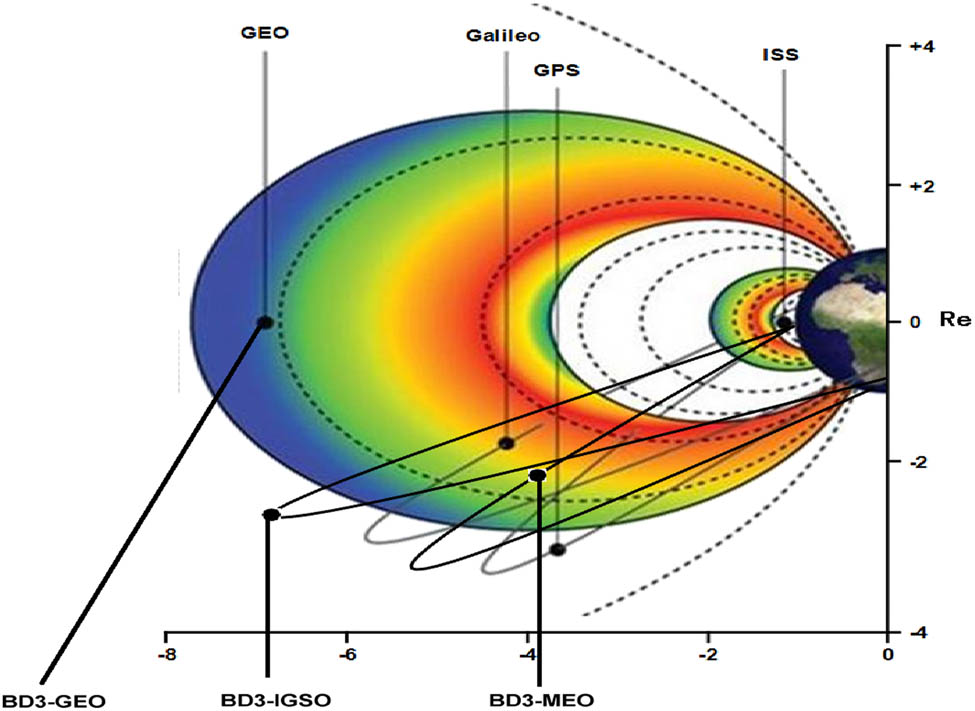
Schematic diagram of the relative position of the navigation satellite orbit and the radiation belt (Horne et al. 2013). (Note: X/Y-axis is Earch radius, the solid line represents the track of different orbit, the color distribution present is particles flux).
Among the Beidou navigation satellites, the orbit altitude of MEO satellite is about 22,000 km and the inclination angle is 55°, and it passes through the central area of the outer radiation belt continuously. With the changing of in orbital position, the radiation intensity is also constantly changing. The high-energy electron spectrum in this region is harder than that of the GEO, and the radiation level is greatly affected by magnetic field disturbance. These satellites are subject to complex effects such as total dose, surface charging and internal charging. Satellites operating in the geomagnetic field will be affected by a variety of charged particles, and the types and energy of particles will change with the difference in satellite orbits and changes in the magnetic field strength (Iucci et al. 2005). In physical research, according to the satellite orbit difference, usually combined with the geomagnetic field model, input the number of orbits, use L-B coordinates to describe the radiation characteristics under different magnetic field parameters, and simulate the B–L values of the three orbital planes of GEO, MEO and LEO; the results are shown in Figure 2.

L-value change curve experienced by navigation satellite in 1 day.
2.2 The disturbance characteristics of orbital radiation environment
Figure 2 shows that navigation satellites are usually operating in MEO, IGSO and GEO orbits. GEO is always immersed in the outer radiation belt. In comparison, the L value of IGSO is larger, and the radiation belt has little influence on it. Most MEO satellites pass through the central area of the outer radiation belt twice a day, and are in the outer radiation belt for about two-thirds of the time (16 h), and they face more intensive radiation environment. Affected by solar activity and geomagnetic field, the temporal and spatial variation of the disturbance in the outer radiation belt is intense. In this study, the measured results of the high-energy electron detectors on-board the Beidou II satellite during the 23 solar activity peak years were selected. From 2012 to 2014, the E1 energy channel of the detector (0.5–0.6 MeV) and ≥1.8 MeV were obtained, the integrated energy channel measurement results show that there are great differences in the occurrence frequency and duration of high-energy electrons in different energy groups. During the large geomagnetic storm that occurred from March 17 to 19, 2015, the flux of high-energy electron in the Beidou orbit has increased. During this period, many satellite charging anomalies occurred, the corresponding time and radiation environment are shown in Figure 3.

Relationship between satellite anomalies and solar storm high-energy particle flux in 2015 (Note: Nomalies refer to satellite anomaly information induced by space environment anomaly at corresponding time; Ee and Ep are the electron integral fluxes above 2 MeV and proton integral fluxes above 10 MeV obtained by GOES-13 satellite. Ap is the index of global diurnal geomagnetic disturbance intensity.).
2.3 On-orbit satellite anomalies caused by space radiation environment
From 1984 to 1992, NOAA/SEC recorded a total of 954 GPS on-orbit anomalies, most of which were caused by single event effects and charge–discharge effects (Hajra and Tsurutani 2018). The degradation of the solar arrays of US GPS satellites has been faster than expected. Studies have shown that in addition to the contribution of displacement damage, and the pollution generated by the surface discharge of the solar array is considered as one of the possible effects. During the solar storm in March 2012, the probability of a single event flip in the Giove-A satellite OBC386 computer device increased by as much as ten times compared to the usual (Jung and Choi 2018).
Through the on-orbit analyzing 992 satellite anomalies of early stage Beidou satellite, related to deep charging events from January 2013 to October 2016 was counted, it can be accessed at the link: https://dx.doi.org/10.12176/05.99.00835, which have been analyzed and confirmed by multiple agencies. It was found that 80% of the events were induced by the space radiation environment, of which the number and level of high-energy electron burst events in a given period time were obtained from the space environment prediction network (http://www.sepc.ac.cn/alerts_chn.php) of Chinese Academic Science. The space environment is currently an important factor affecting the safety of satellites in orbit. For example, during the large geomagnetic storm from March 17 to 19, 2015, the monitoring parameters of Beidou orbit high-energy electronic environment increased by nearly three orders of magnitude and more than 15 anomalies occurred on the satellite platform within 2 days (Figure 3 for the time of anomalies occurrence and the orbital high-energy electron flux) (Yang et al. 2019). It can be seen from the figure that during the high-energy electron burst, the number of satellite anomalies increased significantly, and the risk characteristics of the Beidou satellite space environment conform to conventional cognition and physical laws. Strengthening high-energy electron enhanced monitoring is an important support for satellite on-orbit safety (Quan et al. 2022).
3 Status and highlight of GPS and Galileo navigation satellite space environment monitoring
Since 2000, the Los Alamos laboratory has deployed X-ray and dose detectors (CXD) on GPS satellites, and it is reported that 21 of all 31 GPS satellites in orbit are currently carrying CXD detectors. Each detector is equipped with a wide range of electron and proton energy spectra. These data have been released to the scientific community for validation of space weather models, improving space weather forecasting and situational awareness. The United States also carries space environment monitoring detectors on 24 GPS satellites, and the general situation is as follows.
The first generation of detectors is called the BDD and X-ray detector. In each of the 24 GPS satellites, one of the six GPS satellites is equipped with BDD, and the remaining five are equipped with X-ray detectors. The BDD-1 is equipped with four electrons and four protons, and the two ranges cover the energy range of 0.3–2 MeV. They are installed on the GPS test stars NS08 and NS10 (1983–1992); GPS began to form a network in 1989. The improved BDD-2 began to be deployed on satellites such as NS18, NS24, NS28, NS33, NS39 (beginning in 1990), and BDD-2 measured seven electrons and four protons, with an energy range of 0.25 to >5 MeV.
At present, the current GPS Block IIR is contracted to deploy particle spectrometers on 21 satellites to measure eight energy channel electrons from 80 keV to 6 MeV, and eight energy channel protons from 2 to 60 MeV. The latest detector integrates radiometer and X-ray, called CXD, which will be deployed on all 24 GPS satellites. It can detect electrons in 13 energy channels from 80 keV to 7.6 MeV, protons with three energy channels from 1.3 to 54.1 MeV.
The European Galileo satellite is also equipped with a similar payload, the MERLIN detector is a typical one for measuring heavy ions, its linear energy transform (LET) spectrum can cover 0.1 to >20 MeV/(mg/cm2), with 40–100 MeV protons, internal charges and total dose detection capabilities. High-energy electronic monitors are also included on the SREM, with energy ranges >0.8, >2, and >2.8 MeV.
It can be seen from the above that it is a common practice in the world to obtain environmental data with high spatial and temporal resolution based on navigation satellites. The United States has deployed a large number of space environment detectors on GPS satellites, and through long-term detection, has acquired a large amount of environmental data to support applications in multi-mission applications.
4 Systematic orbits layout of joint monitoring system based on global navigation constellation
According to the characteristics of the orbital space radiation environment of Beidou navigation satellites and the main radiation effect threats, draw lessons from the US GPS satellite and Galileo satellite space radiation environment detection experience, and refer to the Beidou satellite anomaly information to set up scientific research target and detector configuration scheme.
4.1 The main scientific goals of Beidou navigation satellite space environment
In order to deeply understand the distribution of typical parameters and disturbance characteristic of the Beidou orbital space environment, it is necessary to realize joint monitoring with environment and effect, so as to meet the needs of joint research on understanding the temporal and spatial changes of the space environment in medium and high orbits and the laws of solar activity events, to identify the enhancement of high-energy electrons in medium and high orbits and their impact on satellites. The specific scientific objectives involved are as follows:
In view of the characteristics of the constellation, such as multiple orbital types (including GEO, IGSO, MEO, etc.), frequent particle radiation disturbance, wide energy spectrum, complex space–time correlation, high-energy proton and high-energy electron monitoring loads covered by wide energy spectrum are deployed in the monitoring to support the following studies:
Through data accumulation, study and analyze the latitude distribution, local time distribution, and radial distribution of particle energy spectrum, and constantly update and improve the level of understanding.
Support the study of long-term evolution laws such as the solar activity cycle, through long-term data accumulation.
In view of the space weather events, accumulate data sample under different disturbance conditions, especially under the extreme event condition, enhance the quantitative research level of the disaster events.
Space–time coupling analysis, multi-satellite cooperation realizes comprehensive and three-dimensional monitoring of severe disturbances or catastrophic space environment event, eliminating the interference caused by time–space coupling to quantitative research.
Through the study of the above theories and laws, the understanding of the radiation environment of particles in medium and high orbits will be comprehensively improved, and the research on the distribution of radiation belts with multi-dimensional space–time resolution will be supported.
In order to improve the accuracy of prediction, the temporal chain variation and driving parameter characteristics of particle radiation are studied. The particle radiation in this orbit mainly comes from the earth’s radiation belt, solar proton events and galactic cosmic rays.
Priori information for the satellite “killer electron” enhanced event prediction.
Carry out research on the mechanism of particle radiation impact on satellites to support satellite anomalies diagnosis and quantitative assessment. Space particle radiation can induce effects such as total dose, single particle and deep charge–discharge, which seriously threaten the performance of spacecraft, and even affect the life of satellites in orbit. However, the quantitative relationship and effects between the particle radiation environment and the above effects still need to be further studied. By using the resources of the satellite, the space environment and effect-monitoring detector can be carried on the same satellite to realize the coordinated monitoring of environment and effect, which can provide support for the research of radiation effect mechanism. The research results will greatly improve the ability of anomalies analysis and location and ground simulation, and support the follow-up protection upgrade of satellites and the improvement of environmental anomaly diagnosis.
Carry out research on new phenomena and new theories, and promote the development of space weather theory. The middle and high orbit is located in the center and outer edge of the earth’s outer radiation belt. It is not only the most active area of the earth’s radiation belt, but also the key area of the dynamic evolution of the earth’s radiation belt. In particular, the radiation environment of MEO particles is bad, and there are few scientific detection data. For this reason, using this loading condition, comprehensive particle radiation environment detection can be carried out in this area, which provides data support for studying the distribution and disturbance of the radiation environment in this area, and is conducive to promoting the development of space physics and space weather theory.
4.2 Detector configuration and parameter requirements
Focusing on the main environmental elements affecting medium and high-orbit satellites and the need for effect monitoring, referring to past satellite anomaly information, we have prioritized the design of the following three sets of detectors: namely orbital electronics and deep charging risk monitoring detectors, high-energy protons and single event risk monitoring detectors, plasma and surface charging risk monitoring detectors. In order to meet the needs of environmental science and impact effect research, each detector can achieve full causal chain monitoring from environmental parameters to environmental effects.
4.2.1 Electrons and deep charging risk monitoring in orbit
The electron flux captured by the navigation satellite orbit is very high. For example, the flux of electrons with energy greater than 0.04 MeV exceeds 1 × 10¹²/(cm2 day), and the energy spectrum of the solar maximum and minimum is almost the same. The solar activity is closely related, and the electron flux fluctuates greatly with time, and even fluctuates by more than an order of magnitude in more than 10 min. In case of large space environment disturbance events, such as solar flare explosion, solar coronal mass ejection, geomagnetic storm or geomagnetic sub-storm, a large number of high-energy electrons can be injected from the magnetotail into the geostationary orbit or even the orbit with lower altitude, which often greatly increases the flux of electrons (relativistic electrons) with energy greater than 1 MeV in the earth’s radiation belt (Miyake et al. 2007). In these orbits, the charged particle radiation environment of GEO and IGSO satellites is relatively close, but the MEO orbit is close to the central area of the extraterrestrial radiation belt, and its charged particle radiation environment is worse than that of GEO and IGSO. Because the MEO satellite passes through the outer radiation belt four times a day, each time it crosses the radiation belt, the satellite is outside the radiation belt for about 2 h. Affected by the solar wind squeezing the Earth’s magnetic field, orbiting electrons show strong spatial and temporal distribution differences with magnetic field disturbances, and high-energy electron bursts of varying degrees occur, lasting from a few hours to a dozen of days, which increases the risk of satellite charging. In the design, it is necessary to ensure that at any time, there are two satellites in the radiation belt, and there are local time differences, so as to achieve continuous monitoring of high-energy electronic disturbance risks, and the four satellites are arranged in combination with two orbit surface parameters and L-value (L = 3–8) parameters. In this way, at least two satellites in the radiation belt can be detected in two different places most of the time, satisfying the spatial distribution of the latitude with different L-values, and realizing the continuous monitoring of the characteristics of electronic parameters in the local time, at the same time, the magnetic field monitor is equipped to meet the application demand of high-energy electronic forecast and early warning.
The central location of the outer radiation belt is 3–4 Re, the 22,000 km altitude of the Beidou satellite (just at the central location of the outer radiation belt), where there is a large concentration of high- and medium-energy electrons, and the radiation dose at this orbit is about 10–40 Rad/day. At quiet period in space environment, when there is a disturbance in the magnetosphere, a large number of high-energy electrons will enter the satellite orbit, further increasing the total radiation dose in a short event.
Through the joint monitoring of medium and high-energy electrons and satellite deep charging potential, we can obtain the evolution of medium and high-energy electron energy spectrum in orbital space with time and space distribution, and master the process data of satellite deep charging distribution and evolution. The index settings are as follows:
The energy range of electrons is 30 keV to 5.8 MeV. It has the function of particle direction recognition. Its energy channel and other parameter settings are similar to those carried by GPS, which is convenient for data comparison and application.
Particle flux (≥2 MeV): range 102 to 107/(cm2 Sr s), sensitivity 5% (ΔN/N).
Deep charging potential: 0–300 V, accuracy 1 V.
Space magnetic field measurement: −1,500 to +1,500 nT, accuracy is 0.1 nT, direction resolution capability is supporting dynamic monitoring of high-energy electron pitch angle.
4.2.2 High-energy proton and single event effect risk monitoring
The Beidou satellite orbit is mainly located in the outer radiation belt, where the flux of high-energy protons is low. However, during the solar proton event, high energy proton can easily enter the middle-high orbit and affect the satellite in the form of single-event effects, so in the MEO and GEO orbits, it is necessary to monitor not only the flux and energy spectrum of electrons, but also the radiation effects of the solar proton event. Solar mass ejections produce a large number of high-energy protons and heavy ions, which have the characteristics of randomness, and can cause drastic changes of particles in the orbit of navigation satellites. Previous observations have shown that solar proton events often occur during the peak years of solar activity, and also occur occasionally during the low years of solar activity. Therefore, obtaining high-energy protons in orbit and their impact should be paid attention to for a long time in the orbit of navigation satellites. At the same time, high heavy ions could cause single-event effects, so heavy ions in solar energetic proton and galactic cosmic ray are also important factor. Based on the above analysis, high-energy proton spectrum and linear energy transfer (LET) spectrum can provide support to the evaluation, prediction and diagnosis of satellite single-event effects. It is necessary to monitor the proton environment, single particle event, magnetic field and total radiation dose of the Beidou orbital to realize joint monitoring of the space environment and effects, the indicators are set as follows:
The energy range of high-energy proton: 3–300 MeV. Its energy channel and other parameter settings are similar to those carried by GPS, which is convenient for data accuracy comparison.
Particle flux (≥10 MeV): 10–104 pfu, sensitivity 5% (ΔN/N)
Particle LET spectrum: 0.1–100 MeV/(mg/cm2)
Single event effect detection: meet the detection needs of on orbit turnover times of typical devices.
4.2.3 Plasma and surface charging risk monitoring
When the satellite passes through the space plasma region, it is inevitable that electrons or ions with the same charge will be adsorbed on the satellite surface, which will induce the satellite to have abnormal surface potential and even partial discharge. It can be seen from the above research that at present, there are few studies on low-energy (<50 keV) plasma detection in the field of space weather, and there is a lack of on orbit detection data. In the risk perception of the satellite operating environment, the orbital surface plasma environment, surface charging effect and total radiation dose can be jointly detected to obtain related data such as plasma density, temperature and energy spectrum distribution on the satellite surface and the absolute charge of the satellite body, which are supported by scientific research as follows: First, the detectors are used to study the relationship between the electrification effect on the satellite surface and the plasma environment and satellite protection (Redmon et al. 2017; Matéo-Vélez et al. 2019), to support the diagnosing of suspected charging and discharging anomalies of Beidou satellites in orbit and to improve the protection of satellites. Second, the detectors are used to support space research on physical distribution and disturbance characteristics of plasma. The third is to support the research on the physical distribution and disturbance characteristics of space plasma. According to the above detection design, the index design is as follows:
The density range of plasma electrons and ions: 104 to 108 m−3.
Electron and ion energy range of plasma: 10 eV to 20 keV.
Plasma detection field of view: 360°.
Surface unequal potential: −10 to 1 kV, accuracy 10 V.
5 Outlook of scientific application with monitoring data
The data of middle and high orbit space environment and satellite anomalies provided by the Beidou Global Navigation Satellite can be combined with GPS satellite and Fengyun series satellite detection data to enhance the understanding of space–time coverage of middle and high orbit environment monitoring, which is conducive to the following scientific research (Wang et al. 2018; Reeves et al. 2013; Horne et al. 2015). Fengyun 4(A/B) satellite a GEO satellite and Fengyun 3E satellite is a polar orbit solar synchronous satellite, and both of them have high energy particle monitors.
Providing monitoring data of proton, electron and plasma to the study of outer radiation belt distribution and perturbation mechanism.
Supporting studies on magnetospheric substorm particle injection and substorm models, magnetospheric particle acceleration and loss mechanisms, etc.
Combined with monitoring parameters such as solar magnetic field images, interplanetary solar wind, radiation belt distribution, etc., many events such as plasma storms and high-energy protons can be predicted.
Comprehensive use of monitoring data such as space environment and effects, solar activity parameters, and geomagnetism will identify the environmental risks of satellite in-orbit operation, and support satellite in-orbit risk management and environmental protection reinforcement.
Acknowledgements
The authors would like to thank the builders of Beidou satellite project and space environment detectors for their technical support and help. They would also like to thank the anonymous reviewers for many helpful suggestions.
-
Funding information: This research was funded by the National Natural Science Foundation of China, grant number U21B2050, and also funded by Social Science Foundation of China, grant number 2022-SKJJ-B-062.
-
Author contributions: All authors have accepted responsibility for the entire content of this manuscript and approved its submission.
-
Conflict of interest: Authors state no conflict of interest.
References
Daly EJ, Buhler P, Kruglanski M. 1999. Observations of the outer radiation belt with REM and comparisons with models. IEEE Trans Nucl Sci. 46(6):1469–1474. 10.1109/23.819109.Search in Google Scholar
Hajra R, Tsurutani BT. 2018. Magnetospheric “killer” relativistic electron dropouts (reds) and repopulation: a cyclical process. In: Buzulukova editor. Extreme Events Geospace: Origins Predictability Consequences. Amsterdam, The Netherlands: Elsevier. p. 373–400. 10.1016/B978-0-12-812700-1.00014-5.Search in Google Scholar
Horne RB, Glauert SA, Meredith NP, Boscher D, Maget V, Heynderickx D, et al. 2013. Space weather impacts on satellites and forecasting the Earth’s electron radiation belts with SPACECAST. Space Weather. 11:169–186. 10.1002/swe.20023.Search in Google Scholar
Horne RB, Thorne RM, Shprits YY, Meredith NP, Glauert SA, Smith AJ, et al. 2015. Wave acceleration of electrons in the Van Allen radiation belts. Nature. 437:227–230. 10.1038/nature03939.Search in Google Scholar PubMed
Iucci N, Levitin AE, Belov AV, Eroshenko EA, Ptitsyna NG, Villoresi G, et al. 2005. Space weather conditions and spacecraft anomalies in different orbits. Space Weather Int J Res Appl. 3(1):1–16. 10.1029/2003SW000056.Search in Google Scholar
Jung S, Choi JP. 2018. Predicting system failure rates of SRAM-based FPGA on-board processors in space radiation environments. Reliab Eng Syst Saf. 183:374–386. 10.1016/j.ress.2018.09.015.Search in Google Scholar
Matéo-Vélez JC, Paulmier T, Sicard A, Dirassen B, Payan D. 2019. Experimental investigation of surface potentials of materials under electron spectra representative of GEO and MEO worst case environments. Plasma Sci IEEE Trans Plasma Sci. 47(8):3883–.890. 10.1109/TPS.2019.2925413.Search in Google Scholar
Marov MY. 2020. Radiation and space flights safety: an insight. Acta Astronauti. 176:580–590. 10.1016/j.actaastro.2020.03.022.Search in Google Scholar
Miyake H, Honjoh M, Maruta S, Tanaka Y, Takada T, Koga K, et al. 2007. Space charge accumulation in polymeric materials for spacecraft irradiated electron and proton. Conference on Electrical Insulation & Dielectric Phenomena. 2007 Oct 14–17; Vancouver (BC), Canada. IEEE, 2008. p. 763–66. 10.1109/CEIDP.2007.4451611.Search in Google Scholar
Morley SK, Sullivan JP, Henderson MG, Blake JB, Baker DN. 2016. The Global Positioning System constellation as a space weather monitor: comparison of electron measurements with Van Allen Probes data. Space Weather. 14:76–92. 10.1002/2015SW001339.Search in Google Scholar
Quan L, Liu YN, Li L, Wang D, Wang K, Xue L, et al. 2022. Study on matching between environmental warning information and spacecraft anomalies. J Spacecr Rocket. 59(2):1455–62. 10.2514/1.A35173.Search in Google Scholar
Redmon RJ, Rodriguez JV, Gliniak C, Denig WF. 2017. Internal charge estimates for satellites in low earth orbit and space environment attribution. IEEE Trans Plasma Sci. 45(8):1985–1997. 10.1109/TPS.2017.2656465.Search in Google Scholar
Reeves GD, Spence HE, Henderson MG, Morley SK, Friedel RHW, Funsten HO, et al. 2013. Electron acceleration in the heart of the Van Allen radiation belts. Science. 341(6149):991–994. 10.1126/science.1237743.Search in Google Scholar PubMed
Ryden KA, Dyer CS, Morris PA, Haine RA, Jason S. 2004. The merlin space weather monitor and its planned flight on the Galileo System Testbed Satellite (GSTB-V2/A). 55th International Astronautical Congress. 2004 Oct 4–8; Vancouver (BC), Canada. IAC, 2004.Search in Google Scholar
Thorne RM, Li W, Ni B, Bortnik MJ, Chen L, Baker DN, et al. 2013. Rapid local acceleration of relativistic radiation-belt electrons by magnetospheric chorus. Nature. 504:411–414. 10.1038/nature12889.Search in Google Scholar PubMed
Wang J, Hu Y, Yu D, Cai Z, Zhang Q. 2018. Electron environment characteristics and internal charging evaluation for MEO satellite. IEEE Trans Nucl Sci. 65(8):1685–1693. 10.1109/TNS.2018.2792049.Search in Google Scholar
Xie J, Kang CB. 2021. Engineerging innovation and the development of the BDS-3 navigation constellation. Engineer. 2021(7):558–563. (in Chinese)10.1016/j.eng.2021.04.002Search in Google Scholar
Xia Y. 2021. Development and application of Beidou satellite navigation system. Electron Technol Softw Eng. 16:25–26. (in Chinese)Search in Google Scholar
Yang S, Qin X, Li D, Tang D, Shi L. 2019. Basic theory of satellite charging and discharging effect. Beijing Inst Technol Press. (in Chinese)Search in Google Scholar
© 2023 the author(s), published by De Gruyter
This work is licensed under the Creative Commons Attribution 4.0 International License.
Articles in the same Issue
- Research Articles
- Deep learning applications for stellar parameter determination: II-application to the observed spectra of AFGK stars
- Braking and attitude control of lunar lander in active descent stage
- Ka/C dual frequency ranging system for ocean altimetry satellite and analysis of ionospheric error
- Necessary condition for temporary asteroid capture
- A holistic study of the systems V0487 Lac, V0566 Hya, and V0666 Lac
- Review Article
- Light curve analysis of main belt asteroids 4747, 5255, 11411, 15433, 17866
- Special Issue: New Technology for Space Environment Detection Based on Beidou Constellation
- Guest Editorial: Special Issue of New Technology for Space Environment Detection Based on Beidou Constellation
- Medium and high energy electron detectors onboard BeiDou navigation satellite in MEO
- An outlier detection method with CNN for BeiDou MEO moderate-energy electron data
- A low-energy ion spectrometer with large field of view and wide energy range onboard a Chinese GEO satellite
- High-energy proton detector based on semiconductor telescope
- Radiation dosimeter and charge detector onboard BeiDou navigation satellites in MEO
- Design and validation of a space plasma environment detector for BeiDou navigation satellite
- Surface charging and dose monitor on geosynchronous orbit satellite
- Monitor of the single event upsets and linear energy transfer of space radiation on the Beidou navigation satellites
- Radiation environment and effect detection based on global navigation constellation
- An ion beam system for calibration of space low-energy ion detectors
- Special Issue: Modern Stellar Astronomy 2022
- Crossmatching of high-proper motion L, T, and Y brown dwarfs with large photometric surveys
- Magnetic fields with random initial conditions in discs with Kepler rotation curve
- Far-IR emission from bright high-redshift quasars
- A new version of the binary star database BDB: Challenges and directions
- Dust and gas in star-forming complexes in NGC 3351, NGC 5055, and NGC 5457
- Investigation of the halo effect in the evolution of a nonstationary disk of spiral galaxies
- Special Issue: Astromineralogy and cosmochemistry of the Kaba meteorite
- Clay minerals and other hydrous alteration products in the Kaba meteorite: Review of the literature and new XRD investigations
- Special Issue: The Hubble Tension: Current Research and New Perspectives
- Late-time dark energy and Hubble tension
- The history of the Cosmos: Implications for the Hubble tension
Articles in the same Issue
- Research Articles
- Deep learning applications for stellar parameter determination: II-application to the observed spectra of AFGK stars
- Braking and attitude control of lunar lander in active descent stage
- Ka/C dual frequency ranging system for ocean altimetry satellite and analysis of ionospheric error
- Necessary condition for temporary asteroid capture
- A holistic study of the systems V0487 Lac, V0566 Hya, and V0666 Lac
- Review Article
- Light curve analysis of main belt asteroids 4747, 5255, 11411, 15433, 17866
- Special Issue: New Technology for Space Environment Detection Based on Beidou Constellation
- Guest Editorial: Special Issue of New Technology for Space Environment Detection Based on Beidou Constellation
- Medium and high energy electron detectors onboard BeiDou navigation satellite in MEO
- An outlier detection method with CNN for BeiDou MEO moderate-energy electron data
- A low-energy ion spectrometer with large field of view and wide energy range onboard a Chinese GEO satellite
- High-energy proton detector based on semiconductor telescope
- Radiation dosimeter and charge detector onboard BeiDou navigation satellites in MEO
- Design and validation of a space plasma environment detector for BeiDou navigation satellite
- Surface charging and dose monitor on geosynchronous orbit satellite
- Monitor of the single event upsets and linear energy transfer of space radiation on the Beidou navigation satellites
- Radiation environment and effect detection based on global navigation constellation
- An ion beam system for calibration of space low-energy ion detectors
- Special Issue: Modern Stellar Astronomy 2022
- Crossmatching of high-proper motion L, T, and Y brown dwarfs with large photometric surveys
- Magnetic fields with random initial conditions in discs with Kepler rotation curve
- Far-IR emission from bright high-redshift quasars
- A new version of the binary star database BDB: Challenges and directions
- Dust and gas in star-forming complexes in NGC 3351, NGC 5055, and NGC 5457
- Investigation of the halo effect in the evolution of a nonstationary disk of spiral galaxies
- Special Issue: Astromineralogy and cosmochemistry of the Kaba meteorite
- Clay minerals and other hydrous alteration products in the Kaba meteorite: Review of the literature and new XRD investigations
- Special Issue: The Hubble Tension: Current Research and New Perspectives
- Late-time dark energy and Hubble tension
- The history of the Cosmos: Implications for the Hubble tension
