Pretreatment with opioids enhances afferent induced long-term potentiation in the rat dorsal horn
-

Objectives
Opioids are increasingly used against chronic nonmalignant pain. Long-term opioid treatment may be associated with the development of hyperalgesia. Long term facilitation (LTF) of C-fibre evoked firing of wide dynamic range neurons in the spinal dorsal horn in response to conditioning stimulation (CS) of afferent fibres is a widely studied cellular model of spinal nociceptive sensitization. In a rat model with recording of single neurone responses we have previously demonstrated that seven days of opioid pretreatment enhances the stimulus-evoked LTF (Fig. 1, Haugan 2008 [1]). In this study we looked at the effect of long-term pretreatment with morphine on longterm potentiation (LTP) of C-fibre evoked dorsal horn field potentials, a widely used model of spinal hyperexcitability.
Methods
Female rats (Sprague-Dawley, n = 16) were implanted with subcutaneous Alzet mini-osmotic pumps during short-lasting Isoflurane anaesthesia. The rats were randomised to either s.c. infusion of morphine (20 mg/kg/d) or saline (NaCl 9 mg/ml) and blinded to the experimenter. After 7 days the rats were anaesthetised with intraperitoneal urethane (1.4–1.65 g/kg). C-fibre evoked field potentials in the spinal cord dorsal horn were recorded at the level of segments L4-L5. Both the potentiating stimulation (100 Hz, 4 trains, each train 2 s duration, 10 s intervals) and the test stimulation (single stimuli) were given to the sciatic nerve at C-fibre strength.
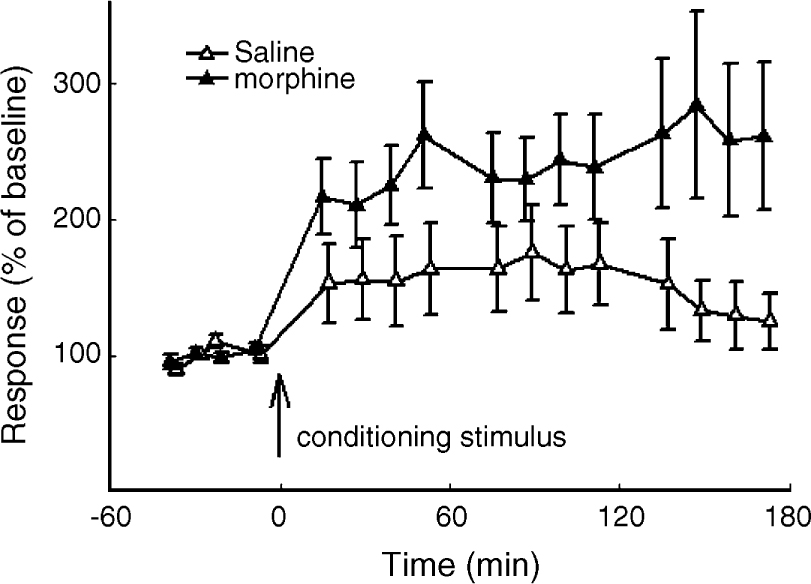
Extracellular single unit recordings. From Haugan (2008).
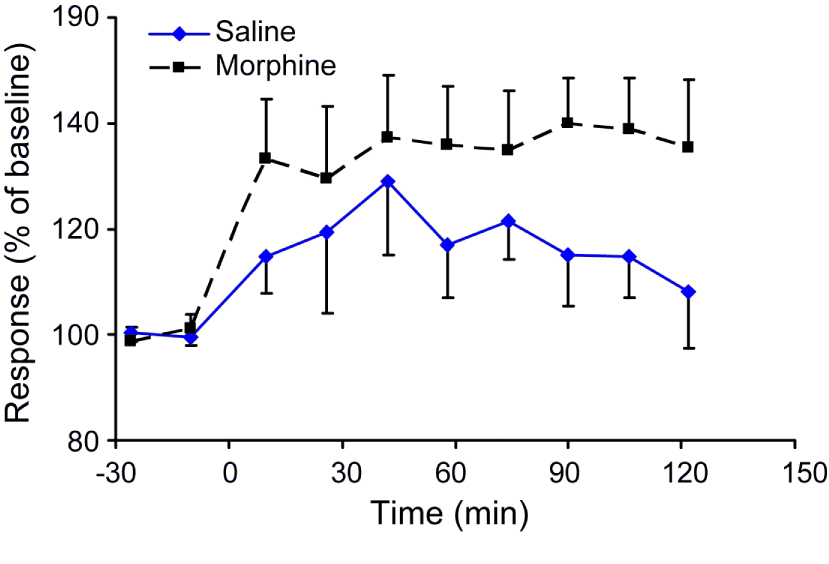
Field potentials after conditioning stimulation after treatment with morphine or saline.
Results
There was a tendency that seven days of morphine pretreatment increased the potentiation of C-fiber evoked field potentials by conditioning stimulation compared to the saline group (Fig. 2).
Conclusion
Our results support our previous findings and indicate that animals treated with long term opioid show amplification of stimulus-induced central sensitisation compared to opioid naïve animals.
References
[1] Haugan F, Rygh LJ, Tjølsen A. Ketamine blocks enhancement of spinal long-term potentiation in chronic opioid treated rats. Acta Anaesthesiol Scand 2008;52:681-7.Search in Google Scholar
© 2010 Scandinavian Association for the Study of Pain
Articles in the same Issue
- Editorial comment
- Functional brain imaging of acute postoperative pain
- Clinical pain research
- Brain activation due to postoperative pain from the right hand measured with regional cerebral blood flow using positron emission tomography
- Editorial comment
- Long-term low-dose transdermal buprenorphine therapy for chronic noncancer pain
- Original experimental
- A 6-months, randomised, placebo-controlled evaluation of efficacy and tolerability of a low-dose 7-day buprenorphine transdermal patch in osteoarthritis patients naïve to potent opioids
- Editorial comment
- Repeated nociceptive stimulation for detecting drug effects
- Original experimental
- The effects of gabapentin in human experimental pain models
- Editorial comment
- Whether the weather influences pain: High prevalence of chronic pain in Iceland and Norway: Common genes? Or lack of sunshine and vitamin D?
- Observational studies
- A population based study of the prevalence of pain in Iceland
- Editorial comment
- Swedish nurses are prone to chronic shoulder and back pain because of miserable working conditions and poor leadership?
- Observational studies
- Predicting of pain, disability, and sick leave regarding a non-clinical sample among Swedish nurses
- Abstracts
- Trigeminal neuralgia or odontogenic pain
- Abstracts
- What’s wrong with animal models of pain?
- Abstracts
- Immunotherapy for neuroblastoma elicits a complement dependent whole body allodynia
- Abstracts
- Pain mechanisms in animal models of rheumatoid arthritis
- Abstracts
- Translating basic research to pharmacological treatment of neuropathic pain
- Abstracts
- Free Poster Presentations: Forearm heat pain does not inhibit electrically induced tibialis anterior muscle pain
- Abstracts
- Offset analgesia evoked by non-contact thermal stimulator
- Abstracts
- Inhibition of FAAH reverses spinal LTP
- Abstracts
- Hyperexcitable C-nociceptors in human paroxysmal pain
- Abstracts
- Pain sensitivity and experimentally induced sensitization in red haired women
- Abstracts
- How are opioids used in Norway? Persistent use, utilization of depot formulation and age profile in non-palliation patients
- Abstracts
- To which extent does incident and persistent use of weak opioids predict problematic opioid use?
- Abstracts
- Is transdermal buprenorphine for chronic non-malignant pain used long term without co-medication with other potentially addictive drugs?
- Abstracts
- Prostaglandin E2 production in synovial tissue and acute postoperative pain after knee arthroscopy
- Abstracts
- Girl presenting with oesophageal spasm pain after fundoplication
- Abstracts
- Epidemiology of persistent postoperative pain: Association of persistent pain and sensory abnormalities
- Abstracts
- Cost–benefit of a 13-week multidiciplinary rehabilitation course for chronic non-malignant pain patients
- Abstracts
- A novel and effective treatment modality for medically unexplained pain
- Abstracts
- Somatocognitive therapy in the management of chronic gynaecological pain. A review of current approach and historical background
- Abstract
- The Manual Intervention Trial (MINT)—The effect of various combinations of naprapathic manual therapy. The study protocol of a randomized controlled trial
- Abstracts
- The experience of chronic pain, loss and grief
- Abstracts
- Effect of buprenorphine and fentanyl in experimental induced superficial, deep and hyperalgesic pain
- Abstract
- Pretreatment with opioids enhances afferent induced long-term potentiation in the rat dorsal horn
- Abstracts
- Pigs in pain—Porcine behavioural responses towards mechanical nociceptive stimulation directed at the hind legs
- Abstracts
- A human experimental bone pain model
Articles in the same Issue
- Editorial comment
- Functional brain imaging of acute postoperative pain
- Clinical pain research
- Brain activation due to postoperative pain from the right hand measured with regional cerebral blood flow using positron emission tomography
- Editorial comment
- Long-term low-dose transdermal buprenorphine therapy for chronic noncancer pain
- Original experimental
- A 6-months, randomised, placebo-controlled evaluation of efficacy and tolerability of a low-dose 7-day buprenorphine transdermal patch in osteoarthritis patients naïve to potent opioids
- Editorial comment
- Repeated nociceptive stimulation for detecting drug effects
- Original experimental
- The effects of gabapentin in human experimental pain models
- Editorial comment
- Whether the weather influences pain: High prevalence of chronic pain in Iceland and Norway: Common genes? Or lack of sunshine and vitamin D?
- Observational studies
- A population based study of the prevalence of pain in Iceland
- Editorial comment
- Swedish nurses are prone to chronic shoulder and back pain because of miserable working conditions and poor leadership?
- Observational studies
- Predicting of pain, disability, and sick leave regarding a non-clinical sample among Swedish nurses
- Abstracts
- Trigeminal neuralgia or odontogenic pain
- Abstracts
- What’s wrong with animal models of pain?
- Abstracts
- Immunotherapy for neuroblastoma elicits a complement dependent whole body allodynia
- Abstracts
- Pain mechanisms in animal models of rheumatoid arthritis
- Abstracts
- Translating basic research to pharmacological treatment of neuropathic pain
- Abstracts
- Free Poster Presentations: Forearm heat pain does not inhibit electrically induced tibialis anterior muscle pain
- Abstracts
- Offset analgesia evoked by non-contact thermal stimulator
- Abstracts
- Inhibition of FAAH reverses spinal LTP
- Abstracts
- Hyperexcitable C-nociceptors in human paroxysmal pain
- Abstracts
- Pain sensitivity and experimentally induced sensitization in red haired women
- Abstracts
- How are opioids used in Norway? Persistent use, utilization of depot formulation and age profile in non-palliation patients
- Abstracts
- To which extent does incident and persistent use of weak opioids predict problematic opioid use?
- Abstracts
- Is transdermal buprenorphine for chronic non-malignant pain used long term without co-medication with other potentially addictive drugs?
- Abstracts
- Prostaglandin E2 production in synovial tissue and acute postoperative pain after knee arthroscopy
- Abstracts
- Girl presenting with oesophageal spasm pain after fundoplication
- Abstracts
- Epidemiology of persistent postoperative pain: Association of persistent pain and sensory abnormalities
- Abstracts
- Cost–benefit of a 13-week multidiciplinary rehabilitation course for chronic non-malignant pain patients
- Abstracts
- A novel and effective treatment modality for medically unexplained pain
- Abstracts
- Somatocognitive therapy in the management of chronic gynaecological pain. A review of current approach and historical background
- Abstract
- The Manual Intervention Trial (MINT)—The effect of various combinations of naprapathic manual therapy. The study protocol of a randomized controlled trial
- Abstracts
- The experience of chronic pain, loss and grief
- Abstracts
- Effect of buprenorphine and fentanyl in experimental induced superficial, deep and hyperalgesic pain
- Abstract
- Pretreatment with opioids enhances afferent induced long-term potentiation in the rat dorsal horn
- Abstracts
- Pigs in pain—Porcine behavioural responses towards mechanical nociceptive stimulation directed at the hind legs
- Abstracts
- A human experimental bone pain model
