Nonlocal electrodynamics of two-dimensional anisotropic magnetoplasmons
-
André J. Chaves
 ,
Line Jelver
,
Diego R. da Costa
,
Joel D. Cox
,
N. Asger Mortensen
,
Line Jelver
,
Diego R. da Costa
,
Joel D. Cox
,
N. Asger Mortensen
 and
Nuno M.R. Peres
and
Nuno M.R. Peres

Abstract
We present a hydrodynamic model, grounded in Madelung’s formalism, to describe collective electronic motion in anisotropic materials. This model incorporates nonlocal contributions from the Thomas–Fermi quantum pressure and quantum effects arising from the Bohm potential. We derive analytical expressions for the magnetoplasmon dispersion and nonlocal optical conductivity. To demonstrate the applicability of the model, we examine electrons in the conduction band of monolayer phosphorene, an exemplary anisotropic two-dimensional electron gas. The dispersion of plasmons derived from our hydrodynamic approach is closely aligned with that predicted by ab initio calculations. Then, we use our model to analyze few-layer black phosphorus, whose measured infrared optical response is hyperbolic. Our results reveal that the incorporation of nonlocal and quantum effects in the optical conductivity prevents black phosphorus from supporting hyperbolic surface plasmon polaritons. We further demonstrate that the predicted wavefront generated by an electric dipole exhibits a significant difference between the local and nonlocal descriptions for the optical conductivity. This study underscores the necessity of moving beyond local approximations when investigating anisotropic systems capable of hosting strongly confined plasmon-polaritons.
1 Introduction
The optical response of crystals is generally anisotropic due to the breaking of rotational symmetry by the discrete crystal lattice. This optical anisotropy gives rise to the phenomenon of birefringence and is crucial for various optical device concepts, owing to their ability to modulate and polarize light [1]. Although anisotropic optics is typically discussed in the context of dielectrics [2], metallic systems can also exhibit optical anisotropy in both linear [3], [4] and nonlinear responses [5], [6], [7]. At the core of light–matter interactions in metals or doped semiconductors are plasmons, which can inherit the anisotropic properties of their parent materials [4].
Recently, the advent of two-dimensional (2D) materials [8] has introduced inherent anisotropy due to the stark difference between in-plane and out-of-plane responses. For instance, insulating hexagonal-phase boron nitride (hBN) possesses two Reststrahlen bands and hyperbolic phonon polaritons in the infrared [9], even at the monolayer limit [10]. Additionally, in-plane hyperbolic phonon-polaritons are observed in the semiconductor orthorhombic alpha-phase molybdenum trioxide (α-MoO3) [11], which exhibits extremely confined modes with low damping [12]. Monoclinic crystals, such as beta-phase gallium oxide (β-Ga2O3), can support shear polaritons due to nonorthogonal principal crystal axes [13]. The phonon modes of low-symmetry crystals can hybridize with plasmons, as seen in hybridized surface plasmon–phonon polaritons in hBN/graphene heterostructures [14] and MoO3 over a gold (Au) substrate [15]. However, only the latter exhibits anisotropic plasmon–phonon dispersion due to the in-plane anisotropy of MoO3. Low-symmetry van der Waals doped semiconductors, such as black phosphorus (BP), and 2D metals like molybdenum chloride dioxide (MoOCl2), can exhibit innate anisotropic plasmons [16], [17], [18].
One of the primary applications of surface polaritons is their ability to confine light in small volumes, or equivalently, possess a high wavenumber compared to free-space radiation of the same frequency [19]. In-plane hyperbolic polaritons can exceed the limits of elliptic ones due to their unbounded isofrequency dispersion relation in reciprocal space, shaped as a hyperbola [20]. However, in the regime of high wavenumbers, nonlocal electrodynamics cannot be disregarded [21], [22], [23]. Thus, nonlocal effects are expected to be significant in describing the optical properties of surface polaritons. This conclusion has been supported by experimental observations of propagating gap surface plasmon modes in ultrathin metal–dielectric–metal planar waveguides [24], where the high wavenumber of graphene plasmons was used to access the nonlocal response of metals. Similarly, nonlocal effects have been observed in 2D plasmons in graphene-on-metal systems [25], [26].
The nonlocal response of materials can be determined using the random-phase approximation (RPA), such as the Lindhard response function or the Kubo formula for the optical conductivity, considering transitions with finite energy and momentum. These calculations can be performed within an ab initio framework [27]. Another similar approach is time-dependent density functional theory (TDDFT) [28]. However, for mesoscopic problems, such as nanostructures containing thousands of atoms, these approaches become unfeasible, necessitating further approximations. One such model is the quantum hydrodynamic model (QHM), which can capture both qualitative and quantitative aspects of nonlocality. It associates the electron liquid with a local density n(r) and a velocity field u(r), governed by the compressible Euler equations where the internal pressure has a quantum origin. One approximation for the quantum pressure is the Thomas–Fermi QHM, where the pressure is given by the degeneracy pressure of a free Fermi gas. More sophisticated approximations have been developed using density functional theory (DFT) exchange and correlation functionals [29]. The hydrodynamic model has been extensively used since the 1970s to discuss surface effects in metals [30] and more recently to describe plasmons in noble metals [31], alkali metals [32], heavily doped semiconductors [33], and 2D materials such as graphene [34] and twisted bilayer graphene [35]. The model has also been used to study nanostructures, including Au nanoparticles [36] and plasmonic gap structures [37]. The hydrodynamic model can also be used in conjunction with numerical methods for the solution of Maxwell’s equations, such as finite-difference time-domain methods (FDTD) [38], [39], finite element methods (FEM) [40], and the discontinuous Galerkin method [41], [42].
In the case of graphene, an isotropic 2D material, the hydrodynamic model has been used to describe the propagation of plasmonic wakes due to the drag of charged particles moving parallel to a graphene sheet [34], in the study of terahertz laser combs [43], and double-layer structures [44]. In the presence of a perfect conductor, the nonlocal correction in the QHD becomes increasingly important as the distance between the graphene layer and the conductor decreases [45]. However, there is limited literature on anisotropic plasmons, as pointed out in Ref. [46], which discussed the Lindhard theory for anisotropic 2D and 3D plasmons in a metal described by an effective-mass Hamiltonian. Building on our recent Madelung considerations for in-plane isotropic 2D systems [47], which we used to calculate the spectrum of magnetoplasmons, magneto-optical conductivity, nonlinear second-harmonic generation, and plasmon self-modulation for an isotropic 2D material, this manuscript aims to address the effects of nonlocality on anisotropic plasmons using hydrodynamic equations. Besides the Madelung’s formalism, the hydrodynamic model can be derived from different paths, such as using Boltzmann semiclassical theory [48] or Wigner function [49]; although those methods are not conceptually equivalent, we stress that the Madelung’s formalism is very simple and easy to obtain analytical models, as already show in Ref. [47].
The paper is organized as follows: in Section 2, we derive the hydrodynamic equations for anisotropic systems using the Madelung formalism, obtaining the dispersion relation for anisotropic plasmons and discussing the magnitude order for the plasmon wavelength that impacts each. In Section 3, we apply the formalism to characterize the optical response of doped BP, an anisotropic semiconductor. We start this section by describing first-principle calculations Section 3.1 that were used to compare with Madelung’s hydrodynamic approach Section 3.2. Then, we discuss the magnetoplasmon dispersion relation and how nonlocal effects impact the velocity field Section 3.3. In Section 3.4, we discuss the effects of nonlocality on the surface plasmon-polariton spectrum, revealing that nonlocal effects inhibit the appearance of hyperbolic modes. In Section 3.5, plasmonic wakes due to oscillating electric dipoles and the Purcell effect are addressed. Finally, in Section 4, our conclusions and perspectives are presented.
2 Hydrodynamic model for anisotropic materials
2.1 Madelung-like derivation of the anisotropic hydrodynamic model
Building on Madelung’s seminal work [50], which reformulated the Schrödinger equation as a hydrodynamic model, we adopt a similar approach to describe the electromagnetic response of an anisotropic two-dimensional electron gas (2DEG). In this framework, we derive a hydrodynamic formulation based on the continuity and Euler equations. As our starting point, the corresponding anisotropic time-dependent Schrödinger equation reads
where m x and m y are the effective masses along the x and y-directions, respectively, and U is the potential energy. Stationary states are associated with a wavefunction of the form Ψ(r, t) = ψ(r)e −iEt/ℏ . Madelung’s approach consists in assuming that a general wavefunction Ψ, not necessarily a stationary state, can be written as
where α and β are real functions depending both on the spatial and temporal coordinates r and t. Substituting Madelung’s trial wavefunction (2) into Schrödinger’s equation (1), one obtains for the real and imaginary equation’s parts, respectively, that
where the dependence of α and β on r and t is implicit. By defining the field v = ∇‖ β, and multiplying Eq. (3b) by α, we can transform the imaginary part of the equation into
which can in turn be written as a continuity equation
with u j = ℏv j /m j having units of velocity and n = α 2 being the electronic density.
By analyzing the real part of the Schrödinger equation, one can derive Euler’s equation. To do so, we divide Eq. (3a) by α and apply the gradient-like operator
Here, the term proportional to ℏ 2 on the right-hand side (RHS) is the Bohm potential, the second term of the RHS has units of force per mass, and the second term of the left-hand side (LHS) can be viewed as the spatial derivative of the kinetic energy. By dimensional analysis of the terms in Eqs. (5) and (6), one notices that α 2 can be interpreted as a density n and α 2 u as a current density of particles.
The anisotropic Bohm potential,
originates from the kinetic term of the Schrödinger equation. Unlike a typical local potential, which depends only on r, the spatial derivative here introduces a source of nonlocality, extending its influence to the near vicinity of r.
2.2 Anisotropic 2D Euler equation
We will include the electromagnetic field as a classical field in the electrostatic approximation, i.e., the electric potential Φ is the solution of the Poisson equation,
with ɛ 0 being the vacuum permittivity, z being the axis transverse to the 2D material sheet, and ρ ext being any external source.
We also consider the presence of a magnetic field, whose vector potential is A = (A x , A y , 0); thus, the Schrödinger equation becomes
with U ext being the total external potential, including the effect of the electron degeneracy.
As was done before, we use the polar representation of the wavefunction (2), now defining the velocity field as:
which includes the vector potential, and eventually we arrive at the Euler equation
For the external potential, we consider the Fermi degeneracy pressure, given for noninteracting anisotropic fermions by
2.3 Anisotropic magnetoplasmons
Our first example for the usage of the Madelung formalism is to study anisotropic magnetoplasmons. For this, we consider a constant magnetic field characterized by the vector potential A = (B z y/2, − B z x/2, 0). Considering the linearized version of Eq. (11), i.e., introducing n = n 0 + n 1 and u = u 1, with n 0 being the equilibrium electronic density and n 1 and u 1 the first-order fluctuations/corrections, we have
with M ≡ diag(m x , m y ) and B = (0, 0, B z ). Likewise, the linearized version of the continuity equation becomes
We are searching for self-sustained solutions when the only source of electrostatic potential is the induced charge at the 2D material itself. Taking the Fourier transform, we can analytically obtain the solution of Eq. (8):
with
Here, we have conveniently introduced the following energy contributions
where K
q
is the free-electron kinetic energy with a characteristic Fermi degeneracy energy scale
For a nontrivial solution of Eq. (16), the determinant must vanish, yielding the plasmon dispersion relation
where
It is instructive that
exhibiting the well-known square-root dependence for magnetoplasmons in a 2DEG [51], [52].
As we decrease the density (increasing ℓ 0), the wavenumber where quantum effects become relevant also decreases. This term is also direction-dependent; therefore, in highly anisotropic systems, one direction can be significantly influenced by the quantum term, while the other remains essentially unaffected.
From the analysis of Eq. (18), the term inside the first bracket contains the two nonlocal contributions K
q
and V
F
, originating from the Bohm potential and Fermi pressure, respectively, which can be compared with the Coulomb energy
The wavelength scale that makes the Fermi-degeneracy term relevant, obtained by choosing
here intuitively parametrized in terms of the Bohr radius a 0 = 4πϵ 0 ℏ 2/m 0 e 2. This result is independent of the electronic density. For given effective masses μ x and μ y , we only need to consider the nonlocal correction due to the Fermi pressure when considering wavelengths smaller than λ FP. This regime is attained for in-plane hyperbolic plasmons, which can achieve very high wavenumbers for a given frequency.
For the case of the quantum corrections due to the Bohm potential, setting
which, due to the anisotropy, is direction-dependent and scales as
2.4 Nonlocal anisotropic optical conductivity
To obtain the linearized optical conductivity, we write Eq. (13) with the scalar potential satisfying the Poisson equation and with an external contribution from an incident electric field
In the spirit of the external field, we introduce the Ansatz
while the linearized continuity equation is still given by Eq. (14). Substituting Eqs. (14) in (23), and retaining terms to first order in u, we obtain:
The solution is given by
with
and where we have introduced the functions
The first-order current is J 1 = −en 0 u 1. Using the constitutive equation J = σ E, we obtain the hydrodynamic conductivity tensor
where we have introduced
Equation (28) represents the nonlocal optical conductivity of an electron gas with anisotropic mass. As discussed in the previous section, this equation accounts for two distinct sources of nonlocality: Fermi pressure and the Bohm potential. We emphasize that the local Drude expression rigorously follows from Eq. (28) in the limit q → 0.
3 Application to phosphorene and black phosphorus
Black phosphorus is a van der Waals material with a layered orthorhombic crystal structure [53]. Its phosphorus (P) atoms form a puckered honeycomb lattice, allowing us to define two orthogonal crystalline directions: armchair (AC) and zigzag (ZZ). As a semiconductor, its bandgap varies with the number of layers, ranging from 0.3 eV in the bulk to 2.0 eV in the monolayer [54]. The mechanical and optical properties of black phosphorus reflect its intrinsic anisotropy [55]. In this section, we begin with the monolayer case – phosphorene [56] – before exploring surface polaritons in few-layer black phosphorus.
3.1 Ab initio calculations
We model an extended monolayer of phosphorene using DFT and the Perdew–Burke–Ernzerhof (PBE) exchange–correlation (XC) functional [57] as implemented in the Quantum Espresso (QE) software [58]. The Kohn–Sham wavefunctions are expanded in a plane-wave basis with an energy cutoff of 48 Rydberg (Ry) and using norm-conserving pseudo potentials from the Pseudo Dojo database [59], [60]. We include 40 bands per unit cell, the reciprocal space is resolved by a k-point grid with 8 points per Ångström (Å), and Gaussian smearing of 0.001 Ry is used for describing the occupations. Relaxing the atom positions until a force tolerance of 0.02 eV/Å3 results in lattice constants of a = 4.61 Å and b = 3.34 Å, while 1.5 nm of vacuum separation is included between repeating images in the z-direction. The unit cell of the relaxed phosphorene crystal can be seen in Figure 1b. Electrostatic doping is included by adding an electron charge carrier density of 1013 cm−2, resulting in a Fermi level crossing the bottom of the conduction band as seen in the resulting band structure shown in Figure 1a. The absorption spectra presented in Figure 2 are calculated within the RPA using the Yambo software [61], [62], including all the Kohn–Sham bands and a 4 times denser k-point sampling. We use 2D truncated Coulomb interaction [63] both for the QE and Yambo calculations to avoid interactions between repeating images.
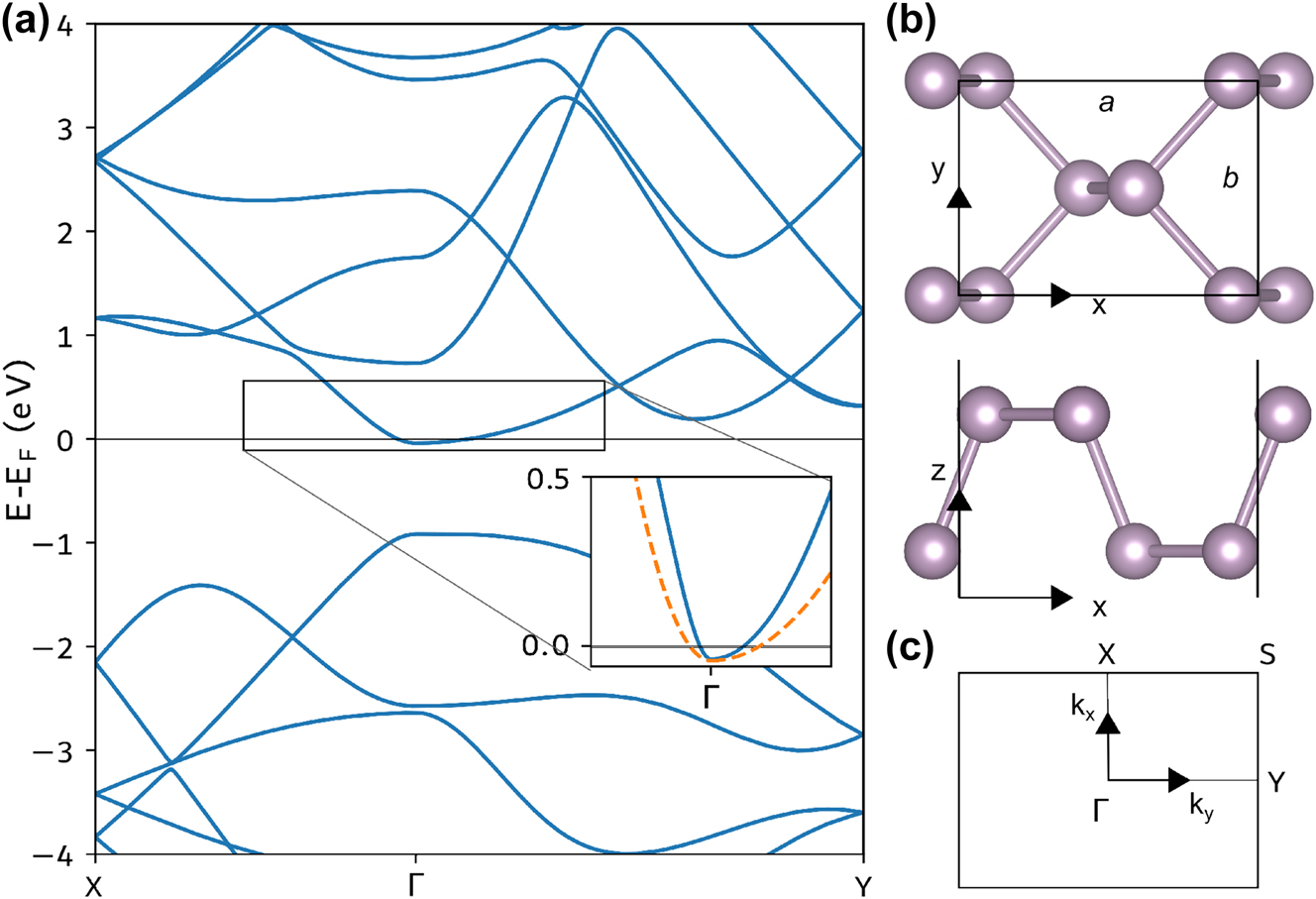
Electronic energy band structure of phosphorene. Panel (a) shows the band structure of extended monolayer phosphorene with doping charge carrier density n = 1 × 1013 cm−2. The inset shows the conduction band along the Γ–X and Γ–Y directions of the first Brillouin zone (BZ) together with the parabolic bands (orange dashed lines) resulting from the fitted effective masses extracted from Figure 2. Panel (b) shows the unit cell of the 2D phosphorene crystal seen from above (top) and the side (bottom). Panel (c) shows the first BZ of the 2D crystal.
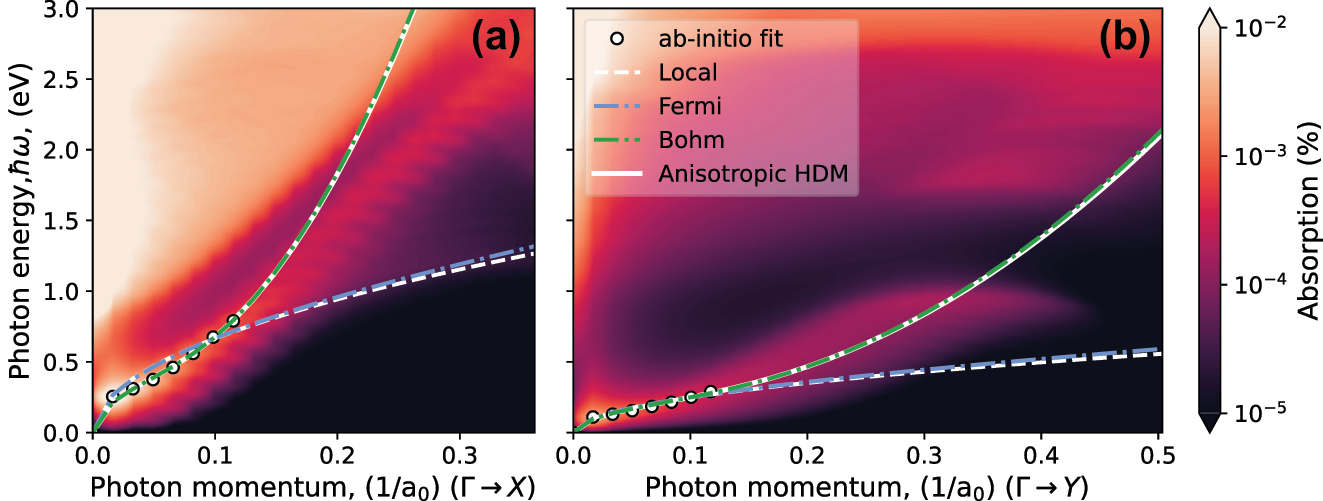
Density plot of the absorption obtained from ab initio calculations as a function of the photon energy ℏω and the photon wavenumber q with zero magnetic field. Panel (a) shows variations of q along the Γ–X direction in the Brillouin zone of the electronic-structure problem, while panel (b) is for the Γ–Y direction. In both panels, results for the dispersion relation from the hydrodynamic model (Eq. (18)) are superimposed, showing both the local approximation (dashed white line), the additional effect of Bohm’s potential (dash-dotted green line), the Fermi pressure (dash-dotted blue line), and the combined effects of Bohm’s potential and the Fermi pressure (solid white line). Maxima in absorption from the first principles calculation at low momenta are used for fitting of the effective masses (circles).
Ground-state DFT using the PBE functional is known to significantly underestimate the band gap of 2D materials, as the method excludes the many-body effects, which result in a significantly reduced screening. In these calculations, we obtain a band gap of 0.89 eV, which should be compared to experimental measurements yielding a gap size of 2 eV [64]. However, since many-body calculations using the GW method mainly result in a nearly constant energy correction of the conduction band [65], the effective masses and plasmon dispersion are not expected to differ much from what we extract within the single-particle approximation.
3.2 Comparison of the first principles and hydrodynamic approaches
Figure 2 presents the ab initio results for plasmons in phosphorene (colormap), as described in the previous section, considering n 0 = 1013 cm−2. Additionally, we show the analytical results derived from Eq. (18) for a zero magnetic field (B z = 0), incorporating different nonlocal terms of f q . The effective masses m x and m y were determined by fitting the plasmon dispersion at low momenta in both the zigzag and armchair directions, yielding m x = 0.464m 0, m y = 2.394m 0. The parabolic bands resulting from these effective masses are shown by the dashed orange lines on the inset of Figure 1a. It can be seen that the conduction band along the Γ–X direction is almost linear close to the Γ-point, resulting in a poorer fit to the parabolic band along this direction. Including the Bohm potential, a nonlocal contribution, enables an accurate description of the ab initio plasmon dispersion, whereas the Drude term, which follows a square root dependence on the wavenumber, fails to do so. Additionally, for the electronic density considered, the contribution from Fermi degeneracy pressure is negligible.
The local-response approximation holds for the Γ–Y direction for larger values of wavenumber than in the Γ–X direction. This occurs due to the effective mass dependence on Eq. (21); the lighter mass direction (Γ–X) results in a greater kinetic energy, implying an increased Bohm’s term and, therefore, more significant nonlocal effects.
3.3 Magnetoplasmons
We begin this section by examining the nonlocal effects on plasmon dispersion governed by Eq. (16), using the fitted effective masses from the previous section. In Figure 3a, we present a colormap of the relative difference in plasmon dispersion, Δω/ω D , where ω D represents the Drude dispersion, obtained by setting f q = 0 in Eq. (16). The quantity Δω ≡ ω p − ω D is shown as a function of the electronic density n 0 and the wavenumber q y . We observe that nonlocal effects are present in the low electronic density and high wavenumber region, such as that for n 0 < 1015 cm−2 and q y > 60 μm−1, the nonlocal corrections are not negligible. A similar conclusion could be obtained for the q x dependence, but nonlocal effects become important at smaller q x when compared to q y due to m x < m y .
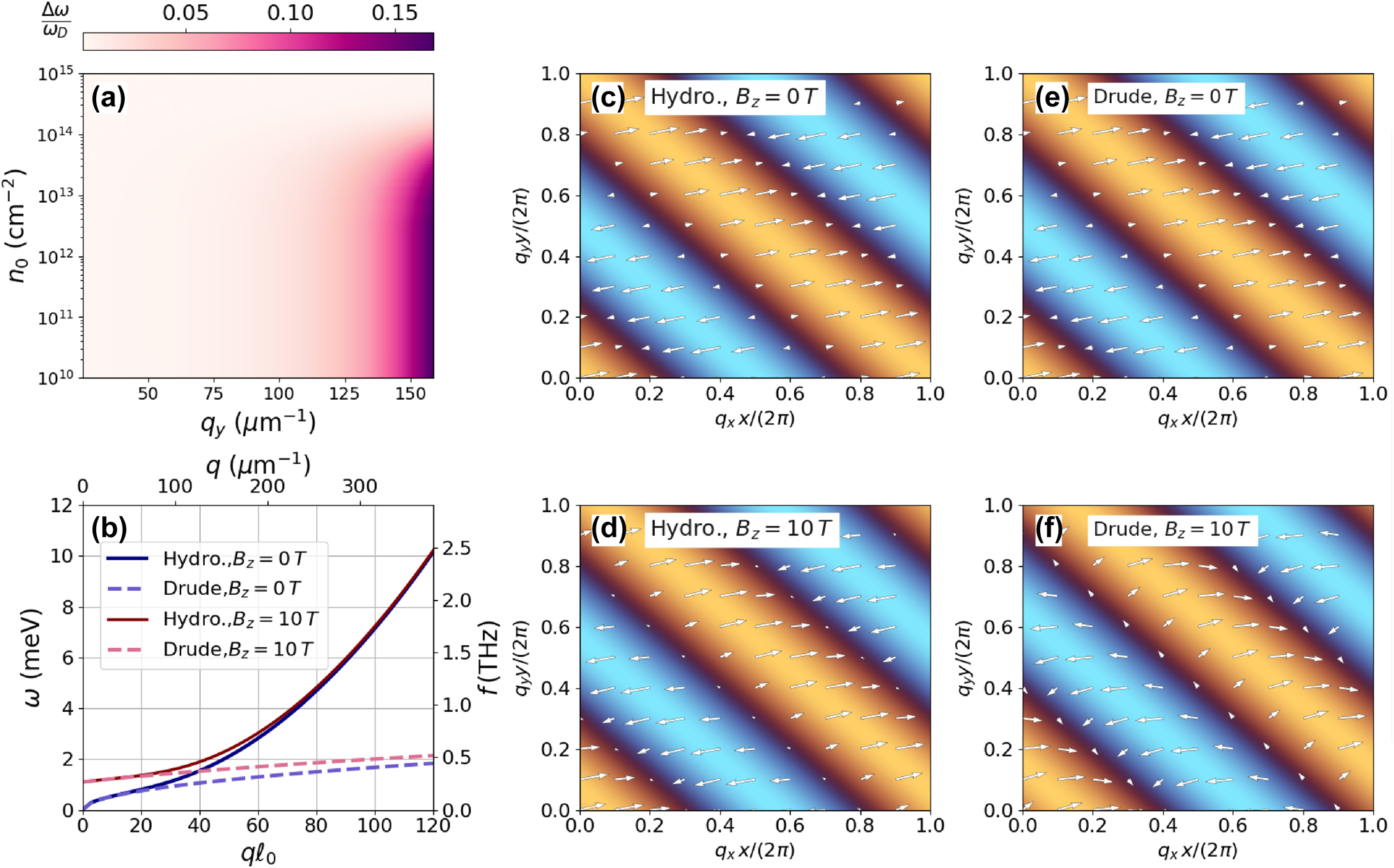
Panel (a) is a density plot of Δω/ω 0 – the relative difference between the nonlocal and local plasmon dispersion of phosphorene – as function of the electronic density n 0 and the plasmon wavenumber q y in the zigzag direction. Panel (b) shows the magnetoplasmon dispersion relation for phosphorene – frequency f = ω/2π versus wavenumber q – comparing the nonlocal hydrodynamic model (solid lines) to the local Drude model (dashed lines) for both B z = 0 T (blue coloring) and B z = 10 T (red coloring). The effective mass was obtained from the ab initio fitting and n 0 = 109 cm−2. We consider a direction that makes a 45° angle with either the zigzag or armchair direction. Panels (c–f) show Quiver plots of the plasmon velocity field and colormap of the charge-density fluctuation for phosphorene for qℓ 0 = 90, as a function of the real-space coordinates x and y for different magnetic fields, for both the nonlocal hydrodynamic and the local Drude models. We use the effective mass obtained from the ab initio fitting and n 0 = 109 cm−2.
The magnetoplasmon spectrum derived from Eq. (18) is displayed in Figure 3b. In the presence of a magnetic field, we observe that the deviation of the hydrodynamic (solid curves) and Drude model (dashed curves) shifts toward higher wavenumbers. This is a consequence of Bohm’s term, which corresponds to the kinetic energy inside the brackets in Eq. (18), and adds quartic terms inside the square root of the plasmon frequency; this explains the deviation between the hydrodynamic and Drude’s models for larger wavenumbers. The behavior is different for the plasmon velocity fields. In Figure 3c–f, we present a quiver plot of the normalized velocity fields obtained from the nontrivial solutions of Eq. (16). The colormap represents the normalized charge density calculated from the continuity equation (14) for both finite and zero magnetic fields, considering the nonlocal hydrodynamic and local Drude (f q = 0) models.
In the case of a vanishing magnetic field, considered in Figure 3c and e, we can show that the nontrivial solution of Eq. (16) simplifies to q y u 1,x /m y − q x u 1,y /m x = 0 and does not depend on f q , such that the velocity field (u 1,x , u 1,y ) is parallel to the vector (q x /m x , q y /m y ) in both cases: Drude and hydrodynamic models. In this case, the velocity field oscillates perpendicular to the charge density wavefront. However, for finite B z , the velocity field acquires a dependence on nonlocal corrections, as can be seen by comparing Figure 3d and f. In the absence of nonlocal corrections, as shown in Figure 3f, the presence of the magnetic field causes the velocity field to become oblique to the charge density wavefront. In the nonlocal hydrodynamic model, as illustrated in Figure 3d, nonlocal effects decrease the transverse component of the velocity field, thus diminishing the magnetic field effect.
3.4 Effects of nonlocality: polaritonic spectrum
The coupling of light with plasmons gives rise to surface plasmon-polaritons (SPPs). In the case of BP, the anisotropic nature of the interband response indicates the existence of in-plane hyperbolic SPPs [66]. In this section, we examine a slab of BP with negligible thickness. The total optical conductivity of BP is expressed as the sum of a hydrodynamic component given by Eq. (28) and an additional contribution from interband transitions that is not accounted for in the hydrodynamic model,
Here, the interband conductivity
for both armchair and zigzag directions of BP, showing in the shaded region the BP Reststrahlen band, i.e., when Re{ϵ xx } × Re{ϵ yy } < 0. In this section, for the thin-layer BP, we will consider the effective masses of Ref. [66], μ x = 0.14 (AC) and μ y = 0.71 (ZZ).
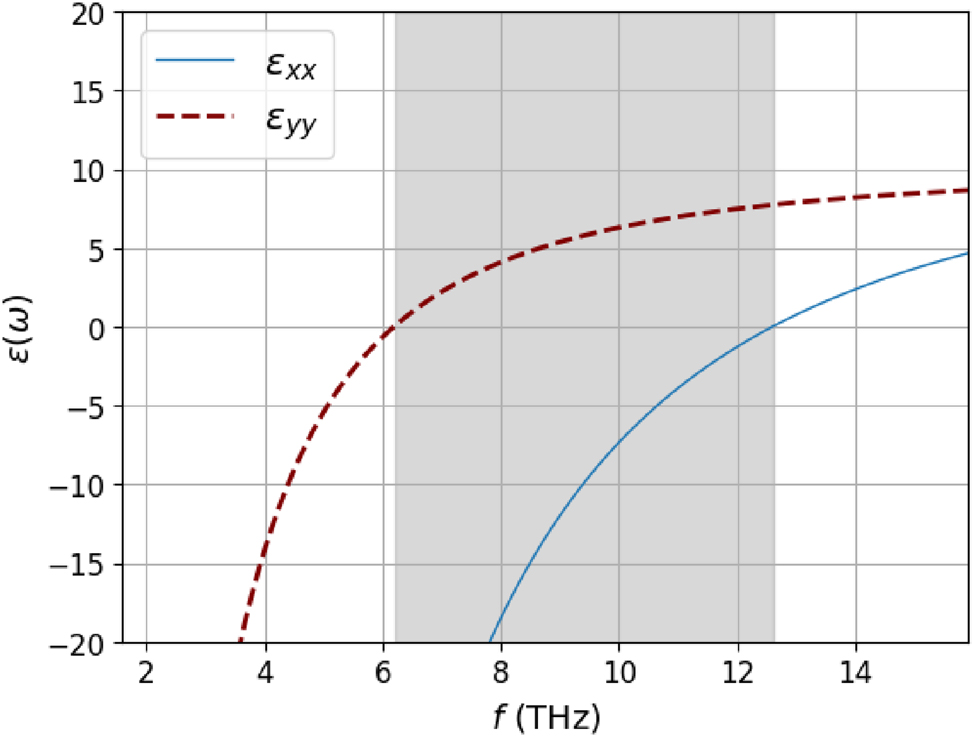
Black phosphorus anisotropic dielectric function ϵ(ω), calculated from Eq. (30) for an electronic density n 0 = 1012 cm−2. The Reststrahlen band with Re{ϵ xx } × Re{ϵ yy } < 0 is highlighted in gray.
The presence of SPPs can be seen in the TM loss function, which is calculated from the imaginary part of the Fresnel coefficient r p,p (see Appendix A for the derivation):
where
with
In Figure 5a and b, we show the TM loss function Im{r p,p } for the surface plasmon-polariton isofrequency for f = 9.0 THz, which lies within the Reststrahlen band when n 0 = 1012 cm−2. The results are shown for both the nonlocal hydrodynamic and local Drude models, including losses (see Appendix B), where we fixed the damping rate at ℏγ = 1.0 meV. The models exhibit markedly different qualitative behaviors. While the local Drude model predicts the existence of hyperbolic modes, these modes completely vanish when nonlocal effects are taken into account. Instead, the isofrequency transitions toward what is expected for a typical anisotropic surface plasmon-polariton. This behavior can be understood by analyzing Eq. (28); the increase in wavenumber alters the sign of the imaginary part of the eigenvalues of the conductivity tensor due to its dependence on q.
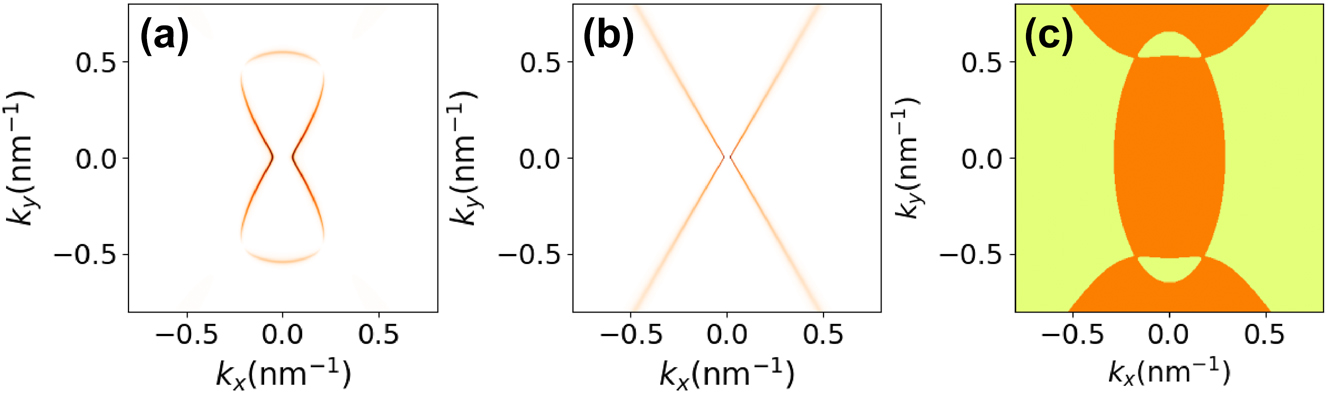
Panels (a) and (b) show density plots of the loss function Im{r pp (q, ω)} as a function of q for a BP thin film at f = ω/2π = 9.0 THz calculated using Eq. (31). Panel (a) is for the nonlocal hydrodynamic model, while panel (b) is for the local Drude model. Panel (c) is a zero-contour plot of Im{λ 1 λ 2} in wavenumber space, separating positive regimes (in yellow) from negative regimes (in orange). The plot is for a photon frequency f = 9.0 THz, and the eigenvalues λ 1,2 are those of the optical conductivity tensor matrix (Eq. (29)).
In Figure 5c, we illustrate the sign of the imaginary part of the product of the eigenvalues of the conductivity tensor (29). When the sign is negative, we can expect the presence of hyperbolic modes. Conversely, when the sign is positive, we may observe elliptic modes (if both imaginary parts are negative) or no modes at all (if both are positive). By comparing Figure 5b and c, we observe that in the hyperbolic branches of the Drude model, the hydrodynamic model alters the sign of Im{λ 1 λ 2}, thereby inhibiting the formation of hyperbolic modes. Similar conclusions have been drawn for SPPs in BP using the Kubo formula for optical conductivity [27], considering an effective Hamiltonian [67]. It was observed that the inclusion of nonlocal effects significantly alters the isofrequencies, preventing the emergence of hyperbolic modes. A similar conclusion has been reached in the context of hyperbolic metamaterials [68] (and eventually also natural hyperbolic materials [69]), where the incorporation of nonlocal effects strongly renormalizes the spectrum in the high wavenumber limit.
3.5 Dipoles and Purcell effect
One possible way to launch surface plasmon-polaritons is through the use of an emitting dipole [70], where the near-field of the dipole couples with the light–matter modes. In the scanning near-field optical microscopy (SNOM), the atomic-force microscopy (AFM) tip can be modeled as a point dipole [71]; in this case, the tip supports evanescent modes that are excited by an incoming laser and can couple to SPP modes. To obtain the electromagnetic field in the presence of a dipole, we use the dyadic Green function formalism [72], in which, for the case of light impinging on an anisotropic medium, it was obtained elsewhere [73]:
where r ss , r sp , r ps , and r pp are the Fresnel coefficients calculated in Appendix A, and the matrix M jk is defined in Appendix C. However, the numerical calculation of the integral above is challenging due to the presence of the SPP poles in the Fresnel coefficients. The electric field for an electric dipole that oscillates with frequency ω located at the position r′ is obtained from the dyadic Green’s function as:
where d is the electric dipole moment and G 0 is the free-space dyadic Green’s function.
For simplicity, we henceforth consider an electric dipole oriented along the z-axis; accordingly, the reflected electric field in the z-direction is given by
The integral is dominated by the plasmon-pole, which can be obtained from the Fresnel coefficient denominator (32) as the solution of
For the case of plasmons, this pole is dominated by the TM part, i.e., the above equation has approximately the same roots as:
and we approximate the r pp Fresnel coefficient as
with ω SPP(q) being the solution of Eq. (37) and F(ω) corresponding to the residue of the plasmon-polariton pole,
We next shift the pole by an infinitesimal amount and take the imaginary part:
Now to simplify the integral in Eq. (35), we rewrite it in polar coordinates and make the change of variables k ‖ = k 0 s. Considering s ≫ 1, we obtain for a dipole placed at (x′, y′, z′) = (0, 0, z 0) that
To illustrate our point, we will for simplicity neglect the Bohm potential (7), so that we can obtain an analytical expression for the isofrequencies of the dispersion relation, as detailed in Appendix D. The relation between s and the polar angle ϕ, obtained after integrating over ϕ using the Dirac delta function, is
where we have defined
and
where the summation in ϕ H corresponds to all nondegenerate solutions of Eq. (42) and the integral is limited to the intervals where |cos2ϕ H (s)| ≤ 1. Using the symmetry of the solutions, we can write the above integral as:
with
For the case of the local response Drude model, Eq. (42) simplifies to:
In Figure 6a and b, we show the comparison between the hydrodynamic (including only the Fermi pressure term) and Drude models, for the frequency ω/(2π) = 9 THz, that lies inside the Reststrahlen band. While the Drude model predicts extremely canalized plasmons that propagate in the direction dictated by the hyperbolic dispersion, the hydrodynamic model shows closed wavefronts propagating in all directions.
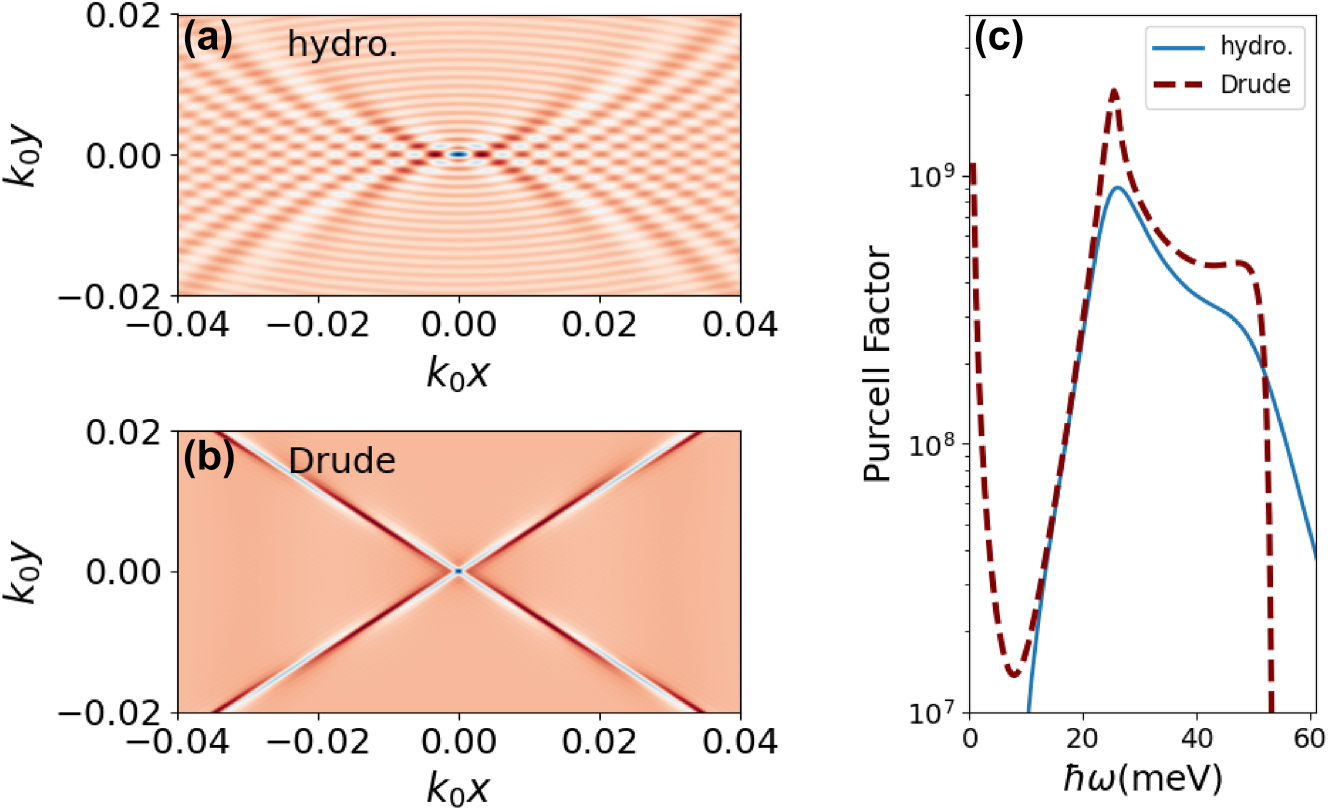
Panels (a) and (b) show plasmonics wakes induced by an electric dipole aligned with the z-axis with a frequency ω/(2π) = 9 THz. The colormap shows the electric field in the z-direction at the surface of the BP. Panel (a) is the hydrodynamic model, and panel (b) is the Drude model. Panel (c) compares the Purcell factor computed from the hydrodynamic model (solid line) and Drude model (dashed line) as a function of the frequency of the electric dipole. In all the plots, the dipole-BP sheet distance is z 0 = 3.0 nm and the BP electronic density is n 0 = 1012 cm−2.
The presence of a 2D material that supports plasmons changes a quantum emitter radiative decay through the Purcell effect [74]. The study of the Purcell effect in phosphorene, including strain, was done before [75] but neglecting nonlocal effects, i.e., the phosphorene optical conductivity was calculated using a tight-binding model without dependence on the in-plane wavenumber, or, when including nonlocal effects, the anisotropy was averaged [76]. The Purcell factor for a dipole aligned in the z-direction can be calculated using the following equation [75]:
The details of the numerical calculation of the Purcell factor are given in Appendix E, and the results are shown in Figure 6c. While the Drude model predicts a peak in the zero frequency, this peak disappears in the hydrodynamic model. The peaks of the Drude model also decrease by almost a factor of 3. For higher frequencies, the hydrodynamic model predicts a higher Purcell factor.
4 Conclusions and perspectives
Through various examples, we have unveiled the critical importance of nonlocal electrodynamics in addressing anisotropic materials, particularly those exhibiting hyperbolic behavior. The formalism presented here can be effectively employed to calculate higher-order responses in such materials, thus reaching the nonlinear regime. Furthermore, it offers a robust framework for describing nanostructures incorporating 2D materials, such as quantum dots or arrays of nanoribbons.
Recent advances in fabrication techniques have yielded systems with reduced losses and have facilitated the discovery of new materials that exhibit hyperbolic behavior. Additionally, improvements in nano-optical techniques now enable the probing of high wavenumber regions of the frequency-wavenumber plane, uncovering quantum properties of polaritons.
In our current formalism, electron–electron interactions are taken into account through a phenomenological approach (see, for example, Ref. [47]). As an exciting avenue for future research, we propose integrating many-body phases, such as superconductivity in twisted bilayer graphene, into the hydrodynamic formalism. Exploring other highly correlated phases within this framework presents a compelling challenge.
Funding source: Fundação Amazônia Paraense de Amparo à Pesquisa
Award Identifier / Grant number: 2022/08086-0
Funding source: Brazilian National Council for the Improvement of Higher Education
Funding source: Danmarks Frie Forskningsfond
Award Identifier / Grant number: 0165-00051B
Award Identifier / Grant number: 2032-00045B
Funding source: Portuguese Foundation for Science and Technology
Award Identifier / Grant number: EXPL/FISMAC/0953/2021
Award Identifier / Grant number: PTDC/FIS-MAC/2045/2021
Award Identifier / Grant number: UIDB/04650/2020
Funding source: Danmarks Grundforskningsfond
Award Identifier / Grant number: DNRF165
Funding source: Brazilian Council for Research
Award Identifier / Grant number: 313211/2021-3
Award Identifier / Grant number: 315408/2021-9
Award Identifier / Grant number: 408144/2022-0
Award Identifier / Grant number: 423423/2021-5
Award Identifier / Grant number: 437067/2018-1
Funding source: Fonds Wetenschappelijk Onderzoek
-
Research funding: NMRP acknowledges support by the Portuguese Foundation for Science and Technology (FCT) in the framework of the projects PTDC/FIS-MAC/2045/2021 and EXPL/FISMAC/0953/2021, and the Strategic Funding UIDB/04650/2020. LJ and JDC acknowledge support from Independent Research Fund Denmark (grant no. 0165- 00051B). NMRP and NAM also acknowledge the Independent Research Fund Denmark (grant no. 2032-00045B). DRC and AJC acknowledge the Brazilian Council for Research (CNPq) grants No. 423423/2021-5, 408144/2022-0. DRC gratefully acknowledges the support from CNPq grants 313211/2021-3, 437067/2018-1, and the Research Foundation -Flanders (FWO). AJC was supported by CNPq Grant No. 315408/2021-9, FAPESP under Grant No. 2022/08086-0, and the Brazilian National Council for the Improvement of Higher Education (CAPES) under a CAPES-PrInt scholarship. The Center for Polariton-driven Light -Matter Interactions (POLIMA) is sponsored by the Danish National Research Foundation (Project No. DNRF165).
-
Author contributions: AJC, DRC, NAM, and NMRP jointly conceived the idea. LJ and JDC performed the ab initio calculations. All authors contributed to the analysis of results and the writing of the manuscript. All authors have accepted responsibility for the entire content of this manuscript and consented to its submission to the journal, reviewed all the results and approved the final version of the manuscript.
-
Conflict of interest: Authors state no conflicts of interest.
-
Data availability: Data sharing is not applicable to this article as no datasets were generated or analyzed during the current study.
Appendix A: Fresnel coefficients for an anisotropic 2D sheet
We consider light impinging on a 2D sheet described by the surface conductivity tensor σ. We define the TM and TE direction versors e p and e s , so that the incident electric field is given by
the reflected field component is
while the transmitted field component one is
with k = (k ‖cosϕ, k ‖sinϕ, k z ) and k′ = (k ‖cosϕ, k ‖sinϕ, − k z ). The unit vectors are given by
where we note that
The corresponding magnetic field for each component is written as
From the continuity of the electric field at the 2D material interface, we have:
From Àmpere’s law at the interface,
we now decompose in p and s modes, where we use that
This implies that
and
Next, we define the conductivity in a rotated frame
with the rotation matrix
With this, we have
which leads to the following set of equations:
From Eqs. (A5) and (A9), we have
and thus also
Using Eq. (A6), we in turn obtain
which can be conveniently rearranged to
Next, we define
The solution of Eq. (A22) now becomes
which in turn implies the following transmission coefficients
Likewise, for the reflection part
the use of Eq. (A6) formally gives
Combining these results, we now explicitly have
In a similar way, we obtain that
Appendix B: Hydrodynamic optical conductivity: the case of losses
In the presence of losses, the Euler equation (11) can be modified by replacing the time derivative as ∂ t → ∂ t + γ, where γ represents a phenomenological damping rate [47]:
Proceeding along the procedure in Section 2.4, we have
and we eventually arrive at the nonlocal optical conductivity tensor
where we have defined
Appendix C: Dyadic Green’s function matrices
For completeness, we present the matrices M ij of Eq. (33):
For further details, we refer to the derivation in Ref. [73].
Appendix D: Surface plasmon-polariton dispersion relation
In this section, we solve Eq. (37) in the limit where Bohm’s potential is neglected:
The conductivity in the rotated frame is now
where we have defined the constants
and the function
By substituting Eqs. (D2) into (D1) and carrying out some algebraic manipulations, the resulting expression can be recast as a quadratic equation in cos(2ϕ):
Being a second-order polynomial, it is straightforward to obtain the two possible roots. The possible angles are limited by |cos2ϕ| ≤ 1.
Appendix E: Numerical calculation of the Purcell factor
We start rewriting Eq. (48) in polar coordinates:
Next, we split the integral into the regions k ‖ < k 0 and k ‖ > k 0. For the first region, we have
and using that |r pp | < 1, we have
Therefore, the contribution to the Purcell factor from the region k ‖ < k 0 cannot exceed unity. The contribution from the region k ‖ > k 0 is several orders of magnitude larger; therefore, the term I can be conveniently neglected in the numerical calculation of the Purcell factor,
where the dimensionless integration variable is defined as
References
[1] M. F. Weber, C. A. Stover, L. R. Gilbert, T. J. Nevitt, and A. J. Ouderkirk, “Giant birefringent optics in multilayer polymer mirrors,” Science, vol. 287, no. 5462, pp. 2451–2456, 2000.10.1126/science.287.5462.2451Search in Google Scholar PubMed
[2] M. Born and E. Wolf, Principles of Optics: Electromagnetic Theory of Propagation, Interference and Diffraction of Light, London, Cambridge University Press, 2013.Search in Google Scholar
[3] T. E. Furtak and D. W. Lynch, “Anisotropic interband effects in electroreflectance of Ag,” Phys. Rev. Lett., vol. 35, no. 14, pp. 960–963, 1975.10.1103/PhysRevLett.35.960Search in Google Scholar
[4] A. Tadjeddine, D. Kolb, and R. Kötz, “The study of single crystal electrode surfaces by surface plasmon excitation,” Surf. Sci., vol. 101, no. 1, pp. 277–285, 1980.10.1016/0039-6028(80)90621-4Search in Google Scholar
[5] A. Friedrich, B. Pettinger, D. M. Kolb, G. Lüpke, R. Steinhoff, and G. Marowsky, “An in situ study of reconstructed gold electrode surfaces by second harmonic generation,” Chem. Phys. Lett., vol. 163, no. 2, pp. 123–128, 1989.10.1016/0009-2614(89)80022-3Search in Google Scholar
[6] G. Lüpke, G. Marowsky, R. Steinhoff, A. Friedrich, B. Pettinger, and D. M. Kolb, “Symmetry superposition studied by surface second-harmonic generation,” Phys. Rev. B, vol. 41, no. 10, pp. 6913–6919, 1990.10.1103/PhysRevB.41.6913Search in Google Scholar PubMed
[7] S. Boroviks, et al.., “Anisotropic second-harmonic generation from monocrystalline gold flakes,” Opt. Lett., vol. 46, no. 4, pp. 833–836, 2021.10.1364/OL.413003Search in Google Scholar PubMed
[8] P. Ajayan, P. Kim, and K. Banerjee, “Two dimensional van der Waals materials,” Phys. Today, vol. 69, no. 9, pp. 38–44, 2016.10.1063/PT.3.3297Search in Google Scholar
[9] P. Li, et al.., “Hyperbolic phonon-polaritons in boron nitride for near-field optical imaging and focusing,” Nat. Commun., vol. 6, no. 1, p. 7507, Jun 2015. https://doi.org/10.1038/ncomms8507.Search in Google Scholar PubMed PubMed Central
[10] S. Dai, et al.., “Phonon polaritons in monolayers of hexagonal boron nitride,” Adv. Mater., vol. 31, no. 37, p. 1806603, 2019.10.1002/adma.201806603Search in Google Scholar PubMed
[11] Z. Zheng, et al.., “Highly confined and tunable hyperbolic phonon polaritons in van der Waals semiconducting transition metal oxides,” Adv. Mater., vol. 30, no. 13, p. 1705318, 2018.10.1002/adma.201705318Search in Google Scholar PubMed
[12] J. Taboada-Gutiérrez, et al.., “Unveiling the mechanism of phonon-polariton damping in α-MoO3,” ACS Photonics, vol. 11, no. 9, pp. 3570–3577, 2024.10.1021/acsphotonics.4c00485Search in Google Scholar PubMed PubMed Central
[13] N. C. Passler, et al.., “Hyperbolic shear polaritons in low-symmetry crystals,” Nature, vol. 602, no. 7898, pp. 595–600, Feb 2022. https://doi.org/10.1038/s41586-021-04328-y.Search in Google Scholar PubMed PubMed Central
[14] A. Kumar, T. Low, K. H. Fung, P. Avouris, and N. X. Fang, “Tunable light–matter interaction and the role of hyperbolicity in graphene–hbn system,” Nano Lett., vol. 15, no. 5, pp. 3172–3180, 2015.10.1021/acs.nanolett.5b01191Search in Google Scholar PubMed
[15] I. D. Barcelos, et al.., “Ultrabroadband nanocavity of hyperbolic phonon–polaritons in 1D-like α-MoO3,” ACS Photonics, vol. 8, no. 10, pp. 3017–3026, Oct 2021. https://doi.org/10.1021/acsphotonics.1c00955.Search in Google Scholar
[16] Z. Liu and K. Aydin, “Localized surface plasmons in nanostructured monolayer black phosphorus,” Nano Lett., vol. 16, no. 6, pp. 3457–3462, 2016.10.1021/acs.nanolett.5b05166Search in Google Scholar PubMed
[17] G. Venturi, A. Mancini, N. Melchioni, S. Chiodini, and A. Ambrosio, “Visible-frequency hyperbolic plasmon polaritons in a natural van der Waals crystal,” Nat. Commun., vol. 15, no. 1, p. 9727, Nov 2024. https://doi.org/10.1038/s41467-024-53988-7.Search in Google Scholar PubMed PubMed Central
[18] F. L. Ruta, et al.., “Good plasmons in a bad metal,” Science, vol. 387, no. 6735, pp. 786–791, 2025.10.1126/science.adr5926Search in Google Scholar PubMed
[19] A. A. Maradudin, J. R. Sambles, and W. L. Barnes, Modern Plasmonics, vol. 4, Amsterdam, Elsevier, 2014.Search in Google Scholar
[20] H. Wang, et al.., “Planar hyperbolic polaritons in 2D van der Waals materials,” Nat. Commun., vol. 15, no. 1, p. 69, Jan 2024. https://doi.org/10.1038/s41467-023-43992-8.Search in Google Scholar PubMed PubMed Central
[21] P. A. D. Gonçalves, N. Stenger, J. D. Cox, N. A. Mortensen, and S. Xiao, “Strong light–matter interactions enabled by polaritons in atomically thin materials,” Adv. Opt. Mater., vol. 8, no. 5, p. 1901473, 2020.10.1002/adom.201901473Search in Google Scholar
[22] N. A. Mortensen, “Mesoscopic electrodynamics at metal surfaces,” Nanophotonics, vol. 10, no. 10, pp. 2563–2616, 2021.10.1515/nanoph-2021-0156Search in Google Scholar
[23] F. Monticone, et al.., “Roadmap on nonlocality in photonic materials and metamaterials,” Opt. Mater. Express, vol. 15, no. 7, pp. 1544–1708, 2025.10.1364/OME.550403Search in Google Scholar
[24] S. Boroviks, et al.., “Extremely confined gap plasmon modes: When nonlocality matters,” Nat. Commun., vol. 13, no. 1, p. 3105, 2022. https://doi.org/10.1038/s41467-022-30737-2.Search in Google Scholar PubMed PubMed Central
[25] M. B. Lundeberg, et al.., “Tuning quantum nonlocal effects in graphene plasmonics,” Science, vol. 357, no. 6347, pp. 187–191, 2017.10.1126/science.aan2735Search in Google Scholar PubMed
[26] E. J. C. Dias, et al.., “Probing nonlocal effects in metals with graphene plasmons,” Phys. Rev. B, vol. 97, no. 24, p. 245405, 2018.10.1103/PhysRevB.97.245405Search in Google Scholar
[27] D. Correas-Serrano, J. S. Gomez-Diaz, A. A. Melcon, and A. Alù, “Black phosphorus plasmonics: anisotropic elliptical propagation and nonlocality-induced canalization,” J. Opt., vol. 18, no. 10, p. 104006, 2016. https://doi.org/10.1088/2040-8978/18/10/104006.Search in Google Scholar
[28] C. A. Ullrich, Time-Dependent Density-Functional Theory: Concepts and Applications, Oxford, New York, Oxford University Press, 2011.10.1093/acprof:oso/9780199563029.001.0001Search in Google Scholar
[29] C. Ciracì, “Current-dependent potential for nonlocal absorption in quantum hydrodynamic theory,” Phys. Rev. B, vol. 95, no. 24, p. 245434, 2017.10.1103/PhysRevB.95.245434Search in Google Scholar
[30] G. Barton, “Some surface effects in the hydrodynamic model of metals,” Rep. Prog. Phys., vol. 42, no. 6, p. 963, 1979. https://doi.org/10.1088/0034-4885/42/6/001.Search in Google Scholar
[31] Q. Zhou, W. Li, Z. He, P. Zhang, and X.-W. Chen, “Quantum hydrodynamic model for noble metal nanoplasmonics,” Phys. Rev. B, vol. 107, no. 20, p. 205413, 2023. https://doi.org/10.1103/PhysRevB.107.205413.Search in Google Scholar
[32] T. V. Teperik, P. Nordlander, J. Aizpurua, and A. G. Borisov, “Robust subnanometric plasmon ruler by rescaling of the nonlocal optical response,” Phys. Rev. Lett., vol. 110, p. 263901, 2013.10.1103/PhysRevLett.110.263901Search in Google Scholar PubMed
[33] F. De Luca, M. Ortolani, and C. Ciracì, “Free electron nonlinearities in heavily doped semiconductors plasmonics,” Phys. Rev. B, vol. 103, no. 11, p. 115305, 2021. https://doi.org/10.1103/PhysRevB.103.115305.Search in Google Scholar
[34] A. J. Chaves, N. M. R. Peres, G. Smirnov, and N. A. Mortensen, “Hydrodynamic model approach to the formation of plasmonic wakes in graphene,” Phys. Rev. B, vol. 96, no. 19, p. 195438, 2017. https://doi.org/10.1103/PhysRevB.96.195438.Search in Google Scholar
[35] T. C. Barbosa, A. J. Chaves, R. O. Freitas, L. C. Campos, and I. D. Barcelos, “Ultra-confined plasmons reveal moiré patterns in a twisted bilayer graphene–talc heterostructure,” Nanoscale, vol. 17, no. 15, pp. 9205–9212, 2025.10.1039/D4NR04532GSearch in Google Scholar
[36] C. Ciracì, et al.., “Probing the ultimate limits of plasmonic enhancement,” Science, vol. 337, no. 6098, pp. 1072–1074, 2012.10.1126/science.1224823Search in Google Scholar PubMed PubMed Central
[37] P. Zhang, C. Tserkezis, and N. A. Mortensen, “Quantum-hydrodynamic modal perspective on plasmonic gap structures,” J. Phys. Chem. C, vol. 129, no. 7, pp. 3667–3675, 2025. https://doi.org/10.1021/acs.jpcc.4c08232.Search in Google Scholar
[38] J. Baxter, A. C. Lesina, and L. Ramunno, “Parallel FDTD modeling of nonlocality in plasmonics,” IEEE Trans. Antenn. Propag., vol. 69, no. 7, pp. 3982–3994, 2021.10.1109/TAP.2020.3044579Search in Google Scholar
[39] H. Du and C. Liu, “An improved FDTD method to calculate nonlocal response in plasmonics,” IEEE Trans. Antenn. Propag., vol. 72, no. 3, pp. 2592–2599, 2024.10.1109/TAP.2024.3363445Search in Google Scholar
[40] K. R. Hiremath, L. Zschiedrich, and F. Schmidt, “Numerical solution of nonlocal hydrodynamic Drude model for arbitrary shaped nanoplasmonic structures using nédélec finite elements,” J. Comput. Phys., vol. 231, no. 17, pp. 5890–5896, 2012.10.1016/j.jcp.2012.05.013Search in Google Scholar
[41] M. Moeferdt, T. Kiel, T. Sproll, F. Intravaia, and K. Busch, “Plasmonic modes in nanowire dimers: A study based on the hydrodynamic Drude model including nonlocal and nonlinear effects,” Phys. Rev. B, vol. 97, no. 7, p. 075431, 2018.10.1103/PhysRevB.97.075431Search in Google Scholar
[42] L. Li, S. Lanteri, N. A. Mortensen, and M. Wubs, “A hybridizable discontinuous Galerkin method for solving nonlocal optical response models,” Comput. Phys. Commun., vol. 219, pp. 99–107, 2017.10.1016/j.cpc.2017.05.012Search in Google Scholar
[43] P. Cosme and H. Terças, “Terahertz laser combs in graphene field-effect transistors,” ACS Photonics, vol. 7, no. 6, pp. 1375–1381, 2020.10.1021/acsphotonics.0c00313Search in Google Scholar
[44] X. Hua, D. Sun, D. Liu, and N. Ma, “The double-layer graphene surface plasmon-polaritons spectrum in hydrodynamic model,” Plasmonics, vol. 20, no. 3, pp. 1183–1191, 2025. https://doi.org/10.1007/s11468-024-02368-4.Search in Google Scholar
[45] A. Moradi and N. Türker Tokan, “Screened plasmons of graphene near a perfect electric conductor,” J. Appl. Phys., vol. 134, no. 15, p. 153103, 2023.10.1063/5.0172268Search in Google Scholar
[46] S. Ahn and S. Das Sarma, “Theory of anisotropic plasmons,” Phys. Rev. B, vol. 103, no. 4, p. L041303, 2021. https://doi.org/10.1103/PhysRevB.103.L041303.Search in Google Scholar
[47] S. S. Cardoso, A. J. Chaves, N. A. Mortensen, and N. M. R. Peres, “Application of Madelung hydrodynamics to plasmonics and nonlinear optics in two-dimensional materials,” Phys. Rev. A, vol. 111, no. 4, p. 043508, 2025.10.1103/PhysRevA.111.043508Search in Google Scholar
[48] M. Scalora, et al.., “Second- and third-harmonic generation in metal-based structures,” Phys. Rev. A, vol. 82, no. 4, p. 043828, 2010. https://doi.org/10.1103/PhysRevA.82.043828.Search in Google Scholar
[49] I. Gasser and P. A. Markowich, “Quantum hydrodynamics, Wigner transforms, the classical limit,” Asymptot. Anal., vol. 14, no. 2, pp. 97–116, 1997.10.3233/ASY-1997-14201Search in Google Scholar
[50] E. Madelung, “Quantum theory in hydrodynamical form,” Z. Phys., vol. 40, p. 322, 1927.10.1007/BF01400372Search in Google Scholar
[51] A. L. Fetter, “Edge magnetoplasmons in a bounded two-dimensional electron fluid,” Phys. Rev. B, vol. 32, no. 12, pp. 7676–7684, 1985.10.1103/PhysRevB.32.7676Search in Google Scholar
[52] A. L. Fetter, “Magnetoplasmons in a two-dimensional electron fluid: Disk geometry,” Phys. Rev. B, vol. 33, no. 8, pp. 5221–5227, 1986.10.1103/PhysRevB.33.5221Search in Google Scholar PubMed
[53] F. Xia, H. Wang, J. C. M. Hwang, A. H. Castro Neto, and L. Yang, “Black phosphorus and its isoelectronic materials,” Nat. Rev. Phys., vol. 1, no. 5, pp. 306–317, 2019.10.1038/s42254-019-0043-5Search in Google Scholar
[54] V. Tran, R. Soklaski, Y. Liang, and L. Yang, “Layer-controlled band gap and anisotropic excitons in few-layer black phosphorus,” Phys. Rev. B, vol. 89, no. 23, p. 235319, 2014. https://doi.org/10.1103/PhysRevB.89.235319.Search in Google Scholar
[55] X. Wang and S. Lan, “Optical properties of black phosphorus,” Adv. Opt. Photonics, vol. 8, no. 4, pp. 618–655, 2016.10.1364/AOP.8.000618Search in Google Scholar
[56] H. Liu, et al.., “Phosphorene: An unexplored 2D semiconductor with a high hole mobility,” ACS Nano, vol. 8, no. 4, pp. 4033–4041, 2014.10.1021/nn501226zSearch in Google Scholar PubMed
[57] J. P. Perdew, K. Burke, and M. Ernzerhof, “Generalized gradient approximation made simple,” Phys. Rev. Lett., vol. 77, no. 18, pp. 3865–3868, 1996.10.1103/PhysRevLett.77.3865Search in Google Scholar PubMed
[58] P. Giannozzi, et al.., “QUANTUM ESPRESSO: A modular and open-source software project for quantum simulations of materials,” J. Phys.: Condens. Matter, vol. 21, no. 39, p. 395502, 2009.10.1088/0953-8984/21/39/395502Search in Google Scholar PubMed
[59] D. R. Hamann, “Optimized norm-conserving Vanderbilt pseudopotentials,” Phys. Rev. B, vol. 88, no. 8, p. 085117, 2013.10.1103/PhysRevB.88.085117Search in Google Scholar
[60] M. J. van Setten, et al.., “The pseudodojo: Training and grading a 85 element optimized norm-conserving pseudopotential table,” Comput. Phys. Commun., vol. 226, pp. 39–54, 2018.10.1016/j.cpc.2018.01.012Search in Google Scholar
[61] A. Marini, C. Hogan, M. Grüning, and D. Varsano, “Yambo: An ab initio tool for excited state calculations,” Comput. Phys. Commun., vol. 180, no. 8, pp. 1392–1403, 2009.10.1016/j.cpc.2009.02.003Search in Google Scholar
[62] D. Sangalli, et al.., “Manybody perturbation theory calculations using the yambo code,” J. Phys.: Condens. Matter, vol. 31, no. 32, p. 325902, 2019.10.1088/1361-648X/ab15d0Search in Google Scholar PubMed
[63] T. Sohier, M. Calandra, and F. Mauri, “Density functional perturbation theory for gated two-dimensional heterostructures: Theoretical developments and application to flexural phonons in graphene,” Phys. Rev. B, vol. 96, no. 7, p. 075448, 2017.10.1103/PhysRevB.96.075448Search in Google Scholar
[64] L. Liang, J. Wang, W. Lin, B. G. Sumpter, V. Meunier, and M. Pan, “Electronic bandgap and edge reconstruction in phosphorene materials,” Nano Lett., vol. 14, no. 11, pp. 6400–6406, 2014.10.1021/nl502892tSearch in Google Scholar PubMed
[65] F. Ferreira and R. M. Ribeiro, “Improvements in the GW and Bethe-Salpeter equation calculations on phosphorene,” Phys. Rev. B, vol. 96, no. 11, p. 115431, 2017.10.1103/PhysRevB.96.115431Search in Google Scholar
[66] S. Biswas, et al.., “Tunable intraband optical conductivity and polarization-dependent epsilon-near-zero behavior in black phosphorus,” Sci. Adv., vol. 7, no. 2, p. eabd4623, 2021.10.1126/sciadv.abd4623Search in Google Scholar PubMed PubMed Central
[67] A. S. Rodin, A. Carvalho, and A. H. Castro Neto, “Strain-induced gap modification in black phosphorus,” Phys. Rev. Lett., vol. 112, no. 17, p. 176801, 2014. https://doi.org/10.1103/PhysRevLett.112.176801.Search in Google Scholar PubMed
[68] W. Yan, M. Wubs, and N. A. Mortensen, “Hyperbolic metamaterials: Nonlocal response regularizes broadband supersingularity,” Phys. Rev. B, vol. 86, no. 20, p. 205429, 2012. https://doi.org/10.1103/PhysRevB.86.205429.Search in Google Scholar
[69] M. N. Gjerding, R. Petersen, T. G. Pedersen, N. A. Mortensen, and K. S. Thygesen, “Layered van der Waals crystals with hyperbolic light dispersion,” Nat. Commun., vol. 8, no. 1, p. 320, 2017.10.1038/s41467-017-00412-ySearch in Google Scholar PubMed PubMed Central
[70] P. A. D. Gonçalves and N. M. Peres, An Introduction to Graphene Plasmonics, Singapore, World Scientific, 2016.10.1142/9948Search in Google Scholar
[71] F. Keilmann and R. Hillenbrand, “Near-field microscopy by elastic light scattering from a tip,” Philos. Trans. R. Soc. A, vol. 362, no. 1817, pp. 787–805, 2004.10.1098/rsta.2003.1347Search in Google Scholar PubMed
[72] L. Novotny and B. Hecht, Principles of Nano-Optics, Cambridge, Cambridge University Press, 2012.10.1017/CBO9780511794193Search in Google Scholar
[73] J. S. Gomez-Diaz, M. Tymchenko, and A. Alù, “Hyperbolic metasurfaces: Surface plasmons, light-matter interactions, and physical implementation using graphene strips,” Opt. Mater. Express, vol. 5, no. 10, pp. 2313–2329, 2015.10.1364/OME.5.002313Search in Google Scholar
[74] B. A. Ferreira, B. Amorim, A. J. Chaves, and N. M. R. Peres, “Quantization of graphene plasmons,” Phys. Rev. A, vol. 101, no. 3, p. 033817, 2020.10.1103/PhysRevA.101.033817Search in Google Scholar
[75] P. P. Abrantes, W. J. M. Kort-Kamp, F. S. S. Rosa, C. Farina, F. A. Pinheiro, and T. P. Cysne, “Controlling electric and magnetic Purcell effects in phosphorene via strain engineering,” Phys. Rev. B, vol. 108, no. 15, p. 155427, 2023.10.1103/PhysRevB.108.155427Search in Google Scholar
[76] R. Petersen, T. G. Pedersen, and F. J. García de Abajo, “Nonlocal plasmonic response of doped and optically pumped graphene, MoS2, and black phosphorus,” Phys. Rev. B, vol. 96, no. 20, p. 205430, 2017. https://doi.org/10.1103/PhysRevB.96.205430.Search in Google Scholar
© 2025 the author(s), published by De Gruyter, Berlin/Boston
This work is licensed under the Creative Commons Attribution 4.0 International License.
Articles in the same Issue
- Frontmatter
- Editorial
- Editorial on special issue “The 11th International Conference on Surface Plasmon Photonics (SPP11)”
- Review
- Beyond limits: a tribute to Dai-Sik Kim’s academic legacy and vision
- Letters
- Meso-chiral optical properties of plasmonic nanoparticles: uncovering hidden chirality
- Modulation of the type and excitation region of plasmonic topological quasiparticles in a metasurface by tailoring the excitation light
- Research Articles
- Nonlocal electrodynamics of two-dimensional anisotropic magnetoplasmons
- Goos–Hänchen effect singularities in transdimensional plasmonic films
- Nature inspired design methodology for a wide field of view achromatic metalens
- Vortex beam nanofocusing and optical skyrmion generation via hyperbolic metamaterials
- Strong coupling of double resonance designs and epsilon-near-zero modes for mode-matching enhancement of second-harmonic generation
- Super-resolution imaging of resonance modes in semiconductor nanowires by detecting photothermal nonlinear scattering
- Cross-polarized and stable second harmonic generation from monocrystalline copper
- Dual-state six-channel polarization multiplexing in reconfigurable metasurfaces
- Metasurface-based Fourier ptychographic microscopy
- Dual-band spectral filter array integrated with a telecentric lens for real-time surface plasmon resonance sensing and imaging
- Visualization of plasmonic diffraction-guided carrier dynamics in silicon photodetectors
- Directional enhancement of photoluminescence from phosphor plates with TiO2 nanoantenna stickers
- Charge reservoir as a design concept for plasmonic antennas
- Cavity-mediated coupling between local and nonlocal modes in Landau polaritons
- Polarization-encoded color images for information encryption enabled by HfN refractory plasmonic metasurfaces
- Wavelength- and angle-multiplexed full-color 3D metasurface hologram
Articles in the same Issue
- Frontmatter
- Editorial
- Editorial on special issue “The 11th International Conference on Surface Plasmon Photonics (SPP11)”
- Review
- Beyond limits: a tribute to Dai-Sik Kim’s academic legacy and vision
- Letters
- Meso-chiral optical properties of plasmonic nanoparticles: uncovering hidden chirality
- Modulation of the type and excitation region of plasmonic topological quasiparticles in a metasurface by tailoring the excitation light
- Research Articles
- Nonlocal electrodynamics of two-dimensional anisotropic magnetoplasmons
- Goos–Hänchen effect singularities in transdimensional plasmonic films
- Nature inspired design methodology for a wide field of view achromatic metalens
- Vortex beam nanofocusing and optical skyrmion generation via hyperbolic metamaterials
- Strong coupling of double resonance designs and epsilon-near-zero modes for mode-matching enhancement of second-harmonic generation
- Super-resolution imaging of resonance modes in semiconductor nanowires by detecting photothermal nonlinear scattering
- Cross-polarized and stable second harmonic generation from monocrystalline copper
- Dual-state six-channel polarization multiplexing in reconfigurable metasurfaces
- Metasurface-based Fourier ptychographic microscopy
- Dual-band spectral filter array integrated with a telecentric lens for real-time surface plasmon resonance sensing and imaging
- Visualization of plasmonic diffraction-guided carrier dynamics in silicon photodetectors
- Directional enhancement of photoluminescence from phosphor plates with TiO2 nanoantenna stickers
- Charge reservoir as a design concept for plasmonic antennas
- Cavity-mediated coupling between local and nonlocal modes in Landau polaritons
- Polarization-encoded color images for information encryption enabled by HfN refractory plasmonic metasurfaces
- Wavelength- and angle-multiplexed full-color 3D metasurface hologram
