The Inoperative Community in Twenty-First-Century British Theatre
-
Martin Middeke
is Professor and Chair of English Literature at the University of Augsburg and Visiting Professor of English at the University of Johannesburg. He has published widely in the field of nineteenth- to twenty-first-century anglophone literature, drama, theatre, and literary theory. He is the co-editor of the
Methuen Drama Guides to Contemporary Irish, British, American, and South African Playwrights (2010–2015). Recent book publications includeTheory Matters: The Place of Theory in Literary and Cultural Studies Today (co-edited, 2016),Of Precariousness: Vulnerabilities, Responsibilities, Communities in 21st-Century British Drama and Theatre (co-edited, 2017),Drama, Theatre and Philosophy (co-edited, 2018), andAffects in 21st-Century British Theatre: Exploring Feeling on Page and Stage (co-edited, 2021). His current projects include a monograph onTheatre and/as Inoperative Community , a project onLiterary Materialisations: Making Matter Matter on Page and Stage (forthcoming, 2024), aHandbook of Literary Ethics (forthcoming, 2025), and a website on theatre philosophy located at the Harry Ransom Center, University of Texas at Austin. He is a co-editor ofAnglia: Journal of English Philology. Since 2013, he is elected member of the Academia Europaea.

Abstract
The literary genre of drama and its performative realisation in the theatre are based on dialogue and interaction. In this, drama and theatre have always had a close affinity to the structures of society in general and community in particular. I shall argue in the following that Inua Ellams’s Barber Shop Chronicles (2017), Travis Alabanza’s Sound of the Underground (2023), and Martin Crimp’s Not One of These People (2022) can be considered as deconstructions of a traditional understanding of community. I shall argue that the designs of community that emanate from these plays conceptually highlight an alternative model of community, which – following the philosophies of Jean-Luc Nancy and Giorgio Agamben – I shall call an “inoperative” (Nancy) or “coming” community (Agamben). The inoperative nature of these communities, which the three plays not only reflect upon but also constitute by themselves, is marked by a shift to singularity, by an openness to the Other, by fluid dramatic/theatrical/linguistic structures that challenge traditional normative and exclusionary practices and borders. The deconstructive aesthetics at work in all three plays reveals an inoperative community which denotes a potentiality that is always on the horizon, but never fully actualised. All three plays become epitomes for defining the ethical as well as the aesthetic programme of much British theatre in the twenty-first century: they question (and reject) traditional concepts of community that are based on unity or identity, while they also criticise overreaching, neoliberal individualism and the decline of communal interactions.
Introduction: Towards the Inoperative Community
The idea of community is a Janus-faced one; the signifier itself a contronym, conceptualised best, perhaps, as a reversible or ambiguous image, a kippfigur. Community signifies inclusion, cohesion, warmth, and a sense of belonging amongst a group of individuals sharing common interests, values, characteristics, and a collective identity. Simultaneously, however, community entails exclusion, as the sense of belonging to a community comes with distinguishing those within the community from those outside of it. Community can refer to a local, geographically bound group, while, especially in an increasingly interconnected and globalised world, the concept of community has expanded to encompass global communities connected through digital networks, shared interests, or common goals. Communities provide stability and a sense of permanence, offering a robust foundational structure and promising distinct identities for individuals associated with it.
It was the German sociologist Ferdinand Tönnies who famously distinguished Gemeinschaft (community) from Gesellschaft (society). He believed that these were the two fundamental types of social organisation. He argued in favour of communities because of the immediacy of face-to-face communication in them and because of personal, close-knit, traditional, and organic relationships. He envisaged communities to rest on blood (kinship), place (neighbourhood), and spirit (friendship). Fashioned after the nineteenth-century ideal of the family, he reckoned a community to be natural, authentic, emotional, organic, and alive, whereas the concept of society, by comparison, appeared as temporary, artificial, inauthentic, false, rational, instrumental, abstract, mechanical, and cold (Tönnies 3–70; see also Gertenbach, Laux, Rosa, and Strecker 40–41).
Vis-à-vis Tönnies’s theory, the philosophical anthropology of German philosopher Helmuth Plessner attempted to put a sociophilosophical stop to the rampant communal radicalism of the Weimar Republic. According to Plessner, the leeway for individual self-development – which he thought had only just been gained in the course of liberation from traditional confinement – had to be defended instead of burying it again under a blind policy of community. He demanded a being-with-others that could, however, never be completely filled by a specific form of community. The limits of community, thus his major thesis, could not be overcome. As a matter of fact, human beings, Plessner argued, needed communal proximity as much as they needed social distance, the latter of which for him in many ways meant the prerequisite of all individuality and creativity (Plessner; see also Gertenbach, Laux, Rosa, and Strecker 39–47). The holocaust marks the most extreme consequence of the inclusion/exclusion pattern constitutional to all communities. In René Girard’s view, this pivotal disposition of a community correlates with violence, as can be seen in the notorious figure of the scapegoat who is exempt from the community but, via their own exclusion, perversely also stabilises communities (Violence and the Sacred; Scapegoat).
In recent years, another model of community has come to the fore. Taking my cue from the philosophies of Jean-Luc Nancy and Giorgio Agamben, I shall call this new understanding of community an “inoperative” (Nancy) or “coming” community (Agamben). These two deconstructive positions necessitate, firstly, to interrogate issues of a fundamental and a-historical kind concerning human collectivity, coexistence, and social intercourse. These questions refer to community as an ontological category. Secondly, and complementarily, community may be approached as a politico-ethical category. Such an interrogation must involve the kinds of assumptions that prevail, for instance, in Benedict Anderson’s influential study Imagined Communities. Anderson explores the nature of nationalism and makes clear that already the nation state of the late eighteenth and early nineteenth centuries is an “imagined political community” (6) characterised by its unity, its specificity, and its sovereignty. Yet, despite Anderson’s emphasis on the imagined nature of these communities, his argument still is deeply rooted in the accepted notion of a community as a collectivity that is unified and enclosed (Miller 15). It rests under the auspices of the idea of a nation that “regardless of the actual inequalities and exploitation that may prevail [. . .] is always conceived as a deep, horizontal comradeship” (Anderson 16).
Arguing from ontological as well as politico-ethical perspectives allows both Nancy and Agamben to dismiss traditional concepts of community that are based solely on unity or identity, while they can, at the same time, also criticise the (neo)liberal subject and the overreaching decline of a sense of collectivity. The shift to the ontological perspective suggested by Nancy and Agamben is the shift from the particular and individualistic to the broader existential perspective. This entails three major operations: firstly, the member of this inoperative and coming community does not appear as an individual but as a “singular” (Nancy, Inoperative Community 28) or “whatever being” (Agamben 1). For Nancy, being equals being-with:
Community means, consequently, that there is no singular being without another singular being, and that there is, therefore, what might be called [. . .] an originary or ontological “sociality” that in its principle extends far beyond the simple theme of man as a social being (the zoon politikon is secondary to this community). (Inoperative Community 28)
What is meant here is a community of existence. Singularity, as proposed by Nancy, can be considered an ontological concept in the Heideggerian sense. It deals with the nature of being itself. Individuality, by contrast, and again in Martin Heidegger’s terminology, is more ontic in nature as it pertains to the particular, concrete, and empirical aspects of existence. It deals with the specific traits, experiences, and attributes that distinguish one person from another. While an individual has unique characteristics and traits that set them apart from others, singularity is closely related to the idea of being-with-others and sharing a common presence, albeit without the need to assimilate or homogenise. Ontologically, we cannot help but share our existence with others. For Nancy, singular being is always already simultaneously divided and unified by the togetherness of a plural being-with. Each of us is both singular and plural at once, we are “singular plural” (Miller 21; see also Nancy, Being Singular Plural 61–63). This means that our finite being is always a co-appearance with other finite beings. In this community of existence, the finitude of one singular being co-appears or, in Nancy’s words, “compears” with the finitude of other singular beings (Inoperative Community 28–29; Being Singular Plural 61–63). Finite beings – as singularities –, then, cannot but appear together, just as finitude “presents itself as being-in-common” (Inoperative Community 28).
Secondly, in as much as this community of existence is finite, it inevitably exists in time. In other words, this open and fluid community is perpetually in motion, or, in the state of becoming, without ever arriving at closure. And, thirdly, because this community of existence can, consequently, never be brought to a close, it must remain un-worked, it is un-workable, it remains – in-operative. Both Nancy and Agamben emphasise that singularities compearing in their finitude are “a fundamental feature of human existence” (Agamben 85): “What could be the politics of whatever singularity, that is, of a being whose community is mediated not by any condition of belonging (being red, being Italian, being Communist) nor by the simple absence of conditions [. . .], but by belonging itself?” (Agamben 85).
The central categories of drama and theatre – dialogue and interaction – manifest a close affinity to the concepts of society and community. Indeed, the relationship between the idea of community and the idea of theatre are deeply intertwined, as theatre has also been serving historically as a means of connecting individuals, reflecting societal values, and fostering a sense of identity. Theatre (as well as, more generally speaking, all texts and performances and, in fact, all art) reflects the values, norms, and identities of a community. It can portray a community’s history, its struggles, aspirations, and cultural expressions. At the same time, it has the power to shape these aspects by presenting diverse perspectives and challenging established norms. Obviously, theatre can act as a powerful tool for bringing people together. The shared experience of attending a performance can create a sense of belonging and social cohesion within a community. It provides a platform for communal interaction and discussion. The very sustainability of the theatre consists in its being a medium for preserving and transmitting cultural heritage from one generation to the next, reflecting cultural practices, languages, rituals, and stories. Theatre, then, as well as, more generally, literature and all art, serves as a mirror to society, no matter how broken, shattered, distorted, and estranged the images look like which this mirror produces. In her concise introduction to the interrelation of theatre and community, Emine Fişek aptly describes a (theatrical) community as an “anchor” that requires “the flexibility of a lengthy rope” (3); plays, she alleges, can both confirm and undo the idea of community (2).
The three examples I shall discuss in the following – Inua Ellams’s Barber Shop Chronicles (2017), Travis Alabanza’s Sound of the Underground (2023), and Martin Crimp’s Not One Of These People (2022) – interrogate the traditional idea of community that not only enacts a closure of potential and possible forms of collectivisation, but more crucially propose that such an idea of community breaks down the complex relations and networks of power that constitute the notion of community. My argument is that the three plays advocate for the alternative model of an inoperative community. Theatre/drama/literature are no longer the imitation, reflection, or representation of stable communities or verisimilar miniature models of community; all three plays, albeit to varying degrees, become enactments of a performative unworking of community. Theatre (understood here as text and performance) appears as a catalyst for change, a platform for diverse voices and stories to be heard, contributing to the overall well-being and the deconstruction of community. All three plays become epitomes for defining the ethical as well as the aesthetic programme of much British theatre in the twenty-first century: to question (and reject) traditional concepts of community that are based on unity or identity, while at the same time also criticising overreaching (neoliberal) individualism and the decline of communal interactions. My thesis is, thus, doubly coded: the theatre, drama, texts, performances, literature, and art in general not only reflect on and highlight the inoperativity of communities as part of their subject matter and aesthetic structures, they also constitute inoperative communities by themselves.
Of Fathers and Nations: Barber Shop Chronicles
Barber Shop Chronicles saw its world premiere at the Dorfman Theatre at the National Theatre, London, on 7 June 2017. The setting features six different barber shops in London, Johannesburg, Accra, Harare, Kampala, and Lagos. The play takes the audience on a vibrant and captivating journey through the interconnected stories of African men across different barber shops in these cities and explores the significance of the barber shop as a space for community, conversation, and identity functioning from “confession-box to soccer-stadium” (Taylor). Michael Billington highlighted the “exuberant” and “invigorating” atmosphere of the play and underlined “how Ellams finds common threads in the geographical diversity.” The play consists of fourteen scenes, vignettes rather, in which the setting of the barber shop remains the same on stage, but the places alternate between the African cities and London. The play features some thirty characters, and the London premiere saw twelve actors cast in multiple roles. Early on, place settings and character configuration hint at the universality or ontological quality of the themes as well as the singular plural understanding of communities.
The play unfolds over the course of a single day, capturing slices of the lives and experiences of the barbers and their customers. Each city serves as a microcosm, representing diverse cultures, traditions, and social issues, and the barber shop becomes a place where men gather to discuss politics, football, and relationships. Even though the stories that are told vary from place to place, context to context, the scenes and settings are linked by common topics such as fatherhood or (African) masculinity that are mentioned explicitly or emerge implicitly through action and dialogue (Curtis). The barbers and their customers engage in spirited debates highlighting the complexities of countries, societies, and communities. The vignettes have no notable plotline. Instead, they are related and interconnected by leitmotifs which emerge cross-geographically and cross-culturally: the Chelsea vs Barcelona Champions League match, racial tensions, cultural heritage, history, the impact of globalisation, themes of tradition vs modernity, and, in fact, the issues of colonisation, independence, the grappling with identity, cultural integration, and a longing for home both at home and in the London diaspora. The barber shop becomes “one of those places, like the old-fashioned English pub or the working men’s club of yesteryear, where men gather and where men talk” (Sierz, “Barber Shop Chronicles” 615). The place is trans-culturally and trans-geographically revealed as a deconstructive, inoperative place, in Nancy’s terminology, that allows for personal transformation, highlighting the shared humanity that connects us all.
The barber shop is a singular plural setting and, as such, a clear renunciation of patriotism and nationalism, as it deconstructs communities which traditionally foster the myth (or the phantasma) of unity, identity, intersubjective understanding, and totality. The phantasma of a harmonious and non-conflictual native community as well as, hence, the myth of that loss of community in contemporary society is unmasked as a projection, a misreading, and a misinterpretation of the binary opposition of community and society. The following dialogue muses on the three largest ethnic groups in Nigeria, the Yoruba, the Igbo, and the Hausa:
BENJAMIN: You know why we are still together?
SAMUEL: Why?
BENJAMIN: South-South, South-West: Yoruba. South-East: Igbo. Together we get economic power. It’s why oyinbo people, the white man amalgamated Nigeria, because Hausa-North can’t stand on their own; Boko Haram! Dey kill each other for their own land!
SAMUEL: We should split up?
BENJAMIN: We’ve split up already. Only the name is why we’re together. (24)
Benjamin and Samuel’s disagreement lays bare the idea of an inoperative community in the play: community is no longer a concept that we always already occupy, where one’s identity, hence, is dependent upon whether we are “red,” “German,” “English,” “French,” or “Muslim,” “Yoruba,” or “Igbo.” Indeed, thus Ellams, ontologically, we are “whatever” beings (Agamben). The inoperative community here is one that does not have the guarantee of meaning, identity, and belonging. It does not offer the essence of a unified collectivity but is fluid, open, and prone to change.
There is a longer discussion about the, eventually, stabilising or paralysing role of Pidgin English for the community, which reflects upon the functions of different varieties of African English. For readers and spectators alike, this endows the play with an energetic linguistic intensity that, by itself, constitutes an invigorating and vibrant appeal to diversity:
MUSA: Why is Pidgin dying?
BENJAMIN: Because of people like you!
MUSA: Wetin I do?
BENJAMIN: Over-educated people wey go federal government colleges spoil Pidgin.
MUSA: Blame teachers! Na teachers conduct class!
BENJAMIN: No, the society tries to be so American or English. Without Pidgin we’re finished!
SAMUEL: GOOD! Choose English because Pidgin no go take you anywhere. (26)
Our common language, Musa seems to be implying, makes it possible for him, in spite of his individuality, to communicate to his neighbour what he is thinking and feeling, in fact, what he is. He can, so he assumes, also understand through language and other signs what the other person is thinking and feeling, what he or she is. The dialogue, however, challenges this commonly accepted model of community. Samuel’s final response may be inflected by Pidgin, but, at the same time, it deconstructs the myth of an unbroken linguistic belonging. What becomes visible here is, in fact, that the myth of a community based on such identity generates the very terror of losing it. The myth of unity (of a community) spawns the very insecurity it is originally meant to protect us against.
Many times, the discussions in the various barber shops centre around (absent) fathers, fatherhood, and the idea of “fatherland”:
SIMPHIWE: Can I get a haircut?
ANDILE: You went to another barber didn’t you?
Beat.
I trained Fabrice. We’re a small community, we know each other.
SIMPHIWE: Well, it’s not my community, gossiping about / clients behind
ANDILE: It used to be, Simphiwe. You’ve lost your way.
Beat.
You know your father is looking for you?
SIMPHIWE: I’m going back to England soon.
ANDILE: See him first.
Simphiwe: NO.
ANDILE: He’s changed, held a dinner during Mandela’s funeral and sang. His voice moved us to tears.
SIMPHIWE: You don’t know my father. Fuck him and Mandela! I don’t need to . . .
Beat.
I ever tell you how I met my father for the first time? Want to know who he really is?
ANDILE: I know he was a travelling church singer, he was away a lot.
SIMPHIWE: Away? He had girlfriends everywhere, had one when he met my mother. Both fell pregnant at the same time. He went with the other one. My mother was too young so I lived with ma grandparents. I could never get any information about him. I moved to London, got married, had a son but never stopped looking. Eventually when I was forty, I tracked him down and discovered I was the eldest of ten kids! Just one simple question I asked him . . . How come you you never came to look for me? You knew where I was . . . Know what he said? He said I thought you were gonna be another drunk rubbish, so didn’t bother.
Beat. (66)
In essence, this passage underscores the intricate and sometimes contradictory nature of the relationships and affiliations within this community, suggesting that while they can shape a collective identity, they can also be a source of conflict, manipulation, and moral challenges. Clearly, the passage uncovers that the formation of a “we” within a community is closely associated with the concepts of friendship, family, and nation. Apparently, friendship is not a static but a changing condition. The family, too, can naturally align with the “we” by virtue of blood ties and shared experiences, yet it also has the potential to undermine the very sense of “we” through conflicts and divisions. And the nation – here, post-apartheid South Africa – is depicted as a complex entity that both appropriates and manipulates the collective emotions of the “we.” It emerges as a construct driven by ideology and, at times, falsehoods.
By allowing Simphiwe to defy both his own father as well as the Madiba – the Xhosa word for “father” – of post-apartheid South Africa, Nelson Mandela, the barber shop also inquires into the ideas of nation, fatherland, and patriotism. The barber shops hear hair-raising views; abusive fathers are defended; totalitarian leaders like Robert Mugabe are praised; Mandela is criticised. Yet, as Alice Saville puts it, such views are “heard, and grappled with, not smacked down” (613). Indeed, the inoperative community Ellams envisages is able to hold conflicting viewpoints in balance, to relish in their complexities rather than find easy solutions, and even to heal itself, turning the barber shop into “both a confessional and a therapy room” (Sierz, “Barber Shop Chronicles” 615), a “place of sanctuary and acceptance, even for those who have transgressed” (Radcliffe).
The aesthetic structure corroborates this diagnosis: the absence of a teleological plotline, the (temporal) juxtaposition of different settings, different languages, multiple linguistic registers, the intersection of the various vignettes by leitmotifs, and the rich texture of affective means of performance, visible, for instance, in the Dorfman production of the play that involved music, vibrant choreography, and scene changes materialising as dances or soft chants of place names enhancing an open and fluid sense of inoperativity (Mountford). Each individual barber shop, thus, becomes the singular barber shop, a liminal space, a synecdoche for a universal place that can turn to perennial, ontological questions such as how to be a father, how to be a son, how to be a man, and, in fact, how to be a mensch, and that can, ultimately, create empathy by fostering a sense of being-with (Nancy, Inoperative Community 33):
EMMANUEL: We who live outside our countries left because of our leaders, our fathers, failed up somehow, or the system was designed for us to fail. [. . .] Maybe we’re all orphans here?
Beat.
Well, you’re good to go.
ETHAN: Thank you.
Beat
How much do I owe?
Emmanuel: What?
ETHAN: Haircut?
EMMANUEL: Nothing. You owe nothing.
ETHAN: You sure?
Emmanuel: Yes.
Beat.
ETHAN: Sorry, can I come tomorrow? Just to sit . . . listen . . . talk?
EMMANUEL: Of course, we open at nine. (90)
The Potentiality of Transformation: Sound of the Underground
What the barber shop is for Ellams, the queer club is for Alabanza – an experimental, truly inoperative place. Under the direction of Debbie Hannan, who features prominently as the co-creator of the piece, Alabanza has orchestrated Sound of the Underground, a production that draws its title from the eponymous 2002 Girls Aloud hit single. Alabanza and Hannan have curated a collective of eight esteemed figures from London’s drag scene, paying homage to London’s queer club culture. Both Alabanza and Hannan, leveraging their personal experiences as nightclub performers, challenge entrenched theatrical norms. While Alabanza has penned select scenes, the crux of the spectacle resides in the dynamic performances by the artists themselves. The roster of performers encompasses a spectrum from Lilly SnatchDragon, the co-founder of the pan-Asian drag collective The Bitten Peach, the enigmatic Wet Mess, cabaret luminary Sadie Sinner the Songbird, drag king Chiyo, to Ms Sharon Le Grand. They all form “a kaleidoscopic image of contemporary queerness” (Sierz, “Sound of the Underground”).
The allure of these drag artists lies in their audacious flair and unapologetic challenge of gender norms – a characteristic Alabanza complements with an emphasis on their frequently overlooked work ethic. During rehearsals, discussions ventured into the lamentable commercialisation of drag and the challenges encountered by working-class artists in an industry largely dominated by the socially advantaged. The irony of performing in one of London’s affluent regions was not lost on them. Alabanza adroitly integrates these dialogues into the play, presenting a vibrant and insightful analysis of contemporary queer artistry. Hannan writes in their director’s note:
Theatre often talks about progressive change, without enacting it. Making Sound of the Underground was, instead, a direct action. This meant interrogating every element of labour and articulating what we wanted to change. We wanted it to be fairer. We wanted to work more collectively. We wanted all types of humans to work safely on our show. We wanted to respect club, drag, and working-class forms, and not squash ourselves into a middle-class dramaturgy. And we wanted to make art that represents these values but also has them sewn through the very muscles of the work.
And we all wanted all of it to be really fucking fun. (5)
For Hannan, the project meant the potentiality of transformation. Explicitly, artists, drag performers, and technicians understand themselves as a collective that is to inspire change; text and performance are deliberately held inoperative, un-worked, that is, with a capacity of modification that remains unscripted and that goes beyond the definiteness of a final text. Hannan writes in their director’s note: “Nothing about this show was the default – everything was a creation, an innovation, an evolution” (7). Alabanza added in another note that the show was “an open collaboration” and that the published text was nothing more (or less) than a “template” (9).
Aesthetically, Sound of the Underground is a genre hybrid: partly a play, partly cabaret, partly workers’ manifesto, blurring the boundaries of drama, documentary, verbatim, and fantasy “to question our preconceptions of what makes for good performance” (Sierz, “Sound of the Underground”; see also Hemming; Akbar, “Sound of the Underground”; Wicker). Throughout, the play is characterised by rich and exuberant textures of language and performance. What is foregrounded is the tangible, material physicality of text, language, and movement that address the entire range of affects from excitement, enjoyment, surprise, anger, and rage to shame and disgust in order to create, to borrow from Jane Bennett and Brian Massumi, “vibrant matter” (Bennett) and high “intensity” (Massumi). This physicality is enhanced by an elaborate choreography of sound, dance, strobe lights, big dildos, hairspray bottles, hair straighteners, objects of queer/drag culture, and even fake urine.
Act one plays with the audience’s expectation of seeing either a serious play or a cabaret show. The set is deliberately chosen to be a naturalistic, middle-class kitchen with a working sink and kettle (see figure 1),[1] in which Alabanza self-consciously recalls “the long history of kitchen sink drama at the Royal Court Theatre going right back to Look Back in Anger [1956]” (17):
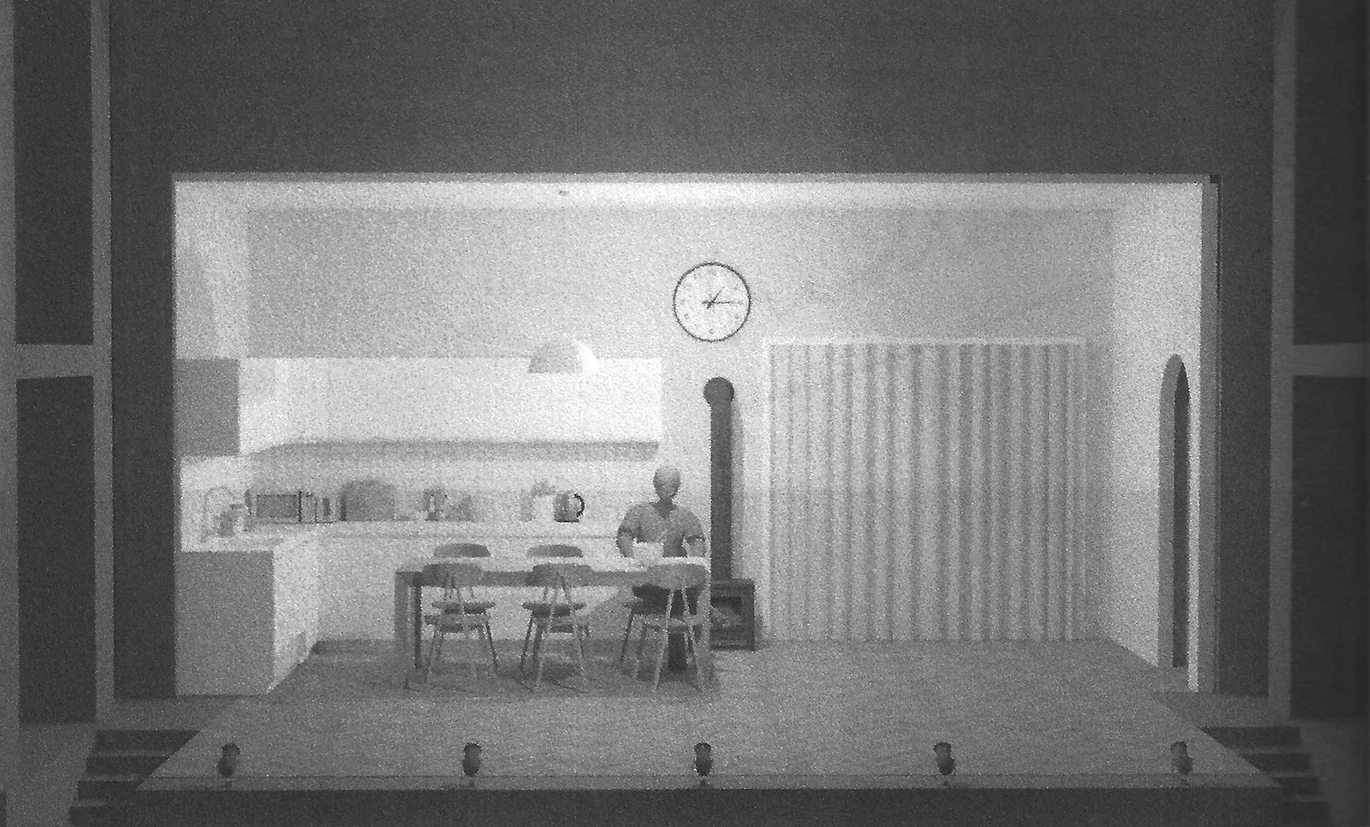
Act One: Kitchen (18).
At the centre of attention is what they call a “union meeting” to discuss their working conditions in capitalist show business: “Union chat, in a dark room – a true community space” (22). The naturalistic objectives of this get-together are made very clear:
MS SHARON: We have had enough. We are tired of pay disparity, the comparisons, the pressure, the stupid little teenagers bloody yaas-queening and the hunty-sashaying, and there comes a time where we must do the risky things in order to help the greater good. (33)
The anger is directed at the commercialisation of the art form of drag in capitalism, which they feel has been bought and sold. An extremely competitive development of drag culture is epitomised by RuPaul, the American actor, drag queen, model, and author with a net worth of sixty million dollars. To the cheers of the performers and the sound of helicopters, tanks, smoke bombs, and in the heat of frantic dancing, the scene culminates in a heavily stylised, half-joking, surreal, satirical killing of a puppet version of RuPaul, out of whose head spurts money.
Quite symbolically, acts two and three have audiences and readers witness how the naturalistic set is then – in a neo-Brechtian “rug-pull” (Akbar, “Sound of the Underground”; see also Sierz, “Sound of the Underground”) – literally taken apart and transformed into a singular dreamscape (see figures 2, 3, and 4.) Here, the transition focuses on the practical and material, as well as time-bound aspects of deconstructing a particular space to pave the way for building a new one.
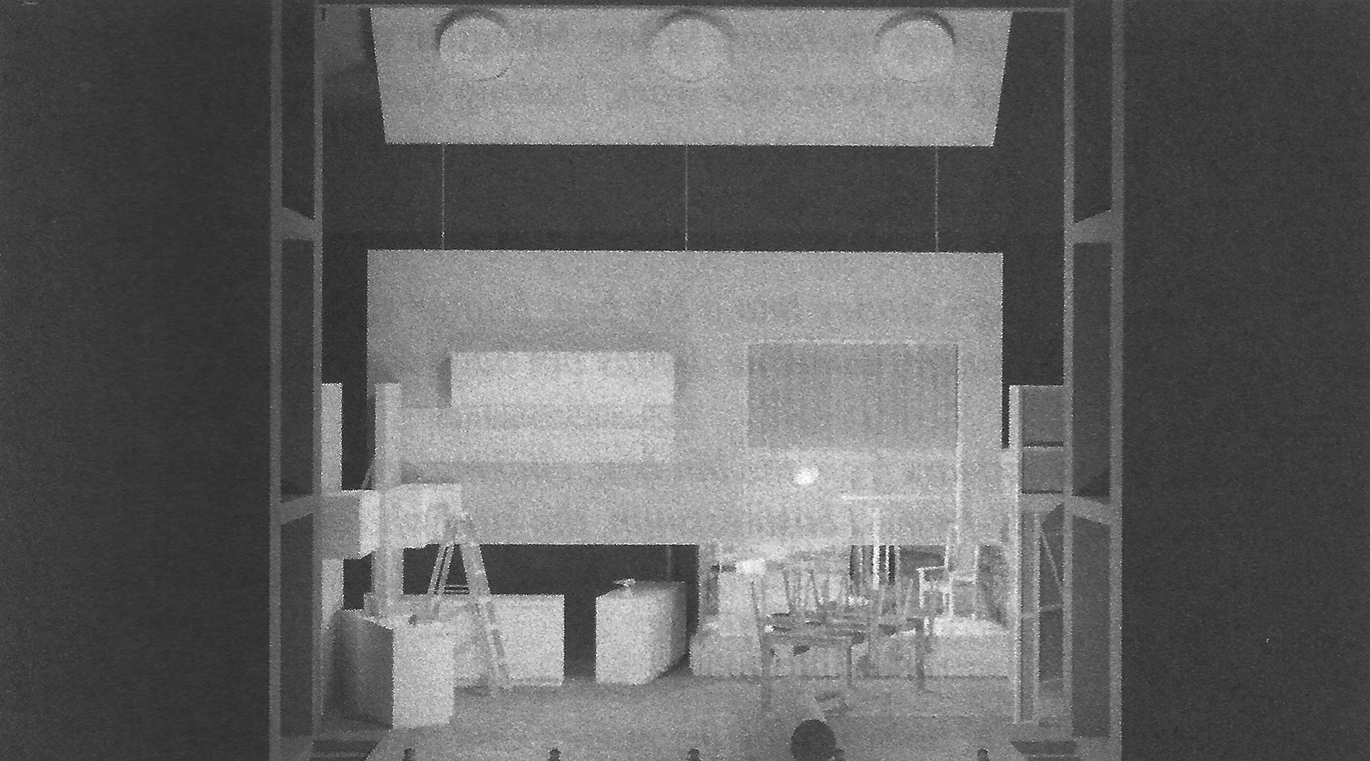
Act Two: Dismantling of the kitchen by the cast and crew (43).

Act Three: The Fabric Palace and bed (46).
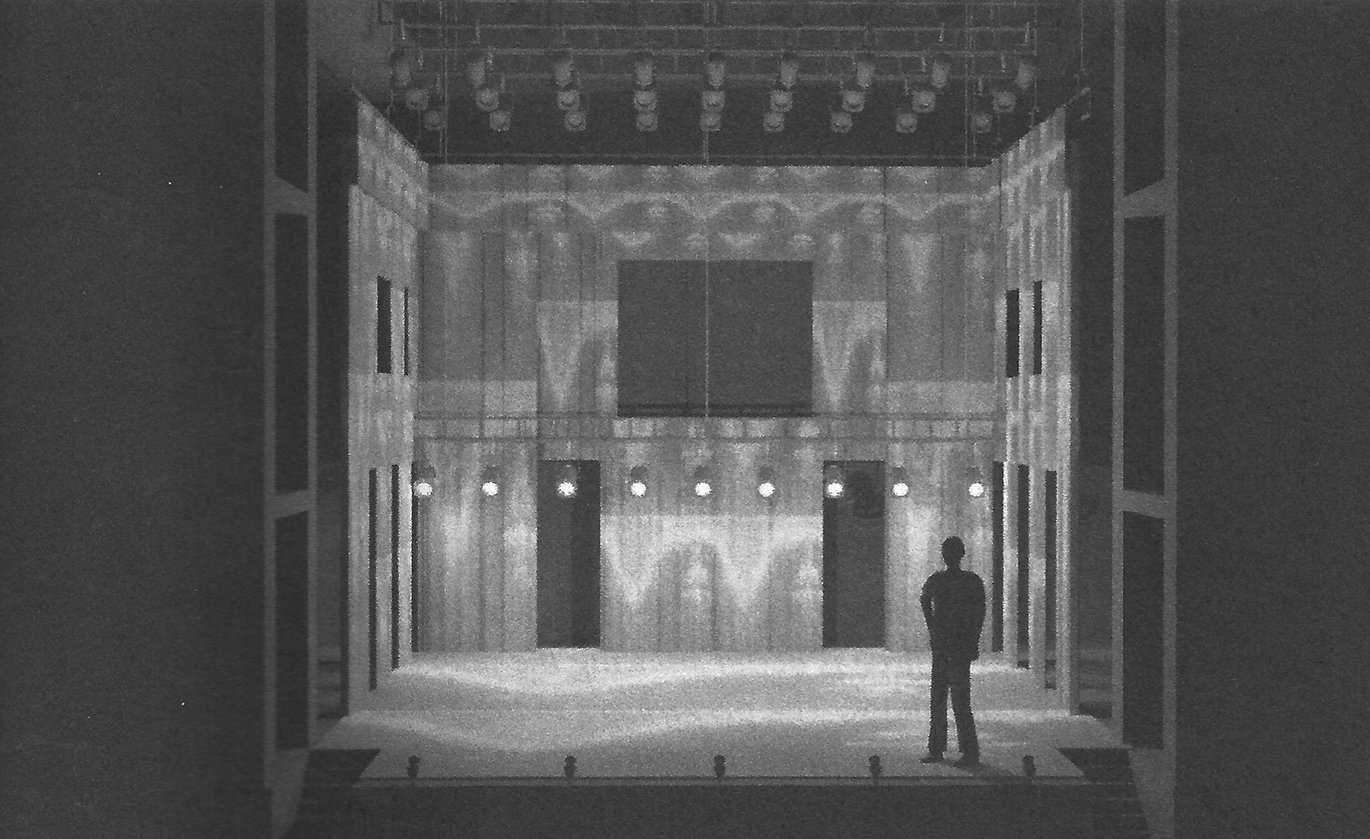
Act Three: The Fabric Palace with lights (47).
The entire second act is primarily made up of real-life interviews with the cast concerning questions “about how they feel as workers in drag, the effect of RuPaul on the industry, competition and capitalism” (44). All of this is rendered entirely inoperative, none of it is scripted.
Act three, finally, centres on the “Fabric Palace”: a dreamlike place which, once the last pieces of the kitchen have been pushed off stage, “floats down from above and defines a shift to a new kind of performance, and an imagined queer future [. . .] inspired by Pink Narcissus and its heavenly dreamlike vibes” (47).
The utopia inherent in such a transformation in the theatre entangles Alabanza, the performers, as well as audiences and readers alike. The performers have co-written the text after they were asked to create a piece of their own reflecting on their dreams, their visions, and their awakening. These pieces span a wide range of topics and atmospheres, from exuberance, fun, jokes, flamboyance, and extravagance of expression to nostalgia about the decline of club life, a melancholy glance backward at Mother Clap’s Molly house and gay subculture in the eighteenth century. All of this highlights the envisaged procedural, ever-changing, ever-coming, evolutionary character of inoperative communities:
SUE: Welcome darlings, welcome back. A lot’s changed, a good chunk of the audience have left, I’m in a gown. [. . .] Give me a whoop if you’re a Kensington local?! Yeah so cleaning is like . . . something’s dirty but you don’t throw it away . . . like what you do to money.
Let’s get to know one another. Give me a whoop if you’re an LGBTQIA+ person! Give me a whoop if you’re a heterosexual person! I am of course joking, heterosexuals you’re more than welcome here. You’re welcome everywhere, that’s how privilege works.
I was quite excited to perform at the Royal Court, the Royal Court. I thought I’ve made it, mother you can return my calls I’m a star. And I am. But it turns out that a star here is paid 570 pounds a week for eight shows and a shared dressing room! And to be honest, all this structure, and explanation, and action of a play just really isn’t my cup of vodka. (49)
The play is an almost aggressive rejection of the commonly accepted model of community that rests on inclusion and exclusion. Likewise, with the argument turned aesthetically, the play is a decided repudiation of stage realism. Neither the text nor the performance do represent constative values or follow the realistic principle of verisimilitude anymore. Both performatively un-work a community and a sense of, for instance, “home.” Sue remembers that she got hired to perform a striptease, characteristically, in the darkness of the basement of a rich man’s house in Hampstead. In the midst of lip syncing a Cher song, to which the man is masturbating, none other than his wife walks in:
SUE: She was absolutely heartbroken to see the man she loved with a drag queen, even more upset to see him crying to a Cher song, that she started yelling at him. Well he said to her that it wasn’t his fault, that I had kept him there, in his own basement against his will, so she turned on me. She starts trying to hit me the with the heel of her Louboutin, now I know if I hit back the papers will have a field day, so I just try to dip and dodge, but a heel did scratch my eye, I manage to escape, leaving all my daytime clothes in the basement – but as I get out onto the road, crying as I wait for my Uber, the one that stops to pick me up, well he sees me and he shouts, “I’M NOT PICKING UP SOME SINFUL FUCKING DEVIANT YOU’RE GOING TO HELL YOU FAGGOT.” (26–27)
This experience reflects on the mechanisms of exclusion (such as transphobia, as in this case, racism, or sexism), the hypocrisy, and the violence inherent in the commonly accepted model of community. Quite tellingly, this scene in the home of a community member who faces the radical Other lays bare the entire precariousness at the heart of the imagination of being at home or in one’s homeland. The scene instantly raises the fearful ghost of the uncanny in this home; Sue becomes virtually un-heimlich, cut off from the outside world, outlandish, queer, and, literally, unhomelike, unhomely.
Again, like Barber Shop Chronicles before, Sound of the Underground lays bare the fact that it is the very mechanisms of inclusion/exclusion inherent in communities that generate the terror of losing security and belonging. What is symbolised here is that this myth of security and belonging produces nothing but the sham of a community which creates the very insecurity it is alleged to protect us against. Chiyo’s beautifully poetic lines at the end of the play corroborate that:
CHIYO: You applaud.
I strip
You cheer
I strip
You question nothing
I strip
You scream my name
We finish
And then you go home.
And I go home too.
[. . .]
But then on my way home, I get attacked.
And I turn to look at someone to help me. (56)
Alabanza’s answer to the inclusion/exclusion pattern is a fluid aesthetics: the creative fireworks of a carnivalesque counterdiscourse resisting the traditional concept of community. They highlight the ethical dimension of dialogicity, communication, and the inoperative community. They emphasise the responsibility to engage in genuine dialogue, to listen to others, and to respect their voices. Alabanza’s concept of community emphasises the need for openness, hospitality, and recognition of the Other, the creation of a meaningful and inclusive community that requires active engagement, empathy, and a willingness to embrace difference, or, in the words of the performers, “fluid” or “queer” time: the finitude of singularities compearing, or, in other words, the significance of engaging with multiple voices and perspectives, and the creation of a vibrant social fabric.
Singularities Compearing and Being Singular Plural: Not One of These People
Whilst the desire for collective experience and intersubjectivity in Barber Shop Chronicles and Sound of the Underground stands incommensurably besides their being un-worked, Crimp’s Not One of These People constitutes a fascinating aesthetic radicalisation of the issue of inoperative communities. Here, any validity claim of collective experience exists only in the negative, as a negation of intersubjectivity, or of the concepts of “subjectivities,” “selves,” “persons,” or “individuals” (Middeke, “The Art of Compearance” 255–260). Not One of These People is no traditional stage play at all, even though it was first performed live at Théâtre La Bordée, Québec City on 1 June 2022 in English and, a day later, in French. The British premiere took place on 3 November 2022 in the Jerwood Theatre Downstairs at the Royal Court Theatre. The play has no plotline and rather resembles a piece of performance art, which, as Arifa Akbar points out in her review of the piece in The Guardian, “seems, in style, like a video installation that might be found in a backroom of the Tate on a perpetual loop” (“Not One of These People”; see also Lukowski).
In an epilogue to the printed version of the play, entitled “On Writing Not One of These People,” Crimp recollects a discussion he had with Vicky Featherstone regarding the creation of works that could be staged as soon as the pandemic lockdown conditions permitted audiences to return. Initially, the aim was to eliminate physical contact among actors and to minimise or entirely bypass the need for rehearsals, relying on actors reading the text directly from the page. Crimp envisioned a text of extended duration, one that would span several hours, allowing small audience groups to enter at intervals, sampling the text before making way for the next group. The initial concept – influenced by Forced Entertainment’s Speak Bitterness (1994) (Crimp 61) – involved creating a text featuring 1000 distinct voices, all to be recited from a script. Two years later, following the alleviation of pandemic restrictions, Crimp joined forces with Québécois director Christian Lapointe to reimagine the original idea. The outcome evolved into a ninety-minute-long monologue, delivered by Crimp himself and accompanied by 299 images representing the “speakers.” Remarkably, each of these 299 images was generated using artificial intelligence, a technique operated by Guillaume Lévesque at 0/1 Hub numérique. Therefore, Not One of These People links Crimp’s monologue to a sequence of photographs of people who do not exist: 299 deep-fake versions of speakers driven by Crimp’s voice and his facial expressions, which were seamlessly mapped onto their faces (Clapp). Keith Mckenna observes that there is a very loose structure to be deciphered:
The first hundred characters reflect what [Crimp] refers to as the cultural “toothache” around the clash of what is regarded as permissible, the second set of people we see let us glimpse what are supposedly a series of confessions and the final ninety-nine contributions he suggests are a riff on notions of chance but seem similar to what has gone [on] before.
Furthermore, certain topics seem to reemerge like leitmotifs, which, in the end, turn out to be red herrings, though: matters of lifestyle, consumerism, gender, race, feminism, community, sex, and art. Various speech acts refer to opinions and tastes, there are confessions, apologies, and, obsessively almost, acts of self-fashioning or self-justification. Even though there seem to be connections between the utterances and different speech acts, these seem entirely out of context, absurdly ephemeral, and, for the most part, almost painfully banal. Highly reminiscent of Samuel Beckett’s minimalist pieces for the theatre, Crimp is far less interested in the content or subject matter of the 299 statements than in their formal shape, less in the individuality of each speaker and their speech acts than in their singularity. Thus, what we have in front of us are repetitive structures on the syntagmatic side of utterances, which vary only on the paradigmatic side of the single parts of a sentence. And as each statement is as ephemeral as the one before and after, the statements appear as entirely exchangeable, as the following examples aptly reveal:
144 I made the mistake of opening a tin can at the wrong end [. . .].
145 I made the mistake of going ahead with testing the reactor [. . .].
146 I made the mistake of trusting him.
147 I made the mistake of inviting my parents for Christmas.
148 I made the mistake of coming here and listening to this shit. (32)
Clearly, the sentences are identical in their syntagmatic order. The paradigms of each sentence after the introductory speech act of a confession – “I made the mistake of” – are different, yet they appear so unconnected and out of context that they become arbitrary in their choice and form a list that potentially could go on forever. One individual confession, in fact, becomes any confession and, thus, a singular one. One concern is any concern or, at the same time, no concern at all, as Beckett would doubtlessly put it with regard to the minima and maxima of the same thing.
The following example centres on the speech act of “apologising” with the same arbitrary outcome: one apology is any apology in a series of, potentially, endless apologies, which, robbed of their contexts, do not appear as individual but as singular speech acts. This impression is, of course, enhanced by the fact that each speech act refers to a deep-fake image and to Crimp’s voice, that is, each creation metadramatically/self-reflexively also echoes their creator:
83 I am sorry: I don’t watch television.
84 I am sorry: I didn’t realise you were in the queue.
85 I am sorry: you can’t claim my experience as your own.
86 I am sorry: but Y chromosome means you’re a man.
87 I am sorry: but I’ll write what the fuck I like.
88 I am terribly sorry, but I think you’re sitting in my seat.
89 I’m sorry, but I had exactly the same background – [. . .].
90 I’m sorry, but if you talk that way you will receive death threats [. . .].
91 I’m sorry, but by endlessly stressing the vulnerability of young women you’re recreating a Pre-Raphaelite world of russet-haired victims.
92 I’m sorry, but you’ve come to the wrong building. [. . .]
93 A man cannot understand the experience of rape. I’m sorry, but it’s a fact. (22–23)
Crimp’s aesthetic strategy is reminiscent of some of the most hermetic moments in his earlier experimental work, such as Attempts On Her Life (1997) or the trilogy of short plays Fewer Emergencies (2005). Crimp devises a complex network of reemerging motifs, but he isolates each repetition (with a difference) from their contexts. The different speech acts quoted above, thus, constitute empty signifiers after all – empty repetitions, phatic acts of speech, underscoring what Jacques Derrida called the “iterability of the signifier” (Limited Inc.), emphasising that in everyday speech each sign or chain of signs can be isolated from a sequence of written speech and can be grafted upon other sequences (Derrida, The Gift of Death 9; with regard to the correlation of this to Crimp’s aesthetics, see also Middeke, “The Undecideable” 103–104).
In that these speech acts fail to provide individual as well as concise communicative meanings and leave us baffled at their incoherence, they provide a shift from the individual and the intersubjectively comprehensible to the singularity of each of these utterances. These speech acts are not linked anymore and, thus, do not point to any semantic belonging, yet they still do co-appear, or rather, in Nancy’s term, compear as singularities: singular by themselves but, at the same time, ontologically plural as they refer to and contain their sign system of language. They are singular plural. The community they are referring to is no longer the community of intersubjective agreement – or, turned aesthetically, realist consensus – but the inoperative community of singularities/singular statements compearing. The following singular statement subscribes to the absent consensus but, albeit implicitly and negatively, also reveals that even a statement such as this cannot not compear with other statements. Therefore, even though it assumes otherwise and fashions itself as individually encapsulated, the statement remains indicative of the inoperative community of being-with:
67 I can hear her saying, we’re so thrilled to have a voice here to represent your community – and of course I’m smiling and being super-thrilled back – but in my mind I’m going: Community? What the fuck? (20)
The inclusion/exclusion pattern (ironically) emanating from the title of the play – Not One of These People – ultimately appears thwarted on the ontological level of the utterance:
277 I’m not one of these people who says they’re comfortable with risks [. . .].
278 I’m not one of these people who questions statistics [. . .].
279 I’m not one of these people who takes risks with spaghetti.
[. . .]
281 I’m not one of these people who think women are more likely to be anxious or depressed.
282 I’m not one of these people who think men are more able to mentally rotate cubes.
283 I’m not one of these people who think when the bombing starts it’s safer to stay out in the street. (54–55)
The obsessive repetition of the “I” in every sentence of this passage (and the two previous ones quoted above) can partly, as so often in Crimp, be read as a satirical debunking of the cult of the “I,” the cult of individuality, and the (narcissist) “babel of opinion” (Marlowe) we all are surrounded by in a twenty-first-century reality of media overkill where opinions are far too often equated to facts, rendering opinions on “statistics” indeed as (ir)relevant as opinions on taking “risks with spaghetti.”
This said, my argument, again, is that Crimp is less concerned with the content side of things and with what is said in each of these singular opinions or speech acts – the ephemerality inherent to them cancels all of them out anyway –, but how it is said and that it is said. In order to underscore the singularity of each voice/utterance/speech act, their abstract structure is foregrounded. Each of the sentences above is a complete or self-contained unit that itself has an inner structure and is subject to linguistic laws. Thoroughly reminiscent of generative grammar and Noam Chomsky’s work, the sentences quoted above do not work as communicative units anymore, as they remain entirely unrelated and out of context in their relationship to us readers and spectators. In their repetitiveness, arbitrariness, and exchangeability of content, they constitute a theoretical, purely formal quantity. Crimp’s metadramatic grammar, therefore, forms a finite system of rules and recursively generates an infinite set of well-formed sentences of language. As the syntactic category “sentence” is defined as the set of sentence expressions of a particular language, it is not possible to list these in finite time since their quantity is potentially infinite and could be extended at will. If you think of Beckett’s Waiting for Godot (1956) for a moment, the second act repeats the first one differently, and a potential third act is superfluous as it would only describe another nested level in an infinite series of nested levels which the play’s structure is composed of. There is no nesting process at work on the sentence level in Crimp here, even though the metadramatic setting of the play itself, which has its author read his own script and lend his voice and facial movements to 299 deep-fake faces, describes a veritable Chinese box, too. The 299 utterances hence are synecdoches, parts of the universe of all utterances going on forever – ad infinitum, ad absurdum, ad nauseam. Disgust or sheer boredom set aside, what Crimp’s structure of singular voices refers to are infinite voices, infinite speech acts, infinite signifiers, infinite contexts these signifiers could be grafted upon, and also infinite readings as well as infinite misreadings.
The traditional kind of community ensures the felicitous uttering of performatives. We all can do things with words – make promises, swear oaths, confirm contracts or wills – but here? If we took each of the sentences seriously for a moment as realistic speech acts – which we cannot, as they are scripted and read by the author and projected onto AI-generated faces –, infinite small communities that are based on identity and non-identity and on their members’ inclusive/exclusive declaration to be either “one of these people” or “not one of these people” would appear. Crimp’s aesthetic structure, however, transcends this in that it isolates each utterance from its concrete communicative context and, thus, highlights the singularity of an opinion, for instance, but, at the same time, each singular opinion remains an opinion within the plurality of everyone who can have an opinion at all. Therefore, claiming “I am not one of these people who [. . .]” ignores the fact that, ontologically, one remains one of those people who can say “I am not one of these people who [. . .].” You cannot not compear. Ontologically, you remain one of those from whom your speech acts of demarcation and separation may set out to set yourself apart from.
In Crimp’s inoperative, un-worked, and un-workable community, there is no solid ground for doing things with words. None of the conditions for successful speech acts laid out by John L. Austin in How to Do Things With Words is met within Crimp’s inoperative community. Unlike a real or, turned aesthetically, realistic setting, Crimp’s text and its performance do not present enclosed selves or egos capable of taking responsibility for what they say and endure through time so that, for instance, promises made yesterday can be kept today. Even in real life, we cannot absolutely certify the sincerity of speech acts uttered by another person. What better representation could there be for this void than a series of deep-fake speech acts? Crimp’s community is truly inoperative, as Not One of These People remains un-worked and open to conjecture and interpretation.
Conclusion
Ellams’s Barber Shop Chronicles, Alabanza’s Sound of the Underground, and Crimp’s Not One of These People not only reflect on inoperative communities, but all three plays constitute inoperative, coming communities by themselves: performative un-workings of the traditional concept of community. All three plays reflect on openness and present networks of relationships that remain in flux. The plays recognise the multiplicity of individual experiences and perspectives, yet transcend these in that they emphasise the singularity of each perspective rather than trying to homogenise or standardise identities while, at the same time, acknowledging the ontological plurality and collectivity all singularity is always embedded in. All three plays underscore the inoperative quality of being singular plural and accentuate the ontological status of being that equals being-with. But the fact that the barber shop, the queer club, or Crimp’s simulation do not provide reassurance of stable identities is also due to the shift away from notions of belonging to an idea of community that ceaselessly works to produce more democratic, open, and fluid relationships with others. This is a community of singularities and fragments, a community “mediated not by any condition of belonging [. . .] nor by the simple absence of conditions [. . .], but by belonging itself” (Agamben 84).
All three plays necessitate active audiences that get involved in the challenging of traditional viewing habits and the breaking of conventions of traditional stage plays. In this, all three plays do not lose any politico-ethical impact. Roberto Esposito reminds us that community has in fact two etymologies: the first one is “cum-unus,” which translates as “being singular plural” or as “together as one.” The second one, then, is “cum-munus,” meaning “being endowed with an office, a duty, a courtesy, a favour, some mercy,” in short, it denotes something we have an obligation for (5). All three plays reveal a thorough ethical appeal that emerges from their aesthetic fluidity and unpredictability: an emphasis on responsibility and care; the acknowledgement of the Other; the acceptance of being with others without trying to dominate or assimilate them. In a more abstract fashion, all three plays invite us to think beyond fixed boundaries and to embrace the ongoing and unpredictable nature of communal interactions.
(Reading) literature and (going to and watching) the theatre as well as confronting text and performance creates an inoperative community of authors, texts, performances, actors, performers, audience members, and readers who establish an always coming community and the enactment of an interpretative as well as performative un-working of traditional understandings of community that are based on identity, non-identity, inclusion, and exclusion. Being-with or finitude compearing are fundamental features of human existence. This is what makes us human, this is what we all have in common. We cannot help but share our existence with others. The conversations in Barber Shop Chronicles, the performances in Sound of the Underground, and even the 299 isolated, singular statements in Not One of These People aptly reveal, from an ontological point of view, that there is no such thing as being “not one of these people.” All three plays discussed here adhere to an ethics of being singular plural. And their ethical quality lies in their resistance to totality. The barber shop in Ellams, the drag club in Alabanza, and the AI simulation in Crimp constitute creative counterdiscourses, alternative imaginaries that resist any definition, neat pigeonholing into clear-cut genre boxes, or even unequivocal programmes and goals, be these political, philosophical, or aesthetic. The inoperative community, as well as reading and spectatorship, are thus seen as an active idea, as an interruption, working from the notion of the impossibility of a lasting, fixed collectivity.
About the author
is Professor and Chair of English Literature at the University of Augsburg and Visiting Professor of English at the University of Johannesburg. He has published widely in the field of nineteenth- to twenty-first-century anglophone literature, drama, theatre, and literary theory. He is the co-editor of the Methuen Drama Guides to Contemporary Irish, British, American, and South African Playwrights (2010–2015). Recent book publications include Theory Matters: The Place of Theory in Literary and Cultural Studies Today (co-edited, 2016), Of Precariousness: Vulnerabilities, Responsibilities, Communities in 21st-Century British Drama and Theatre (co-edited, 2017), Drama, Theatre and Philosophy (co-edited, 2018), and Affects in 21st-Century British Theatre: Exploring Feeling on Page and Stage (co-edited, 2021). His current projects include a monograph on Theatre and/as Inoperative Community, a project on Literary Materialisations: Making Matter Matter on Page and Stage (forthcoming, 2024), a Handbook of Literary Ethics (forthcoming, 2025), and a website on theatre philosophy located at the Harry Ransom Center, University of Texas at Austin. He is a co-editor of Anglia: Journal of English Philology. Since 2013, he is elected member of the Academia Europaea.
Works Cited
Agamben, Giorgio. The Coming Community. Trans. Michael Hardt. Minneapolis: U of Minnesota P, 1993. Print.Search in Google Scholar
Akbar, Arifa. “Not One of These People: The Playwright as Puppet Master.” The Guardian, 4 Nov. 2022. Web. 2 Jan. 2024. <https://www.theguardian.com/stage/2022/nov/04/not-one-of-these-people-review-royal-court-theatre-london>.Search in Google Scholar
–-. “Sound of the Underground Review: Magnificent Explosion of Mesmerising Drag.” The Guardian, 26 Jan. 2023. Web. 2 Jan. 2024. <https://www.the guardian.com/stage/2023/jan/26/sound-of-the-underground-royal-court-london>.Search in Google Scholar
Alabanza, Travis. Sound of the Underground. Co-created by Debbie Hannan. London: Methuen Drama, 2017. Print.Search in Google Scholar
Anderson, Benedict. Imagined Communities: Reflexions on the Origin and Spread of Nationalism. London: Verso, 2006. Print.Search in Google Scholar
Austin, John L. How To Do Things With Words: The William James Lectures Delivered at Harvard University. Oxford: Clarendon Press, 1962. Print.Search in Google Scholar
Bennett, Jane. Vibrant Matter: A Political Ecology of Things. Durham: Duke UP, 2010. Print.10.2307/j.ctv111jh6wSearch in Google Scholar
Billington, Michael. “Barber Shop Chronicles Review: Close Shaves and Hairy Tales from Harare to London.” The Guardian, 8 June 2017. Web. 2 Jan. 2024. <https://www.theguardian.com/stage/2017/jun/08/barber-shop-chronicles-review-dorfman-theatre-london-national-inua-ellams>.Search in Google Scholar
Chomsky, Noam. Syntactic Structures. The Hague: Mouton, 1957. Print.10.1515/9783112316009Search in Google Scholar
Clapp, Susannah. “The Week in the Theatre: Not One of These People; Not Now; Super High Resolution.” The Guardian, 13 Nov. 2022. Web. 2 Jan. 2024. <https://www.theguardian.com/stage/2022/nov/13/not-one-of-these-people-martin-crimp-royal-court-review-not-now-david-ireland-finborough-super-high-resolution-nathan-ellis-soho-theatre>.Search in Google Scholar
Crimp, Martin. Not One of These People. London: Faber and Faber, 2022. Print.10.5040/9780571385478.00000004Search in Google Scholar
Curtis, Nick. “Barber Shop Chronicles Review: A Witty and Celebratory Study of Black Masculinity.” Evening Standard, 30 July 2019. Web. 2 Jan. 2014. <https://www.standard.co.uk/culture/theatre/barber-shop-chronicles-review-a-witty-and-celebratory-study-of-black-masculinity-a4201111.html>. Search in Google Scholar
Derrida, Jacques. The Gift of Death. Trans. David Wills. Chicago: U of Chicago P, 1995. Print.Search in Google Scholar
–-. Limited Inc. Ed. Gerald Graff. Trans. Samuel Weber. Evanston: Northwestern UP, 1998. Print.Search in Google Scholar
Ellams, Inua. Barber Shop Chronicles. London: Methuen Drama, 2017. Print.10.5040/9781350206311.00000003Search in Google Scholar
Esposito, Roberto. Communitas: The Origin and Destiny of Community. Trans. Timothy Campbell. Stanford: Stanford UP, 2010. Print.10.1515/9781503620520Search in Google Scholar
Fişek, Emine. Theatre & Community. London: Palgrave Macmillan, 2019. Print.Search in Google Scholar
Gertenbach, Lars, Henning Laux, Hartmut Rosa, and David Strecker, eds. Theorien der Gemeinschaft. Hamburg: Junius, 2010. Print.Search in Google Scholar
Girard, René. Violence and the Sacred. Trans. Patrick Gregory. Baltimore: Johns Hopkins UP, 1979. Print.Search in Google Scholar
–-. The Scapegoat. Trans. Yvonne Freccero. Baltimore: Johns Hopkins UP, 1986. Print.Search in Google Scholar
Hemming, Sarah. “Drag Deconstructed in Sound of the Underground.” Financial Times, 2 Feb. 2023. Web. 2 Jan. 2024. <https://www.ft.com/content/2b9fdb79-a71d-4844-a579-c17a4cffc278>.Search in Google Scholar
Lukowski, Andrzej. “Not One of These People Review.” Time Out, 3 Nov. 2022. Web. 2 Jan. 2024. <https://www.timeout.com/london/theatre/not-one-of-these-people-review>.Search in Google Scholar
Marlowe, Sam. “Not One of These People Review.” The Stage, 4 Nov. 2022. Web. 2 Jan. 2024. <https://www.thestage.co.uk/reviews/not-one-of-these-people-review-at-jerwood-theatre-downstairs-royal-court-london>.Search in Google Scholar
Massumi, Brian. Parables of the Virtual: Movement, Affect, Sensation. Durham: Duke UP, 2002. Print. 10.1215/9780822383574Search in Google Scholar
–-. Politics of Affect. Cambridge: Polity, 2015. Print.Search in Google Scholar
Mckenna, Keith. “Not One of These People.” British Theatre Guide, 6 Nov. 2022. Web. 2 Jan. 2024. <https://www.britishtheatreguide.info/reviews/not-one-of-thes-royal-court-the-21500>.Search in Google Scholar
Middeke, Martin. “The Undecidable and the Event: Ethics of Unrest in Martin Crimp’s Attempts on Her Life and debbie tucker green’s truth and reconciliation.” Ethical Speculations in Contemporary British Theatre. Eds. Mireia Aragay and Enric Monforte. London: Palgrave, 2014. 96–113. Print. 10.1057/9781137297570_6Search in Google Scholar
–-. “The Art of Compearance: Ethics, (Reading) Literature, and the Coming Community.” Theory Matters: The Place of Theory in Literary and Cultural Studies Today. Eds. Martin Middeke and Christoph Reinfandt. London: Palgrave, 2016. 247–263. Print.10.1057/978-1-137-47428-5_18Search in Google Scholar
Miller, J. Hillis. The Conflagration of Community: Fiction Before and After Auschwitz. Chicago: U of Chicago P, 2011. Print.10.7208/chicago/9780226527239.001.0001Search in Google Scholar
Mountford, Fiona. “Barber Shop Chronicles, Theatre Review: Make an Appointment.” Evening Standard, 5 Dec. 2017. Web. 2 Jan. 2024. <https://www.standard.co.uk/culture/theatre/the-barber-shop-chronicles-theatre-review-make-an-appointment-a3681276.html>.Search in Google Scholar
Nancy, Jean-Luc. The Inoperative Community. Trans. Peter Connor, Lisa Garbus, Michael Holland, and Simona Sawhney. Minneapolis: U of Minnesota P, 1991. Print.Search in Google Scholar
–-. Being Singular Plural. Trans. Robert Richardson and Anne O’Byrne. Stanford: Stanford UP, 2000. Print.Search in Google Scholar
Plessner, Helmuth. The Limits of Community: A Critique of Social Radicalism. Trans. Andrew Wallace. Amherst: Humanity Books, 1999. Print.Search in Google Scholar
Radcliffe, Allan. “Barber Shop Chronicles Review: Take a Seat for Razor-Sharp Insight Into Men’s Heads.” The Times, 28 Oct. 2019. Web. 2 Jan. 2024. <https://www.thetimes.co.uk/article/barber-shop-chronicles-review-take-a-seat-for-razor-sharp-insight-into-mens-heads-zn33mcbxn>.Search in Google Scholar
Saville, Alice. “Review of Inua Ellams, Barber Shop Chronicles.” Time Out, 8 June 2017. Repr. in Theatre Record 37.11/12 (2017): 613. Print.Search in Google Scholar
Sierz, Aleks. “Review of Barber Shop Chronicles.” Tribune, 16 June 2017. Repr. in Theatre Record 37.11/12 (2017): 615. Print.Search in Google Scholar
–-. “Sound of the Underground, Royal Court Review: Loud and Triumphantly Proud.” The Arts Desk, 30 Jan. 2023. Web. 2 Jan. 2024. <https://theartsdesk.com/theatre/sound-underground-royal-court-review-loud-and-triumphantly-proud>.Search in Google Scholar
Taylor, Paul. “Barber Shop Chronicles, National Theatre, London, Review: Staged with Exhilarating Dynamism.” The Independent, 8 June 2017. Web. 2 Jan. 2024. <https://www.independent.co.uk/arts-entertainment/theatre-dance/reviews/barber-shop-chronicles-dorfman-national-theatre-t-london-review-a7779761.html>.Search in Google Scholar
Tönnies, Ferdinand. Community and Civil Society. Ed. Jose Harris. Trans. Margaret Hollis. Cambridge: Cambridge UP, 2001. Print. 10.1017/CBO9780511816260Search in Google Scholar
Wicker, Tom. “Sound of the Underground Review.” Time Out, 26 Jan. 2023. Web. 23 Jan. 2024. <https://www.timeout.com/london/theatre/sound-of-the-underground-review>.Search in Google Scholar
© 2024 the author(s), published by Walter de Gruyter GmbH, Berlin/Boston
This work is licensed under the Creative Commons Attribution 4.0 International License.
Articles in the same Issue
- Frontmatter
- Frontmatter
- Preliminary Note
- Acknowledgements
- Articles
- Introduction: Theater and Community. Poetics, Politics, Performances
- Sensing a Twenty-First-Century Commons in the Theater: Relationality in a Climate of Distrust and Destruction
- The Inoperative Community in Twenty-First-Century British Theatre
- The Poetics and Politics of We-Narration on the Contemporary British Stage
- “You Are Alone”: Singularity, Community, and the Possibility of Solidarity in Slavoj Žižek’s The Three Lives of Antigone
- Community and Manipulation in the “Parallel Worlds” of Tim Crouch
- Dissensual Performances of Race and Community in Claudia Rankine’s The White Card and Jackie Sibblies Drury’s Fairview
- Staging the Theatrical Public Sphere in The Laramie Project
- Mary Kathryn Nagle in Conversation with Nina De Bettin Padolin and Ilka Saal
- The Politics of Queer Be-longing and Acts of Hope in Peter McMaster’s Solo Performance A Sea of Troubles and Split Britches’ “Zoomie” Last Gasp (WFH)
- Queer Hope in Working-Class Performance: Scottee’s Bravado and Class
- “Be Yo’self. It’s Just a Show”: Performing Community through the Comic Grotesque in Branden Jacobs-Jenkins’s Neighbors
- Identity Politics as Lingua Franca?
- Reviews
- Avra Sidiropoulou, ed. Staging 21st Century Tragedies: Theatre, Politics, and Global Crisis. New York: Routledge, 2022, 276 pp., £130.00 (hardback), £35.99 (paperback), £32.39 (ebook).
- Michael Meeuwis. Property and Finance on the Post-Brexit London Stage: We Want What You Have. Abingdon: Routledge, 2021, vi + 144 pp., £130.00 (hardback), £38.99 (paperback), £35.09 (ebook).
- Nicola Abram. Black British Women’s Theatre: Intersectionality, Archives, Aesthetics. Palgrave Macmillan, 2020, xiii + 224 pp., $109.99 (hardback), $109.99 (softcover), $84.99 (ebook).
Articles in the same Issue
- Frontmatter
- Frontmatter
- Preliminary Note
- Acknowledgements
- Articles
- Introduction: Theater and Community. Poetics, Politics, Performances
- Sensing a Twenty-First-Century Commons in the Theater: Relationality in a Climate of Distrust and Destruction
- The Inoperative Community in Twenty-First-Century British Theatre
- The Poetics and Politics of We-Narration on the Contemporary British Stage
- “You Are Alone”: Singularity, Community, and the Possibility of Solidarity in Slavoj Žižek’s The Three Lives of Antigone
- Community and Manipulation in the “Parallel Worlds” of Tim Crouch
- Dissensual Performances of Race and Community in Claudia Rankine’s The White Card and Jackie Sibblies Drury’s Fairview
- Staging the Theatrical Public Sphere in The Laramie Project
- Mary Kathryn Nagle in Conversation with Nina De Bettin Padolin and Ilka Saal
- The Politics of Queer Be-longing and Acts of Hope in Peter McMaster’s Solo Performance A Sea of Troubles and Split Britches’ “Zoomie” Last Gasp (WFH)
- Queer Hope in Working-Class Performance: Scottee’s Bravado and Class
- “Be Yo’self. It’s Just a Show”: Performing Community through the Comic Grotesque in Branden Jacobs-Jenkins’s Neighbors
- Identity Politics as Lingua Franca?
- Reviews
- Avra Sidiropoulou, ed. Staging 21st Century Tragedies: Theatre, Politics, and Global Crisis. New York: Routledge, 2022, 276 pp., £130.00 (hardback), £35.99 (paperback), £32.39 (ebook).
- Michael Meeuwis. Property and Finance on the Post-Brexit London Stage: We Want What You Have. Abingdon: Routledge, 2021, vi + 144 pp., £130.00 (hardback), £38.99 (paperback), £35.09 (ebook).
- Nicola Abram. Black British Women’s Theatre: Intersectionality, Archives, Aesthetics. Palgrave Macmillan, 2020, xiii + 224 pp., $109.99 (hardback), $109.99 (softcover), $84.99 (ebook).
