IUPAC reflectivity principle for normative work—the case of valence as a quantity
-
Pavel Karen
Pavel Karen <
pavel.karen@kjemi.uio.no > is professor at the University of Oslo, Department of Chemistry, in Oslo, Norway. and a current member of the Inorganic Chemistry Division;https://orcid.org/0000-0003-2937-6477 .

Abstract
My first IUPAC meeting in 2008 was with inorganic chemists of Division II who serve the chemical community by developing standards for nomenclature, terminology, definitions, and data/quantities. How can they do it? That’s how I learned about the IUPAC reflectivity principle: Adopted standards should reflect the current use as much as possible and with high consistency. Since ~30 years ago, the current use was gradually becoming easier to evaluate, even for quantities such as valence characterized by one of those colleagues as “valence is all things to all people.” Valence in general refers to the atom’s ability to bond other atoms, yet it is also used as a quantity. How to define that quantity under the IUPAC reflectivity principle?
Survey of valence assignments on examples
The first step was an anonymized survey asking 28 chemists from four IUPAC bodies to assign valence quantities in up to 20 examples of simple compounds, molecules, or ions, some of them specifically added to fit the chemistry field. Statistic evaluation revealed the likely concepts behind those quantities and the consistency of that. The most frequent concept was the Number of bonding electron pairs at an atom, followed by Number of bonding pairs sharing electrons of both atoms, Oxidation state, Number of electrons an atom uses in bonds, Number of bonded nearest neighbors, and Absolute value of oxidation state. Can the opinion of 28 chemists be representative of the current use? It is inspirational, but the current use must be searched in the literature way back. Still, how to explain the large variation?
History of valence as a quantity
One must look at the history of the term. For the valence quantity, it is described in the introduction of IUPAC Technical Report [ 1]. In brief, the quantity valence appeared about 50 years after the expression oxidation grade was introduced by Berzelius in English [2] and likewise in German and Swedish. In the 1860s, isolated occurrences emerged in German journals (see ref. 1). In 1885, valence as a “combining value” of an atom appeared in Inorganic Chemistry by Frankland and Japp [3] (p. 78) among a few synonyms for that “atom-fixing power” in units of the combining value of hydrogen. The legacy of Werner’s theory of complexes is the “Hauptvalenz” and “Nebenvalenz” [ 4] still used as the primary and secondary valence (see the 2005 IUPAC Red Book [ 5] page 144), not as a quantity, but as an adjective describing the group of bonds in a complex. About a decade after the 1897 discovery of electron by Thomson, the inorganic redox chemistry demanded valences of both positive and negative values, while organic chemistry simply counted bonds (see ref. 1). A major change came in 1938 with Latimer tables of standard redox potentials [6], where the so far rarely used term oxidation state defined the formal ionic states of the given-element atom pair to which the standard potential applies. Ten years later, Pauling, the chair of the Section II of the 1947 London IUPAC congress, saw the valence quantity in inorganic chemistry as an adjective n-valent for the oxidation number [ 7]. In organic chemistry, the valence quantity continued as before.
Recent new valence-type quantities
Two additional valence-type quantities appeared since: In 1970, a term “bond valence” was used [8] for the quantity “mean bond strength” suggested in 1929 by Pauling [9] for the then cation valence divided by its coordination, yielding the average bond order of that cation’s bonding interactions. The bond valence became popular after a table of bond-valence parameters for selected bonds of two elements with specified oxidation state was computed in 1985 by Brown and Altermatt [10] from quantities in the inorganic crystal structure database. It allowed easy calculation of bond valences from bond lengths in a crystal, yielding a decimal number of two-electron-bond equivalents. The second quantity appeared in 2005, when the term valence number was suggested by Parkin (see ref. 1) for the number of electrons an atom uses in bonds.
IUPAC definition of valence
The 1994 IUPAC Recommendation Glossary of terms used in physical organic chemistry [ 11] describes the organic-chemistry valence quantity as “the maximum number of univalent atoms (originally hydrogen or chlorine atoms) that may combine with an atom of the element under consideration, or with a fragment, or for which an atom of this element can be substituted.” This somewhat unclear wording now appears also in the Gold Book. A 2022 revision of this Glossary [12] states that valence is the “maximum number of single bonds that can be commonly formed by an atom or ion of the element under consideration,” which calls for opinion instead of defining the quantity.
Evaluation of valence-quantity candidates
The six valence-quantity concepts from the mentioned survey were complemented in the study behind ref. 1 by the current Gold Book definition from ref. 11, by the bond-valence sum at an atom, and by the auxiliary quantity of formal charge at an atom in the Lewis formula. These nine valence-related quantities were evaluated on 47 sets for 38 chemical entities, some on several alternative Lewis formulas or bonding schemes. All values were sensible numbers with specific meaning and mutual relationships stated in ref. 1. The ambiguity of the ref. 11 definition was avoided by “considering” the given atom with its open-ended bonds and the formal charge as in the Lewis formula. Table 11 in Ref. 1 illustrates that such an approach yields values identical to the plain count of two-electron bonds or their equivalents at the given bonded atom in a specific compound. In case of multiatomic ions, the ionic charge in Lewis formula should follow electronegativity. For an anion like BF4−, the addition of Lewis base F− to Lewis acid BF3 is followed by reshuffling electrons to the four terminal F atoms so that they bond in an ideal approximation by ¾ to B and by ¼ to a cation as required by the 8−N rule. Likewise, yet inversely, for NH4+.

F igure 1 Valence-type quantities evaluated for carbon atom in ethyne.
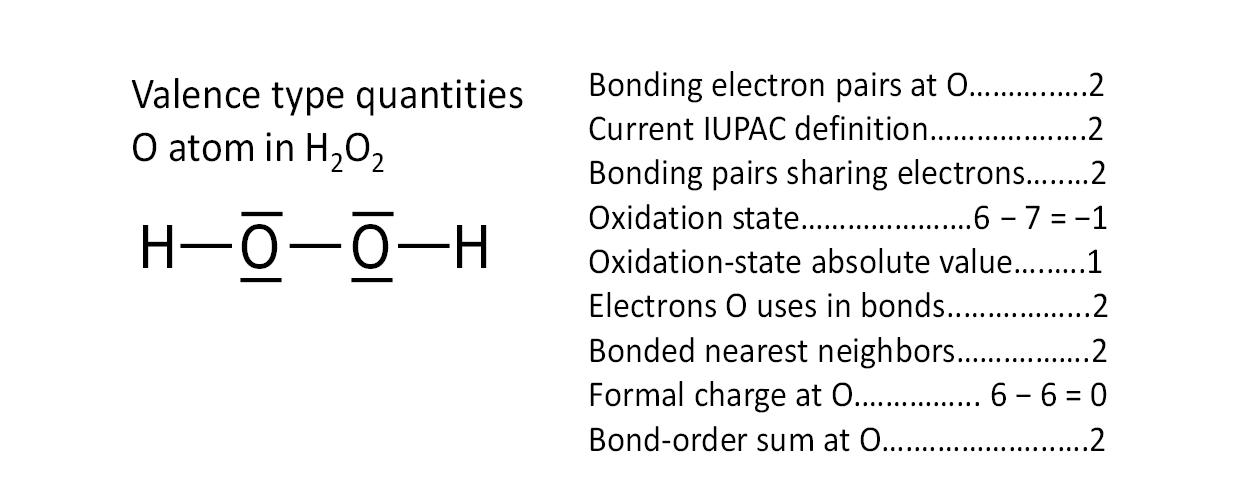
Fi gure 2 Valence-type quantities evaluated for oxygen atom in hydrogen peroxide.
Evaluation of these alternative valence quantities on a simple organic-chemistry example of C2H2 is illustrated on Figure 1. The current IUPAC definition was followed by taking the four-bonded carbon and asking how many Cl or H atoms it would bond. Oxidation state was obtained as the carbon charge after ionic approximation that divides homonuclear bonds equally. The list of results gives several values to choose from. The only question is which value corresponds to the current use and the declared context of the quantity called valence.
Inorganic example of a simple molecule is evaluated similarly for the hydrogen peroxide in Figure 2.
Third example concerns rhenium in the Lewis formula of the repeat unit in the crystal of ReCl3, drawn in Figure 3 upon the so called neutral-atom counting ([13] p. 815) that yields 18-plet at each Re atom of two double bonds Re=Re. Following the 1994 IUPAC definition considers the segment of nine-bonded Re2− acceptor of two donated bonds and obtains ReCl92−, thus valence 9 seen directly by counting two-electron bonds. The oxidation state of ReCl3 is +3 also in the Figure 3 formula, after each Re keeps 4 electrons from its Re-to-Re bonds while the rest is extrapolated ionic to Cl−.
Surely, the Re 18-plet of integer bond orders is an approximation, but the chlorine-bridge bond lengths do yield the bond-valence (bond-order) sum at Cl well over 1. Ambiguities are avoided upon ionic extrapolation into the oxidation state as an integer dimensionless quantity characterizing this binary compound; a quantity that Werner called primary valence. One is then curious whether the high values 7 and 9 obtained from Figure 3 are actually used for Re valence in ReCl3.
Likewise with other evaluated examples. What decides the best of those 9 valence definitions? The current use since ~1954, after changes following the 1947 London IUPAC Congress became accepted by the chemistry community.
Current use of valence
How to evaluate the actual recent use of valence as a quantity? The only way is to search published peer-reviewed texts. Since the etymology of the word valence in chemistry is the ability of an atom to bond, valence enters many terms. Some do not describe any quantity (valence-bond theory), some have quantitative context yet no numerical value (hypervalent, hypovalent, polyvalent, isovalent, aliovalent, heterovalent, sub-valent, semi-valent, expandable valence, saturated valence, intervalence, high or low covalence, primary and secondary valence), some are countable (valence orbital, valence electron), and some are composed terms of a numerical value (mixed valence, bond valence, electrovalence, magnetic valence). The Technical Report [1] lists a brief description of these terms that are not relevant in the search for the valence-quantity use.

Fig ure 3 Valence-type quantities evaluated at Re in the Lewis formula of the ReCl3 repeat unit in the solid. Donated bonds in the neutral-atom counting are green. Red lines divide the six Cl linkers in half.
Search of valence use in textbooks
Search [1] for all valence-related terms in 33 textbooks of general, organic, inorganic, physical, and materials chemistry revealed occurrences of the valence quantity. The highest count was 12 times in an organic-chemistry textbook where the oxidation-state quantity appeared four times in contrast to several hundred times in some inorganic chemistry textbooks.
Search for valence as a quantity in articles
Searches are key to establish the relevant recent use of a term. In case of a dimensionless quantity characterizing a bonded atom in a compound or ion, the search must focus on that given element or chemical entity and the specific alternative valences. As an example, for the valence quantity of C in C2H2, one searches Google Scholar, choice Articles (in a chosen custom range of years and sorted by relevance) for: “divalent carbon” in C2H2, “divalent carbon” in ethyne, “bivalent carbon” C2H2, “tetravalent carbon” in C2H2, “quadrivalent carbon” in C2H2, acetylene “divalent carbon.” The quotations indicate expressions not to be separated. Searches are best done at several global locations that somewhat differ due to the perceived relevance.
If the Hg valence in Hg2Cl2 is searched as divalent mercury (and then as bivalent mercury), it gives tens of thousands of hits. Quotation marks improve the focus substantially, so the subsequent search is for “monovalent mercury” and for “univalent mercury”. Search for divalent Hg2Cl2 and for bivalent Hg2Cl2 is well focused by the compound formula.
The Google-Scholar search is only the first step. It also contains books, dissertations, and citations. The possibly relevant articles must be selected “manually” and downloaded as pdf files to be searched by clicking for “valen” to see all contexts and then select only the searched quantities for the given atom in the given compound. This search is very useful to see the use as well as the related terminology from additional similar examples.
The search behind the Figure 3 valence example was performed to answer whether chemists consider Re in ReCl3 trivalent, heptavalent or nonavalent. Articles were selected from Google-Scholar search results for several formulations:
trivalent “rhenium trichloride” (first 10 articles of in total 36 search hits)
trivalent rhenium ReCl3 (first 14 articles of 249 search hits)
heptavalent rhenium ReCl3 (first 4 articles of 39 search hits)
“heptavalent rhenium” ReCl3 (3 articles of 3 search hits)
“hepta-valent” ReCl3 (0 search hits)
“nonavalent rhenium” (0 search hits)
nona-valent ReCl3 (0 search hits)
In total 31 articles of highest search relevance were then searched manually for “valen” to select the desired context. 21 were of irrelevant context (prior 1954, unrelated, concerned complexes of ReVII). Of the 10 truly relevant articles:
7 consider rhenium trivalent in ReCl3 or Re3X9 (1 implied),
2 consider Re trivalent in an octahedral complex with 3 Cl− and 3 electron-pair-donor neutral ligands,
1 uses valence as a synonym for oxidation state (even with negative values),
0 considers rhenium heptavalent in ReCl3 or Re3X9,
0 considers rhenium nonavalent in ReCl3 or Re3X9.
Telling examples for search of current use
From the tested compounds and formulas, 15 telling examples were selected in ref. 1 to search the preferred valence-quantity context in the current use of this term. Nine of these examples were formulated as a comparison of a contrasting pair, such as HgCl2 versus Hg2Cl2 (Table 11 in ref. 1). Some results are straightforward:
22 papers consider Hg in Hg2Cl2 monovalent, 0 divalent.
04 papers consider Cr in Cr2(CH3COO)4 divalent, 0 hexavalent.
07 papers consider Re in ReCl3 trivalent, 0 heptavalent or nonavalent.
08 papers consider Mo in MoCl2 divalent, 0 hexavalent or nonavalent.
12 papers consider Ni in Ni(CO)4 zerovalent, 0 tetravalent.
06 papers consider Mn in Mn2(CO)10 zerovalent, 1 monovalent, 0 hexavalent.
09 papers consider Os in Os3(CO)12 zerovalent, 0 divalent, 0 hexavalent.
Whereas
04 papers (all organic) state that C2H2 has tetravalent C, 0 divalent.
Some chemistry fields are less straightforward:
02 papers consider N in N2 zerovalent, 1 trivalent.
04 papers consider P in P4 zerovalent, 1 trivalent.
14 papers (11 organic, 3 inorganic) consider S in S2X2 halogenide divalent, 1 inorganic article as monovalent.
05 papers consider N in NH4+ tetravalent.
16 papers (14 organic, 2 inorganic) consider O in H3O+ trivalent, 0 as divalent (absolute value of oxidation state), none as tetravalent (oxygen electrons in bonds).
This suggests that inorganic chemists working with metals do not follow the organic-chemistry counting of two-electron bonds or the 1994 IUPAC Recommendations [11]. They follow the Pauling’s advice [7] and use the adjective n-valent for the Werner’s primary valence [4] that corresponds to the oxidation state of the metal. The Werner’s secondary valence in his 1909 book [4] (and in the Red Book [5] p. 144) refers to the number of donated bonds; only his 1893 paper [14] presented the secondary valence as the total number of coordinated bonds. Organic chemists follow the 1994 IUPAC definition [11]. Inorganic chemists working with main-group elements of the periodic system sit on the fence.
Conclusions
The survey about valence quantity among chemists brought the idea of investigating all sensible dimensionless quantities as candidates for valence. The current use was subsequently searched in peer-reviewed articles where it is well considered and verified as opposed to quick guesses in a survey. Evaluating the recent use is even more important for the valence quantity that is used rarely, relatively to similar dimensionless counts like oxidation state or bond order. The definition of the quantity needs to respect the current use as far it is possible or reasonable.
Organic chemists count electron pairs at the atom or use the ref. 11 IUPAC definition applied to that isolated atom with bonds and formal charge. Inorganic chemists working with metals use the adjective n-valent for the metal oxidation state. Chemists working with nonmetallic elements use one or the other alternative, yet rarely.
The IUPAC reflectivity principle was the basis of the ref. 1 investigation whether and how could valence quantity be defined. Reflecting the current/recent use is not something that applies merely to IUPAC normative papers. It is what we can do when wondering which chemical synonym is best in a text, for instance “acid dissociation” versus “acid ionization.” Google-Scholar gives their occurrences in chemistry papers. We do not make “inventions” by associating a traditional term with conceptually different quantities of simple verbal description. We should not disrespect the current use by using “covalence” for “valence” or by avoiding adjective “n-valent” for a metal oxidation state. Chemists depend on a whole era of chemistry literature that needs to be understood correctly. Explanatory clarity first. 
About the author
Pavel Karen <pavel.karen@kjemi.uio.no> is professor at the University of Oslo, Department of Chemistry, in Oslo, Norway. and a current member of the Inorganic Chemistry Division; https://orcid.org/0000-0003-2937-6477.
References
1. Karen P, Armelao L, Butler IS, Tomišić V, Yamashita M. Pure Appl Chem 2025;97:149-187. https://doi.org/10.1515/pac-2023-0402 (and references therein)10.1515/pac-2023-0402Search in Google Scholar
2. Berzelius J. Experiments on the Nature of Azote, of Hydrogen, and of Ammonia, and upon the Degrees of Oxidation of which Azote is Susceptible. Ann Philos 1813;II:276–284.Search in Google Scholar
3. Frankland E, Japp FR. Inorganic Chemistry, Lea Brothers & Co.: Philadelphia, 1885.Search in Google Scholar
4. Werner A. Neuere Anschauungen auf dem Gebiete der anorganischen Chemie, 2nd ed.; Friedrich Vieweg und Sohn: Braunschweig, 1909.Search in Google Scholar
5. Connelly NG, Damhus T, Hartshorn RM, Hutton AT. https://iupac.org/what-we-do/books/redbook/.Search in Google Scholar
6. Latimer WM. The oxidation states of the elements and their potentials in aqueous solutions, Prentice Hall, Inc.: New York, NY, 1938.Search in Google Scholar
7. Pauling L. J Chem Soc 1948:1461–1467. http://dx.doi.org/10.1039/JR948000146110.1039/jr9480001461Search in Google Scholar PubMed
8. Donnay G, Allman R. Amer Min 1970;55:1003–1015. https://msaweb.org/AmMin/AM55/AM55_1003.pdfSearch in Google Scholar
9. Pauling L. J Am Chem Soc 1929;51:1010–1026 (1929) https://doi.org/10.1021/ja01379a00610.1021/ja01379a006Search in Google Scholar
10. Brown ID, Altermatt D. Acta Crystallogr Ser B 1985;41:244–247. https://doi.org/10.1107/S010876818500206310.1107/S0108768185002063Search in Google Scholar
11. Muller P. Pure Appl Chem 1994;66:1077–1184. http://dx.doi.org/10.1351/pac19946605107710.1351/pac199466051077Search in Google Scholar
12. Perrin CL et al. Pure Appl Chem 2022;94:353–534. https://doi.org/10.1515/pac-2018-101010.1515/pac-2018-1010Search in Google Scholar
13. Housecroft CE, Sharpe A. Inorganic Chemistry, 3rd edition, Pearson-Prentice Hall (2008).Search in Google Scholar
14. Werner A. Z Anorg Allgem Chem 1893;3:267–330. https://doi.org/10.1002/zaac.1893003013610.1002/zaac.18930030136Search in Google Scholar
©2025 by Walter de Gruyter Berlin/Boston
This work is licensed under the Creative Commons Attribution-NonCommercial-NoDerivatives 4.0 International License.
Articles in the same Issue
- Masthead - Full issue pdf
- Vice President’s Column
- Reimagining the Scientific Horizons of IUPAC
- Features
- Chemistry’s Role in Malaysia Sustainable Development Progress
- Reusing Chemical Data Across Disciplines: Initiatives and Common Challenges
- IUPAC reflectivity principle for normative work—the case of valence as a quantity
- IUPAC Wire
- Awardees of the IUPAC 2025 Distinguished Women in Chemistry or Chemical Engineering
- Paolo Franzosini Prize and Christo Balarew Award 2024
- Graham Cooks and Anna Regoutz win the 2025 Awards in Analytical Chemistry
- Peter Mahaffy to Receive 2025 Pimentel Award for Outstanding Contributions to Chemistry Education
- Zafra Lerman to Receive Cardozo’s 24th Annual International Advocate for Peace Award
- CIAAW Student Observer Grant 2025
- USNC/IUPAC Announces the 2025 Young Observers and IYCN Delegates
- The Muscat Global Knowledge Dialogue and the 3rd ISC General Assembly: IUPAC’s Role in Shaping Global Science Policy
- In Memoriam
- Project Place
- Setting Standards for Wearable Biochemical Measurement Devices: Defining Nomenclature and Guidelines
- Promoting Chemistry Applied to World Needs
- The isotopic composition of VPDB
- IUPAC Provisional Recommendations
- Radical Copolymerization Reactivity
- Making an imPACt
- Toward a definition of valence as a quantity (IUPAC Technical Report)
- Diffusion in nanoporous materials with special consideration of the measurement of determining parameters (IUPAC Technical Report)
- Thermoplastic Starch with Maltodextrin: Preparation, Morphology, Rheology, and Mechanical Properties
- Glossary of terms for mass and volume in analytical chemistry (IUPAC Recommendations 2024)
- Special CTI
- Conference Call
- Medicinal Chemistry and Drug Discovery & Development India
- Solubility Phenomena and Related Equilibrium Processes
- The Historic Gathering of IUPAC Presidents at the 10th International Conference of Green Chemistry
- Chemistry, a Lever for Sustainable Development of African Countries
- Where 2B & Y
- Space Exploration and Research
- Mark Your Calendar
Articles in the same Issue
- Masthead - Full issue pdf
- Vice President’s Column
- Reimagining the Scientific Horizons of IUPAC
- Features
- Chemistry’s Role in Malaysia Sustainable Development Progress
- Reusing Chemical Data Across Disciplines: Initiatives and Common Challenges
- IUPAC reflectivity principle for normative work—the case of valence as a quantity
- IUPAC Wire
- Awardees of the IUPAC 2025 Distinguished Women in Chemistry or Chemical Engineering
- Paolo Franzosini Prize and Christo Balarew Award 2024
- Graham Cooks and Anna Regoutz win the 2025 Awards in Analytical Chemistry
- Peter Mahaffy to Receive 2025 Pimentel Award for Outstanding Contributions to Chemistry Education
- Zafra Lerman to Receive Cardozo’s 24th Annual International Advocate for Peace Award
- CIAAW Student Observer Grant 2025
- USNC/IUPAC Announces the 2025 Young Observers and IYCN Delegates
- The Muscat Global Knowledge Dialogue and the 3rd ISC General Assembly: IUPAC’s Role in Shaping Global Science Policy
- In Memoriam
- Project Place
- Setting Standards for Wearable Biochemical Measurement Devices: Defining Nomenclature and Guidelines
- Promoting Chemistry Applied to World Needs
- The isotopic composition of VPDB
- IUPAC Provisional Recommendations
- Radical Copolymerization Reactivity
- Making an imPACt
- Toward a definition of valence as a quantity (IUPAC Technical Report)
- Diffusion in nanoporous materials with special consideration of the measurement of determining parameters (IUPAC Technical Report)
- Thermoplastic Starch with Maltodextrin: Preparation, Morphology, Rheology, and Mechanical Properties
- Glossary of terms for mass and volume in analytical chemistry (IUPAC Recommendations 2024)
- Special CTI
- Conference Call
- Medicinal Chemistry and Drug Discovery & Development India
- Solubility Phenomena and Related Equilibrium Processes
- The Historic Gathering of IUPAC Presidents at the 10th International Conference of Green Chemistry
- Chemistry, a Lever for Sustainable Development of African Countries
- Where 2B & Y
- Space Exploration and Research
- Mark Your Calendar
