Reimagining the Scientific Horizons of IUPAC

Abstract
The Executive Board and the Science Board of IUPAC commenced their governance responsibilities at the beginning of the 2024 biennium. As Vice-President, I was given the honour of being the inaugural Chair of the Science Board, and in this column I will update the IUPAC membership on the work of the Board during its first year of operation, and explain some of our future workplans.
In line with its terms of reference, the Science Board began its work by considering the scientific structure of IUPAC, currently comprising 8 scientific Divisions and 5 thematic (i.e. operational) Standing Committees intended to address scientific topics across the breadth of chemistry. Additionally, there are 7 other advisory Standing Committees that are mostly of an administrative nature. The organisational structure of IUPAC is further complicated by a plethora of Sub-Committees, evidence of at least 30 such groupings appear within the IUPAC webpages!
The scientific structure of IUPAC was last considered in detail more than 20 years ago at the time of establishment of the project system, thus the current Science Board asked itself the question “Is this complex scientific structure still fit-for purpose?” While the current Divisional structure with its emphasis on the traditional sub-disciplines of physical, inorganic, organic, analytical and polymer chemistry may reflect the way in which academic chemistry is taught, it is no longer representative of modern chemistry research. And overall, the current structure is bewildering to those outside the IUPAC family and to key stakeholders in industry, NGOs, government and likely also to the thought leaders in our National Adhering Organisations (NAOs).
During 2024, we set out to reconsider IUPAC’s scientific priorities and agree on tangible outcomes that should be defined by these priorities, all of this in parallel with considering wide-ranging organisational change and restructure options. Our bimonthly discussions were intended to generate suggestions for commentary from the wider IUPAC community but were often constrained by the virtual nature of global meetings and the inconvenient timelines for some members. At key moments there is no substitute for face-to-face meetings, and so members were appreciative when the Royal Society of Chemistry kindly offered to host an in-person meeting of the Board at Burlington House in London between 16-17 January 2025. The IUPAC Executive Board subsequently endorsed a Finance Committee recommendation to support the meeting financially. Several delegates supported their attendance at the meeting through external funding mechanisms and so did not require IUPAC financial support, while three delegates joined remotely.
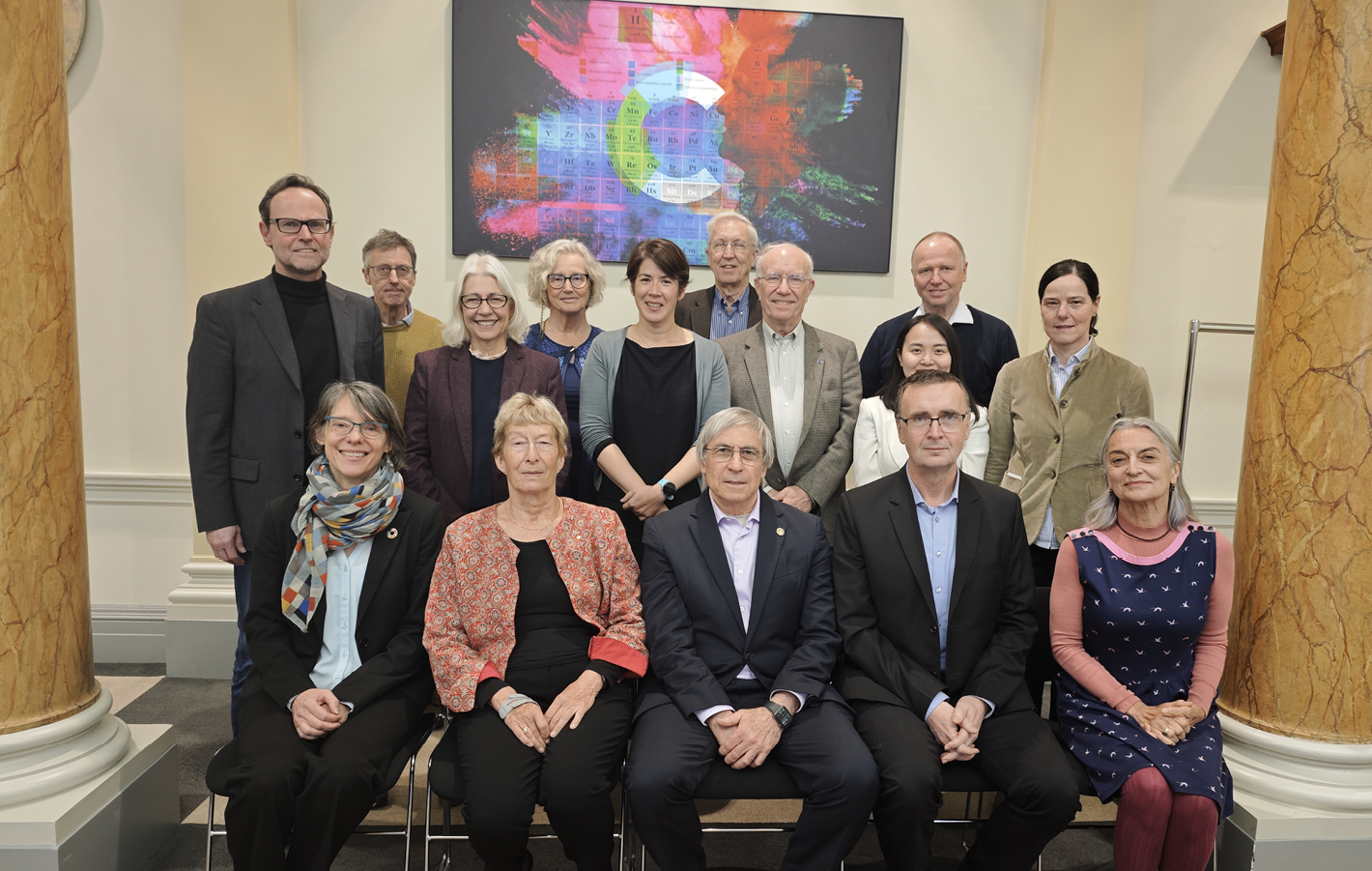
The IUPAC Science Board together with Chairs of the IUPAC Project Committee, Evaluation Committee, and the International Younger Chemists Network meet at Burlington House, London on January 16-17. (front row, sitting from left) Fabienne Meyers, Mary Garson, Ehud Keinan, Zoltan Mester, Frances Separovic, (second raw, standing) Peter Schreiner, Derek Craston, Ale Palermo, Eva Akesson, Christine Luscombe, Russell Boyd, Pierre Braunstein, Tien Thuy Quach, Igor Lacik, and Lidia Armelao.
In preparation for this in-person meeting, Board members identified a number of key topics to explore, including:
The strategic direction for IUPAC’s future scientific activities and areas of growth.
Potential restructuring of the project submission process to support divisional initiatives better.
Defining IUPAC’s role in industry engagement to enhance real-world impact.
Brainstorming idea: would would happen if IUPAC were created now: what would be the focus, who would we be? What would happen if IUPAC ceased to exist?
During December 2024, a “Whiteboard” survey of the Science Board membership was undertaken, asking questions about the current traditional outputs, digital outputs, external outreach and scientific operations of IUPAC and thereby seeking answers as to which areas of chemistry activity should be addressed by IUPAC in future. The responses received from Science Board members were shared in the first session of the London meeting. There was unanimous support for digital aspects of IUPAC work, but noting that “digital” and “traditional” aspects of IUPAC work are strongly linked. Also strongly supported was the need for involvement in new areas of science, although existing areas should not be neglected. IUPAC needs to cooperate closely with all stakeholders, and to engage better with cognate disciplines and the external world. Science Board members diverged in their views regarding the role of IUPAC in global scientific issues with some suggesting that IUPAC currently has insufficient bandwidth to contribute. Outreach activities were generally thought to have a lower share of the budget than “traditional” / “digital” outputs; indeed, resourcing issues were generally of concern with the need expressed to adopt a stronger commercial mindset in future outputs.
There was general agreement that the project system needed to be refreshed, while there was no support for a tiered TM/AM/NR membership model. An option that could be considered is that IUPAC bodies have elected Leadership Teams consisting of president, vice president, past president, secretary and project coordinator together with elected NRs. Individual arrangements could be made for the small number of long-standing IUPAC volunteers whose country of origin is not an NAO.
The meeting then further explored the balance between traditional and digital outputs, and between scientific and engagement activities, with the aim of providing guidance to the IUPAC community at large, and to the Executive Board about funding allocations for the next biennium. A set of updated scientific priorities are shown in the accompanying text box. Next exploring the project system and how to get value and beneficial outcomes from it, the Board agreed that there needed to be more accountability by insisting on regular project updates, and recommended follow-on action to cull under-achieving projects. Projects deemed to be relevant to few IUPAC members or with a scientific goal insufficiently reaching across IUPAC bodies should be discouraged. Ultimately the impact of completed projects needs to be better measured, although the Board did not address how this might be achieved. A small working party of Science Board members will further develop these ideas during 2025.
Scientific Priorities
IUPAC enables global scientific cooperation and collaboration by :
a. Creating a common language to the academic community and industry, including data standards, nomenclature, terminology and symbols, in particular in the digital age;
b. Providing curated data and fundamental or physical constants to the academic community and industry;
c. Defining and providing technical standards in chemistry and related disciplines;
d. Facilitating the exchange of best practice in chemistry and in chemistry education;
e. Supporting initiatives in data standards and data management, including educational activities;
f. Fostering scientific outreach and engagement initiatives, notably those that contribute to the UN Sustainable Development Goals;
g. Liaising with key industry, science unions, and governmental and non-governmental partners, to ensure/deliver IUPACs scientific contribution to a more sustainable future.
The need to incorporate International Younger Chemists Network members within the scientific work of IUPAC was widely acknowledged, as well as other volunteers and key stakeholders to ensure there is a sustainable access to a skill base aligned with IUPAC targets. The current chair of IYCN, Tien Thuy Quach, attended the London meeting.
In the final session of the London retreat, there was discussion on how best to develop options for refreshing the organisational structure of IUPAC. A working group led by Derek Craston (President, Division V), together with Igor Lacik (President, Division IV) and Mary Garson later developed a discussion paper which was circulated in February for comments from Science Board, Executive Board and a small number of experienced volunteers with considerable knowledge of IUPAC. Based on the initial feedback received, a second discussion paper is currently circulating for comment within the IUPAC community. In early April, an online meeting of Division Presidents and Standing Committee chairs will further consider the restructure options presented in the discussion paper(s), leading to informative input for a Science Board meeting scheduled in May. After this, an updated position paper will be circulated to NAOs in the Kuala Lumpur agenda papers to prepare General Assembly delegates for a Town Hall meeting on Sunday July 13. This will inform both formal and informal discussions held later that week at the IUPAC Council. Afterwards, during the second half of 2025 and taking careful account of all the feedback received, additional (virtual) Town Hall sessions should be held to ensure that every IUPAC volunteer is well informed of the options for organizational change and has the opportunity to comment.
Ultimately, a Special Council meeting should be convened no later than early 2026 to vote on proposal(s) for a new organizational structure based around scientific activity. The timing of the Special Council meeting should allow for modified election processes for the 2028 biennium if structural change is agreed.
It is important for everyone reading this Chemistry International report to understand that no decisions on the future scientific shape of IUPAC have yet been made, and that core activities continue. There is no intention in any restructure outcome to interfere with well-established and dynamic IUPAC activities that are generating strong scientific outputs.
IUPAC acknowledges the generous support of the Royal Society of Chemistry for their hosting of the meeting and for their generous hospitality. The in-person meeting provided an excellent opportunity to interact with RSC staff and to meet their leadership team at an evening reception. During the in-person meeting, Science Board members developed an excellent sense of teamwork through breakout sessions. A light-hearted team-building competition was designed around building a standalone tower from a single A4 piece of paper. To find out more, take a look at https://sciencing.com/make-out-one-piece-paper-6284616.html
Exploring change always generates uncertainty and misinformation. If you have questions or feedback, and want more detail on the individual discussion papers and their content, please contact me at mgarson@iupac.org. My e-office door is always open to our wonderful IUPAC volunteers. 
About the author

©2025 by Walter de Gruyter Berlin/Boston
This work is licensed under the Creative Commons Attribution-NonCommercial-NoDerivatives 4.0 International License.
Articles in the same Issue
- Masthead - Full issue pdf
- Vice President’s Column
- Reimagining the Scientific Horizons of IUPAC
- Features
- Chemistry’s Role in Malaysia Sustainable Development Progress
- Reusing Chemical Data Across Disciplines: Initiatives and Common Challenges
- IUPAC reflectivity principle for normative work—the case of valence as a quantity
- IUPAC Wire
- Awardees of the IUPAC 2025 Distinguished Women in Chemistry or Chemical Engineering
- Paolo Franzosini Prize and Christo Balarew Award 2024
- Graham Cooks and Anna Regoutz win the 2025 Awards in Analytical Chemistry
- Peter Mahaffy to Receive 2025 Pimentel Award for Outstanding Contributions to Chemistry Education
- Zafra Lerman to Receive Cardozo’s 24th Annual International Advocate for Peace Award
- CIAAW Student Observer Grant 2025
- USNC/IUPAC Announces the 2025 Young Observers and IYCN Delegates
- The Muscat Global Knowledge Dialogue and the 3rd ISC General Assembly: IUPAC’s Role in Shaping Global Science Policy
- In Memoriam
- Project Place
- Setting Standards for Wearable Biochemical Measurement Devices: Defining Nomenclature and Guidelines
- Promoting Chemistry Applied to World Needs
- The isotopic composition of VPDB
- IUPAC Provisional Recommendations
- Radical Copolymerization Reactivity
- Making an imPACt
- Toward a definition of valence as a quantity (IUPAC Technical Report)
- Diffusion in nanoporous materials with special consideration of the measurement of determining parameters (IUPAC Technical Report)
- Thermoplastic Starch with Maltodextrin: Preparation, Morphology, Rheology, and Mechanical Properties
- Glossary of terms for mass and volume in analytical chemistry (IUPAC Recommendations 2024)
- Special CTI
- Conference Call
- Medicinal Chemistry and Drug Discovery & Development India
- Solubility Phenomena and Related Equilibrium Processes
- The Historic Gathering of IUPAC Presidents at the 10th International Conference of Green Chemistry
- Chemistry, a Lever for Sustainable Development of African Countries
- Where 2B & Y
- Space Exploration and Research
- Mark Your Calendar
Articles in the same Issue
- Masthead - Full issue pdf
- Vice President’s Column
- Reimagining the Scientific Horizons of IUPAC
- Features
- Chemistry’s Role in Malaysia Sustainable Development Progress
- Reusing Chemical Data Across Disciplines: Initiatives and Common Challenges
- IUPAC reflectivity principle for normative work—the case of valence as a quantity
- IUPAC Wire
- Awardees of the IUPAC 2025 Distinguished Women in Chemistry or Chemical Engineering
- Paolo Franzosini Prize and Christo Balarew Award 2024
- Graham Cooks and Anna Regoutz win the 2025 Awards in Analytical Chemistry
- Peter Mahaffy to Receive 2025 Pimentel Award for Outstanding Contributions to Chemistry Education
- Zafra Lerman to Receive Cardozo’s 24th Annual International Advocate for Peace Award
- CIAAW Student Observer Grant 2025
- USNC/IUPAC Announces the 2025 Young Observers and IYCN Delegates
- The Muscat Global Knowledge Dialogue and the 3rd ISC General Assembly: IUPAC’s Role in Shaping Global Science Policy
- In Memoriam
- Project Place
- Setting Standards for Wearable Biochemical Measurement Devices: Defining Nomenclature and Guidelines
- Promoting Chemistry Applied to World Needs
- The isotopic composition of VPDB
- IUPAC Provisional Recommendations
- Radical Copolymerization Reactivity
- Making an imPACt
- Toward a definition of valence as a quantity (IUPAC Technical Report)
- Diffusion in nanoporous materials with special consideration of the measurement of determining parameters (IUPAC Technical Report)
- Thermoplastic Starch with Maltodextrin: Preparation, Morphology, Rheology, and Mechanical Properties
- Glossary of terms for mass and volume in analytical chemistry (IUPAC Recommendations 2024)
- Special CTI
- Conference Call
- Medicinal Chemistry and Drug Discovery & Development India
- Solubility Phenomena and Related Equilibrium Processes
- The Historic Gathering of IUPAC Presidents at the 10th International Conference of Green Chemistry
- Chemistry, a Lever for Sustainable Development of African Countries
- Where 2B & Y
- Space Exploration and Research
- Mark Your Calendar
