On the politics of “music theory” and the implications of its importation into research on music and meaning
-
Joshua Han


Abstract
This paper critically examines the importation of concepts and tools from the field of music theory into interdisciplinary research that investigates music and meaning. Within the field of music theory, one type of music theory – Western classical music theory – holds institutional dominance to the extent that the term “music theory” has become synonymous with this specific type of theory, even though it has been demonstrated to be highly incompatible with non-Western musical practices as well as many genres of popular music. This paper examines the biases and blind spots of Western classical music theory that carry over into research in music semiotics and related interdisciplinary fields such as music psychology, critically reflecting on the limitations these biases and blind spots impose on investigations into music and meaning. An eclectic range of alternative discourses on musical knowledge (e.g. from theoretical texts on non-Western and non-classical musical practices) are also explored and insights from these alternative music theories are collated in order to synthesise practical considerations that allow for broader (and less ethnocentric) perspectives to be applied in future research on music and meaning, with a particular emphasis on considerations for multimodal semiotic studies of music in contemporary global media practices.
1 Introduction
The study of music and meaning is inherently interdisciplinary, demanding engagement with multiple fields. Alongside concepts and methods for theorising and analysing meaning making (e.g. from semiotics), it is also necessary to apply concepts, analytical tools and terminology that enable music to be studied, which are often derived from (whether implicitly or explicitly) the disciplinary field of music theory. This is a field that has been strongly criticised (both from within the field and externally) for its white racial, Eurocentric and class centric biases (Ewell 2020; Robinson 2020; Tagg 2014). Interdisciplinary research that applies approaches from semiotics (amongst other fields) to the study of music has undoubtedly contributed to challenging conventional approaches to music scholarship and introduced broader and more critical perspectives to it. However, when the tools of conventional music theory are applied in research on music and meaning with the assumption that they can be used as a neutral apparatus for understanding musical phenomena, not only is there a risk for the same biases to be replicated – resulting in culturally specific practices being equated with universal principles of musical meaning making – additionally, the vast range of ways of understanding musical structure, as well as the broad potential for types of meanings that can be made musically get overlooked. This poses a challenge for research in music and meaning, one that is long overdue to be fully addressed. However, it is also an opportunity for interdisciplinary studies in music and meaning to contribute to the democratisation and decolonisation of music theory.
This paper critically examines the importation of music theoretical concepts and tools into interdisciplinary research that investigates music and meaning making. It does so by identifying the biases and blind spots of the tools and concepts that are commonly borrowed from Western classical music derived theory. It also explores alternative perspectives from music theories derived from non-Western classical musical genres and traditions. In doing so, it critically reflects on the limitations that concepts and tools exclusively derived from Western classical music theory impose on the investigation of musical meaning, and explores the insights that are opened up when alternative perspectives and approaches are considered. These insights are synthesised as practical considerations that can be applied broadly in future research on music and meaning making in general, and more specifically in relation to contemporary multimodal semiotic practices.
2 Background
2.1 The politics of “music theory”
The term “music theory”, used grammatically in the singular and without a determiner or qualifier (e.g. as opposed to “a music theory” or “music theories”) as it is often used, implies theory that can account for all musics, across genres and situated in any social and historical context. For this to be true, music theory must be pluralistic, comprising many different theories, perspectives and approaches based on studies of a wide range of musical practices from different cultural traditions and contexts. Ewell (2023: 23) makes plurality explicit in his idealised definition of music theory, which is “the interpretation, investigation, analysis, pedagogy, and performance of any music from our planet”. In Blum’s (2023) account of music theory in ethnomusicology, his definition of theory is centred around the process of theorising, which comprises processes such as “reflection, introspection, speculation, conceptualization, imagination, judgment, or argument” (Blum 2023: 5), hence “theories […] are at once outcomes of theorizing and invitations or occasions for further theorizing” (Blum 2023: 1). Blum’s (2023: 18) process-oriented definition of music theory emphasises plurality of perspectives through its dialogic nature: “Music theory and musical knowledge […] are subject to continual reinterpretation and transformation”. This definition of music theory points towards the necessity of constant critical engagement.
Critical engagement with music theory involves evaluation of whether a given music theoretical concept, tool or perspective fits with a musical practice, especially when the theory itself was developed in and imported from another context. For example, Farraj and Shumays’ (2019) theorisation of Arabic music in the 20th century seeks in part to “correct misconceptions” sourced from ancient Greek music theory that were introduced by “medieval Arab theorists and then passed down over the last millennium”, as well as misconceptions sourced from European music theory that were first “forced upon modern Arabs in the colonial period and then adopted” in “attempts to modernize and assimilate to Western culture” (Farraj and Shumays 2019: xxx). Critical engagement also entails evaluation of the theory in relation to specific social purposes e.g. whether a theory is intended to be used primarily for normative (e.g. pedagogical) purposes or descriptive ones (Huebscher 2022: 171). An additional aspect of critical engagement is examining how well theorisations of music lend themselves to connections with other fields of human knowledge by recognising music as a complex social phenomenon that is always connected to other dimensions of social reality (cf. Born 2010).
These aspects of critical engagement also reveal the ways in which music theory can be subject to politics in specific institutional contexts (which in turn makes critical engagement all the more important). This is a politics of representation and legitimacy – this is both a question of how music theory represents “music” and thereby define the parameters along which musical practices are legitimated, as well as a question of how music theory represents itself and thereby determines what counts as music theory (or rather, whose music theory counts and who gets to do the theorising?). Within the academic field of music theory, these politics have historically played out resulting in one type of music theory – based largely on a classical canon of music from Europe between the 17th and 19th centuries – maintaining a dominant position and being the central focus of the field. This is a music theory that also places a large amount of emphasis on the internal structure of music, with a focus of one aspect of that structure (namely tonality) and privileges the approach of one theorist (Heinrich Schencker) at the expense of others.
This dominance of Western classical music theory plays out across multiple institutions including music education and academia. In a paper titled Music Theory and the White Racial Frame, Ewell (2020) highlights the white racial dominance of the field of music theory in terms of the composers and theorists privileged in music scholarship and tertiary music education. In this paper, he names and challenges the core belief within the field of music theory that is used to legitimise this dominance, namely the belief that the music and ideas of white composers and theorists (in particular, those from Germanophone countries between the 18th and early 20th centuries) are exclusively or exceptionally worth studying as a basis for music theory, and as well as the belief that issues of race and whiteness are irrelevant to music theory. Johnson-Williams (2023) further unpacks these core beliefs, tracing their history to 19th century European Romantic ideas of there being an inherent autonomous aesthetic value in “the music itself” and hence being beyond any issues of race. She not only documents how such beliefs persist today, but also how they have been continuously used since the Victorian era to legitimise the institutionalisation of a “musical standard” based on the Western canon in music education in the UK and commonwealth countries (Johnson-Williams 2023). Boyd (2025) also argues that the authority and reputation of so-called “music theory” is used to devalue and delegitimate Black music in public and private spheres since it does not meet the specific standards of complexity deemed valuable by a tradition of music theory that is based on repertoire from the Western European classical canon.
Within academic music theory, although there has historically been a narrow focus on theories based on a limited repertoire and a select few theorists, diverse and critical perspectives on music theory can be found. Ethnomusicology has contributed to music theory with alternative perspectives and approaches based on studies that demonstrate Western classical music theory’s incompatibility with many non-Western musical traditions and (perhaps more importantly) demonstrate that often practitioners of these traditions have their own legitimate ways of theorising music that should be taken seriously (e.g. Blum 2023; Feld 1981). Musicological studies of popular music genres (e.g. Butler 2006; Tagg 2013) have done the same. There have also been scholars both within and outside of the field of music theory who have introduced to music scholarship tools from other fields such as semiotics, psychology, gender theory and cultural studies to expand music theory’s focus beyond the internal structure of music. For example, there have been music theorists who have taken in the critiques and observations from ethnomusicology and used tools from psychology to develop less Eurocentric music theoretical frameworks (e.g. Hasty 1997; Rahn 1996). Critical perspectives – whether they concern selecting or adapting music theoretical resources in ways that are sensitive to specific socio-cultural contexts of musical practices, or examining race and racial justice as well as other dimensions of social reality and ethics in relation to music theory – have become more commonplace in academic music theory, especially in recent years amongst scholars who are seeking to expand and redefine the agenda for music theory (e.g. Boyd 2022; Ewell 2023; McCreless 1997; Rehding and Rings 2019).
Although there is an ongoing transformation within academic music theory challenging the dominant position that Western classical music theory holds, the consequences of Western classical music theory’s dominance on musical knowledge more broadly outside of the academic field of music theory should also be considered. The institutionalisation of Western classical music theory as a “standard” in music education in the USA, as well as in UK and commonwealth countries, has far reaching implications for global knowledge production when considering the influential power of the anglosphere on global knowledge production. These include implications for interdisciplinary research that draws upon music theory as a source of knowledge on music. A major area of interdisciplinary music scholarship that should be considered in this context is the study of music and meaning.
2.2 Music theory and interdisciplinary research on music and meaning
There is a broad range of research that examines meaning in music as a psychological and/or social phenomenon. This includes research conducted under various labels such as music semiotics, music psychology (or closely related labels such as music perception and music cognition) and New Musicology. All of these studies attempt to examine the meanings that music has for people producing or listening to it. In other words, they all deal with meaning in musical sound and connect it in some way to extra-musical phenomena, whether it be human perception, emotion or social communication. Key authors who have worked under the label of music semiotics (or music semiology) include Jean-Jacques Nattiez, Eero Tarasti, Raymond Monelle, David Lidov and Robert Hatten, amongst others. Although there is no single approach that unifies music semiotics, the tendency of music semiotic studies is to systematically theorise or analyse music as a meaning making system (for instance, as a ‘grammar’), building up a technical metalanguage of concepts and categories relating to meaning making structures, processes or principles, often drawing on general concepts from semiotic theories (e.g. Peircean semiotics). Studies in the psychological perception of music aim to investigate how (objective) musical sound stimuli are (subjectively) perceived, thus they seek out explanations of how music becomes meaningful to humans (especially in relation to emotion) through general principles of human perception. Studies that were a part of a movement of critical research in music scholarship that came to be known as “New Musicology” sought to analyse how musical compositions (as well as musicological discourses) construct meanings in relation to specific social categories such as gender and sexuality (e.g. McClary 2002).
As is the case with the academic field of music theory, interdisciplinary studies of music and meaning have mainly focused on Western classical music in terms of the repertoire studied. However, all of these different approaches to the study of music and meaning have contributed to expanding the possibilities of music scholarship by introducing new ways of studying music that connect music’s internal structure to extra-musical phenomena. New Musicology’s analysis of meanings in musical works takes musical analysis beyond autonomous aesthetics and makes issues such as “violence, misogyny, and racism” relevant to the study of musical structures and aesthetics (McClary 2002: 4). Music semiotics and music psychology have demonstrated that there are general principles to musical meaning that apply across cultural contexts (e.g. that musical meaning largely derives from the experience of the moving human body), warranting and facilitating further investigation in relation to musical practices outside of the Western canon. For instance, music semiotics opened new pathways for the investigation of how general semiotic principles manifest in ways that are specific to cultural musical traditions (e.g. Martinez 1997).
Tagg (2013) and van Leeuwen (1999) have expanded the study of the semiotics of music by conceptualising general principles of (social) meaning making in music and examining examples from a very broad range of musical genres, traditions, contexts and practices (including multimodal practices such as film and advertising). In doing so, they demonstrate the rich potential and varied forms of musical meaning making beyond that which an exclusive focus on Western classical music has to offer. Their frameworks for music semiotic analysis have also been widely applied to studies in multimodality and musical discourse analysis. Such approaches, however, are an exception in music semiotics, and the majority of work in music semiotics remains largely focused on repertoire from the Western canon.
Although studies in music and meaning have opened up new possibilities for music research, there has been relatively little critical examination of tools and concepts from conventional music theory derived from the study of music of the Western canon. Even studies in New Musicology that attempt to analyse music of the Western canon with a critical lens have often done so relying on conventional music theory derived tools. Tagg (2014) has noted that through his research on non-Western classical genres of music, he was made aware of the problems of applying concepts and terminology from conventional music theory to non-Euroclassical forms of music as they can be “inadequate” and “deceptive” (Tagg 2014: 1). He also notes that although his own work has contributed to identifying specific problems that arise when assuming that concepts from conventional Euroclassical music theory can be applied to any type of music as well as suggesting alternative terms and concepts in these cases, such assumptions still persist in many contexts of music studies (Tagg 2014: 35). Tagg’s campaign to develop alternative ways for denotating and conceptualising musical structure that are less ethnocentric and more democratic than conventional Euroclassical music theory (Tagg 2014) and his call for music semiotics to shift its focus away from repertoire of the Western canon (Tagg 2013: 148–150) go hand in hand.
Just as critical engagement with music theory is important when working within the field of music theory, it is also important when drawing on it while working in any area of music scholarship. For research in music and meaning, critical engagement with music theory should also be accompanied by a principled approach to selecting musical repertoire and contexts for study. The following section will consider a broad area of musical inquiry that is of particular relevance for research on music and meaning today, namely music circulating in the contemporary globalised media ecology.
2.3 Research on music and meaning: multimodal discourse analysis in the contemporary global media landscape
As the previous section highlighted, research in the study of music and meaning has focused on studying the musical repertoire of the Western canon, as has the field of music theory. Tagg (2013: 145–151) has argued that there is an urgent need for musicology and semiotics to take seriously the study of the music circulating in contemporary media as it is this music that is encountered in everyday life, and as noted above, the tools from conventional music theory based on the study Western classical music alone are inadequate for understanding meaning making in such contexts. This relationship between music, media and everyday life has been theorised by Pontara and Volgsten (2017) who argue that the ubiquitous dissemination of music in society, which has both a discursive dimension (i.e. relating to the socially constructed knowledge of what music is) and a sounding dimension, is intricately connected to the process of “mediatisation”, which refers to “the transformation of everyday life, culture and society in the context of the transformation of the media” (Krotz 2017: 110). It has been argued in this context that if a critical literacy of media texts is deemed an important competency in contemporary society, then this media literacy should also include an understanding of musical meaning making (cf. Pontara and Volgsten 2017: 254; Tagg 2013: 115).
Studies in multimodal social semiotics have taken an interest in understanding media texts as a major aspect of the contemporary semiotic landscape. Within this body of research, there have been studies that focus on the role that music contributes as a semiotic resource to multimodal meaning making practices such as television, film, popular music and advertising (e.g. Machin 2010; Moschini and Wingstedt 2020; van Leeuwen 2017; Wingstedt et al. 2010). Such semiotic studies of contemporary media practices that focus on music’s role in multimodal meaning making are relatively rare compared to studies that focus on investigating other semiotic modes (e.g. language, visual images) in these media practices. The relative lack of attention on music’s role in meaning making in global media practices can be attributed, in part, to the difficulty of analysing musical meaning in these practices, especially since most of the existing tools and methods for understanding musical meaning making are not wholly compatible when applied to these contexts.
Let us briefly consider an example of a contemporary media text and the questions that arise when attempting to analyse musical meaning making in the example. The example is an Instagram reel (i.e. a short-form social media video) posted by the New York Times Cooking to their Instagram account in December 2024. The reel is a 16-second-long video for a recipe for Saltine-Crusted Pork Tenderloin by the New York Times Cooking writer, Kevin Pang.[1] The reel is audiovisual and combines multiple semiotic resources which I have dissected into three simultaneous semiotic channels and transcribed in Table 1. The first semiotic channel is the speech audio – this is the audio of the recipe writer speaking about the recipe. The second semiotic channel is the audio and video that portray cooking actions involved to make the recipe. This semiotic channel is multimedial since it is audiovisual, however it can be considered as a single semiotic channel since the recorded sounds and recorded visuals of the cooking actions are synchronised to form a single layer of meaning making for the video. The third semiotic channel is the background music.
Transcription of NYT cooking recipe video for Saltine-Crusted Pork Tenderloin.
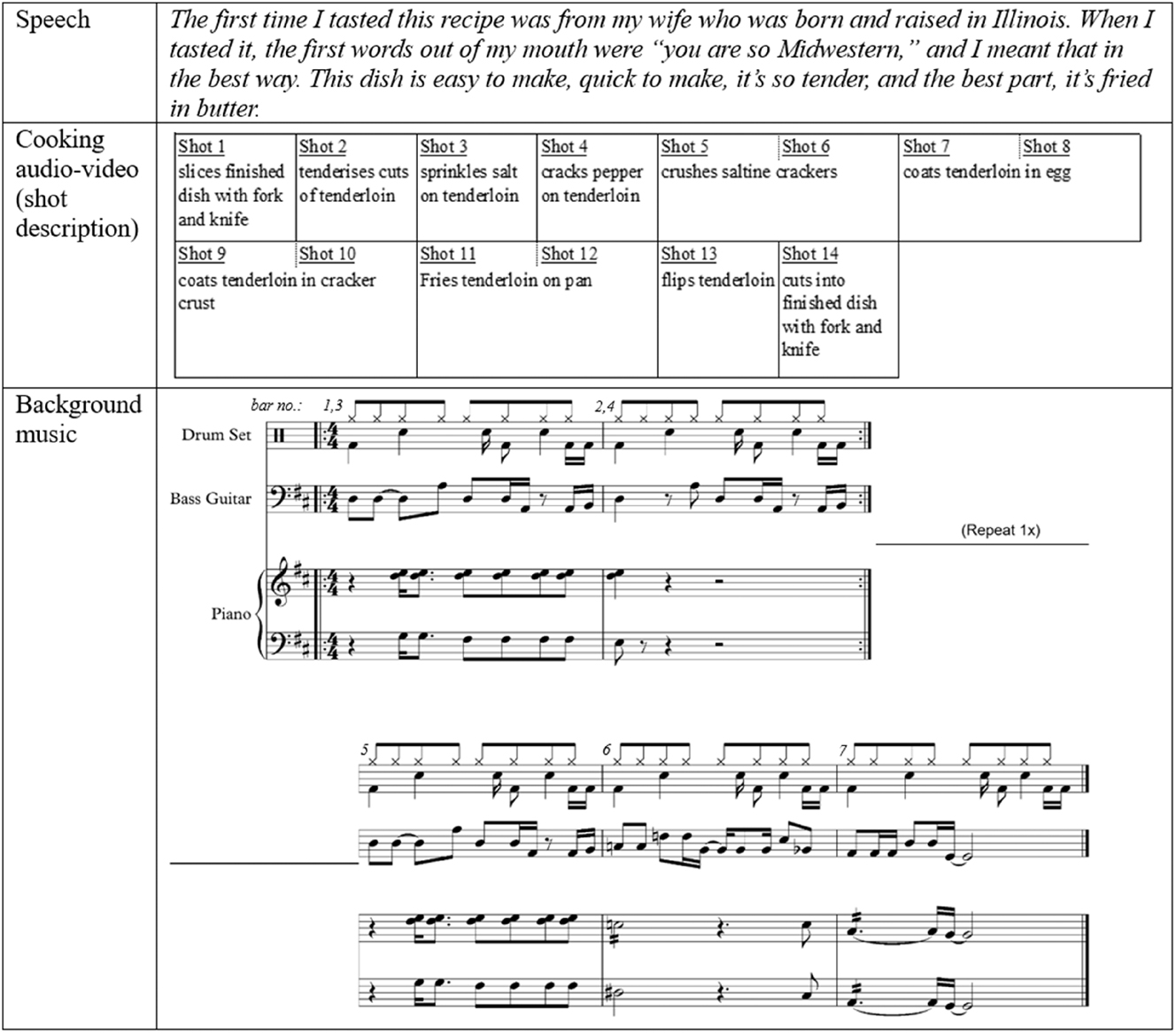
In this example, “music” is most obviously found in the third semiotic channel labelled as “background music”. However, the background music is not a discrete layer that simply adds prepackaged meanings to the video. All three semiotic channels unfold over time together and create specific temporal relations with one another. Therefore, to fully appreciate the musical meaning of this media text, it is insufficient to analyse the background music in isolation, but rather the musicality of each individual semiotic channel (including the speech audio channel and the audiovisual channel of the cooking actions) as well as the media text as a whole must be taken into consideration. It is also important to consider that the background music was not specifically composed for this multimodal media text. Not only has this specific music audio been used in a myriad of other social media videos, but the generic features of the background music are recognisable enough to trace it to a popular genre of music that appears in many other musical contexts. The conventions of the background music’s genre, the conventions of the type of media text (short form video) and the technological affordances of the social media platform that allow for an excerpt of pre-existing music audio to be easily inserted as background music to any video must all be taken into account together to appreciate how the music as an integral part of the media text makes meaning.
Most existing approaches to understanding or analysing musical meaning are insufficient for addressing the key considerations identified above. Whether these approaches attempt to posit general explanations of how music becomes meaningful to humans, provide detailed and systematic tools for analysis of musical meaning, or demonstrate critical analyses of socio-cultural meanings made in music, insofar as they import tools and concepts from Western classical music theory with the assumption that these tools and concepts are compatible with any cultural musical practice or context, and/or do not substantially engage with alternative music theoretical perspectives, these approaches will be limited.
The remaining sections of this paper will closely examine specific limitations of this literature through a metatheoretical analysis and explore practical considerations for future research in music and meaning, especially for multimodal semiotic research that investigates musical meaning making in contemporary globalised media practices. Section 3 critically examines a selection of discursive blind spots and biases of Western classical music theory that are commonly recontextualised in research on music and meaning, and also explores a variety of alternative music theoretical discourses. The purpose of this section is not to arrive at a “pure” music theory free of blind spots that applies to any music in any context, nor is it to attempt to provide a comprehensive account of the immensely vast range of music theories that have existed across the world throughout history.[2] Rather, it is to explore a limited yet eclectic variety of specific ways that knowledges of music have been constructed that present alternative conceptualisations to conventional theory, and in doing so, demonstrate that Western classical music theory is itself one specific socially constructed knowledge of music that exists amongst many others. Section 4 discusses the findings of the metatheoretical analysis in order to synthesise practical considerations for future research in the study of music and meaning. It does so by identifying some of the underlying principles that emerge from the metatheoretical analysis and connecting these underlying principles to other areas of human knowledge that are relevant to the study of meaning such as social theory, semiotics, and the phenomenology of movement. Section 5 revisits the illustrative example presented above and analyses it from a multimodal social semiotic perspective, applying the practical considerations synthesised in Section 4.
3 The biases and blind spots of Western classical music theory
Theories are always and necessarily incomplete. They foreground certain aspects of a practice and background others (i.e. theories abstract concepts and patterns from practices) in accordance to what is deemed relevant in a particular context or set of contexts. Analysis, like theorisation, is a process of abstraction – it involves separating certain parts of the object of analysis out of the whole. What is important then, is to be aware of what is being abstracted from the whole in the process of analysis, what is being left out, and understanding if and what damage is done in these omissions. To identify the biases and blind spots of Western classical music theory, we can cross-examine other theories and bodies of knowledge related to other musical practices.
The subsequent subsections will take a discursive approach to the analysis of music theories following van Leeuwen’s (2005) approach to discourse analysis. This approach is both Foucauldian and linguistic in that it recognises discourses as: “socially constructed knowledges of some aspect of aspect of reality”; pluralistic in that “there can be different discourses, different ways of making sense of the same aspect of reality, which include and exclude different things, and serve different interests”; and examinable through text analysis (van Leeuwen 2005: 94–95). Thus, the subsections will examine Western classical music theory as one socially constructed knowledge of music and compare this discourse with other socially constructed knowledges of music. The former will be examined through text analysis of research outputs in music semiotics and other interdisciplinary fields that investigate music and meaning (e.g. music perception, music psychology), and the latter through music theoretical texts and other texts that construct knowledge of music that do not come from Western classical music theory. The aim is thus to examine normative discourses of music that have originated in conventional music theory and have been recontextualised in research on music and meaning, and to compare these with instances of theorisation where corresponding aspects of musical knowledge have been socially constructed in different ways in different contexts. To reiterate, the aim is not to provide a comprehensive account of all possible music theoretical discourses that exist, nor is it to arrive at some pure, unmediated musical truth, rather it is to explore a limited yet eclectic plurality of ways that musical knowledge has been constructed in discursive instances of theorisation.
Sections 3.1 and 3.2 examine the boundaries that Western classical music theory has constructed between music and its context, and Section 3.3 examines the constructed “internal” boundaries of music i.e. between the constituents of music, and the specific ways in which these constituents have been conceptualised in Western classical music theory.
3.1 Separation of “music” from its social context
That the word music is used grammatically as a noun is noteworthy, as it allows music to be separated from its social context and for human agency to be backgrounded or erased in analysis. In studies on meaning and music, it is very common to find grammatical constructions that isolate “music” as a discrete entity that contains elements or has characteristics that are meaningful, has its own agency, or has particular effects can that induce responses when people listen to it, e.g.:
[…] in the music(al work): “The framework of the Affektenlehre founded a common understanding of the meaning deposited in the music” (Christensen 1995: 86), “These two metasemes produced in the musical work a kind of divided consciousness” (Monelle 2000: 145).
The music itself: “The listening to the music itself (the level of the musical data)” (Tarasti 1995), “and symbol refers to a response based on internal, ‘syntactic’ relationships within the music itself” (Sloboda and Juslin 2010: 89), “Before proceeding to the music itself, however, I want to reconstruct something of the historical contexts” (McClary 2002: 82).
music with grammatical agency: “Sometimes music can make us laugh, cry, or want to dance” (Larson 2012: 1), “as the music moves away from stability and back towards a new point of stability” (Jackendoff 2009: 201).
music in an ergative-intransitive construction: “[music] feels meaningful and emotional to most people” (Vuust et al. 2022: 287).
As Pontara and Volgsten have highlighted, “there is no such thing as ‘the music itself’; representing music (verbally, visually, etc.) and thinking about music are to be already involved in the cultural construction of what music means and what it is” (Pontara and Volgsten 2017: 251). Musicologist Christopher Small advocates for construing music as an activity rather than as a thing, and therefore uses the term, “musicking” to highlight the specific types of musical activities (e.g. performing, listening, composing) that people are involved in (Small 1998).
In his ethnomusicological study of West African music, Chernoff (1979) underlines the concept of musical cultural integration to stress that African musical forms can only be understood in the context of their social situations:
There are very few important things which happen without music, and the range and diversity of specific kinds of music can astound a Westerner. Ashanti children sing special songs to cure a bedwetter; in the Republic of Benin there are special songs sung when a child cuts its first teeth; among the Hausas of Nigeria, young people pay musicians to compose songs to help them court lovers or insult rivals; men working in a field may consider it essential to appoint some of their number to work by making music instead of putting their hands to the hoe; among the Hutus, men paddling a canoe will sing a different song depending on whether they are going with or against the current. (Chernoff 1979: 34)
Music sociologists have also argued that musical practices should be considered as integral to social practices and to social life itself (Crossley 2020; Hesmondhalgh 2013). When “music” is abstracted from its context as it is in discourses derived from conventional music theory, what is taken for granted are the social roles that participants have in the process of music making and the kinds of activities that they are engaged in. Much experimental research on music perception is thus oriented towards answering questions framed around the mechanisms that explain emotional responses and the desire to move when people listen to music (Vuust et al. 2022). Robinson’s (2020) decolonial work on Indigenous sound studies invites and challenges researches in sound and music studies to adopt a “critical listening position”, which entails becoming aware of the “listening privilege, listening biases and listening ability” that we carry and often take for granted (Robinson 2020: 10). For example, Robinson notes the differences between ontologies of Western music, which “are largely though not exclusively oriented toward aesthetic contemplation and for the affordances it provides” (e.g. setting moods for activities in everyday life), and those of Indigenous song (in relation to Indigenous groups in North America), which serve different functions including “law and primary historical documentation” (Robinson 2020: 41). Taking such ontological differences into account, Robinson illuminates the damage done in the context of ethnographic collection of Indigenous songs in Canada during the 20th century (which was justified as a means of cultural preservation in the face of cultural loss caused by colonial policies that banned Indigenous populations from practicing their own culture) when these songs as “forms of doing (healing, law, and sovereignty)” become disconnected from Indigenous communities (Robinson 2020: 151) and transcriptions and recordings of Indigenous songs are misused by settler Canadian composers in their contemporary art music by breaching Indigenous protocols of their use (Robinson 2020: 150).
In Farraj and Shumays’ (2019) account of Arabic music, music as a dynamic and collective process is highlighted through many different aspects of music making. For example, in describing participant roles in music performances, they explain that.
Performers and listeners (the sammi’a) have a symbiotic relationship in Arabic music. During tarab,[3] a feedback loop develops between them, a very important ingredient for tarab, if not a prerequisite for it. When listeners hear beautiful music that is being performed for them, they react both in verbal and nonverbal ways to show their appreciation. In return, that confirms to musicians that their performance is being appreciated, and that they are provoking the desired reaction in the listeners. That motivates them to give more and to excel and keeps tarab moving forward. (Farraj and Shumays 2019: 367)
Not only is there a dynamic responsivity between audience and performers, but there is also a dynamic responsiveness between performers:
Because of its richness in ornamentation, Arabic music is not required to faithfully follow a composition note for note and can therefore be highly personalized. Heterophony (when different musicians simultaneously ornament the same melody differently) is a dynamic exercise, one that cannot be composed or notated. It happens in a live performance and needs a type of musician who devotes more energy to listening than to reading sheet music. Therefore, experienced Arabic musicians develop a resilient disposition that allows them to be attentive and quick to react to the other musicians’ playing. (Farraj and Shumays 2019: 8)
A final point to make on the separation of music from its social context is that this also includes a separation from its historical and geographical context. Many ethnomusicological studies underline the importance of taking into account social histories and geographical provenance of musical structures to fully understand and appreciate musical meaning, particularly in relation to continuity and variation of musical traditions (e.g. see Brown 2014; Chernoff 1979; Farraj and Shumays 2019).
3.2 Separation of “music” from other semiotic modes
The discursive separation of music from its context also entails a separation of music from other communicative and artistic modes with which it forms a whole. It is not uncommon for papers in music semiotics to base their analyses on musical scores or sound recordings alone. With growing interest in multimodality in semiotic research, there has been an effort more recently to combine the semiotic analysis of music with the analysis of other semiotic modes in multimodal communicative practices such as popular music (Machin 2010) and film (Wingstedt et al. 2010). Whilst such studies have demonstrated that music can be combined and coordinated with other semiotic modes to make meanings in various and complex ways, in many theorisations, music has also been construed as an already integral part of a single practice.
Many traditional genres of Japanese music for instance are integral parts of other artforms such as dance, poetry recitation and theatre. Noh, for example, is a traditional Japanese theatrical art first codified in treatises written by the playwright, Zeami in the 14th and 15th centuries (Komparu 1983: 345–347). A central aesthetic principle in Zeami’s theoretical texts is Jo-ha-kyu, a tripartite spatio-temporal ordering principle, which applies to every aspect of Noh including the compilation of plays in a program, composition of sections in a play, organisation of the performance space, and the rhythm of the performance, which includes performers’ movements, chanting, and instrumental music (Komparu 1983: 24–29). Komparu (1983: 29), also notes that the Jo-ha-kyu principle is found in many other traditional Japanese performing arts.
Zeami’s theoretical text constructs Jo-ha-kyu as a general aesthetic principle, however it can also be constructed as a musical principle when music is abstracted out from the theatrical art. Akira Tamba (1932–2023), a Japanese composer who moved to and had a career in France (where he studied under Olivier Messiaen) had written theoretical texts in French on the aesthetics of Japanese music (e.g. Tamba 1988) distilling music and musical aesthetics out from traditional Japanese performing arts (including Noh) to write to a French audience interested in comparing “Western” and “Eastern” musical aesthetics. He not only wrote theoretical texts on Japanese musical aesthetics (which included the principle of Jo-ha-kyu) but also applied them to his musical compositions, which were otherwise based in a Western classical musical tradition. Later in his career, he had also written a book in Japanese on Jo-ha-kyu as a living and continuous Japanese tradition, writing about it from multiple discursive perspectives including Jo-ha-kyu as a mathematical pattern, as a general aesthetic principle in traditional performing arts, as a musical aesthetic principle in traditional music, and finally as an aesthetic principle that can be applied in contemporary musical composition, in which Tamba analyses how Messiaen applied Jo-ha-kyu in an orchestral composition (Tamba 2004).
Although in Western thinking, music has an obvious association with dance, it is still discursively kept separate from it. Consider the following phrases from a recent review article on neuroscientific research of music: “our ability to dance to music”; “Why do people rush to the dance floor when hearing the grooves on James Brown’s records and move to the music with such apparent pleasure?” (Vuust et al. 2022: 294). The semantics of these phrases makes music (construed as a thing) a pre-existing entity to which people can dance/move (construed as an activity). In this construction, music is independent from dancing, which is an optional addition. Music and dance can, however, be thought of as integrated processes that mutually shape one another. For instance, in his interpretation of L’affillard’s Principes Très-Faciles (1705), an early 18th century French treatise on singing, Schwandt (1974) argues that L’affillard provides detailed instructions for articulation, phrasing and tempo so that singers can learn to perform songs to popular court dances (e.g. courante, menuet, sarabande, bourrée, gavotte, passepied) in a manner that makes them danceable. An even more integrative construction of music and dance can be found in Butler (2006):
EDM dancers at a live event can have a significant impact upon the sounds that unfold. Successful DJs are highly attuned to the crowd’s behavior: most do not play prearranged sets, instead preferring to shape their performance as the evening unfolds in order to get a maximal response from the people on the floor. As a result, the audience’s actions – whether or not they dance, the intensity with which they dance, and the other physical and verbal cues that they give to the DJ – can affect what music will be played, when it will be played, and how it will be played.
Furthermore, communication flows […] not only between audience and DJ, but also within the audience itself. Individual dancers collaborate with the DJ and with each other to create a sense of “vibe” – a powerful affective quality associated with the experience of going dancing – among those present. […] this sense of communal energy is an essential part of an effective event. (Butler 2006: 72)
Just as is the case in the performance of Arabic music, music making here is construed as a dynamic and collective process that cannot be separated from its context, which in the case of EDM (Electronic dance music) live events includes dancers. Hence, vibe can be thought of as a music theoretical concept that recognises dancer and DJ (Disc Jockey) to be integral participants in a social musical activity in the context of EDM practices, just as tarab can also be thought of as a music theoretical concept in the context of Arabic musical practices.
3.3 Division of “music” into separate constituents
That a music theory separates music into separate analytical constituents or aspects is self-evident. However, where a theory draws the lines between aspects of “music”, which ones are focussed on, and generally how they are conceptualised can have many possibilities. Studies on meaning and music often take analytical categories from conventional music theory and use these concepts as a point of departure for investigating musical meaning. For example, Tarnawska-Kaczorowska (1995), analysing the music work as a “sign”, considers the lowest layer (i.e. the fundamental level of structure) as the materials of music, which include “the sound (acoustical signal) itself”, “articulation”, “dynamics”, “rhythm”, “meter”, “agogics”, “melody”, “harmony”, and “texture”. The examples that she gives of each constituent reflects conventional music theoretical understanding e.g. “the sound (acoustical signal) itself: a, C, F#, Eb”, “articulation: legato, sforzato, sul ponticello, frullato;”, “rhythm: quarter-note, dotted eighth-note, triplet, rest”, “melody: a two-bar ascending melody, an intervallic structure based mainly on second”, “harmony: major third, perfect fourth, augmented triad, a quartal chord, subdominant, variously formalized systems for noting the harmonic progressions” (Tarnawska-Kaczorowska 1995: 123).
Although Tarnawska-Kaczorowska (1995) lists nine distinct constituents, it is not uncommon for studies to single out a smaller number as being the most important “fundamental” constituents of music e.g. “from the point of view of music theory, music can be broken down into three fundamental constituents – melody, harmony and rhythm” (Vuust et al. 2022: 287). As Vuust et al.’s review article encapsulates, studies in music perception and cognition tend to use one or more of these analytical concepts as a basis for study e.g. research questions are formulated around how the brain processes these elements of music, what mechanisms and parts of the brain are involved, and also seek to understand the psycho-physiological responses in terms of emotion or action, the effect of prior musical learning, and consequences for musical communication in relation to “cognitive processing” of these musical constituents. It is also not uncommon for these specific music theoretical concepts to be foregrounded in music semiotic analyses and used as the basis for analysing musical meaning, e.g. Larson’s (2012) framework for analysing musical meaning based on metaphors of motion recognises two categories of musical forces: melodic forces and rhythmic forces.
The remaining subsections will examine how melody, harmony and rhythm are conceptualised in conventional music theoretical discourses and compare these conceptualisations to alternative ones found in other music theoretical discourses. The purpose of these subsections is to illustrate not only the incompatibility of these Western frameworks when applied to non-Western (and non-classical) musical practices, but also to illuminate the ways in which these conceptualisations on their own provide a limited view on music as a type of meaning making phenomenon, and to explore a range of alternate perspectives.
3.3.1 Melody
In Western music theory, the basic unit of melody is the pitched sound (or “note”), which is systematised into 12 pitch classes which divide the tonal space of the octave evenly into intervals of semitones (Figure 1) and can also be organised into a circle of fifths. Melodies are understood as a sequence of discrete pitched sounds, which form melodic contours. The collection of pitches in the melody points to a tonal centre (the tonic) and a scale of notes that can ascend and descend in steps (relatively small intervals) from the tonic in one octave to the tonic in the next octave up or down. The specific scale (order of intervals from tonic to tonic) suggests a particular modality, which in Western music is either the major or minor mode (see Figure 2).

Octave divided into 12 notes, each separated by an interval of a semitone.
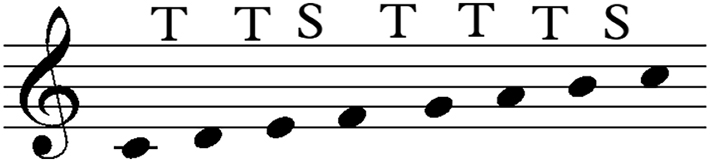
C major scale.
In this discourse of melody, discrete pitched sounds are the basic building blocks and analytical point of departure: “Once musical pitches are combined into melodies, global properties emerge, such as melodic contour, melodic expectations and tonality” (Vuust et al. 2022: 291). For Larson (2012), although melody “is not just a succession of pitches but may be heard in terms of physical motion”, his entry point and basis for melodic analysis is the sequential organisation of discrete pitched sounds, for example:
In “Twinkle, Twinkle, Little Star,” the first note (C) provides a base for subsequent melodic action. Every other note is heard as above that C. And if we pause on any of those other notes, we may feel that the unfinished melody is “up in the air.” In other words, melodic gravity pulls all those other notes down. […] This melody has a prototypical shape. A large ascending leap is balanced by descending steps, creating an arching path. […] As in an analogous physical motion, the energy of the large ascending leap is dissipated in the following descending steps. To me, this leap suggests a quality of ease because it leaps from the most stable platform (the tonic) to the next-most-stable degree of the scale (the fifth scale degree). That ease, combined with the energy associated with an ascending leap of this size, suggests a kind of athletic quality that is effortless and secure. (Larson 2012: 83–84)
The above example is typical of music semiotic analysis based on melodic analysis – sequences of notes are analysed, and meaning is interpreted in relation to the size and direction of intervals between notes, the relationship between notes and the tonal centre (e.g. stable/unstable) and the overall melodic shape.
Within this discourse of melody, it is often assumed that what is specific to Western music are tonal conventions and vocabulary. In other words, it is assumed that melodies can be constructed or analysed in any musical tradition as sequences of discrete pitches selected from culturally specific closed systems of pitches (equivalent to the Western 12-tone system in Figure 1) and reflecting melodic scales/modes that are distinct from,but constructed using the same principles as melodic scales in Western music. However, when closely examining other musical practices and knowledges based on those practices, it becomes apparent that this framework is not always an ideal way of understanding melody, and in some cases, is incompatible.
For instance, Farraj and Shumays (2019) have argued that the Western framework for melody is incompatible on multiple levels when applied to Arabic musical practice. Firstly, the basic unit that they assign to melody in Arabic music is the jins (plural: ajnas) and not a discrete pitched sound (Farraj and Shumays 2019: 192). A jins is defined as an area of melody with phrases in a limited vocal register (usually around 3–5 notes) and a distinct and identifying interval structure between notes (Farraj and Shumays 2019: 192–193. See Figure 3a below). A melodic pathway will remain in a jins before moving (modulating) to a different jins either up to a higher register or down to a lower register (Farraj and Shumays 2019: 192). Each jins has a distinct set of intervals and therefore a distinct character or mood, so each modulation to a new jins along the melodic pathway brings with it a change of character/mood (Farraj and Shumays 2019: 195). The two most important notes in a jins is the tonic (the “note of principal melodic emphasis”), the leading tone (the note immediately below the jins) and the ghammaz (the note of modulation – when modulating, the tonic of the upper jins will be the same as the ghammaz of the lower jins) which is also emphasised, particularly when modulating (Farraj and Shumays 2019: 195–196). Each jins has multiple possibilities for modulation to other specific ajnas, and a network of interconnecting ajnas which maps out the possibilities for modulation between ajnas is called a maqam (plural: maqamat), which also reflects the full collection of musical pitches across the network of interconnected ajnas (see Figure 3b). The complete melodic pathway that is formed as the melody modulates from jins to jins (within the network of a maqam) is the sayr (literally “course” or “motion”), which also carry with it expectations and conventions for melodic behaviour within a maqam (Farraj and Shumays 2019: 314–315).
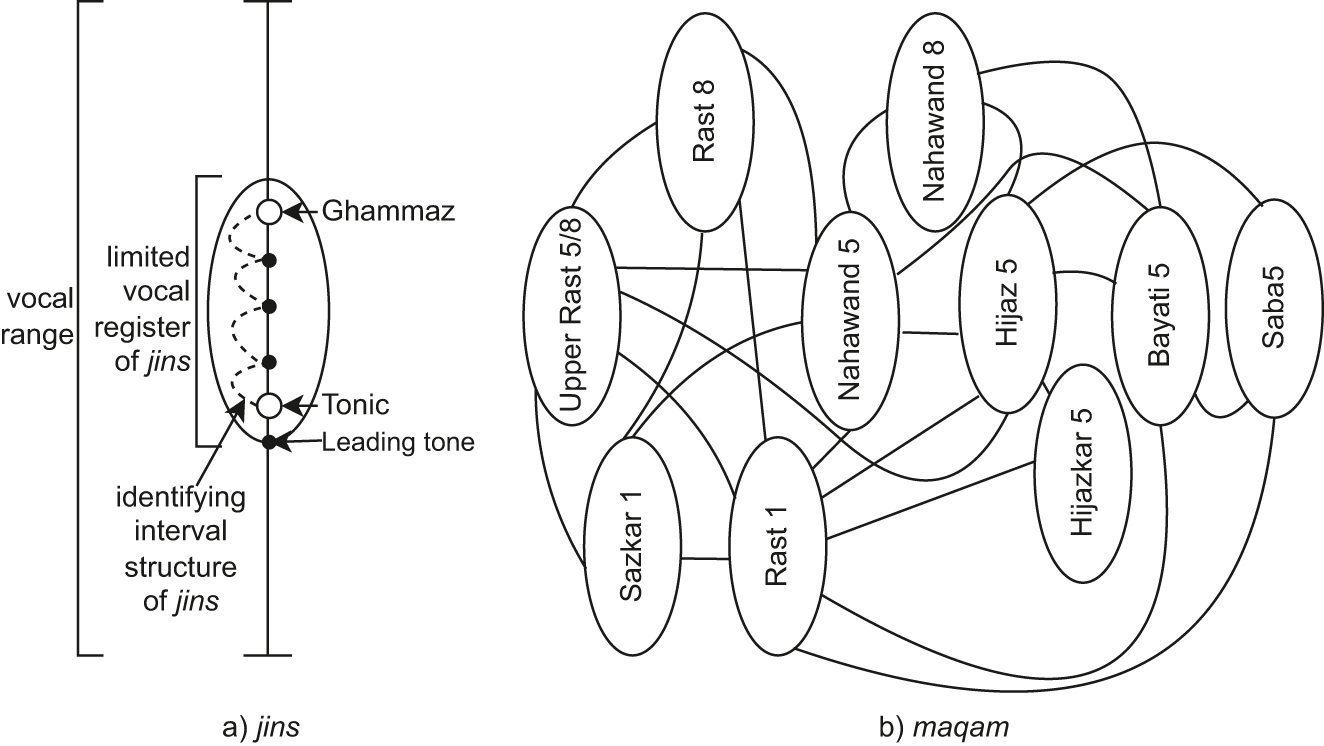
Diagrammatic representations of a jins and a maqam: (a) diagrammatic representation of a jins, loosely based on figure 13.4 in Farraj and Shumays (2019: 199); (b) diagrammatic representation of a maqam as a network of ajna, based on diagram in Farraj and Shumays (2019: 280). Each ellipse represents a particular jins and lines indicate possible movement between ajna.
This very concise (and perhaps oversimplified) overview of Farraj and Shumays’ (2019) theoretical conceptualisation of melodic pathways in Arabic music illustrates many points of incongruency with a conventional Western conception of melody. Firstly, the basic unit of melody is not a pitched sound but the jins. It may be tempting to ask why the “note” is not considered the basic melodic unit, since a jins can be further broken down into distinct pitched sounds. Farraj and Shumays stress that pitches (and the intervals between them) are not considered in the abstract, but rather, they are only considered specifically in relation to “its effect on the jins as a unit” (Farraj and Shumays 2019: 194). This is not to say that intonation is approximate in Arabic music – on the contrary, intonation in Arabic music is in fact more precise and strict in comparison to Western music (Farraj and Shumays 2019: 10). Farraj and Shumays argue that it makes little sense to theorise a complete set of possible pitches in Arabic music (analogous to the equal temperament 12-pitch system used in Western music) from which melodies and melodic scales are built, since if one were to do so, there would be an incredibly fine level of detail e.g. “if we take […] the [equal temperament] semitone between the notes E-flat and E-natural, at least 10–12 aurally distinct pitches from different maqam scales occur within it” (Farraj and Shumays 2019: 167). Further, there is no direct equivalent concept of a melodic mode or scale – both the jins and the maqam are concepts with similar aspects, but neither of them translate perfectly and both have very clear differences.
What is clear when we compare the conceptual affordances between the conventional Western understanding of melody with that of Farraj and Shumays (2019) is that the latter emphasises the melodic pathway as a continuous whole rather than something that is built up from a sequential ordering of discrete units (i.e. a “syntax”). The jins, as the basic unit of melody is larger than a discrete pitched sound, and even above this basic unit, connection between ajnas is emphasised through concepts such as a modulating note and the metaphor of a maqam as a network of interconnected ajnas which maps out potential melodic pathways.
Alternative discourses of melody can also be found in traditional Korean genres of music, which have produced a very diverse range of systems of recording and transmitting musical knowledge. One type of system used to facilitate the reproduction of music is Gueum, which uses a closed system of onomatopoeic syllables that imitate an instrument’s timbre to indicate playing style and pitch (Kwon 2024). Gueum has been used both in oral transmission as well as a system for written notation of music, used in yukbo type scores which were widely used by the late 15th century (Kwon 2024). Although many different Gueum systems existed across different time periods and for different instruments, a common feature was that the consonants of a syllable would indicate timbre and playing technique (e.g. plucking with a plectrum) and the vowels would provide an indication of relative pitch (Kwon 2024). When notated in yukbo, gueum notates musical sound in discrete segments and thus does not indicate the individual musical expression of the performer (Kwon 2024). Gueum, like the conventional Western system of notation, organises musical sounds into a discrete system. However, whilst in the Western system of notation, discrete “notes” indicate the pitch, in gueum, pitch is not as important as the timbre that is indicated by each note. When extended to the concept of melody, this makes it possible to conceptualise melody as a pathway not only of changing pitches, but also of changing timbre.
Another type of score notation that is found specifically in traditional vocal genres of Korean music (such as gagok and sijo) that first appeared in the 18th century is supa-bo, which (in contrast with notation forms that used closed systems of notes notated as discrete segments) represents melodies as continuous wavy lines (Jo 2021; Y. W. Kim 2010). Although reproduction of musical pieces is difficult using these types of scores alone, the representation of the melodic flow and the overall melodic line has allowed it to be an effective learning aid not only in learning gagok songs (Y. W. Kim 2010), but also in contexts of contemporary school music education (Jo 2021).
In traditional genres of Korean music, a concept that is roughly equivalent to that of melodic mode or scale is akjo. However, akjo is much broader than the Western concept of melodic scale encompassing more than just intonation of melodic materials. For example, consider the following description of performance of woojo and gyemyeonjo (which are two akjo that are found across various instrumental and vocal genres of music) found in Hakpo Hyeongeumbo, a music theoretical text presumed to date from the early 20th century:
The sound of woojo ascends and descends, momentarily flies then momentarily hides likes dripping water. The sound of gyemyeonjo is extremely strong and clear, like striking metal or stone. The learner must understand this. (in Kang et al. 2021: 630 translated to modern Korean by editors, my translation to English)
This passage in the Hakpo Hyeongeumbo immediately precedes a series of scores notated in supa-bo type notation,[4] each score also indicating whether the song is in woojo or gyemyeonjo.
When we examine sources of knowledge of Arabic and Korean genres of music, we find that melody can be conceptualised in different ways, e.g. not just a shape that is built from a sequence of discrete pitches, but as a dynamically flowing pathway, which is not only a pathway of degrees of pitch but simultaneously of other aspects of sound as well.
3.3.2 Harmony
In Western music theory, harmony is closely related to melody since it uses the same materials (i.e. pitched sounds) and is therefore also an important dimension of tonal organisation. Tonality, with its focus on harmony, and based largely on the theories of Austrian theorist, Heinrich Schenker (1868–1935) plays a central and defining role in Western music theory. The point of departure for the conceptualisation of harmony is the simultaneous combination of the pitched sounds to form chords. In Western tonal harmony, chords are formed by simultaneously stacking pitched sounds (at least three) in intervals of thirds, which therefore forms tertial chords (Tagg 2014). Western tonal theory is concerned with how chords are ordered in a sequence, and the resulting movement of individual lines (including the melody) from this harmonic sequence. Chords are formed based on each degree of the major or minor scale. The two most important chords are the ones built on the first degree (the tonic, or I) and fifth degree (the dominant, or V) of the scale. Schenkerian analysis is primarily concerned with identifying the underlying, “fundamental structure” (German: Ursatz) of a musical work, which can be summed up as goal-oriented motion from I to V and back to I (Schenker 1979: 4). Thus chords are assigned functions in relation to this structure e.g. chords IV (subdominant) and ii (supertonic) in the major mode primarily function as pre-dominant chords, i.e. they lead up to chord V, which subsequently leads back to chord I.
Since this type of “harmonic language” forms a central part of the meaning in Western classical music, semiotic studies of Western classical music often incorporate harmonic analysis and point out whether the harmonic movement towards its goal is direct or if it deviates in some way e.g.:
One of the attractions of Brahms’s Hungarian Dance especially evident in measures 17–32 is the brusque simplicity of his harmonic language. Making do with little more than tonic, dominant, and subdominant he charts a confident and unwavering harmonic course through the tonal landscape of the dance. To be sure, the broad outlines of this landscape are part and parcel of the traditions of Western European dance music; that said, the specific course Brahms traces is a consequence of the syntactic processes he deploys, which organize the constituent sonic analogs of the passage to create an analog for a dynamic process that moves surely and somewhat precipitously toward its goal. (Zbikowski 2017: 118)
This type of analysis which is common in music semiotic analyses can also be found in McClary’s (2002) analysis of an aria from Donizetti’s opera, Lucia di Lammermoor:
In measure 32 there is a sudden pivot from the key of the dominant, Bb major, to the key of its lowered submediant, Gb major. And it is at the moment of this flat-six excursion that the kind of madness Donizetti seems to have in mind bursts forth in all its splendor. (McClary 2002: 93)
Chord progressions are also commonly used in experimental studies on music and emotion that address the general concept of “musical expectancy” by testing listener responses to “unexpected chords” (e.g. Steinbeis et al. 2006) within a Western tonal framework.
It is worth noting that the basic principles of tonal harmony apply not only to Western classical music, but also to the majority of musical practices of global Western culture (e.g. popular music, film music), therefore Western tonality and chord progressions have become a dominant paradigm for understanding music in the context of globalisation. Although conventional Western classical harmonic theory is the dominant framework for understanding harmony, it is not the only one. In the 1950’s and 1960’s, George Russell developed a theory to describe different ways in which jazz musicians in the US were relating melodic scales to chords through their improvisations, which came to be known as the Lydian Chromatic Concept of Tonal Organization (Russell 2001). Russell’s theory recognised different types of tonal gravity including “Horizontal Tonal Gravity” (HTG) and “Vertical Tonal Gravity” (VTG), the latter associated primarily with the “modal” jazz movement. In HTG, which is based around the tonality of the major (i.e. Ionian) scale, chords function to accompany melodic movement that resolves towards a “tonic station” goal (thus chords function in the same way as in Western classical music). In VTG, which is based around the tonality of the Lydian scale, the chord and melodic scale form a unity (Russell uses the concept of “chordmode” to capture the unity of chord and melodic mode), therefore there is no “goal pressure” (Russell 2001: 9) and melodies are related “to each chord in the chordstream as an autonomous vertical entity” (Russell 2001: 58). In HTG (and conventional Western tonality), chords and their functions are derived from the degrees of the melodic scale where as in VTG, melody is derived from each individual chord.
Russell’s (2001) theory of harmony is based on the 12-tone system of Western music, yet it uses these resources in very different ways to “conventional” Western tonality. It is also possible find other forms of tonality and harmony from non-Western musical traditions, however, the diversity of non-Western forms of tonality has been lost and threatened as a result of the “colonising force” of European tonality, a topic Agawu (2016) has critically examined in the context of the African continent. Agawu (2016) describes one such form of tonal expression that has existed on the African continent since the pre-European era, namely use of the anhemitonic pentatonic scale (Agawu 2016: 343–344). He analyses a recorded performance by Bibayak pygmies from Gabon using this tonal resource and highlights how it contrasts with European tonality:
Each singer has internalized the pentatonic horizon and sings her individual part against that horizon, assured that articulating one or two notes – that is, a subset of the five-note collection – is enough to guarantee the integrity of the resultant pentatonic texture. There are no long-term trajectories in this mode of play, no phrase-generated expectations, no authentic cadences, no archetypal urges of managed desire and its fulfillment. There is only presentness, the repetition of notes and groups of notes into patterns organized around a palpable pulse. The form emerges additively from an accumulation of nows, a kind of moment form. […] If modern artistic production were being guided by this pentatonic practice, it would explore the openness of resultant sounds; give priority to intervals of seconds, fourths, and fifths; embrace a nonteleological temporality; and prefer an egalitarian texture to a hierarchic one. This is, of course, not a prescription for what composers should do but a thought experiment about what they would do if they were following certain cultural or communal imperatives. (Agawu 2016: 343–344)
It is also important to remember that whilst in Western classical music, harmony is the principal paradigm for developing complexity as well as for combining parts to form a whole (which is literally what complexity is), in other musical traditions, we find other areas of complexity and part-whole relations. For example, as alluded to in Section 3.3.1, the focus in Arabic music is on melodic complexity and richness, which is facilitated by heterophony that allows multiple musicians to simultaneously ornament the same melody in idiosyncratic ways (Farraj and Shumays 2019: 8). In many African musical traditions, there is a focus on rhythmic complexity (Chernoff 1979: 41), which will be discussed in the next section.
3.3.3 Rhythm
In Western classical music theory, rhythm is often defined as temporal durations of notes and rests, which can be measured by a metre, which is the underlying regular pattern of accentuation of a regular pulse (or “beat”). When the rhythm stresses notes that fall on weak beats or between beats, this is often referred to as syncopation. In Western classical music theory, the study of rhythm has historically had much less focus than harmony, however theories of rhythm that apply to Western music do exist. One of the first key theories was by Cooper and Meyer (1960), who develop a very intricate, unconventional and perhaps controversial framework for analysing rhythm in Western classical music. In their view, rhythm should not be sidelined, as they declare in the very first sentences of their book: “To study rhythm is to study all of music. Rhythm both organizes, and is itself organized by, all the elements which create and shape musical processes” and take a position against reducing rhythm to durational proportions (Cooper and Meyer 1960: 1). In this framework, metre measures the regular alternation between accented beats and unaccented beats (e.g. one accented beat for every three beats), and rhythm is the grouping of unaccented beats with accented beats. Each rhythmic group has one accented beat plus one or more unaccented beats. Rhythmic groups can then be grouped together to form rhythmic groups at a higher level. The rhythmic group at the higher level will be composed of one accented rhythmic group and one or more unaccented rhythmic groups. Rhythmic groupings can then be formed at the next level up with the same principles. These levels are called “architectonic levels” and also apply to metre, with metric accents at each level generally coinciding with rhythmic accents. Figure 4 is an example of a rhythmic analysis by Cooper and Meyer (1960) which illustrates the principles of their framework directly listed above.
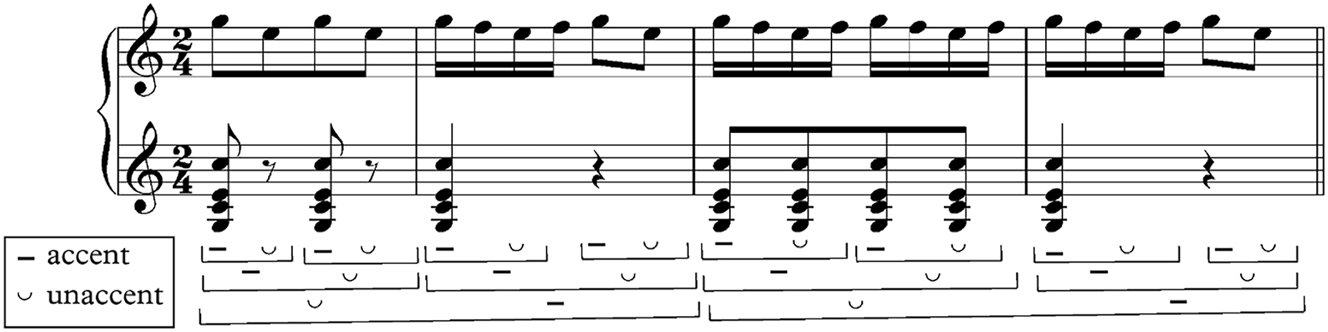
Rhythmic analysis of excerpt of Haydn’s String Quartet Op. 33 No. 3 found in Cooper and Meyer (1960: 38).
What is noteworthy about their framework for rhythmic analysis is that although rhythm is independent of metre to some degree, rhythm and metre are also inextricably linked – rhythmic accents coincide with metric accents, and rhythmic groupings can only have one accent, meaning that the duration of a rhythmic group is limited to (approximately) one metric cycle of alternation. Also, both accentuation and rhythmic grouping are perceptual, relational concepts – accentuation means a beat or rhythmic group is “marked for consciousness” (compared to unaccented beats) by various means, and grouping is determined by similarity or proximity, by various means (Cooper and Meyer 1960: 6–7). It is worth noting that Cooper and Meyer (1960) draw on evidence from experimental studies on perception to build their music theoretical framework. Whilst this is just one aspect of rhythm in their framework, there is also much interest in studying musical rhythm primarily through a perceptual psychological lens (e.g. London 2012). Another noteworthy feature about their theoretical framework is the conceptualisation of musical structure as dynamic process:
As a piece of music unfolds, its rhythmic structure is perceived not as a series of discrete independent units strung together in a mechanical, additive way like beads, but as an organic process in which smaller rhythmic motives, while possessing a shape and structure of their own, also function as integral parts of a larger rhythmic organization. (Cooper and Meyer 1960: 2)
Another theory of rhythm that builds on the approach developed by Cooper and Meyer (1960) is found within the Generative Theory of Tonal Music (GTTM) by Lehrdahl and Jackendoff (1983), which is a theory heavily inspired by Chomskyan linguistics and aims to theorise music in relation to a “generative grammar”. GTTM’s framework for rhythmic analysis is similar to Cooper and Meyer’s (1960) framework, however a significant difference is that they return to a more “conventional” distinction between metre and rhythm (which they call grouping) – metre forms an abstract “grid” of time points (which are not durations), and grouping forms durations which can be measured by metre, but is independent from it. From this perspective, temporal durations and temporal measurement are separate phenomena.
It could be argued that the rhythmic model proposed by GTTM, with the measurement of time as an abstract “grid”, is well suited for analysing rhythm in Western classical music since Western classical music has what Chernoff (1979: 42) calls a “unifying” or “main” beat that all musicians adhere to. As noted in 3.3.2, Western classical music builds complexity in its harmonic progressions. Since the building blocks of harmony (chords) require temporal simultaneity, Western classical music tends to be monorhythmic – all instruments play to the same beat.
Chernoff (1979) describes a very different rhythmic sensibility in the musical traditions of West Africa. Rather than there being a unifying beat, different instruments play separate rhythmic patterns with individual accentual patterns that do not meet one another, which from a conventional music theoretical perspective would be described as “polymetric” (Chernoff 1979: 42). Although there is no unifying beat, the separate rhythms are unified: rhythms fit together into a “cross-rhythmic fabric” (Chernoff 1979: 51). In other words, different rhythms fit together by each having a beat that mutually responds to one another (thus have a conversational relationship with one another) rather than one that is simultaneous with one another (Chernoff 1979: 55). An effect of cross-rhythms is that rhythms mutually define one another by cutting each other in different ways (Chernoff 1979: 52, 59). In order for this to be effective, different rhythms must adhere to the conversational relationship, so that the rests and unaccented parts of one rhythm allows other rhythms to be better accentuated:
A rhythm which cuts and defines another rhythm must leave room for the other rhythm to be heard clearly, and the African drummer concerns himself as much with the notes he does not play as with the accents he delivers. […] In traditional African music, compositions have been developed and refined over the years, and superfluous beating has been eliminated so that the rhythms do not encroach on each other. A master drummer’s varied improvisations will isolate or draw attention to parts of the ensemble more than they seek to emphasize their own rhythmic lines, and a musician must always play with a mind to communicative effectiveness. (Chernoff 1979: 60)
What Chernoff (1979) also makes clear is that rhythm goes hand in hand with repetition in African music:
Repetition is an integral part of the music. It is necessary to bring out fully the rhythmic tension that characterizes a particular “beat,” and in this sense, repetition is the key factor which focuses the organization of the rhythms in an ensemble. The repetition of a well-chosen rhythm continually reaffirms the power of the music by locking that rhythm, and the people listening or dancing to it, into a dynamic and open structure. The rhythms in African music may relate by cutting across each other or by calling or responding to each other, but in either case, because of the conflict of African cross-rhythms, the power of the music is not only captured by repetition, it is magnified. (Chernoff 1979: 111–112)
In Western classical music, repetition finds its place in metre (i.e. in a regular “beat”) but not necessarily in rhythm, which is simply the durational values of notes and groups of notes. Anku (2000) theorises that in African music, each recurrent rhythm provides a “regulative beat”. However, rather than keeping linear time as the Western conception of metre does, Anku argues that African music should be understood in relation to circular (or cyclical) time – each cycle of rhythmic repetition is a regulative beat, and multiple rhythms form concentric time circles. Other music theorists have also called into question the applicability of conventional music theory’s strict division of rhythm and metre to African music (e.g. Hasty 1997; Rahn 1996). Rhythmic/cyclical repetition (e.g. in the form of riffs) has also been recognised as playing an important role in musics of the African diaspora more broadly (Floyd 1995; Monson 1999).
One genre of music with origins in African American musical practice in which the layering of cyclical repetition is particularly prominent (and a defining feature) is techno. In techno (and other EDM genres) repeating patterns are known as “loops” and in some cases, a techno track will exclusively be composed with loops (Butler 2006: 90). Butler (2006: 95–113) analyses a pre-recorded techno track by Jeff Mills titled Jerical (1992) in order to demonstrate how the theoretical distinction between rhythm and metre is not useful in this genre of music and to also illustrate that textural and rhythmic/metric processes are intertwined. Butler dissects the different instrumental layers of Jerical to show two characteristic features of the genre: the music is built on layers with distinctive sounds, which together form a blended but heterogenous texture (no one layer is more prominent more than any other) and each layer plays a loop (see Figure 5).
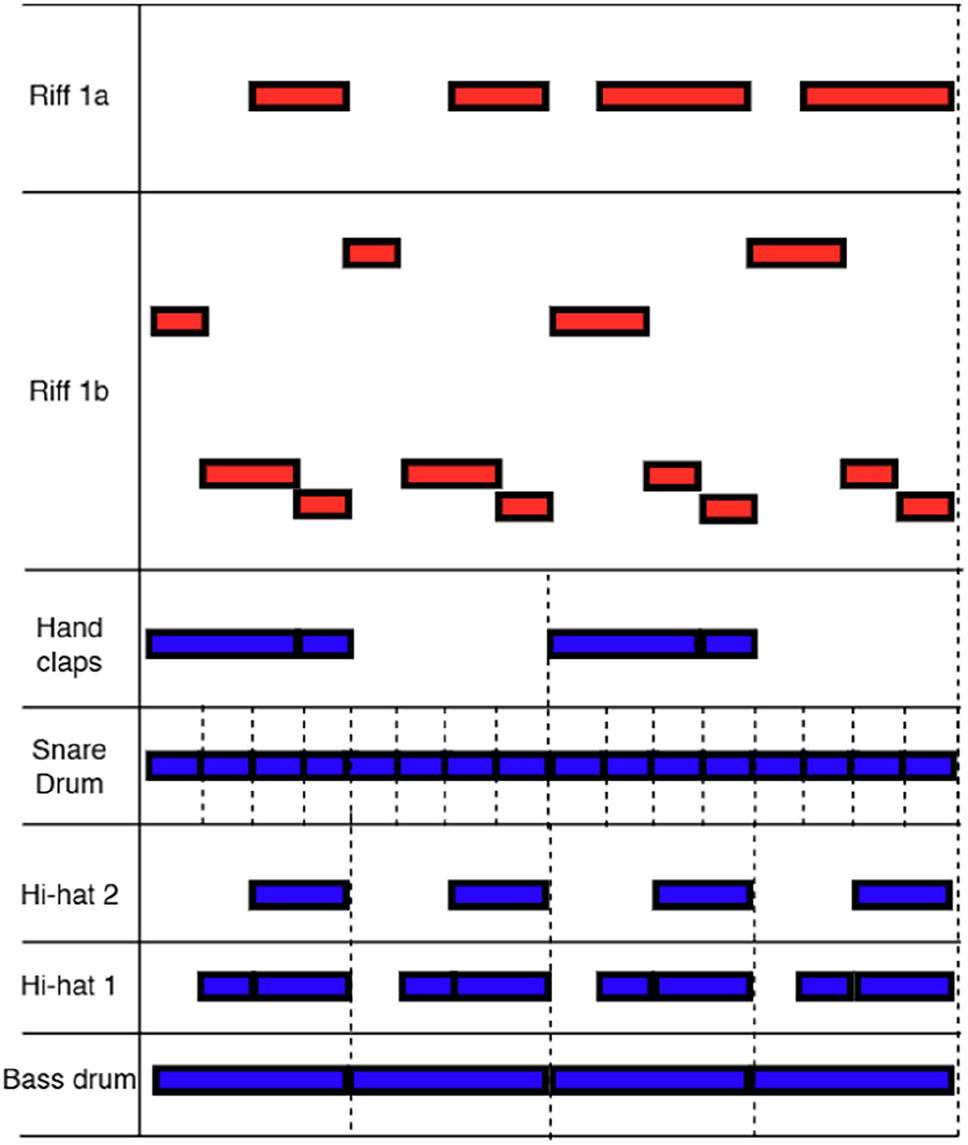
Graphic notation of the loops played by each instrument in Jerical (1992) by Jeff Mills, based on transcription in Butler (2006: 97). Dotted lines indicate where each cycle begins again.
Although each layer only plays one short pattern repeatedly, layers are introduced progressively, one by one until eventually the track reaches a point where it has a “complete texture”. After this point, different textural configurations are explored as different layers are taken away and reintroduced. What Butler highlights in his analysis is that this process of “textural completion is accompanied by a metrical completion” (Butler 2006: 97). Butler notes that each layer not only has a loop with a unique rhythmic pattern, but also a unique rhythmic value: the rhythmic value of the loop of the riff layers is a semibreve, a minim for the hand claps, a quaver for the snare drum, and a crochet for the bass drum and hi-hat layers. What Butler notes is that each of these rhythmic values corresponds with a distinct level of a 4/4 metre, and when all layers are played together they combine to form this 4/4 metre, but when any layer is missing, the metre is also incomplete and thus the metric identity of the music is heard differently. What Butler’s analysis and argument essentially illustrates is that each rhythmic layer provides a “beat” against which any other rhythmic layer can be measured, thus the distinction between rhythm and metre is unnecessary, in a similar way that Anku (2000) theorises that a recurrent rhythm will provide a regulative beat.
In a paper titled Riffs, Repetition and Theories of Globalization, Ingrid Monson (1999) makes note of the cross-cultural continuities of the underlying the principles by which repetition is used in layered ways across musics of the African diaspora:
Although musics such as jazz, Afro-Cuban, zouk, Haitian vodou drumming, bata drumming, and the traditional musics of the Ewe, Dagomba, and Banda-Linda peoples are extremely divergent in terms of musical surface, the continuities at the level of collective musical process and use of repetition are striking. Repeating parts of varying periodicities are layered together to generate an interlocking texture […] which then serves as a stage over which various kinds of interplay (call and response) and improvisational inspiration take place. If the layered combination generates a good flow (hits a groove) a compelling processual whole emerges that sustains the combination through time and also the people interrelated through playing it, dancing to it, or listening to it (live or on recordings). That these combinations often carry named identities (swing, guaguancó, gahu, etc.) illustrates the symbolic and affective dimensions of the synthesizing cultural flow that emerge simultaneously from these processes. (Monson 1999: 36–44)
What is interesting about Monson’s ethnomusicological analysis is that she connects musical process to cultural process. From this perspective, we could say that rhythmic repetition is not restricted to the spatio-temporal boundaries of an individual musical event, but can continue across musical instances to the point rhythms become named. Whilst this particular approach to layering multiple rhythms of different periodicities that Monson describes may be a specific characteristic of musics of the African diaspora, cyclically repeated rhythms with named identities play an important part in the musical vocabularies of various musical cultures. For instance, according to Farraj and Shumays (2019) (who also reject the universal applicability of the Western conceptual distinction between rhythm and metre) there is a very diverse range of iqa‘at (cyclical rhythmic patterns that are played by percussion instruments that accompany singers or melodic instruments; singular: iqa‘ ) across the Arab world. Farraj and Shumays (2019) catalogue iqa‘at in relation to time signatures and notate their “skeletons”, which are the basic underlying abstract forms (in practice, the skeletons are nearly always elaborated with ornamentation) including two generic types of drum sounds that can be made across different types of percussion instruments: dum, which is a “bassy sustained sound” and tak, a “sharp and dry sound” (Farraj and Shumays 2019: 88). They also describe iqa‘at in relation to their conventions, characteristic structural features, timing subtleties and affects e.g. in describing two variations of Iqa‘ Hacha‘ they write:
Hacha‘ (also pronounced Hadja‘) is a very popular Iraqi dance iqa‘ that made its way to Syria and beyond. The most basic form of Hacha‘ is in 2/4 and is identical to Wahda Saghira in its notation, except that it is faster and more jumpy. This iqa‘ is used in many folkloric songs from Syria, such as “‘al- maya,” or in Sufi songs such as “tala‘a al- badru ‘alayna.” (Farraj and Shumays 2019: 109)
A 4/4 form of Iqa‘ Hacha‘ is very common and is a possible modulation from other 4/4 iqa‘at such as Maqsum and Baladi. A modulation to Hacha‘ in 4/4 introduces a dramatic mood when it starts because it tends to slow down the groove, and also because of the contrast between its single dum and multiple tak-s, creating a jumpy (staccato) feel. It is a very popular iqa‘ in Sufi dhikr ceremonies and is the ideal iqa‘ for a repeated chanting of the word “Allah,” divided into three syllables (a/al/lah) over the first three tak-s. (Farraj and Shumays 2019: 110)
In various traditional instrumental and vocal genres of Korean music, the concept of jangdan refers to named cyclical rhythmic patterns played by an accompanying percussion instrument such as the janggu or buk (H. J. Kim 2024). There are many different jangdan with different time signatures and cycle lengths, and sometimes similar jangdan will have different names depending on the genre it is used in (ibid.). In the context of 18th century Europe, rhythms with named identities also formed a type of cultural musical vocabulary. Allanbrook’s (1983) meticulous musicological analysis of two of Mozart’s operas illustrates how Mozart used the characteristic rhythms of court dances – most of which were no longer being danced, yet had rhythmic profiles that were recognisable by his audiences at the time – such as the minuet, gigue, sarabande, passepied, siciliano, gavotte and bourrée as topoi in his operas to make affective and character identity related meanings.
Rhythm arguably plays an important role in all musics, yet a narrow view of rhythm based exclusively on analysis of Western classical music will not be adequate for understanding the diversity of rhythmic processes and vocabularies across different musical cultures. Repetition is an important concept for rhythm, but to relegate repetition to the regularity of pulsed beats and to overlook how it is involved in both the measurement and construction of time, as well as overlooking the significance of the cultural repetition of rhythm will mean overlooking many important aspects of musical process and social meaning. This section has explored only a relatively small selection of theorisations of rhythm. Many other theorisations of musical rhythm exist, often adapted to be suitable to specific types of repertoire, and some drawing on other areas of knowledge such as the psychological perception of rhythm or the philosophy of time. Examples include Hasty’s (1997) framework (which Butler [2006] draws upon in his analysis of rhythm in techno music) which proposes the psychological concept of “projection” to account for the perception of rhythmic regularity and irregularity, and is suitable for analysing rhythmically complex music, and Murphy’s (2023) framework which focuses on flexible metre in the music of singer-songwriters such as Joni Mitchell and Bob Dylan.
4 Discussion and synthesis
This section discusses the key implications of the findings from Section 3 and synthesises potential applications and directions for future research that investigates music and meaning making.
It is worth noting first of all that the metatheoretical analysis of concepts only examined three music “internal” concepts: melody, harmony and rhythm, and only explored a relatively small set of possible alternative discourses of these theoretical concepts. These three concepts are often assumed to have a taken for granted definition and centrality in relation to musical structure. It would have also been worthwhile to critically examine and compare discourses on other music theoretical concepts such as timbre. In Europe during the second half of the 20th century, there was a particular interest amongst certain composers of Western art music – notably, those associated with IRCAM (L’Institut de Recherche et Coordination Acoustique/Musique) and GRM (Groupe de Recherche Musicales) in France – on the theorisation of timbre, which sought to develop alternative ways of theorising music to conventional Western music theory (e.g. Barrière 1991; Schaeffer 1966). There were multiple historical factors that lead to the development these theories, one of them being the development of computer technologies that enabled new techniques of sound synthesis and analysis (in particular, spectral analysis). These music theoretical discourses offer very different paradigms for conceptualising what music is when compared to conventional music theory, yet also have many of their own limitations worth interrogating (see Born 1995: 193–207). Although it is beyond the scope of the present paper to discuss these limitations, the core issues will be named here. These theories of timbre are totalising in at least two ways. Firstly, they place timbre as the primary and all-consuming structural parameter of music, through which virtually all aspects of music can be analysed (Born 1995: 197–198). Secondly, these theories also situate themselves within or connecting to scientific fields of perception and cognition and make universal claims about connections between the objective synthesis/analysis of sound and the subjective human perception of it (Born 1995: 202). Considering theories such as those of Schaeffer (1966) are still applied in contemporary research in music perception and cognition (e.g. Godøy 2021), it is worth interrogating these claims of theoretical power and culturally independent universality, as well as critically examining how such claims can implicitly sideline other music theories, particularly theorisations of timbre that have been developed in the contexts of specific musical cultures.
By examining alternate discourses of musical knowledge associated with musical cultural practices including African musics, EDM, traditional genres of Korean and Japanese music, Arabic music and modal jazz, I do not intend to make any attempt to build a comprehensive picture of musical knowledge. Although the selection is limited (yet still eclectic), the discourses realised through these sources help to illuminate what has been cut out, where boundaries have been placed, what parts have been amplified and what parts have been muted in relation to the musical knowledge that Western classical music theory builds. The point of this exercise is not to make any claims that the discourses that conventional music theory construct are inherently wrong, nor is it to suggest that the concepts and tools of this theory should be abandoned all together when it comes to music semiotics. These music theoretical concepts and tools are certainly valuable for investigating meaning making in certain musical practices and contexts. However, it is important to recognise what aspects of music they do not pick up on and what they take for granted, especially when claims are made (or even implied) about universal principles of musical meaning making in research that uses these tools and concepts.
It is also necessary to reflect upon whether this has been nothing more than an exercise in poststructuralist deconstruction, and to thereby resign to the position that musical practices (and any meaning made in these practices) are wholly socially constructed. Although specific cultural conventions vary across musical practices, introducing a certain degree of arbitrariness, when we superimpose different musical knowledges over each other (as we have done in Section 3), what seems to emerge is a heterophonic texture in which similar underlying principles have been realised in idiosyncratic ways into different conventions. Music theorists that compare different musical cultures make such cross-cultural connections in their theorisations (Blum 2023: 93) and music semioticians have repeatedly underlined the importance of recognising that meaning in music is to a large extent built on metaphors based on experience of the moving human body (and in some cases, this principle underlies entire music semiotic frameworks e.g. Hatten 2004; Larson 2012) which is obviously shared across cultures. According to phenomenologist, Maxine Sheets-Johnstone, it is through our experience of movement that we first come to know ourselves and the world (Sheets-Johnstone 2011: 195) and she has further argued that “animate form is indeed a semantic template, the standard upon which fundamental human concepts and comportments alike are generated” (Sheets-Johnstone 2011: 306). What she highlights is that through our living moving bodies we find semantic archetypes (e.g. ways of articulating social relationships or expressing affect through movement) which are “differentially modified by cultures”, meaning that the task of delineating “the cultural” from “the natural” poses a challenge since they “are densely intertwined” (Sheets-Johnstone 2011: 306).
The challenge that this paper attempts to address (but more broadly, poses to all researchers interested in studying music and meaning) is in navigating the dialectical movement between cultural musical conventions and general semiotic principles derived from the living, moving human body. In order to collate insights from knowledge on diverse cultural musical practices and synthesise applications to (music) semiotics, I will attempt to make connections between the various music theoretical discourses explored in Section 3, theoretical concepts related to kinaesthesia (e.g. Bartenieff and Lewis 1980; Sheets-Johnstone 2011), social theory and semiotics. Or rather, I will attempt to identify concepts with corporeal (specifically kinaesthetic), social and semiotic dimensions that emerge from the findings in Section 3. To begin this task, let us discuss the findings.
A general observation that can be made about all of the findings across all the sub-sections of Section 3 is that conventional Western classical music theory privileges a bottom-up, static and synthetic perspective on musical knowledge. That is, it is concerned with setting the smallest possible self-contained unit as a point of departure and building up to larger structures: It begins with the “building blocks” of melody and harmony, and combines them to construct larger structures governed by a syntax; the measurement of time is a pregiven constant “grid” in the background upon which temporal durations can be measured; the “music itself” is given clear boundaries and its content predetermined before being inserted into different social contexts or combined with other semiotic modes. What tends to be overlooked is a top-down holistic perspective and one that recognises musical practices as dynamic and complex processes. This is not to suggest that a bottom-up synthetic perspective is inherently wrong or that we can do without it, but rather that both perspectives should be considered.
Considering music and social context, it can be useful to analytically separate “music” from its social context in order to consider what meaning potential that a musical work could have compared to any other musical work, and the meaning potential that it brings with it to different contexts. Yet even though it may have a certain meaning potential, this does not mean that any piece of music contains any autonomous meaning. The actual meanings articulated and functions realised will depend on the context. Not only do the meanings depend on context, but as some of the examples in Section 3 illustrated, the actual dynamic, collective construction of musical activity itself may not be separable from the actual context and the participants involved. In other words, the context shapes the musical activity and the musical activity is an integral part of its context’s structure. It is also impossible to fully appreciate musical meaning without considering social history of particular musical structures (e.g. particular rhythms, melodies, modes) and of participants involved in musical activity.
To think of music as being something that can be combined with other modes of communication or artistic expression can be useful – it can be useful to appreciate what each layer adds and what effect that addition has on the overall meaning. Yet to view “music” necessarily as a separable or additional entity can also miss how it is an integral part of a larger dynamic process, or how construction of its form is guided in the first place by integrative principles.
It can be helpful to think about musical structures in relation to building blocks e.g. “melody” in relation to syntaxes of discrete pitched sounds. This is not only helpful in (re)producing musical structures but also in identifying syntactic structures that are (or have been made to be) meaningful. But it is also important to recognise that building blocks (or units of analysis) have been abstracted out from a continuous whole in the first place. To reduce melody to a sequence of discrete sounds and to abstract pitch as a single dimension out of a multidimensional whole means that we miss the meanings made in the dynamic structural nuances of flow that “syntax” cannot recognise, as well as the other dynamically flowing dimensions in sound that are inseparable from pitch. We also miss how basic melodic units and dimensions can be abstracted out from a melodic whole in different ways (e.g. as ajna or in relation to gueum).
How can we conceptually reconcile these alternative (holistic) perspectives on musical knowledge with semiotics, kinaesthesia and social theory? What I suggest is to take the concepts of melody and rhythm – not in the limited discursive constructions found in conventional music theory but the expanded discourses explored in Sections 3.3.1 and 3.3.3 respectively – and identify connections to concepts in other areas of knowledge.
A broad musical definition of melody that can be formulated based on the cross-theoretical explorations in Section 3.3.1 is: melody is a continuous and dynamically changing pathway with multiple dimensions (e.g. intonation, intensity, timbre etc.). Certain dimensions can be singled out analytically and melody can be segmented into discrete units in different ways, and these units can in turn be used to build up continuous melodic pathways. What is of importance is the connection made between units to form a continuous melodic flow, such as pivotal notes of modulation.
This definition of (musical) melody shares many analogous aspects with the concept of kinaesthetic/kinetic melody, which is a concept that Sheets-Johnstone (2012) borrows and develops from neuroscientist Alexander Luria (e.g. 1973) to describe the process of learning skilful movement, whether it is habitual, voluntary everyday movement (e.g. brushing teeth) or dance. The aspects of Luria’s (1973) description of learning skilful movement that Sheets-Johnstone (2012) foregrounds is that this process of learning begins with sequences of isolated kinetic impulses but eventually “the individual impulses are synthesized and combined into integral kinaesthetic structures or kinetic melodies when a single impulse is sufficient to activate a complete dynamic stereotype of automatically interchanging elements” (Luria 1973: 176, quoted in Sheets-Johnstone 2012: 48). Sheets-Johnstone expands on this concept to emphasise that the essence of kinaesthetic melodies are the “experienced dynamic patterns of movement that we initiate and that then flow forth”, and further elaborates that dynamics in this context are the inherent qualitative dynamics of movement (Sheets-Johnstone 2012: 48–49). Sheets-Johnstone lists multiple qualitative aspects of movement that constitute these dynamics i.e. the tensional, linear, areal and projectional aspects, and notes that these dimensions are “separable only analytically; that is, they are always integral parts of what is experientially a whole kinesthetic/kinetic dynamic” (Sheets-Johnstone 2012: 44). By virtue of these qualitative dynamics, “movement creates its own space, time and force” (Sheets-Johnstone 2012: 49).
There are many points of congruence between the expanded definition of musical melody above and the concept of kinaesthetic melody: a dynamic, multidimensional continuous flow/pathway that can be synthesised by making connections between discrete segments. Further, just as movement qualities that are felt kinaesthetically can also be perceived visually (Sheets-Johnstone 2012: 53), they can also be perceived aurally in music (see Han 2021). It is also worth pointing out that the act of physically playing music (either on an instrument or singing) literally is an example of a kinaesthetic melody, one which is learnt initially with isolated kinetic impulses and then eventually becomes fluent “integral kinaesthetic structures”.
With these points of congruence between musical melodies and kinaesthetic melodies, it is possible to identify multiple rich areas of meaning potential for melody. Firstly, that musical melodies can have analogous structures to all sorts of voluntary movement and action points to the possibility for meaning making through experiential meaning potential (Kress and van Leeuwen 2001: 76), which is metaphorical meaning derived from the physiology of human body and experience of material qualities (including kinaesthesia). Further, just as dance can be a symbol for actual human feelings through a logical congruence with the dynamic form of feeling (Sheets-Johnstone 2012: 52), so too can melody (this would also be considered experiential meaning potential). Just as kinaesthetic melodies become familiar through repetition and habit formation – “inscribed in our bodies” (Sheets-Johnstone 2012: 48) – musical melodies can become familiar and become associated with connotative meanings.
When the conceptualisation of melody is reduced to a sequence of discrete pitches, this constrains the meaning potential that can be picked up in analysis, especially in relation to “chronotopes” (Bakhtin 1981). For example, the dynamic flow of melody affords a meaning potential similar to that of bodily movement, which “articulates a dynamic rather than static semantics” (Sheets-Johnstone 2009: 14). Reducing musical structure to a “syntax” thus reduces its semantics to a static semantics that is typical of language:
Everyday language is clumsy and inadequate when it comes to dynamics. It essentially names things and tags a verb to the name: the waves are rolling; the wind is blowing; the baby is crying; the mailman is coming. Its concern is with objects and with what objects do, not with dynamics. Even when an adverb is added – the wind is blowing hard, the baby is crying loudly – dynamics are hardly captured (Sheets-Johnstone 2009: 60).
The conceptualisation of melody as a continuous pathway (and not simply as movement from one position to the next) also holds broad metaphoric potential. Anthropologist Tim Ingold conceptualises life itself as lived along paths of movement, yet he specifies that this movement is what he calls “wayfaring”, which he distinguishes from “transport”:
By transport, I mean the displacement or carrying across of an already constituted, self-contained entity from one location to another, rather like the “move”, in draughts or chess, of a piece across the board. […] In wayfaring, by contrast, things are instantiated in the world as their paths of movement, not as objects located in space. They are their stories. Here it is the movement itself that counts, not the destinations it connects. (Ingold 2011: 162)
Returning to a point mentioned above, by virtue of its qualitative dynamics, “movement creates its own space, time and force” (Sheets-Johnstone 2012: 49). Just as in kinaesthetic melodies, musical melodies also create their own temporality through its qualitative dynamics. What this means is that rhythms constitute melodies (both musical and kinaesthetic). Melodies have rhythms, but rhythms can and often do exist without melody.
Rhythm is a unifying concept, not just in musical processes but far beyond as well. Returning to the meta-theoretical examination of it in Section 3.3.3, although different music theoretical and musicological accounts of rhythm highlight different aspects of it, there are common themes that emerge. The most essential aspect of rhythm is repetition. This is in the form of cyclical repetition (e.g. loops, riffs) and the repetition of a pulse (though a regular pulse will tend to alternate between accents and non-accents, which itself is a type of cyclical repetition). Both types of repetition become references for the measurement of time – in other words, they create time. Repetition is not only an aspect of rhythm, but rhythms themselves can also be culturally repeated across instances of music. As already alluded to, rhythm also includes alternation in some form, for example, between accented and unaccented beats, or between playing and not playing. Accentuation acts as a relative focal point (e.g. within a grouping that has been temporally demarcated from other groups) that is marked out for consciousness, however in cross-rhythmic music, the moments when one part does not play (the room that it leaves empty) draws attention to other parts that do play. Rhythm is also a phenomenon of perception (e.g. accentuation, temporal grouping and metre are all subjective) and one of its main functions is the temporal organisation of different musical parts, either by providing a unifying beat that all instruments adhere to, or establishing multiple different beats that mutually respond to one other and interlock.
These aspects of rhythm apply far beyond music, and also connect music to many other dimensions. Rhythmic alternation can be found in bodily systems and movement. Movement analyst Rudolf Laban considers these alternations to be alternations between exertion and recuperation (Laban in Bartenieff and Lewis 1980: 71). Rhythms of the body coordinate with one another and when there are multiple bodies, these rhythms of movement can coordinate in various ways. Other than synchronisation, they can also interlock in the way that musical cross-rhythms interlock e.g.:
In a sequence from a prison work camp film, the exertion/recuperation spatial Effort rhythms of a work action were observed: Three men fell a tree with an axe. They strike with power, one after the other, leaving each man a time of recuperative and preparatory action. Thus, a particular triadic rhythmical sequence is established which allows each to contribute his Strength Effort maximally at the right moment. The action is accompanied by singing which reinforces the rhythm and keeps it going. (Bartenieff and Lewis 1980: 73)
Hall’s (1983) broad anthropological study of human behaviour has found that this kind of rhythmic coordination is crucial in all sorts of social interaction, thus demonstrating that rhythm is not simply an individual phenomenon that is either purely perceptual or purely in action, but is both perceptual and coordinates interaction.
Rhythm has also been studied using interdisciplinary approaches, with focuses on rhythm in social organisation (Lefebvre 2004), multimodal communication (van Leeuwen 1985, 1999, 2005, 2025), and skilled actions (Ingold 2011). What these studies illustrate is that rhythms exist across many spatio-temporal scales in nature, in social practice and in machines, and that many different connections can be made between different types of rhythms, though how and why these connections are made vary across cultural and historical contexts. Here I will elucidate some important points about rhythm for the present discussion. Rhythmic repetition is not identical or monotonous since each repetition also introduces some degree of variation or change (Lefebvre 2004: 6). Rhythm is a multisensory phenomenon, in that all the senses of our body are involved in the perception of rhythm (Ingold 2011: 58–59; Lefebvre 2004: 21). Rhythm plays multiple crucial roles in all time-based semiotic events and activity: it regulates the flow of information by dividing the flow into a regular beat and into groups, and marking out moments of prominence; it coordinates communicative interaction between participants; when there are multiple semiotic modes or channels of communication, rhythm integrates these modes with each other (van Leeuwen 2005). Rhythms of semiotic texts and events are intertwined with the rhythms of social life, in that the former reflects, transforms, and constitutes the latter (cf. Lefebvre 2004: 55; van Leeuwen 2025: 1). Lefebvre distinguishes between cyclical repetition, which tends to have origins in nature, and linear repetition, which tends to have origins in social practice, though he emphasises that “they enter into perpetual interaction and are even relative to one another, to the extent that one serves as the measure of the other” (Lefebvre 2004: 90). Skills and cultural practices themselves have rhythmic structures, and the process of developing them into skills and practices also involves repetition and therefore has its own rhythm (Ingold 2011: 60–61; Lefebvre 2004: 38–45).
This is by no means a comprehensive account of rhythm, musical or otherwise. There are many important aspects of rhythm that have not been addressed here, however the point here is to demonstrate that connections can be made from music theoretical knowledge to other areas of knowledge. These connections can help guide research on music and meaning to incorporate diverse approaches and perspectives. Firstly, although rhythmic structure in music takes on a diverse range of forms across different cultural musical practices (as discussed in Section 3.3.3), this does not mean that the form it takes is arbitrary. Even across very different musical rhythmic practices, the same general principles (e.g. repetition, alternation) can be found, even though these principles may take form and be realised in diverse ways and certain aspects may be made more complex in some traditions compared to others. These general principles of musical rhythm are also underlying principles of the rhythms of nature and social organisation. Any instance of musical rhythm is thus a motivated social construction of time and a motivated form of social interaction that is meaningful in relation to other rhythms (cf. van Leeuwen 2025). For example, in Western classical music, that a single metric of time can be construed as a “grid” against which all temporal durations are measured reflects a specific cultural value (e.g. of social synchronicity and objective measurement of time).
Further, the concept of rhythm allows music to be analysed as a constituent of its context, for example, by analysing the dynamic rhythmic relationship between performers and audience, or the rhythmic integration of musical process in a specific social situation or within the rhythms of social life itself. It also allows any specific instance of musical activity to be conceptualised as a repeated instance of a larger dynamic cultural rhythm that has aspects that are stable and others that are changing. Rhythmic analysis is also invaluable in multimodal analysis as it reveals the multimodal cohesion that integrates music and other types of semiotic resources into a whole (van Leeuwen 2005: 181).
The power of rhythm as a unifying concept – one that not only elucidates the integration of parts of a multimodal whole, but also illuminates the culturally symbolic potential of semiotic rhythms – is exemplified through the aesthetic principle of Jo-ha-kyu discussed in Section 3.2:
Jo-ha-kyu governs all the rhythms of Noh, based on the assumption that Jo-ha-kyu is the natural rhythm of human life, that all thought and verbal modulations proceed not at an even pace but with time on an incline, so to speak. The idea is that the most natural, human way of being and doing is to begin slowly and gradually build to a rapid climax, to stop, and begin again. (Komparu 1983: 29)
The conceptual explorations of melody and rhythm made in this section (summarised in Table 2) – which formulate a more expansive musical understanding of these concepts beyond that of conventional music theory and makes connections to other areas of knowledge – are not intended to form a comprehensive and finished framework (and further conceptual explorations can still be made), rather they are intended as guiding principles for making stronger interdisciplinary connections in the study of music and meaning. These guiding principles can be applied in a variety of ways. They can be used to establish a stronger grounding of general principles of musical meaning making in knowledge from disciplines outside of music scholarship such as sociology, anthropology or phenomenological and neuroscientific studies of kinaesthesia. The guiding principles can also be used to identify analogous dynamic structures between musical processes and other types of processes (e.g. action, interaction, social life, learning, cognition and kinaesthetic consciousness) across scales of time, space and complexity. These analogous structures are significant for research in music and meaning in two ways. Firstly, as alluded to earlier, analogous structures point to the metaphoric potential of music and thus illuminate denotative and connotative meanings made in music in relation to extra-musical processes. Secondly, these analogous structures allow for musical structure to be analysed as integral to and inseparable from other structures e.g. structures of social practices or cognitive processes.
Summary of conceptual explorations of melody and rhythm. The general musical dimensions are listed as well as the connections to other areas of human knowledge that these musical dimensions lend themselves to.
| Theoretical concept | Musical dimensions | Connections to other areas of knowledge |
|---|---|---|
| Melody |
|
|
| Rhythm |
|
|
Research in this broad area of study should be critically aware of the ontological limitations and ethnocentric biases of concepts borrowed from conventional music theory and should make attempts to engage with non-Western classical musical knowledge. Specific ways such critical awareness can be applied in future research vary depending on the specific aims of research. For instance, semiotic studies that seek to contribute to projects of systematically theorising musical meaning making at a general level of abstraction can build on existing frameworks by examining not only a broader variety of cultural musical practices but also different types of musical structures (including musical structures that are traditionally considered to be “external” to music) which alternative music theories provide more suitable tools for identifying and denotating compared to conventional music theory. In doing so, such studies can examine how cross-cultural general principles of musical meaning making are realised and modified (e.g. exaggerated, extended, varied, simplified, supressed etc.) in culturally specific ways. Experimental studies that seek to investigate human perception and cognition of musical meaning can consider surveying a diverse range of music theories for concepts and discursive perspectives that can be used at the very outset of investigation (i.e. in the formulation of hypotheses and research questions, and in experimental design).
It could be argued that to a certain extent, it is unnecessary to consult non-Western knowledges of music since Western music theory and practices have had a substantial influence on global music practices, and therefore research on music and meaning will predominantly end up analysing or studying music that reflects a Western idiom anyway. In other words, it could be said that we should simply accept that there is a Western cultural hegemony in global music practices and therefore only use music theory relevant to this. Even in cases where only Western music is under investigation, it is important to incorporate knowledges of non-Western musics in the study of music and meaning so that we are aware of the meanings that are not being made in contemporary musical practices – so that we are aware of the meanings that are being lost as a result of Western cultural hegemony, and the meanings that can potentially be recovered. For example, Agawu (2016) has argued that we have yet to fully evaluate the violence that European tonality has caused as a “colonizing force” on the African continent. Further, with Western tonality as the dominant musical idiom in mass media, music in film and television generally has a teleological meaning potential afforded by the goal oriented structure of Western harmonic progressions (cf. Pontara and Volgsten 2017: 254), which is taken for granted when alternative harmonic structures are rarely used. It is also worth appreciating the diverse ways that different social forms of temporal organisation are “symbolised” and “celebrated” across different musical cultural practices (van Leeuwen 2025).
To demonstrate how the main points of synthesis from this section can be deployed in semiotic studies of music, Section 5 will outline a semiotic analysis of a concise illustrative example.
5 Illustrative example
This section analyses the example introduced in Section 2.3 and proceeds directly from the description of the video in that section. The analysis is centred around the expanded, trans-disciplinary conceptualisation of rhythm (but also touches on the expanded conceptualisation of melody) as discussed in Section 4, beginning with an analysis of the individual layers separately, then together as an integrated whole, and finally moving to analysis of the video as an integral part of the social rhythms of everyday life.
The three semiotic channels of the video (see Table 1) correspond to three different layers of prominence. The third semiotic channel is in the background mainly because it only uses audio and is lowest in volume. The first two semiotic channels compete for the foreground – the speech layer only uses audio but it has the loudest volume, whereas the second semiotic layer makes full use of video and audio at a lower volume than the speech sounds and a slightly louder volume than the background music channel overall. Since these two layers compete for attention, it is up to the social media user to direct and attune their focal attention to one or the other – or in other words, they can “tune in” to either the speech channel or the cooking audio-video channel.
Each semiotic channel has its own distinct rhythm (and this is in part what allows the video to be divided into three semiotic channels) which coordinate and relate to each other in different ways. A starting point for rhythmic analysis of the background music can be identifying the units of repetition. The hi-hats lay out a repeating pulse (notated as quavers in Table 1), though there is a slightly stronger sense of beat on the first of every two of these pulses (i.e. on every crochet), due to the snare and bass drums playing on many of these pulses. Against this regular crochet beat, there are many moments of syncopation staggered across the rhythms of all instruments, however this is a regularised syncopation since all instruments also play their own riff. The riff of the drum kit has a rhythmic value of four crochet beats (or one bar) and the riffs of the bass guitar and the piano both have a rhythmic value of two bars. Although the bass guitar and piano riffs have the same rhythmic value, which is also exactly twice that of the drumkit riff, each riff has a different rhythmic shape: the bass guitar alternates constantly between the tonic (D) and dominant (A) both above and below the tonic creating a wave-like pattern constantly returning to the centre; The drumkit has an alternation between the snare drum and the bass drum, which in some places rhythmically aligns with the bass guitar riff, and in others plays separately; The piano alternates between playing a pulsating chord with a moving bassline for half of its riff and not playing at all for the other half, which has the effect of foregrounding itself for one bar-length, and then foregrounding the other instruments for one bar-length.
The linear repetitions of the quaver and crochet beats, and the cyclical repetitions of the riffs all provide measurements of time (see Figure 6). Although the linear repetitions provide clearly delineated measurements, the cyclical repetition of the riffs, each with their own shapes and different potential starting points obscure a clear delineation between cycles – at this level, time is measurable but lacks rigid boundaries. The repetition of the bass guitar and piano riffs is disrupted after two and a half cycles (five bars), and for the final two bars, these instruments play material with a continually downward-shifting tonal centre instead of their respective riffs.
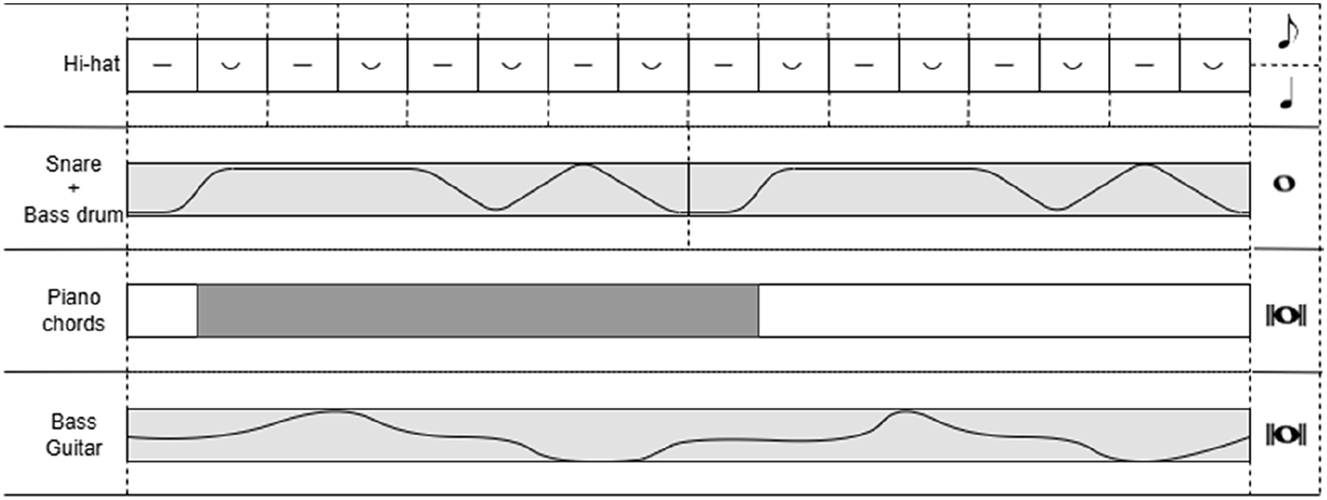
Rhythmic analysis of background music – rhythmic values created by linear repetition of hi-hat beat (with a regular accentuation of the first of each of these beats) and cyclical repetitions of riffs of drumkit, piano chords and bass guitar. Vertical dotted lines indicate when each period/cycle restarts and the column on the righthand side indicates the rhythmic value of each riff/beat in conventional Western notation.
Moving to the next semiotic channel, the cooking audio-video also has a clear rhythm to it (see Figure 7), even though it may not be as regular as the music. This semiotic channel can be temporally segmented by the changes of video shot. There are fourteen shots in total, with the first and last shots both depicting the finished product (the first shot continues directly on from the final shot, creating a loop of the entire video) and shots 2–13 depict cooking actions in sequential order (i.e. steps of the recipe) leading towards the finished product, with some steps being split over two shots (see Table 1). Each cooking action has at least one repetition, e.g. shot 2 depicts a hand tenderising a piece of meat, an action that is repeated three times (i.e. the hand smashes the piece of meat a total of four times). The cooking actions with their repetitions create a regular pulse and beat that continues across each shot. In some shots, the cooking action divides the beat into pulses that are half as long, in others, the action lasts two whole beats or is a single beat followed by a silent beat. In Figure 7, the perceived intensity (which is the combined effect of both the sound and video) of each cooking action has been transcribed in the form of continuous wave-form lines, the peaks of which represent more accurately where each pulse lies. Within each cooking step, one of the peaks is slightly higher than the other(s) – this represents the accented beat of each cooking step (i.e. the beat that is perceived as more prominent than the other beats in the same cooking step). The final shot and cooking step is accented compared to all other shots/cooking steps, so the accented beat in the final shot also marks the climax of the entire video (i.e. on the third crunch).
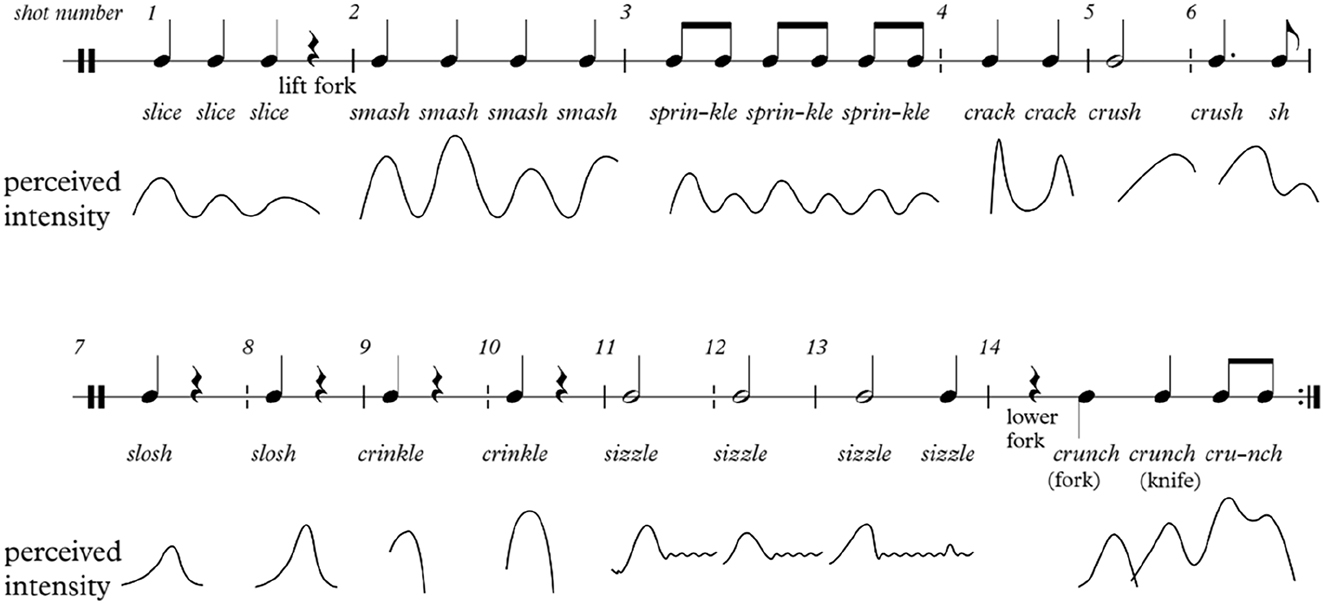
Rhythmic analysis of cooking audio-video.
Although the background music lacks a melody, the cooking audio-video forms a sort of audiovisual melody (there is a certain musicality to this semiotic channel) that is accompanied by the background music. The continuous rhythm of the cooking actions connects each step (here the movement metaphor of “steps” is quite apt since the rhythm matches those of walking) of the recipe into a continuous melodic path (although this path is quite jarring at times with abrupt cuts between shots) that leads to a finished dish. The melodic path connects a sequence of dynamic actions to represent the process of cooking. This is a very smooth and functional representation, one that makes the process feel very easy and uncomplicated.
Connecting the background music rhythm (Figure 6) to the cooking audio-video rhythm (Figure 7), although the two rhythms do not align exactly, the repeating elements of the background music provide a stable reference for the measurement of temporal durations in the cooking audio-video. There are 7 cycles of the drum kit riff of the background music and 14 shots in the cooking audio-video, making each shot roughly half a drumkit riff cycle (though some shots are longer than others), and the main cooking action beat is roughly equivalent to the quaver beat of the hi-hats. The background music thus makes the rhythm of the cooking audio-video perceived as more regular than without it.
The relationship between the cooking audio-video rhythm and the speech rhythm demonstrates more interplay between the layers. Although the rhythms are somewhat independent of one another, there are many moments in which the pulses of the cooking audio-video align exactly with the accents in the speech rhythm. An analysis of the speech rhythm and its relationship to the cooking audio-video from shot 11 onwards is presented in Figure 8. Here we can see that there are speech rhythm accents on the syllables EASy, QUICK, and SO (these accents are all the most prominent moments of each of their respective phrases) which synchronise with the peaks of intensity in the cooking action rhythm. After this point, there is a different type of temporal coordination between the two rhythms. The final words of the speech are each grouped into single (or two) word phrases, which allows each of the final three words ([FRIED//] [IN//][BUTter//]) to receive their own accent and emphasis (van Leeuwen 1999: 46). The final word (and phrase) is [BUTter//] which is also the main phrase of the entire speech rhythm, hence the speech “climax”. When inspecting where this falls in relation to the climax of the cooking audio-video layer (which is also a succession of three beats, the final of which marks the climax) in Figure 8, we can see that the speech rhythm is timed so that it begins building to its climax just before the cooking action rhythm does, and so that the climax of the cooking action rhythm (the final crunch of the knife slicing the crumbed tenderloin) strikes just after BUTter.
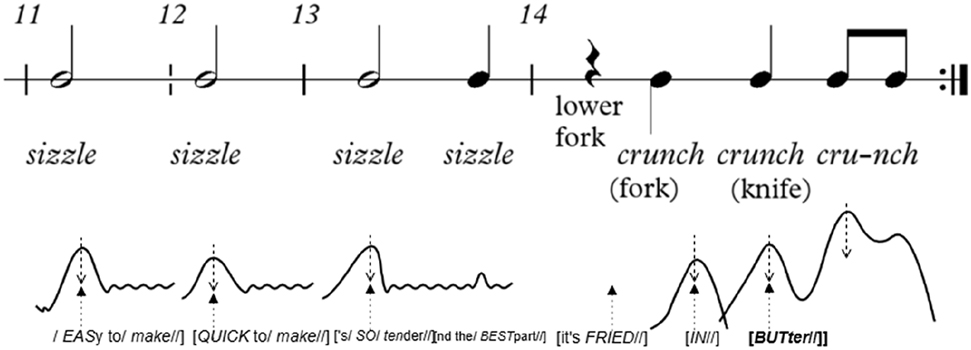
Coordination of cooking audio-video rhythm with speech rhythm. The speech rhythm is analysed and notated using van Leeuwen’s (1999) framework.
Both types of rhythmic coordination – synchronisation and the staggered climaxes – have their own communicative effects. In the synchronisation of accents, the accents of one emphasise those of the other, depending on which semiotic channel focus is being directed towards. In the case of the staggered climax, the speech rhythm reaches its most prominent moment and then moves aside to give full attention to the climax of the cooking action rhythm (and entire video). The timing of this rhythmic coordination is very subtle. The coordination of the background music rhythm also plays a role in the final moments. The point at which the cyclical repetition of the bass guitar and piano riffs ends (i.e. bar 6 of the background music. See transcription in Table 1) aligns with the beginning of shot 13, and the tonal centre of the piano and bass guitar parts continually shift from this point onwards. The background music rhythm thus also signals that the video is moving towards a moment of particular interest from this point onwards.
It is also important to consider how the rhythm of this multimodal text fits into, and is shaped by the rhythms of its social context. What is noteworthy about the multimodal text is that it fits a great deal of meaning into a short time span. The subtle timings of the rhythmic layers and their respective moments of prominence play a large role in economising time, as well as economising the social media user’s attention. It is also noteworthy that the very first shot is of the finished product. This functions as a “hook” to grab the social media user’s attention while they are in a rhythm of continuously scrolling through Instagram reels and engaging selectively with videos. Such considerations are crucial in the composition of social media texts in the context of the “attention economy” (Abidin 2021) in particular for established institutions and organisations such as the New York Times that constantly need to adapt to changing social conditions of media communication (Krotz 2017: 110).
Finally, we can also consider an additional layer of meaning that the background music adds. The background music also adds identity meanings through its aesthetic qualities and the social histories of these aesthetic resources (van Leeuwen 2021). The complex rhythmic layering described above – layers of cyclical repetition with matching rhythmic values but contrasting rhythmic shapes – along with the pulsating (but not incessant) piano chords that emphasise non-tertial harmonies imbue the music with energy and playfulness, yet at a steady and unhurried pace. These characteristics set an appropriate mood for easy, simple and fun cooking. In terms of the social history of this music, the name of the track is displayed as Cookin and the artist name as Jumbo, however a web search returns no further information on neither the artist nor track (nor does a Spotify search). When clicking on the music track name, Instagram provides the option of reusing the same music in a new reel and also displays other Instagram reels that have used the same background music. This track has been used in 284,000 Instagram reels by accounts based in many different countries around the world, mostly with food videos but also with other types of non-food related content. It seems that this music has been written by an anonymous composer specifically for use as background music in short form social media videos. Although there is no information about the artist or track, it does have many musical qualities that are evocative of funk and other closely related genres of jazz. Although it would be possible to trace specific musical qualities of this background music to the origins of funk (which in its historical context, the same musical qualities would have had different meanings), this piece of background music has been severed from the history of the genre, just as many other genres of popular music with African American origins (e.g. rock and roll, techno, gospel to name just a few) often have their histories forgotten (or erased), and are exploited in the global capitalist circulation of popular music to become background music inserted not just into multimedia texts, but into the rhythms of our everyday lives, accompanying activities of work and leisure. Music semiotics must engage in historical research of musical signifiers, lest the field contributes to this amnesia of musical meanings.
6 Conclusions
There are many challenges to carrying out genuine interdisciplinary research. A deep engagement in multiple fields of knowledge is required, and when this requires engaging with music theory, this means taking the effort to explore the plurality of knowledges that can be found, rather than assuming that the dominant discourses represent the field as a monolith. Although this is may be a difficult task, there is much to be gained. Musical knowledge based on the study of diverse musical cultural practices not only has the potential to broaden perspectives in music interdisciplines such as music perception and music semiotics, it can also help semiotics in general expand beyond its own logocentric biases, providing concepts and tools that are better suited to investigating meaning making as a dynamic process. In turn, multimodal social semiotics – as an inherently interdisciplinary mode of investigation – can help music theory to redirect its inward gaze outwards, and to embrace pluralistic knowledge building by making sense of apparent contradictions between perspectives built on different cultural practices, thus contributing to music theory becoming less ethnocentric and more democratic.
Funding source: Wenner-Gren Stiftelserna
Award Identifier / Grant number: UPD2023-0130
-
Research ethics: The local Institutional Review Board deemed the study exempt from review.
-
Informed consent: Not applicable.
-
Conflict of interest: The author states no conflict of interest.
-
Research funding: This work was supported by the Wenner-Gren Foundations as part of the research project entitled “Decolonising Music Theory” (grant number UPD2023-0130).
-
Data availability: The author confirms that the data supporting the findings of this study are available within the article.
References
Abidin, Crystal. 2021. Mapping internet celebrity on TikTok: Exploring attention economies and visibility labours. Cultural Science 12(1). 77–103. https://doi.org/10.5334/csci.140.Suche in Google Scholar
Agawu, Kofi. 2016. Tonality as a colonizing force in Africa. In Ronald Radano & Tejumola Olaniyan (eds.), Audible empire: music, global politics, critique, 334–356. New York: Duke University Press.10.2307/j.ctv11smhd0.19Suche in Google Scholar
Allanbrook, Wye J. 1983. Rhythmic gesture in Mozart: Le nozze di Figaro & Don Giovanni. Chicago: University of Chicago Press.10.7208/chicago/9780226437712.001.0001Suche in Google Scholar
Anku, Willie. 2000. Circles and time: A theory of structural organization of rhythm in African music. Music Theory Online 6(1). https://doi.org/10.30535/mto.6.1.2.Suche in Google Scholar
Bakhtin, Mikhail M. 1981. The dialogic imagination: Four essays by M. M. Bakhtin. Caryl Emerson & Michael Holquist (trans.). Texas: University of Texas Press.Suche in Google Scholar
Barrière, Jean-Baptiste (ed.). 1991. Le timbre: Métaphore pour la composition [The stamp: Metaphor for composition]. Paris: IRCAM and Cristian Bourgeois.Suche in Google Scholar
Bartenieff, Irmgard & Dori Lewis. 1980. Body movement: Coping with the environment. New York, NY: Gordon and Breach Science.Suche in Google Scholar
Blum, Stephen. 2023. Music theory in ethnomusicology. New York, NY: Oxford University Press.10.1093/oso/9780199303526.001.0001Suche in Google Scholar
Born, Georgina. 1995. Rationalizing culture: IRCAM, Boulez, and the institutionalization of the musical avant-garde. London: University of California Press.10.1525/9780520916845Suche in Google Scholar
Born, Georgina. 2010. For a relational musicology: Music and interdisciplinarity, beyond the practice turn. Journal of the Royal Musical Association 135(2). 205–243. https://doi.org/10.1080/02690403.2010.506265.Suche in Google Scholar
Boyd, Clifton. 2022. Music theory, race, and the barbershop harmony society. In John D. Jenkins (ed.), The Oxford handbook of public music theory. Oxford: Oxford University Press. https://doi.org/10.1093/oxfordhb/9780197551554.013.15.Suche in Google Scholar
Boyd, Clifton. 2025. The hidden politics of (public) music theory. Music Theory Spectrum 47(1). 35–39. https://doi.org/10.1093/mts/mtaf001.Suche in Google Scholar
Brown, Reuben. 2014. The role of songs in connecting the living and the dead: A funeral ceremony for Nakodjok in western Arnhem Land. In Amanda Harris (ed.), Circulating cultures: Exchanges of Australian indigenous music, dance and media, 169–201. Canberra: Australian National University Press.10.22459/CC.12.2014.07Suche in Google Scholar
Butler, Mark J. 2006. Unlocking the groove rhythm, meter, and musical design in electronic dance music. Bloomington: Indiana University Press.Suche in Google Scholar
Chernoff, John M. 1979. African rhythm and African sensibility: Aesthetics and social action in African musical idioms. Chicago: The University of Chicago Press.Suche in Google Scholar
Christensen, Otto M. 1995. Interpretation and meaning in music. In Eero Tarasti (ed.), Musical signification: Essays in the semiotic theory and analysis of music, 81–90. Berlin: Mouton de Gruyter.10.1515/9783110885187.81Suche in Google Scholar
Christensen, Thomas, Carmel Raz & Lester Hu (eds.). Forthcoming. Thinking music: Global sources for the history of music theory. Chicago: University of Chicago OPS.Suche in Google Scholar
Cooper, Grosvenor W. & Leonard B. Meyer. 1960. The rhythmic structure of music. London: The University of Chicago Press.Suche in Google Scholar
Crossley, Nick. 2020. Connecting sounds: The social life of music. Manchester: Manchester University Press.10.7765/9781526126023Suche in Google Scholar
Ewell, Philip A. 2020. Music theory and the white racial frame. Music Theory Online 26(2). https://doi.org/10.30535/mto.26.2.4.Suche in Google Scholar
Ewell, Philip A. 2023. On music theory, and making music more welcoming for everyone. Ann Arbor: University of Michigan Press.10.3998/mpub.12050329Suche in Google Scholar
Farraj, Johnny & Sami Abu Shumays. 2019. Inside Arabic music: Arabic maqam performance and theory in the 20th century. Oxford: Oxford University Press.Suche in Google Scholar
Feld, Steven. 1981. ‘Flow like a waterfall’: The metaphors of Kaluli musical theory. Yearbook of Traditional Music 13. 22–47. https://doi.org/10.2307/768356.Suche in Google Scholar
Floyd, Samuel A.Jr. 1995. The power of black music: Interpreting its history from Africa to the United States. Oxford: Oxford University Press.Suche in Google Scholar
Godøy, Rolf I. 2021. Perceiving sound objects in the musique concrète. Frontiers in Psychology 12. https://doi.org/10.3389/fpsyg.2021.672949.Suche in Google Scholar
Hall, Edward T. 1983. The dance of life: The other dimension of time. New York: Anchor.Suche in Google Scholar
Han, Joshua. 2021. A social semiotic account of music-movement correspondences. Sydney: University of New South Wales PhD thesis.Suche in Google Scholar
Hasty, Christopher. 1997. Meter as rhythm. Oxford: Oxford University Press.Suche in Google Scholar
Hatten, Robert S. 2004. Interpreting musical gestures, topics, and tropes: Mozart, Beethoven, Schubert. Bloomington, Indiana: Indiana University Press.Suche in Google Scholar
Hesmondhalgh, David. 2013. Why music matters. Malden, MA: Wiley-Blackwell.Suche in Google Scholar
Huebscher, Netta. 2022. Invoking the modal nymph: The emergence and dissemination of the concept of modality in Swedish folk music. Gothenburg, Sweden: University of Gothenburg PhD thesis.Suche in Google Scholar
Ingold, Tim. 2011. Being alive: Essays on movement, knowledge and description. London: Routledge.Suche in Google Scholar
Jackendoff, Ray. 2009. Parallels and nonparallels between language and music. Music Perception: An Interdisciplinary Journal 26(3). 195–204. https://doi.org/10.1525/mp.2009.26.3.195.Suche in Google Scholar
Jo, Eun-Suk & Eun-Suk Jo. 2021. Joseon hugi supahyeong (shui bo xing) akbo-ui jeonseung yangsang-gwa eumak gyoyukjeok hyoyuseong [The transitional patterns of the supa-type (水波形) scores in the late Joseon Dynasty and the music educational utility]. Gugak Gyoyuk Yeongu [Gugak Education Research]15(2). 255–289. https://doi.org/10.31177/sskme.2021.15.2.09.Suche in Google Scholar
Johnson-Williams, Erin. 2023. Valuing whiteness: The presumed innocence of musical truth. Current Musicology 109/110. 43–47. https://doi.org/10.52214/cm.v109i.8729.Suche in Google Scholar
Kang, Myeong-Kwan, Dong-Chan Lee, Hyeon-Ju Seok, Hye-Gyeong Kim & Seong-Hye Kim (eds.). 2021 Yeokju Goakbo [Annotated translations of old music scores, vol. 2)]. Seoul: Minsokwon.Suche in Google Scholar
Kim, Young-woon. 2010. Korean notational systems. In Jun-Yon Hwang, Jin-Ah Kim & Yong-Shik Lee (eds.), Musical notations of Korea, 21–76. Seoul: National Gugak Center.Suche in Google Scholar
Kim, Hye-Jeong. 2024. Jangdan [Rhythm]. In Gugak dictionary. Seoul: National Gugak Center.Suche in Google Scholar
Komparu, Kunio. 1983. The Noh theater: Principles and perspectives. New York: Weatherihill.Suche in Google Scholar
Kress, Gunther R. & Theo van Leeuwen. 2001. Multimodal discourse: The modes and media of contemporary communication. London: Arnold.Suche in Google Scholar
Krotz, Friedrich. 2017. Explaining the mediatisation approach. Javnost – The Public 24(2). 103–118. https://doi.org/10.1080/13183222.2017.1298556.Suche in Google Scholar
Kwon, Do-Hui. 2024. Gueum [Mimetic sounds]. Gugak dictionary. Seoul: National Gugak Center.Suche in Google Scholar
L’affilard, Michel. 1705. Principes très-faciles pour bien apprendre la Musique, qui conduiront promptement ceux qui on du naturel pour le Chant jusq’au point de chanter toute sorte de Musique promptement et à Livre ouvert, 5ème edn. [Easy principles for learning music: A rapid guide to sight-singing for the naturally gifted, 5th edn.]. Paris: Christophe Ballard.Suche in Google Scholar
Larson, Steve. 2012. Musical forces: Motion, metaphor, and meaning in music. Bloomington: Indiana University Press.10.2979/6363.0Suche in Google Scholar
Lefebvre, Henri. 2004. Rhythmanalysis: Space, time and everyday life. Stuart Elden & Gerald Moore (trans.). London: Contniuum.Suche in Google Scholar
Lehrdahl, Fred & Ray S. Jackendoff. 1983. A generative theory of tonal music. Cambridge, MA: MIT Press.Suche in Google Scholar
London, Justin. 2012. Hearing in time: Psychological aspects of musical meter, 2nd edn. Oxford: Oxford University Press.10.1093/acprof:oso/9780199744374.001.0001Suche in Google Scholar
Luria, Alexander R. 1973. The working brain. Basil Haigh (trans.). Harmondsworth, Middlesex, England: Penguin.Suche in Google Scholar
Machin, David. 2010. Analysing popular music: Image, sound, text. London: Sage.10.4135/9781446280027Suche in Google Scholar
Martinez, José Luiz. 1997. Semiosis in Hindustani music. Imatra, Finland: International Semiotics Institute.Suche in Google Scholar
McClary, Susan. 2002. Feminine endings: Music, gender and sexuality, 2nd edn. Minnesota: University of Minnesota Press.Suche in Google Scholar
McCreless, Patrick. 1997. Rethinking contemporary music theory. In David Schwarz, Anahid Kassabian & Lawrence Siegel (eds.), Keeping score: Music, disciplinarity, culture, 13–53. Charlottesville: University Press of Virginia.Suche in Google Scholar
Monelle, Raymond. 2000. The sense of music: Semiotic essays. Princeton: Princeton University Press.Suche in Google Scholar
Monson, Ingrid T. 1999. Riffs, repetition, and theories of globalization. Ethnomusicology 43. 31–36. https://doi.org/10.2307/852693.Suche in Google Scholar
Moschini, Ilaria & Johnny Wingstedt. 2020. Singing corporate social responsibility: A multimodal analysis of the 2018 budweiser super bowl commercial. Linguæ & – Journal of Modern Languages and Cultures 20(1). 155–172.10.7358/ling-2020-001-mowiSuche in Google Scholar
Murphy, Nancy. 2023. Times A-changin’: Flexible meter as self-expression in singer-songwriter music. New York: Oxford University Press.10.1093/oso/9780197635216.001.0001Suche in Google Scholar
Pontara, Tobias & Ulrik Volgsten. 2017. Musicalization and mediatization. In Olivier Driessens, Göran Bolin & Andreas Hepp (eds.), Dynamics of mediatization: Institutional change and everyday transformations in a digital age, 247–269. Camden: Palgrave McMillan.10.1007/978-3-319-62983-4_12Suche in Google Scholar
Rahn, Jay. 1996. Turning the analysis around: Africa-derived rhythms and Europe-derived music theory. Black Music Research Journal 16(1). 71–89. https://doi.org/10.2307/779378.Suche in Google Scholar
Rehding, Rehding & Steven Rings (eds.). 2019. The Oxford handbook of critical concepts in music theory. Oxford: Oxford University Press.Suche in Google Scholar
Robinson, Dylan. 2020. Hungry listening: Resonant theory for indigenous sound studies. Minneapolis: The University of Minnesota Press.10.5749/j.ctvzpv6bbSuche in Google Scholar
Russell, George. 2001. The Lydian chromatic concept of tonal organization: The art and science of tonal gravity, 4th edn. Brookline, MA: Concept.Suche in Google Scholar
Schaeffer, Pierre. 1966. Traité des objets musicaux [Treatise on musical objects]. Paris: Le Seuil.Suche in Google Scholar
Schenker, Heinrich. 1979. Free composition. Ernst Oster (ed.) & Oswald Jonas (trans.). New York: Longman.Suche in Google Scholar
Schwandt, Erich. 1974. L’Affilard on the French court dances. The Musical Quarterly 60(3). 389–400. https://doi.org/10.1093/mq/lx.3.389.Suche in Google Scholar
Sheets-Johnstone, Maxine. 2009. The corporeal turn: An interdisciplinary reader. Exeter, UK: Imprint Academic.Suche in Google Scholar
Sheets-Johnstone, Maxine. 2011. The primacy of movement. Amsterdam: John Benjamins.10.1075/aicr.82Suche in Google Scholar
Sheets-Johnstone, Maxine. 2012. From movement to dance. Phenomenology and the Cognitive Sciences 11(1). 39–57. https://doi.org/10.1007/s11097-011-9200-8.Suche in Google Scholar
Sloboda, John A. & Patrik N. Juslin. 2010. At the interface between the inner and outer world: Psychological perspectives. In Patrik N. Juslin & John Sloboda (eds.), Handbook of music and emotion: Theory, research, applications, 73–98. Oxford: Oxford University Press.10.1093/acprof:oso/9780199230143.003.0004Suche in Google Scholar
Small, Christopher. 1998. Musicking: The meanings of performing and listening. Hanover, NH: Wesleyan University Press.Suche in Google Scholar
Steinbeis, Nikolaus, Stefan Koelsch & John A. Sloboda. 2006. The role of harmonic expectancy violations in musical emotions: Evidence from subjective, physiological, and neural responses. Journal of Cognitive Neuroscience 18(8). 1380–1393. https://doi.org/10.1162/jocn.2006.18.8.1380.Suche in Google Scholar
Tagg, Philip. 2013. Music’s meaning: A modern musicology for non-musos. New York, NY: The Mass Media Music Scholars’ Press.Suche in Google Scholar
Tagg, Philip. 2014. ‘Music theory terminology as ideology’, a.k.a. ‘Semiotics: The missing link between music and the rest of human knowledge’. Paper presented at the 1st international congress of numanities “ICoN”, international semiotics institute in Kaunas, Lithuania, June 2–7, 2014.Suche in Google Scholar
Tamba, Akira. 1988. La théorie et l’esthétique musicale Japonaise: Du 8e à la fin du 19e siècle [Japanese musical theory and aesthetics: From the 8th to the end of the 19th century]. Paris: Publications orientalistes de France.Suche in Google Scholar
Tamba, A. 2004.“Jo-Ha-Kyu” to iu bigaku: Gendai ni yomigaeru Nihon ongaku no shikō-gata [The aesthetics of “Jo-Ha-Kyu”: A modern revival of a Japanese musical philosophy]. Tokyo: Ongaku No Tomo Sha.Suche in Google Scholar
Tarasti, Eero. 1995. Preface. In Eero Tarasti (ed.), Musical signification: Essays in the semiotic theory and analysis of music, v–x. Berlin: De Gruyter Mouton.10.1515/9783110885187.vSuche in Google Scholar
Tarnawska-Kaczorowska, Krystyna. 1995. The musical work as sign: Significative constituents, layers, structure. In Eero Tarasti (ed.), Musical signification: Essays in the semiotic theory and analysis of music, 123–140. Berlin: De Gruyter Mouton.10.1515/9783110885187.123Suche in Google Scholar
van Leeuwen, Theo. 1985. Rhythmic structure of the film text. In Teun A. van Dijk (ed.), Discourse and communication: New approaches to the analysis of mass media discourse and communication, 216–232. Berlin: De Gruyter Mouton.10.1515/9783110852141.216Suche in Google Scholar
van Leeuwen, Theo. 1999. Speech, music, sound. London: Macmillan.10.1007/978-1-349-27700-1Suche in Google Scholar
van Leeuwen, Theo. 2005. Introducing social semiotics. London: Routledge.10.4324/9780203647028Suche in Google Scholar
van Leeuwen, Theo. 2017. Sonic logos. In Lyndon C. S. Way & Simon McKerrell (eds.), Music as multimodal discourse, 119–134. London: Bloomsbury.10.5040/9781474264419.ch-006Suche in Google Scholar
van Leeuwen, Theo. 2021. Multimodality and identity. London: Routledge.10.4324/9781003186625Suche in Google Scholar
van Leeuwen, Theo. 2025. Multimodality and time: A social semiotic approach. London: Routledge.10.4324/9781003433453Suche in Google Scholar
Vuust, Peter, Ole A. Heggli, Karl J. Friston & Morten L. Kringelbach. 2022. Music in the brain. Nature Reviews Neuroscience 23(5). 287–305. https://doi.org/10.1038/s41583-022-00578-5.Suche in Google Scholar
Wingstedt, Johnny, Sture Brändström & Jan Berg. 2010. Narrative music, visuals and meaning in film. Visual Communication 9(2). 193–210. https://doi.org/10.1177/1470357210369886.Suche in Google Scholar
Zbikowski, Lawrence M. 2017. Foundations of musical grammar. New York: Oxford University Press.10.1093/oso/9780190653637.001.0001Suche in Google Scholar
© 2025 the author(s), published by De Gruyter and FLTRP on behalf of BFSU
This work is licensed under the Creative Commons Attribution 4.0 International License.
