Contested Ground: Public Commemorations of the Shoah in Lviv
-
Ekaterina Shapiro-Obermair
Dr. Phil.
Ekaterina Shapiro-Obermair (1980, Moscow) is a visual artist, curator, and researcher. Her research interests lie within the (post-)Soviet space, with a focus on visual and memory cultures. Her publications include:
Geschichte performen: Öffentliches Gedenken an den Zweiten Weltkrieg im Zeichen des russisch-ukrainischen Krieges; History and Other Objects (editor), and Soviet Modernism, 1955–1991: Unknown History , edited with Katharina Ritter, Dietmar Steiner and Alexandra Wachter.


Abstract
The narratives of World War II, and especially accusations of nationalism and anti-Semitism, are widely used in Russian propaganda to legitimize the military aggression against Ukraine. This article takes a closer look at Lviv, a city with a traditionally strong national identity. While historical events related to the implementation of the Shoah in the city are well researched, less attention has been paid to public perception of them. Besides giving an overview of the local memory actors, the main focus of this article lies on public commemorations, which are considered to be media of the transmission and articulation of historical knowledge. The article first examines the content of speeches, and the manner in which ceremonies are staged. It then questions the views society holds toward the Jewish past and how the Jewish identity is conveyed through these rituals. The study is based on in-situ empirical research conducted between August 2015 and January 2023.
Dear Jewish community! Dear residents of Lviv! Today, on this grief-stricken day, I am addressing you on behalf of the head of the regional state administration and on my own behalf with condolences and with a bitter awareness of this tragedy of planetary scale. A tragedy that happened here, right next to us, on our lands. […] Not even a hundred years have passed since these barbaric exterminations [took place], the extermination of 1.5 million Ukrainian Jews. And this is actually a quarter of the world’s losses, the world’s victims of the Holocaust. Fifty years ago, Ivan Dziuba firmly asserted that the Holocaust is our common tragedy, […] the tragedy of the Ukrainian and the Jewish peoples. Today, we must follow […] the principles of our Metropolitan Andrei, who personally saved many Jewish lives here in Lviv. He wrote that the extent of the highest love is to save a brother’s life. And today, we have a duty to prevent such losses and such victims. We must make every effort to educate the next generation on the principles of human dignity and tolerance. Glory to the heroes, and to those who are risking their own lives today to save their neighbours. Thank you![1]
This speech was given by Khrystyna Berehovska, Director of the Department of Culture, Nationalities and Religions of the Lviv Regional State Administration [Lvivska Oblasna Derzhavna Administratsiia], during the commemorations of the International Holocaust Remembrance Day on January 27, 2017 (event filmed by the author). Delivered by a representative of local government, not only could her contribution to events be seen as an official statement and a sign of solidarity between Ukrainians and Jews, it was also a response to Russian propaganda accusing Ukrainians of being anti-Semitic. Furthermore, it is possible to identify several motifs in the speech that are essential to contemporary public reception of the Shoah in Ukraine, especially in the west of the country. While the Ukrainians’ collaboration with the Germans remained hidden, Berehovska mentioned the contribution Ukrainians made to saving Jews, emphasizing the special role played by the metropolitan of the Greek Catholic Church, Andrei Sheptytskyi. Concluding her speech by acknowledging the Ukrainian soldiers who were involved in the current military actions in the east of the country, she foregrounded the idea of unity between the past and the present, with the understanding that the Russo-Ukrainian war that has been ongoing since 2014 is a continuation of World War II.
This article examines the perception of the Shoah in the western Ukrainian city of Lviv through the lens of public commemorations. These collective events are considered as a form of social interaction and communication that cannot be reduced solely to the function of mourning. On the one hand, they are a medium through which governments convey normative historical views to their citizens. On the other, they enable various groups in the population to express their political and social demands by appealing to historical justice. According to Burke (2010, 108), public commemorations can be understood as an “agreed interpretation of the past linked to shared views of the present.” Furthermore, these collective practices do not solely refer to a historical event to be remembered but are placed in an ongoing dialogue with the previous iterations of the ceremony (Olick 2005, 338). In any case, commemorations do not just serve as an anchor for the present: they are also a guide for the future.
While monuments and museums remain more or less static and could therefore be analyzed through their genesis, appearance, and impacts, the study of commemorations demands a special methodology. First of all, their annual proceedings are by no means fixed and vary from year to year. Even though these collective practices follow an established canon or adhere to a certain (not always written) script, occurring in public spaces and involving various actors – organizers, participants, but also random passers-by – they are characterized by their open-ended nature. At the same time, simple cause-and-effect mechanisms (such as bad weather or overlapping commitments) can influence final outcomes and should not lead to heavy political overinterpretations. Most of the empirical data collected for this article was gathered in situ through participant observation, a method that enabled the events’ distinctive atmosphere and emotional dimensions to be captured. Analysis is focused on both the content of speeches and the performative elements within these ceremonies. In addition, interviews were conducted with representatives of the Jewish community, some of whom are involved with, or take part in, commemorative events. Between August 2015 and April 2017, field research was carried out in collaboration with the historian Alexandra Wachter within the framework of the project “Lwiw. Kriegsmuseum.”
The article looks in greater detail at two kinds of events: an annual event and a standalone occasion (Burawoy 1998, 136–37). This methodological approach allows the distinction between typical and accidental elements within these assemblies. The one-off event analyzed below is the inauguration of the memorial site “Spaces of Synagogues” which took place on September 4, 2016. The author did not attend this ceremony. Instead, publicly available video documentation was used for analysis (Lviv4you 2016a, 2016b). The observance of International Holocaust Remembrance Day, which has been commemorated in Ukraine every January 27 since 2012, serves as an example of a cyclical event. The article examines the ceremonies on this date in 2017 and 2023 (Commemorations of the International Holocaust Remembrance Day 2017, 2023); both events were attended and filmed by the author.
1 Historical Background and Knowledge
With the ghetto located within walking distance from the city center and the Lemberg-Janowska concentration camp on the periphery, Lviv was one of the most significant sites for the mass murder of Jews during World War II. While the course of the Shoah in and around the city has been thoroughly investigated (e.g. in Amar 2015; Himka 2011, 2021, Mick 2010, 2011, 2015, Pohl 1996, 2002; Struve 2015), its (under)repression during the Soviet period (Amar 2014) still influences both Jewish and non-Jewish city dwellers’ perception of events. The local population’s involvement in the mass killings of Jews, particularly those who were members of the Organization of Ukrainian Nationalists (OUN) and its military wing, the Ukrainian Insurgent Army (UPA), makes public discourse about these crimes particularly difficult (Himka 2013, 639–40).
During our research, we conducted interviews with leading representatives of Jewish organizations in Lviv, including Dianova (2016); Pleskov (2019), and Shtatsman (2016). All these prominent figures in the Jewish community stated that it was only in the 1990s that they learned what had happened in the city during the war, mainly through their work in their respective institutions. In an interview with the author on March 16, 2016, Olha Fadeeva, a librarian at the All-Ukrainian Jewish Charitable Foundation Hesed Arieh, explained:
When the club was founded and the library opened, we got the opportunity to read [about] all these [events]. I [began to] read the literature about the catastrophe with [a sense of] horror. Because at home, we didn’t talk about it. As you can understand, [it was] the Soviet era. Thank God, no one in our [family] perished, nowhere, neither in the ghetto nor in [ravines like] Babyn Yar. […] Since we didn’t have such conversations in our family, I only found out about it thanks to my work here, that was in 1998. Otherwise, I am a simple Soviet child who attended a Soviet school. [There were] only very general references to the war, and that was it. There was nothing about the Jewish exterminations.
Fadeeva described her reaction to these revelations in the following words: “It was more than a shock. It was a dumbfounded horror” (Fadeeva 2016).
At the time of our interview with him, on May 3, 2016, Iosif Shtatsman was interim Director of “B’nai B’brith ‘Leopolis’” and Chairman of the “Holocaust Center.” He was also a professional historian and worked for the State Archive of Lviv Oblast [Derzhavnyi Arkhiv Lvivskoi Oblasti (DALO)] before retiring. When he was asked when he had learned about what happened to Jews in the city during the war, Shtatsman responded:
Details – very late. So, I had a very general knowledge, mainly from literature. I knew this already in the late ’70s–early ’80s. But the details [I learned] only when it became possible to get access to the documents, in the early ’90s. […] People didn’t talk about it. It was difficult for them. Well, separate mosaic pieces were there, but the entire picture wasn’t coming together. The entire picture emerged only in the ’90s when articles were published, when [representatives of the] Soros Foundation started working here, when the first conferences took place, when the monument to the victims of the ghetto was erected. Only then did the entire picture emerge.
He also explained the situation regarding archive documents that described crimes against Jewish people:
All these documents were labelled as “secret.” They were not handed out at all. […] If someone got a permission, […] you were supposed to talk in your research about the criminals […] but not about the victims. The term “victim” became an empty linguistic formula.
The quotations above illustrate that during the Soviet period the experience of the Shoah was not discussed within the Jewish families of Lviv, a state that can be described as a break in communicative memory (Assmann 2018). One of the reasons for this silence lies with the underrepresentation of the mass killing of Jews during World War II within the Soviet war narrative (David-Fox et al. 2014). Embedded in Marxist critiques of capitalism (Gitelman 1993, 117) and suppressed by the politics of state anti-Semitism, the Shoah remained unwritten in the official history. However, the general tendency in the Soviet Union was not to deny the Jewish genocide, but rather to obscure it (Gitelman 1993, 118). Moreover, as elucidated in the realm of Soviet memory culture, the pain of Jewish victims was transferred from innocent suffering to dedicated sacrifice (Voronina 2018, 16). Consequently, many Soviet Jews adopted the narrative of a great victory instead of the one about the perishing – we will observe this fusion in one of the examples discussed below. For the half a million Jews who survived the Shoah by enrolling in the Red Army, their experiences did not, in fact, differ significantly from those of other Soviet military men (Epstein and Khanin 2013, 146–7).
The situation in Lviv was still specific. After almost the entire Jewish community was annihilated in the Shoah (Amar 2015, 88–142), most of the few survivors had to leave the city for Poland as former Polish citizens in a forced population exchange between the USSR and Poland by the end of 1946 (Amar 2005, 93). Jews who settled in Lviv in the aftermath of the war came mainly from the eastern parts of the Soviet Union and had little to no family or cultural ties to the local pre-war Jewish community (Amar 2015, 165; Amar 2015, 143–44). Even if these people were aware of what had happened to the Jewish population in the Soviet territories occupied by the Germans, they did not possess the memory of local experiences and could not transmit it to their children and grandchildren. The continued transfer of historical knowledge was also interrupted by a further break within community life in the early 1960s. The synagogue, which was re-established after the war, served not only as a religious, but possibly as an even stronger cultural and social center (Amar 2005, 91). Its compulsory closure in 1962, due to an anti-religious campaign that also targeted other religions (Amar 2015, 281) allegedly led to the disruption of vital communication channels.
2 Foundation of Jewish Organizations and Other Commemorative Actors
Public Jewish associations didn’t open in Lviv for another 20 years. The first organization to emerge was the Society for Jewish Culture named after Sholem Aleichem. It was founded in 1988 by journalist Boris Dorfman (1923–2022) and writer Aleksandr Lizen (1911–2000). Both men did not originally come from western Ukraine and they had survived the Shoah by joining the Red Army. One of the first actions taken by their organization was to install memorial plaques at locations where synagogues were destroyed by Germans during the war, among them the “Golden Royz” synagogue, which I will return to later. The society’s most prominent project was the erection in 1992 of a monument to the victims of the Lemberg ghetto, with planning commencing as early as 1988, three years before the collapse of the Soviet Union.
The first religious community was registered in 1992, four years after the foundation of the first cultural society. Two further religious communities – the Jewish Religious-Orthodox Community “Turei Zahav” [Golden Rose] and the Jewish Religious Community of Progressive Judaism “Teiva” – were only established in 2009. It could therefore be assumed that in post-Soviet Lviv, the Jewish population’s cultural identity was stronger than their sense of religious belonging.
In the 1990s, other Jewish organizations appeared in Lviv thanks to support from abroad. The International Memorial Fund “Janowska Camp” was created by a former prisoner, Alexander Schwarz (1924–2014), in 1993. In the same year, to mark the fiftieth anniversary of the camp’s liquidation, and in collaboration with the local branch of the “Memorial” organization, the fund’s “Janowska Camp” initiated the first international conference on the camp’s history. The inauguration of the memorial stone took place during this big event. Despite later efforts by various actors to redesign the area, no representative memorial complex matching the scale of the crimes committed here had been erected so far. Thus, the stone, conceived as a temporary symbol, remains the only object commemorating the existence of the camp and its victims. The fund’s “Janowska Camp” became the precursor to the local cultural organization B’nai B’rith “Leopolis”, which was founded in May 1996. In 2001, the fund was renamed the Holocaust International Center, named after Alexander Schwarz.
The All-Ukrainian Jewish Charitable Foundation Hesed-Arieh, financed by the American Jewish Joint Distribution Committee, and the youth organization Hillel Lviv were founded in 1998. As a vital cultural center and an organization with a social profile, Hesed-Arieh is currently one of the most active commemorative actors in the region. As of 2018, its Director, Ada Dianova, moved to the progressive Jewish community “Teiva’’ which has also become increasingly active in the field of memory work.
While for years only Jewish organizations carried out memory work regarding the Shoah, since the mid-2000s academic institutions also have become active in this field, with the first being the Center for Urban History of East Central Europe (2004) and later, the “Territory of Terror” Memorial Museum (2014–16). The city council [Lvivska Oblasna Rada] can also be considered a significant commemorative actor. Even if the city does not initiate its own commemorative projects dedicated to Jewish history and culture, it often supports similar initiatives. The rise of academic and municipal structures involved in the study and popularization of the history of the Shoah in Lviv sits alongside Ukraine’s efforts to integrate itself into the European Union. Being a part of Europe means recognizing the Holocaust as central to its foundation.
3 Holocaust Remembrance Day: An Occasion of International Significance and the Local Canon
The apex of the mass killing of Jewish civilians in the Soviet Union during World War II is the massacre of the Babyn Yar – the murder of more than 33,000 Jews on September 29 and 30, 1941, in a ravine near Kyiv. Since Ukraine’s declaration of independence in 1991, commemorations of these events have occurred annually in late September (Prymachenko 2017, 209), mainly in Kyiv but also in another cities. However in 2011, on the seventieth anniversary of the Babyn Yar tragedy, January 27 was introduced to the state memorial calendar as Holocaust Remembrance Day (Supreme Council of Ukraine 2011) rather than one of the dates in late September. The date for this memorial was established in 2005 by the United Nations (n.d.) on the sixtieth anniversary of the liberation of the Auschwitz-Birkenau concentration and extermination camp by the troops of the First Ukrainian Front of the Red Army in 1945. Since then, it has been commemorated internationally by many member countries. In Ukraine, designating January 27 as a date to remember the victims of the Shoah has several dimensions. On the one hand, it helps to unite distinct experiences from different parts of the country and enables them to be understood as components of a larger phenomenon. On the other, referring to an event that occurred outside of the Soviet Union makes it possible to connect national history to the history of Europe. Furthermore, by commemorating the date, which is of significance to countries such as the USA and Germany, among others, Ukraine aligns itself with the international memorial canon established in Europe and North America. This is particularly remarkable given that the decision was made during Viktor Yanukovych’s presidency, a period characterized by approximation to Russia in the field of historical policy.
Victims of the Shoah have been publicly remembered in Lviv on January 27 since 2013. As a recurring event, commemorations in 2017 followed an established pattern that, according to my observations in 2023, essentially remained the same, even after the escalation of the Russo-Ukrainian war. In both 2017 and 2023, people first met at the monument to the victims of the Lemberg ghetto, and later at the stone memorializing the victims of the Lemberg-Janowska camp. At both sites, first, a rabbi led a prayer, then speeches were made and finally, memorial offerings were laid down. In 2017, the first assembly (at the monument to the victims of the Lemberg ghetto) was attended by approximately one hundred people, while the assembly at the memorial stone consisted of a narrow circle of approximately 20 people, most of whom belonged to the organizations involved. In 2023, slightly fewer people took part in these commemorative events but the proportion stayed the same. On both occasions, representatives of the municipality were invited solely as guest speakers and were not involved as initiators or organizers. They only participated during the assembly at the monument to the victims of the ghetto, marking this event as the more important of the two.
In 2017 and 2023, most of the participants, especially those who assembled at the stone, were native Russian speakers from the middle or older generations. Nevertheless, (with very few exceptions) they delivered their speeches in Ukrainian. According to Radchenko (2023, 5) this shift began in 2014 with the Russo-Ukrainian war. As a political gesture, the choice of language could be interpreted as an expression of unity between Jews and Ukrainians and was therefore a counterargument to Russian accusations that Ukrainians were “fascists.” The comparison with commemorations carried out by the local Polish associations is insightful as these assemblies are usually only conducted in Polish. For instance, during the ceremony to remember the murdered Polish academics, which happened on July 4, 2016, most of the participants also represented the middle or older generations, but no speeches were delivered in Ukrainian and only Polish was spoken. This example illustrates the incongruity of the fact that the representatives of the Jewish community speak Ukrainian in public. It also indicates that the position of the Russian language is more problematic than its Polish counterpart.
Nevertheless, some distinctions between the events in 2017 and 2023 could be made. One of those differences signifies a strengthening of new commemorative actors. While in 2017 the assemblies were initiated and implemented by the local Jewish organizations “Hesed-Arieh” and “B’nai B’rith ‘Leopolis’” in 2023, “Teiva” and the “Territory of Terror” Museum co-organized the event. The museum, which is located on the street opposite the monument to the victims of the ghetto, has taken an increasingly active role in designing commemorative events. In 2023, before the gatherings, it offered a guided tour of its permanent exhibition. In 2024, a lecture called “Memories and Documents: The History of the Rosenthal Family” occurred there following the events. Allegedly, for this reason, even the established order of the locations being visited was changed and people first met at the site of the former camp and later at the monument. Olha Honchar, the museum’s director, attended the gatherings at the monument in 2023 and 2024.
In 2023, further minor but significant shifts occurred. Since their inauguration, gatherings at both sites have regularly included a service, most often ecumenical. However, in 2017, aside from the prayer, the commemorative events took on a distinctly secular character (Figure 1). Wreaths and flowers were mostly laid down, though candles were also present. In 2023, as a grassroots initiative, people also brought stones to the memorial to the victims of the ghetto, among other offerings, a rite borrowed from the Jewish religious canon. While this practice does not necessarily serve as proof of a rise in religious observance among the Jewish community of Lviv, it suggests the increasing importance of public expressions of religious identity. Furthermore, in both years a minute’s silence took place. While in 2017 it was marked by the sound of a metronome, in 2024, this sound was missing. This acoustic element, typical of the Soviet tradition, is still widely used in Russia, especially during Victory Day celebrations. Its meaning is not, however, inseparably linked to the Great Patriotic War. For example, on Independence Day 2019, during the minute’s silence in honor of soldiers who had died in the current war, President Volodymyr Zelensky used the sound of a metronome. The absence of this tone might indicate that the Soviet memory tradition is losing its significance but also that the emotional impact has shifted from heroic pathos to a pathos of mourning.
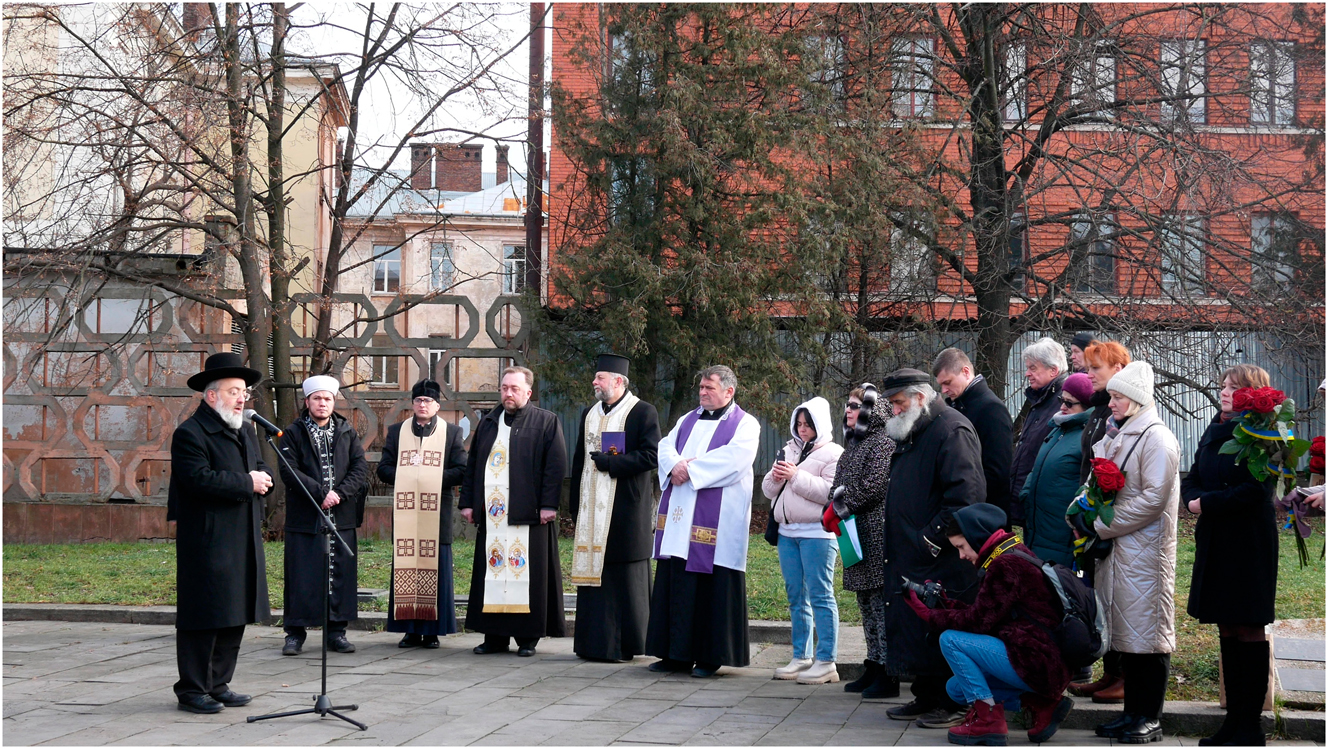
Commemoration on International Holocaust Remembrance Day at the monument to the victims of the Lemberg ghetto. Lviv. January 27, 2023. © Ekaterina Shapiro-Obermair.
In both 2017 and 2023, the process of laying memorial offerings was accompanied by music from a film soundtrack, but a change was made here as well. Even though the musical background to a commemorative event should not be overinterpreted, its semantic framework is still present. In 2017, a score from Steven Spielberg’s Schindler’s List played on loudspeakers at both sites. This well-known film represents a Hollywood interpretation of the Shoah: rich in details it features a charismatic hero and a happy ending where most of the characters with whom the audience sympathizes survive. In Ukraine, as well as in other Commonwealth of Independent States (CIS) countries, the significance of this fact-based fiction in shaping the perception of historical events cannot be underestimated (Epstein and Khanin 2013, 149). Composed by John Williams in a minor key, the film music is also frequently used internationally during events to remember victims of the Shoah. It not only aims to evoke a strong sense of sadness or melancholy in listeners but also places respective commemoratives within a North American/Western European context. During the memorial ceremonies in Lviv in 2023, the Schindler’s List theme was replaced by Myroslav Skoryk’s soundtrack to the film Vysokyy pereval. Released in 1982, the movie depicts the anti-Soviet resistance of the Ukrainian Insurgent Army (UPA). Skoryk’s “Melody” is highly symbolic as an unofficial Ukrainian national anthem and is regularly played during commemorations of the Holodomor and the Revolution of Dignity, events central to the construction of Ukrainian national identity. After the full-scale invasion it also became popular outside of Ukraine, as it is often played during various charity concerts aimed to support the country in the current war. The use of this emblematic music during the commemorations of the Shoah frames the mass murder of Jews during World War II as a part of a genuinely Ukrainian history. At the same time, it presents the Shoah through a nationalistic lens and thereby appropriates Jewish suffering.
All these alterations to the course of the events indicate shifts in public perception of the Shoah in the region: the appearance of memory actors outside the Jewish community; the valorization of Judaism through the inclusion of religious rites; the increased abandonment of the Soviet memorial canon; and – probably the most challenging one – the integration of Holocaust remembrance into the tradition of Ukrainian national victimization.
4 From Soviet Heroism to the Individualization of the Victims
During the two commemorations held on January 27, 2017, most of the speakers limited their contributions to brief and generalized statements that corresponded with their position within the Jewish community or politics. However, there were several presentations which conveyed that people with different, yet contradictory, approaches were present among those gathered. In particular, the less formal assembly at the memorial stone, where political representatives were absent and anyone who wanted could make a public statement, afforded more space for individual improvisation. The two following speeches illustrate the most radically different positions. Both of them were given by older men who were receiving support from “Hesed-Arieh”: Viktor Korniichuk and Yury Storozhenskyi.
Korniichuk read a poem in Russian which he wrote. As space does not allow me to quote it in full, I will limit myself to several of the most characteristic strophes:
Remember, Comrade, to whom you are indebted,
For the fact that you now walk in the sun.
Those millions of lads who perished,
Who put down their lives for us.
[…]
When you pass by this stone, bow down low.
And whisper: thank you, lads, that life carries on!
It is remarkable that throughout the poem Korniichuk spoke solely about males and heroes and not about civilians or victims, and never was the word “Jew” mentioned. At the same time, words such as “Red Army” or “soldiers,” to which the poem obviously refers were not used explicitly either. This double silencing is not easy to interpret. On the one hand, the topic of Soviet military heroism was already unpopular in Western Ukraine in 2017 and commemorations of the Shoah gave the speaker an opportunity to perform familiar and internalized forms of public grief without being blamed for being pro-Russian. On the other hand, within the context of remembering victims of the Shoah, the poem intended to express the speaker’s sorrow and empathy with the deceased, but its rhetoric reveals a gap between the crimes committed in the camp and their representation in the spoken language. In any case, the poem reproduces the concept of a sacrificial death for the sake of future generations that is inherent to the concept of social realism found in literature (Clark 1981). It also indicates how strongly the reception of the Shoah in Lviv is still intertwined with the Soviet tradition, even within the Jewish community. Korniichuk’s attitude is even more striking, as he claims to have been a child prisoner of Majdanek (Korniichuk 2017). Even if this assertion might be true, I could not find any evidence.
Storozhenskyi’s contribution conveyed the opposite message. In his speech, he related the story of the prominent lawyer Maurycy Allerhand who was killed in the Lemberg-Janowska camp. Storozhenskyi was aware of Allerhand’s fate due to the book written by his grandson Leszek. Using the terminology of Assmann (2018), his knowledge was not transmitted to him by living people and came not from a communicative, but from a cultural source that lies outside the Soviet narrative. When the speaker referred to Allerhand by name and pointed out that “behind the numbers were real people,” it was the first time at both gatherings that day that a certain victim was mentioned as an individual. This emphasis on the personal dimension of the greater historical narrative follows the international trend toward the individualization of Shoah victims and marks a shift in the local memory culture from the Soviet canon to the “North American/Western European.” During the assembly it emerged as a private statement, indicating a process of transformation carried out from the bottom. The coexistence of both positions within one community illustrates its heterogeneity and therefore, its potential for further change.
5 Opening Ceremony of the “Spaces of Synagogues”: An Occasion of Local Significance and the International Canon
The memorial site “Spaces of Synagogues” was erected on the site where the “Golden Royz” synagogue used to stand. The creation of this memorial site marked an important effort in public recognition of the Shoah in Lviv and cannot be underestimated. Even if in the early 1990s the Society for Jewish Culture managed to install a memorial plaque with basic information in Ukrainian, English, and Yiddish on this spot, for years, the place itself looked like a wasteland in the heart of the city. The project was initiated and realized by the Center for Urban History of East Central Europe in cooperation with the municipality and the German Society for International Collaboration [Deutsche Gesellschaft für internationale Zusammenarbeit (GiZ)]. An international design competition was launched in 2010, which was won by a German landscape architect Franz Reschke (Figure 2).
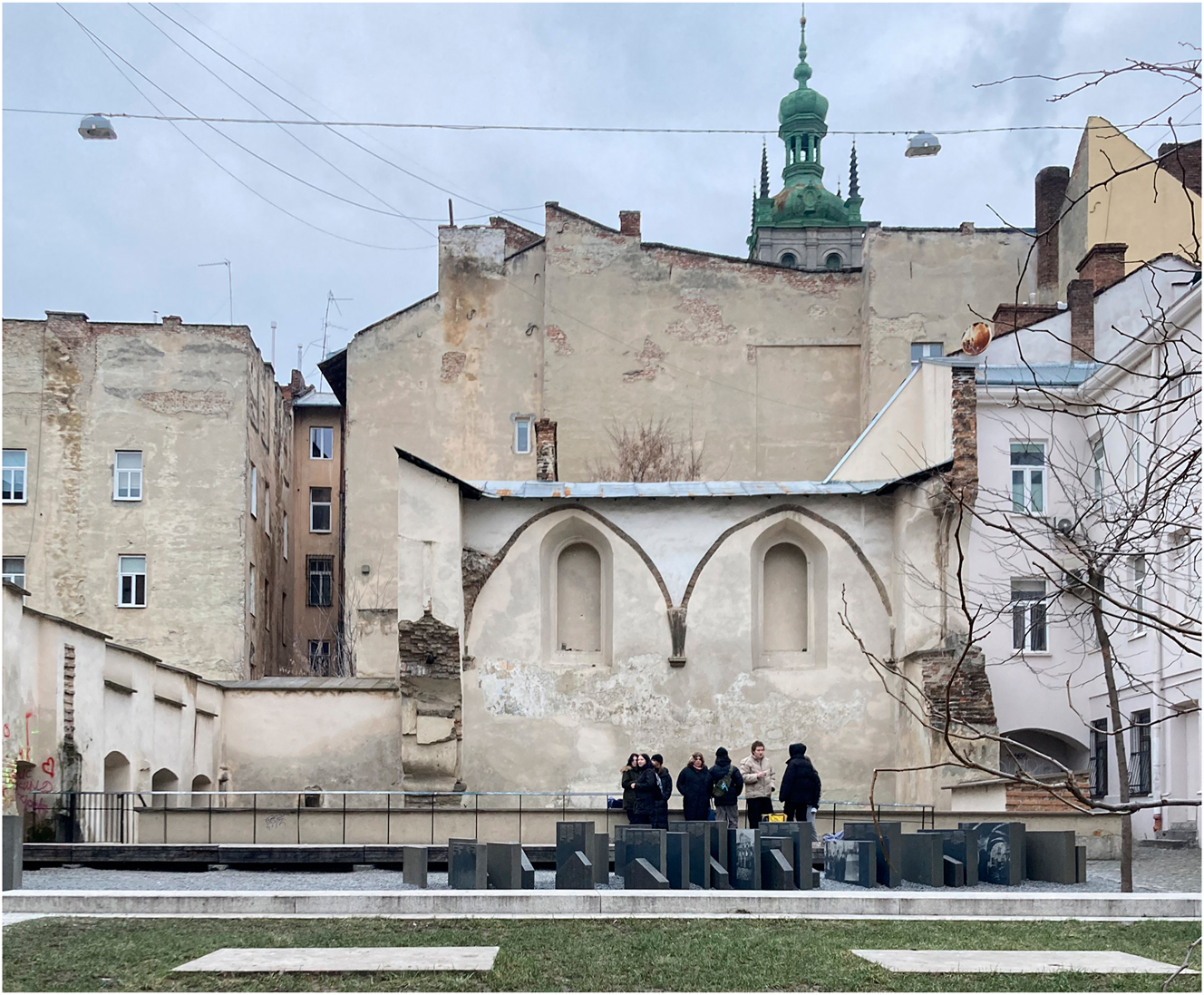
Memorial site “Spaces of Synagogues.” Lviv. January 28, 2023. © Ekaterina Shapiro-Obermair.
The memorial site was inaugurated on September 4, 2016. More than 200 people participated in this ceremony, making it the biggest assembly discussed in this article. The event expressed a new direction in the public’s processing of the Shoah. In addition to speeches by organizers and political representatives, there was more focus on the victims and the witnesses who survived the Shoah in the city. Leszek Allerhand and Aharon Weiss attended the event in person. Janina Hescheles and Krystyna Chriger were unable to join the assembly and had their letters read out instead. After the speeches, the rabbi led prayers, then a white cloth was removed to reveal the sculptural element of the complex and the participants laid down stones on it. In contrast to the commemorations on January 27, wreaths of flowers were absent.
This act of laying stones to honor the deceased as a religious rite was included due to the site’s former sacred function. In the given situation, it was not indispensable, since it was performed during a secular event and not at a cemetery or a place of burial. Obviously, through its integration the victims’ Jewish identity was stressed, just as the Soviet-era silence about the Shoah ended. It did, however, reduce the identity of those who perished solely to their dedication to Judaism and indirectly implied that only Orthodox Jews were the victims of mass extermination by the Nazis. Furthermore, through the overemphasis on religious identity, Jews were presented via their otherness to Ukraine. On the visual level, this distinction between the two groups was emphasized by the appearance of the city’s mayor, Andriy Sadovyi, who wore a traditional embroidered shirt vyshyvanka. This garment is customary in the region, but it is not mandatory. Indeed, Sadovyi wears it frequently but does not have it on at every public event. Yet, his clothing did not only point out the differences between the two groups, it also expressed Ukrainian solidarity with Jewish loss.
When the site was inaugurated, all the invited witnesses to the historical events no longer lived in Lviv. But it was not only their addresses that marked them as foreigners. Only Aharon Weiss spoke Ukrainian to the audience. Hescheles, Chriger, and Allerhand used Polish to describe the events in their testimonies and their appeals were translated. Expressed through language, their Polish identity revealed that the city, as well as most of the Jews who were killed here during the Shoah, were not Ukrainian, Russian, or Soviet but Polish. Their presence also made clear that the contemporary Jewish community differed a lot from its pre-war incarnation and created a kind of juxtaposition.
Even though the project originated in collaboration with the local Jewish organizations, only two of their members participated in the event. Ada Dianova, the director of “Hesed-Arieh,” moderated the ceremony and Boris Dorfman, one of the founders of the Sholem Aleichem Society, was the eighteenth and final speaker. Being the last speaker distinguished Dorfman from the other representatives of his generation; he was perceived as being a less significant witness, or not even a witness at all, and merely a leading member of the oldest local Jewish organization. He was the only person to address the crowd in Yiddish as, according to him, this was the language of those who lived here before. He read two poems: the first poem was “Testament” [Zapovit], by Taras Shevchenko, translated into Yiddish – a piece emblematic of Ukrainian culture and primarily national in its content; the second was written by Aleksandr Lizen, a co-founder of the Sholem Aleichem Society, which Dorfman read in Yiddish and in Russian. Through these two poems, Dorfman expressed two contradictory messages. He insisted that Jews are not just a religious minority, but an integral part of Ukrainian society, while the use of the Russian language indicated how the local Jewish community belonged to the Russian culture.
6 The Difficult Past, Spoken and Unspoken
Following the outbreak of the Russo-Ukrainian war, two perceptions of twentieth-century Ukrainian history could be observed in various parts of the country. On the one hand, many share the idea that the current war is a continuation of World War II (Hellbeck et al. 2017, 65–6). On the other, the Nazi and Soviet regimes are often considered as equal in their nature (Kasianov 2023, 11). As Ukrainians are currently at war for their independence against Russia, these concepts often merge. Both notions were expressed to the audience during the gatherings described in this article. The Ukrainian involvement in the mass killings of Jews, however, remained unacknowledged.
The equality and joint culpability of both totalitarian regimes were emphasized during all the events discussed here and were expressed by very different actors, Jewish as well as non-Jewish. Here, I will quote only two examples. At the opening ceremony of “Space of Synagogues,” Oleh Vyshnyakov, the consul for the state of Israel in Lviv, drew a parallel between the Nazi policy of annihilation and the suppression of Soviet Jews in the post-war period:
Unfortunately, during the Soviet era many people have forgotten their history. But they are returning to it. […] Unfortunately, the history of the Jewish people has many sad and tragic aspects. This is the Holocaust, the ghettos, the concentration camps; these are the torments under the Soviet rule.
In his comparison of both powers, journalist Marko Simkin relied less on fact and blended inaccurate historical representations with flowery metaphors and Jewish stereotypes. During the assembly at the memorial for the victims of the ghetto on January 27, 2017, he stated:
800 years ago, following the invitation of King Danylo, Jewish people came to Galicia. They came from Hungary and Germany. They developed the economy, taught people here, treated them as doctors. This community existed for hundreds of years and reached its peak in the 19th century. Who could have imagined that on the ruins of the Austro-Hungarian Empire and the Russian Empire, two such monsters would arise – one under the bloody flag, under Satan’s pentagram, and the other under the swastika – and unleash together the Holocaust against the Jews. The Holocaust against the Jews began with the Holocaust against the Ukrainians and the Russians in Soviet territories as the Soviets took power. Jewish intelligence was annihilated, Jewish scientists were annihilated. And Hitler was just a student of these crazy ideas.
According to Simkin, the Soviet regime was an even greater evil and was just as – if not more – involved in the implementation of the Shoah. This perspective is characteristic of the nationalistic, Ukrainian-centric historical master narrative and its inclusion in the commemorations of victims of the Shoah is particularly striking. On the one hand, it shows the Jewish community’s desire to position itself as part of Ukrainian society; on the other, it demonstrates the influence this dominant national discourse has on the perception of the Shoah.
However, bearing the idea of unity between the current war and World War II, the commemorations of the Shoah were used by those assembled not only to confirm the equality, but also to refute it. In this case, the focus lies on the role of Ukrainians whom Russian media presents solely as nationalists in the past as well as in the present. The mere fact that memorial ceremonies honoring Jewish victims could take place in Lviv’s public spaces should serve as proof that “fascists” did not prevail in Ukraine. Speakers who did not belong to the Jewish community emphasized their solidarity with the Jewish people and in doing so, countered the Russian propaganda. During all the commemorations discussed in this article, it was stated by several orators that some Ukrainians saved Jews during World War II. Andrei Sheptytskyi was mentioned repeatedly, as shown in the quotation at the beginning of the article, while Ukrainians’ involvement in the Shoah was not addressed in a single speech.
It is useful to take a closer look at how the Holocaust was used – before and after the full-scale invasion – as a reference point to describe current events and to see that an essential shift occurred post-2022. In 2017, reference to the Holocaust was rare and I could trace it only once during the event on January 27. It was made by the head of the Jewish religious orthodox community “Turei Zahav,” Meilakh Sheikhet, a controversial figure in the Jewish community, during the gathering at the monument to victims of the ghetto. He compared the year 1939 and the current urban policy of Lviv and summarized his speech with the phrase “Today, the Holocaust goes on in Lviv.” This statement was promptly contradicted by subsequent speakers. An immediate reaction came from Myroslav Marynonych, a human rights activist and former Soviet dissident, who spoke right after Meilakh. Marynonych stated:
It is difficult for me to speak. I am irritated by the phrase we just heard, that the Holocaust continues in Lviv. I believe this is a different interpretation of the Holocaust. […] I cannot accept this statement. I protest against it internally.
Later, at the memorial stone, Siva Fainerman, the rabbi from the progressive community also opposed Sheikhet:
What does he who said these [words] know about fascism? What has he seen, being born after the war? What does he know about the Holocaust, he who has never heard of it? And does he know with what joy the mass media there, in the East, among our neighbours, will pick up on this presentation. On behalf of my community, I disavow these words!
Fainerman wanted to prevent this provocative equation of the past, when Ukrainians actively collaborated with the National Socialists, with the present from being assumed as a shared belief within the Jewish community.
By contrast, in 2023, the idea of equating the Shoah with the Russo-Ukrainian war was not just present, it dominated the commemorations on January 27. However, this comparison emphasized different aspects. For example, Yury Storozhenskyi, who spoke again, said:
And I would also like to touch on another topic and compare today’s war to the genocide of the Jewish people. Jews were herded into a pile by armed men into a pit. […] And they shot at them with machine guns. This was genocide. It was the destruction of people. What our “brothers” Russians are doing now is driving tanks and long-range artillery to some village and shooting at the settlement. They destroy houses, kill people. That is the same genocide.
In his statement, Storozhenskyi not only equated contemporary Russians with Germans of the wartime period but also linked present-day Ukrainians to Jews of the past. This idea borders on the relativization of the Holocaust. Expressed first in the Jewish community, it might change the perception of the current war in the future.
7 Concluding Remarks
In North American and Western European discourses, the interpretation of World War II is inextricably linked to the Holocaust, which has become a negative foundation myth of Europe. Therefore, Ukraine’s desired integration into the European Union implies the inclusion of the Holocaust in the country’s national narrative, a process which began way before the full-scale Russian invasion. One of the main difficulties on this path lies in reconciling remembering the victims of the Shoah with the positive image of the glorified “liberation struggle.” Even more complicated when coming to terms with the past is the marginalization of the Shoah as a narrative belonging to one specific group and not as part of a national history.
Forms of public remembrance have been ongoing since the late 1990s, in contrast to the suppression of the Shoah during the Soviet period. For members of the Jewish community in Lviv, who are still predominantly lacking religious identification, participating in commemorative events became one of the most significant rituals in building identity and replaced religious rites as an affirmative performative action. At the same time, other commemorative actors have become active in this field: first, the Center for Urban History of East Central Europe and then the “Territory of Terror” Museum. In collaboration with the city municipality, these institutions are dedicated to the research and popularization of Jewish history in the region. By aiming to close the gap left after the period of silence that surrounded the Shoah in the Soviet era, their actions are oriented toward the international memorial canon. Although these efforts are undoubtedly outstanding, there is a risk that the local Jewish community could be marginalized or even excluded from the public memory work. Due to not being religious or conscious of their ancestors’ history, these people are perceived as not authentic enough to be legitimate bearers of memory. While potentially neglecting the complex Soviet Jewish identity that has been shaped by numerous historical ruptures, “the Jew” becomes a phantom and the perpetual “Other.” Squeezed between Soviet and Western memorial cultures, the public memory of the Shoah shows itself as open to the national or even nationalistic narrative, thus creating hybrid forms of Jewish-Ukrainian identity. The diversity of the actors involved and the efforts made to commemorate the past reveal that the act of remembering the Shoah is highly contested.
Funding source: Austrian Academy of Sciences (OeAW)
Award Identifier / Grant number: Post-DocTrack Programme of the OeAW
About the author
Dr. Phil.
Ekaterina Shapiro-Obermair (1980, Moscow) is a visual artist, curator, and researcher. Her research interests lie within the (post-)Soviet space, with a focus on visual and memory cultures. Her publications include: Geschichte performen: Öffentliches Gedenken an den Zweiten Weltkrieg im Zeichen des russisch-ukrainischen Krieges; History and Other Objects (editor), and Soviet Modernism, 1955–1991: Unknown History, edited with Katharina Ritter, Dietmar Steiner and Alexandra Wachter.
-
Research funding: This work was supported by the Austrian Academy of Sciences (OeAW) and Post-DocTrack Programme of the OeAW.
References
Amar, Tarik Cyril. 2005. “Yom Kippur in Lviv. The Lviv Synagogue and the Soviet Party-State, 1944–1962.” East European Jewish Affairs 35 (1): 91–110. https://doi.org/10.1080/13501670500191835.Suche in Google Scholar
Amar, Tarik Cyril. 2014. “A Disturbed Silence: Discourse on the Holocaust in the Soviet West as an Anti-Site of Memory.” In The Holocaust in the East: Local Perpetrators and Soviet Responses, edited by Michael David-Fox, Peter Holquist, and Alexander M. Martin. University of Pittsburgh Press.Suche in Google Scholar
Amar, Tarik Cyril. 2015. The Paradox of Ukrainian Lviv: A Borderland City between Stalinists, Nazis, and Nationalists. Cornell University Press.10.7591/cornell/9780801453915.001.0001Suche in Google Scholar
Assmann, Jan. 2018. [1992]. Das kulturelle Gedächtnis: Schrift, Erinnerung und politische Identität in frühen Hochkulturen, edited by H. C. Beck.Suche in Google Scholar
Burawoy, Michael. 1998. “The Extended Case Method.” Sociological Theory 16 (1): 4–33. https://doi.org/10.1111/0735-2751.00040.Suche in Google Scholar
Burke, Peter. 2010. “Co-Memorations: Performing the Past.” In Performing the Past: Memory, History, and Identity in Modern Europe, edited by Katalin Tilmans, Frank van Vree, and Jay Winter. Amsterdam University Press.Suche in Google Scholar
Clark, Katharina. 1981. Soviet Novel: History as Ritual. Chicago University Press.Suche in Google Scholar
Commemorations of the International Holocaust Remembrance Day. 2017. Filmed by the author. Lviv.Suche in Google Scholar
Commemorations of the International Holocaust Remembrance Day. 2023. Filmed by the author. Lviv.Suche in Google Scholar
David-Fox Michael, Peter Holquist, and Alexander M. Martin. eds. 2014. The Holocaust in the East: Local Perpetrators and Soviet Responses. University of Pittsburgh Press.Suche in Google Scholar
Dianova, Ada. 2016. “Interview with the author, in collaboration with Alexandra Wacher.Suche in Google Scholar
Epstein, Alek, and Vladimir Khanin. 2013. “The Holocaust & Memory: Non-self-evident Memory: Post-Soviet Jewry and the Holocaust.” Judaica Ukrainica 2: 142–51.Suche in Google Scholar
Fadeeva, Olha. 2016. “Interview with the author, in collaboration with Alexandra Wacher.Suche in Google Scholar
Gitelman, Zvi. 1993. “Die Sowjetische Holocaust-Politik.” In Mahnmale des Holocaust: Motive, Rituale und Stätte des Gedenkens, edited by James E. Young Prestel.Suche in Google Scholar
Hellbeck, Jochen, Tetiana Pastushenko, and Dmytro Tytarenko. 2017. “‘Wir werden siegen, wie schon vor 70 Jahren unsere Großväter gesiegt haben.’ Weltkriegsgedenken in der Ukraine im Schatten des neuerlichen Kriegs.” In Kriegsgedenken als Event. Der 9. Mai 2015 im postsozialistischen Europa, edited by Mischa Gabowitsch, Cordula Gdaniec, and Ekaterina Makhotina. Verlag Ferdinand Schöningh.Suche in Google Scholar
Himka, John-Paul. 2011. “The Lviv Pogrom of 1941: The Germans, Ukrainian Nationalists, and the Carnival Crowd.” Canadian Slavonic Papers/Revue canadienne des slavistes 53 (2–4): 209–43. https://doi.org/10.1080/00085006.2011.11092673.Suche in Google Scholar
Himka, John-Paul. 2013. “The Reception of the Holocaust in the Postcommunist Ukraine.” In Bringing the Dark Past to Light: The Reception of the Holocaust in Postcommunist Europe, edited by John- Paul Himka, and Joanna Beata Michlic. University of Nebraska Press.10.2307/j.ctt1ddr8vfSuche in Google Scholar
Himka, John-Paul. 2021. Ukrainian Nationalists and the Holocaust: OUN and UPA’s Participation in the Destruction of Ukrainian Jewry, 1941–1944. ibidem-Verlag.Suche in Google Scholar
Kasianov, Georgiy. 2023. “In Search of Lost Time? Decommunization in Ukraine, 2014–2020.” Problems of Post-Communism 71 (4): 326–40. https://doi.org/10.1080/10758216.2023.2198135.Suche in Google Scholar
Korniichuk, Viktor. 2017.“U Lvovi Pomyanuly Zhertv Holokostu.” In ZAHID.NET, Interview by Oksana Laboiko, January 27. Video, 1:05. https://zaxid.net/u_lvovi_pomyanuli_zhertv_golokostu_n1416240.Suche in Google Scholar
Lviv4you. 2016a. “Prostir Synahoh, Chastyna 1, Lviv, 4 Veresnia 2016.” In YouTube, September 5. Video, 1:04:46. https://www.youtube.com/watch?v=MMHvE00cBus&t=12s.Suche in Google Scholar
Lviv4you. 2016b. “Prostir Synahoh, Chastyna 2, Lviv, 4 Veresnia 2016.” In YouTube, September 5. Video, 57:50. https://www.youtube.com/watch?v=zt7O_Ecccbs&t=2037s.Suche in Google Scholar
Mick, Christoph. 2010. Kriegserfahrungen in einer multiethnischen Stadt: Lemberg 1914–1947. Wiesbaden: Harrassowitz.Suche in Google Scholar
Mick, Christoph. 2011. “Incompatible Experiences: Poles, Ukrainians, and Jews in Lviv under Soviet and German Occupation, 1939–1944.” Journal for Contemporary History 46 (2): 336–63. https://doi.org/10.1177/0022009410392409.Suche in Google Scholar
Mick, Christoph. 2015. Lemberg, Lwow, L’viv, 1914–1947: Violence and Ethnicity in a Contested City. Purdue University Press.10.2307/j.ctv15wxrkrSuche in Google Scholar
Olick, Jeffrey K. 2005. In the House of the Hangman: The Agonies of German Defeat, 1943–1949. University of Chicago.Suche in Google Scholar
Pleskov, Mykhailo. 2019. Interview with the author.Suche in Google Scholar
Pohl, Dieter. 1996. Nationalsozialistische Judenverfolgung in Ostgalizien 1941–1944: Organisation und Durchführung eines staatlichen Massenverbrechens. Oldenbourg: Institut für Zeitgeschichte.10.1524/9783486706505Suche in Google Scholar
Pohl, Dieter. 2002. “Ukrainische Hilfskräfte Beim Mord an Den Juden.” In Die Täter der Shoah: Fanatische Nationalsozialisten oder ganz normale Deutsche? edited by Paul Gerhard. Wallstein Verlag.Suche in Google Scholar
Prymachenko, Yana. 2017. “The Ukrainian Historical Policy and the Holocaust: The Problem of Perception.” In The Holocaust in the Eastern and Western European States Occupied by Nazis: Studies and Memory, edited and translated by Teresė Ringailienė and Jurgita Vaičenonienė, 206–16. IX forto muziejus.Suche in Google Scholar
Radchenko, Yuri. 2023. “How Does Jewish Identity Relate to Modern-Day Ukrainian Identity?” Eastern European Holocaust Studies 1 (1): 1–6. https://doi.org/10.1515/eehs-2023-0010.Suche in Google Scholar
Shtatsman, Iosif. 2016. Interview with the author, in collaboration with Alexandra Wacher.Suche in Google Scholar
Struve, Kai. 2015. Deutsche Herrschaft, ukrainischer Nationalismus, antijudische Gewalt: Der Sommer 1941 in der Westukraine. De Gruyter Oldenbourg.10.1515/9783110360226Suche in Google Scholar
Supreme Council of Ukraine. 2011. “About the 70th Anniversary of the Babyny Yar Tragedy.” Report 43, Article 455. May 5. https://zakon.rada.gov.ua/laws/show/3560-17 (accessed October 16, 2023).Suche in Google Scholar
United Nations. n.d. “Gedenken an Den Holocaust.” In Resolutions Adopted Without Reference to a Main Committee 60/7. https://www.un.org/depts/german/gv-60/band1/ar60008.pdf (accessed October 16, 2023).Suche in Google Scholar
Voronina, Tatiana. 2018. Remembering our way: Socialist-realist historicism and the Siege of Leningrad. Moscow: Novoe Literaturnoe Obozrenie.Suche in Google Scholar
© 2024 the author(s), published by De Gruyter on behalf of the Babyn Yar Holocaust Memorial Center
This work is licensed under the Creative Commons Attribution 4.0 International License.
